
Current Status of Marine-Derived Compounds as Warheads in Anti-Tumor Drug Candidates
Abstract
1. Introduction
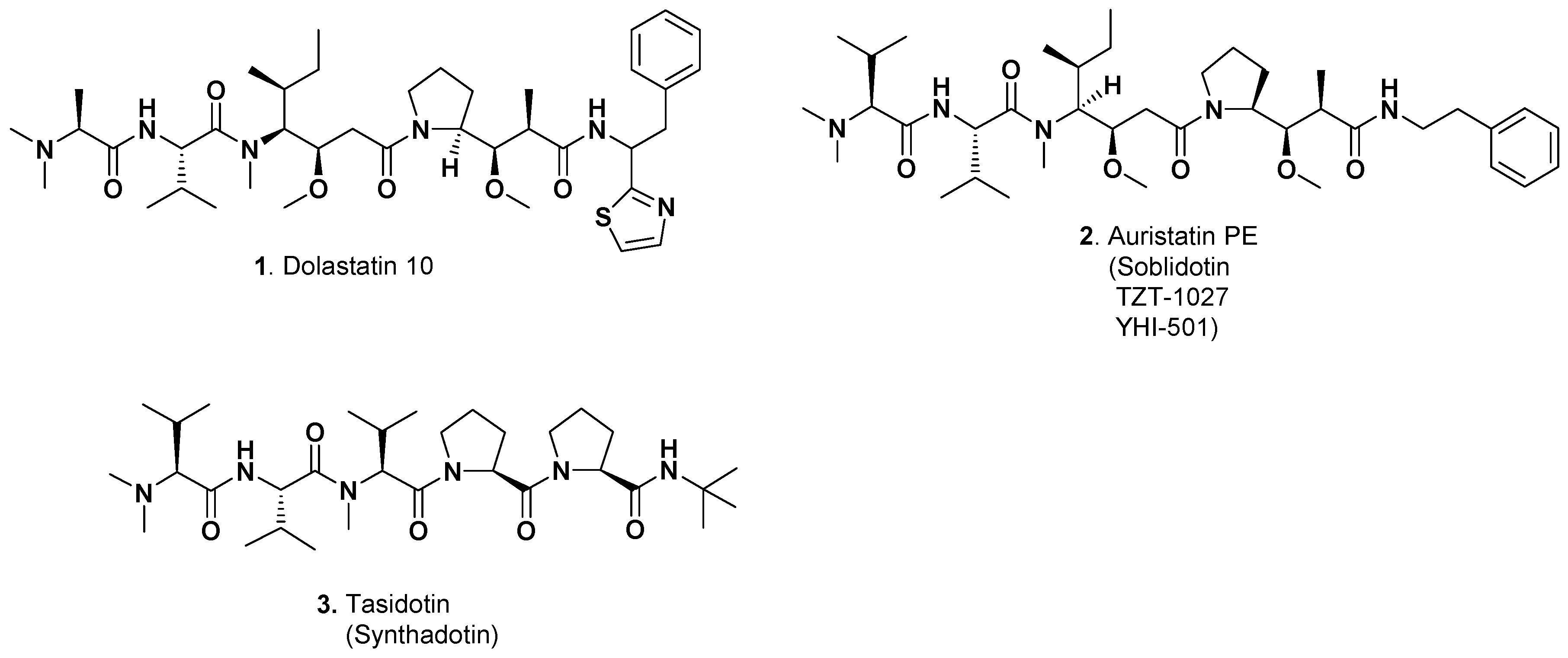
2. Dolastatin 10 and Related Structures
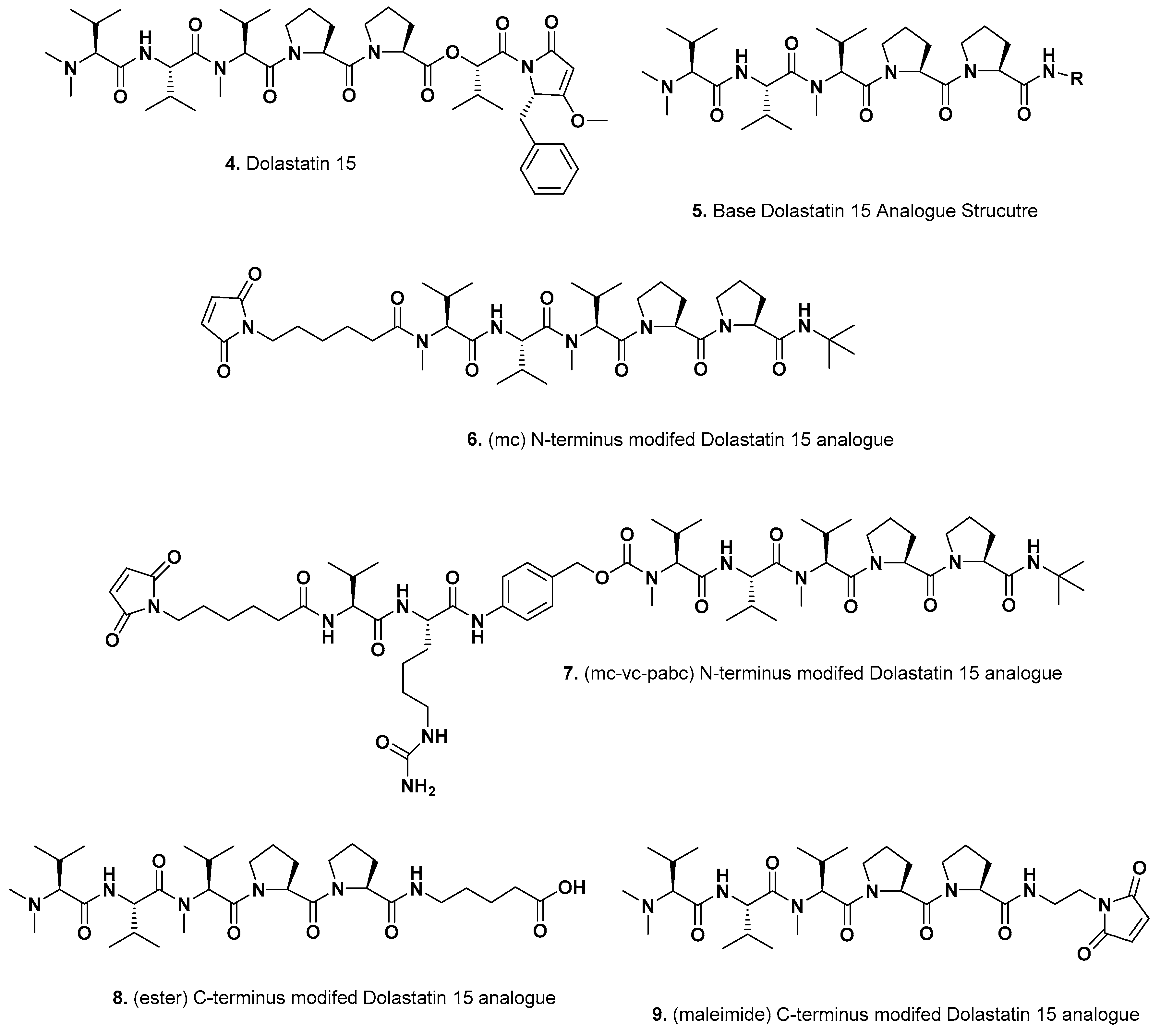
3. Dolastatin 15 and Variants as Warheads
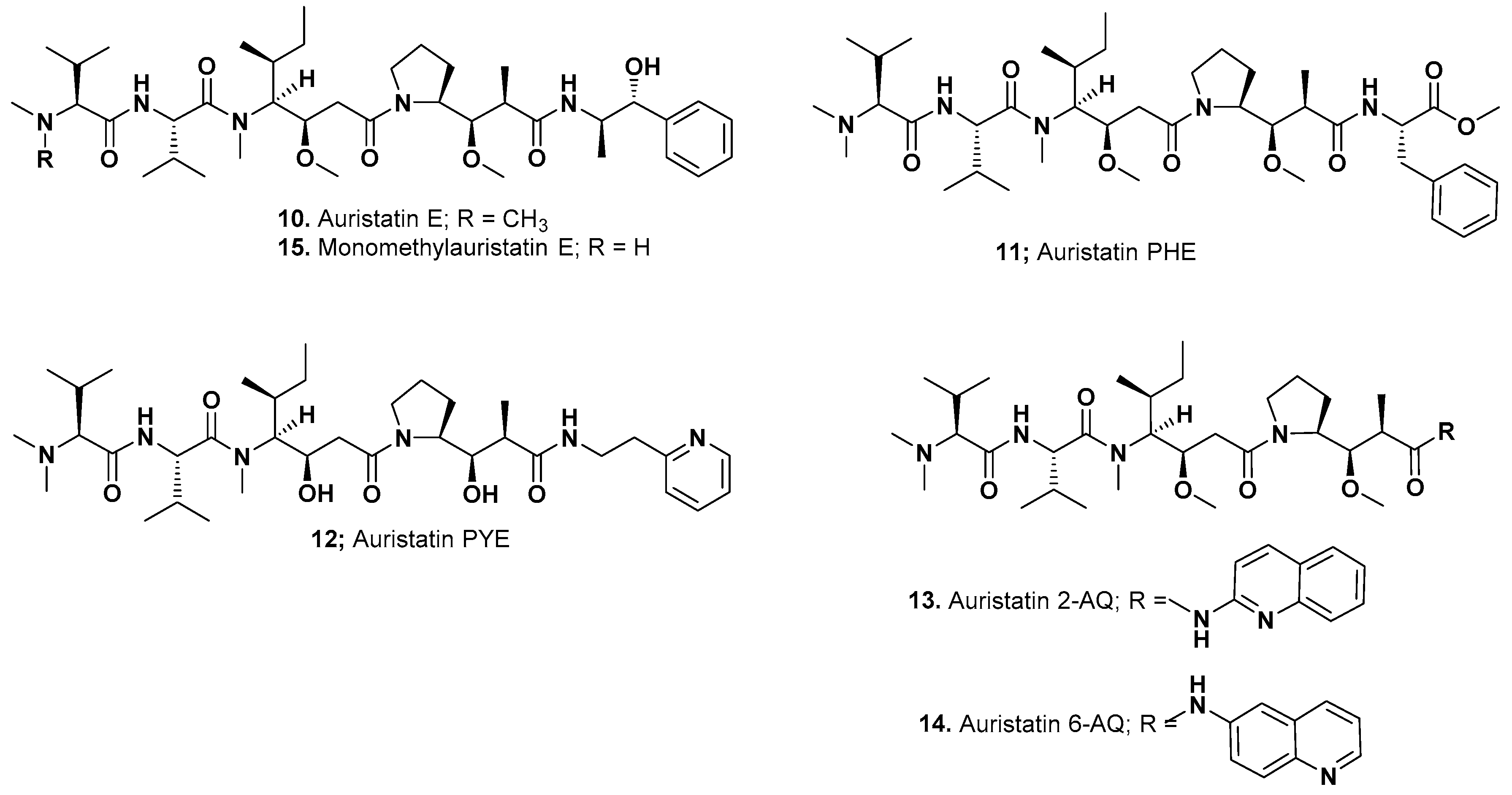
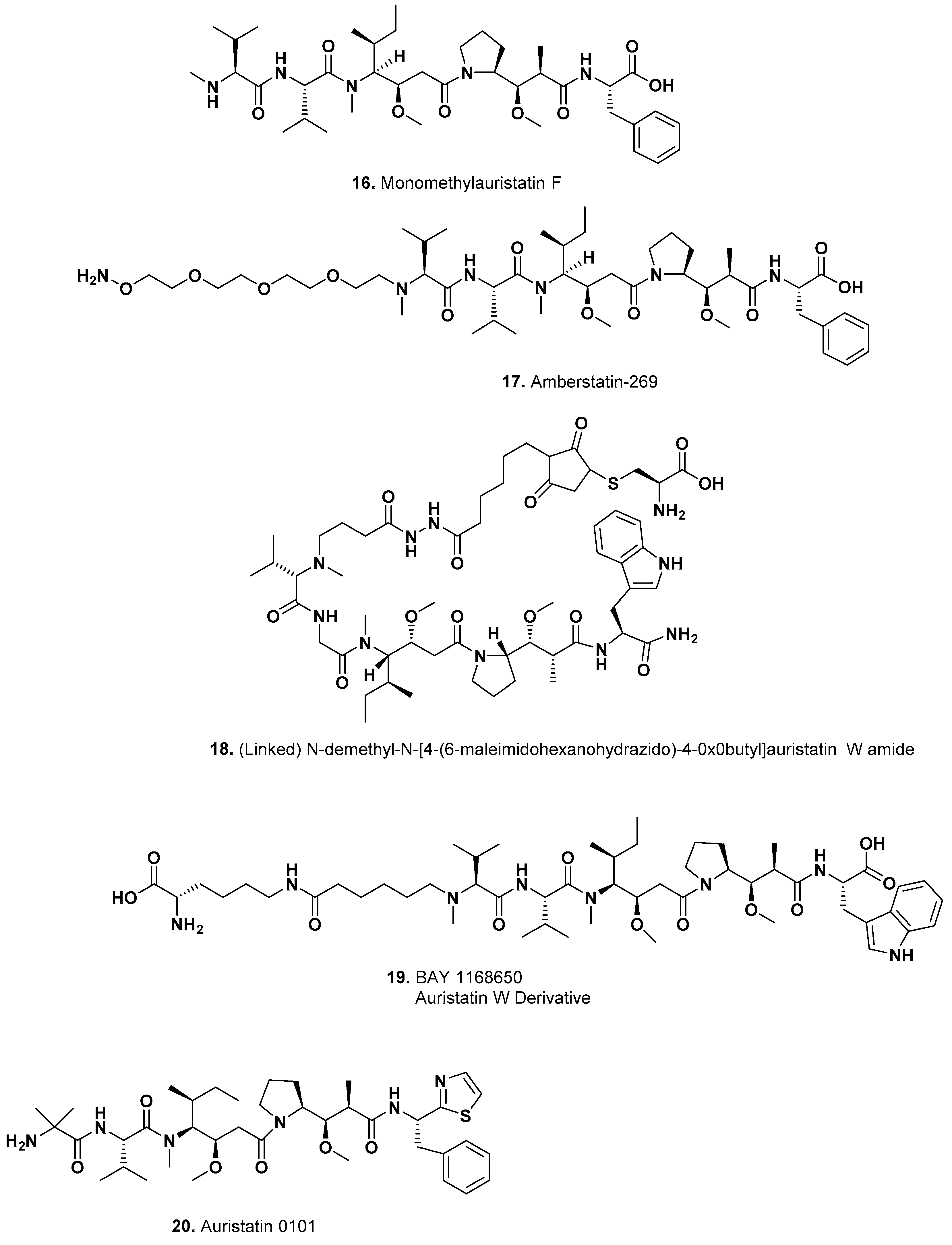
4. Auristatins
4.1. Background
4.2. Antibody Drug Conjugates (General Patent Status)
4.3. Approved Monomethylauristatin-Linked ADCs (MMAE-ADC)
- Phase III: seven (six being directed against various lymphomas with multiple drug regimens, and one being a comparative trial).
- Phase II: 53 (52 against various lymphomas with 15 only studying brentuximab vedotin, 35 having a variety of other drug treatments in addition to the ADC, and one where the ADC alone is being tested against mesothelioma).
- Phase I: 28 (27 against lymphomas and leukemias, with one against mycosis fungoides/Sezary Syndrome. One trial has brentuximab vedotin as the sole agent studying Graft versus Host Disease following allogenic stem cell transplantation).
4.4. Monomethylauristatin E-Linked ADCs in Clinical Trials
4.4.1. Glembatumumab Vedotin (Phase II)
- NCT02713828: Glembatumumab Vedotin in gpNMB-Expressing, Advanced or Metastatic SCC of the Lung (PrE0504), Phases I/II.
- NCT02487979: Glembatumumab Vedotin in Treating Patients with Recurrent or Refractory Osteosarcoma, Phase II (pharmacokinetics as well).
- NCT02363283: Glembatumumab Vedotin in Treating Patients with Metastatic or Locally Recurrent Uveal Melanoma, Phase II.
- NCT02302339: A Study of Glembatumumab Vedotin as Monotherapy or in Combination with Immunotherapies in Patients with Advanced Melanoma, Phase II.
- NCT01997333: Study of Glembatumumab Vedotin (CDX-011) in Patients with Metastatic, gpNMB Over-Expressing, Triple Negative Breast Cancer (METRIC), Phase II.
4.4.2. Pinatuzumab Vedotin (RG-7593) (Phases I/II)
- NCT01691898: A Study of Pinatuzumab Vedotin (DCDT2980S) Combined with Rituximab or Polatuzumab Vedotin (DCDS4501A) Combined with Rituximab or Obinutuzumab in Participants with Relapsed or Refractory B-Cell Non-Hodgkin’s Lymphoma (ROMULUS), Phases I/II.
4.4.3. Polatuzumab Vedotin (RG-7596) (Phases I/II)
- NCT01992653: A Study of Polatuzumab Vedotin in Combination with Rituximab or Obinutuzumab, Cyclophosphamide, Doxorubicin, and Prednisone in Participants with B-Cell Non-Hodgkin’s Lymphoma, Phases I/II.
- NCT01691898: A Study of Pinatuzumab Vedotin (DCDT2980S) Combined with Rituximab or Polatuzumab Vedotin (DCDS4501A) Combined with Rituximab or Obinutuzumab in Participants with Relapsed or Refractory B-Cell Non-Hodgkin’s Lymphoma (ROMULUS), Phases I/II. (Note that this trial also includes pinatuzumab vedotin).
- NCT02729896: A Study of Obinutuzumab, Polatuzumab Vedotin, and Atezolizumab in Relapsed or Refractory Follicular Lymphoma (FL) or Diffuse Large B-Cell Lymphoma (DLBCL), Phase I (under Hofmann-LaRoche).
- NCT02611323: A Study of Obinutuzumab, Polatuzumab Vedotin, and Venetoclax in Relapsed or Refractory Follicular Lymphoma (FL) or Diffuse Large B-Cell Lymphoma (DLBCL). Phase I (under Hofmann-LaRoche).
- NCT02600897: A Study of Obinutuzumab, Polatuzumab Vedotin, and Lenalidomide in Relapsed or Refractory Follicular Lymphoma (FL) or Diffuse Large B-Cell Lymphoma (DLBCL). Phase I (under Hofmann-LaRoche).
- NCT02257567: A Study of Polatuzumab Vedotin (DCDS4501A) in Combination with Rituximab or Obinutuzumab Plus Bendamustine in Participants with Relapsed or Refractory Follicular or Diffuse Large B-Cell Lymphoma. Phase I/II (under Hofmann-LaRoche).
4.4.4. Lifastuzumab Vedotin (RG-7599; Also Known as DNIB-0600A) (Phases I/II)
- NCT01991210: A Study of DNIB0600A in Comparison with Pegylated Liposomal Doxorubicin (PLD) in Participants with Platinum-Resistant Ovarian Cancer (PROC). Phase II.
- NCT01995188: A Study to Evaluate the Safety and Pharmacology of DNIB0600A in Participants with Platinum-Sensitive Ovarian Cancer or Non-Squamous Non-Small Cell Lung Cancer. Phase I.
- NCT01363947: Safety and Pharmacokinetics of Escalating Doses of DNIB0600A in Patients with Non-Small Cell Lung Cancer and Platinum Resistant Ovarian Cancer. Phase I.
4.4.5. Tisotumab Vedotin (Phases I/II)
- NCT02552121: Tisotumab Vedotin (HuMax®-TF-ADC) Safety Study in Patients with Solid Tumors. This is a dose-escalating and cohort expansion study. Phase I/II.
- NCT02001623: Tisotumab Vedotin (HuMax®-TF-ADC) Safety Study in Patients with Solid Tumors. This is the first in human trial. Phase I/II.
4.4.6. PSMA-ADC (Phases I/II)
- NCT02020135: An Open-label Treatment Extension of PSMA ADC in Subjects with Metastatic Castration-resistant Prostate Cancer (mCRPC). Phase II: Study completed.
- NCT01856933: BrUOG 263: Prostate Specific Membrane Antigen (PSMA) Glioblastoma Multiforme (GBM). Phase II: Study completed.
- NCT01695044: A Study of PSMA ADC in Subjects with Metastatic Castration-resistant Prostate Cancer (mCRPC). Phase II: Study completed.
- NCT01414296: Prostate-specific Membrane Antigen Antibody-Drug Conjugate in Subjects with Prostate Cancer. Phase I: Study completed.
- NCT01414283: Prostate-specific Membrane Antigen Antibody-Drug Conjugate in Subjects with Prostate Cancer. Phase I: Study completed.
4.4.7. MLN-0264 (Industuzumab Vedotin) (Phases I/II)
- NCT02391038: MLN0264 in Previously Treated Asian Patients with Advanced Gastrointestinal Carcinoma or Metastatic or Recurrent Gastric or Gastroesophageal Junction Adenocarcinoma Expressing Guanylyl Cyclase C. Phase I/II: Completed.
- NCT02202785: A Study of MLN0264 in Patients with Pancreatic Cancer. Continuing but not recruiting. Phase II: Final date for data collection is May 2018.
- NCT02202759: A Study of MLN0264 in Patients with Cancer of the Stomach or Gastroesophageal Junction. Continuing but not recruiting. Phase II: Final date for data collection is September 2018.
- NCT01577758: Study of MLN0264 in Adult Patients with Advanced Gastrointestinal Malignancies Expressing Guanylyl Cyclase C. Phase I: The study was completed in February 2014.
4.4.8. DEDN-6256A (RG-7636) (Phase I)
- NCT01522664: A Study of DEDN6526A in Patients with Metastatic or Unresectable Melanoma. Phase I: The study is completed.
4.4.9. DMOT-4039A (Phase I)
- NCT01832116: 89Zr-MMOT PET Imaging in Pancreatic and Ovarian Cancer Patients (MMOT). Phase I: Completed with data published [33].
- NCT01469793: A Study of DMOT4039A in Participants with Unresectable Pancreatic or Platinum-Resistant Ovarian Cancer. Phase I: Completed with a paper covering the results published in 2016 [34].
4.4.10. Enfortumab Vedotin (Phase I)
- NCT02091999: A Study of Escalating Doses of ASG-22CE Given as Monotherapy in Subjects with Metastatic Urothelial Cancer and Other Malignant Solid Tumors That Express Nectin-4. Phase I.
- NCT01409135: A Study of the Safety and Pharmacokinetics of ASG-22M6E in Subjects with Malignant Solid Tumors That Express Nectin-4. Phase I.
4.4.11. Telisotuzumab Vedotin (Phase I)
- NCT02099058: A Phase I/Ib Study with ABBV-399, an Antibody Drug Conjugate, in Subjects with Advanced Solid Cancer Tumors. Phase I.
4.4.12. DLYE5953A (Phase I)
- NCT02092792: A Study Evaluating the Safety of Escalating Doses of DLYE5953A in Patients with Refractory Solid Tumors. Phase I: This trial is still continuing but not recruiting after November 2016.
4.4.13. SGN-LIV1A (Phase I)
- NCT01969643: A Safety Study of SGN-LIV1A in Breast Cancer Patients. Phase I.
4.4.14. ASG-15E/15ME (Phase I)
- NCT01963052: ASG-15ME is a Study of Escalating Doses of AGS15E Given as Monotherapy in Subjects with Metastatic Urothelial Cancer. Phase I.
4.4.15. AGS-67E (Phase I)
- NCT02610062: A Study to Evaluate Safety, Tolerability, and Pharmacokinetics of Escalating Doses of AGS67E Given as Monotherapy in Subjects with Acute Myeloid Leukemia (AML). Phase I: This trial is actively recruiting.
- NCT02175433: A Study to Evaluate Safety, Tolerability, and Pharmacokinetics of Escalating Doses of AGS67E Given as Monotherapy in Subjects with Refractory or Relapsed Lymphoid Malignancies. Phase I: This trial is actively recruiting.
4.4.16. ASG-5ME (Phase I)
- NCT01228760: A Study to Determine the Maximum Tolerated Dose of ASG-5ME in Subjects with Castration-Resistant Prostate Cancer. Phase I: Completed.
- NCT01166490: Dose Escalation Trial of ASG-5ME in Pancreatic or Gastric Adenocarcinoma. Phase I: Completed.
4.4.17. DMUC-5754A (Sofituzumab Vedotin) (Phase I)
- NCT01335958: Safety and Pharmacokinetics of DMUC5754A Administered Intravenously to Patients with Platinum-Resistant Ovarian Cancer or Unresectable Pancreatic Cancer. Phase I: Completed and details published [42].
4.4.18. RG7450 (Vandortuzumab Vedotin) (Phase I)
- NCT01283373: A Study of the Safety and Pharmacokinetics of Escalating Doses of DSTP3086S in Patients with Metastatic Castration-Resistant Prostate Cancer. Phase I: This trial was completed but no information on further work has been available since early 2016.
4.4.19. DFRF4539A (Phase I)
- NCT01432353: A Study of DFRF4539A in Patients with Relapsed or Refractory Multiple Myeloma. Phase I
4.5. Monomethylauristatin F-Linked ADCs in Clinical Trials
4.5.1. Denintuzumab Mafodotin (SGN-CD19A) (Phases I/II)
- NCT02855359: Denintuzumab Mafodotin (SGN-CD19A) Combined with RCHOP or RCHP versus RCHOP Alone in Diffuse Large B-Cell Lymphoma or Follicular Lymphoma. Phase II (recruiting).
- NCT02592876: Treatment Study of Denintuzumab Mafodotin (SGN-CD19A) Plus RICE Versus RICE Alone for Diffuse Large B-Cell Lymphoma. Phase II (recruiting).
- NCT01786135: A Safety Study of SGN-CD19A for B-Cell Lymphoma. Phase I: Study ongoing but not recruiting.
- NCT01786096: A Safety Study of SGN-CD19A for Leukemia and Lymphoma. Phase I: Study ongoing but not recruiting.
4.5.2. AGS-16C3F (Phases I/II)
- NCT02639182: A Study of AGS-16C3F vs. Axitinib in Metastatic Renal Cell Carcinoma. Phase II: Actively recruiting patients.
- NCT01672755: A Study of AGS-16C3F vs. Axitinib in Metastatic Renal Cell Carcinoma Phase I: Ongoing but no further recruitment.
4.5.3. Depatuxizumab Mafodotin (Phases I/II)
- NCT2573324: A Study of ABT-414 in Subjects with Newly Diagnosed Glioblastoma (GBM) with Epidermal Growth Factor Receptor (EGFR) Amplification (Intellance 1). Phase II: Study currently recruiting.
- NCI02343406: Adult Study: ABT-414 Alone or ABT-414 Plus Temozolomide vs. Lomustine or Temozolomide for Recurrent Glioblastoma Pediatric Study: Evaluation of ABT-414 in Children with High Grade Gliomas (INTELLANCE 2). Phase II: Currently recruiting patients.
- NCT02590263: Study Evaluating ABT-414 in Japanese Subjects with Malignant Glioma. Phase I: Currently recruiting.
- NCT01800695: Evaluating the Safety and Pharmacokinetics of ABT-414 for Subjects with Glioblastoma Multiforme. Phase I: Ongoing but not recruiting.
- NCT01741727: A Study of ABT-414 in Subjects with Solid Tumors. Phase I/II: Study completed.
4.5.4. PF-06263507 (Phase I)
- NCT01891669: A Study of PF-06263507 in Patients with Advanced Solid Tumors Phase I.
4.5.5. GSK-2857916 (Phase I)
- NCT02064387: Dose Escalation Study to Investigate the Safety, Pharmacokinetics, Pharmacodynamics, Immunogenicity and Clinical Activity of GSK2857916. Phase I.
4.5.6. MEDI-547 (1C1-mcMMAF)
- NCT00796055: Study of MEDI-547 to Evaluate the Safety, Tolerability, and Biologic Activity of IV Administration in Subjects with Relapsed or Refractory Solid Tumors (MEDI-54). Phase I: Discontinued (see above).
4.5.7. XMT-1522 (Phase I)
- NCT02952729: Study of Antibody Drug Conjugate in Patients with Advanced Breast Cancer Expressing HER2. Phase I: This trial is currently recruiting patients.
4.6. Clinical Trials with Auristatin Derivatives Other Than MMAE or MMAF
4.6.1. Amberstatin 269
ARX-788 (Phase I)
- NCT02512237: A Dose-escalation Study of ARX788, IV Administered in Subjects with Advanced Cancers with HER2 Expression. Phase I: This trial is currently recruiting patients.
4.6.2. Auristatin W
BAY-1129980 (Lupatumab Amadotin)
- NCT02134197: Dose-escalation Study of BAY1129980 Phase I: Currently recruiting patients.
BAY-1187982 (Phase I)
- NCT02368951: Dose-escalation Trial of BAY1187982 in Subjects with Advanced Solid Tumors Known to Express Fibroblast Growth Factor Receptor 2 (FGFR2). Phase I: As of August 2016 the trial was terminated, with no details yet available
4.6.3. Auristatin-0101
PF06647020 (Phase I)
- NCT02222922: A Study of PF-06647020 for Adult Patients with Advanced Solid Tumors. Phase I: This trial is actively recruiting patients.
5. Preclinical Candidates
5.1. Preclinical Auristatin Derivatives
5.1.1. SGN-CD48A (Preclinical)
5.1.2. HTI-1511 (Preclinical)
5.1.3. mAbs 7-1C-mc-MMAF/mAbs 67-7A-mc-MMAF (Preclinical)
5.1.4. ASN-004 (Preclinical)
5.1.5. ZV-0201 (Preclinical)
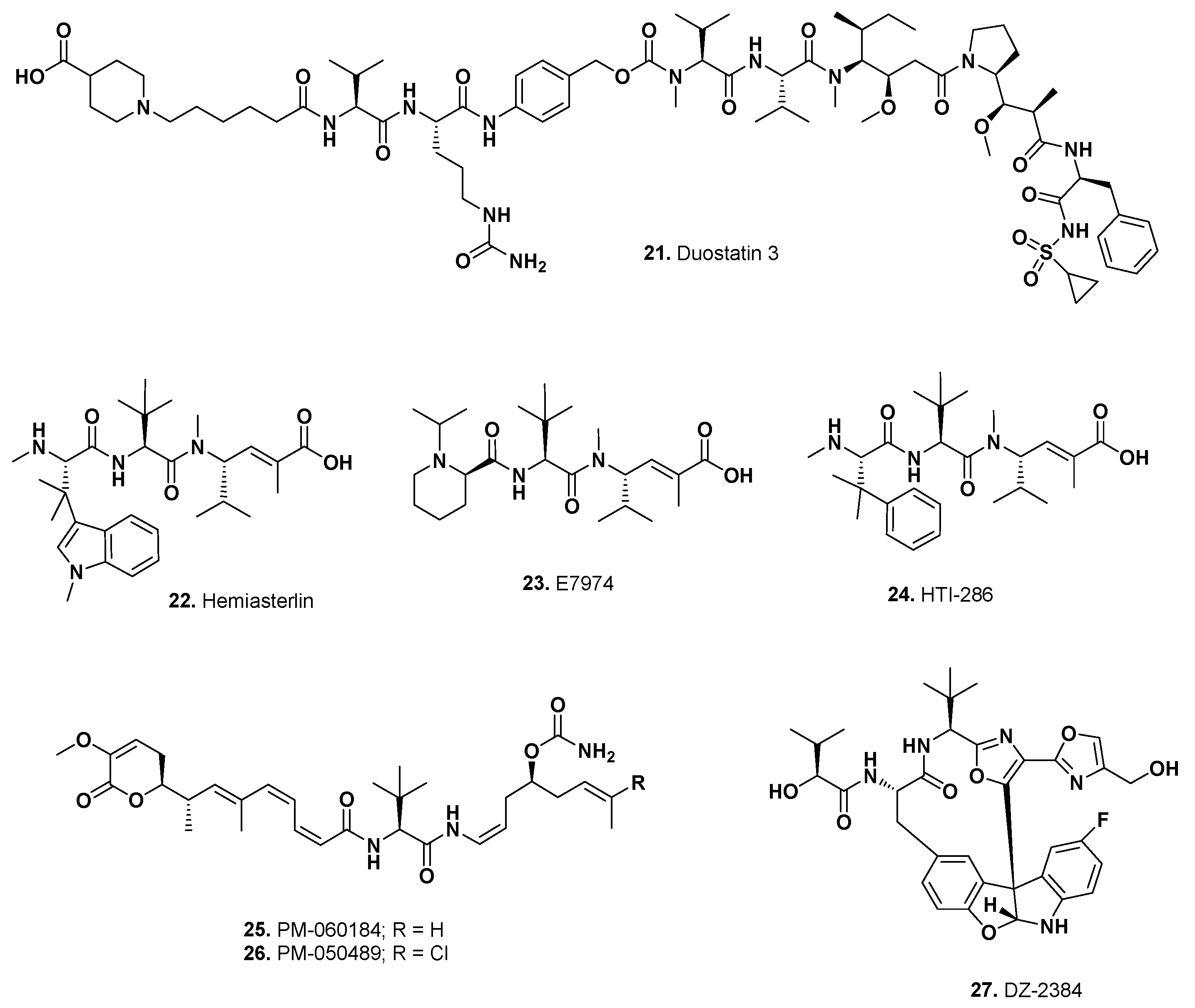
5.1.6. Duostatin 3 (Preclinical)
5.2. Preclinical Candidates Not Auristatin Based
5.2.1. NC-6201 (Preclinical)
5.2.2. MI130004 (Preclinical)
6. A Potential Warhead Compound
DZ-2384 (Preclinical)
7. Conclusions
Conflicts of Interest
References
- Newman, D.J.; Cragg, G.M. Marine-sourced anti-cancer and cancer pain control agents in clinical and late preclinical development. Mar. Drugs 2014, 12, 255–278. [Google Scholar] [PubMed]
- Newman, D.J.; Cragg, G.M. Drugs and drug candidates from marine sources: An assessment of the current “state of play”. Planta Med. 2016, 82, 775–789. [Google Scholar] [CrossRef] [Scilit] [PubMed]
- Pettit, G.R.; Kamano, Y.; Herald, C.L.; Tuinman, A.A.; Boettner, F.E.; Kizu, H.; Schmidt, J.M.; Baczynskyj, L.; Tomer, K.B.; Bontems, R.J. The isolation and structure of a remarkable marine animal antineoplastic constituent: Dolastatin 10. J. Am. Chem. Soc. 1987, 109, 6883–6885. [Google Scholar]
- Pettit, G.R. The dolastatins. In Fortschritte der Chemie Organischer Naturstoffe; Progress in the Chemistry of Organic Natural Products; Herz, W., Kirby, G.W., Moore, R.E., Steglich, W., Tamm, C., Eds.; Springer: Vienna, Austria, 1997; Volume 70, pp. 1–79. [Google Scholar]
- Flahive, E.; Srirangam, J. The dolastatins. In Anticancer Agents from Natural Products, 2nd ed.; Cragg, G.M., Kingston, D.G.I., Newman, D.J., Eds.; Taylor and Francis: Boca Raton, FL, USA, 2011; pp. 263–290. [Google Scholar]
- Pettit, G.R.; Srirangam, J.K.; Barkoczy, J.; Williams, M.D.; Durkin, K.P.; Boyd, M.R.; Bai, R.; Hamel, E.; Schmidt, J.M.; Chapuis, J.C. Antineoplastic agents 337. Synthesis of dolastatin 10 structural modifications. Anticancer Drug Des. 1995, 10, 529–544. [Google Scholar] [PubMed]
- Pettit, G.R.; Srirangam, J.K.; Barkoczy, J.; Williams, M.D.; Boyd, M.R.; Hamel, E.; Pettit, R.K.; Hogan, F.; Bai, R.; Chapuis, J.-C.; et al. Antineoplastic agents 365. Dolastatin 10 sar probes. AntiCancer Drug Des. 1998, 13, 243–277. [Google Scholar] [PubMed]
- Pettit, G.R.; Barkoczy, J.; Kantoci, D. Human Cancer Inhibitory Pentapeptide Amides. EP Patent 0611775 A2, 25 April 1995. [Google Scholar]
- Madden, T.; Tran, H.T.; Beck, D.; Huie, R.; Newman, R.A.; Pusztai, L.; Wright, J.J.; Abbruzzese, J.L. Novel marine-derived anticancer agents: A phase I clinical, pharmacological, and pharmacodynamic study of dolastatin 10 (NSC 376128) in patients with advanced solid tumors. Clin. Cancer Res. 2000, 6, 1293–1301. [Google Scholar] [PubMed]
- Vaishampayan, U.; Glode, M.; Du, W.; Kraft, A.; Hudes, G.; Wright, J.; Hussain, M. Phase II study of dolastatin-10 in patients with hormone-refractory metastatic prostate adenocarcinoma. Clin. Cancer Res. 2000, 6, 4205–4208. [Google Scholar] [PubMed]
- Perez, E.A.; Hillman, D.W.; Fishkin, P.A.; Krook, J.E.; Tan, W.W.; Kuriakose, P.A.; Alberts, S.R.; Dakhil, S.R. Phase II trial of dolastatin-10 in patients with advanced breast cancer. Investig. New Drugs 2005, 23, 257–261. [Google Scholar]
- Gianolio, D.A.; Rouleau, C.; Bauta, W.E.; Lovett, D.; Cantrell, W.R., Jr.; Recio, A., III; Wolstenholme-Hogg, P.; Busch, M.; Pan, P.; Stefano, J.E.; et al. Targeting her2-positive cancer with dolastatin 15 derivatives conjugated to trastuzumab, novel antibody-drug conjugates. Cancer Chemother. Pharmacol. 2012, 70, 439–449. [Google Scholar] [PubMed]
- Pettit, G.R.; Flahive, E.J.; Boyd, M.R.; Bai, R.; Hamel, E.; Pettit, R.K.; Schmidt, J.M. Antineoplastic agents 360. Synthesis and cancer cell growth inhibitory studies of dolastatin 15 structural modifications. Anticancer Drug Des. 1998, 13, 47–66. [Google Scholar] [PubMed]
- Pettit, G.R.; Hogan, F.; Toms, S. Antineoplastic agents. 592. Highly effective cancer cell growth inhibitory structural modifications of dolastatin 10. J. Nat. Prod. 2011, 74, 962–968. [Google Scholar] [CrossRef] [Scilit] [PubMed]
- Storz, U. Antibody-drug conjugates: Intellectual property considerations. mAbs 2015, 7, 989–1009. [Google Scholar] [CrossRef] [Scilit] [PubMed]
- Doronina, S.; Senter, P.D.; Toki, B.E. Pentapeptide Compounds and Uses Related Thereto. WO Patent 200288172, 7 November 2002. [Google Scholar]
- Doronina, S.O.; Toki, B.E.; Torgov, M.Y.; Mendelsohn, B.A.; Cerveny, C.G.; Chace, D.F.; DeBlanc, R.L.; Gearing, R.P.; Bovee, T.D.; Siegall, C.B.; et al. Development of potent monoclonal antibody auristatin conjugates for cancer therapy. Nat. Biotechnol. 2003, 21, 778–784. [Google Scholar] [CrossRef] [Scilit] [PubMed]
- Dorywalska, M.; Strop, P.; Melton-Witt, J.A.; Hasa-Moreno, A.; Farias, S.E.; Casas, M.G.; Delaria, K.; Lui, V.; Poulsen, K.; Sutton, J.; et al. Site-dependent degradation of a non-cleavable auristatin-based linker-payload in rodent plasma and its effect on adc efficacy. PLoS ONE 2015, 10, e0132282. [Google Scholar] [CrossRef] [Scilit] [PubMed]
- Dorywalska, M.; Strop, P.; Melton-Witt, J.A.; Hasa-Moreno, A.; Farias, S.E.; Casas, M.G.; Delaria, K.; Lui, V.; Poulsen, K.; Loo, C.; et al. Effect of attachment site on stability of cleavable antibody drug conjugates. Bioconj. Chem. 2015, 26, 650–659. [Google Scholar] [CrossRef] [Scilit] [PubMed]
- Strop, P.; Liu, S.-H.; Dorywalska, M.; Delaria, K.; Dushin, R.G.; Tran, T.-T.; Ho, W.-H.; Farias, S.; Casas, M.G.; Abdiche, Y.; et al. Location matters: Site of conjugation modulates stability and pharmacokinetics of antibody drug conjugates. Chem. Biol. 2013, 20, 161–167. [Google Scholar] [CrossRef] [Scilit] [PubMed]
- Senter, P.D.; Sievers, E.L. The discovery and development of brentuximab vedotin for use in relapsed hodgkin lymphoma and systemic anaplastic large cell lymphoma. Nat. Biotechnol. 2012, 30, 631–637. [Google Scholar] [CrossRef] [Scilit] [PubMed]
- Flerlage, J.E.; Metzger, M.L.; Wu, J.; Panetta, J.C. Pharmacokinetics, immunogenicity, and safety of weekly dosing of brentuximab vedotin in pediatric patients with Hodgkin lymphoma. Cancer Chemother. Pharmacol. 2016, 78, 1217–1223. [Google Scholar] [PubMed]
- Roth, M.; Barris, D.M.; Piperdi, S.; Kuo, V.; Everts, S.; Geller, D.; Houghton, P.; Kolb, E.A.; Hawthorne, T.; Gill, J.; et al. Targeting glycoprotein nmb with antibody-drug conjugate, glembatumumab vedotin, for the treatment of osteosarcoma. Pediatr. Blood Cancer 2016, 63, 32–38. [Google Scholar] [CrossRef] [Scilit] [PubMed]
- Breij, E.C.W.; Satijn, D.; Verploegen, S.; de Goeij, B.E.; Schuurhuis, D.H.; Bleeker, W.K.; Houtkamp, M.; Parren, P.W. Use of an antibody-drug conjugate targeting tissue factor to induce complete tumor regression in xenograft models with heterogeneous target expression. J. Clin. Oncol. 2013, 31, 3066. [Google Scholar]
- Breij, E.C.W.; de Goeij, B.E.C.G.; Verploegen, S.; Schuurhuis, D.H.; Amirkhosravi, A.; Francis, J.; Miller, V.B.; Houtkamp, M.; Bleeker, W.K.; Satijn, D.; et al. An antibody-drug conjugate that targets tissue factor exhibits potent therapeutic activity against a broad range of solid tumors. Cancer Res. 2014, 74, 1214–1226. [Google Scholar] [PubMed]
- Breij, E.C.W.; Verploegen, S.; Lingnau, A.; van den Brink, E.N.; Janmaat, M.; Houtkamp, M.; Bleeker, W.K.; Satijn, D.; Parren, P. Preclinical efficacy studies using Humax-AXL-ADC, a novel antibody-drug conjugate targeting AXL-expressing solid cancers. J. Clin. Oncol. 2015, 33. Abst. 3066. [Google Scholar]
- Wang, X.; Ma, D.; Olson, W.C.; Heston, W.D. In Vitro and In Vivo responses of advanced prostate tumors to PSMA ADC, an auristatin-conjugated antibody to prostate-specific membrane antigen. Mol. Cancer Ther. 2011, 10, 1728–1739. [Google Scholar] [CrossRef] [Scilit] [PubMed]
- Donaghy, H. Effects of antibody, drug and linker on the preclinical and clinical toxicities of antibody-drug conjugates. mAbs 2016, 8, 659–671. [Google Scholar] [CrossRef] [Scilit] [PubMed]
- Thomas, A.; Teicher, B.A.; Hassan, R. Antibody-drug conjugates for cancer therapy. Lancet Oncol. 2016, 17, e254–e262. [Google Scholar] [PubMed]
- Infante, J.R.; Sandhu, S.K.; McNeil, C.M.; Kabbarah, O.; Li, C.; Zhong, W.; Asundi, J.; Wood, K.; Chu, Y.; Hamid, O. A first-in-human phase I study of the safety and pharmacokinetic (PK) activity of DEDN6526A, an anti-endothelin b receptor (etbr) antibody-drug conjugate (adc), in patients with metastatic or unresectable melanoma. Cancer Res. 2014, 74. Abst. CT233. [Google Scholar] [CrossRef] [Scilit]
- Zhao, X.Y.; Subramanyam, B.; Sarapa, N.; Golfier, S.; Dinter, H. Novel antibody therapeutics targeting mesothelin in solid tumors. Clin. Cancer Drugs 2016, 3, 76–86. [Google Scholar] [CrossRef] [Scilit] [PubMed]
- Hassan, R.; Thomas, A.; Alewine, C.; Le, D.T.; Jaffee, E.M.; Pastan, I. Mesothelin immunotherapy for cancer: Ready for prime time? J. Clin. Oncol. 2016, 34, 4171–4179. [Google Scholar] [CrossRef] [Scilit] [PubMed]
- Lamberts, L.E.; Menke-van der Houven van Oordt, C.W.; ter Weele, E.J.; Bensch, F.; Smeenk, M.M.; Voortman, J.; Hoekstra, O.S.; Williams, S.P.; Fine, B.M.; Maslyar, D.; et al. Immunopet with anti-mesothelin antibody in patients with pancreatic and ovarian cancer before anti-mesothelin antibody-drug conjugate treatment. Clin. Cancer Res. 2016, 22, 1642–1652. [Google Scholar] [CrossRef] [Scilit] [PubMed]
- Weekes, C.D.; Lamberts, L.E.; Borad, M.J.; Voortman, J.; McWilliams, R.R.; Diamond, J.R.; de Vries, E.G.; Verheul, H.M.; Lieu, C.H.; Kim, G.P.; et al. Phase I study of DMOT4039A, an antibody-drug conjugate targeting mesothelin, in patients with unresectable pancreatic or platinum-resistant ovarian cancer. Mol. Cancer Ther. 2016, 15, 439–447. [Google Scholar] [PubMed]
- Challita-Eid, P.M.; Satpayev, D.; Yang, P.; An, Z.; Morrison, K.; Shostak, Y.; Raitano, A.; Nadell, R.; Liu, W.; Lortie, D.R.; et al. Enfortumab vedotin antibody-drug conjugate targeting nectin-4 is a highly potent therapeutic agent in multiple preclinical cancer models. Cancer Res. 2016, 76, 3003–3013. [Google Scholar] [CrossRef] [Scilit] [PubMed]
- Wang, J.; Anderson, M.G.; Oleksijew, A.; Vaidya, K.S.; Boghaert, E.R.; Tucker, L.; Zhang, Q.; Han, E.K.; Palma, J.P.; Naumovski, L.; et al. Abbv-399, a c-met antibody-drug conjugate that targets both met-amplified and c-met-overexpressing tumors, irrespective of met pathway dependence. Clin. Cancer Res 2017, 23, 992–1000. [Google Scholar] [CrossRef] [Scilit] [PubMed]
- Sussman, D.; Smith, L.M.; Anderson, M.E.; Duniho, S.; Hunter, J.H.; Kostner, H.; Miyamoto, J.B.; Nesterova, A.; Westendorf, L.; Van Epps, H.A.; et al. SGN-LIV IA: A novel antibody-drug conjugate targeting liv-1 for the treatment of metastatic breast cancer. Mol. Cancer Ther. 2014, 13, 2991–3000. [Google Scholar] [CrossRef] [Scilit] [PubMed]
- Morrison, K.; Challita-Eid, P.M.; Raitano, A.; An, Z.; Yang, P.; Abad, J.D.; Liu, W.; Lortie, D.R.; Snyder, J.T.; Capo, L.; et al. Development of ASG-15ME, a novel antibody-drug conjugate targeting SLITRK6, a new urothelial cancer biomarker. Mol. Cancer Ther. 2016, 15, 1301–1310. [Google Scholar] [PubMed]
- Pereira, D.S.; Guevara, C.I.; Jin, L.; Mbong, N.; Verlinsky, A.; Hsu, S.J.; Aviña, H.; Karki, S.; Abad, J.D.; Yang, P.; et al. AGS67E, an anti-CD37 monomethyl auristatin E antibody-drug conjugate as a potential therapeutic for B/T-cell malignancies and AML: A new role for CD37 in AML. Mol. Cancer Ther. 2015, 14, 1650–1660. [Google Scholar] [PubMed]
- Mattie, M.; Raitano, A.; Morrison, K.; An, Z.; Capo, L.; Verlinsky, A.; Leavitt, M.; Ou, J.; Nadell, R.; Aviña, H.; et al. The discovery and preclinical development of ASG-5ME, an antibody-drug conjugate targeting SLC44A4-positive epithelial tumors including pancreatic and prostate cancer. Mol. Cancer Ther. 2016, 15, 2679–2687. [Google Scholar] [CrossRef] [Scilit] [PubMed]
- Coveler, A.L.; Ko, A.H.; Catenacci, D.V.; Von Hoff, D.; Becerra, C.; Whiting, N.C.; Yang, J.; Wolpin, B. A phase 1 clinical trial of asg-5me, a novel drug-antibody conjugate targeting SLC44A4, in patients with advanced pancreatic and gastric cancers. Invest. New Drugs 2016, 34, 319–328. [Google Scholar] [CrossRef] [Scilit] [PubMed]
- Liu, J.F.; Moore, K.N.; Birrer, M.J.; Berlin, S.; Matulonis, U.A.; Infante, J.R.; Wolpin, B.; Poon, K.A.; Firestein, R.; Xu, J.; et al. Phase I study of safety and pharmacokinetics of the anti-muc16 antibody-drug conjugate DMUC5754A in patients with platinum-resistant ovarian cancer or unresectable pancreatic cancer. Ann. Oncol. 2016, 27, 2124–2130. [Google Scholar] [CrossRef] [Scilit] [PubMed]
- Boswell, C.A.; Mundo, E.E.; Zhang, C.; Bumbaca, D.; Valle, N.R.; Kozak, K.R.; Fourie, A.; Chuh, J.; Koppada, N.; Saad, O.; et al. Impact of drug conjugation on pharmacokinetics and tissue distribution of anti-STEAP1 antibody-drug conjugates in rats. Bioconjug. Chem. 2011, 22, 1994–2004. [Google Scholar] [CrossRef] [Scilit] [PubMed]
- Thomas, L.J.; Vitale, L.; O’Neill, T.; Dolnick, R.Y.; Wallace, P.K.; Minderman, H.; Gergel, L.E.; Forsberg, E.M.; Boyer, J.M.; Storey, J.R.; et al. Development of a novel antibody-drug conjugate for the potential treatment of ovarian, lung, and renal cell carcinoma expressing tim-1. Mol. Cancer Ther. 2016, 15, 2946–2954. [Google Scholar] [CrossRef] [Scilit] [PubMed]
- Gajdosik, Z. Depatuxizumab mafodotin. Anti-egfr antibody-drug conjugate, treatment of glioblastoma multiforme. Drugs Future 2016, 41, 217–220. [Google Scholar]
- Phillips, A.C.; Boghaert, E.R.; Vaidya, K.S.; Mitten, M.J.; Norvell, S.; Falls, H.D.; DeVries, P.J.; Cheng, D.; Meulbroek, J.A.; Buchanan, F.G.; et al. ABT-414, an antibody-drug conjugate targeting a tumor-selective EGFR epitope. Mol. Cancer Ther. 2016, 15, 661–669. [Google Scholar] [CrossRef] [Scilit] [PubMed]
- Shah, D.K.; King, L.E.; Han, X.; Wentland, J.A.; Zhang, Y.; Lucas, J.; Haddish-Berhane, N.; Betts, A.; Leal, M. A priori prediction of tumor payload concentrations: Preclinical case study with an auristatin-based anti-5T4 antibody-drug conjugate. AAPS J. 2014, 16, 452–463. [Google Scholar] [CrossRef] [Scilit] [PubMed]
- Shapiro, G.I.; Vaishampayan, U.N.; LoRusso, P.; Barton, J.; Hua, S.; Reich, S.D.; Shazer, R.; Taylor, C.T.; Xuan, D.; Borghaei, H. First-in-human trial of an anti-5T4 antibody-monomethylauristatin conjugate, PF-06263507, in patients with advanced solid tumors. Investig. New Drugs 2017, 35, 1–9. [Google Scholar] [CrossRef] [Scilit] [PubMed]
- Van Rhee, F. Engineering more efficacious antibody therapy for myeloma. Blood 2014, 123, 3062–3063. [Google Scholar] [CrossRef] [Scilit] [PubMed]
- Tai, Y.-T.; Mayes, P.A.; Acharya, C.; Zhong, M.Y.; Cea, M.; Cagnetta, A.; Craigen, J.; Yates, J.; Gliddon, L.; Fieles, W.; et al. Novel anti-B-cell maturation antigen antibody-drug conjugate (GSK2857916) selectively induces killing of multiple myeloma. Blood 2014, 123, 3128–3138. [Google Scholar] [CrossRef] [Scilit] [PubMed]
- De Goeij, B.E.C.G.; Lambert, J.M. New developments for antibody-drug conjugate-based therapeutic approaches. Curr. Opin. Immunol. 2016, 40, 14–23. [Google Scholar] [CrossRef] [Scilit] [PubMed]
- Sommer, A.; Kopitz, C.; Schatz, C.A.; Nising, C.F.; Mahlert, C.; Lerchen, H.G.; Stelte-Ludwig, B.; Hammer, S.; Greven, S.; Schuhmacher, J.; et al. Preclinical efficacy of the auristatin-based antibody-drug conjugate BAY 1187982 for the treatment of FGFR2-positive solid tumors. Cancer Res. 2016, 76, 6331–6339. [Google Scholar] [CrossRef] [Scilit] [PubMed]
- Maderna, A.; Doroski, M.; Subramanyam, C.; Porte, A.; Leverett, C.A.; Vetelino, B.C.; Chen, Z.; Risley, H.; Parris, K.; Pandit, J.; et al. Discovery of cytotoxic dolastatin 10 analogues with N-terminal modifications. J. Med. Chem. 2014, 57, 10527–10543. [Google Scholar] [CrossRef] [Scilit] [PubMed]
- Lewis, T.S.; Olson, D.; Gordon, K.; Sandall, S.; Quick, M.; Finn, M.; Westendorf, W.; Linares, G.; Leiske, C.; Nesterova, A.; et al. SGN-CD48A: A novel humanized anti-CD48 antibody-drug conjugate for the treatment of multiple myeloma. Blood 2016, 128. Abst. 4470. [Google Scholar]
- Huang, L.; Veneziale, B.; Frigerio, M.; Badescu, G.; Li, X.; Zhao, Q.; Bahn, J.; Souratha, J.; Osgood, R.; Zhao, C.; et al. Preclinical evaluation of a next-generation, EGFR targeting ADC that promotes regression in kras or braf mutant tumors. Cancer Res. 2016, 76. Abst. 1217. [Google Scholar]
- Kim, S.Y.; Theunissen, J.-W.; Balibalos, J.; Liao-Chan, S.; Babcock, M.C.; Wong, T.; Cairns, B.; Gonzalez, D.; van der Horst, E.H.; Perez, M.; et al. A novel antibody-drug conjugate targeting SAIL for the treatment of hematologic malignancies. Blood Cancer J. 2015, 5, e316. [Google Scholar] [CrossRef] [Scilit] [PubMed]
- Smith, R.A.; Damle, N.K.; Reddy, S.P.; Yurkovetskiy, A.; Bodyak, N.; Yin, M.; Gumerov, D.; Ter-Ovanesyan, E.; Qin, L.; Park, P.U.; et al. ASN004, a novel 5T-targeted dolaflexin™ antibody drug conjugate, causes complete regression in multiple solid tumor models. Cancer Res. 2015, 75. Abst. 1693. [Google Scholar] [CrossRef] [Scilit]
- Miao, Z.; Hong, Y.; Zhu, T.; Chucholoski, A.W. Drug-Conjugates, Conjugation Methods and Uses Thereof. U.S. Patent US2015/0105539 A1, 16 April 2015. [Google Scholar]
- De Goeij, B.E.C.G.; Satijn, D.; Freitag, C.M.; Wubbolts, R.; Bleeker, W.K.; Khasanov, A.; Zhu, T.; Chen, G.; Miao, D.; van Berkel, P.H.C.; et al. High turnover of tissue factor enables efficient intracellular delivery of antibody-drug conjugates. Mol. Cancer Ther. 2015, 14, 1130–1140. [Google Scholar] [CrossRef] [Scilit] [PubMed]
- Kuznetsov, G.; TenDyke, K.; Towle, M.J.; Cheng, H.; Liu, J.; Marsh, J.P.; Schiller, S.E.; Spyvee, M.R.; Yang, H.; Seletsky, B.M.; et al. Tubulin-based antimitotic mechanism of e7974, a novel analogue of the marine sponge natural product hemiasterlin. Mol. Cancer Ther. 2009, 8, 2852–2860. [Google Scholar] [CrossRef] [Scilit] [PubMed]
- Aviles, P.M.; Guillen, M.J.; Dominguez, J.M.; Muñoz-Alonso, M.J.; Garcia-Fernandez, L.F.; Garranzo, M.; Martinez, V.; Francesch, A.; Munt, S.; Galmarini, C.M.; et al. MI130004, an antibody–drug conjugate including a novel payload of marine origin: Evidences of in vivo activity. Eur. J. Cancer 2014, 50, 164, (Abst. 502). [Google Scholar] [CrossRef] [Scilit]
- Aviles, P.; Guillen, M.J.; Dominguez, J.M.; Galmarini, C.M.; Cuevas, C. MI130004, a new ADC with a payload of marine origin shows outstanding activity against her2-expressing tumors. Mol. Cancer Ther. 2015, 14. Abst. A147. [Google Scholar]
- Aviles, P.M.; Guillen, M.J.J.; Gallardo, A.; Cespedes, M.V.; Mangues, R.; Fiebig, H.; Hartman, N.; Dominguez, J.M.; Garcia, L.F.; Galmarini, C.; et al. MI130004, a new antibody-drug conjugate, induces strong, long-lasting antitumor effect in her2 expressing breast tumor models. Cancer Res. 2015, 75. Abst. 2480. [Google Scholar] [CrossRef] [Scilit]
- Ding, H.; DeRoy, P.L.; Perreault, C.; Larivee, A.; Siddiqui, A.; Caldwell, C.G.; Harran, S.; Harran, P.G. Electrolytic macrocyclizations: Scalable synthesis of a diazonamide-based drug development candidate. Angew. Chem. Int. Ed. 2015, 54, 4818–4822. [Google Scholar] [CrossRef] [Scilit] [PubMed]
- Wieczorek, M.; Tcherkezian, J.; Bernier, C.; Prota, A.E.; Chaaban, S.; Rolland, Y.; Godbout, C.; Hancock, M.A.; Arezzo, J.C.; Ocal, O.; et al. The synthetic diazonamide DZ-2384 has distinct effects on microtubule curvature and dynamics without neurotoxicity. Sci. Transl. Med. 2016, 8, 365ra159. [Google Scholar] [PubMed]

© 2017 by the authors. Licensee MDPI, Basel, Switzerland. This article is an open access article distributed under the terms and conditions of the Creative Commons Attribution (CC BY) license (http://creativecommons.org/licenses/by/4.0/).
Share and Cite
Newman, D.J.; Cragg, G.M. Current Status of Marine-Derived Compounds as Warheads in Anti-Tumor Drug Candidates. Mar. Drugs 2017, 15, 99. https://doi.org/10.3390/md15040099
Newman DJ, Cragg GM. Current Status of Marine-Derived Compounds as Warheads in Anti-Tumor Drug Candidates. Marine Drugs. 2017; 15(4):99. https://doi.org/10.3390/md15040099
Chicago/Turabian StyleNewman, David J., and Gordon M. Cragg. 2017. "Current Status of Marine-Derived Compounds as Warheads in Anti-Tumor Drug Candidates" Marine Drugs 15, no. 4: 99. https://doi.org/10.3390/md15040099
APA StyleNewman, D. J., & Cragg, G. M. (2017). Current Status of Marine-Derived Compounds as Warheads in Anti-Tumor Drug Candidates. Marine Drugs, 15(4), 99. https://doi.org/10.3390/md15040099