


Abstract
Many chemicals are present in cleaning and personal care products, which after use are washed down the drain and find their way into water bodies, where they may impact the environment. This study surveyed individuals to determine what products were used most in the home, in an attempt to prioritize which compounds may be of most concern. The survey resulted in the identification of 14 categories of products consisting of 315 specific brands. The survey estimated that individuals each discharge almost 33 L of products per year down the drain. Dishwashing liquids and hand wash gels, which accounted for 40% of this volume, were selected for identification of specific ingredients. Ingredients were classified as surfactants, preservatives, fragrances or miscellaneous, with hand wash gels having a wider range of ingredients than dishwashing liquids. A review of the literature suggested that preservatives, which are designed to be toxic, and fragrances, where data on toxicity are limited, should be prioritized. The approach undertaken has successfully estimated use and provisionally identified some classes of chemicals which may be of most concern when used in cleaning and personal care products.
1. Introduction
Products used in the home comprise a diverse range of leave-on and rinse-off formulations used for general hygiene and cleaning purposes, as well as for personal hygiene and cosmetic reasons [1]. Although cleaning and personal care products (PCP) are consumed in higher volumes than other categories of chemicals, such as pharmaceuticals, little is currently known regarding their effects on the aquatic environment, related potential toxicity or environmental concentrations [2,3]. The primary pathway for household chemicals to the aquatic environment is mediated by wastewater treatment works, which act as a barrier between the sewer and aquatic environment. However, although effective removal of some chemicals may occur [4], others pass through the treatment processes to pose a possible risk to the environment and human health [1,5,6].
A range of chemicals related to PCP have been reviewed for occurrence and toxicity, highlighting areas for concern [2], and evidence shows that some of these chemicals and/or their biodegradation products found in sewage effluent and subsequently surface waters have been shown to be harmful to aquatic organisms [1,7]. The use of a myriad of cleaning and PCP on a daily basis and the introduction of new chemicals every year can therefore possibly pose a risk to aquatic organisms.
This aim of this work is to develop an approach which will help identify chemicals disposed of “down the drain” by households. It is based on obtaining information on the products used, and determining what chemicals they contain. This was developed by gathering information on the use of products and the development of a methodology which prioritized the chemicals based on their use and potential to effect the aquatic environment.
2. Experimental Section
2.1. Design of the Questionnaire
The study focused on developing an inventory of consumer products which were most frequently used in UK households. A survey was carried out from 2 June to 3 July 2014 and the data were collected through a questionnaire. All subjects gave their informed consent for inclusion before they participated in the study, which followed the guidelines provided for research within the Institute for the Environment at Brunel University. The questionnaire was distributed to 150 postgraduate students and staff of the Institute for the Environmental at Brunel University, resulting in a sample of working age, mixed sex individuals. No personal details were collected from participants, who listed up to ten products they most frequently used in the kitchen and bathroom. The respondents were asked to provide full product descriptions, the frequency of use (daily, weekly or monthly) and to estimate the quantity used. Two examples of how the products should be described were given on the questionnaire (see supplementary file).
2.2. Estimation of Use from the Questionnaire Data
The amount of each product used was expressed as the average use (in L) per respondent per year, based on Equation (1). As the questionnaire asked users to estimate volumes (or masses used), all calculations assumed that 1 mL≡1 g. In the questionnaire, quantities were expressed as 0–10, 10–100 or >100 mL (or g) and in the calculation, values of 3, 30 or 300 (mL) were substituted into “quantity used” for each of these responses respectively. The objective of the calculation was to give an estimate for the volume used, which would allow for the determination of which products were used more than others. For frequency of use, values of 30 (daily), 4 (weekly) and 1 for monthly use were used. The calculation then averaged use amongst all respondents and multiplied that average by 12 to give an estimate of average annual use per product per respondent.
3. Results
The survey resulted in the return of 52 completed questionnaires, the analysis of which resulted in the identification of 315 different products used in the household by respondents. The initial challenge was how to begin assessing information about such a large number of individually branded products, and to facilitate dealing with this issue, the products were allocated into categories according to the details provided by the respondents. In all, 14 categories to which products could be allocated were identified, and these fell into either cleaning products or PCP (Table 1). Some of these categories, such as “household cleaners” were relatively broad, whilst others, such as “toothpastes” were quite specific. In some cases the number of users for each category exceeded the number of respondents, as more than one product from each category were used by some of the individual respondents.
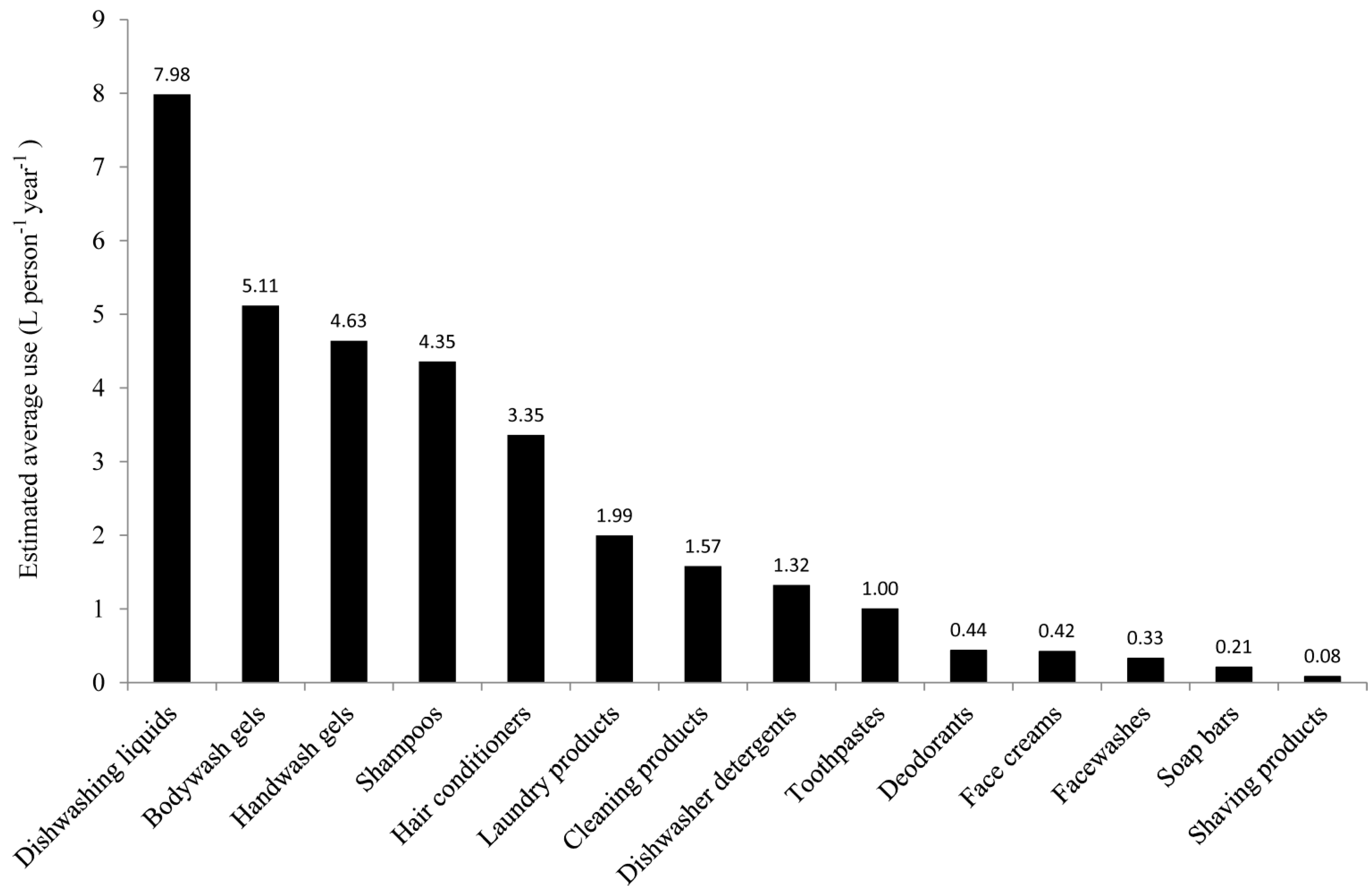
The responses provide an overview of product use and also data on how the respondents may perceive the amount used. The questionnaire asked for information on the 10 products most frequently used, and for the amount used to then be estimated. Overall, 14 product categories were identified, with use ranging from 0.08 to 7.98 L per person per year (L·per−1·yr−1) with a total of 32.78 L·per−1·yr−1 used and potentially discharged to the drain.
Table 1.
The categories of cleaning products and PCP identified and the number of times respondents identified using products in each category in brackets.
3.1. Prioritization of Product Categories
The prioritization of the product categories was undertaken using Equation (1), which gave the average annual use per person (Figure 1). The data in Figure 1 are based on estimates of use, and may therefore not reflect with a high degree of accuracy actual volumes used. However, unless there was a consistent under or overestimate for any product by most respondents, the data should reflect what are the highest to least used products. The outcome demonstrated that dishwashing liquids, used to hand wash cutlery and crockery in the sink, were the products estimated to be used most, followed by a range of PCP used for cleaning the body, hands and hair. Next in sequence were three more cleaning products (for laundry, more general household cleaning products and dishwasher detergents), followed by a range of PCP, from toothpastes to shaving products.
Figure 1.
Prioritization of product categories based on the estimated average use (L) per person per year. Detail showing the calculation for the dishwashing liquids is shown in Table 2.
Having prioritized the product categories by the volume used, the next logical step in development of the methodology was to investigate further the brands that respondents used within each category. For the dishwashing liquids this breakdown is shown in Table 2, with Fairy being the most popular brand (78% of users). However, with seven different types of this brand, which from the product descriptions were apparently based on fragrance combinations, the complexity of the task was becoming apparent. Overall, Fairy Original and Fairy Lemon were the dishwashing liquids that dominated this category. The majority of those using these products (73%) estimated use as between 10 and 100 mL a day.
Table 2.
The 14 different dishwashing liquids as reported by the 51 respondents who used these products, in order of decreasing average use. The frequency was identified as “daily” by all respondents, so columns for weekly and monthly are omitted.
The product category with second highest use, body-wash gels, displayed a much more complex mix of brands, although the Dove brand appeared to dominate, with average use of these products by the 52 respondents being 1.54 L·per−1·yr−1, or 30% of the body-wash used. In manner similar to the dishwashing liquids, the use of terms describing fragrance or flavor was apparent in many of the names of products, such as “Pink Grapefruit” or “Power Fruits”. It was also apparent that people who use these products do so daily, and the majority of users (24) estimated use to be between 10 and 100 mL per day (Table 3).
A full breakdown of brands and individual types of product for the other categories identified in Table 1 and Figure 1 was also undertaken and the outcomes are summarized in Table 4. A full breakdown of each of these categories is provided in Tables S1–S12. The category of cleaning products is the most diverse, covering products used in kitchens, bathrooms and toilets, for general cleaning and specific tasks such as disinfection and lime scale removal. They comprise a wide range of forms, liquids, gels, sprays and powders. Although these products were identified most commonly by respondents, their less frequent, predominantly weekly use, in combination with estimated volumes, resulted in the lower overall usage reported in Figure 1.
3.2. Identification and Classification of Chemicals in the Products
After the prioritization of the 14 product categories, the next step was to identify the chemicals used in the products. With a total of 315 products over the 14 categories, this task needed to be made manageable to meet the objective of the work. The two categories of products used most, dishwasher liquids and body-wash, which accounted for 40% of the total volume of 32.78 L·per−1·yr−1 (Figure 1), were selected to determine if chemicals used as ingredients could be identified, evaluated and prioritized.
Table 3.
The 31 different body-washes as reported by the 39 respondents who used these products, in order of decreasing average use.
Table 4.
A summary of the 12 remaining product categories and the number of different products within each category. For full details see Tables S1–S12.
A total of 116 different ingredients were identified from these two most-used categories. To facilitate the prioritization exercise, these were classified by functionality in the formulation. This resulted in the derivation of three clear classes, surfactants, preservatives and fragrances. Compounds which did not readily fit into these classes were placed in a “miscellaneous” class. Emulsifiers were assessed with the surfactants, given their similar functionality, and anti-oxidants were included in the class of preservatives. This step was, however, challenging for many chemicals, since their functionality did not clearly relate to one class and many are reported to have more than one role in product formulations. For example, benzyl alcohol is used as both a preservative and a fragrance, whereas benzophenone has functionality as a UV filter and fragrance [8,9,10]. The miscellaneous class included thickeners (such as xanthan gum), chelating agents (e.g., EDTA), UV stabilizers (e.g., benzotriazolyl dodecyl p-cresol), pH regulators (e.g., lactic acid), artificial colors (e.g., CI 17200) and inorganic salts.
3.2.1. Chemicals in Dishwashing Products
Identification of the ingredients was obtained from the labels of ten out of the 14 dishwashing liquids identified in Table 2, since only these were readily available. The chemicals listed for each dishwashing liquid included those in the seven Fairy dishwashing liquids along with the Ecover, Tesco and Sainsbury’s products (Table 5). The number of ingredients in this product category ranged from five for the Fairy “Original” and “Lemon” to 12 for the Sainsbury’s and Tesco dishwashing liquids.
Apart from water (which was estimated to be around 40%–50% by volume), the key ingredients in the dishwashing products were anionic and non-ionic surfactants, with only two also containing amphoteric surfactants (Table 5). Nine out of these ten dishwashing liquids gave the percentage of the surfactants used in the product from 5% to 30% for anionic surfactants, <5% to 15% for non-ionic surfactants and 5% to 15% amphoteric surfactants. Only the Ecover product was labelled differently, with more detailed description containing the commercial names of two surfactants, namely sodium lauryl ether sulfate and alkyl polyglycoside C10-16.
Table 5.
The ingredients identified in ten dishwashing liquids, allocated to classes.
Regarding the preservatives, eight different ingredients of this class were identified in the dishwashing liquids, with methylisothiazolinone and phenoxyethanol being the most frequently observed chemicals in the Fairy dishwashing liquids. Fairy “Chamomile and vitE” included the preservative benzisothiazolinone instead of methylisothiazolinone, which was also contained in the label list of Tesco’s and Sainsbury’s dishwashing liquids. Citric acid and 2-bromo-2-nitropropane-1,3-diol were identified in Ecover, with the latter being also identified in Tesco’s dishwashing liquid. The Tesco’s product was labelled differently, with information also giving the quantity of the preservatives.
The class of fragrances included five different chemicals, of which limonene was the most frequently used and the term “perfume” was listed in all the dishwashing products.
3.2.2. Chemicals in Body-Wash Products
From the second most used category, body-washes, information on the ingredients was readily available for only 12 out of 31 products that were reported as used in the survey. In comparison to dishwashing liquids, a wider range of brands was identified, while also a higher number of ingredients was observed, which ranged from 11 for Sanex “0% for Dry Skin” shower gel to 33 for Dove “Deeply Nourishing Body-wash” (Table 6).
The body-washes were, as dishwashing liquids, also surfactant-based, often giving the name of the specific surfactant. However unlike dishwashing liquids, the percentage amount of this ingredient was not provided in any product. More specifically, body-washes included a number of anionic (e.g., sodium laureth sulphate and sodium C12-13 pareth sulphate) and non-ionic (e.g., cocamide DEA, cocamide MEA and coco-glycoside) surfactants. Amphoteric surfactants were also present, the most prominent being cocamidopropyl betaine. The ingredient list of body-washes, in contrast to dishwashing liquids, also included emulsifiers (e.g., PEG-7 glyceryl cocoate, PEG-40 hydrogenated castor oil and poloxamer 124), which are listed with surfactants in Table 6.
There were 16 different preservatives identified, twice the number found in dishwashing liquids. However, both categories of products had some of this class of chemicals in common, such as citric acid, methylchloroisothiazolinone and methylisothiazolinone. As preservatives in the body-washes, citric acid and sodium benzoate were the most frequently identified ingredients (nine times each), and two forms of parabens (methyl- and propyl- paraben) were identified in one body-wash. The class of preservatives also included antioxidants, which were not present in dishwashing liquids. The antioxidants identified were BHT, retinyl palmitate, sodium ascorbyl phosphate, tocopherol and tocopheryl acetate.
A wider range of fragrances were also present in body-washes, with 11 different ingredients identified in this class. The four most frequently observed were limonene, linalool, butylphenyl methylpropional and hexyl cinnamal, which were identified seven, six, five and four times, respectively. All these four chemicals were also used as fragrances in dishwashing liquids. Additionally, benzophenone-4 was presentd in two body-washes, whereas the remaining chemicals, alpha-isomethyl ionone, amyl cinnamal, benzyl benzoate, hydroxyisohexyl 3-cyclohexene carboxaldehyde and coumarin, were identified just once. As in dishwashing liquids, the term “perfume” was included as an ingredient in all the body-washes.
Table 6.
The ingredients identified in 12 body-wash products, allocated to classes.
4. Discussion
The questionnaire asked respondents about how much of a product was used and how frequently, however, for some products, clearly use is at a household, rather than an individual, level. No differentiation was made in this respect, as it would have added complexity, although it is a possible source of error. It also suggested categories of chemicals, which were added following feedback on a trial version, where respondents were unclear about what was included. A clear, simple, questionnaire was important in obtaining a good response. There are, however, indications that responses do reflect actual use of products.
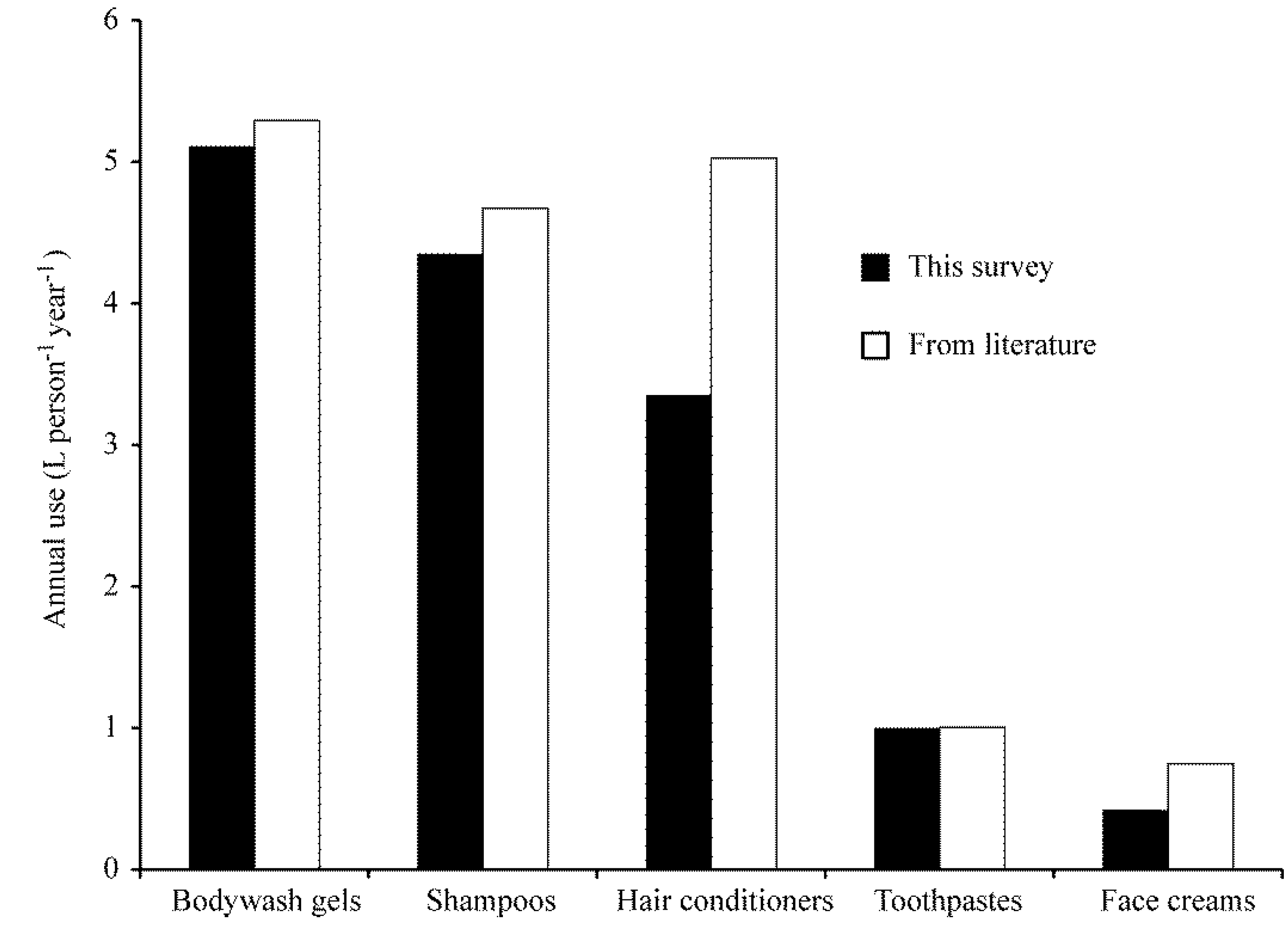
In the dishwashing liquids category, Fairy was the brand most frequently reported which is consistent with UK market research data, which show that Fairy dishwashing products dominate, with a 43% market share [11]. This trend was also reflected in the brands of dishwasher detergents, where Finish was the most popular brand, which also has a large (56%) market share in the UK [12,13]. The responses and subsequent calculation of annual use in L·per−1·yr−1 for a range of products used in the survey also agrees well with values reported in the literature [14,15,16,17] (Figure 2). These results demonstrate that the approach used to estimate use has produced data consistent with other research, which therefore gives a high degree of confidence that values derived are likely to be reasonable estimates of actual use.
Figure 2.
Comparison of annual use of categories in the survey with data available in the literature.
4.1. The Environmental Significance of Surfactants in the Products
Surfactants constitute the key ingredients in dishwashing liquids and body-washes, with three types of surfactants identified in these two mostly used categories, namely anionic, non-ionic and amphoteric surfactants The occurrence and effects of surfactants have been studied extensively in comparison to preservatives and fragrances [8,18]. The linear alkyl sulphonates (LAS) are the most commercially important anionic surfactant globally, constituting 40% of the total sales of surfactants and more than 80% of those used in detergents in Europe [19]. After being discharged, LAS are removed by up to 99% in aerobic wastewater treatment processes [20], with further degradation in river water [21]. There is evidence that the risk posed by LAS to the aquatic environment is low, with the predicted environmental concentration (PEC) being below the predicted no-effect concentration (PNEC) for all the environmental compartments tested [19].
Other anionic surfactants, such as alcohol ethoxylates (AE) and alcohol ethoxysulfates (AES), are also readily degradable [21]. Their elimination rates in wastewater treatment are also high, indicating that there is little possibility of reaching the aquatic environment via sewage effluent and therefore they are expected to pose low aquatic risk [7,22]. The environmental risk assessment conducted for AE at 29 sites in Europe, Canada and the United States revealed that PEC/PNEC was well below 1, ranging between 0.049 and 0.094 [23], indicating that again, the risks posed to the aquatic environment by AE and AES are low.
Cocamidopropyl betaine is the commercial name of the amphoteric surfactant identified in many of the body-washes (Table 6). Cocamidopropyl betaine exhibits harmful/toxic effects to many aquatic test organisms in concentrations of 1–10 mg·L−1. However, in the aquatic risk assessment conducted by Gheorghe et al. (2013) for rivers in Romania [24], cocamidopropyl betaine was assessed to be safe for the aquatic environment with risk coefficients (PEC/PNEC) ranging from 0.036 to 0.38. Moreover, cocamidopropyl betaine is extensively degraded during wastewater treatment, is not bioaccumulative and not expected to cause long-term harmful effects in the local aquatic biota [25]. Overall, indications are that although surfactants constitute a significant volume of material discharged from households, they are not compounds of immediate concern.
4.2. The Environmental Significance of Preservatives in the Products
Chemicals used as preservatives are responsible for the inhibition of growth of bacteria in consumer products [26,27], and therefore are designed to have adverse effects on organisms. In this study, a wide range of preservatives have been identified in dishwashing liquids and body-washes. However, in comparison to detergents, there is less knowledge of the fate and occurrence of many of these compounds in the aquatic environment.
Preservatives which have the potential to present risks to the aquatic environment were identified, such as the two antimicrobial parabens compounds, methylparaben and propylparaben, which have been associated with weak estrogenic activity and low toxicity [28,29,30], and in mixtures with other estrogenic compounds can enhance the response [26]. Another example of a preservative with potential risk for aquatic life is 2-bromo-nitropropane-1,3-diol, which was identified in two dishwashing liquids Although not bioaccumulative, it is a preservative that has been classified as “very toxic to aquatic organisms” [25]. The anti-oxidant BHT, which was identified in three body-washes, is a further example of a preservative of potential concern, being a persistent, toxic and bioaccumulative compound, which has been previously detected in grey wastewater, wastewater and river water samples [29]. There was, therefore, some evidence that the preservatives present in products from households may pose a threat to the receiving waters following wastewater treatment. There is no indication on any of the products of how much preservative is present, which if available might allow for derivation of a PEC through modelling exercises.
4.3. The Environmental Significance of Fragrances in the Products
Fragrances are used ubiquitously in cleaning and PCP [31] and this is demonstrated in this survey, where five and 11 fragrances were identified in dishwashing liquids and body-washes respectively. In contrast to polycyclic-musks (PCMs) and nitromusks (not present in products identified in this survey), which have been studied thoroughly regarding their fate and effects on the aquatic environment, the potential aquatic impact of many fragrance compounds is largely unknown [8,32,33].
From the fragrances identified in this survey, limonene is an example of a fragrance with an indication of hazardous properties classified as “very dangerous to the aquatic environment”, with high acute toxicity to a range of aquatic species [8,34]. The most sensitive species to limonene was Daphnia magna, with a lowest reported acute toxicity of 0.4 mg·L−1 in a 48-h exposure [34]; however, no chronic exposure data, where effects are possible at lower concentrations, are available. The reported concentrations of limonene in surface waters are at least 250 times below the acute effect concentration; however, these data are more than 15 years old. The increasing pattern of use of fragrances in general [33] and the low dilution capacity of rivers in countries such as the UK [35], suggest that limonene may pose a risk to the aquatic environment.
Two other fragrances, coumarin and benzophenone, identified in body-washes, may also have negative impacts on aquatic organisms. Both these fragrances exhibit estrogenic activity, while benzophenone has also been classified as “very toxic to aquatic organisms”, with an acute EC50 to D. magna of 0.28 mgL−1 [8]. However, although environmental concentrations are likely to be well below this, with concentrations in both raw and treated drinking water ranging from 0.26 to 5.61 μg·L−1, a lack of chronic toxicity data does not allow for a full assessment of risk, and it may present an environmental hazard [8,36]. Other benzophenonic compounds, such as benzophenone-2, also demonstrate estrogenic effects [36]. In an environmental risk assessment, 92% of the organic chemicals used for the preparation of fragrances show an acceptable environmental risk [31]. However, the design of new fragrances with properties such as better adherence to surfaces or higher stability will lead to higher persistence and lipophilicity, which may increase their risk to the aquatic environment in future [8].
5. Conclusions
A wide range of cleaning and PCP used in households were identified and subsequently allocated into 14 product categories. Available market research data, and comparison with usage data in the literature, gives confidence in the relative use of each product category, and the estimates on how much was used resulted in prioritization of dishwashing liquids and body-washes for evaluation of chemicals present in the products.
Assessment of the chemicals present resulted in their allocation into a range of classes, with further evaluation of surfactants, preservatives and fragrances. Surfactants are relatively well studied, and are expected to pose a low risk for the aquatic environment. However, in contrast some preservatives exhibit toxicity, including estrogenic activity, are resistant to degradation and/or bioaccumulative and may, therefore present a hazard for the aquatic environment. Additionally, fragrances include compounds exhibiting estrogenic activity, and the lack of toxicity data for these and the preservatives is of concern.
By prioritizing the product categories and classifying the chemicals, the work has demonstrated that it is possible to begin to identify gaps in knowledge and to begin to prioritize compounds, or classes of compounds, for environmental risk assessment.
Supplementary Files
Supplementary File 1Author Contributions
Both authors contributed to the conception and design of the study. Marina Rotsidou collected the data. Both authors contributed to analysis of the data and preparation of the manuscript.
Conflicts of Interest
The authors declare no conflict of interest.
References
- Villa, S.; Assi, L.; Ippolito, A.; Bonfanti, P.; Finizio, A. First evidences of the occurrence of polycyclic synthetic musk fragrances in surface water systems in Italy: Spatial and temporal trends in the Molgora River (Lombardia Region, Northern Italy). Sci. Total Environ. 2012, 416, 137–141. [Google Scholar] [CrossRef] [PubMed]
- Brausch, J.M.; Rand, G.M. A review of personal care products in the aquatic environment: Environmental concentrations and toxicity. Chemosphere 2011, 82, 1518–1532. [Google Scholar] [CrossRef] [PubMed]
- Farré, M.I.; Pérez, S.; Kantiani, L.; Barceló, D. Fate and toxicity of emerging pollutants, their metabolites and transformation products in the aquatic environment. TRAC Trends Anal. Chem. 2008, 27, 991–1007. [Google Scholar] [CrossRef]
- Gardner, M.; Comber, S.; Scrimshaw, M.D.; Cartmell, E.; Lester, J.; Ellor, B. The significance of hazardous chemicals in wastewater treatment works effluents. Sci. Total Environ. 2012, 437, 363–372. [Google Scholar] [CrossRef] [PubMed]
- Janna, H.; Scrimshaw, M.D.; Williams, R.J.; Churchley, J.; Sumpter, J.P. From dishwasher to tap? Xenobiotic substances benzotriazole and tolyltriazole in the environment. Environ. Sci. Technol. 2011, 45, 3858–3864. [Google Scholar]
- Karsprzyk-Hondern, B.; Dinsdale, R.M.; Guwy, A.J. The occurrence of pharmaceuticals, personal care products, endocrine disruptors and illicit drugs in surface water in South Wales, UK. Water Res. 2008, 42, 3498–3518. [Google Scholar] [CrossRef] [PubMed]
- Scott, M.J.; Jones, M.N. The biodegradation of surfactants in the environment. BBA–Biomembr. 2000, 1508, 235–251. [Google Scholar] [CrossRef]
- Klaschka, U.; von der Ohe, P.C.; Bschorer, A.; Krezmer, S.; Sengl, M.; Letzel, M. Occurrences and potential risks of 16 fragrances in five German sewage treatment plants and their receiving waters. Environ. Sci. Pollut. Res. 2013, 20, 2456–2471. [Google Scholar] [CrossRef]
- Trenholm, R.A.; Vanderford, B.J.; Drewes, J.E; Snyder, S.A. Determination of household chemicals using gas chromatography and liquid chromatography with tandem mass spectrometry. J. Chromatogr. A 2008, 1190, 253–262. [Google Scholar]
- Yazar, K.; Johnsson, S.; Lind, M.L.; Boman, A.; Lidén, C. Preservatives and fragrances in selected consumer-available cosmetics and detergents. Contact Dermat. 2011, 64, 265–272. [Google Scholar] [CrossRef]
- Mintel. Dishwashing Products—UK—May 2014; Mintel International: London, UK, 2014. [Google Scholar]
- Mintel. Dishwashing Detergents—UK—April 2009; Mintel International: London, UK, 2009. [Google Scholar]
- Mintel. Dishwashing Detergents—UK—April 2011; Mintel International: London, UK, 2011. [Google Scholar]
- Hall, B.; Steiling, W.; Safford, B.; Coroama, M.; Tozer, S.; Firmani, C.; McNamara, C.; Gibney, M. European consumer exposure to cosmetic products, a framework for conducting population exposure assessments Part 2. Food Chem. Toxicol. 2011, 49, 408–422. [Google Scholar] [CrossRef]
- Loretz, L.J.; Api, A.M.; Barraj, L.M.; Burdick, J.; Dressler, W.E.; Gettings, S.D.; Han, H.H.; Pan, Y.H.; Re, T.A.; Renskers, K.J.; et al. Exposure data for cosmetic products: Lipstick, body lotion, and face cream. Food Chem. Toxicol. 2005, 3, 279–291. [Google Scholar]
- Loretz, L.J.; Api, A.M.; Barraj, L.M.; Burdick, J.; Davis, W.; Dressler, W.E.; Gilberti, E.; Jarrett, G.; Mann, S.; Laurie Pan, Y.H.; et al. Exposure data for personal care products: Hairspray, spray perfume, liquid foundation, shampoo, body-wash, and solid antiperspirant. Food Chem. Toxicol. 2006, 44, 2008–2018. [Google Scholar]
- Loretz, L.J.; Api, A.M.; Babcock, L.; Barraj, L.M.; Burdick, J.; Cater, K.C.; Jarrett, G.; Mann, S.; Pan, Y.H.L; Re, T.A.; et al. Exposure data for cosmetic products: Facial cleanser, hair conditioner, and eye shadow. Food Chem. Toxicol. 2008, 46, 1516–1524. [Google Scholar]
- McAvoy, C.D.; Dyer, S.D.; Fendinger, N.J.; Eckhoff, W.S.; Lawrence, D.L.; Begley, D.W. Removal of alcohol ethoxylates, alkyl ethoxylate sulfates, and linear alkylbenzene sulfonates in wastewater treatment. Environ. Toxicol. Chem. 1998, 17, 1705–1711. [Google Scholar] [CrossRef]
- HERA Linear Alkylbenzene Sulphonate (CAS No. 68411-30-3). Revised Environmental Aspect of the HERA Report 2013. Available online: http://www.heraproject.com/files/HERA-LAS%20revised%20February%202013.pdf (accessed on 10 August 2014).
- Mungray, A.K.; Kumar, P. Fate of linear alkylbenzene sulfonates in the environment: A review. Int. Biodeter. Biodegr. 2009, 63, 981–987. [Google Scholar] [CrossRef]
- Ying, G.G. Fate, behavior and effects of surfactants and their degradation products in the environment. Environ. Int. 2006, 32, 417–431. [Google Scholar] [CrossRef] [PubMed]
- Matthijs, E.; Holt, M.S.; Kiewiet, A.; Rijs, G.B.J. Environmental monitoring for linear alkylbenze sulfonate, alcohol ethoxylate, alcohol ethoxy sulfate, alcohol sulfate and soap. Environ. Toxicol. Chem. 1999, 18, 2634–2644. [Google Scholar] [CrossRef]
- Belanger, S.E.; Dorn, P.B.; Toy, R.; Boeije, G.; Marshall, S.J.; Wind, T.; van Compernolle, R.; Zeller, D. Aquatic risk assessment of alcohol ethoxylates in North America and Europe. Ecotoxcol. Environ. Safe. 2006, 64, 85–99. [Google Scholar] [CrossRef]
- Ecotoxicological Behaviour of Some Cationic and Amphoteric Surfactants (Biodegradation, Toxicity and Risk Assessment). Available online: http://cdn.intechopen.com/pdfs-wm/43968.pdf (accessed on 30 August 2014).
- Survey of Liquid Hand Soaps, Including Health and Environmental Assessments. Available online: http://www2.mst.dk/common/Udgivramme/Frame.asp?http://www2.mst.dk/udgiv/publications/2006/87-7052-062-3/html/kap08_eng.htm (accessed on 10 September 2014).
- Basin, I.; Gadal, A.; Touraud, E.; Roig, B. Hydroxy benzoate preservatives (Parabens) in the environment: Data for environmental toxicity assessment. Environ. Pollut. 2010, 16, 245–257. [Google Scholar]
- Environmental and Health Assessment of Substances in Household Detergents and Cosmetic Detergent Products. Environmental Project No. 615. Available online: http://www2.mst.dk/udgiv/Publications/2001/87-7944-596-9/pdf/87-7944-597-7.pdf (accessed on 12 August 2014).
- Daughton, C.G.; Ternes, T.A. Pharmaceuticals and personal care products in the environment: Agents of subtle change? Environ. Health Perspect. 1999, 117, 907–938. [Google Scholar] [CrossRef]
- Eriksson, E.; Auffarth, K.; Eilersen, A.-M.; Henze, M.; Ledin, A. Household chemicals and personal care products as sources for xenobiotic organic compounds in grey wastewater. AJOL 2003, 29, 135–146. [Google Scholar]
- Routledge, E.J.; Parker, J.; Odum, J.; Ashby, J.; Sumpter, J.P. Some alkyl hydroxy benzoate preservatives (parabens) are estrogenic. Toxicol. Appl. Pharm. 1998, 153, 12–19. [Google Scholar] [CrossRef]
- Salvito, D.T.; Vey, M.G.H.; Senna, R.J. Fragrance materials and their environmental impact. Flavour Frag. J. 2004, 19, 105–108. [Google Scholar] [CrossRef]
- Bolek, R.; Kümmerer, K. Fate and effects of little investigated scents in the aquatic environment. Environ. Pollut. 2004, 16, 87–100. [Google Scholar]
- Klaschka, U.; Kolossa-Gehring, M. Fragrances in the environment: Pleasant odours for nature? Environ. Sci. Pollut. Res. 2007, 14, 44–52. [Google Scholar] [CrossRef]
- Limonene. Concise International Chemical Assessment Document 5. Available online: http://www.who.int/ipcs/publications/cicad/en/cicad05.pdf (accessed on 12 August 2014).
- Johnson, A.C.; Acreman, M.C.; Dunbar, M.J.; Feist, S.W.; Giakomello, A.M.; Gozian, R.E.; Hinsley, S.A.; Ibbotson, A.T.; Jervie, H.P.; Jones, J.I.; et al. The British river of the future: How climate change and human activity might affect two contrasting river ecosystems in England. Sci. Total Environ. 2009, 407, 4787–4798. [Google Scholar]
- Weisbrod, C.J.; Kunz, P.Y.; Zenker, A.K.; Fent, K. Effects of the UV filter benzophenone-2 on reproduction in fish. Toxicol. Appl. Pharm. 2007, 225, 255–266. [Google Scholar] [CrossRef]
© 2015 by the authors; licensee MDPI, Basel, Switzerland. This article is an open access article distributed under the terms and conditions of the Creative Commons Attribution license (http://creativecommons.org/licenses/by/4.0/).