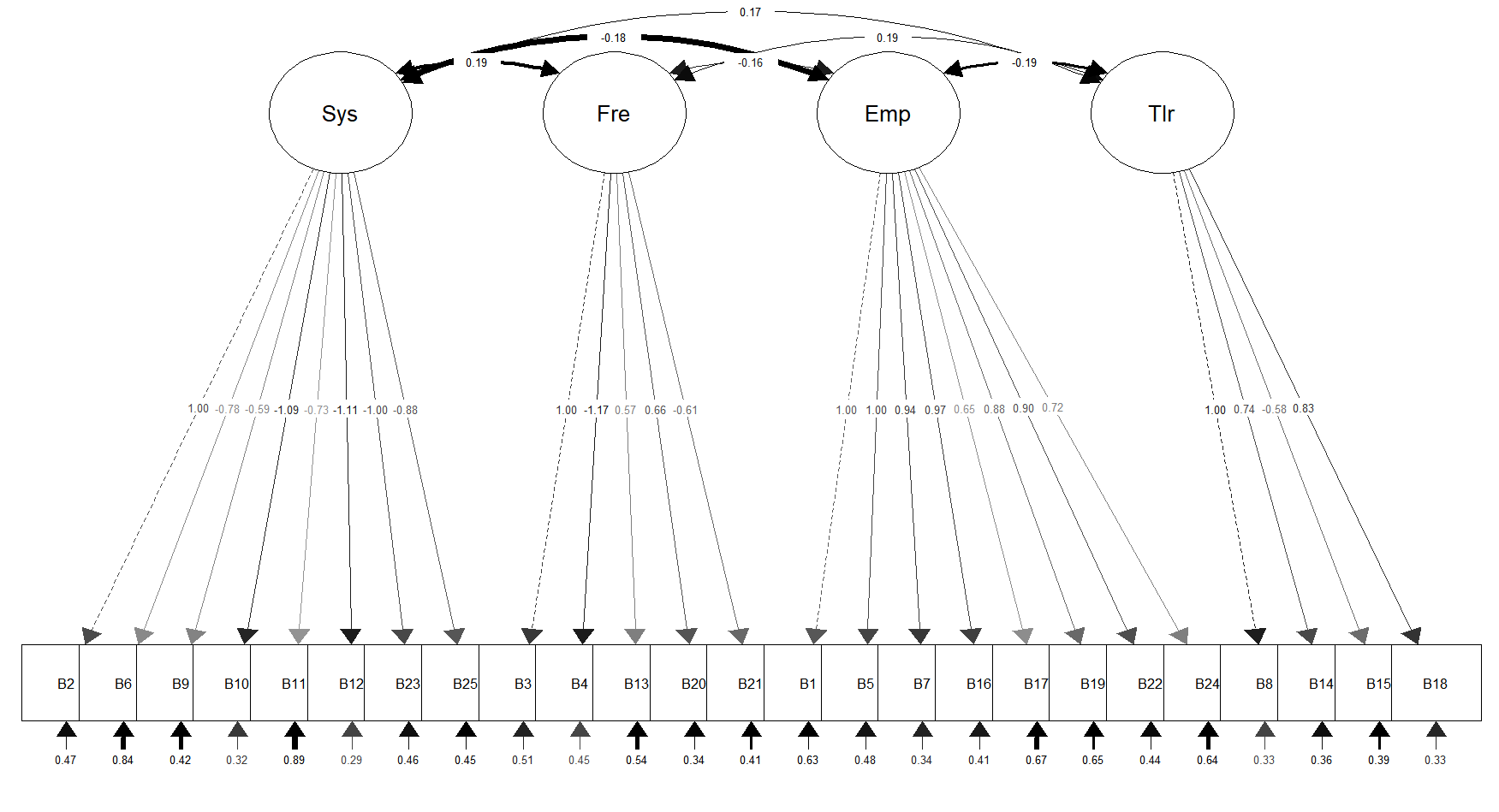
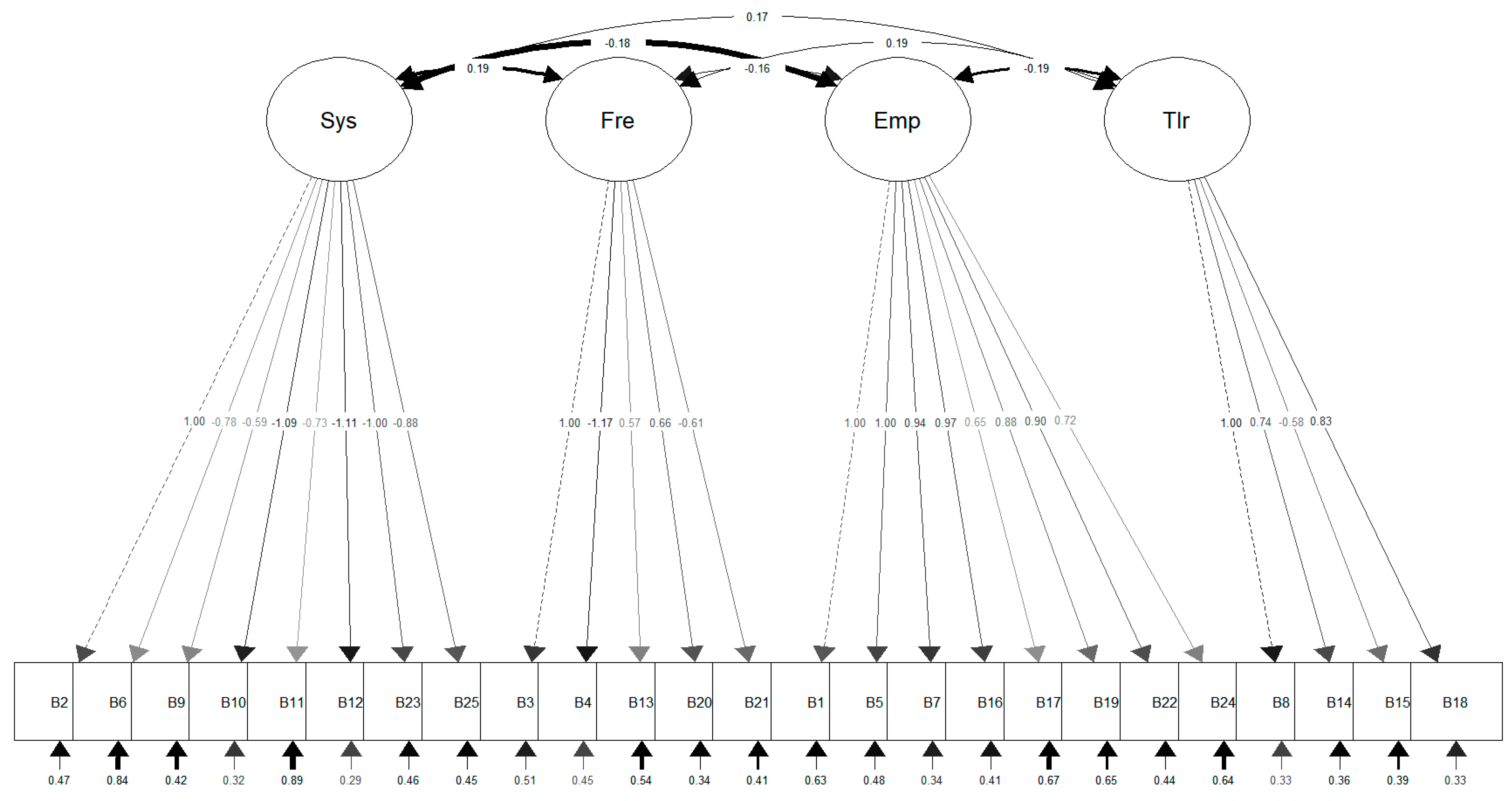
An Instrument to Measure Mental Health Professionals’ Beliefs and Attitudes towards Service Users’ Rights



Abstract
1. Introduction
Previous Measures
2. Materials and Methods
2.1. Development
2.2. Sample and Procedure
2.3. Analysis
3. Results
4. Discussion
5. Conclusions
Supplementary Materials
Author Contributions
Funding
Acknowledgments
Conflicts of Interest
References
- Eiroa-Orosa, F.J.; Rowe, M. Taking the concept of citizenship in mental health across countries. Reflections on transferring principles and practice to different sociocultural contexts. Front. Psychol. 2017, 8, 1020. [Google Scholar] [CrossRef] [Scilit] [PubMed]
- Davidson, L. The recovery movement: Implications for mental health care and enabling people to participate fully in life. Health Aff. 2016, 35, 1091–1097. [Google Scholar] [CrossRef] [Scilit] [PubMed]
- Henderson, C.; Noblett, J.; Parke, H.; Clement, S.; Caffrey, A.; Gale-Grant, O.; Schulze, B.; Druss, B.; Thornicroft, G. Mental health-related stigma in health care and mental health-care settings. Lancet Psychiatry 2014, 1, 467–482. [Google Scholar] [CrossRef] [Scilit]
- Knaak, S.; Mantler, E.; Szeto, A. Mental illness-related stigma in healthcare. Healthc. Manag. Forum 2017, 30, 111–116. [Google Scholar] [CrossRef] [Scilit] [PubMed]
- Schomerus, G.; Schwahn, C.; Holzinger, A.; Corrigan, P.W.; Grabe, H.J.; Carta, M.G.; Angermeyer, M.C. Evolution of public attitudes about mental illness: A systematic review and meta-analysis. Acta Psychiatr. Scand. 2012, 125, 440–452. [Google Scholar] [CrossRef] [Scilit]
- Hansson, L.; Jormfeldt, H.; Svedberg, P.; Svensson, B. Mental health professionals’ attitudes towards people with mental illness: Do they differ from attitudes held by people with mental illness? Int. J. Soc. Psychiatry 2011, 59, 48–54. [Google Scholar] [CrossRef] [Scilit] [PubMed]
- Sheehan, L.; Nieweglowski, K.; Corrigan, P.W. Structures and types of Stigma. In The Stigma of Mental Illness—End of the Story? Springer: Cham, Switzerland, 2017; pp. 43–66. [Google Scholar]
- Lorem, G.F.; Hem, M.H.; Molewijk, B. Good coercion: Patients’ moral evaluation of coercion in mental health care. Int. J. Ment. Health Nurs. 2015, 24, 231–240. [Google Scholar] [CrossRef] [Scilit]
- Mabe, P.A.; Rollock, M.; Duncan, G.N. Teaching clinicians the practice of recovery-oriented care. In Handbook of Recovery in Inpatient Psychiatry; Singh, N.N., Barber, J.W., Van Sant, S., Eds.; Springer: Cham, Switzerland, 2016; pp. 81–97. [Google Scholar]
- Ponce, A.N.; Clayton, A.; Gambino, M.; Rowe, M. Social and clinical dimensions of citizenship from the mental health-care provider perspective. Psychiatr. Rehabil. J. 2016, 39, 161–166. [Google Scholar] [CrossRef] [Scilit]
- Gilbert, D.C.; Levinson, D.J. Ideology, personality, and institutional policy in the mental hospital. J. Abnorm. Soc. Psychol. 1956, 53, 263–271. [Google Scholar] [CrossRef] [Scilit]
- Rogers, A.H.; Cohen, M.; Naranick, C.S. A validation study of the custodial mental illness ideology scale. J. Clin. Psychol. 1958, 14, 269–270. [Google Scholar] [CrossRef] [Scilit]
- Cohen, J.; Struening, E.L. Opinions about mental illness in the personnel of two large mental hospitals. J. Abnorm. Soc. Psychol. 1962, 64, 349–360. [Google Scholar] [CrossRef] [Scilit] [PubMed]
- Goffman, E.; Guinsberg, L. Stigma: Notes on the Management of Spoiled Identity; Prentice-Hall: New Yok, NY, USA; London, UK; Toronto, ON, Canada, 1963. [Google Scholar]
- Corrigan, P.W.; Markowitz, F.E.; Watson, A.; Rowan, D.; Kubiak, M.A. An attribution model of public discrimination towards persons with mental illness. J. Health Soc. Behav. 2003, 44, 162–179. [Google Scholar] [CrossRef] [Scilit] [PubMed]
- Taylor, S.M.; Dear, M.J. Scaling community attitudes toward the mentally ill. Schizophr. Bull. 1981, 7, 225–240. [Google Scholar] [CrossRef] [Scilit] [PubMed]
- Evans-Lacko, S.; Rose, D.; Little, K.; Flach, C.; Rhydderch, D.; Henderson, C.; Thornicroft, G. Development and psychometric properties of the Reported and Intended Behaviour Scale (RIBS): A stigma-related behaviour measure. Epidemiol. Psychiatr. Sci. 2011, 20, 263–271. [Google Scholar] [CrossRef] [Scilit] [PubMed]
- Penn, D.L.; Guynan, K.; Daily, T.; Spaulding, W.D.; Garbin, C.P.; Sullivan, M. Dispelling the Stigma of Schizophrenia: What Sort of Information Is Best? Schizophr. Bull. 1994, 20, 567–578. [Google Scholar] [CrossRef] [Scilit] [PubMed]
- Evans-lacko, S.; Little, K.; Meltzer, H.; Rose, D.; Rhydderch, D.; Henderson, C.; Thornicroft, G. Mental Health Knowledge Schedule. Can. J. Psychiatry 2010, 55, 157–165. [Google Scholar] [CrossRef] [Scilit] [PubMed]
- Link, B.G.; Cullen, F.T.; Frank, J.; Wozniak, J.F. The Social Rejection of Former Mental Patients: Understanding Why Labels Matter. Am. J. Sociol. 1987, 92, 1461–1500. [Google Scholar] [CrossRef] [Scilit]
- Crisp, A.H.; Gelder, M.G.; Rix, S.; Meltzer, H.I.; Rowlands, O.J. Stigmatisation of people with mental illnesses. Br. J. Psychiatry 2000, 177, 4–7. [Google Scholar] [CrossRef] [Scilit]
- Teachman, B.A.; Wilson, J.G.; Komarovskaya, I. Implicit and Explicit Stigma of Mental Illness in Diagnosed and Healthy Samples. J. Soc. Clin. Psychol. 2006, 25, 75–95. [Google Scholar] [CrossRef] [Scilit]
- Ritsher, J.B.; Otilingam, P.G.; Grajales, M. Internalized stigma of mental illness: Psychometric properties of a new measure. Psychiatry Res. 2003, 121, 31–49. [Google Scholar] [CrossRef] [Scilit]
- Kassam, A.; Papish, A.; Modgill, G.; Patten, S. The development and psychometric properties of a new scale to measure mental illness related stigma by health care providers: The Opening Minds Scale for Health Care Providers (OMS-HC). BMC Psychiatry 2012, 12, 62. [Google Scholar] [CrossRef] [Scilit]
- Stull, L.G.; McConnell, H.; McGrew, J.; Salyers, M.P. Explicit and implicit stigma of mental illness as predictors of the recovery attitudes of assertive community treatment practitioners. Isr. J. Psychiatry Relat. Sci. 2017, 54, 31–38. [Google Scholar] [PubMed]
- Gabbidon, J.; Clement, S.; van Nieuwenhuizen, A.; Kassam, A.; Brohan, E.; Norman, I.; Thornicroft, G. Mental Illness: Clinicians’ Attitudes (MICA) Scale-Psychometric properties of a version for healthcare students and professionals. Psychiatry Res. 2013, 206, 81–87. [Google Scholar] [CrossRef] [Scilit] [PubMed]
- Christison, G.W.; Haviland, M.G.; Riggs, M.L. The Medical Condition Regard Scale. Acad. Med. 2002, 77, 257–262. [Google Scholar] [CrossRef] [Scilit]
- Esen Danacı, A.; Balıkçı, K.; Aydın, O.; Cengisiz, C.; Uykur, A.B. The Effect of Medical Education On Attitudes Towards Schizophrenia: A Five-Year Follow-Up Study. Turk. J. Psychiatry 2016, 27, 176–184. [Google Scholar] [CrossRef] [Scilit]
- Watson, A.C.; Angell, B.; Vidalon, T.; Davis, K. Measuring perceived procedural justice and coercion among persons with mental illness in police encounters: The Police Contact Experience Scale. J. Commun. Psychol. 2010, 38, 206–226. [Google Scholar] [CrossRef] [Scilit]
- Burra, P.; Kalin, R.; Leichner, P.; Waldron, J.J.; Handforth, J.R.; Jarrett, F.J.; Amara, I.B. The ATP 30—A scale for measuring medical students’ attitudes to psychiatry. Med. Educ. 1982, 16, 31–38. [Google Scholar] [CrossRef] [Scilit] [PubMed]
- Bedregal, L.E.; O’Connell, M.; Davidson, L. The Recovery Knowledge Inventory: Assessment of Mental Health Staff Knowledge and Attitudes about Recovery. Psychiatr. Rehabil. J. 2006, 30, 96–103. [Google Scholar] [CrossRef] [Scilit]
- Mabe, P.A.; Fenley, G. Project GREAT Recovery Based Training Procedures Manual. Ph.D Dissertation, Department of Psychiatry and Health Behavior Medical College of Georgia, Augusta, GA, USA, 2008. [Google Scholar]
- Salyers, M.P.; Rollins, A.L.; Bond, G.R.; Tsai, J.; Moser, L.; Brunette, M.F. Development of a scale to assess practitioner knowledge in providing integrated dual disorders treatment. Adm. Policy Ment. Health Ment. Health Serv. Res. 2007, 34, 570–581. [Google Scholar] [CrossRef] [Scilit]
- Borkin, J.R.; Steffen, J.J.; Ensfield, L.B.; Krzton, K.; Wishnick, H.; Wilder, K.; Yangarber, N. Recovery Attitudes Questionnaire: Development and evaluation. Psychiatr. Rehabil. J. 2000, 24, 95–102. [Google Scholar] [CrossRef] [Scilit]
- Salyers, M.P.; Brennan, M.; Kean, J. Provider Expectations for Recovery Scale: Refining a measure of provider attitudes. Psychiatr. Rehabil. J. 2013, 36, 153–159. [Google Scholar] [CrossRef] [Scilit] [PubMed]
- Casper, E.S.; Oursler, J.; Schmidt, L.T.; Gill, K.J. Measuring practitioners’ beliefs, goals, and practices in psychiatric rehabilitation. Psychiatr. Rehabil. J. 2002, 25, 223–234. [Google Scholar] [CrossRef] [Scilit] [PubMed]
- Deane, F.P.; Goff, R.O.; Pullman, J.; Sommer, J.; Lim, P. Changes in Mental Health Providers’ Recovery Attitudes and Strengths Model Implementation Following Training and Supervision. Int. J. Ment. Health Addict. 2018. [Google Scholar] [CrossRef] [Scilit]
- Killaspy, H.; White, S.; Wright, C.; Taylor, T.L.; Turton, P.; Schützwohl, M.; Schuster, M.; Cervilla, J.A.; Brangier, P.; Raboch, J.; et al. The development of the Quality Indicator for Rehabilitative Care (QuIRC): A measure of best practice for facilities for people with longer term mental health problems. BMC Psychiatry 2011, 11, 35. [Google Scholar] [CrossRef] [Scilit] [PubMed]
- Strating, M.M.H.; Broer, T.; van Rooijen, S.; Bal, R.A.; Nieboer, A.P. Quality improvement in long-term mental health: Results from four collaboratives. J. Psychiatr. Ment. Health Nurs. 2012, 19, 379–388. [Google Scholar] [CrossRef] [Scilit] [PubMed]
- Drake, C.E.; Codd, R.T.; Terry, C. Assessing the validity of implicit and explicit measures of stigma toward clients with substance use disorders among mental health practitioners. J. Context. Behav. Sci. 2018, 8, 44–54. [Google Scholar] [CrossRef] [Scilit]
- Mancini, A.; Finnerty, M. Recovery-Oriented Practices Index (ROPI); University of Minnesota: New York, NY, USA, 2005. [Google Scholar]
- O’Connell, M.; Tondora, J.; Croog, G.; Evans, A.; Davidson, L. From Rhetoric to Routine: Assessing Perceptions of Recovery-Oriented Practices in a State Mental Health and Addiction System. Psychiatr. Rehabil. J. 2005, 28, 378–386. [Google Scholar] [CrossRef] [Scilit]
- Moors, G. Exploring the effect of a middle response category on response style in attitude measurement. Qual. Quant. 2008, 42, 779–794. [Google Scholar] [CrossRef] [Scilit]
- Revelle, W. An Introduction to Psychometric Theory with Applications in R. Available online: https://personality-project.org/r/book/ (accessed on 14 January 2019).
- Rosseel, Y. lavaan: An R Package for Structural Equation Modeling. J. Stat. Softw. 2012, 48, 1–21. [Google Scholar] [CrossRef] [Scilit]
- Rizopoulos, D. ltm: An R package for latent variable modeling and item response theory analyses. J. Stat. Softw. 2006, 17, 1–25. [Google Scholar] [CrossRef] [Scilit]
- Chalmers, R.P. mirt: A Multidimensional Item Response Theory Package for the R Environment. J. Stat. Softw. 2012, 48, 1–29. [Google Scholar] [CrossRef] [Scilit]
- R Core Team R: A language and Environment For Statistical Computing. R Foundation for Statistical Computing: Vienna, Austria. Available online: https://www.r-project.org/ (accessed on 14 January 2019).
- Penn, D.L.; Kommana, S.; Mansfield, M.; Link, B.G. Dispelling the Stigma of Schizophrenia: II. The Impact of Information on Dangerousness. Schizophr. Bull. 1999, 25, 437–446. [Google Scholar] [CrossRef] [Scilit] [PubMed]
- Kidd, S.A.; George, L.; O’Connell, M.; Sylvestre, J.; Kirkpatrick, H.; Browne, G.; Odueyungbo, A.O.; Davidson, L. Recovery-oriented service provision and clinical outcomes in assertive community treatment. Psychiatr. Rehabil. J. 2011, 34, 194–201. [Google Scholar] [CrossRef] [Scilit] [PubMed]
- Barbic, S.P.; Kidd, S.A.; Davidson, L.; McKenzie, K.; O’Connell, M.J. Validation of the Brief Version of the Recovery Self-Assessment (RSA-B) Using Rasch Measurement Theory. Psychiatr. Rehabil. J. 2015, 38, 349–358. [Google Scholar] [CrossRef] [Scilit] [PubMed]
- Salyers, M.P.; Tsai, J.; Stultz, T.A. Measuring recovery orientation in a hospital setting. Psychiatr. Rehabil. J. 2007, 31, 131–137. [Google Scholar] [CrossRef] [Scilit] [PubMed]
- Kassam, A.; Glozier, N.; Leese, M.; Henderson, C.; Thornicroft, G. Development and responsiveness of a scale to measure clinicians’ attitudes to people with mental illness (medical student version). Acta Psychiatr. Scand. 2010, 122, 153–161. [Google Scholar] [CrossRef] [Scilit]
- Albee, G.W.; Joffe, J.M. Mental Illness Is NOT “an Illness Like Any Other”. J. Prim. Prev. 2003, 24, 419–436. [Google Scholar] [CrossRef] [Scilit]
- Read, J.; Haslam, N.; Sayce, L.; Davies, E. Prejudice and schizophrenia: A review of the “mental illness is an illness like any other” approach. Acta Psychiatr. Scand. 2006, 114, 303–318. [Google Scholar] [CrossRef] [Scilit] [PubMed]
- Molewijk, B.; Kok, A.; Husum, T.; Pedersen, R.; Aasland, O. Staff’s normative attitudes towards coercion: The role of moral doubt and professional context—A cross-sectional survey study. BMC Med. Ethics 2017, 18, 37. [Google Scholar] [CrossRef] [Scilit] [PubMed]
- Berlin, I.N. Resistance to change in mental health professionals. Am. J. Orthopsychiatry 1969, 39, 109–115. [Google Scholar] [CrossRef] [Scilit]
- Rogers, A.; Pilgrim, D. ‘Pulling down churches’: Accounting for the British Mental Health Users’ Movement. Sociol. Health Ill. 1991, 13, 129–148. [Google Scholar] [CrossRef] [Scilit]
- Morley, C. Towards Critical Social Work Practice in Mental Health. J. Progr. Hum. Serv. 2003, 14, 61–84. [Google Scholar] [CrossRef] [Scilit]
- Bower, F.L.; McCullough, C.S.; Timmons, M.E. A Synthesis of What We Know About the Use of Physical Restraints and Seclusion with Patients in Psychiatric and Acute Care Settings: 2003 Update. Worldviews Evid.-Based Nurs. 2003, 10, 1–29. [Google Scholar] [CrossRef] [Scilit]
- Laursen, S.B.; Jensen, T.N.; Bolwig, T.; Olsen, N.V. Deep venous thrombosis and pulmonary embolism following physical restraint. Acta Psychiatr. Scand. 2005, 111, 324–327. [Google Scholar] [CrossRef] [Scilit] [PubMed]
- Nielsen, A.S. Deep venous thrombosis and fatal pulmonary embolism in a physically restrained patient. Ugeskr. Laeger 2005, 167, 2294. [Google Scholar] [PubMed]
- Morrison, A.; Sadler, D. Death of a Psychiatric Patient during Physical Restraint. Excited Delirium—A Case Report. Med. Sci. Law 2001, 41, 46–50. [Google Scholar] [CrossRef] [Scilit] [PubMed]
- Goulet, M.-H.; Larue, C.; Dumais, A. Evaluation of seclusion and restraint reduction programs in mental health: A systematic review. Aggress. Violent Behav. 2017, 31, 413–424. [Google Scholar] [CrossRef] [Scilit]
- Lebel, J.; Goldstein, R. The economic cost of using restraint and the value added by restraint reduction or elimination. Psychiatr. Serv. 2005, 56, 1109–1114. [Google Scholar] [CrossRef] [Scilit]
- Breeze, J. Can paternalism be justified in mental health care? J. Adv. Nurs. 1998, 28, 260–265. [Google Scholar] [CrossRef] [Scilit] [PubMed]
- Pelto-Piri, V.; Engström, K.; Engström, I. Paternalism, autonomy and reciprocity: Ethical perspectives in encounters with patients in psychiatric in-patient care. BMC Med. Ethics 2013, 14, 49. [Google Scholar] [CrossRef] [Scilit]
- Sisti, D.; Young, M.; Caplan, A. Defining mental illnesses: Can values and objectivity get along? BMC Psychiatry 2013, 13, 346. [Google Scholar] [CrossRef] [Scilit] [PubMed]
- Stuart, H. Mental illness and employment discrimination. Curr. Opin. Psychiatry 2006, 19, 522–526. [Google Scholar] [CrossRef] [Scilit] [PubMed]
- Overton, S.L.; Medina, S.L. The Stigma of Mental Illness. J. Couns. Dev. 2008, 86, 143–151. [Google Scholar] [CrossRef] [Scilit]
- Singh, N.N.; Barber, J.W.; Van Sant, S. Handbook of Recovery in Inpatient Psychiatry; Singh, N.N., Barber, J.W., Van Sant, S., Eds.; Evidence-Based Practices in Behavioral Health; Springer: Cham, Switzerland, 2016; ISBN 978-3-319-40535-3. [Google Scholar]
- Thornicroft, G.; Rose, D.; Kassam, A.; Kassman, A. Discrimination in health care against people with mental illness. Int. Rev. Psychiatry 2007, 19, 113–122. [Google Scholar] [CrossRef] [Scilit] [PubMed]
- Lawn, S.; McMillan, J.; Comley, Z.; Smith, A.; Brayley, J. Mental health recovery and voting: Why being treated as a citizen matters and how we can do it. J. Psychiatr. Ment. Health Nurs. 2014, 21, 289–295. [Google Scholar] [CrossRef] [Scilit] [PubMed]
- Corrigan, P.W. Best Practices: Strategic Stigma Change (SSC): Five Principles for Social Marketing Campaigns to Reduce Stigma. Psychiatr. Serv. 2011, 62, 824–826. [Google Scholar] [CrossRef] [PubMed]
- United Nations. Convention on the Rights of Persons with Disabilities. Treaty Ser. 2006, 2515, 3. [Google Scholar]


| Measure | Applies to | Constructs Measured | Reference |
|---|---|---|---|
| Custodial Mental Illness Ideology Scale | Mental health professionals | Custodial and humanistic ideologies | [11,12] |
| Opinions about Mental Illness Scale | Mental health professionals | Public stigma | [13] |
| Community Attitudes towards the Mentally Ill Scale | General public | Public stigma | [16] |
| Attitudes towards Psychiatry (ATP-30) | Mental health professionals | Attitudes towards the psychiatry specialty | [30] |
| Perceived Devaluation and Discrimination Scale | General public/mental health service users | Public stigma | [20] |
| Affective Reaction Scale | General public | Public stigma | [18,49] |
| Dangerousness Scale | General public | Public stigma | [18,49] |
| “Changing Minds” questionnaire | General public | Public stigma | [21] |
| Recovery Attitudes Questionnaire (RAQ-7) | Mental health professionals | Recovery attitudes | [34] |
| Professionals’ Beliefs, Goals and Practices in Psychiatric Rehabilitation | Mental health professionals | Recovery practice | [36] |
| Medical Condition Regard Scale | Medical students | Professional stigma | [27] |
| Attribution Questionnaire | General public | Public stigma | [15] |
| Internalized Stigma of Mental Illness (ISMI) | Mental health service users | Public stigma | [23] |
| Recovery-Oriented Practices Index (ROPI) | Mental health professionals | Recovery practice | [41] |
| Recovery Self-Assessment | Mental health institutions (professionals, service users and relatives) | Recovery practice | [42,50,51,52] |
| Recovery Knowledge Inventory (RKI) | Mental health professionals | Recovery knowledge | [31] |
| Implicit Stigma (Implicit Association Test) | General public Mental health professionals | Public/professional stigma | [22] [25,40] |
| Integrated Dual Disorders Treatment Model Knowledge Scale | Mental health professionals | Recovery knowledge | [33] |
| The Project GREAT Recovery Knowledge Measure—Recovery Attitudinal Pre-Post Survey | Mental health professionals | Recovery knowledge | [32] |
| Mental Health Knowledge Schedule | General public | Public stigma | [19] |
| Mental Illness: Clinicians’ Attitudes Scale (MICA) | Health professionals | Professional stigma | [26,53] |
| Police Contact Experience Scale | Police officers | Professional stigma | [29] |
| Reported and Intended Behaviour Scale (RIBS) | General public | [17] | |
| Quality Indicator for Rehabilitative Care (QuIRC) | Mental health professionals | Recovery practice | [38] |
| Opening Minds Stigma Scale for Health Care Providers (OMS-HC) | Primary care professionals | Professional stigma | [24] |
| Consumer Optimism Scale | Mental health professionals | Professional optimism | [33] |
| Provider Expectations for Recovery Scale | Mental health professionals | Professional optimism for recovery | [35] |
| PAREM (Attitude Questionnaire developed by Psychiatric Investigations and Education Center) | Mental health students | Professional stigma | [28] |
| Strengths Model Attitudes Questionnaire (SMAQ) | Mental health professionals | Recovery practice | [37] |
| Original Item Number | Final Item Number | Statement | EFA Weights * | ||||||
|---|---|---|---|---|---|---|---|---|---|
| System criticism/justifying beliefs | Freedom/coercion | Empowerment/paternalism | Tolerance/discrimination | Univariate IRT discriminant parameter within the whole scale | Univariate IRT discriminant parameter within the subscale | Multivariate IRT discriminant parameter | |||
| System criticism/justifying beliefs | |||||||||
| 3 | 2 | It is possible to recover without professional interventions. | 0.292 | 1.229 | 1.091 | 1.088 | |||
| 10 | 6 | Mental disorders are diseases like any other. | 0.257 * | 0.639 | 0.853 | 0.856 | |||
| 13 | 9 | When patients behave aggressively it is due to their mental disorder. | 0.639 | 0.867 | 0.845 | 0.832 | |||
| 14 | 10 | Declaring someone with a severe mental disorder incapacitated is a good way of taking care of that person. | 0.471 | 1.867 | 1.444 | 1.422 | |||
| 15 | 11 | Individuals with mental disorders currently have the same rights as other people. | 0.463 | 0.754 | 0.986 | 0.991 | |||
| 16 | 12 | Coercive measures are currently applied only when necessary. | 0.552 | 1.929 | 2.630 | 2.677 | |||
| 39 | 23 | Some patients will never be able to recover. | 0.210 * | 1.332 | 0.955 | 0.945 | |||
| 44 | 25 | For the most part, mental health professionals work collaboratively with patients. | 0.504 | 1.098 | 1.465 | 1.484 | |||
| Freedom/coercion | |||||||||
| 4 | 3 | People should not be involuntarily hospitalised if they do not pose a threat to the integrity of others | 0.638 | 1.066 | 1.584 | 1.644 | |||
| 6 | 4 | Sometimes it is necessary to mechanically restrain patients. | 0.557 | 1.367 | 1.967 | 1.907 | |||
| 23 | 13 | When a patient behaves aggressively it is due to the situations, that occur for example in involuntary admissions. | 0.757 | .577 | 1.011 | 1.016 | |||
| 34 | 20 | Greater importance should be placed on promoting the patient’s independence than on reducing the patient’s symptoms. | 0.367 | 1.264 | 1.166 | 1.187 | |||
| 37 | 21 | If there are not enough staff, mechanical restraints are the only way to manage violent situations. | 0.137 * | 1.058 | 0.898 | 0.892 | |||
| Empowerment/paternalism | |||||||||
| 1 | 1 | The possibility of people with severe mental disorders having children should be regulated. | 0.496 | 1.208 | 1.311 | 1.318 | |||
| 8 | 5 | Patients with severe mental disorders require clearer instructions than other patients. | 0.359 | 1.254 | 1.339 | 1.346 | |||
| 11 | 7 | Professionals should have more say than patients in making treatment decisions. | 0.115 * | 1.969 | 1.536 | 1.585 | |||
| 27 | 16 | People with severe mental disorders always require support to be able to live independently. | 0.416 | 1.408 | 1.494 | 1.500 | |||
| 28 | 17 | Objective tests should be prioritised over the professionals’ and patients’ opinion. | 0.591 | 0.632 | 0.698 | 0.699 | |||
| 33 | 19 | Respecting the patients’ dignity is important, but some aspects of treatment may require flexibility. | 0.240 | 1.022 | 1.016 | 1.032 | |||
| 38 | 22 | When dealing with patients it is important for me not to get emotionally involved. | 0.617 | 1.307 | 1.482 | 1.472 | |||
| 40 | 24 | In my clinical practice I try to leave my personal values aside. | 0.538 | 0.812 | 0.877 | 0.888 | |||
| Tolerance/discrimination | |||||||||
| 12 | 8 | Individuals incapacitated by severe mental health problems should have the right to vote. | 0.474 | 1.845 | 1.541 | 1.476 | |||
| 24 | 14 | I would feel comfortable making friends with someone with a severe mental disorder. | 0.534 | 1.148 | 1.786 | 1.827 | |||
| 25 | 15 | I am uncomfortable with patients who regularly use emergency services. | 0.634 | 0.850 | 1.121 | 1.150 | |||
| 30 | 18 | I would be comfortable if a person with a mental disorder were a teacher in a school. | 0.602 | 1.443 | 1.954 | 2.035 | |||
| Dimensions | Cronbach’s Alpha |
|---|---|
| Core structure (19 items) | 0.824 |
| Total structure (25 items) | 0.867 |
| Dimension 1—System criticism/justifying beliefs | |
| Core (5 items: 3/2 It is possible to recover without professional interventions, 10/6 Mental disorders are diseases like any other, 15/11 Individuals with mental disorders currently have the same rights as other people, 16/12 Coercive measures are currently applied only when necessary, 44/25 For the most part, mental health professionals work collaboratively with patients) | 0.644 |
| Core + 13/9 (When patients behave aggressively it is due to their mental disorder). | 0.644 |
| Core + 14/10 (Declaring someone with a severe mental disorder incapacitated is a good way of taking care of that person). | 0.681 |
| Core + 39/23 (Some patients will never be able to recover). | 0.649 |
| Final (8 items) | 0.706 |
| Dimension 2—Freedom/coercion | |
| Core (4 items: 4/3 People should not be involuntarily hospitalised if they do not pose a threat to the integrity of others, 6/4 Sometimes it is necessary to mechanically restrain patients, 23/13 When a patient behaves aggressively it is due to the situations that occur, for example in involuntary admissions, 34/20 Greater importance should be placed on promoting the patient’s independence than on reducing the patient’s symptoms). | 0.641 |
| Core + 37/21 (If there are not enough staff, mechanical restraints are the only way to manage violent situations). | 0.652 |
| Dimension 3—Empowerment/paternalism | |
| Core (6 items: 1/1 The possibility of people with severe mental disorders having children should be regulated, 8/5 Patients with severe mental disorders require clearer instructions than other patients, 27/16 People with severe mental disorders always require support to be able to live independently, 28/17 Objective tests should be prioritised over the professionals’ and patients’ opinion, 38/22 When dealing with patients it is important for me not to get emotionally involved, 40/24 In my clinical practice I try to leave my personal values aside). | 0.658 |
| Core + 11/7 (Professionals should have more say than patients in making treatment decisions). | 0.689 |
| Core + 33/19 (Respecting the patients’ dignity is important, but some aspects of treatment may require flexibility). | 0.676 |
| Final (8 items) | 0.709 |
| Dimension 4—Tolerance/discrimination | |
| Core/Final (4 items: 12/8 Individuals incapacitated by severe mental health problems should have the right to vote, 24/14 I would feel comfortable making friends with someone with a severe mental disorder, 25/15 I am uncomfortable with patients who regularly use emergency services, 30/18 I would be comfortable if a person with a mental disorder were a teacher in a school). | 0.650 |
| En relación a pacientes con problemas de salud mental y como profesional pienso que… | 1 Totalmente en desacuerdo | 2 En desacuerdo | 3 De acuerdo | 4 Totalmente de acuerdo |
| □ | □ | □ | □ |
| □ | □ | □ | □ |
| □ | □ | □ | □ |
| □ | □ | □ | □ |
| □ | □ | □ | □ |
| □ | □ | □ | □ |
| □ | □ | □ | □ |
| □ | □ | □ | □ |
| □ | □ | □ | □ |
| □ | □ | □ | □ |
| □ | □ | □ | □ |
| □ | □ | □ | □ |
| □ | □ | □ | □ |
| □ | □ | □ | □ |
| □ | □ | □ | □ |
| □ | □ | □ | □ |
| □ | □ | □ | □ |
| □ | □ | □ | □ |
| □ | □ | □ | □ |
| □ | □ | □ | □ |
| □ | □ | □ | □ |
| □ | □ | □ | □ |
| □ | □ | □ | □ |
| □ | □ | □ | □ |
| □ | □ | □ | □ |
| Puntuación (ítems en cada subescala y valencia): Crítica al sistema/creencias justificativas(+2, −6, −9, −10, −11, −12, −23, −25), Libertad/coerción (+3, −4, +13, +20, −21), Empoderamiento/paternalismo (−1, −5, −7, −16, −17, −19, −22, −24), Tolerancia/discriminación (+8, +14, −15, +18). Antes de realizar cualquier cálculo los ítems negativos deben ser recodificados si se desean obtener puntuaciones que indiquen respeto por los derechos (y viceversa para vulneración). Recomendamos promediar los ítems en cada subescala para que todas las puntuaciones tengan un rango de 1–4. | ||||
| In relation to patients with mental health problems and as a professional I think that... | 1 Totally disagree | 2 disagree | 3 Agree | 4 Totally agree |
| □ | □ | □ | □ |
| □ | □ | □ | □ |
| □ | □ | □ | □ |
| □ | □ | □ | □ |
| □ | □ | □ | □ |
| □ | □ | □ | □ |
| □ | □ | □ | □ |
| □ | □ | □ | □ |
| □ | □ | □ | □ |
| □ | □ | □ | □ |
| □ | □ | □ | □ |
| □ | □ | □ | □ |
| □ | □ | □ | □ |
| □ | □ | □ | □ |
| □ | □ | □ | □ |
| □ | □ | □ | □ |
| □ | □ | □ | □ |
| □ | □ | □ | □ |
| □ | □ | □ | □ |
| □ | □ | □ | □ |
| □ | □ | □ | □ |
| □ | □ | □ | □ |
| □ | □ | □ | □ |
| □ | □ | □ | □ |
| □ | □ | □ | □ |
| Scoring (items in each subscale and valence): System criticism/justifying beliefs (+2, −6, −9, −10, −11, −12, −23, −25), Freedom/coercion (+3, −4, +13, +20, −21), Empowerment/paternalism (−1, −5, −7, −16, −17, −19, −22, −24), Tolerance/discrimination (+8, +14, −15, +18). Before performing any calculations, negative items must be recoded if scores indicating respect for rights want to be obtained (and vice versa for violation). We recommend averaging the items in each subscale so that all scores have a range of 1–4. | ||||
© 2019 by the authors. Licensee MDPI, Basel, Switzerland. This article is an open access article distributed under the terms and conditions of the Creative Commons Attribution (CC BY) license (http://creativecommons.org/licenses/by/4.0/).
Share and Cite
Eiroa-Orosa, F.J.; Limiñana-Bravo, L. An Instrument to Measure Mental Health Professionals’ Beliefs and Attitudes towards Service Users’ Rights. Int. J. Environ. Res. Public Health 2019, 16, 244. https://doi.org/10.3390/ijerph16020244
Eiroa-Orosa FJ, Limiñana-Bravo L. An Instrument to Measure Mental Health Professionals’ Beliefs and Attitudes towards Service Users’ Rights. International Journal of Environmental Research and Public Health. 2019; 16(2):244. https://doi.org/10.3390/ijerph16020244
Chicago/Turabian StyleEiroa-Orosa, Francisco José, and Laura Limiñana-Bravo. 2019. "An Instrument to Measure Mental Health Professionals’ Beliefs and Attitudes towards Service Users’ Rights" International Journal of Environmental Research and Public Health 16, no. 2: 244. https://doi.org/10.3390/ijerph16020244
APA StyleEiroa-Orosa, F. J., & Limiñana-Bravo, L. (2019). An Instrument to Measure Mental Health Professionals’ Beliefs and Attitudes towards Service Users’ Rights. International Journal of Environmental Research and Public Health, 16(2), 244. https://doi.org/10.3390/ijerph16020244