

Incorporating Intermediate-Severity Disturbances in Oak Stand Development



Abstract
1. Introduction
2. Background on Disturbance and Development in Oak Stands
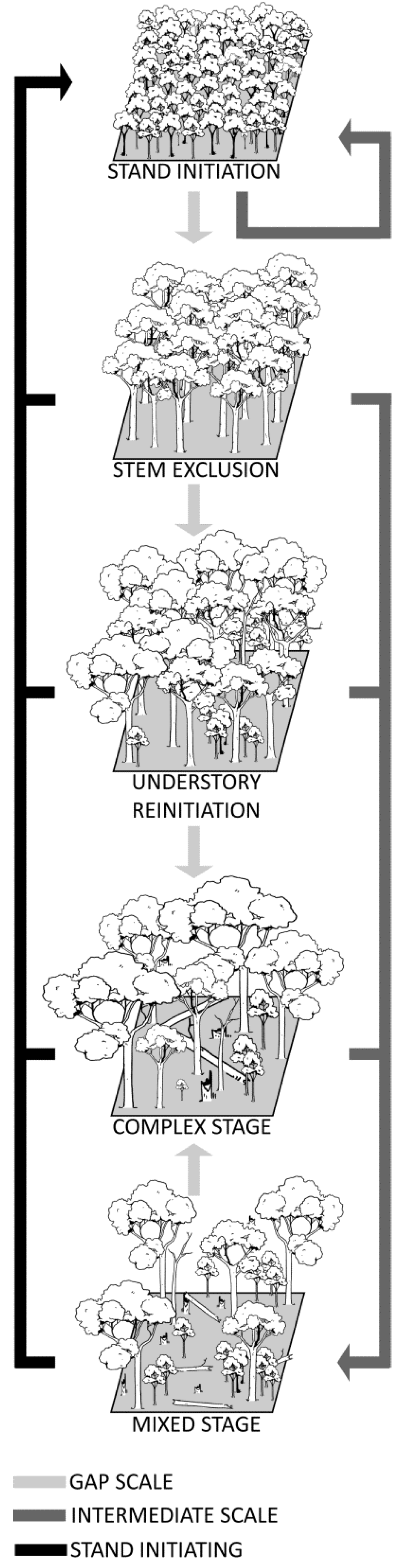
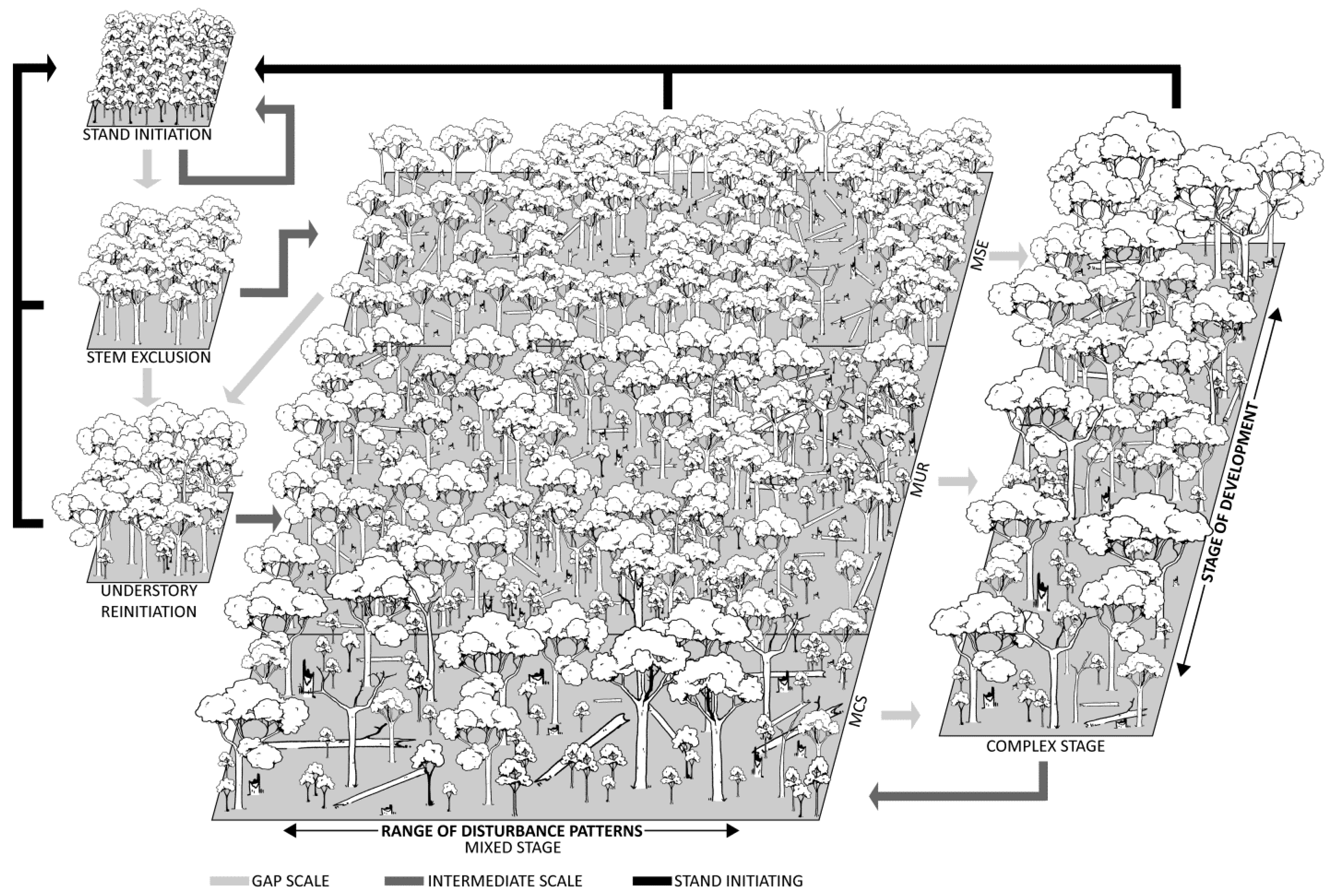
3. Conceptual Model of Oak Stand Development
3.1. Multiple Mixed Stages
3.2. Development of Mixed Stage Stands
3.3. Intermediate-Severity Disturbance Frequency
4. Implementation and Management Implications
5. Conclusions
Conflicts of Interest
References
- O’Hara, K.L. Multiaged Silviculture: Managing for Complex Forest Stand Structures; Oxford University Press: Oxford, UK, 2014. [Google Scholar]
- Oliver, C.D.; Larson, B.C. Forest Stand Dynamics; Wiley: New York, NY, USA, 1996. [Google Scholar]
- Johnson, P.S.; Schifley, S.R.; Rogers, R. The Ecology and Silviculture of Oaks, 1st ed.; CAB International: Cambridge, MS, USA, 2002. [Google Scholar]
- Johnson, P.S.; Schifley, S.R.; Rogers, R. The Ecology and Silviculture of Oaks, 2nd ed.; CAB International: Cambridge, MA, USA, 2009. [Google Scholar]
- Zeide, B. How to measure stand density. Trees 2005, 19, 1–14. [Google Scholar] [CrossRef] [Scilit]
- Hart, J.L.; Grissino-Mayer, H.D. Vegetation patterns and dendroecology of a mixed hardwood forest on the Cumberland Plateau: Implications for stand development. For. Ecol. Manag. 2008, 255, 1960–1975. [Google Scholar] [CrossRef] [Scilit]
- Hart, J.L.; Bhuta, A.A.R.; Schneider, R.M. Canopy disturbance patterns in secondary hardwood stands on the Highland Rim of Alabama. Castanea 2011, 76, 55–63. [Google Scholar] [CrossRef] [Scilit]
- Lorimer, C.G. Development of the red maple understory in northeastern oak forests. For. Sci. 1984, 30, 3–22. [Google Scholar]
- Abrams, M.D. The red maple paradox. BioScience 1998, 48, 355–364. [Google Scholar] [CrossRef] [Scilit]
- Nowacki, G.J.; Abrams, M.D. Demise of fire and mesophication of eastern U.S. forests. BioScience 2008, 58, 123–138. [Google Scholar] [CrossRef] [Scilit]
- Hart, J.L.; Grissino-Mayer, H.D. Gap-scale disturbance processes in secondary hardwood stands on the Cumberland Plateau, Tennessee, USA. Plant Ecol. 2009, 201, 131–146. [Google Scholar] [CrossRef] [Scilit]
- Richards, J.D.; Hart, J.L. Canopy gap dynamics and development patterns in secondary Quercus stands on the Cumberland Plateau, Alabama, USA. For. Ecol. Manag. 2011, 262, 2229–2239. [Google Scholar] [CrossRef] [Scilit]
- Himes, J.M.; Rentch, J.S. Canopy gap dynamics in a second-growth Appalachian hardwood forest in West Virginia. Castanea 2013, 78, 171–184. [Google Scholar] [CrossRef] [Scilit]
- Weber, T.A.; Hart, J.L.; Schweitzer, C.J.; Dey, D.C. Influence of gap-scale disturbance on developmental and successional pathways in Quercus-Pinus stands. For. Ecol. Manag. 2014, 331, 60–70. [Google Scholar] [CrossRef] [Scilit]
- Lorimer, C.G.; Halpin, C.R. Classification and dynamics of developmental stages in late-successional temperate forests. For. Ecol. Manag. 2014, 334, 344–357. [Google Scholar] [CrossRef] [Scilit]
- Rentch, J.S.; Fajvan, M.A.; Hicks, R.R., Jr. Oak establishment and canopy accession strategies in five old-growth stands in the Central Hardwood forest region. For. Ecol. Manag. 2003, 184, 285–297. [Google Scholar] [CrossRef] [Scilit]
- Webster, C.R.; Lorimer, C.G. Minimum opening sizes for canopy recruitment of midtolerant tree species: A retrospective approach. Ecol. Appl. 2005, 15, 1245–1262. [Google Scholar] [CrossRef] [Scilit]
- Zeide, B. Comparison of self-thinning models: An exercise in reasoning. Trees 2010, 24, 1117–1126. [Google Scholar] [CrossRef] [Scilit]
- Foster, D.R.; Boose, E.R. Patterns of forest damage resulting from catastrophic wind in central New England, USA. J. Ecol. 1992, 80, 79–98. [Google Scholar] [CrossRef] [Scilit]
- Peterson, C.J.; Rebertus, A.J. Tornado damage and initial recovery in three adjacent, lowland temperate forests in Missouri. J. Veg. Sci. 1997, 8, 559–564. [Google Scholar] [CrossRef] [Scilit]
- Peterson, C.J. Consistent influence of tree diameter and species on damage in nine eastern North America tornado blowdowns. For. Ecol. Manag. 2007, 250, 96–108. [Google Scholar] [CrossRef] [Scilit]
- White, S.D.; Hart, J.L.; Schweitzer, C.J.; Dey, D.C. Altered structural development and accelerated succession from intermediate-scale wind disturbance in Quercus stands on the Cumberland Plateau, USA. For. Ecol. Manag. 2015, 336, 52–64. [Google Scholar] [CrossRef] [Scilit]
- Cox, L.E.; Hart, J.L.; Dey, D.C.; Schweitzer, C.J. Composition, structure, and intra-stand spatial patterns along a disturbance severity gradient in a Quercus stand. For. Ecol. Manag. 2016, 381, 305–317. [Google Scholar] [CrossRef] [Scilit]
- Johnstone, J.F.; Allen, C.D.; Franklin, J.F.; Frelich, L.E.; Harvey, B.J.; Higuera, P.E.; Mack, M.C.; Meentemeyer, R.K.; Metz, M.R.; Perry, G.L.W.; et al. Changing disturbance regimes, ecological memory, and forest resilience. Front. Ecol. Environ. 2016, 14, 369–378. [Google Scholar] [CrossRef] [Scilit]
- Jogiste, K.; Korjus, H.; Stanturf, J.A.; Frelich, L.E.; Baders, E.; Donis, J.; Jansons, A.; Kangur, A.; Koster, K.; Laarmann, D.; et al. Hemiboreal forest: Natural disturbances and the importance of ecosystem legacies to management. Ecosphere 2017, 8, e01706. [Google Scholar] [CrossRef] [Scilit]
- Hart, J.L.; van de Gevel, S.L.; Grissino-Mayer, H.D. Forest dynamics in a natural area of the southern Ridge and Valley, Tennessee. Nat. Areas J. 2008, 28, 275–289. [Google Scholar] [CrossRef] [Scilit]
- Keasberry, A.M.; Hart, J.L.; Dey, D.C.; Schweitzer, C.J. Spatial patterns of irradiance and advanced reproduction along a canopy disturbance severity gradient in an upland hardwood stand. Forests 2016, 7, 73. [Google Scholar] [CrossRef] [Scilit]
- Elliot, K.J.; Swank, W.T. Impacts of drought on tree mortality and growth in a mixed hardwood forest. J. Veg. Sci. 1994, 5, 229–236. [Google Scholar] [CrossRef] [Scilit]
- Cosgriff, R.J.; Nelson, J.C.; Yin, Y. Floodplain forest response to large-scale flood disturbance. Trans Ill. State Acad. Sci. 2007, 100, 47–70. [Google Scholar]
- Sakai, T.; Tanaka, H.; Shibata, M.; Suzuki, W.; Nomiya, H.; Kanazashi, T.; Iida, S.; Nakashizuka, T. Riparian disturbance and community structure of a Quercus-Ulmus forest in central Japan. Plant Ecol. 1999, 140, 99–109. [Google Scholar] [CrossRef] [Scilit]
- Covey, K.R.; Barrett, A.L.; Ashton, M.S. Ice storms as a successional pathway for Fagus grandifolia advancement in Quercus rubra dominated forests of southern New England. Can. J. For. Res. 2015, 45, 1628–1635. [Google Scholar] [CrossRef] [Scilit]
- Rebertus, A.J.; Shifley, S.R.; Richards, R.H.; Roovers, L.M. Ice storm damage to an old-growth oak-hickory forest in Missouri. Am. Midl. Nat. 1997, 137, 48–61. [Google Scholar] [CrossRef] [Scilit]
- Turcotte, R.M.; Elliott, T.R.; Fajvan, M.A.; Park, Y.L.; Snider, D.A.; Tobin, P.C. Effects of ice storm damage on hardwood survival and growth in Ohio. North. J. Appl. For. 2012, 29, 53–59. [Google Scholar] [CrossRef] [Scilit]
- Lafon, C.W. Forest disturbance by ice storms in Quercus forests of the southern Appalachian Mountains. Ecoscience 2006, 13, 30–43. [Google Scholar] [CrossRef] [Scilit]
- Warrillow, M.; Mou, P. Ice Storm damage to forest tree species in the Ridge and Valley region of southwestern Virginia. J. Torrey Bot. Soc. 1999, 126, 147–158. [Google Scholar] [CrossRef] [Scilit]
- Whitney, H.E.; Johnson, W.C. Ice storms and forest succession in southwestern Virginia. Bull. Torrey Bot. Club 1984, 111, 429–437. [Google Scholar] [CrossRef] [Scilit]
- Fajvan, M.A.; Wood, J.M. Stand structure and development after gypsy moth defoliation in the Appalachian Plateau. For. Ecol. Manag. 1996, 89, 79–88. [Google Scholar] [CrossRef] [Scilit]
- Catry, F.X.; Moreira, F.; Duarte, I.; Acacio, V. Factors affecting post-fire crown regeneration in cork oak (Quercus suber L.) trees. Eur. J. For. Res. 2009, 128, 231–240. [Google Scholar] [CrossRef] [Scilit]
- Cocking, M.I.; Varner, J.M.; Knapp, E.E. Long-term effects of fire severity on oak-conifer dynamics in the southern Cascades. Ecol. Appl. 2014, 24, 94–107. [Google Scholar] [CrossRef] [Scilit] [PubMed]
- Henderson, N.R.; Long, J.N. A comparison of stand structure and fire history in two black oak woodlands in northwestern Indiana. Bot. Gaz. 1984, 145, 222–228. [Google Scholar] [CrossRef] [Scilit]
- van de Gevel, S.L.; Hart, J.L.; Spond, M.D.; White, P.B.; Sutton, M.N.; Grissino-Mayer, H.D. American chestnut to northern red oak: Forest dynamics in an old-growth forest in the Blue Ridge Mountains, USA. Botany 2012, 90, 126–1276. [Google Scholar] [CrossRef] [Scilit]
- Keever, C. Present composition of some stands of the former oak-chestnut forest in the southern Blue Ridge Mountains. Ecology 1953, 34, 44–54. [Google Scholar] [CrossRef] [Scilit]
- McCormick, J.F.; Platt, R.B. Recovery of an Appalachian forest following the chestnut blight or Catherine Keever-you were right! Am. Midl. Nat. 1980, 104, 264–273. [Google Scholar] [CrossRef] [Scilit]
- Oguroa, M.; Imahiroa, S.; Saitob, S.; Nakashizukaa, T. Relative importance of multiple scale factors to oak tree mortality due to Japanese oak wilt disease. For. Ecol. Manag. 2015, 356, 173–183. [Google Scholar] [CrossRef] [Scilit]
- Cowden, M.M.; Hart, J.L.; Schweitzer, C.J.; Dey, D.C. Effects of intermediate-scale wind disturbance on composition, structure, and succession in Quercus stands: Implications for natural disturbance-based silviculture. For. Ecol. Manag. 2014, 330, 240–251. [Google Scholar] [CrossRef] [Scilit]
- Holzmueller, E.J.; Gibons, D.J.; Suchecki, P.F. Accelerated succession following an intense wind storm in an oak-dominated forest. For. Ecol. Manag. 2012, 279, 141–146. [Google Scholar] [CrossRef] [Scilit]
- Altman, J.; Dolezal, J.; Cerny, T.; Song, J.S. Forest response to increasing typhoon activity on the Korean peninsula: Evidence from oak tree-rings. Glob. Chang. Biol. 2013, 19, 498–504. [Google Scholar] [CrossRef] [Scilit] [PubMed]
- Greenberg, C.H.; McNab, W.H. Forest disturbance in hurricane-related downbursts in the Appalachian mountains of North Carolina. For. Ecol. Manag. 1998, 104, 179–191. [Google Scholar] [CrossRef] [Scilit]
- Myster, R.W.; Malahy, M.P. Tornado effects on damage, resprouting and spatial heterogeneity in the Cross Timbers ecotone of Oklahoma, USA. J. Plant Ecol. 2010, 3, 157–163. [Google Scholar] [CrossRef] [Scilit]
- Johnson, P.S. Predicting Oak Stump Sprouting and Sprout Development in the Missouri Ozarks; Research Paper NC-149; USDA Forest Service, North Central Forest Experiment Station: St. Paul, MN, USA, 1977. [Google Scholar]
- McGee, C.E. Size and Age of Tree Affect White Oak Stump Sprouting; Reserch Note SO-239; USDA Forest Service, Southern Forest Experiment Station: New Orelans, LA, USA, 1978. [Google Scholar]
- Dey, D.C.; Jensen, R.G. Stump sprouting potential for oaks in Missouri Ozark forests managed by even- and uneven-aged silviculture. In Proceedings of the Second Missouri Ozark Forest Ecosystem Project Symposium: Post-treatment Results of the Landscape Experiment, St. Louis, MO, USA, 17–18 October 2000; Shifley, S.R., Kabrick, J.M., Eds.; General Technical Report NC-227. USDA Forest Service, North Central Forest Experiment Station: St. Paul, MN, USA, 2002. [Google Scholar]
- Sands, B.; Abrams, M.D. The effects of stump diameter on sprout number and size for three oak species in a Pennsylvania clearcut. North. J. Appl. For. 2009, 26, 122–125. [Google Scholar]
- Tyrrell, L.E.; Nowacki, G.J.; Crow, T.R.; Buckley, D.S.; Nauertz, E.A.; Niese, J.N.; Rollinger, J.L.; Zasada, J.C. Information About Old-Growth for Selected Forest Type Groups in the Eastern United States; GTR-NC-197; USDA Forest Service, North Central Forest Experiment Station: St. Paul, MN, USA, 1998. [Google Scholar]
- Burrascano, S.; Keeton, W.S.; Sabatini, F.M.; Blasi, C. Commonality and variability in the structural attributes of moist temperate old-growth forests: A global review. For. Ecol. Manag. 2013, 291, 458–479. [Google Scholar] [CrossRef] [Scilit]
- Nowacki, G.J.; Abrams, M.D. Radial-growth averaging criteria for reconstructing disturbance histories from presettlement-origin oaks. Ecol. Monogr. 1997, 67, 225–249. [Google Scholar] [CrossRef] [Scilit]
- Ruffner, C.M.; Abrams, M.D. Relating land-use history and climate to the dendroecology of a 326-year old Quercus prinus talus slope forest. Can. J. For. Res. 1998, 28, 347–358. [Google Scholar] [CrossRef]
- Lafon, C.W.; Speer, J.H. Using dendrochronology to identify major ice storm events in oak forests of southwestern Virginia. Clim. Res. 2002, 20, 41–54. [Google Scholar] [CrossRef] [Scilit]
- Hart, J.L.; Clark, S.L.; Torreano, S.J.; Buchanan, M.L. Composition, structure, and dendroecology of an old-growth Quercus forest on the tablelands of the Cumberland Plateau, USA. For. Ecol. Manag. 2012, 266, 11–24. [Google Scholar] [CrossRef] [Scilit]
- Hart, J.L.; Cowden, M.M.; Torreano, S.J.; Vestal, P.R. Disturbance, succession, and structural development of an upland hardwood forest on the Interior Low Plateau, Tennessee. Nat. Areas J. 2015, 35, 557–573. [Google Scholar] [CrossRef] [Scilit]
- Ford, S.A.; Kleinman, J.S.; Hart, J.L. Spatial patterns of canopy disturbance, structure, and species composition in a multi-cohort hardwood stand. Forests 2017, 8, 93. [Google Scholar] [CrossRef] [Scilit]
- National Climate Data Center. Tornado Climatology, US National Oceanic and Atmospheric Administration. Available online: http://www.ncdc.noaa.gov/climate-information/extreme-events/us-tornado-climatology (accessed on 15 July 2016).
- Storm Prediction Center. US National Oceanic and Atmospheric Administration, National Weather Service. Available online: http://www.spc.noaa.gov/climo/online/monthly/2015_annual_summary.html (accessed on 1 April 2017).
- Abell, C.A. Glaze storms in hardwood forests. J. For. 1934, 32, 35–37. [Google Scholar]

| Disturbance agent | Location | Dominant species | Citation |
|---|---|---|---|
| Drought | North Carolina, USA | Mixed oak | [28] |
| Flood | Illinois, USA | Mixed oak | [29] |
| Flood | Tochigi Prefecture, Japan | Mongolian oak (Q. mongolica) | [30] |
| Ice storm | Connecticut, USA | Northern red oak (Q. rubra) | [31] |
| Ice storm | Missouri, USA | White oak (Q. alba), northern red oak | [32] |
| Ice storm | Ohio, USA | Mixed oak, hickory (Carya spp.), tulip-poplar | [33] |
| Ice storm | Virginia, USA | Chestnut oak (Q. prinus) | [34] |
| Ice storm | Virginia, USA | Chestnut oak, white oak, scarlet oak (Q. coccinea) | [35] |
| Ice storm | Virginia, USA | Mixed oak | [36] |
| Insect outbreak | Pennsylvania, USA | Mixed oak | [37] |
| Mixed severity fire | Algarve District, Portugal | Cork oak (Q. suber) | [38] |
| Mixed severity fire | California, USA | California black oak (Q. kelloggii) | [39] |
| Mixed severity fire | Indiana, USA | Black oak (Q. velutina) | [40] |
| Pathogen | North Carolina, USA | Northern red oak | [41] |
| Pathogen | North Carolina, USA | Mixed oak | [42] |
| Pathogen | Tennessee, USA | White oak, tulip-poplar | [26] |
| Pathogen | Virginia, USA | Chestnut oak, northern red oak, white oak | [43] |
| Pathogen | Yamagata Prefecture, Japan | Mongolian oak | [44] |
| Wind event | Alabama, USA | Mixed oak, hickory | [45] |
| Wind event | Alabama, USA | White oak | [23] |
| Wind event | Illinois, USA | Mixed oak | [46] |
| Wind event | Jeju-do Province, South Korea | Mongolian oak | [47] |
| Wind event | Missouri, USA | Mixed oak, overcup oak (Q. lyrata) | [20] |
| Wind event | North Carolina, USA | Scarlet oak, chestnut oak, black oak | [48] |
| Wind event | Oklahoma, USA | Blackjack oak (Q. marilandica), post oak (Q. stellata) | [49] |
© 2017 by the authors. Licensee MDPI, Basel, Switzerland. This article is an open access article distributed under the terms and conditions of the Creative Commons Attribution (CC BY) license (http://creativecommons.org/licenses/by/4.0/).
Share and Cite
Hart, J.L.; Cox, L.E. Incorporating Intermediate-Severity Disturbances in Oak Stand Development. Forests 2017, 8, 284. https://doi.org/10.3390/f8080284
Hart JL, Cox LE. Incorporating Intermediate-Severity Disturbances in Oak Stand Development. Forests. 2017; 8(8):284. https://doi.org/10.3390/f8080284
Chicago/Turabian StyleHart, Justin L., and Lauren E. Cox. 2017. "Incorporating Intermediate-Severity Disturbances in Oak Stand Development" Forests 8, no. 8: 284. https://doi.org/10.3390/f8080284
APA StyleHart, J. L., & Cox, L. E. (2017). Incorporating Intermediate-Severity Disturbances in Oak Stand Development. Forests, 8(8), 284. https://doi.org/10.3390/f8080284

