Pricing or Quota? A Solution to Water Scarcity in Oasis Regions in China: A Case Study in the Heihe River Basin

Abstract
1. Introduction
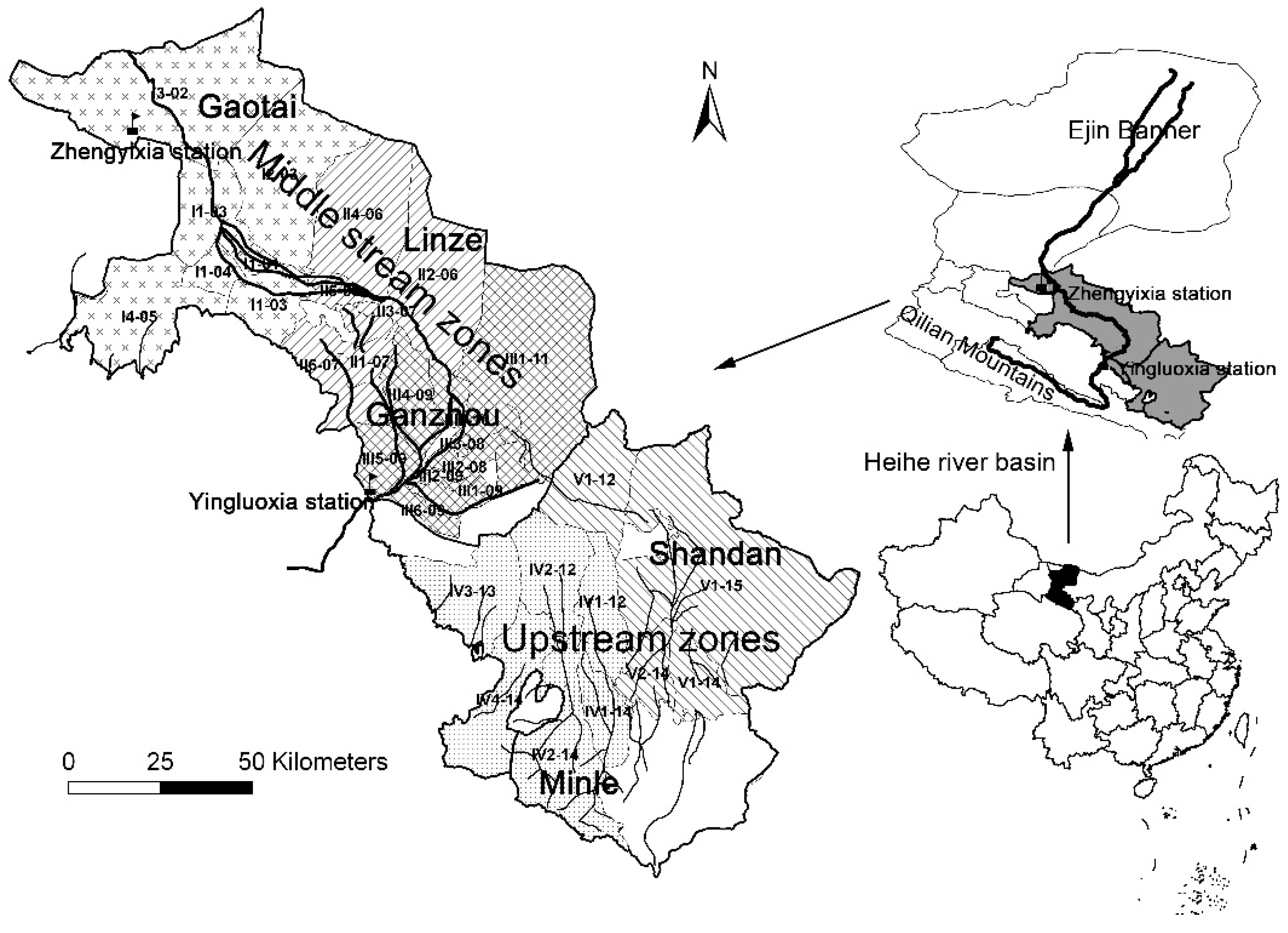
2. Description of the Heihe River Basin

3. Analytical Framework
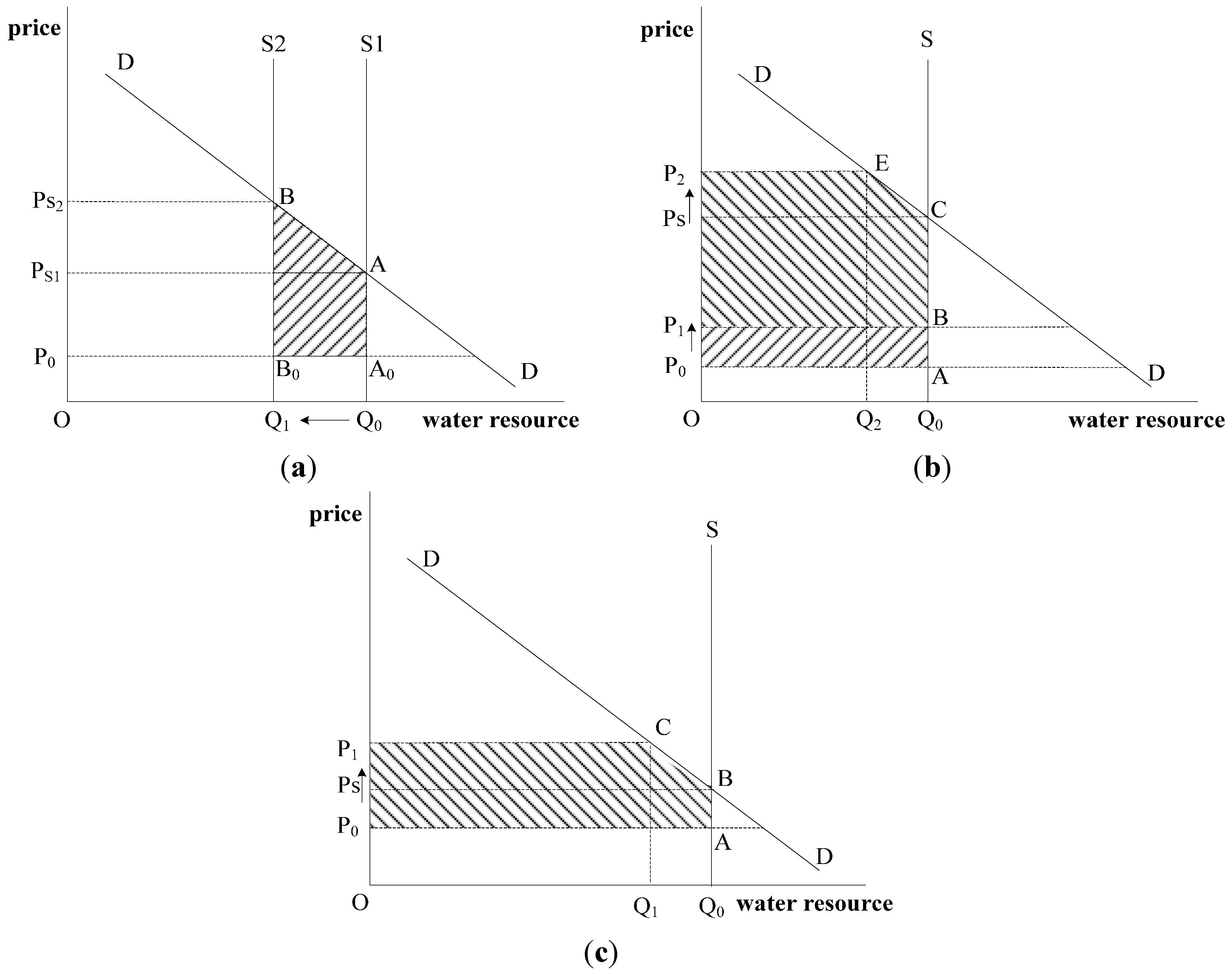
3.1. Characterization of Quantitative Control and Price Control

3.2. The Bio-Economic Model

| Variables | Explanation | Variables | Explanation |
|---|---|---|---|
| M | Net income | N | Amount of available loan |
| M0 | Cash income in the base year | D | Subsidy to farmers |
| x | A vector of inputs used in production of crop c or livestock v | i | Type of vectors of input x |
| g | Land type of cultivated land | c | Crop |
| A | Land endowment | P | Price of crop output, livestock output or purchased food |
| Ar | Area of rangeland | Acg | Area of crop c produced on land type g |
| v | Livestock | ycg | Yield function for production of crop c on land type g |
| Lv | Stock level of livestock v | yv | Yield function for livestock v and livestock product |
| ei | Per unit input cost for input xi | yr | Grass yield of rangeland |
| j | Type of purchased food | f | Purchased food |
| zf | Family labor used on-farm | Zh | Total family labor |
| Zf | Total farm labor input | wk | Wage for hired labor |
| w0 | Wage for off-farm labor | hk | Hired labor used on-farm |
| z0 | Family labor used off-farm | α | Daily fodder requirement of livestock v |
| γ | Daily subsistent nutrition requirement of human | β | Nutrition content of food |
| H | Human population | T | Supplementary fodder from crop residue |
| b | Crop or livestock output y used for self-consumption | S | Crop or livestock output y used for self-supply, such as seed, feed, draft animal |
| W total | Total available water resources | Ws | Allocated surface water based on quota |
| Wg | Available groundwater resources | inf | Infiltration of mainstream |
| et | Evaporation of runoff | cf | Canal use efficiency coefficient |
| Qcg | Water quota of crop c on land type g | Qv | Water quota of livestock v |


3.3. Data Source and Data Description
| Middle Stream Region | Upstream Regions | ||||
|---|---|---|---|---|---|
| Ganzhou | Linze | Gaotai | Minle | Shandan | |
| Sampled villages | 14 | 6 | 9 | 10 | 6 |
| Householder | 138 | 108 | 113 | 63 | 90 |
| Population (person) | 581 | 425 | 449 | 265 | 439 |
| Cultivated land (ha) | 79 | 89 | 68 | 73 | 110 |
| Labor (person) | 281 | 208 | 209 | 117 | 201 |
| Proportion of farm labor (%) | 46 | 54 | 67 | 39 | 35 |
| Proportion of Off-farm labor (%) | 54 | 46 | 33 | 61 | 65 |
| Income per capita (Yuan/person) | 9913 | 10,867 | 10,917 | 10,799 | 9663 |
| Proportion of agriculture income (%) | 35 | 50 | 38 | 48 | 35 |
| Proportion of off-farm income (%) | 65 | 50 | 62 | 52 | 65 |
| Crop structure | |||||
| Grain crops (%) | 18 | 11 | 24 | 36 | 37 |
| Cash crop (%) (including seed corn) | 57 | 75 | 51 | 36 | 41 |
| Other crops (%) | 25 | 14 | 25 | 29 | 22 |
3.4. Model Calibration
4. Results and Discussion
4.1. Effects of Changing Runoff on the Shadow Price
| Cases of Irrigation Zones | Regions | Code for the Irrigation Zones | Description | Shadow Price of Water Resources (Yuan/m3) | |
|---|---|---|---|---|---|
| Present Situation | Annual Mean Runoff | ||||
| Q1 | Middle stream regions | I1-01, I1-03, I1-04, I3-02,II2-06, II4-06, II5-06, III4-09, III5-09, III6-09 | Water surplus irrigation zones where available water is able to meet current water requirement under annual mean runoff | 0.082 | 0.083 |
| Q2 | Middle stream regions | I2-03, II3-07, II6-07, III1-11 | Irrigation zones where available water changes from surplus to shortage with runoff changes from present situation to annual mean runoff | 0.082 | 1.133 |
| Q3 | Middle stream regions | II1-07, III1-09, III2-08, III2-09, III3-08, III3-10; | Water shortage irrigation zones where available water cannot meet current water requirement under present situation | 0.836 | 0.839 |
| Upstream regions | IV1-12, IV1-14, IV2-12, IV2-14, IV3-13, IV4-14, V1-12, V1-14, V1-15, V2-14, I4-05 | 1.553 | 1.550 | ||
4.2. Effects of Raising Water Price
| Case of Irrigation Zones | Regions | Code for the Irrigation Zones | Description | Change in Water Requirement (million m3) | Change in per capita cereal production (%) | ||||||||||
|---|---|---|---|---|---|---|---|---|---|---|---|---|---|---|---|
| Effects of Raising Surface and Ground Water Price | Effects of Raising Surface Water Price | Effects of Raising Surface and Ground Water Price | Effects of Raising Surface Water Price | ||||||||||||
| 2 Times | 5 Times | 10 Times | 2 Times | 5 Times | 10 Times | 2 Times | 5 Times | 10 Times | 2 Times | 5 Times | 10 Times | ||||
| P1 | Middle stream regions | I1-01, I1-03, I1-04, I3-02, II2-06, II4-06, II5-06, III4-09, III1-09, III5-09, III6-09 | Water surplus irrigation zones under annual mean runoff | −1 | −15 | −78 | −1 | −11 | −71 | −1 | −19 | −16 | 0 | −18 | −19 |
| P2 | Middle stream regions | II1-07, II3-07, II6-07, III1-11 | Water shortage irrigation zones under annual runoff and there is no change of cropping system with water price rise | 0 | 0 | −31 | 0 | 0 | −20 | 0 | 0 | −15 | 0 | 0 | −8 |
| Upstream regions | V1-14, V1-15, V2-14, IV1-14, IV2-14, V3-13, IV4-14 | 0 | 0 | 0 | 0 | 0 | 0 | 0 | 0 | 0 | 0 | 0 | 0 | ||
| P3 | Middle stream regions | I2-03, III2-08, III2-09, III3-08, III3-10 | Water shortage irrigation zones under annual mean runoff and there are changes of cropping system with water price rise | 0 | 0 | −49 | 0 | 0 | −46 | −1 | −3 | −7 | 0 | −1 | −3 |
| Upstream regions | I4-05, V1-12, IV1-12, IV2-12 | 0 | −1 | −18 | 0 | −1 | −18 | −1 | −3 | −7 | −1 | −3 | −5 | ||
| Case of Irrigation Zones | Regions | Effects of Raising Surface and Ground Water Price | Effects of Raising Surface Water Price | |||||
|---|---|---|---|---|---|---|---|---|
| 2 Times | 5 Times | 10 Times | 2 Times | 5 Times | 10 Times | |||
| Changes in per capita income (Yuan/person) | P1 | Middle stream regions | −125 | −496 | −1095 | −80 | −317 | −685 |
| P2 | Middle stream regions | −145 | −578 | −1309 | −120 | −479 | −1087 | |
| Upstream regions | −56 | −226 | −513 | −43 | −172 | −390 | ||
| P3 | Middle stream regions | −84 | −336 | −748 | −48 | −192 | −431 | |
| Upstream regions | −109 | −452 | −1128 | −98 | −406 | −1018 | ||
| Of which: changes in per capita income caused by irrigation cost increasing (Yuan/person) | P1 | Middle stream regions | −49 | −185 | −381 | −31 | −110 | −229 |
| P2 | Middle stream regions | −51 | −204 | −295 | −42 | −169 | −268 | |
| Upstream regions | −26 | −103 | −235 | −19 | −77 | −174 | ||
| P3 | Middle stream regions | −43 | −170 | −39 | −24 | −97 | 103 | |
| Upstream regions | −32 | −138 | −264 | −27 | −110 | −232 | ||
| Of which: changes in per capita income caused by production system change (Yuan/person) | P1 | Middle stream regions | −76 | −311 | −714 | −49 | −206 | −456 |
| P2 | Middle stream regions | −94 | −374 | −1014 | −78 | −310 | −820 | |
| Upstream regions | −30 | −122 | −278 | −24 | −95 | −216 | ||
| P3 | Middle stream regions | −41 | −166 | −710 | −24 | −95 | −534 | |
| Upstream regions | −77 | −314 | −865 | −71 | −296 | −785 | ||
| Compensation (Yuan/person) | P1 | Middle stream regions | 100 | 392 | 801 | 64 | 251 | 488 |
| P2 | Middle stream regions | 121 | 486 | 906 | 101 | 402 | 790 | |
| Upstream regions | 47 | 188 | 423 | 36 | 145 | 326 | ||
| P3 | Middle stream regions | 64 | 256 | 463 | 37 | 147 | 228 | |
| Upstream regions | 80 | 317 | 647 | 71 | 280 | 564 | ||
4.3. Effects of Reducing Water Allocation Quota Control
| Case of Irrigation Zones | Regions | Shadow Price of Annual Mean Runoff | Shadow Price of Reducing Water Allocation | Change in Water Requirement | Change in Per Capita Income | Change in Per Capita Cereal Production | Compensation |
|---|---|---|---|---|---|---|---|
| (Yuan/m3) | (Yuan/m3) | (Million m3) | (Yuan/Person) | (%) | (Yuan/Person) | ||
| Q1 | Middle stream regions | 0.083 | 0.948 | −232 | −98 | 0 | 879 |
| Q2 | Middle stream regions | 1.133 | 1.280 | −16 | −97 | −20 | 174 |
| Q3 | Middle stream regions | 0.839 | 0.963 | −15 | −50 | 0 | 84 |
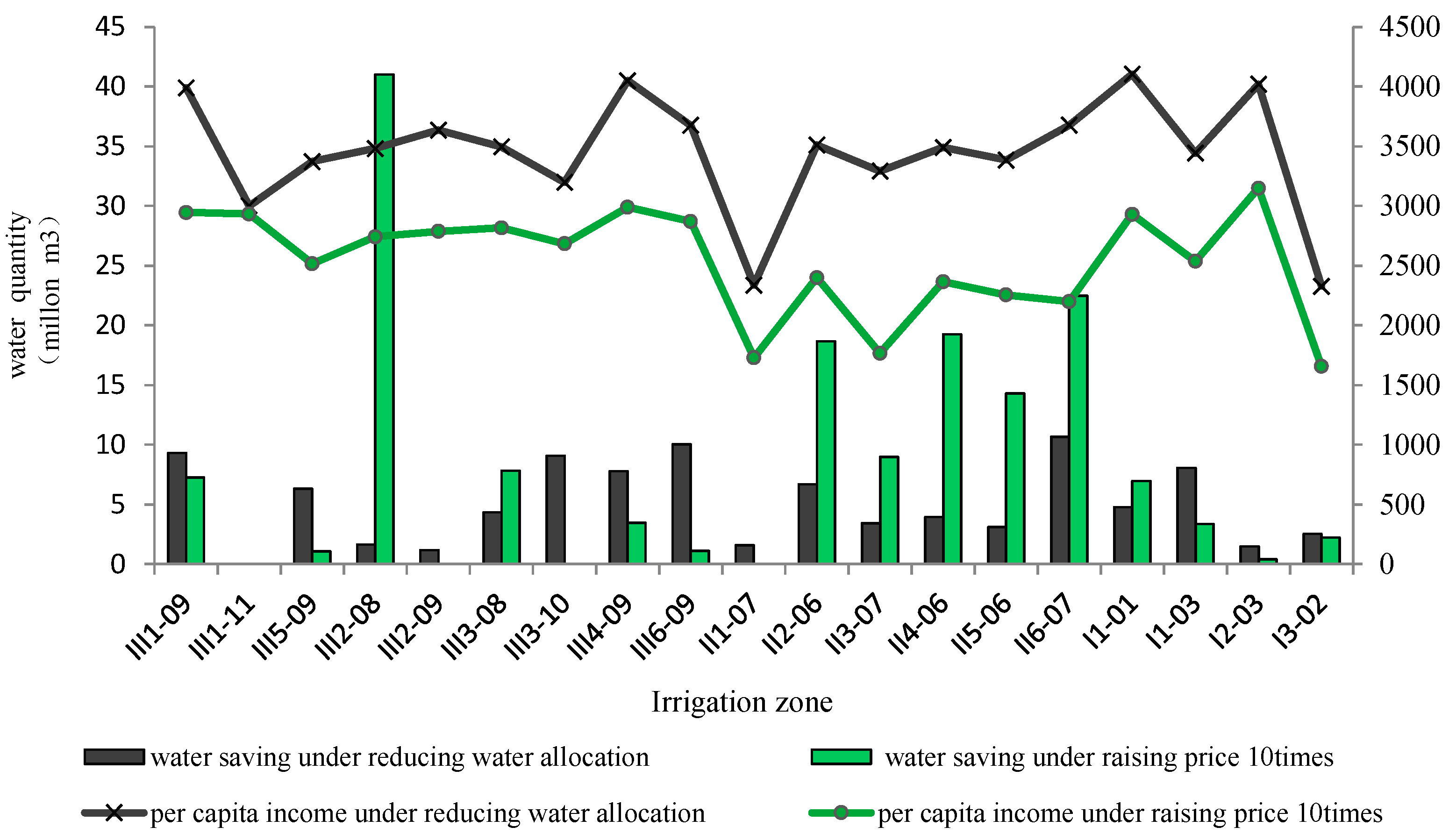
4.4. Comparison of Income Losses of Water Saving under the Quantitative Control and Price Control

5. Main Findings and Conclusions
Acknowledgments
Author Contributions
Conflicts of Interest
References
- Chen, Y.; Zhang, D.Q.; Sun, Y.B.; Liu, X.N.; Wang, N.Z.; Savenije, H.H.G. Water demand management: A case study of the heihe river basin in china. Phys. Chem. Earth 2005, 30, 408–419. [Google Scholar] [CrossRef]
- Qu, F.; Kuyvenhoven, A.; Shi, X.; Heerink, N. Sustainable natural resource use in rural China: Recent trends and policies. China Econ. Rev. 2011, 22, 444–460. [Google Scholar] [CrossRef]
- Ward, F.A.; Pulido-Velazquez, M. Water conservation in irrigation can increase water use. Proc. Natl. Acad. Sci. USA 2008, 105, 18215–18220. [Google Scholar] [CrossRef] [PubMed]
- Wietzman, M. Prices vs. quantities. Rev. Econ. Stud. 1974, 41, 477–491. [Google Scholar] [CrossRef]
- Cosgrove, W.J.; Rijsberman, F.R. World Water Vision: Making Water Everybody’s Business; Earthscan: London, UK, 2000. [Google Scholar]
- Tsur, Y.; Dinar, A. The relative efficiency and implementation costs of alternative methods for pricing irrigation water. World Bank Econ. Rev. 1997, 11, 243–262. [Google Scholar] [CrossRef]
- European Union. Establishing a framework for community action in the field of water policy (2000/60/EC). Off. J. Eur. Commun. 2000, 327, 1–72. [Google Scholar]
- Kampas, A.; Petsakos, A.; Rozakis, S. Price induced irrigation water saving: Unraveling conflicts and synergies between European agricultural and water policies for a Greek Water District. Agric. Syst. 2012, 113, 28–38. [Google Scholar] [CrossRef]
- Varela-Ortega, C.; Sumpsi, J.M.; Garrido, A.; Blanco, M.; Iglesias, E. Water pricing policies, public decision making and farmers’ response: Implications for water policy. Agric. Econ. 1998, 19, 193–202. [Google Scholar] [CrossRef]
- Yang, H.; Zhang, X.H.; Zehnder, A.J.B. Water scarcity, pricing mechanism and institutional reform in northern China irrigated agriculture. Agric. Water Manag. 2003, 61, 143–161. [Google Scholar] [CrossRef]
- Abu-Madi, M.O. Farm-level perspectives regarding irrigation water prices in the Tulkarm district, Palestine. Agric. Water Manag. 2009, 96, 1344–1350. [Google Scholar] [CrossRef]
- Molle, F. Water scarcity, prices and quotas: A review of evidence on irrigation volumetric pricing. Irrig. Drain. Syst. 2009, 23, 43–58. [Google Scholar] [CrossRef]
- Gallego-Ayala, J.; Gomez-Limon, J.A.; Arriaza, M. Irrigation water pricing instruments: A sustainability assessment. Spanish J. Agric. Res. 2011, 9, 981–999. [Google Scholar] [CrossRef]
- Wei, Y.P.; Chen, D.L.; Hu, K.L.; Willett, I.R.; Langford, J. Policy incentives for reducing nitrate leaching from intensive agriculture in desert oases of Alxa, Inner Mongolia, China. Agric. Water Manag. 2009, 96, 1114–1119. [Google Scholar] [CrossRef]
- Wei, Y.P.; Davidson, B.; Chen, D.L.; White, R. Balancing the economic, social and environmental dimensions of agro-ecosystems: An integrated modeling approach. Agric. Ecosyst. Environ. 2009, 131, 263–273. [Google Scholar] [CrossRef]
- Huang, Q.Q.; Rozelle, S.; Howitt, R.; Wang, J.X.; Huang, J.K. Irrigation water demand and implications for water pricing policy in rural China. Environ. Dev. Econ. 2010, 15, 293–319. [Google Scholar] [CrossRef]
- Appels, D.; Douglas, R.; Dwyer, G. Responsiveness of Demand for Irrigation Water: A Focus on the Southern Murray-Darling Basin; Productivity Commission: Melbourne, Australia, 2004. [Google Scholar]
- Scheierling, S.M.; Loomis, J.B.; Young, R.A. Irrigation water demand: A meta-analysis of price elasticities. Water Resour. Res. 2006. [Google Scholar] [CrossRef]
- Olmstead, S.M.; Michael Hanemann, W.; Stavins, R.N. Water demand under alternative price structures. J. Environ. Econ. Manag. 2007, 54, 181–198. [Google Scholar] [CrossRef]
- Davidson, B.; Hellegers, P. Estimating the own-price elasticity of demand for irrigation water in the Musi catchment of India. J. Hydrol. 2011, 408, 226–234. [Google Scholar] [CrossRef]
- Bate, R. Water- can property rights and markets replace conflict? In Sustainable Development: Promoting Progress or Perpetuating Poverty? Morris, J., Ed.; Profile Books: London, UK, 2002. [Google Scholar]
- Tsur, Y.; Dinar, A. Efficiency and Equity Considerations in Pricing and Allocating Irrigation Water; World Bank Publications: Washington, DC, USA, 1995; Volume 1460. [Google Scholar]
- Mohamed, A.S.; Savenije, H.H.G. Water demand management: Positive incentives, negative incentives or quota regulation? Phys. Chem. Earth Part B Hydrol. Oceans Atmos. 2000, 25, 251–258. [Google Scholar] [CrossRef]
- Wichelns, D. Economic analysis of water allocation policies regarding nile river water in Egypt. Agric. Water Manag. 2002, 52, 155–175. [Google Scholar] [CrossRef]
- Mul, M.L.; Kemerink, J.S.; Vyagusa, N.F.; Mshana, M.G.; van der Zaag, P.; Makurira, H. Water allocation practices among smallholder farmers in the South Pare Mountains, Tanzania: The issue of scale. Agric. Water Manag. 2011, 98, 1752–1760. [Google Scholar] [CrossRef]
- Vos, J.; Vincent, L. Volumetric water control in a large-scale open canal irrigation system with many smallholders: The case of Chancay-Lambayeque in Peru. Agric. Water Manag. 2011, 98, 705–714. [Google Scholar] [CrossRef]
- Liao, Y.S.; Gao, Z.Y.; Bao, Z.Y.; Huang, Q.W.; Feng, G.Z.; Xu, D.; Cai, J.B.; Han, H.J.; Wu, W.F. China’s Water Pricing Reforms for Irrigation: Effectiveness and Impact; International Water Management Institute: Sri Lanka, Colombo, 2008. [Google Scholar]
- Wang, J.X.; Huang, J.K.; Xu, Z.G.; Rozell, S.; Hussain, I.; Biltonen, E.; Huang, Q.Q.; Msangi, S. Pro-poor intervention strategies in irrigated agriculture in Asia: Poverty in irrigated agriculture: Issues and options: China. Irrig. Drain 2007, 56, 119–126. [Google Scholar] [CrossRef]
- Webber, M.; Barnett, J.; Finlayson, B.; Wang, M. Pricing China’s irrigation water. Glob. Environ. Change-Hum. Policy Dimens. 2008, 18, 617–625. [Google Scholar] [CrossRef]
- Shen, Y.; Lein, H. Treating water as an economic good: Policies and practices in irrigation agriculture in Xinjiang, China. Geogr. J. 2010, 176, 124–137. [Google Scholar]
- Fragoso, R.; Marques, C. The Economic Impact of Alternative Water Pricing Policies in Alentejo Region; University of Evora: Evora, Portugal, 2013. [Google Scholar]
- Li, X.; Tian, Z. Practices and Reflections on Establishing a Water-Saving Society; China Water Press: Beijing, China, 2003. (In Chinese) [Google Scholar]
- Berbel, J.; Mateos, L. Does investment in irrigation technology necessarily generate rebound effects? A simulation analysis based on an agro-economic model. Agric. Syst. 2014, 128, 25–34. [Google Scholar] [CrossRef]
- Aucamp, D.C.; Steinberg, D.I. The computation of shadow prices in linear programming. J. Oper. Res. Soc. 1982, 33, 557–565. [Google Scholar] [CrossRef]
- Shi, M.J.; Zhang, Q.Y.; Wang, T. Better access to new technologies and credit service, farmers’ land use decision, and policy for poverty alleviation and rangeland conservation. Jarq-Jpn. Agric. Res. Q. 2005, 39, 181–190. [Google Scholar] [CrossRef]
- Janssen, S.; van Ittersum, M.K. Assessing farm innovations and responses to policies: A review of bio-economic farm models. Agric. Syst. 2007, 94, 622–636. [Google Scholar] [CrossRef]
© 2014 by the authors; licensee MDPI, Basel, Switzerland. This article is an open access article distributed under the terms and conditions of the Creative Commons Attribution license (http://creativecommons.org/licenses/by/4.0/).
Share and Cite
Shi, M.; Wang, X.; Yang, H.; Wang, T. Pricing or Quota? A Solution to Water Scarcity in Oasis Regions in China: A Case Study in the Heihe River Basin. Sustainability 2014, 6, 7601-7620. https://doi.org/10.3390/su6117601
Shi M, Wang X, Yang H, Wang T. Pricing or Quota? A Solution to Water Scarcity in Oasis Regions in China: A Case Study in the Heihe River Basin. Sustainability. 2014; 6(11):7601-7620. https://doi.org/10.3390/su6117601
Chicago/Turabian StyleShi, Minjun, Xiaojun Wang, Hong Yang, and Tao Wang. 2014. "Pricing or Quota? A Solution to Water Scarcity in Oasis Regions in China: A Case Study in the Heihe River Basin" Sustainability 6, no. 11: 7601-7620. https://doi.org/10.3390/su6117601
APA StyleShi, M., Wang, X., Yang, H., & Wang, T. (2014). Pricing or Quota? A Solution to Water Scarcity in Oasis Regions in China: A Case Study in the Heihe River Basin. Sustainability, 6(11), 7601-7620. https://doi.org/10.3390/su6117601