

Facilities Design Based on Apparent Motion of Grating for Speed Reduction in Tunnel
Abstract
1. Introduction
2. Design Theory
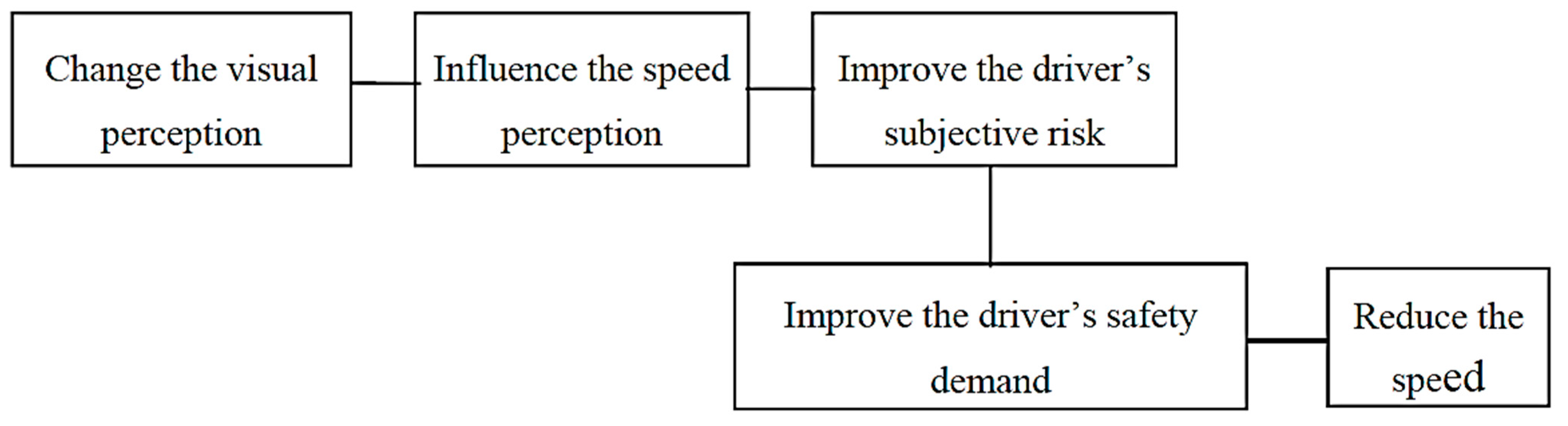
2.1. Speed Control Process

2.2. Apparent Motion
3. Experimental Section
3.1. Experiment 1: Optimal Form of Apparent Motion
3.1.1. Measurement of Optimal Form of Apparent Motion
3.1.2. Apparatus
3.1.3. Participants
3.1.4. Procedures
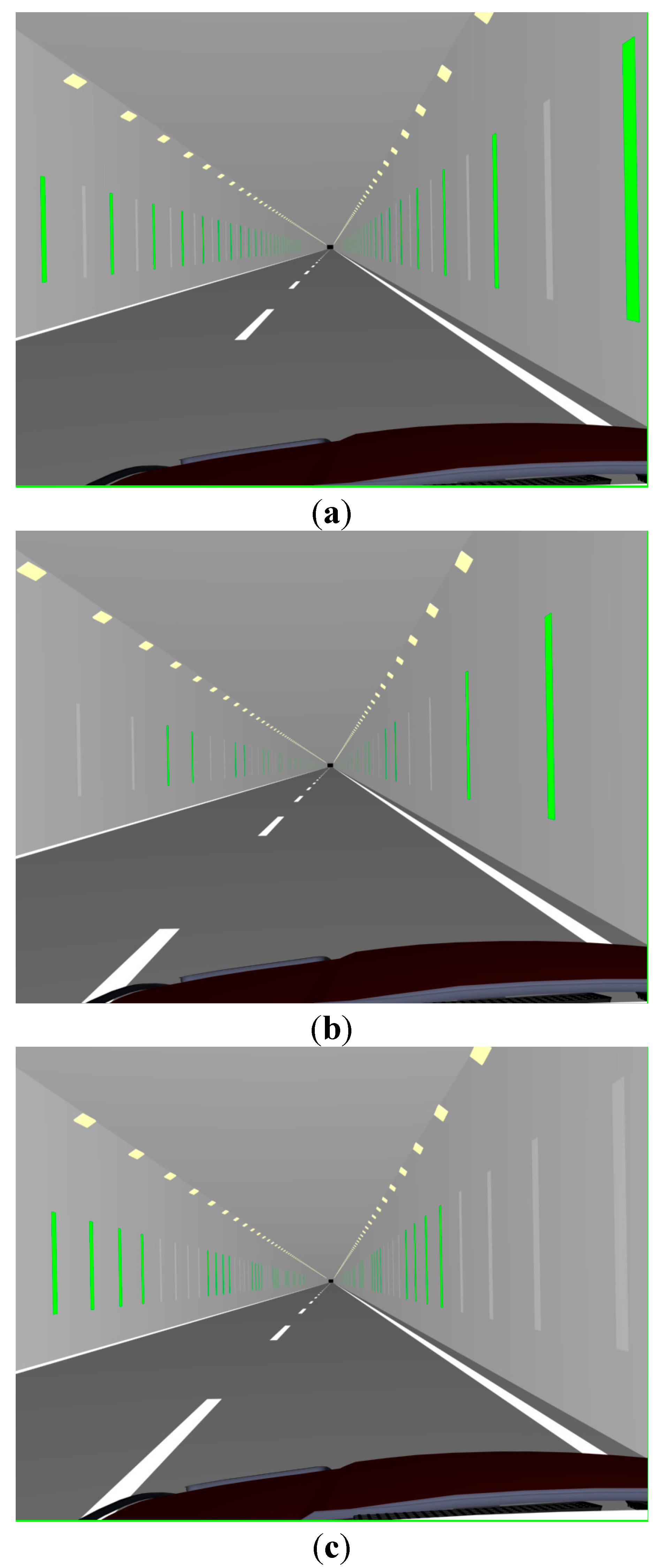
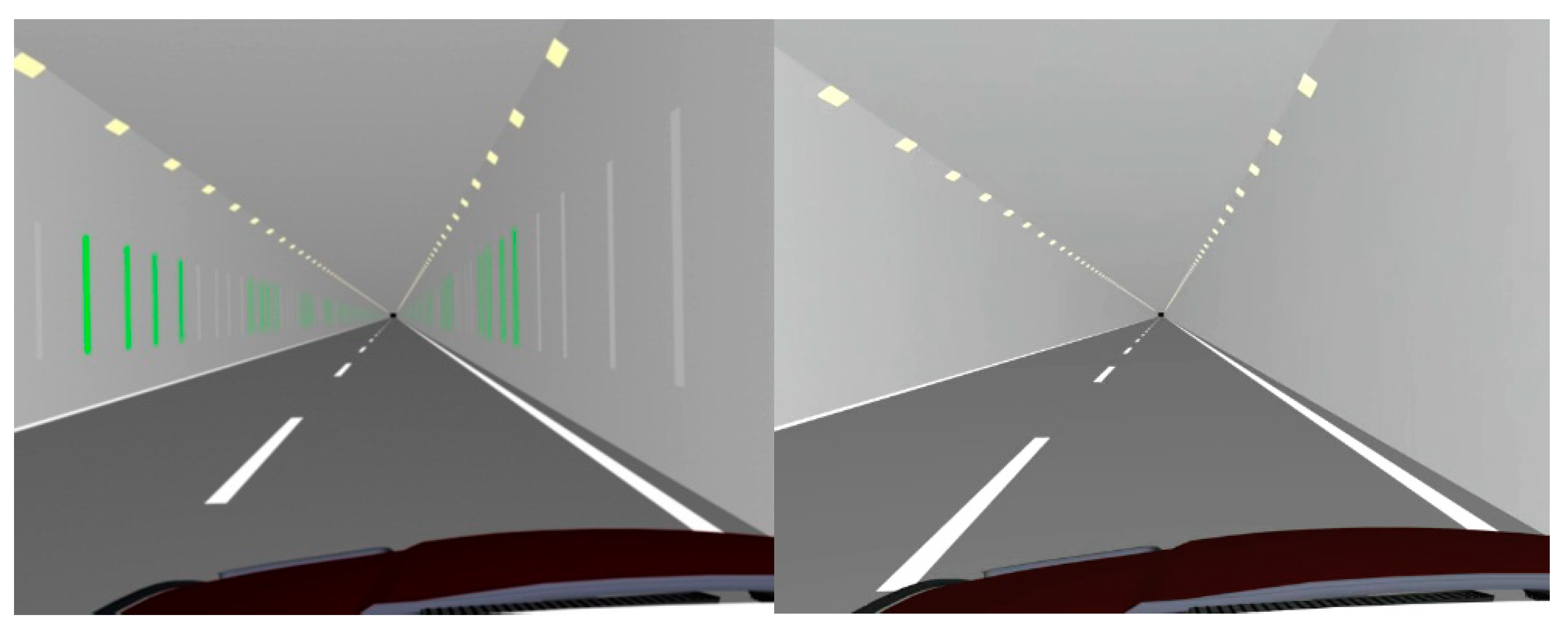
3.1.5. Experiment Scenarios

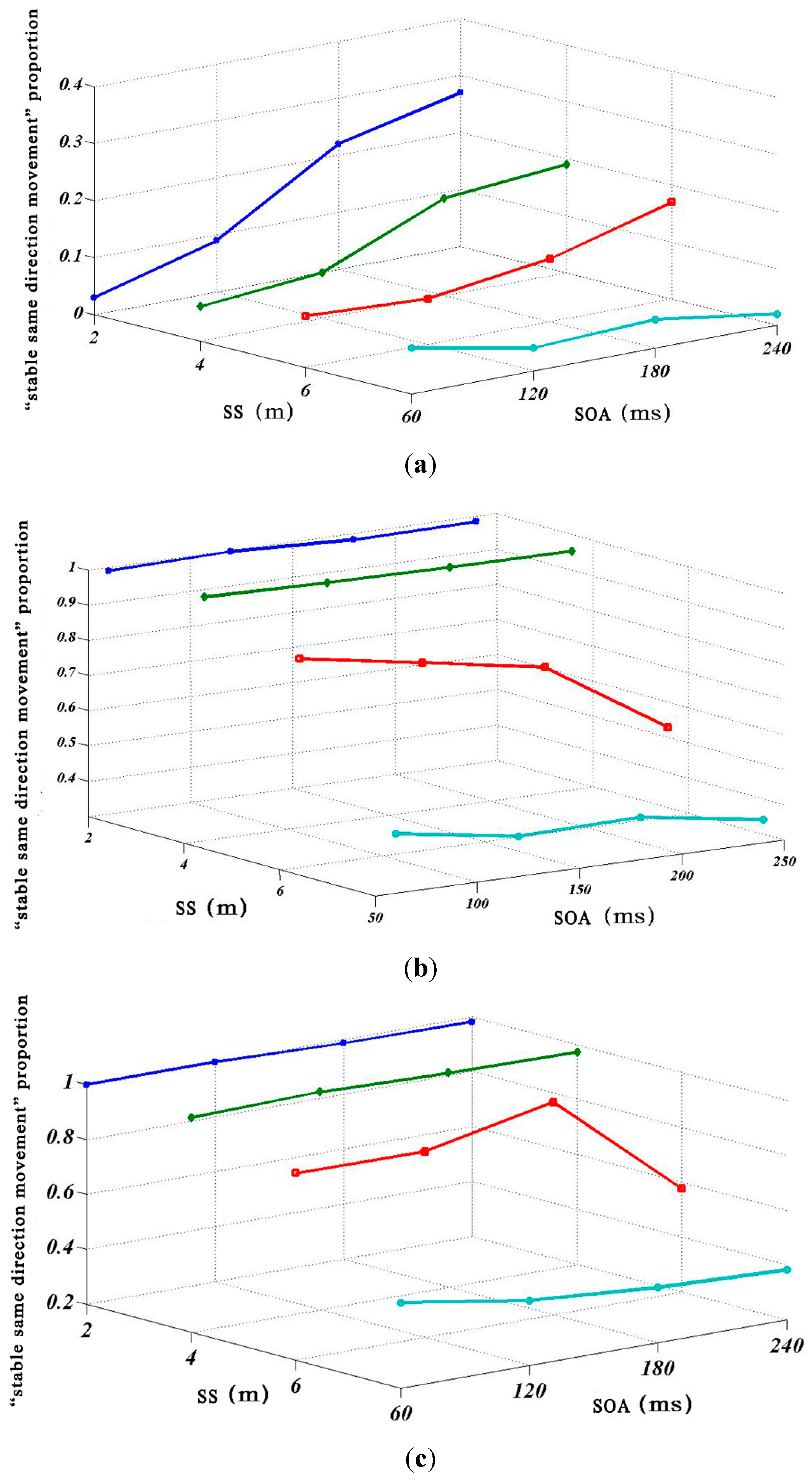
3.1.6. Results

- (1)
- When one bright, one dark grating was used, no matter the value of SS and the SOA, participants tended to perceived grating as “flashing” or “unstable movement”.
- (2)
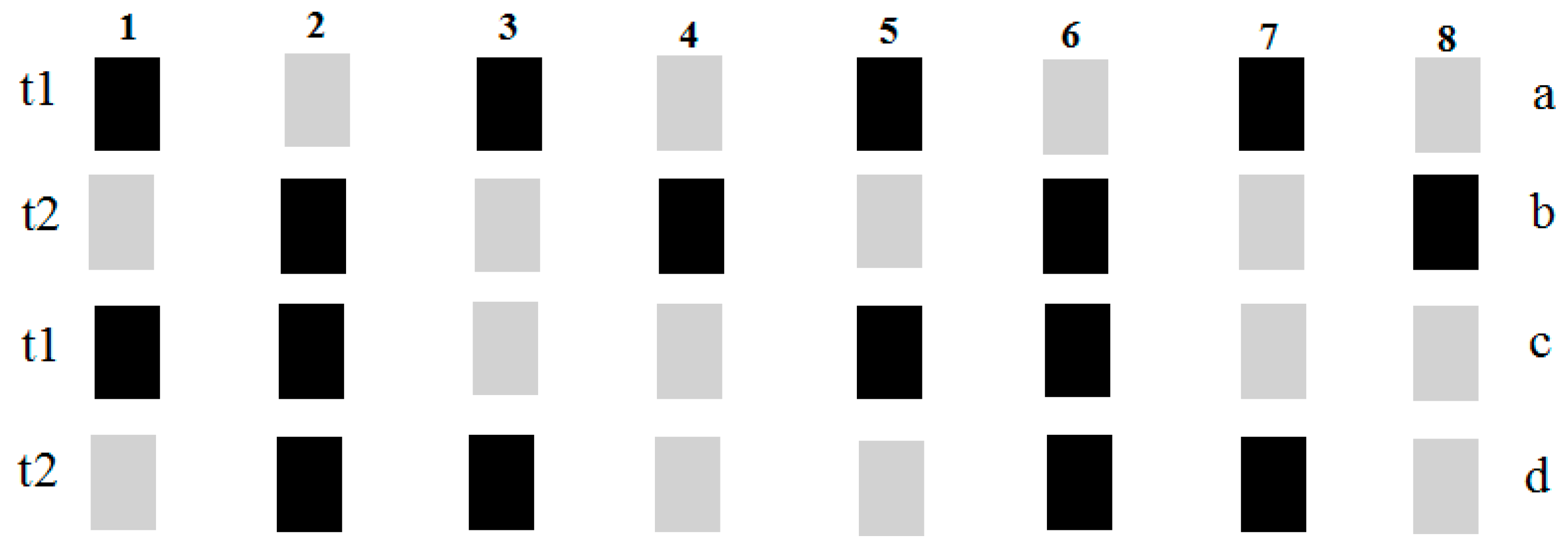
- When two bright, two dark or four bright, four dark was used, with the changes of SOA and SS, participants’ perceptions of grating changed also. When the SS was 2 m or 4 m and the SOA was 60 ms, 120 ms, 180 ms or 240 ms, participants tended to perceive grating as “stable, same direction movement”. This constituted more than 95% of perceptions, which differs from the Waite Alzheimer’s experimental results. When the SS was 6 m or 8 m, the proportions reduce gradually. SS and SOA all have significant influence on apparent motion perception; the mean difference was significant at the 0.05 level using Analysis of Variance (ANOVA).
- (1)
- Layout: two bright, two dark, four bright, four dark.
- (2)
- SS: 2 m, 4 m.
- (3)
- SOA: 60 ms, 120 ms, 180 ms and 240 ms.
3.2. Experiments 2: Measurement of Driver’s Speed Perception
3.2.1. Index of the Driver’s Perceived Speed
3.2.2. Apparatus and Participants
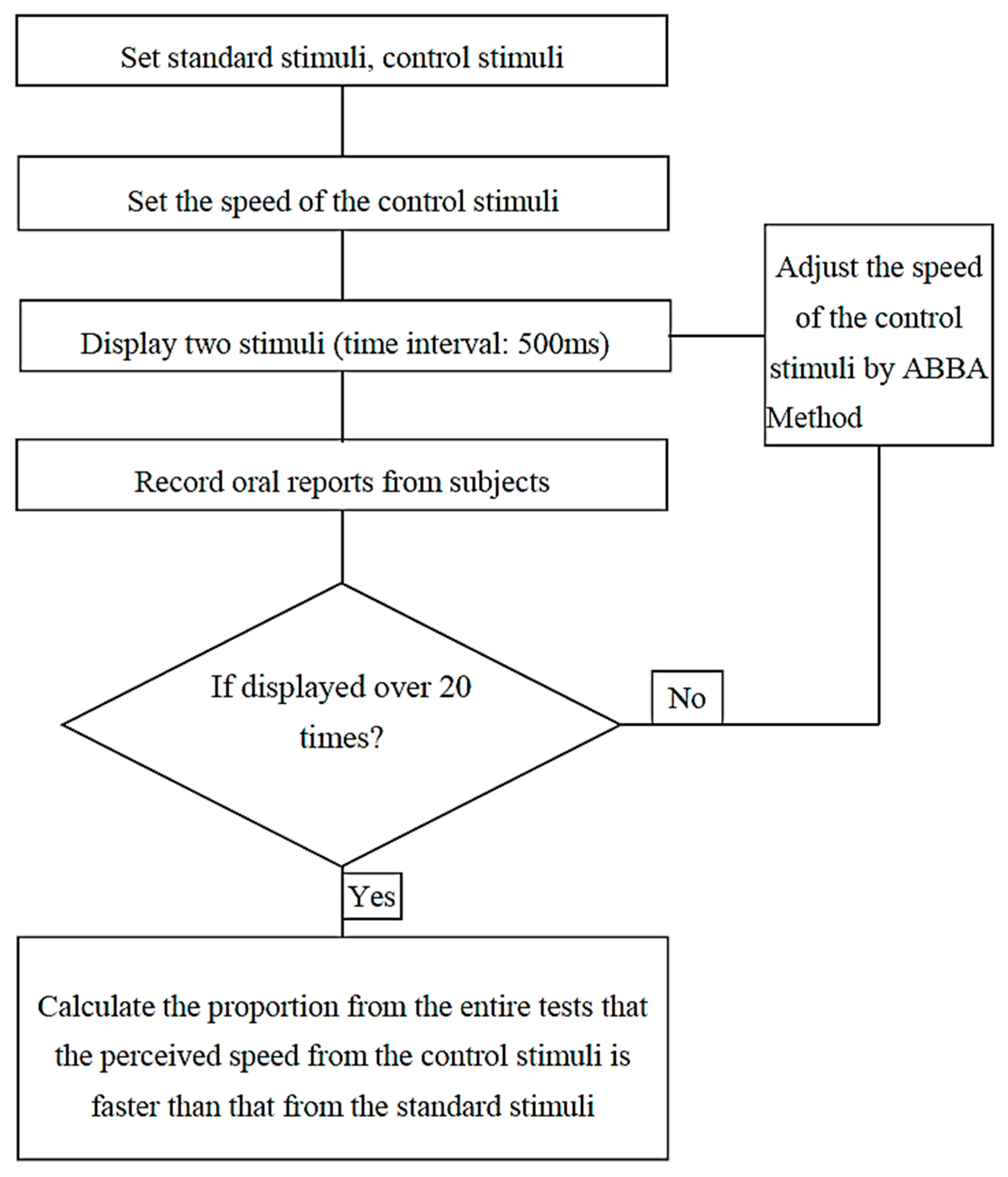
3.2.3. Procedures


| The order of displaying stimuli (S-standard, C-control) | C-S | S-C | S-C | C-S |
|---|---|---|---|---|
| Speed Change of comparison stimuli | Increase | Decrease | Decrease | Increase |
Stimuli

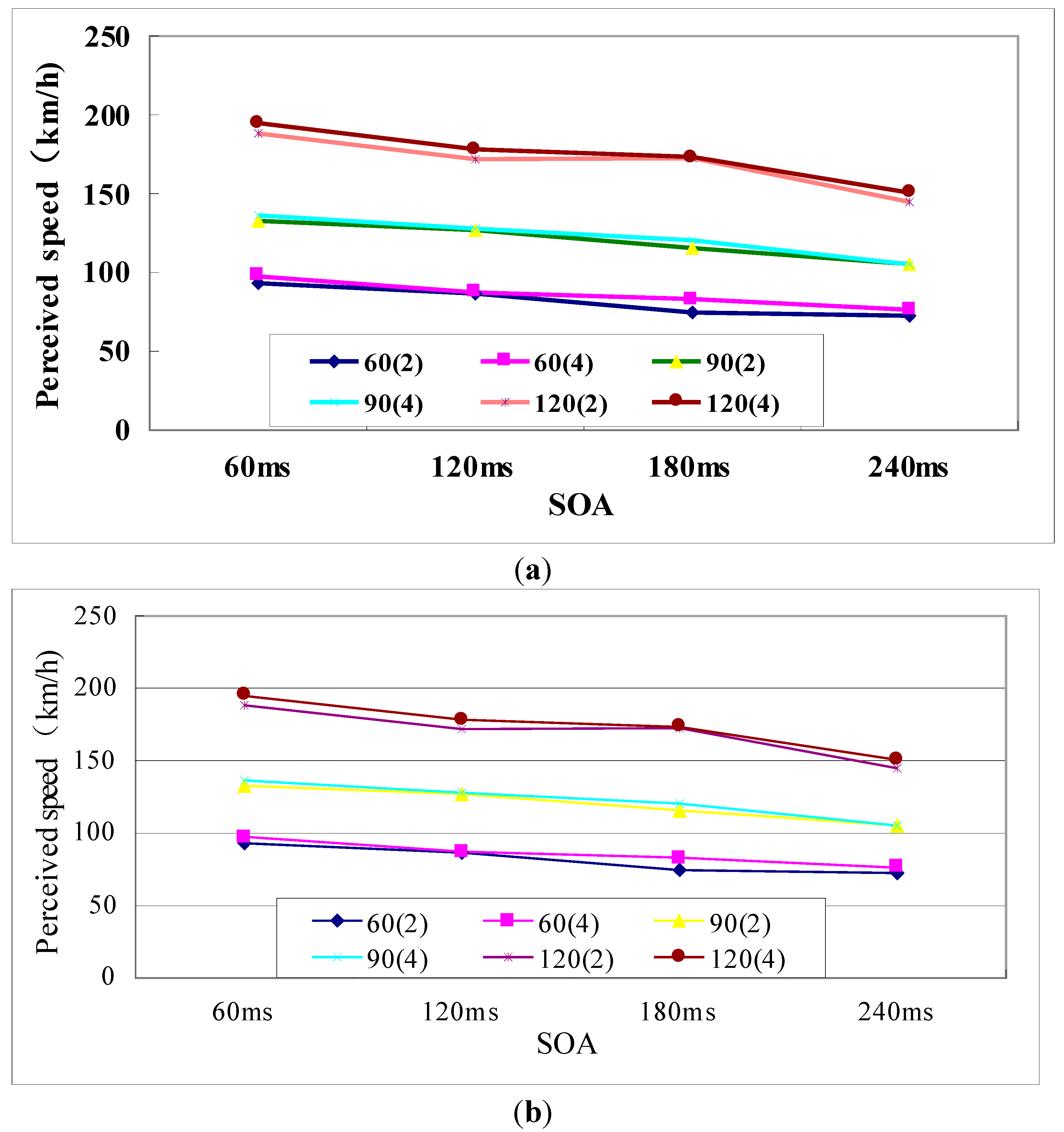
Results

4. Discussion and Conclusions
4.1. Optimal Form of Apparent Motion

4.2. Driver’s Speed Perception
| SS | 2 m | 4 m | |
|---|---|---|---|
| SOA | |||
| 60 ms | 120 | 240 | |
| 120 ms | 60 | 120 | |
| 180 ms | 40 | 80 | |
| 240 ms | 30 | 60 | |
4.3. Optimal Form for Speed Control
Acknowledgments
Author Contributions
Conflicts of Interest
References
- Ministry of Public Security of the People’s Republic of China. White Paper on Road Traffic Accident in China; China Communications Press: Beijing, China, 2011.
- Theeuwes, J. Self-Explaining Roads: An exploratory study. In Transportation Research Record: Journal of the Transportation Research Board; Transportation Research Board of the National Academies: Washington, DC, USA, 1994. [Google Scholar]
- Gepshtein, S.; Kubovy, M. The Lawful Perception of Apparent Motion. J. Vision 2007, 7, 1–15. [Google Scholar]
- Recarte, M.A.; Nunes, L.M. Perception of Speed in an Automobile: Estimation and Production. J. Exp. Psychol. Appl. 1996, 2, 291–304. [Google Scholar] [CrossRef]
- Wertheimer, M. Experimentelle Studien uber dasSehen von Bewegung. Zeitschrift fu¨r Psychologie 1912, 61, 161–265. [Google Scholar]
- Hock, H.S.; Gilroy, L.A.; Harnett, G. Counter-changing Luminance: A Non-fourier, Non-attentional Basis for the Perception of Single-element Apparent Motion. J. Exp. Psychol. Hum. Perce. Perform. 2002, 28, 93–112. [Google Scholar] [CrossRef]
- Hock, H.S.; Kogan, K.; Espinoza, J.K. Dynamic State-dependent Thresholds for the Perception of Single-element Apparent Motion: Bistability from Local Cooperativity. Perce. Psych. 1997, 59, 1077–1088. [Google Scholar] [CrossRef]
- Zhuo, Y.; Zhou, T.G.; Rao, H.Y.; Wang, J.J.; Meng, M.; Chen, M.; Zhou, C.; Chen, L. Contributions of the Visual Ventral Pathway to Long-range Apparent Motion. Science 2003, 299, 417–420. [Google Scholar] [CrossRef] [PubMed]
- Tsuda, R.; Ueno, S. Perception of Visual Apparent Movement in Central and Peripheral Vision. IEEE 1993. [Google Scholar] [CrossRef]
- Yamamoto, K.; Uchida, K.; Sagawa, Y.; Tanaka, T.; Sugie, N. Quantitative Measurements of Driver’s Motion After-Effect. Intell. Vehicle Symp. 2002, 2, 336–343. [Google Scholar]
- Shen, H.; Shimodaira, Y.; Ohashi, O. Speed-Tuned Mechanism and Speed Perception in Human Vision. Syst. Comput. Japan 2005, 36, 1718–1727. [Google Scholar] [CrossRef]
- Jäkel, F.; Wichmann, F.A. Spatial Four-alternative Forced-choice Method is the Preferred Psychophysical Method for Naïve Observers. J. Vision 2006, 6, 1307–1322. [Google Scholar] [CrossRef]
- Ruud, G.J.; Meulenbroeka Galena, G.P.; van Hulstijnb, M.; Hulstijna, W.; Bloemsaat, G. Muscular Co-contraction Covaries with Task Load to Control the Flow of Motion in Fine Motor Tasks. Biol. Psychol. 2005, 68, 331–352. [Google Scholar] [CrossRef] [PubMed]
- Anstis, S. Moving Objects Appear to Slow Down at Low Contrasts. Neural Netw. 2003, 16, 933–938. [Google Scholar] [CrossRef] [PubMed]
- Michelson, A.A. Studies in Optics; Dover Publication, Inc.: New York, NY, USA, 1995. [Google Scholar]
- Wickens, C.D.; Hollands, J. Engineering Psychology and Human Performance; Prentice Hall, Inc.: Upper Saddle River, NJ, USA, 1999. [Google Scholar]
- Denton, G.G. The Influence of Visual Pattern on Perceived Speed. Perception 1980, 9, 393–402. [Google Scholar] [CrossRef] [PubMed]
© 2015 by the authors; licensee MDPI, Basel, Switzerland. This article is an open access article distributed under the terms and conditions of the Creative Commons Attribution license (http://creativecommons.org/licenses/by/4.0/).
Share and Cite
Liu, B.; Zhu, S.; Wang, H.; Xia, J. Facilities Design Based on Apparent Motion of Grating for Speed Reduction in Tunnel. Sustainability 2015, 7, 1503-1515. https://doi.org/10.3390/su7021503
Liu B, Zhu S, Wang H, Xia J. Facilities Design Based on Apparent Motion of Grating for Speed Reduction in Tunnel. Sustainability. 2015; 7(2):1503-1515. https://doi.org/10.3390/su7021503
Chicago/Turabian StyleLiu, Bing, Shunying Zhu, Hong Wang, and Jing Xia. 2015. "Facilities Design Based on Apparent Motion of Grating for Speed Reduction in Tunnel" Sustainability 7, no. 2: 1503-1515. https://doi.org/10.3390/su7021503
APA StyleLiu, B., Zhu, S., Wang, H., & Xia, J. (2015). Facilities Design Based on Apparent Motion of Grating for Speed Reduction in Tunnel. Sustainability, 7(2), 1503-1515. https://doi.org/10.3390/su7021503