

Low Glycemic Index Prototype Isomaltulose—Update of Clinical Trials

 , ,
, ,
Abstract
1. Carbohydrates with High and Low Glycemic Index on Postprandial Glucose Homeostasis
2. Isomaltulose—Its Manufacturing and Key Characteristics
3. Postprandial Blood Glucose and Insulin Levels
4. Glucose Turnover in Type 2 Diabetes
5. Sports Nutrition and Cognitive Performance
6. Regulation of Body Weight and Composition
7. Pregnancy Outcome
8. Conclusions
Acknowledgments
Author Contributions
Conflicts of Interest
References
- Ludvik, B.; Nolan, J.J.; Roberts, A.; Baloga, J.; Joyce, M.; Bell, J.M.; Olefsky, J.M. Evidence for decreased splanchnic glucose uptake after oral glucose administration in non-insulin-dependent diabetes mellitus. J. Clin. Invest. 1997, 100, 2354–2361. [Google Scholar] [CrossRef] [Scilit] [PubMed]
- Basu, A.; Basu, R.; Shah, P.; Vella, A.; Johnson, C.M.; Jensen, M.; Nair, K.S.; Schwenk, W.F.; Rizza, R.A. Type 2 diabetes impairs splanchnic uptake of glucose but does not alter intestinal glucose absorption during enteral glucose feeding: Additional evidence for a defect in hepatic glucokinase activity. Diabetes 2001, 50, 1351–1362. [Google Scholar] [CrossRef] [Scilit] [PubMed]
- Wahren, J.; Ekberg, K. Splanchnic regulation of glucose production. Annu. Rev. Nutr. 2007, 27, 329–345. [Google Scholar] [CrossRef] [Scilit] [PubMed]
- Foster-Powell, K.; Holt, S.H.; Brand-Miller, J.C. International table of glycemic index and glycemic load values: 2002. Am. J. Clin. Nutr. 2002, 76, 5–56. [Google Scholar] [PubMed]
- Thomas, D.; Elliott, E.J. Low glycaemic index, or low glycaemic load, diets for diabetes mellitus. Cochrane Database Syst. Rev. 2009. [Google Scholar] [CrossRef] [Scilit]
- Thomas, D.E.; Elliott, E.J.; Baur, L. Low glycaemic index or low glycaemic load diets for overweight and obesity. Cochrane Database Syst. Rev. 2007. [Google Scholar] [CrossRef] [Scilit]
- Schwarzfuchs, D.; Golan, R.; Shai, I. Four-year follow-up after two-year dietary interventions. N. Engl. J. Med. 2012, 367, 1373–1374. [Google Scholar] [CrossRef] [Scilit] [PubMed]
- Shai, I.; Schwarzfuchs, D.; Henkin, Y.; Shahar, D.R.; Witkow, S.; Greenberg, I.; Golan, R.; Fraser, D.; Bolotin, A.; Vardi, H.; et al. Weight loss with a low-carbohydrate, mediterranean, or low-fat diet. N. Engl. J. Med. 2008, 359, 229–241. [Google Scholar] [CrossRef] [Scilit] [PubMed]
- Atkinson, F.S.; Foster-Powell, K.; Brand-Miller, J.C. International tables of glycemic index and glycemic load values: 2008. Diabetes Care 2008, 31, 2281–2283. [Google Scholar] [CrossRef] [Scilit] [PubMed]
- American Diabetes, A. Evidence-based nutrition principles and recommendations for the treatment and prevention of diabetes and related complications. Diabetes Care 2002, 25, 202–212. [Google Scholar] [CrossRef] [Scilit]
- Mann, J.I.; De Leeuw, I.; Hermansen, K.; Karamanos, B.; Karlstrom, B.; Katsilambros, N.; Riccardi, G.; Rivellese, A.A.; Rizkalla, S.; Slama, G.; et al. Evidence-based nutritional approaches to the treatment and prevention of diabetes mellitus. Nutr. Metab. Cardiovasc. Dis. 2004, 14, 373–394. [Google Scholar] [CrossRef] [Scilit]
- Lina, B.A.; Jonker, D.; Kozianowski, G. Isomaltulose (palatinose): A review of biological and toxicological studies. Food Chem. Toxicol. 2002, 40, 1375–1381. [Google Scholar] [CrossRef] [Scilit]
- Weidenhagen, R.L.A.D. Palatinose (6-0-alpha-d-glucopyranosyl-d-fructofuranose), ein neues bakterielles umwandlungsprodukt der saccharose (palatinose (6-0-alpha-d-glucopyranosyl-d-fructofuranose), a new bacterial conversion of sucrose product). Z. Für Die Zuckerind. Fachorg. Für Tecknik Rubenbau Und Wirtsch. 1957, 7, 533–534. [Google Scholar]
- Holub, I.; Gostner, A.; Theis, S.; Nosek, L.; Kudlich, T.; Melcher, R.; Scheppach, W. Novel findings on the metabolic effects of the low glycaemic carbohydrate isomaltulose (palatinose). Br. J. Nutr. 2010, 103, 1730–1737. [Google Scholar] [CrossRef] [Scilit] [PubMed]
- Codex, F.C. Monograph on Isomaltulose, 7th ed.; US Pharmacopeial Convention: Rockville, MD, USA, 2010. [Google Scholar]
- Sentko, A.W.-E.I. Isomaltulose. In Sweeteners and Sugar Alternatives in Food Technology, 2nd ed.; Wiley-Blackwell: Oxford, UK, 2012. [Google Scholar]
- Fleddermann, M.; Rauh-Pfeiffer, A.; Demmelmair, H.; Holdt, L.; Teupser, D.; Koletzko, B. Effects of a follow-on formula containing isomaltulose (palatinose) on metabolic response, acceptance, tolerance and safety in infants: A randomized-controlled trial. PLoS ONE 2016, 11, e0151614. [Google Scholar] [CrossRef] [Scilit] [PubMed]
- EFSA Panel on Dietetic Products, Nutrition and Allergies (NDA). Scientific opinion on the substantiation of health claims related to the sugar replacers xylitol, sorbitol, mannitol, maltitol, lactitol, isomalt, erythritol, d-tagatose, isomaltulose, sucralose and polydextrose and maintenance of tooth mineralisation by decreasing tooth demineralisation (id 463, 464, 563, 618, 647, 1182, 1591, 2907, 2921, 4300), and reduction of post-prandial glycaemic responses (id 617, 619, 669, 1590, 1762, 2903, 2908, 2920) pursuant to article 13 (1) of regulation (ec) No. 1924/2006. EFSA J. 2011, 9, 2076. [Google Scholar]
- Pubmed. Available online: http://www.ncbi.nlm.nih.gov/ (accessed on 1 February 2017).
- Web of Science. Available online: http://webofscience.com/ (accessed on 1 February 2017).
- ScienceDirect. Available online: http://www.sciencedirect.com/ (accessed on 1 February 2017).
- Cochrane Library. Available online: http://www.cochranelibrary.com/ (accessed on 1 February 2017).
- Liao, Z.; Li, Y.; Yao, B.; Fan, H.; Hu, G.L.; Weng, J. The effects of isomaltulose on blood glucose and lipids for diabetic subjects. Diabetes 2001, 50, A1366. [Google Scholar]
- Konig, D.; Theis, S.; Kozianowski, G.; Berg, A. Postprandial substrate use in overweight subjects with the metabolic syndrome after isomaltulose (palatinose) ingestion. Nutrition 2012, 28, 651–656. [Google Scholar] [CrossRef] [Scilit] [PubMed]
- van Can, J.G.; Ijzerman, T.H.; van Loon, L.J.; Brouns, F.; Blaak, E.E. Reduced glycaemic and insulinaemic responses following isomaltulose ingestion: Implications for postprandial substrate use. Br. J. Nutr. 2009, 102, 1408–1413. [Google Scholar] [CrossRef] [Scilit] [PubMed]
- Macdonald, I. The bioavailability of isomaltulose in man and rat. Nutr. Rep. Int. 1983, 28, 1083–1090. [Google Scholar]
- Maeda, A.; Miyagawa, J.; Miuchi, M.; Nagai, E.; Konishi, K.; Matsuo, T.; Tokuda, M.; Kusunoki, Y.; Ochi, H.; Murai, K.; et al. Effects of the naturally-occurring disaccharides, palatinose and sucrose, on incretin secretion in healthy non-obese subjects. J. Diabetes Investig. 2013, 4, 281–286. [Google Scholar] [CrossRef] [Scilit] [PubMed]
- Ang, M.; Linn, T. Comparison of the effects of slowly and rapidly absorbed carbohydrates on postprandial glucose metabolism in type 2 diabetes mellitus patients: A randomized trial. Am. J. Clin. Nutr. 2014, 100, 1059–1068. [Google Scholar] [CrossRef] [Scilit] [PubMed]
- Kawai, K.; Okuda, Y.; Yamashita, K. Changes in blood glucose and insulin after an oral palatinose administration in normal subjects. Endocrinol. Jpn. 1985, 32, 933–936. [Google Scholar] [CrossRef] [Scilit] [PubMed]
- Bracken, R.M.; Page, R.; Gray, B.; Kilduff, L.P.; West, D.J.; Stephens, J.W.; Bain, S.C. Isomaltulose improves glycemia and maintains run performance in type 1 diabetes. Med. Sci. Sports Exerc. 2012, 44, 800–808. [Google Scholar] [CrossRef] [Scilit] [PubMed]
- West, D.J.; Stephens, J.W.; Bain, S.C.; Kilduff, L.P.; Luzio, S.; Still, R.; Bracken, R.M. A combined insulin reduction and carbohydrate feeding strategy 30 min before running best preserves blood glucose concentration after exercise through improved fuel oxidation in type 1 diabetes mellitus. J. Sports Sci. 2011, 29, 279–289. [Google Scholar] [CrossRef] [Scilit] [PubMed]
- Achten, J.; Jentjens, R.L.; Brouns, F.; Jeukendrup, A.E. Exogenous oxidation of isomaltulose is lower than that of sucrose during exercise in men. J. Nutr. 2007, 137, 1143–1148. [Google Scholar] [PubMed]
- Konig, D.; Zdzieblik, D.; Holz, A.; Theis, S.; Gollhofer, A. Substrate utilization and cycling performance following palatinose ingestion: A randomized, double-blind, controlled trial. Nutrients 2016, 8, 390. [Google Scholar] [CrossRef] [Scilit] [PubMed]
- König, D.; Luther, W.; Polland, V.; Berg, A. Carbohydrates in sports nutrition impact of the glycemic index. AgroFood 2007, 18, 9–10. [Google Scholar]
- Oosthuyse, T.; Carstens, M.; Millen, A.M. Ingesting isomaltulose versus fructose-maltodextrin during prolonged moderate-heavy exercise increases fat oxidation but impairs gastrointestinal comfort and cycling performance. Int. J. Sport Nutr. Exerc. Metab. 2015, 25, 427–438. [Google Scholar] [CrossRef] [Scilit] [PubMed]
- West, D.J.; Morton, R.D.; Stephens, J.W.; Bain, S.C.; Kilduff, L.P.; Luzio, S.; Still, R.; Bracken, R.M. Isomaltulose improves postexercise glycemia by reducing cho oxidation in t1dm. Med. Sci. Sports Exerc. 2011, 43, 204–210. [Google Scholar] [CrossRef] [Scilit] [PubMed]
- Kraemer, W.J.; Hooper, D.R.; Szivak, T.K.; Kupchak, B.R.; Dunn-Lewis, C.; Comstock, B.A.; Flanagan, S.D.; Looney, D.P.; Sterczala, A.J.; DuPont, W.H.; et al. The addition of beta-hydroxy-beta-methylbutyrate and isomaltulose to whey protein improves recovery from highly demanding resistance exercise. J. Am. Coll. Nutr. 2015, 34, 91–99. [Google Scholar] [CrossRef] [Scilit] [PubMed]
- Campbell, M.D.; Walker, M.; Trenell, M.I.; Stevenson, E.J.; Turner, D.; Bracken, R.M.; Shaw, J.A.; West, D.J. A low-glycemic index meal and bedtime snack prevents postprandial hyperglycemia and associated rises in inflammatory markers, providing protection from early but not late nocturnal hypoglycemia following evening exercise in type 1 diabetes. Diabetes Care 2014, 37, 1845–1853. [Google Scholar] [CrossRef] [Scilit] [PubMed]
- Blaak, E.E.; Antoine, J.M.; Benton, D.; Bjorck, I.; Bozzetto, L.; Brouns, F.; Diamant, M.; Dye, L.; Hulshof, T.; Holst, J.J.; et al. Impact of postprandial glycaemia on health and prevention of disease. Obes. Rev. 2012, 13, 923–984. [Google Scholar] [CrossRef] [Scilit] [PubMed]
- Dye, L.; Gilsenan, M.B.; Quadt, F.; Martens, V.E.; Bot, A.; Lasikiewicz, N.; Camidge, D.; Croden, F.; Lawton, C. Manipulation of glycemic response with isomaltulose in a milk-based drink does not affect cognitive performance in healthy adults. Mol. Nutr. Food Res. 2010, 54, 506–515. [Google Scholar] [CrossRef] [Scilit] [PubMed]
- Sekartini, R.; Wiguna, T.; Bardosono, S.; Novita, D.; Arsianti, T.; Calame, W.; Schaafsma, A. The effect of lactose-isomaltulose-containing growing-up milks on cognitive performance of indonesian children: A cross-over study. Br. J. Nutr. 2013, 110, 1089–1097. [Google Scholar] [CrossRef] [Scilit] [PubMed]
- Taib, M.N.; Shariff, Z.M.; Wesnes, K.A.; Saad, H.A.; Sariman, S. The effect of high lactose-isomaltulose on cognitive performance of young children. A double blind cross-over design study. Appetite 2012, 58, 81–87. [Google Scholar] [CrossRef] [Scilit] [PubMed]
- Young, H.B.; Benton, D. The glycemic load of meals, cognition and mood in middle and older aged adults with differences in glucose tolerance: A randomized trial. e-SPEN J. 2014, 9, e147–e154. [Google Scholar] [CrossRef] [Scilit]
- Young, H.; Benton, D. The effect of using isomaltulose (palatinose) to modulate the glycaemic properties of breakfast on the cognitive performance of children. Eur. J. Nutr. 2015, 54, 1013–1020. [Google Scholar] [CrossRef] [Scilit] [PubMed]
- Kahlhofer, J.; Lagerpusch, M.; Enderle, J.; Eggeling, B.; Braun, W.; Pape, D.; Muller, M.J.; Bosy-Westphal, A. Carbohydrate intake and glycemic index affect substrate oxidation during a controlled weight cycle in healthy men. Eur. J. Clin. Nutr. 2014, 68, 1060–1066. [Google Scholar] [CrossRef] [Scilit] [PubMed]
- Larsen, T.M.; Dalskov, S.M.; van Baak, M.; Jebb, S.A.; Papadaki, A.; Pfeiffer, A.F.; Martinez, J.A.; Handjieva-Darlenska, T.; Kunesova, M.; Pihlsgard, M.; et al. Diets with high or low protein content and glycemic index for weight-loss maintenance. N. Engl. J. Med. 2010, 363, 2102–2113. [Google Scholar] [CrossRef] [Scilit] [PubMed]
- Gower, B.A.; Hunter, G.R.; Chandler-Laney, P.C.; Alvarez, J.A.; Bush, N.C. Glucose metabolism and diet predict changes in adiposity and fat distribution in weight-reduced women. Obesity (Silver Spring) 2010, 18, 1532–1537. [Google Scholar] [CrossRef] [Scilit] [PubMed]
- Feinman, R.D.; Fine, E.J. Nonequilibrium thermodynamics and energy efficiency in weight loss diets. Theor. Biol. Med. Model. 2007, 4, 27. [Google Scholar] [CrossRef] [Scilit] [PubMed]
- Ludwig, D.S. The glycemic index: Physiological mechanisms relating to obesity, diabetes, and cardiovascular disease. JAMA 2002, 287, 2414–2423. [Google Scholar] [CrossRef] [Scilit] [PubMed]
- Boule, N.G.; Chaput, J.P.; Doucet, E.; Richard, D.; Despres, J.P.; Bouchard, C.; Tremblay, A. Glucose homeostasis predicts weight gain: Prospective and clinical evidence. Diabetes Metab. Res. Rev. 2008, 24, 123–129. [Google Scholar] [CrossRef] [Scilit] [PubMed]
- Froidevaux, F.; Schutz, Y.; Christin, L.; Jequier, E. Energy expenditure in obese women before and during weight loss, after refeeding, and in the weight-relapse period. Am. J. Clin. Nutr. 1993, 57, 35–42. [Google Scholar] [PubMed]
- Diaz, E.O.; Galgani, J.E.; Aguirre, C.A. Glycaemic index effects on fuel partitioning in humans. Obes. Rev. 2006, 7, 219–226. [Google Scholar] [CrossRef] [Scilit] [PubMed]
- Bosy-Westphal, A.; Hagele, F.; Nas, A. Impact of dietary glycemic challenge on fuel partitioning. Eur. J. Clin. Nutr. 2016. [Google Scholar] [CrossRef] [Scilit] [PubMed]
- Casimir, M.; de Andrade, P.B.; Gjinovci, A.; Montani, J.P.; Maechler, P.; Dulloo, A.G. A role for pancreatic beta-cell secretory hyperresponsiveness in catch-up growth hyperinsulinemia: Relevance to thrifty catch-up fat phenotype and risks for type 2 diabetes. Nutr. Metab. (Lond.) 2011, 8, 2. [Google Scholar] [CrossRef] [Scilit] [PubMed]
- Reichkendler, M.H.; Auerbach, P.; Rosenkilde, M.; Christensen, A.N.; Holm, S.; Petersen, M.B.; Lagerberg, A.; Larsson, H.B.; Rostrup, E.; Mosbech, T.H.; et al. Exercise training favors increased insulin-stimulated glucose uptake in skeletal muscle in contrast to adipose tissue: A randomized study using fdg pet imaging. Am. J. Physiol. Endocrinol. Metab. 2013, 305, E496–E506. [Google Scholar] [CrossRef] [Scilit] [PubMed]
- Alibegovic, A.C.; Hojbjerre, L.; Sonne, M.P.; van Hall, G.; Stallknecht, B.; Dela, F.; Vaag, A. Impact of 9 days of bed rest on hepatic and peripheral insulin action, insulin secretion, and whole-body lipolysis in healthy young male offspring of patients with type 2 diabetes. Diabetes 2009, 58, 2749–2756. [Google Scholar] [CrossRef] [Scilit] [PubMed]
- Kahlhofer, J.; Karschin, J.; Silberhorn-Buhler, H.; Breusing, N.; Bosy-Westphal, A. Effect of low-glycemic-sugar-sweetened beverages on glucose metabolism and macronutrient oxidation in healthy men. Int. J. Obes. (Lond.) 2016, 40, 990–997. [Google Scholar] [CrossRef] [Scilit] [PubMed]
- Das, S.K.; Gilhooly, C.H.; Golden, J.K.; Pittas, A.G.; Fuss, P.J.; Cheatham, R.A.; Tyler, S.; Tsay, M.; McCrory, M.A.; Lichtenstein, A.H.; et al. Long-term effects of 2 energy-restricted diets differing in glycemic load on dietary adherence, body composition, and metabolism in calerie: A 1-year randomized controlled trial. Am. J. Clin. Nutr. 2007, 85, 1023–1030. [Google Scholar] [PubMed]
- Karl, J.P.; Roberts, S.B.; Schaefer, E.J.; Gleason, J.A.; Fuss, P.; Rasmussen, H.; Saltzman, E.; Das, S.K. Effects of carbohydrate quantity and glycemic index on resting metabolic rate and body composition during weight loss. Obesity (Silver Spring) 2015, 23, 2190–2198. [Google Scholar] [CrossRef] [Scilit] [PubMed]
- Pereira, M.A.; Swain, J.; Goldfine, A.B.; Rifai, N.; Ludwig, D.S. Effects of a low-glycemic load diet on resting energy expenditure and heart disease risk factors during weight loss. JAMA 2004, 292, 2482–2490. [Google Scholar] [CrossRef] [Scilit] [PubMed]
- Zhang, R.; Han, S.; Chen, G.C.; Li, Z.N.; Silva-Zolezzi, I.; Pares, G.V.; Wang, Y.; Qin, L.Q. Effects of low-glycemic-index diets in pregnancy on maternal and newborn outcomes in pregnant women: A meta-analysis of randomized controlled trials. Eur. J. Nutr. 2016, 1–11. [Google Scholar] [CrossRef] [Scilit] [PubMed]
- Kizirian, N.V.; Kong, Y.; Muirhead, R.; Brodie, S.; Garnett, S.P.; Petocz, P.; Sim, K.A.; Celermajer, D.S.; Louie, J.C.; Markovic, T.P.; et al. Effects of a low-glycemic index diet during pregnancy on offspring growth, body composition, and vascular health: A pilot randomized controlled trial. Am. J. Clin. Nutr. 2016, 103, 1073–1082. [Google Scholar] [CrossRef] [Scilit] [PubMed]
- Kizirian, N.V.; Markovic, T.P.; Muirhead, R.; Brodie, S.; Garnett, S.P.; Louie, J.C.; Petocz, P.; Ross, G.P.; Brand-Miller, J.C. Macronutrient balance and dietary glycemic index in pregnancy predict neonatal body composition. Nutrients 2016, 8, 270. [Google Scholar] [CrossRef] [Scilit] [PubMed]
- Ajala, O.; English, P.; Pinkney, J. Systematic review and meta-analysis of different dietary approaches to the management of type 2 diabetes. Am. J. Clin. Nutr. 2013, 97, 505–516. [Google Scholar] [CrossRef] [Scilit] [PubMed]
- Slame, G.; Lean, M.; Toeller, M.; Chantelau, E.; van Gaal, L.; Heine, R.; Karamanos, B.; Karlstrom, B.; de Leeuw, I.; Librenti, G.; et al. Recommendations for the nutritional management of patients with diabetes mellitus. Diabetes Nutr. Metab. 1995, 8, 186–189. [Google Scholar]
- Brunner, S.; Holub, I.; Theis, S.; Gostner, A.; Melcher, R.; Wolf, P.; Amann-Gassner, U.; Scheppach, W.; Hauner, H. Metabolic effects of replacing sucrose by isomaltulose in subjects with type 2 diabetes: A randomized double-blind trial. Diabetes Care 2012, 35, 1249–1251. [Google Scholar] [CrossRef] [Scilit] [PubMed]
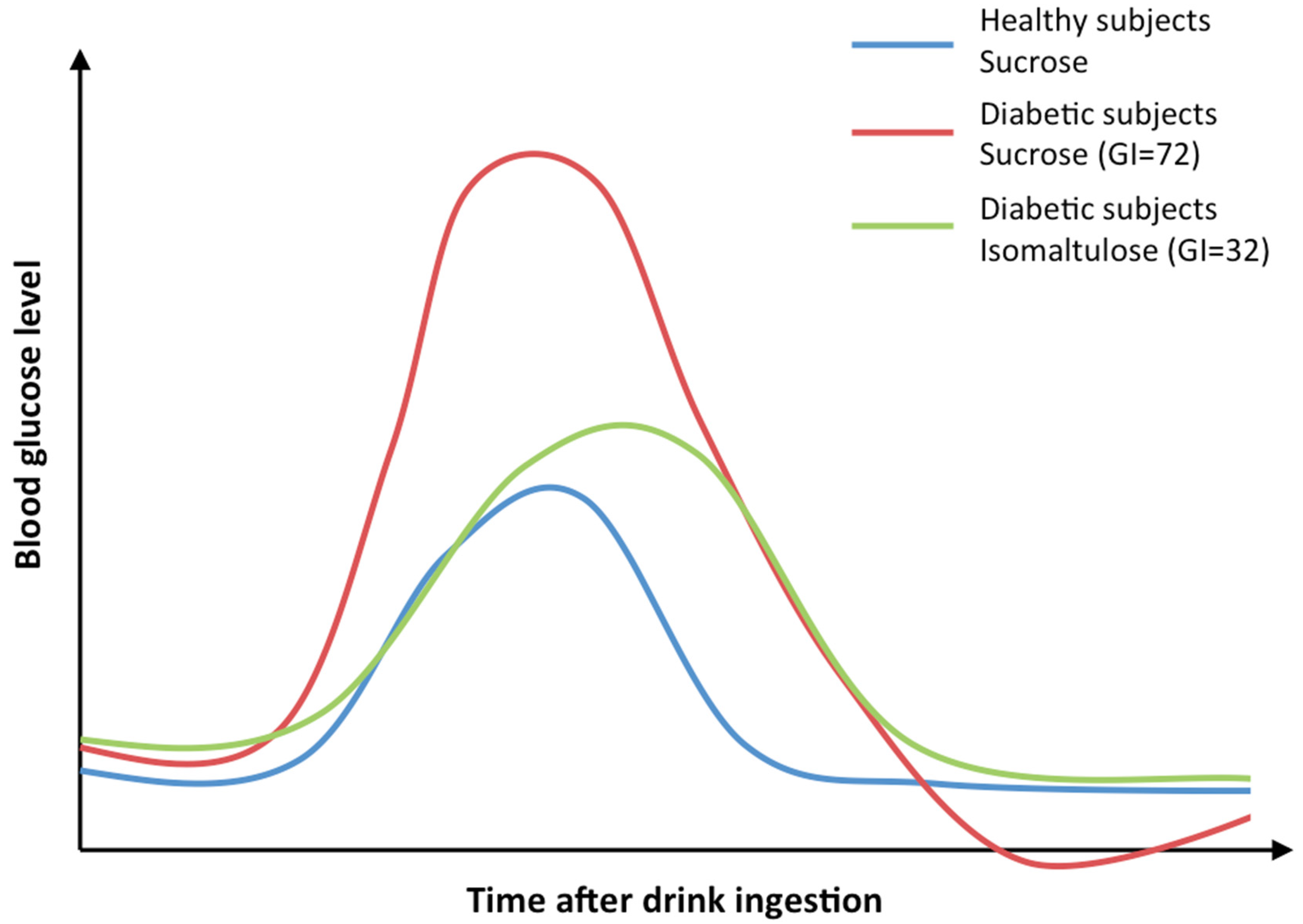
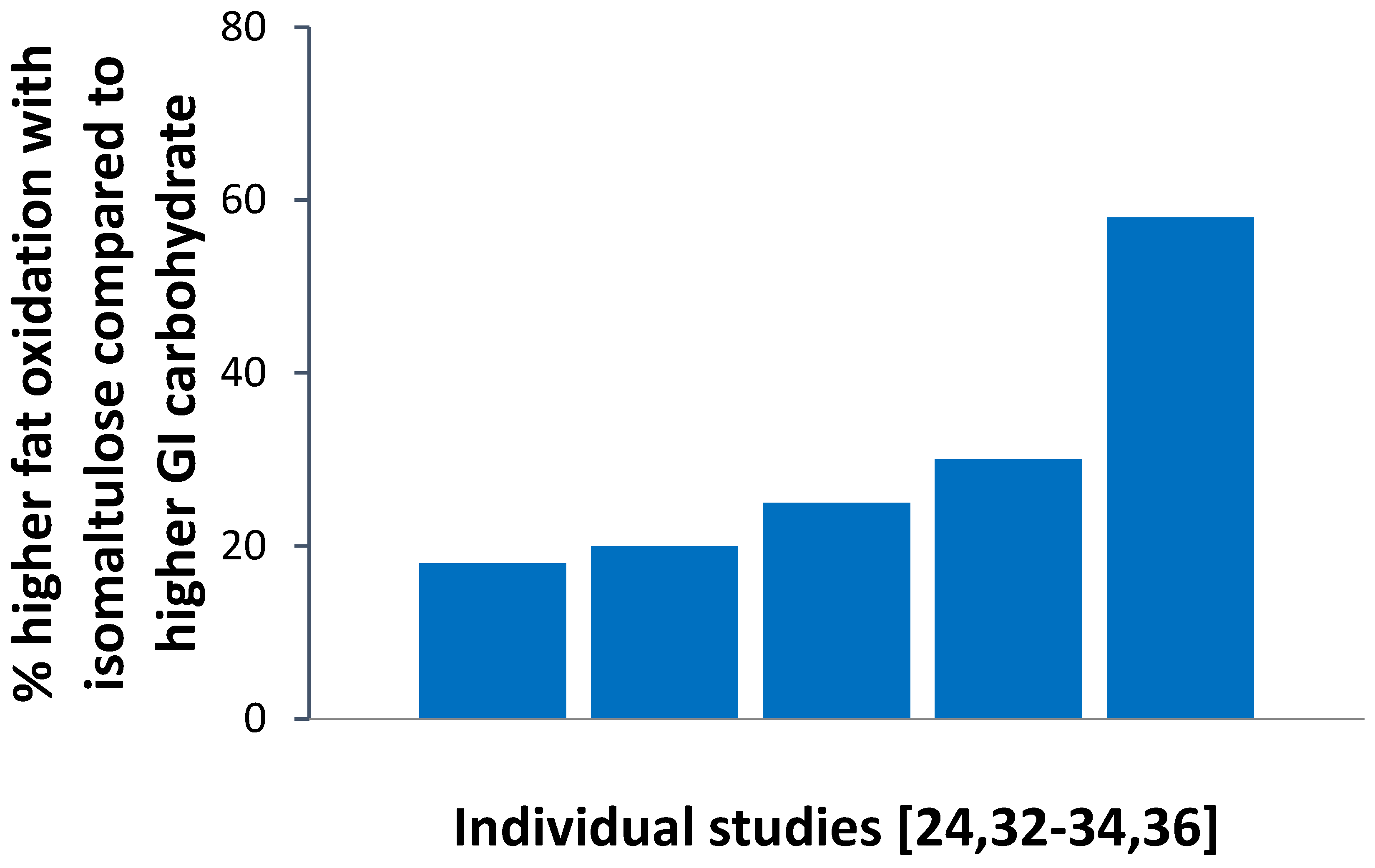

| Application | Observed Effects | Studies Using Isomaltulose Drinks | Studies Using Low-GI Diets |
|---|---|---|---|
| Diabetes mellitus | Isomaltulose drinks: 20%–50% reduced glucose and insulin levels as compared with sucrose or maltodextrin single drink; Delay of peak glucose level; No fermentation up to 75 g per drink; Reduced amount of total glucose in the systemic blood circulation; Increased first-pass splanchnic glucose uptake; Low GI diet: Glycated hemoglobin 1Ac reduced 0.1%–0.5% | [23,24,25,26,27,28,29,30,31] | [5,64,65] |
| Sports | Promotes a higher contribution of fat oxidation in energy metabolism; Improved physical performance; Protection against hypoglycemia during exercise | [24,31,32,33,34,35,36,40] | [24,37,38] |
| Cognitive performance | Positive effects on mood; Improved episodic and working memory; Improved attention speed | [41,42] | [43,44] |
| Body weight and composition | Facilitation of weight maintenance; Increased fat oxidation | [57] | [45,46,47,58,59,60] |
| Pregnancy outcome | Reduced gestational weight gain and birth weight; Reduced proportion of babies born large for gestational age | - | [61,62,63] |
© 2017 by the authors. Licensee MDPI, Basel, Switzerland. This article is an open access article distributed under the terms and conditions of the Creative Commons Attribution (CC BY) license (http://creativecommons.org/licenses/by/4.0/).
Share and Cite
Maresch, C.C.; Petry, S.F.; Theis, S.; Bosy-Westphal, A.; Linn, T. Low Glycemic Index Prototype Isomaltulose—Update of Clinical Trials. Nutrients 2017, 9, 381. https://doi.org/10.3390/nu9040381
Maresch CC, Petry SF, Theis S, Bosy-Westphal A, Linn T. Low Glycemic Index Prototype Isomaltulose—Update of Clinical Trials. Nutrients. 2017; 9(4):381. https://doi.org/10.3390/nu9040381
Chicago/Turabian StyleMaresch, Constanze Christin, Sebastian Friedrich Petry, Stephan Theis, Anja Bosy-Westphal, and Thomas Linn. 2017. "Low Glycemic Index Prototype Isomaltulose—Update of Clinical Trials" Nutrients 9, no. 4: 381. https://doi.org/10.3390/nu9040381
APA StyleMaresch, C. C., Petry, S. F., Theis, S., Bosy-Westphal, A., & Linn, T. (2017). Low Glycemic Index Prototype Isomaltulose—Update of Clinical Trials. Nutrients, 9(4), 381. https://doi.org/10.3390/nu9040381

