
Relative Expression of Vitamin D Hydroxylases, CYP27B1 and CYP24A1, and of Cyclooxygenase-2 and Heterogeneity of Human Colorectal Cancer in Relation to Age, Gender, Tumor Location, and Malignancy: Results from Factor and Cluster Analysis


Abstract
1. Introduction
2. Patients and Methods
2.1. Patient Data and Analysis of Tissue Samples
2.2. Expression Analysis
2.3. Statistical Methods
3. Results
3.1. RT-PCR Analysis of mRNA Expression
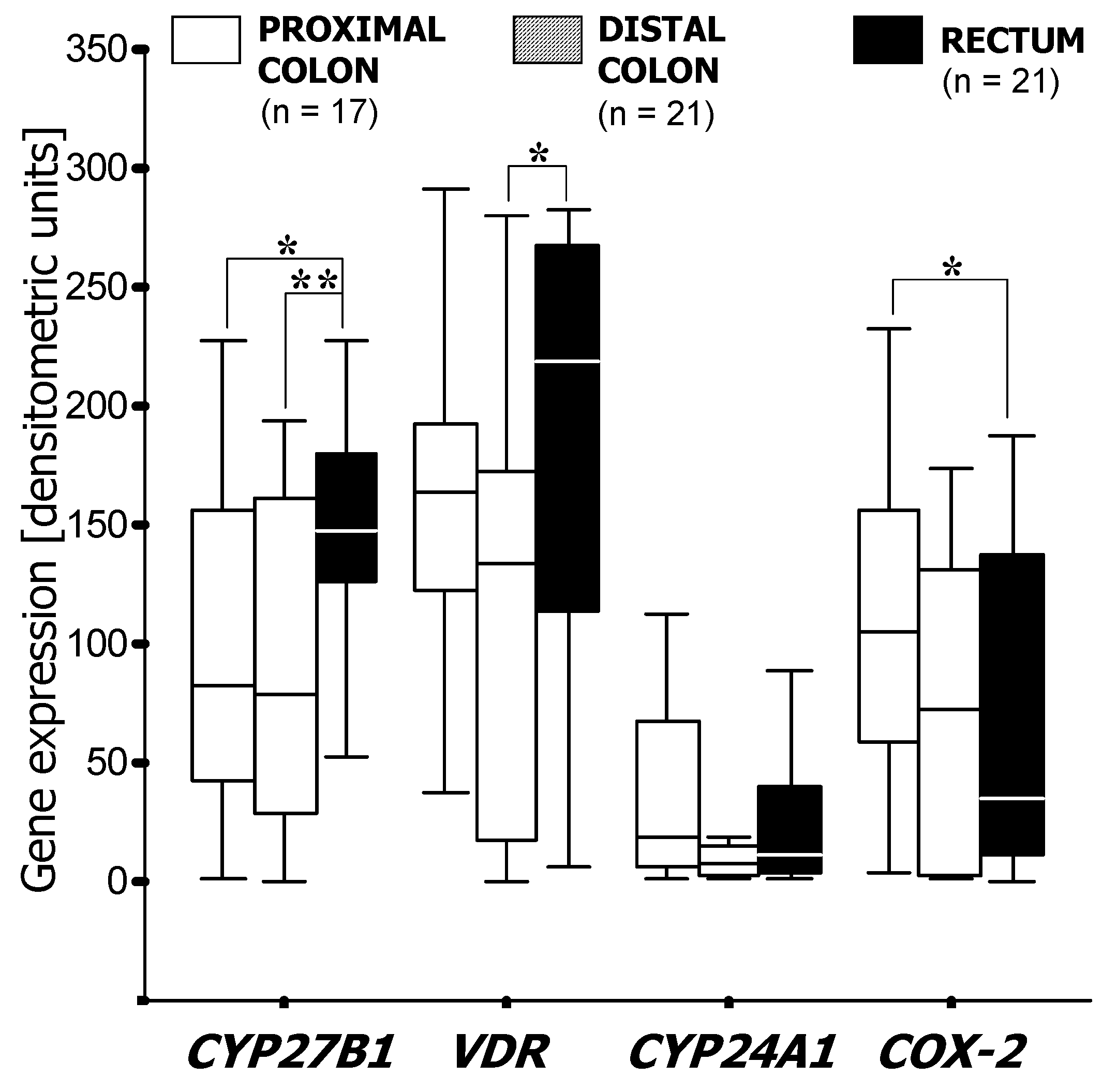
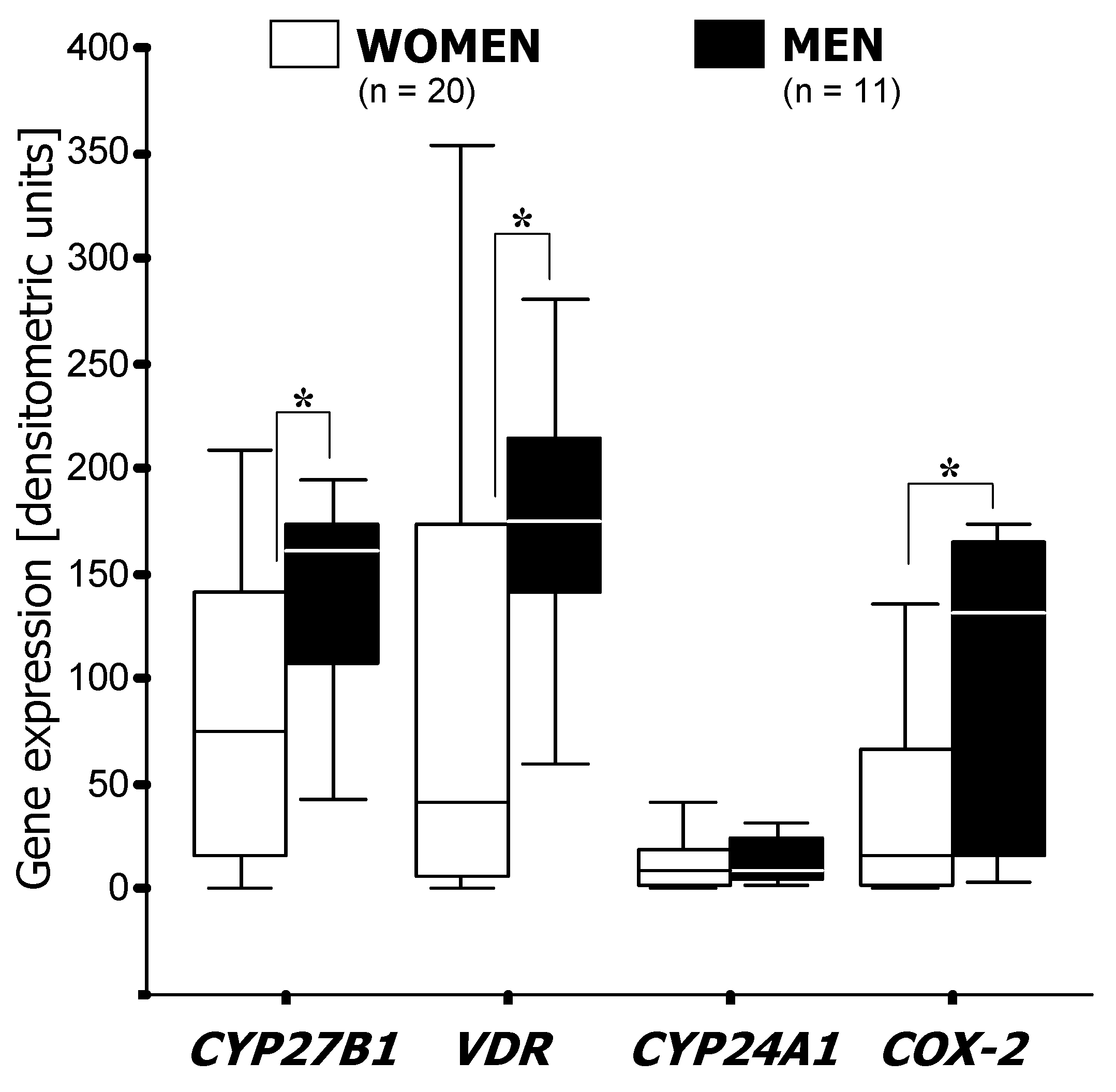
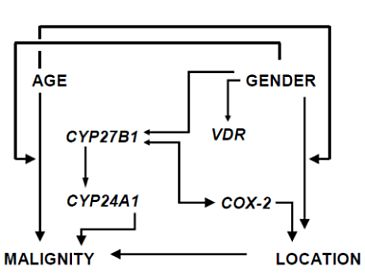
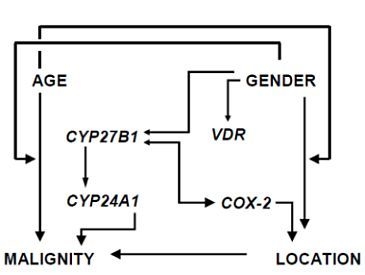
3.2. Factor and Cluster Analysis
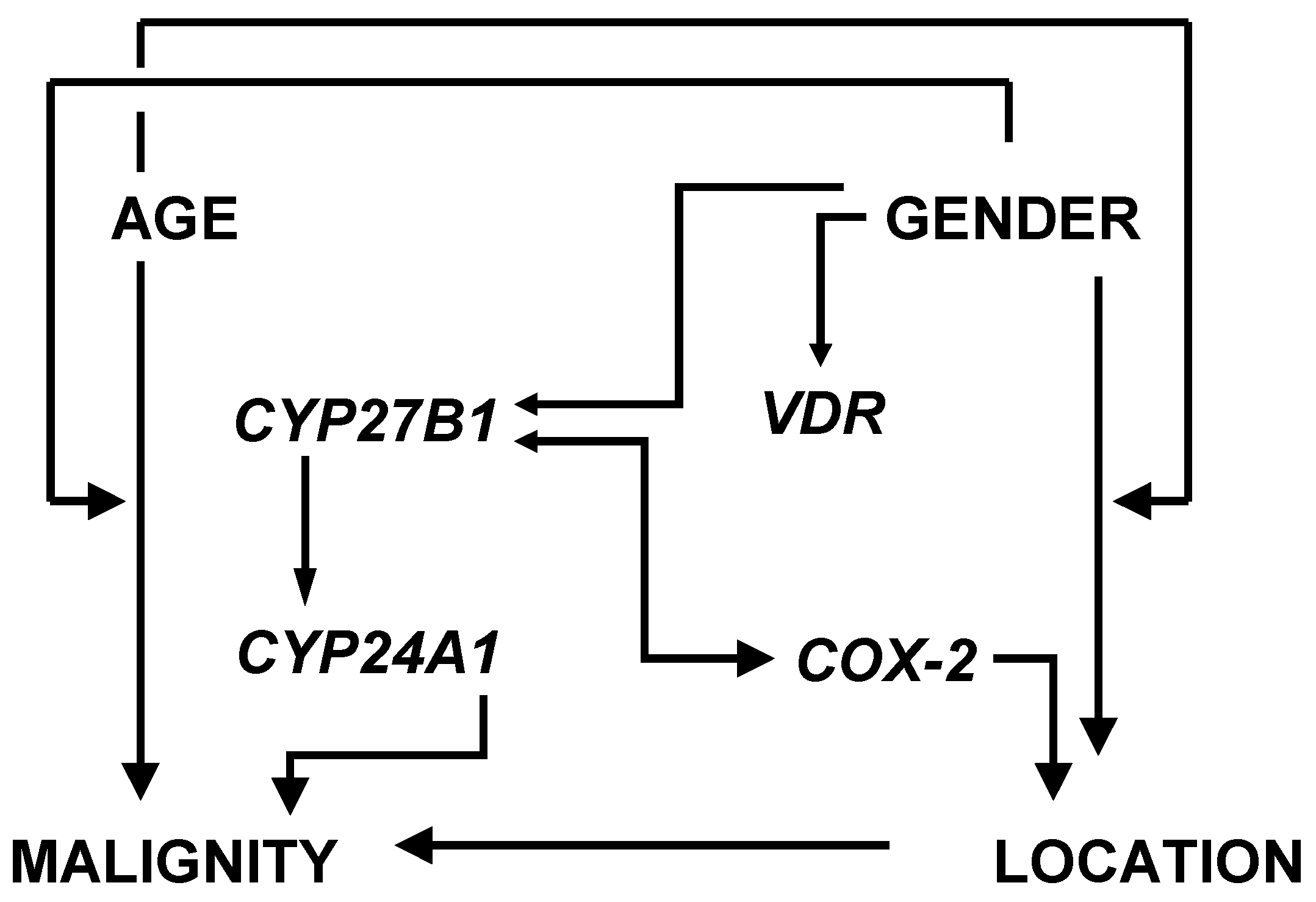

| Colorectal cancer tissue | ||||||||
| F1TU | F2TU | F3TU | F4TU | |||||
| PF | ML | PF | ML | PF | ML | PF | ML | |
| CYP27B1 | 0.73 | 0.61 | 0.07 | 0.15 | −0.08 | −0.11 | 0.05 | 0.15 |
| VDR | 0.81 | 0.92 | −0.11 | 0.01 | −0.03 | −0.01 | 0.2 | 0.19 |
| COX-2 | 0.34 | 0.38 | −0.50 | -0.3 | −0.10 | −0.14 | −0.02 | 0.01 |
| subsite | 0.2 | 0.1 | 0.62 | 0.9 | −0.12 | −0.10 | −0.16 | −0.13 |
| gender | −0.18 | −0.17 | 0.33 | 0.24 | 0.45 | 0.95 | 0.18 | 0.14 |
| age | 0 | −0.02 | −0.12 | -0.13 | 0.7 | 0.31 | −0.07 | 0 |
| grading | −0.01 | 0.04 | −0.03 | -0.05 | 0 | 0.05 | 0.4 | 0.25 |
| CYP24A1 | 0.24 | 0.16 | −0.03 | 0.01 | 0.02 | −0.04 | 0.5 | 0.77 |
| Adjacent Mucosa | ||||||||
| CYP27B1 | 1 | 0.99 | 0.03 | 0.08 | 0.06 | 0.06 | −0.03 | 0.13 |
| VDR | 0.42 | 0.34 | −0.06 | −0.04 | 0.11 | 0.07 | 0.6 | 0.69 |
| COX-2 | 0.25 | 0.18 | −0.05 | −0.03 | 0.1 | 0.07 | 0.3 | 0.34 |
| subsite | 0.06 | 0.08 | 0.16 | 0.19 | −0.25 | −0.20 | −0.16 | -0.15 |
| gender | −0.04 | −0.08 | 0.77 | 0.63 | 0.14 | 0.18 | 0.01 | 0 |
| age | 0.12 | 0.11 | 0.2 | 0.15 | 0.83 | 0.98 | −0.02 | 0.02 |
| grading | −0.11 | −0.20 | 0.09 | 0.1 | −0.03 | −0.03 | 0.52 | 0.49 |
| CYP24A1 | 0.32 | 0.29 | 0.31 | 0.41 | −0.17 | −0.14 | 0.1 | 0.11 |
4. Discussion
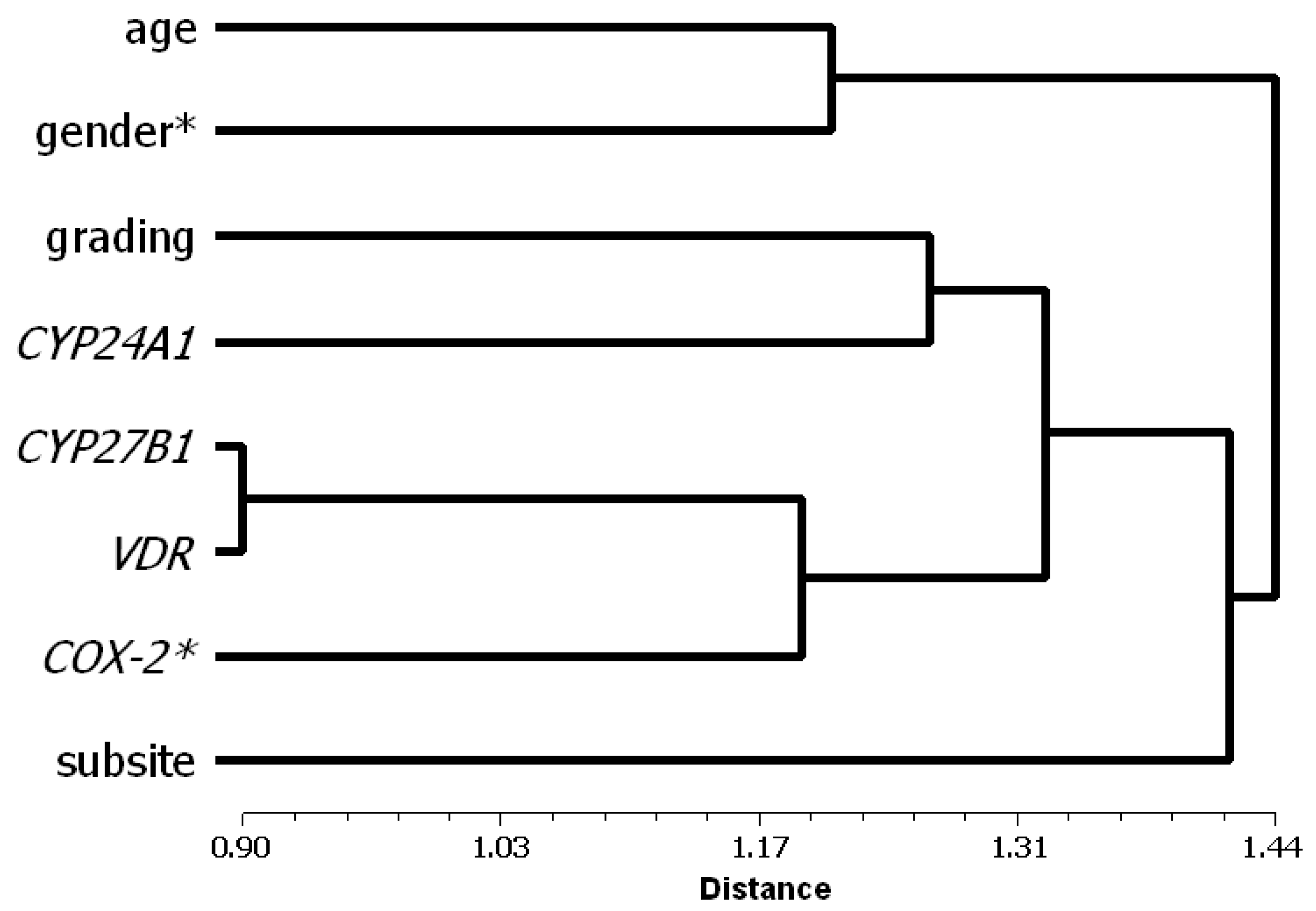
5. Conclusions
Conflict of Interest
References
- Jass, J.R. Molecular heterogeneity of colorectal cancer: Implications for cancer control. Surg. Oncol. 2007, 16, S7–S9. [Google Scholar] [CrossRef]
- Brozek, W.; Kriwanek, S.; Bonner, E.; Peterlik, M.; Cross, H.S. Mutual associations between malignancy, age, gender, and subsite incidence of colorectal cancer. Anticancer Res. 2009, 29, 3721–3726. [Google Scholar]
- Cross, H.S.; Nittke, T.; Kallay, E. Colonic vitamin D metabolism: Implications for the pathogenesis of inflammatory bowel disease and colorectal cancer. Mol. Cell. Endocrinol. 2011, 347, 70–79. [Google Scholar]
- Krishnan, A.V.; Moreno, J.; Nonn, L.; Malloy, P.; Swami, S.; Peng, L.; Peehl, D.M.; Feldman, D. Novel pathways that contribute to the anti-proliferative and chemopreventive activities of calcitriol in prostate cancer. J. Steroid Biochem. Mol. Biol. 2007, 103, 694–702. [Google Scholar] [CrossRef]
- Cross, H.S.; Kallay, E. Regulation of the colonic vitamin D system for prevention of tumor progression: An update. Future Oncol. 2009, 5, 493–507. [Google Scholar] [CrossRef]
- Deeb, K.K.; Trump, D.L.; Johnson, C.S. Vitamin D signalling pathways in cancer: Potential for anticancer therapeutics. Nat. Rev. Cancer 2007, 7, 684–700. [Google Scholar] [CrossRef]
- Lechner, D.; Kallay, E.; Cross, H.S. 1alpha,25-Dihydroxyvitamin D3 downregulates CYP27B1 and induces CYP24A1 in colon cells. Mol. Cell. Endocrinol. 2007, 263, 55–64. [Google Scholar]
- Horvath, H.C.; Lakatos, P.; Kosa, J.P.; Bacsi, K.; Borka, K.; Bises, G.; Nittke, T.; Hershberger, P.A.; Speer, G.; Kallay, E. The candidate oncogene CYP24A1: A potential biomarker for colorectal tumorigenesis. J. Histochem. Cytochem. 2010, 58, 277–285. [Google Scholar] [CrossRef]
- Nittke, T.; Selig, S.; Kallay, E.; Cross, H.S. Nutritional calcium modulates colonic expression of vitamin D receptor and pregnane X receptor target genes. Mol. Nutr. Food Res. 2008, 52, 45–51. [Google Scholar]
- Eberhart, C.E.; Coffey, R.J.; Radhika, A.; Giardiello, F.M.; Ferrenbach, S.; DuBois, R.N. Up-regulation of cyclooxygenase 2 gene expression in human colorectal adenomas and adenocarcinomas. Gastroenterology 1994, 107, 1183–1188. [Google Scholar]
- Fosslien, E. Molecular pathology of cyclooxygenase-2 in neoplasia. Ann. Clin. Lab. Sci. 2000, 30, 3–21. [Google Scholar]
- Leedham, S.J.; Graham, T.A.; Oukrif, D.; McDonald, S.A.; Rodriguez-Justo, M.; Harrison, R.F.; Shepherd, N.A.; Novelli, M.R.; Jankowski, J.A.; Wright, N.A. Clonality, founder mutations, and field cancerization in human ulcerative colitis-associated neoplasia. Gastroenterology 2009, 136, 542–550. [Google Scholar]
- Wang, D.; Mann, J.R.; DuBois, R.N. WNT and cyclooxygenase-2 cross-talk accelerates adenoma growth. Cell Cycle 2004, 3, 1512–1515. [Google Scholar] [CrossRef]
- Sheehan, K.M.; Sheahan, K.; O’Donoghue, D.P.; MacSweeney, F.; Conroy, R.M.; Fitzgerald, D.J.; Murray, F.E. The relationship between cyclooxygenase-2 expression and colorectal cancer. JAMA 1999, 282, 1254–1257. [Google Scholar] [CrossRef]
- Baron, J.A.; Cole, B.F.; Sandler, R.S.; Haile, R.W.; Ahnen, D.; Bresalier, R.; McKeown-Eyssen, G.; Summers, R.W.; Rothstein, R.; Burke, C.A.; et al. A randomized trial of aspirin to prevent colorectal adenomas. N. Engl. J. Med. 2003, 348, 891–899. [Google Scholar]
- Jass, J.R.; Sobin, L.H.; Watanabe, H. The World Health Organization’s histologic classification of gastrointestinal tumors. A commentary on the second edition. Cancer 1990, 66, 2162–2167. [Google Scholar] [CrossRef]
- Fabrigar, L.R.; Wegener, D.T.; MacCallum, R.C.; Strahan, E.J. Evaluating the use of exploratory factor analysis in psychological research. Psychol. Methods 1999, 4, 272–299. [Google Scholar] [CrossRef]
- Gorsuch, R.L. Factor Analysis, 2nd ed; Lawrence Erlbaum Associates: Hillsdale, NJ, USA, 1983. [Google Scholar]
- Sneath, P.H.A.; Sokal, R.R. Numerical Taxonomy; W.H. Freeman and Company: San Francisco, CA, USA, 1973; pp. 230–234. [Google Scholar]
- Bareis, P.; Bises, G.; Bischof, M.G.; Cross, H.S.; Peterlik, M. 25-Hydroxyvitamin D metabolism in human colon cancer cells during tumor progression. Biochem. Biophys. Res. Commun. 2001, 285, 1012–1017. [Google Scholar] [CrossRef]
- Cross, H.S.; Bareis, P.; Hofer, H.; Bischof, M.G.; Bajna, E.; Kriwanek, S.; Bonner, E.; Peterlik, M. 25-Hydroxyvitamin D(3)-1alpha-hydroxylase and vitamin D receptor gene expression in human colonic mucosa is elevated during early cancerogenesis. Steroids 2001, 66, 287–292. [Google Scholar] [CrossRef]
- Gustafsson Asting, A.; Caren, H.; Andersson, M.; Lonnroth, C.; Lagerstedt, K.; Lundholm, K. COX-2 gene expression in colon cancer tissue related to regulating factors and promoter methylation status. BMC Cancer 2011, 11, 238. [Google Scholar] [CrossRef]
- Peterlik, M. Role of bile acid secretion in human colorectal cancer. Wien. Med. Wochenschr. 2008, 158, 539–541. [Google Scholar] [CrossRef]
- Miyaki, A.; Yang, P.; Tai, H.H.; Subbaramaiah, K.; Dannenberg, A.J. Bile acids inhibit NAD+-dependent 15-hydroxyprostaglandin dehydrogenase transcription in colonocytes. Am. J. Physiol. Gastrointest. Liver Physiol. 2009, 297, G559–G566. [Google Scholar] [CrossRef]
- Nehring, J.A.; Zierold, C.; DeLuca, H.F. Lithocholic acid can carry out in vivo functions of vitamin D. Proc. Natl. Acad. Sci. USA 2007, 104, 10006–10009. [Google Scholar]
- Lai, T.Y.; Chen, L.M.; Lin, J.Y.; Tzang, B.S.; Lin, J.A.; Tsai, C.H.; Lin, Y.M.; Huang, C.Y.; Liu, C.J.; Hsu, H.H. 17beta-Estradiol inhibits prostaglandin E2-induced COX-2 expressions and cell migration by suppressing Akt and ERK1/2 signaling pathways in human LoVo colon cancer cells. Mol. Cell Biochem. 2010, 342, 63–70. [Google Scholar] [CrossRef]
- Lechner, D.; Cross, H.S. Phytoestrogens and 17beta-estradiol influence vitamin D metabolism and receptor expression-relevance for colon cancer prevention. Recent Results Cancer Res. 2003, 164, 379–391. [Google Scholar]
- Lechner, D.; Bajna, E.; Adlercreutz, H.; Cross, H.S. Genistein and 17beta-estradiol, but not equol, regulate vitamin D synthesis in human colon and breast cancer cells. Anticancer Res. 2006, 26, 2597–2603. [Google Scholar]
- Lechner, D.; Kallay, E.; Cross, H.S. Phytoestrogens and colorectal cancer prevention. Vitam Horm. 2005, 70, 169–198. [Google Scholar] [CrossRef]
- Protiva, P.; Cross, H.S.; Hopkins, M.E.; Kallay, E.; Bises, G.; Dreyhaupt, E.; Augenlicht, L.; Lipkin, M.; Lesser, M.; Livote, E.; et al. Chemoprevention of colorectal neoplasia by estrogen: Potential role of vitamin D activity. Cancer Prev. Res. (Phila) 2009, 2, 43–51. [Google Scholar] [CrossRef]
- Hendifar, A.; Yang, D.; Lenz, F.; Lurje, G.; Pohl, A.; Lenz, C.; Ning, Y.; Zhang, W.; Lenz, H.J. Gender disparities in metastatic colorectal cancer survival. Clin. Cancer Res. 2009, 15, 6391–6397. [Google Scholar]
- Oates, J.A. Cardiovascular risk markers and mechanisms in targeting the COX pathway for colorectal cancer prevention. Cancer Prev. Res. (Phila) 2011, 4, 1145–1148. [Google Scholar] [CrossRef]
- Aparna, R.; Subhashini, J.; Roy, K.R.; Reddy, G.S.; Robinson, M.; Uskokovic, M.R.; Venkateswara Reddy, G.; Reddanna, P. Selective inhibition of cyclooxygenase-2 (COX-2) by 1alpha,25-dihydroxy-16-ene-23-yne-vitamin D3, a less calcemic vitamin D analog. J. Cell Biochem. 2008, 104, 1832–1842. [Google Scholar]
- Fearon, E.R.; Vogelstein, B. A genetic model for colorectal tumorigenesis. Cell 1990, 61, 759–767. [Google Scholar] [CrossRef]
- Cross, H.S.; Bises, G.; Lechner, D.; Manhardt, T.; Kallay, E. The vitamin d endocrine system of the gut—Its possible role in colorectal cancer prevention. J. Steroid Biochem. Mol. Biol. 2005, 97, 121–128. [Google Scholar] [CrossRef]
- Dobnig, H.; Pilz, S.; Scharnagl, H.; Renner, W.; Seelhorst, U.; Wellnitz, B.; Kinkeldei, J.; Boehm, B.O.; Weihrauch, G.; Maerz, W. Independent association of low serum 25-hydroxyvitamin d and 1,25-dihydroxyvitamin d levels with all-cause and cardiovascular mortality. Arch. Intern. Med. 2008, 168, 1340–1349. [Google Scholar] [CrossRef]
© 2012 by the authors; licensee MDPI, Basel, Switzerland. This article is an open access article distributed under the terms and conditions of the Creative Commons Attribution license (http://creativecommons.org/licenses/by/3.0/).
Share and Cite
Brozek, W.; Manhardt, T.; Kállay, E.; Peterlik, M.; Cross, H.S. Relative Expression of Vitamin D Hydroxylases, CYP27B1 and CYP24A1, and of Cyclooxygenase-2 and Heterogeneity of Human Colorectal Cancer in Relation to Age, Gender, Tumor Location, and Malignancy: Results from Factor and Cluster Analysis. Cancers 2012, 4, 763-776. https://doi.org/10.3390/cancers4030763
Brozek W, Manhardt T, Kállay E, Peterlik M, Cross HS. Relative Expression of Vitamin D Hydroxylases, CYP27B1 and CYP24A1, and of Cyclooxygenase-2 and Heterogeneity of Human Colorectal Cancer in Relation to Age, Gender, Tumor Location, and Malignancy: Results from Factor and Cluster Analysis. Cancers. 2012; 4(3):763-776. https://doi.org/10.3390/cancers4030763
Chicago/Turabian StyleBrozek, Wolfgang, Teresa Manhardt, Enikö Kállay, Meinrad Peterlik, and Heide S. Cross. 2012. "Relative Expression of Vitamin D Hydroxylases, CYP27B1 and CYP24A1, and of Cyclooxygenase-2 and Heterogeneity of Human Colorectal Cancer in Relation to Age, Gender, Tumor Location, and Malignancy: Results from Factor and Cluster Analysis" Cancers 4, no. 3: 763-776. https://doi.org/10.3390/cancers4030763
APA StyleBrozek, W., Manhardt, T., Kállay, E., Peterlik, M., & Cross, H. S. (2012). Relative Expression of Vitamin D Hydroxylases, CYP27B1 and CYP24A1, and of Cyclooxygenase-2 and Heterogeneity of Human Colorectal Cancer in Relation to Age, Gender, Tumor Location, and Malignancy: Results from Factor and Cluster Analysis. Cancers, 4(3), 763-776. https://doi.org/10.3390/cancers4030763