Effect of Compatibility on the Foaming Behavior of Injection Molded Polypropylene and Polycarbonate Blend Parts


Abstract
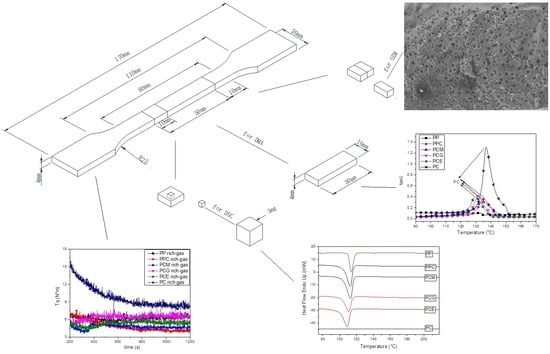
1. Introduction
2. Experimental
2.1. Materials
2.2. Sample Preparation
2.3. Sample Tests
3. Results and Discussion
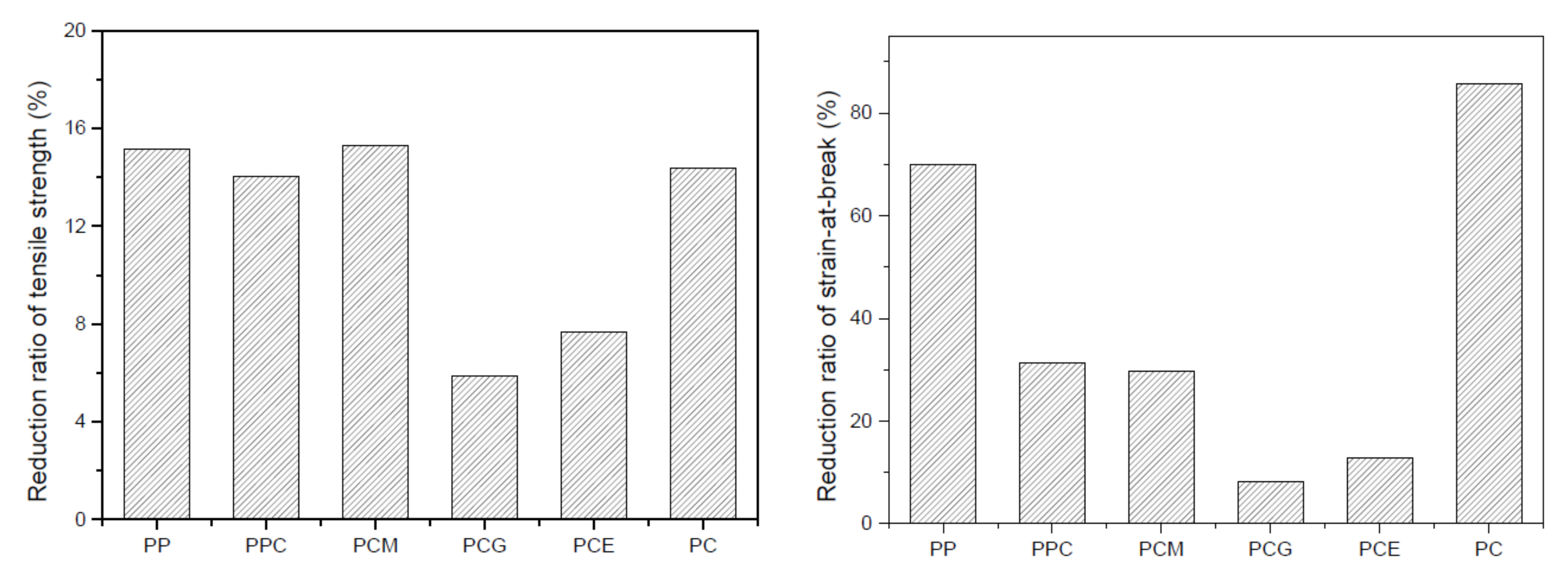
3.1. Mechanical Properties
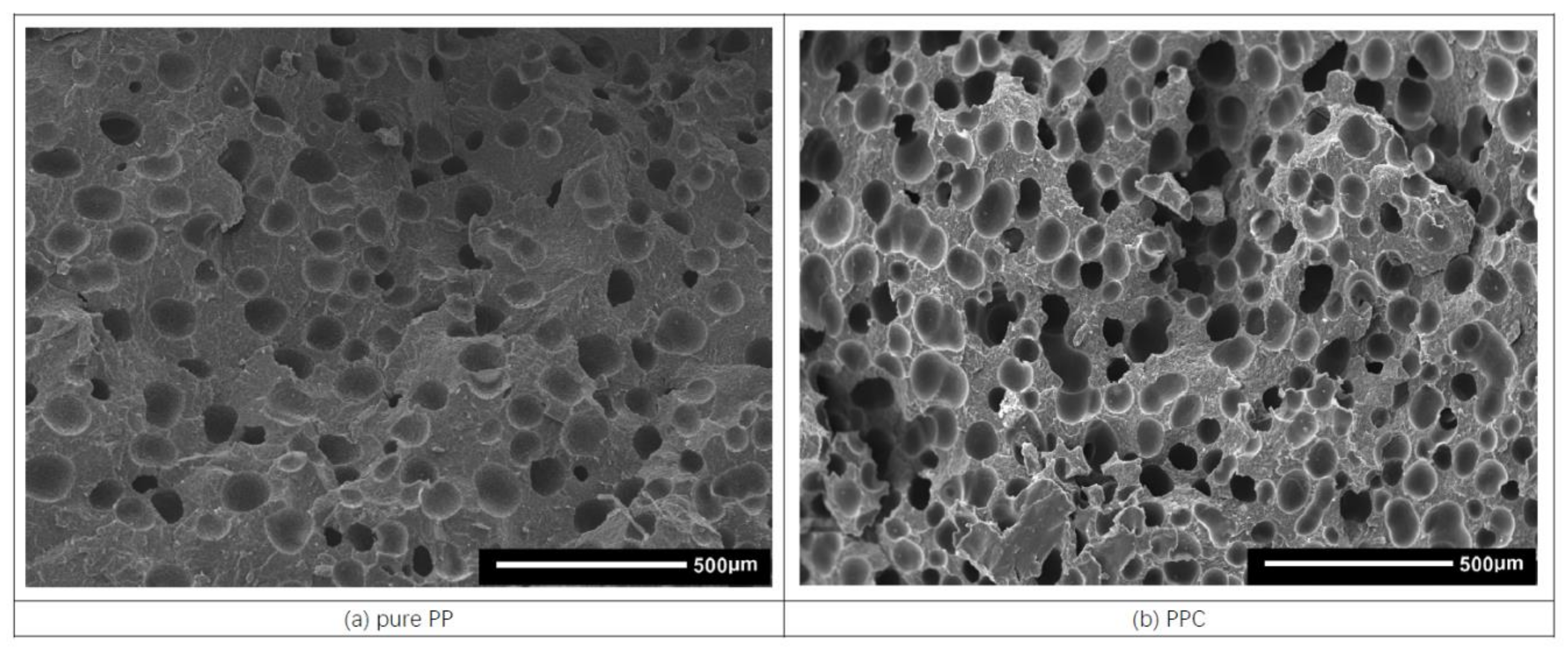
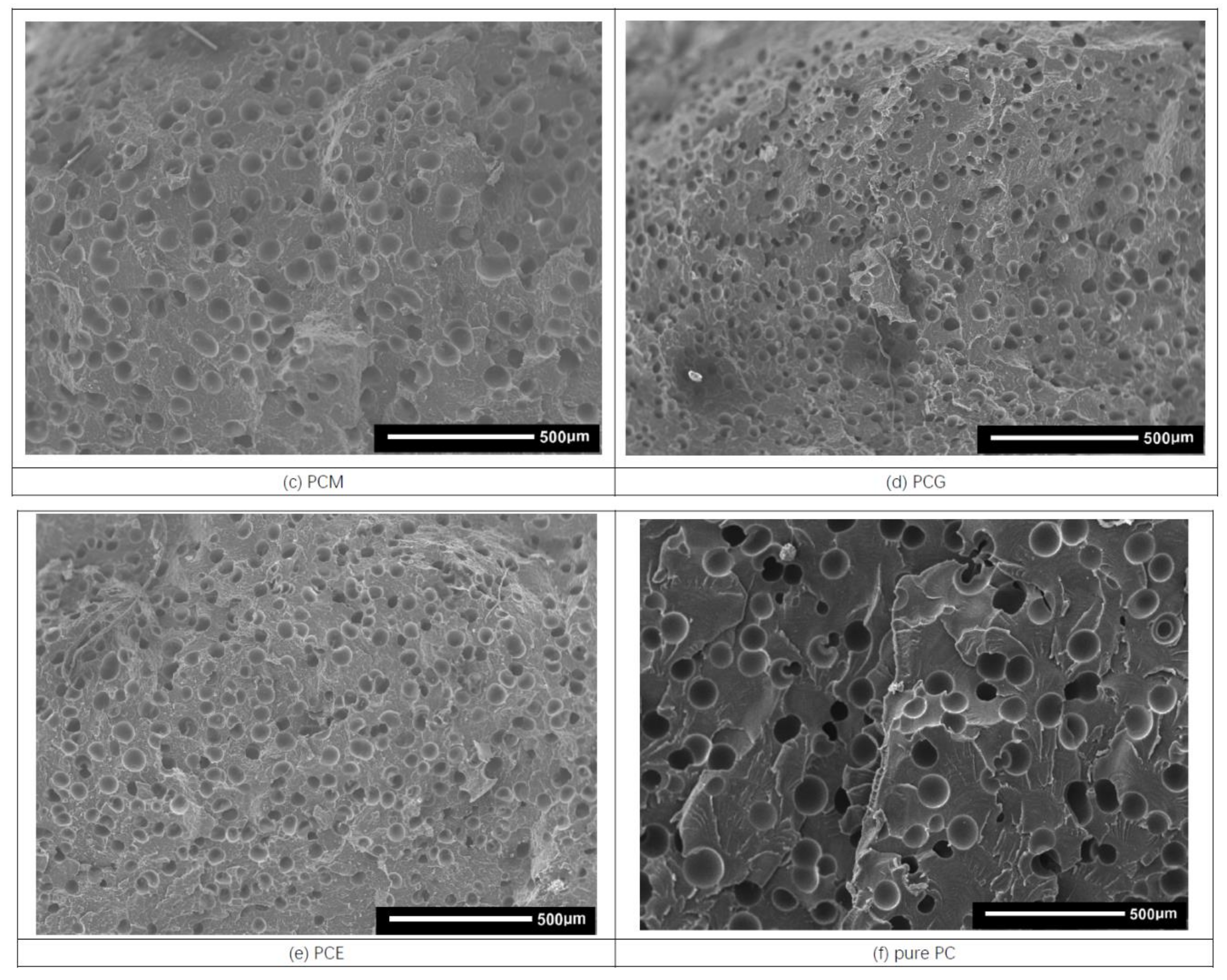
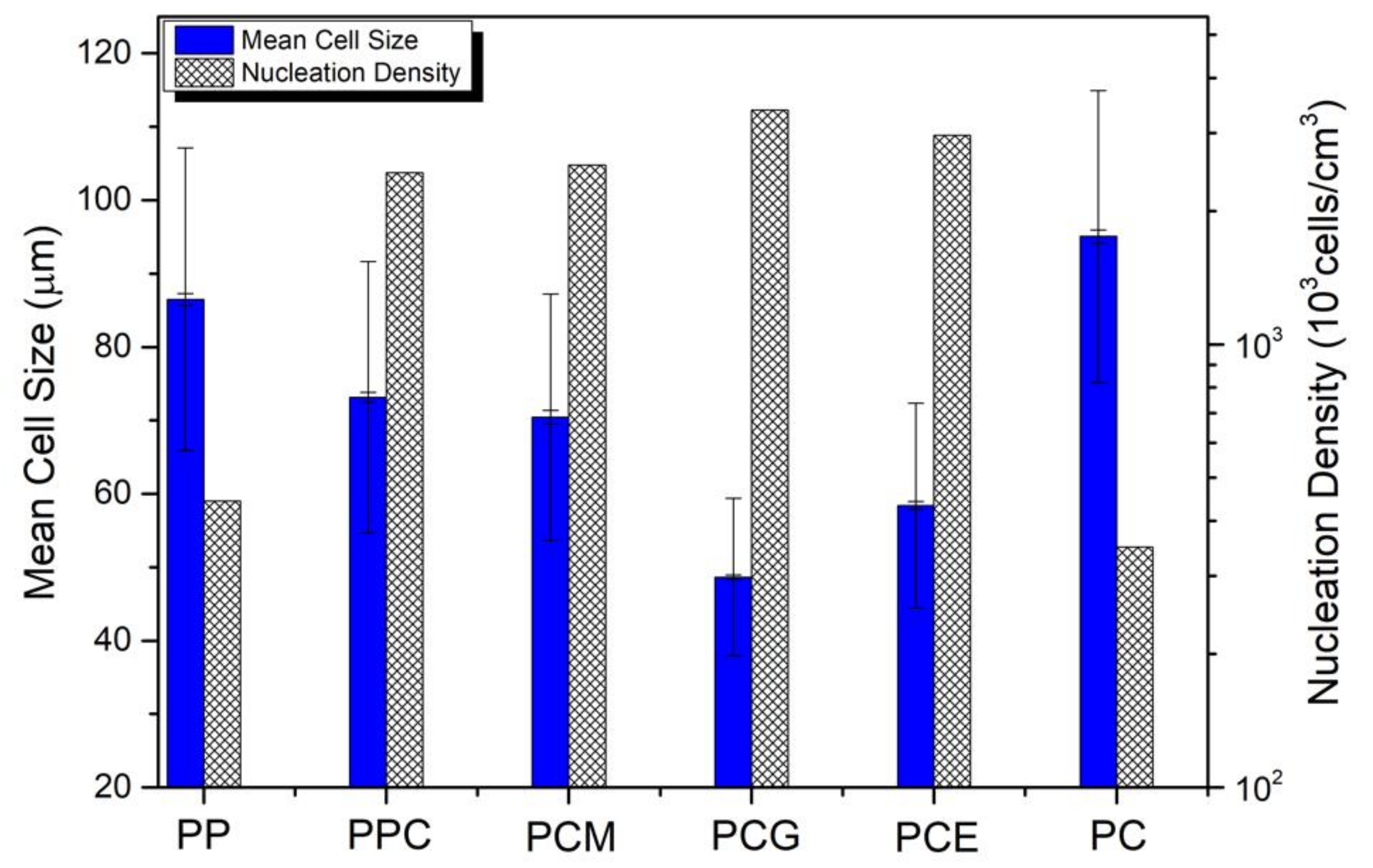
3.2. Foaming Behavior
3.3. Compatibility
3.4. Relative Rheological Behavior
4. Conclusions
Author Contributions
Funding
Conflicts of Interest
References
- Park, C.B.; Cheung, L.K. A Study of Cell Nucleation in the Extrusion of Polypropylene Foams. Polym. Eng. Sci. 1997, 37, 1–10. [Google Scholar] [CrossRef] [Scilit]
- Saiz-Arroyo, C.; de Saja, J.A.; Velasco, J.I.; Rodriguez-Perez, M.A. Moulded Polypropylene Foams Produced Using Chemical or Physical Blowing Agents Structure–Properties Relationship. J. Mater. Sci. 2012, 47, 5680–5692. [Google Scholar] [CrossRef] [Scilit]
- Mohebbi, A.; Mighri, F.; Ajji, A.; Rodrigue, D. Current Issues and Challenges in Polypropylene Foaming: A Review. Cell. Polym. 2015, 34, 299–338. [Google Scholar] [CrossRef] [Scilit]
- Li, G.; Wang Park, C.B. Measurement of Gas Solubility in Linear/branched PP Melts. J. Polym. Sci. Part B 2007, 45, 2497–2508. [Google Scholar] [CrossRef] [Scilit]
- Yu, C.; Wang, Y.; Wu, B.; Xie, Y.; Yu, C.; Chen, S.; Li, W. Evaluating the Foamability of Polypropylene with Nitrogen as the Blowing Agent. Polym. Test. 2011, 30, 887–892. [Google Scholar]
- Xu, Z.M.; Jiang, X.L.; Liu, T. Foaming of Polypropylene with Supercritical Carbon Dioxide. J. Supercrit. Fluids 2007, 41, 299–310. [Google Scholar] [CrossRef] [Scilit]
- Li, Y.; Yao, Z.; Chen, Z.; Qiu, S.; Zeng, C.; Cao, K. High Melt Strength Polypropylene by Ionic Modification: Preparation, Rheological Properties and Foaming Behaviors. Polymer 2015, 70, 207–214. [Google Scholar] [CrossRef] [Scilit]
- Zhou, S.; Zhao, S.; Xin, Z. Preparation and Foamability of High Melt Strength Polypropylene Based on Grafting Vinyl Polydimethylsiloxane and Styrene. Polym. Eng. Sci. 2015, 55, 251–259. [Google Scholar] [CrossRef] [Scilit]
- Zheng, W.G.; Lee, Y.H.; Park, C.B. Use of Nanoparticles for Improving the Foaming Behaviors of Linear PP. J. Appl. Polym. Sci. 2010, 117, 2972–2979. [Google Scholar] [CrossRef] [Scilit]
- Ding, S.; Ma, W.; Zhong, Q. Foaming Behavior of Microcellular Foam Polypropylene/Modified Nano Calcium Carbonate Composites. J. Appl. Polym. Sci. 2013, 128, 3639–3651. [Google Scholar] [CrossRef] [Scilit]
- Antunes, M.; Velasco, I. Multifunctional Polymer Foams with Carbon Nanoparticles. Prog. Polym. Sci. 2014, 39, 468–509. [Google Scholar] [CrossRef] [Scilit]
- Zhou, Y.G.; Su, B.; Turng, L.S. Mechanical Properties, Fiber Orientation, and Length Distribution of Glass Fiber-Reinforced Polypropylene Parts: Influence of Water-Foaming Technology. Polym. Compos. 2018, 39, 4386–4399. [Google Scholar]
- Su, B.; Zhou, Y.G. Influence of Foaming Technology on Fiber Breakage in Long Fiber-Reinforced Composites Foamed Parts. Plast. Rubber Compos. 2017, 46, 365–374. [Google Scholar] [CrossRef] [Scilit]
- Zhai, W.; Wang, H.; Yu, J.; Dong, J.; He, J. Foaming Behavior of Polypropylene/Polystyrene Blends Enhanced by Improved Interfacial Compatibility. J. Polym. Sci. Part B 2008, 46, 1641–1651. [Google Scholar] [CrossRef] [Scilit]
- Sharudin, R.W.; Alwi, H.; Ohshima, M. PP/PS/PMMA Ternary Blend Foaming Using Supercritical CO2. Adv. Mater. Res. 2013, 701, 17–22. [Google Scholar] [CrossRef] [Scilit]
- Zhang, P.; Wang, X.J.; Yang, Y.; Zhou, N. Effect of Dynamic Shear on the Microcellular Foaming of Polypropylene/high-density Polyethylene Blends. J. Appl. Polym. Sci. 2009, 114, 1320–1328. [Google Scholar] [CrossRef] [Scilit]
- Rachtanapun, P.; Selke, S.; Matuana, L. Effect of the High-density Polyethylene Melt Index on the Microcellular Foaming of High-density Polyethylene/polypropylene Blends. J. Appl. Polym. Sci. 2004, 93, 364–371. [Google Scholar] [CrossRef] [Scilit]
- Rachtanapun, P.; Selke, S.; Matuana, L. Relationship between Cell Morphology and Impact Strength of Microcellular Foamed High-density Polyethylene/polypropylene Blends. Polym. Eng. Sci. 2004, 44, 1551–1560. [Google Scholar] [CrossRef] [Scilit]
- Sun, X.; Kharbas, H.; Peng Turng, L.S. Fabrication of Super Ductile Polymeric Blends Using Microcellular Injection Molding. Manuf. Lett. 2014, 2, 64–68. [Google Scholar] [CrossRef] [Scilit]
- Sun, X.; Kharbas, H.; Kharbas, H.; Peng, J.; Turng, L.S. A Novel Method of Producing Lightweight Microcellular Injection Molded Parts with Improved Ductility and Toughness. Polymer 2015, 56, 102–110. [Google Scholar] [CrossRef] [Scilit]
- Zhou, Y.G.; Su, B.; Turng, L.S. Fabrication of Super-Ductile PP/LDPE Blended Parts with a Chemical Foaming Agent. J. Appl. Polym. Sci. 2016, 133, 44101. [Google Scholar] [CrossRef] [Scilit]
- Zhou, Y.G.; Su, B.; Wu, H.H. Effect of Cold-drawn Fibers on the Self-reinforcement of the PP/LDPE Composites. J. Mater. Eng. Perform. 2017, 26, 4072–4082. [Google Scholar] [CrossRef] [Scilit]
- Zhou, Y.G.; Su, B.; Turng, L.S. Influence of Processing Conditions on Morphological Structure and Ductility of Water-Foamed Injection Molded PP/LDPE Blended Parts. Cell. Polym. 2017, 36, 51–74. [Google Scholar] [CrossRef] [Scilit]
- Gunkel, F.; Spörrer, A.; Lim, G.; Bangarusampath, D.; Altstädt, V. Understanding Melt Rheology and Foamability of Polypropylene-based TPO Blends. J. Cell. Plast. 2008, 44, 307–325. [Google Scholar] [CrossRef] [Scilit]
- Tan, X.X.; Zhou, Y.G.; Dong, B.B.; Liu, C.T.; Xu, B.P. Effect of Acrylonitrile-butadiene-styrene Terpolymer on the Foaming Behavior of Polypropylene. Cell. Polym. 2019. accepted and to be published. [Google Scholar]
- Rudin, A.; Brathwaite, N.E. Polycarbonate Blends with Polystyrene and Polypropylene. Polym. Eng. Sci. 2010, 24, 1312–1318. [Google Scholar] [CrossRef] [Scilit]
- Laoutid, F.; Estrada, E.; Michell, R.M.; Bonnaud, L.; Müller, A.J.; Dubois, P.H. The Influence of Nanosilica on the Nucleation, Crystallization and Tensile properties of PP–PC and PP–PA Blends. Polymer 2013, 54, 3982–3993. [Google Scholar] [CrossRef] [Scilit]
- Fisa, B.; Favis, B.D.; Bourgeois, S. Injection Molding of Polypropylene/polycarbonate blends. Polym. Eng. Sci. 2010, 30, 1051–1055. [Google Scholar] [CrossRef] [Scilit]
- Yin, Z.; Zhang, Y.; Zhang, X.; Yin, J. Effects of the Compatibilizer PP-g-GMA on Morphology and Mechanical Properties of PP/PC Blends. Polymer 1998, 39, 547–551. [Google Scholar]
- Renaut, N.; Duquesne, S.; Zanardi, S.; Bardollet, P.; Steil, C.; Delobel, R. Fire Retardancy, Thermomechanical and Thermal Properties of PP/PC Blends. J. Macromol. Sci. Part A 2005, 42, 977–991. [Google Scholar] [CrossRef] [Scilit]
- Dai, S.; Ye, L.; Hu, G. Preparation and Properties of PP/PC/POE Blends. Polym. Adv. Technol. 2010, 21, 279–289. [Google Scholar] [CrossRef] [Scilit]
- Su, B.; Zhou, Y.G.; Wu, H.H. Influence of Mechanical Properties of PP/LDPE Nanocomposites: Compatibility and Crystallization. Nanomater. Nanotechnol. 2017, 7, 1–11. [Google Scholar] [CrossRef] [Scilit]
- Favis, B.D.; Chalifoux, P. The Effect of Viscosity Ratio on the Morphology of Polypropylene/polycarbonate Blends during Processing. Polym. Eng. Sci. 1987, 27, 1591–1600. [Google Scholar] [CrossRef] [Scilit]
- Hammani, S.; Moulai-Mostefa, N.; Benyahia, L.; Tassin, F. Effects of Composition and Extrusion Parameters on the Morphological Development and Rheological Properties of PP/PC blends. Co-continuity Investigation. J. Polym. Res. 2012, 19, 1–9. [Google Scholar] [CrossRef] [Scilit]
- Zhou, Y.G.; Su, B.; Turng, L.S. Depositing-Induced Effects of Isotactic Polypropylene and Polycarbonate Composites during Fused Deposition Modeling. Rapid Prototyping J. 2017, 23, 869–880. [Google Scholar] [CrossRef] [Scilit]
- Samsudin, S.A.; Kelly, C.A.; Kukureka, S.N.; Jenkins, M.J. Development of Partial Miscibility in Polycarbonate/polypropylene Blends via Annealing. J. Polym. Eng. 2017, 37, 707–714. [Google Scholar]
- Zhou, Y.G.; Su, B.; Dong, B.B. Processing Method of Parts Manufactured by PP/PC Microcellular Materials. Chinese Patent 201810132662.2, 9 February 2018. [Google Scholar]
- Nam, P.H.; Maiti, P.; Okamoto, M.; Kotaka, T.; Nakayama, T.; Takada, M.; Ohshima, M.; Usuki, A.; Hasegawa, N.; Okamoto, H. Foam Processing and Cellular Structure of Polypropylene/clay Nanocomposites. Polym. Eng. Sci. 2002, 42, 1907–1918. [Google Scholar] [CrossRef] [Scilit]
- Lee, J.; Turng, L.S.; Dougherty, E.; Gorton, P. Novel Foam Injection Molding Technology using Carbon Dioxide-laden Pellets. Polym. Eng. Sci. 2011, 51, 2295–2303. [Google Scholar] [CrossRef] [Scilit]
- Cabrera, E.D.; Mulyana, R.; Castro, M.; Lee, L.J.; Min, Y. Pressurized Water Pellets and Supercritical Nitrogen in Injection Molding. J. Appl. Polym. Sci. 2013, 127, 3760–3767. [Google Scholar] [CrossRef] [Scilit]
- Xu, B.; Liu, Y.; He, L.; Turng, L.S.; Liu, C. Effect of Centerline Distance on Mixing of a Non-Newtonian Fluid in a Cavity with Asymmetric Rotors. Phys. Fluids 2019, 31, 1–18. [Google Scholar] [CrossRef] [Scilit]
- Wang, S.; Ameli, A.; Shaayegan, V.; Kazemi, Y.; Huang, Y.; Naguib, H.E.; Park, C.B. Modelling of Rod-Like Fillers’ Rotation and Translation near Two Growing Cells in Conductive Polymer Composite Foam Processing. Polymers 2018, 10, 261. [Google Scholar] [CrossRef] [Scilit]
- Yilmaz, G.; Ellingham, T.; Turng, L.S. Improved Processability and the Processing-Structure-Properties Relationship of Ultra-High Molecular Weight Polyethylene via Supercritical Nitrogen and Carbon Dioxide in Injection Molding. Polymers 2018, 10, 36. [Google Scholar] [CrossRef] [Scilit]
- Bai, T.; Dong, B.; Xiao, M.; Liu, H.; Wang NWang, Y.M. Polystyrene Foam with High Cell Density and Small Cell Size by Compression-Injection Molding and Core Back Foaming Technique: Evolution of Cells in Cavity. Macromol. Mater. Eng. 2018, 303, 1800110. [Google Scholar] [CrossRef] [Scilit]
- Zhou, Y.; Lu, S.; Wang, G.; Shi, F. Modeling and Numerical Simulation of Injection Molding of Semi-crystalline Polymer Isotactic Polypropylene. J. Comput. Theor. Nanosci. 2012, 9, 1364–1367. [Google Scholar] [CrossRef] [Scilit]
- Zhou, Y.G.; Wu, W.B.; Zou, J.; Turng, L.S. Dual-scale Modeling and Simulation of Film Casting of Isotactic Polypropylene. J. Plast. Film Sheet. 2016, 32, 239–271. [Google Scholar] [CrossRef] [Scilit]
- Zhou, Y.G.; Wu, W.B.; Lu, G.Y.; Zou, J. Isothermal and Non-Isothermal Crystallization Kinetics and Predictive Modeling in the Solidification of Poly(cyclohexylene dimethylene cyclohexanedicarboxylate) Melt. J. Elastomers Plast. 2017, 49, 132–156. [Google Scholar] [CrossRef] [Scilit]
- Liu, X.; Zhang, L.; Yuan, C.; Jia, R.; Shao, C.; Wang, M.; Hong, S. A Study of the Pressure-Induced Solidification of Polymers. Polymers 2018, 10, 847. [Google Scholar] [CrossRef] [Scilit]
- Pantani, R.; Coccorullo, I.; Speranza, V.; Titomanlio, G. Modeling of Morphology Evolution in the Injection Molding Process of Thermoplastic Polymers. Prog. Polym. Sci. 2005, 30, 1185–1222. [Google Scholar] [CrossRef] [Scilit]
- Xu, J. Microcellular Injection Molding; John Wiley and Sons Publication: New York City, NY, USA, 2010. [Google Scholar]
- Naguib, H.E.; Park, C.B.; Reichelt, N. Fundamental Foaming Mechanisms Governing the Volume Expansion of Extruded Polypropylene Foams. J. Appl. Polym. Sci. 2004, 91, 2661–2668. [Google Scholar] [CrossRef] [Scilit]
- Cheng, B.; Zhou, C.; Yu, W.; Sun, X. Evaluation of Rheological Parameters of Polymer Melts in Torque Rheometers. Polym. Test. 2001, 20, 811–818. [Google Scholar] [CrossRef] [Scilit]
- Goodrich, E.; Porter Roger, S. A Rheological Interpretation of Torque-rheometer Data. Polym. Eng. Sci. 1967, 7, 45–51. [Google Scholar] [CrossRef] [Scilit]
- Marquez, A.; Quijano, J.; Gaulin, M. A Calibration Technique to Evaluate the Power-law Parameters of Polymer Melts Using a Torque-rheometer. Polym. Eng. Sci. 1996, 36, 2556–2563. [Google Scholar] [CrossRef] [Scilit]
- Ceraulo, M.; Botta, L.; Scaffaro, R.; Mistretta, M.C.; Mantia, F.P.L. Prediction of the Flow Curves of Thermoplastic Polymer/clay Systems from Torque Data. Polym. Test. 2014, 37, 12–18. [Google Scholar]
- Köpplmayr, T.; Luger, H.J.; Burzic, I.; Battisti, M.G.; Miethlinger, J. A Novel Online Rheometer for Elongational Viscosity Measurement of Polymer Melts. Polym. Test. 2016, 50, 208–215. [Google Scholar]
- Wang, C.; Yu, C. Correlation of Steady-State Torque with Blending Composition for Immiscible Polymer Blends in Molten State. Plastics 2013, 42, 12–15. (In Chinese) [Google Scholar]
- Babbar, I.; Mathur, G.N. Rheological Properties of Blends of Polycarbonate with Poly(acrylonitrile-butadiene-styrene). Polymer 1994, 35, 2631–2635. [Google Scholar] [CrossRef] [Scilit]
- Nalawade, S.P.; Picchioni, F.; Janssen, L. Supercritical Carbon Dioxide as a Green Solvent for Processing Polymer Melts: Processing Aspects and Applications. Prog. Polym. Sci. 2006, 31, 19–43. [Google Scholar] [CrossRef] [Scilit]
- Wan, C.; Sun, G.; Gao, F.; Liu, T.; Esseghir, M.; Zhao, L.; Yuan, W. Effect of Phase Compatibility on the Foaming Behavior of LDPE/HDPE and LDPE/PP Blends with Subcritical CO2 as the Blowing Agent. J. Supercrit. Fluids 2017, 120, 421–431. [Google Scholar] [CrossRef] [Scilit]



| Parameter | Value |
|---|---|
| Speed of mixing | 480 rpm |
| Temperature of hopper | 200~220 °C |
| Speed of the screw rotation | 120 rpm |
| Speed of the take-up rolls | 0.58 m/s |
| Temperature of take-up rolls | 50 °C |
| Parameter | Value of Conventional Injection Molding | Value of Foaming Injection Molding |
|---|---|---|
| Melt temperature | 230 °C | 230 °C |
| Mold temperature | 80 °C | 80 °C |
| Injection pressure | 90 MPa | 90 MPa |
| Injection rate | 50 cm3/s | 50 cm3/s |
| Packing pressure | 75 MPa | 10 MPa |
| Packing time | 5.0 s | 1.0 s |
| Cycle time | 40 s | 40 s |
| Samples | Solid (Unit: kg/m3) | Foamed (Unit: kg/m3) |
|---|---|---|
| PP | 908 | 819 |
| PPC | 1135 | 1011 |
| PCM | 1131 | 1006 |
| PCG | 1130 | 1004 |
| PCE | 1131 | 1007 |
| PC | 1211 | 1086 |
© 2019 by the authors. Licensee MDPI, Basel, Switzerland. This article is an open access article distributed under the terms and conditions of the Creative Commons Attribution (CC BY) license (http://creativecommons.org/licenses/by/4.0/).
Share and Cite
Su, B.; Zhou, Y.-G.; Dong, B.-B.; Yan, C. Effect of Compatibility on the Foaming Behavior of Injection Molded Polypropylene and Polycarbonate Blend Parts. Polymers 2019, 11, 300. https://doi.org/10.3390/polym11020300
Su B, Zhou Y-G, Dong B-B, Yan C. Effect of Compatibility on the Foaming Behavior of Injection Molded Polypropylene and Polycarbonate Blend Parts. Polymers. 2019; 11(2):300. https://doi.org/10.3390/polym11020300
Chicago/Turabian StyleSu, Bei, Ying-Guo Zhou, Bin-Bin Dong, and Cao Yan. 2019. "Effect of Compatibility on the Foaming Behavior of Injection Molded Polypropylene and Polycarbonate Blend Parts" Polymers 11, no. 2: 300. https://doi.org/10.3390/polym11020300
APA StyleSu, B., Zhou, Y.-G., Dong, B.-B., & Yan, C. (2019). Effect of Compatibility on the Foaming Behavior of Injection Molded Polypropylene and Polycarbonate Blend Parts. Polymers, 11(2), 300. https://doi.org/10.3390/polym11020300