Design and Synthesis of Cross-Linked Copolymer Membranes Based on Poly(benzoxazine) and Polybenzimidazole and Their Application to an Electrolyte Membrane for a High-Temperature PEM Fuel Cell

Abstract
1. Introduction
2. Core Technologies and Issues
2.1. Catalyst
2.2. Membrane
2.3. MEA
2.3.1. MEA Background
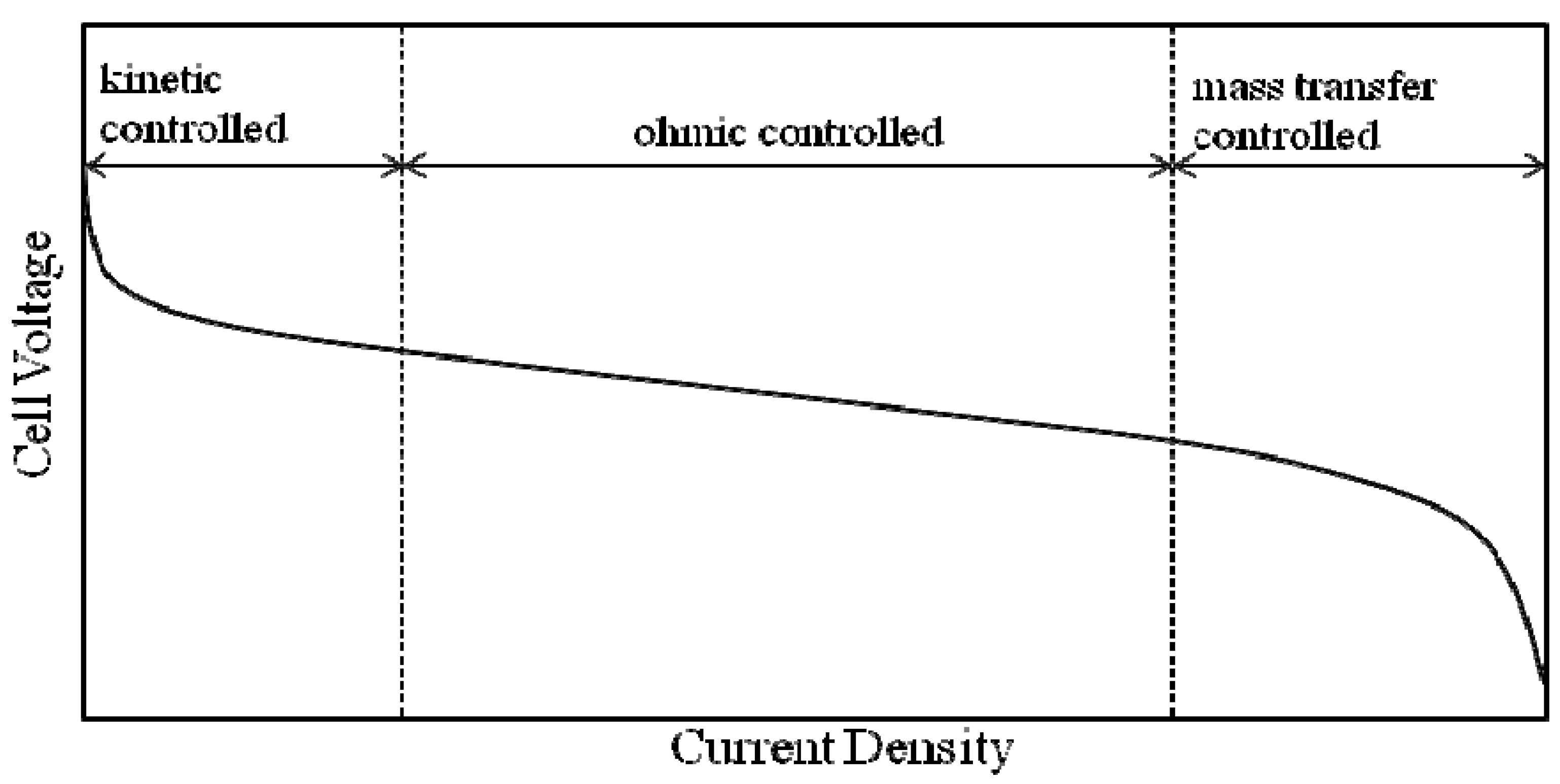
2.3.2. MEA Performance
2.3.3. Durability of the MEA
2.4. Stack
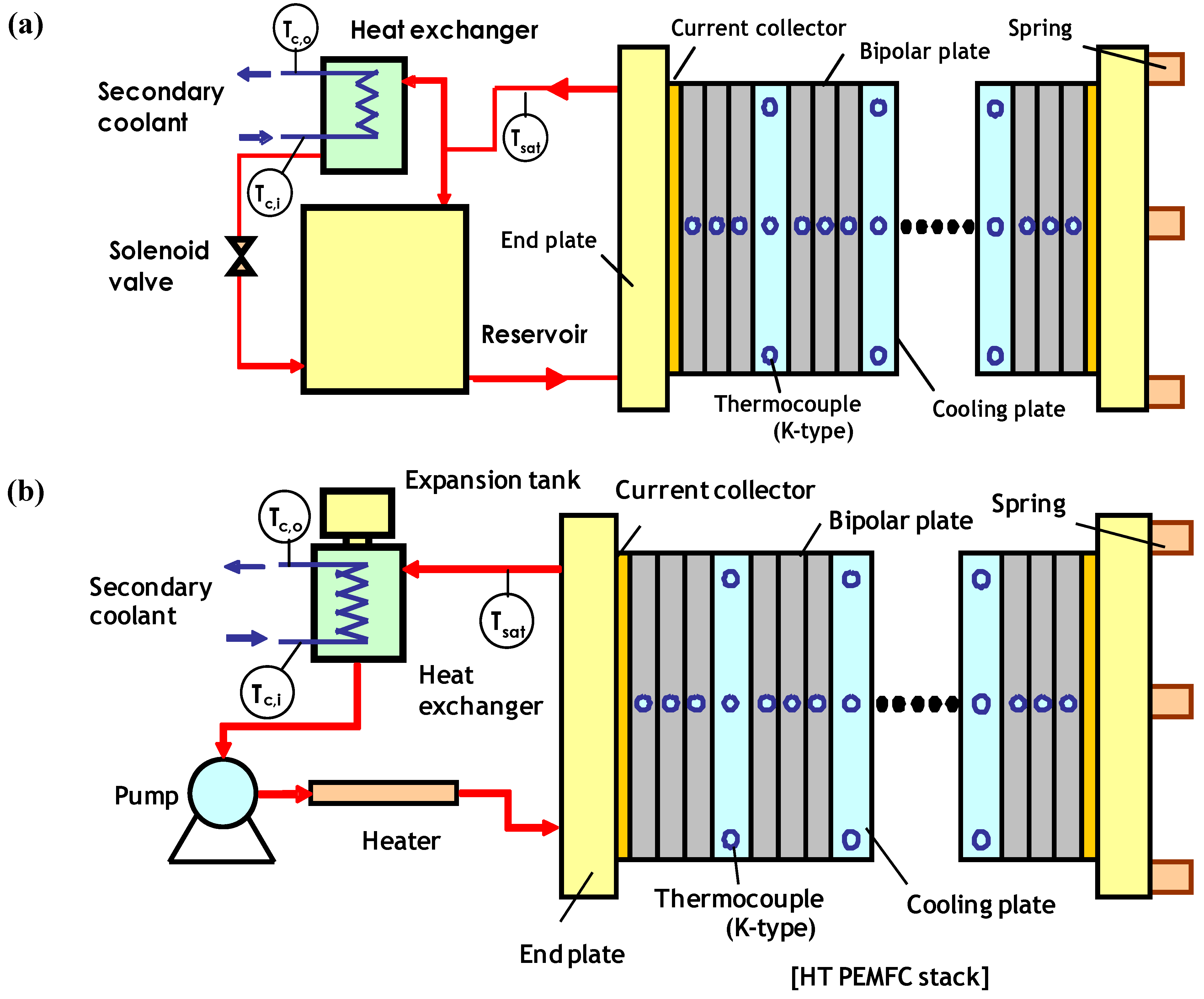
3. High-Temperature PEM
3.1. Design Rules of the Membrane
3.2. Synthesis of Poly(benzoxazine), Polybenzimidazole and Its Membrane
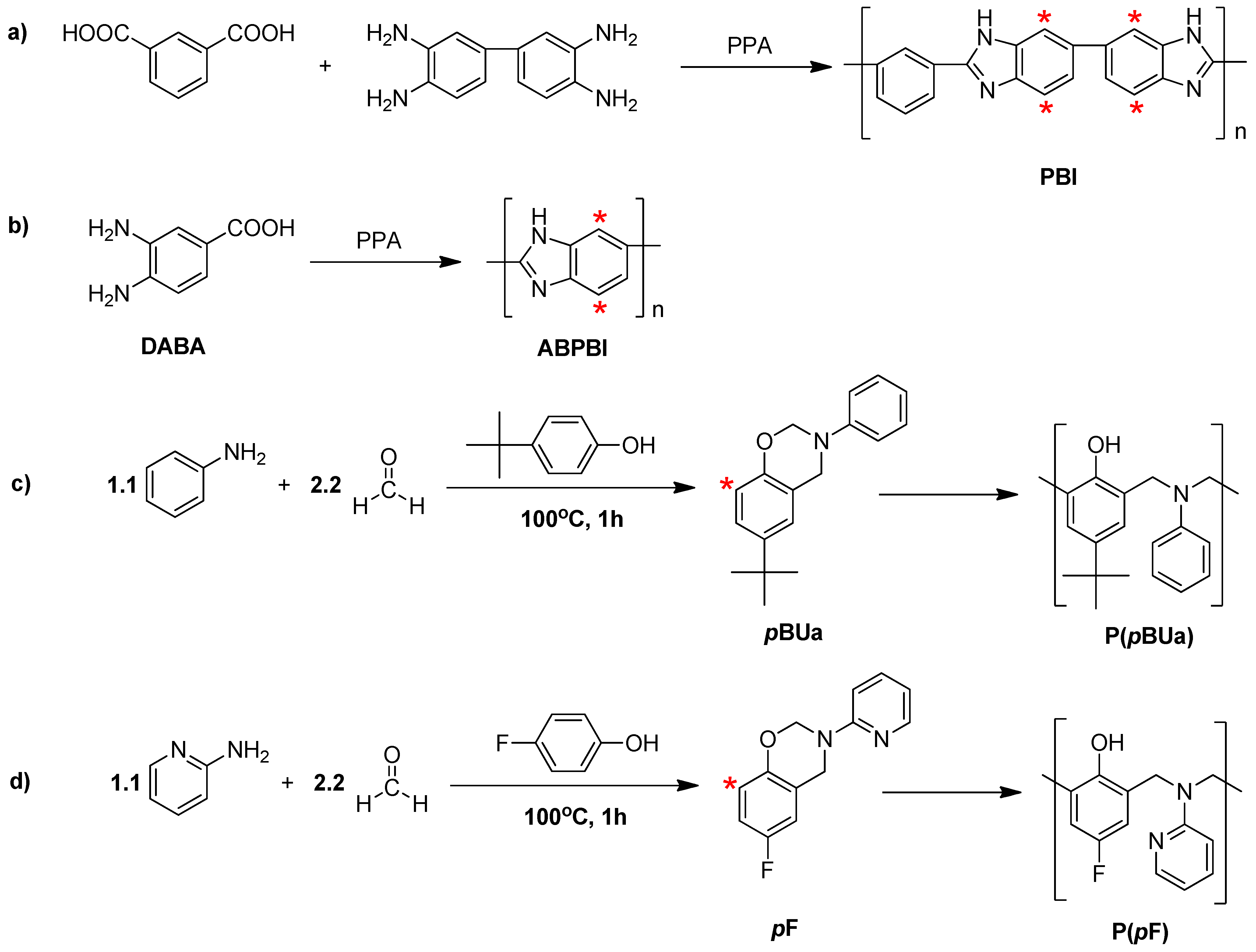
3.2.1. Synthesis of Benzoxazine Monomer, 6-tert-butyl-3-phenyl-3,4-dihydro-2H-benzo[e][1,3]oxazine (pBUa) and 6-Fluoro-3-(pyridine-2-yl)-3,4-dihydro-2H-benzo[e][1,3]oxazine (pF)
3.2.2. Synthesis of Poly[2,2'-(m-phenylene)-5,5'-bibenzimidazole] (PBI)
3.2.3. Preparation of the PA-Doped P(pBUa-co-BI) Membranes
3.2.4. Preparation of PA-Doped PpF-co-ABPBI
3.2.5. Preparation of Membrane-Electrode Assembly (MEA)
3.2.6. Cell Performance Measurement and Acceleration Lifetime Test (ALT)
3.3. Characterization
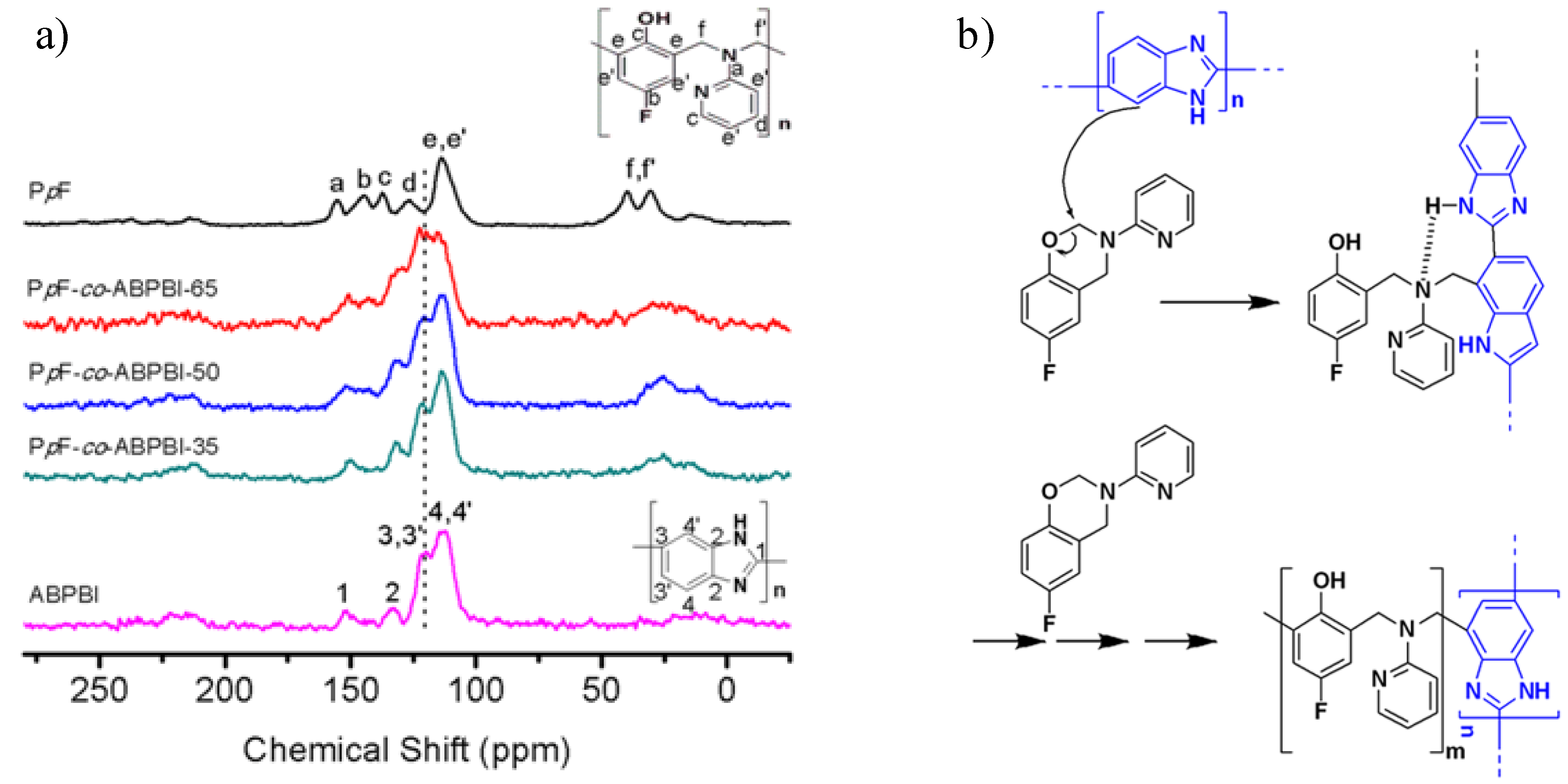
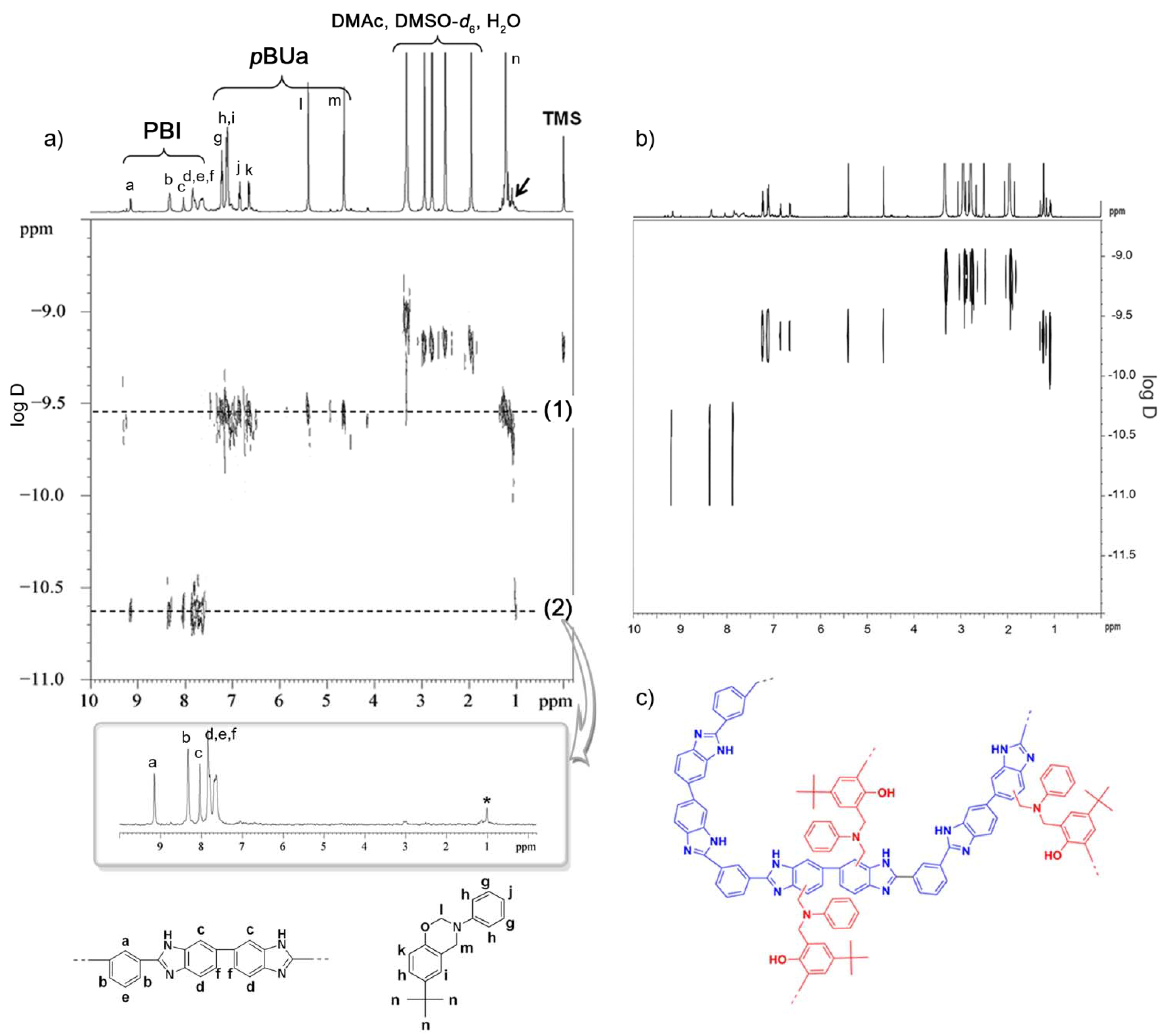
3.3.1. Copolymer Formation

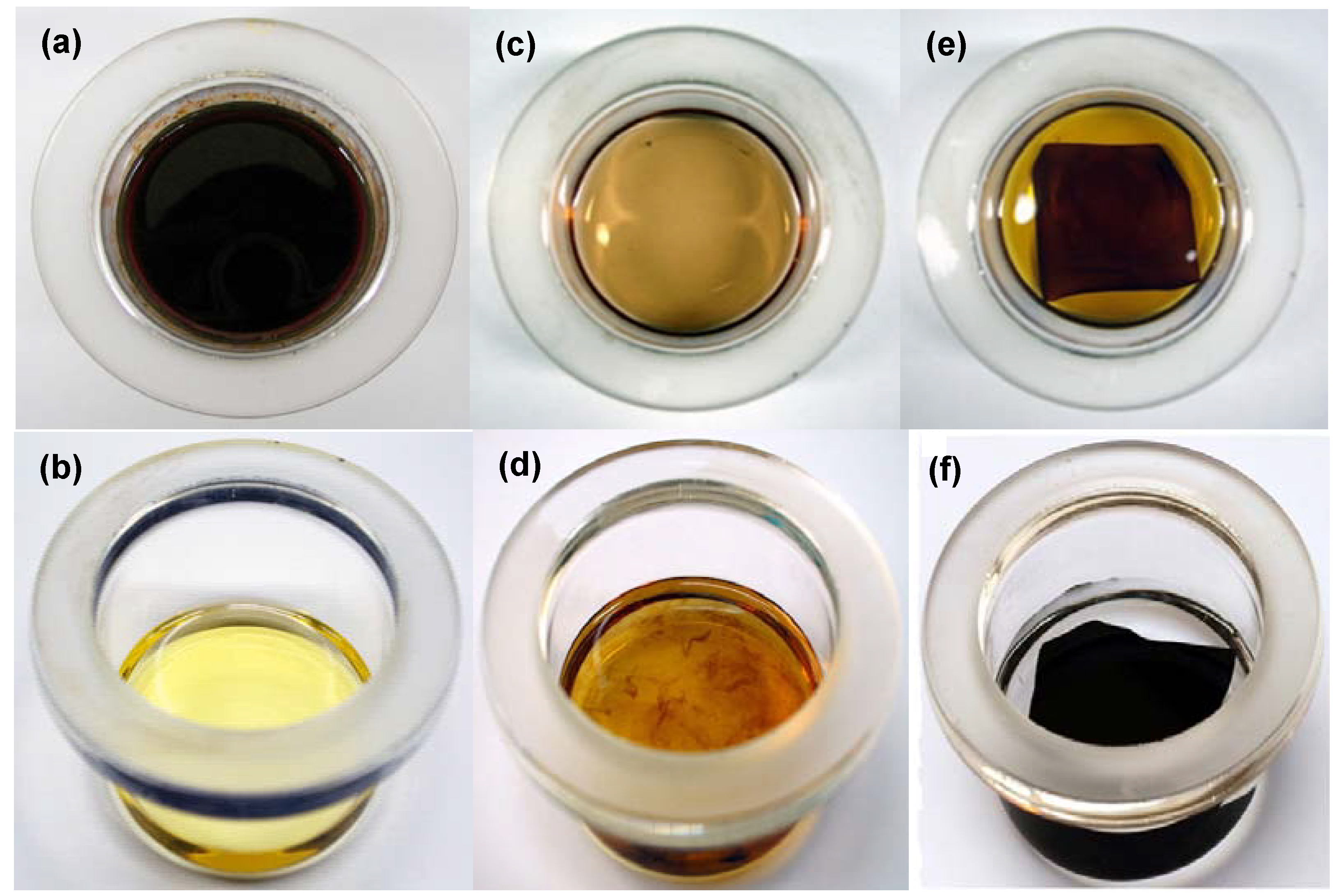
3.3.2. Chemical Stability

| Membranes | PA content (wt %) | Proton Conductivity (S cm−1) |
|---|---|---|
| P(pBUa-co-BI)-65 | 88.5 | 0.1206 |
| P(pBUa-co-BI)-50 | 83.9 | 0.0922 |
| P(pBUa-co-BI)-35 | 83.0 | 0.0792 |
| P(pF-co-BI)-65 | 86.6 | 0.1267 |
| P(pF-co-BI)-50 | 84.9 | 0.1327 |
| P(pF-co-BI)-35 | 83.0 | 0.1091 |
| PpF-co-ABPBI-65 | 73.0 | 0.1015 |
| 77.1 | 0.1472 | |
| PpF-co-ABPBI-50 | 74.4 | 0.0983 |
| 78.3 | 0.1098 | |
| 81.0 | 0.1315 | |
| 84.4 | 0.1434 | |
| PpF-co-ABPBI-35 | 71.9 | 0.0656 |
| 75.6 | 0.0889 | |
| 84.1 | 0.1449 | |
| ABPBI a | 75.3 b | 0.0832 |
| PBI a | 81.2 b | 0.0951 |
| Membranes | PA content (wt %) | Tensile strength (MPa) | Elongation at break (%) | Modulus (MPa) |
|---|---|---|---|---|
| P(pBUa-co-BI)-65 | 88.5 | 2.19 | 72.3 | 5.70 |
| P(pBUa-co-BI)-50 | 83.9 | 2.69 | 54.8 | 14.5 |
| P(pBUa-co-BI)-35 | 83.0 | 4.25 | 38.1 | 41.4 |
| PpF-co-ABPBI-65 | 62.8 | 24.5 | 48.9 | 34.8 |
| 72.9 | 11.5 | 73.9 | 17.1 | |
| PpF-co-ABPBI-50 | 76.6 | 14.9 | 70.6 | 21.4 |
| 79.3 | 13.4 | 113 | 11.2 | |
| PpF-co-ABPBI-35 | 67.1 | 25.4 | 48.5 | 47.2 |
| 77.4 | 18.1 | 78.9 | 25.3 | |
| 82.5 | 11.1 | 61.5 | 23.3 | |
| ABPBI a | 67.1 | 39.5 | 247 | 260 |
| PBI a | 76.8 | 19.5 | 143 | 25.1 |
| 81.2 | 5.34 | 47.6 | 43.2 |
3.3.3. The Proton Conductivity
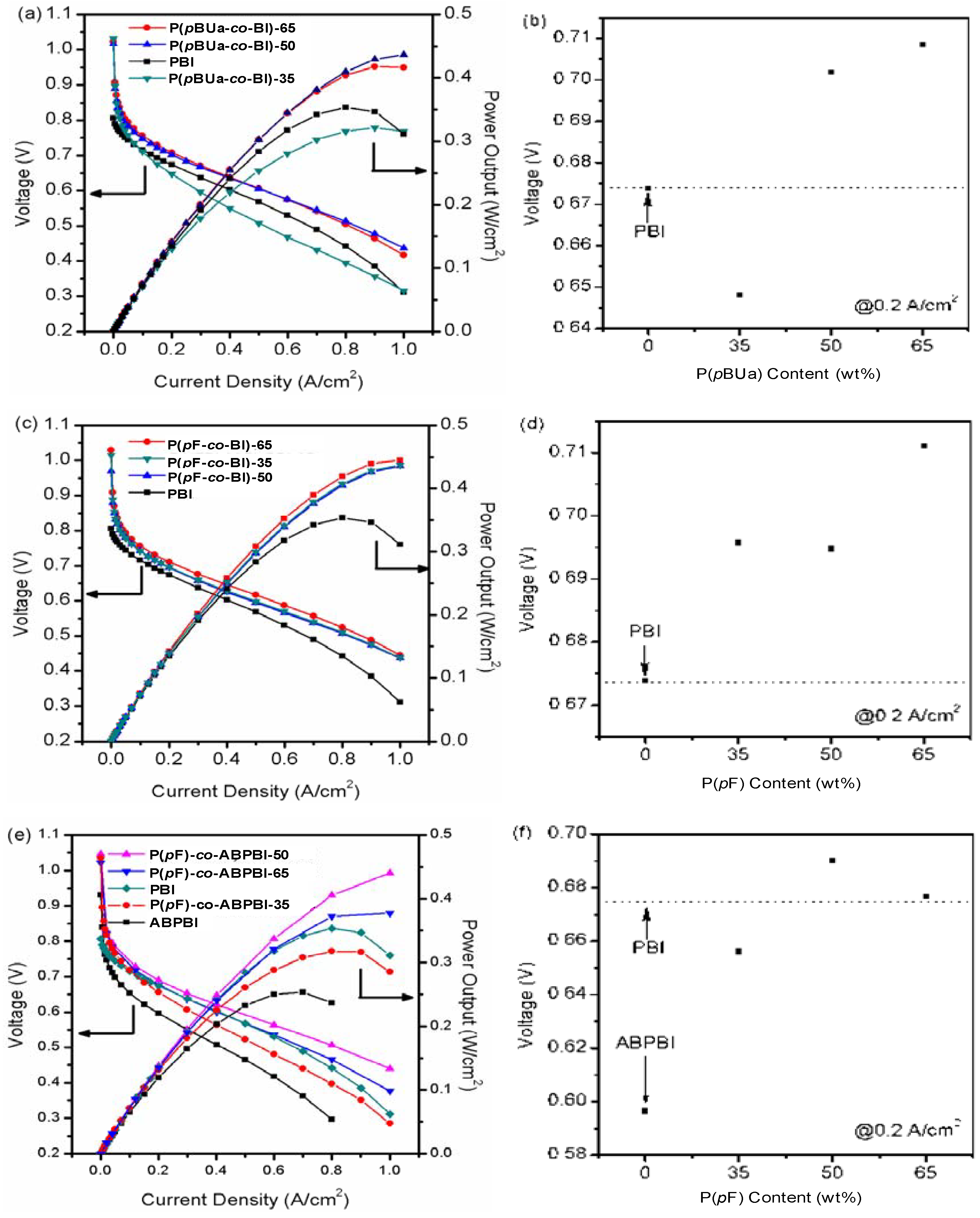
3.3.4. Fuel Cell Evaluation

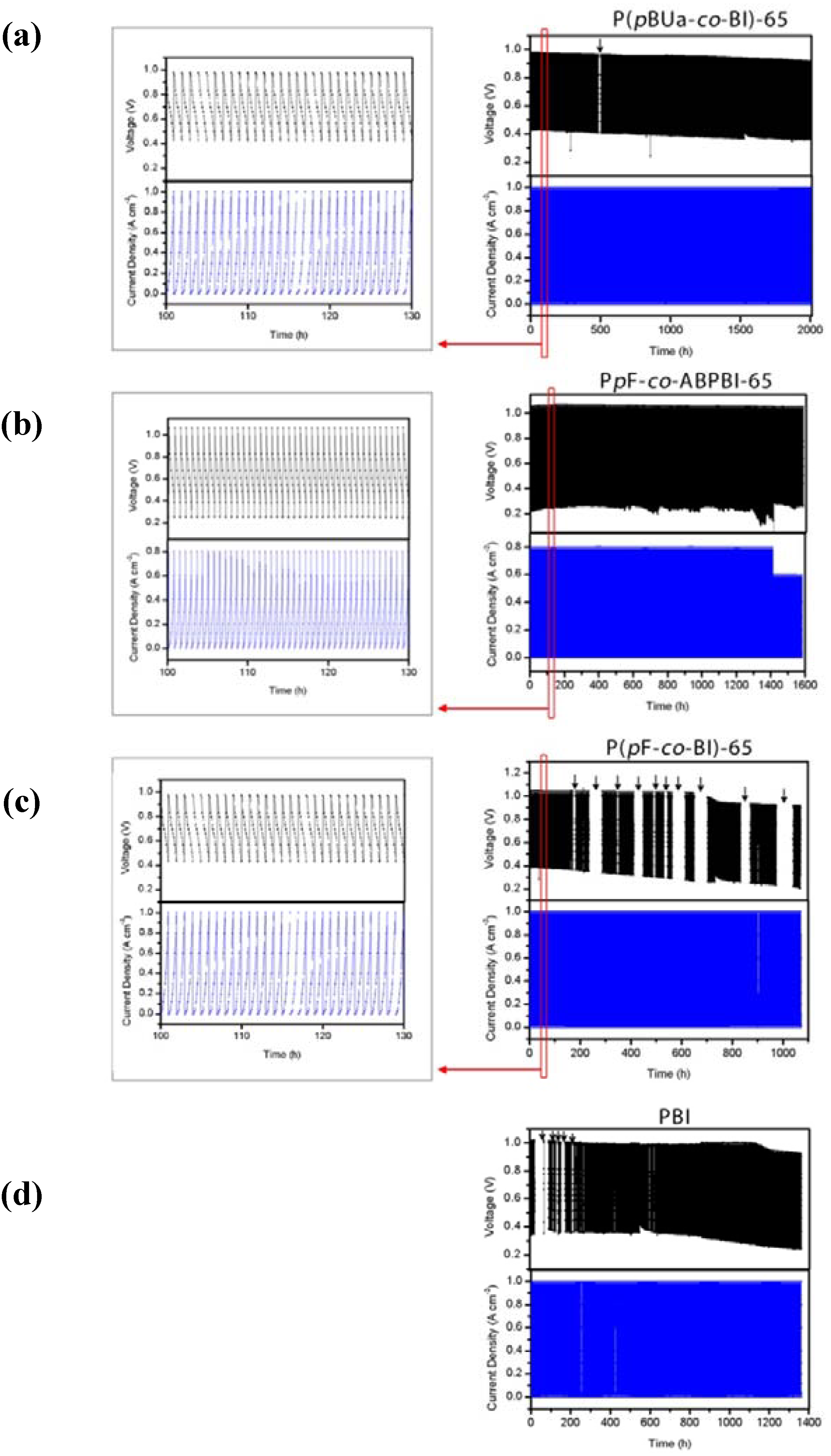
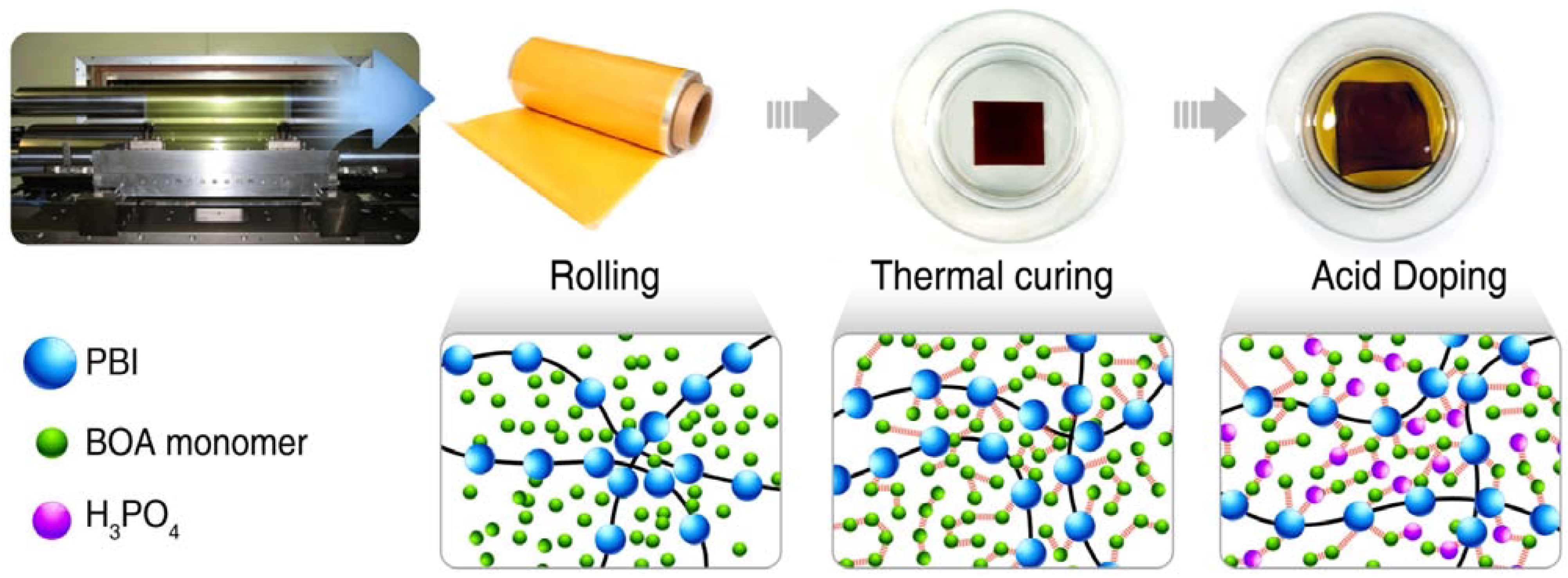
4. High Temperature MEA
4.1. MEA Design and Characteristics
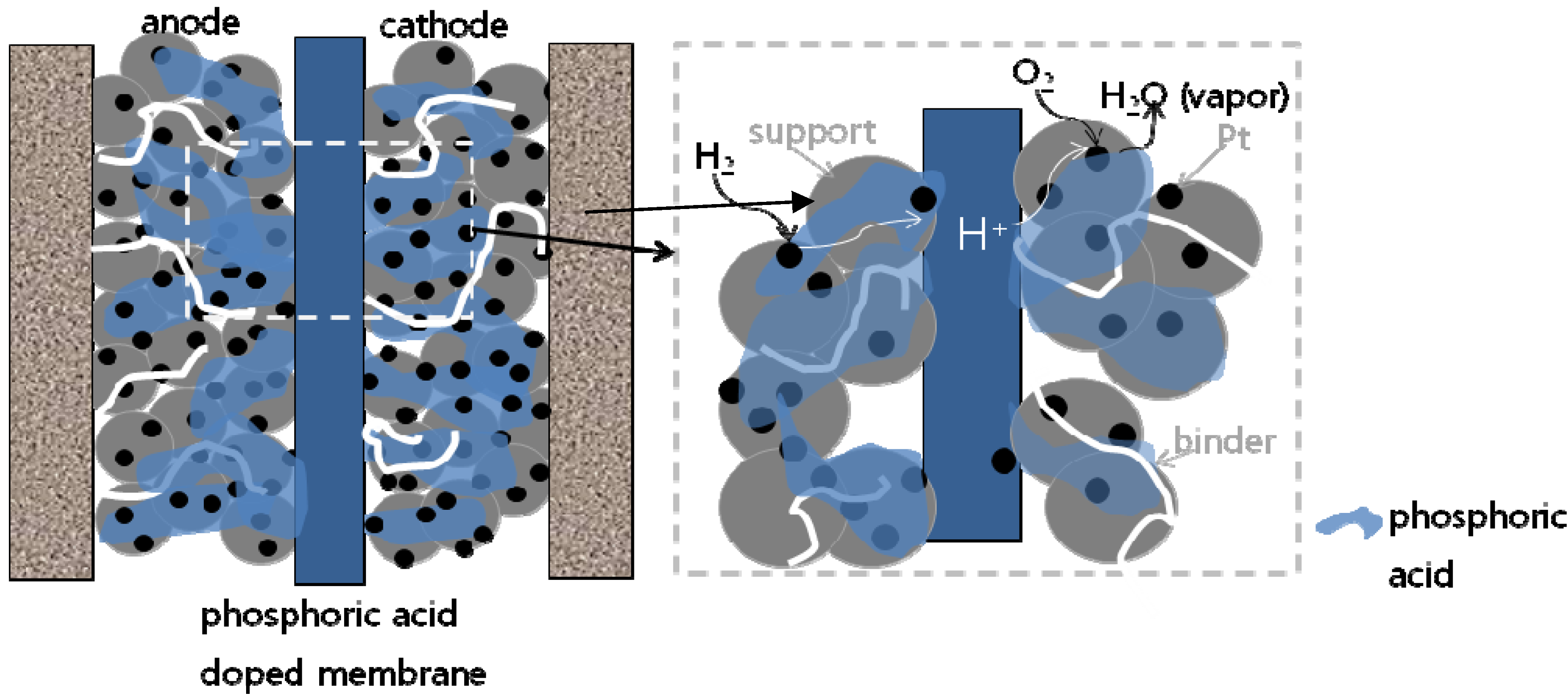
4.2. MEA Performance on System Level Requirements
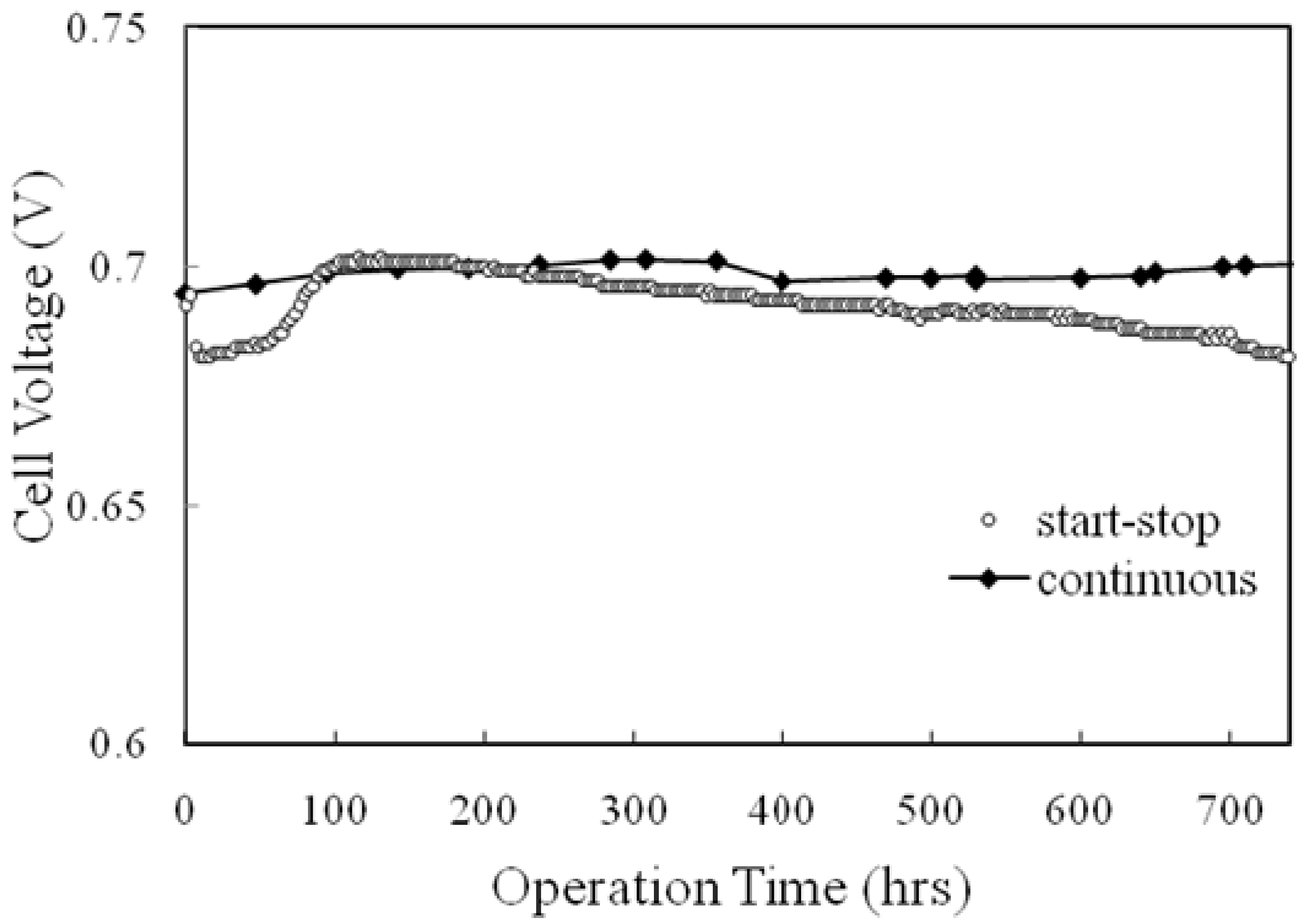
5. Summary and Further Studies
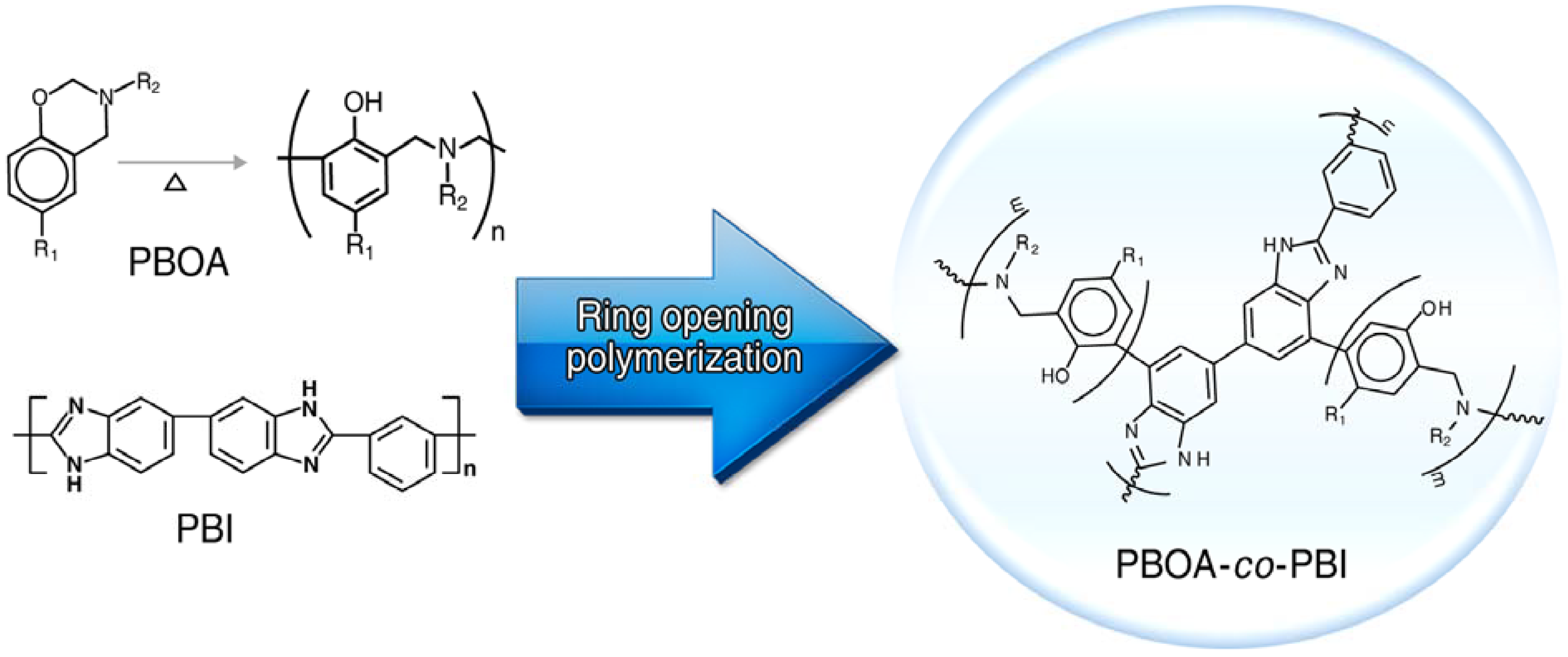
References
- Mehta, V.; Cooper, J.S. Review and analysis of PEM fuel cell design and manufacturing. J. Power Sources 2003, 114, 32–53. [Google Scholar] [CrossRef]
- Ahn, S.-Y.; Shin, S.-J.; Ha, H.Y.; Hong, S.-A.; Lee, Y.-C.; Lim, T.W.; Oh, I.-H. Performance and lifetime analysis of the kW-class PEMFC stack. J. Power Sources 2002, 106, 295–303. [Google Scholar] [CrossRef]
- Mallant, R.K.A.M. PEMFC systems: The need for high temperature polymers as a consequence of PEMFC water and heat management. J. Power Sources 2003, 118, 424–429. [Google Scholar] [CrossRef]
- Li, Q.; Jensen, J.O.; Savinell, R.F.; Bjerrum, N.J. High temperature proton exchange membranes based on polybenzimidazoles for fuel cells. Prog. Polym. Sci. 2009, 34, 449–477. [Google Scholar] [CrossRef]
- Kwon, K.; Kim, T.Y.; Yoo, D.Y.; Hong, S.-G.; Park, J.O. Maximization of high-temperature proton exchange membrane fuel cell performance with the optimum distribution of phosphoric acid. J. Power Sources 2009, 188, 463–467. [Google Scholar] [CrossRef]
- Wannek, C.; Konradi, I.; Mergel, J.; Lehnert, W. Redistribution of phosphoric acid in membrane electrode assemblies for high-temperature polymer electrolyte fuel cells. Int. J. Hydrog. Energy 2009, 34, 9479–9485. [Google Scholar] [CrossRef]
- He, R.; Li, Q.; Bach, A.; Jensen, J.O.; Bjerrum, N.J. Physicochemical properties of phosphoric acid doped polybenzimidazole membranes for fuel cells. J. Membr. Sci. 2006, 277, 38–45. [Google Scholar] [CrossRef]
- Park, J.O.; Kwon, K.; Cho, M.D.; Hong, S.-G.; Kim, T.Y.; Yoo, D.Y. Role of binders in high-temperature PEMFC electrode. J. Electrochem. Soc. 2011, 158, B675–B681. [Google Scholar] [CrossRef]
- Mamlouk, M.; Scott, K. An investigation of Pt alloy oxygen reduction catalysts in phosphoric acid doped PBI fuel cells. J. Power Sources 2011, 196, 1084–1089. [Google Scholar] [CrossRef]
- Andujar, J.M.; Segura, F. Fuel cells: History and updating. A walk along two centuries. Renew. Sustain. Energy Rev. 2009, 13, 2309–2322. [Google Scholar] [CrossRef]
- Debe, M.K. Electrocatalyst approaches and challenges for automotive fuel cells. Nature 2012, 486, 43–51. [Google Scholar] [CrossRef]
- Steele, B.C.H. Material science and engineering: The enabling technology for the commercialization of fuel cell systems. J. Mater. Sci. 2001, 36, 1053–1068. [Google Scholar]
- You, D.J.; Kwon, K.; Joo, S.H.; Kim, J.H.; Kim, J.M.; Pak, C.; Chang, H. Carbon-supported ultra-high loading Pt nanoparticle catalyst by controlled overgrowth of Pt: Improvement of Pt utilization leads to enhanced direct methanol fuel cell performance. Int. J. Hydrog. Energy 2012, 37, 6880–6885. [Google Scholar] [CrossRef]
- Greeley, J.; Stephens, I.E.L.; Bondarenko, A.S.; Johansson, T.P.; Hansen, H.A.; Jaramillo, T.F.; Rossmeisl, J.; Chorkendorff, I.; Nørskov, J.K. Alloys of platinum and early transition metals as oxygen reduction electrocatalysts. Nat. Chem. 2009, 1, 552–556. [Google Scholar] [CrossRef]
- Petrii, O.A. Pt-Ru electrocatalysts for fuel cells: A representative review. J. Solid State Electrochem. 2008, 12, 609–642. [Google Scholar] [CrossRef]
- Yang, H. Platinum-based electrocatalysts with core-shell nanostructures. Angew. Chem. Int. Ed. 2011, 50, 2674–2676. [Google Scholar] [CrossRef]
- Strasser, P.; Koh, S.; Anniyev, T.; Greeley, J.; More, K.; Yu, C.; Liu, Z.; Kaya, S.; Nordlund, D.; Ogasawara, H.; Toney, M.F.; Nilsson, A. Lattice-strain control of the activity in dealloyed core-shell fuel cell catalysts. Nat. Chem. 2010, 2, 454–460. [Google Scholar] [CrossRef]
- Stamenkovic, V.R.; Fowler, B.; Mun, B.S.; Wang, G.; Ross, P.N.; Lucas, C.A.; Markovic, N. Improved oxygen reduction activity on Pt3Ni(111) via increased surface site availability. Science 2007, 315, 493–497. [Google Scholar] [CrossRef]
- Wang, J.X.; Inada, H.; Wu, L.; Zhu, Y.; Choi, Y.; Liu, P.; Zhou, W.-P.; Adzic, R.R. Oxygen reduction on well-defined core-shell nanocatalysts: particle size, facet, and Pt shell thickness effects. J. Am. Chem. Soc. 2009, 131, 17298–17302. [Google Scholar]
- Sasaki, K.; Naohara, H.; Cai, Y.; Choi, Y.M.; Liu, P.; Vukmirovic, M.B.; Wang, J.X.; Adzic, R.R. Core-protected platinum monolayer shell high-stability electrocatalysts for fuel-cell cathodes. Angew. Chem. Int. Ed. 2010, 49, 8602–8607. [Google Scholar] [CrossRef]
- Sasaki, K.; Naohara, H.; Choi, Y.M.; Cai, Y.; Chen, W.-F.; Liu, P.; Adzic, R.R. Highly stable Pt monolayer on PdAu nanoparticle electrocatalysts for the oxygen reduction reaction. Nat. Commun. 2012, 3, 1115–1119. [Google Scholar] [CrossRef]
- Wang, J.X.; Ma, C.; Choi, Y.M.; Su, D.; Zhu, Y.; Liu, P.; Si, R.; Vukmirovic, M.B.; Zhang, Y.; Adzic, R.R. Kirkendall effect and lattice contraction in nanocatalysts: A new strategy to enhance sustainable activity. J. Am. Chem. Soc. 2011, 133, 13551–13557. [Google Scholar]
- Watanabe, M.; Uchida, M.; Motoo, S. Preparation of Highly Dispersed Pt + Ru Clusters and the Activity for the Electrooxidation of Methanol. J. Electroanal. Chem. 1987, 229, 395–406. [Google Scholar] [CrossRef]
- Wakisaka, M.; Mitsui, S.; Hirose, Y.; Kawashima, K.; Uchida, H.; Watanabe, M. Electronic Structures of Pt-Co and Pt-Ru Alloys for CO-Tolerant Anode Catalysts in Polymer Electrolyte Fuel Cells Studied by EC-XPS. J. Phys. Chem. B 2006, 110, 23489–23496. [Google Scholar]
- Li, Q.; He, R.; Gao, J.-A.; Jensen, J.O.; Bjerrum, N.J. The CO Poisoning Effect in PEMFCs Operational at Temperatures up to 200°C. J. Electrochem. Soc. 2003, 150, A1599–A1605. [Google Scholar] [CrossRef]
- Skulason, E.; Tripkovic, V.; Bjorketun, M.E.; Gudmundsdottir, S.; Karlberg, G.; Rossmeisl, J.; Bligaard, T.; Jonsson, H.; Norskov, J.K. Modeling the electrochemical hydrogen oxidation and evolution reactions on the basis of density functional theory calculations. J. Phys. Chem. C 2010, 114, 18182–18197. [Google Scholar]
- Markovic, N.M.; Grgur, B.N.; Ross, P.N. Temperature-dependent hydrogen electrochemistry on platinum low-index single-crystal surfaces in acid solutions. J. Phys. Chem. B 1997, 101, 5405–5413. [Google Scholar]
- Murthi, V.S.; Urian, R.C.; Mukerjee, S. Oxygen reduction kinetics in low and medium temperature acid environment: Correlation of water activation and surface properties in supported Pt and Pt alloy electrocatalysts. J. Phys. Chem. B 2004, 108, 11011–11023. [Google Scholar] [CrossRef]
- Suzuki, A.; Oono, Y.; Williams, M.C.; Miura, R.; Inaba, K.; Hatakeyama, N.; Takaba, H.; Hori, M.; Miyamoto, A. Evaluation for sintering of electrocatalysts and its effect on voltage drops in high-temperature proton exchange membrane fuel cells (HT-PEMFC). Int. J. Hydrog. Energy 2012, 37, 18272–18289. [Google Scholar]
- Shao, M. Palladium-based electrocatalysts for hydrogen oxidation and oxygen reduction reactions. J. Power Sources 2011, 196, 2433–2444. [Google Scholar] [CrossRef]
- Antolini, E. Palladium in fuel cell catalysis. Energy Environ. Sci. 2009, 2, 915–931. [Google Scholar] [CrossRef]
- Serov, A.; Kwak, C. Review of non-platinum anode catalysts for DMFC and PEMFC application. Appl. Catal. B Environ. 2009, 90, 313–320. [Google Scholar] [CrossRef]
- Kwon, K.; Lee, K.H.; Jin, S.-A.; You, D.J.; Pak, C. Ceria-promoted oxygen reduction reaction in Pd-based electrocatalysts. Electrochem. Commun. 2011, 13, 1067–1069. [Google Scholar] [CrossRef]
- Jin, S.-A.; Kwon, K.; Pak, C.; Chang, H. The oxygen reduction electrocatalytic activity of intermetallic compound of palladium-tin supported on tin oxide-carbon composite. Catal. Today 2011, 164, 176–180. [Google Scholar]
- You, D.J.; Jin, S.-A.; Lee, K.H.; Pak, C.; Choi, K.H.; Chang, H. Improvement of activity for oxygen reduction by decoration of Ir on PdCu/C catalyst. Catal. Today 2012, 185, 138–142. [Google Scholar]
- Antolini, E. Carbon supports for low-temperature fuel cell catalysts. Appl. Catal. B Environ. 2009, 88, 1–24. [Google Scholar] [CrossRef]
- Yang, Y.; Chiang, K.; Burke, N. Porous carbon-supported catalysts for energy and environmental application: A short review. Catal. Today 2011, 178, 197–205. [Google Scholar]
- Dicks, A.L. The role of carbon in fuel cells. J. Power Sources 2006, 156, 128–141. [Google Scholar] [CrossRef]
- Lee, H.I.; Stucky, G.D.; Kim, J.H.; Pak, C.; Chang, H.; Kim, J.M. Spontaneous phase separation mediated synthesis of 3D mesoporous carbon with controllable cage and window size. Adv. Mater. 2011, 23, 2357–2361. [Google Scholar] [CrossRef]
- Pak, C.; Kim, J.M.; Chang, H. Mesoporous carbon-supported catalysts for direct methanol fuel cells. In Electrocatalysis of Direct Methanol Fuel Cells, 1st; Liu, H., Zhang, J., Eds.; WILEY-VCH Verlag GmbH & Co. KGaA: Weinheim, Germany, 2009; pp. 355–378. [Google Scholar]
- Chang, H.; Joo, S.H.; Pak, C. Synthesis and characterization of mesoporous carbon for fuel cell applications. J. Mater. Chem. 2007, 17, 3078–3088. [Google Scholar]
- Kwon, K.; Jin, S.-A.; Pak, C.; Chang, H.; Joo, S.H.; Lee, H.I.; Kim, J.H.; Kim, J.M. Enhancement of electrochemical stability and catalytic activity of Pt nanoparticles via strong metal-support interaction with sulfur-containing ordered mesoporous carbon. Catal. Today 2011, 164, 186–189. [Google Scholar]
- Lee, H.I.; Joo, S.H.; Kim, J.H.; You, D.J.; Kim, J.M.; Park, J.-N.; Chang, H.; Pak, C. Ultrastable Pt nanoparticles supported on sulfur-containing ordered mesoporous carbon via strong metal-support interaction. J. Mater. Chem. 2009, 19, 5934–5939. [Google Scholar] [CrossRef]
- Joo, S.H.; Pak, C.; You, D.J.; Lee, S.-A.; Lee, H.I.; Kim, J.M.; Chang, H.; Seung, D. Ordered mesoporous carbons (OMC) as supports of electrocatalysts for direct methanol fuel cells (DMFC): Effect of carbon precursors of OMC on DMFC performances. Electrochim. Acta 2006, 52, 1618–1626. [Google Scholar] [CrossRef]
- Joo, S.H.; Kwon, K.; You, D.J.; Pak, C.; Chang, H.; Kim, J.M. Preparation of high loading Pt nanoparticles on ordered mesoporous carbon with a controlled Pt size and its effect on oxygen reduction and methanol oxidation reactions. Electrochim. Acta 2009, 54, 5746–5753. [Google Scholar] [CrossRef]
- Joo, S.H.; Lee, H.I.; You, D.J.; Kwon, K.; Kim, J.H.; Choi, Y.S.; Kang, M.; Kim, J.M.; Pak, C.; Chang, H.; Seung, D. Ordered mesoporous carbons with controlled particle sizes as catalyst supports for direct methanol fuel cell cathodes. Carbon 2008, 46, 2034–2045. [Google Scholar] [CrossRef]
- Sharma, S.; Pollet, B.G. Support materials for PEMFC and DMFC electrocatalysts—A review. J. Power Sources 2012, 208, 96–119. [Google Scholar] [CrossRef]
- Wang, Y.J.; Wilkinson, D.; Zhang, J. Noncarbon support materials for polymer electrolyte membrane fuel cell electrocatalysts. Chem. Rev. 2011, 111, 7625–7651. [Google Scholar] [CrossRef]
- Steele, B.C.H.; Heinzel, A. Materials for fuel-cell technologies. Nature 2001, 414, 345–352. [Google Scholar] [CrossRef]
- Kreuer, K.D. On the development of proton conducting polymer membranes for hydrogen andmethanol fuel cells. J. Membr. Sci. 2001, 185, 29–39. [Google Scholar] [CrossRef]
- Miyatake, K.; Chikashige, Y.; Higuchi, E.; Watanabe, M. Tuned polymer electrolyte membranes based on aromatic polyethers for fuel cell applications. J. Am. Chem. Soc. 2007, 129, 3879–3887. [Google Scholar]
- Savadogo, O. Emerging membranes for electrochemical systems: Part II. High temperature composite membranes for polymer electrolyte fuel cell (PEFC) applications. J. Power Sources 2004, 127, 135–161. [Google Scholar] [CrossRef]
- Mustarelli, P.; Quartarone, E.; Grandi, S.; Carollo, A.; Magistris, A. Polybenzimidazole-based membranes as a real alternative to Nafion for fuel cells operating at low temperature. Adv. Mater. 2008, 20, 1339–1343. [Google Scholar] [CrossRef]
- Lee, S.-Y.; Ogawa, A.; Kanno, M.; Nakamoto, H.; Yasuda, T.; Watanabe, M. Nonhumidified intermediate temperature fuel cells using protic ionic liquids. J. Am. Chem. Soc. 2010, 132, 9764–9773. [Google Scholar]
- Wainright, J.S.; Wang, J.-T.; Weng, D.; Savinell, R.F.; Litt, M. Acid-doped polybenzimidazoles: A new polymer electrolyte. J. Electrochem. Soc. 1995, 142, L121–L123. [Google Scholar]
- Li, Q.; He, R.; Jensen, J.O.; Bjerrum, N.J. Approaches and recent development of polymer electrolyte membranes for fuel cells operating above 100 °C. Chem. Mater. 2003, 15, 4896–4915. [Google Scholar] [CrossRef]
- Zhang, J.; Xie, Z.; Zhang, J.; Tang, Y.; Song, C.; Navessin, T.; Shi, Z.; Song, D.; Wang, H.; Wilkinson, D.P.; Liu, Z.-S.; Holdcroft, S. High temperature PEM fuel cells. J. Power Sources 2006, 160, 872–891. [Google Scholar] [CrossRef]
- Hogarth, W.H.J.; Diniz da Costa, J.C.; Lu, G.Q. Solid acid membranes for high temperature (at 140°C) proton exchange membrane fuel cells. J. Power Sources 2005, 142, 223–237. [Google Scholar] [CrossRef]
- Shao, Y.; Yin, G.; Wang, Z.; Gao, Y. Proton exchange membrane fuel cell from lowtemperature to high temperature: Material challenges. J. Power Sources 2007, 167, 235–242. [Google Scholar] [CrossRef]
- Li, Q.; He, R.; Jenson, J.O.; Bjerrum, N.J. PBI-based polymer membranes for high temperature fuel cells—Preparation, Characterization and Fuel Cell Demonstration. Fuel Cells 2004, 4, 147–159. [Google Scholar] [CrossRef]
- Lobato, J.; Cañizares, P.; Rodrigo, M.A.; Linares, J.J.; Manjavacas, G. Synthesis and characterization ofpoly[2,2-(m-phenylene)-5,5-bibenzimidazole] as polymer electrolyte membrane for high-temperature PEMFCs. J. Membr. Sci. 2006, 280, 351–362. [Google Scholar] [CrossRef]
- He, R.; Li, Q.; Bach, A.; Jensen, J.O.; Bjerrum, N.J. Doping phosphoric acid in polybenzimidazole membranes for high temperature proton exchange membrane fuel cells. J. Polym. Sci. A Polym. Chem. 2007, 45, 2989–2997. [Google Scholar] [CrossRef]
- He, R.; Li, Q.; Xiao, G.; Bjerrum, N.J. Proton conductivity of phosphoric acid doped polybenzimidazole and its composites with inorganic proton conductors. J. Membr. Sci. 2003, 226, 169–184. [Google Scholar] [CrossRef]
- Pu, H.; Meyer, W.H.; Wegner, G. Proton transport in polybenzimidazole blended with H3PO4 or H2SO4. J. Polym. Sci. B Polym. Phys. 2002, 40, 663–669. [Google Scholar] [CrossRef]
- Li, Q.; Hjuler, H.A.; Bjerrum, N.J. Phosphoric acid doped polybenzimidazole membranes: Physiochemical characterization and fuel cell applications. J. Appl. Electrochem. 2001, 31, 773–779. [Google Scholar] [CrossRef]
- Weng, D.; Wainright, J.S.; Landau, U.; Savinell, R.F. Electro-osmotic drag coefficient of water and methanol in polymer electrolytes at elevated temperatures. J. Electrochem. Soc. 1996, 143, 1260–1263. [Google Scholar] [CrossRef]
- Xiao, L.; Zhang, H.; Scanlon, E.; Ramanathan, L.S.; Choe, E.W.; Rogers, D.; Apple, T.; Benicewicz, B.C. High-temperature polybenzimidazole fuel cell membranes via a sol-gel process. Chem. Mater. 2005, 17, 5328–5333. [Google Scholar]
- Kim, T.-H.; Lim, T.-W.; Lee, J.-C. High temperature fuel cell membranes based on mechanically stable para-ordered polybenzimidazole prepared by direct casting. J. Power Sources 2007, 172, 172–179. [Google Scholar] [CrossRef]
- Wang, J.-T.; Savinell, R.F.; Wainright, J.; Litt, M.; Yu, H. A H2O2 fuel cell using acid doped polybenzimidazole as polymer electrolyte. Electrochim. Acta 1996, 41, 193–197. [Google Scholar] [CrossRef]
- Samms, S.R.; Wasmus, S.; Savinell, R.F. Thermal stability of proton conducting acid doped polybenzimidazole in simulated fuel cell environments. J. Electrochem. Soc. 1996, 143, 1225–1232. [Google Scholar] [CrossRef]
- Asensio, J.A.; Gómez-Romero, P. Recent developments on proton conducting poly(2,5-benzimidazole) (ABPBI) membranes for high temperature polymer electrolyte membrane fuel cells. Fuel Cells 2005, 5, 336–343. [Google Scholar] [CrossRef]
- Kim, H.J.; Lim, T.H. PBI derivatives: Polymer electrolyte fuel cell membrane for high temperature operation. J. Ind. Eng. Chem. 2004, 10, 1081–1085. [Google Scholar]
- Kim, S.-K.; Kim, T.-H.; Ko, T.; Lee, J.-C. Cross-linked poly(2,5-benzimidazole) consisting of wholly aromatic groups for high-temperature PEM fuel cell applications. J. Membr. Sci. 2011, 373, 80–88. [Google Scholar] [CrossRef]
- Kim, H.-J.; Cho, S.Y.; An, S.J.; Eun, Y.C.; Kim, J.-Y.; Yoon, H.-K.; Kweon, H.-J.; Yew, K.H. Synthesis of poly(2,5-benzimidazole) for use as a fuel cell membrane. Macromol. Rapid Commun. 2004, 25, 894–897. [Google Scholar] [CrossRef]
- Asensio, J.A.; Borrós, S.; Gómez-Romero, P. Polymer electrolyte fuel cells based on phosphoric acid impregnated poly(2,5-benzimidazole) membranes. J. Electrochem. Soc. 2004, 151, A304–A310. [Google Scholar] [CrossRef]
- Kim, T.-H.; Lim, T.-W.; Park, Y.-S.; Shin, K.; Lee, J.-C. Proton-conducting zirconium pyrophosphate/poly(2,5-benzimidazole) composite membranes prepared by a PPA direct casting method. Macromol. Chem. Phys. 2007, 208, 2293–2302. [Google Scholar] [CrossRef]
- Wannek, C.; Lehnert, W.; Mergel, J. Membrane electrode assemblies for high-temperature polymer electrolyte fuel cells based on poly(2,5-benzimidazole) membranes with phosphoric acid impregnation via the catalyst layers. J. Power Sources 2009, 192, 258–266. [Google Scholar] [CrossRef]
- Burke, W.J. 3,4-Dihydro-1,3,2H-Benzoxazines. Reaction of p-substituted phenols with N,N-dimethylolamines. J. Am. Chem. Soc. 1949, 71, 609–612. [Google Scholar] [CrossRef]
- Burke, W.J.; Kolbezen, M.J.; Stephens, C.W. Condensation of naphthols with formaldehyde and primary amines. J. Am. Chem. Soc. 1952, 74, 3601–3605. [Google Scholar] [CrossRef]
- Burke, W.J.; Hammer, C.R.; Weatherbee, C.J. Bis-m-oxazines from Hydroquinone. J. Org. Chem. 1961, 26, 4403–4407. [Google Scholar] [CrossRef]
- Burke, W.J.; Glennie, E.L.M.; Weatherbee, C. Condensationof halophenols with formaldehyde and primary amines. J. Org. Chem. 1964, 29, 909–912. [Google Scholar] [CrossRef]
- Burke, W.J.; Bishop, J.L.; Glennie, E.L.M.; Bauer, W.N., Jr. A new aminoalkylation reaction. Condensation of phenols with dihydro-1,3-aroxazines. J. Org. Chem. 1965, 30, 3423–3427. [Google Scholar]
- Gardziella, A.; Pilato, L.; Knop, A. Pilato, Phenolic Resins, Chemistry, Applications, Standardization, Safety, and Ecology and Performance, Future Directions, 2nd ed; Springer-Verlag: Heidelberg, Germany, 2000. [Google Scholar]
- Ning, X.; Ishida, H. Phenolic materials via ring-opening polymerization of benzoxazines: Effect of molecular structure on mechanical and dynamic mechanical properties. J. Polym. Sci. B Polym. Phys. 1994, 32, 921–927. [Google Scholar] [CrossRef]
- Ning, X.; Ishida, H. Phenolic materials via ring-opening polymerization: Synthesis and characterization of bisphenol—A based benzoxazines and their polymers. J. Polym. Sci. A Polym. Chem. 1994, 32, 1121–1129. [Google Scholar] [CrossRef]
- Ishida, H.; Rodriguez, Y. Curing kinetics of a new benzoxazine-based phenolic resin by differential scanning calorimetry. Polymer 1995, 36, 3151–3158. [Google Scholar] [CrossRef]
- Ishida, H.; Allen, D.J. Physical and mechanical characterization of near-zero shrinkage polybenzoxazines. J. Polym. Sci. B Polym. Phys. 1996, 34, 1019–1030. [Google Scholar] [CrossRef]
- Ishida, H. Process for Preparation of Benzoxazine Compounds in Solventless Systems. U.S. Patent 5,543,516, 6 August 1996. [Google Scholar]
- Ghosh, N.N.; Kiskan, B.; Yagci, Y. Polybenzoxazines—New high performance thermosetting resins: synthesis and properties. Prog. Polym. Sci. 2007, 32, 1344–1391. [Google Scholar] [CrossRef]
- Lee, M.-J.; Choi, S.-W.; Sun, H.-Y.; Jeon, W.-S. Electrolyte Membrane using Polybenzoxazine Based Compound and Method of Manufacturing the Same. U.S. Patent 7,858,668, 5 September 2006. [Google Scholar]
- Choi, S.-W.; Sun, H.-Y.; Lee, M.-J.; Jeon, W.-S. Polybenzoxazine-Based Compound, Electrolyte Membrane Including the Same, and Fuel Cell Employing the Electrolyte Membrane. U.S. Patent 8,034,508, 1 September 2006. [Google Scholar]
- Choi, S.-W.; Sun, H.-Y.; Jeon, W.-S. Polybenzoxazine-Based Compound, Electrolyte Membrane Including the Same, and Fuel Cell Employing the Electrolyte Membrane. U.S. Patent 8,148,028, 3 May 2007. [Google Scholar]
- Choi, S.-W.; Lee, J.-C.; Park, J.O. Cross-Linked Polyazole, Method of Preparing the Polyazole, Electrode for Fuel Cell including the Cross-Linked Polyazole, Electrolyte Membrane for Fuel Cell. U.S. Patent 20100273087A1, 23 April 2010. [Google Scholar]
- Kim, S.-K.; Choi, S.-W.; Jeon, W.S.; Park, J.O.; Ko, T.; Pak, C.; Chang, H.; Lee, J.-C. Cross-linked benzoxazine-benzimidazole copolymer electrolyte membranes for fuel cells at elevated temperature. Macromolecules 2012, 45, 1438–1446. [Google Scholar] [CrossRef]
- Seel, D.C.; Benicewicz, B.C.; Xiao, L.; Schmidt, T.J. High-temperature polybenzimidazole-based membranes. In Handbook of Fuel Cells—Advances in Electorocatalysis, Materials, Diagnostics and Durability; Vielstich, W., Yokokawa, H., Gasteiger, H.A., Eds.; John Wiley & Sons: Hoboken, NJ, USA, 2009; Volume 5, pp. 1–13. [Google Scholar]
- Gasteiger, H.A.; Kocha, S.S.; Sompalli, B.; Wagner, F.T. Activity benchmarks and requirements for Pt, Pt-alloy, and non-Pt oxygen reduction catalysts for PEMFCs. Appl. Catal. B Environ. 2005, 56, 9–35. [Google Scholar] [CrossRef]
- Janssen, G.J.M.; Sittersa, E.F.; Pfrang, A. Proton-exchange-membrane fuel cells durability evaluated by load-on/off cycling. J. Power Sources 2009, 191, 501–509. [Google Scholar] [CrossRef]
- Asghari, S.; Akhgar, H.; Imani, B. Design of thermal management subsystem for a 5kW polymer electrolyte membrane fuel cell system. J. Power Sources 2011, 196, 3141–3148. [Google Scholar] [CrossRef]
- Andreasen, S.; Kær, S. Modelling and evaluation of heating strategies for high temperature polymer electrolyte membrane fuel cell stacks. Int. J. Hydrog. Energy 2008, 33, 4655–4664. [Google Scholar] [CrossRef]
- Pfeifer, P.; Wall, C.; Jensen, O.; Hahn, H.; Fichtner, M. Thermal coupling of a high temperature PEM fuel cell with a complex hydride tank. Int. J. Hydrog. Energy 2009, 34, 3457–3466. [Google Scholar] [CrossRef]
- Song, T.W.; Choi, K.H.; Kim, J.R.; Yi, J.S. Pumpless thermal management of water-cooled high-temperature proton exchange membrane fuel cell. J. Power Sources 2011, 196, 4671–4679. [Google Scholar] [CrossRef]
- Asensio, J.A.; Sánchez, E.M.; Gómez-Romero, P. Proton-conducting membranes based on benzimidazole polymers for high-temperature PEM fuel cells. A chemical quest. Chem. Soc. Rev. 2010, 39, 3210–3239. [Google Scholar] [CrossRef]
- Kim, S.-K.; Ko, T.; Choi, S.-W.; Park, J.O.; Kim, K.-H.; Pak, C.; Chang, H.; Lee, J.-C. Durable cross-linked copolymer membranes based on poly(benzoxazine) and poly(2,5-benzimidazole) for use in fuel cells at elevated temperatures. J. Mater. Chem. 2012, 22, 7194–7205. [Google Scholar]
- Kim, S.-K.; Kim, T.-H.; Jung, J.-W.; Lee, J.-C. Copolymers of poly(2,5-benzimidazole) and poly[2,2-bep-phenylene)-5,5'-bibenzimidazole] for high-temperature fuel cell applications. Macromol. Mater. Eng. 2008, 293, 914–921. [Google Scholar] [CrossRef]
- Antalek, B. Using pulsed gradient spin echo NMR for chemical mixture analysis: How to obtain optimum results. Concepts Magn. Reson. 2002, 14, 225–258. [Google Scholar] [CrossRef]
- Chen, A.; Wu, D.; Johnson, C.S., Jr. Determination of molecular weight distributions for polymers by diffusion-ordered NMR. J. Am. Chem. Soc. 1995, 117, 7965–7970. [Google Scholar]
- Viel, S.; Capitani, D.; Mannina, L.; Segre, A. Diffusion-ordered NMR spectroscopy: Aversatile tool for the molecular weight determination of uncharged polysaccharides. Biomacromolecules 2003, 4, 1843–1847. [Google Scholar] [CrossRef]
- Jayawickrama, D.A.; Larive, C.K.; Macord, E.F.; Roe, D.C. Polymer additives mixture analysis using pulsed-field gradient NMR spectroscopy. Magn. Reson. Chem. 1998, 36, 755–760. [Google Scholar] [CrossRef]
- Nishinari, K.; Kohyama, K.; Williams, P.A.; Phillips, G.O.; Burchard, W.; Ogino, K. Solution properties of pullulan. Macromolecules 1991, 24, 5590–5593. [Google Scholar] [CrossRef]
- Gorkom, V.; Leon, C.M.; Hancewicz, T.M. Analysis of DOSY and GPC-NMR experiments on polymers by multivariate curve resolution. J. Magn. Reson. 1998, 130, 125–130. [Google Scholar]
- Bovey, F.A.; Mirau, P.A. The solution characterization of polymers. In NMR of Polymers, 1st ed; Academic Press, Inc.: San Diego, CA, USA, 1996; Volume 3, pp. 155–242. [Google Scholar]
- Wang, Y.-X.; Ishida, H. Synthesis and properties of new thermoplastic polymers from substituted 3,4-dihydro-2H-1,3-benzoxazines. Macromolecules 2000, 33, 2839–2847. [Google Scholar] [CrossRef]
- Leykin, A.Y.; Fomenkov, A.I.; Galpern, E.G.; Stankevich, I.V.; Rusanov, A.L. Some aspects of polybenzimidazoles’ synthesis in P2O5 containing condensation media. Polymer 2010, 51, 4053–4057. [Google Scholar] [CrossRef]
- Oh, S.-Y.; Yoshida, T.; Kawamura, G.; Muto, H.; Sakai, M.; Matsuda, A. Inorganic-organic composite electrolytes consisting of polybenzimidazole and Cs-substituted heteropoly acids and their application for medium temperature fuel cells. J. Mater. Chem. 2010, 20, 6359–6366. [Google Scholar] [CrossRef]
- Zhang, J.; Tang, Y.; Song, C.; Zhang, J. Polybenzimidazole-membrane-based PEM fuel cell in the temperature range of 120-200 °C. J. Power Sources 2007, 172, 163–171. [Google Scholar] [CrossRef]
- Li, Q.; Pan, C.; Jensen, J.O.; Noyé, P.; Bjerrum, N.J. Cross-linked polybenzimidazole membranes for fuel cells. Chem. Mater. 2007, 19, 350–352. [Google Scholar] [CrossRef]
- Marrony, M.; Barrer, R.; Quenet, S.; Ginocchio, S.; Montelatici, L.; Aslanides, A. Durability study and lifetime prediction of baseline proton exchange membrane fuel cell under severe operating conditions. J. Power Sources 2008, 182, 469–475. [Google Scholar] [CrossRef]
- Pei, P.; Chang, Q.; Tang, T. A quick evaluating method for automotive fuel cell lifetime. Int. J. Hydrog. Energy 2008, 33, 3829–3836. [Google Scholar] [CrossRef]
- Zhang, S.; Yuan, X.; Wang, H.; Mérida, W.; Zhu, H.; Shen, J.; Wu, S.; Zhang, J. A review of accelerated stress tests of MEA durability in PEM fuel cells. Int. J. Hydrog. Energy 2009, 34, 388–404. [Google Scholar] [CrossRef]
- Zelenay, P.; Scharifker, B.R.; O’M Bockris, J.; Gervasio, D. A comparison of the properties of CF3SO3H and H3PO4 in relation to fuel cells. J. Electrochem. Soc. 1986, 133, 2262–2267. [Google Scholar] [CrossRef]
- Razaq, M.; Razaq, A.; Yeager, E.; DesMarteau, D.D.; Singh, S. Perfluorosulfonimide as an additive in phosphoric acid fuel cell. J. Electrochem. Soc. 1989, 136, 385–390. [Google Scholar] [CrossRef]
- Hsueh, K.-L.; Gonzolez, E.R.; Srinivasan, S. Effects of phosphoric acid concentration on oxygen reduction kinetics at platinum. J. Electrochem. Soc. 1984, 131, 823–828. [Google Scholar] [CrossRef]
- Qingfeng, L.; Hjuler, H.A.; Bjerrum, N.J. Oxygen reduction on carbon supported platinum catalysts in high temperature polymer electrolytes. Electrochim. Acta 2000, 45, 4219–4226. [Google Scholar] [CrossRef]
- Kanamura, K.; Tanaka, A.; Gervasio, D.; Kennedy, V.; Adzic, R.; Yeager, E.B. Perfluoro-ethylene-1,2-bis-phosphonic acid fuel cell electrolyte. J. Electrochem. Soc. 1996, 143, 2765–2770. [Google Scholar] [CrossRef]
- Seland, F.; Berning, T.; Borresen, B.; Tunold, R. Improving the performance of high-temperature PEM fuel cells based on PBI electrolyte. J. Power Sources 2006, 160, 27–36. [Google Scholar] [CrossRef]
- Zecevic, S.K.; Wainright, J.S.; Litt, M.H.; Gojkovic, S.L.; Savinell, R.F. Kinetics of O2 reduction on a Pt electrode covered with a thin film of solid polymer electrolyte. J. Electrochem. Soc. 1997, 144, 2973–2982. [Google Scholar] [CrossRef]
- Liu, Z.; Wainright, J.S.; Litt, M.H.; Savinell, R.F. Study of the oxygen reduction reaction (ORR) at Pt interfaced with phosphoric acid doped polybenzimidazole at elevated temperature and low relative humidity. Electrochim. Acta 2006, 51, 3914–3923. [Google Scholar] [CrossRef]
- Schmidt, T.J.; Baurmeister, J. Properties of high-temperature PEFC Celtec®-P 1000 MEAs in start/stop operation mode. J. Power Sources 2008, 176, 428–434. [Google Scholar] [CrossRef]
- Park, J.O.; Choi, S.-W.; Jeon, W.-S.; Yi, J.-S.; Oemer, U. A Composition Containing a Uniformly Dispersed Polyoxazine-Based Compound, a Method of Preparing the Composition, an Electrode Including the Composition, and a Fuel Cell Including the Electrode. U.S. Patent 0217627A1, 3 March 2011. [Google Scholar]
© 2013 by the authors; licensee MDPI, Basel, Switzerland. This article is an open-access article distributed under the terms and conditions of the Creative Commons Attribution license (http://creativecommons.org/licenses/by/3.0/).
Share and Cite
Choi, S.-W.; Park, J.O.; Pak, C.; Choi, K.H.; Lee, J.-C.; Chang, H. Design and Synthesis of Cross-Linked Copolymer Membranes Based on Poly(benzoxazine) and Polybenzimidazole and Their Application to an Electrolyte Membrane for a High-Temperature PEM Fuel Cell. Polymers 2013, 5, 77-111. https://doi.org/10.3390/polym5010077
Choi S-W, Park JO, Pak C, Choi KH, Lee J-C, Chang H. Design and Synthesis of Cross-Linked Copolymer Membranes Based on Poly(benzoxazine) and Polybenzimidazole and Their Application to an Electrolyte Membrane for a High-Temperature PEM Fuel Cell. Polymers. 2013; 5(1):77-111. https://doi.org/10.3390/polym5010077
Chicago/Turabian StyleChoi, Seong-Woo, Jung Ock Park, Chanho Pak, Kyoung Hwan Choi, Jong-Chan Lee, and Hyuk Chang. 2013. "Design and Synthesis of Cross-Linked Copolymer Membranes Based on Poly(benzoxazine) and Polybenzimidazole and Their Application to an Electrolyte Membrane for a High-Temperature PEM Fuel Cell" Polymers 5, no. 1: 77-111. https://doi.org/10.3390/polym5010077
APA StyleChoi, S.-W., Park, J. O., Pak, C., Choi, K. H., Lee, J.-C., & Chang, H. (2013). Design and Synthesis of Cross-Linked Copolymer Membranes Based on Poly(benzoxazine) and Polybenzimidazole and Their Application to an Electrolyte Membrane for a High-Temperature PEM Fuel Cell. Polymers, 5(1), 77-111. https://doi.org/10.3390/polym5010077