Evaluation of Surface Fluxes in the WRF Model: Case Study for Farmland in Rolling Terrain


Abstract
1. Introduction
2. Materials and Methods
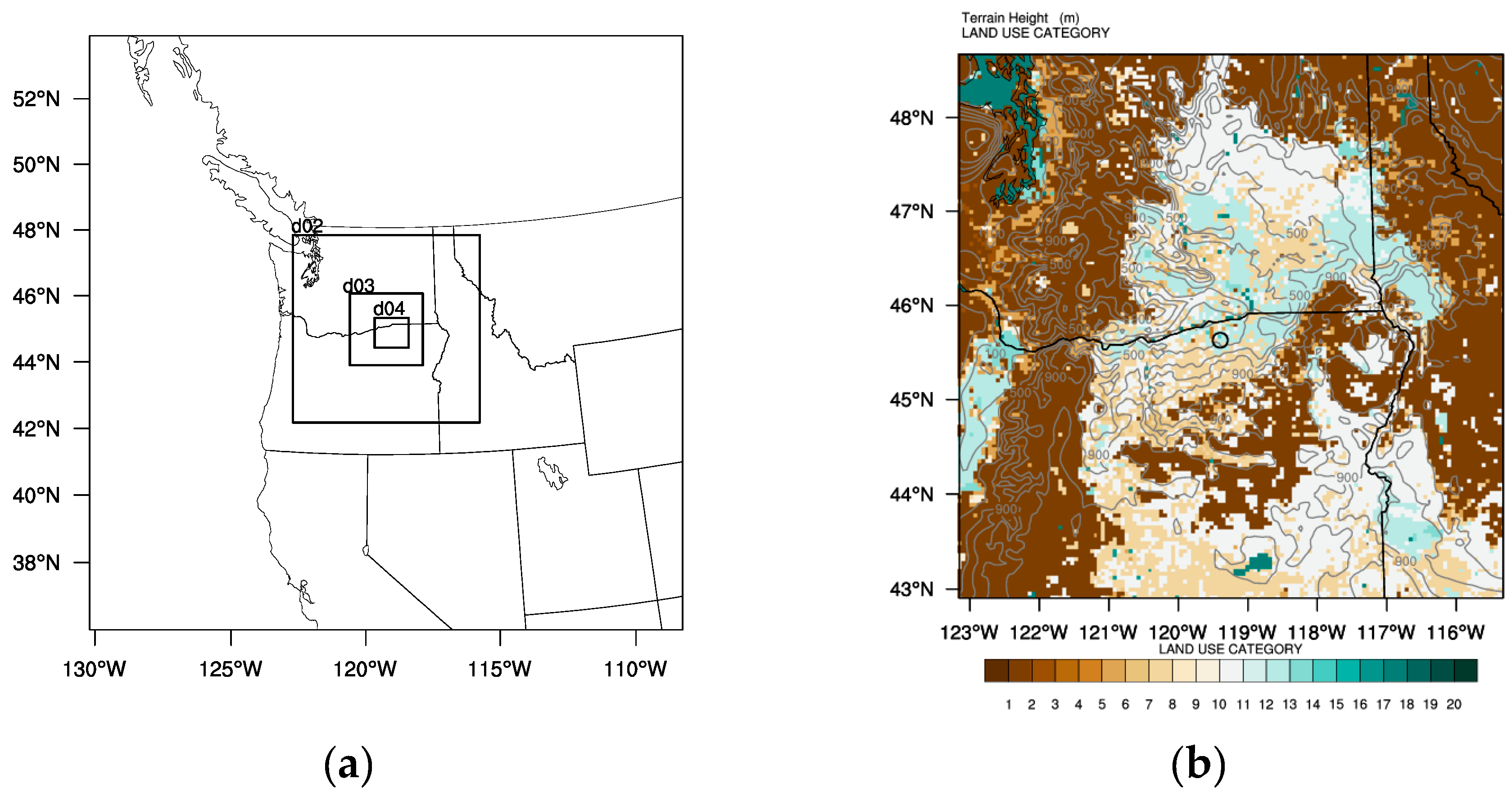
2.1. Observations
2.2. Model Configurations
2.3. Evaluation Methods
3. Results
3.1. Surface Meteorological Variables
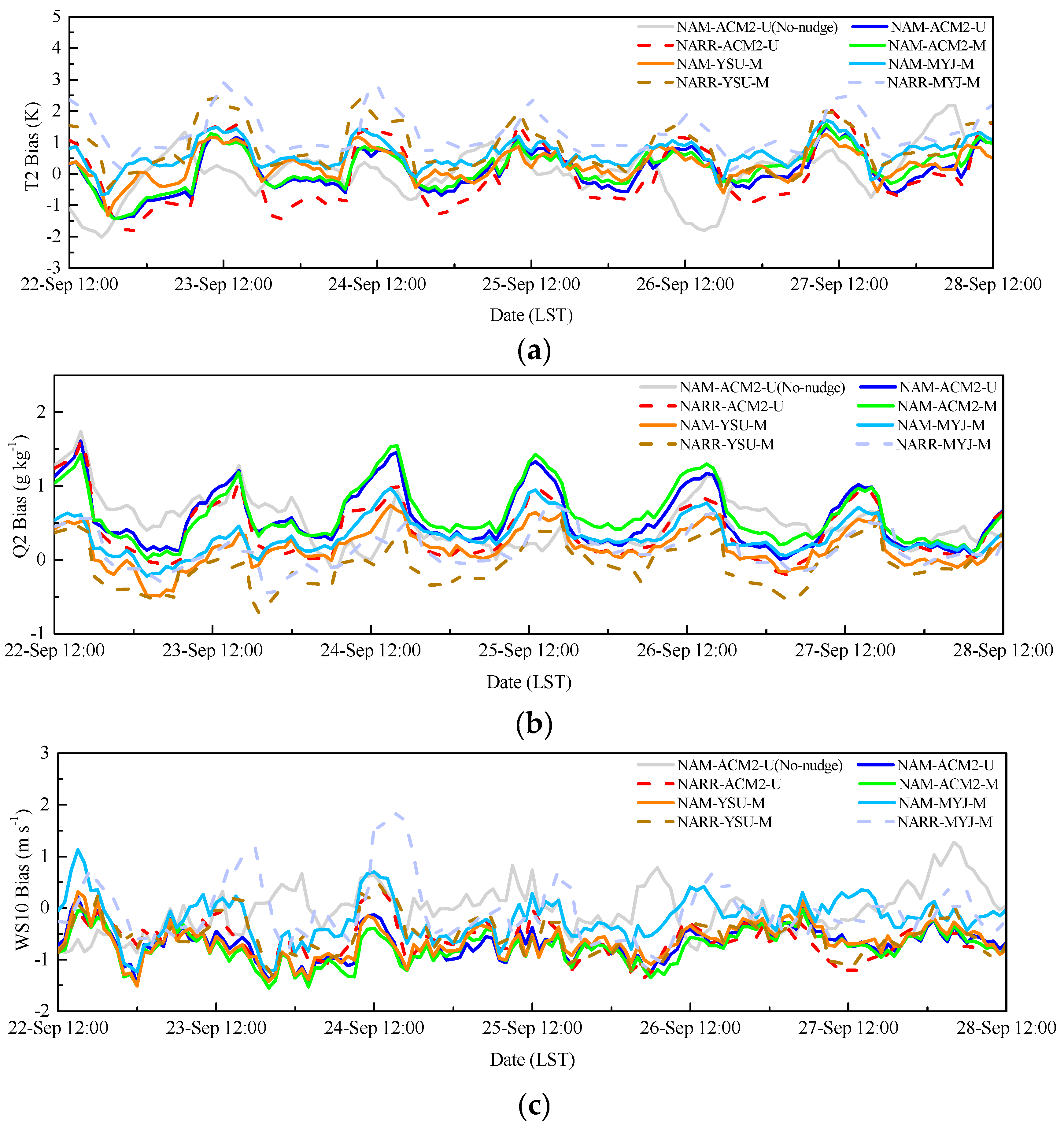
3.1.1. Surface Temperature
3.1.2. Surface Water Vapor Mixing Ratio
3.1.3. 10-m Wind Speed
3.2. Turbulence Data
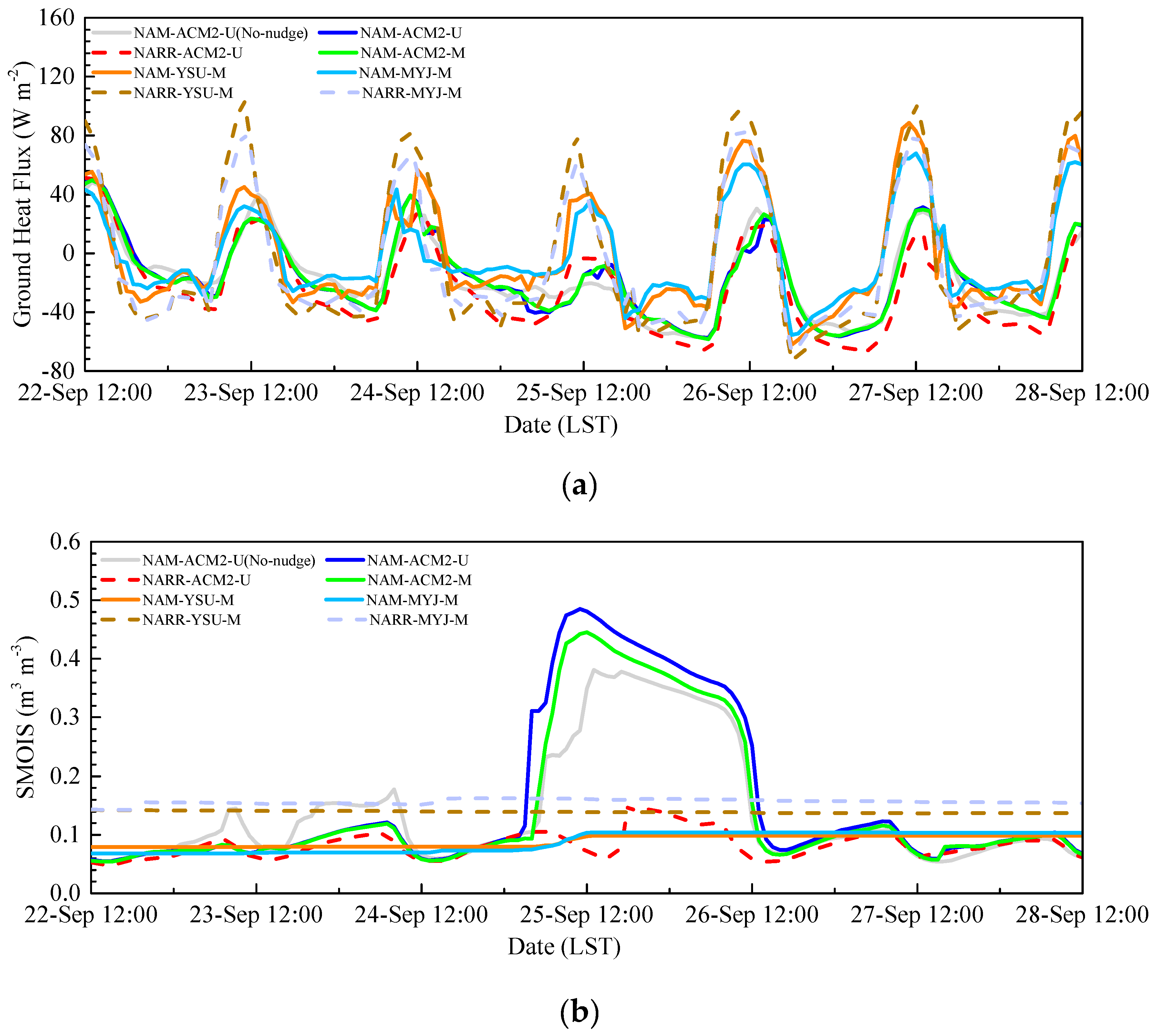
3.2.1. Temporal Variation of Surface Fluxes
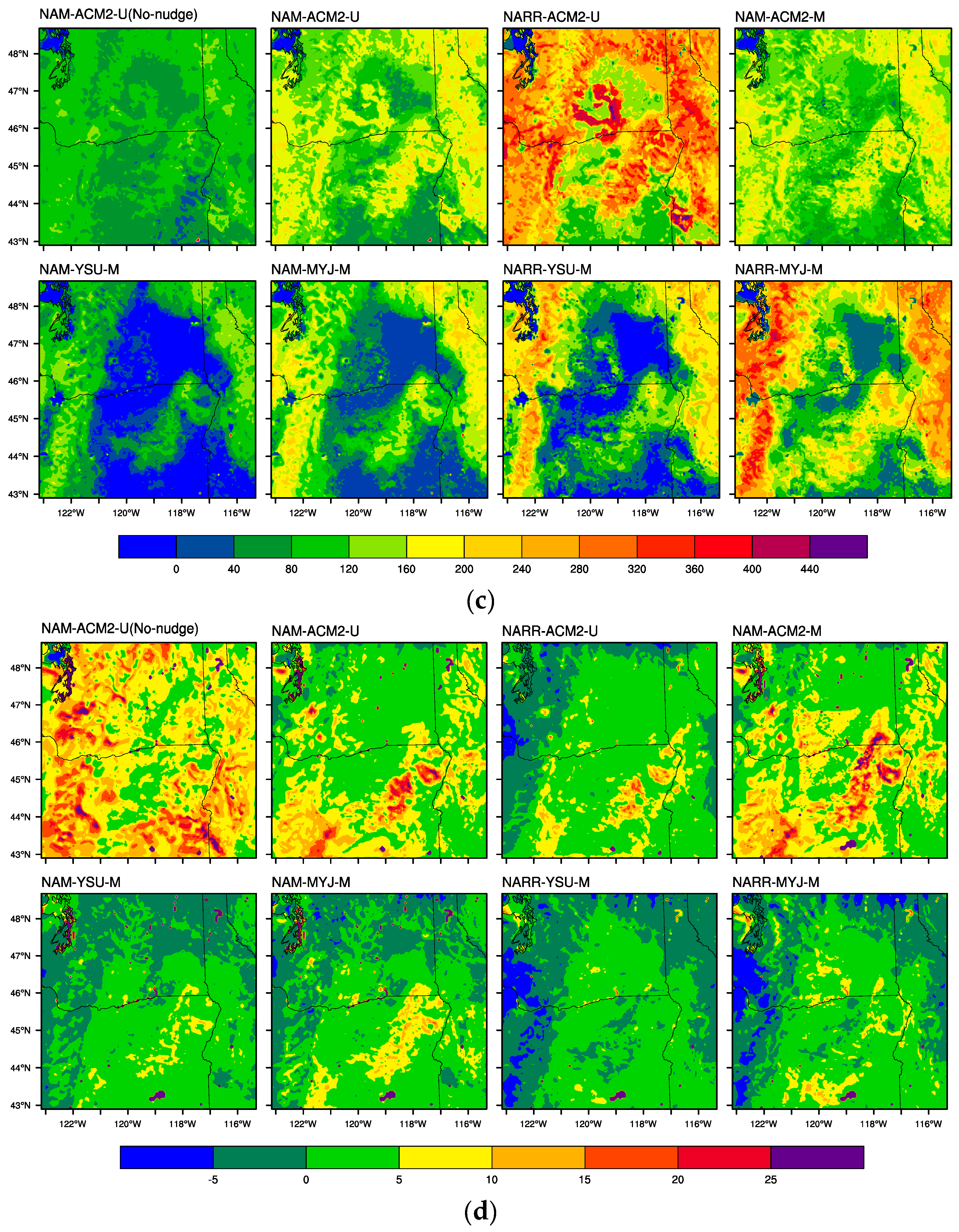
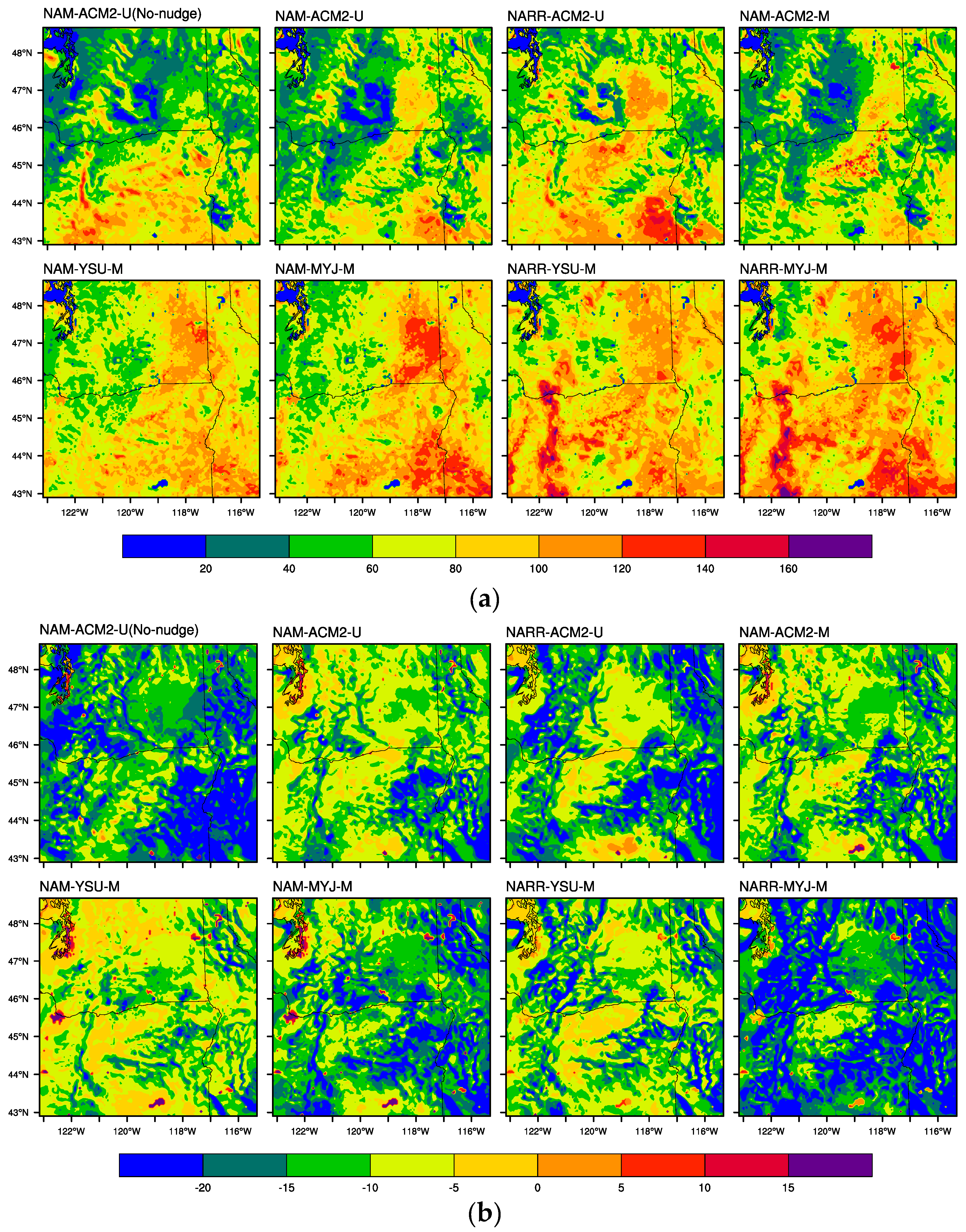
3.2.2. Spatial Variation of Surface Fluxes
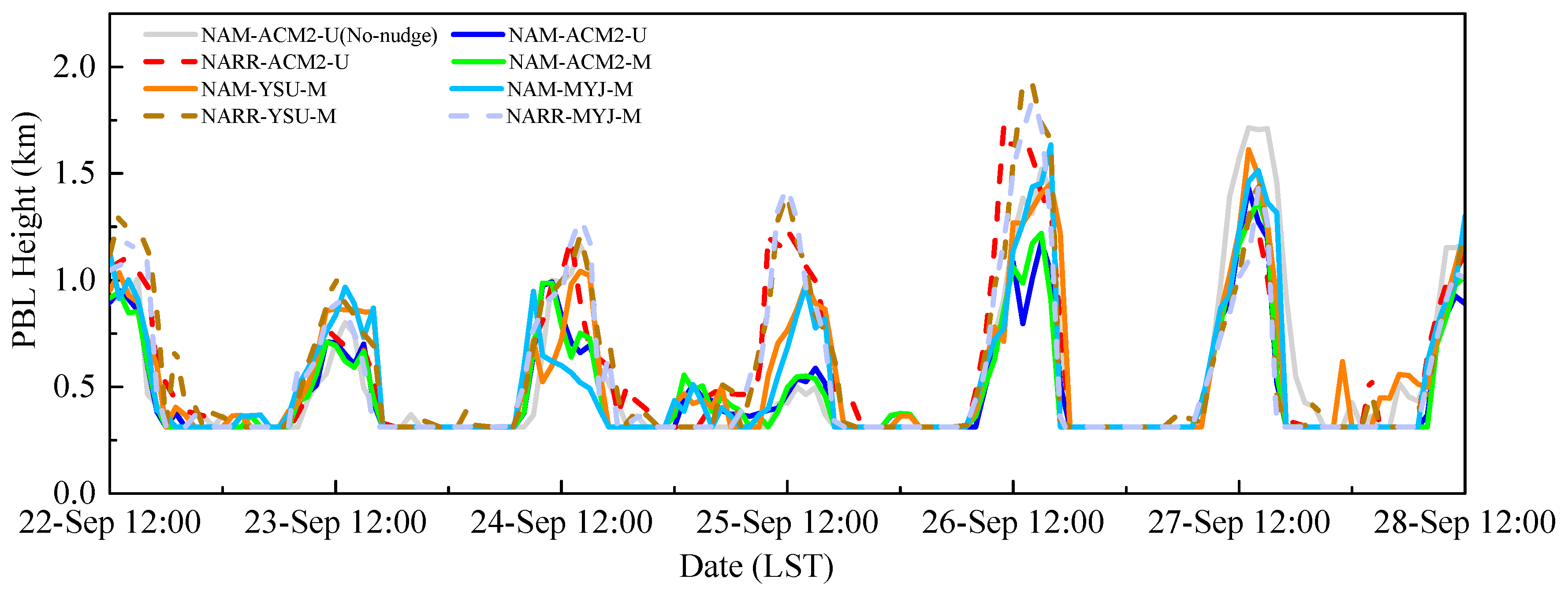
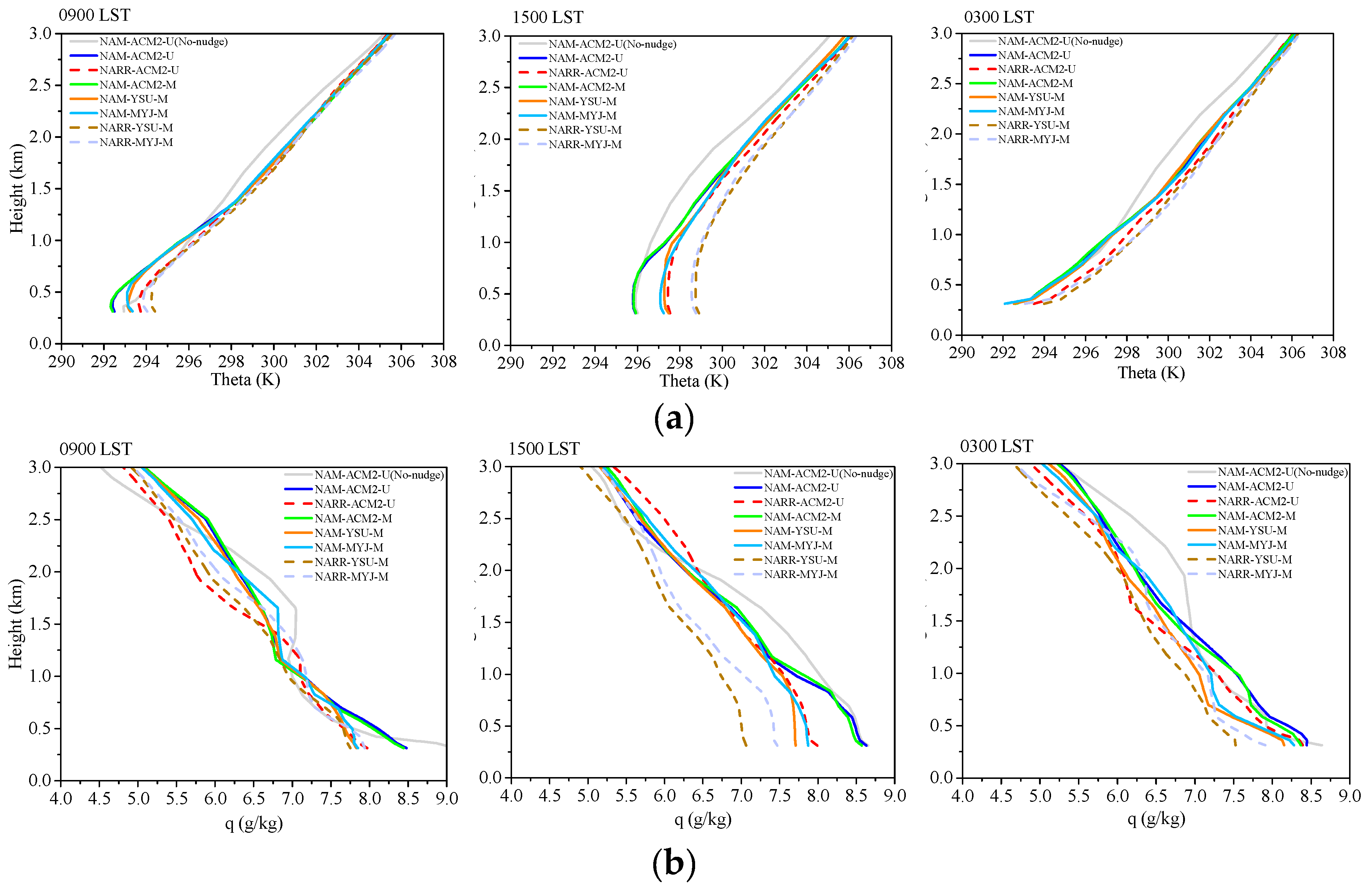
3.3. Vertical Structure
4. Discussion
4.1. LSMs Sensitivities to Large-Scale Forcing Datasets
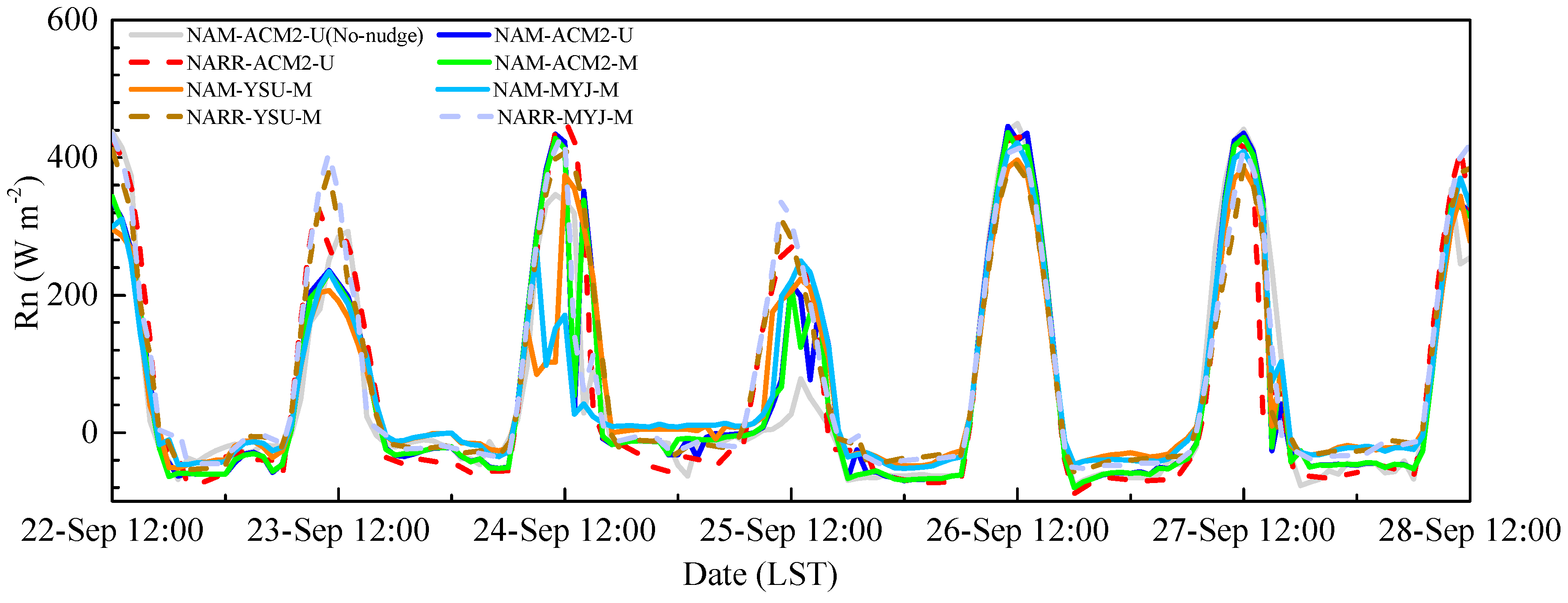
4.2. Simulation Differences for Surface Energy Balance
5. Conclusions
Acknowledgments
Author Contributions
Conflicts of Interest
References
- Pleim, J.; Ran, L. Surface flux modeling for air quality applications. Atmosphere 2011, 2, 271–302. [Google Scholar] [CrossRef] [Scilit]
- Zeng, X.-M.; Wang, N.; Wang, Y.; Zheng, Y.; Zhou, Z.; Wang, G.; Chen, C.; Liu, H. WRF-simulated sensitivity to land surface schemes in short and medium ranges for a high-temperature event in east China: A comparative study. J. Adv. Model. Earth Syst. 2015, 7, 1305–1325. [Google Scholar] [CrossRef] [Scilit]
- Gibbs, J.A.; Fedorovich, E.; van Eijk, A.M.J. Evaluating weather research and forecasting (WRF) model predictions of turbulent flow parameters in a dry convective boundary layer. J. Appl Meteorol. Clim. 2011, 50, 2429–2444. [Google Scholar] [CrossRef] [Scilit]
- Cheng, W.Y.Y.; Steenburgh, W.J. Evaluation of surface sensible weather forecasts by the WRF and the Eta models over the western United States. Weather Forecast. 2005, 20, 812–821. [Google Scholar] [CrossRef] [Scilit]
- Panda, J.; Sharan, M. Influence of land-surface and turbulent parameterization schemes on regional-scale boundary layer characteristics over northern India. Atmos. Res. 2012, 112, 89–111. [Google Scholar] [CrossRef] [Scilit]
- Prabha, T.V.; Hoogenboom, G.; Smirnova, T.G. Role of land surface parameterizations on modeling cold-pooling events and low-level jets. Atmos. Res. 2011, 99, 147–161. [Google Scholar] [CrossRef] [Scilit]
- Green, M.C.; Chow, J.C.; Watson, J.G.; Dick, K.; Inouye, D. Effects of snow cover and atmospheric stability on winter PM2.5 concentrations in western US Valleys. J. Appl. Meteorol. Clim. 2015, 54, 1191–1201. [Google Scholar] [CrossRef] [Scilit]
- Lu, W.; Zhong, S. A numerical study of a persistent cold air pool episode in the Salt Lake Valley, Utah. J. Geophys. Res. Atmos. 2014, 119, 1733–1752. [Google Scholar] [CrossRef] [Scilit]
- Peng, J.; Niesel, J.; Loew, A.; Zhang, S.; Wang, J. Evaluation of satellite and reanalysis soil moisture products over southwest China using ground-based measurements. Remote Sens. 2015, 7, 15729–15747. [Google Scholar] [CrossRef] [Scilit]
- Cheng, F.-Y.; Hsu, Y.-C.; Lin, P.-L.; Lin, T.-H. Investigation of the effects of different land use and land cover patterns on mesoscale meteorological simulations in the Taiwan area. J. Appl. Meteorol. Clim. 2013, 52, 570–587. [Google Scholar] [CrossRef] [Scilit]
- LeMone, M.A.; Chen, F.; Alfieri, J.G.; Tewari, M.; Geerts, B.; Miao, Q.; Grossman, R.L.; Coulter, R.L. Influence of land cover and soil moisture on the horizontal distribution of sensible and latent heat fluxes in southeast Kansas during IHOP_2002 and CASES-97. J. Hydrometeorol. 2007, 8, 68–87. [Google Scholar] [CrossRef] [Scilit]
- Ek, M.B.; Mitchell, K.E.; Lin, Y.; Rogers, E.; Grunmann, P.; Koren, V.; Gayno, G.; Tarpley, J.D. Implementation of Noah land surface model advances in the national centers for environmental prediction operational mesoscale Eta model. J. Geophys. Res. Atmos. 2003, 108. [Google Scholar] [CrossRef] [Scilit]
- Xiu, A.; Pleim, J.E. Development of a land surface model. Part I: Application in a mesoscale meteorological model. J. Appl. Meteorol. 2001, 40, 192–209. [Google Scholar] [CrossRef] [Scilit]
- Chen, F.; Zhang, Y. On the coupling strength between the land surface and the atmosphere: From viewpoint of surface exchange coefficients. Geophys. Res. Lett. 2009, 36. [Google Scholar] [CrossRef] [Scilit]
- Hong, S.-Y.; Pan, H.-L. Nonlocal boundary layer vertical diffusion in a medium-range forecast model. Mon. Weather Rev. 1996, 124, 2322–2339. [Google Scholar] [CrossRef] [Scilit]
- Janjic, Z. The surface layer parameterization in the NCEP Eta model. In Proceedings of the 11th Conference on Numerical Weather Prediction, Norfolk, VA, USA, 19–23 August 1996; pp. 354–355. [Google Scholar]
- Gilliam, R.C.; Pleim, J.E. Performance assessment of new land surface and planetary boundary layer physics in the WRF-ARW. J. Appl. Meteorol. Clim. 2010, 49, 760–774. [Google Scholar] [CrossRef] [Scilit]
- Pleim, J.E.; Xiu, A. Development of a land surface model. Part II: Data assimilation. J. Appl. Meteorol. 2003, 42, 1811–1822. [Google Scholar] [CrossRef] [Scilit]
- Pleim, J.E.; Gilliam, R. An indirect data assimilation scheme for deep soil temperature in the Pleim–Xiu land surface model. J. Appl. Meteorol. Clim. 2009, 48, 1362–1376. [Google Scholar] [CrossRef] [Scilit]
- Miao, J.; Chen, D.; Borne, K. Evaluation and comparison of Noah and Pleim–Xiu land surface models in MM5 using GÖTE2001 data: Spatial and temporal variations in near-surface air temperature. J. Appl. Meteorol. Clim. 2007, 46, 1587–1605. [Google Scholar] [CrossRef] [Scilit]
- Peña, A.; Hahmann, A.N. Atmospheric stability and turbulence fluxes at Horns Rev—An intercomparison of sonic, bulk and WRF model data. Wind Energy 2012, 15, 717–731. [Google Scholar] [CrossRef] [Scilit]
- Banks, R.F.; Tiana-Alsina, J.; Baldasano, J.M.; Rocadenbosch, F.; Papayannis, A.; Solomos, S.; Tzanis, C.G. Sensitivity of boundary-layer variables to PBL schemes in the WRF model based on surface meteorological observations, lidar, and radiosondes during the Hygra-CD campaign. Atmos. Res. 2016, 176–177, 185–201. [Google Scholar] [CrossRef] [Scilit]
- Berg, L.K.; Zhong, S. Sensitivity of MM5-simulated boundary layer characteristics to turbulence parameterizations. J. Appl. Meteorol. 2005, 44, 1467–1483. [Google Scholar] [CrossRef] [Scilit]
- Cohen, A.E.; Cavallo, S.M.; Coniglio, M.C.; Brooks, H.E. A review of planetary boundary layer parameterization schemes and their sensitivity in simulating southeastern US cold season severe weather environments. Weather Forecast. 2015, 30, 591–612. [Google Scholar] [CrossRef] [Scilit]
- Shin, H.H.; Hong, S.-Y. Intercomparison of planetary boundary-layer parametrizations in the WRF model for a single day from CASES-99. Bound.-Layer Meteorol. 2011, 139, 261–281. [Google Scholar] [CrossRef] [Scilit]
- Hu, X.-M.; Klein, P.M.; Xue, M. Evaluation of the updated YSU planetary boundary layer scheme within WRF for wind resource and air quality assessments. J. Geophys. Res. Atmos. 2013, 118, 10490–10505. [Google Scholar] [CrossRef] [Scilit]
- Zhang, D.-L.; Zheng, W.-Z. Diurnal cycles of surface winds and temperatures as simulated by five boundary layer parameterizations. J. Appl. Meteorol. 2004, 43, 157–169. [Google Scholar] [CrossRef] [Scilit]
- Patil, M.N.; Waghmare, R.T.; Halder, S.; Dharmaraj, T. Performance of Noah land surface model over the tropical semi-arid conditions in western India. Atmos. Res. 2011, 99, 85–96. [Google Scholar] [CrossRef] [Scilit]
- The Eddy Covariance Method. Available online: https://link.springer.com/chapter/10.1007/978-94-007-2351-1_1#citeas (accessed on 14 November 2011).
- Osibanjo, O.O. Investigation of the Influence of Temperature Inversions and Turbulence on Land-Atmosphere Interactions for Rolling Terrain. Master’s Thesis, University of Nevada, Reno, NV, USA, 2016. [Google Scholar]
- TDL U.S. and Canada Surface Hourly Observations. Available online: https://rda.ucar.edu/datasets/ds472.0/ (accessed on 11 July 2017).
- Shin, H.H.; Hong, S.-Y.; Dudhia, J. Impacts of the lowest model level height on the performance of planetary boundary layer parameterizations. Mon. Weather Rev. 2011, 140, 664–682. [Google Scholar] [CrossRef] [Scilit]
- Smirnova, T.G.; Brown, J.M.; Benjamin, S.G.; Kenyon, J.S. Modifications to the rapid update cycle land surface model (RUC LSM) available in the weather research and forecasting (WRF) model. Mon. Weather Rev. 2016, 144, 1851–1865. [Google Scholar] [CrossRef] [Scilit]
- NCAR. Objective Analysis (Obsgrid). Available online: http://www2.mmm.ucar.edu/wrf/users/docs/user_guide_V3/users_guide_chap7.htm (accessed on 11 June 2017).
- Chen, F.; Kusaka, H.; Bornstein, R.; Ching, J.; Grimmond, C.S.B.; Grossman-Clarke, S.; Loridan, T.; Manning, K.W.; Martilli, A.; Miao, S.; et al. The integrated WRF/urban modelling system: Development, evaluation, and applications to urban environmental problems. Int. J. Climatol. 2011, 31, 273–288. [Google Scholar] [CrossRef] [Scilit]
- Kala, J.; Andrys, J.; Lyons, T.J.; Foster, I.J.; Evans, B.J. Sensitivity of WRF to driving data and physics options on a seasonal time-scale for the southwest of western Australia. Clim. Dyn. 2014, 44, 633–659. [Google Scholar] [CrossRef] [Scilit]
- Morrison, H.; Curry, J.; Khvorostyanov, V. A new double-moment microphysics parameterization for application in cloud and climate models. Part I: Description. J. Atmos. Sci. 2005, 62, 1665–1677. [Google Scholar] [CrossRef] [Scilit]
- Mlawer, E.J.; Taubman, S.J.; Brown, P.D.; Iacono, M.J.; Clough, S.A. Radiative transfer for inhomogeneous atmospheres: RRTM, a validated correlated-k model for the longwave. J. Geophys. Res. Atmos. 1997, 102, 16663–16682. [Google Scholar] [CrossRef] [Scilit]
- Dudhia, J. Numerical study of convection observed during the winter monsoon experiment using a mesoscale two-dimensional model. J. Atmos. Sci. 1989, 46, 3077–3107. [Google Scholar] [CrossRef] [Scilit]
- Kain, J.S. The kain–fritsch convective parameterization: An update. J. Appl. Meteorol. 2004, 43, 170–181. [Google Scholar] [CrossRef] [Scilit]
- Pleim, J.E. A simple, efficient solution of flux–profile relationships in the atmospheric surface layer. J. Appl. Meteorol. Clim. 2006, 45, 341–347. [Google Scholar] [CrossRef] [Scilit]
- Jiménez, P.A.; Dudhia, J. Improving the representation of resolved and unresolved topographic effects on surface wind in the WRF model. J. Appl. Meteorol. Clim. 2012, 51, 300–316. [Google Scholar] [CrossRef] [Scilit]
- Janjić, Z.I. Nonsingular Implementation of the Mellor–Yamada Level 2.5 Scheme in the NCEP Meso Model. Available online: http://www.emc.ncep.noaa.gov/officenotes/newernotes/on437.pdf (accessed on 5 October 2017).
- Jiménez, P.A.; Dudhia, J.; González-Rouco, J.F.; Navarro, J.; Montávez, J.P.; García-Bustamante, E. A revised scheme for the WRF surface layer formulation. Mon. Weather Rev. 2012, 140, 898–918. [Google Scholar] [CrossRef] [Scilit]
- Stull, R.B. An introduction to Boundary Layer Meteorology; Springer Science & Business Media: Dordrecht, The Netherlands, 2012. [Google Scholar]
- Enhanced Meteorological Modeling and Performance Evaluation for Two Texas Ozone Episodes, Project Report Prepared for the Texas Natural Resource Conservation Commissions. Available online: https://www.tceq.texas.gov/assets/public/implementation/air/am/contracts/reports/mm/EnhancedMetModelingAndPerformanceEvaluation.pdf (accessed on 31 August 2001).
- Willmott, C.J. Some comments on the evaluation of model performance. Bull. Am. Meteorol. Soc. 1982, 63, 1309–1313. [Google Scholar] [CrossRef] [Scilit]
- Xie, B.; Fung, J.C.H.; Chan, A.; Lau, A. Evaluation of nonlocal and local planetary boundary layer schemes in the WRF model. J. Geophys. Res. Atmos. 2012, 117. [Google Scholar] [CrossRef] [Scilit]
- Otte, T.L. The impact of nudging in the meteorological model for retrospective air quality simulations. Part I: Evaluation against national observation networks. J. Appl. Meteorol. Clim. 2008, 47, 1853–1867. [Google Scholar] [CrossRef] [Scilit]
- Hariprasad, K.B.R.R.; Srinivas, C.V.; Singh, A.B.; Vijaya Bhaskara Rao, S.; Baskaran, R.; Venkatraman, B. Numerical simulation and intercomparison of boundary layer structure with different PBL schemes in WRF using experimental observations at a tropical site. Atmos. Res. 2014, 145–146, 27–44. [Google Scholar] [CrossRef] [Scilit]
- Zhang, Y.; Gao, Z.; Li, D.; Li, Y.; Zhang, N.; Zhao, X.; Chen, J. On the computation of planetary boundary-layer height using the bulk Richardson number method. Geosci. Model Dev. 2014, 7, 2599–2611. [Google Scholar] [CrossRef] [Scilit]
- Hariprasad, K.B.R.R.; Venkata Srinivas, C.; Venkateswara Naidu, C.; Baskaran, R.; Venkatraman, B. Assessment of surface layer parameterizations in ARW using micro-meteorological observations from a tropical station. Meteorol. Appl. 2016, 23, 191–208. [Google Scholar] [CrossRef] [Scilit]
- Tanaka, H.; Hiyama, T.; Kobayashi, N.; Yabuki, H.; Ishii, Y.; Desyatkin, R.V.; Maximov, T.C.; Ohta, T. Energy balance and its closure over a young larch forest in eastern Siberia. Agr. Forest Meteorol. 2008, 148, 1954–1967. [Google Scholar] [CrossRef] [Scilit]
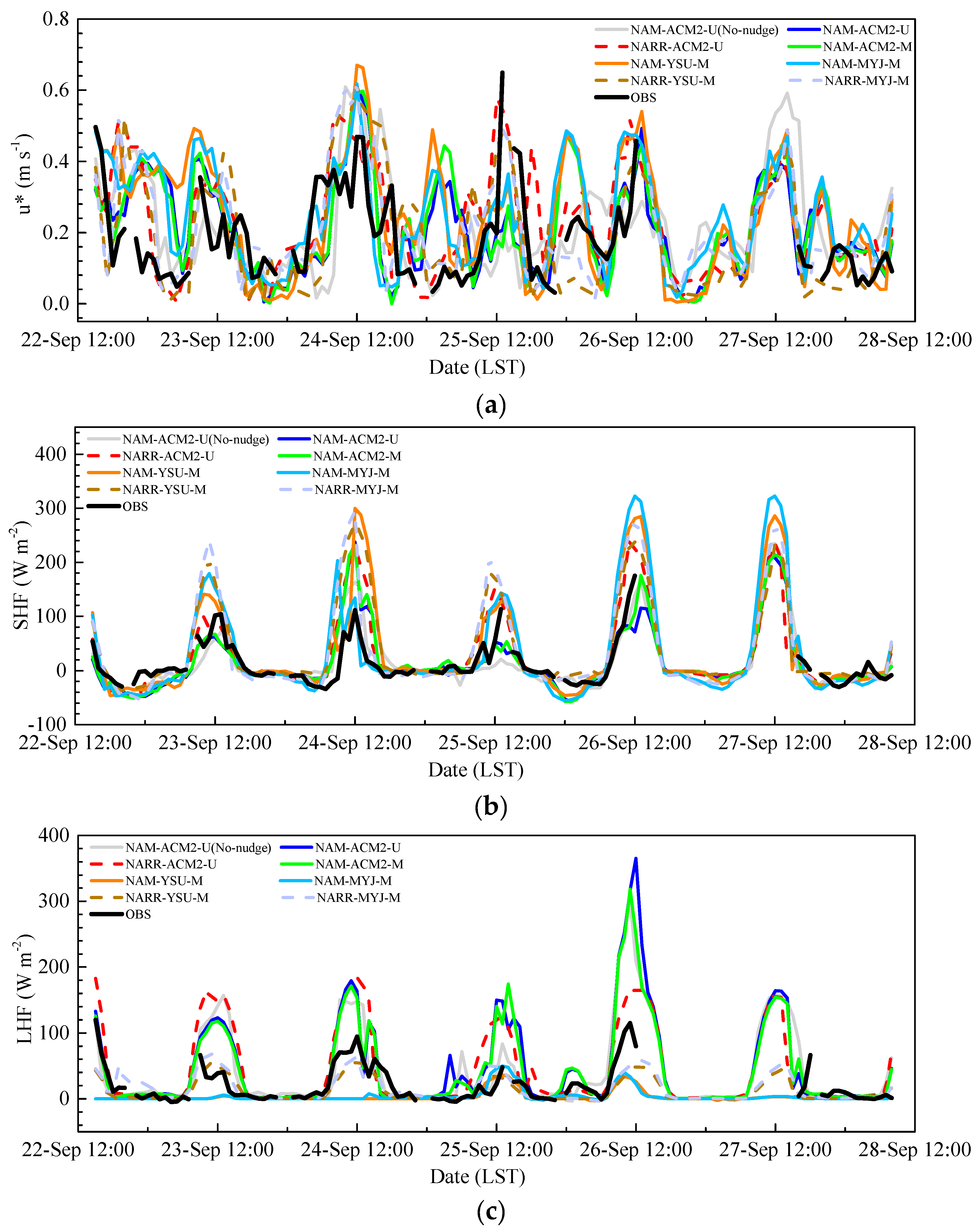



| Experiment | Input Forcing Data (Resolution, Interval) | Land Surface Model | Planetary Boundary Layer Scheme | Surface Layer Scheme | Land Surface INPUT Data |
|---|---|---|---|---|---|
| NAM-ACM2-U (No-nudge) | NAM (12km, 6 h) 1 | Pleim-Xiu | ACM2 2 | Pleim-Xiu Surface layer | USGS 3 |
| NAM-ACM2-U | NAM (12km, 6 h) | Pleim-Xiu | ACM2 | Pleim-Xiu Surface layer | USGS |
| NARR-ACM2-U | NARR (32km, 3 h) 4 | Pleim-Xiu | ACM2 | Pleim-Xiu Surface layer | USGS |
| NAM-ACM2-M | NAM (12 km, 6 h) | Pleim-Xiu | ACM2 | Pleim-Xiu Surface layer | MODIS 5 |
| NAM-YSU-M | NAM (12 km, 6 h) | Noah | YSU 6 | Revised MM5 Similarity | MODIS |
| NAM-MYJ-M | NAM (12 km, 6 h) | Noah | MYJ 7 | Eta similarity | MODIS |
| NARR-YSU-M | NARR (32 km, 3 h) | Noah | YSU | Revised MM5 Similarity | MODIS |
| NARR-MYJ-M | NARR (32 km, 3 h) | Noah | MYJ | Eta similarity | MODIS |
| NAM- ACM2-U (No-nudge) | NAM- ACM2-U | NARR- ACM2-U | NAM- ACM2-M | NAM- YSU-M | NAM- MYJ-M | NARR- YSU-M | NARR- MYJ-M | |
|---|---|---|---|---|---|---|---|---|
| 2-m Temperature (K) | ||||||||
| MB | 0.08 (±0.59) | 0.06 (±0.35) | 0.01 (±0.33) | 0.15 (±0.38) | 0.27 (±0.18) | 0.64 (±0.16) | 0.85 (±0.21) | 1.31 (±0.18) |
| RMSE | 2.13 (±0.40) | 1.69 (±0.20) | 1.87 (±0.19) | 1.80 (±0.22) | 1.81 (±0.20) | 1.80 (±0.17) | 2.18 (±0.17) | 2.28 (±0.19) |
| IOA | 0.91 (±0.02) | 0.95 (±0.01) | 0.95 (±0.01) | 0.95 (±0.01) | 0.95 (±0.01) | 0.95 (±0.01) | 0.93 (±0.01) | 0.92 (±0.01) |
| 2-m Humidity (g kg−1) | ||||||||
| MB | 0.54 (±0.30) | 0.56 (±0.11) | 0.40 (±0.11) | 0.61 (±0.15) | 0.16 (±0.11) | 0.32 (±0.12) | −0.05 (±0.14) | 0.15 (±0.12) |
| RMSE | 1.30 (±0.25) | 0.99 (±0.12) | 0.91 (±0.14) | 1.08 (±0.13) | 0.83 (±0.14) | 0.86 (±0.11) | 0.93 (±0.14) | 0.89 (±0.09) |
| IOA | 0.75 (±0.12) | 0.87 (±0.04) | 0.88 (±0.04) | 0.84 (±0.04) | 0.90 (±0.04) | 0.90 (±0.03) | 0.87 (±0.04) | 0.88 (±0.33) |
| 10-m Wind Speed (m s−1) | ||||||||
| MB | −0.04 (±0.33) | −0.67 (±0.13) | −0.61 (±0.11) | −0.74 (±0.16) | −0.63 (±0.15) | −0.15 (±0.15) | −0.53 (±0.12) | −0.03 (±0.21) |
| RMSE | 1.80 (±0.19) | 1.56 (±0.16) | 1.61 (±0.14) | 1.64 (±0.18) | 1.59 (±0.16) | 1.60 (±0.16) | 1.75 (±0.19) | 1.87 (±0.26) |
| IOA | 0.66 (±0.07) | 0.72 (±0.06) | 0.69 (±0.06) | 0.69 (±0.07) | 0.71 (±0.06) | 0.74 (±0.06) | 0.62 (±0.08) | 0.64 (±0.09) |
| 10-m Wind Direction (deg) | ||||||||
| MB | 8.27 (±4.87) | 4.54 (±2.83) | 7.01 (±1.85) | 4.45 (±3.17) | 5.28 (±4.00) | 4.39 (±3.82) | 7.19 (±4.27) | 5.36 (±4.24) |
| RMSE | N/A1 | N/A | N/A | N/A | N/A | N/A | N/A | N/A |
| IOA | N/A | N/A | N/A | N/A | N/A | N/A | N/A | N/A |
| Experiment | Friction Velocity (m s−1) | Sensible Heat Flux (W m−2) | Latent Heat Flux (W m−2) | ||||||
|---|---|---|---|---|---|---|---|---|---|
| RMSE1 | MB2 | MAE3 | RMSE | MB | MAE | RMSE | MB | MAE | |
| NAM-ACM2-U (No-nudge) | 0.15 | 0.03 | 0.12 | 27.51 | −3.18 | 19.03 | 46.12 | 18.15 | 26.06 |
| NAM-ACM2-U | 0.15 | 0.04 | 0.12 | 34.22 | −0.95 | 21.04 | 55.73 | 24.44 | 30.47 |
| NARR-ACM2-U | 0.14 | 0.06 | 0.11 | 38.83 | 13.25 | 22.32 | 47.88 | 23.24 | 29.52 |
| NAM-ACM2-M | 0.16 | 0.04 | 0.12 | 34.59 | −0.26 | 21.45 | 48.01 | 21.07 | 27.07 |
| NAM-YSU-M | 0.17 | 0.07 | 0.14 | 54.56 | 18.86 | 30.96 | 30.99 | −16.92 | 18.41 |
| NAM-MYJ-M | 0.16 | 0.07 | 0.12 | 49.72 | 11.45 | 29.90 | 30.54 | −15.84 | 18.08 |
| NARR-YSU-M | 0.14 | 0.02 | 0.11 | 59.25 | 27.68 | 33.61 | 20.63 | −8.53 | 13.09 |
| NARR-MYJ-M | 0.13 | 0.03 | 0.10 | 60.17 | 21.61 | 33.90 | 20.60 | −4.37 | 13.40 |
© 2017 by the authors. Licensee MDPI, Basel, Switzerland. This article is an open access article distributed under the terms and conditions of the Creative Commons Attribution (CC BY) license (http://creativecommons.org/licenses/by/4.0/).
Share and Cite
Sun, X.; Holmes, H.A.; Osibanjo, O.O.; Sun, Y.; Ivey, C.E. Evaluation of Surface Fluxes in the WRF Model: Case Study for Farmland in Rolling Terrain. Atmosphere 2017, 8, 197. https://doi.org/10.3390/atmos8100197
Sun X, Holmes HA, Osibanjo OO, Sun Y, Ivey CE. Evaluation of Surface Fluxes in the WRF Model: Case Study for Farmland in Rolling Terrain. Atmosphere. 2017; 8(10):197. https://doi.org/10.3390/atmos8100197
Chicago/Turabian StyleSun, Xia, Heather A. Holmes, Olabosipo O. Osibanjo, Yun Sun, and Cesunica E. Ivey. 2017. "Evaluation of Surface Fluxes in the WRF Model: Case Study for Farmland in Rolling Terrain" Atmosphere 8, no. 10: 197. https://doi.org/10.3390/atmos8100197
APA StyleSun, X., Holmes, H. A., Osibanjo, O. O., Sun, Y., & Ivey, C. E. (2017). Evaluation of Surface Fluxes in the WRF Model: Case Study for Farmland in Rolling Terrain. Atmosphere, 8(10), 197. https://doi.org/10.3390/atmos8100197