Comparative Study of Three Two-Stage Hybrid Ecological Wastewater Treatment Systems for Producing High Nutrient, Reclaimed Water for Irrigation Reuse in Developing Countries


Abstract
1. Introduction
2. Materials and Methods
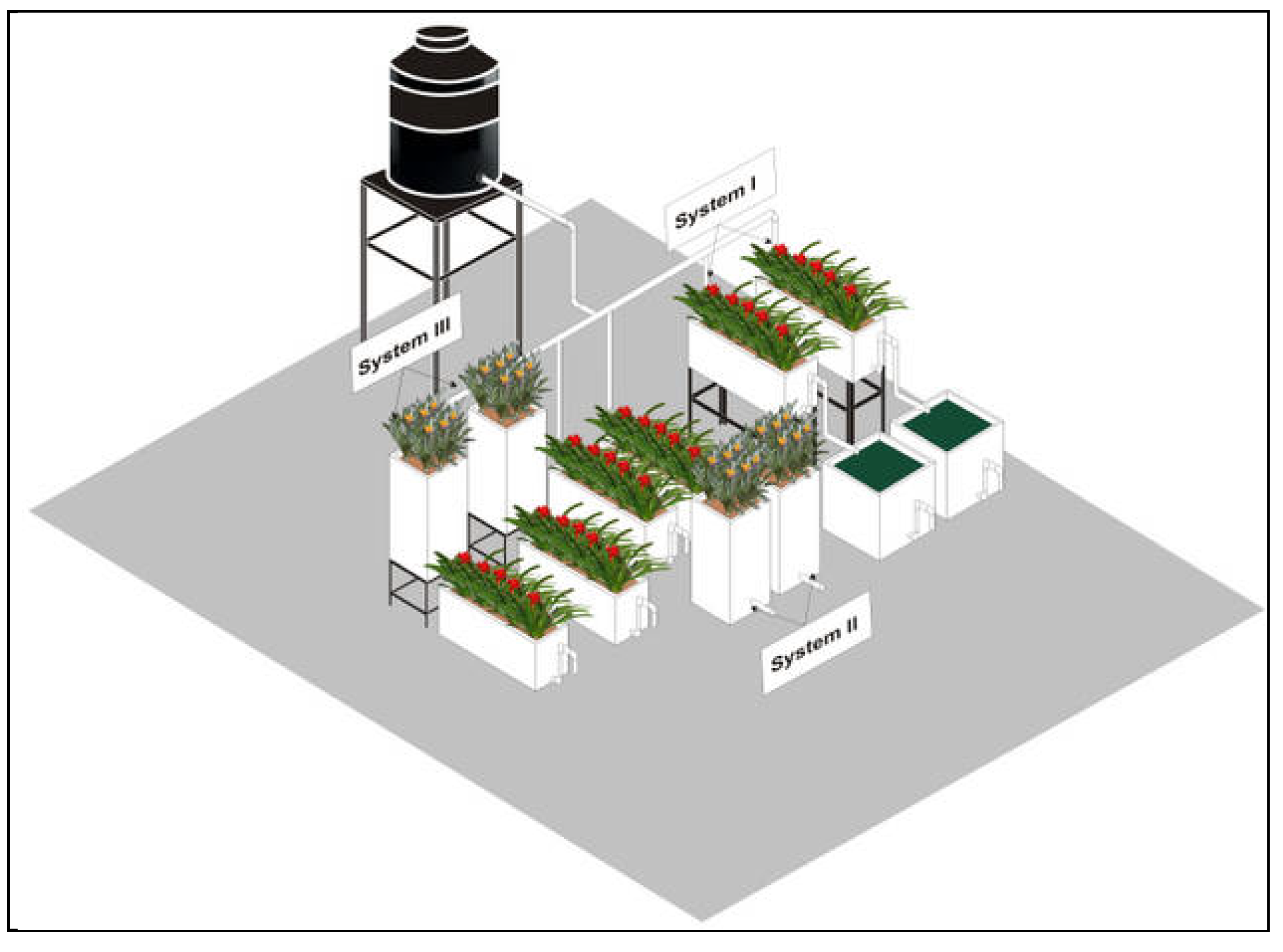
2.1. Description of the Wetland Systems

2.2. Water Quality Parameters
2.3. Data Analysis
3. Results and Discussion
3.1. Organic Nitrogen

| Parameter | Influent | System I: HF-SP | System II: HF-VF | System III: VF-HF | |||
|---|---|---|---|---|---|---|---|
| 1st stage HF-CW | 2nd stage SP | 1st stage HF-CW | 2nd stage VF-CW | 1st stage VF-CW | 2nd stage HF-CW | ||
| Org-N (mg/L) | 7.1 ± 1.2 | 3.2± 1.0 | 10.5± 1.0 | 2.8 ± 0.7 | 1.6 ± 0.7 | 1.4 ± 0.8 | 1.2 ± 0.8 |
| Org-N Removal (%) | 54.9 | −228.1 (−47.9) | 60.6 | 42.9(77.5) | 80.3 | * (83.1) | |
| NH4+-N (mg/L) | 128.2 ± 11.4 | 103.1± 11.4 | 35.8 ± 12.2 | 103.4 ± 12.4 | 18.6 ± 5.6 | 25.1 ± 6.7 | 19.2 ± 6.2 |
| NH4+-N Removal (%) | 19.6 | 65.3 (72.0) | 19.3 | 82.0 (85.5) | 80.4 | * (85.0) | |
| NO3−-N (mg/L) | 4.2 ± 1.4 | 1.95± 0.3 | 14.1 ± 1.8 | 1.97 ± 0.6 | 91.4 ± 17.6 | 108 ± 16.3 | 82.5 ± 17.2 |
| NO3−-N Removal (%) | 53.6 | −623 (−236) | 53.1 | −4540 (−2076) | −2471 | 23.6 (−1864) | |
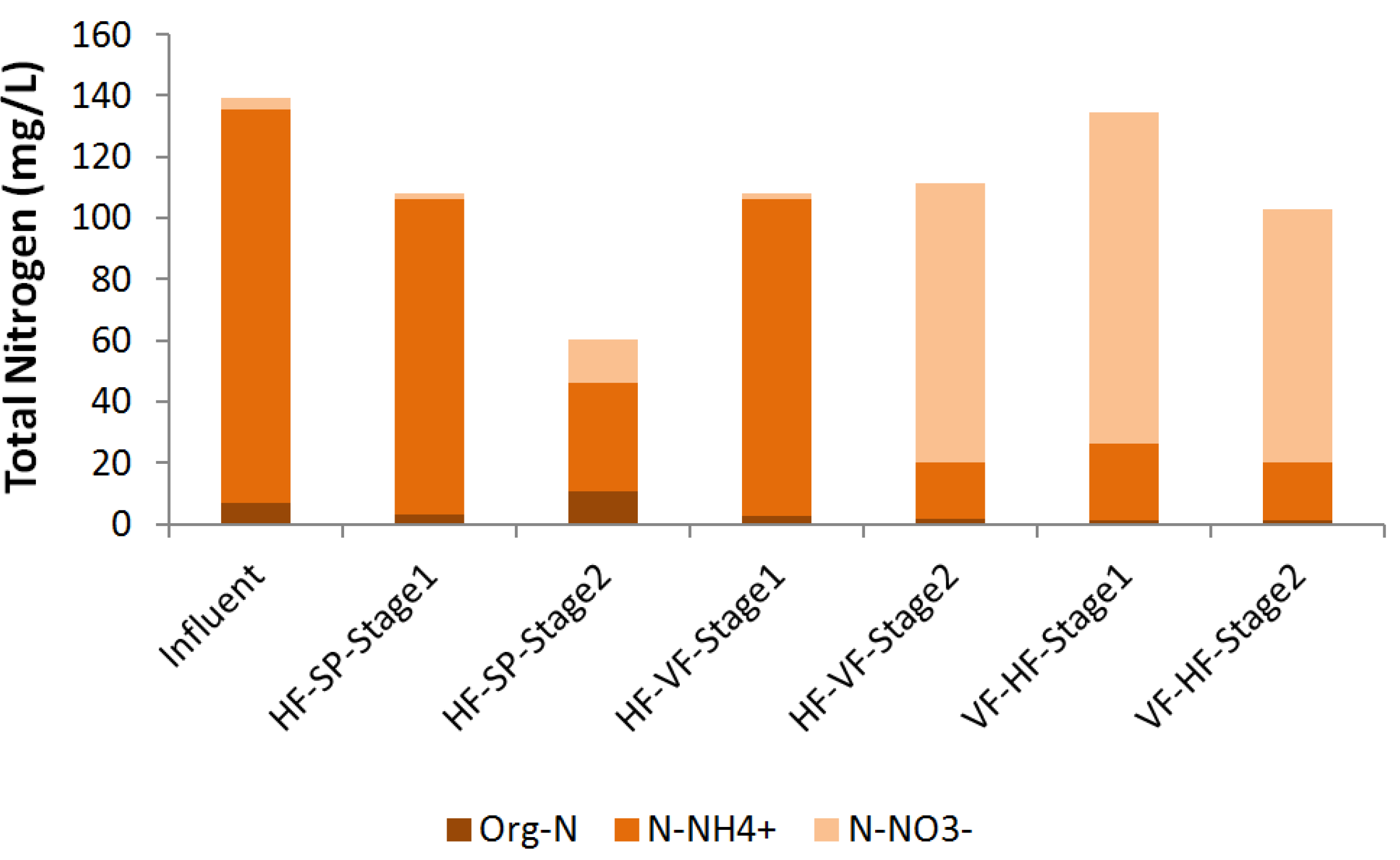
| TN (mg/L) | 139.5 ± 12.1 | 108.3±12.1 | 60.4 ± 9.9 | 108.2 ± 22.2 | 111.6 ± 13.2 | 134.5 ± 21.1 | 102.9 ± 13.1 |
| TN Removal (%) | 22.4 | 44.2 (56.7) | 22.4 | * (20) | * | 23.5 (26.2) | |
| TP (mg/L) | 12.4 ± 1.1 | 11.8± 1.0 | 11.4 ± 1.0 | 12.1 ± 1.1 | 12.2 ± 1.0 | 11.3 ± 1.1 | 12.4 ± 1.1 |
| TP removal (%) | * | * | * | * | * | * | |
3.2. Ammonium
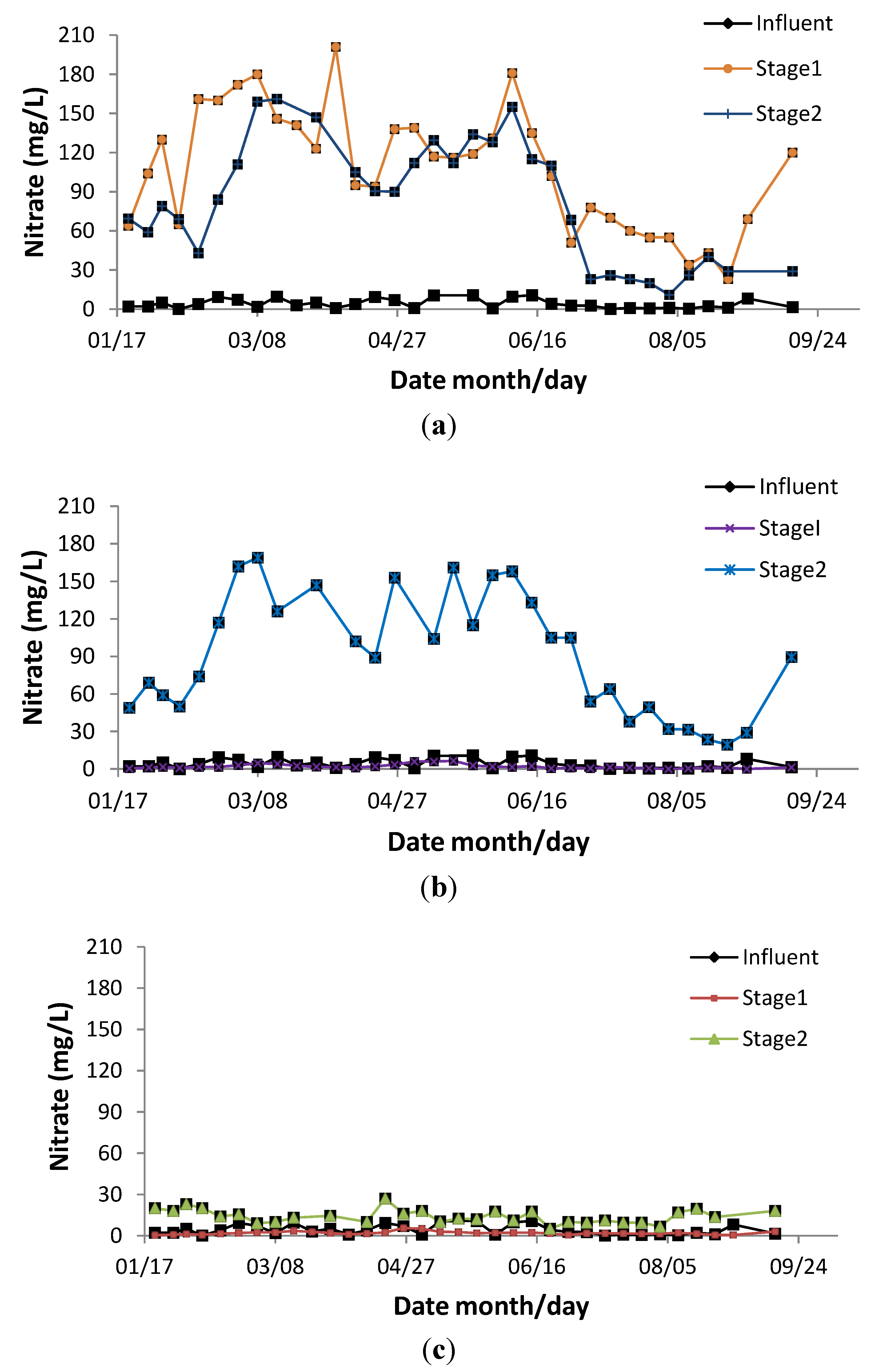
3.3. Nitrate
3.4. Total N

3.5. Total P

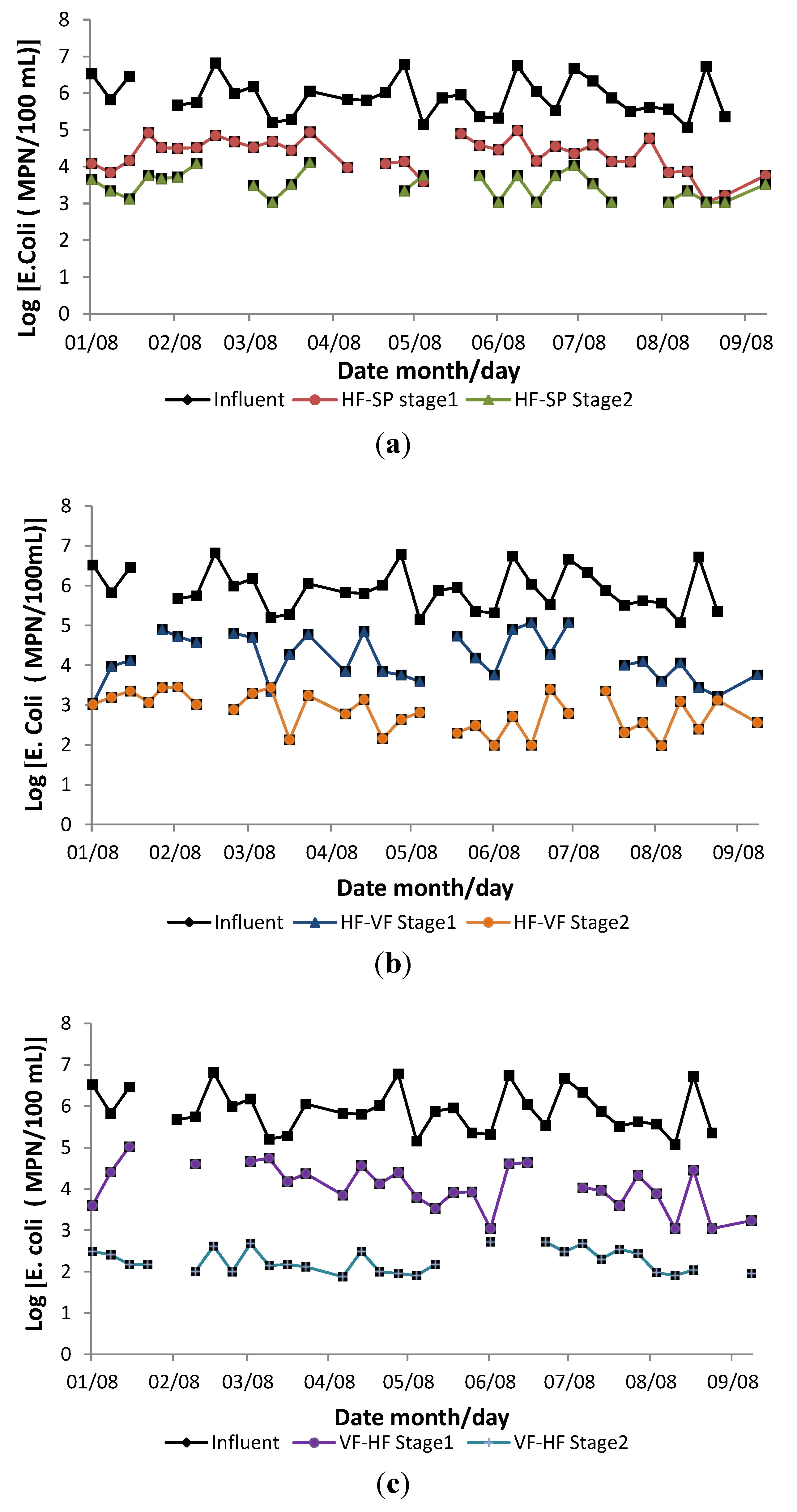
3.6. Disinfection Performance
| Parameter | Influent | System I: HF-SP | System II: HF-VF | System III: VF-HF | |||
|---|---|---|---|---|---|---|---|
| 1st stage HF CW | 2nd stage SP | 1st stage HF-CW | 2nd stage VF-CW | 1st stage VF-CW | 2nd stage HF-CW | ||
| Tot.Coliform (MPN/100mL) | 2.5 × 10⁶ ± 9.9 × 10⁵ | 2.0 × 10⁵ ± 6.3 × 10⁴ | 3.8 × 10⁵ ± 1.4 × 10⁵ | 2.1 × 10⁵ ± 6.6 × 10⁴ | 1.6 × 10⁴ ± 5.7 × 10³ | 1.1 × 10⁵ ± 4.1 × 10⁴ | 7.7 × 10⁴ ± 2.5 × 10⁴ |
| Tot.Coliform Removal (% ) | 92.0 | −90.0 (84.8) | 91.6 | 92.38 (99.36) | 95.6 | 30.00 (96.92) | |
| E. coli (MPN/100 mL) | 1.6 × 10⁶ ± 6.8 × 10⁵ | 3.1 × 10⁴ ± 9.6 × 10³ | 4210 ± 1457 | 3.1 × 10⁴ ± 1.3 × 10⁴ | 1060 ± 326 | 3.8 × 10⁴ ± 6.2 × 10³ | 213.1 ± 59.0 |
| E. coli Removal (%) | 98.06 | 86.42 (99.74) | 98.06 | 96.58 (99.93) | 97.63 | 99.44 (99.99) | |
3.7. BOD and COD

| Parameter | Influent | System I: HF-SP | System II: HF-VF | System: VF-HF | |||
|---|---|---|---|---|---|---|---|
| 1st stage HF-CW | 2nd stage SP | 1st stage HF-CW | 2nd stage VF-CW | 1st stage VF-CW | 2nd stage HF-CW | ||
| BOD (mg/L) | 140.6 ± 28.2 | 27.3 ± 5.1 | 55.5 ± 9.6 | 24.3 ± 3.8 | 6.1 ± 0.9 | 6.7 ± 1.5 | 4.8 ± 0.72 |
| BOD Removal (%) | 80.6 | −103.3 (60.5) | 82.7 | 74.9 (95.7) | 95.2 | * (96.6) | |
| COD (mg/L) | 273.5 ± +50.0 | 96.9 ± 11.8 | 277.8 ± 43.5 | 95.4 ± 17.5 | 56.9 ± 7.4 | 66.7 ± 8.9 | 55.8 ± 8.2 |
| COD Removal (%) | 64.6 | −186.7 (0.0) | 65.1 | 40.4 (79.2) | 75.6 | * (79.6) | |
| TSS (mg/L) | 61.8 ± 11.7 | 12.3 ± 2.4 | 138.3 ± 31.0 | 8.3 ± 2.0 | 4.6 ± 1.0 | 10.6 ± 3.6 | 4.5 ± 1.0 |
| TSS Removal (%) | 80.1 | −1024.4 (−123.8) | 84.9 | 49.5 (92.4) | 82.8 | 57.4(92.7) | |
| Conductivity (µS/cm) | 1797 ± 359 | 1774 ± 119 | 1387 ± 119 | 1693 ± 375.5 | 1369 ± 291 | 1381 ± 285 | 1457 ± 409 |
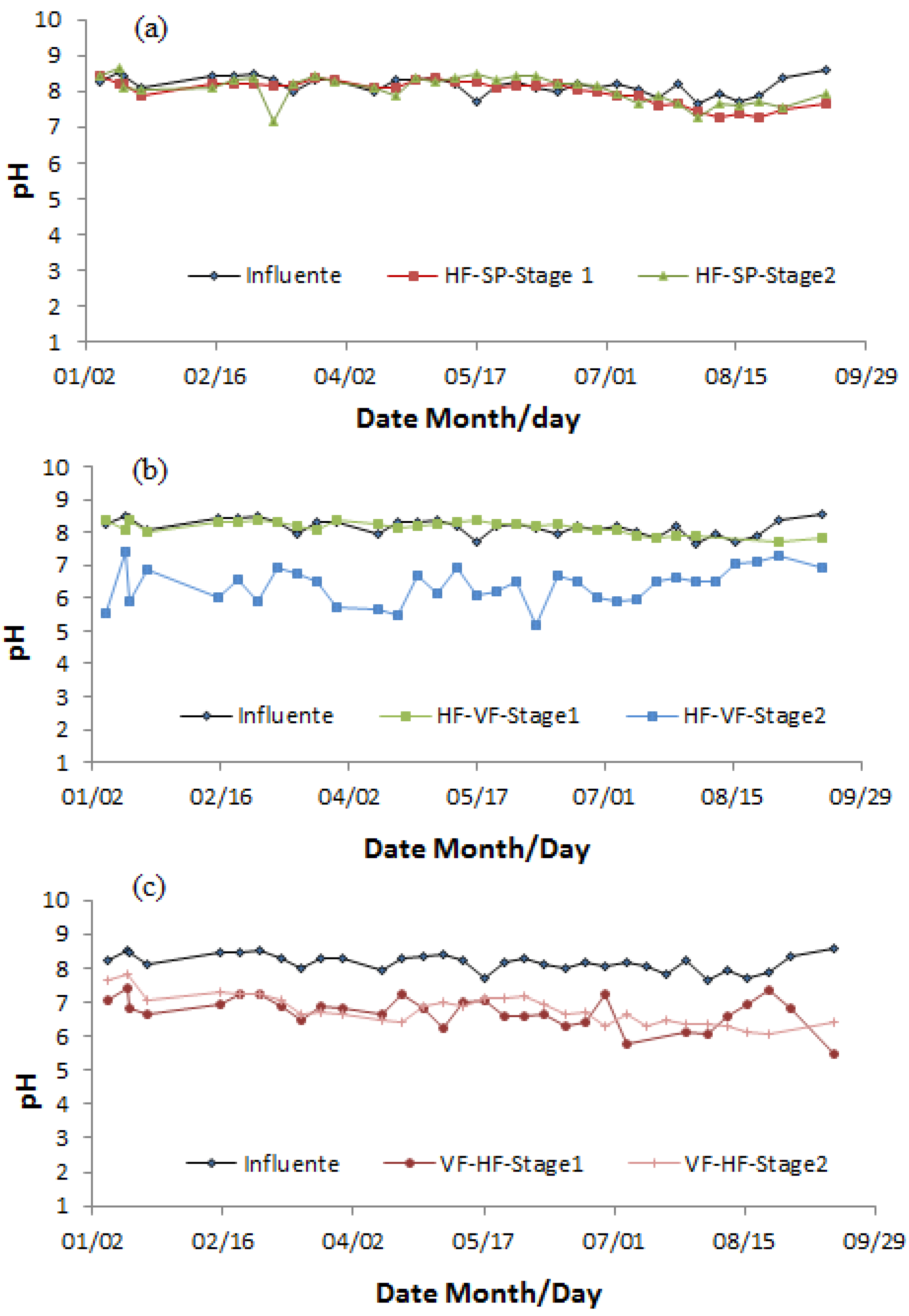
| pH | 8.2 ± 0.08 | 8.0 ± 0.08 | 8.1 ± 0.08 | 8.2 ± 0.14 | 6.4 ± 0.13 | 6.7 ± 0.12 | 6.8 ± 0.12 |
| DO (mg/L) | 1.5 ± 0.5 | 5.5 ± 0.6 | 8.8 ± 1.7 | 4.7 ± 0.7 | 4.3 ± 0.6 | 6.9 ± 0.5 | 5.2 ± 0.5 |
3.8. Total Suspended Solids
3.9. PH
3.10. Electrical Conductivity (EC)

4. Conclusions
Acknowledgments
Conflicts of Interest
References
- Jiménez, B.; Drechsel, P.; Koné, D.; Bahri, A.; Raschid-Sally, L.; Qadir, M. Wastewater, sludge and excreta use in developing countries: An overview. In Wastewater Irrigation and Health. Assessing and Mitigating Risk in Low-Income Countries; Drechsel, P., Scott, C.A., Raschid-Sally, L, Redwood, M., Bahri, A., Eds.; International Water Management Institute and International Development Research Centre (IDRC): London, UK, 2010; pp. 3–27. [Google Scholar]
- Jiménez, B. Irrigation in developing countries using wastewater. Int. Rev. Environ. Strateg. 2006, 2, 229–250. [Google Scholar]
- Bos, R.; Carr, R.; Keraita, B. Assessing and mitigating wastewater-related health risks in low-income countries: An introduction. In Wastewater Irrigation and Health. Assessing and Mitigating Risk in Low-Income Countries; Drechsel, P., Scott, C.A., Raschid-Sally, L, Redwood, M., Bahri, A., Eds.; International Water Management Institute and International Development Research Centre (IDRC): London, UK, 2010; pp. 29–47. [Google Scholar]
- Jiménez, B.; Mara, D.; Carr, R.; Brissaud, F. Wastewater treatment for pathogen removal and nutrient conservation: Suitable systems for use in developing countries. In Wastewater Irrigation and Health. Assessing and Mitigating Risk in Low-Income Countries; Drechsel, P., Scott, C.A., Raschid-Sally, L., Redwood, M., Bahri, A., Eds.; International Water Management Institute and International Development Research Centre (IDRC): London, UK, 2010; pp. 149–169. [Google Scholar]
- Zurita, F.; Roy, E.D.; White, J.R. Municipal wastewater treatment in Mexico: Current status and opportunities for employing ecological treatment systems. Environ. Technol. 2012, 33, 1151–1158. [Google Scholar] [CrossRef]
- Sharafi, K.; Fazlzadehdavil, M.; Pirsaheb, M.; Derayat, J.; Hazrati, S. The comparison of parasite eggs and protozoan cysts of urban raw wastewater and efficiency of various wastewater treatment systems to remove them. Ecol. Eng. 2012, 44, 244–248. [Google Scholar] [CrossRef]
- García, J.A.; Paredes, D.; Cubillos, J.A. Effect of plants and the combination of wetland treatment type systems on pathogen removal in tropical climate conditions. Ecol. Eng. 2013, 58, 57–62. [Google Scholar] [CrossRef]
- Saeed, T.; Sun, G. Enhanced denitrification and organics removal in hybrid wetland columns: Comparative experiments. Bioresour. Technol. 2011, 102, 967–974. [Google Scholar] [CrossRef]
- Marecos Do Monte, H.; Albuquerque, A. Analysis of constructed wetland performance for irrigation reuse. Water Sci. Technol. 2010, 61, 1699–1705. [Google Scholar] [CrossRef]
- Vymazal, J. Horizontal sub-surface flow and hybrid constructed wetlands systems for wastewater treatment. Ecol. Eng. 2005, 25, 478–490. [Google Scholar] [CrossRef]
- Herrera-Melián, J.A.; Martín-Rodríguez, A.J.; Araña, J.; Gonzalez-Díaz, O.; González-Enríquez, J.J. Hybrid constructed wetlands for wastewater treatment and reuse in the Canary Islands. Ecol. Eng. 2010, 36, 891–899. [Google Scholar] [CrossRef]
- Zurita, F.; De Anda, J.; Belmont, M.A. Treatment of domestic wastewater and production of commercial flowers in vertical and horizontal subsurface-flow constructed wetlands. Ecol. Eng. 2009, 35, 861–869. [Google Scholar] [CrossRef]
- American Public Health Association; American Water Works Association; Water Environment Federation. Standard Methods for the Examination of Water and Wastewater; APHA: Washington, DC, USA, 2005.
- Park, J.B.K.; Craggs, R.J.; Shilton, A.N. Wastewater treatment high rate algal ponds for biofuel production. Bioresour. Technol. 2011, 102, 35–42. [Google Scholar] [CrossRef]
- Ayas, S.C.; Aktas, Ô.; Findik, N.; Akca, L.; Kinaci, C. Effect of recirculation on nitrogen removal in a hybrid constructed wetland system. Ecol. Eng. 2012, 40, 1–5. [Google Scholar] [CrossRef]
- White, J.R.; Reddy, K.R. Potential nitrification and denitrification rates in a phosphorus-impacted subtropical peatland. J. Environ. Qual. 2003, 32, 2436–2443. [Google Scholar] [CrossRef]
- Gikas, G.D.; Tsihrintzis, V.A. A small-size vertical flow constructed wetland for on-site treatment of household wastewater. Ecol. Eng. 2012, 44, 337–343. [Google Scholar] [CrossRef]
- Ávila, C.; Salas, J.J.; Martín, I.; Aragón, C.; García, J. Integrated treatment of combined sewer wastewater and stormwater in a hybrid constructed wetland system in southern Spain and its further reuse. Ecol. Eng. 2013, 50, 13–20. [Google Scholar] [CrossRef]
- Gardner, L.M.; White, J.R. Denitrification enzyme activity as a potential spatial indicator of nitrate loading in a Mississippi River diversion wetland soil. Soil Sci. Soc. Am. J. 2010, 74, 1037–1047. [Google Scholar] [CrossRef]
- VanZomeren, C.; White, J.R.; DeLaune, R.D. Ammonification and denitrification rates in coastal louisiana bayou sediment and marsh soil: Implications for Mississippi River diversion management. Ecol. Eng. 2013, 54, 77–81. [Google Scholar] [CrossRef]
- White, J.R.; Reddy, K.R. The influence of nitrate and phosphorus loading on denitrifying enzyme activity in Everglades wetland soils. Soil Sci. Soc. Am. J. 1999, 63, 1945–1954. [Google Scholar] [CrossRef]
- Vymazal, J.; Kropfelová, L. A three-stage experimental constructed wetland for treatment of domestic sewage: First 2 years of operation. Ecol. Eng. 2011, 37, 90–98. [Google Scholar] [CrossRef]
- Tanner, C.C.; Sukias, J.P.S.; Headley, T.R.; Yates, C.R.; Stott, R. Constructed wetlands and denitrifying bioreactors for on-site and decentralized wastewater treatment: Comparison of five alternative configurations. Ecol. Eng. 2012, 42, 112–123. [Google Scholar] [CrossRef]
- Masi, F.; Martinuzzi, N. Constructed wetlands for the Mediterranean countries: Hybrid systems for water reuse and sustainable sanitation. Desalination 2007, 215, 44–55. [Google Scholar] [CrossRef]
- Reddy, K.R.; DeLaune, R.D. Biogeochemistry of Wetlands: Science and Applications; CRC Press, Taylor & Francis Group: Boca Raton, FL, USA, 2008. [Google Scholar]
- Lai, P.C.C.; Lam, P.K.S. Major pathways for nitrogen removal in wastewater stabilization ponds. Water Air Soil Poll. 1997, 94, 125–136. [Google Scholar]
- Moustafa, M.Z.; White, J.R.; Coghlan, C.C.; Reddy, K.R. Influence of hydropattern and vegetation on P reduction in a constructed wetland under high and low mass loading rates. Ecol. Eng. 2012, 42, 134–145. [Google Scholar] [CrossRef]
- Bostic, E.M.; White, J.R.; Reddy, K.R.; Corstanje, R. Evidence of phosphorus distribution in wetland soil after the termination of nutrient loading. Soil Sci. Soc. Am. J. 2010, 74, 1808–1815. [Google Scholar] [CrossRef]
- Zhang, W.; White, J.R.; De Laune, R.D. Diverted Mississippi River sediment as a potential phosphorus source affecting louisiana water quality. J. Freshwater Ecol. 2012, 27, 575–586. [Google Scholar] [CrossRef]
- Vohla, C.; Kõiva, M.; Bavorb, H.J.; Chazarencc, F.; Mandera, U. Filter materials for phosphorus removal from wastewater in treatment wetlands—A review. Ecol. Eng. 2011, 37, 70–89. [Google Scholar] [CrossRef]
- Wu, H.; Zhang, J.; Li, P.; Zhang, J.; Xie, H.; Zhang, B. Nutrient removal in constructed microcosm wetlands for treating polluted river water in northern China. Ecol. Eng. 2011, 37, 560–568. [Google Scholar] [CrossRef]
- Zhao, Y.J.; Hui, Z.; Chao, X.; Nie, E.; Li, H.J.; He, J.; Zheng, Z. Efficiency of two-stage combinations of subsurface vertical down-flow and up-flow constructed wetland systems for treating variation in influent C/N ratios of domestic wastewater. Ecol. Eng. 2011, 37, 1546–1554. [Google Scholar] [CrossRef]
- Belmont, M.A.; White, J.R.; Reddy, K.R. Phosphorus sorption characteristics of sediments in Lake Istokpoga and the upper chair of lakes. J. Environ. Quality 2009, 38, 987–996. [Google Scholar] [CrossRef]
- Tyagi, V.K.; Chopra, A.K.; Kazmi, A.A.; Kumar, A. Alternative microbial indicators of faecal pollution: Current perspective. Iran J. Environ. Health. Sci. Eng. 2006, 3, 205–216. [Google Scholar]
- Secretaría de Medio Ambiente y Recursos Naturales (SEMARNAT). Que Establece los Límites Máximos Permisibles de Contaminantes en las Descargas de Aguas Residuales en Aguas y Bienes Nacionales; Norma Oficial Mexicana NOM-001-SEMARNAT-1996; OfficialGazette of the Federation, Secretary of Government: Mexico City, Mexico, 1996.
- Mara, D.; Bos, R. Risk analysis and epidemiology: The 2006 WHO guidelines for the safe use of wastewater in agriculture. In Wastewater Irrigation and Health. Assessing and Mitigating Risk in Low-Income Countries; Drechsel, P., Scott, C.A., Raschid-Sally, L, Redwood, M., Bahri, A., Eds.; International Water Management Institute and International Development Research Centre (IDRC): London, UK, 2010; pp. 51–62. [Google Scholar]
- Shilton, N.; Walmsley, A. Solids and Organics in Pond Treatment Technology; Shilton, A., Ed.; IWA Publishing: London, UK, 2005. [Google Scholar]
- Carr, G.; Potter, R.B.; Nortcliff, S. Water reuse for irrigation in Jordan: Perceptions of water quality among farmers. Agr. Water Manag. 2011, 98, 847–854. [Google Scholar] [CrossRef]
- Ghehsareh, A.M.; Samadi, N. Effect of soil acidification on growth indices and microelements uptake by greenhouse cucumber. Afr. J. Agr. Res. 2012, 7, 1659–1665. [Google Scholar]
- Díaz, F.J.; O’Geen, A.T.; Dahlgren, R.A. Agricultural pollutant removal by constructed wetlands: Implications for water management and design. Agr. Water Manag. 2012, 104, 171–183. [Google Scholar] [CrossRef]
- Kyambadde, J.; Kansiime, F.; Dalhammar, G. Nitrogen and phosphorus removal in substrate-free pilot constructed wetlands with horizontal surface flow in Uganda. Water Air Soil Poll. 2005, 165, 37–59. [Google Scholar] [CrossRef]
- Zurita, F.; Del Toro-Sánchez, C.L.; Gutierrez-Lomelí, M.; Rodríguez-Sahagún, A.; Castellanos-Hernández, O.A; Ramírez-Martínez, G.; White, J.R. Preliminary study on the potential of arsenic removal by subsurface flow constructed mesocosms. Ecol. Eng. 2012, 47, 101–104. [Google Scholar] [CrossRef]
- Pedrero, F.; Alarcón, J.J. Effects of treated wastewater irrigation on lemon. Desalination 2009, 246, 631–639. [Google Scholar] [CrossRef]
- De Miguel, A.; Martínez-Hernández, V.; Leal, M.; González-Naranjo, V.; de Bustamante, I.; Lillo, J.; Salas, J.J.; Palacios-Díaz, M.P. Short-term effects of reclaimed water irrigation: Jatropha curcas L. cultivation. Ecol. Eng. 2013, 50, 44–51. [Google Scholar] [CrossRef]
© 2014 by the authors; licensee MDPI, Basel, Switzerland. This article is an open access article distributed under the terms and conditions of the Creative Commons Attribution license (http://creativecommons.org/licenses/by/3.0/).
Share and Cite
Zurita, F.; White, J.R. Comparative Study of Three Two-Stage Hybrid Ecological Wastewater Treatment Systems for Producing High Nutrient, Reclaimed Water for Irrigation Reuse in Developing Countries. Water 2014, 6, 213-228. https://doi.org/10.3390/w6020213
Zurita F, White JR. Comparative Study of Three Two-Stage Hybrid Ecological Wastewater Treatment Systems for Producing High Nutrient, Reclaimed Water for Irrigation Reuse in Developing Countries. Water. 2014; 6(2):213-228. https://doi.org/10.3390/w6020213
Chicago/Turabian StyleZurita, Florentina, and John R. White. 2014. "Comparative Study of Three Two-Stage Hybrid Ecological Wastewater Treatment Systems for Producing High Nutrient, Reclaimed Water for Irrigation Reuse in Developing Countries" Water 6, no. 2: 213-228. https://doi.org/10.3390/w6020213
APA StyleZurita, F., & White, J. R. (2014). Comparative Study of Three Two-Stage Hybrid Ecological Wastewater Treatment Systems for Producing High Nutrient, Reclaimed Water for Irrigation Reuse in Developing Countries. Water, 6(2), 213-228. https://doi.org/10.3390/w6020213