


Abstract
Microwave fracturing and assisted mechanical breakage offer efficient and cost-effective rock excavation potential. However, these methods have not been well studied or understood for the deployment of in situ recovery (ISR) in mining, which could benefit from microwave-induced cracking to accelerate in situ leaching. This paper reports on investigations into the effects of microwaves on rock transport properties, specifically for in situ recovery applications. The research focused on microwave fragmentation of a synthetic ore with composition and particle size similar to many wet ore-bearing deposits, as well as hard lithium-bearing rock (spodumene) as a natural analogue, to assess changes in porosity and permeability after microwave treatment. The experiments involved exposing samples with varying water content to heating with different microwave energy levels, followed by examining the impact on the induced crack characteristics. All the samples were characterized by a suite of measurements before and after microwave treatment, including scanning electron microscopy (SEM), Nuclear Magnetic Resonance (NMR), nitrogen gas permeameter-porosimeter, and P-wave velocity measurements. The results showed a strong dependence of rock properties after microwave treatment on water content. At high water content (100%), NMR results showed a substantial increase in porosity, by nearly 17% and a dramatic 47-fold rise in permeability, from 0.65 mD to 311 mD. However, the treatment also caused partial melting of the sample, rendering it unsuitable for further testing, including permeability and P-wave velocity. At moderate water content (20%), permeability substantially increased (233–3404%), which was consistent with the observation of multiple cracks in SEM images. These changes led to low P-wave velocity values. This research provides crucial insights into microwave fracturing as a method for in situ recovery in mining.
1. Introduction
With the depletion of shallow mineral resources, reliance on deeper deposits is increasing. Research indicates that deeper resource extraction correlates with a higher risk of geological disasters [1]. Consequently, in the pursuit of deep resource extraction, issues such as hard-rock fragmentation and rock bursts are encountered more frequently because of complex geological environments. Developing safer alternative mineral extraction methods is crucial to avoid hazards that can occur with current explosive-based techniques, such as uncontrolled vibration, damage to infrastructure and nearby heritage sites, fly rock incidents, and dust emissions. In situ recovery (ISR) is an alternative mining technique that may help overcome these challenges [2]. According to [3], in situ mining extracts target minerals from an ore deposit without physical excavation. This is achieved by circulating a lixiviant through the deposit and dissolving the desired minerals while maintaining the integrity of the surrounding rock.
Artificial fracture stimulation of mineral-bearing ores could increase their permeability and make them more suitable for in situ recovery (ISR). Potential techniques include hydraulic fracturing, blasting, microwave heating, and high-voltage pulses [4]. Hydraulic fracturing uses fluid injections under high pressure to promote fracture development inside the reservoir rocks. This method has especially been applied in gas/oil tight shale formations to extract gas resources [5]. Hydraulic fracturing has also been used to increase the permeability of the Gunpowder and San Manuel copper deposits [3]. This method, however, can create unstable fractures that are widely spaced and prone to closure due to local stress. Such issues may result in insufficient access for the lixiviant to reach and leach minerals of interest, as well as potentially de-stabilizing the rock mass. When fracture direction, connectivity, and density are poorly constrained, it can result in “short circuiting,” where the leaching solution is diverted from the target area and flows through highly permeable zones outside the intended leaching region [6]. Pulsed power technologies have been proposed for creating rock cracks based on the application of energy into a short-pulsed form. These methods, including exposure to high-power pulsed electric and magnetic fields, charged particle beams, microwave radiation, neutrons, X-rays, and low-temperature plasma, have primarily been researched for pre-treating refractory minerals. The goal is to improve disintegration, softening, and liberation of finely disseminated mineral complexes, and enhance the contrast in physico-chemical and process properties of mineral components [7].
Microwave Theory
Microwaves (MWs) are electromagnetic radiation with wavelengths from 1 mm to 1 m and frequencies from 300 MHz to 300 GHz. Microwave heating is caused by the realignment of charged molecules in an oscillating electromagnetic field [6,8].
In microwave fracturing, the heating effects of the microwave energy are the main reason for hard-rock fragmentation. When microwave energy propagates into a rock sample, the sample is weakened gradually because of the differential thermal expansion of different minerals within a rock [9,10]. The exposure of rocks and minerals to microwaves, including their heating by microwave absorption, has been studied for over 50 years. In the 1960s, a microwave rock breakage method was introduced. Microwave heating has been studied extensively for the breaking and cutting of different rock types in mining applications [11,12]. Despite extensive research, no large-scale application or commercial equipment applying microwaves to rocks has been developed [9].
When applying microwave irradiation to a material, the electric and magnetic fields change rapidly (~2.4 × 10⁹ per second at a frequency of 2.45 GHz), and the molecules cannot respond quickly to the change in direction, which gives rise to friction and heat generation [13]. The most commonly used frequencies for heating purposes are 915 MHz and 2.45 GHz, which correspond to wavelengths of 33.5 and 12.2 cm, respectively [14]. A comprehensive understanding of the fundamentals of microwave–matter interactions is a precondition for better utilization of microwave technology.
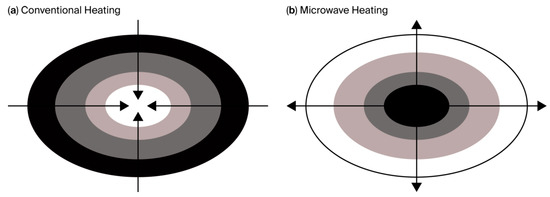
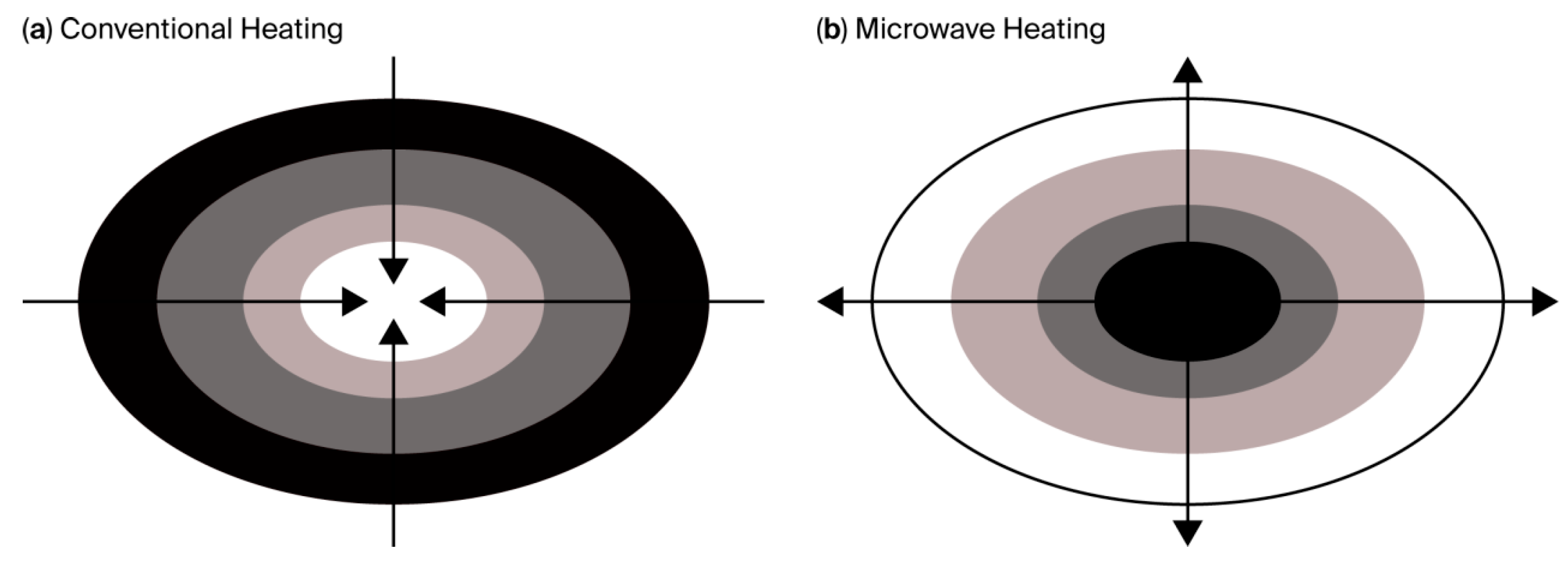
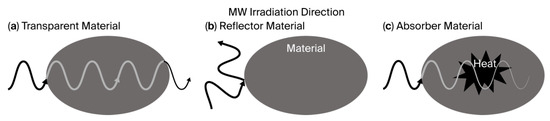
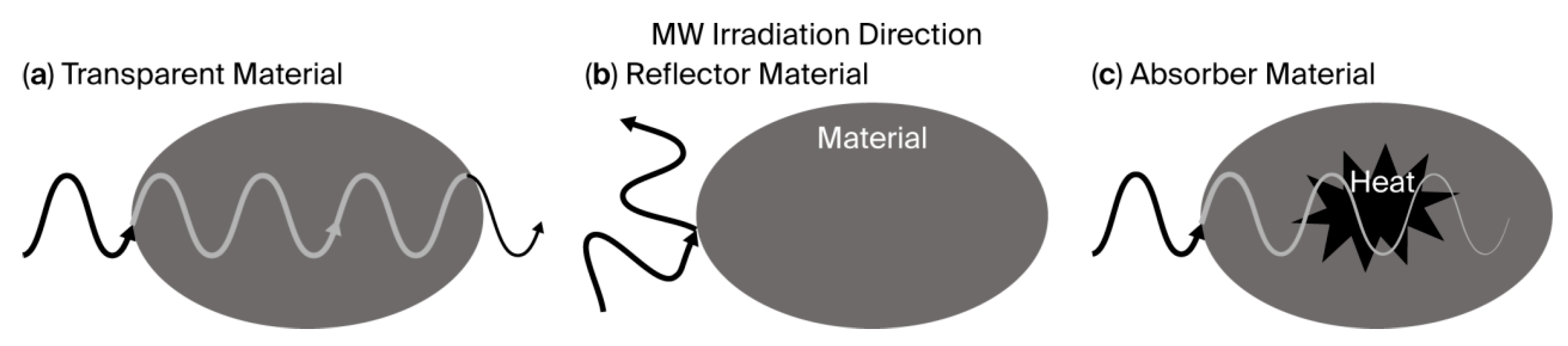
Unlike conventional heating, which relies on surface heating and subsequent heat transfer via conduction, convection, and radiation, microwave heating occurs at the molecular level, penetrating to the skin depth—the point where nearly all microwave energy is absorbed [15]. This effect provides volumetric heating in the material (Figure 1 with dark grey for heated area and light grey for cooler area). Besides volumetric heating, microwave heating offers a number of advantages such as (1) selective material heating; (2) fast heating; (3) non-contact heating; and (4) quick heating reactivity system [6]. Ores often contain dielectric materials embedded in a non-dielectric matrix. Upon exposure to microwave radiation, the disparity in microwave absorption characteristics between the two materials results in a thermal gradient at their boundary, which is the driving force behind fracture formation. Microwaves interact with materials based on their dielectric loss properties. Components with high dielectric loss absorb microwaves, while those with low dielectric loss either reflect them or allow them to pass through. This difference in behaviours allow for the classification of materials into three primary groups [6,16]: (a) low-loss materials with no absorption of microwaves; (b) no-loss materials that reflect microwaves without any, or with negligible, energy absorption; and (c) high-loss materials (typically dielectrics) with total absorption of microwaves (Figure 2).
Figure 1.
Phenomenon of heat generation in (a) conventional heating and (b) microwave heating [6], with dark grey for hot areas and light grey for cold areas.
Figure 2.
Behaviour of material within a microwave field [6].
Selective heating using microwaves exploits the significant differences in how materials respond to this form of radiation [16]. This property of microwave-induced fracturing is particularly advantageous for in situ recovery (ISR), as it can generate a complex network of both granular and trans-granular fractures within the ore deposit.
Microwave-induced fracturing of hard rock has been studied extensively [17,18]. The University of Nottingham, UK, carried out numerous research projects on microwave-assisted mineral processing, including mineral separation, grinding, and purification, as well as studying the reaction mechanisms between microwaves and rocks [19,20].
The objective of the present research was to investigate the effectiveness of a microwave method in creating cracks in a spodumene-rich quartz formation (lithium-rich ore), which was a representative of hard-rock, spodumene-containing deposit. Prior to testing with this ore, extensive tests were performed on a synthetic ore facsimile, which was made using silica-kaolinite cement. Based on the work by [21], who proposed that water content of a rock could enhance microwave interactions with rocks/minerals, a laboratory-scale experimental approach was designed to evaluate this effect for the synthetic and natural rocks representing spodumene-containing ore. A microwave oven was used to irradiate and heat two groups of synthetic and spodumene hard rock samples with two different water contents of 20 and 100 wt%. The microwave oven was set at 230–240 V/50 Hz/700–1200 W power for 10 min. The pre- and post-microwave treated samples were characterized with a suite of measurements, including porosity, permeability, pore size distribution from Nuclear Magnetic Resonance, X-ray CT and SEM imaging, and ultrasonic P- and S-wave velocities to evaluate the induced mechanical damage and their intensity.
2. Materials and Methods
To prevent uncontrolled variables, particularly variations in the concentration of gangue minerals, from obscuring trends in the data, synthetic samples were employed for most of the tests. In the final set of tests, spodumene was used to assess the validity of synthetic rock observations for a real rock.
2.1. Sample Preparation and Characterization
All synthetic sample experiments were carried out using high-purity silica sand (Si at 99.87%; Ca at 0.026%, Na at 0.03%, and Ti at 0.015%) from Cook Industry as a non-reactive material. Three different amounts of milled silica powder with three different particle sizes were mixed with kaolinite and 0.1 M NaCl solution to make a dense slurry. Table 1 specifies the compositions of the three sample types. The silica powder was analyzed by using inductively coupled plasma optical emission spectrometry (ICP-OES, Waltham (Corporate HQ), MA, USA). The particle size distribution for a silica sample before grinding was d80–600 µm (80% < 600 µm). A total of 64 synthetic cylindrical samples of 38 mm in diameter and 20–25 mm in length were prepared based on a method reported in [22].
Table 1.
Synthetic rock composition where X is the relative weight concentration and d80 is the mean silica grain size.
For the final set of tests, 6 cylindrical samples were cut from a spodumene containing rock extracted from Greenbushes mine in Western Australia. X-ray diffraction measurements on the spodumene specimen indicated a composition of 42 wt% quartz, 50.4 wt% spodumene, and 7 wt% other minerals, including illite, chlorite, actinolite, and kaolinite.
Gas porosity and permeability of the synthetic and spodumene samples were measured using an automated AP 608 nitrogen gas permeameter-porosimeter, Coretest Ltd., Alpharetta, GA, USA from Coretest Inc., with a 0.1% error bar, under 500 psi confining pressure and 250 psi pore pressure, with the measurements repeated two times.
Water content and distribution in the pore network of each sample were measured by Nuclear Magnetic Resonance (NMR) using a GeoSpec II 53 NMR spectrometer at 2.33 MHz from Oxford Instruments Ltd., (Abingdon, UK). Under the action of a magnetic field, the hydrogen nuclei in water produced an NMR signal that decayed with time (i.e., relaxation time). The NMR transversal relaxation time, T2, was determined using a CPMG sequence [23]. The T2 distribution is directly proportional to the pore size distribution for water-filled pores, and this was used to determine the water content and water-filled pore distribution. Combining NMR free induction decay with a magnetic gradient applied along the sample allows you to record the water content profile (or water saturation profile). The NMR was set using the following parameters: echo time: 62 µs for T2 and 500 µs for profile; receiver delay: 5625 ms; number of echoes: 30,242; field of view: 5 cm; profile resolution: 128 points; and gradient duration for profile: 300 µs. While correlating NMR-derived water content with permeability is fundamental, several mechanisms can weaken this relationship: pore-scale heterogeneity and geometry, variations in surface relaxivity and fluid properties, saturation state and fluid distribution, and calibration/model limitations. To mitigate these influences, we employed synthetic rock samples, maintained consistent vacuum time, saturation time, and fluid (water), and referenced saturations to total porosity (computed from grain and bulk density) rather than just connected porosity.
The material strength was evaluated using benchtop measurements of ultrasonic P- and S-wave velocities through each sample. Two piezoelectric transducers (excitation frequency 0.5 MHz generating either compressive P-waves or shear S-waves) were placed on each flat surface of the cylindrical samples. The pulse transmission method from [24,25] used to provide travel-time measurements for a wave to propagate through a known sample length. The ultrasonic waves were generated and received using an alternating pulser/receiver apparatus connected to the transducers (Olympus, Notting Hill, VIC, Australia 5072PR Pulser/Receiver,). The wave arrivals were recorded with a digital 25 MHz oscilloscope (TiePie Ltd., Sneek, The Netherlands) connected to the pulser/receiver. The recorded wave data were then converted into an ASCII file for processing with Excel software (Microsoft Ltd., Redmond, WA, USA) to pick up P- and S-waves arrival times and convert these into velocities Vp and Vs, respectively. The P- and S-waves standard picking method was applied where P-waves arrival time corresponds to the first strong amplitude signal intersecting the baseline (amplitude 0). The S-waves arrival time corresponds to when a second package of waves is recorded after the P-waves, with a change in amplitude and frequency also intersecting the baseline. Uncertainties in the arrival time were estimated to be ~2% for the P-waves and ~4% for the S-waves. Combining Vp and Vs with sample density data, Poisson’s ratio and Young’s modulus were computed. Poisson’s ratio (u) is usually between 0.1 and 0.4 in rock materials and is calculated as:
where εTrans and εAxial are the transversal and axial strains, respectively.
The Young’s modulus (E) provides information about difficulty of deforming, and it is defined as the ratio of strain to stress.
Scanning electron microscopy (SEM) images of the fresh surface of each sample were acquired to visualize cracks and their evolutions post-treatment by microwave. A Tescan Mira-3 field emission SEM instrument was used with accelerating voltage of 25 kV, and a chamber pressure of 30 Pa was used to take the images of dry samples before and after microwave treatment.
2.2. Experimental Methodology
Following the characterization of dry samples (XRD, SEM, Vp-Vs, porosity-permeability) pre-treatment, six synthetic rock samples were selected (Table 2), with low to high permeabilities and with the three compositions presented in Table 1.
Table 2.
Synthetic rock samples with their corresponding initial permeability, composition based on Table 1, and their water saturation.
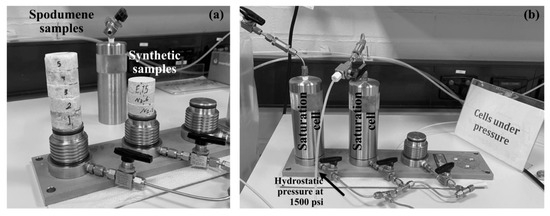
The samples were saturated with water at 20 or 100 weight percentage saturation. The six samples were first dried into an air vacuum oven at 80 °C for 12 h. While under air vacuum, in-house designed cells (Figure 3) were used to inject water into the samples before applying 1500 psi hydrostatic pressure using an ISCO pump (Teledyne, Thousand Oaks, CA, USA) for 24 h to ensure maximum water saturation (100 wt%). Three samples saturated at 100 wt% were placed on an electronic balance to dehydrate naturally under room conditions. Their weights were monitored until they reached the expected weights corresponding to moisture contents of 20 wt% (M20%) based on the pore volume (Vpore) computed from the total porosity (øTotal) method and assuming water density rwater = 1 g/cm3:
where Msample and Vsample are the mass (gram) and volume (cm3) of the sample, respectively, ø is a unit fraction between 0 and 1, and r is in g/cm3.
Figure 3.
(a) Designed cells used for vacuuming and (b) saturating synthetic and spodumene samples.
For spodumene samples, their porosity < 3% and permeability < 0.07 mD limited their ability to absorb water despite using 1500 psi hydrostatic pressure. It was also challenging to reach low moisture levels by the dehydration method given the very small pore volume of those samples. Therefore, in the final tests, only spodumene samples at a water saturation of~98% were used.
The 20 and 100 wt% water-saturated synthetic samples and ~100 wt% water-saturated spodumene samples were assessed using NMR to measure their pore distribution before and immediately after microwaving them at 900 W for 10 min. The oven cavity dimensions were 20.6 cm (H) × 31.8 cm (W) × 29.3 cm (D). All samples were placed in the centre of the glass tray to avoid hot-spot effects and ensure consistent treatment across all runs. They were then dried under air vacuum at 80 °C for 12 h and were characterized using SEM, the porosity-permeability measurement technique, and the Vp-Vs measurement technique to allow comparison between pre- and post-treated samples.
3. Results and Discussion
3.1. Influence of Water Content on Synthetic Rock Pores
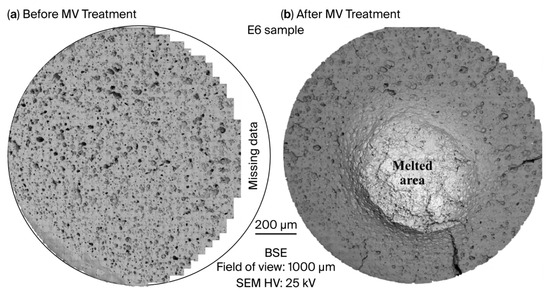
The dielectric loss factor of water is greater than that of the rock matrix in porous rocks, but the higher the pore water content, the greater the rock dielectric loss factor becomes. This is mainly because water enhances MW absorption and produces intense localized heating, which leads to thermal runaway. According to [26], when the temperature of a sample reaches a certain value, MW heating becomes more complex due to the temperature dependency of the dielectric properties of a material. For instance, silicon carbide (SiC) has a loss factor of 1.71 at room temperature, but it increases to 27.99 at a temperature of 695 °C when irradiated by microwave energy at 2.45 GHz frequency. An example of thermal runaway as a result of microwave heating in our tests was the melting of sample E6 inside the microwave furnace (see Figure 4).
Figure 4.
Sample E6 (100% water saturated) melted by MW heating along with backscattered images from SEM before and after MW treatment.
Additionally, ref. [27] showed that materials like Al2O3, SiO2, and Fe3O4 exhibit thermal runaway in microwaves leading to rapid temperature increases. This supports the idea that as samples become hotter, they absorb more MWs causing an exponential increase in temperature point.
To effectively enhance rock permeability while preventing the undesirable outcome of localized melting in the field, it is crucial to employ strict control over the microwave energy dose. This is best achieved using a pulsed wave system instead of continuous irradiation. The most effective weakening and fracturing occur when applying high power for short exposure times (typically less than 0.1 to a few seconds). This technique maximizes rapid, differential heating between the microwave-absorbing components (like pore water) and the bulk rock matrix, thus maximizing the beneficial thermal stress that causes micro-fracturing while avoiding the bulk overheating that leads to melting. For successful field practice, an absorbed energy limit must be set based on lab-derived thresholds. Furthermore, real-time temperature monitoring using high-temperature fibre-optic sensors or downhole thermal logging tools is essential for maintaining temperatures below the rock’s melting threshold.
3.2. Influence of Microwave Irradiation on the Pore Structure and Permeability
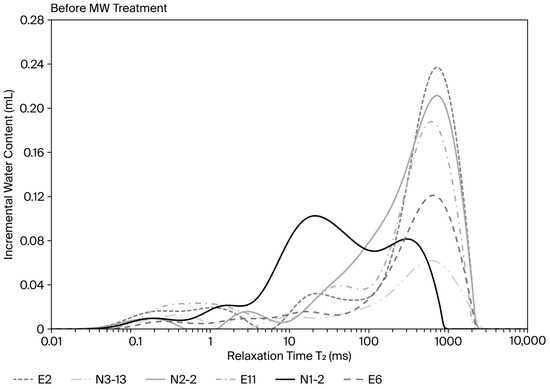
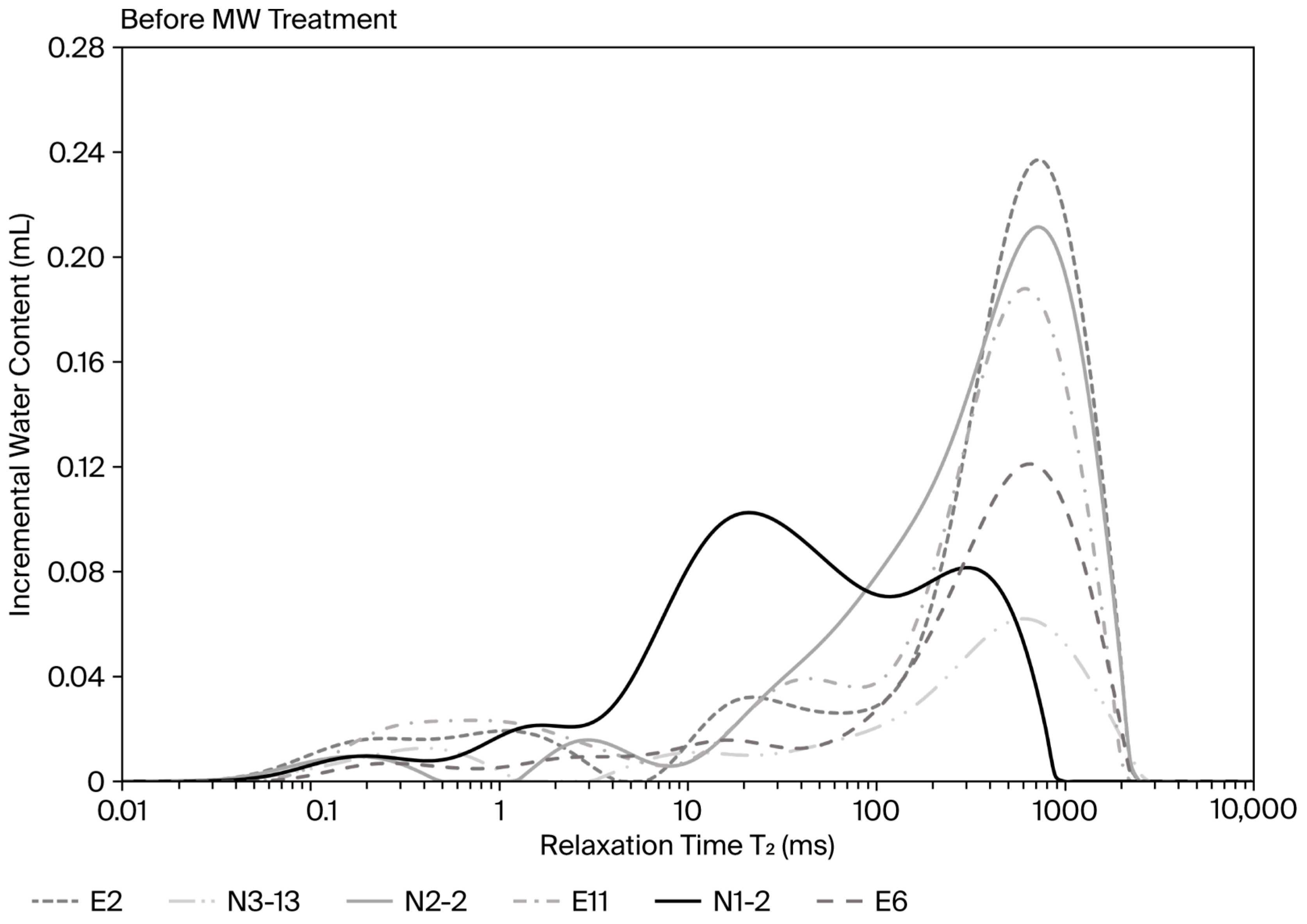
Figure 5 illustrates the NMR T2 distribution curves for all synthetic rocks before MW treatment. Due to the compact nature of the spodumene samples, water absorption was negligible (<0.1 mL), rendering it undetectable by the NMR instrument.
Figure 5.
NMR T2 distribution curves for the synthetic rocks in their untreated states at 100 wt%.
With the exception of sample N1-2, the untreated samples show a bimodal pore distribution with a dominant pore size centred around T2 = 1000 ms corresponding to large pores (>10 µm). The high number of large pores (i.e., intensity of T2 signal on T2~1000 ms) correlates with high values of gas permeability up to ~90 mD (Table 1), and therefore samples hosting more large pores will have higher permeability.
Some small pores (<1 µm) with T2 ≤ 1 ms were also recorded in the whole sample collection, suggesting micro-pores contribute to the pore structure [28]. However, sample N1-2 recorded large pores (T2~1s) and small pores (T2 < 1 ms) as well as a population of pores around T2~30 ms (i.e., tri-modal pore size population). Nevertheless, the sample had fewer large pores (T2~1s) leading to a lower permeability <1 mD.
Table 3 presents the percentage differences as a result of MW treatment for the synthetic and spodumene samples as determined by NMR, porosity-permeability measurements, and the P-wave velocity tests. For samples E2, N2-2, and E11, the NMR results were inconclusive, indicating no significant water content change, yet an increase in ~200% in permeability was recorded. Additionally, the Vp results indicated a decrease for all samples after MW treatment, including the dense spodumene samples, suggesting the formation of voids and/or cracks. Interestingly, despite the higher initial permeability and larger pores observed in E2, N2-2, and E11, these samples exhibited a decrease in NMR readings after treatment. Conversely, samples with smaller pores and lower initial permeability showed an increase in the NMR-measured water content and permeability values following microwave treatment.
Table 3.
Percentage change between before and after MW treatment for NMR water content, permeability, and P-wave velocity for the whole collection of synthetic and spodumene samples. Numbers are average of four different repeated experiments, with average standard deviation of ±6 in NMR.
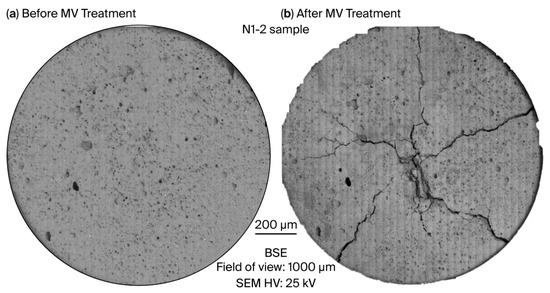
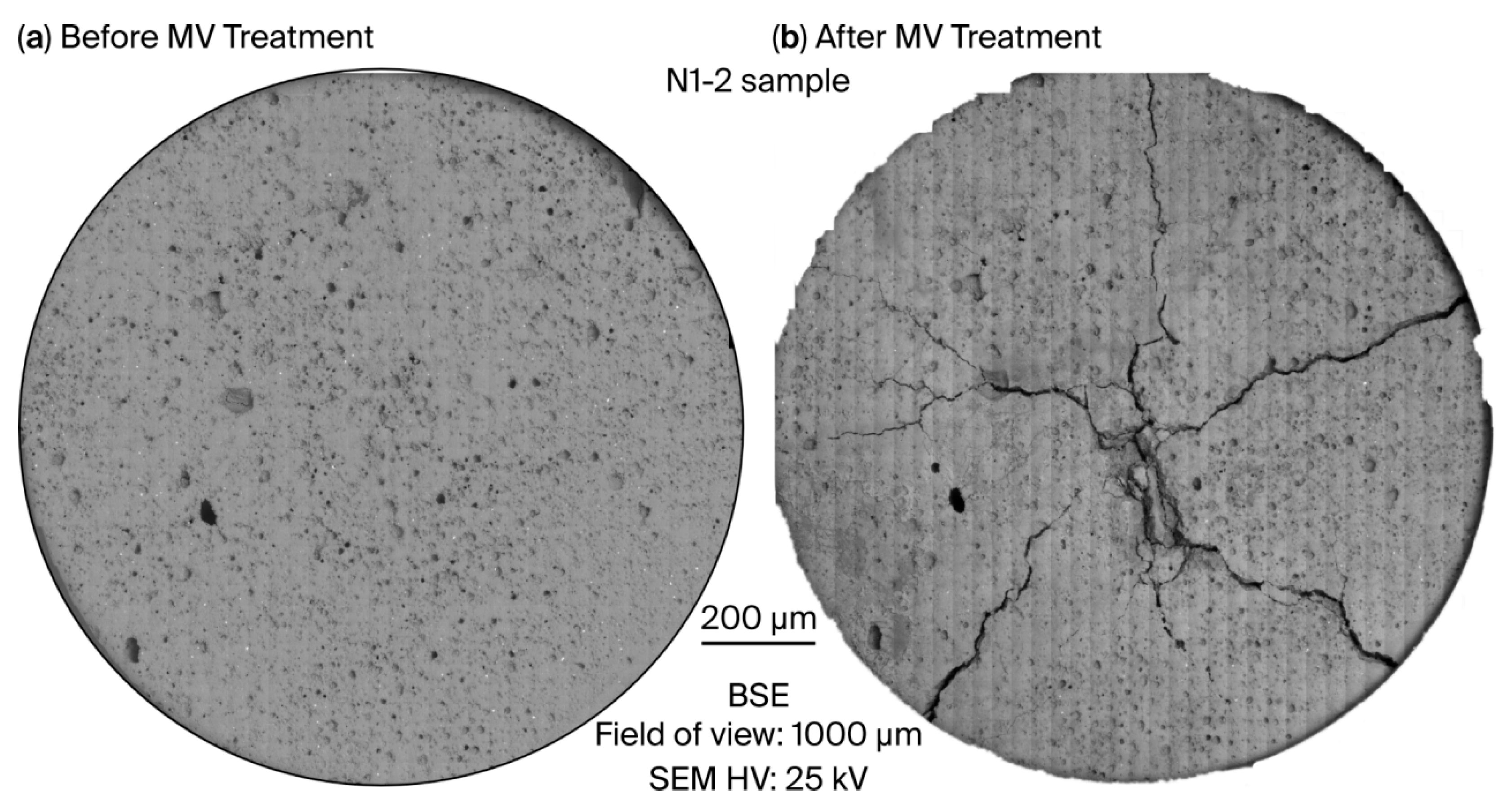
Based on Table 3, there was not a linear trend between water content and permeability improvement. For instance, in sample N1-2 at 100% saturation, results indicated a significant permeability enhancement from 0.66 to 313 millidarcies (mD), with visible cracking observed in scanning electron microscopy (SEM) images, alongside a consistent reduction in P-wave velocity, attributed to fracture-induced weakening. In this sample, the initial permeability was not high enough to allow more water absorption and consequently buildup of water vapour in pores incurring in thermal runaway. The low initial permeability confines the explosive pressure, transforming absorbed microwave energy into mechanical work (fracturing and pore expansion) as well as vapour pressure that alters the pore structure, thus creating a high-permeability medium. The low permeability prevents this steam from escaping quickly, leading to an extreme buildup of internal vapour pressure. These effects tend to be more dramatic in low-permeability rocks because any change in pore connectivity has a larger impact on flow. A relatively small increase in pore-throat diameter, or the creation of even a few new conductive pathways (micro-cracks), can result in a very large proportional increase in permeability because the system is initially so constrained. Conversely, in sample E6, which had a medium initial permeability (4.1 mD), water was more confined within narrow pore spaces, leading to a rapid buildup of internal vapour pressure under microwave heating. This localized overheating caused thermal runaway, ultimately resulting in the partial melting of the matrix. The confinement of water limited its escape and focused the energy on a small volume, intensifying the heating effect.
In contrast, sample E11 at 100% saturation with a much higher initial permeability (82 mD) allowed more fluid mobility and dissipation of pressure, which reduced the intensity of localized heating. As a result, despite the same moisture content (100%), the permeability improvement was lower than that of the 20% saturation sample (E2 with similar initial permeability 87.7 mD), where partial water presence enabled more effective pressu29re buildup and microcrack propagation without reaching the runaway threshold. Another possible explanation could be structural effects where materials with high permeability have a lower MW penetration depth [27].
This highlights that an optimal range of water content and initial permeability exists for maximizing microwave-induced damage. Excess water or too-high permeability can dampen the beneficial effects by either over-saturating the system or allowing too much pressure dissipation.
The difference in porosity between synthetic and real samples can be attributed to their inherent structural characteristics. Due to the dense and compact nature of the spodumene samples, their initial porosity and permeability were significantly lower than those of the synthetic cores. As a result, the impact of microwave treatment was less pronounced in the spodumene samples, leading to relatively smaller changes in porosity and permeability compared to the synthetic ones.
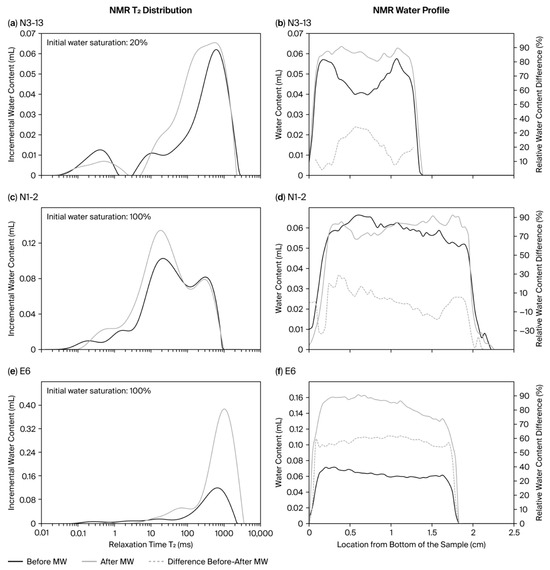
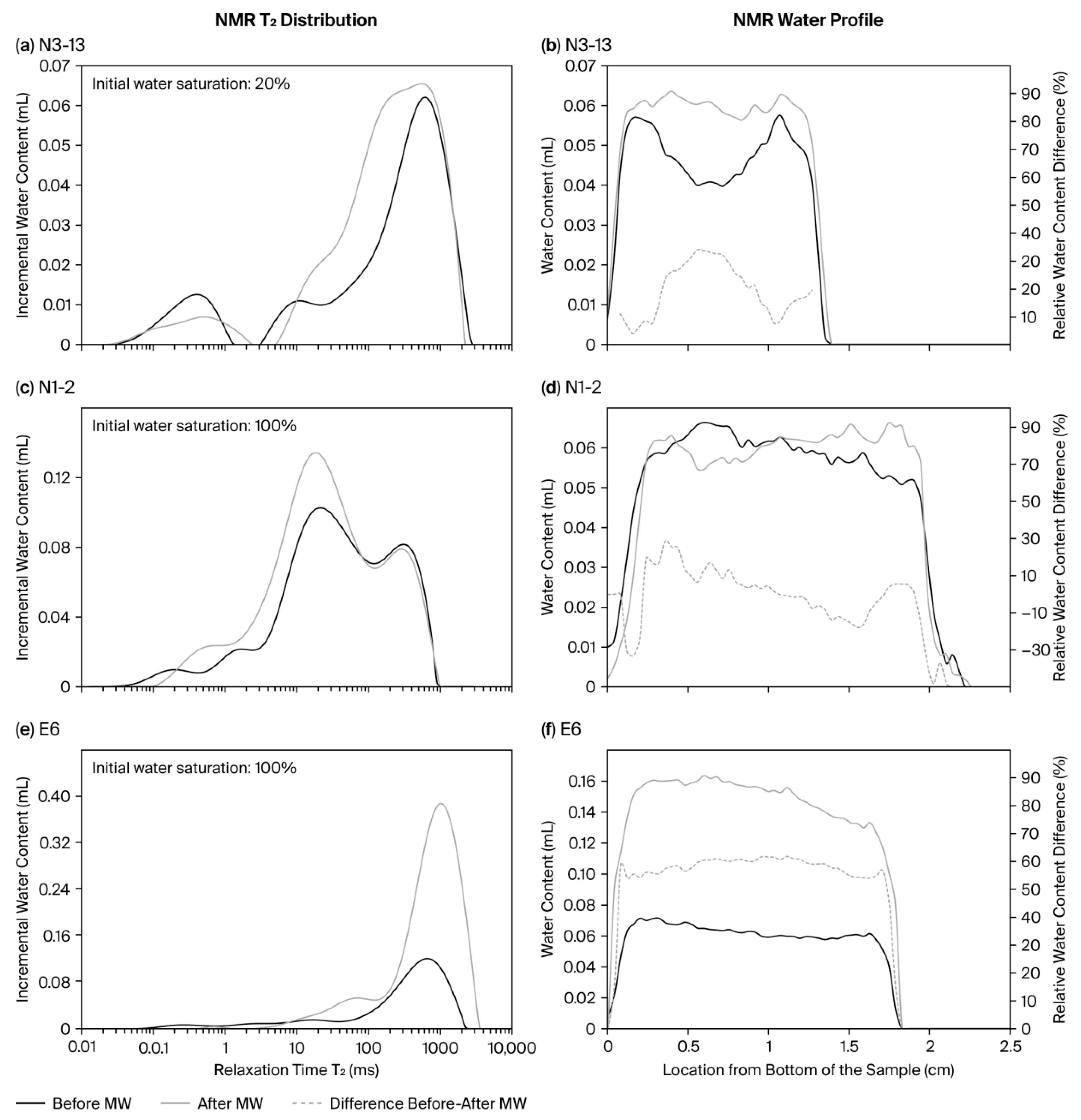
Figure 6 depicts NMR T2 distributions and NMR water content profiles along the samples for N3-13, N1-2, and E6 before and after microwave treatment, with the dotted curve in the NMR profiles representing the difference before and after MW treatment. In all cases, there is a noticeable increase in NMR water content from both T2 distribution and water content profiles after treatment. However, for sample E6, which experienced melting, the difference in NMR T2 values is notably greater compared to samples N1-2 and N3-13.
Figure 6.
(a) T2 distribution and (b) NMR water content profile before (bold black colour) and after MW treatment (grey colour) for sample N3-13, with low permeability and 20% initial water saturation. The black curve in the NMR profile represents the water content difference between before and after MW treatment. (c) T2 distribution and (d) NMR water content profile before (bold black colour) and after MW treatment (grey colour) for sample N1-2, with low permeability and 100% initial water saturation. The black curve in the NMR profile represents the water content difference between before and after MW treatment. (e) T2 distribution and (f) NMR water content profile before (bold black colour) and after MW treatment (grey colour) for sample E6, with moderate permeability of 4 mD and 100% initial water saturation. The black curve in the NMR profile represents the water content difference between before and after MW treatment. Note that this sample started to melt during MW treatment.
3.3. P- and S-Wave Results
Table 4 summarizes the results for all samples of measured ultrasonic P- and S-waves, except for sample E11, which melted and was therefore unable to be tested. E (Young’s modulus) and ν (Poisson’s ratio) before and after MW treatment are also shown. The velocities decreased when the permeabilities increased as expected, from ~3000 to 500 m/s for Vp and from ~2000 to 300 m/s for Vs. These differences were less for spodumene samples than for synthetic samples since it was a compact hard rock with less crack generation after MW treatment.
Table 4.
Ultrasonic P- and S-wave velocity data before and after MW treatment, with error bar of ~2% for P-waves and ~4% for S-waves.
Poisson’s ratio ν and Young’s modulus E were calculated based on the compressional wave velocity Vp, shear wave velocity Vs, and density ρ using the formulae:
where ν is Poisson’s ratio; Vp is the compressional (primary) wave velocity, and Vs is the shear (secondary) wave velocity.
where E is Young’s modulus, and ρ is the density of the material.
Sample N1-2 showed a lower pre-treatment Vp value than sample N3-13 despite having similar permeability. This was primarily because of its higher porosity (31.6%) and lower density 1842 (g/cm3) compared to sample N3-13’s porosity of (25.1%) and density of 2035 g/cm3. These discrepancies could be due to small-scale heterogeneities in mineral distribution, grain structure, or variations in density.
According to Table 4, Young’s modulus for all samples decreased after MW treatment, meaning that their stiffness decreased due to microcrack generation. Moreover, Poisson’s ratio increased for all the samples which exhibited more lateral (sideways) expansion relative to their axial (lengthwise) contraction when under compressive stress. This result is expected as a reduction in Young’s modulus, which is common in materials that develop microcracks or porosity, making them less able to resist deformation under compressive loads. However, sample N1-2’s Poisson’s ratio increased. One possible explanation could be an increase in plastic deformation due to greater microstructure creation. This would lead to more lateral deformation under stress, raising Poisson’s ratio. Alternatively, when porosity increases, especially in a sample with already high pre-treatment porosity, the bulk modulus (resistance to compressive stress) can decrease more significantly than the shear modulus. Since Poisson’s ratio depends on the relationship between bulk and shear moduli, a reduction in bulk modulus relative to shear modulus may lead to a higher Poisson’s ratio.
3.4. Microwave Effect on Permeability and Lixiviant Access Creation
The dielectric loss factor of water vapour is significantly lower compared to that of liquid water. As the temperature rose during MW irradiation, the rock samples exhibited a decrease in their overall dielectric loss factor, particularly when a substantial amount of liquid water transformed into steam. Consequently, there was a notable reduction in the overall temperature. Simultaneously, the rate of heat exchange between the sample surface and the external environment increased. This phenomenon could lead to temperature gradient and the creation of cracks indicated in Figure 7 as well as Figure 4.
Figure 7.
(a) Before MV treatment, backscatter SEM images showing cracking inside synthetic rock sample N1-2 after microwave treatment (b) at 100% water saturation.
4. Further Discussion
This paper was a result of a PhD study on comparing three different fracturing techniques. Key findings demonstrated that HV has a potential for complete fragmentation which supports fluid mobility, while MW demonstrated notable permeability enhancement in initiating micro-fracturing under wet condition, resulting in more visible cracks and confirming its efficiency due to the higher dielectric factor of water. MW technology has potential applications beyond rock fracturing; it could also be effectively utilized in comminution and preconditioning processes to enhance mineral liberation. Additionally, CF fracturing revealed promising results in stimulating fluid flow paths in otherwise impermeable rock, especially in the presence of water in wet conditions.
The results of these experiments may be positive for the use of MW crack promotion as part of an ISR process for mineral extraction from deep ore deposits. The water saturated environment increases the chance of absorbing microwaves generating cracks that improve permeability, which is crucial for efficient ISR operations. The results indicate that a hybrid hydraulic–MW crack promotion solution might be needed for improved access creation in ISR since water existence is a necessary part of the pretreatment using MW. However, one of the challenges associated with MW cracking is applying it at the bottom of the ISR injection and recovery wells. This would be difficult to do from a surface MW source, as the power pulse would attenuate before reaching the rock of interest. Another challenge is delivering sufficiently powerful microwaves to impact an ISR operation of reasonable size. Nowadays, researchers are focusing on developing high-power microwave equipment for efficient fracturing of rocks in the near field.
According to [29], the new integrated high-power metal-plate lens antenna achieved extended working distances and enhanced power focusing. Numerical simulations showed that the antenna delivered a peak microwave power density of 22 W/cm2 on diabase rock at 6 kW input power and 36 cm distance, effectively reaching 270 °C in 4 min and inducing thermal cracking, demonstrating strong potential for tunnelling and excavation applications.
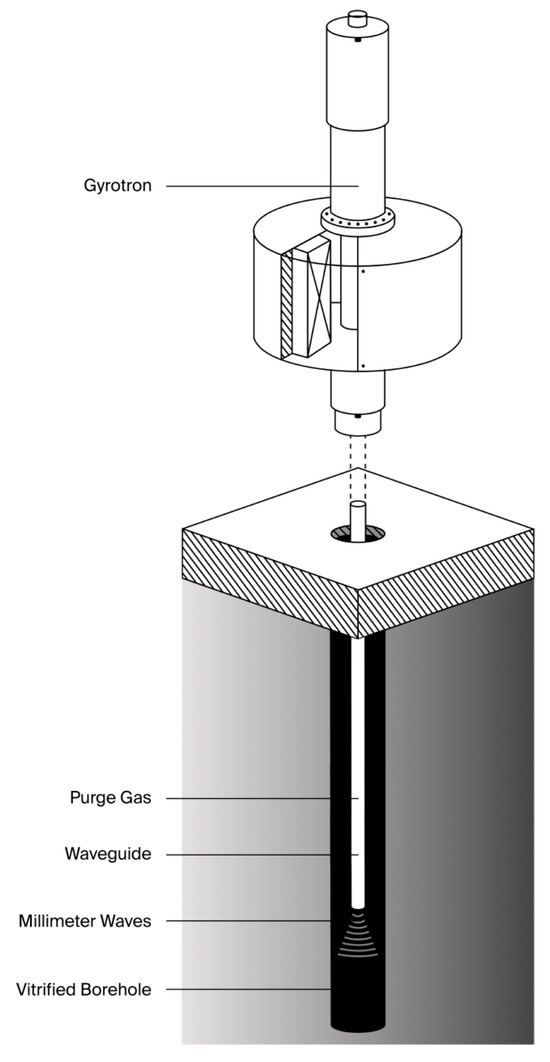
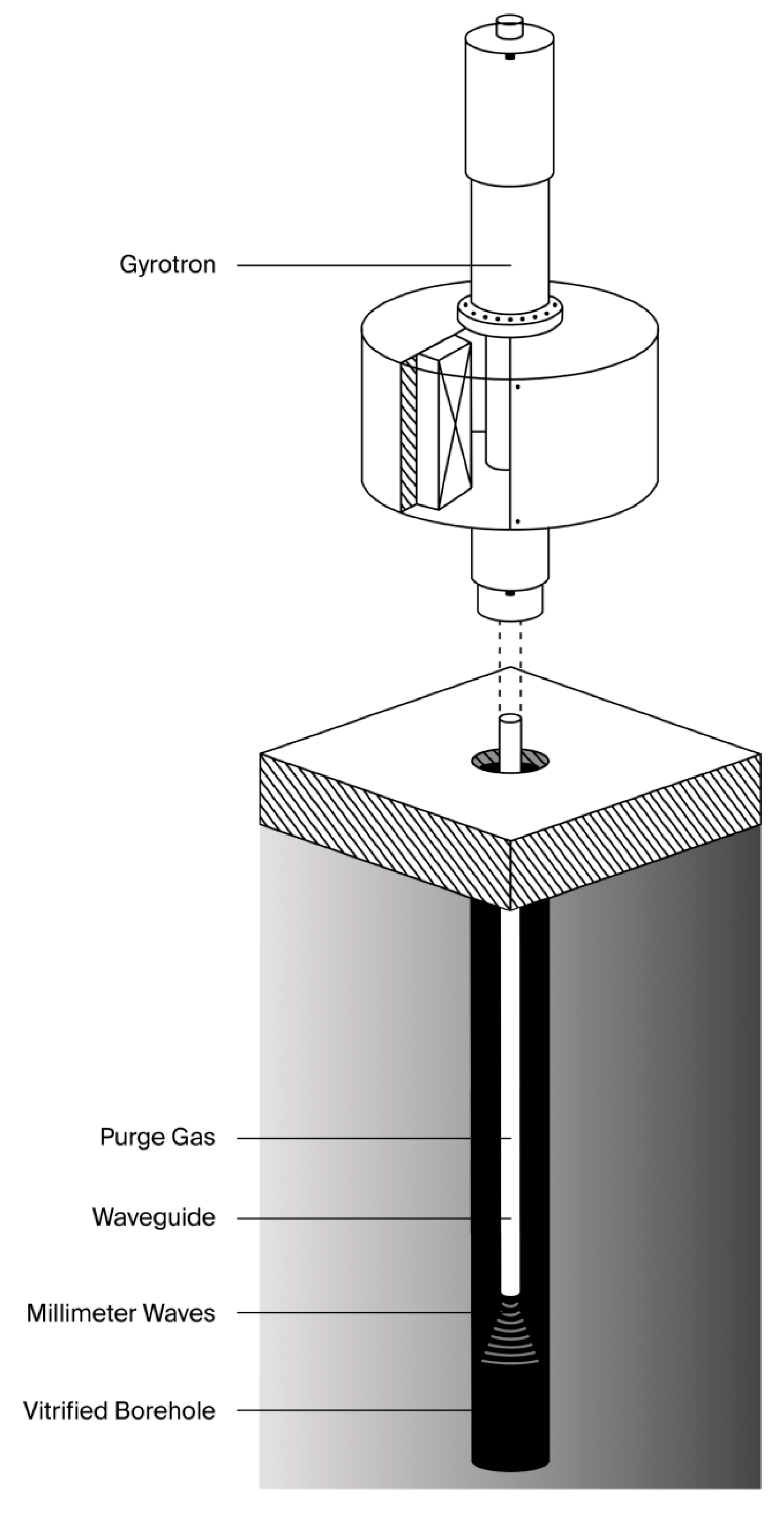
In our experiments, we used magnetrons, less powerful lab scale microwaves with frequency up to 2.5 GHz and power up to 1200 w. However, gyrotrons can deliver power up to 10 KW or 2 MW at frequencies between 25 and 527 GHz. One potential system might therefore comprise gyrotrons attached to drill bits used to drill the ISR injection and recovery wells (Figure 8).
Figure 8.
Gyrotrons attached to drill bits (https://www.quaise.energy/), accessed on 23 June 2024.
Future research should include tests on samples, with a wider range of dielectric mineral content or fabricated from a wider range of natural rocks to understand how different materials react to MW treatment. Assessing the efficiency of MW technology in large-scale operations is critical, particularly concerning energy input versus mineral yield.
5. Conclusions
This study examined the influence of microwave treatment on the porosity and permeability of synthetic and natural spodumene rock samples. The results indicated that microwave treatment significantly affects the rock’s physical properties, with water content being a critical factor in these changes. At high water content (100%), the samples showed significant increases in porosity but also experienced melting, rendering them unsuitable for further testing. At moderate water content (20%), the samples exhibited substantial increases in permeability, supported by the presence of multiple cracks observed in SEM images and lower P-wave velocity values. Specifically, the permeability of sample N3-13 increased by approximately 3404.8%, while sample E2 showed an increase of 233.06%.
These findings have notable implications for mining practices. Enhancing rock permeability through microwave treatment could lead to more efficient and cost-effective mining operations, particularly in the context of in situ recovery (ISR). By improving the permeability of ore bodies, microwave treatment can facilitate the extraction of valuable minerals without traditional blasting methods, which are often associated with environmental and safety concerns. This technique could reduce the risk of geological hazards, such as uncontrolled vibrations and fly rock incidents, and minimize damage to infrastructure and nearby heritage sites. Additionally, the selective heating properties of microwaves can target specific minerals, therefore creating preferential access to target minerals and increasing the yield and purity of the extracted metal. Further research is required to optimize microwave parameters and assess the long-term effects on rock stability and integrity, but the potential for integrating microwave treatment into mining practices appears promising.
Author Contributions
Conceptualization: S.K., A.N.N.; methodology: S.K., A.N.N.; software: L.E., S.K.; validation: A.N.N., L.E., A.B.; formal analysis: S.K., A.N.N.; investigation: S.K., resources: A.N.N., A.B., L.E.; data curation: S.K., L.E.; writing—original draft preparation: S.K.; writing—review and editing, S.K., A.N.N., Esteban Lionel, A.B.; visualization: S.K., Esteban Lionel; supervision: A.N.N., L.E., A.B.; project administration: A.N.N.; funding acquisition: A.N.N., A.B. All authors have read and agreed to the published version of the manuscript.
Funding
This research was funded by Minerals Research Institute of Western Australia (MRIWA), Murdoch University, and Mining3 in the form of a grant for project M0529.
Data Availability Statement
Data is unavailable due to privacy or ethical restrictions.
Acknowledgments
The authors would like to acknowledge Laura Kuhar, a member of the research team in the earlier phase of this study, for their contribution to securing funding for this research. They also express gratitude to the Minerals Research Institute of Western Australia (MRIWA), Murdoch University, and Mining3 for providing financial support in the form of a grant for project M0529.
Conflicts of Interest
The authors declare no conflict of interest.
References
- Tang, M.-Y.; Gao, M.-Z.; Li, S.-W.; Yang, B.-G.; Tang, R.-F.; Li, F.; Liu, J.-J. Failure behavior and energy evolution characteristics of deep roadway sandstone under different microwave irradiation modes. J. Central South Univ. 2023, 30, 214–226. [Google Scholar] [CrossRef] [Scilit]
- Hidalgo, T.; Kuhar, L.; Beinlich, A.; Putnis, A. Effect of multistage solution–mineral contact in in-situ recovery for low-grade natural copper samples: Extraction, acid consumption, gangue-mineral changes and precipitation. Miner. Eng. 2020, 159, 106616. [Google Scholar] [CrossRef] [Scilit]
- Seredkin, M.; Zabolotsky, A.; Jeffress, G. In situ recovery, an alternative to conventional methods of mining: Exploration, resource estimation, environmental issues, project evaluation and economics. Ore Geol. Rev. 2016, 79, 500–514. [Google Scholar] [CrossRef] [Scilit]
- Kafashi, S.; Rasaei, M.R.; Eshraghi, E.; Kuhar, L.; Bona, A.; Nikoloski, A.N. Visual study of TiO2 nanofluid stabilization methods on inhibition of asphaltene precipitation in porous media. Miner. Eng. 2021, 169, 106953. [Google Scholar] [CrossRef] [Scilit]
- Liew, M.S.; Danyaro, K.U.; Zawawi, N.A.W.A. A Comprehensive Guide to Different Fracturing Technologies: A Review. Energies 2020, 13, 3326. [Google Scholar] [CrossRef] [Scilit]
- Kafashi, S.; Kuhar, L.; Bóna, A.; Nikoloski, A.N. Review of Fracturing Techniques (Microwaves, High-Voltage Pulses, and Cryogenic Fluids) for Application as Access Creation Method in Low-Permeability Hard Rocks for Potential in situ Metal Recovery. Miner. Process. Extr. Met. Rev. 2023, 45, 522–537. [Google Scholar] [CrossRef] [Scilit]
- Chanturiya, V.A.; Bunin, I.Z. Advances in Pulsed Power Mineral Processing Technologies. Minerals 2022, 12, 1177. [Google Scholar] [CrossRef] [Scilit]
- Yang, W.; Pickles, C.A.; Forster, J. Microwave fragmentation of a synthetic alundum-pyrite ore. Miner. Process. Extr. Metall. 2020, 129, 251–266. [Google Scholar] [CrossRef] [Scilit]
- Meisels, R.; Toifl, M.; Hartlieb, P.; Kuchar, F.; Antretter, T. Microwave propagation and absorption and its thermo-mechanical consequences in heterogeneous rocks. Int. J. Miner. Process. 2015, 135, 40–51. [Google Scholar] [CrossRef] [Scilit]
- Lu, G.; Li, Y.; Hassani, F.; Zhang, X. The influence of microwave irradiation on thermal properties of main rock-forming minerals. Appl. Therm. Eng. 2017, 112, 1523–1532. [Google Scholar] [CrossRef] [Scilit]
- Hassani, F.; Nekoovaght, P.M.; Gharib, N. The influence of microwave irradiation on rocks for microwave-assisted underground excavation. J. Rock Mech. Geotech. Eng. 2016, 8, 1–15. [Google Scholar] [CrossRef] [Scilit]
- Hassani, F.; Nekoovaght, P.M.; Radziszewski, P.; Waters, K.E. Microwave assisted mechanical rock breaking. In Proceedings of the 12th ISRM Congress, Beijing, China, 16–21 October 2011. [Google Scholar]
- Galema, S.A. Microwave chemistry. Chem. Soc. Rev. 1997, 26, 233–238. [Google Scholar] [CrossRef] [Scilit]
- Al-Harahsheh, M.; Kingman, S.W. Microwave-assisted leaching—A review. Hydrometallurgy 2004, 73, 189–203. [Google Scholar] [CrossRef] [Scilit]
- Singh, S.; Gupta, D.; Jain, V.; Sharma, A.K. Microwave processing of materials and applications in manufacturing industries: A review. Mater. Manuf. Process. 2015, 30, 1–29. [Google Scholar] [CrossRef] [Scilit]
- Ju, Y.; Zhu, Y.; Zhou, H.; Ge, S.; Xie, H. Microwave pyrolysis and its applications to the in situ recovery and conversion of oil from tar-rich coal: An overview on fundamentals, methods, and challenges. Energy Rep. 2021, 7, 523–536. [Google Scholar] [CrossRef] [Scilit]
- Lu, G.; Sun, Z.; Zhou, J.; Chen, K.; Li, F. Effect of Microwave Irradiation on Computed Tomography and Acoustic Emission Characteristics of Hard Rock. Geotech. Geol. Eng. 2021, 39, 411–424. [Google Scholar] [CrossRef] [Scilit]
- Koleini, S.M.J.; Barani, K.; Rezaei, B. The effect of microwave treatment on dry grinding kinetics of iron ore. Miner. Process. Extr. Metall. Rev. 2012, 33, 159–169. [Google Scholar] [CrossRef] [Scilit]
- Kingman, S.W. Microwave Processing of Materials. Ph.D. Thesis, Stellenbosch University, Stellenbosch, South Africa, 2018. [Google Scholar]
- Lu, G.-M.; Feng, X.-T.; Li, Y.-H.; Zhang, X. The microwave-induced fracturing of hard rock. Rock Mech. Rock Eng. 2019, 52, 3017–3032. [Google Scholar] [CrossRef] [Scilit]
- Peinsitt, T.; Kuchar, F.; Hartlieb, P.; Moser, P.; Kargl, H.; Restner, U.; Sifferlinger, N. Microwave heating of dry and water saturated basalt, granite and sandstone. Int. J. Min. Miner. Eng. 2010, 2, 18–29. [Google Scholar] [CrossRef] [Scilit]
- Ding, P.; Di, B.; Wang, D.; Wei, J.; Li, X. Measurements of seismic anisotropy in synthetic rocks with controlled crack geometry and different crack densities. Pure Appl. Geophys. 2017, 174, 1907–1922. [Google Scholar] [CrossRef] [Scilit]
- Dunn, K.-J.; Bergman, D.J.; LaTorraca, G.A. Nuclear Magnetic Resonance: Petrophysical and Logging Applications; Elsevier: Amsterdam, The Netherlands, 2002. [Google Scholar]
- Birch, F. The velocity of compressional waves in rocks to 10 kilobars: 1. J. Geophys. Res. 1960, 65, 1083–1102. [Google Scholar] [CrossRef] [Scilit]
- Mattaboni, P.; Schreiber, E. Method of pulse transmission measurements for determining sound velocities. J. Geophys. Res. 1967, 72, 5160–5163. [Google Scholar] [CrossRef] [Scilit]
- Mishra, R.R.; Sharma, A.K. Microwave–material interaction phenomena: Heating mechanisms, challenges and opportunities in material processing. Part A Appl. Sci. Manuf. 2016, 81, 78–97. [Google Scholar] [CrossRef] [Scilit]
- Vasudev, H.; Singh, G.; Bansal, A.; Vardhan, S.; Thakur, L. Microwave heating and its applications in surface engineering: A review. Mater. Res. Express 2019, 6, 102001. [Google Scholar] [CrossRef] [Scilit]
- Cai, C.; Li, G.; Huang, Z.; Shen, Z.; Tian, S. Rock pore structure damage due to freeze during liquid nitrogen fracturing. Arab. J. Sci. Eng. 2014, 39, 9249–9257. [Google Scholar] [CrossRef] [Scilit]
- Zheng, Y.; Ma, Z.; Li, J. Developing a High-Power Metal-Plate Lens Antenna for Microwave Fracturing of Rocks. Microw. Opt. Technol. Lett. 2025, 67, e70169. [Google Scholar] [CrossRef] [Scilit]

Disclaimer/Publisher’s Note: The statements, opinions and data contained in all publications are solely those of the individual author(s) and contributor(s) and not of MDPI and/or the editor(s). MDPI and/or the editor(s) disclaim responsibility for any injury to people or property resulting from any ideas, methods, instructions or products referred to in the content. |
© 2025 by the authors. Licensee MDPI, Basel, Switzerland. This article is an open access article distributed under the terms and conditions of the Creative Commons Attribution (CC BY) license (https://creativecommons.org/licenses/by/4.0/).