Associations of 16-Year Population Dynamics in Range-Expanding Moths with Temperature and Years since Establishment

Department of Biology and Environmental Science, Linnaeus University, SE-39182 Kalmar, Sweden
*
Author to whom correspondence should be addressed.
Insects 2023, 14(1), 55; https://doi.org/10.3390/insects14010055
Submission received: 6 December 2022
/
Revised: 20 December 2022
/
Accepted: 2 January 2023
/
Published: 6 January 2023
(This article belongs to the Special Issue Climate Change and Insects)
Simple Summary
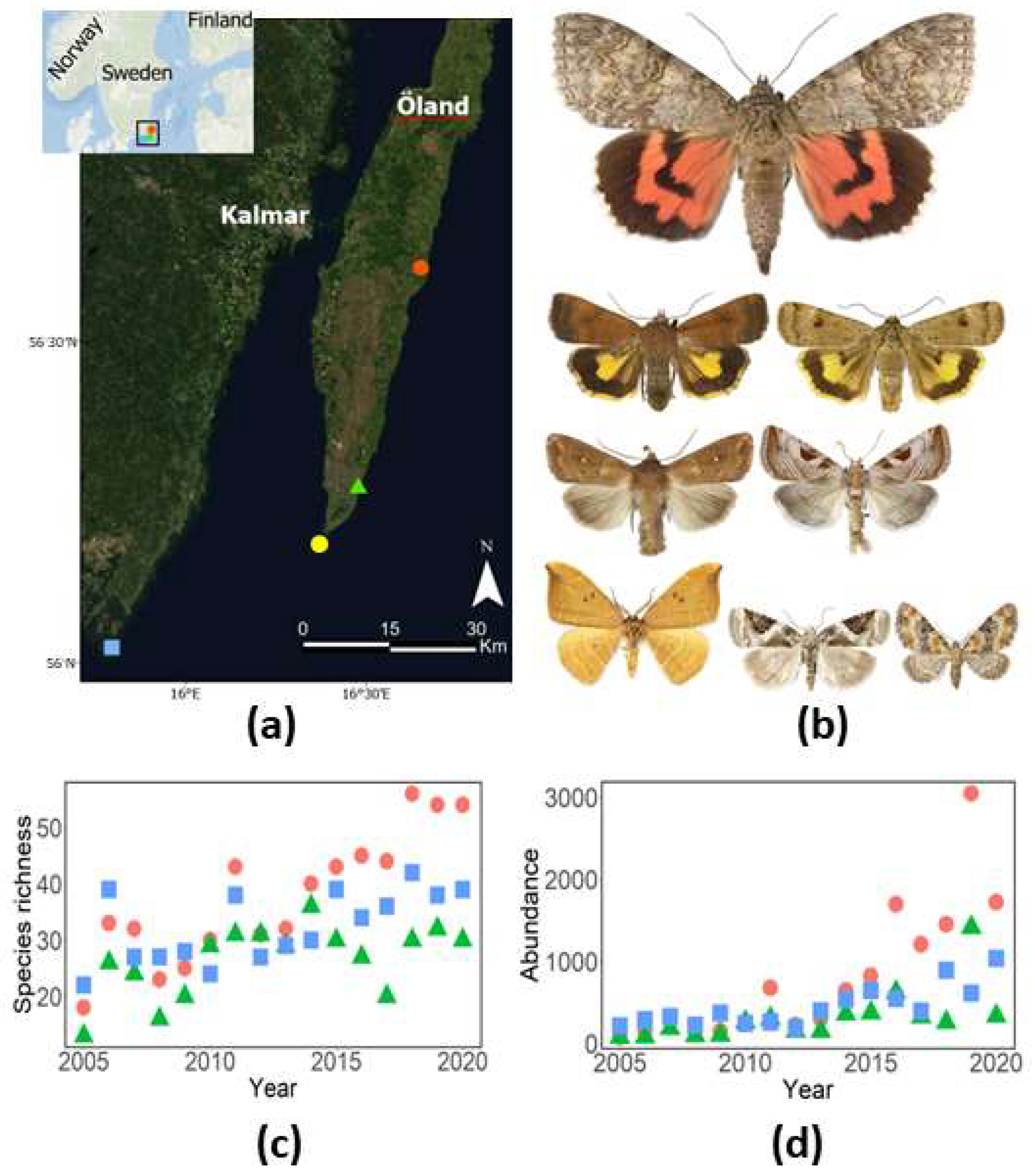
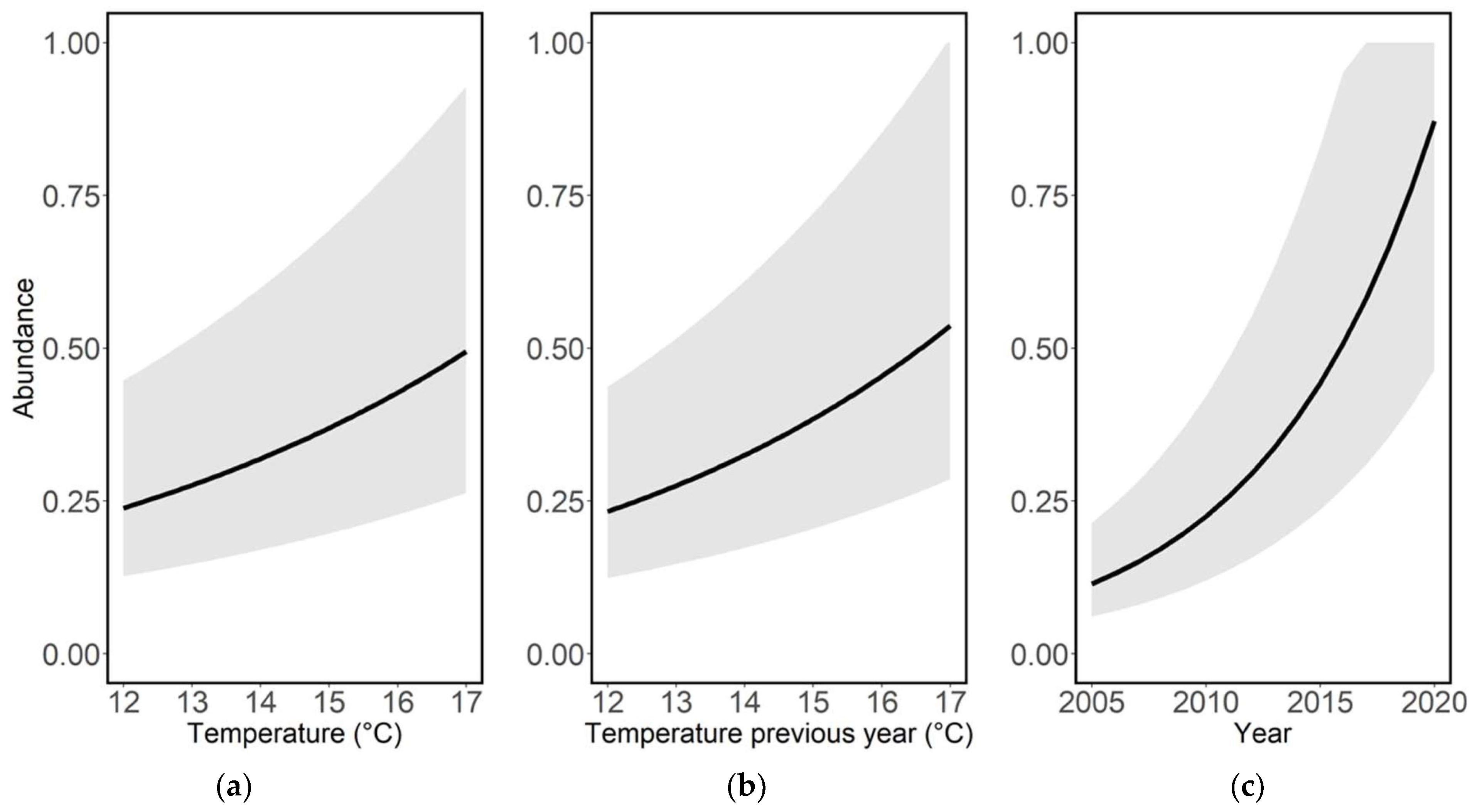
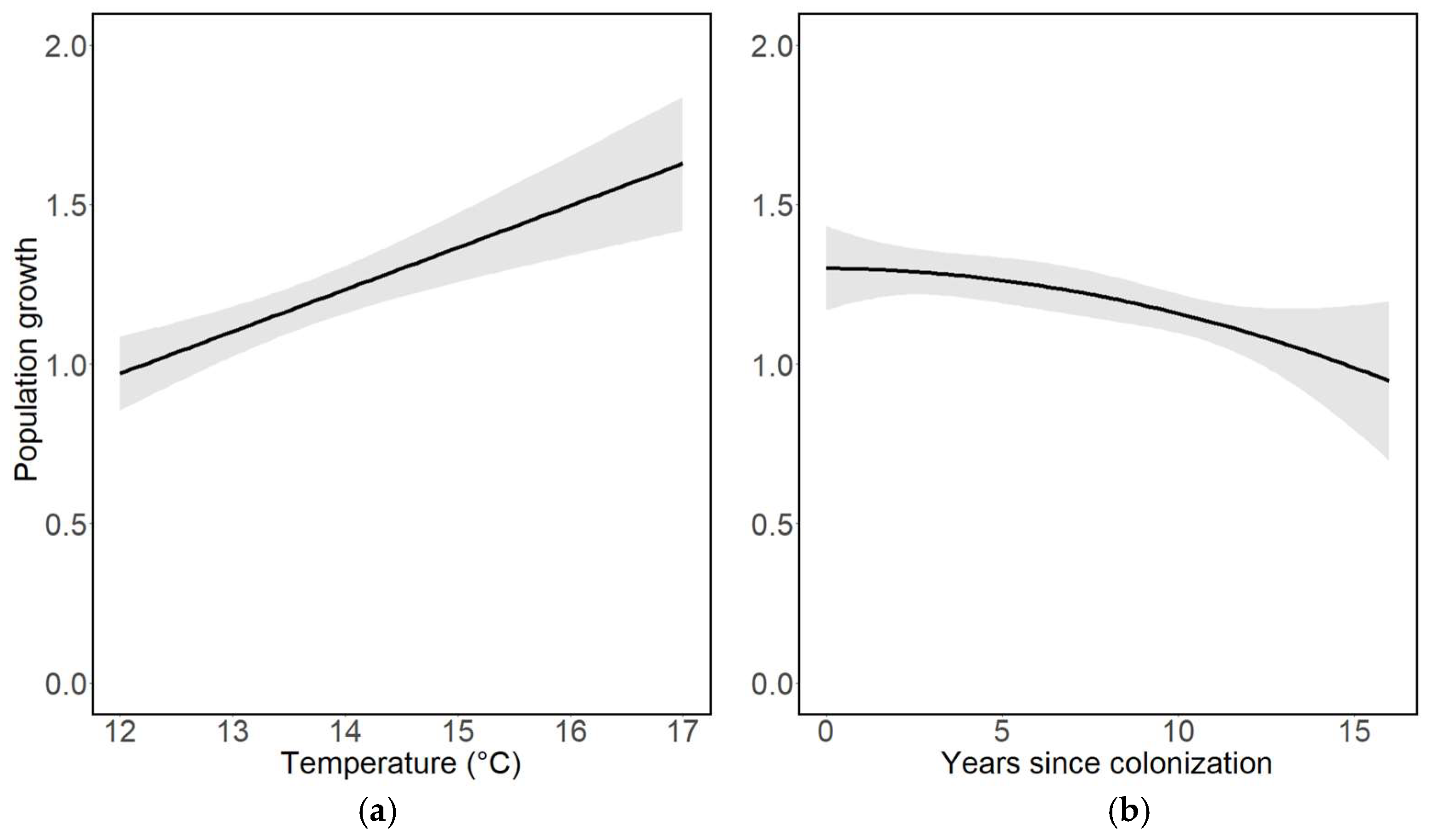
There has been a widespread decline of many plants and animals driven at least partly by climate change. This pattern is not universal, and certain taxa are increasing in abundance and distribution. A better understanding of population dynamics and range expansions in different areas and how different taxa respond to changing temperatures is therefore important, as we are facing a warmer and more fluctuating climate in the future. In this study, we show that range-expanding moths in southeastern Sweden have increased their species richness over time and that abundance and population growth increase during years with higher temperatures. We also show that population growth in range-expanding moths is fastest in the first years after establishment in an area. These shifts in distribution and abundance of moths may lead to rapid and dramatic changes in community compositions, with potentially widespread consequences for species interactions and ecosystem functioning.
Abstract
Parallel to the widespread decline of plants and animals, there is also an ongoing expansion of many species, which is especially pronounced in certain taxonomic groups and in northern latitudes. In order to inform an improved understanding of population dynamics in range-expanding taxa, we studied species richness, abundance and population growth in a sample of 25,138 individuals representing 107 range-expanding moth species at three light-trap sites in southeastern Sweden over 16 years (from 2005 to 2020) in relation to temperature and years since colonisation. Species richness and average abundance across range-expanding moths increased significantly over time, indicating a continuous influx of species expanding their ranges northward. Furthermore, average abundance and population growth increased significantly with increasing average ambient air temperature during the recording year, and average abundance also increased significantly with increasing temperature during the previous year. In general, population growth increased between years (growth rate > 1), although the population growth rate decreased significantly in association with years since colonisation. These findings highlight that, in contrast to several other studies in different parts of the world, species richness and abundance have increased in southeastern Sweden, partly because the warming climate enables range-expanding moths to realise their capacity for rapid distribution shifts and population growth. This may lead to fast and dramatic changes in community composition, with consequences for species interactions and the functioning of ecosystems. These findings are also of applied relevance for agriculture and forestry in that they can help to forecast the impacts of future invasive pest species.
Keywords:
abundance; climate change; light trap; migration; moths; population growth; Sweden; temperature