



You are currently viewing a new version of our website. To view the old version click .

Insects

Insects is an international, peer-reviewed, open access journal on entomology, published monthly online by MDPI. 

Indexed in PubMed | Quartile Ranking JCR - Q1 (Entomology)
All Articles (7,621)

Glyptapanteles porthetriae (Hymenoptera: Braconidae) is a solitary larval endoparasitoid of the spongy moth, Lymantria dispar (Lepidoptera: Erebidae). Previous studies suggested that only the spring generation of the wasp parasitizes early instars of L. dispar, while subsequent generations develop in larvae of unidentified alternative hosts and overwinter exclusively as endoparasitic larvae within these hosts. In a declining outbreak population of L. dispar in Austria, we observed two successive generations of G. porthetriae developing in spongy moth larvae during spring and early summer. The high abundance of parasitoids in the third outbreak year prompted us to test alternative hypotheses proposing a univoltine, monophagous life cycle with strong specialization on L. dispar. We exposed various developmental stages of L. dispar embryonic larvae to wasp females and evaluated potential dormancy induction in G. porthetriae larvae or pupae by assessing developmental parameters and respiratory activity under different environmental conditions. G. porthetriae did not develop from L. dispar individuals exposed in the egg stage, and no dormancy was observed in G. porthetriae developing in L. dispar larvae. These findings disprove the univoltine, monophagous development hypotheses and highlight the reliance of G. porthetriae on suitable alternative hosts to complete its life cycle.

14 December 2025

Phenology of L. dispar in Eggenburg in 2020 (green) compared with observations from Eastern Austria in 1993–1995 [6,36] and 2003–2004 [37] (blue). Blue bars are shown as a heatmap: stages recorded in only one of the five reference years appear in the lightest blue, while those recorded in all five years appear in the darkest blue. The red segment (calendar weeks 22–24) indicates adult eclosion of the summer generation of G. porthetriae in 2020.

Land maxing in cultivated ecosystems can improve upon other agroecological approaches because in this approach social, economic and ecological benefits are maximized within the available land, in part through the careful selection of plant species with specific benefits, e.g., biodiversity conservation, provision of ecological services, diversifying and improving farmer incomes. In this approach, plant species selected for improving farmer incomes are those providing non-timber marketable products, and plant species selected for biodiversity conservation and provision of ecological services can be identified quantitatively via ecological network theory. Here, we demonstrate using ecological network theory to identify (a) farm management practices associated with ecological network indices, and (b) key plant species that farmers can plant to maximize the potential for their land to support bees and pollination services. In this study we quantified bee-plant interaction networks within 10 agroforests, and compared results between the entire bee community and the subsetted stingless bee community. Bee abundance increased with flowering plant richness, explaining 9% of the variance (R2 = 0.09; β = 0.05, SE = 0.03). Diverse agroforests with higher numbers of tree species supported less connected (R2 = 0.67; β = −0.08, SE = 0.02), less nested (R2 = 0.53; β = −0.05, SE = 0.01), and more specialized (R2 = 0.63; β = 0.07, SE = 0.02) and modular (R2 = 0.37; β = 0.05, SE = 0.02) bee-plant networks. Some key plant species with the strongest impacts on network structure and stability were shared between the entire bee-plant and the stingless bee-plant networks. We recommend that farmers plant the species highlighted in this study to maximize the value of their diverse agroforests to support bee communities and pollination services.

13 December 2025

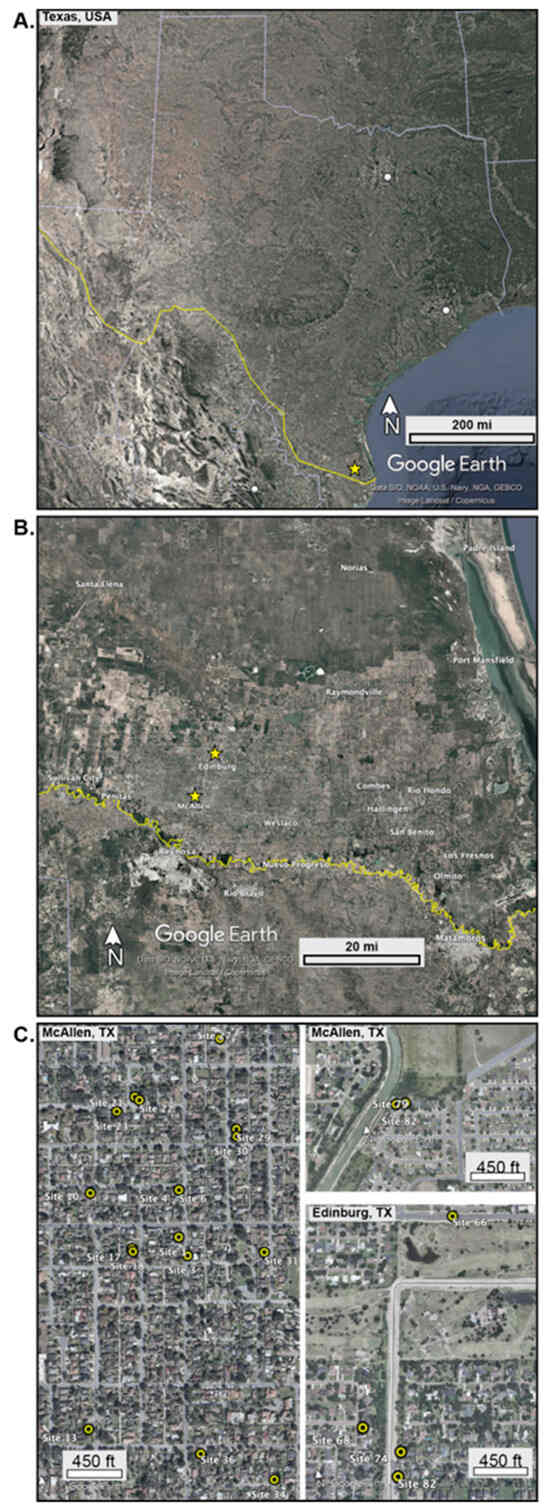
Map of study sites in the San Luis de Monteverde, Puntarenas, Costa Rica. Coffee Agroforestry Systems are denoted with green coffee icon, and Silvopastural Agroforestry Systems are denoted with orange cattle icon. Agroforests were of similar elevation, ranging from 800 to 1000 m.a.s.l. Map center point is located at 10°16′42.73″ N; 84°48′46.45″ W. Map data: Google, Airbus.

The psyllid genus Cacopsylla comprises mainly bisexually reproducing species; however, some members of this genus exhibit a unisexual mode of reproduction. Using an integrative approach that combines molecular and cytogenetic methods, as well as Wolbachia screening, we conducted a comprehensive study of the Palaearctic species C. ledi. We show that this species uses various reproductive strategies (bisexual and parthenogenetic) across its distribution range. Our findings indicate that the bisexual mode of reproduction has emerged at least twice in the evolutionary history of C. ledi. Bisexual populations in southern Fennoscandia are of ancestral origin, whereas the bisexual mode of reproduction observed in northern Fennoscandia represents a recent secondary transition from parthenogenesis. We report that in the first case, parthenogenetic and bisexual lineages can be easily distinguished not only cytogenetically but also by DNA barcoding, while in the second case, “bisexual” individuals share DNA barcodes with parthenogenetic ones. A comprehensive Wolbachia screening (1140 specimens across the entire distribution range) revealed Wolbachia infection in every specimen of C. ledi, indicating a significant role of the endosymbiont in the biology and evolution of this species.

13 December 2025

Cacopsylla ledi immature individual (left) and adult females (right) on the host plant (Ledum palustre). Russia, Murmansk Oblast, 10 km W of Kandalaksha town, 67.157280° N, 32.150402° E. 20 July 2024. Photos: G.N. Shapoval.

Ostrinia nubilalis (Lepidoptera: Crambidae) and Sesamia nonagrioides (Lepidoptera: Noctuidae) are major maize pests in the central-eastern Mediterranean area, responsible for both quantitative and qualitative yield losses. This study investigated the corn borer species present in central-eastern Italy, the presence and prevalence of O. nubilalis pheromone races, and the within-plant larval distribution. Traps baited with E, Z, or E/Z pheromone lures were used to investigate O. nubilalis pheromone races, while 596 maize plants were sampled at harvest and dissected to determine species composition, relative abundance, and larval distribution across three plant sections (lower and upper stalk and ear). Males were captured in traps baited with each pheromone lure, with no significant differences among catches. Larval sampling revealed the co-occurrence of O. nubilalis and S. nonagrioides, with O. nubilalis being the prevalent species. For both species, larvae were significantly more abundant in the lower plant section, and co-occurrence did not appear to influence their within-plant distribution. Comparing the species-specific larval distribution, a significantly higher proportion of S. nonagrioides occurred in the lower plant section, whereas O. nubilalis was significantly more frequent in the ears. However, the presence of both species in the ears highlights the need to consider both pests in management. These findings highlight the importance of monitoring activities in the area, using traps baited with each pheromone lure for O. nubilalis. Knowledge of the co-occurrence between the two species can be considered fundamental for developing Integrated Pest Management strategies, as it can influence the timing and effectiveness of control methods.

13 December 2025

Schematic representation of trap placement within the field. Black dots represent individual cone traps, and dashed lines indicating the three experimental blocks.

News & Conferences

Issues

Open for Submission

Editor's Choice

Reprints of Collections

Corn Insect Pests
Reprint

Corn Insect Pests

From Biology to Control Technology
Editors: Tiantao Zhang
Environmentally-Friendly Pest Control Approaches for Invasive Insects
Reprint

Environmentally-Friendly Pest Control Approaches for Invasive Insects

Editors: Yibo Zhang, Hongbo Jiang, Ying Yan

Get Alerted

Add your email address to receive forthcoming issues of this journal.

XFacebookLinkedIn
Insects - ISSN 2075-4450