Male Armaments and Reproductive Behavior in “Nutcracker” Camel Crickets (Rhaphidophoridae, Pristoceuthophilus)
Abstract
1. Introduction

2. Experimental Section
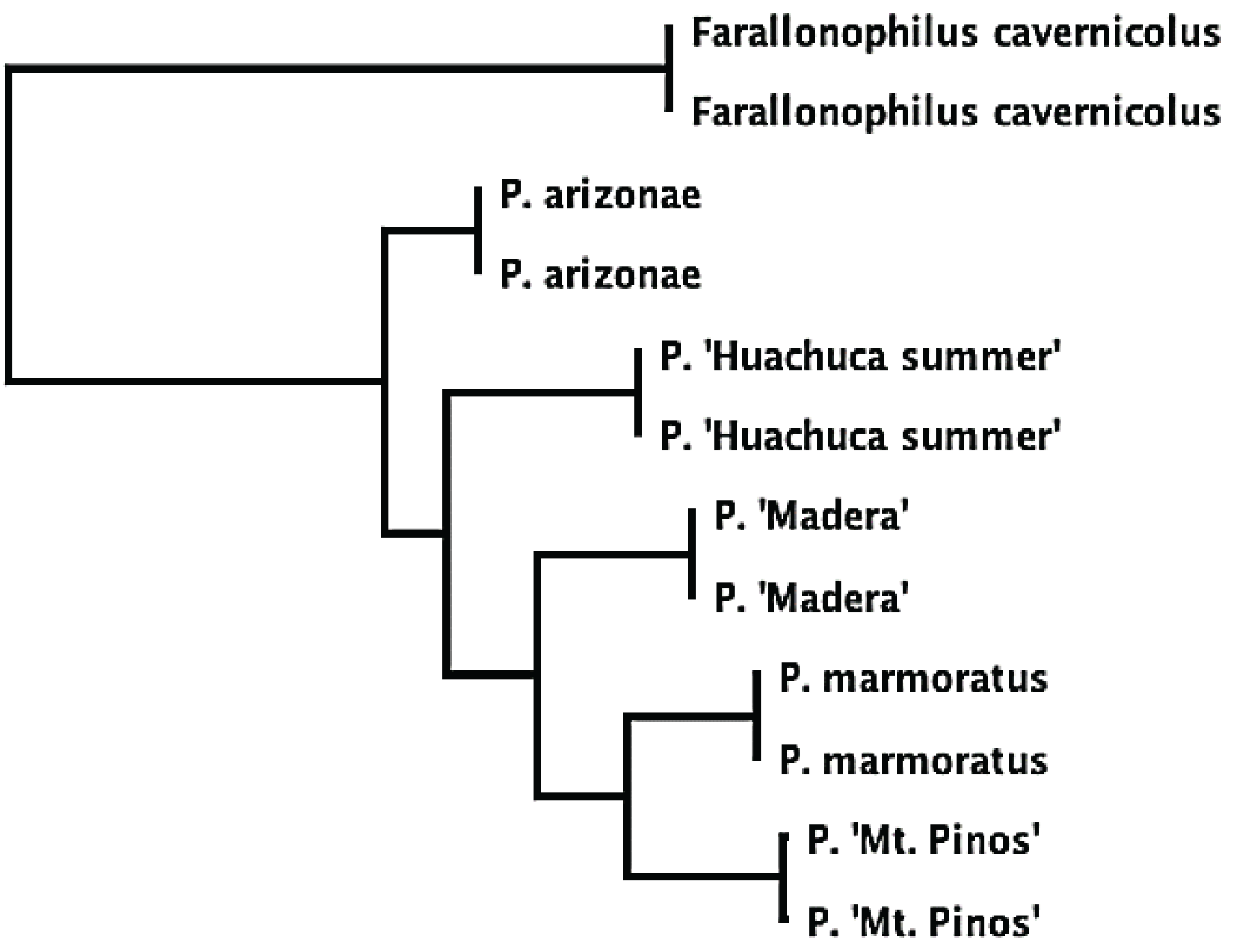
2.1. Taxonomic Issues and Species Status


2.2. Collection and Housing
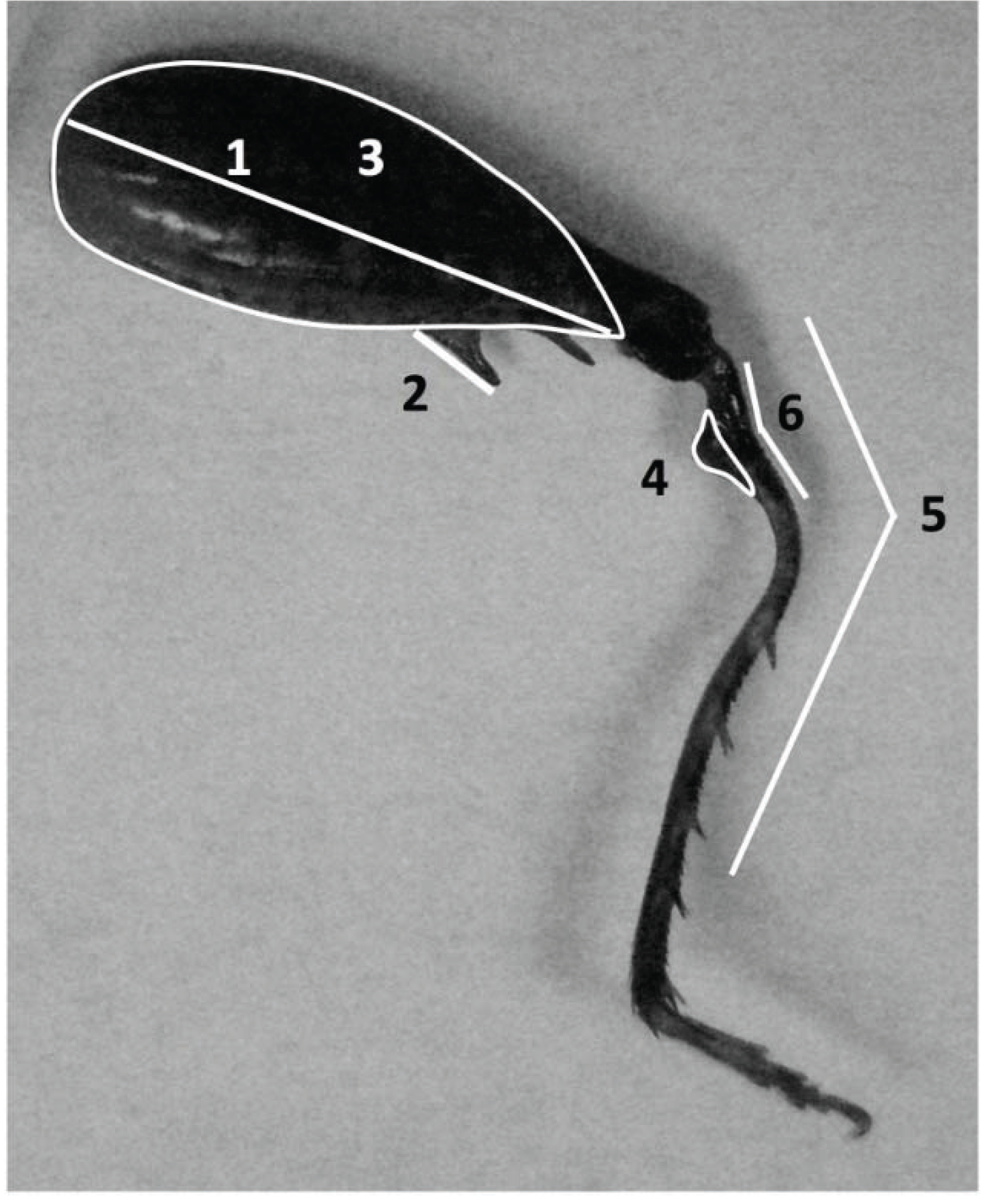
2.3. Measurement of Body Size, Armaments and Allometry

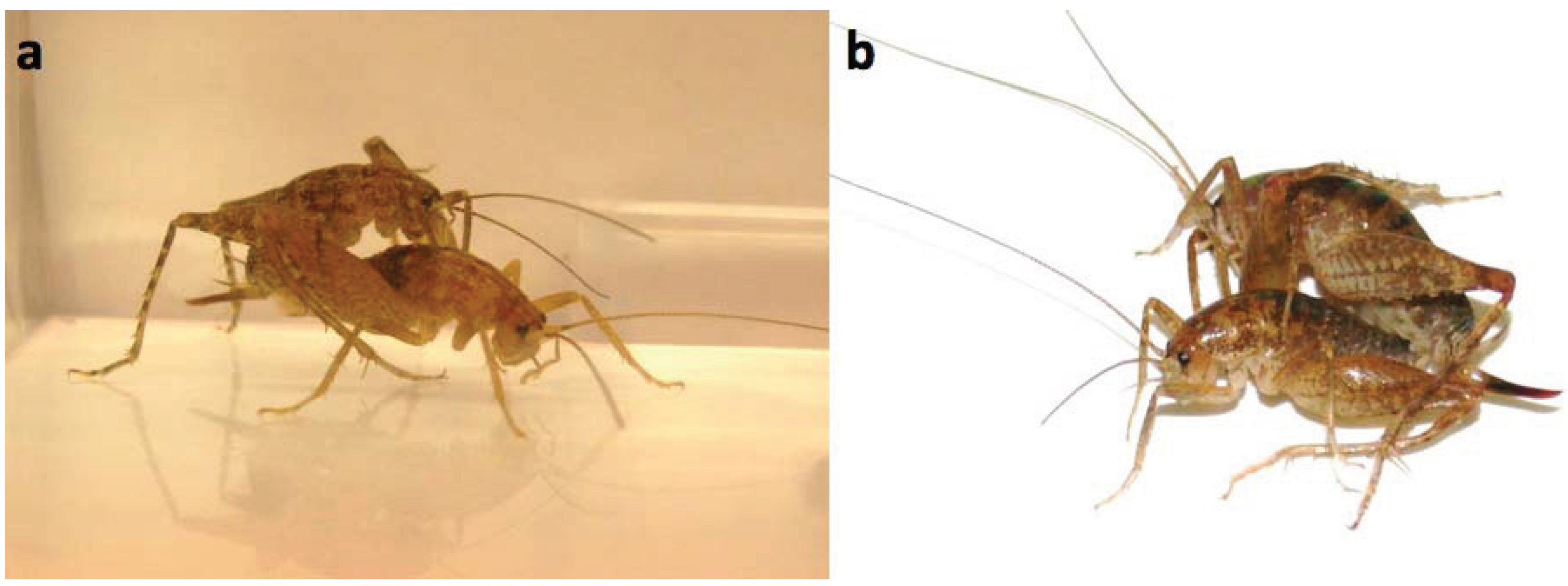
2.4. Behavioral Trials: Male-Male Fights and Male-Female Mating
2.5. Statistical Analyses
3. Results and Discussion
3.1. Armament Allometry

| Species | Spine Length | Flange Area | Primary Tibial Deflection | Secondary Tibial Deflection | Femur Area | Femur Length |
|---|---|---|---|---|---|---|
| P. ‘Huachuca summer’ | 6.24 ± 0.48 (0.71) | 4.05 ± 0.33 (0.67) | 6.23 ± 0.56 (0.61) | 6.44 ± 0.68 (0.45) | 1.13 ± 0.08 (0.74) | 0.94 ± 0.07 (0.72) |
| P. arizonae | 3.66 ± 0.68 (0.56) | 2.77 ± 0.68 (0.40) | 2.09 ± 0.53 (0.36) | 2.48 ± 0.54 (0.54) | 1.07 ± 0.14 (0.82) | 0.89 ± 0.12 (0.82) |
| P. ‘Madera’ | 5.28 ± 0.70 (0.81) | 3.85 ± 0.57 (0.76) | 3.04 ± 0.47 (0.74) | 2.41 ± 0.60 (0.32) | 1.2 ± 0.1 (0.92) | 1.17 ± 0.17 (0.77) |
| P. marmoratus | 4.67 ± 0.29 (0.71) | – | 2.35 ± 0.13 (0.76) | – | 1.06 ± 0.03 (0.94) | 1.02 ± 0.04 (0.91) |
| P. ‘Mt. Pinos’ | 2.53 ± 0.18 (0.69) | 2.40 ± 1.15 (0.76) | 3.62 ± 0.35 (0.43) | 3.62 ± 0.44 (0.14) | 1.03 ± 0.04 (0.91) | 1.02 ± 0.05 (0.84) |


3.2. Comparisons of Body Size and Relative Armament Size among Species
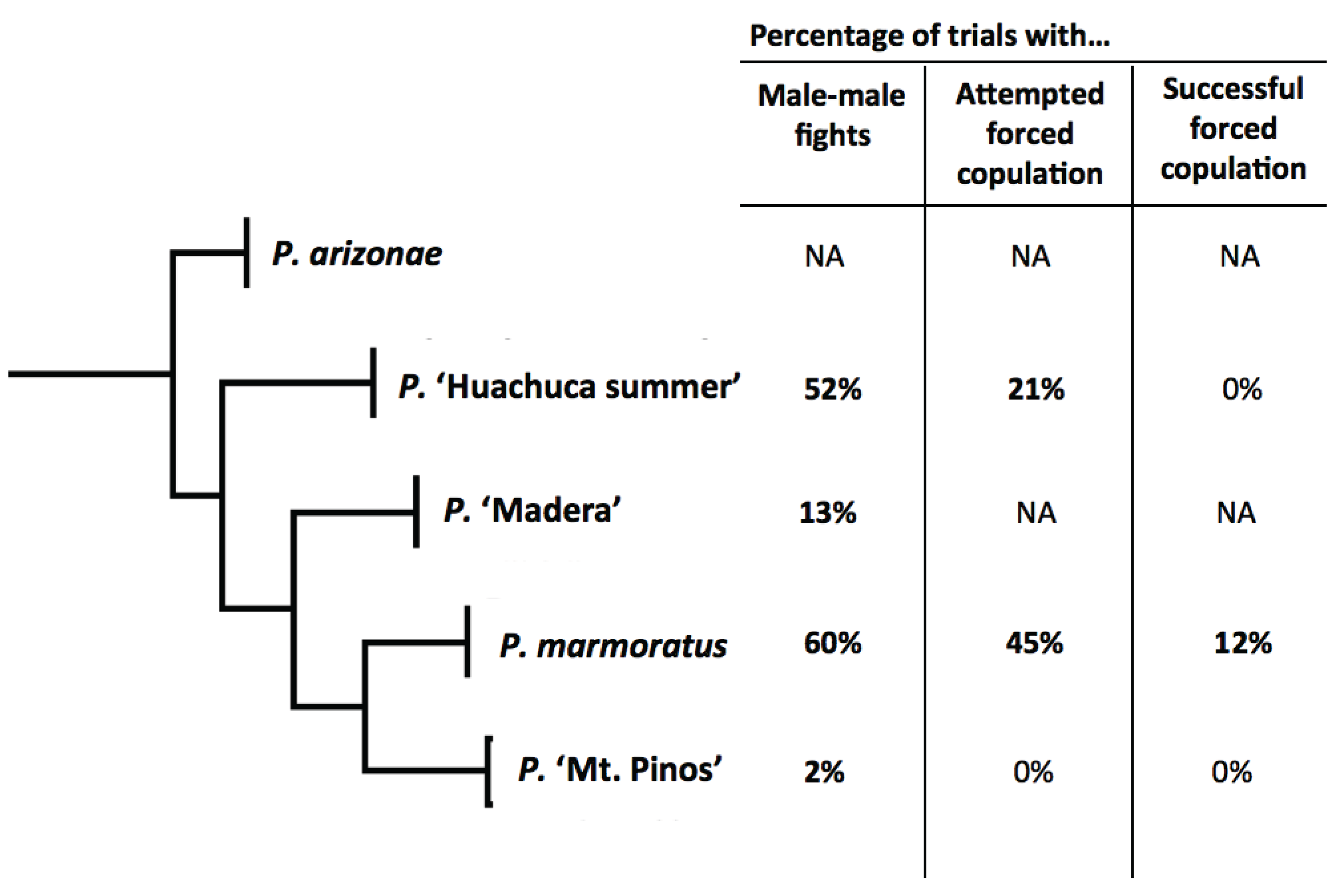
3.3. Behavioral Trials
| Species | No. of Trials | No. of Trials with: | |||
|---|---|---|---|---|---|
| Male-Male Fights | Voluntary Copulation | Attempted Forced Copulation (Unsuccessful) | Successful Forced Copulation | ||
| P. ‘Huachuca summer’ | 21 | 11 | 15 | 4 | 0 |
| P. ‘Madera’ | 16 | 2 | 4 | 0 | 0 |
| P. marmoratus | 20 | 12 | 2 | 2 | 2 |
| P. ‘Mt. Pinos’ | 47 | 1 | 2 | 2 | 0 |
| Species | Total No. of trials | Total No. of Trials with | ||||
|---|---|---|---|---|---|---|
| Copulation Attempted (Successful/Unsuccessful) | Unsuccessful Attempted Copulation | Successful Copulation | ||||
| Forceful | Voluntary | Forceful | Voluntary | |||
| P. ‘Huachuca summer’ | 16 | 14 | 3 | 0 | 0 | 11 |
| P. ‘Madera’ | 11 | 0 | 0 | 0 | 0 | 0 |
| P. marmoratus | 101 | 33 | 15 | 0 | 4 | 14 |
| P. ‘Mt. Pinos’ | 69 | 1 | 0 | 0 | 0 | 1 |

3.4. General Observations of Voluntary Copulatory Behavior
3.5. Status of P. ‘Huachuca Summer’
3.6. Comparisons of Allometries and Armaments
3.7. Dual-Purpose Armaments in Other Pristoceuthophilus?
4. Conclusions
Supplementary Files
Supplementary File 1Acknowledgments
Author Contributions
Conflicts of Interest
References
- Emlen, D.J. The evolution of animal weapons. Annu. Rev. Ecol. Evol. Syst. 2008, 39, 387–413. [Google Scholar] [CrossRef]
- Andersson, M. Sexual Selection; Princeton University Press: Princeton, NJ, USA, 1994.
- Berglund, A.; Bisazza, A.; Pilastro, A. Armaments and ornaments: An evolutionary explanation of traits of dual utility. Biol. J. Linnaean Soc. 1996, 58, 385–399. [Google Scholar] [CrossRef]
- McKinney, F.; Derrickson, S.R.; Mineau, P. Forced copulation in waterfowl. Behaviour 1983, 86, 250–294. [Google Scholar] [CrossRef]
- Wilgers, D.J.; Nicholas, A.C.; Reed, D.H.; Stratton, G.E.; Hebets, E.A. Condition-dependent alternative mating tactics in a sexually cannibalistic wolf spider. Behav. Ecol. 2009, 20, 891–900. [Google Scholar] [CrossRef]
- Sakaluk, S.K.; Bangert, P.J.; Eggert, A.-K.; Gack, C.; Swanson, L.V. The gin trap as a device facilitating coercive mating in sagebrush crickets. Proc. R. Soc. Lond. Ser. B 1995, 261, 65–71. [Google Scholar] [CrossRef]
- Vahed, K. Coercive copulation in the alpine bushcricket Anonconotus alpinus Yersin (Tettigoniidae: Tettigoniinae: Platycleidini). Ethology 2002, 108, 1065–1075. [Google Scholar] [CrossRef]
- Vahed, K.; Carron, G. Comparison of forced mating behaviour in four taxa of Anonconotus, the Alpine bushcricket. J. Zool. 2008, 276, 313–321. [Google Scholar] [CrossRef]
- Khila, A.; Abouheif, E.; Rowe, L. Function, developmental genetics, and fitness consequences of a sexually antagonistic trait. Science 2012, 336, 585–589. [Google Scholar] [CrossRef] [PubMed]
- Haley, E.L.; Gray, D.A. Mating behavior and dual-purpose armaments in a camel cricket. Ethology 2012, 118, 49–56. [Google Scholar] [CrossRef]
- Mitchell, P.L. Combat and territorial defense of Acanthophora femorata (Hemiptera: Coreidae). Ann. Entomol. Soc. Am. 1980, 73, 404–408. [Google Scholar]
- Miyatake, T. Functional morphology of the hind legs as weapons for male contests in Leptoglossus australis (Heteroptera: Coreidae). J. Insect Behav. 1997, 10, 727–735. [Google Scholar]
- Eberhard, W.G. The function of female resistance behavior: intromission by male coercin vs. female cooperation in sepsid flies (Diptera: Sepsidae). Rev. Biol. Trop. 2002, 50, 484–505. [Google Scholar]
- Conroy, L.P.; Gray, D.A. Forced copulation as a conditional alternative strategy in camel crickets. Behav. Ecol. Sociobiol. 2014, 68, 1431–1439. [Google Scholar] [CrossRef] [PubMed]
- Bonduriansky, R.; Day, T. The evolution of static allometry in sexually selected traits. Evolution 2003, 57, 2450–2458. [Google Scholar] [CrossRef] [PubMed]
- Kodric-Brown, A.; Sibly, R.M.; Brown, J.H. The allometry of ornaments and weapons. Proc. Natl. Acad. Sci. USA 2006, 103, 8733–8738. [Google Scholar] [CrossRef] [PubMed]
- Rodríguez, R.L.; Araya-Salas, M.; Gray, D.A.; Reichert, M.S.; Symes, L.B.; Wilkins, M.R.; Safran, R.J.; Höbel, G. How acoustic signals scale with individual body size: Common trends across diverse taxa. Behav. Ecol. 2014. [Google Scholar] [CrossRef]
- Cohn, T.J.; University of Michigan, Ann Arbor, MI, USA. Personal communication, 2011.
- Hebard, M. Studies in the Orthoptera of Arizona. Part I. New genera, species, and geographical races. Trans. Am. Entomol. Soc. 1935, 61, 111–153. [Google Scholar]
- Gray, D.A.; California State University, Northridge, CA, USA. Unpublished data. 2014.
- O’Hara, J.; Gray, D.A. Two new Orthopteran hosts of North American Polideini (Diptera: Tachinidae). Entomol. News 2004, 115, 177–178. [Google Scholar]
- Bohonak, A.J.; van der Linde, K. RMA: Software for Reduced Major Axis Regression, Java version. 2004. Available online: http://www.kimvdlinde.com/professional/rma.html (accessed on 20 November 2014).
- Mosimann, J.E. Size allometry: Size and shape variables with characteristics of the lognormal and generalized gamma distributions. J. Am. Stat. Assoc. 1970, 65, 930–945. [Google Scholar] [CrossRef]
- Haley, E.; Gray, D.A. Abdominal tubercles of adult male camel crickets, Pristoceuthophilus marmoratus Rehn (Orthoptera: Rhaphidophoridae), produce cues attractive to females. J. Insect Behav. 2013, 26, 804–811. [Google Scholar]
- Bonduriansky, R. Sexual selection and allometry: A critical reappraisal of the evidence and ideas. Evolution 2007, 61, 838–849. [Google Scholar] [CrossRef] [PubMed]
- Polis, G.A.; Sisson, W.D. Life history. In The Biology of Scorpions; Polis, G.A., Ed.; Stanford University Press: Stanford, CA, USA, 1990; pp. 161–223. [Google Scholar]
- Gould, S.J.; Vrba, E.S. Exaptation—A missing term in the science of form. Paleobiology 1982, 8, 4–15. [Google Scholar]
© 2015 by the authors; licensee MDPI, Basel, Switzerland. This article is an open access article distributed under the terms and conditions of the Creative Commons Attribution license (http://creativecommons.org/licenses/by/4.0/).
Share and Cite
Conroy, L.P.; Gray, D.A. Male Armaments and Reproductive Behavior in “Nutcracker” Camel Crickets (Rhaphidophoridae, Pristoceuthophilus). Insects 2015, 6, 85-99. https://doi.org/10.3390/insects6010085
Conroy LP, Gray DA. Male Armaments and Reproductive Behavior in “Nutcracker” Camel Crickets (Rhaphidophoridae, Pristoceuthophilus). Insects. 2015; 6(1):85-99. https://doi.org/10.3390/insects6010085
Chicago/Turabian StyleConroy, Lauren P., and David A. Gray. 2015. "Male Armaments and Reproductive Behavior in “Nutcracker” Camel Crickets (Rhaphidophoridae, Pristoceuthophilus)" Insects 6, no. 1: 85-99. https://doi.org/10.3390/insects6010085
APA StyleConroy, L. P., & Gray, D. A. (2015). Male Armaments and Reproductive Behavior in “Nutcracker” Camel Crickets (Rhaphidophoridae, Pristoceuthophilus). Insects, 6(1), 85-99. https://doi.org/10.3390/insects6010085