Parental Nitrogen Transfer and Apparent Absence of N2 Fixation during Colony Foundation in Coptotermes formosanus Shiraki


Abstract
1. Introduction
2. Materials and Methods
3. Results
4. Discussion
5. Conclusions
Acknowledgments
Author Contributions
Conflicts of Interest
References
- Bao, W.; O’Malley, D.M.; Sederoff, R.R. Wood contains a cell-wall structural protein. Proc. Natl. Acad. Sci. USA 1992, 89, 6604–6608. [Google Scholar] [CrossRef] [Scilit] [PubMed]
- Nalepa, C.A. Altricial development in subsocial cockroach ancestors: Foundation for the evolution of phenotypic plasticity in termites. Evol. Dev. 2010, 12, 95–105. [Google Scholar] [CrossRef] [Scilit] [PubMed]
- Nalepa, C.A. Origin of termite eusociality: Trophallaxis integrates the social, nutritional, and microbial environments. Ecol. Entomol. 2015, 40, 323–335. [Google Scholar] [CrossRef] [Scilit]
- Potrikus, C.J.; Breznak, J.A. Gut bacteria recycle uric acid nitrogen in termites: A strategy for nutrient conservation. Proc. Natl. Acad. Sci. USA 1981, 78, 4601–4605. [Google Scholar] [CrossRef] [Scilit] [PubMed]
- La Fage, J.P.; Nutting, W.L. Nutrient dynamics of termites. In Production Ecology of Ants and Termites; Brian, M.V., Ed.; Cambridge University Press: Cambridge, MA, USA, 1978; Volume 1, pp. 165–233. [Google Scholar]
- Prestwich, G.D.; Bentley, B.L.; Carpenter, E.J. Nitrogen sources for neotropical nasute termites: Fixation and selective foraging. Oecologia 1980, 46, 397–401. [Google Scholar] [CrossRef] [Scilit] [PubMed]
- Bignell, D.E. Introduction to symbiosis. In Termites: Evolution, Sociality, Symbioses, Ecology; Abe, T., Bignell, D.E., Higashi, M., Eds.; Springer: Dordrecht, The Netherlands, 2000; pp. 189–208. [Google Scholar]
- Brune, A.; Ohkuma, M. Role of the termite gut microbiota in symbiotic digestion. In Biology of Termites: A Modern Synthesis; Bignell, D.E., Roisin, Y., Lo, N., Eds.; Springer: Dordrecht, The Netherlands, 2011; pp. 439–475. [Google Scholar]
- Breznak, J.A.; Brill, W.J.; Mertins, J.W.; Coppel, H.C. Nitrogen fixation in termites. Nature 1973, 244, 577–580. [Google Scholar] [CrossRef] [Scilit] [PubMed]
- Noda, S.; Ohkuma, M.; Kudo, T. Nitrogen fixation genes expressed in the symbiotic microbial community in the gut of the termite Coptotermes formosanus. Microbes Environ. 2002, 17, 139–143. [Google Scholar] [CrossRef] [Scilit]
- Breznak, J.A. Ecology of prokaryotic microbes in the guts of wood- and litter-feeding termites. In Termites: Evolution, Sociality, Symbioses, Ecology; Abe, T., Bignell, D.E., Higashi, M., Eds.; Springer: Dordrecht, The Netherlands, 2000; pp. 209–231. [Google Scholar]
- Hongoh, Y. Diversity and genomes of uncultured microbial symbionts in the termite gut. Biosci. Biotechnol. Biochem. 2010, 74, 1145–1151. [Google Scholar] [CrossRef] [Scilit] [PubMed]
- Hongoh, Y.; Sharma, V.K.; Prakash, T.; Noda, S.; Toh, H.; Taylor, T.D.; Kudo, T.; Sakaki, Y.; Toyoda, A.; Hattori, M.; et al. Genome of an endosymbiont coupling N2 fixation to cellulolysis within protist cells in termite gut. Science 2008, 322, 1108–1109. [Google Scholar] [CrossRef] [Scilit] [PubMed]
- Grassé, P.P. Termitologia Tome I; Masson: Paris, France, 1982. [Google Scholar]
- Noirot, C. The digestive system. In Biology of Termites; Krishna, K., Weesner, F.M., Eds.; Academic Press: New York, NY, USA, 1969; pp. 49–88. [Google Scholar]
- Lai, P.Y.; Tamashiro, M.; Fujii, J.K.; Yates, J.R.; Su, N.-Y. Sudan red 7b, a dye marker for Coptotermes formosanus. Proc. Hawaiian Entomol. Soc. 1983, 24, 277–282. [Google Scholar]
- Nutting, W.L. Flight and colony foundation. In Biology of Termites; Krishna, K., Weesner, F., Eds.; Academic Press: New York, NY, USA, 1969; pp. 233–282. [Google Scholar]
- Higa, S.Y.; Tamashiro, M. Swarming of the Formosan subterranean termite, C. formosanus Shiraki in Hawaii (isoptera: Rhinotermitidae). Proc. Hawiian Entomol. Soc. 1983, 24, 233–238. [Google Scholar]
- Chouvenc, T.; Su, N.-Y. Irreversible transfer of brood care duties and insights into the burden of caregiving in incipient subterranean termite colonies. Ecol. Entomol. 2017, 42, 777–784. [Google Scholar] [CrossRef] [Scilit]
- Trivers, R.L. Parental investment and sexual selection. In Sexual Selection and the Descent of Man; Campbell, B.G., Ed.; Aldine: Chicago, IL, USA, 1972; pp. 136–179. [Google Scholar]
- Johnston, M.L.; Wheeler, D.E. The role of storage proteins in colony-founding in termites. Insectes Soc. 2007, 54, 383–387. [Google Scholar] [CrossRef] [Scilit]
- Scheffrahn, R.H.; Bourguignon, T.; Bordereau, C.; Hernandez-Aguilar, R.A.; Oelze, V.M.; Dieguez, P.; Šobotnik, J.; Pascual-Garrido, A. White-gutted soldiers: Simplification of the digestive tube for a non-particulate diet in higher old world termites (isoptera: Termitidae). Insectes Soc. 2017, 64, 525–533. [Google Scholar] [CrossRef] [Scilit] [PubMed]
- Nalepa, C.A. Colony composition, protozoan transfer and some life history characteristics of the woodroach Cryptocercus punctulatus Scudder (dictyoptera: Cryptocercidae). Behav. Ecol. Sociobiol. 1984, 14, 273–279. [Google Scholar] [CrossRef] [Scilit]
- Oster, G.F.; Wilson, E.O. Social Insects; Princeton University Press: Princeton, NJ, USA, 1978. [Google Scholar]
- Breznak, J.A. Symbiotic relationships between termites and their intestinal microbiota. Symp. Soc. Exp. Biol. 1975, 29, 559–580. [Google Scholar]
- Shellman-Reeve, J.S. Dynamics of biparental care in the dampwood termite, zootermopsis nevadensis (hagen): Response to nitrogen availability. Behav. Ecol. Sociobiol. 1990, 26, 389–397. [Google Scholar] [CrossRef] [Scilit]
- Shellman-Reeve, J.S. Limited nutrients in a dampwood termite: Nest preference, competition and cooperative nest defense. J. Anim. Ecol. 1994, 63, 921–932. [Google Scholar] [CrossRef] [Scilit]
- Brent, C.S.; Traniello, J.F.A. Effect of enhanced dietary nitrogen on reproductive maturation of the termite Zootermopsis angusticollis (Isoptera: Termopsidae). Envoron. Entomol. 2002, 31, 313–318. [Google Scholar] [CrossRef] [Scilit]
- Waughman, G.J.; French, J.R.J.; Jones, K. Nitrogen fixation in some terrestrial environments. In Nitrogen Fixation Vol. 1; Broughton, J.W., Ed.; Clarendon Press: Oxford, UK, 1981; pp. 104–134. [Google Scholar]
- Curtis, A.D.; Waller, D.A. Variation in rates of nitrogen fixation in termites: Response to dietary nitrogen in the field and laboratory. Physiol. Entomol. 2008, 22, 303–309. [Google Scholar] [CrossRef] [Scilit]
- Janzow, M.P.; Judd, T.M. The termite Reticulitermes flavipes (Isoptera: Rhinotermitidae) can acquire micronutrients from soil. Environ. Entomol. 2015, 44, 814–820. [Google Scholar] [CrossRef] [Scilit] [PubMed]



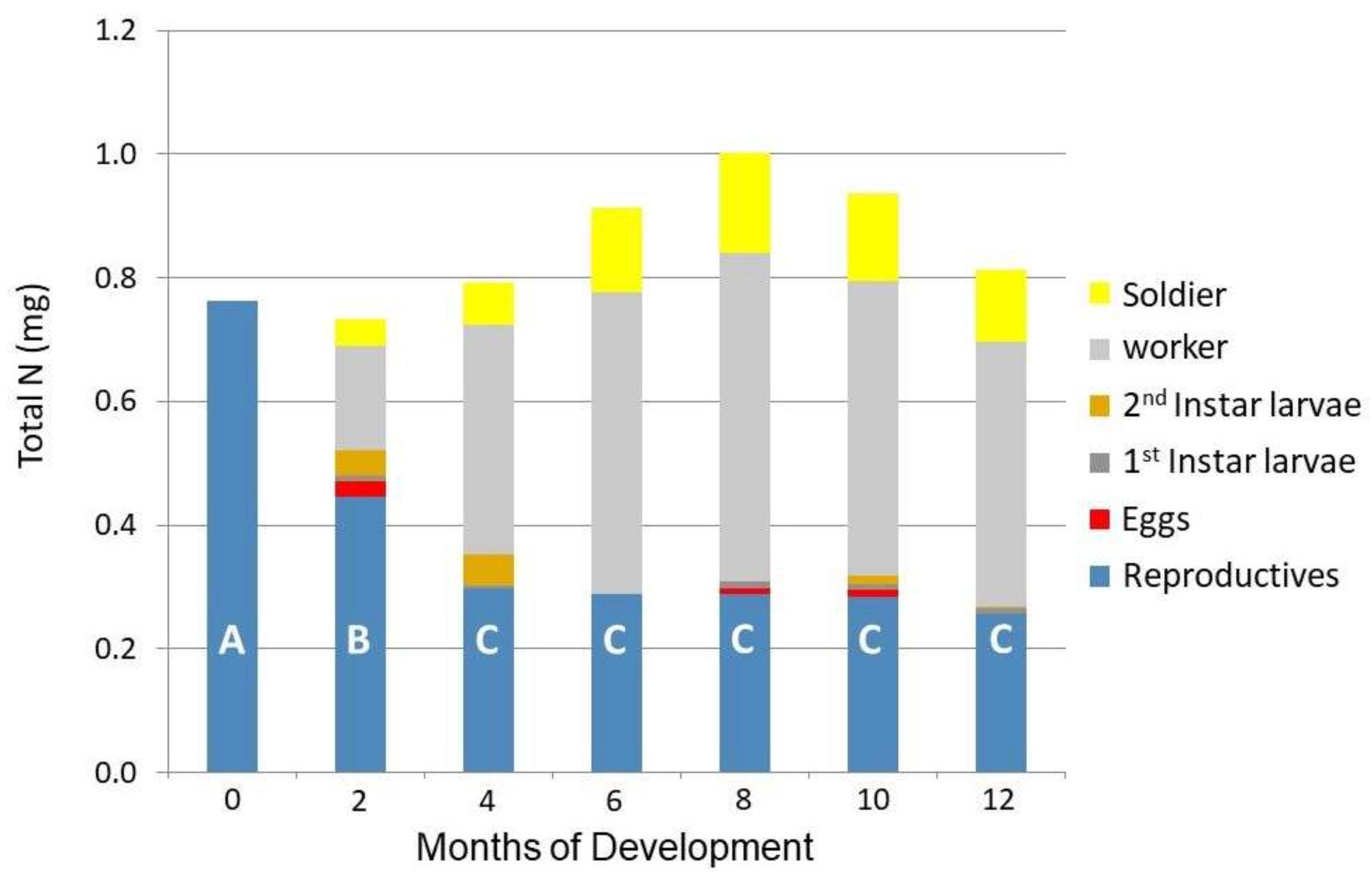
| Month of Development | Reproductives | 1st Instar Larvae | 2nd Instar Larvae | Worker | Soldier/Presoldier | Eggs | Colony Totals |
|---|---|---|---|---|---|---|---|
| 0 | (2 ± 0) 8.53 ± 0.79 mg | N/A | N/A | N/A | N/A | N/A | (2 ± 0) A 8.53 ± 0.79 mg a,b |
| 2 | (2 ± 0) 3.89 ± 0.71 mg | (2.4 ± 1.71) 0.11 ± 0.17 mg | (3.2 ± 2.00) 0.39 ± 0.40 mg | (10.0 ± 4.27) 1.79 ± 0.87 mg | (1.7 ± 1.25) 0.42 ± 0.43 mg | (8.8 ± 7.89) 0.30 ± 0.28 mg | (21.3 ± 7.67) A 6.90 ± 1.88 mg b |
| 4 | (2 ± 0) 2.79 ± 0.38 mg | (0.4 ± 0.70) 0.04 ± 0.09 mg | (4.0 ± 5.12) 0.49 ± 0.72 mg | (22.0 ± 9.01) 4.35 ± 1.63 mg | (2.3 ± 1.06) 0.96 ± 0.60 mg | (0.0 ± 0.0) 0.00 ± 0.00 mg | (32.7 ± 9.13) C 8.63 ± 1.78 mg a,b |
| 6 | (2 ± 0) 2.71 ± 0.23 mg | (0.2 ± 0.42) 0.00 ± 0.00 mg | (0.1 ± 0.32) 0.01 ± 0.03 mg | (25.5 ± 2.95) 5.67 ± 0.74 mg | (3.6 ± 0.84) 1.94 ± 0.40 mg | (0.0 ± 0.0) 0.00 ± 0.00 mg | (33.4 ± 3.20) C 10.33 ± 1.06 mg b,c |
| 8 | (2 ± 0) 2.71 ± 0.31 mg | (0.5 ± 0.85) 0.01 ± 0.032 mg | (0.2 ± 0.42) 0.01 ± 0.03 mg | (27.1 ± 5.95) 6.17 ± 1.52 mg | (4.6 ± 1.65) 2.28 ± 0.74 mg | (3.8 ± 3.99) 0.00 ± 0.00 mg | (36.4 ± 7.97) C 11.31 ± 2.26 mg c |
| 10 | (2 ± 0) 2.68 ± 0.20 mg | (1.6 ± 1.71) 0.09 ± 0.13 mg | (2.2 ± 1.23) 0.00 ± 0.00 mg | (22.8 ± 3.01) 5.52 ± 0.97 mg | (3.9 ± 0.99) 2.01 ± 0.57 mg | (3.6 ± 4.67) 0.00 ± 0.00 mg | (34.5 ± 2.84) C 10.57 ± 1.38 mg b,c |
| 12 | (2 ± 0) 2.41 ± 0.31 mg | (0.5 ± 0.71) 0.01 ± 0.03 mg | (0.5 ± 0.71) 0.02 ± 0.04 mg | (21.9 ± 4.9) 4.99 ± 1.21 mg | (3.7 ± 0.95) 1.64 ± 0.50 mg | (0.2 ± 0.42) 0.00 ± 0.00 mg | (30.6 ± 6.22) C 9.07 ± 1.81 mg a,b |
© 2018 by the authors. Licensee MDPI, Basel, Switzerland. This article is an open access article distributed under the terms and conditions of the Creative Commons Attribution (CC BY) license (http://creativecommons.org/licenses/by/4.0/).
Share and Cite
Mullins, A.; Su, N.-Y. Parental Nitrogen Transfer and Apparent Absence of N2 Fixation during Colony Foundation in Coptotermes formosanus Shiraki. Insects 2018, 9, 37. https://doi.org/10.3390/insects9020037
Mullins A, Su N-Y. Parental Nitrogen Transfer and Apparent Absence of N2 Fixation during Colony Foundation in Coptotermes formosanus Shiraki. Insects. 2018; 9(2):37. https://doi.org/10.3390/insects9020037
Chicago/Turabian StyleMullins, Aaron, and Nan-Yao Su. 2018. "Parental Nitrogen Transfer and Apparent Absence of N2 Fixation during Colony Foundation in Coptotermes formosanus Shiraki" Insects 9, no. 2: 37. https://doi.org/10.3390/insects9020037
APA StyleMullins, A., & Su, N.-Y. (2018). Parental Nitrogen Transfer and Apparent Absence of N2 Fixation during Colony Foundation in Coptotermes formosanus Shiraki. Insects, 9(2), 37. https://doi.org/10.3390/insects9020037