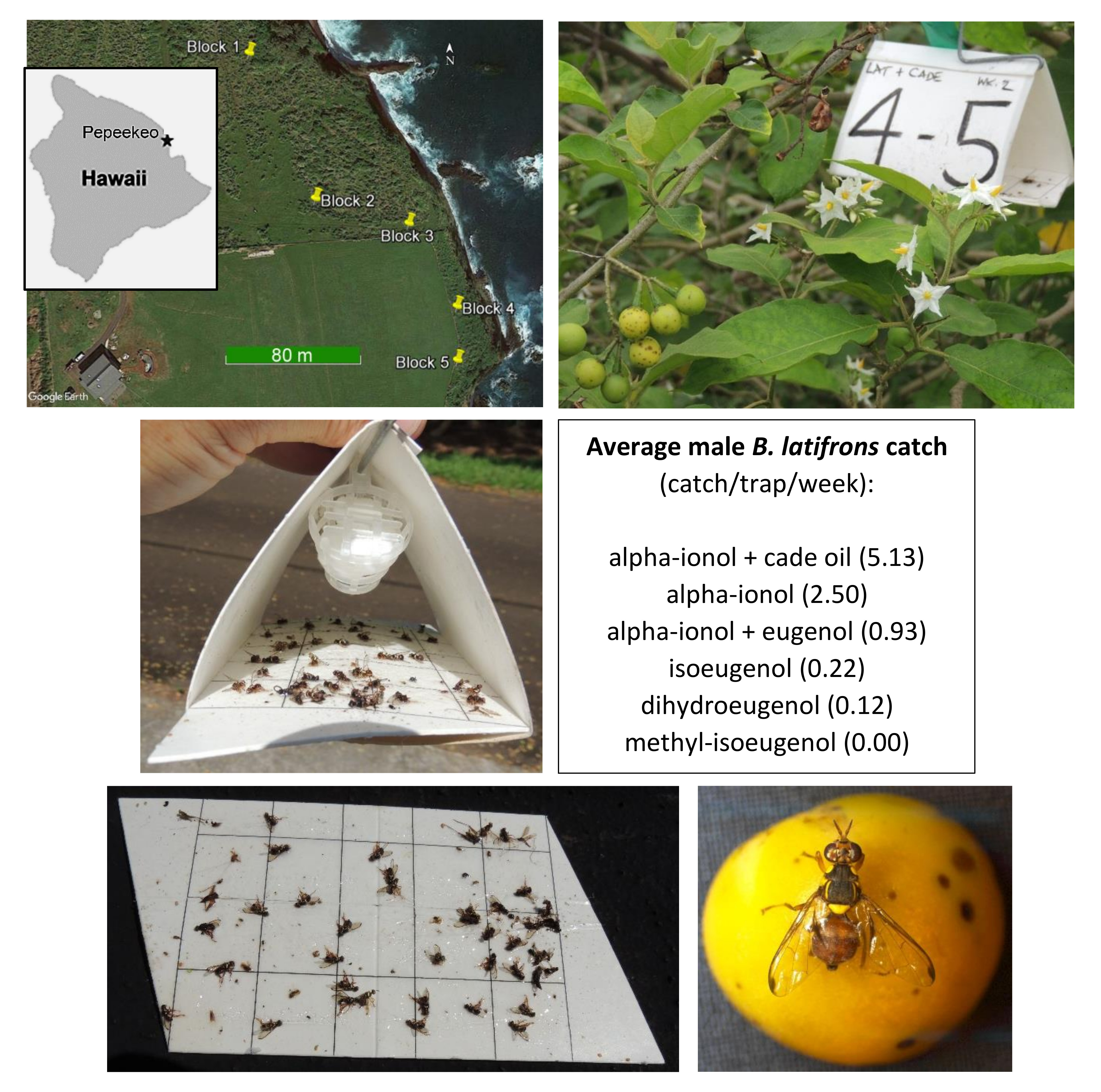
Field Trapping Bactrocera latifrons (Diptera: Tephritidae) with Select Eugenol Analogs That Have Been Found to Attract Other ‘Non-Responsive’ Fruit Fly Species

Abstract
1. Introduction
2. Materials and Methods
2.1. Lures
2.2. Study Site
2.3. Bioassay
2.4. Statistical Analyses
3. Results
4. Discussion
5. Conclusions
Supplementary Materials
Author Contributions
Acknowledgments
Conflicts of Interest
References
- Schutze, M.K.; Virgilio, M.; Norrbom, A.; Clarke, A.R. Tephritid integrative taxonomy: Where we are now, with a focus on the resolution of three tropical fruit fly complexes. Ann. Rev. Entomol. 2016, 62, 147–164. [Google Scholar] [CrossRef] [Scilit] [PubMed]
- White, I.M.; Elson-Harris, M.M. Fruit Flies of Economic Importance: Their Identification and Bionomics; CAB International: Wallingford, UK, 1992; p. 601. ISBN 0-85198-790-7. [Google Scholar]
- Doorenweerd, C.; Leblanc, L.; Norrbom, A.L.; San Jose, M.; Rubinoff, D. A global checklist of the 932 fruit fly species in the tribe Dacini (Diptera: Tephritidae). ZooKeys 2018, 730, 19–56. [Google Scholar] [CrossRef] [Scilit] [PubMed]
- White, I.M. Morphological features of the Tribe Dacini (Dacinae): Their significance to behavior and classification. In Fruit Flies (Tephritidae): Phylogeny and Evolution of Behavior; Aluja, M., Norrbom, A.L., Eds.; CRC Press LLC: Boca Raton, FL, USA, 2000; pp. 505–533. ISBN 0-8493-1275-2. [Google Scholar]
- Drew, R.A.I. The tropical fruit flies (Diptera: Tephritidae: Dacinae) of the Australasian and Oceanian Regions. Mem. Qld. Mus. 1989, 26, 1–521. [Google Scholar]
- Drew, R.A.I.; Romig, M.C. Pest species in the genera Bactrocera and Dacus. In Tropical Fruit Flies (Tephritidae: Dacinae) of South-East Asia; CAB International: Wallingford, UK, 2013; pp. 408–410. ISBN 978-1-78064-035-8. [Google Scholar]
- Virgilio, M.; Jordaens, K.; Verwimp, C.; White, I.M.; De Meyer, M. Higher phylogeny of frugivorous flies (Diptera, Tephritidae, Dacini): Localized partition conflicts and a novel generic classification. Mol. Phylogenet. Evol. 2015, 85, 171–179. [Google Scholar] [CrossRef] [Scilit] [PubMed]
- Drew, R.A.I.; Hancock, D.L. Phylogeny of the Tribe Dacini (Dacinae) based on morphological, distributional, and biological data. In Fruit Flies (Tephritidae): Phylogeny and Evolution of Behavior; Aluja, M., Norrbom, A.L., Eds.; CRC Press LLC: Boca Raton, FL, USA, 2000; pp. 491–504. ISBN 0-8493-1275-2. [Google Scholar]
- Royer, J.E.; Agovaua, S.; Bokosou, J.; Kurika, K.; Mararuai, A.; Mayer, D.G.; Niangu, B. Responses of fruit flies (Diptera: Tephritidae) to new attractants in Papua New Guinea. Austral Entomol. 2018, 57, 40–49. [Google Scholar] [CrossRef] [Scilit]
- Royer, J.E. Responses of fruit flies (Tephritidae: Dacinae) to novel male attractants in north Queensland, Australia, and improved lures for some pest species. Austral Entomol. 2015, 54, 411–426. [Google Scholar] [CrossRef] [Scilit]
- Fay, H.A.C. Exploring structure-activity relationships in the phenylpropanoids to procure new male lures for non-responsive Bactrocera and Dacus. In Proceedings of the 8th International Symposium on Fruit Flies of Economic Importance (26 September–1 October 2010, Valencia, Spain); Muñoz, B.S., Llopis, V.N., García, A.U., Eds.; Editorial Universtat Politècnica de València: Valencia, Spain, 2010; pp. 270–280. Available online: https://riunet.upv.es/handle/10251/14530 (accessed on 12 April 2018).
- McQuate, G.T.; Liquido, N.J. Annotated world bibliography of host fruits of Bactrocera latifrons (Hendel) (Diptera: Tephritidae). Insecta Mundi 2013, 289, 1–61. Available online: http://centerforsystematicentomology.org/insectamundi/0289McQuateandLiquido.pdf (accessed on 11 January 2018).
- McQuate, G.T.; Liquido, N.J. Host plants of Solanum fruit fly, Bactrocera latifrons (Hendel) (Diptera: Tephritidae). In USDA Compendium of Fruit Fly Host Information, Edition 3.0; Liquido, N.J., McQuate, G.T., Suiter, K.A., Eds.; USDA-APHIS-CPHST: Raleigh, NC, USA, 2017. Available online: https://coffhi.cphst.org/ (accessed on 16 March 2018).
- Liquido, N.J.; Harris, E.J.; Dekker, L.A. Ecology of Bactrocera latifrons (Diptera: Tephritidae) populations: Host plants, natural enemies, distribution, and abundance. Ann. Entomol. Soc. Am. 1994, 87, 71–84. [Google Scholar] [CrossRef] [Scilit]
- Vargas, R.I.; Nishida, T. Survey for Dacus latifrons (Diptera: Tephritidae). J. Econ. Entomol. 1985, 78, 1311–1314. [Google Scholar] [CrossRef] [Scilit]
- Mwatawala, M.W.; De Meyer, M.; White, I.M.; Maerere, A.; Makundi, R.H. Detection of the solanum fruit fly, Bactrocera latifrons (Hendel) in Tanzania (Dipt., Tephritidae). J. Appl. Entomol. 2007, 131, 501–503. [Google Scholar] [CrossRef] [Scilit]
- Papadopoulos, N.T.; Plant, R.E.; Carey, J.R. From trickle to flood: The large-scale, cryptic invasion of California by tropical fruit flies. Proc. R. Soc. B 2013, 280, 20131466. [Google Scholar] [CrossRef] [Scilit] [PubMed]
- McQuate, G.T.; Keum, Y.-S.; Sylva, C.D.; Li, Q.X.; Jang, E.B. Active ingredients in cade oil which synergize the attractiveness of alpha-ionol to male Bactrocera latifrons (Diptera: Tephritidae). J. Econ. Entomol. 2004, 97, 862–870. [Google Scholar] [CrossRef] [Scilit] [PubMed]
- Flath, R.A.; Cunningham, R.T.; Liquido, N.J.; McGovern, T.P. α-Ionol as attractant for trapping Bactrocera latifrons (Diptera: Tephritidae). J. Econ. Entomol. 1994, 87, 1470–1476. [Google Scholar] [CrossRef] [Scilit]
- McQuate, G.T.; Peck, S.L. Enhancement of attraction of alpha-ionol to male Bactrocera latifrons (Diptera: Tephritidae) by addition of a synergist, cade oil. J. Econ. Entomol. 2001, 94, 39–46. [Google Scholar] [CrossRef] [Scilit] [PubMed]
- Bellis, G.A.; Brito, A.A.; De Jesus, H.; Quintao, V.; Sarmento, J.C.; Bere, A.; Rodrigues, J.; Hancock, D.L. A preliminary account of the fruit fly fauna of Timor-Leste (Diptera: Tephritidae: Dacinae). Zootaxa 2017, 4362, 421–432. [Google Scholar] [CrossRef] [Scilit] [PubMed]
- McQuate, G.T.; Jang, E.B.; Siderhurst, M. Detection/Monitoring of Bactrocera latifrons (Diptera: Tephritidae): Assessing the Potential of Prospective New Lures. Proc. Hawaii. Entomol. Soc. 2013, 45, 69–81. [Google Scholar]
- McQuate, G.T.; Bokonon-Ganta, A.H.; Jang, E.B. Use of Alpha-Ionol + Cade Oil for Detection and Monitoring of Bactrocera latifrons (Diptera: Tephritidae) Populations. In Fruit Flies of Economic Importance: From Basic to Applied Knowledge. Proceedings of the 7th International Symposium on Fruit Flies of Economic Importance (10–15 September 2006, Salvador, Bahia, Brazil); Sugayama, R., Zucchi, R.A., Ovruski, S., Sivinski, J., Eds.; SBPC (Sociedade Brasileira para o Progresso da Ciência): São Paulo, Brazil, 2008; pp. 89–95. Available online: http://www.moscamed.org.br/simposium.html (accessed on 11 January 2018).
- USGS. The Universal Transverse Mercator (UTM) Grid. Fact Sheet 077-01 (August 2001); 2001. Available online: https://pubs.usgs.gov/fs/2001/0077/report.pdf (accessed on 5 January 2018).
- Shelly, T.E.; Pahio, E.; Edu, J. Synergistic and inhibitory interactions between methyl eugenol and cue lure influence trap catch of male fruit flies, Bactrocera dorsalis (Hendel) and B. cucurbitae (Diptera: Tephritidae). Fla. Entomol. 2004, 87, 481–486. [Google Scholar] [CrossRef] [Scilit]
- SAS Institute Inc. JMP 11.2.0; SAS Institute Inc.: Cary, NC, USA, 2013. [Google Scholar]
- Metcalf, R.L.; Metcalf, E.R. Plant Kairomones in Insect Ecology and Control; Chapman and Hall: New York, NY, USA, 1992; p. 168. ISBN 0-412-01991-4. [Google Scholar]
- Royer, J.E.; Kahn, M.; Mayer, D.G. Methyl-isoeugenol, a highly attractive male lure for the cucurbit flower pest Zeugodacus diversus (Coquillett) (syn. Bactrocera diversa) (Diptera: Tephritidae: Dacinae). J. Econ. Entomol. 2018, 111. [Google Scholar] [CrossRef] [Scilit] [PubMed]
- Royer, J.E.; Teakle, G.; Mayer, D.G. Methyl-isoeugenol, a significantly more attractive male lure for the methyl eugenol-responsive Pacific fruit fly, Bactrocera xanthodes (Broun) (Diptera: Tephritidae: Dacinae). 2018; manuscript in preparation.
- Royer, J.E.; Mille, C.; Cazeres, S.; Brinon, J.; Mayer, D.G. Isoeugenol, a more attractive male lure for the cuelure-responsive pest fruit fly Bactrocera curvipennis (Froggatt) (Tephritidae: Dacinae), and new records of species responding to zingerone in New Caledonia. 2018; manuscript in preparation.
- Inskeep, J. (Macquarie University, Sydney, New South Wales, Australia). Personal communication, 2018.
- Enomoto, H.; Ishida, T.; Hamagami, A.; Nishida, R. 3-Oxygenated α-ionone derivatives as potent male attractants for the solanaceous fruit fly, Bactrocera latifrons (Diptera: Tephritidae), and sequestered metabolites in the rectal gland. Appl. Entomol. Zool. 2010, 45, 551–556. [Google Scholar] [CrossRef] [Scilit]
- Nishida, R. (Kyoto University, Kyoto, Kansai, Japan); Tan, K.H. (Tan Hak Heng Co., Ulu Tiram, Johor, Malaysia). Personal communication, 2016.

© 2018 by the authors. Licensee MDPI, Basel, Switzerland. This article is an open access article distributed under the terms and conditions of the Creative Commons Attribution (CC BY) license (http://creativecommons.org/licenses/by/4.0/).
Share and Cite
McQuate, G.T.; Royer, J.E.; Sylva, C.D. Field Trapping Bactrocera latifrons (Diptera: Tephritidae) with Select Eugenol Analogs That Have Been Found to Attract Other ‘Non-Responsive’ Fruit Fly Species. Insects 2018, 9, 50. https://doi.org/10.3390/insects9020050
McQuate GT, Royer JE, Sylva CD. Field Trapping Bactrocera latifrons (Diptera: Tephritidae) with Select Eugenol Analogs That Have Been Found to Attract Other ‘Non-Responsive’ Fruit Fly Species. Insects. 2018; 9(2):50. https://doi.org/10.3390/insects9020050
Chicago/Turabian StyleMcQuate, Grant T., Jane E. Royer, and Charmaine D. Sylva. 2018. "Field Trapping Bactrocera latifrons (Diptera: Tephritidae) with Select Eugenol Analogs That Have Been Found to Attract Other ‘Non-Responsive’ Fruit Fly Species" Insects 9, no. 2: 50. https://doi.org/10.3390/insects9020050
APA StyleMcQuate, G. T., Royer, J. E., & Sylva, C. D. (2018). Field Trapping Bactrocera latifrons (Diptera: Tephritidae) with Select Eugenol Analogs That Have Been Found to Attract Other ‘Non-Responsive’ Fruit Fly Species. Insects, 9(2), 50. https://doi.org/10.3390/insects9020050