The Functional Role of Prion Protein (PrPC) on Autophagy

Abstract
1. Introduction
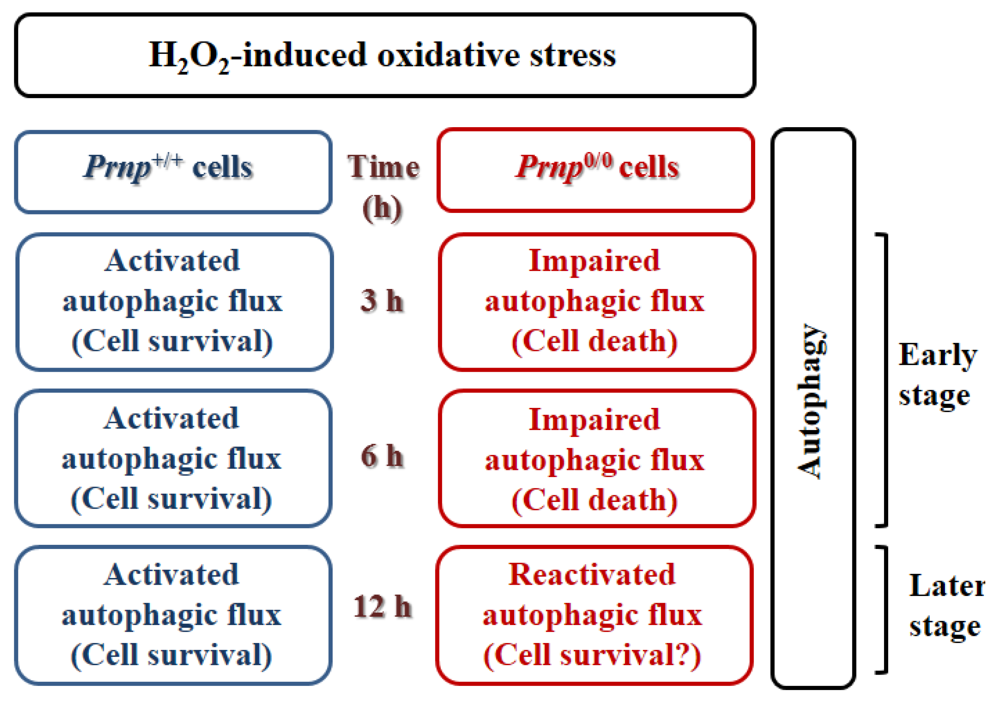
2. The Functional Role of PrPC on Autophagy in vitro

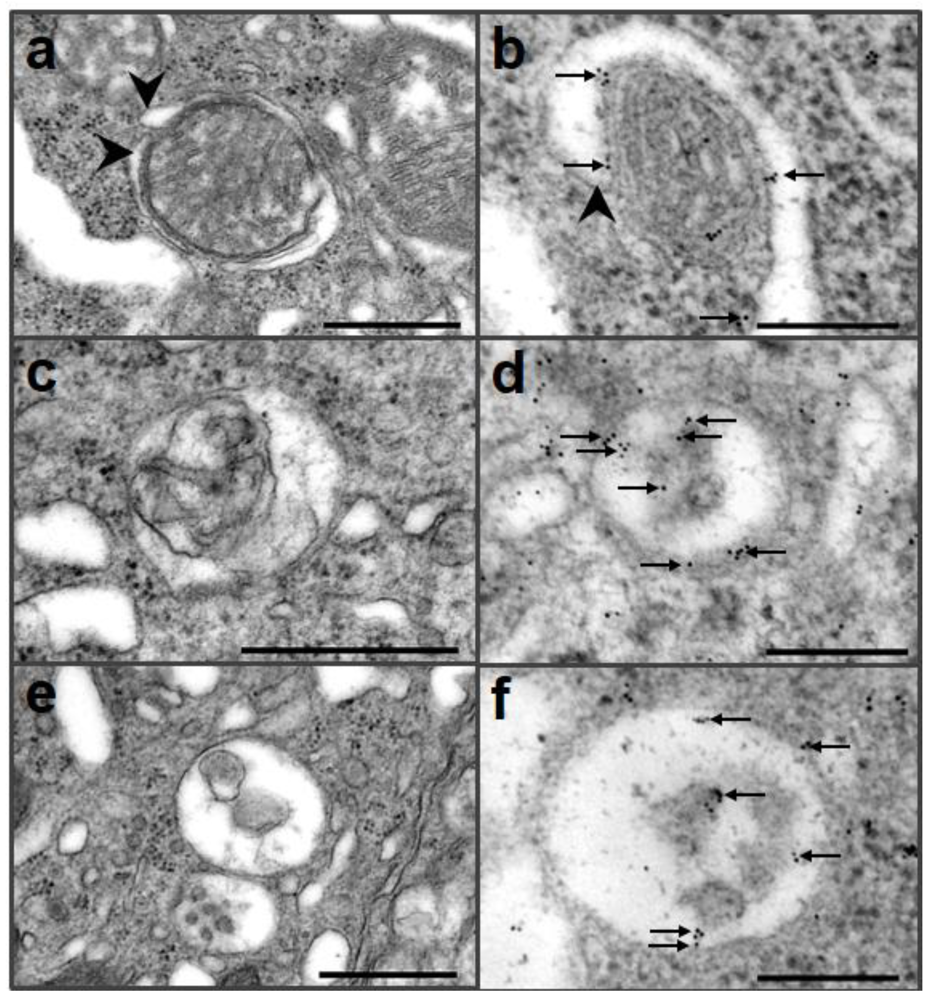
3. The functional role of PrPC on autophagy in vivo

| 3-4 months of age | 6-8 months of age | |
|---|---|---|
| PrP-deficient mice |
|
|
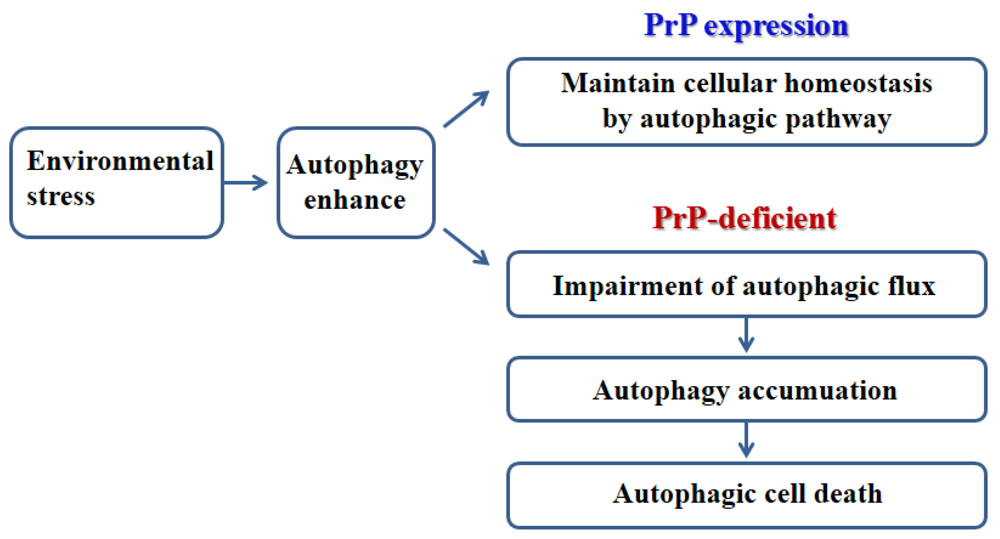
4. Conclusions
Acknowledgments
References
- Basler, K.; Oesch, B.; Scott, M.; Westaway, D.; Wälchli, M.; Groth, D.F.; McKinley, M.P.; Prusiner, S.B.; Weissmann, C. Scrapie and cellular PrP isoforms are encoded by the same chromosomal gene. Cell 1986, 46, 417–428. [Google Scholar] [CrossRef]
- Kretzschmar, H.A.; Prusiner, S.B.; Stowring, L.E.; DeArmond, S.J. Scrapie prion proteins are synthesized in neurons. Am. J. Pathol. 1986, 122, 1–5. [Google Scholar]
- Prusiner, S.B. Molecular biology of prion diseases. Science 1991, 252, 1515–1522. [Google Scholar] [CrossRef]
- Sales, N.; Rodolfo, K.; Hassig, R.; Faucheux, B.; Di Giamberardino, L.; Moya, K.L. Cellular prion protein localization in rodent and primate brain. Eur. J. Neurosci. 1998, 10, 2464–2471. [Google Scholar] [CrossRef]
- Bolton, D.C.; McKinley, M.P.; Prusiner, S.B. Identification of a protein that purifies with the scrapie prion. Science 1982, 218, 1309–1311. [Google Scholar]
- Prusiner, S.B. Prions. Proc. Natl. Acad. Sci. USA 1998, 95, 13363–13383. [Google Scholar] [CrossRef]
- Aguzzi, A.; Weissmann, C. Spongiform encephalopathies: a suspicious signature. Nature 1996, 383, 666–667. [Google Scholar] [CrossRef]
- Weissmann, C. The Ninth Datta Lecture. Molecular biology of transmissible spongiform encephalopathies. FEBS Lett. 1996, 389, 3–11. [Google Scholar] [CrossRef]
- Klionsky, D.J.; Emr, S.D. Autophagy as a regulated pathway of cellular degradation. Science 2000, 290, 1717–1721. [Google Scholar] [CrossRef]
- Petersen, A.; Larsen, K.E.; Behr, G.G.; Romero, N.; Przedborski, S.; Brundin, P.; Sulzer, D. Expanded CAG repeats in exon 1 of the Huntington's disease gene stimulate dopamine-mediated striatal neuron autophagy and degeneration. Hum. Mol. Genet. 2001, 10, 1243–1254. [Google Scholar] [CrossRef]
- Selimi, F.; Lohof, A.M.; Heitz, S.; Lalouette, A.; Jarvis, C.I.; Bailly, Y.; Mariani, J. Lurcher GRID2-induced death and depolarization can be dissociated in cerebellar Purkinje cells. Neuron 2003, 37, 813–819. [Google Scholar] [CrossRef]
- Kabeya, Y.; Mizushima, N.; Ueno, T.; Yamamoto, A.; Kirisako, T.; Noda, T.; Kominami, E.; Ohsumi, Y.; Yoshimori, T. LC3, a mammalian homologue of yeast Apg8p, is localized in autophagosome membranes after processing. EMBO J. 2000, 19, 5720–5728. [Google Scholar] [CrossRef]
- Noda, T.; Matsuura, A.; Wada, Y.; Ohsumi, Y. Novel system for monitoring autophagy in the yeast Saccharomyces cerevisiae. Biochem. Biophys. Res. Commun. 1995, 210, 126–132. [Google Scholar] [CrossRef]
- Aubert, S.; Gout, E.; Bligny, R.; Marty-Mazars, D.; Barrieu, F.; Alabouvette, J.; Marty, F.; Douce, R. Ultrastructural and biochemical characterization of autophagy in higher plant cells subjected to carbon deprivation: control by the supply of mitochondria with respiratory substrates. Cell. Biol. 1996, 133, 1251–1263. [Google Scholar] [CrossRef]
- Reunanen, H.; Punnonen, E.L.; Hirsimäki, P. Studies on vinblastine-induced autophagocytosis in mouse liver. V. A cytochemical study on the origin of membranes. Histochemistry 1985, 83, 513–517. [Google Scholar] [CrossRef]
- Manson, J.; West, J.D.; Thomson, V.; McBride, P.; Kaufman, M.H.; Hope, J. The prion protein gene: a role in mouse embryogenesis? Development 1992, 115, 117–122. [Google Scholar]
- Cuervo, A.M. Autophagy: in sickness and in health. Trends Cell. Biol. 2004, 14, 70–77. [Google Scholar] [CrossRef]
- Shintani, T.; Klionsky, D.J. Autophagy in health and disease: a double-edged sword. Science 2004, 306, 990–995. [Google Scholar] [CrossRef]
- Boellaard, J.W.; Schlote, W.; Tateishi, J. Neuronal autophagy in experimental Creutzfeldt-Jakob's disease. Acta Neuropathol. 1989, 78, 410–418. [Google Scholar] [CrossRef]
- Boellaard, J.W.; Kao, M.; Schlote, W.; Diringer, H. Neuronal autophagy in experimental scrapie. Acta Neuropathol. 1991, 82, 225–228. [Google Scholar]
- Schätzl, H.M.; Laszlo, L.; Holtzman, D.M.; Tatzelt, J.; DeArmond, S.J.; Weiner, R.I.; Mobley, W.C.; Prusiner, S.B. A hypothalamic neuronal cell line persistently infected with scrapie prions exhibits apoptosis. J. Virol. 1997, 71, 8821–8831. [Google Scholar]
- Liberski, P.P.; Sikorska, B.; Bratosiewicz-Wasik, J.; Gajdusek, D.C.; Brown, P. Neuronal cell death in transmissible spongiform encephalopathies (prion diseases) revisited: from apoptosis to autophagy. Int. J. Biochem. Cell. Biol. 2004, 36, 2473–2490. [Google Scholar]
- Sikorska, B.; Liberski, P.P.; Giraud, P.; Kopp, N.; Brown, P. Autophagy is a part of ultrastructural synaptic pathology in Creutzfeldt-Jakob disease: a brain biopsy study. Int. J. Biochem. Cell. Biol. 2004, 36, 2563–2573. [Google Scholar] [CrossRef]
- Dron, M.; Bailly, Y.; Beringue, V.; Haeberlé, A.M.; Griffond, B.; Risold, P.Y.; Tovey, M.G.; Laude, H.; Dandoy-Dron, F. Scrg1 is induced in TSE and brain injuries, and associated with autophagy. Eur. J. Neurosci. 2005, 22, 133–146. [Google Scholar] [CrossRef]
- Aguib, Y.; Heiseke, A.; Gilch, S.; Riemer, C.; Baier, M.; Schätzl, H.M.; Ertmer, A. Autophagy induction by trehalose counteracts cellular prion infection. Autophagy 2009, 5, 361–369. [Google Scholar] [CrossRef]
- Heiseke, A.; Aguib, Y.; Riemer, C.; Baier, M.; Schätzl, H.M. Lithium induces clearance of protease resistant prion protein in prion-infected cells by induction of autophagy. J. Neurochem. 2009, 109, 25–34. [Google Scholar] [CrossRef]
- Cortes, C.J.; Qin, K.; Cook, J.; Solanki, A.; Mastrianni, J.A. Rapamycin delays disease onset and prevents PrP plaque deposition in a mouse model of Gerstmann-Sträussler-Scheinker disease. J. Neurosci. 2012, 32, 12396–12405. [Google Scholar] [CrossRef]
- Xu, Y.; Tian, C.; Wang, S.B.; Xie, W.L.; Guo, Y.; Zhang, J.; Shi, Q.; Chen, C.; Dong, X.P. Activation of the macroautophagic system in scrapie-infected experimental animals and human genetic prion diseases. Autophagy 2012, 8, 1604–1620. [Google Scholar]
- Oh, J.M.; Shin, H.Y.; Park, S.J.; Kim, B.H.; Choi, J.K.; Choi, E.K.; Carp, R.I.; Kim, Y.S. The involvement of cellular prion protein in the autophagy pathway in neuronal cells. Mol. Cell. Neurosci. 2008, 39, 238–247. [Google Scholar] [CrossRef]
- Oh, J.M.; Choi, E.K.; Carp, R.I.; Kim, Y.S. Oxidative stress impairs autophagic flux in prion protein-deficient hippocampal cells. Autophagy 2012, 8, 1448–1461. [Google Scholar]
- Heitz, S.; Grant, N.J.; Bailly, Y. Doppel induces autophagic stress in prion protein-deficient Purkinje cells. Autophagy 2009, 5, 422–424. [Google Scholar] [CrossRef]
- Heitz, S.; Grant, N.J.; Leschiera, R.; Haeberlé, A.M.; Demais, V.; Bombarde, G.; Bailly, Y. Autophagy and cell death of Purkinje cells overexpressing Doppel in Ngsk Prnp-deficient mice. Brain. Pathol. 2010, 20, 119–132. [Google Scholar] [CrossRef]
- Wong, B.S.; Liu, T.; Paisley, D.; Li, R.; Pan, T.; Chen, S.G.; Perry, G.; Petersen, R.B.; Smith, M.A.; Melton, D.W.; Gambetti, P.; Brown, D.R.; Sy, M.S. Induction of HO-1 and NOS in doppel-expressing mice devoid of PrP: implications for doppel function. Mol. Cell. Neurosci. 2001, 17, 768–775. [Google Scholar] [CrossRef]
- Cui, T.; Holme, A.; Sassoon, J.; Brown, D.R. Analysis of doppel protein toxicity. Mol. Cell. Neurosci. 2003, 23, 144–155. [Google Scholar] [CrossRef]
- Barbieri, G.; Palumbo, S.; Gabrusiewicz, K.; Azzalin, A.; Marchesi, N.; Spedito, A.; Biggiogera, M.; Sbalchiero, E.; Mazzini, G.; Miracco, C.; Pirtoli, L.; Kaminska, B.; Comincini, S. Silencing of cellular prion protein (PrPC) expression by DNA-antisense oligonucleotides induces autophagy-dependent cell death in glioma cells. Autophagy 2011, 7, 840–853. [Google Scholar] [CrossRef]
- Herms, J.; Tings, T.; Gall, S.; Madlung, A.; Giese, A.; Siebert, H.; Schürmann, P.; Windl, O.; Brose, N.; Kretzschmar, H. Evidence of presynapticlocation and function of the prion protein. J. Neurosci. 1999, 19, 8866–8875. [Google Scholar]
- Brown, D.R.; Wong, B.S.; Hafiz, F.; Clive, C.; Haswell, S.J.; Jones, I.M. Normal prion protein has an activity like that of superoxide dismutase. Biochem. J. 1999, 344, 1–5. [Google Scholar] [CrossRef]
- Lee, H.G.; Park, S.J.; Choi, E.K.; Carp, R.I.; Kim, Y.S. Increased expression of prion protein is associated with changes in dopamine metabolism and MAO activity in PC12 cells. J. Mol. Neurosci. 1999, 13, 121–126. [Google Scholar] [CrossRef]
- Graner, E.; Mercadante, A.F.; Zanata, S.M.; Forlenza, O.V.; Cabral, A.L.; Veiga, S.S.; Juliano, M.A.; Roesler, R.; Walz, R.; Minetti, A.; Izquierdo, I.; Martins, V.R.; Brentani, R.R. Cellular prion protein binds laminin and mediates neuritogenesis. Brain. Res. Mol. Brain. Res. 2000, 76, 85–92. [Google Scholar] [CrossRef]
- Mouillet-Richard, S.; Ermonval, M.; Chebassier, C.; Laplanche, J.L.; Lehmann, S.; Launay, J.M.; Kellermann, O. Signal transduction through prion protein. Science 2000, 289, 1925–1928. [Google Scholar] [CrossRef]
- Mange, A.; Milhavet, O.; Umlauf, D.; Harris, D.; Lehmann, S. PrP-dependent cell adhesion in N2a neuroblastoma cells. FEBS. Lett. 2002, 514, 159–162. [Google Scholar] [CrossRef]
- Li, A.; Harris, D.A. Mammalian prion protein suppresses Bax-induced cell death in yeast. J. Biol. Chem. 2005, 280, 17430–17434. [Google Scholar] [CrossRef]
- Bueler, H.; Fischer, M.; Lang, Y.; Bluethmann, H.; Lipp, H.P.; DeArmond, S.J.; Prusiner, S.B.; Aguet, M.; Weissmann, C. Normal development and behaviour of mice lacking the neuronal cell-surface PrP protein. Nature 1992, 356, 577–582. [Google Scholar] [CrossRef]
- Criado, J.R.; Sa´nchez-Alavez, M.; Conti, B.; Giacchino, J.L.; Wills, D.N.; Henriksen, S.J.; Race, R.; Manson, J.C.; Chesebro, B.; Oldstone, M.B. Mice devoid of prion protein have cognitive deficits that are rescued by reconstitution of PrP in neurons. Neurobiol. Dis. 2005, 19, 255–265. [Google Scholar] [CrossRef]
- Weissmann, C.; Flechsig, E. PrP knock-out and PrP transgenic mice in prion research. Br. Med. Bull. 2003, 66, 43–60. [Google Scholar] [CrossRef]
- Prestori, F.; Rossi, P.; Bearzatto, B.; Laine´, J.; Necchi, D.; Diwakar, S.; Schiffmann, S.N.; Axelrad, H.; D'Angelo, E. Altered Neuron excitability and synaptic plasticity in the cerebellar granular layer of juvenile prion protein knock-out mice with impaired motor control. J. Neurosci. 2008, 28, 7091–7103. [Google Scholar] [CrossRef]
- Singh, A.; Kong, Q.; Luo, X.; Petersen, R.B.; Meyerson, H.; Singh, N. Prion protein (PrP) knock-out mice show altered iron metabolism: A functional role for PrP in iron uptake and transport. PLoS ONE 2009, 4, 1–14. [Google Scholar]
- Sánchez-Pérez, A.M.; Claramonte-Clausell, B.; Sánchez-Andrés, J.V.; Herrero, M.T. Parkinson's disease and autophagy. Parkinsons. Dis. 2012, 2012. [Google Scholar] [CrossRef]
- Sanchez-Varo, R.; Trujillo-Estrada, L.; Sanchez-Mejias, E.; Torres, M.; Baglietto-Vargas, D.; Moreno-Gonzalez, I.; De Castro, V.; Jimenez, S.; Ruano, D.; Vizuete, M.; Davila, J.C.; Garcia-Verdugo, J.M.; Jimenez, A.J.; Vitorica, J.; Gutierrez, A. Abnormal accumulation of autophagic vesicles correlates with axonal and synaptic pathology in young Alzheimer's mice hippocampus. Acta. Neuropathol. 2012, 123, 53–70. [Google Scholar] [CrossRef]
- Jackson, G.S.; Clarke, A.R. Mammalian prion proteins. Curr. Opin. Struct. Biol. 2000, 10, 69–74. [Google Scholar] [CrossRef]
- Brandner, S.; Isenmann, S.; Raeber, A.; Fischer, M.; Sailer, A.; Kobayashi, Y.; Marino, S.; Weissmann, C.; Aguzzi, A. Normal host prion protein necessary for scrapie-induced neurotoxicity. Nature 1996, 379, 339–343. [Google Scholar] [CrossRef]
- Chu, C.T.; Plowey, E.D.; Dagda, R.K.; Hickey, R.W.; Cherra, S.J.; Clark, R.S. Autophagy in neurite injury and neurodegeneration: in vitro and in vivo models. Methods. Enzymol. 2009, 453, 217–249. [Google Scholar]
- Bursch, W.; Ellinger, A.; Gerner, C.; Frohwein, U.; Schulte-Hermann, R. Programmed cell death (PCD). Apoptosis, autophagic PCD, or others? Ann. N. Y. Acad. Sci. 2000, 926, 1–12. [Google Scholar]
- Dong, J.; Li, A.; Yamaguchi, N.; Sakaguchi, S.; Harris, D.A. Doppel induces degeneration of cerebellar Purkinje cells independently of Bax. Am. J. Pathol. 2007, 171, 599–607. [Google Scholar] [CrossRef]
- Lee, J.A. Autophagy in neurodegeneration: two sides of the same coin. BMB Rep. 2009, 42, 324–330. [Google Scholar] [CrossRef]
- Wong, E.; Cuervo, A.M. Autophagy gone awry in neurodegenerative diseases. Nat. Neurosci. 2010, 13, 805–811. [Google Scholar] [CrossRef]
© 2013 by the authors; licensee MDPI, Basel, Switzerland. This article is an open access article distributed under the terms and conditions of the Creative Commons Attribution license (http://creativecommons.org/licenses/by/3.0/).
Share and Cite
Shin, H.-Y.; Oh, J.-M.; Kim, Y.-S. The Functional Role of Prion Protein (PrPC) on Autophagy. Pathogens 2013, 2, 436-445. https://doi.org/10.3390/pathogens2030436
Shin H-Y, Oh J-M, Kim Y-S. The Functional Role of Prion Protein (PrPC) on Autophagy. Pathogens. 2013; 2(3):436-445. https://doi.org/10.3390/pathogens2030436
Chicago/Turabian StyleShin, Hae-Young, Jae-Min Oh, and Yong-Sun Kim. 2013. "The Functional Role of Prion Protein (PrPC) on Autophagy" Pathogens 2, no. 3: 436-445. https://doi.org/10.3390/pathogens2030436
APA StyleShin, H.-Y., Oh, J.-M., & Kim, Y.-S. (2013). The Functional Role of Prion Protein (PrPC) on Autophagy. Pathogens, 2(3), 436-445. https://doi.org/10.3390/pathogens2030436