


Abstract
The management of organic waste in mining operations located in remote regions poses considerable logistical challenges, primarily because of the long distance to available landfill sites and the associated high costs. In addition, substantial environmental concerns arise from greenhouse gas emissions generated during waste processing and transportation. This study evaluated the implementation of an accelerated and automated composting process for the on-site treatment of organic waste at a mining operation. Operational performance indicators were established and evaluated over a 14-month period, including waste-to-compost conversion ratios, environmental indicators comparing emissions from conventional waste management with on-site treatment, and an economic profitability analysis. The quality of the produced compost was also assessed. The results showed an average conversion rate of 32 ± 7%, resulting in a 38% reduction in emissions compared with landfill disposal, equivalent to 0.17 kg CO2e per kg of food waste treated. From an economic perspective, the process generated savings equivalent to USD 41.52 per Mg of food waste. Overall, the quality of the compost produced was adequate and met most regulatory and hygiene requirements. The comprehensive evaluation demonstrated that the improvements achieved by this management model offer an opportunity for treating organic waste in mining contexts and in communities with limited access, as well as under operational or environmental conditions that restrict conventional composting alternatives.
1. Introduction
The management of solid waste, particularly organic food waste, is a major challenge for modern societies and urban development [1], as well as for mining operations. The challenges faced by many mining units in managing food waste (FW) can be compared to the problems encountered in island or isolated communities, where limited infrastructure and logistical constraints make the implementation of efficient waste management strategies essential [2]. This need is especially relevant for the organic fraction of general or municipal solid waste, which accounts for approximately 60–70% of the total waste generated in many developing countries [3,4].
In mining operations, FW is usually sent to landfills, a practice associated with complex logistics, high transportation and disposal costs, and significant environmental risks, including greenhouse gas (GHG) emissions throughout the management chain. In high Andean regions, these limitations are magnified by adverse weather conditions and poor road access, making it necessary to establish management strategies that minimize impacts and promote long-term sustainability.
Composting is one of the most widely used alternatives for treating and valorizing biodegradable waste and has demonstrated economic and environmental viability in different regions of the world [5,6,7]. Composting contributes to reducing GHG emissions compared with landfill disposal [3,5] and provides several economic benefits [8]. This treatment approach aligns with the principles of the circular economy by enabling nutrient recirculation, reducing the amount of waste sent for final disposal, and replacing external inputs such as organic fertilizers [9,10,11,12,13,14].
However, the effectiveness of conventional composting is strongly affected by environmental conditions, because the biological processes involved depend on temperature, moisture, and aeration. In regions with unfavorable environmental conditions, such as low temperatures or limited or excessive rainfall, in-vessel composting systems offer substantial advantages by enabling greater process control and reducing treatment times through the regulation of key operational parameters [15,16]. Nevertheless, information remains limited regarding the performance of accelerated composting systems under the logistical and environmental constraints typical of remote mining operations, as well as their environmental and economic benefits relative to conventional disposal practices.
Therefore, this study evaluates an accelerated composting system specifically implemented to treat food waste generated at a mining unit. Unlike assessments that focus solely on process performance, this study integrates operational, environmental, economic, and product quality perspectives to provide a comprehensive evaluation of the technology under real operating conditions. The objectives were to: (i) assess the operational efficiency, environmental impact, and economic viability of the system compared with landfill disposal; and (ii) evaluate the quality of the compost produced by the treatment process.
2. Materials and Methods
2.1. Assay Conditions, Equipment and Materials
The study was conducted at the Cerro Corona mining unit, operated by Gold Fields La Cima S.A., located in the high Andean region of Hualgayoc, Cajamarca (Peru). The area is characterized by average temperatures of 7 °C, with minimums from 2.6 °C in July–October and maximums in November–January at 14 °C. Annual precipitation ranges from 1100 to 1400 mm, corresponding to a temperate climate with mild to moderate winters and a non-xeric aridity regime [17], with Citrus-type winters, Triticum-type summers, and a high and humid cold-earth humidity regime according to Papadakis [18]. The food waste (FW) used in the study was obtained from the mining camp dining hall and treated in an accelerated composting unit, the Ecobot EB-1000 (Maharashtra, India, ISOKLIN Fine Chem©). The unit has a maximum capacity of 1000 kg FW/day, an average power consumption of 31 kW, and performs shredding, microbial inoculation (Bioactive Isoklin©; 1011 CFU/g), mixing, and an accelerated thermal phase at an operating temperature of 75 ± 3 °C.
The evaluation period for the accelerated composting treatment covered 14 months, from May 2024 to August 2025, to ensure seasonal representativeness of the food waste. This waste consisted of a mixture of processed and unprocessed food residues, including vegetable scraps, eggshells, meat trimmings, rice and bread, with it having a moisture content ranging from 50 to 85%. During this period, 215 production records were obtained and used to evaluate the operational, environmental, and economic efficiency of the process, as well as the quality of the final product.
2.2. Evaluation of Operational, Environmental and Economic Efficiency
Operational efficiency was determined by quantifying the amount of compost produced per equipment operating cycle and by evaluating both the conversion rate (compost/FW) and the variability of production per unit of time to determine operational yields.
Environmental efficiency was assessed by determining the carbon footprint associated with the composting process and comparing it with that of landfill disposal. For the accelerated composting process, emissions derived from electricity consumption were considered using the Peruvian electricity mix emission factor of 0.218 kgCO2e/kWh [19]. This calculation considered the total equipment operating time and the amount of food waste (FW) managed.
To determine the carbon footprint associated with the landfill disposal, emissions from waste transport outside the mining unit (1) and emissions generated by waste degradation in the landfill (2–5) were considered. For both calculations, the following considerations and equations from the IPCC were considered [20,21,22]:
where Fuel is the amount of fuel consumed (TJ), and EF is the emission factor (kg/TJ). For this, the calorific value of diesel (43 TJ/Mg) was considered, as shown in Table 1.2 of IPCC, Vol. 2 [20], along with the following emission factors (in kg/TJ: CO2 74,100; CH4 3.9; N2O 3.9), as shown in Tables 3.2.1 and 3.2.2 of Vol. 2. IPCC [20]. The transport’s operating capacity was 5 Mg, with an average consumption of 0.40 L/km, and a final disposal distance of 327 km.
where DDOCm is the mass of decomposable DOC deposited (Mg); W is the mass of waste deposited (Mg); DOC is the degradable organic carbon in the year of deposition, (fraction = 0.05) (Mg); DOCf is the fraction of DOC that can decompose (fraction = 0.7); and MCF is the CH4 correlation factor for aerobic decomposition in the year of deposition (0.5) [21].
where t is the inventory year; DDOCmat is the DDOCm accumulated in the landfill at the end of year t (Mg); DDOCmaT−1 is the DDOCm deposited into the landfill in year t, (Mg); DDOCmdt is the DDOCm decomposed in the landfill in year T (Mg); k is the reaction constant, being k = ln(2)/t1/2 (y−1) (k = 0.06); t1/2 is the half-life time (12 years) [21].
where CH4 generated is the amount of CH4 generated from decomposable material; DDOCm decompot is DDOCm decomposed in year t (Mg); F is the fraction of CH4, by volume, in generated landfill gas; 16/12 is the molecular weight ratio CH4/C [21].
Emissions = Fuel · EF
DDOCm = W · DOC · DOCf · MCF
DDOCma. = DDOCmdt + (DDOCmat−1 · e−k)
DDOCm decompt = DDOCmat−1 · (1 − e−k)
CH4 generated = DDOCm decompt · F · 16/12
According to the IPCC (AR6), the global warming factors (GWP100) for CH4 from fossil origin and biogenic origin were 29.8 and 27.2, respectively, and the GWP for N2O was 273 [22]. The methodology used for the uncertainty analysis and the results obtained are presented in the Supplementary Material.
The economic efficiency of the process was evaluated by comparing the direct processing costs of accelerated composting with those of landfill disposal, including operating costs and the economic value associated with environmental benefits and the generated product. The energy use of methane in landfills has not been evaluated, as it is not the existing system in the study area; therefore, it is excluded from the environmental and economic analysis.
2.3. Physicochemical and Microbiological Characterization of the Compost
For the physicochemical characterization of the compost, 12 composite samples were collected, dried at 40 °C, homogenized, and sieved at 2 mm [23]. The bulk density was determined [24]. The following physicochemical analyses were performed on the fraction smaller than 2 mm: moisture [25]; electrical conductivity (EC) [26] and pH in water [27]; organic matter (OM) [28]; total N by Kjeldahl method [29]. The elemental contents in the pseudo-total fraction were obtained by acid digestion [30]. The different elements in the pseudo-total fractions (P; As; Pb, Hg, Cr, Cd and Ni) were quantified by inductively coupled plasma optical emission spectroscopy (ICP-OES) and (Ca; Cu; Fe; K; Mg; Mn; Na and Zn) by Flame Atomic Absorption Spectroscopy (FASS).
The microbiological characterization consisted of determining the content of Salmonella [31]; fecal coliforms [32], and helminth ova enumeration [33]. All analyses were carried out in ISO 17025 certified laboratories, whose limits of quantification for the main indicated methodologies are presented in the Supplementary Material (Table S2).
2.4. Statistical Analysis
The study data allowed calculations and analyses of operational feasibility, environmental value, and economic impact, with the data processed in Office Excel. For numerical processing of compost quality data, element content below the detection limit of the equipment was considered equal to the limit value. Quality control of the analyses was performed using analytical replicates, certified standard solutions, blanks, and laboratory standards (ALS LS Perú S.A.C).
3. Results and Discussion
3.1. Comprehensive Evaluation of the Operational, Environmental and Economic Efficiency of the Composting Process
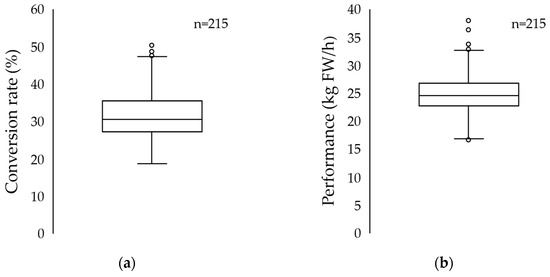
The evaluation of the 215 accelerated composting production records enabled the establishment of several operational indicators. During the assessment period, a total of 186.9 Mg of food waste (FW) was treated, producing 60.45 Mg of compost. The compost/FW conversion rate was 32 ± 7%, with mass losses consistent with dehydration and organic matter oxidation processes (Figure 1a). The average processing time per cycle was 35.67 h, corresponding to an operational efficiency of 24.71 ± 3.54 kg FW/h (Figure 1b), equivalent to an approximate daily operating capacity of 590 kg of food waste. It should be noted that the product resulting from the accelerated composting process and which has been sanitized is not subjected to any further curing or maturation process; it is simply stored or used.
Figure 1.
Operational evaluation: (a) conversion rate; (b) performance, in kg FW/h.
The results of the evaluation of emissions avoided by the rapid composting process compared with conventional landfill disposal are presented in Table 1. Internal transport processes, which were considered equivalent for both management alternatives, and emissions from the composting process itself, which were negligible based on direct measurements (Table S3), were excluded from the quantification. Over the full assessment period, rapid composting avoided 32,630 kg CO2, equivalent to 0.17 kg CO2e per kg of food waste treated, representing a 38% reduction relative to landfill disposal. These values are consistent with those reported in previous studies [34,35,36].
Table 1.
Calculation of emissions from landfill disposal and rapid composting processes. Input variables are presented, and total emissions are expressed as Mg CO2e and as emissions per kg of food waste (FW).
For the economic evaluation of the accelerated composting management model, annual depreciation was considered together with the operating costs associated with managing 186.19 Mg of food waste, resulting in a total cost of USD 99,719.71 (Table 2). This value represents an increase of USD 27,269.03 compared with landfill disposal. Although the total operating cost was higher for accelerated composting, the valorization of the treated material generated a marketable compost product, resulting in a final project balance of USD 7731.52 and an improvement of USD 41.52 per Mg of FW (Table 2). It should be noted that operating costs accounted for 53% of the total cost of the composting model, indicating an opportunity to improve process efficiency and increase the profitability of FW valorization and management.
Table 2.
Economic analysis of food waste management through landfill disposal versus accelerated composting, expressed in US dollars (USD).
3.2. Comparison with Conventional Decentralized Composting Systems
Although the accelerated composting system showed clear environmental and economic benefits compared with landfill disposal—the management approach previously used by the mining company—a comparison was also conducted with conventional decentralized composting technologies, particularly windrow composting and aerated static piles, which are widely used for organic waste management (Table 3). Conventional windrow systems generally require larger land areas and periodic mechanical turning to maintain adequate temperature and moisture conditions for microbial activity, and they are more dependent on environmental conditions [37,38,39]. These limitations are particularly relevant for many mining projects in the Andean region, as well as for isolated communities, many of which are located above 3500 m.a.s.l., where low temperatures and climatic variability may slow biodegradation processes and affect process stability.
Table 3.
Comparative aspects between conventional on-site treatment systems and the accelerated composting model.
By contrast, accelerated composting operates under controlled aeration and temperature conditions, maintaining thermophilic temperatures throughout the processing cycle. This level of control promotes more efficient pathogen inactivation, improves process stability, and reduces sensitivity to climatic variation, compared with open composting systems [37].
Another important difference is related to the operational footprint and processing time. Windrow composting typically requires extended treatment and maturation periods ranging from several weeks to several months, depending on the characteristics of the feedstock and local environmental conditions [37,40]. In contrast, the accelerated system completes its treatment cycle in approximately 36 h, reducing space requirements and enabling continuous operation close to the source of waste generation. These attributes are particularly advantageous in remote mining facilities or communities where land and labor availability, and transport logistics may represent major operational constraints.
However, the accelerated composting system requires a higher initial investment and greater energy consumption for process control than conventional systems. Table 3 summarizes the main comparative aspects of the evaluated systems.
3.3. Quality of the Compost Produced
The physicochemical and microbiological characterization of the compost produced during the 14-month evaluation period showed generally suitable quality, meeting most of the parameters established in Peruvian regulations, specifically the Peruvian Technical Regulation (NTP 201.207:2020) for fertilizers [41], and showing values comparable to the international reference standard for Class A compost quality in Canada [42]. The compost quality assessment was based not only on the content of potentially toxic elements, but also on parameters such as pH, electrical conductivity, and the C/N ratio, which are relevant indicators of compost stability and agronomic suitability [43].
The compost batches produced using the implemented system did not exhibit unpleasant odors or the presence of impurities, such as inert materials larger than 16 mm. The absence of unpleasant odors is a useful indicator of compost stability [44], which is also supported by parameters such as moisture content and bulk density [45]. Compost maturity and stability are not defined by a single parameter; rather, they are commonly assessed using complementary indicators such as the nitrification index [44], germination indices [45], phytotoxicity indices [46], or particle size [44], among others. The moisture content is a key parameter for compost stabilization, as well as for microbial activity, showing values in the compost between 7 and 22%, lower than the normative reference values [41,42], but characteristic of adequate compost stabilization [9]. Bulk density also showed low values, below the NTP limits [41], indicating good physical structure and porosity. These characteristics may contribute to soil aeration, facilitating root penetration and water infiltration. Parameters such as respiration activity, germination indices, or nitrification were not measured in this study, which may limit the understanding of the product’s maturity, even though these parameters are not included in national or international regulations applied to compost.
The average pH of compost was 5.38, with a range between 4.60 and 7.80 (Table 4), indicating acidic to neutral reaction conditions, although within the ranges established in the quality reference standards [41,42]. Lower pH values are commonly associated with the presence of acetic and lactic acids during the early or intermediate stages of decomposition [34,47,48,49]. Electrical conductivity also showed substantial variability, with several elevated values that exceeded the thresholds established in national regulations [41] and were categorized as high salinity [50]. This may limit direct agricultural application. High salinity can negatively affect crop growth and yield by reducing plant water uptake due to osmotic stress, as well as inducing toxicity or nutrient imbalances, particularly in salt-sensitive species [51,52]. This salinity was also related to the high sodium content, with average values of 11.23 g/kg (Table 4). Excessive sodium accumulation can contribute to soil structural degradation and reduce water infiltration. However, these limitations can be mitigated through appropriate management practices, such as blending with low-salinity soils or other materials, applying the material at controlled rates, promoting salt leaching under adequate drainage conditions, or using salt-tolerant crops [51,52]. Therefore, while the material may not be suitable for direct application at high doses, it could be used in agriculture when appropriate salinity management strategies are implemented.
Table 4.
Main physicochemical and microbiological characteristics of the produced compost and reference values from Peruvian Technical Regulation (NTP) 201.207:2020 for fertilizers [41] and the Canadian Council of Ministers of the Environment (CCME) Compost Quality–Class A [42] (minimum–maximum, median; n = 12).
Organic matter content was very high, with an average value of 817.2 g/kg, as was total N content (29.7 g/kg; Table 4). These values met the minimum requirements established in the reference standards [41,42], and exceeded the N content specified by Peruvian regulations [41]. Despite the high N content, the C/N ratio is high, with low N losses [9,50]. The C/N ratio is also considered an indicator of compost maturity, although many authors regard it as a misleading measure because it depends largely on the C/N ratios of the initial materials used. While there is no established limit for this parameter, a review by Azim et al. [53] identified the most common range as 7.8–20.5. Other authors, however, associate stability with lower C/N ratios, in the range of 10–15 [54,55,56]. Singh and Amberger [57] demonstrated the importance of a good balance of P content in the composting process, since an adequate supply and nutritional ratio promotes sufficient microbial growth. These authors established that the C/P ratio for composting is optimal between 75 and 150, while the N/P ratio should be between 5 and 20. The results of the process obtained average values in that range, of 131.50 for C/P and 8.44 for N/P.
The P and K contents were adequate and met the NTP reference values [41], while Ca and Mg contents were also high. The Ca/Mg ratio was very high (>20), which may limit Mg availability to plants [50].
Regarding the content of the main trace elements and potentially toxic elements, most risk elements, including As, Cd, Hg, Cr, Pb, and Ni, showed concentrations below the detection limits or well below the reference values [41,42] (Table 4). The Cu and Zn, which are essential micronutrients, were also below the reference thresholds and within ranges suitable for agricultural use [58].
Finally, the microbiological quality of the compost showed compliance with regulatory safety standards [41,42], with only one sample showing values above the analytical detection limits for helminth ova. These results confirm the adequate quality of the product obtained, and limitations such as salinity or high nutritional content, such as N, must be considered when determining the dosage for its use.
4. Conclusions
This study demonstrates that accelerated automated composting is a viable solution for on-site food waste management in remote mining operations. The approach may also be scalable to other contexts, such as high Andean communities or island systems, where logistical constraints, limited processing space, and restricted access to conventional waste management infrastructure are major challenges. It may also be suitable for areas with unfavorable environmental conditions (e.g., low temperatures or excessive or insufficient precipitation), which can make conventional composting or waste valorization models impractical. The system achieved stable operational performance, reduced greenhouse gas emissions by 38% compared with landfill disposal, and generated economic benefits through waste valorization. The compost produced met most national and international quality standards, with limitations such as salinity and high nutrient content requiring adjustment. However, this allows for its use in agriculture or land restoration. Overall, the proposed management model supports the principles of the circular economy and offers a replicable approach for processing organic waste in isolated industrial settings with significant logistical constraints.
Supplementary Materials
The following supporting information can be downloaded at: https://www.mdpi.com/article/10.3390/app16157440/s1, Table S1. Sensitivity classification and uncertainty calculation; Table S2. Limits of quantification for the main laboratory analyses performed by the accredited laboratory ALS LS Peru S.A.C; Table S3. Measurement of combustion gases during the accelerated composting process.
Author Contributions
Conceptualization, C.C.; methodology, C.C. and D.A.; validation, C.C., E.Z. and D.A.; formal analysis, C.C. and D.A.; investigation, C.C.; resources, E.Z.; data curation, C.C.; writing—original draft preparation, C.C. and D.A.; writing—review and editing, D.A.; C.C. and E.Z.; visualization, D.A.; supervision, E.Z.; project administration, C.C.; funding acquisition, E.Z. All authors have read and agreed to the published version of the manuscript.
Funding
This research received no external funding.
Institutional Review Board Statement
Not applicable.
Informed Consent Statement
Not applicable.
Data Availability Statement
Data will be made available on request.
Acknowledgments
The authors acknowledge Gold Fields La Cima S.A. for enabling the implementation and continuous improvement of the accelerated composting system at Cerro Corona Mine, as part of its commitment to sustainable mining and circular economy practices. The authors also recognize the valuable contribution of the multidisciplinary operational teams, whose collaboration ensured the successful execution, monitoring, and optimization of the system under real mining conditions. This work reflects an integrated effort to advance innovative environmental management solutions in remote and high-altitude operations.
Conflicts of Interest
Author Carlos Cueva and Edwin Zegarra were employed by the company Gold Fields La Cima S.A. The remaining authors declare that the research was conducted in the absence of any commercial or financial relationships that could be construed as a potential conflict of interest.
References
- Sánchez, A. Decentralized composting of food waste: A perspective on scientific knowledge. Front. Chem. Eng. 2022, 4, 850308. [Google Scholar] [CrossRef] [Scilit]
- Zorpas, A.A. Strategy development in the framework of waste management. Sci. Total Environ. 2020, 716, 137088. [Google Scholar] [CrossRef] [Scilit] [PubMed]
- Das, S.; Lee, S.H.; Kumar, P.; Kim, K.H.; Lee, S.S.; Bhattacharya, S.S. Solid waste management: Scope and the challenge of sustainability. J. Clean. Prod. 2019, 228, 658–678. [Google Scholar] [CrossRef] [Scilit]
- Wei, Y.; Li, J.; Shi, D.; Liu, G.; Zhao, Y.; Shimaoka, T. Environmental challenges impeding the composting of biodegradable municipal solid waste: A critical review. Resour. Conserv. Recycl. 2017, 122, 51–65. [Google Scholar] [CrossRef] [Scilit]
- Guo, W.; Zhou, Y.; Zhu, N.; Hu, H.; Shen, W.; Huang, X.; Zhang, T.; Wu, P.; Li, Z. On site composting of food waste: A pilot scale case study in China. Resour. Conserv. Recycl. 2018, 132, 130–138. [Google Scholar] [CrossRef] [Scilit]
- Bourtsalas, A. Energy recovery from solid wastes in China and a green-bri mechanism for advancing sustainable waste management of the global south. Waste Dispos. Sustain. Energy 2023, 5, 309–321. [Google Scholar] [CrossRef] [Scilit]
- Hall, S.M.; Tikku, V.; Heiger-Bernays, W.J. Potential policy and community implications of equitable organic waste, compost, and urban agricultural systems in the United States. Environ. Health Perspect. 2023, 131, 115001. [Google Scholar] [CrossRef] [Scilit] [PubMed]
- Wang, Q.; Awasthi, M.K.; Zhang, Z.; Wong, J.W. Sustainable composting and its environmental implications. In Sustainable Resource Recovery and Zero Waste Approaches; Elsevier: Amsterdam, The Netherlands, 2019; pp. 115–132. [Google Scholar] [CrossRef] [Scilit]
- Bernal, M.P.; Alburquerque, J.A.; Moral, R. Composting of animal manures and chemical criteria for compost maturity. Bioresour. Technol. 2009, 100, 5444–5453. [Google Scholar] [CrossRef] [Scilit] [PubMed]
- European Commission/Bundesgütegemeinschaft Kompost e.V. Heavy Metals and Organic Compounds From Wastes Used as Organic Fertilizers; Office for Official Publications of the European Communities: Luxembourg, 2001. [Google Scholar]
- Singha, R.; Singha, S. Composting for a sustainable future: Turning waste into nutrient-rich soil. In Water-Soil-Plant-Animal Nexus in the Era of Climate Change; IGI Global Scientific Publishing: Hershey, PA, USA, 2024; pp. 279–297. [Google Scholar]
- Normi, S.S.M.; Baidurah, S. Transforming food waste into nutrient-rich fertilizer: A sustainable path towards carbon neutrality and circular economy. In Biomass Valorization: A Sustainable Approach Towards Carbon Neutrality and Circular Economy; Springer: Singapore, 2025; pp. 261–292. [Google Scholar] [CrossRef] [Scilit]
- Lin, L.; Xu, F.; Ge, X.; Li, Y. Improving the sustainability of organic waste management practices in the food-energy-water nexus: A comparative review of anaerobic digestion and composting. Renew. Sustain. Energy Rev. 2018, 89, 151–167. [Google Scholar] [CrossRef] [Scilit]
- Lal, R. Agricultural activities and the global carbon cycle. Nutr. Cycl. Agroecosyst. 2004, 70, 103–116. [Google Scholar] [CrossRef] [Scilit]
- Sharma, A.; Soni, R.; Soni, S.K. Decentralized in-vessel composting: An efficient technology for biodegradable solid waste management. Biomass Conv. Bioref. 2024, 14, 23775–23792. [Google Scholar] [CrossRef] [Scilit]
- Pandey, P.; Vaddella, V.; Cao, W.; Biswas, S.; Chiu, C.; Hunter, S. In-vessel composting system for converting food and green wastes into pathogen free soil amendment for sustainable agriculture. J. Clean. Prod. 2016, 139, 407–415. [Google Scholar] [CrossRef] [Scilit]
- UNESCO-FAO. Agroclimatological Methods: Proceeding of the Reading Symposium; UNESCO-FAO: Paris, France, 1968. [Google Scholar]
- Papadakis, J. Climates of the World and Their Agricultural Potentialities; Eigenverl. d. Verf.: Buenos Aires, Argentina, 1966. [Google Scholar]
- IEA Emissions Factors 2025. Available online: https://www.iea.org/data-and-statistics/data-product/emissions-factors-2025 (accessed on 12 February 2026).
- Intergovernmental Panel on Climate Change. 2006 IPCC Guidelines for National Greenhouse Gas Inventories Volume 2 Energy; Institute for Global Environmental Strategies: Kanagawa, Japan, 2006. [Google Scholar]
- Intergovernmental Panel on Climate Change. 2006 IPCC Guidelines for National Greenhouse Gas Inventories Volume 5 Waste; Institute for Global Environmental Strategies: Kanagawa, Japan, 2006. [Google Scholar]
- Intergovernmental Panel on Climate Change. Climate Change 2021: The Physical Science Basis. Contribution of Working Group I to the Sixth Assessment Report of the Intergovernmental Panel on Climate Change; Cambridge University Press: Cambridge, UK, 2023. [Google Scholar] [CrossRef] [Scilit]
- ISO 11464:1994; Soil Quality—Pretreatment of Samples for Physico-Chemical Analyses. ISO: Geneva, Switzerland, 1994.
- US Composting Council (USCC). Test Methods for the Examination of Composting and Compost (TMECC). Method 03.01: Bulk Density; US Composting Council Research and Education Foundation & USDA: Raleigh, NC, USA, 2002. [Google Scholar]
- ASTM D2216-10; Standard Test Methods for Laboratory Determination of Water (Moisture) Content of Soil and Rock by Mass. ASTM International: Conshohocken, PA, USA, 2010.
- ISO 11265:1994; Soil Quality—Determination of the Specific Electrical Conductivity. ISO: Geneva, Switzerland, 1994.
- EPA. SW-846 Test Methods for Evaluating Solid Waste, Physical/Chemical Methods (Revision 4); U.S. EPA: Washington, DC, USA, 2004.
- Walkley, A.; Black, I.A. An Examination of the Degtjareff Method for Determining Organic Carbon in Soils: Effect of Variation in Digestion Conditions and of Inorganic Soil Constituents. Soil Sci. 1934, 63, 251–263. [Google Scholar] [CrossRef] [Scilit]
- Bremner, J.M. Determination of nitrogen in soils by the Kjeldahl method. J. Agric. Sci. 1960, 55, 11–33. [Google Scholar] [CrossRef] [Scilit]
- EPA. Method 3050B: Acid Digestion of Sediments, Sludges, and Soils. In Selected Analytical Methods for Environmental Remediation and Recovery (SAM); U.S. EPA: Washington, DC, USA, 1996; p. 723. [Google Scholar]
- US Composting Council (USCC). Test Methods for the Examination of Composting and Compost (TMECC). In Method 07.02-A: Salmonella Detection Test; USCC Research and Education Foundation & USDA: Raleigh, NC, USA, 2002. [Google Scholar]
- US Composting Council (USCC). Test Methods for the Examination of Composting and Compost (TMECC). In Method 07.01-B: Fecal Coliform Bacteria; USCC Research and Education Foundation & USDA: Raleigh, NC, USA, 2002. [Google Scholar]
- US Composting Council (USCC). Test Methods for the Examination of Composting and Compost (TMECC). In Method 07.03-A: Helminth Ova Enumeration; USCC Research and Education Foundation & USDA: Raleigh, NC, USA, 2002. [Google Scholar]
- Pérez, T.; Vergara, S.E.; Silver, W.L. Assessing the climate change mitigation potential from food waste composting. Sci. Rep. 2023, 13, 7608. [Google Scholar] [CrossRef] [Scilit] [PubMed]
- Andersen, J.K.; Boldrin, A.; Christensen, T.H.; Scheutz, C. Home composting as an alternative treatment option for organic household waste in Denmark: An environmental assessment. Waste Manag. 2010, 30, 1137–1146. [Google Scholar] [CrossRef] [Scilit] [PubMed]
- Boldrin, A.; Andersen, J.K.; Møller, J.; Christensen, T.H.; Favoino, E. Composting and compost utilization: Accounting of greenhouse gases and global warming contributions. Waste Manag. Res. 2009, 27, 800–812. [Google Scholar] [CrossRef] [Scilit] [PubMed]
- Diaz, L.F.; Savage, G.M.; Eggerth, L.L. Systems Used in Composting. In Compost Science and Technology; Waste Management Series; Diaz, L.F., de Bertoldi, M., Bidlingmaier, W., Eds.; Elsevier: Amsterdam, The Netherlands, 2007; Volume 8, pp. 67–87. [Google Scholar] [CrossRef] [Scilit]
- Diaz, L.F.; Savage, G.M. Factors that Affect the Process. In Compost Science and Technology; Waste Management Series; Diaz, L.F., de Bertoldi, M., Bidlingmaier, W., Eds.; Elsevier: Amsterdam, The Netherlands, 2007; Volume 8, pp. 49–65. [Google Scholar] [CrossRef] [Scilit]
- de Bertoldi, M.; Vallini, G.; Pera, A. The biology of composting: A review. Waste Manag. Res. 1983, 1, 157–176. [Google Scholar] [CrossRef] [Scilit]
- Barrena, R.; Font Segura, X.; Gabarrell Durany, X.; Sánchez, A. Home composting versus industrial composting: Influence of composting system on compost quality with focus on compost stability. Waste Manag. 2014, 34, 1109–1116. [Google Scholar] [CrossRef] [Scilit] [PubMed]
- Instituto Nacional de Calidad (INACAL). NTP 201.207:2020. Fertilizantes. Compost para uso Agrícola, 1st ed.; Instituto Nacional de Calidad (INACAL): Lima, Peru, 2021. [Google Scholar]
- Canadian Council of Ministers of the Environment (CCME). Guidelines for Compost Quality; Canadian Council of Ministers of the Environment (CCME): Winnipeg, MB, Canada, 2005. [Google Scholar]
- Zhang, L.; Sun, X. Evaluation of composting strategies and physicochemical quality indicators of compost products. Waste Manag. 2018, 77, 435–446. [Google Scholar] [CrossRef] [Scilit] [PubMed]
- Zhang, L.; Sun, X. Improving green waste composting by addition of sugarcane bagasse and exhausted grape marc. Bioresour. Technol. 2016, 218, 335–343. [Google Scholar] [CrossRef] [Scilit] [PubMed]
- Guo, R.; Li, G.; Jiang, T.; Schuchardt, F.; Chen, T.; Zhao, Y.; Shen, Y. Effect of aeration rate, C/N ratio and moisture content on the stability and maturity of compost. Bioresour. Technol. 2012, 112, 171–178. [Google Scholar] [CrossRef] [Scilit] [PubMed]
- Young, B.J.; Rizzo, P.F.; Riera, N.I.; Della Torre, V.; López, V.A.; Molina, C.D.; Sánchez, A. Development of phytotoxicity indexes and their correlation with ecotoxicological, stability and physicochemical parameters during passive composting of poultry manure. Waste Manag. 2016, 54, 101–109. [Google Scholar] [CrossRef] [Scilit] [PubMed]
- Sundberg, C.; Yu, D.; Franke-Whittle, I.; Kauppi, S.; Smårs, S.; Insam, H.; Romantschuk, M.; Jönsson, H. Effects of pH and microbial composition on odour in food waste composting. Waste Manag. 2013, 33, 204–211. [Google Scholar] [CrossRef] [Scilit] [PubMed]
- Sundberg, C.; Smårs, S.; Jönsson, H. Low pH as an inhibiting factor in the transition from mesophilic to thermophilic phase in composting. Bioresour. Technol. 2004, 95, 145–150. [Google Scholar] [CrossRef] [Scilit] [PubMed]
- Suler, D.J.; Finstein, S. Effect of Temperature, Aeration, and Moisture on CO2 Formation in Bench-Scale, continuously Thermophilic Composting of Solid Waste. Appl. Environ. Microbiol. 1977, 33, 345–350. [Google Scholar] [CrossRef] [Scilit] [PubMed]
- Veloso, A.; Sempiterno, C.; Calouro, F.; Rebelo, F.; Pedra, F.; Castro, I.V.; Gonçalves, M.C.; Marcelo, M.E.; Pereira, P.; Fareleira, P.; et al. Manual de Fertilização das Culturas. In Instituto Nacional de Investigação Agrária e Ve-terinária, I.P.—INIAV, 3rd ed.; Instituto Nacional de Investigação Agrária e Veterinária (INIAV): Oeiras, Portugal, 2022. [Google Scholar]
- El-Ramady, H.; Prokisch, J.; Mansour, H.; Bayoumi, Y.A.; Shalaby, T.A.; Veres, S.; Brevik, E.C. Review of Crop Response to Soil Salinity Stress: Possible Approaches from Leaching to Nano-Management. Soil Syst. 2024, 8, 11. [Google Scholar] [CrossRef] [Scilit]
- Alkharabsheh, H.M.; Seleiman, M.F.; Hewedy, O.A.; Battaglia, M.L.; Jalal, R.S.; Alhammad, B.A.; Schillaci, C.; Ali, N.; Al-Doss, A. Field Crop Responses and Management Strategies to Mitigate Soil Salinity in Modern Agriculture: A Review. Agronomy 2021, 11, 2299. [Google Scholar] [CrossRef] [Scilit]
- Azim, K.; Soudi, B.; Boukhari, S.; Perissol, C.; Roussos, S.; Alami, T. Composting parameters and compost quality: A literature review. Org. Agric. 2018, 8, 141–158. [Google Scholar] [CrossRef] [Scilit]
- Gomez-Brandon, M.; Lazcano, C.; Dominguez, J. The evaluation of stability and maturity during the composting of cattle manure. Chemosphere 2008, 70, 436–444. [Google Scholar] [CrossRef] [Scilit] [PubMed]
- Singh, Y.K.; Kalamdhad, A.S.; Ali, M.; Kazmi, A.A. Maturation of primary stabilized compost from rotary drum composter. Resour. Conserv. Recycl. 2009, 53, 386–392. [Google Scholar] [CrossRef] [Scilit]
- Bernal, M.P.; Paredes, C.; Sanchez-Mondero, M.A.; Cegarra, J. Maturity and stability parameters of composts prepared with a wide range of organic wastes. Bioresour. Technol. 1998, 63, 91–99. [Google Scholar] [CrossRef] [Scilit]
- Singh, C.P.; Amberger, A. Humic substances in straw compost with rock phosphate. Biol. Wastes 1990, 31, 165–174. [Google Scholar] [CrossRef] [Scilit]
- Alloway, B.J. Heavy Metals in Soils; Springer: Berlin/Heidelberg, Germany, 2013. [Google Scholar] [CrossRef] [Scilit]

Disclaimer/Publisher’s Note: The statements, opinions and data contained in all publications are solely those of the individual author(s) and contributor(s) and not of MDPI and/or the editor(s). MDPI and/or the editor(s) disclaim responsibility for any injury to people or property resulting from any ideas, methods, instructions or products referred to in the content. |
© 2026 by the authors. Licensee MDPI, Basel, Switzerland. This article is an open access article distributed under the terms and conditions of the Creative Commons Attribution (CC BY) license.