


Abstract
The present communication examines the magnetohydrodynamic (MHD) squeezing flow of Jeffrey nanofluid between two parallel disks. Constitutive relations of Jeffrey fluid are employed in the problem development. Heat and mass transfer aspects are examined in the presence of thermophoresis and Brownian motion. Jeffrey fluid subject to time dependent applied magnetic field is conducted. Suitable variables lead to a strong nonlinear system. The resulting systems are computed via homotopic approach. The behaviors of several pertinent parameters are analyzed through graphs and numerical data. Skin friction coefficient and heat and mass transfer rates are numerically examined.
1. Introduction
The homogenous mixture of ultrafine nanometer-sized particles and convectional heat transfer base liquids is termed as nanofluid. Nanomaterials have a key role in the industrial and engineering processes like processing of coolants for the nuclear reactors, transformer coolant and radiation therapy in cancer treatment etc. Furthermore, the magneto-nanofluid is very helpful in various sectors including sterilizing devices, oil recovery from the underground reservoirs, gastric medications, and tumor elimination with hyperthermia. The small sized nanoparticles (which are mostly metallic, nonmetallic, metal-oxides) are good thermal conductors. For this reason, the nanofluid in comparison to the base fluid has greater thermal efficiency. Choi [1] proposed the idea of nanofluid. He argued that the addition of nanoparticles into the base fluid enhances the thermal performance of base fluid. Buongiorno [2] provided expressions including thermophoresis and Brownian motion. Later on, numerous researchers discussed the flows of nanofluid under different geometries. The relevant literature can be seen through the investigations [3,4,5,6,7,8,9,10,11,12,13,14,15,16,17,18,19,20] and several studies therein.
Squeezing flow between the parallel disks has received the attention of recent researchers due to widespread applications of such flows in various mechanical engineering disciplines. The flow is generated because of two parallel approaching surfaces in relative motion. The parallel approaching surfaces phenomena along with the relative motion is mostly used by the engineers in the modeling of flow of oil in bearings, determination of capacity of load-bearings, compression and injection modeling, etc. (see [21,22]). Stefan [23] reported the squeezing flow for lubrication approximation. Domairry and Aziz [24] studied magnetohydrodynamic squeezing flow of viscous liquid bounded by parallel disks. Siddiqui et al. [25] examined squeezing flow subject to an applied magnetic field. Rashidi et al. [26] performed an analysis of hydrodynamic squeezing flow by developing series solutions. Some other investigations on squeezing flow can be seen in the studies [27,28,29,30].
The prime interest in the present communication is to venture further into the regime of the squeezing flow of non-Newtonian nanofluid. Therefore, the explicit contribution here is as follows: firstly, to formulate the relevant problem for constitutive relations of the Jeffrey fluid model; secondly, to analyze Brownian motion and thermophoresis; thirdly, to consider magnetohydrodynamics of nanofluid; and fourthly, to entertain the idea of permeable characteristics of lower disks. The upper impermeable disk moves towards the lower disk with time-dependent velocity. Problem formulation is made through small magnetic Reynolds number approximation. The homotopy analysis technique (HAM) [31,32,33,34,35,36,37,38,39,40] is applied to obtain the convergent solutions of the governing equations. The present study has been arranged as follows. The next section presents problem development. Section 3 depicts the development convergent series solutions. Analysis for convergence and discussion have been examined in Section 4 and Section 5, respectively. Section 6 gives the main outcomes of the present study. Note that the considered Jeffrey fluid, although capturing the salient features of relaxation and retardation time, is not able to predict the shear thinning/shear thickening and normal stress effects.
2. Formulation
Consider magnetohydrodynamic squeezing flow of a Jeffrey nanofluid between the two parallel disks. The distance between the parallel disks is . The upper disk is at , whereas the lower permeable disk is at . A magnetic field is taken transverse to the flow. Here, the induced magnetic field is neglected for a small magnetic Reynolds number [41,42,43]. Brownian motion and thermophoresis phenomena are accounted. The governing equations for Jeffrey nanofluid are differences in traffic flow
with the associated boundary conditions
Here, u and w denote the velocity components along the r- and z- directions, respectively, p the pressure, the kinematic viscosity, the dynamic viscosity, the density of base fluid, the electrical conductivity, the ratio of relaxation and retardation times, the retardation time, respectively, T the temperature, the ratio of effective heat capacity of nanoparticles and heat capacity of fluid, the effective heat capacity of nanoparticles, the heat capacity of fluid, C the concentration, the mean fluid temperature, the thermal diffusivity, k the thermal conductivity, the Brownian diffusion coefficient and the thermophoresis diffusion coefficient. Consider
Equations (2)–(6) after elimination of pressure gradient yield
Here, denotes the Prandtl number, the Lewis number, Brownian motion parameter, S the suction/blowing parameter, the thermophoresis parameter, the Deborah number, M the Hartman number and the squeezing parameter. These quantities are expressed as follows:
Expressions of skin frictions corresponding to lower and upper disks are
and
with
The dimensionless forms of skin friction coefficients are
and
where
Local Nusselt numbers at lower and upper disks are given by
and
Local Sherwood numbers at lower and upper disks can be expressed as follows:
and
3. Homotopic Solutions
3.1. Zeroth-Order Deformation
Here, we construct the convergent series solutions of the incoming nonlinear systems. For these, the initial approximation and auxiliary linear operators are taken in the form
with the properties
Here, are the arbitrary constants. The zeroth-order deformation statements are
Here, Þ indicates the embedding parameter and , and the non-zero auxiliary parameters.
3.2. mth-Order Deformation Equations
The general solutions , consisting of the special solutions are
where the constants are computed through the boundary conditions and with values
4. Convergence Analysis
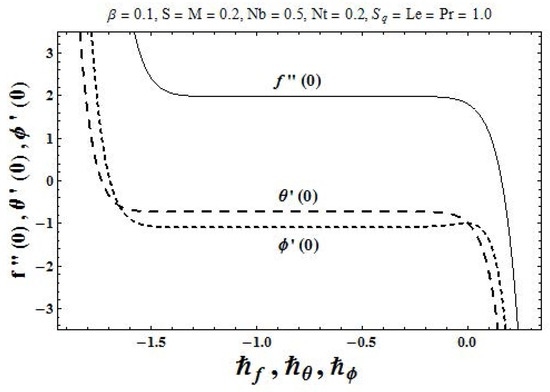
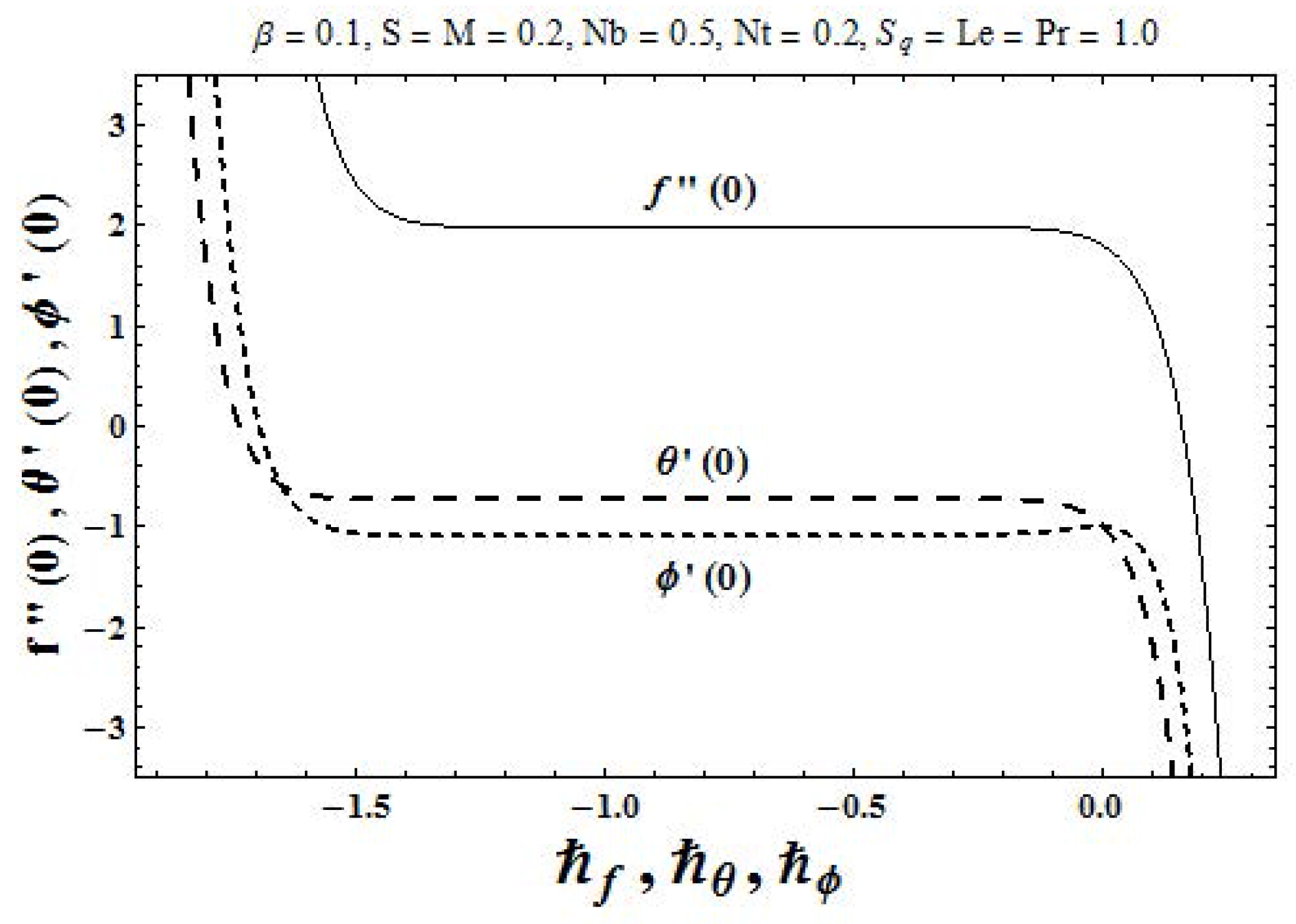
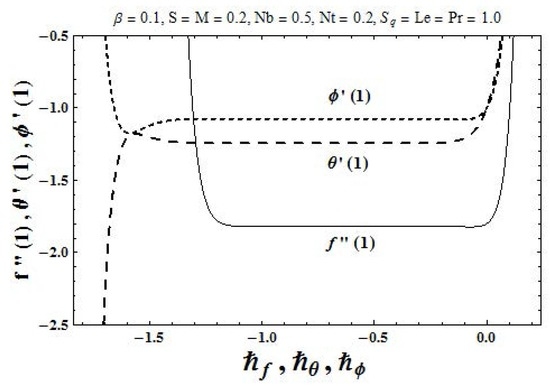
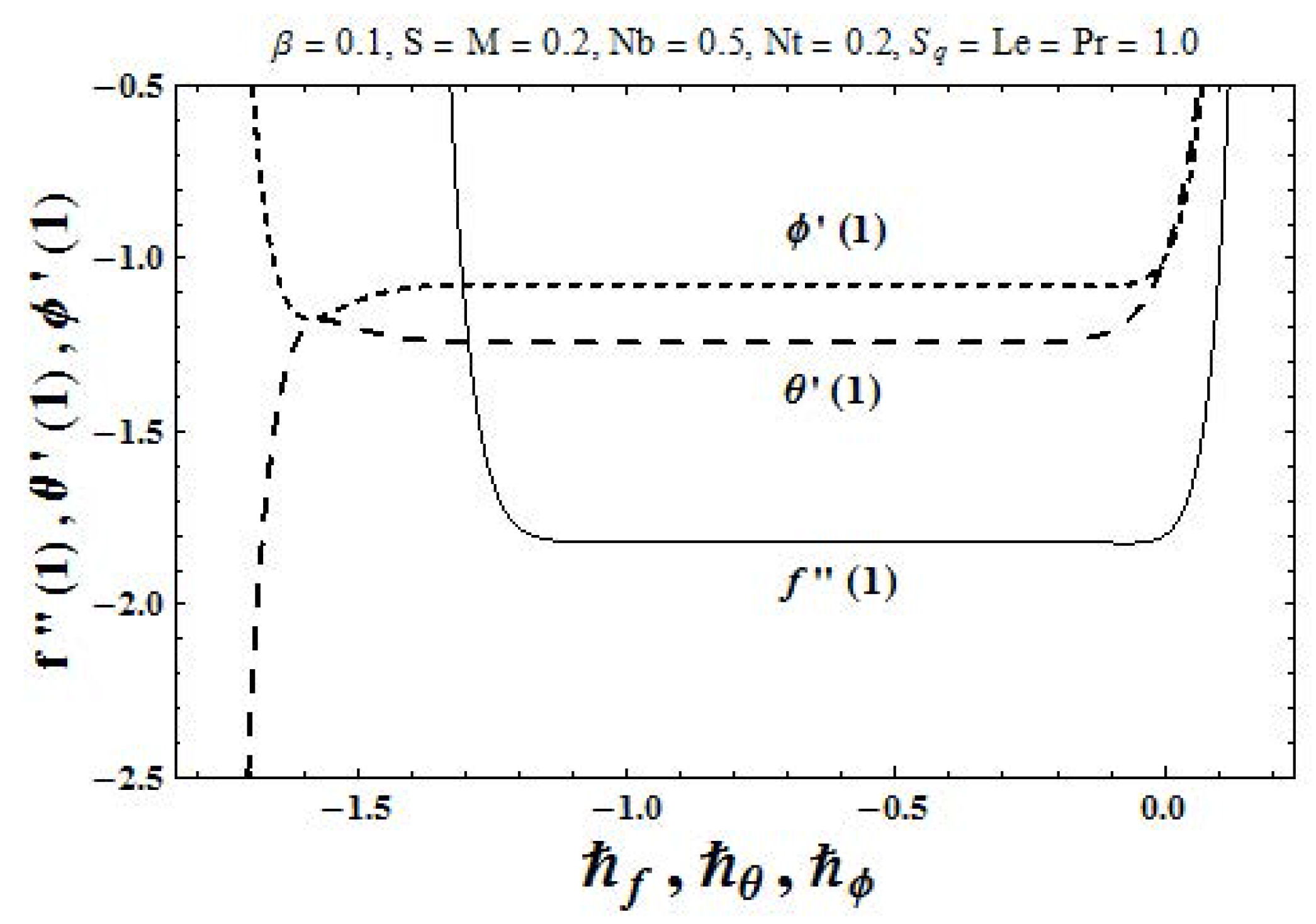
Clearly, the approximate series solutions involve the nonzero auxiliary parameters and To get the appropriate values of and the curves are plotted at 20th order of deformations. Figure 1 and Figure 2 clearly show that the convergence zone exists inside the ranges and for lower disk case and and for upper disk case Table 1 depicts that 16th order of deformations is sufficient for convergent homotopic solutions for lower disk, whereas the 18th order of deformations is necessary for convergent homotopic solutions regarding upper disks (see Table 2).
Figure 1.
ħ -Curves for f, and at the lower disk.
Figure 2.
ቿ -Curves for f, and at the upper disk.
Table 1.
HAM solution convergence at the lower disk when and
Table 2.
HAM solution convergence at the upper disk when and
5. Discussion
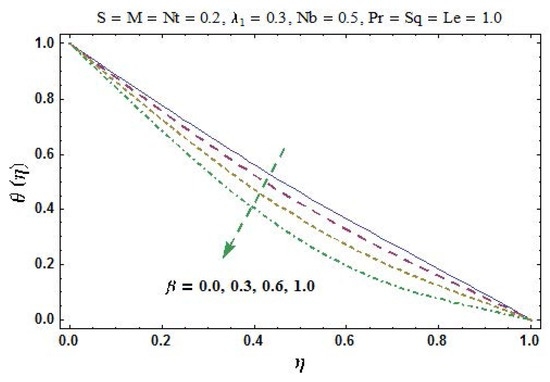
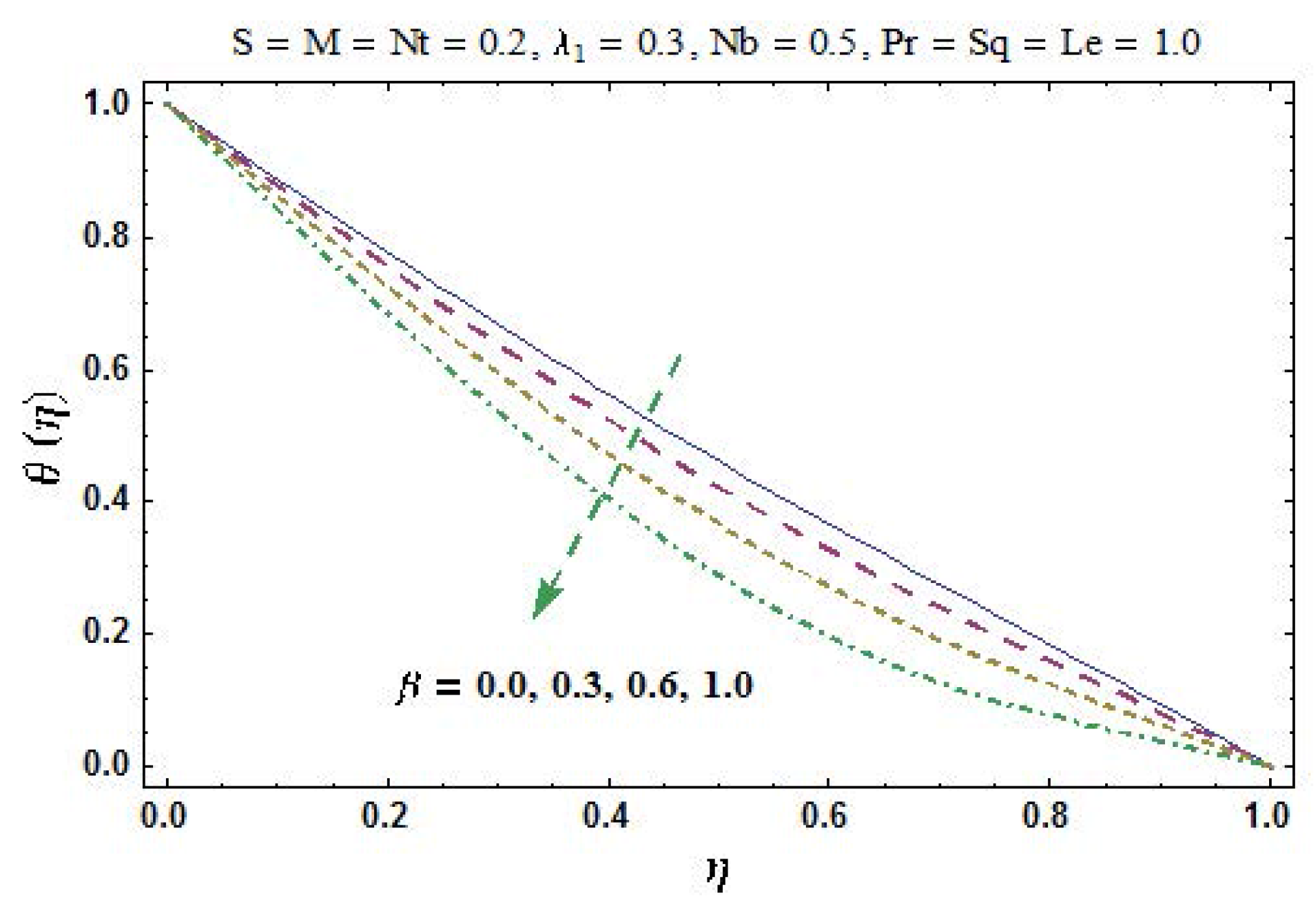
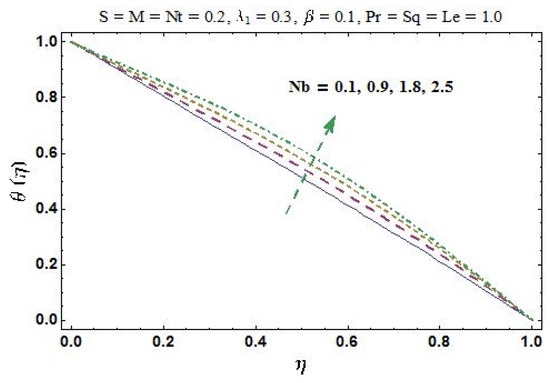
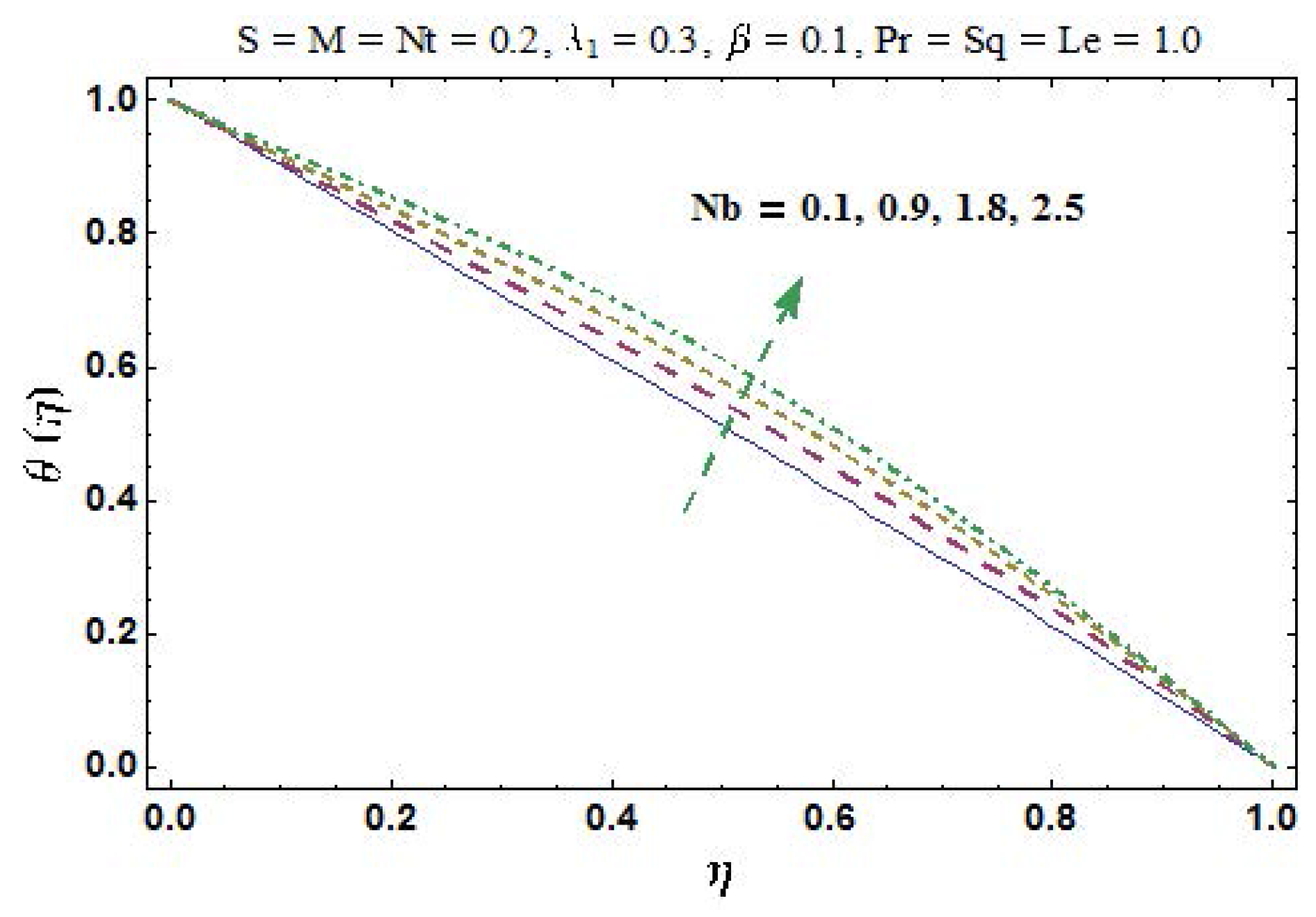
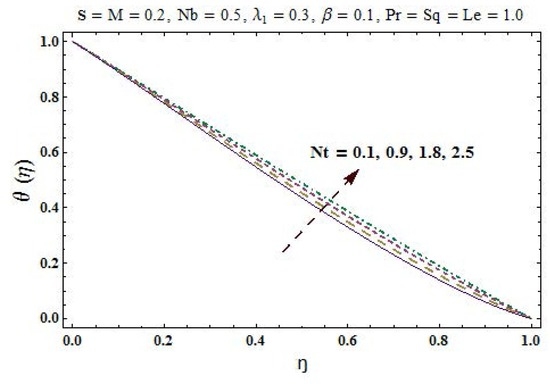
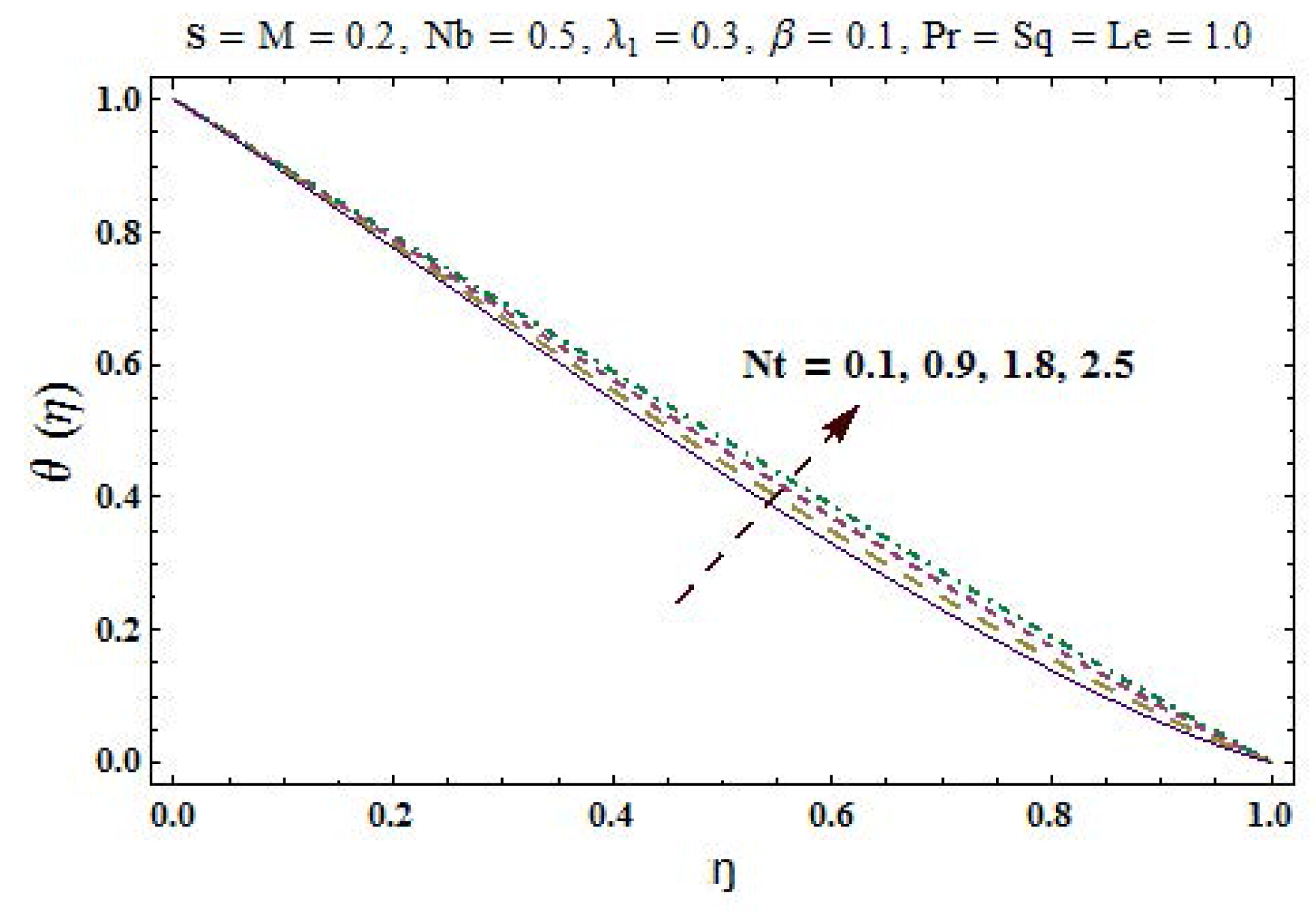
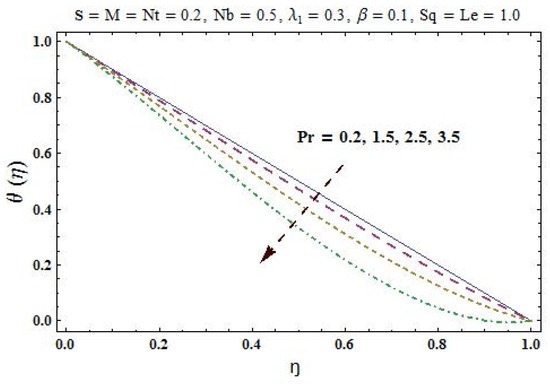
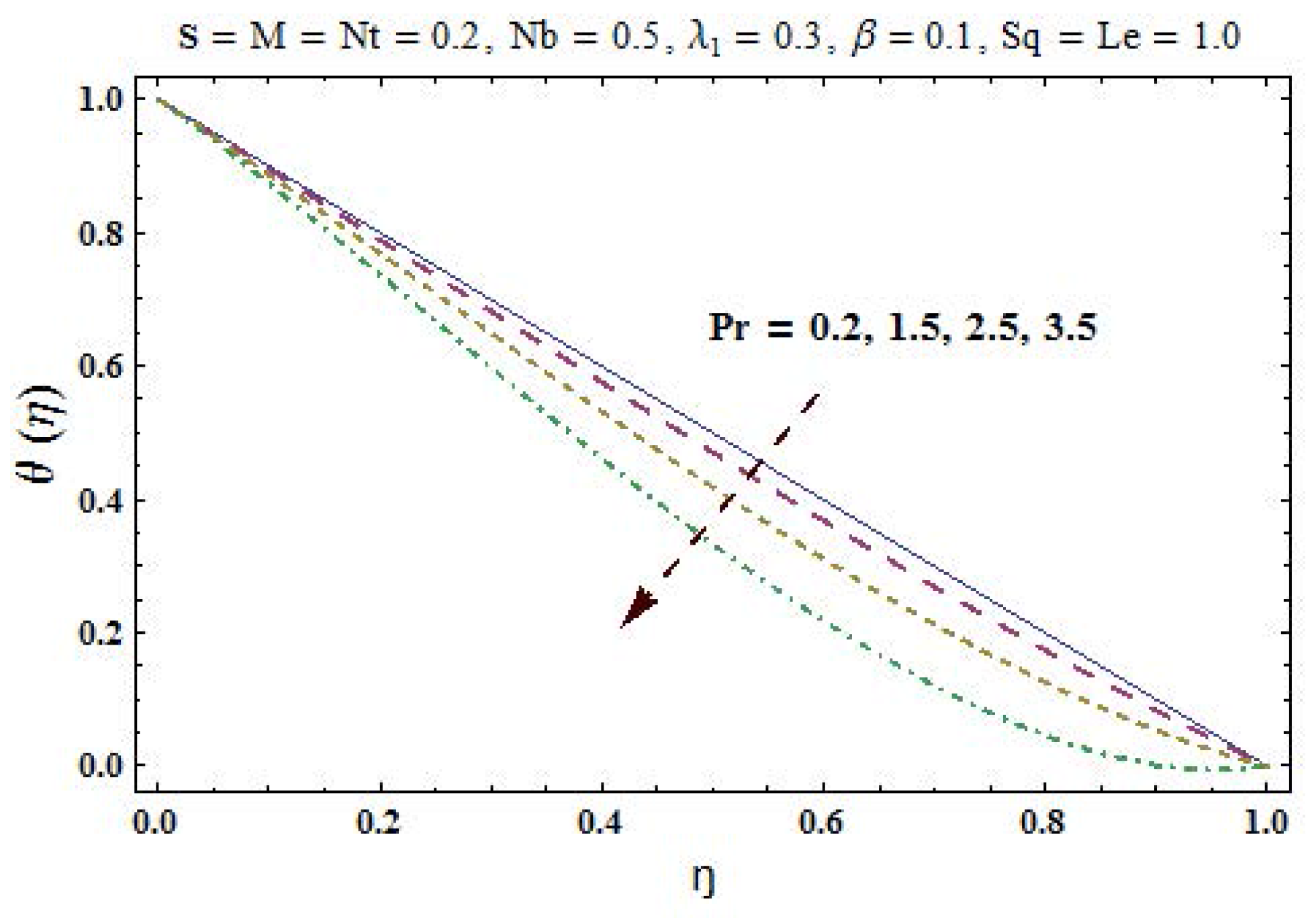
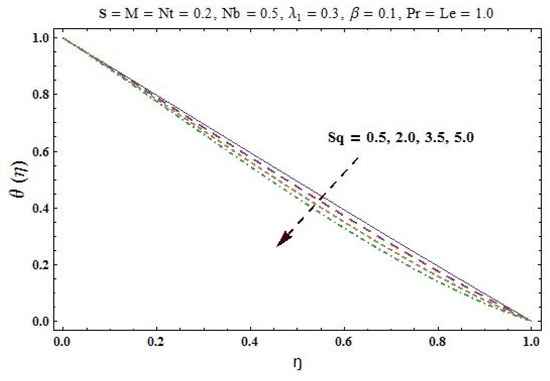
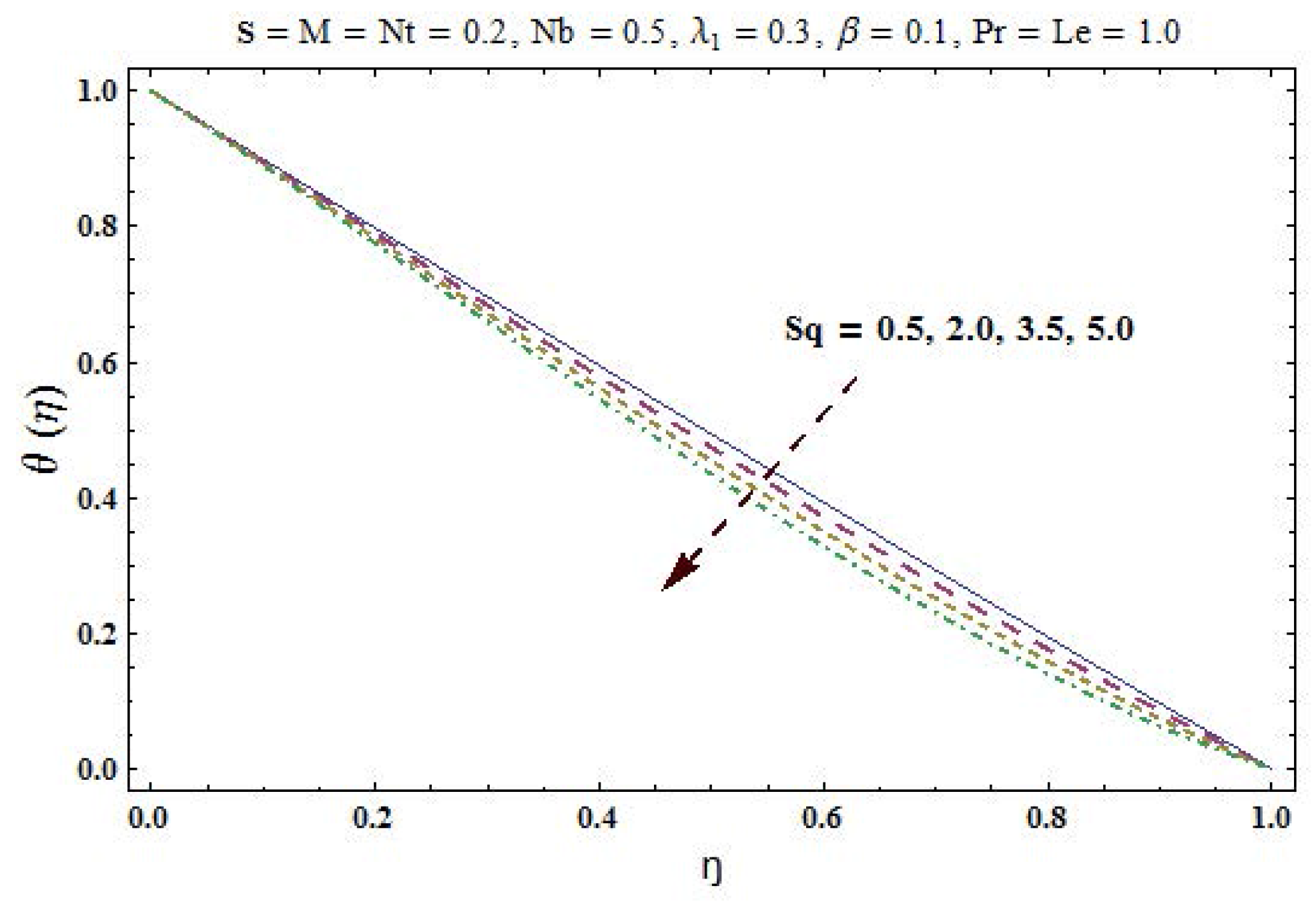
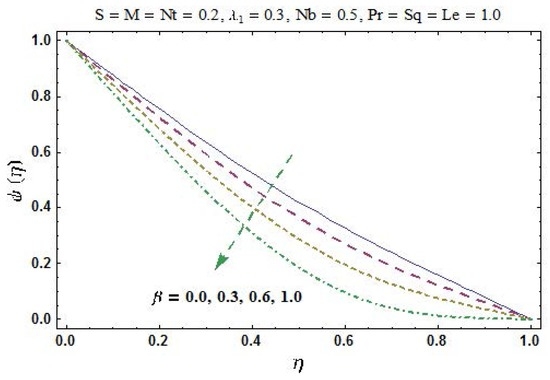
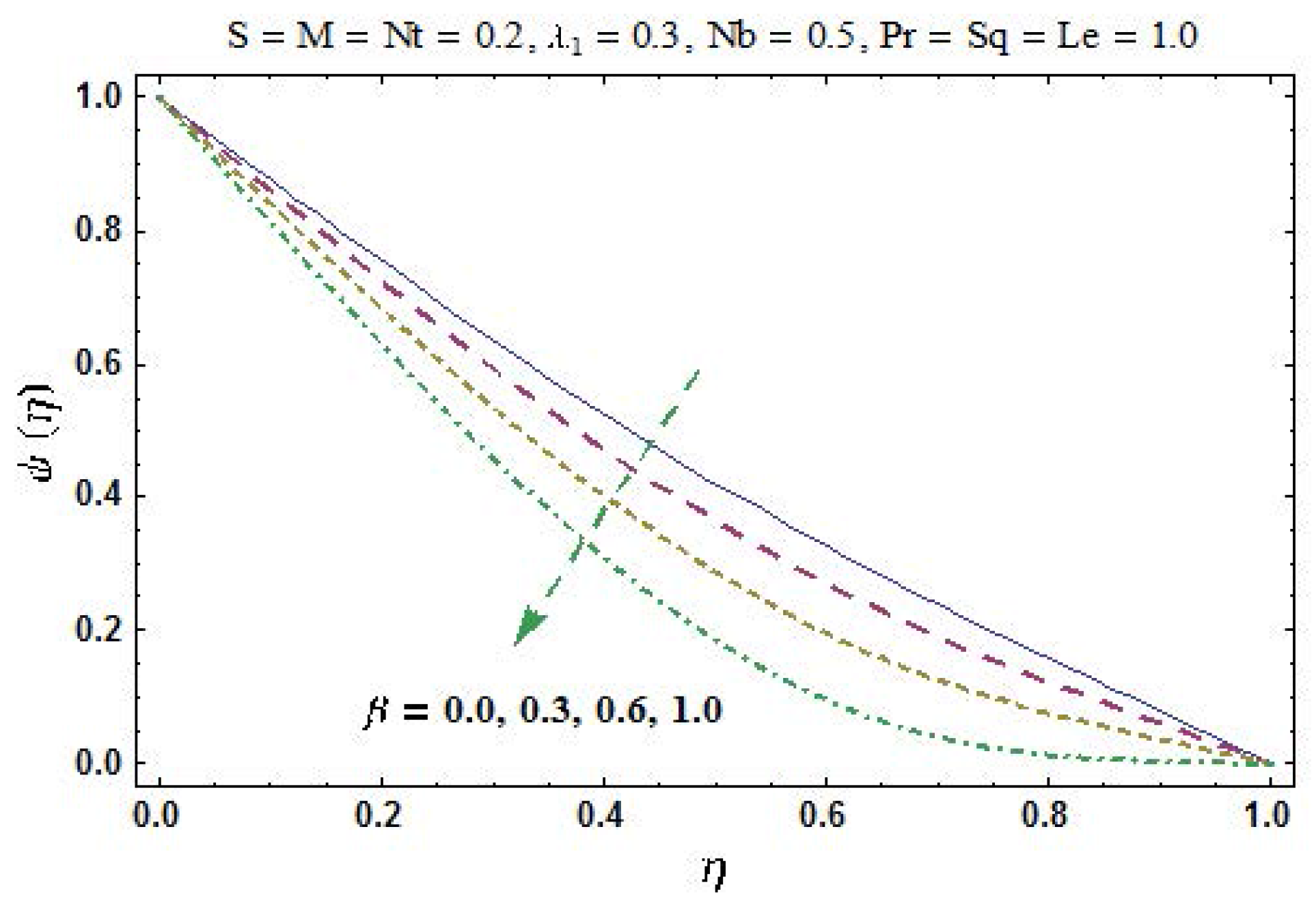
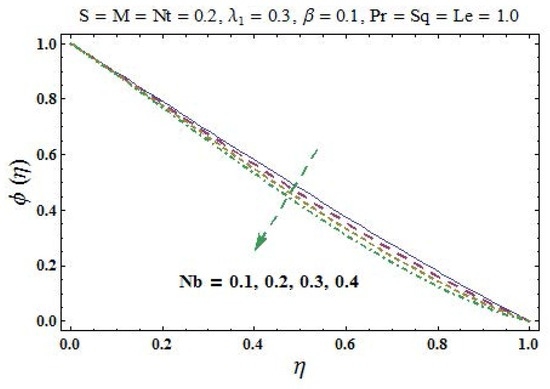
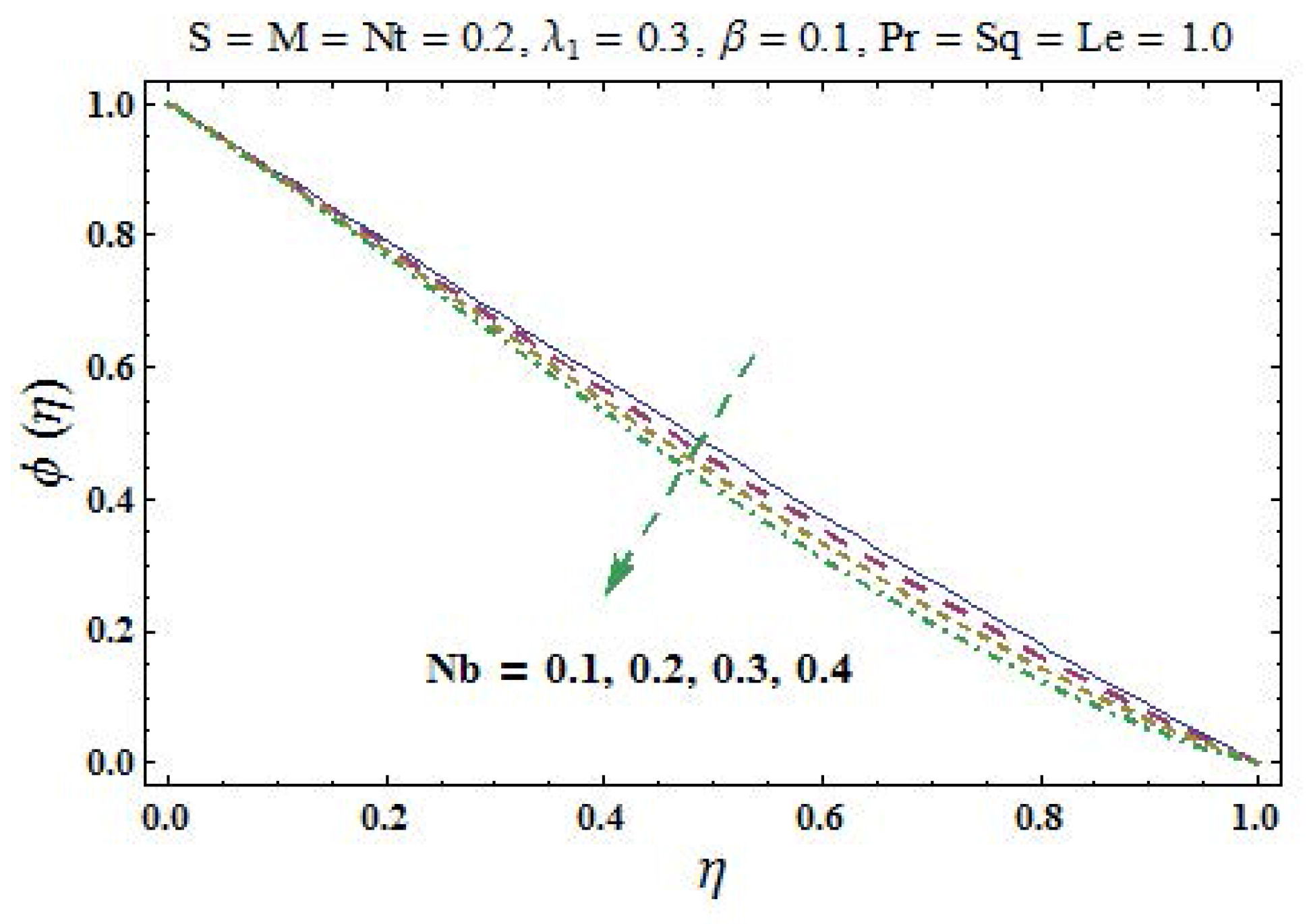
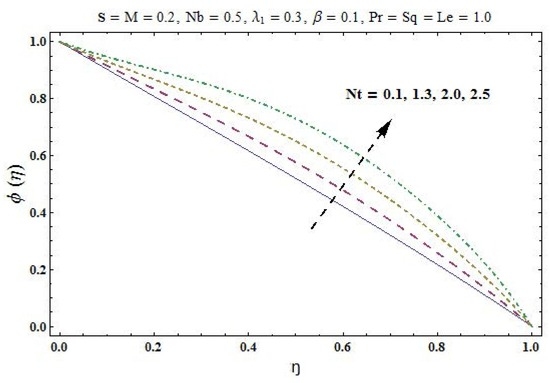
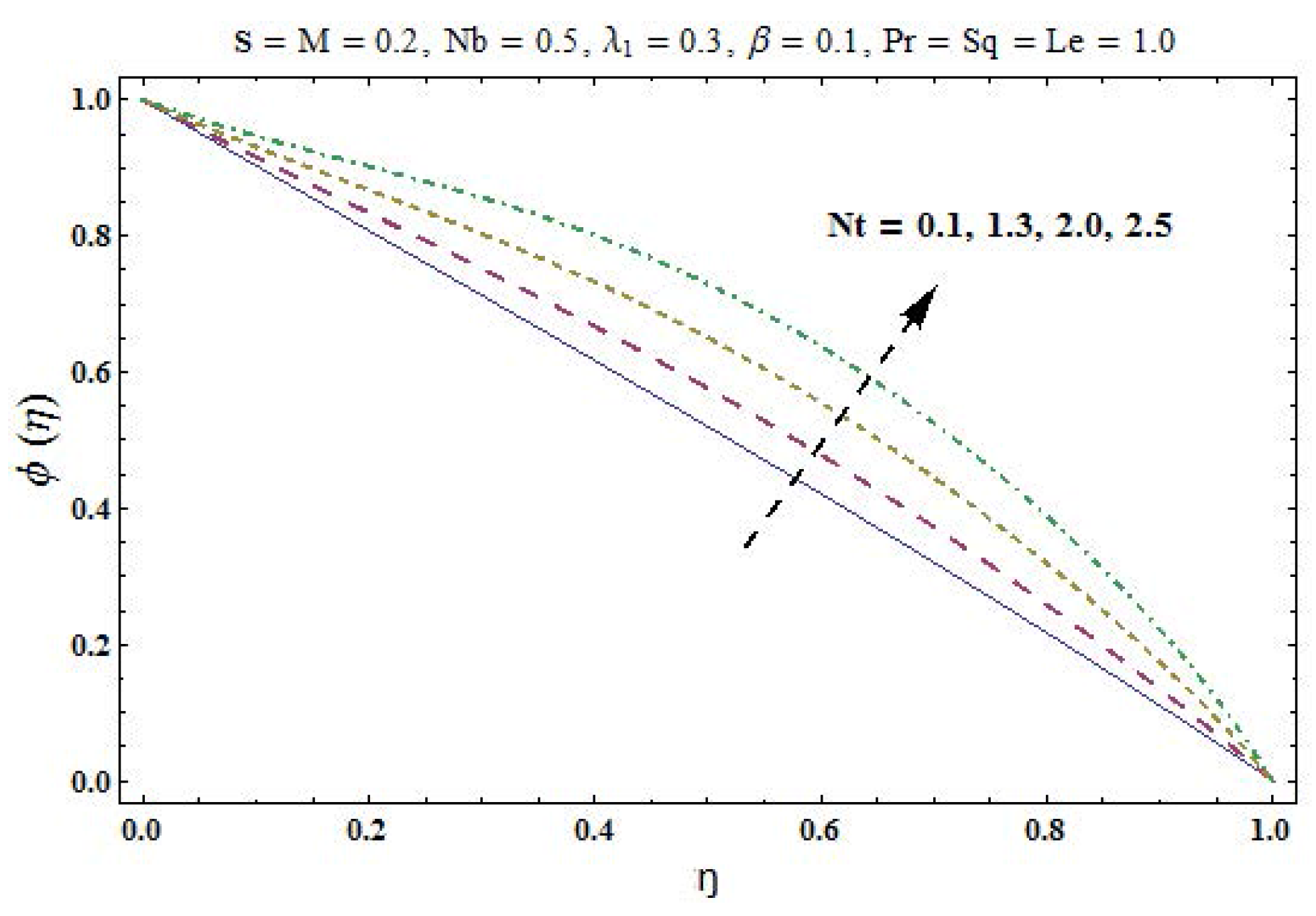
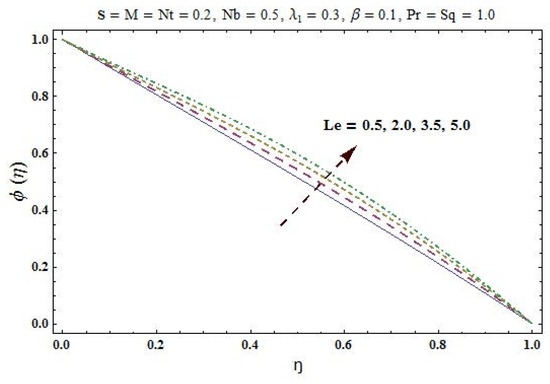
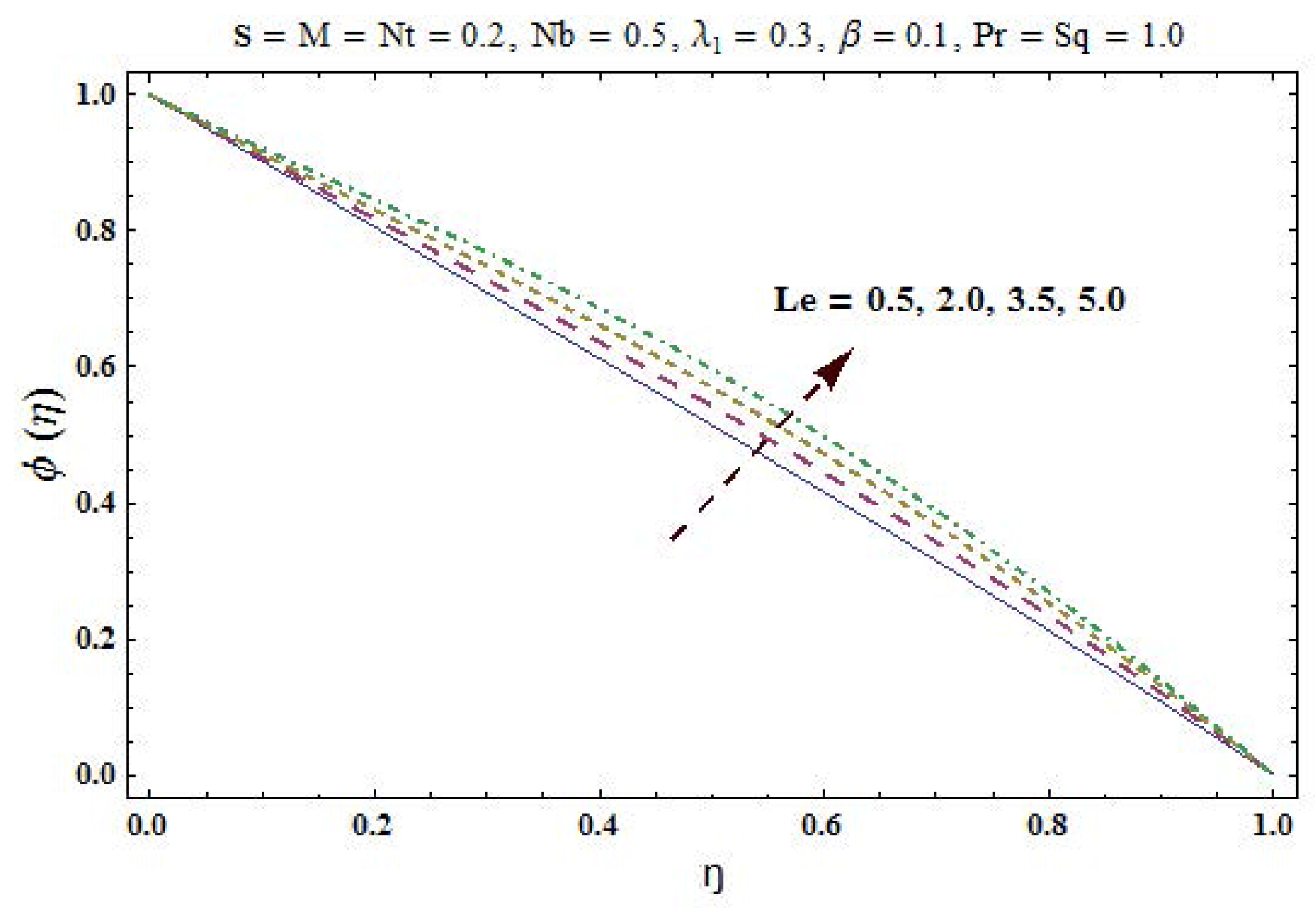
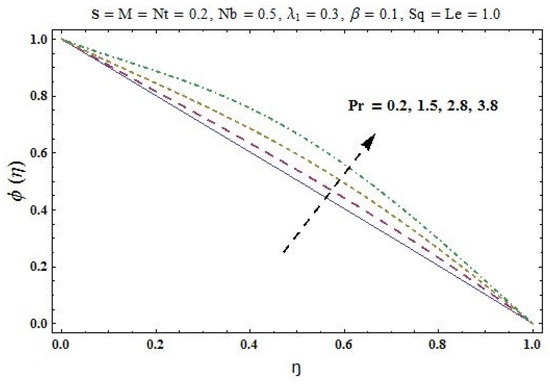
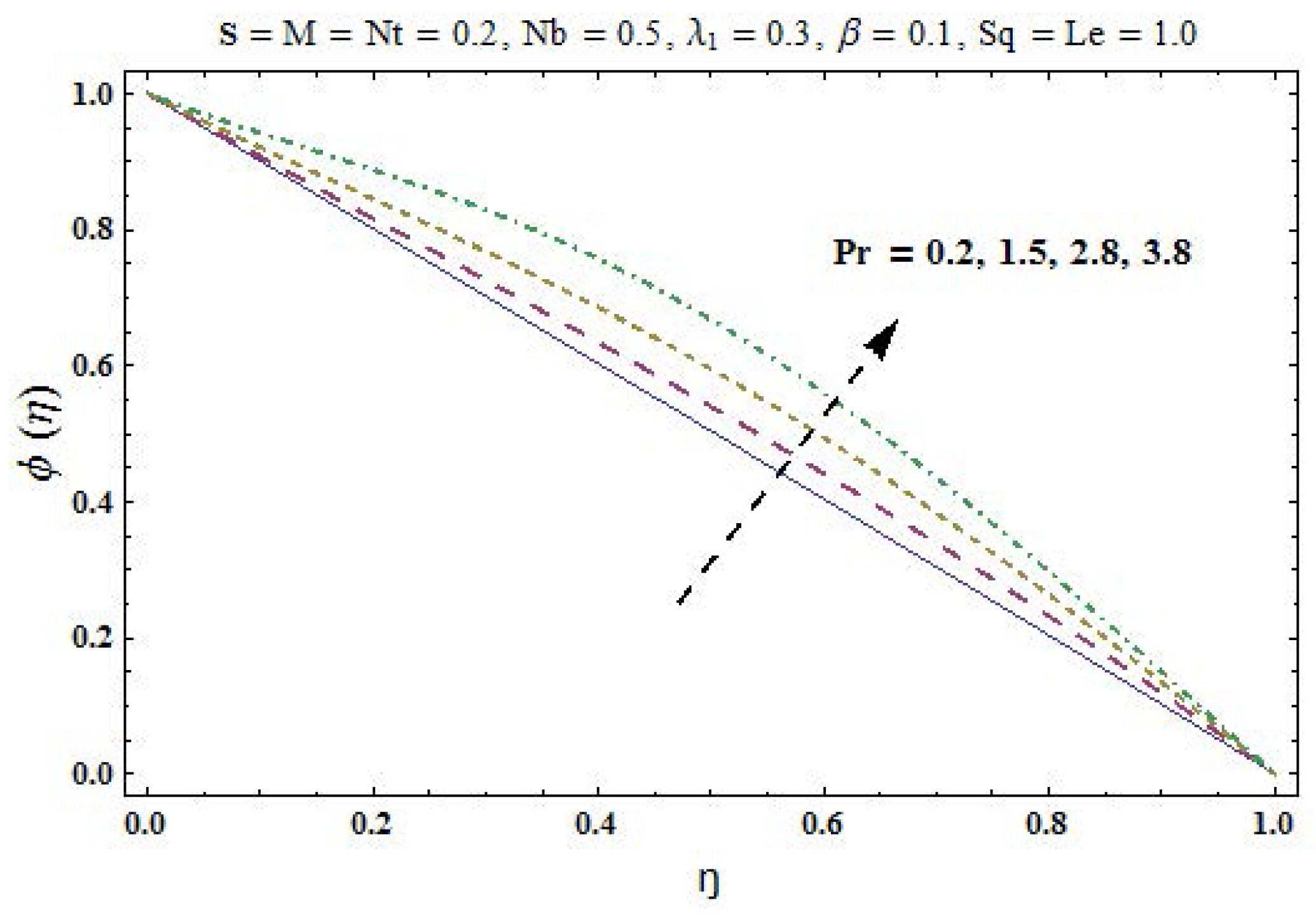
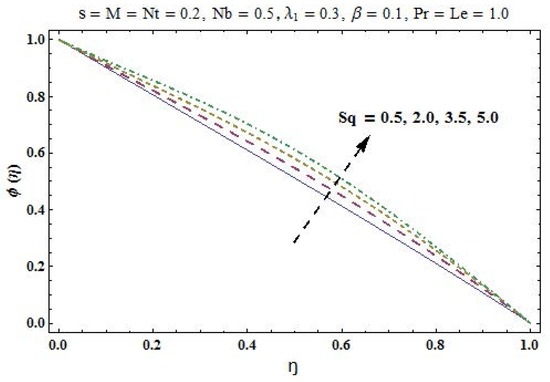
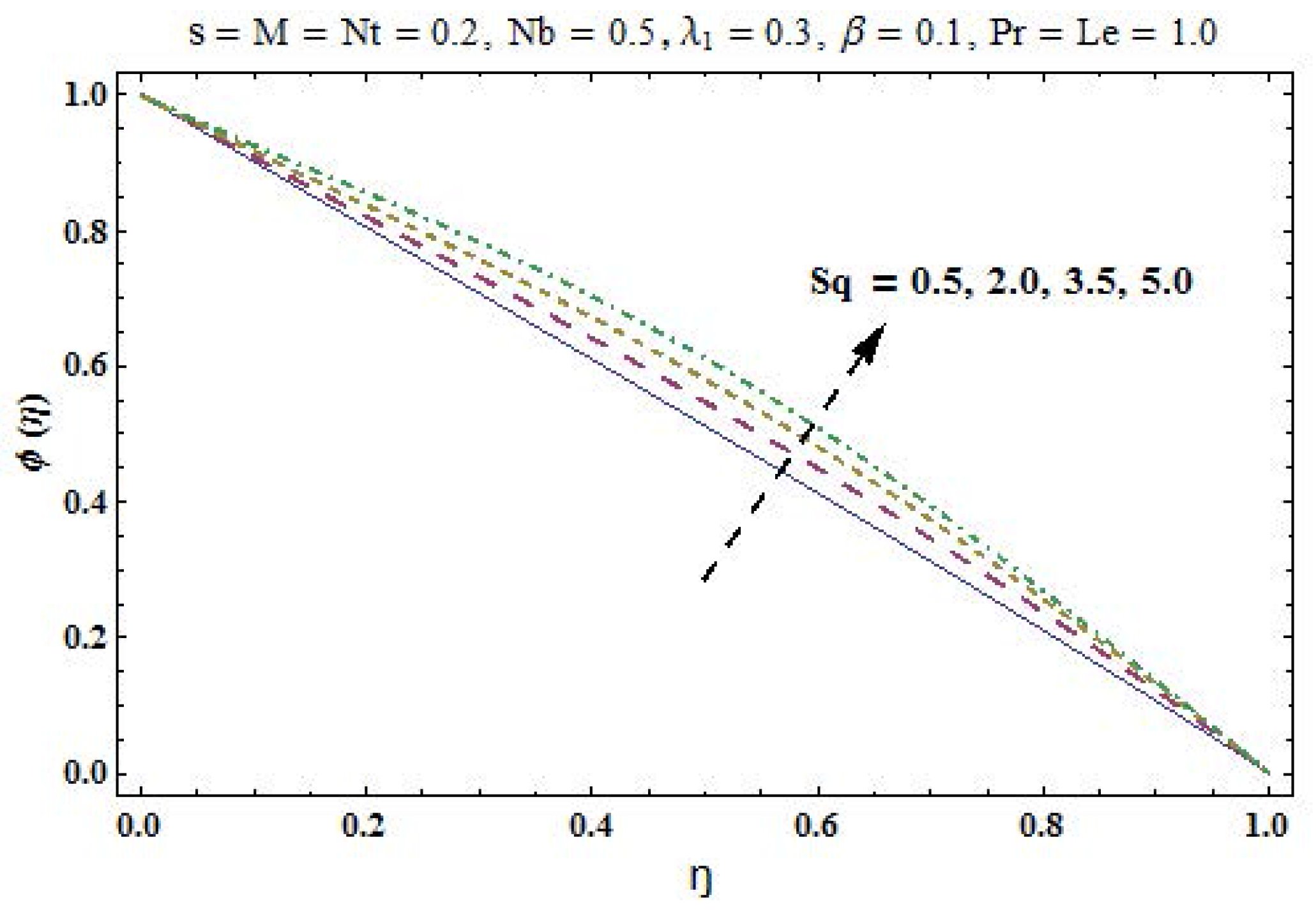
This portion explores the effects of various pertinent parameters including Deborah number , Lewis number , Brownian motion parameter , Prandtl number , thermophoresis parameter and squeezing parameter on temperature and concentration profiles. Figure 3 shows the the impact of Deborah number on the temperature field . It is observed that the temperature field decreases with the increase in the Deborah number . Figure 4 illustrates the impact of Brownian motion parameter on temperature field . Here, temperature field is increased by enhancing Brownian motion parameter. Variation of thermophoresis parameter on temperature field is sketched in Figure 5. Larger values of thermophoresis parameter show higher temperature fields. Physically larger causes an enhancement in temperature distribution. This is because of a stronger thermophoretic impact. Figure 6 shows temperature against Lower temperature is noticed for larger Figure 7 indicates that larger squeezing parameter guarantees a decay in temperature . Figure 8 elucidates the impact of Deborah number on the concentration profile . The concentration field is decreased by increasing the Deborah number . Figure 9 shows the impact of Brownian motion parameter on concentration profile . Concentration profile is reduced for larger values of Brownian motion parameter Figure 10 shows behavior of thermophoresis parameter on concentration field . Here, concentration field is enhanced for larger thermophoresis parameter. Figure 11 elucidates the concentration for variation of Lewis number Obviously larger leads to a large concentration field. Figure 12 sketched the concentration field against Prandtl number . Larger shows concentration field. Figure 13 declares that the increasing values of squeezing parameter lead to higher enhancement. Table 3 is developed to validate the present results with the previously published results in a limiting sense. From this Table, we analyzed that the present HAM solution have good agreement with the previous solution by Hashmi et al. [6] in a limiting sense. Table 4 consists of skin friction at the lower and upper disks. Here, the skin friction coefficient at the lower and upper disks are higher for increasing Deborah number and squeezing parameter. Table 5 is computed to examine the numerical data of local Nusselt number at the lower and upper disks for several embedding parameters. It is observed that local Nusselt number enhances at both lower and upper disks for larger Lewis number while the reverse is found for Prandtl number. Table 6 depicts numerical data of local Sherwood number at the lower and upper disks for various values of pertinent parameters. Here, we noticed that local Sherwood number increases at both lower and upper disks for increasing values of squeezing parameter.
Figure 3.
Plots of for .
Figure 4.
Plots of for
Figure 5.
Plots of for
Figure 6.
Plots of for
Figure 7.
Plots of for
Figure 8.
Plots of for
Figure 9.
Plots of for
Figure 10.
Plots of for
Figure 11.
Plots of for
Figure 12.
Plots of for
Figure 13.
Plots of for
Table 3.
Comparative values of for different values of M when and
Table 4.
Skin friction coefficient at the lower and upper disks via M and
Table 5.
Numerical data for local Nusselt number at the lower and upper disks for several values of and .
Table 6.
Numerical data for local Sherwood number at the lower and upper disks for several values of and .
6. Conclusions
Magnetohydrodynamic (MHD) squeezing flow of Jeffrey nanofluid between two parallel disks is examined. The key points of presented analysis are mentioned below:
- Larger values of Deborah number correspond to lower temperature and concentration profiles.
- Both temperature and concentration profiles are higher for larger values of thermophoresis parameter.
- Effects of Brownian motion parameter on temperature and concentration profiles are quite the opposite from each other.
- Larger values of Prandtl number show opposite trends for temperature and concentration profiles.
- Effects of squeezing parameter on temperature and concentration profiles are quite opposite to each other.
- The present analysis reduces to a Newtonian nanofluid flow situation when
Acknowledgments
The authors are grateful for the useful suggestions of the reviewers.
Author Contributions
Conflicts of Interest
The authors declare no conflict of interest.
References
- Choi, S.U.S. Enhancing Thermal Conductivity of Fluids with Nanoparticles; FED 231/MD; ASME: New York, NY, USA, 1995; pp. 99–105. [Google Scholar]
- Buongiorno, J. Convective transport in nanofluids. ASME J. Heat Transf. 2006, 128, 240–250. [Google Scholar] [CrossRef]
- Makinde, O.D.; Aziz, A. Boundary layer flow of a nanofluid past a stretching sheet with a convective boundary condition. Int. J. Therm. Sci. 2011, 50, 1326–1332. [Google Scholar] [CrossRef]
- Mustafa, M.; Hayat, T.; Pop, I.; Asghar, S.; Obaidat, S. Stagnation-point flow of a nanofluid towards a stretching sheet. Int. J. Heat Mass Transf. 2011, 54, 5588–5594. [Google Scholar] [CrossRef]
- Turkyilmazoglu, M. Exact analytical solutions for heat and mass transfer of MHD slip flow in nanofluids. Chem. Eng. Sci. 2012, 84, 182–187. [Google Scholar] [CrossRef]
- Hashmi, M.M.; Hayat, T.; Alsaedi, A. On the analytic solutions for squeezing flow of nanofluid between parallel disks. Nonlinear Anal. Model. Control 2012, 17, 418–430. [Google Scholar]
- Ibrahim, W.; Makinde, O.D. The effect of double stratification on boundary layer flow and heat transfer of nanofluid over a vertical plate. Comput. Fluids 2013, 86, 433–441. [Google Scholar] [CrossRef]
- Sheikholeslami, M.; Bandpy, M.G.; Ellahi, R.; Hassan, M.; Soleimani, S. Effects of MHD on Cu-water nanofluid flow and heat transfer by means of CVFEM. J. Magn. Magn. Mater. 2014, 349, 188–200. [Google Scholar] [CrossRef]
- Malvandi, A.; Safaei, M.R.; Kaffash, M.H.; Ganji, D.D. MHD mixed convection in a vertical annulus filled with Al2O3—Water nanofluid considering nanoparticle migration. J. Magn. Magn. Mater. 2015, 382, 296–306. [Google Scholar] [CrossRef]
- Hayat, T.; Muhammad, T.; Alsaedi, A.; Alhuthali, M.S. Magnetohydrodynamic three-dimensional flow of viscoelastic nanofluid in the presence of nonlinear thermal radiation. J. Magn. Magn. Mater. 2015, 385, 222–229. [Google Scholar] [CrossRef]
- Chamkha, A.; Abbasbandy, S.; Rashad, A.M. Non-Darcy natural convection flow for non-Newtonian nanofluid over cone saturated in porous medium with uniform heat and volume fraction fluxes. Int. J. Numer. Methods Heat Fluid Flow 2015, 25, 422–437. [Google Scholar] [CrossRef]
- Gireesha, B.J.; Gorla, R.S.R.; Mahanthesh, B. Effect of suspended nanoparticles on three-dimensional MHD flow, heat and mass transfer of radiating Eyring-Powell fluid over a stretching sheet. J. Nanofluids 2015, 4, 474–484. [Google Scholar] [CrossRef]
- Lin, Y.; Zheng, L.; Zhang, X.; Ma, L.; Chen, G. MHD pseudo-plastic nanofluid unsteady flow and heat transfer in a finite thin film over stretching surface with internal heat generation. Int. J. Heat Mass Transf. 2015, 84, 903–911. [Google Scholar] [CrossRef]
- Sheikholeslami, M.; Ellahi, R. Three dimensional mesoscopic simulation of magnetic field effect on natural convection of nanofluid. Int. J. Heat Mass Transf. 2015, 89, 799–808. [Google Scholar] [CrossRef]
- Hsiao, K.L. Stagnation electrical MHD nanofluid mixed convection with slip boundary on a stretching sheet. Appl. Therm. Eng. 2016, 98, 850–861. [Google Scholar] [CrossRef]
- Hayat, T.; Muhammad, T.; Shehzad, S.A.; Alsaedi, A. On three-dimensional boundary layer flow of Sisko nanofluid with magnetic field effects. Adv. Powder Tech. 2016, 27, 504–512. [Google Scholar] [CrossRef]
- Malvandi, A.; Ganji, D.D.; Pop, I. Laminar filmwise condensation of nanofluids over a vertical plate considering nanoparticles migration. Appl. Therm. Eng. 2016, 100, 979–986. [Google Scholar] [CrossRef]
- Hayat, T.; Imtiaz, M.; Alsaedi, A. Unsteady flow of nanofluid with double stratification and magnetohydrodynamics. Int. J. Heat Mass Transf. 2016, 92, 100–109. [Google Scholar] [CrossRef]
- Hayat, T.; Waqas, M.; Shehzad, S.A.; Alsaedi, A. On model of Burgers fluid subject to magneto nanoparticles and convective conditions. J. Mol. Liq. 2016, 222, 181–187. [Google Scholar] [CrossRef]
- Hayat, T.; Aziz, A.; Muhammad, T.; Alsaedi, A. On magnetohydrodynamic three-dimensional flow of nanofluid over a convectively heated nonlinear stretching surface. Int. J. Heat Mass Transf. 2016, 100, 566–572. [Google Scholar] [CrossRef]
- Hussain, A.; Mohyud-Din, S.T.; Cheema, T.A. Analytical and numerical approaches to squeezing flow and heat transfer between two parallel disks with velocity slip and temperature jump. Chin. Phys. Lett. 2012, 29, 114705. [Google Scholar] [CrossRef]
- Chatraei, S.H.; Macosko, C.W.; Winter, H.H. Lubricated squeezing flow: A new biaxial extensional rheometer. J. Rheol. 1981, 25, 433–443. [Google Scholar] [CrossRef]
- Stefan, M.J. Versuch Uber die scheinbare adhesion, Sitzungsberichte der Akademie der Wissenschaften in Wien. Math. Naturwissen 1874, 69, 713–721. [Google Scholar]
- Domairry, G.; Aziz, A. Approximate analysis of MHD squeeze flow between two parallel disks with suction or injection by homotopy perturbation method. Math. Prob. Eng. 2009, 2009, 603916. [Google Scholar] [CrossRef]
- Siddiqui, A.M.; Irum, S.; Ansari, A.R. Unsteady squeezing flow of a viscous MHD fluid between parallel plates, a solution using the homotopy perturbation method. Math. Model. Anal. 2008, 13, 565–576. [Google Scholar] [CrossRef]
- Rashidi, M.M.; Siddiqui, A.M.; Asadi, M. Application of homotopy analysis method to the unsteady squeezing flow of a second-grade fluid between circular plates. Math. Probl. Eng. 2010, 2010, 706840. [Google Scholar] [CrossRef]
- Qayyum, A.; Awais, M.; Alsaedi, A.; Hayat, T. Unsteady squeezing flow of Jeffery fluid between two parallel disks. Chin. Phys. Lett. 2012, 29, 034701. [Google Scholar] [CrossRef]
- Sheikholeslami, M.; Ganji, D.D. Heat transfer of Cu-water nanofluid flow between parallel plates. Powder Technol. 2013, 235, 873–879. [Google Scholar] [CrossRef]
- Hayat, T.; Muhammad, T.; Qayyum, A.; Alsaedi, A.; Mustafa, M. On squeezing flow of nanofluid in the presence of magnetic field effects. J. Mol. Liq. 2016, 213, 179–185. [Google Scholar] [CrossRef]
- Hayat, T.; Mustafa, M.; Shehzad, S.A.; Obaidat, S. Melting heat transfer in the stagnation-point flow of an upper-convected Maxwell (UCM) fluid past a stretching sheet. Int. J. Numer. Methods Fluids 2012, 68, 233–243. [Google Scholar] [CrossRef]
- Liao, S.J. On the homotopy analysis method for nonlinear problems. Appl. Math. Comput. 2004, 147, 499–513. [Google Scholar] [CrossRef]
- Dehghan, M.; Manafian, J.; Saadatmandi, A. Solving nonlinear fractional partial differential equations using the homotopy analysis method. Numer. Methods Part. Differ. Equ. 2010, 26, 448–479. [Google Scholar] [CrossRef]
- Malvandi, A.; Hedayati, F.; Domairry, G. Stagnation point flow of a nanofluid toward an exponentially stretching sheet with nonuniform heat generation/absorption. J. Thermodyn. 2013, 2013, 764827. [Google Scholar] [CrossRef]
- Abbasbandy, S.; Hashemi, M.S.; Hashim, I. On convergence of homotopy analysis method and its application to fractional integro-differential equations. Quaest. Math. 2013, 36, 93–105. [Google Scholar] [CrossRef]
- Arqub, O.A.; El-Ajou, A. Solution of the fractional epidemic model by homotopy analysis method. J. King Saud Univ. Sci. 2013, 25, 73–81. [Google Scholar] [CrossRef]
- Ellahi, R.; Hassan, M.; Zeeshan, A. Shape effects of nanosize particles in Cu-H2O nanofluid on entropy generation. Int. J. Heat Mass Transf. 2015, 81, 449–456. [Google Scholar] [CrossRef]
- Hayat, T.; Imtiaz, M.; Alsaedi, A. Impact of magnetohydrodynamics in bidirectional flow of nanofluid subject to second order slip velocity and homogeneous—Heterogeneous reactions. J. Magn. Magn. Mater. 2015, 395, 294–302. [Google Scholar] [CrossRef]
- Sui, J.; Zheng, L.; Zhang, X.; Chen, G. Mixed convection heat transfer in power law fluids over a moving conveyor along an inclined plate. Int. J. Heat Mass Transf. 2015, 85, 1023–1033. [Google Scholar] [CrossRef]
- Hayat, T.; Hussain, Z.; Muhammad, T.; Alsaedi, A. Effects of homogeneous and heterogeneous reactions in flow of nanofluids over a nonlinear stretching surface with variable surface thickness. J. Mol. Liq. 2016, 221, 1121–1127. [Google Scholar] [CrossRef]
- Hayat, T.; Abbas, T.; Ayub, M.; Farooq, M.; Alsaedi, A. Flow of nanofluid due to convectively heated Riga plate with variable thickness. J. Mol. Liq. 2016, 222, 854–862. [Google Scholar] [CrossRef]
- Hsiao, K.L. MHD mixed convection for viscoelastic fluid past a porous wedge. Int. J. Non-Linear Mech. 2011, 46, 1–8. [Google Scholar] [CrossRef]
- Hsiao, K.L. Combined electrical MHD heat transfer thermal extrusion system using Maxwell fluid with radiative and viscous dissipation effects. Appl. Therm. Eng. 2016, 8, 208. [Google Scholar] [CrossRef]
- Hsiao, K.L. Numerical solution for Ohmic Soret-Dufour heat and mass mixed convection of viscoelastic fluid over a stretching sheet with multimedia physical features. J. Aerosp. Eng. 2016. [Google Scholar] [CrossRef]

© 2016 by the authors; licensee MDPI, Basel, Switzerland. This article is an open access article distributed under the terms and conditions of the Creative Commons Attribution (CC-BY) license (http://creativecommons.org/licenses/by/4.0/).