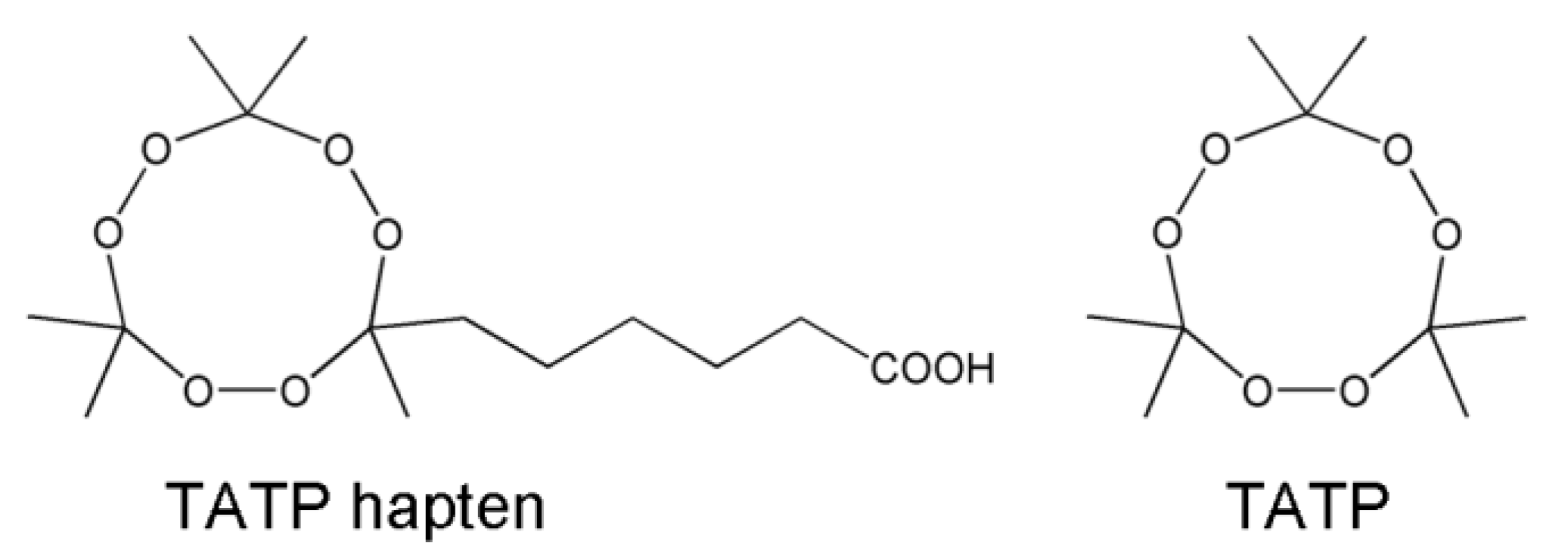
A Novel Immunoreagent for the Specific and Sensitive Detection of the Explosive Triacetone Triperoxide (TATP)



Abstract

1. Introduction
2. Experimental Section
2.1. Reagents
2.2. Safety Note
2.3. Synthesis of TATP, TATP Hapten, Immunogen and Enzyme Tracer

2.4. Immunization
2.5. Enzyme-Linked Immunosorbent Assay (ELISA)
2.6. Syntheses of Cross-Reactants and Determination of Cross-Reactivities
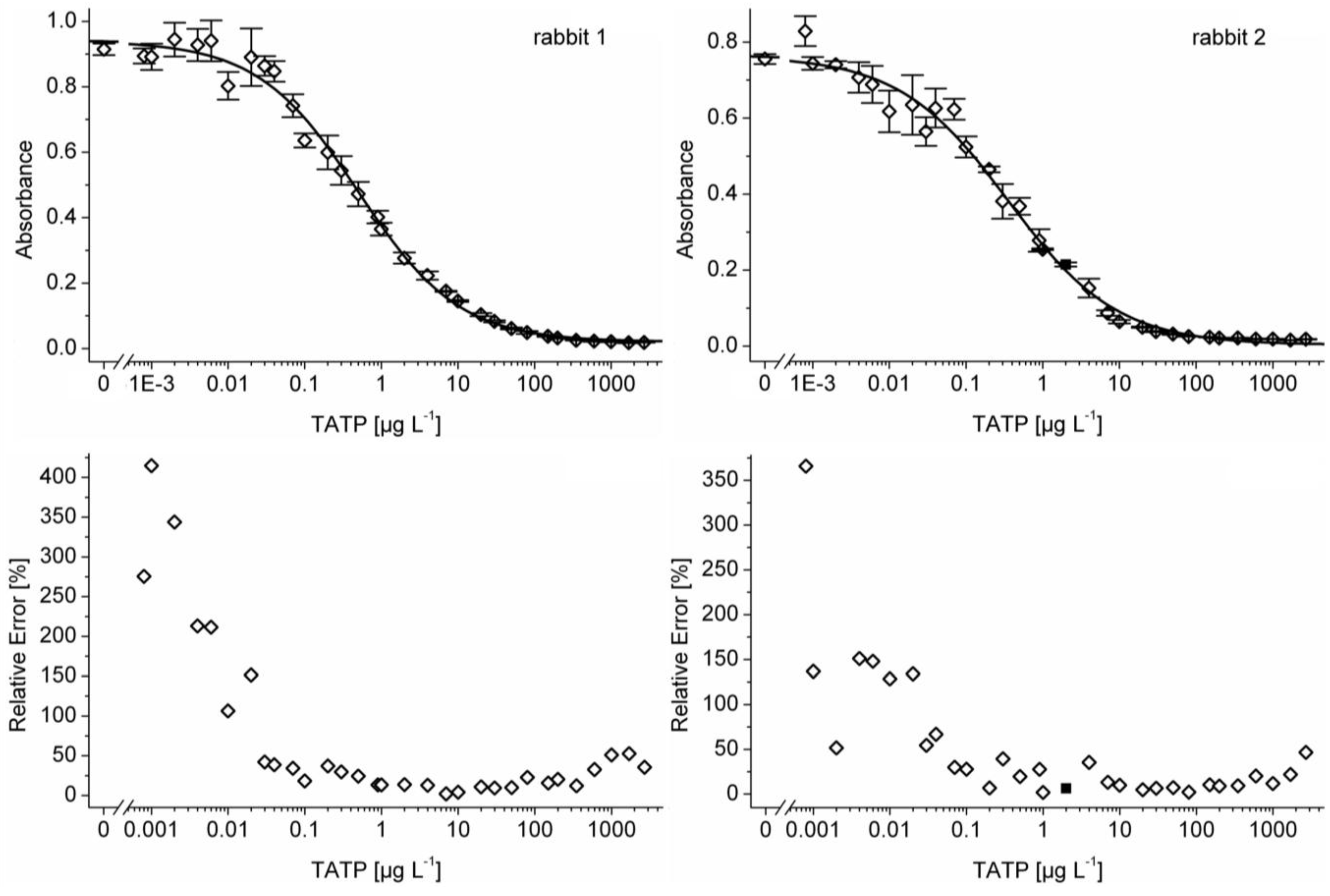
3. Results and Discussion
3.1. Antibody Development
3.2. Limit of Detection and Quantification Range
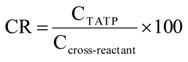
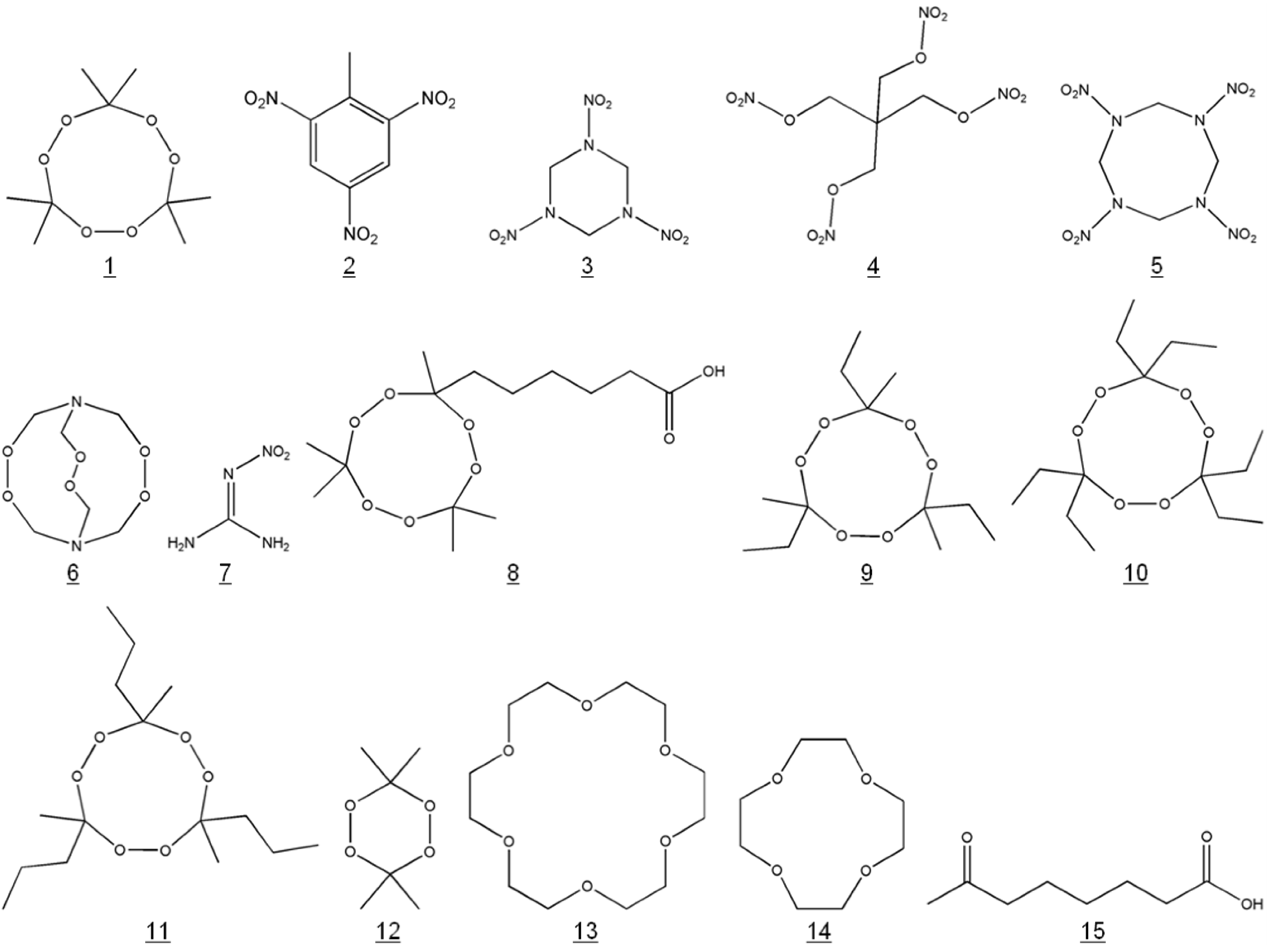
3.3. Cross-Reactivities

| Rabbit 1 | Rabbit 2 | Rabbit 1 | Rabbit 2 | |||
|---|---|---|---|---|---|---|
| Name | MW [g mol−1] | CR in % | molar CR in % | |||
| 1 | TATP | 222.24 | 100 | 100 | 100 | 100 |
| 2 | TNT | 227.13 | <0.01 | <0.01 | <0.01 | <0.01 |
| 3 | RDX | 222.12 | <0.01 | <0.01 | <0.01 | <0.01 |
| 4 | PETN | 316.14 | <0.01 | <0.01 | <0.01 | <0.01 |
| 5 | HMX | 296.16 | <0.01 | <0.01 | <0.01 | <0.01 |
| 6 | HMTD | 208.17 | <0.01 | <0.01 | <0.01 | <0.01 |
| 7 | Nitroguanidine | 104.07 | <0.01 | <0.01 | <0.01 | <0.01 |
| Ammonium nitrate (NH4NO3) | 80.04 | <0.01 | <0.01 | <0.01 | <0.01 | |
| Rabbit 1 | Rabbit 2 | Rabbit 1 | Rabbit 2 | |||
|---|---|---|---|---|---|---|
| Name | MW [g mol−1] | CR in % | molar CR in % | |||
| 8 | TATP hapten | 322.35 | 340 ± 70 | 330 ± 10 | 490 ± 100 | 470 ± 10 |
| 9 | Tri-butanone triperoxide * | 264.32 | 4 | 2 | 4 | 3 |
| 10 | Tri-3-pentanone triperoxide | 306.40 | 0.01 | 0.01 | 0.02 | 0.01 |
| 11 | Tri-2-pentanone triperoxide * | 306.40 | <0.01 | 0.01 | <0.01 | 0.01 |
| 12 | Diacetone diperoxide (DADP) | 148.16 | <0.01 | <0.01 | <0.01 | <0.01 |
| 13 | 18-Crown-6 | 264.32 | <0.01 | <0.01 | <0.01 | <0.01 |
| 14 | 12-Crown-4 | 176.21 | <0.01 | <0.01 | <0.01 | <0.01 |
| 15 | 7-Oxooctanoic acid | 158.19 | <0.01 | <0.01 | <0.01 | <0.01 |
| Acetone (CH3COCH3) | 58.08 | <0.01 | <0.01 | <0.01 | <0.01 | |
| Hydrogen peroxide (H2O2) | 34.01 | <0.01 | <0.01 | <0.01 | <0.01 | |
4. Conclusions
Supplementary Files
Acknowledgments
Supplementary Material
Material Availability
References
- Wolffenstein, R. Ueber die Einwirkung von Wasserstoffsuperoxyd auf Aceton und Mesityloxyd. Ber. Dtsch. Chem. Ges. 1895, 28, 2265–2269. [Google Scholar] [CrossRef]
- Muller, D.; Levy, A.; Shelef, R.; Abramovich-Bar, S.; Sonenfeld, D.; Tamiri, T. Improved method for the detection of TATP after explosion. J. Forensic Sci. 2004, 49, 935–938. [Google Scholar]
- Räsänen, R.M.; Nousiainen, M.; Perakorpi, K.; Sillanpaa, M.; Polari, L.; Anttalainen, O.; Utriainen, M. Determination of gas phase triacetone triperoxide with aspiration ion mobility spectrometry and gas chromatography-mass spectrometry. Anal. Chim. Acta 2008, 623, 59–65. [Google Scholar]
- Buttigieg, G.A.; Knight, A.K.; Denson, S.; Pommier, C.; Denton, M.B. Characterization of the explosive triacetone triperoxide and detection by ion mobility spectrometry. Forensic Sci. Intern. 2003, 135, 53–59. [Google Scholar] [CrossRef]
- Oxley, J.C.; Smith, J.L.; Kirschenbaum, L.J.; Marimganti, S.; Vadlamannati, S. Detection of explosives in hair using ion mobility spectrometry. J. Forensic Sci. 2008, 53, 690–693. [Google Scholar] [CrossRef]
- Germain, M.E.; Knapp, M.J. Turn-on fluorescence detection of H2O2 and TATP. Inorg. Chem. 2008, 47, 9748–9750. [Google Scholar] [CrossRef]
- Lin, H.W.; Suslick, K.S. A colorimetric sensor array for detection of triacetone triperoxide vapor. J. Am. Chem. Soc. 2010, 132, 15519–15521. [Google Scholar] [CrossRef]
- Schulte-Ladbeck, R.; Karst, U. Liquid chromatography—Post-column photochemical conversion and electrochemical detection for determination of peroxide-based explosives. Chromatographia 2003, 57, S61–S65. [Google Scholar] [CrossRef]
- Schulte-Ladbeck, R.; Karst, U. Determination of triacetonetriperoxide in ambient air. Anal. Chim. Acta 2003, 482, 183–188. [Google Scholar] [CrossRef]
- Girotti, S.; Ferri, E.; Maiolini, E.; Bolelli, L.; D’Elia, M.; Coppe, D.; Romolo, F.S. A quantitative chemiluminescent assay for analysis of peroxide-based explosives. Anal. Bioanal. Chem. 2011, 400, 313–320. [Google Scholar] [CrossRef]
- Malashikhin, S.; Finney, N.S. Fluorescent signaling based on sulfoxide profluorophores: Application to the visual detection of the explosive TATP. J. Am. Chem. Soc. 2008, 130, 12846–12447. [Google Scholar] [CrossRef]
- Schulte-Ladbeck, R.; Kolla, P.; Karst, U. A field test for the detection of peroxide-based explosives. Analyst 2002, 127, 1152–1154. [Google Scholar] [CrossRef]
- Widmer, L.; Watson, S.; Schlatter, K.; Crowson, A. Development of an LC/MS method for the trace analysis of triacetone triperoxide (TATP). Analyst 2002, 127, 1627–1632. [Google Scholar] [CrossRef]
- Sigman, M.E.; Clark, C.D.; Caiano, T.; Mullen, R. Analysis of triacetone triperoxide (TATP) and TATP synthetic intermediates by electrospray ionization mass spectrometry. Rapid Comm. Mass Spectr. 2008, 22, 84–90. [Google Scholar] [CrossRef]
- Cotte-Rodriguez, I.; Chen, H.; Cooks, R.G. Rapid trace detection of triacetone triperoxide (TATP) by complexation reactions during desorption electrospray ionization. Chem. Commun. 2006, 9, 953–955. [Google Scholar] [CrossRef]
- Cotte-Rodriguez, I.; Hernandez-Soto, H.; Chen, H.; Cooks, R.G. In situ trace detection of peroxide explosives by desorption electrospray ionization and desorption atmospheric pressure chemical ionization. Anal. Chem. 2008, 80, 1512–1519. [Google Scholar] [CrossRef]
- Benson, S.J.; Lennard, C.J.; Maynard, P.; Hill, D.M.; Andrew, A.S.; Roux, C. Forensic analysis of explosives using isotope ratio mass spectrometry (IRMS)—Preliminary study on TATP and PETN. Sci. Justice 2009, 49, 81–86. [Google Scholar] [CrossRef]
- Schulte-Ladbeck, R.; Edelmann, A.; Quintas, G.; Lendl, B.; Karst, U. Determination of peroxide-based explosives using liquid chromatography with on-line infrared detection. Anal. Chem. 2006, 78, 8150–8155. [Google Scholar] [CrossRef]
- Jensen, L.; Mortensen, P.M.; Trane, R.; Harris, P.; Berg, R.W. Reaction kinetics of acetone peroxide formation and structure investigations using raman spectroscopy and x-ray diffraction. Appl. Spectr. 2009, 63, 92–97. [Google Scholar]
- Willer, U.; Schade, W. Photonic sensor devices for explosive detection. Anal. Bioanal. Chem. 2009, 395, 275–282. [Google Scholar] [CrossRef]
- Burks, R.M.; Hage, D.S. Current trends in the detection of peroxide-based explosives. Anal. Bioanal. Chem. 2009, 395, 301–313. [Google Scholar] [CrossRef]
- Bromage, E.S.; Lackie, T.; Unger, M.A.; Ye, J.; Kaattari, S.L. The development of a real-time biosensor for the detection of trace levels of trinitrotoluene (TNT) in aquatic environments. Biosens. Bioelectron. 2007, 22, 2532–2538. [Google Scholar] [CrossRef]
- Conroy, P.J.; Hearty, S.; Leonard, P.; O’Kennedy, R.J. Antibody production, design and use for biosensor-based applications. Semin. Cell Develop. Biol. 2009, 20, 10–26. [Google Scholar] [CrossRef]
- Holt, D.B.; Gauger, P.R.; Kusterbeck, A.W.; Ligler, F.S. Fabrication of a capillary immunosensor in polymethyl methacrylate. Biosens. Bioelectron. 2002, 17, 95–103. [Google Scholar] [CrossRef]
- Whelan, J.P.; Kusterbeck, A.W.; Wemhoff, G.A.; Bredehorst, R.; Ligler, F.S. Continuous-flow immunosensor for detection of explosives. Anal. Chem. 1993, 65, 3561–3565. [Google Scholar] [CrossRef]
- Goodrow, M.H.; Hammock, B.D. Hapten design for compound-selective antibodies: ELISAS for environmentally deleterious small molecules. Anal. Chim. Acta 1998, 376, 83–91. [Google Scholar] [CrossRef]
- Marco, M.P.; Gee, S.; Hammock, B.D. Immunochemical techniques for environmental-analysis II. Antibody-production and immunoassay development. Trends Anal. Chem. 1995, 14, 415–425. [Google Scholar]
- Szurdoki, F.; Bekheit, H.K.M.; Marco, M.P.; Goodrow, M.H.; Hammock, B.D. Important Factors in Hapten Design and Enzyme-Linked Immunosorbent Assay Development. In New Frontiers in Agrochemical Immunoassay; Kurtz, D.A., Skerritt, J.H., Stanker, L., Eds.; AOAC International: Arlington, VA, USA, 1995; pp. 39–62. [Google Scholar]
- Winklmair, M.; Weller, M.G.; Mangler, J.; Schlosshauer, B.; Niessner, R. Development of a highly sensitive enzyme-immunoassay for the determination of triazine herbicides. Fresenius J. Anal. Chem. 1997, 358, 614–622. [Google Scholar] [CrossRef]
- Abdulhalim, I.; Zourob, M.; Lakhtakia, A. Surface plasmon resonance for biosensing: A mini-review. Electromagnetics 2008, 28, 214–242. [Google Scholar] [CrossRef]
- Anderson, G.P.; Goldman, E.R. TNT detection using llama antibodies and a two-step competitive fluid array immunoassay. J. Immunol. Meth. 2008, 339, 47–54. [Google Scholar] [CrossRef]
- Kawaguchi, T.; Shankaran, D.R.; Kim, S.J.; Gobi, K.V.; Matsumoto, K.; Toko, K.; Miura, N. Fabrication of a novel immunosensor using functionalized self-assembled monolayer for trace level detection of TNT by surface plasmon resonance. Talanta 2007, 72, 554–560. [Google Scholar] [CrossRef]
- Kawaguchi, T.; Shankaran, D.R.; Kim, S.J.; Matsumoto, K.; Toko, K.; Miura, N. Surface plasmon resonance immunosensor using Au nanoparticle for detection of TNT. Sens. Actuat. B 2008, 133, 467–472. [Google Scholar] [CrossRef]
- Shankaran, D.R.; Matsumoto, K.; Toko, K.; Miura, N. Development and comparison of two immunoassays for the detection of 2,4,6-trinitrotoluene (TNT) based on surface plasmon resonance. Sens. Actuators B 2006, 114, 71–79. [Google Scholar] [CrossRef]
- Charles, P.T.; Adams, A.A.; Howell, P.B.; Trammell, S.A.; Deschamps, J.R.; Kusterbeck, A.W. Fluorescence-based sensing of 2,4,6-Trinitrotoluene (TNT) using a multi-channeled poly(methyl methacrylate) (PMMA) microimmunosensor. Sensors 2010, 10, 876–889. [Google Scholar] [CrossRef]
- Girotti, S.; Eremin, S.; Montoya, A.; Moreno, M.J.; Caputo, P.; D’Elia, M.; Ripani, L.; Romolo, F.S.; Maiolini, E. Development of a chemiluminescent ELISA and a colloidal gold-based LFIA for TNT detection. Anal. Bioanal. Chem. 2010, 396, 687–695. [Google Scholar] [CrossRef]
- Onodera, T.; Mizuta, Y.; Horikawa, K.; Singh, P.; Matsumoto, K.; Miura, N.; Toko, K. Displacement immunosensor based on surface plasmon resonance for rapid and highly sensitive detection of 2,4,6-trinitrotoluene. Sens. Mater. 2011, 23, 39–52. [Google Scholar]
- Smith, R.G.; D’Souza, N.; Nicklin, S. A review of biosensors and biologically-inspired systems for explosives detection. Analyst 2008, 133, 571–584. [Google Scholar] [CrossRef]
- Yinon, J. Field detection and monitoring of explosives. Trends Anal. Chem. 2002, 21, 292–301. [Google Scholar] [CrossRef]
- Singh, S. Sensors—An effective approach for the detection of explosives. J. Hazard. Mater. 2007, 144, 15–28. [Google Scholar] [CrossRef]
- Mitchell, J. Small molecule immunosensing using surface plasmon resonance. Sensors 2010, 10, 7323–7346. [Google Scholar] [CrossRef]
- Bowen, J.; Noe, L.J.; Sullivan, B.P.; Morris, K.; Martin, V.; Donnelly, G. Gas-phase detection of trinitrotoluene utilizing a solid-phase antibody immobilized on a gold film by means of surface plasmon resonance spectroscopy. Appl. Spectr. 2003, 57, 906–914. [Google Scholar] [CrossRef]
- Bowen, J.M.; Noe, L.J.; Sullivan, P. Immunochemical Detection of an Explosive Substance in the Gas Phase through Surface Plasmon Resonance Spectroscopy. U.S. Patent 6,573,107, 3 June 2003. [Google Scholar]
- Hunt, W.D.; Lee, S.H.; Stubbs, D.D.; Edmonson, P.J. Clues from digital radio regarding biomolecular recognition. IEEE Trans. Biomed. Circ. Syst. 2007, 1, 50–55. [Google Scholar] [CrossRef]
- Weller, M.G.; Schuetz, A.J.; Winklmair, M.; Niessner, R. Highly parallel affinity sensor for the detection of environmental contaminants in water. Anal. Chim. Acta 1999, 393, 29–41. [Google Scholar] [CrossRef]
- Long, F.; He, M.A.; Zhu, A.N.; Song, B.D.; Sheng, J.W.; Shi, H.C. Compact quantitative optic fiber-based immunoarray biosensor for rapid detection of small analytes. Biosens. Bioelectron. 2010, 26, 16–22. [Google Scholar] [CrossRef]
- Bunte, G.; Hurttlen, J.; Pontius, H.; Hartlieb, K.; Krause, H. Gas phase detection of explosives such as 2,4,6-trinitrotoluene by molecularly imprinted polymers. Anal. Chim. Acta 2007, 591, 49–56. [Google Scholar] [CrossRef]
- Walker, N.R.; Linman, M.J.; Timmers, M.M.; Dean, S.L.; Burkett, C.M.; Lloyd, J.A.; Keelor, J.D.; Baughman, B.M.; Edmiston, P.L. Selective detection of gas-phase TNT by integrated optical waveguide spectrometry using molecularly imprinted sol-gel sensing films. Anal. Chim. Acta 2007, 593, 82–91. [Google Scholar] [CrossRef]
- Ehrentreich-Förster, E.; Orgel, D.; Krause-Griep, A.; Cech, B.; Erdmann, V.A.; Bier, F.; Scheller, F.W.; Rimmele, M. Biosensor-based on-site explosives detection using aptamers as recognition elements. Anal. Bioanal. Chem. 2008, 391, 1793–1800. [Google Scholar] [CrossRef]
- Fodey, T.; Leonard, P.; O’Mahony, J.; O’Kennedy, R.; Danaher, M. Developments in the production of biological and synthetic binders for immunoassay and sensor-based detection of small molecules. Trends Anal. Chem. 2011, 30, 254–269. [Google Scholar] [CrossRef]
- Röck, F.; Barsan, N.; Weimar, U. Electronic nose: Current status and future trends. Chem. Rev. 2008, 108, 705–725. [Google Scholar] [CrossRef]
- Hirst, E.R.; Yuan, Y.J.; Xu, W.L.; Bronlund, J.E. Bond-rupture immunosensors—A review. Biosens. Bioelectron. 2008, 23, 1759–1768. [Google Scholar] [CrossRef]
- Heiss, C.; Weller, M.G.; Niessner, R. Dip-and-read test strips for the determination of trinitrotoluene (TNT) in drinking water. Anal. Chim. Acta 1999, 396, 309–316. [Google Scholar] [CrossRef]
- Gonzalez-Martinez, M.A.; Puchades, R.; Maquieira, A. Optical immunosensors for environmental monitoring: How far have we come? Anal. Bioanal. Chem. 2007, 387, 205–218. [Google Scholar] [CrossRef]
- Van Dorst, B.; Mehta, J.; Bekaert, K.; Rouah-Martin, E.; De Coen, W.; Dubruel, P.; Blust, R.; Robbens, J. Recent advances in recognition elements of food and environmental biosensors: A review. Biosens. Bioelectron. 2010, 26, 1178–1194. [Google Scholar] [CrossRef]
- Walter, M.A.; Pfeifer, D.; Kraus, W.; Emmerling, F.; Schneider, R.J.; Panne, U.; Weller, M.G. Triacetone triperoxide (TATP): Hapten design and development of antibodies. Langmuir 2010, 26, 15418–15423. [Google Scholar] [CrossRef]
- Tatake, J.G.; Knapp, M.M.; Ressler, C. Synthesis and characterization of protein and polylysine conjugates of sulfamethoxazole and sulfanilic acid for investigation of sulfonamide drug allergy. Bioconjug. Chem. 1991, 2, 124–132. [Google Scholar] [CrossRef]
- Weller, M.G.; Weil, L.; Niessner, R. Determination of triazine herbicides by ELISA—optimization of enzyme tracer synthesis. Fresenius J. Anal. Chem. 1992, 343, 51–52. [Google Scholar] [CrossRef]
- Bahlmann, A.; Weller, M.G.; Panne, U.; Schneider, R.J. Monitoring carbamazepine in surface and wastewaters by an immunoassay based on a monoclonal antibody. Anal. Bioanal. Chem. 2009, 395, 1809–1820. [Google Scholar] [CrossRef]
- Dudley, R.A.; Edwards, P.; Ekins, R.P.; Finney, D.J.; Mckenzie, I.G.M.; Raab, G.M.; Rodbard, D.; Rodgers, R.P.C. Guidelines for immunoassay data-processing. Clin. Chem. 1985, 31, 1264–1271. [Google Scholar]
- Carvalho, J.J.; Weller, M.G.; Panne, U.; Schneider, R.J. A highly sensitive caffeine immunoassay based on a monoclonal antibody. Anal. Bioanal. Chem. 2010, 396, 2617–2628. [Google Scholar] [CrossRef]
- Abraham, G.E. Solid-phase radioimmunoassay of estradiol-17beta. J. Clin. Endocrin. Metabol. 1969, 29, 866–870. [Google Scholar] [CrossRef]
- Ekins, R. The “Precision Profile”: Its use in RIA assessment and design. Ligand Q 1981, 4, 33–44. [Google Scholar]
- Reid, V.; Doherty, J.; McIntosh, G.; Cowell, S.; Lee, M.; Rees, M. The first quantitative comparison of immunohistochemical rabbit and mouse monoclonal antibody affinities using Biacore analysis. J. Histotechnol. 2007, 30, 177–182. [Google Scholar] [CrossRef]
- Rocha, R.; Nunes, C.; Rocha, G.; Oliveira, F.; Sanches, F.; Gobbi, H. Rabbit monoclonal antibodies show higher sensitivity than mouse monoclonals for estrogen and progesterone receptor evaluation in breast cancer by immunohistochemistry. Pathol. Res. Pract. 2008, 204, 655–662. [Google Scholar] [CrossRef]
- Rossi, S.; Laurino, L.; Furlanetto, A.; Chinellato, S.; Orvieto, E.; Canal, F.; Facchetti, F.; Tos, A.P.D. A comparative study between a novel category of immunoreagents and the corresponding mouse monoclonal antibodies. Am. J. Clin. Pathol. 2005, 124, 295–302. [Google Scholar] [CrossRef]
- Saito, M.; Sakurai, S.; Motegi, A.; Saito, K.; Sano, T.; Nakajima, T. Comparative study using rabbit-derived polyclonal, mouse-derived monoclonal, and rabbit-derived monoclonal antibodies for KIT immunostaining in GIST and other tumors. Pathol. Intern. 2007, 57, 200–204. [Google Scholar] [CrossRef]
© 2011 by the authors; licensee MDPI, Basel, Switzerland. This article is an open access article distributed under the terms and conditions of the Creative Commons Attribution license (http://creativecommons.org/licenses/by/3.0/).
Share and Cite
Walter, M.A.; Panne, U.; Weller, M.G. A Novel Immunoreagent for the Specific and Sensitive Detection of the Explosive Triacetone Triperoxide (TATP). Biosensors 2011, 1, 93-106. https://doi.org/10.3390/bios1030093
Walter MA, Panne U, Weller MG. A Novel Immunoreagent for the Specific and Sensitive Detection of the Explosive Triacetone Triperoxide (TATP). Biosensors. 2011; 1(3):93-106. https://doi.org/10.3390/bios1030093
Chicago/Turabian StyleWalter, Maria Astrid, Ulrich Panne, and Michael G. Weller. 2011. "A Novel Immunoreagent for the Specific and Sensitive Detection of the Explosive Triacetone Triperoxide (TATP)" Biosensors 1, no. 3: 93-106. https://doi.org/10.3390/bios1030093
APA StyleWalter, M. A., Panne, U., & Weller, M. G. (2011). A Novel Immunoreagent for the Specific and Sensitive Detection of the Explosive Triacetone Triperoxide (TATP). Biosensors, 1(3), 93-106. https://doi.org/10.3390/bios1030093