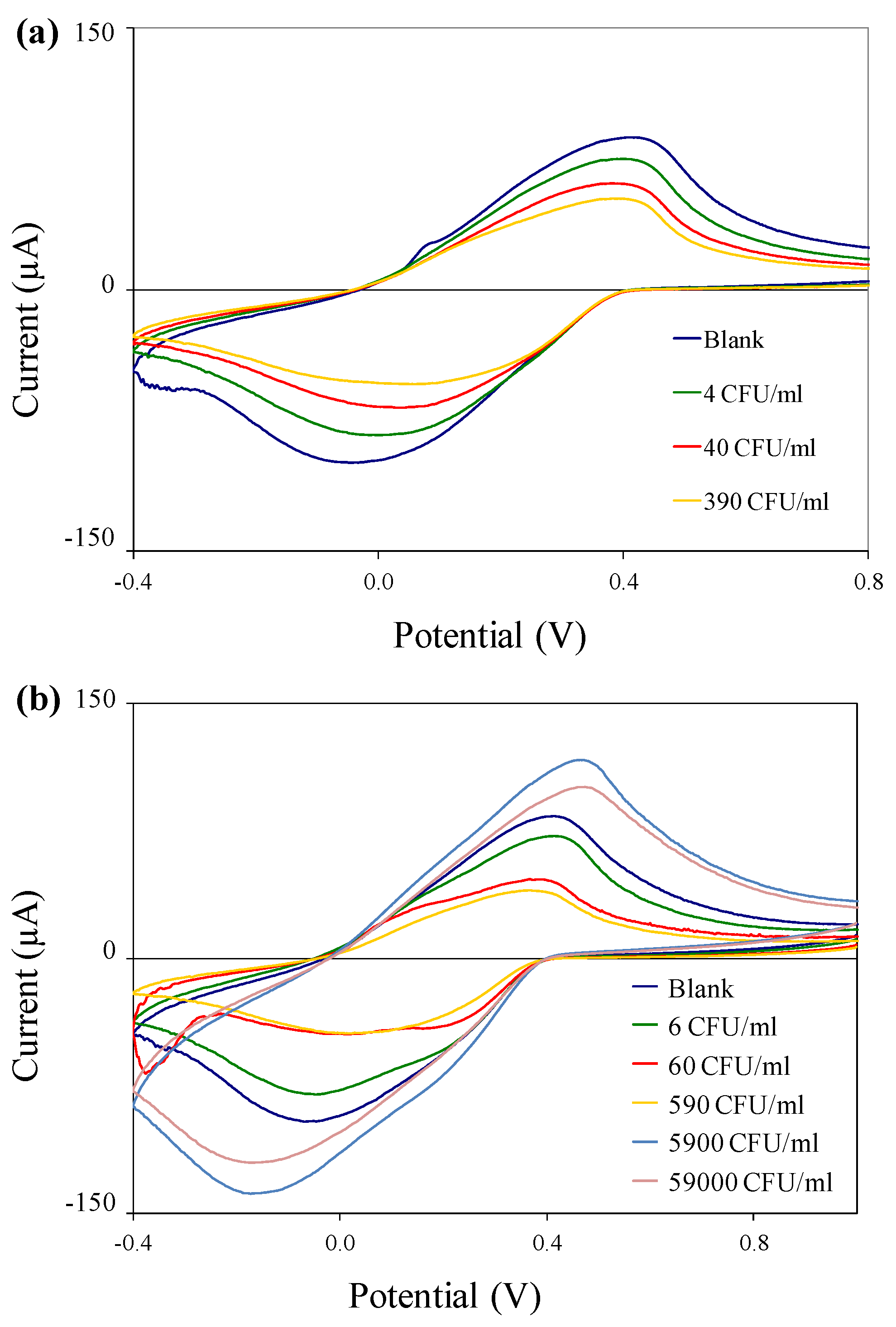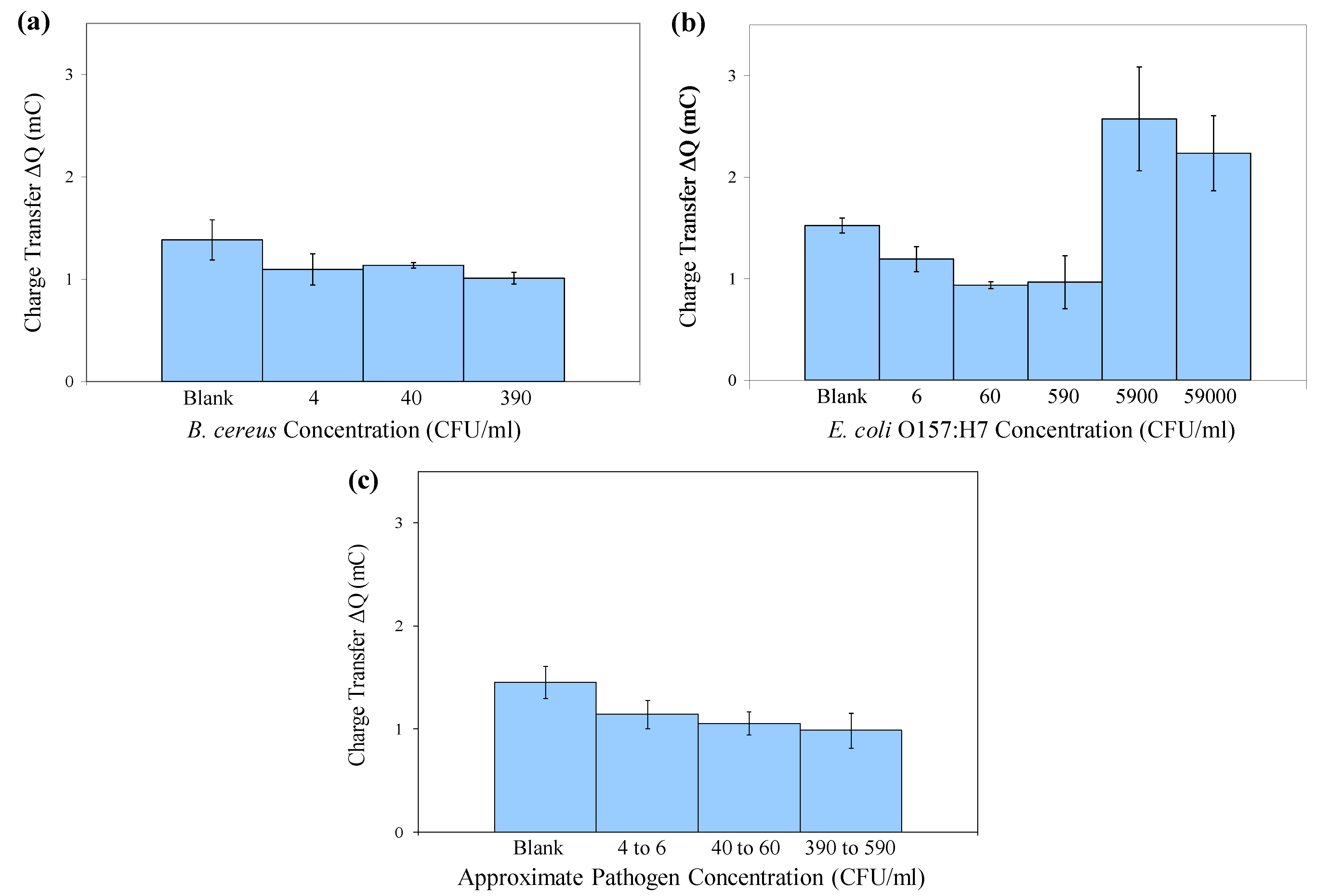
Electrochemical Biosensor for Rapid and Sensitive Detection of Magnetically Extracted Bacterial Pathogens


Abstract
1. Introduction
2. Materials and Methods
2.1. Reagents and Materials
2.2. Apparatus

2.3. Preparation of Pure Polyaniline Nanoparticles
2.4. Preparation and Characterization of Core/Shell Nanoparticles
2.5. Electrochemical Characterization of Nanoparticles
2.6. Immunomagnetic Separation of Bacterial Target

2.7. Electrochemical Detection of Bacterial Target
3. Results and Discussion
3.1. Preparation and Characterization of Core/Shell Nanoparticles
3.2. Electrochemical Characterization of Nanoparticles

3.3. Immunomagnetic Separation of Bacterial Target

| Original Est. Viable Cell Concentration (CFU/mL) | Mean Captured Viable Cell Concentration (CFU/mL) | Mean Capture Efficiency (log( captured)/log(original)) ± S.D. | Mean Est. Viable Cell Number (CFU) on SPCE | Mean Charge Transfer ΔQ (mC) |
|---|---|---|---|---|
| ± S.D. ( n = 3) | ( n = 3) | ± S.D. ( n = 3) | ± S.D. ( n = 3) | |
| B. cereus | ||||
| 0 (Blank) | 0 | --- | 0 | 1.4 ± 0.20 |
| 4 × 100 | (0 ± 0) × 100 | (0 ± 0)% | 0 ± 0 | 1.1 ± 0.15 |
| 4 × 101 | (1 ± 1) × 101 | (48 ± 43)% | 1 ± 1 | 1.1 ± 0.03 |
| 3.9 × 10² | (1.2 ± 0.31) × 102 | (80 ± 4.4)% | 12 ± 3.1 | 1.0 ± 0.06 |
| E. coli O157:H7 | ||||
| 0 (Blank) | 0 | --- | 0 | 1.5 ± 0.07 |
| 6 × 100 | (7 ± 6) × 100 | (86 ± 75)% | 0.7 ± 0.6 | 1.2 ± 0.12 |
| 6 × 101 | (1 ± 0.6) × 101 | (62 ± 9.8)% | 1 ± 0.6 | 0.94 ± 0.03 |
| 5.9 × 10² | (1.7 ± 0.12) × 102 | (80 ± 1.1)% | 17 ± 1.2 | 0.97 ± 0.26 |
| 5.9 × 10³ | (1.6 ± 0.81) × 103 | (84 ± 7.3)% | 160 ± 81 | 2.6 ± 0.51 |
| 5.9 × 10⁴ | (1.3 ± 0.36) × 104 | (86 ± 2.4)% | 1,300 ± 360 | 2.2 ± 0.37 |
3.4. Electrochemical Detection of Bacterial Target


4. Conclusions
Acknowledgments
References
- Pal, S.; Setterington, E.B.; Alocilja, E.C. Electrically active magnetic nanoparticles for concentrating and detecting Bacillus anthracis spores in a direct-charge transfer biosensor. IEEE Sens. J. 2008, 8, 647–654. [Google Scholar]
- Pal, S.; Alocilja, E.C. Electrically Active Polyaniline Coated Magnetic (EAPM) nanoparticle as novel transducer in biosensor for detection of Bacillus anthracis spores in food samples. Biosens. Bioelectron. 2009, 24, 1437–1444. [Google Scholar]
- Bad Bug Book: Foodborne Pathogenic Micro-Organisms and Natural Toxins Handbook. Bacillus cereus and other Bacillus spp; U.S. Food and Drug Administration (FDA): Silver Spring, MD, USA. Available online: http://www.fda.gov/Food/FoodSafety/FoodborneIllness/FoodborneIllnessFoodbornePathogensNaturalToxins/BadBugBook/ucm070492.htm (accessed on 16 December 2011).
- Edwards, K.; Clancy, H.; Baeumner, A. Bacillus anthracis: Toxicology, epidemiology and current rapid-detection methods. Anal. Bioanal. Chem. 2006, 384, 73–84. [Google Scholar]
- Bioterrorism Agents/Diseases; Centers for Disease Control and Prevention (CDC): Atlanta, GA, USA. Available online: http://emergency.cdc.gov/agent/agentlist-category.asp (accessed on 16 December 2011).
- Biodefense and Emerging Infectious Diseases: NIAID Category A, B, and C Priority Pathogens; National Institute of Allergy and Infectious Diseases (NIAID): Bethesda, MD, USA. Available online: http://www.niaid.nih.gov/topics/BiodefenseRelated/Biodefense/Pages/CatA.aspx (accessed on 16 December 2011).
- Bacteriological Analytical Manual (BAM). Chapter 4A: Diarrheagenic Escherichia coli. U.S. Food and Drug Administration (FDA): Silver Spring, MD, USA. Available online: http://www.fda.gov/Food/ScienceResearch/LaboratoryMethods/BacteriologicalAnalyticalManualBAM/ucm070080.htm (accessed on 16 December 2011).
- Water Sanitation and Health: Guidelines for Drinking-Water Quality, 3rd ed; World Health Organization (WHO): Geneva, Switzerland. Available online: http://www.who.int/water_sanitation_health/dwq/gdwq3rev/en/index.html (accessed on 16 December 2011).
- E. coli Outbreak Investigations; Centers for Disease Control and Prevention (CDC): Atlanta, GA, USA. Available online: http://www.cdc.gov/ecoli/outbreaks.html (accessed on 16 December 2011).
- Escherichia coli O157:H7 and Other Shiga Toxin-Producing Escherichia coli (STEC); Centers for Disease Control and Prevention (CDC): Atlanta, GA, USA. Available online: http://www.cdc.gov/nczved/divisions/dfbmd/diseases/ecoli_o157h7/ (accessed on 16 December 2011).
- Jaffrezic-Renault, N.; Martelet, C.; Chevolot, Y.; Cloarec, J.-P. Biosensors and bio-bar code assays based on biofunctionalized magnetic microbeads. Sensors 2007, 7, 589–614. [Google Scholar] [CrossRef]
- Tu, S.-I.; Golden, M.; Cooke, P.; Paoli, G.; Gehring, A. Detection of Escherichia coli O157:H7 through the formation of sandwiched complexes with immunomagnetic and fluorescent beads. J. Rapid Meth. Aut. Mic. 2005, 13, 269–282. [Google Scholar] [CrossRef]
- Cheng, Y.; Liu, Y.; Huang, J.; Li, K.; Zhang, W.; Xian, Y.; Jin, L. Combining biofunctional magnetic nanoparticles and ATP bioluminescence for rapid detection of Escherichia coli. Talanta 2009, 77, 1332–1336. [Google Scholar] [CrossRef]
- Aslan, K.; Previte, M.J.R.; Zhang, Y.; Gallagher, T.; Baillie, L.; Geddes, C.D. Extraction and detection of DNA from Bacillus anthracis spores and the vegetative cells within 1 min. Anal. Chem. 2008, 80, 4125–4132. [Google Scholar]
- Liu, Y.J.; Yao, D.J.; Chang, H.Y.; Liu, C.M.; Chen, C. Magnetic bead-based DNA detection with multi-layers quantum dots labeling for rapid detection of Escherichia coli O157:H7. Biosens. Bioelectron. 2008, 24, 558–565. [Google Scholar]
- Ruan, C.; Wang, H.; Li, Y. A bienzyme electrochemical biosensor coupled with immunomagnetic separation for rapid detection of Escherichia coli O157:H7 in food samples. Trans. ASAE 2002, 45, 249–255. [Google Scholar]
- Gehring, A.G.; Brewster, J.D.; Irwin, P.L.; Tu, S.-I.; Van Houten, L.J. 1-Naphthyl phosphate as an enzymatic substrate for enzyme-linked immunomagnetic electrochemistry. J. Electroanal. Chem. 1999, 469, 27–33. [Google Scholar]
- Gehring, A.G.; Tu, S.-I. Enzyme-linked immunomagnetic electrochemical detection of live Escherichia coli O157:H7 in apple juice. J. Food Protect. 2005, 68, 146–149. [Google Scholar]
- Varshney, M.; Li, Y. Interdigitated array microelectrode based impedance biosensor coupled with magnetic nanoparticle-antibody conjugates for detection of Escherichia coli O157:H7 in food samples. Biosens. Bioelectron. 2007, 22, 2408–2414. [Google Scholar] [CrossRef]
- Varshney, M.; Li, Y.; Srinivasan, B.; Tung, S. A label-free, microfluidics and interdigitated array microelectrode-based impedance biosensor in combination with nanoparticles immunoseparation for detection of Escherichia coli O157:H7 in food samples. Sens. Actuat. B-Chem. 2007, 128, 99–107. [Google Scholar]
- Maalouf, R.; Hassen, W.; Fournier-Wirth, C.; Coste, J.; Jaffrezic-Renault, N. Comparison of two innovative approaches for bacterial detection: Paramagnetic nanoparticles and self-assembled multilayer processes. Microchim. Acta 2008, 163, 157–161. [Google Scholar] [CrossRef]
- Palchetti, I.; Mascini, M. Electroanalytical biosensors and their potential for food pathogen and toxin detection. Anal. Bioanal. Chem. 2008, 391, 455–471. [Google Scholar] [CrossRef]
- Daniels, J.S.; Pourmand, N. Label-free impedance biosensors: Opportunities and challenges. Electroanalysis 2007, 19, 1239–1257. [Google Scholar] [CrossRef]
- Obuchowska, A. Quantitation of bacteria through adsorption of intracellular biomolecules on carbon paste and screen-printed carbon electrodes and voltammetry of redox-active probes. Anal. Bioanal. Chem. 2008, 390, 1361–1371. [Google Scholar] [CrossRef]
- Shabani, A.; Zourob, M.; Allain, B.; Marquette, C.A.; Lawrence, M.F.; Mandeville, R. Bacteriophage-modified microarrays for the direct impedimetric detection of bacteria. Anal. Chem. 2008, 80, 9475–9482. [Google Scholar]
- Escamilla-Gómez, V.; Campuzano, S.; Pedrero, M.; Pingarrón, J.M. Gold screen-printed-based impedimetric immunobiosensors for direct and sensitive Escherichia coli quantisation. Biosens. Bioelectron. 2009, 24, 3365–3371. [Google Scholar]
- Gamella, M.; Campuzano, S.; Parrado, C.; Reviejo, A.J.; Pingarrón, J.M. Microorganisms recognition and quantification by lectin adsorptive affinity impedance. Talanta 2009, 78, 1303–1309. [Google Scholar]
- Susmel, S.; Guilbault, G.G.; O’Sullivan, C.K. Demonstration of labeless detection of food pathogens using electrochemical redox probe and screen printed gold electrodes. Biosens. Bioelectron. 2003, 18, 881–889. [Google Scholar] [CrossRef]
- Rahman, M.; Kumar, P.; Park, D.-S.; Shim, Y.-B. Electrochemical sensors based on organic conjugated polymers. Sensors 2008, 8, 118–141. [Google Scholar]
- Sarno, D.M.; Manohar, S.K.; MacDiarmid, A.G. Controlled interconversion of semiconducting and metallic forms of polyaniline nanofibers. Synth. Met. 2005, 148, 237–243. [Google Scholar]
- Prakash, R. Electrochemistry of polyaniline: Study of the pH effect and electrochromism. J. Appl. Polym. Sci. 2002, 83, 378–385. [Google Scholar] [CrossRef]
- Pal, S.; Alocilja, E.C.; Downes, F.P. Nanowire labeled direct-charge transfer biosensor for detecting Bacillus species. Biosens. Bioelectron. 2007, 22, 2329–2336. [Google Scholar]
- Laska, J.; Widlarz, J. One-step polymerization leading to conducting polyaniline. Synth. Met. 2003, 135–136, 263–264. [Google Scholar]
- Laska, J.; Widlarz, J. Water soluble polyaniline. Synth. Met. 2003, 135–13, 261–262. [Google Scholar]
- Sharma, R.; Lamba, S.; Annapoorni, S.; Sharma, P.; Inoue, A. Composition dependent magnetic properties of iron oxide-polyaniline nanoclusters. J. Appl. Phys. 2005, 97, 14311–14316. [Google Scholar]
- Liu, W.; Kumar, J.; Tripathy, S.; Senecal, K.J.; Samuelson, L. Enzymatically synthesized conducting polyaniline. J. Am. Chem. Soc. 1998, 121, 71–78. [Google Scholar]
- Varshney, M.; Yang, L.; Su, X.L.; Li, Y. Magnetic nanoparticle-antibody conjugates for the separation of Escherichia coli O157:H7 in ground beef. J. Food Protect. 2005, 68, 1804–1811. [Google Scholar]
- Widjojoatmodjo, M.N.; Fluit, A.C.; Torensma, R.; Verhoef, J. Comparison of immunomagnetic beads coated with protein A, protein G, or goat anti-mouse immunoglobulins. Applications in enzyme immunoassays and immunomagnetic separations. J. Immunol. Methods 1993, 165, 11–19. [Google Scholar] [CrossRef]
- Aybay, C. Differential binding characteristics of protein G and protein A for Fc fragments of papain-digested mouse IgG. Immunol. Lett. 2003, 85, 231–235. [Google Scholar] [CrossRef]
- Wang, Z.; Jin, G. Feasibility of protein A for the oriented immobilization of immunoglobulin on silicon surface for a biosensor with imaging ellipsometry. J. Biochem. Bioph. Meth. 2003, 57, 203–211. [Google Scholar]
- Marquis, R.E.; Carstensen, E.L. Electric conductivity and internal osmolality of intact bacterial cells. J. Bacteriol. 1973, 113, 1198–1206. [Google Scholar]
- Radke, S.M.; Alocilja, E.C. Design and fabrication of a microimpedance biosensor for bacterial detection. IEEE Sens. J. 2004, 4, 434–440. [Google Scholar]
© 2012 by the authors; licensee MDPI, Basel, Switzerland. This article is an open access article distributed under the terms and conditions of the Creative Commons Attribution license (http://creativecommons.org/licenses/by/3.0/).
Share and Cite
Setterington, E.B.; Alocilja, E.C. Electrochemical Biosensor for Rapid and Sensitive Detection of Magnetically Extracted Bacterial Pathogens. Biosensors 2012, 2, 15-31. https://doi.org/10.3390/bios2010015
Setterington EB, Alocilja EC. Electrochemical Biosensor for Rapid and Sensitive Detection of Magnetically Extracted Bacterial Pathogens. Biosensors. 2012; 2(1):15-31. https://doi.org/10.3390/bios2010015
Chicago/Turabian StyleSetterington, Emma B., and Evangelyn C. Alocilja. 2012. "Electrochemical Biosensor for Rapid and Sensitive Detection of Magnetically Extracted Bacterial Pathogens" Biosensors 2, no. 1: 15-31. https://doi.org/10.3390/bios2010015
APA StyleSetterington, E. B., & Alocilja, E. C. (2012). Electrochemical Biosensor for Rapid and Sensitive Detection of Magnetically Extracted Bacterial Pathogens. Biosensors, 2(1), 15-31. https://doi.org/10.3390/bios2010015