


Nitrogen Trapping Ability of Hydrogen-Induced Vacancy and the Effect on the Formation of AlN in Aluminum

Abstract
1. Introduction
2. Materials and Methods
3. Results
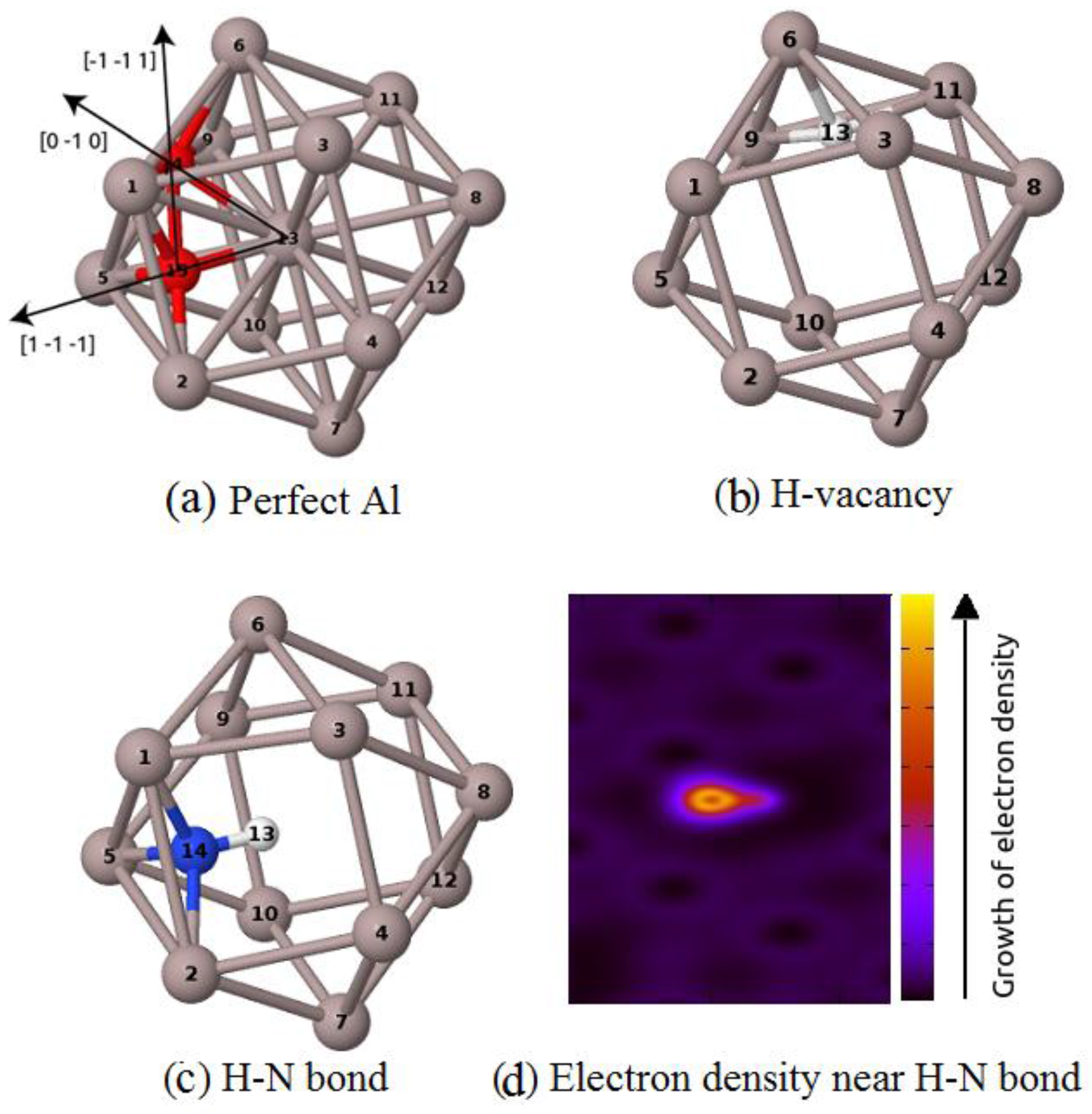
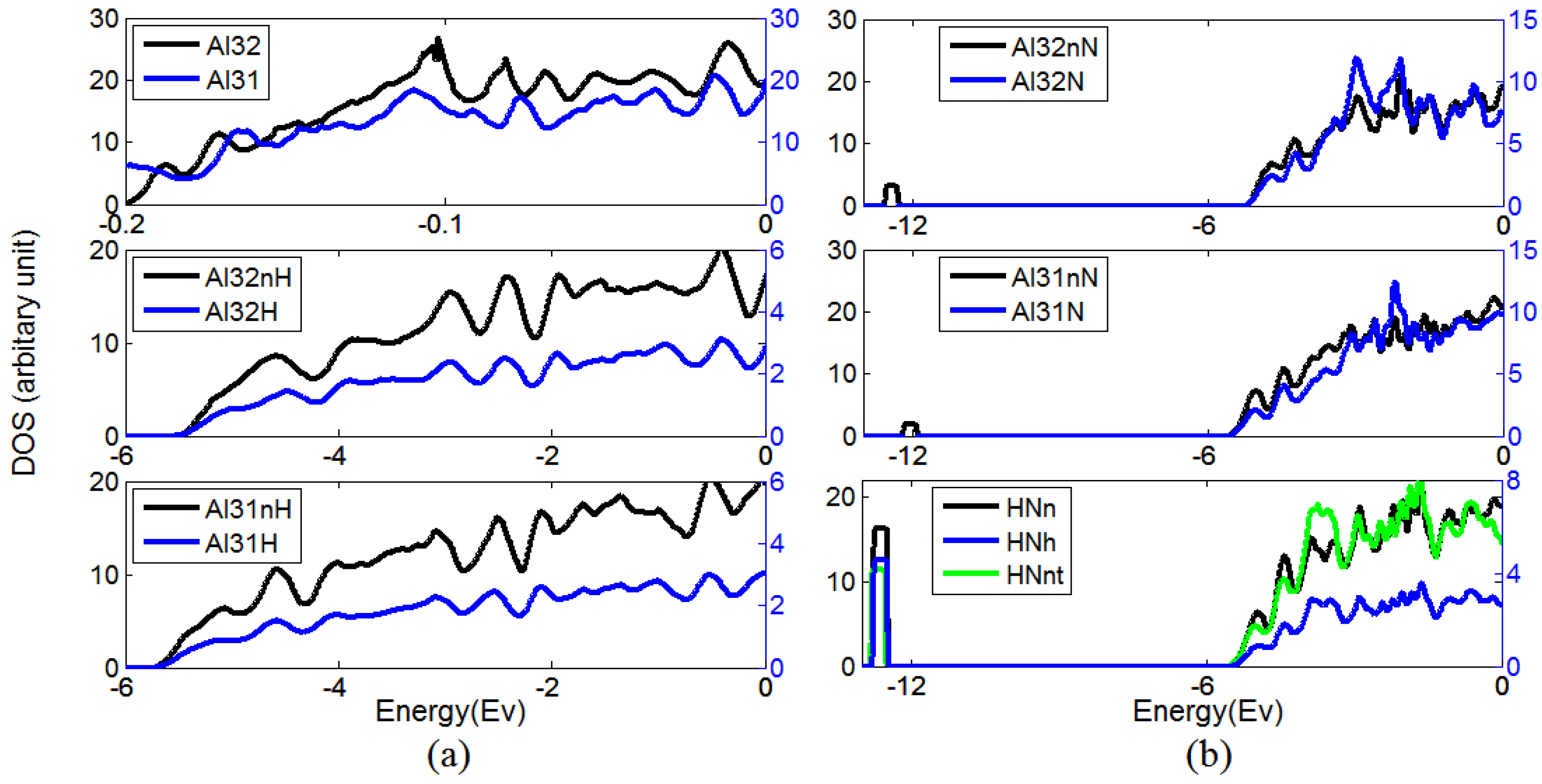
3.1. The Formation of H–N Bond Near Al Vacancy
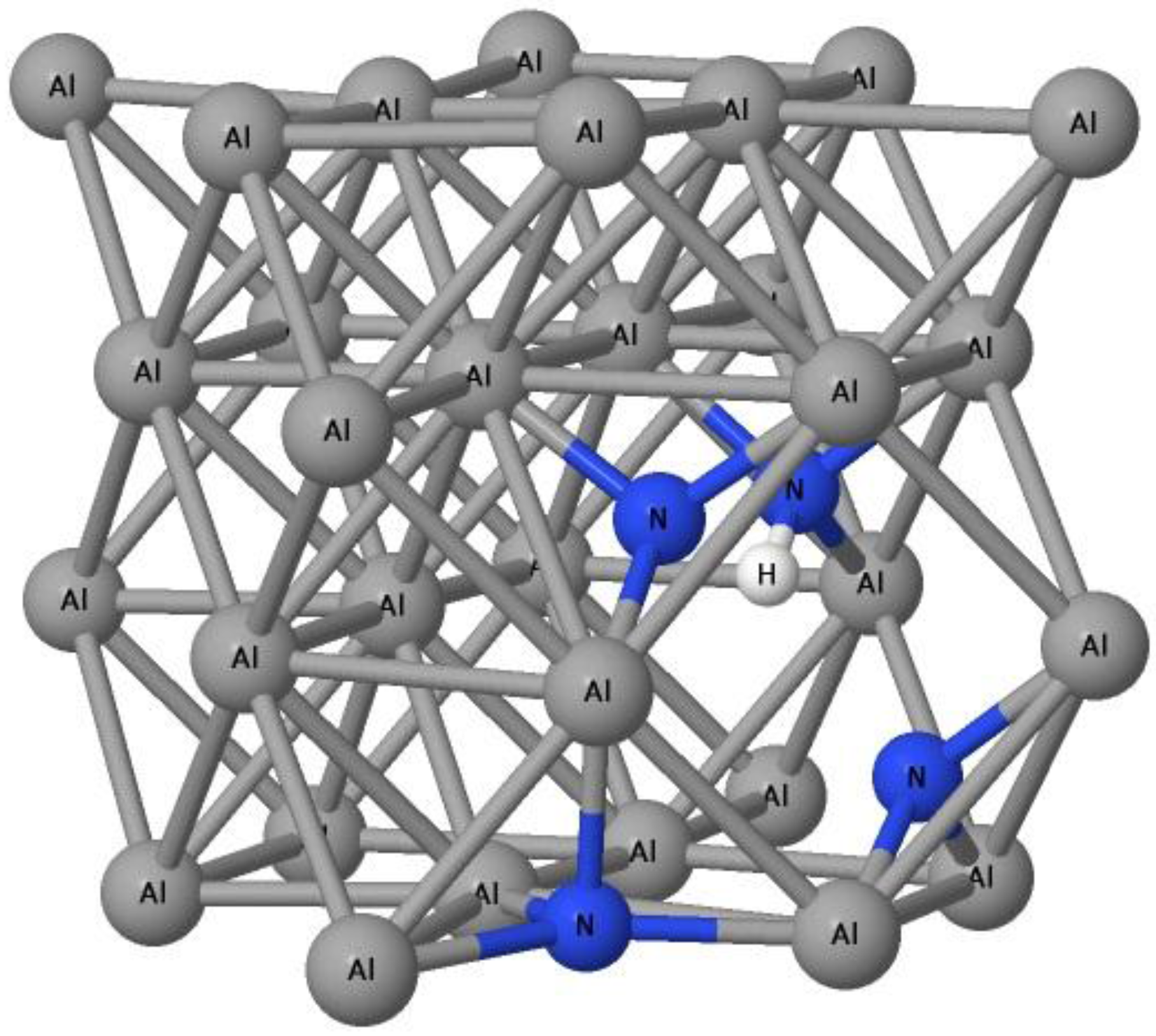
3.2. The Ability of Vacancies to Trap Nitrogen Atoms
4. Discussion and Conclusions
- N–vacancy interaction is repulsive;
- hydrogen reduces the vacancy formation energy and makes the N–vacancy interaction attractive.
Acknowledgments
Author Contributions
Conflicts of Interest
References
- Zheng, X.; Ren, Z.; Li, X.; Wang, Y. Microstructural characterization and mechanical properties of nitrided layers on aluminum substrate prepared by nitrogen arc. Appl. Surf. Sci. 2012, 259, 508–514. [Google Scholar] [CrossRef] [Scilit]
- Figueroa, U.; Salas, O.; Oseguera, J. Deposition of AlN on Al substrates by reactive magnetron sputtering. Surf. Coat. Technol. 2005, 200, 1768–1776. [Google Scholar] [CrossRef] [Scilit]
- Sheppard, L.M. Aluminum nitride: A versatile but challenging material. Bull. Am. Ceram. Soc. 1990, 69, 1801–1812. [Google Scholar]
- Kuramoto, N.; Taniguchi, H. Transparent AIN ceramics. J. Mater. Sci. Lett. 1984, 3, 471–474. [Google Scholar] [CrossRef] [Scilit]
- Shu, L.; Peng, B.; Cui, Y.; Gong, D.; Yang, Z.; Liu, X.; Zhang, W. Effects of AlN Coating Layer on High Temperature Characteristics of Langasite SAW Sensors. Sensors 2016, 16, 1436. [Google Scholar] [CrossRef] [Scilit] [PubMed]
- Chen, S.; You, Z. Modeling and Experimental Analysis on the Temperature Response of AlN-Film Based SAWRs. Sensors 2016, 16, 1205. [Google Scholar] [CrossRef] [Scilit] [PubMed]
- Zamora, R.J.; Nair, A.K.; Hennig, R.G.; Warner, D.H. Ab initio prediction of environmental embrittlement at a crack tip in aluminum. Phys. Rev. B 2012, 86, 60101. [Google Scholar] [CrossRef] [Scilit]
- Aoki, Y.; Fujii, H.; Nogi, K. Effect of atomic oxygen exposure on bubble formation in aluminum alloy. J. Mater. Sci. 2004, 39, 1779–1783. [Google Scholar] [CrossRef] [Scilit]
- Turner, D.E.; Zhu, Z.Z.; Chan, C.T.; Ho, K.M. Energetics of vacancy and substitutional impurities in aluminum bulk and clusters. Phys. Rev. B 1997, 55, 13842–13852. [Google Scholar] [CrossRef] [Scilit]
- Chung, J.P.; Lee, J.S.; Kim, K.R.; Choi, B.H. The change of atomic distribution and hardness by nitrogen implantation into aluminum alloy. Rev. Sci. Instrum. 2008, 79, 02C509. [Google Scholar] [CrossRef] [Scilit] [PubMed]
- Ghoranneviss, M.; Sari, A.H.; Dorranian, D.; Khorshid, P.; Hajihosseini, G.H.S.; Shokouhy, A.; Hesabi, M. Nitrogen Ion Implantation in Pure Aluminium; Japan Society of Plasma Science and Nuclear Fusion Research: Nagoya, Japan, 2006. [Google Scholar]
- Hogg, B.G.; Paulin, R.; Troev, T.D. Detection of nitrogen impurities in aluminum by positron annihilation. Phys. Lett. 1979, 71, 240–242. [Google Scholar] [CrossRef] [Scilit]
- Andrey, I.K.; Dat Duy, V.; Lipnitskii, A.G. The interaction between light impurities and vacancies in titanium and aluminum metals: A DFT study. St. Petersburg Polytech. Univ. J. Phys. Math. 2016, 2, 96–102. [Google Scholar]
- Hehenkamp, T. Absolute vacancy concentrations in noble metals and some of their alloys. J. Phys. Chem. Solids 1994, 55, 907–915. [Google Scholar] [CrossRef] [Scilit]
- Lynn, K.G.; Schultz, P. Vacancy formation energy measurements in single crystal aluminum using a variable-energy positron beam. Appl. Phys. A 1985, 37, 31–36. [Google Scholar] [CrossRef] [Scilit]
- Fluss, M.J.; Smedskjaer, L.C.; Chason, M.K.; Legnini, D.G.; Siegel, R.W. Measurements of the vacancy formation enthalpy in aluminum using positron annihilation spectroscopy. Phys. Rev. B 1978, 17, 3444–3455. [Google Scholar] [CrossRef] [Scilit]
- Carling, K.M.; Wahnström, G.; Mattsson, T.R.; Sandberg, N.; Grimvall, G. Vacancy concentration in Al from combined first-principles and model potential calculations. Phys. Rev. B 2003, 67, 054101. [Google Scholar] [CrossRef] [Scilit]
- Poletaev, D.O.; Aksyonov, D.A.; Dat Duy, V.; Lipnitskii, A.G. Hydrogen solubility in hcp titanium with the account of vacancy complexes and hydrides: A DFT study. Comput. Mater. Sci. 2016, 114, 199–208. [Google Scholar] [CrossRef] [Scilit]
- Peter, E.B.; Jepsen, O.; Andersen, O.K. Improved tetrahedron method for Brillouin-zone integrations. Phys. Rev. B 1994, 49, 16223–16233. [Google Scholar]
- Perdew, J.P.; Kieron, B.; Ernzerhof, M. Generalized Gradient Approximation Made Simple. Phys. Rev. Lett. 1996, 77, 3865–3868. [Google Scholar] [CrossRef] [Scilit] [PubMed]
- Kresse, G.; Hafner, J. Ab initio molecular dynamics for liquid metals. Phys. Rev. B 1993, 47. [Google Scholar] [CrossRef] [Scilit]
- Press, W.H.; Flannery, B.P.; Teukolsky, S.A.; Vetterling, W.T. Numerical Recipes; Cambridge University Press: New York, NY, USA, 1986. [Google Scholar]
- Jacobs, P.W.M.; Zhukovskii, Y.F.; Mastrikov, Y.; Shunin, Y.N. Bulk and surface properties of metallic aluminium: DFT simulations. Comput. Model. New Technol. 2002, 6, 7–28. [Google Scholar]
- Evans, D.J.; Holian, B.L. The Nose–Hoover thermostat. J. Chem. Phys. 1985, 83, 4069–4074. [Google Scholar] [CrossRef] [Scilit]
- Verlet, L. Computer “Experiments” on Classical Fluids. I. Thermodynamical Properties of Lennard-Jones Molecules. Phys. Rev. 1967, 159, 98–103. [Google Scholar] [CrossRef] [Scilit]
- Edwards, R.A.H.; Eichenauer, W. Reversible hydrogen trapping at grain boundaries in superpure aluminium. Scr. Metall. 1980, 14, 971–973. [Google Scholar] [CrossRef] [Scilit]
- Eichenauer, W.; Hattenbach, K.; Pebler, Z. The Solubility of Hydrogen in Solid and Liquid Aluminum. Z. Metallkunde 1961, 52, 682–684. [Google Scholar]
- Sugimoto, H.; Fukai, Y. Solubility of hydrogen in metals under high hydrogen pressures: Thermodynamical calculations. Acta Metall. Mater. 1992, 40, 2327–2336. [Google Scholar] [CrossRef] [Scilit]
- Ichimura, M.; Katsuta, H.; Sasajima, Y.; Imabayashi, M. Hydrogen and deuterium solubility in aluminum with voids. J. Phys. Chem. Solids 1988, 49, 1259–1267. [Google Scholar] [CrossRef] [Scilit]
- Wolverton, C.; Ozoliņš, V.; Asta, M. Hydrogen in aluminum: First-principles calculations of structure and thermodynamics. Phys. Rev. B 2004, 69, 144109. [Google Scholar] [CrossRef] [Scilit]
- Linderoth, S. Hydrogen diffusivity in aluminium. Philos. Mag. Lett. 1988, 57, 229–234. [Google Scholar] [CrossRef] [Scilit]
- Linderoth, S.; Rajainmäki, H.; Nieminen, R.M. Defect recovery in aluminum irradiated with protons at 20 K. Phys. Rev. B 1987, 35, 5524–5528. [Google Scholar] [CrossRef] [Scilit]
- Myers, S.M.; Besenbacher, F.; Norskov, J.K. Immobilization mechanisms for ion-implanted deuterium in aluminum. J. Appl. Phys. 1985, 58. [Google Scholar] [CrossRef] [Scilit]
- Demaison, J.; Margulès, L.; Boggs, J.E. The equilibrium N–H bond length. Chem. Phys. 2000, 260, 65–81. [Google Scholar] [CrossRef] [Scilit]

| DFT package | ECH–vacancy | ECN–vacancy | ECN–(H–vacancy) |
|---|---|---|---|
| Abinit | 0.39 | −0.69 | 0.56 |
| VASP | 0.50 | −0.51 | 0.59 |
| DFT package | Evacancyf | Evacancyf[H] | Evacancyf[H + N] |
|---|---|---|---|
| Abinit | 0.55 | 0.16 | −0.38 |
| VASP | 0.65 | 0.15 | −0.44 |
| m | Efvacancy−H+mN | Etrap(m) | ΔV | Δa | Δaver |
|---|---|---|---|---|---|
| 1 | −0.59 | 0.00 | |||
| 2 | −0.54 | −0.16 | 5.69 | 0.04 | 0.02 |
| 3 | −0.69 | −0.35 | 6.12 | 0.07 | 0.17 |
| 4 | −0.49 | −0.01 | 7.47 | 0.05 | 0.11 |
| 5 | 1.57 | 1.90 | 1.43 | 0.15 | 0.38 |
| 6 | −0.08 | −1.90 | 4.92 | 0.10 | 0.47 |
| 7 | −2.62 | −2.74 | 10.91 | 0.24 | 0.80 |
| 8 | −0.62 | 1.80 | 16.37 | -0.30 | 0.30 |
© 2017 by the authors. Licensee MDPI, Basel, Switzerland. This article is an open access article distributed under the terms and conditions of the Creative Commons Attribution (CC BY) license (http://creativecommons.org/licenses/by/4.0/).
Share and Cite
Vo, D.D.; Lipnitskii, A.G.; Nguyen, T.K.; Nguyen, T.T. Nitrogen Trapping Ability of Hydrogen-Induced Vacancy and the Effect on the Formation of AlN in Aluminum. Coatings 2017, 7, 79. https://doi.org/10.3390/coatings7060079
Vo DD, Lipnitskii AG, Nguyen TK, Nguyen TT. Nitrogen Trapping Ability of Hydrogen-Induced Vacancy and the Effect on the Formation of AlN in Aluminum. Coatings. 2017; 7(6):79. https://doi.org/10.3390/coatings7060079
Chicago/Turabian StyleVo, Duy Dat, Aleksey G. Lipnitskii, Truong Khang Nguyen, and Thoi Trung Nguyen. 2017. "Nitrogen Trapping Ability of Hydrogen-Induced Vacancy and the Effect on the Formation of AlN in Aluminum" Coatings 7, no. 6: 79. https://doi.org/10.3390/coatings7060079
APA StyleVo, D. D., Lipnitskii, A. G., Nguyen, T. K., & Nguyen, T. T. (2017). Nitrogen Trapping Ability of Hydrogen-Induced Vacancy and the Effect on the Formation of AlN in Aluminum. Coatings, 7(6), 79. https://doi.org/10.3390/coatings7060079

