A Perspective on the Enhancer Dependent Bacterial RNA Polymerase
Abstract
1. Introduction
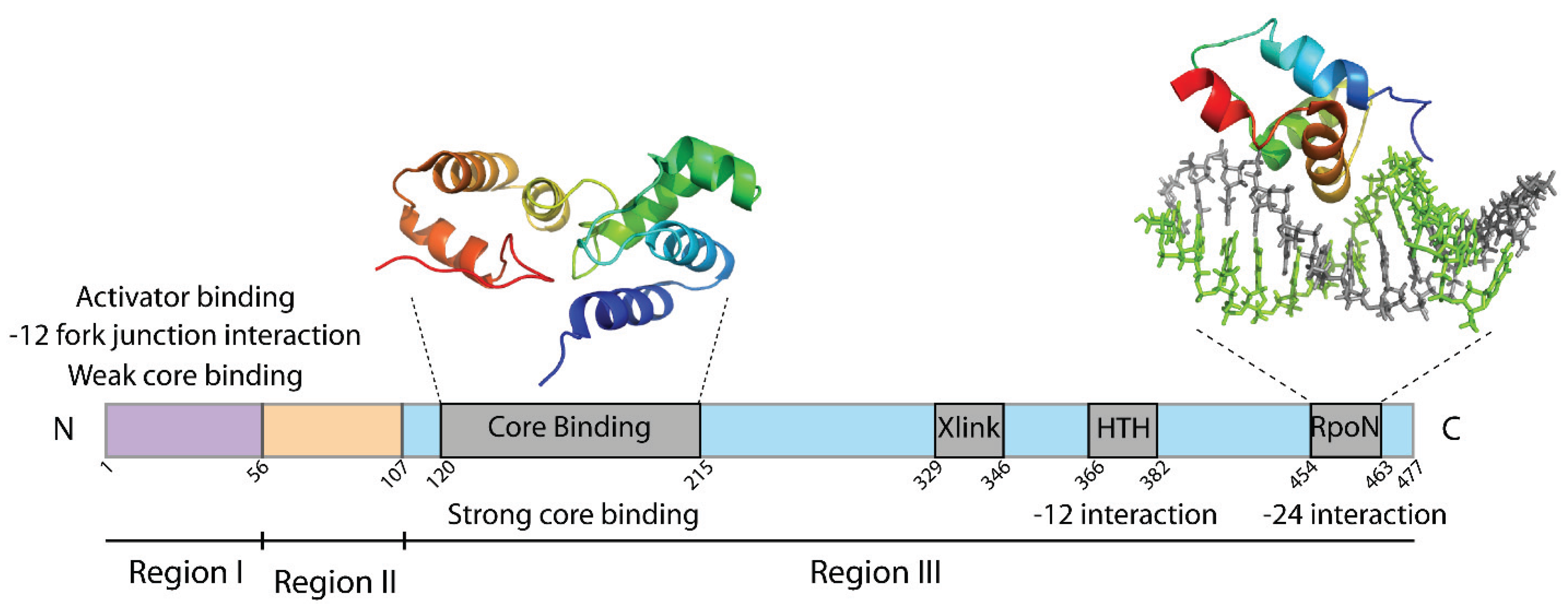
2. The Sigma54 Factor

3. Promoter Recognition
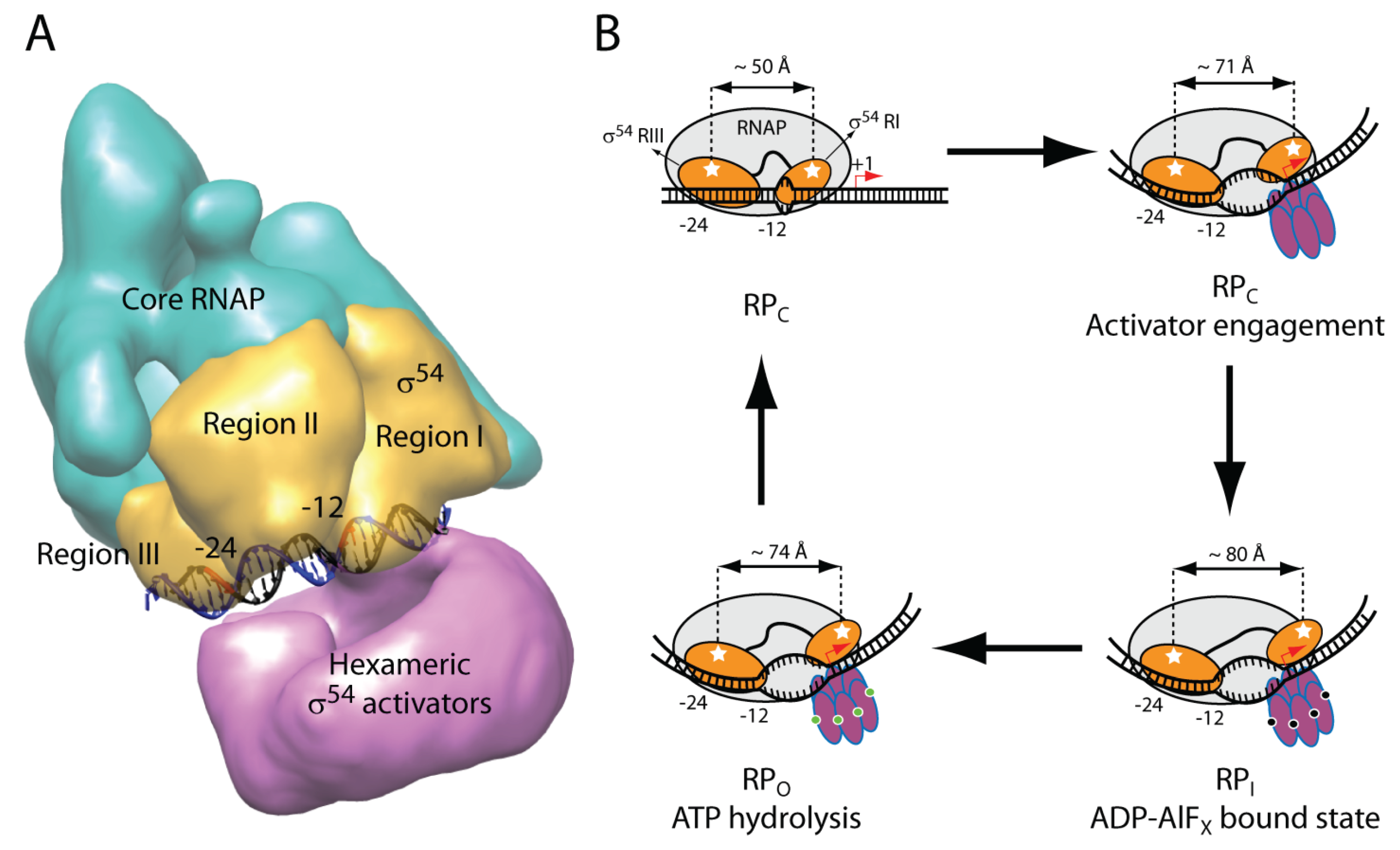
4. Activator Remodel of the Sigma54 Holoenzyme

5. Signaling for Sigma54 Dependent Transcription
6. Conclusions and a Final Perspective
Acknowledgments
Author Contributions
Conflicts of Interest
References
- Merrick, M.J. In a class of its own—The RNA polymerase sigma factor sigma 54 (sigma N). Mol. Microbiol. 1993, 10, 903–909. [Google Scholar] [CrossRef] [PubMed]
- Bush, M.; Dixon, R. The role of bacterial enhancer binding proteins as specialized activators of sigma54-dependent transcription. Microbiol. Mol. Biol. Rev. 2012, 76, 497–529. [Google Scholar] [CrossRef] [PubMed]
- Joly, N.; Zhang, N.; Buck, M.; Zhang, X. Coupling AAA protein function to regulated gene expression. Biochim. Biophys. Acta 2012, 1823, 108–116. [Google Scholar] [CrossRef] [PubMed]
- Francke, C.; Groot Kormelink, T.; Hagemeijer, Y.; Overmars, L.; Sluijter, V.; Moezelaar, R.; Siezen, R.J. Comparative analyses imply that the enigmatic sigma factor 54 is a central controller of the bacterial exterior. BMC Genomics 2011. [Google Scholar] [CrossRef]
- Dixon, R.; Kahn, D. Genetic regulation of biological nitrogen fixation. Nat. Rev. Microbiol. 2004, 2, 621–631. [Google Scholar] [CrossRef] [PubMed]
- Fisher, M.A.; Grimm, D.; Henion, A.K.; Elias, A.F.; Stewart, P.E.; Rosa, P.A.; Gherardini, F.C. Borrelia burgdorferi sigma54 is required for mammalian infection and vector transmission but not for tick colonization. Proc. Natl. Acad. Sci. USA 2005, 102, 5162–5167. [Google Scholar] [CrossRef] [PubMed]
- Fouts, D.E.; Abramovitch, R.B.; Alfano, J.R.; Baldo, A.M.; Buell, C.R.; Cartinhour, S.; Chatterjee, A.K.; D’Ascenzo, M.; Gwinn, M.L.; Lazarowitz, S.G.; et al. Genomewide identification of Pseudomonas syringae pv. Tomato DC3000 promoters controlled by the hrpL alternative sigma factor. Proc. Natl. Acad. Sci. USA 2002, 99, 2275–2280. [Google Scholar] [CrossRef]
- Studholme, D.J.; Buck, M. The biology of enhancer-dependent transcriptional regulation in bacteria: Insights from genome sequences. FEMS Microbiol. Lett. 2000, 186, 1–9. [Google Scholar] [CrossRef] [PubMed]
- Wolfe, A.J.; Millikan, D.S.; Campbell, J.M.; Visick, K.L. Vibrio fischeri sigma54 controls motility, biofilm formation, luminescence, and colonization. Appl. Environ. Microbiol. 2004, 70, 2520–2524. [Google Scholar] [CrossRef] [PubMed]
- Kustu, S.; Santero, E.; Keener, J.; Popham, D.; Weiss, D. Expression of sigma 54 (NtrA)-dependent genes is probably united by a common mechanism. Microbiol. Rev. 1989, 53, 367–376. [Google Scholar] [PubMed]
- Popham, D.L.; Szeto, D.; Keener, J.; Kustu, S. Function of a bacterial activator protein that binds to transcriptional enhancers. Science 1989, 243, 629–635. [Google Scholar] [CrossRef] [PubMed]
- Cannon, W.; Chaney, M.; Buck, M. Characterisation of holoenzyme lacking sigman regions I and II. Nucleic Acids Res. 1999, 27, 2478–2486. [Google Scholar] [CrossRef] [PubMed]
- Syed, A.; Gralla, J.D. Isolation and properties of enhancer-bypass mutants of sigma 54. Mol. Microbiol. 1997, 23, 987–995. [Google Scholar] [CrossRef] [PubMed]
- Doucleff, M.; Malak, L.T.; Pelton, J.G.; Wemmer, D.E. The C-terminal RpoN domain of sigma54 forms an unpredicted helix-turn-helix motif similar to domains of sigma70. J. Biol. Chem. 2005, 280, 41530–41536. [Google Scholar] [CrossRef] [PubMed]
- Doucleff, M.; Pelton, J.G.; Lee, P.S.; Nixon, B.T.; Wemmer, D.E. Structural basis of DNA recognition by the alternative sigma-factor, sigma54. J. Mol. Biol. 2007, 369, 1070–1078. [Google Scholar] [CrossRef] [PubMed]
- Wang, L.; Gralla, J.D. Roles for the C-terminal region of sigma 54 in transcriptional silencing and DNA binding. J. Biol. Chem. 2001, 276, 8979–8986. [Google Scholar] [CrossRef] [PubMed]
- Friedman, L.J.; Mumm, J.P.; Gelles, J. RNA polymerase approaches its promoter without long-range sliding along DNA. Proc. Natl. Acad. Sci. USA 2013, 110, 9740–9745. [Google Scholar] [CrossRef] [PubMed]
- Friedman, L.J.; Gelles, J. Mechanism of transcription initiation at an activator-dependent promoter defined by single-molecule observation. Cell 2012, 148, 679–689. [Google Scholar] [CrossRef] [PubMed]
- Tintut, Y.; Wang, J.T.; Gralla, J.D. Abortive cycling and the release of polymerase for elongation at the sigma 54-dependent glnAP2 promoter. J. Biol. Chem. 1995, 270, 24392–24398. [Google Scholar] [CrossRef] [PubMed]
- Burrows, P.C.; Severinov, K.; Ishihama, A.; Buck, M.; Wigneshweraraj, S.R. Mapping sigma 54-RNA polymerase interactions at the −24 consensus promoter element. J. Biol. Chem. 2003, 278, 29728–29743. [Google Scholar] [CrossRef] [PubMed]
- Bose, D.; Pape, T.; Burrows, P.C.; Rappas, M.; Wigneshweraraj, S.R.; Buck, M.; Zhang, X. Organization of an activator-bound RNA polymerase holoenzyme. Mol. Cell 2008, 32, 337–346. [Google Scholar] [CrossRef] [PubMed]
- Zhang, N.; Joly, N.; Buck, M. A common feature from different subunits of a homomeric AAA+ protein contacts three spatially distinct transcription elements. Nucleic Acids Res. 2012, 40, 9139–9152. [Google Scholar] [CrossRef] [PubMed]
- Sysoeva, T.A.; Chowdhury, S.; Guo, L.; Nixon, B.T. Nucleotide-induced asymmetry within ATPase activator ring drives sigma54-RNAP interaction and ATP hydrolysis. Genes Dev. 2013, 27, 2500–2511. [Google Scholar] [PubMed]
- Sharma, A.; Leach, R.N.; Gell, C.; Zhang, N.; Burrows, P.C.; Shepherd, D.A.; Wigneshweraraj, S.; Smith, D.A.; Zhang, X.; Buck, M.; et al. Domain movements of the enhancer-dependent sigma factor drive DNA delivery into the RNA polymerase active site: Insights from single molecule studies. Nucleic Acids Res. 2014, 42, 5177–5190. [Google Scholar] [CrossRef]
- Zhang, N.; Gordiyenko, Y.; Joly, N.; Lawton, E.; Robinson, C.V.; Buck, M. Subunit dynamics and nucleotide-dependent asymmetry of an AAA+ transcription complex. J. Mol. Biol. 2014, 426, 71–83. [Google Scholar] [CrossRef] [PubMed]
- Burrows, P.C.; Joly, N.; Buck, M. A prehydrolysis state of an AAA+ ATPase supports transcription activation of an enhancer-dependent RNA polymerase. Proc. Natl. Acad. Sci. USA 2010, 107, 9376–9381. [Google Scholar] [CrossRef] [PubMed]
- Lawton, E.; Jovanovic, M.; Joly, N.; Waite, C.; Zhang, N.; Wang, B.; Burrows, P.; Buck, M. Determination of the self-association residues within a homomeric and a heteromeric AAA+ enhancer binding protein. J. Mol. Biol. 2014, 426, 1692–1710. [Google Scholar] [CrossRef] [PubMed]
- Brown, D.R.; Barton, G.; Pan, Z.; Buck, M.; Wigneshweraraj, S. Nitrogen stress response and stringent response are coupled in Escherichia coli. Nat. Commun. 2014. [Google Scholar] [CrossRef]
- Zhao, K.; Liu, M.; Burgess, R.R. Promoter and regulon analysis of nitrogen assimilation factor, sigma54, reveal alternative strategy for E. coli MG1655 flagellar biosynthesis. Nucleic Acids Res. 2010, 38, 1273–1283. [Google Scholar] [CrossRef] [PubMed]
© 2015 by the authors; licensee MDPI, Basel, Switzerland. This article is an open access article distributed under the terms and conditions of the Creative Commons Attribution license (http://creativecommons.org/licenses/by/4.0/).
Share and Cite
Zhang, N.; Buck, M. A Perspective on the Enhancer Dependent Bacterial RNA Polymerase. Biomolecules 2015, 5, 1012-1019. https://doi.org/10.3390/biom5021012
Zhang N, Buck M. A Perspective on the Enhancer Dependent Bacterial RNA Polymerase. Biomolecules. 2015; 5(2):1012-1019. https://doi.org/10.3390/biom5021012
Chicago/Turabian StyleZhang, Nan, and Martin Buck. 2015. "A Perspective on the Enhancer Dependent Bacterial RNA Polymerase" Biomolecules 5, no. 2: 1012-1019. https://doi.org/10.3390/biom5021012
APA StyleZhang, N., & Buck, M. (2015). A Perspective on the Enhancer Dependent Bacterial RNA Polymerase. Biomolecules, 5(2), 1012-1019. https://doi.org/10.3390/biom5021012