


Abstract
We prove the existence of the monotone traveling wave for the isothermal fluid equations with viscous and capillary terms by the planar dynamical system method. We obtain that the monotone traveling wave is asymptotically stable under the suitable perturbation. In the process of establishing the uniform a priori estimate, we dispose the capillary term reasonably according to the feature of the equations, and find the appropriate weighted function to overcome the difficulty caused by the non-convex pressure function.
Keywords:
nonlinear stability; monotone traveling wave; capillary term; non-convex pressure; weighted energy estimate MSC:
35B40; 35A24
1. Introduction
We consider the nonlinear stability of the monotone traveling wave for the following isothermal fluid equations with the viscous and capillary terms [1] in the Lagrangian coordinates
In (1), is the time, and is the coordinate. u and v represent the velocity and specific volume, respectively. is the viscous term, and is the capillary term, where the coefficients and are constants, satisfying and . The capillarity was first proposed by Korteweg [2], so the system with the capillary term is also called a Korteweg type [3,4,5,6,7]. The van del Waals pressure is in the form of
(1) with (2) could be treated as a simple model to describe the liquid–gas phase transition [8,9,10]. M. Affouf and R.E. Caflisch [1] used its simplified form
to analyze the stability for rarefaction waves, shock waves, and phase jump of Equation (1) by a numerical method.
The energy estimate method [11,12] is usually used to theoretically analyze the asymptotic stability of the traveling wave. Applying this method, the stability of the rarefaction wave and shock wave for a one-dimensional compressible model with viscous gas
has been studied in [13,14,15]. Z. Chen et al. [6,7] studied the large time behavior of the rarefaction wave and traveling wave for the following fluid equations
where is the capillary term. W. Zhang et al. [16] studied the existence and asymptotic stability of the monotone traveling waves of Equations (1) with (3). In the above studies, the pressure is supposed to satisfy
This paper mainly focuses on the case of Equations (1) with (2), in which the pressure is more complex. We assume that its first-order derivative satisfies (6), while the second-order derivative will change the signal on , where the constants are the asymptotic values of the traveling wave throughout, i.e.,
This means the pressure is not strictly convex. The case with a non-convex pressure function has been investigated by some researchers [17,18,19,20,21,22], but the models they studied had no capillarity. In light of [6,7,17,18,19,20,21,22], we studied the nonlinear stability of the monotone traveling wave, when the system has a capillary effect and the pressure , chosen as (2), satisfies (6) and (8).
In Section 2, we qualitatively analyze the existence of monotone traveling waves by the planar dynamical system method. In Section 3, in order to settle the difficulty caused by the non-convex pressure , we find the appropriate weight function to establish the uniformly prior estimate. In this process, we dispose the capillary term reasonably by the structure of Equation (1) itself. The uniformly prior estimate can be used to explain the asymptotic behavior under the suitable perturbation.
In this paper, we use Young’s inequality and the differential mean value theorem. To enhance readability, we list them as follows:
Young’s Inequality Suppose , with . Then
Differential Mean Value Theorem If function meets the following conditions:
(1) is continuous on close interval ;
(2) is derivable on open interval .
Then, at least there is one point that can make the equation true.
Notations. denotes the space of measurable functions on R which are square integrable, with the norm . denoting the Sobolev space, with the norm .
2. Traveling Wave and Main Results
Integrating the above formula on and , respectively, yields
where , . Then c satisfies
which is the Rankine–Hugoniot condition.
When the viscous coefficient and capillary coefficient , the system (1) has two eigenvalues . The wave speed c satisfies the Lax shock condition
In this paper, we only discuss the case of , i.e.,
The case of can be discussed similarly.
Theorem 1
Proof.
We prove Theorem 1 with the planar dynamical system method [23].
From (9), the traveling wave satisfies
Integrating above on , we have
where g is an integral constant.
Letting and , then (15) is equivalent to the planar dynamical system
We want to find the monotone traveling wave of Equation (1), satisfying and , with the asymptotic value , as long as we find the bounded orbit connecting , where are the real roots of satisfying .
On the phase plane , we denote the singular points to be and , at which the Jocabi matrix is
The characteristic polynomial of is . From the Lax shock condition (13), we have
From the planar dynamical system theory, we know that is a saddle point, since has two real eigenvalues with opposite signs; is a stable node point, since has two real negative eigenvalues.
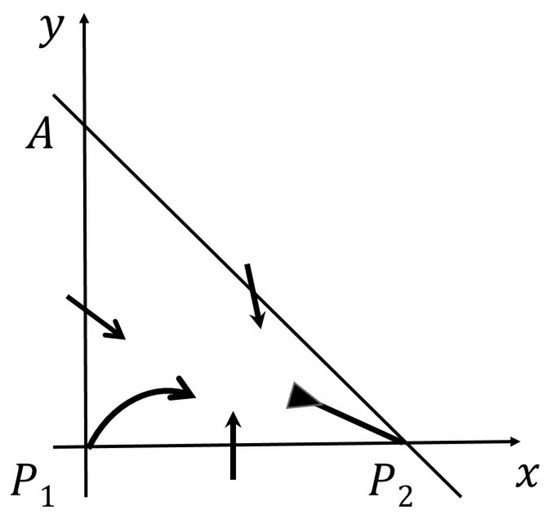
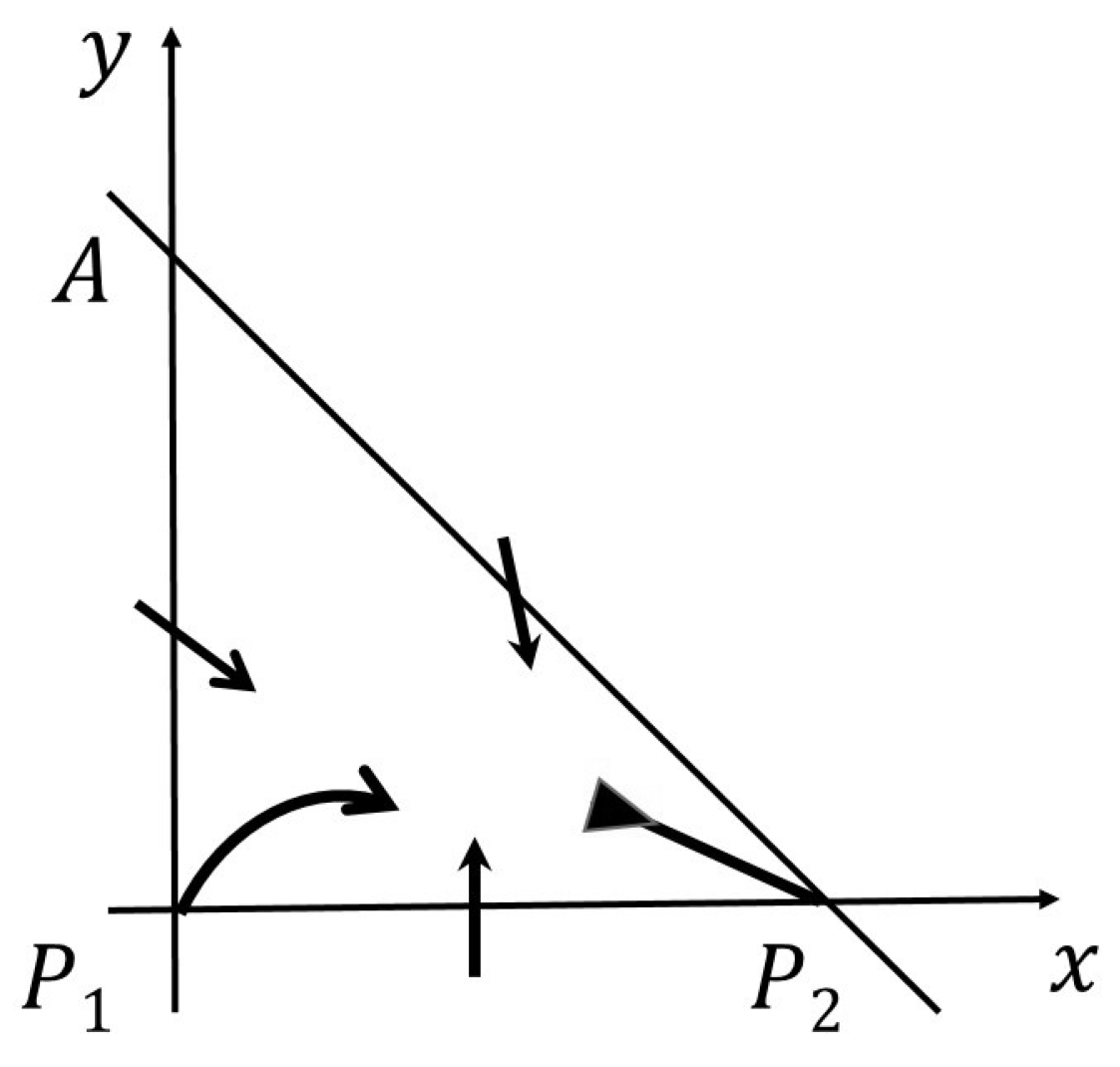
In the next step, we give the tendency of the separatrix at the right side of the saddle point . For this purpose, we establish a triangle region, surrounded by the straight lines , , and , where will be determined later. The triangle region is generalized non-tangential. Since the tangent slope of the orbits of system (16) at , and are
See details in Figure 1.
Figure 1.
The tangent slopes of the orbit at , and .
From the direction of the vector field described in Figure 1, we know that the separatrix line of the saddle point will not pass through the triangle region . Note that is a stable node point, so the separatrix coming from the saddle point must trend to . Hence, there must be a bounded orbit connecting the points and , which corresponds to the monotone increasing traveling wave since . □
Theorem 2
(21) is very important in the energy estimate, which can be obtained from (9) by direct calculations, so we omit the proof. See details in [16].
We discuss the traveling wave solution of Equations (1) and (2) with the initial condition
where , are measurable functions, satisfying and as . and are constants.
Let , i.e.,
and then satisfy
Suppose that
Theorem 3
(Nonlinear stability). is the monotone traveling wave obtained in Theorem 1. Then there exist constant and , such that Equation (1) has a unique global solution with the initial value , satisfying
if
and
Furthermore, the asymptotic behaviors of the global solution are shown in the form of
3. Proof to Theorem 3 on Nonlinear Stability
Integrate (24), and make the integration constant to be zero. Then we get
Linearizing (32) yields
among which .
Theorem 4.
Theorem 3 could be proved by Theorem 4 directly. Actually, from the uniqueness of the global solution, its existence can be obtained by the global solution of the initial problem (33) and (34). Meanwhile, from (35) and (36), we know that
Furthermore, from the Sobolev inequality, then (31) in Theorem 3 holds.
Theorem 4 can be proved by two parts: the local existence and the a priori estimate. The first part can be arrived at in the standard way, so we omit it. We only give the proof for the a priori estimate. Combining the two parts, we can give the global existence by continuations.
Proposition 1
Proposition 2
Proof.
We first give the weight energy estimate of on .
We multiply and with the first formula and second formula in (33), respectively, where . Summing the results, then we have
To simplify the term in (39), we differentiate the first formula in (33) with respect to , and multiply . Summing (39), then we get
Note that will disappear after integrating, so we write it as for short in the following.
In order to find the appropriate weight function , we rewrite (40) as
To obtain the lower order a priori estimate, the weight function should be chosen to make
hold. Further,
We could choose
Note that, under the selection of (43), the coefficient of all terms at the left of (41) is positive.
On the other hand, from the Schwartz inequality, the first term at the right of (41) satisfies
From Theorem 2, , if , and then we obtain
To control in (46), we give the estimate on . Multiply with , and then we get
Moreover,
By Young’s inequality,
where .
From the Taylor expansion,
which means is the dominant term, since it is much bigger that , , …, as . Since in (38), then
From the smallness of , and , we obtain the lower-order weight energy estimate (35).
Next, we give the weight energy estimate of on .
Differentiating the two formulas in (33) with respect to ,
and multiplying and with the first formula and second formula in (52), respectively. Summing the results and noting , we can obtain
Simplify (53), similarly with (41), and is also chosen as (43). Integrating (53) on , and the terms and can be controlled by the left. We could have
To obtain the estimate of on , we multiply on the second formula in (52). Then we have
Similarly, by Young’s inequality and the smallness of , then we have
To give the estimate of on , we multiply on the second formula in (52), and note that . Then we obtain
Applying the differential mean value theorem,
where , by Young’s inequality,
From the smallness of and , (36) holds naturally. □
4. Discussion
In this paper, we investigated the nonlinear stability of the monotone traveling wave for the isothermal fluid equations with viscous and capillary terms under the suitable perturbation. It should be pointed out that, in the proof of Proposition 2, we only use the smallness of , which can be controlled by from (35). So in the condition of Theorem 3, we assume . However, for the higher-order derivative of the perturbation , we only need to assume it to be bounded. See details in (61)–(63). This is enough to ensure the prior estimate holds.
The condition in Theorem 3 is only a sufficient condition. In future research, we want to find the optimal condition which the initial perturbation satisfies to make the traveling wave stable, and will search some counter-examples by numerical simulation. We are also interested in the linear stability [24,25,26], the blowup phenomenon [27], and the problem of control for nonlinear systems [28,29,30] in the future.
Author Contributions
Conceptualization, X.L. and W.Z.; methodology, X.L.; formal analysis, X.L.; investigation, X.L.; writing—original draft preparation, X.L.; writing—review and editing, W.Z. and H.J.; project administration, W.Z.; funding acquisition, W.Z. All authors have read and agreed to the published version of the manuscript.
Funding
This research was funded by the National Natural Science Foundation of China grant number 11471215.
Data Availability Statement
No underlying data were collected or produced in this study.
Conflicts of Interest
The authors declare no conflict of interest.
References
- Affouf, M.; Caflsch, R.E. A numerical study of Riemann problem solutions and stability for a system of viscous conservation laws of mixed type. SIAM J. Appl. Math. 1991, 51, 605–634. [Google Scholar] [CrossRef] [Scilit]
- Korteweg, D.J. Sur la forme que prennent lea équation des mouvements des fluids si l’on tient compte des forces capillarires par des variations de densité. Arch. Neerl. Sci. Exactes Nat. Ser. II 1901, 6, 1–24. [Google Scholar]
- Hattori, H.; Li, D.N. Solutions for two dimensional system for materials of Korteweg type. SIAM J. Math. Anal. 1994, 25, 85–98. [Google Scholar] [CrossRef] [Scilit]
- Hattori, H.; Li, D.N. The existence of global solutions to a fluid dynamic model for materials for Korteweg type. J. Partial Differ. Equ. 1996, 9, 323–342. [Google Scholar]
- Haspot, B. Existence of global weak solution for compressible fluid models of Korteweg type. J. Math. Fluid Mech. 2011, 13, 223–249. [Google Scholar] [CrossRef] [Scilit]
- Chen, Z.Z. Asymptotic stability of strong rarefaction waves for the compressible fluid models of Korteweg type. J. Math. Anal. Appl. 2012, 394, 438–448. [Google Scholar] [CrossRef] [Scilit]
- Chen, Z.; He, L.; Zhao, H. Nonlinear stability of traveling wave solutions for the compressible fluid models of Korteweg type. J. Math. Anal. Appl. 2015, 422, 1213–1234. [Google Scholar] [CrossRef] [Scilit]
- Slemrod, M. Admissibility criteria for propagating phase boundaries in a van der Waals fluid. Arch. Rational Mech. Anal. 1983, 81, 301–315. [Google Scholar] [CrossRef] [Scilit]
- Slemrod, M. Dynamic phase transitions in a Van der Waalsfluid. J. Differ. Equ. 1984, 52, 1–23. [Google Scholar] [CrossRef] [Scilit]
- Glimm, J. The continuous structure of discontinuities. Lect. Notes Phys. 1986, 344, 175–186. [Google Scholar]
- Goodman, J. Nonlinear asymptotic stability of viscous shock profiles for conservations laws. Arch. Rational. Mech. Anal. 1986, 95, 325–344. [Google Scholar] [CrossRef] [Scilit]
- Pego, R.L. Remarks on the stability of shock profiles for conservation laws with dissipation. Trans. Amer. Math. Soc. 1985, 291, 353–361. [Google Scholar] [CrossRef]
- Matsumura, A.; Nishihara, K. On the stability of travelling wave solutions of a one-dimensional model system for compressible viscous Gas. Jpn. J. Appl. Math. 1985, 2, 17–25. [Google Scholar] [CrossRef] [Scilit]
- Kawashima, S.; Matsumura, A. Asymptotic Stability of Traveling Wave Solutions of Systems for One-dimensional Gas Motion. Commun. Math. Phys. 1985, 1, 97–127. [Google Scholar] [CrossRef] [Scilit]
- Matsumura, A.; Nishihara, K. Global stability of the rarefaction wave of a one-dimensional model system for compressible viscous gas. Commun. Math. Phys. 1992, 144, 325–335. [Google Scholar] [CrossRef] [Scilit]
- Zhang, W.; Li, X.; Yong, Y. Asymptotic stability of monotone increasing traveling wave solutions for viscous compressible fluid equations with capillarity term. J. Math. Anal. Appl. 2016, 434, 401–412. [Google Scholar] [CrossRef] [Scilit]
- Jones, C.; Gardner, R.; Kapitula, T. Stability of travelling waves for non-convex scalar viscous conservation laws. Commun. Pure Appl. Math. 1993, 46, 505–526. [Google Scholar] [CrossRef] [Scilit]
- Matsumura, A.; Nishihara, K. Asymptotic stability of traveling waves for scale viscous conservation laws with non-convex nonlinearity. Comm. Math. Phys. 1994, 165, 83–96. [Google Scholar] [CrossRef] [Scilit]
- Mei, M. Stability of shock profiles for non-convex scalar viscous conservation laws. Math. Model. Methods Appl. Sci. 1995, 5, 279–296. [Google Scholar] [CrossRef] [Scilit]
- Kawashima, S.; Matsumura, A. Stability of shock profiles in viscoelasticity with non-convex constitutive relations. Commun. Pure Appl. Math. 1994, 47, 1547–1569. [Google Scholar] [CrossRef] [Scilit]
- Matsumura, A.; Mei, M. Nonlinear stability of viscous shock profile for a non-convex system of viscoelasticity. Osaka J. Math. 1997, 34, 589–603. [Google Scholar]
- Matsumura, A.; Mei, M. Convergence to travelling fronts of solutions of the p-system with viscosity in the presence of a boundary. Arch. Rational Mech. Anal. 1999, 146, 1–22. [Google Scholar] [CrossRef] [Scilit]
- Zhang, Z.F.; Ding, T.R.; Huang, W.Z.; Dong, Z.X. Qualitative Theory of Differential Equations, Translations of Mathematical Monographs; American Mathematical Society: Providence, RI, USA, 1992. [Google Scholar]
- Sarma, R.; Mondal, P.K. Marangoni instability in a heated viscoelastic liquid film: Longwave versus shortwave perturbations. Phys. Rev. E 2019, 100, 1–14. [Google Scholar] [CrossRef] [Scilit]
- Sarma, R.; Mondal, P.K. Thermosolutal Marangoni instability in a viscoelastic liquid film: Effect of heating from the free surface. J. Fluid Mech. 2020, 909, 1–24. [Google Scholar] [CrossRef] [Scilit]
- Sarma, R.; Mondal, P.K. Marangoni instability in a viscoelastic binary film with cross-diffusive effect. J. Fluid Mech. 2021, 910, 1–34. [Google Scholar] [CrossRef] [Scilit]
- Jin, H.Y.; Wang, Z.A. Boundedness, blowup and critical mass phenomenon in competing chemotaxis. J. Differ. Equ. 2016, 260, 162–196. [Google Scholar] [CrossRef] [Scilit]
- Xu, S.; Dai, H.; Li, F.; Chen, H.; Chai, Y.; Zheng, W.X. Fault Estimation for Switched Interconnected Nonlinear Systems with External Disturbances via Variable Weighted Iterative Learning. IEEE Trans. Circuits Syst. II Express Briefs 2023, 70. [Google Scholar] [CrossRef] [Scilit]
- Sun, L.; Hou, J.; Xing, C.; Fang, Z. A Robust Hammerstein-Wiener Model Identification Method for Highly Nonlinear Systems. Processes 2022, 10, 2664. [Google Scholar] [CrossRef] [Scilit]
- Ye, R.; Liu, P.; Shi, K.B.; Yan, B. State Damping Control: A Novel Simple Method of Rotor UAV with High Performance. Access 2020, 8, 214346–214357. [Google Scholar] [CrossRef] [Scilit]
Disclaimer/Publisher’s Note: The statements, opinions and data contained in all publications are solely those of the individual author(s) and contributor(s) and not of MDPI and/or the editor(s). MDPI and/or the editor(s) disclaim responsibility for any injury to people or property resulting from any ideas, methods, instructions or products referred to in the content. |
© 2023 by the authors. Licensee MDPI, Basel, Switzerland. This article is an open access article distributed under the terms and conditions of the Creative Commons Attribution (CC BY) license (https://creativecommons.org/licenses/by/4.0/).