


Abstract
Arumugam and Mathew [Discret. Math. 2012, 312, 1584–1590] introduced the notion of fractional metric dimension of a connected graph. In this paper, a combinatorial technique is devised to compute it. In addition, using this technique the fractional metric dimension of the generalized Jahangir graph is computed for and .
1. Introduction and Preliminaries
In this paper, is a finite, undirected, connected and simple graph of order and size . For any two vertices , the distance is the length of a shortest path in G. For graph theoretic terminology, we refer to [1,2,3].
An ordered set of vertices, we mean a set on which the ordering has been imposed. For an ordered subset of , we refer to the -vector (ordered -tuple) as the (metric) representation of v with respect to W. The set W is called a resolving set for G if implies that for all . Hence, if W is a resolving set of cardinality k for a graph G of order n, then the set consists of n distinct -vectors. A vertex is said to resolve in G if . The collection of all such x in is called resolving neighbourhood of the pair , denoted by . Explicitly, . Let denote the collection of all pairs of vertices of G. Then for each the set is called resolvent neighbourhood of x.
Definition 1
([4]). Let be a connected graph of order n. A function is called a resolving function (RF) of G if for any two distinct vertices , where . A resolving function g of a graph G is minimal (MRF) if any function such that and for at least one is not a resolving function of G. Then, the fractional metric dimension of the graph G is where
In [5,6], Slatter introduced the notion of resolving set of a connected graph under the term locating set. Harary and Melter in [7], independently discovered these concepts and termed them as the metric dimension of graph. Resolving sets enjoy their several applications in various areas of computer sciences such as network discovery and verification [8], robot navigation [9], mastermind game [10], coin weighing problem [11], integer programming [12] and drug discovery [13]. The problem of finding metric dimension of a graph as an integer programming problem (IPP) has been introduced by Chartrand et al. [13], and independently by Currie and Oellermann [12]. As a further refinement, Currie and Oellermann [8] devised the notion of fractional metric dimension as the optimal solution of the linear relaxation of the IPP. An equivalent formulation for the fractional metric dimension of a graph has been proposed by Fehr et al. [14] as follows:
Suppose and . Let be the matrix with if and 0 otherwise, where and . The IPP of the metric dimension is given by;
Minimize subject to , where , and is the column vector with all entries as 1.
The optimal solution of the aforementioned linear programming relaxation, with replacement by gives the fractional metric dimension of G, represented by . The optimal solution of the dual of this LPP is referred to as the metric independence number of G. Therefore, the duality and weak duality theorem in linear programming implies that , as discussed by Arumugam and Mathew in [4]. For further details of the duality and weak duality theorem, we refer to [15].
In [16], Ali et al. introduced the generalized Jahangir graph as follows:
Definition 2.
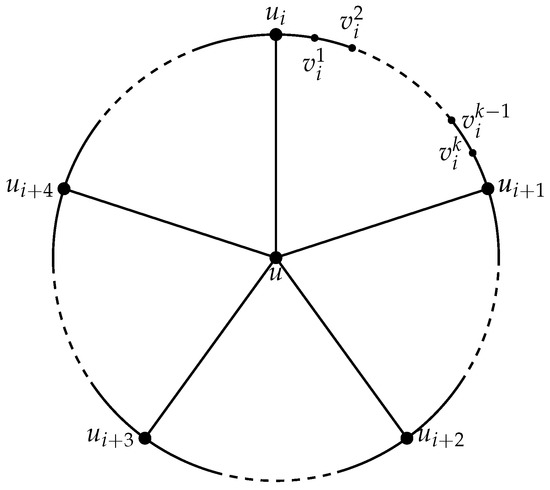
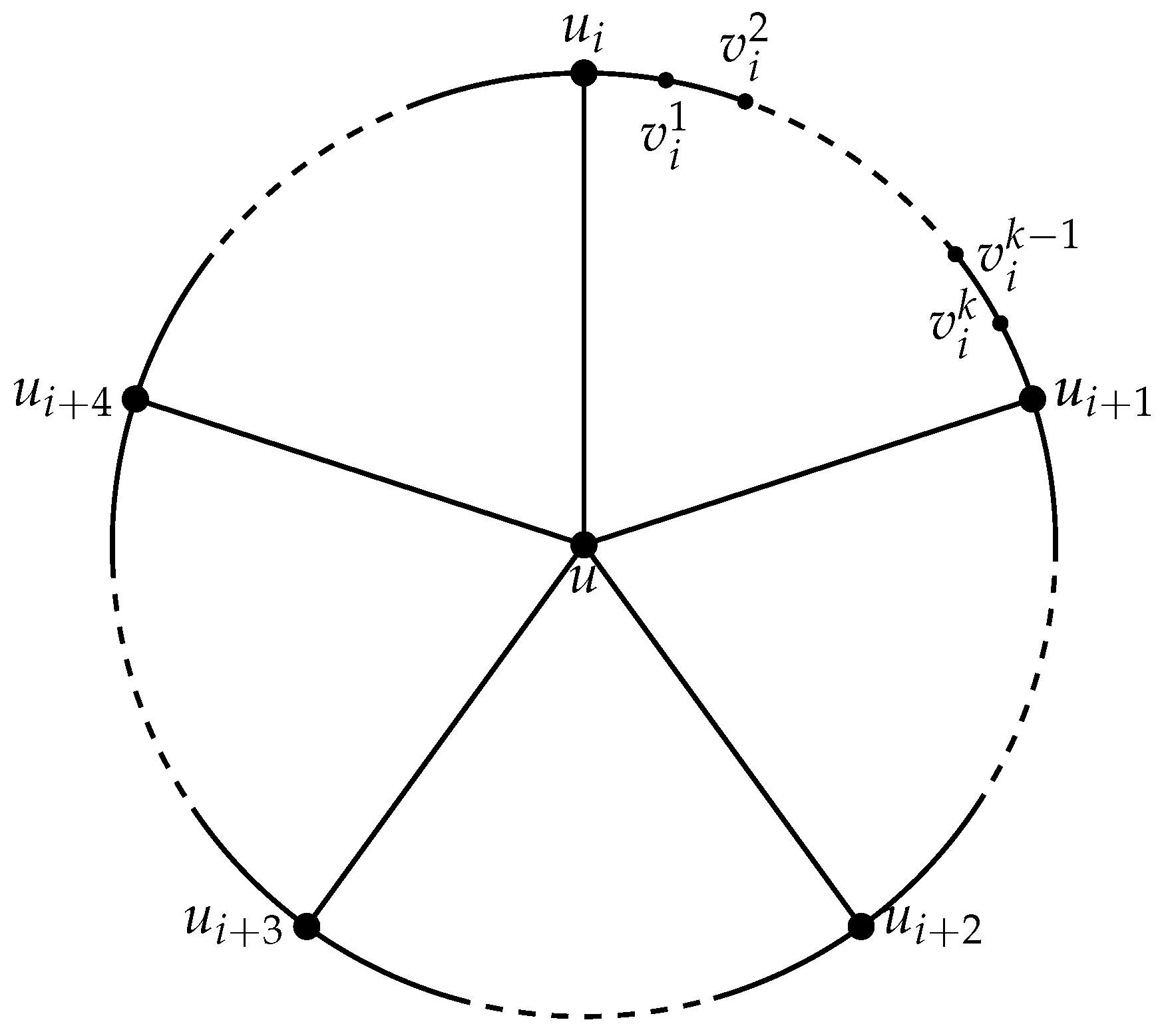
The generalized Jahangir graph , for , is a graph on vertices i.e., a graph consisting of a cycle with one additional vertex which is adjacent to m vertices of at distance to each other on . The vertex set of is with
The vertices of the generalized Jahangir graph can be classified into three different types. The vertices of degree and m are respectively named as minors, major and center. The generalized Jahangir graph have minor vertices, m major vertices and one center vertex. In this article, we have discussed results for , shown in Figure 1. For , the generalized Jahangir graph is the Jahangir graph , for , discussed by Tomescu et al. in [17].
Figure 1.
Generalized Jahangir graph .
Arumugam and Mathew [4] formally introduced the notion of fractional metric dimension and discussed some fundamental results. The fractional metric dimension of the cartesian product, hierarchical product, corona product, lexicographic product and comb product of connected graphs, see [18,19,20,21]. YI [22] computed the fractional metric dimension of permutation graphs. Mainly, Arumugama et al. [4] studied the graphs whose fractional metric dimension graphs equals half of their orders and Feng et al. [23] investigated the fractional metric dimension of vertex transitive and distance regular graphs. This motivated us to devise a criterion to compute fractional metric dimension of those graphs which are neither vertex transitive and distance regular graphs nor their fractional metric dimension is half of their orders. In particular, the criterion is applied to compute fractional metric dimension of the generalized Jahangir graph for and .
The paper is organized as follows: Section 1 is for introduction and preliminaries and in Section 2, the resolving neighbourhood of each possible pair of the vertices of the generalized Jahangir graph for and are obtained. The main results are included in Section 3. Finally, the paper is concluded with some future prospects in Section 4.
2. Resolving Neighbourhoods of the Generalized Jahangir Graph for and
The possible pairs of vertices of the generalized Jahangir graph for and are majors with majors, major with minors, center with majors, center with minors, and minors with minors. In this section, the resolving neighbourhoods for each pair of vertices of and are classified.
Lemma 1.
Let be the generalized Jahangir graph for and . Then
Moreover, and .
Proof.
The resolving neighborhood of for is with . Similarly, the resolving neighborhood of for is with .
Also in both cases, and hence . □
In the following lemma resolving neighbourhoods of the center vertex with major vertices in are computed.
Lemma 2.
Let be the generalized Jahangir graph for and . Then and .
Proof.
For , the resolving neighbourhood is with and . Therefore, . Similarly, for , with and . Therefore, . This completes the proof. □
In the following lemma resolving neighbourhoods of center vertex with minor vertices in are computed.
Lemma 3.
Let be the generalized Jahangir graph for and . Then and .
Proof.
Case 1: (When )
Since, with and Therefore, . Now for , the resolving neighbourhood with . Also, and therefore, .
Case 2: (When )
Since, with and . Therefore, . Now for is odd, the resolving neighbourhood with . Also, and therefore, . Finally, for is even, , and the case is easy to see. This completes the proof. □
In the following lemma resolving neighbourhoods of the pair of major vertices in are computed.
Lemma 4.
Let be the generalized Jahangir graph for and . Then and for .
Proof.
The symmetry of the generalized Jahangir graph allows us to discuss only the following case:
Case 1: (When and )
Since, with and . Therefore, .
Case 2: (When and )
Since, with and . Therefore, .
Case 3: (When and )
Since, with and . Therefore, .
Case 4: (When and )
Since, with and . Therefore, . □
In the following lemma resolving neighbourhoods of major vertices with minor vertices in are computed.
Lemma 5.
Let be the generalized Jahangir graph for and . Then and for .
Proof.
Case 1: (When and )
For , the resolving neighbourhood and for j is even and odd respectively. Also, and . Now and , therefore, , , and .
Case 2: (When and )
In this case, the resolving neighbourhoods are , , for even j, for odd j, and . Therefore, . Also, .
Case 3: (When and )
In this case, the resolving neighbourhoods are , , for odd j and for even j. Therefore, . Also, .
Case 4: (When and )
In this case, for even , for odd and . Therefore, in each of the above cases respectively, is greater than . Also each of , for even j, for odd j and are greater than .
Case 5: (When and )
In this case, for odd , , for even and . Therefore, in each of the above cases respectively, is greater than . Also each of , for odd j, , for even j and are greater than .
Case 6: (When and )
In this case, for odd , and for even . Therefore, in each of the above cases and respectively, is greater than . Also each of , for odd j, and for even j are greater than . □
In the following lemma resolving neighbourhoods of each pair of minor vertices in are computed.
Lemma 6.
Let be the generalized Jahangir graph for and . Then and for .
Proof.
Case 1: When :
Case 1.1: For and
Here, , and . Also, , and . Now .
Case 1.2: For , and
for even j and , for odd j and for odd j and . Also, . Now .
Case 1.3: For and
Here, , , , , , ,, , , . Also, .
Now . Similarly, it can be done for .
Case 2: When :
The proof is same as of case 1. □
3. Fractional Metric Dimension of the Generalized Jahangir Graph for and
In this section, the fractional metric dimension of the generalized Jahangir graph for and is computed. Before achieving the main result a combinatorial criterion to compute fractional metric dimension of a graph is devised in Lemma 7. The criteria is then used in main theorems of this section.
Lemma 7.
Let be the collection of all pair wise resolving sets of such that and . Then
where,
Proof.
Define a function defined by
Then g is indeed a minimal resolving function for G. Since and , therefore, assigning zero to all is required to attain minimum possible weight of . Consequently, zero is assigned to all . Therefore, computing summation of over all gives □
Theorem 1.
The fractional metric dimension of the generalized Jahangir graph for and is
Proof.
Case 1: When
The resolving neighbourhood of all possible pairs of vertices in are , and . Hence, for all . Also, . Therefore, from Lemma 7 .
Case 2: When
The resolving neighbourhood of any pair of consecutive major vertices in is and . It is indeed easy to see that and for any pair of vertices in such that and . Therefore, from Lemma 7 .
Case 3: When
The resolving neighbourhood of any pair of consecutive major vertices in is and the resolving neighbourhood of the pair of minors in is . Also, . It is indeed easy to see that and for any pair of vertices in such that either and or and . Therefore, from Lemma 7 .
Case 4: When
The resolving neighbourhood of the pair of minors in is . Also, . It is indeed easy to see that and for any pair of vertices in such that and . Therefore, from Lemma 7 . □
Remark 1.
In [4], Arumugam and Mathew computed fractional metric dimension of the wheel graph as for . It is to be noted that the graph is a special case of the generalized Jahangir graph for . Also, the fractional dimension for computed above is in consensus with [4].
Theorem 2.
The fractional metric dimension of the generalized Jahangir graph for and is
Proof.
In view of Lemma 1,
and . Also from Lemma 2 to Lemma 6, for all such that and . Therefore, from the criteria given in Lemma 7, the fractional metric of is given as follows:
Here, . This implies
Hence,
This completes the proof. □
Theorem 3.
The fractional metric dimension of the generalized Jahangir graph is for and for .
Proof.
Clear from Theorem 2. □
4. Conclusions
In this paper, a combinatorial criteria is developed to compute fractional metric dimension of a connected graph. The criteria is applied to compute fractional metric dimension of the generalized Jahangir graph for and . The problem to investigate the fractional metric dimension of the generalized Jahangir graph for and is still open.
Author Contributions
J.-B.L. contributed the discussion on problem, validation of results, funding and final reading, A.K. and M.J. contributed the source of problem, collection of material, analyze and compute the results, and wrote the paper, and T.R. contributed for discussion on problem, methodology, and prepared the final draft.
Funding
The work was partially supported by the China Postdoctoral Science Foundation under Grant No. 2017M621579 and the Postdoctoral Science Foundation of Jiangsu Province under Grant No. 1701081B. Project of Anhui Jianzhu University under Grant No. 2016QD116 and 2017dc03. Anhui Province Key Laboratory of Intelligent Building & Building Energy Saving.
Acknowledgments
The authors are indebted to all the anonymous referees for their careful reading and valuable comments to improve the original version of this paper.
Conflicts of Interest
The authors declare that there are no conflicts of interest regarding the publication of this paper.
References
- Chartrand, G.; Lesniak, L. Graphs & Digraphs, 4th ed.; Chapman & Hall, CRC: London, UK, 2005. [Google Scholar]
- Gross, J.L.; Yellen, J. Graph Theory and Its Applications, 2nd ed.; Chapman and Hall/CRC: London, UK, 2005. [Google Scholar]
- West, D.B. Introduction to Graph Theory; Prentice Hall: Upper Saddle River, NJ, USA, 2001. [Google Scholar]
- Arumugam, S.; Mathew, V. The fractional metric dimension of graphs. Discret. Math. 2012, 312, 1584–1590. [Google Scholar] [CrossRef] [Scilit]
- Slater, P.J. Leaves of trees. Congr. Numer. 1975, 14, 549–559. [Google Scholar]
- Slater, P.J. Domination and location in acyclic graphs. Networks 1987, 17, 55–64. [Google Scholar] [CrossRef] [Scilit]
- Harary, F.; Melter, R.A. On the metric dimension of a graph. ARS Combin. 1976, 2, 191–195. [Google Scholar]
- Beerliova, Z.; Eberhard, F.; Erlebach, T.; Hall, A.; Hoffman, M.; Mihalak, M.; Ram, L. Network discovery and verification. IEEE J. Sel. Areas Commun. 2006, 24, 2168–2181. [Google Scholar] [CrossRef] [Scilit]
- Khuller, S.; Raghavachari, B.; Rosenfield, A. Landmarks in graphs. Discret. Appl. Math. 1996, 70, 217–229. [Google Scholar] [CrossRef] [Scilit]
- Chvátal, V. Mastermind. Combinatorica 1983, 3, 325–329. [Google Scholar] [CrossRef] [Scilit]
- Shapiro, H.; Soderberg, S. A combinatory detection problem. Am. Math. Mon. 1963, 70, 1066–1070. [Google Scholar]
- Currie, J.; Oellermann, O.R. The metric dimension and metric independence of a graph. J. Combin. Math. Combin. Comput. 2001, 39, 157–167. [Google Scholar]
- Chartrand, G.; Eroh, L.; Johnson, M.; Oellermann, O.R. Resolvability in graphs and the metric dimension of a graph. Discret. Appl. Math. 2000, 105, 99–113. [Google Scholar] [CrossRef] [Scilit]
- Fehr, M.; Gosselin, S.; Oellermann, O.R. The metric dimension of Cayley digraphs. Discret. Math. 2006, 306, 31–41. [Google Scholar] [CrossRef] [Scilit]
- Bot, R.I.; Grad, S.M.; Wanka, G. Duality in Vector Optimization; Springer: Berlin, Germany, 2009; ISBN 978-3-642-02885-4. [Google Scholar]
- Ali, K.; Baskoro, E.T.; Tomescu, I. On the Ramsey numbers for paths and generalized Jahangir graphs Js,m. Bull. Math. Soc. Sci. Math. 2008, 51, 177–182. [Google Scholar]
- Tomescu, I.; Javaid, I. On the metric dimension of the Jahangir graph. Bull. Math. Soc. Sci. Math. 2007, 50, 371–376. [Google Scholar]
- Arumugam, S.; Mathew, V.; Shen, J. On fractional metric dimension of graphs Discrete Mathematics. Algorithms Appl. 2013, 5, 1–8. [Google Scholar]
- Feng, M.; Wang, K. On the metric dimension and fractional metric dimension of the hierarchical product of graphs. Appl. Anal. Discret. Math. 2013, 7, 302–313. [Google Scholar] [CrossRef] [Scilit]
- Feng, M.; Wang, K. On the fractional metric dimension of corona product graphs and lexicographic product graphs. arXiv, 2012; arXiv:1206.1906v1.
- Saputro, S.W.; Fenovcikova, A.S.; Baca, M.; Lascsakova, M. On fractional metric dimension of comb product graphs. Stat. Optim. Inf. Comput. 2018, 6, 150–158. [Google Scholar] [CrossRef] [Scilit]
- Yi, E. The fractional metric dimension of permutation graphs. Acta Math. Sin. 2015, 31, 367–382. [Google Scholar] [CrossRef] [Scilit]
- Feng, M.; Lv, B.; Wang, K. On the fractional metric dimension of graphs. Discret. Appl. Math. 2014, 170, 55–63. [Google Scholar] [CrossRef] [Scilit]
© 2019 by the authors. Licensee MDPI, Basel, Switzerland. This article is an open access article distributed under the terms and conditions of the Creative Commons Attribution (CC BY) license (http://creativecommons.org/licenses/by/4.0/).