Longitudinal Fibular Deficiency: A Cross-Sectional Study Comparing Lower Limb Function of Children and Young People with That of Unaffected Peers

 , ,
, ,
Abstract
1. Introduction
2. Materials and Methods
2.1. Study Design
2.2. Participants
2.3. Identification and Recruitment of Participants with LFD and Unaffected Peers
2.4. Data Collected
2.5. Outcomes
2.6. Statistical Analysis
3. Results
4. Discussion
5. Conclusions
Author Contributions
Funding
Acknowledgments
Conflicts of Interest
References
- Stanitski, D.F.; Stanitski, C.L. Fibular hemimelia: A new classification system. J. Pediatr. Orthop. 2003, 23, 30–34. [Google Scholar] [CrossRef] [Scilit] [PubMed]
- Catagni, M.A.; Radwan, M.; Lovisetti, L.; Guerreschi, F.; Elmoghazy, N.A. Limb lengthening and deformity correction by the ilizarov technique in type III fibular hemimelia: An alternative to amputation. Clin. Orthop. Relat. Res. 2010, 469, 1175–1180. [Google Scholar] [CrossRef] [Scilit] [PubMed]
- Oberc, A.; Sułko, J. Fibular hemimelia—Diagnostic management, principles, and results of treatment. J. Pediatr. Orthop. B 2013, 22, 450–456. [Google Scholar] [CrossRef] [Scilit] [PubMed]
- Froster, U.G.; Baird, P.A. Congenital defects of lower limbs and associated malformations: A population based study. Am. J. Med. Genet. 1993, 45, 60–64. [Google Scholar] [CrossRef] [Scilit] [PubMed]
- Rogala, E.; Wynne-Davies, R.; Littlejohn, A.; Gormley, J. Congenital limb anomalies: Frequency and aetiological factors: Data from the Edinburgh Register of the Newborn. J. Med. Genet. 1974, 11, 221–233. [Google Scholar] [CrossRef] [Scilit] [PubMed]
- Hamdy, R.C.; Makhdom, A.M.; Saran, N.; Birch, J. Congenital fibular deficiency. J. Am. Acad. Orthop. Surg. 2014, 22, 246–255. [Google Scholar] [CrossRef] [Scilit] [PubMed]
- Gabos, P.G.; Rassi, G.E.; Pahys, J. Knee reconstruction in syndromes with congenital absence of the anterior cruciate ligament. J. Pediatr. Orthop. 2005, 25, 210–214. [Google Scholar] [CrossRef] [Scilit] [PubMed]
- Tomás-Gil, J.; Valverde Belda, D.; Chismol-Abad, J.; Valverde-Mordt, C. Complete fibular hemimelia: A long term review of four cases. Acta Orthop. Belg. 2002, 68, 265–271. [Google Scholar] [PubMed]
- Achterman, C.; Kalamchi, A. Congenital deficiency of the fibula. J. Bone Jt. Surg. Br. 1979, 61, 133–137. [Google Scholar] [CrossRef] [Scilit]
- Birch, J.G.; Lincoln, T.L.; Mack, P.W.; Birch, C.M. Congenital fibular deficiency: A review of thirty Year’s experience at one institution and a proposed classification system based on clinical deformity. J. Bone Jt. Surg. Am. 2011, 93, 1144–1151. [Google Scholar] [CrossRef] [Scilit] [PubMed]
- Shabtai, L.; Specht, S.C.; Standard, S.C.; Herzenberg, J.E. Internal lengthening device for congenital femoral deficiency and fibular hemimelia. Clin. Orthop. Relat. Res. 2014, 472, 3860–3868. [Google Scholar] [CrossRef] [Scilit] [PubMed]
- Naudie, D.; Hamdy, R.; Fassier, F.; Morin, B.; Duhaime, M. Management of fibular hemimelia amputation or limb lengthening. J. Bone Jt. Surg. Br. 1997, 79, 58–65. [Google Scholar] [CrossRef] [Scilit]
- El-Sayed, M.M.; Correll, J.; Pohlig, K. Limb sparing reconstructive surgery and Ilizarov lengthening in fibular hemimelia of Achterman–Kalamchi type II patients. J. Pediatr. Orthop. B 2010, 19, 55–60. [Google Scholar] [CrossRef] [Scilit] [PubMed]
- Egilson, S.T. Parent perspectives of therapy services for their children with physical disabilities. Scand. J. Caring Sci. 2010, 25, 277–284. [Google Scholar] [CrossRef] [Scilit] [PubMed]
- World Health Organization. International Classification of Functioning, Disability, and Health: Children & Youth Version: ICF-CY; World Health Organization: Geneva, Switzerland, 2007. [Google Scholar]
- Birch, J.G.; Walsh, S.J.; Small, J.M.; Morton, A.; Koch, K.D.; Smith, C.; Cummings, D.; Buchanan, R. Syme amputation for the treatment of fibular deficiency. An evaluation of long-term physical and psychological functional status. J. Bone Jt. Surg. Am. 1999, 81, 1511–1518. [Google Scholar] [CrossRef] [Scilit]
- Crawford, D.A.; Tompkins, B.J.; Baird, G.O.; Caskey, P.M. The long-term function of the knee in patients with fibular hemimelia and anterior cruciate ligament deficiency. Bone Jt. J. 2012, 94-B, 328–333. [Google Scholar] [CrossRef] [Scilit] [PubMed]
- Walker, J.L. Adult outcomes following amputation or lengthening for fibular deficiency. J. Bone Jt. Surg. Am. 2009, 91, 797. [Google Scholar] [CrossRef] [Scilit] [PubMed]
- McKay, M.J.; Baldwin, J.N.; Ferreira, P.; Simic, M.; Vanicek, N.; Hiller, C.E.; Nightingale, E.J.; Moloney, N.A.; Quinlan, K.G.; Pourkazemi, F. 1000 Norms project: Protocol of a cross-sectional study cataloging human variation. Physiotherapy 2015, 102, 50–56. [Google Scholar] [CrossRef] [Scilit] [PubMed]
- Centre for Epidemiology and Evidence. HealthStats NSW. NSW Ministry of Health: Sydney, Australia. Available online: www.healthstats.nsw.gov.au (accessed on 10 June 2016).
- Collins, N.J.; Misra, D.; Felson, D.T.; Crossley, K.M.; Roos, E.M. Measures of knee function: International knee documentation committee (IKDC) subjective knee evaluation form, knee injury and osteoarthritis outcome score (KOOS), knee injury and osteoarthritis outcome score physical function short form (KOOS-PS), knee ou. Arthritis Care Res. 2011, 63, S208–S228. [Google Scholar] [CrossRef] [Scilit] [PubMed]
- Ortqvist, M.; Iversen, M.D.; Janarv, P.M.; Brostrom, E.W.; Roos, E.M. Psychometric properties of the knee injury and osteoarthritis outcome score for children (KOOS-Child) in children with knee disorders. Br. J. Sports Med. 2014, 48, 1437–1446. [Google Scholar] [CrossRef] [Scilit] [PubMed]
- Hiller, C.E.; Refshauge, K.M.; Bundy, A.C.; Herbert, R.D.; Kilbreath, S.L. The cumberland ankle instability tool: A report of validity and reliability testing. Archi. Phys. Med. Rehabil. 2006, 87, 1235–1241. [Google Scholar] [CrossRef] [Scilit] [PubMed]
- Mandarakas, M.; Hiller, C.E.; Rose, K.J.; Burns, J. Measuring ankle instability in pediatric charcot-marie-tooth disease. J. Child Neurol. 2013, 28, 1456–1462. [Google Scholar] [CrossRef] [Scilit] [PubMed]
- Centers for Disease Control and Prevention. Body mass index BMI (BMI) Percentile calculator for child and teen. Available online: https://nccd.cdc.gov/dnpabmi/calculator.aspx (accessed on 17 June2017).
- IBM Corp. IBM SPSS Statistics for Windows Version 22.0; IBM Corp: Armonk, NY, USA, 2013. [Google Scholar]
- British Society of Rehabilitation Medicine (BSRM). Amputee & Prosthetic Rehabilitation—Standards & Guidelines; British Society of Rehabilitation Medicine: London, UK, 2003. [Google Scholar]
- Sefton, J.M.; Yarar, C.; Hicks-Little, C.A.; Berry, J.W.; Cordova, M.L. Six weeks of balance training improves sensorimotor function in individuals with chronic ankle instability. J. Orthop. Sports Phys. Ther. 2011, 41, 81–89. [Google Scholar] [CrossRef] [Scilit] [PubMed]
- Lemacks, J.; Fowles, K.; Mateus, A.; Thomas, K. Insights from parents about caring for a child with Birth defects. Int. J. Environ. Res. Public Health 2013, 10, 3465–3482. [Google Scholar] [CrossRef] [Scilit] [PubMed]



| Characteristic | LFD (n = 23) |
|---|---|
| Bilateral (n, %) | 5/23 (22%) |
| Unilateral side affected (right, %) | 12/18 (67%) |
| Classification of every affected limb 1 (IA, IB, II) | 23, 3, 2 |
| Number of foot rays (Median, IQR) | 4 (3.5–5) |
| Number of orthopaedic procedures (median, IQR) | 1.5 (1–2) |
| Amputation (n, %, age range in years) | 8 2 (35%), 8–18 |
| Leg lengthening (n, %, age range in years) | 7 (30%), 11–18 |
| Epiphysiodesis (n, %, age range in years) | 8 (35%), 11–20 |
| Number of falls in past week (Median, IQR) | 0 (0–1) |
| Characteristic | Children with LFD (n = 23) | Unaffected Peers (n = 213) |
|---|---|---|
| Age in years (Mean, SD, range) | 13.5 (3.8), 7–20 | 13.7 (3.8) 8–20 |
| Gender (Female, %) | 11/23 (48%) | 110/213 (52%) |
| Body Mass Index For Age Percentile (Mean, SD, range) | 54 (28.6), 5.9–97.7 | 60 (27.0), 2.3–98.8 |
| Outcome | LFD | Unaffected Peers | Unadjusted Difference between Groups (95% CI) | p value | Adjusted 3 Difference between Groups (95% CI) | p Value (Adjusted Difference) | |
|---|---|---|---|---|---|---|---|
| Knee function1 | Pain (/100) | n = 22 | n = 211 | ||||
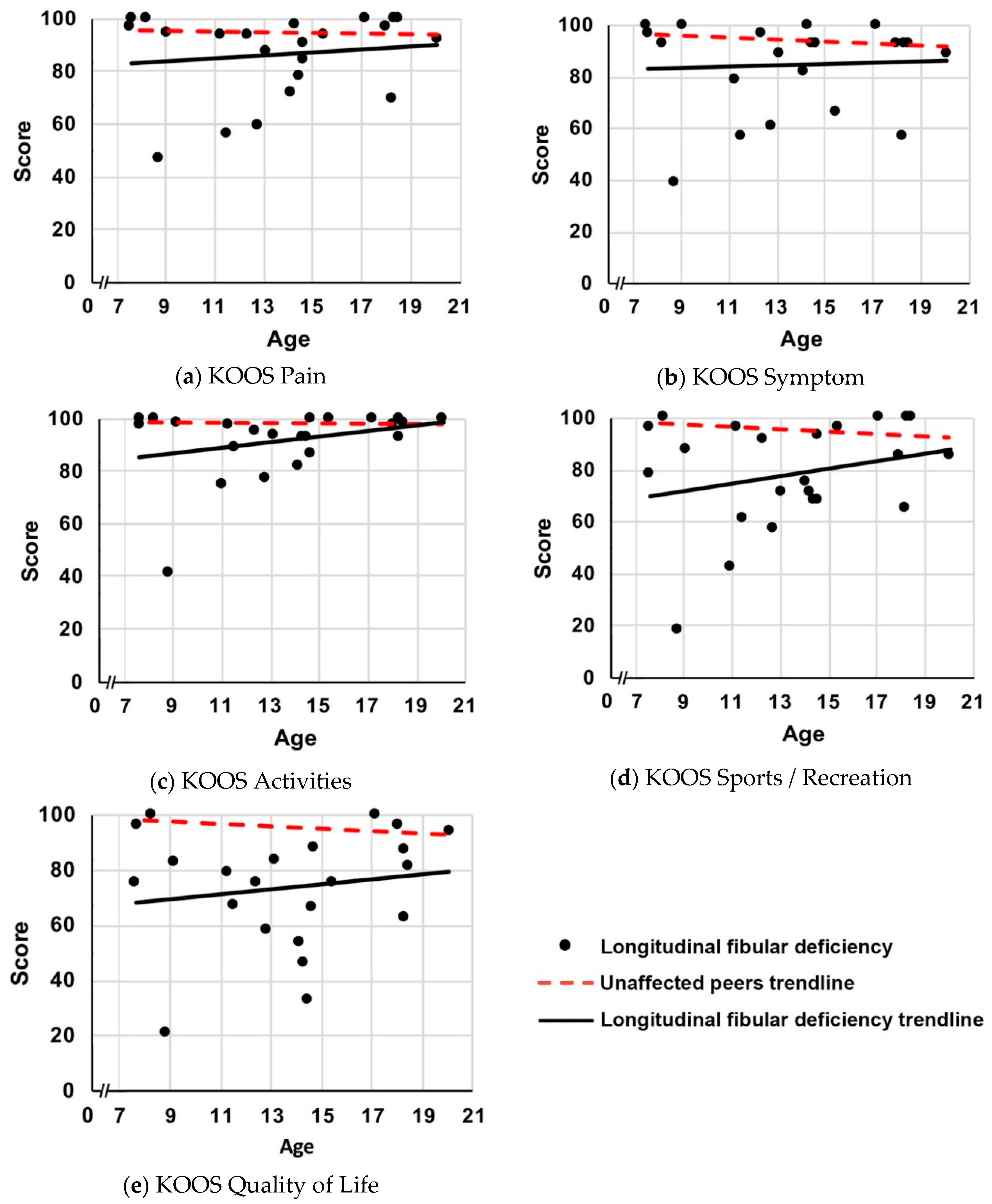
| Mean score (SD) | 86.4 (15.9) | 94.9 (11.4) | −8.5 (−13.8 to −3.3) | 0.002 | −8.8 (−14.2 to −3.4) | 0.001 | |
| Symptoms (/100) | n = 22 | n = 211 | |||||
| Mean score (SD) | 84.7 (17.3) | 94.4 (9.2) | −9.6 (−14.2 to −5.1) | <0.001 | −9.6 (−14.1 to −5.0) | <0.001 | |
| Activities of Daily Living (/100) | n = 23 | n = 211 | |||||
| Mean score (SD) | 91.6 (13.3) | 98.2 (5.4) | −6.6 (−9.4 to −3.7) | <0.001 | −7.2 (−10.1 to −4.3) | <0.001 | |
| Sports/Recreation (/100) | n = 23 | n = 211 | |||||
| Mean score (SD) | 78.6 (21.0) | 95.6 (10.3) | −16.9 (−22.0 to −11.9) | <0.001 | −17.9 (−23.1 to −12.8) | <0.001 | |
| Quality of life (/100) | n = 22 | n = 211 | |||||
| Mean score (SD) | 73.7 (21.3) | 95.6 (10.7) | −22.0 (−27.3 to −16.7) | <0.001 | −23.2 (−28.8 to −17.7) | <0.001 | |
| Ankle function2 | Total (/30) | n = 19 | n = 208 | ||||
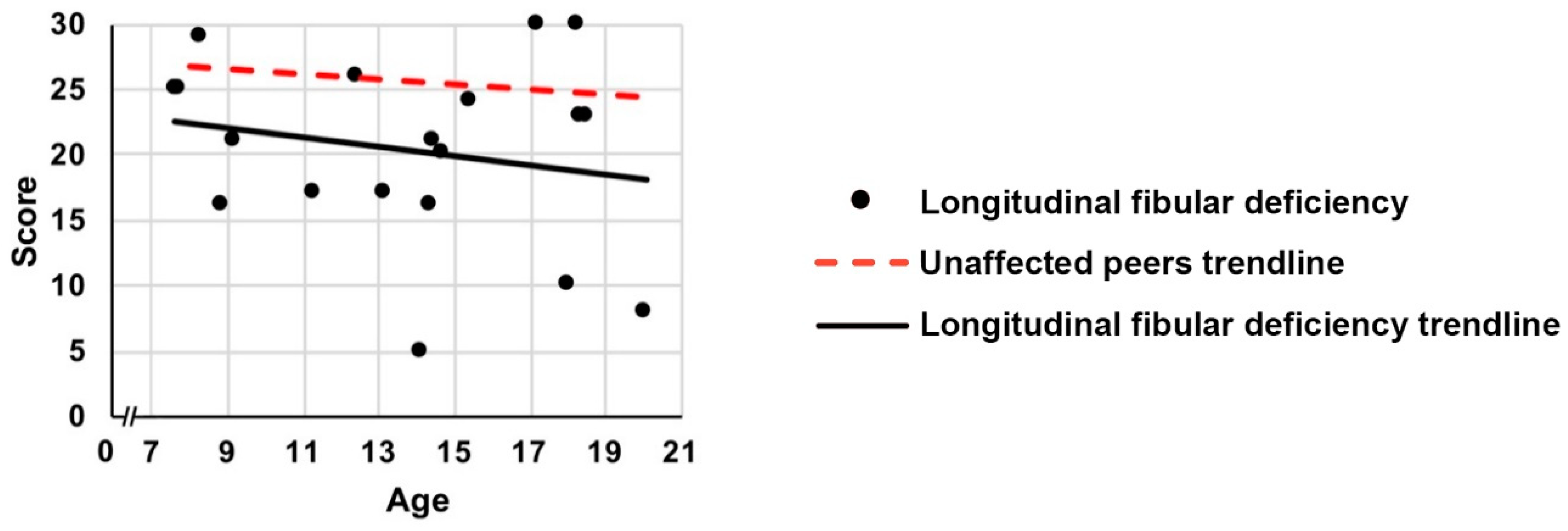
| Mean score (SD) | 20.3 (7.1) | 25.6 (4.8) | −5.3 (−7.7 to −2.9) | <0.001 | −6.6 (−9.0 to −4.3) | <0.001 |
© 2019 by the authors. Licensee MDPI, Basel, Switzerland. This article is an open access article distributed under the terms and conditions of the Creative Commons Attribution (CC BY) license (http://creativecommons.org/licenses/by/4.0/).
Share and Cite
Pate, J.W.; Hancock, M.J.; Tofts, L.; Epps, A.; Baldwin, J.N.; McKay, M.J.; Burns, J.; Morris, E.; Pacey, V. Longitudinal Fibular Deficiency: A Cross-Sectional Study Comparing Lower Limb Function of Children and Young People with That of Unaffected Peers. Children 2019, 6, 45. https://doi.org/10.3390/children6030045
Pate JW, Hancock MJ, Tofts L, Epps A, Baldwin JN, McKay MJ, Burns J, Morris E, Pacey V. Longitudinal Fibular Deficiency: A Cross-Sectional Study Comparing Lower Limb Function of Children and Young People with That of Unaffected Peers. Children. 2019; 6(3):45. https://doi.org/10.3390/children6030045
Chicago/Turabian StylePate, Joshua W., Mark J. Hancock, Louise Tofts, Adrienne Epps, Jennifer N. Baldwin, Marnee J. McKay, Joshua Burns, Eleanor Morris, and Verity Pacey. 2019. "Longitudinal Fibular Deficiency: A Cross-Sectional Study Comparing Lower Limb Function of Children and Young People with That of Unaffected Peers" Children 6, no. 3: 45. https://doi.org/10.3390/children6030045
APA StylePate, J. W., Hancock, M. J., Tofts, L., Epps, A., Baldwin, J. N., McKay, M. J., Burns, J., Morris, E., & Pacey, V. (2019). Longitudinal Fibular Deficiency: A Cross-Sectional Study Comparing Lower Limb Function of Children and Young People with That of Unaffected Peers. Children, 6(3), 45. https://doi.org/10.3390/children6030045