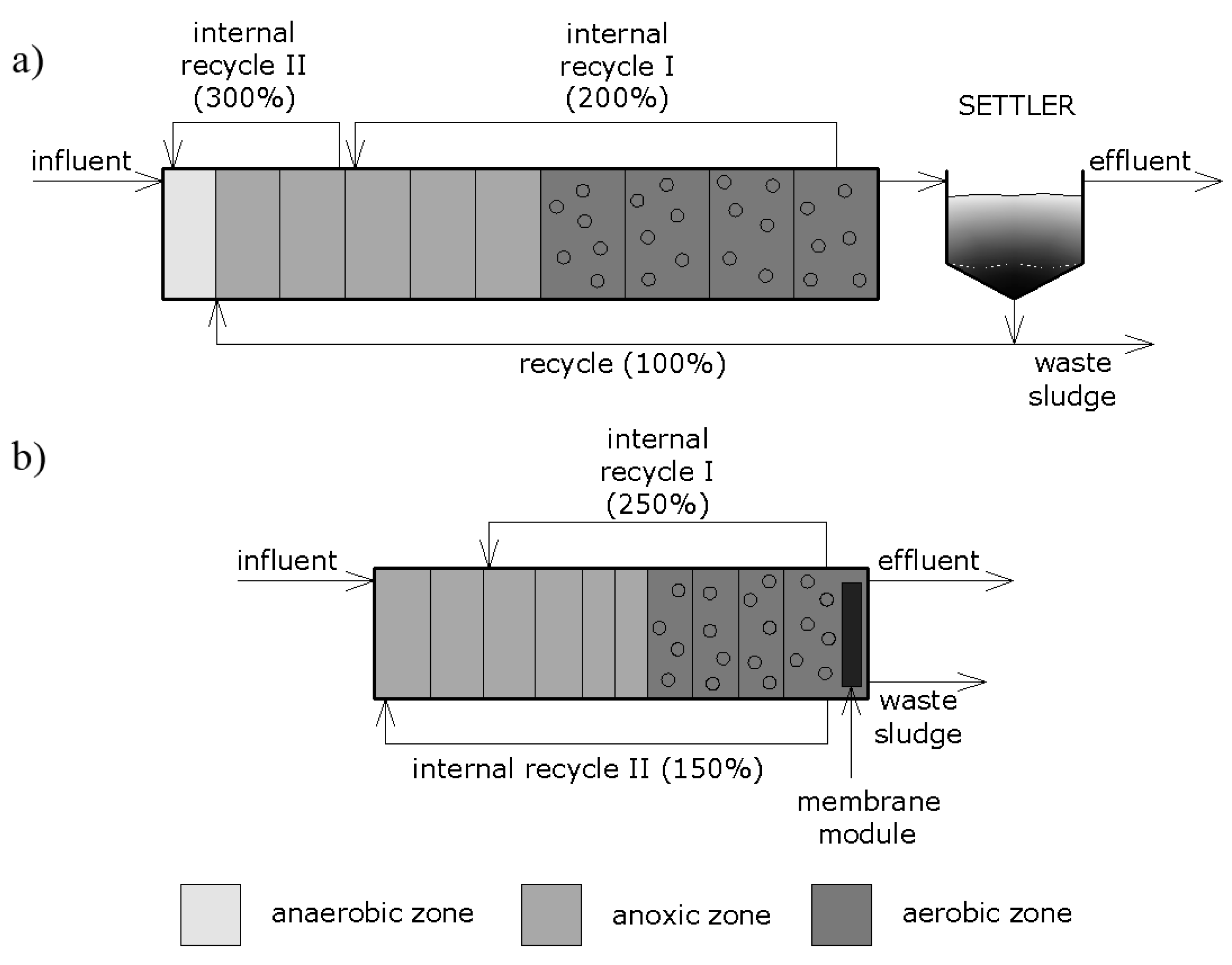
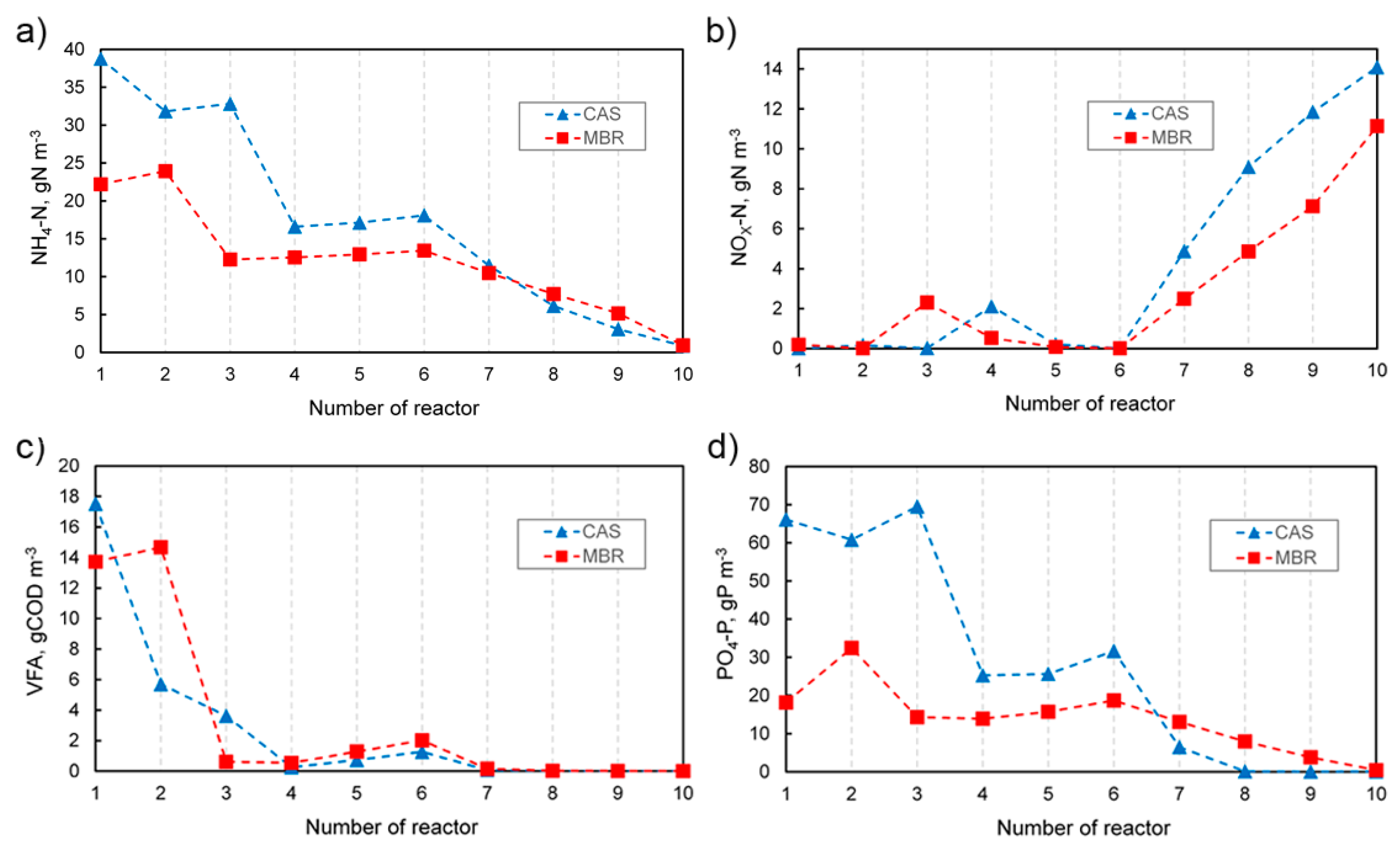
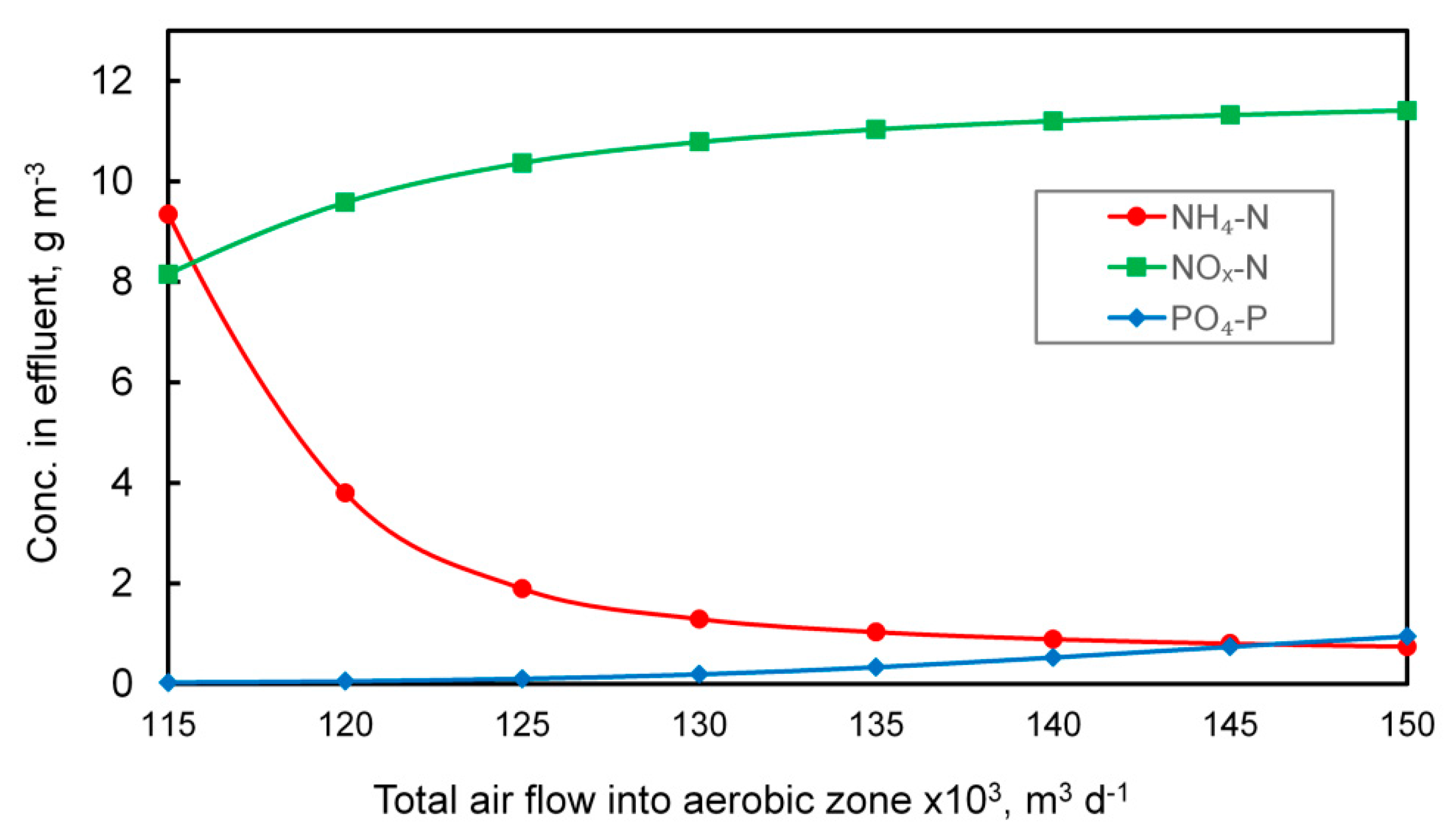
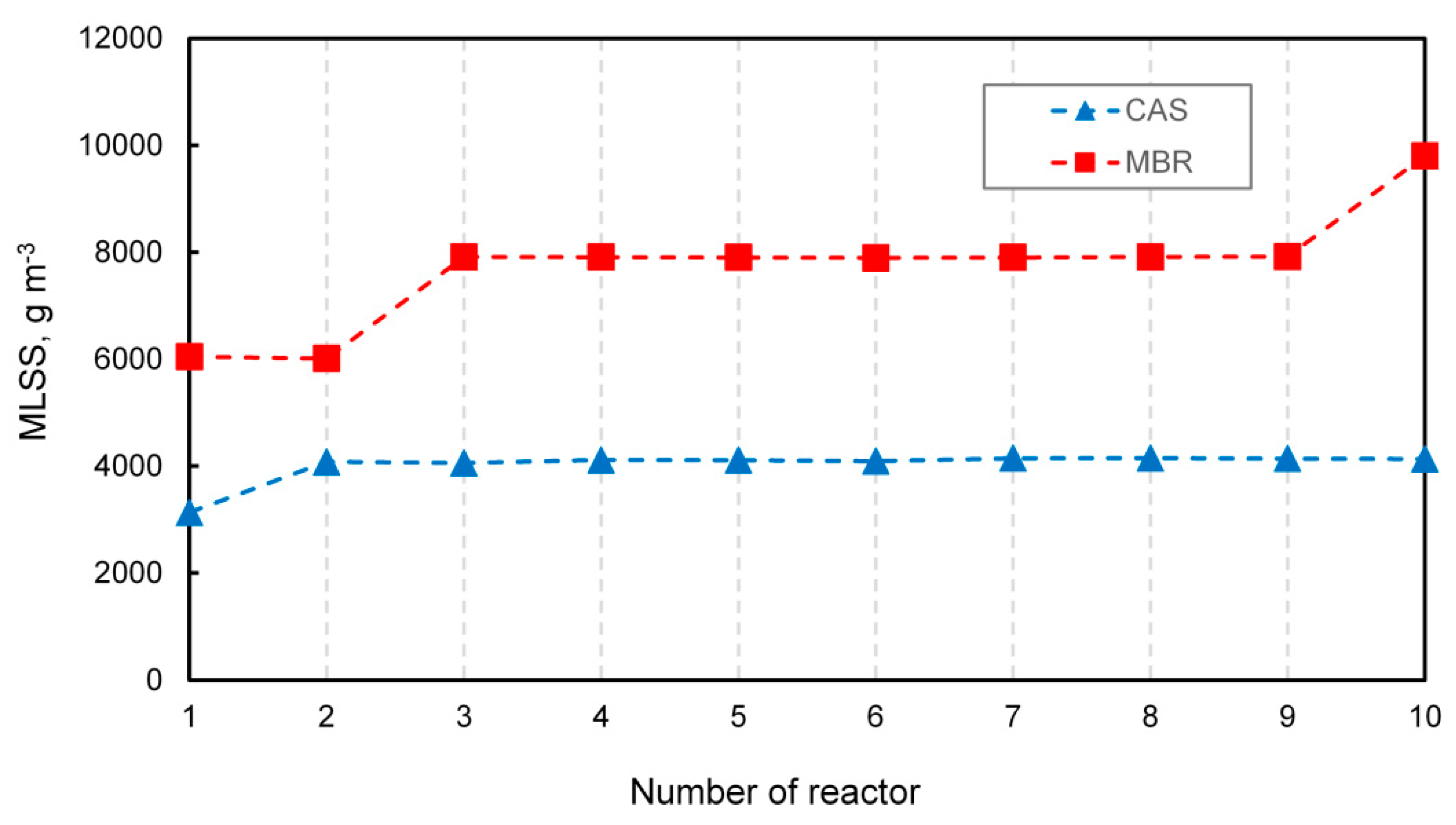
Modeling of Wastewater Treatment Processes in Membrane Bioreactors Compared to Conventional Activated Sludge Systems



Abstract
1. Introduction
2. Materials and Methods
3. Results and Discussion
4. Conclusions
Author Contributions
Funding
Conflicts of Interest
References
- Piaskowski, K.; Wojciechowski, R. Technologie membranowe jako alternatywa dla klasycznej rozbudowy oczyszczalni gwarantujące maksymalną ochronę środowiska naturalnego. Membrane Technologies as an alternative to classic development wastewater treatment plant giving a guarantee maximum protection of the environment. Gaz Woda Tech. 2017, 11–17. [Google Scholar] [CrossRef] [Scilit]
- Konieczny, K. Efektywność oczyszczania ścieków przy pomocy reaktora membranowego. Effectiveness of Wastewater Treatment with the Use of the Biological Membrane Reactors. Rocz. Ochr. Śr. Annu. Set Environ. Prot. 2015, 17, 1034–1052. [Google Scholar]
- Korniluk, M.; Montusiewicz, A.; Piotrowicz, A.; Łagód, G. Simulation of wastewater treatment systems with membrane separation. Proc. ECOpole 2008, 2, 41–45. [Google Scholar]
- De Luca, G.; Sachetti, R.; Leoni, E.; Zanetti, F. Removal of indicator bacteriophages from municipal wastewater by a full-scale membrane bioreactor and a conventional activated sludge process Implications to water reuse. Bioresour. Technol. 2013, 129, 526–531. [Google Scholar] [CrossRef] [Scilit]
- Judd, S. The status of membrane bioreactor technology. Review. Trends Biotechnol. 2008, 26, 109–116. [Google Scholar] [CrossRef] [Scilit]
- Ng, A.N.L.; Kim, A.S. A mini-review of modeling studies on membrane bioreactor (MBR) treatment for municipal wastewaters. Desalination 2007, 212, 261–281. [Google Scholar] [CrossRef] [Scilit]
- Radjenović, J.; Matošić, M.; Mijatovi, I.; Petrović, M.; Barceló, D. Membrane Bioreactor (MBR) as an Advanced Wastewater Treatment Technology. Handb. Environ. Chem. 2008, 5, 37–101. [Google Scholar] [CrossRef] [Scilit]
- Naessens, W.; Maere, T.; Nopens, I. Critical review of membrane bioreactor models, part 1: Biokinetic and filtration models. Bioresour. Technol. 2012, 122, 95–106. [Google Scholar] [CrossRef] [Scilit] [PubMed]
- Tsai, H.-H.; Ravindran, V.; Pirbazari, M. Model for predicting the performance of membrane bioadsorber reactor process in water treatment applications. Chem. Eng. Sci. 2005, 60, 5620–5636. [Google Scholar] [CrossRef] [Scilit]
- Vanhooren, H.; Meirlaen, J.; Amerlinck, Y.; Claeys, F.; Vangheluwe, H.; Vanrolleghem, P.A. WEST: Modelling biological wastewater treatment. J. Hydroinform. 2003, 5, 27–50. [Google Scholar] [CrossRef] [Scilit]
- Drewnowski, J.; Zaborowska, E.; De Vega, C.H. Computer Simulation in Predicting Biochemical Processes and Energy Balance at WWTPs. In E3S Web of Conference; EDP Sciences: Les Ulis, France, 2018; Volume 30. [Google Scholar]
- Drewnowski, J.; Mąkinia, J.; Szaja, A.; Łagód, G.; Kopeć, Ł.; Aguilar, J.A. Comparative Study of Balancing SRT by using Modified ASM2d in Control and Operation Strategy at Full-Scale WWTP. Water 2019, 11, 485. [Google Scholar] [CrossRef] [Scilit]
- Fenu, A.; Guglielmi, G.; Jimenez, J.; Spèrandio, M.; Saroj, D.; Lesjean, B.; Brepols, C.; Thoeye, C.; Nopens, I. Activated sludge model (ASM) based modelling of membrane bioreactor (MBR) processes: A critical review with special regard to MBR specificities. Water Res. 2010, 44, 4272–4294. [Google Scholar] [CrossRef] [Scilit]
- Henze, M.; Gujer, W.; Mino, T.; Matsuo, L.T.; Wentzel, M.C.; Marais, G.R.; Loosdrecht, C.M.V. Activated sludge model No.2D, ASM2D. Water Sci. Technol. 1999, 39, 165–182. [Google Scholar] [CrossRef] [Scilit]
- Verrecht, B.; Maere, T.; Benedetti, L.; Nopens, I.; Judd, S. Model-based energy optimisation of a small-scale decentralised membrane bioreactor for urban reuse. Water Res. 2010, 44, 4047–4056. [Google Scholar] [CrossRef] [Scilit]
- Zuthi, M.F.R.; Ngo, H.H.; Guo, W.S. Modelling bioprocesses and membrane fouling in membrane bioreactor (MBR): A review towards finding an integrated model framework. Bioresour. Technol. 2012, 122, 119–129. [Google Scholar] [CrossRef] [Scilit]
- Mannina, G.; Di Bella, G. Comparing two start-up strategies for MBRs: Experimental study and mathematical modelling. Biochem. Eng. J. 2012, 68, 91–103. [Google Scholar] [CrossRef] [Scilit]
- Busch, J.; Cruse, A.; Marquardt, W. Modeling submerged hollow-fiber membrane filtration for wastewater treatment. J. Membr. Sci. 2007, 288, 94–111. [Google Scholar] [CrossRef] [Scilit]
- Janus, T. Integrated Mathematical Model of a MBR Reactor Including Biopolymer Kinetics and Membrane Fouling. Procedia Eng. 2014, 70, 882–891. [Google Scholar] [CrossRef] [Scilit]
- Mannina, G.; Di Bella, G.; Viviani, G. An integrated model for biological and physical process simulation in membrane bioreactors (MBRs). J. Memb. Sci. 2011, 376, 56–69. [Google Scholar] [CrossRef] [Scilit]
- Zuthi, M.F.R.; Guo, W.; Ngo, H.H.; Nghiem, DL.; Hai, F.I.; Xia, S.; Li, J.; Li, J.; Liu, Y. New and practical mathematical model of membrane fouling in an aerobic submerged membrane bioreactor. Bioresour. Technol. 2017, 238, 86–94. [Google Scholar] [CrossRef] [Scilit]
- Dalmau, M.; Atanasova, N.; Gabarrón, S.; Rodriguez-Roda, I.; Comas, J. Comparison of a deterministic and a data driven model to describe MBR fouling. Chem. Eng. J. 2015, 260, 300–308. [Google Scholar] [CrossRef] [Scilit]
- Janus, T. Modelling and Simulation of Membrane Bioreactors for Wastewater Treatment. Ph.D. Thesis, Faculty of Technology, School of Engineering, Media and Sustainable Development, De Montfort University, Leicester, UK, 2013. Available online: https://www.dora.dmu.ac.uk/handle/2086/9507 (accessed on 4 April 2019).
- Drewnowski, J. Zastosowanie komputerowej symulacji w procesie kształcenia inżyniera branży sanitarnej. The application of computer simulation in the education of modern sanitary engineer. Zesz. Naukowe Wydz. Elektrotech. i Autom. PG 2016, 48, 17–22. [Google Scholar]
- Hydromantis ESS, Inc. GPS-X Technical Reference; Hydromantis ESS, Inc.: Hamilton, ON, Canada, 2017. [Google Scholar]
- Gao, M.; Yang, M.; Li, H.; Yang, Q.; Zhang, Y. Comparison between a Submerged Membrane Bioreactor and a Conventional Activated Sludge System on Treating Ammonia-Bearing Inorganic Wastewater. J. Biotechnol. 2004, 108, 265–269. [Google Scholar] [CrossRef] [Scilit]
- Jiang, T.; Sin, G.; Spanjers, H.; Nopens, I.; Kennedy, M.D.; van der Meer, W.; Futselaar, H.; Amy, G.; Vanrolleghem, P.A. Comparison of the modeling approach between membrane bioreactor and conventional activated sludge processes. Water Environ Res. 2009, 81, 432–440. [Google Scholar] [CrossRef] [Scilit]
- Gonzalez, S.; Petrovic, M.; Barcelò, D. Removal of a broad range of surfactants from municipal wastewater—Comparison between membrane bioreactor and conventional activated sludge treatment. Chemosphere 2007, 67, 335–343. [Google Scholar] [CrossRef] [Scilit]
- Bertanza, G.; Canato, M.; Laera, G.; Vaccari, M.; Svanström, M.; Heimersson, S. A comparison between two full-scale MBR and CAS municipal wastewater treatment plants: Techno-economic-environmental assessment. Environ. Sci. Pollut. Res. 2017, 24, 17383–17393. [Google Scholar] [CrossRef] [Scilit]
- Arévalo, J.; Ruiz, L.M.; Pérez, J.; Gómez, M.A. Effect of temperature on membrane bioreactor performance working with high hydraulic and sludge retention time. Biochem. Eng. J. 2014, 88, 42–49. [Google Scholar] [CrossRef] [Scilit]
- Gurung, K.; Ncibi, M.C.; Sillanpää, M. Assessing membrane fouling and the performance of pilot-scale membrane bioreactor (MBR) to treat real municipal wastewater during winter season in Nordic regions. Sci. Total Environ. 2017, 579, 1289–1297. [Google Scholar] [CrossRef] [Scilit]
- Massé, A.; Spérandio, M.; Cabassud, C. Comparison of sludge characteristics and performance of a submerged membrane bioreactor and an activated sludge process at high solids retention time. Water Res. 2006, 40, 2405–2415. [Google Scholar] [CrossRef] [Scilit]
- Yang, X.-L.; Song, H.-L.; Chen, M.; Cheng, B. Characterizing membrane foulants in MBR with addition of polyferric chloride to enhance phosphorus removal. Bioresour. Technol. 2011, 102, 9490–9496. [Google Scholar] [CrossRef] [Scilit]
- Zhang, Z.; Wang, Y.; Leslie, G.L.; Waite, T.D. Effect of ferric and ferrous iron addition on phosphorus removal and fouling in submerged membrane bioreactors. Water Res. 2015, 69, 210–222. [Google Scholar] [CrossRef] [Scilit]
- Zuthi, M.F.R.; Guo, W.S.; Ngo, H.H.; Nghiem, L.D.; Hai, FI. Enhanced biological phosphorus removal and its modeling for the activated sludge and membrane bioreactor processes. Review. Bioresour. Technol. 2013, 139, 363–374. [Google Scholar] [CrossRef] [Scilit] [PubMed]
- Daigger, G.T.; Crawford, G.V.; Johnson, B.R. Full-Scale Assessment of the Nutrient Removal Capabilities of Membrane Bioreactors. Water Environ. Res. 2010, 82, 806–818. [Google Scholar] [CrossRef] [Scilit] [PubMed]
- Ahmed, Z.; Lim, B.-R.; Cho, J.; Ahn, K.-H. Effects of the internal recycling rate on biological nutrient removal and microbial community structure in a sequential anoxic/anaerobic membrane bioreactor. Bioprocess Biosyst. Eng. 2007, 30, 61–69. [Google Scholar] [CrossRef] [Scilit] [PubMed]
- Ding, A.; Qu, F.; Liang, H.; Ma, J.; Han, Z.; Yu, H.; Guo, S.; Li, G. A novel integrated vertical membrane bioreactor (IVMBR) for removal of nitrogen from synthetic wastewater/domestic sewage. Chem. Eng. J. 2013, 223, 908–914. [Google Scholar] [CrossRef] [Scilit]
- Fenu, A.; Roels, J.; Wambecq, T.; De Gussem, K.; Thoeye, C.; De Gueldre, G.; Van De Steene, B. Energy audit of a full scale MBR system. Desalination 2010, 262, 121–128. [Google Scholar] [CrossRef] [Scilit]
- Germain, E.; Stephenson, T. Biomass Characteristics, Aeration and Oxygen Transfer in Membrane Bioreactors: Their Interrelations Explained by a Review of Aerobic Biological Processes. Rev. Environ. Sci. Biotechnol. 2005, 4, 223–233. [Google Scholar] [CrossRef] [Scilit]
- Lousada-Ferreira, M.; Geilvoet, S.; Moreau, A.; Atasoy, E.; Krzeminski, P.; van Nieuwenhuijzen, A.; van der Graaf, J. MLSS concentration: Still a poorly understood parameter in MBR filterability. Desalination 2010, 250, 618–622. [Google Scholar] [CrossRef] [Scilit]
- Ren, N.; Chen, Z.; Wang, A.; Hu, D. Removal of organic pollutants and analysis of MLSS–COD removal relationship at different HRTs in a submerged membrane bioreactor. Int. Biodeterior. Biodegrad. 2005, 55, 279–284. [Google Scholar] [CrossRef] [Scilit]
- Yang, M.; Yu, D.; Liu, M.; Zheng, L.; Zheng, X.; Wei, Y.; Wang, F.; Fan, Y. Optimization of MBR hydrodynamics for cake layer fouling control through CFD simulation and RSM design. Bioresour. Technol. 2017, 227, 102–111. [Google Scholar] [CrossRef] [Scilit]
- Insel, G.; Hocaoğlu, M.; Cokgor, U.; Orhon, D. Modelling the effect of biomass induced oxygen transfer limitations on the nitrogen removal performance of membrane bioreactor. J. Membr. Sci. 2011, 368, 54–63. [Google Scholar] [CrossRef] [Scilit]
- Sarioglu, M.; Sayi-Ucar, N.; Cokgor, E.; Orhon, D.; van Loosdrecht, M.C.M.; Insel, G. Dynamic modeling of nutrient removal by a MBR operated at elevated temperatures. Water Res. 2017, 123, 420–428. [Google Scholar] [CrossRef] [Scilit] [PubMed]



| Parameter | Unit | CAS | MBR |
|---|---|---|---|
| Food to microorganisms ratio (F/M) | gBOD gMLVSS−1 d−1 | 0.16 | 0.16 |
| Solids retention time (SRT) | d | 14.0 | 10.4 |
| Mixed liquor suspended solids (MLSS) | gMLSS m−3 | 4130 | 9800 |
| Hydraulic retention time (HRT) in clarifier | h | 3.6 | - |
| Waste activated sludge (WAS) | m3 d−1 | 415 | 353 |
| Parameter | Unit | Value |
|---|---|---|
| Chemical oxygen demand (COD) | gO2 m−3 | 810 |
| Soluble fraction of total COD | - | 0.35 |
| Soluble inert fraction of total COD | - | 0.09 |
| Fermentable biodegradable fraction of total COD | - | 0.23 |
| Volatile fatty acids fraction of total COD | - | 0.03 |
| Particulate inert fraction of total COD | - | 0.11 |
| Heterotrophic biomass fraction of total COD | - | 0.05 |
| Biochemical oxygen demand (BOD5) | gO2 m−3 | 428 |
| BOD5/BODultimate ratio | - | 0.66 |
| Total suspended solids (TSS) | g m−3 | 390 |
| Volatile/total suspended solids ratio (VSS/TSS) | - | 0.75 |
| Particulate COD/volatile suspended solids ratio (XCOD/VSS) | - | 1.8 |
| Total nitrogen (TN) | gN m−3 | 64.5 |
| Ammonia nitrogen (NH4-N) | gN m−3 | 51 |
| Nitrate and nitrite nitrogen (NOx-N) | gN m−3 | 0.5 |
| Total phosphorus (TP) | gP m−3 | 15.8 |
| Orthophosphate phosphorus (PO4-P) | gP m−3 | 11.9 |
| Alkalinity | gCaCO3 m−3 | 350 |
| Parameter | Unit | CAS | MBR | ||
|---|---|---|---|---|---|
| Effluent Concentration | Removal Efficiency (%) | Effluent Concentration | Removal Efficiency (%) | ||
| TSS | g m−3 | 10.3 | 97.5 | 0.98 | 99.8 |
| BOD5 | gO2 m−3 | 3.3 | 99.2 | 0.6 | 99.9 |
| COD | gO2 m−3 | 82.3 | 90.3 | 74.2 | 91.2 |
| TN | gN m−3 | 16.1 | 76.1 | 12.9 | 80.8 |
| TKN | gN m−3 | 2.0 | 97.0 | 1.7 | 97.4 |
| NH4-N | gN m−3 | 0.88 | 98.3 | 0.94 | 98.2 |
| NOx-N | gN m−3 | 14.1 | - | 11.2 | - |
| TP | gP m−3 | 0.67 | 95.9 | 0.50 | 96.9 |
| PO4-P | gP m−3 | 0.09 | 99.3 | 0.45 | 96.4 |
© 2019 by the authors. Licensee MDPI, Basel, Switzerland. This article is an open access article distributed under the terms and conditions of the Creative Commons Attribution (CC BY) license (http://creativecommons.org/licenses/by/4.0/).
Share and Cite
Bis, M.; Montusiewicz, A.; Piotrowicz, A.; Łagód, G. Modeling of Wastewater Treatment Processes in Membrane Bioreactors Compared to Conventional Activated Sludge Systems. Processes 2019, 7, 285. https://doi.org/10.3390/pr7050285
Bis M, Montusiewicz A, Piotrowicz A, Łagód G. Modeling of Wastewater Treatment Processes in Membrane Bioreactors Compared to Conventional Activated Sludge Systems. Processes. 2019; 7(5):285. https://doi.org/10.3390/pr7050285
Chicago/Turabian StyleBis, Marta, Agnieszka Montusiewicz, Adam Piotrowicz, and Grzegorz Łagód. 2019. "Modeling of Wastewater Treatment Processes in Membrane Bioreactors Compared to Conventional Activated Sludge Systems" Processes 7, no. 5: 285. https://doi.org/10.3390/pr7050285
APA StyleBis, M., Montusiewicz, A., Piotrowicz, A., & Łagód, G. (2019). Modeling of Wastewater Treatment Processes in Membrane Bioreactors Compared to Conventional Activated Sludge Systems. Processes, 7(5), 285. https://doi.org/10.3390/pr7050285