
Oleogel-Based Systems for the Delivery of Bioactive Compounds in Foods
 ,
,  ,
,  ,
,  and
and 
Abstract
1. Introduction
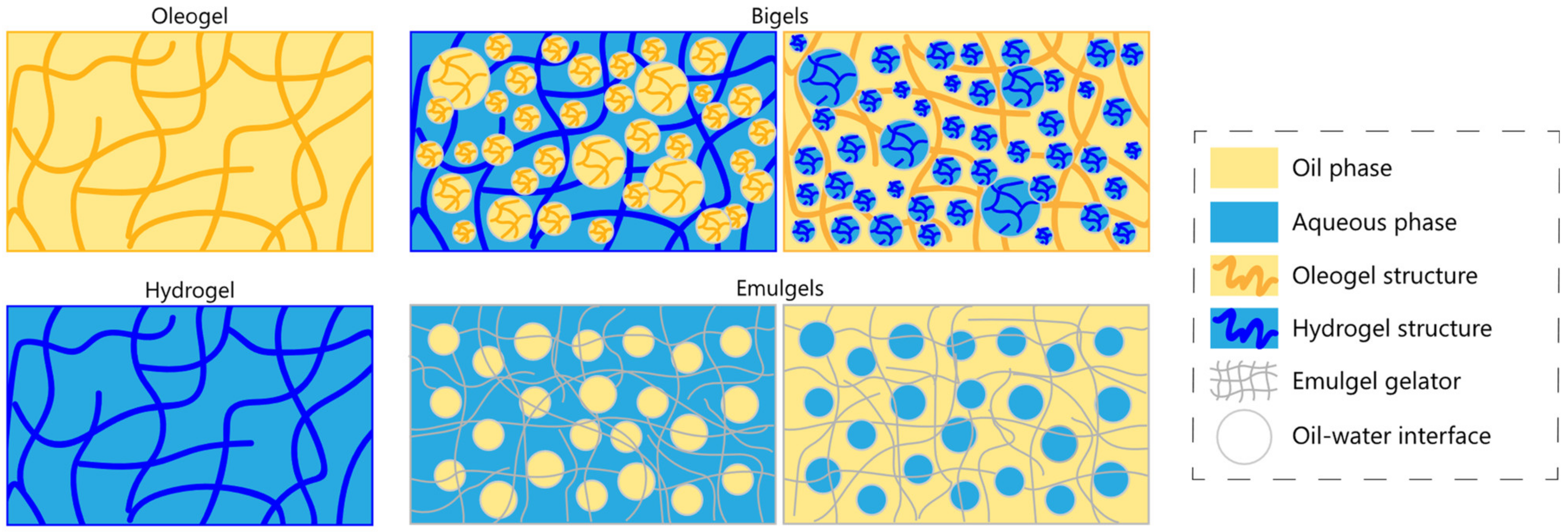
2. Hydrogels, Oleogels, Bigels, and Emulgels
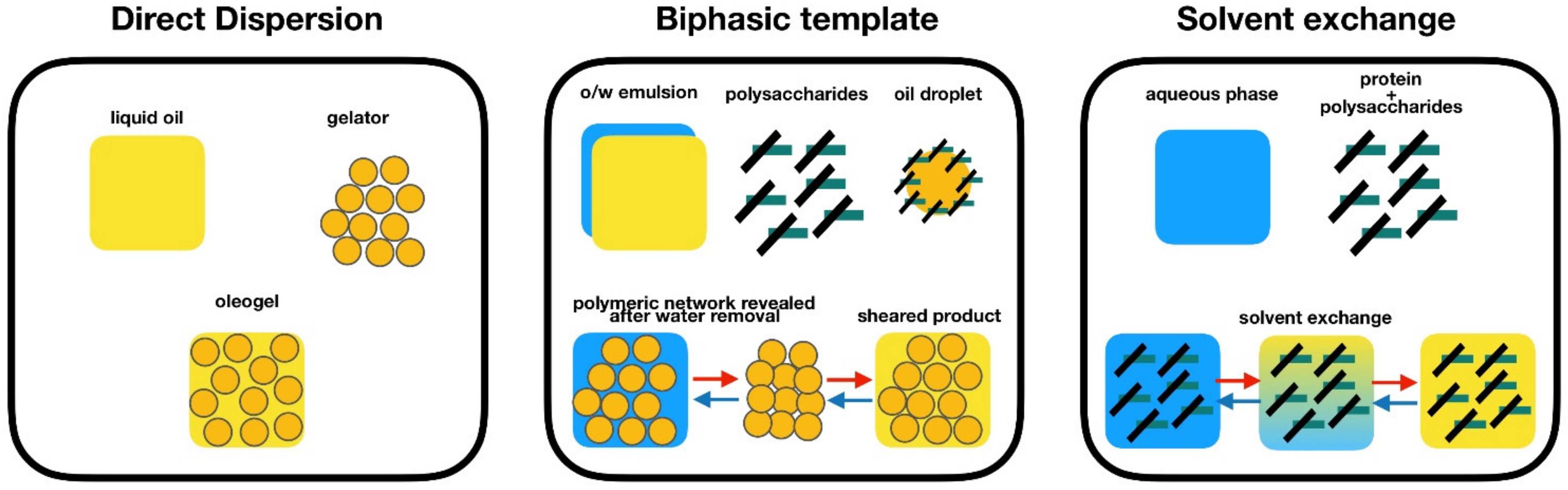
3. Oleogel Preparation for Food Applications
3.1. Direct Dispersion
3.1.1. Crystallite Conformations
3.1.2. Self-Assembled Networks
3.2. Indirect Dispersion
3.2.1. Emulsion-Template Methodologies
3.2.2. Solvent Exchange Methodologies
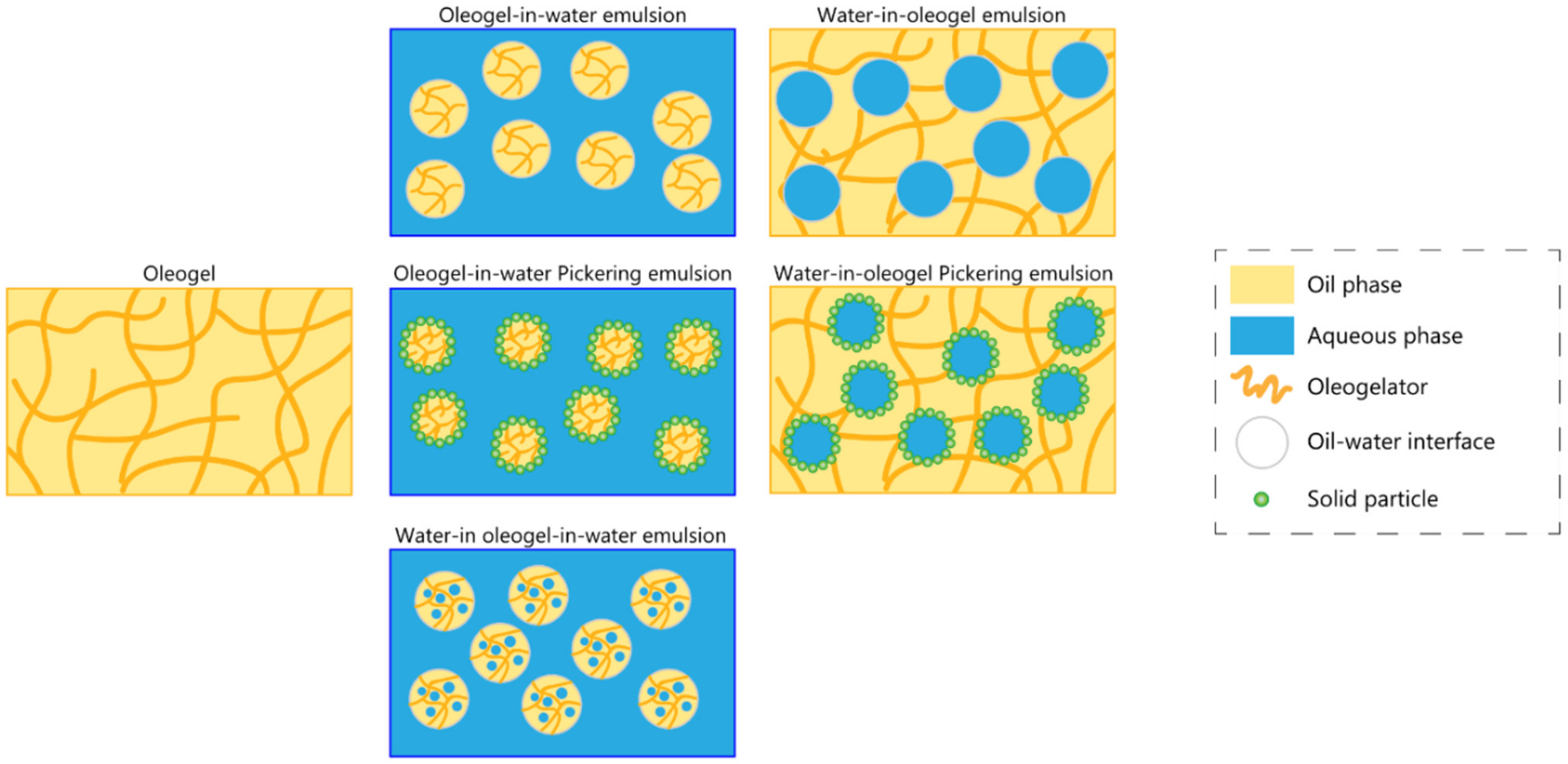
4. Oleogel-Based Emulsion Systems Using Food-Grade Components
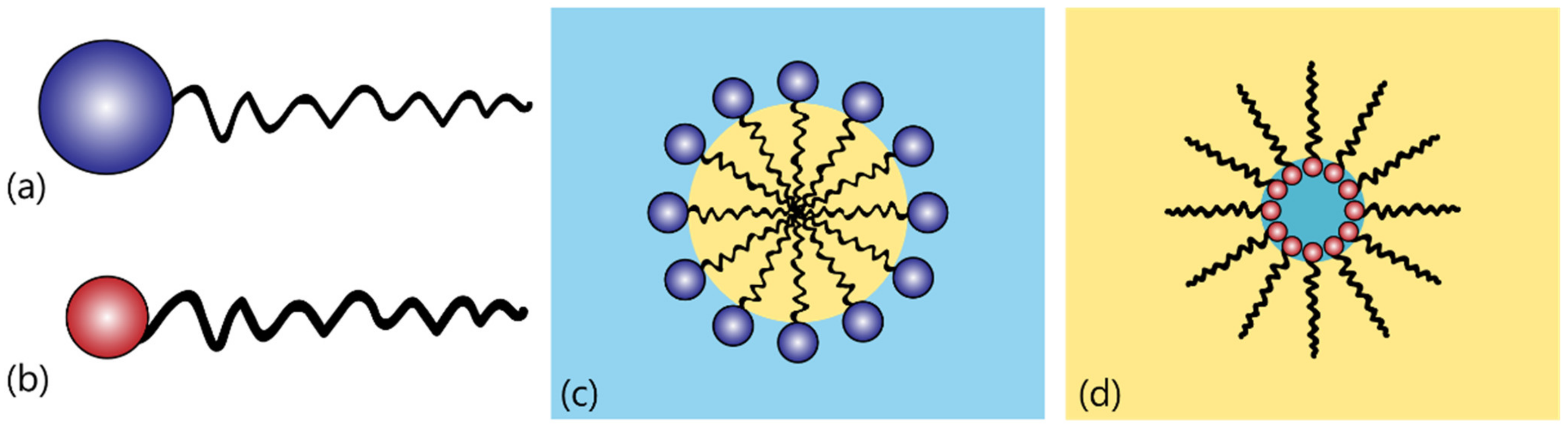
4.1. Single Emulsions
- oil-in-water (O/W)—oil droplets are dispersed in the continuous water phase;
- water-in-oil (W/O)—water droplets are dispersed in the continuous oil phase.
4.1.1. Oleogel-In-Water Emulsions
4.1.2. Water-In-Oleogel Emulsions
4.2. Double Emulsions
- oil-in-water-in-oil (O/W/O)—a continuous oil phase contains water droplets with smaller oil droplets dispersed inside them;
- water-in-oil-in-water (W/O/W)—a continuous water phase contains oil droplets with smaller water droplets dispersed inside them.
Water-In-Oleogel-In-Water Emulsions
5. Oleogel-Based Systems as a Vehicle for the Delivery of Bioactive Compounds
6. Conclusions
Author Contributions
Funding
Conflicts of Interest
References
- Poti, J.M.; Braga, B.; Qin, B. Ultra-processed Food Intake and Obesity: What Really Matters for Health-Processing or Nutrient Content? Curr. Obes. Rep. 2017, 6, 420–431. [Google Scholar] [CrossRef] [Scilit]
- Martins, A.J.; Vicente, A.A.; Pastrana, L.M.; Cerqueira, M.A. Oleogels for development of health-promoting food products. Food Sci. Hum. Wellness 2020, 9, 31–39. [Google Scholar] [CrossRef] [Scilit]
- Aschemann-Witzel, J.; Gantriis, R.F.; Fraga, P.; Perez-Cueto, F.J.A. Plant-based food and protein trend from a business perspective: Markets, consumers, and the challenges and opportunities in the future. Crit. Rev. Food Sci. Nutr. 2020. [Google Scholar] [CrossRef] [Scilit]
- Remig, V.; Franklin, B.; Margolis, S.; Kostas, G.; Nece, T.; Street, J.C. Trans Fats in America: A Review of Their Use, Consumption, Health Implications, and Regulation. J. Am. Diet. Assoc. 2010, 110, 585–592. [Google Scholar] [CrossRef] [Scilit]
- Mensink, R.P.; Katan, M.B. Effect of Dietary trans Fatty Acids on High-Density and Low-Density Lipoprotein Cholesterol Levels in Healthy Subjects. N. Engl. J. Med. 1990, 323, 439–445. [Google Scholar] [CrossRef] [Scilit]
- World Health Organization Regional Office for Europe. Eliminating Trans Fats in Europe—A Policy Brief; World Health Organization Regional Office for Europe: Copenhagen, Denmark, 2015. [Google Scholar]
- Food and Drug Administration. Final Determination Regarding Partially Hydrogenated Oils (Removing Trans Fat). Fed. Regist. 2018, 83, 23358–23359. [Google Scholar]
- EFSA (European Food Safety Authority). Scientific and Technical Assistance on Trans Fatty Acids; EFSA Supporting Publications: Parma, Italy, 2018. [Google Scholar] [CrossRef] [Scilit]
- Samateh, M.; Sagiri, S.S.; John, G. Molecular Oleogels: Green Approach in Structuring Vegetable Oils. In Edible Oleogels: Structure and Health Implications, 2nd ed.; Marangoni, A.G., Garti, N., Eds.; Academic Press: Toronto, ON, Canada, 2018; pp. 415–438. [Google Scholar]
- Mao, L.; Lu, Y.; Cui, M.; Miao, S.; Gao, Y. Design of gel structures in water and oil phases for improved delivery of bioactive food ingredients. Crit. Rev. Food Sci. Nutr. 2020, 60, 1651–1666. [Google Scholar] [CrossRef] [Scilit] [PubMed]
- Patel, A.R.; Dewettinck, K. Edible oil structuring: An overview and recent updates. Food Funct. 2015, 7, 20–29. [Google Scholar] [CrossRef] [Scilit] [PubMed]
- Hermans, P.H. Gels. In Colloid Science, 1st ed.; Kruyt, H.R., Ed.; Elsevier: Amsterdam, The Netherlands, 1949; pp. 483–650. [Google Scholar]
- Davidovich-Pinhas, M. Oleogels. In Polymeric Gels: Characterization, Properties and Biomedical Applications, 1st ed.; Pal, K., Banerjee, I., Eds.; Woodhead Publishing: Cambridge, UK, 2018; pp. 231–249. [Google Scholar]
- Nayak, A.K.; Das, B. Introduction to Polymeric Gels. In Polymeric Gels: Characterization, Properties and Biomedical Applications, 1st ed.; Pal, K., Banerjee, I., Eds.; Woodhead Publishing: Cambridge, UK, 2018; pp. 3–27. [Google Scholar]
- Caló, E.; Khutoryanskiy, V.V. Biomedical applications of hydrogels: A review of patents and commercial products. Eur. Polym. J. 2015, 65, 252–267. [Google Scholar] [CrossRef] [Scilit]
- Lai, J.-Y.; Luo, L.-J.; Nguyen, D.D. Multifunctional glutathione-dependent hydrogel eye drops with enhanced drug bioavailability for glaucoma therapy. Chem. Eng. J. 2020, 402, 126190. [Google Scholar] [CrossRef] [Scilit]
- Lima-Sousa, R.; de Melo-Diogo, D.; Alves, C.G.; Cabral, C.S.; Miguel, S.P.; Mendonça, A.G.; Correia, I.J. Injectable in situ forming thermo-responsive graphene based hydrogels for cancer chemo-photothermal therapy and NIR light-enhanced antibacterial applications. Mater. Sci. Eng. C 2020, 117, 111294. [Google Scholar] [CrossRef] [Scilit]
- Zhang, X.; Pan, Y.; Li, S.; Xing, L.; Du, S.; Yuan, G.; Li, J.; Zhou, T.; Xiong, D.; Tan, H.; et al. Doubly crosslinked biodegradable hydrogels based on gellan gum and chitosan for drug delivery and wound dressing. Int. J. Biol. Macromol. 2020, 164, 2204–2214. [Google Scholar] [CrossRef] [Scilit] [PubMed]
- Lu, P.; Yang, Y.; Liu, R.; Liu, X.; Ma, J.; Wu, M.; Wang, S. Preparation of sugarcane bagasse nanocellulose hydrogel as a colourimetric freshness indicator for intelligent food packaging. Carbohydr. Polym. 2020, 249, 116831. [Google Scholar] [CrossRef] [Scilit] [PubMed]
- Guedes Silva, K.C.; Feltre, G.; Dupas Hubinger, M.; Kawazoe Sato, A.C. Protection and targeted delivery of β-carotene by starch-alginate-gelatin emulsion-filled hydrogels. J. Food Eng. 2021, 290, 110205. [Google Scholar] [CrossRef] [Scilit]
- Fu, G.Q.; Zhang, S.C.; Chen, G.G.; Hao, X.; Bian, J.; Peng, F. Xylan-based hydrogels for potential skin care application. Int. J. Biol. Macromol. 2020, 158, 244–250. [Google Scholar] [CrossRef] [Scilit]
- Talodthaisong, C.; Boonta, W.; Thammawithan, S.; Patramanon, R.; Kamonsutthipaijit, N.; Hutchison, J.A.; Kulchat, S. Composite guar gum-silver nanoparticle hydrogels as self-healing, injectable, and antibacterial biomaterials. Mater. Today Commun. 2020, 24, 100992. [Google Scholar] [CrossRef] [Scilit]
- Decembrini, S.; Hoehnel, S.; Brandenberg, N.; Arsenijevic, Y.; Lutolf, M.P. Hydrogel-based milliwell arrays for standardized and scalable retinal organoid cultures. Sci. Rep. 2020, 10, 1–10. [Google Scholar] [CrossRef] [Scilit] [PubMed]
- Xie, G.; Zhou, N.; Gao, Y.; Du, S.; Du, H.; Tao, J.; Zhang, L.; Zhu, J. On-demand release of CO2 from photothermal hydrogels for accelerating skin wound healing. Chem. Eng. J. 2021, 403, 126353. [Google Scholar] [CrossRef] [Scilit]
- Martins, A.J.; Vicente, A.A.; Cunha, R.; Cerqueira, M.A. Edible oleogels: An opportunity for fat replacement in foods. Food Funct. 2018, 9, 758–773. [Google Scholar] [CrossRef] [Scilit] [PubMed]
- Martins, A.J.; Silva, P.; Maciel, F.; Pastrana, L.; Cunha, R.; Cerqueira, M.A.; Vicente, A.A. Hybrid gels: Influence of oleogel/hydrogel ratio on rheological and textural properties. Food Res. Int. 2019, 116, 1298–1305. [Google Scholar] [CrossRef] [Scilit]
- Wróblewska, M.; Szymańska, E.; Szekalska, M.; Winnicka, K. Different Types of Gel Carriers as Metronidazole Delivery Systems to the Oral Mucosa. Polymers 2020, 12, 680. [Google Scholar] [CrossRef] [Scilit] [PubMed]
- Lupi, F.R.; Shakeel, A.; Greco, V.; Rossi, C.O.; Baldino, N.; Gabriele, D. A rheological and microstructural characterisation of bigels for cosmetic and pharmaceutical uses. Mater. Sci. Eng. C 2016, 69, 358–365. [Google Scholar] [CrossRef] [Scilit] [PubMed]
- Lupi, F.; Gentile, L.; Gabriele, D.; Mazzulla, S.; Baldino, N.; De Cindio, B. Olive oil and hyperthermal water bigels for cosmetic uses. J. Colloid Interface Sci. 2015, 459, 70–78. [Google Scholar] [CrossRef] [Scilit]
- Shakeel, A.; Lupi, F.R.; Gabriele, D.; Baldino, N.; De Cindio, B. Bigels: A unique class of materials for drug delivery applications. Soft Mater. 2018, 16, 77–93. [Google Scholar] [CrossRef] [Scilit]
- Zheng, H.; Mao, L.; Cui, M.; Liu, J.; Gao, Y. Development of food-grade bigels based on κ-carrageenan hydrogel and monoglyceride oleogels as carriers for β-carotene: Roles of oleogel fraction. Food Hydrocoll. 2020, 105, 105855. [Google Scholar] [CrossRef] [Scilit]
- Bollom, M.A.; Clark, S.; Acevedo, N.C. Development and characterization of a novel soy lecithin-stearic acid and whey protein concentrate bigel system for potential edible applications. Food Hydrocoll. 2020, 101, 105570. [Google Scholar] [CrossRef] [Scilit]
- Said dos Santos, R.; Vecchi, C.F.; Rosseto, H.C.; Bassi da Silva, J.; Dano, M.E.L.; de Castro-Hoshino, L.V.; Baesso, M.L.; Bruschi, M.L. Emulgels Containing Carbopol 934P and Different Vegetable Oils for Topical Propolis Delivery: Bioadhesion, Drug Release Profile, and Ex Vivo Skin Permeation Studies. AAPS PharmSciTech. 2020, 21, 209. [Google Scholar] [CrossRef] [Scilit]
- Satapathy, M.; Quereshi, D.; Nguyen, T.T.H.; Pani, D.; Mohanty, B.; Anis, A.; Maji, S.; Kim, D.; Sarkar, P.; Pal, K. Preparation and characterization of cocoa butter and whey protein isolate based emulgels for pharmaceutical and probiotics delivery applications. J. Dispers. Sci. Technol. 2019, 41, 426–440. [Google Scholar] [CrossRef] [Scilit]
- Torregrosa, A.; Ochoa-Andrade, A.T.; Parente, M.E.; Vidarte, A.; Guarinoni, G.; Savio, E. Development of an emulgel for the treatment of rosacea using quality by design approach. Drug Dev. Ind. Pharm. 2020, 46, 296–308. [Google Scholar] [CrossRef] [Scilit]
- Marangoni, A.G.; Garti, N. Oleogels: An Overview. In Edible Oleogels: Structure and Health Implications, 2nd ed.; Marangoni, A.G., Garti, N., Eds.; Academic Press: Toronto, ON, Canada, 2018; pp. 1–29. [Google Scholar]
- Nettleton, J.A.; Brouwer, I.A.; Geleijnse, J.M.; Hornstra, G. Saturated Fat Consumption and Risk of Coronary Heart Disease and Ischemic Stroke: A Science Update. Ann. Nutr. Metab. 2017, 70, 26–33. [Google Scholar] [CrossRef] [Scilit]
- Clarke, R.; Lewington, S. Trans fatty acids and coronary heart disease. BMJ 2006, 333, 214. [Google Scholar] [CrossRef] [Scilit] [PubMed]
- Martins, A.J.; Pastrana, L.M.; Vicente, A.A.; Cerqueira, M.A. Food Grade Polymers for the Gelation of Edible Oils Envisioning Food Applications. In Polymers for Food Applications, 1st ed.; Gutiérrez, T.J., Ed.; Springer: Cham, Switzerland, 2018; pp. 591–608. [Google Scholar]
- Marangoni, A.G.; Co, E.D. Organogels: An Alternative Edible Oil-Structuring Method. J. Am. Oil Chem. Soc. 2012, 89, 749–780. [Google Scholar] [CrossRef] [Scilit]
- Blake, A.I.; Toro-Vazquez, J.F.; Hwang, H.-S. Wax Oleogels. In Edible Oleogels: Structure and Health Implications, 2nd ed.; Marangoni, A.G., Garti, N., Eds.; Academic Press: Toronto, ON, Canada, 2018; pp. 133–171. [Google Scholar]
- Mandu, C.C.; Barrera-Arellano, D.; Santana, M.H.; Fernandes, G.D. Waxes used as structuring agents for food organogels: A Review. Grasas Aceites 2020, 71, 344. [Google Scholar] [CrossRef] [Scilit]
- Barroso, N.G.; Okuro, P.K.; Ribeiro, A.P.B.; Cunha, R.L. Tailoring Properties of Mixed-Component Oleogels: Wax and Monoglyceride Interactions Towards Flaxseed Oil Structuring. Gels 2020, 6, 5. [Google Scholar] [CrossRef] [Scilit]
- Pehlivanoğlu, H.; Demirci, M.; Toker, O.S.; Konar, N.; Karasu, S.; Sagdic, O. Oleogels, a promising structured oil for decreasing saturated fatty acid concentrations: Production and food-based applications. Crit. Rev. Food Sci. Nutr. 2017, 58, 1330–1341. [Google Scholar] [CrossRef] [Scilit]
- Martins, A.J.; Cerqueira, M.A.; Pastrana, L.M.; Cunha, R.; Vicente, A.A. Sterol-based oleogels’ characterization envisioning food applications. J. Sci. Food Agric. 2018, 99, 3318–3325. [Google Scholar] [CrossRef] [Scilit]
- Bot, A.; Den, A.R.; Roijers, E.C. Fibrils of γ-oryzanol + β-sitosterol in edible oil organogels. JAOCS J. Am. Oil Chem. Soc. 2008, 85, 1127–1134. [Google Scholar] [CrossRef] [Scilit]
- European Food Safety Authority. Scientific Opinion on the substantiation of a health claim related to 3 g/day plant sterols/stanols and lowering blood LDL-cholesterol and reduced risk of (coronary) heart disease pursuant to Article 19 of Regulation (EC) No 1924/2006. EFSA J. 2012, 10, 2693. [Google Scholar] [CrossRef] [Scilit]
- Wright, A.J.; Marangoni, A.G. Vegetable Oil-based Ricinelaidic Acid Organogels-Phase Behavior, Microstructure, and Rheology. In Edible Oleogels: Structure and Health Implications, 2nd ed.; Marangoni, A.G., Garti, N., Eds.; Academic Press: Toronto, ON, Canada, 2018; pp. 65–83. [Google Scholar]
- Jiang, Z.; Lu, X.; Geng, S.; Ma, H.; Liu, B. Structuring of sunflower oil by stearic acid derivatives: Experimental and molecular modelling studies. Food Chem. 2020, 324, 126801. [Google Scholar] [CrossRef] [Scilit]
- Whitby, C.P.; Onnink, A.J. Rheological properties and structural correlations in particle-in-oil gels. Adv. Powder Technol. 2014, 25, 1185–1189. [Google Scholar] [CrossRef] [Scilit]
- Whitby, C.P.; Krebsz, M.; Booty, S.J. Understanding the role of hydrogen bonding in the aggregation of fumed silica particles in triglyceride solvents. J. Colloid Interface Sci. 2018, 527, 1–9. [Google Scholar] [CrossRef] [Scilit] [PubMed]
- Patel, A.R.; Mankoč, B.; Bin Sintang, M.D.; Lesaffer, A.; Dewettinck, K. Fumed silica-based organogels and “aqueous-organic” bigels. RSC Adv. 2015, 5, 9703–9708. [Google Scholar] [CrossRef] [Scilit]
- Kumar, R.; Katare, O.P. Lecithin organogels as a potential phospholipid-structured system for topical drug delivery: A review. AAPS PharmSciTech. 2005, 6, E298–E310. [Google Scholar] [CrossRef] [Scilit] [PubMed]
- Matheson, A.B.; Dalkas, G.; Gromov, A.; Euston, S.R.; Clegg, P.S. The development of phytosterol-lecithin mixed micelles and organogels. Food Funct. 2017, 8, 4547–4554. [Google Scholar] [CrossRef] [Scilit]
- Okuro, P.K.; Tavernier, I.; Bin Sintang, M.D.; Skirtach, A.G.; Vicente, A.A.; Dewettinck, K.; Cunha, R.L. Synergistic interactions between lecithin and fruit wax in oleogel formation. Food Funct. 2018, 9, 1755–1767. [Google Scholar] [CrossRef] [Scilit]
- Aguilar-Zárate, M.; Macias-Rodriguez, B.; Toro-Vazquez, J.; Marangoni, A. Engineering rheological properties of edible oleogels with ethylcellulose and lecithin. Carbohydr. Polym. 2019, 205, 98–105. [Google Scholar] [CrossRef] [Scilit] [PubMed]
- Okuro, P.K.; Martins, A.J.; Vicente, A.; Cunha, R.L. Perspective on oleogelator mixtures, structure design and behaviour towards digestibility of oleogels. Curr. Opin. Food Sci. 2020, 35, 27–35. [Google Scholar] [CrossRef] [Scilit]
- Romoscanu, A.I.; Mezzenga, R. Emulsion-Templated Fully Reversible Protein-in-Oil Gels. Langmuir 2006, 22, 7812–7818. [Google Scholar] [CrossRef] [Scilit]
- Sánchez, R.; Stringari, G.; Franco, J.; Valencia, C.; Gallegos, C. Use of chitin, chitosan and acylated derivatives as thickener agents of vegetable oils for bio-lubricant applications. Carbohydr. Polym. 2011, 85, 705–714. [Google Scholar] [CrossRef] [Scilit]
- Nikiforidis, C.V.; Scholten, E. Polymer organogelation with chitin and chitin nanocrystals. RSC Adv. 2015, 5, 37789–37799. [Google Scholar] [CrossRef] [Scilit]
- Oh, I.K.; Lee, S. Utilization of foam structured hydroxypropyl methylcellulose for oleogels and their application as a solid fat replacer in muffins. Food Hydrocoll. 2018, 77, 796–802. [Google Scholar] [CrossRef] [Scilit]
- Jiang, Y.; Liu, L.; Wang, B.; Sui, X.; Zhong, Y.; Zhang, L.; Mao, Z.; Xu, H. Cellulose-rich oleogels prepared with an emulsion-templated approach. Food Hydrocoll. 2018, 77, 460–464. [Google Scholar] [CrossRef] [Scilit]
- Scholten, E. Edible oleogels: How suitable are proteins as a structurant? Curr. Opin. Food Sci. 2019, 27, 36–42. [Google Scholar] [CrossRef] [Scilit]
- De Vries, A.; Hendriks, J.; Van Der Linden, E.; Scholten, E. Protein Oleogels from Protein Hydrogels via a Stepwise Solvent Exchange Route. Langmuir 2015, 31, 13850–13859. [Google Scholar] [CrossRef] [Scilit]
- Manzocco, L.; Valoppi, F.; Calligaris, S.; Andreatta, F.; Spilimbergo, S.; Nicoli, M.C. Exploitation of κ-carrageenan aerogels as template for edible oleogel preparation. Food Hydrocoll. 2017, 71, 68–75. [Google Scholar] [CrossRef] [Scilit]
- Pușcaș, A.; Mureșan, V.; Socaciu, C.; Muste, S. Oleogels in Food: A Review of Current and Potential Applications. Foods 2020, 9, 70. [Google Scholar] [CrossRef] [Scilit]
- Tadros, T.F. Emulsions: Formation, Stability, Industrial Applications, 2nd ed.; Tadros, T.F., Ed.; De Gruyter: Berlin, Germany, 2016; pp. 1–8. [Google Scholar]
- Schramm, L.L. Introduction. In Emulsions, Foams, Suspensions and Aerosols: Microscience and Applications, 2nd ed.; Schramm, L.L., Ed.; Wiley-VCH Verlag: Weinheim, Germany, 2014; pp. 1–22. [Google Scholar]
- Schramm, L.L. Interfacial Energetics. In Emulsions, Foams, Suspensions and Aerosols: Microscience and Applications, 2nd ed.; Schramm, L.L., Ed.; Wiley-VCH Verlag: Weinheim, Germany, 2014; pp. 85–146. [Google Scholar]
- Schramm, LL. Colloid Stability. In Emulsions, Foams, Suspensions, and Aerosols: Microscience and Applications, 2nd ed.; Schramm, L.L., Ed.; Wiley-VCH Verlag: Weinheim, Germany, 2014; pp. 163–208. [Google Scholar]
- Guo, Q.; Wijarnprecha, K.; Sonwai, S.; Rousseau, D. Oleogelation of emulsified oil delays in vitro intestinal lipid digestion. Food Res. Int. 2019, 119, 805–812. [Google Scholar] [CrossRef] [Scilit] [PubMed]
- Munk, M.B.; Utoft, A.; Larsen, F.H.; Needham, D.; Risbo, J. Oleogelating properties of ethylcellulose in oil-in-water emulsions: The impact of emulsification methods studied by 13C MAS NMR, surface tension and micropipette manipulation studies. Food Hydrocoll. 2019, 89, 700–706. [Google Scholar] [CrossRef] [Scilit]
- Lupi, F.; Gabriele, D.; De Cindio, B.; Sánchez, M.C.; Gallegos, C. A rheological analysis of structured water-in-olive oil emulsions. J. Food Eng. 2011, 107, 296–303. [Google Scholar] [CrossRef] [Scilit]
- Toro-Vazquez, J.F.; Mauricio-Pérez, R.; González-Chávez, M.M.; Sánchez-Becerril, M.; Ornelas-Paz, J.D.J.; Pérez-Martínez, J.D. Physical properties of organogels and water in oil emulsions structured by mixtures of candelilla wax and monoglycerides. Food Res. Int. 2013, 54, 1360–1368. [Google Scholar] [CrossRef] [Scilit]
- Öğütçü, M.; Arifoğlu, N.; Yilmaz, E. Preparation and characterization of virgin olive oil-beeswax oleogel emulsion products. JAOCS J. Am. Oil Chem. Soc. 2015, 92, 459–471. [Google Scholar] [CrossRef] [Scilit]
- Pandolsook, S.; Kupongsak, S. Influence of bleached rice bran wax on the physicochemical properties of organogels and water-in-oil emulsions. J. Food Eng. 2017, 214, 182–192. [Google Scholar] [CrossRef] [Scilit]
- Wijarnprecha, K.; de Vries, A.; Santiwattana, P.; Sonwai, S.; Rousseau, D. Microstructure and rheology of oleogel-stabilized water-in-oil emulsions containing crystal-stabilized droplets as active fillers. LWT 2019, 115, 108058. [Google Scholar] [CrossRef] [Scilit]
- Wijarnprecha, K.; De Vries, A.; Santiwattana, P.; Sonwai, S.; Rousseau, D. Rheology and structure of oleogelled water-in-oil emulsions containing dispersed aqueous droplets as inactive fillers. LWT 2019, 115, 108067. [Google Scholar] [CrossRef] [Scilit]
- Velderrain-Rodríguez, G.R.; Salvia-Trujillo, L.; Wall-Medrano, A.; González-Aguilar, G.A.; Martín-Belloso, O. In vitro digestibility and release of a mango peel extract encapsulated within water-in-oil-in-water (W1/O/W2) emulsions containing sodium carboxymethyl cellulose. Food Funct. 2019, 10, 6110–6120. [Google Scholar] [CrossRef] [Scilit]
- Wang, L.; Song, M.; Zhao, Z.; Chen, X.; Cai, J.; Cao, Y.; Xiao, J. Lactobacillus acidophilus loaded pickering double emulsion with enhanced viability and colon-adhesion efficiency. LWT 2020, 121, 108928. [Google Scholar] [CrossRef] [Scilit]
- Nelis, V.; Declerck, A.; Vermeir, L.; Balcaen, M.; Dewettinck, K.; Van Der Meeren, P. Fat crystals: A tool to inhibit molecular transport in W/O/W double emulsions. Magn. Reson. Chem. 2019, 57, 707–718. [Google Scholar] [CrossRef] [Scilit] [PubMed]
- Goibier, L.; Pillement, C.; Monteil, J.; Faure, C.; Leal-Calderon, F. Preparation of multiple water-in-oil-in-water emulsions without any added oil-soluble surfactant. Colloids Surfaces A Physicochem. Eng. Asp. 2020, 590, 124492. [Google Scholar] [CrossRef] [Scilit]
- Liu, J.; Kharat, M.; Tan, Y.; Zhou, H.; Mundo, J.L.M.; McClements, D.J. Impact of fat crystallization on the resistance of W/O/W emulsions to osmotic stress: Potential for temperature-triggered release. Food Res. Int. 2020, 134, 109273. [Google Scholar] [CrossRef] [Scilit] [PubMed]
- Yu, H.; Shi, K.; Liu, D.; Huang, Q. Development of a food-grade organogel with high bioaccessibility and loading of curcuminoids. Food Chem. 2012, 131, 48–54. [Google Scholar] [CrossRef] [Scilit]
- Yu, H.; Huang, Q. Improving the Oral Bioavailability of Curcumin Using Novel Organogel-Based Nanoemulsions. J. Agric. Food Chem. 2012, 60, 5373–5379. [Google Scholar] [CrossRef] [Scilit]
- Li, L.; Wan, W.; Cheng, W.; Liu, G.; Han, L. Oxidatively stable curcumin-loaded oleogels structured by β-sitosterol and lecithin: Physical characteristics and release behaviour in vitro. Int. J. Food Sci. Technol. 2019, 54, 2502–2510. [Google Scholar] [CrossRef] [Scilit]
- Vellido-Pérez, J.A.; Rodríguez-Remacho, C.; Rodríguez-Rodríguez, J.; Ochando-Pulido, J.M.; la Fuente, E.B.; de Martínez-Férez, A. Optimization of oleogel formulation for curcumin vehiculization and lipid oxidation stability by multi-response surface methodology. Chem. Eng. Trans. 2019, 75, 427–432. [Google Scholar]
- Calligaris, S.; Alongi, M.; Lucci, P.; Anese, M. Effect of different oleogelators on lipolysis and curcuminoid bioaccessibility upon in vitro digestion of sunflower oil oleogels. Food Chem. 2020, 314, 126146. [Google Scholar] [CrossRef] [Scilit] [PubMed]
- Liu, N.; Lu, Y.; Zhang, Y.; Gao, Y.; Mao, L. Surfactant addition to modify the structures of ethylcellulose oleogels for higher solubility and stability of curcumin. Int. J. Biol. Macromol. 2020, 165, 2286–2294. [Google Scholar] [CrossRef] [Scilit]
- Ojeda-Serna, I.; Rocha-Guzmán, N.; Gallegos-Infante, J.; Cháirez-Ramírez, M.; Rosas-Flores, W.; Pérez-Martínez, J.; Moreno-Jiménez, M.; González-Laredo, R.F. Water-in-oil organogel based emulsions as a tool for increasing bioaccessibility and cell permeability of poorly water-soluble nutraceuticals. Food Res. Int. 2019, 120, 415–424. [Google Scholar] [CrossRef] [Scilit] [PubMed]
- Rocha-Amador, O.G.; Gallegos-Infante, J.A.; Huang, Q.; Gonzàlez-Laredo, R.F. Effect of Glycosylation Degree of Quercetin on Its In Vitro Bioaccessibility in Food Grade Organogels. Int. J. Food Eng. 2017, 13, 20170166. [Google Scholar] [CrossRef] [Scilit]
- Wei, Z.; Huang, Q. Developing organogel-based Pickering emulsions with improved freeze-thaw stability and hesperidin bioaccessibility. Food Hydrocoll. 2019, 93, 68–77. [Google Scholar] [CrossRef] [Scilit]
- Lu, M.; Cao, Y.; Ho, C.-T.; Huang, Q. Development of Organogel-Derived Capsaicin Nanoemulsion with Improved Bioaccessibility and Reduced Gastric Mucosa Irritation. J. Agric. Food Chem. 2016, 64, 4735–4741. [Google Scholar] [CrossRef] [Scilit]
- O’Sullivan, C.M.; Davidovich-Pinhas, M.; Wright, A.J.; Barbut, S.; Marangoni, A.G. Ethylcellulose oleogels for lipophilic bioactive delivery–Effect of oleogelation on in vitro bioaccessibility and stability of beta-carotene. Food Funct. 2017, 8, 1438–1451. [Google Scholar] [CrossRef] [Scilit] [PubMed]
- Fan, Y.; Gao, L.; Yi, J.; Zhang, Y.; Yokoyama, W. Development of β-Carotene-Loaded Organogel-Based Nanoemulsion with Improved in Vitro and in Vivo Bioaccessibility. J. Agric. Food. Chem. 2017, 65, 6188–6194. [Google Scholar] [CrossRef] [Scilit]
- Cui, M.; Mao, L.; Lu, Y.; Yuan, F.; Gao, Y. Effect of monoglyceride content on the solubility and chemical stability of β-carotene in organogels. LWT 2019, 106, 83–91. [Google Scholar] [CrossRef] [Scilit]
- Martins, A.J.; Cerqueira, M.A.; Cunha, R.; Vicente, A.A. Fortified beeswax oleogels: Effect of β-carotene on the gel structure and oxidative stability. Food Funct. 2017, 8, 4241–4250. [Google Scholar] [CrossRef] [Scilit]
- Qi, W.; Zhang, Z.; Wu, T. Encapsulation of β-carotene in oleogel-in-water Pickering emulsion with improved stability and bioaccessibility. Int. J. Biol. Macromol. 2020, 164, 1432–1442. [Google Scholar] [CrossRef] [Scilit]
- Jiang, Z.; Geng, S.; Liu, C.; Jiang, J.; Liu, B. Preparation and characterization of lutein ester-loaded oleogels developed by monostearin and sunflower oil. J. Food Biochem. 2019, 43, e12992. [Google Scholar] [CrossRef] [Scilit] [PubMed]
- Lupi, F.R.; Gabriele, D.; Baldino, N.; Mijovic, P.; Parisi, O.I.; Puoci, F. Olive oil/policosanol organogels for nutraceutical and drug delivery purposes. Food Funct. 2013, 4, 1512–1520. [Google Scholar] [CrossRef] [Scilit]
- Zahi, M.R.; Wan, P.; Liang, H.; Yuan, Q. Formation and Stability of d-Limonene Organogel-Based Nanoemulsion Prepared by a High-Pressure Homogenizer. J. Agric. Food Chem. 2014, 62, 12563–12569. [Google Scholar] [CrossRef] [Scilit] [PubMed]
- Bei, W.; Zhou, Y.; Xing, X.; Zahi, M.R.; Li, Y.; Yuan, Q.; Liang, H. Organogel-nanoemulsion containing nisin and D-limonene and its antimicrobial activity. Front. Microbiol. 2015, 6, 1010. [Google Scholar] [CrossRef] [Scilit]
- Yılmaz, E.; Öğütçü, M.; Yüceer, Y.K. Physical Properties, Volatiles Compositions and Sensory Descriptions of the Aromatized Hazelnut Oil-Wax Organogels. J. Food Sci. 2015, 80, S2035–S2044. [Google Scholar] [CrossRef] [Scilit] [PubMed]
- Chen, X.-W.; Chen, Y.-J.; Wang, J.-M.; Guo, J.; Yin, S.-W.; Yang, X.-Q. Tunable volatile release from organogel-emulsions based on the self-assembly of β-sitosterol and γ-oryzanol. Food Chem. 2017, 221, 1491–1498. [Google Scholar] [CrossRef] [Scilit]
- Yang, D.; Chen, X.-W.; Yang, X. Phytosterol-based oleogels self-assembled with monoglyceride for controlled volatile release. J. Sci. Food Agric. 2017, 98, 582–589. [Google Scholar] [CrossRef] [Scilit] [PubMed]
- Shi, R.; Zhang, Q.; Vriesekoop, F.; Yuan, Q.; Liang, H. Preparation of Organogel with Tea Polyphenols Complex for Enhancing the Antioxidation Properties of Edible Oil. J. Agric. Food Chem. 2014, 62, 8379–8384. [Google Scholar] [CrossRef] [Scilit] [PubMed]
- Andrade, J.; Wright, A.J.; Corredig, M. In vitro digestion behavior of water-in-oil-in-water emulsions with gelled oil-water inner phases. Food Res. Int. 2018, 105, 41–51. [Google Scholar] [CrossRef] [Scilit] [PubMed]
- Eggersdorfer, M.; Wyss, A. Carotenoids in human nutrition and health. Arch. Biochem. Biophys. 2018, 652, 18–26. [Google Scholar] [CrossRef] [Scilit] [PubMed]



| Bioactive Compound(s) | Oil | Gelator | Gelator Conc. (%) | Type of Structure | Main Conclusions | Ref. |
|---|---|---|---|---|---|---|
| Curcumin | MCT Oil | MAGs | 20 | Oleogel | Increase in oral bioavailability of curcumin in both structures. The emulsions had faster lipolysis than the oleogels. | [84] |
| MCT Oil | MAGs | 20 | Oleogel-based emulsion | [85] | ||
| Corn Oil | β-sitosterol + lecithin | 12 | Oleogel | The curcumin did not interfere with the gel network assembling; its bioaccessibility at the intestinal level was enhanced in a fasted state. | [86] | |
| Fish Oil | Fully hydrogenated rapeseed oil | 3–7 | Oleogel | The gel structure and curcumin content helped to retard the oil oxidation. | [87] | |
| Sunflower Oil | Saturated MAGs, rice bran wax, γ-oryzanol + β-sitosterol | 5 | Oleogel | The nature of the oleogelator affected the bioaccessibility of the curcumin during in vitro digestion, which was higher in the β-sitosterol + γ-oryzanol oleogel. However, the extent of lipolysis was lower on this oleogel. | [88] | |
| Corn Oil | Ethylcellulose | 12 | Oleogel | The addition of a surface-active agent improved curcumin solubility and stability while reducing lipid oxidation. | [89] | |
| Betulin, Curcumin, Quercetin | Canola Oil, Coconut Oil | MAGs | 10 | Oleogel-based emulsion | The bioaccessibility and permeability of the bioactive compound depend on the type of molecule and not only on the oleogel system. | [90] |
| Quercetin | Canola Oil, Corn Oil, Soybean Oil | MAGs | 8 | Oleogel | Oleogels prepared with canola oil featured better bioaccessibility of the loaded quercetin. | [91] |
| Hesperidin | Soybean Oil | MAGs | 3 | Oleogel–Pickering emulsion | Both lipolysis rate and bioaccessibility of hesperidin were improved in the Pickering emulsion regarding the oleogel. | [92] |
| Capsaicin | MCT Oil | Sucrose stearate S-370 | 20 | Oleogel-based emulsion | Enhancement of the bioavailability of capsaicin and in vivo proof of the reduced irritability of the capsaicin. | [93] |
| β-carotene | Canola Oil | Ethylcellulose | 10 | Oleogel | Increased stability of β-carotene in the oleogel and protection against oxidation. | [94] |
| Coconut Oil, Corn Oil, MCT Oil | MAGs | 18.2 | Oleogel, oleogel-based emulsion | Cellular uptake and bioavailability of β-carotene were higher in the emulsion than in control (liquid oil). | [95] | |
| Corn Oil | MAGs | 10, 15, 20, 25 | Oleogel | The oleogel structure improved the heat/light stability and solubility of β-carotene. | [96] | |
| High Oleic Sunflower Oil | Beeswax | 2, 4, 6, 8 | Oleogel | β-carotene improved the strength and oil-binding capacity of the oleogels; higher beeswax concentration improved oxidative stability of the oleogels. | [97] | |
| Soybean Oil | Beeswax | 10 | Oleogel–based Pickering emulsion | Improved pH/salt concentration/freeze–thaw stability; enhanced chemical stability and bioavailability of β-carotene. | [98] | |
| Lutein Ester | Sunflower Oil | MAGs | 4, 6, 8, 10, 12 | Oleogel | The oleogel structure successfully protected lutein ester from UV radiation. | [99] |
| Ferulic Acid | Olive Oil | Policosanol | 3 | Oleogel | The addition of a gelator to the FA-loaded oil helped to control the release in stomach conditions. | [100] |
| D-limonene | MCT Oil | Stearic acid | 5, 10, 15 | Oleogel-based emulsion | Increased storage stability regarding conventional emulsions. | [101] |
| Nisin, D-limonene | Peanut Oil | Stearic acid | 70 | Oleogel-based emulsion | The combined use of D-limonene and nisin improved the antimicrobial properties and supported its use as a food preservative. | [102] |
| Volatile Aromas, Vitamins | Hazelnut Oil | Beeswax, sunflower wax | 5 | Oleogel | The addition of flavorings and vitamins did not undermine the gelation process and its concentration was intact after 3 months of storage. | [103] |
| Volatile Aromas | Sunflower Oil | γ-oryzanol + β-sitosterol | 10 | Oleogel-based emulsion | Successful delay of volatile release by entrapment in an oleogel network. | [104] |
| Volatile Aromas | Sunflower Oil | β-sitosterol + MAGs | 10 | Oleogel | The combination of 2 gelators resulted in stable oleogels, with controlled release of volatiles. | [105] |
| Tea Polyphenols | Peanut Oil | Stearic acid | 5–30 | Oleogel | The tea polyphenols helped to extend the storage stability of the oleogel. | [106] |
| Phytosterols, Vitamin D3, Vitamin B12 | Soybean Oil | Trimyristin | 15 | Oleogel-based double emulsion | Higher extent of release of the bioactive compound and increased lipid digestibility, when compared to non-gelled double-emulsions. | [107] |
Publisher’s Note: MDPI stays neutral with regard to jurisdictional claims in published maps and institutional affiliations. |
© 2021 by the authors. Licensee MDPI, Basel, Switzerland. This article is an open access article distributed under the terms and conditions of the Creative Commons Attribution (CC BY) license (https://creativecommons.org/licenses/by/4.0/).
Share and Cite
Pinto, T.C.; Martins, A.J.; Pastrana, L.; Pereira, M.C.; Cerqueira, M.A. Oleogel-Based Systems for the Delivery of Bioactive Compounds in Foods. Gels 2021, 7, 86. https://doi.org/10.3390/gels7030086
Pinto TC, Martins AJ, Pastrana L, Pereira MC, Cerqueira MA. Oleogel-Based Systems for the Delivery of Bioactive Compounds in Foods. Gels. 2021; 7(3):86. https://doi.org/10.3390/gels7030086
Chicago/Turabian StylePinto, Tiago C., Artur J. Martins, Lorenzo Pastrana, Maria C. Pereira, and Miguel A. Cerqueira. 2021. "Oleogel-Based Systems for the Delivery of Bioactive Compounds in Foods" Gels 7, no. 3: 86. https://doi.org/10.3390/gels7030086
APA StylePinto, T. C., Martins, A. J., Pastrana, L., Pereira, M. C., & Cerqueira, M. A. (2021). Oleogel-Based Systems for the Delivery of Bioactive Compounds in Foods. Gels, 7(3), 86. https://doi.org/10.3390/gels7030086