

Journal Menu
► ▼ Journal Menu-
- Machines Home
- Aims & Scope
- Editorial Board
- Reviewer Board
- Topical Advisory Panel
- Instructions for Authors
- Special Issues
- Topics
- Sections & Collections
- Article Processing Charge
- Indexing & Archiving
- Editor’s Choice Articles
- Most Cited & Viewed
- Journal Statistics
- Journal History
- Journal Awards
- Society Collaborations
- Conferences
- Editorial Office
Journal Browser
► ▼ Journal BrowserNeed Help?
Announcements
2 April 2024
MDPI Insights: The CEO's Letter #10 - South Korea, IWD, U2A, Japan

Welcome to the MDPI Insights: The CEO's Letter.
In these monthly letters, I will showcase two key aspects of our work at MDPI: our commitment to empowering researchers and our determination to facilitating open scientific exchange.
Opening Thoughts
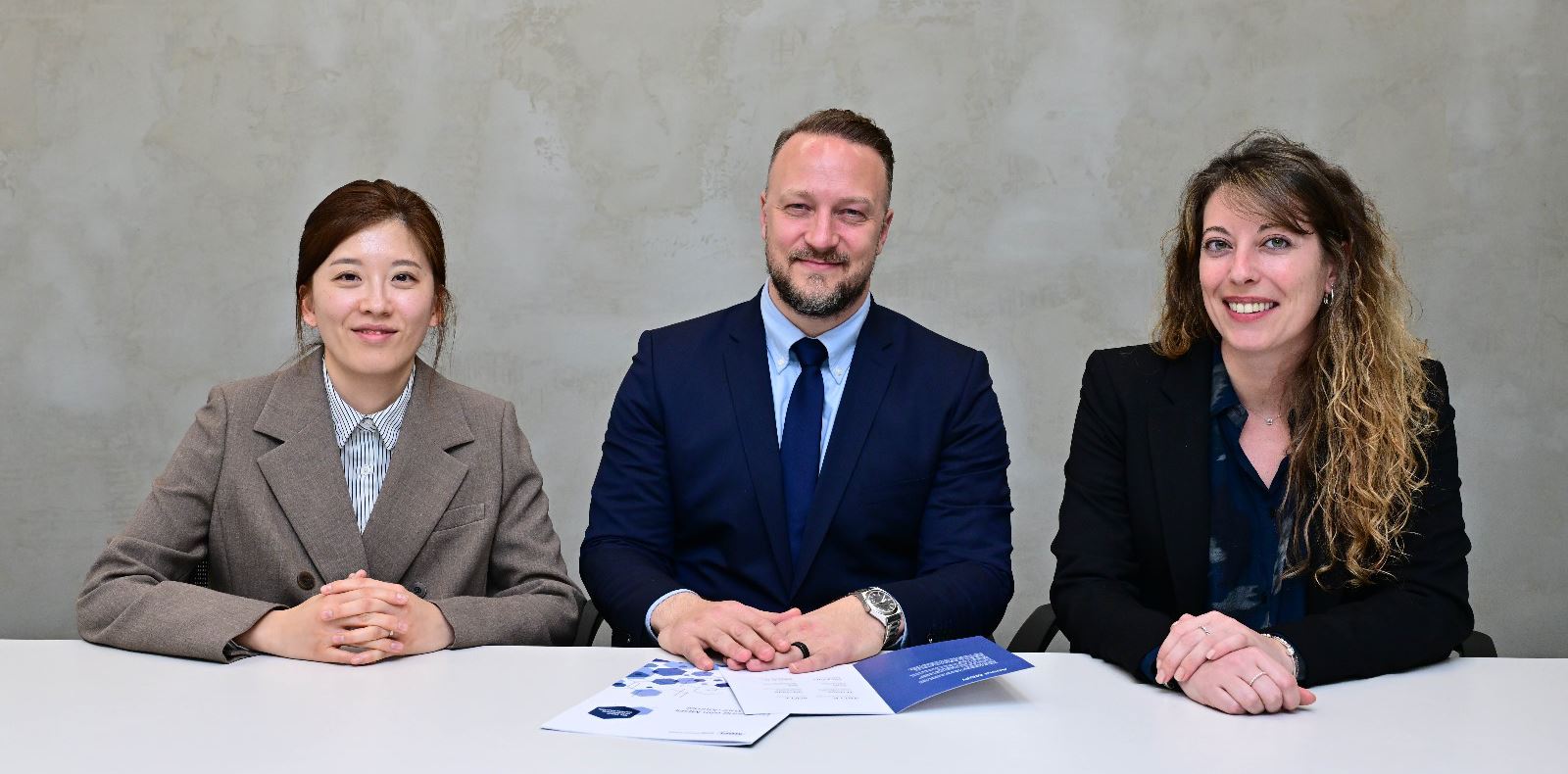
Left to right: Dr. Jisuk Kang (Scientific Officer, MDPI), Stefan Tochev (CEO, MDPI), and Dr. Giulia Stefenelli (Chair of Scientific Office Board, MDPI), during media meetings at Prain Agency office in Seoul, South Korea.
Visit to Seoul, South Korea
During my recent visit to South Korea, I had the privilege of meeting various stakeholders, including representatives of government, research institutions, and academia, to understand their needs and communicate MDPI’s commitment to accessible science. Accompanied by my colleagues Dr. Giulia Stefenelli and Dr. Jisuk Kang, I engaged with the Korean scientific community, which is increasingly embracing open access (OA).
As the leading OA publisher in South Korea, MDPI is trusted by local authors and in 2023 enjoyed an approximately 30% share of the OA market. South Korea ranks sixth globally for MDPI in terms of research papers submitted and published.
MDPI and South Korea by Numbers
As at 30 March, over 76,000 MDPI articles have been authored by individuals affiliated with Korean institutions. We have over 1,800 active editorial board members (EBMs) from South Korea, with more than 880 EBMs having an H-index between 26 and 50, including 10 serving as Chief Editors.
“South Korea is the sixth-largest contributor to our total publications”
Over the past five years (2019–2023), nearly 120,000 authors affiliated with South Korean institutes have published with MDPI. Specifically in 2023, we received approximately 25,000 submissions from South Korean authors, publishing close to 13,000 articles, resulting in a rejection rate of 47.4%, which is not far below MDPI’s overall rejection rate of 56.4% in 2023.
Institutional Partnerships with South Korea
I am pleased to share that MDPI has more than 825 institutional partnerships worldwide, with 12 in South Korea, including Kyunghee University, Chung-Ang University, and Inha University, among others.
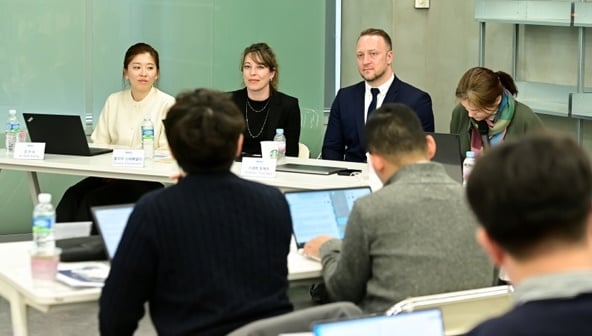
Left to right: Dr. Jisuk Kang (Scientific Officer, MDPI), Dr. Giulia Stefenelli (Chair of Scientific Office Board, MDPI), and Stefan Tochev (CEO, MDPI) fielding media questions at Prain PR Agency office in Seoul, South Korea.
Over the past three years (2021–2023), we have had some of the most prestigious academic universities ranked among the top 10 Korean institutions publishing with MDPI. Seoul National University had the highest number of publications with MDPI during those three years, publishing nearly 6,000 papers. Universities such as Korea University and Yonsei University also rank among the top 10 Korean institutions publishing with MDPI.
MDPI Hosts Seminar for Academia and Media
As the world’s leading OA publisher, MDPI is actively democratizing science. This is reflected in the seminars we hosted on 21 March to address questions about our editorial processes and ethical standards. The visit garnered media coverage, reflecting our mission to providing high-quality services and fostering open dialogue in the community.
“MDPI is actively democratizing science”
MDPI in the News

Stefan Tochev (CEO, MDPI) leading a seminar on OA and MDPI at Prain PR Agency office in Seoul, South Korea.
Media coverage generated by our visit to Seoul included the following stories:
“Open access is an unstoppable trend…it will lead the development of the knowledge ecosystem.”
I greatly appreciate the contributions of everyone who took the time to meet with us, share their stories, and hold us accountable for continuing to provide high-quality publishing services while identifying areas for improvement. I am also excited to announce that we have opened an MDPI office in Seoul and will release a press release on MDPI.com, with details, by the end April 2024. The purpose of the office is to establish a local presence to connect with and support the South Korean academic community through institutional partnerships, conferences, author workshops, stakeholder communications, and more.
Impactful Research

Featured Articles on Women’s Leadership and Healthcare
In celebration of International Women’s Day (8 March 2024), MDPI curated a collection of research articles on various topics, including women’s leadership, reproductive health, preventive healthcare, and a selection of articles from our journal Women.
Women’s Leadership
- Women Entrepreneurship and Sustainable Development: Bibliometric Analysis and Emerging Research Trends
Sustainability 2022, 14, 9160. https://doi.org/10.3390/su14159160 - Refugee Women Business Mentors: New Evidence for Women’s Empowerment
Sustainability 2022, 14, 9154. https://doi.org/10.3390/su14159154 - Women and Leadership in Higher Education: A Systematic Review
Soc. Sci. 2023, 12, 555. https://doi.org/10.3390/socsci12100555 - Understanding Needs and Potentials for Gender-Balanced Empowerment and Leadership in Climate Change Adaptation and Mitigation in Africa
Sustainability 2022, 14, 9410. https://doi.org/10.3390/su14159410 - Challenges Women Experience in Leadership Careers: An Integrative Review
Merits 2023, 3, 366-389. https://doi.org/10.3390/merits3020021
Women’s Reproductive Health
- Recreational Female Athletes’ Understanding of and Perceived Impact of the Menstrual Cycle on Physical Performance, Mood, and Sleeping Behaviour
Women 2023, 3, 445-456. https://doi.org/10.3390/women3030034 - Difficulties in Adaptation of the Mother and Newborn via Cesarean Section versus Natural Birth—A Narrative Review
Life 2023, 13, 300. https://doi.org/10.3390/life13020300 - The Main Theories on the Pathogenesis of Endometriosis
Int. J. Mol. Sci. 2023, 24, 4254. https://doi.org/10.3390/ijms24054254
Women’s Preventive Healthcare
- Insulin Metabolism in Polycystic Ovary Syndrome: Secretion, Signaling, and Clearance
Int. J. Mol. Sci. 2023, 24, 3140. https://doi.org/10.3390/ijms24043140 - Assessing Barriers Encountered by Women in Cervical Cancer Screening and Follow-Up Care in Urban Bolivia, Cochabamba
Healthcare 2022, 10, 1604. https://doi.org/10.3390/healthcare10091604 - Updates on HPV Vaccination
Diagnostics 2023, 13, 243. https://doi.org/10.3390/diagnostics13020243
Featured Articles in MDPI Journal Women
Below are a few articles from Women, our journal focused on women’s health, the social determinants of health, and the healthcare system that serves women. The aim of Women is to encourage academics to publish their experimental and theoretical results in detail, to aid reproducibility, and in an engaging style, to aid comprehensibility.
- Premenstrual Syndrome and Exercise: A Narrative Review
Women 2023, 3, 348-364. https://doi.org/10.3390/women3020026 - Increasing Awareness of the Human Papillomavirus (HPV) Vaccine for Women 18–45 Years of Age
Women 2023, 3, 365-373. https://doi.org/10.3390/women3030027 - Addressing Women’s Needs with Human Immunodeficiency Virus (HIV) and Enhancing the Visibility of Pharmacists in the Public Health Arena
Women 2022, 2, 346-352. https://doi.org/10.3390/women2040032
Inside MDPI

Championing Women’s Healthcare and Access to Healthcare Information
MDPI colleagues from our offices joined in celebrating #IWD2024. In doing so, we emphasized key missions that encompass:
- Empowering women to assume leadership and decision-making roles in both business and science.
- Helping women and girls make informed decisions about their health.
- Recruiting and developing female talent and fostering inclusive workplace environments.
“We are thrilled to recognize the accomplishments of women scientists”
I am proud to see our colleagues enthusiastically supporting the International Women’s Day call to ‘Inspire Inclusion!’ The heart-hands in the collage below symbolize our appreciation of the achievements of women researchers and the recognition of the trailblazers who have courageously made a mark on societies past and present.
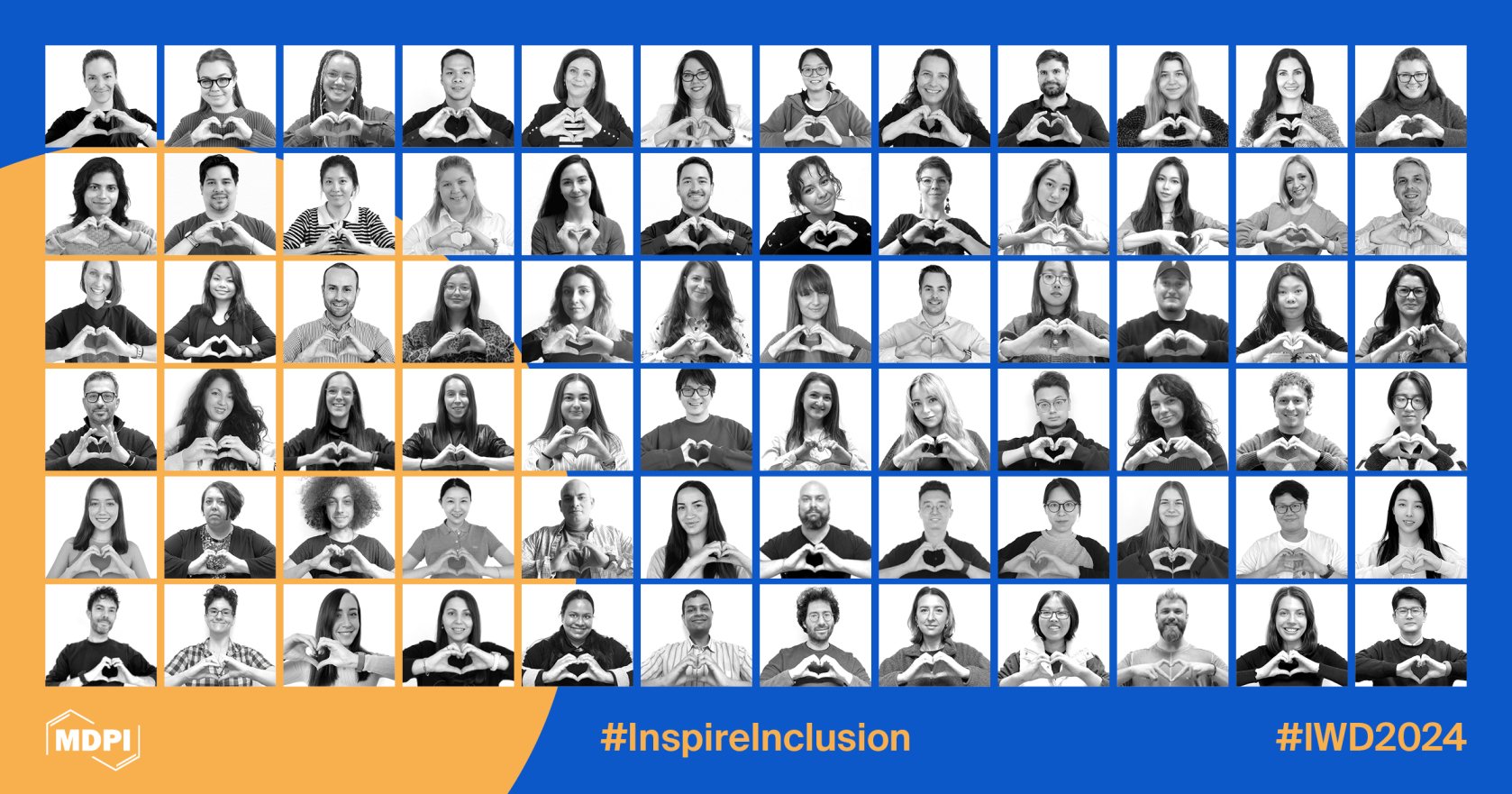
We are thrilled to recognize the accomplishments of women scientists through our many MDPI awards and by highlighting success stories. As inspirational figures, female scientists are paving the way for the next generation of women aspiring to pursue careers in engineering, life sciences, computing, and various other STEM fields.
“I consider myself lucky because I work with incredibly talented women who inspire me every day.”
– Dr. Alessandra Pasut, Winner of MDPI's ‘Biology 2023 Young Investigator Award’
“It’s really important to find a supportive and enabling environment in which to do your science; it would have a big impact on you as a person and on your scientific outputs.”
– Dr. Rhea Longley, Winner of the ‘Pathogens 2023 Young Investigator Award’
Open-access publishing, in particular, allows early-career women researchers to share their work more widely, potentially attracting mentorship opportunities and collaborations. This support is crucial for career development and advancement.
Coming Together for Science

MDPI Joins United2Act in Collective Fight to Stop Paper Mills
In my February 2024 CEO Letter, I highlighted some of our recent initiatives aimed at bolstering our commitment to research integrity, including joining the STM Integrity Hub and expanding our Research Integrity and Publication Ethics team (RIPE). Continuing our efforts in coming together for science, I am pleased to share our participation in the United2Act initiative.
The text below is taken from our official announcement:
United2Act represents an international group of stakeholders in the publishing industry committed to addressing the collective challenge posed to research integrity by paper mills.
Scientists and academic publishers have increasingly noted the alarming proliferation of paper mills, recognized as fraudulent entities seeking to manipulate the publication process for financial profit. These entities engage in fraudulent practices such as falsifying or fabricating data, selling co-authorship of fake papers, manipulating peer review, and including inappropriate citations. These actions pose a significant threat to the integrity of the scholarly record, prompting widespread concern among those involved in the academic community.
MDPI has been actively contributing to combat the undermining of the scientific record. Our editors employ a set of tools to detect potential ethical breaches within a manuscript and to tackle the issue of fake papers.
United2Act’s consensus statement is the outcome of a virtual summit held in May 2023. It involved the participation of research bodies, publishers, researchers/sleuths, universities, and publishing infrastructure from 15 countries and resulted in a Consensus Statement outlining five key areas of action for all stakeholders:
- Education and awareness
- Improve post-publication corrections
- Facilitate and organise research on paper mills
- Enable the development of trust markers
- Facilitate dialogue between stakeholders
MDPI is committed to promoting transparency and integrity in scholarly publishing and is continuing to work closely with the scientific community toward this goal.
Closing Thoughts
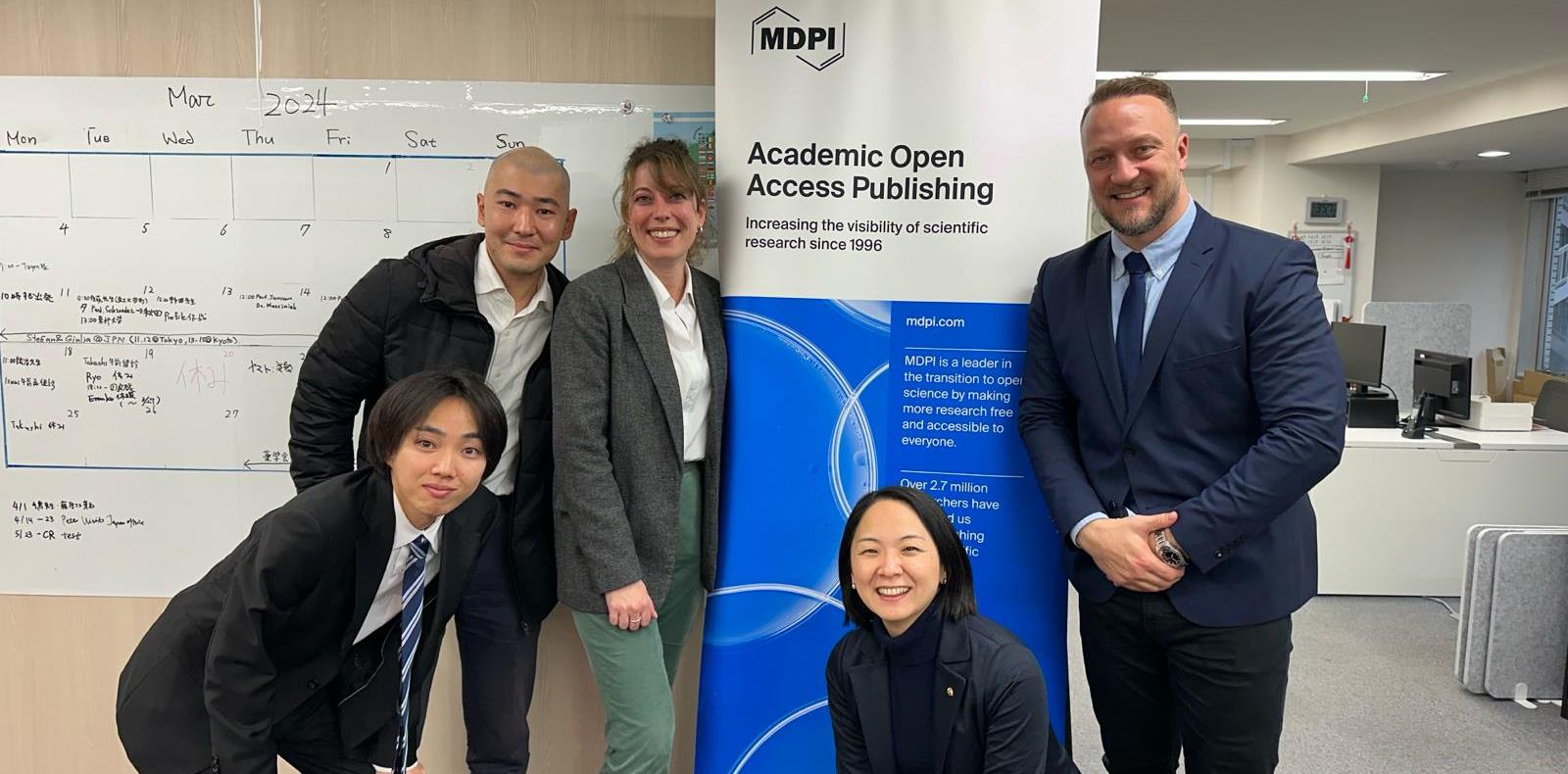
Left to right: Ryo Hirayama (Marketing Specialist, MDPI), Takashi Sasabe (Marketing Specialist, MDPI), Dr. Giulia Stefenelli (Chair of Scientific Office Board, MDPI), Dr. Izumi Yamamoto (Marketing Manager, MDPI), and Stefan Tochev (CEO, MDPI), at MDPI’s office in Tokyo, Japan.
Visit to Tokyo and Kyoto, Japan
In March, I had the opportunity to visit our Tokyo office and engage with stakeholders in Tokyo and Kyoto. During the visit, I also recorded a video message to welcome Japanese scholars working with MDPI and to highlight our operations in Japan.
We held meetings with Editors-in-Chief, librarians, scholars, and external consultants to gather feedback on our efforts to enhance our reputation and explore additional steps we can take in that direction. Japan's rich cultural heritage, characterized by tradition, respect, and formality, provided valuable insights into meeting the publishing needs specific to Japan.
Japan’s Open Access statistics
Over the years, we have seen a shift from subscription-only to gold OA publishing in Japan, despite the lack of an official mandate. Here are some statistics:
- 2012: 68% of articles were subscription-only, 6% were green Open Access, and 8% were gold Open Access.
- 2016: 55% of articles were subscription-only, 6% were green Open Access, and 20% were gold Open Access.
- 2022: 43% of articles were subscription-only, 7% were green Open Access, and 39% were gold Open Access.
To learn more about the history of OA in Japan as well as about future trends, please read this blog post.
“Japan is the ninth-largest contributor to our total publications”
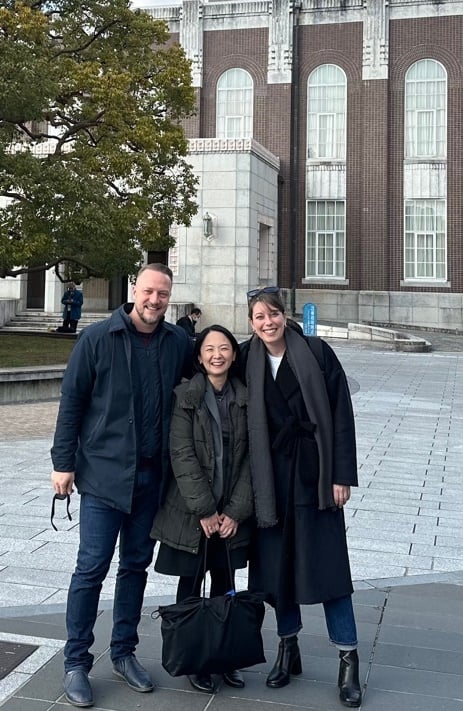
Left to right: Stefan Tochev (CEO, MDPI), Dr. Izumi Yamamoto (Marketing Manager, MDPI), and Dr. Giulia Stefenelli (Chair of Scientific Office Board, MDPI) visiting Kyoto University in Kyoto, Japan.
MDPI and Japan by Numbers
As at 1 April, over 50,000 MDPI articles have been authored by scholars affiliated with Japanese institutions, making the country the ninth-largest contributor to our total publications. Over the past three years (2020–2023), nearly 90,000 authors affiliated with Japanese institutes have published with MDPI, and we have collaborated with over 4,600 Guest Editors from Japan.
In 2023, we published over 8,200 papers from authors associated with Japanese institutions. MDPI collaborates with 41 institutional partnerships in Japan, including the University of Tokyo, Hokkaido University, and Nagoya University. We have over 2,100 active EBMs from Japan, more than 1,050 EBMs having an H-index between 26 and 50, including 13 serving as Editors-in-Chief.
General Feedback – a side note
A general takeaway from our discussions with stakeholders from around the world is that negative perceptions of MDPI often stem from misinformation, misconceptions, or misunderstandings about MDPI and our practices. While we acknowledge our mistakes and work diligently to address them, maintaining a strong editorial procedure and robust peer-review process, I find that educating stakeholders about our how we do what we do and our ongoing improvements tends to help shift opinions.
That said, we recognize the importance of addressing individual concerns. We take feedback seriously and are continuously working to get better while not compromising the core principles that millions of authors appreciate about MDPI.
Chief Executive Officer
MDPI AG
26 March 2024
Meet Us at the Canadian Society for Mechanical Engineering International Congress and 31st Annual Conference of the CFD Society of Canada (CSME/CFD2024), 26–29 May 2024, Toronto, Canada

Conference: Canadian Society for Mechanical Engineering International Congress and 31st Annual Conference of the CFD Society of Canada (CSME/CFD2024)
Organization: Canadian Society for Mechanical Engineering (CSME) and the CFD Society of Canada (CFDSC)
Date: 26–29 May 2024
Place: University of Toronto, Toronto, Canada
MDPI journals will be attending the Canadian Society for Mechanical Engineering International Congress and 31st Annual Conference of the CFD Society of Canada (CSME/CFD2024) as an exhibitor. This meeting will be held in Toronto, Canada, from 26 to 29 May 2024.
The Canadian Society for Mechanical Engineering International Congress and 31st Annual Conference of the CFD Society of Canada is an annual meeting and represents a marvellous opportunity for the mechanical engineering and CFD communities in Canada and beyond to come together to exchange the latest research results and to build a community, as it brings together students and professors with colleagues from industry and government.
The following MDPI journals will be represented:
- Machines;
- Fluids;
- Micromachines;
- Aerospace;
- Inventions;
- Drones;
- Eng;
- Technologies;
- Actuators;
- Automation;
- Journal of Manufacturing and Materials Processing (JMMP);
- Robotics;
- Journal of Experimental and Theoretical Analyses (JETA);
- Modelling.
If you are attending this conference, please feel free to start a conversation with us. Our delegates look forward to meeting you in person and answering any questions you may have. For more information about the conference, please visit the following link: https://www.csmecongress.org/.
25 March 2024
Meet Us at the 37th International Electric Vehicle Symposium and Exhibition (EVS37), 23–26 April 2024, Seoul, South Korea

MDPI will attend the 37th International Electric Vehicle Symposium and Exhibition, held from 23 to 26 April 2024 in Seoul, South Korea.
Since its inception in 1969, the International Electric Vehicle Symposium and Exhibition (EVS) series has been at the forefront of this movement and has grown to become the largest and most prominent global event in the electric vehicle industry, showcasing current and emerging technologies both in the market and under development.
The EVS37 organizing committee aims to address and shape the monumental movement of e-mobility under the theme of "Electric Waves to Future Mobility" with academic, government, and industry professionals involved in electric vehicle technologies. As the EV revolution continues to evolve at increasingly faster speeds, EVS37 serves a critical role as a nexus to exchange ideas and feature the latest EV breakthroughs.
The following MDPI journals will be represented:
- Electronics;
- WEVJ;
- Vehicles;
- Energies;
- Smart Cities;
- Batteries;
- Machines.
If you plan to attend this conference, we invite you to visit our booth and converse with our delegates. We are excited to meet you in person and address any questions you may have. For further details about the conference, please visit the following website: https://evs37korea.org/main.asp.
5 March 2024
Machines 2023 Young Investigator Award—Winner Announced
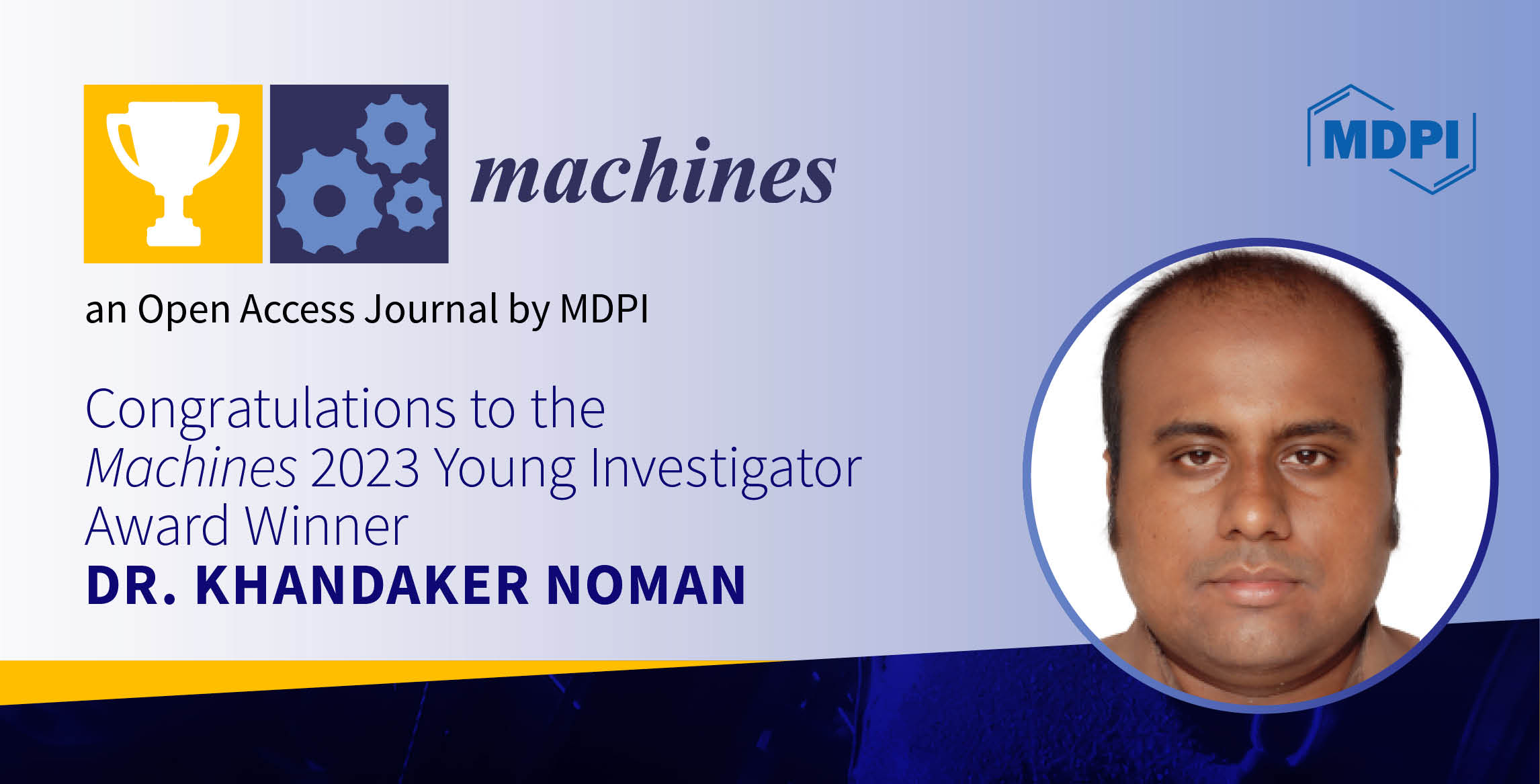
We are pleased to announce that the winner of the Machines 2023 Young Investigator Award is Dr. Khandaker Noman.
Dr. Khandaker Noman is an associate professor at the School of Civil Aviation, Northwestern Polytechnical University, Xi’an, China. Dr. Noman’s main research focus is on entropy theory, condition monitoring and fault diagnosis, mechanical signal analysis and processing, remaining useful life prediction model, and intelligent fault diagnosis.
Dr. Noman received his Ph.D. in 2021 and has an outstanding publication record, with a total of 20 scientific journal articles published, among which he is the first/corresponding author of 9, and 13 are published in the top journals listed by the Chinese Academy of Sciences in the last 5 years. So far, he has delivered five invited reports at different international academic conferences. He also managed five major projects including projects from the National Natural Science Foundation of China (NSFC), the Ministry of Science and Technology of China, etc. This is an outstanding achievement in today’s competitive environment. Please join us in congratulating Dr. Noman on his outstanding achievements.
As the awardee, Dr. Noman will receive an honorarium of CHF 1500, an offer to publish a paper free of charge before the end of 2024 in Machines (ISSN: 2075-1702) after peer-review, and an electronic certificate.
We would like to thank all the nominators from various fields of study for their participation and all the Award Committee Members for their evaluation of the many excellent nominations.
Machines 2023 Young Investigator Evaluation Committee
4 March 2024
MDPI Insights: The CEO's Letter #9 - Romania, Research Integrity, Viruses
Welcome to the MDPI Insights: The CEO's Letter.
In these monthly letters, I will showcase two key aspects of our work at MDPI: our commitment to empowering researchers and our determination to facilitating open scientific exchange.
Opening Thoughts
Reka Kovacs (Deputy Office Manager, MDPI), Stefan Tochev (CEO, MDPI), and Sandra Ana Spatariu (Office Manager, MDPI) at the MDPI office in Cluj, Romania.
MDPI’s Impact on Romania
In February, I visited our office in Cluj, Romania. I worked closely with our senior office managers and various teams, including the departments of training, marketing and conferences, as well as our journal relationship specialists, reviewing our service to the local scholarly community. During the visit, I also met with representatives from Babes-Bolyai University and the Technical University of Cluj-Napoca. Our multifunctional Romanian office plays an important role in supporting our collaborations with the local market as well as helping to meet MDPI’s overall business needs.
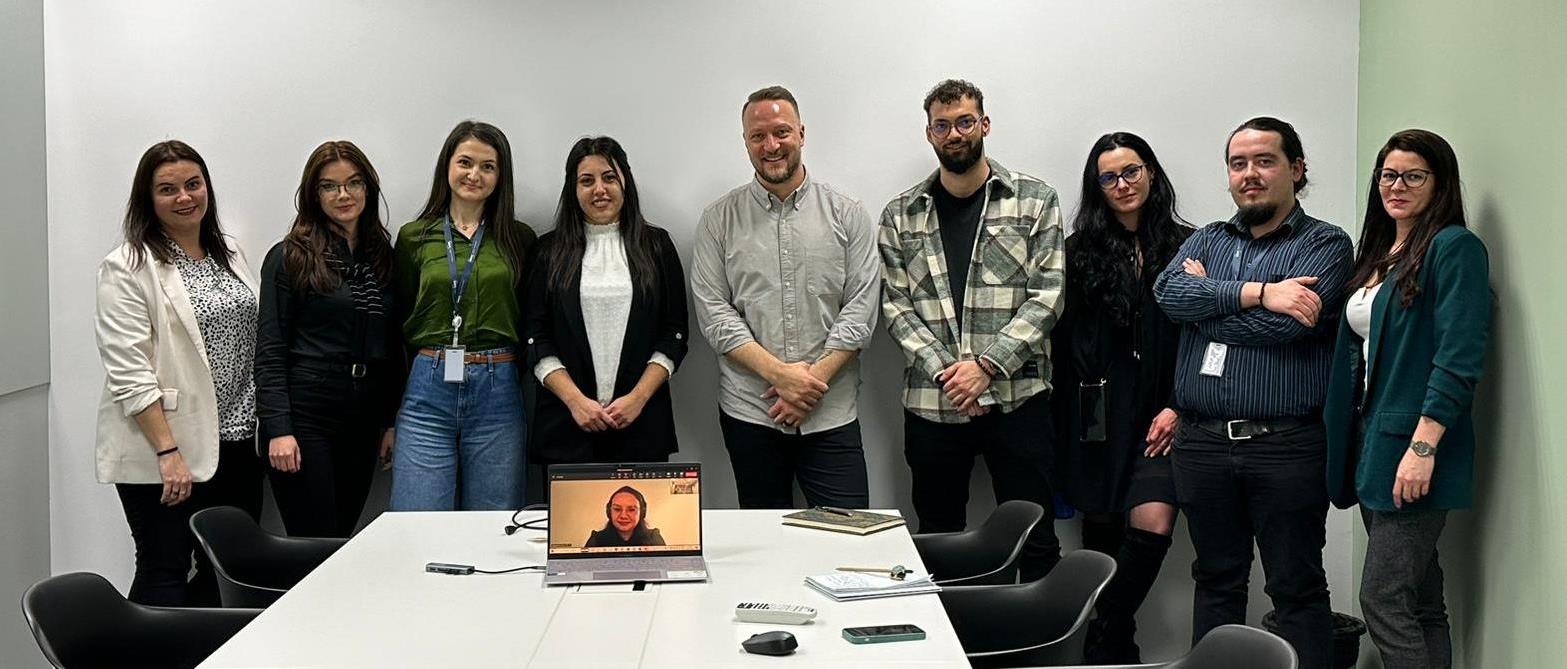
Feedback and strategy meeting with a group of MDPI’s Journal Relationship Specialists at the MDPI office in Cluj, Romania.
With 22,436 articles, Romania ranks as a top 20 contributing country to MDPI’s total number of papers published as at 28 February 2024. This highlights the importance of our collaboration with Romanian-affiliated authors and the growing opportunity to support their publishing needs. MDPI is one of the few academic publishers with a significant presence in Romania, boasting over 360 colleagues across our offices in Bucharest and Cluj. We are also proud to hire colleagues from local institutions to launch their careers within publishing.
Romania ranks as a top 20 contributing country.
The Numbers: 2019–2023
MDPI has seen a healthy increase in submissions from Romanian authors over the past three years, from 8,439 in 2021 to 11,866 by end of 2023, with most submissions going to journals such as Sustainability, Medicina, Diagnostics, IJMS, Applied Sciences, and JCM. From 2019 to 2023, MDPI published articles from 32,145 authors affiliated with Romanian institutions. Over those years, we have worked with Romanian Guest Editors on nearly 3,000 occasions to support their Special Issue and Topical collections.
With more than 300 Editorial Board Members from Romania, 34 appear on the board of Mathematics, 27 on Materials, 19 on Polymers, 18 on Coatings, and 16 on Molecules, while three serve as Section Editors-in-Chief (SEiC) on our journals Coatings (3.4 IF, 4.6 Citescore), Magnetochemistry (2.7 IF, 3.5 Citescore), and Chemosensors (4.2 IF, 3.9 Citescore).
Institutional Open Access Programs
Our commitment to working with institutions is evident in Romania, where we have established eight Institutional Open Access Programs (IOAP) with esteemed institutions such as the University of Bucharest, the University of Medicine and Pharmacy Cluj-Napoca, and most recently the National Institute for Laser, Plasma and Radiation Physics.
Our growth and presence in Romania are a true testament.
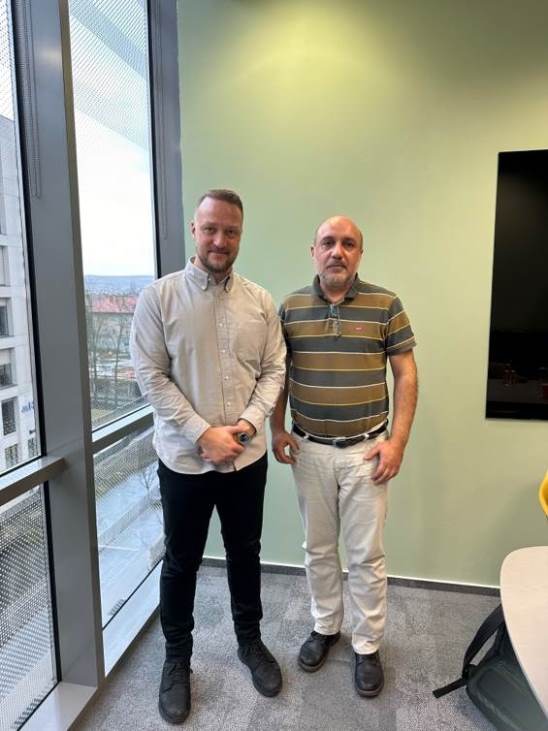
We also have IOAP agreements with Babes-Bolyai University and the Technical University of Cluj-Napoca, where I had the opportunity to meet senior stakeholders during my visit. Below are a few photos capturing our meeting with Prof. Radu Silaghi-Dumitrescu (Head of Faculty of Chemistry, Babes-Bolyai University) at the MDPI office in Cluj, Romania, along with a photo from our meeting with Vice Deans Nicoleta Cobarzan, Nicoleta Ilies, and Hoda Gavril, from the faculty of Civil Engineering at the Technical University of Cluj, Romania.

Our growth and presence in Romania are a true testament to the service we provide to the scholarly community and the relationships we foster in that region. We look forward to continuing to support Romanian scholars and institutions by providing a valuable and trusted experience with MDPI, the leader in open access publishing.
Impactful Research

MDPI Joins the STM Integrity Hub
MDPI has long been a supporter and partner of STM, with our involvement ranging from sponsoring and attending events to helping organize event programs. By joining the STM Integrity Hub, we aim to further our commitment to STM initiatives aimed at safeguarding the integrity of science.
“We are pleased to welcome MDPI as the 35th organisation participating in the Hub. This expansion is critical, as every new member enhances our capacity to prevent fraudulent submissions from entering the academic record.”
Joris van Rossum, Director of Research Integrity, STM
MDPI operates in full alignment with STM Integrity Hub's values of shared data and experiences. We strongly believe in collaboration and open exchange for the purposes of creating a holistic approach to support research integrity at MDPI itself and across the entire academic publishing industry. The Integrity Hub is an excellent example of how publishers can come together to jointly address industry-wide challenges related to research integrity, such as manuscripts that breach research integrity standards and paper-mills.
I look forward to our Research Integrity and Publication Ethics Team (RIPE) team immersing themselves in this initiative, exchanging information, best practices, and tools for the benefit of the entire scholarly ecosystem. We believe that ethical publishing standards should be implemented across the board, and we aim to be rigorous in our approach, addressing research integrity issues and improving the impact of published research.
Inside MDPI

MDPI Expands Research Integrity and Publication Ethics Team (RIPE)
In addition to external collaborations and joint initiatives aimed at further strengthening our commitment to research integrity, we are also enhancing our internal efforts. This includes improving our processes and guidelines and expanding our teams and departments to ensure quality assurance throughout our publishing process.
We are pleased to announce the expansion of our Research Integrity and Publication Ethics Team (RIPE) at MDPI. The RIPE team has recently welcomed new colleagues, each bringing unique skills and a personal commitment to prioritize ethical considerations in all our work.
The demand for research integrity and high ethical standards in academic publishing is steadily rising across our industry. Our expanded RIPE team will work to enhance and align our practices with industry best practices, ensuring excellence in research integrity and publication ethics.
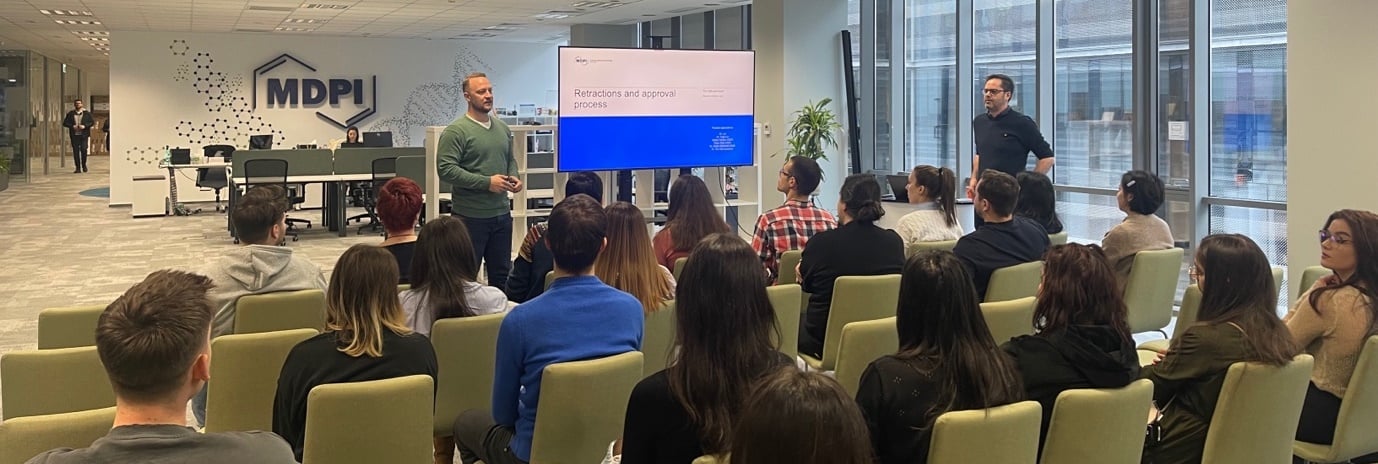
Stefan Tochev (CEO, MDPI) introduces Dr. Tim Tait-Jamieson (Research Integrity Lead, MDPI) for his presentation on MDPI’s Retraction and Approval Process to a group of Journal Relationship Specialists at the MDPI office in Cluj, Romania: “The demand for research integrity and publication ethics is steadily rising across our industry.”
Introducing our Research Integrity and Publication Ethics Team
Led by Dr. Tim Tait-Jamieson (Research Integrity Lead), the RIPE team comprises Dr. Ivana Resanovic (Research Integrity Manager), Dr. Lavinia Rogojina (Research Integrity Manager), Ms. Diana Apodaritei (Research Integrity Specialist), Dr. Zoltan Mihaly (Research Integrity Specialist), Mr. Aleksandar Đukić (Research Integrity Specialist), Ms. Ana Stankovic (Research Integrity Specialist), and Ms. Anna Pena (Publication Ethics Assistant).
Please click here to access everything that you need to know about MDPI’s Research and Publication Ethics.
With this span of complementary roles, the RIPE team collaborates directly with journal editorial teams and works closely with various departments, including our Scientific Office Board and our Journal Relationship Specialists. The team’s primary objectives are to help prevent issues regarding research integrity and publication ethics during peer review, uphold MDPI’s ethics policies, adhere to industry standards, and resolve publication ethics and research integrity issues and complaints.
Quality Updates to Special Issues Oversight
At MDPI, we are committed to reviewing policies pertaining to the quality of research. In this blog post, Shaheena Patel (Communications Associate, MDPI), outlines two recent updates to MDPI journal processes. These updates pertain to Special Issue (SI) quality guidelines, in line with criteria provided by COPE and DOAJ. Alongside the SI updates, details regarding the new minor corrections policy introduced in 2024 are provided in the blog.
The two updates we implemented include greater oversight and the verification of Guest Editor credentials. These guidelines require that Editors-in-Chief (EiCs) and Editorial Board Members (EBMs) take responsibility for overseeing SIs.
PS. Thank you, James Butcher, for featuring this up in your 67th issue of the Journalogy newsletter.
Read more:
Coming Together for Science
Viruses 2024 – A World of Viruses
I am pleased to share the success of our MDPI conference Viruses 2024 – A World of Viruses, held 14-16 February, in Barcelona. With 240 registrations, this event brought together top scientists, researchers, and industry experts from 40 countries to share their findings on the latest developments in viral pathogenesis and immune responses.
Attendees gathered for the 5th edition of the Viruses’ conference, where we hosted influential keynote speeches from Nobel Prize laureate Dr. Charles M. Rice and ‘Distinguished Senior Virologist’ Prof. Luis Enjuanes, along with 14 invited speakers, 47 selected speakers, and nine flash poster presenters, to discuss the most significant issues in virology today.
Recap on the #Viruses2024 Conference
Take a look at the key moments from MDPI’s Viruses event and please join us in commemorating a gathering for global knowledge and cooperation. A heartfelt thank-you to all attendees; their passion and engagement played a crucial role in making this event an engaging success!
Below are calls to action from the keynote speakers encouraging collaboration and communication:
“There’s never been a better time than now to really take the power that we have both in terms of basic research and also in biotech and pharma to develop antiviral agents.” - Dr. Charles M. Rice, The Rockefeller University, New York, USA
“The collaboration between labs is absolutely essential. Improving initial detection and improving communication is a must for all of us working in science.” - Prof. Dr. Luis Enjuanes, National Center of Biotechnology (CNB-CSIC), Madrid, Spain
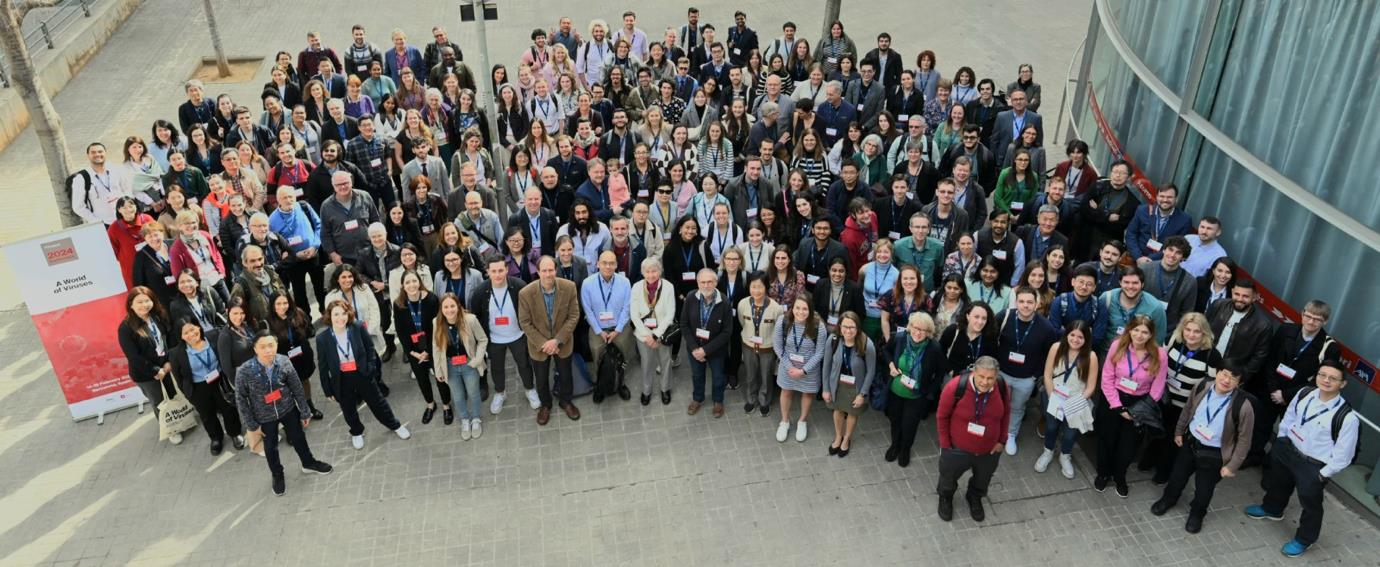
Our thanks go to our sponsors and partnering societies, our Viruses journal and editorial team, our Barcelona colleagues, and the social media, conference and other MDPI teams for making this event a memorable occasion. View the event gallery here.
Upcoming In-Person Event
24–26 April, 2024
4th MMCS – Harnessing the Power of New Drug Modalities
Location: Barcelona, Spain
Esteemed speakers at MMCS 2024 include Prof. Arun K. Ghosh, the mind behind the Darunavir molecule, and Prof. Paul Brennan, CSO of Alzheimer's Research UK Oxford Drug Discovery Institute.
Find more upcoming MDPI events here.
Organize Your Event with MDPI’s Sciforum
Sciforum is MDPI’s platform dedicated to the organization of scientific events. In line with our mission to promote science, Sciforum supports scholars, societies, research networks, and universities at all stages of organizing in-person events, virtual events and webinars. Our platforms are efficient, user-friendly, and cost-effective. We handle all steps related to event management. Contact us for details.
Closing Thoughts

Researcher to Reader (R2R) Conference
From 20–21 February 2024, I had the pleasure of attending the Researcher to Reader (R2R) conference in London, which MDPI has proudly sponsored over the years. The conference programme offered a variety of session formats, including workshops, panel discussions, debates, interviews, presentations, and lightning talks, with opportunities to discuss relevant topics.
We take pride in supporting the scientific community, bringing researchers across the world together to network, exchange ideas and share the latest in science and publishing. In 2023, MDPI invested close to 2 million CHF in sponsoring over 2,000 scientific and publishing-related conferences worldwide.
R2R Peer Review Innovations Workshop
I found the R2R conference to be engaging, with the workshops being particularly enjoyable. My colleague Giulia Stefenelli (Chair of Scientific Office Board) and I participated in the “Peer Review Innovations” workshop, which spanned four sessions over the two days. These sessions explored the future of peer review and how we can improve the peer review process for everyone involved. Notably, the large majority of attendees expressed their opinion that peer review, as currently practiced, requires significant improvement. Together, we collaborated on potential immediate and long-term improvements and innovative processes, aiming to create an ecosystem beneficial to all stakeholders by strengthening submission systems with the aim of reducing threats and making authors more responsible for their work. We also discussed the opportunity for academic institutions to better scrutinize the quality of the work produced and submitted to journals.
Our group comprised publishers, software providers, librarians, and more, bringing diverse perspectives to the discussions. These interactions were relevant to MDPI’s ongoing conversations, providing insights to our efforts. The session also made me appreciate that MDPI is doing well, as the group discussions included the subject of various quality checks that we have already embedded in our processes, ensuring that we keep abreast of industry standards.
The need for an optimized system to incentivize the activities of editors and reviewers was also a focus of discussion, as well as the support that reviewers need from publishers via the provision of strong reports through fixed forms, questionnaires and training.
At MDPI, we are currently auditing our reviewer program to improve reviewer recognition, guidelines, and methods for identifying suitable reviewers, while maintaining our commitment to quality and timeliness.
Congratulations to Mark Carden, Conference Director, and the R2R team for organizing a productive and successful event. PS: The break times were greatly appreciated as well!
Chief Executive Officer
MDPI AG
23 February 2024
Meet Us at the European Robotics Forum 2024, 13–15 March 2024, Rimini, Italy
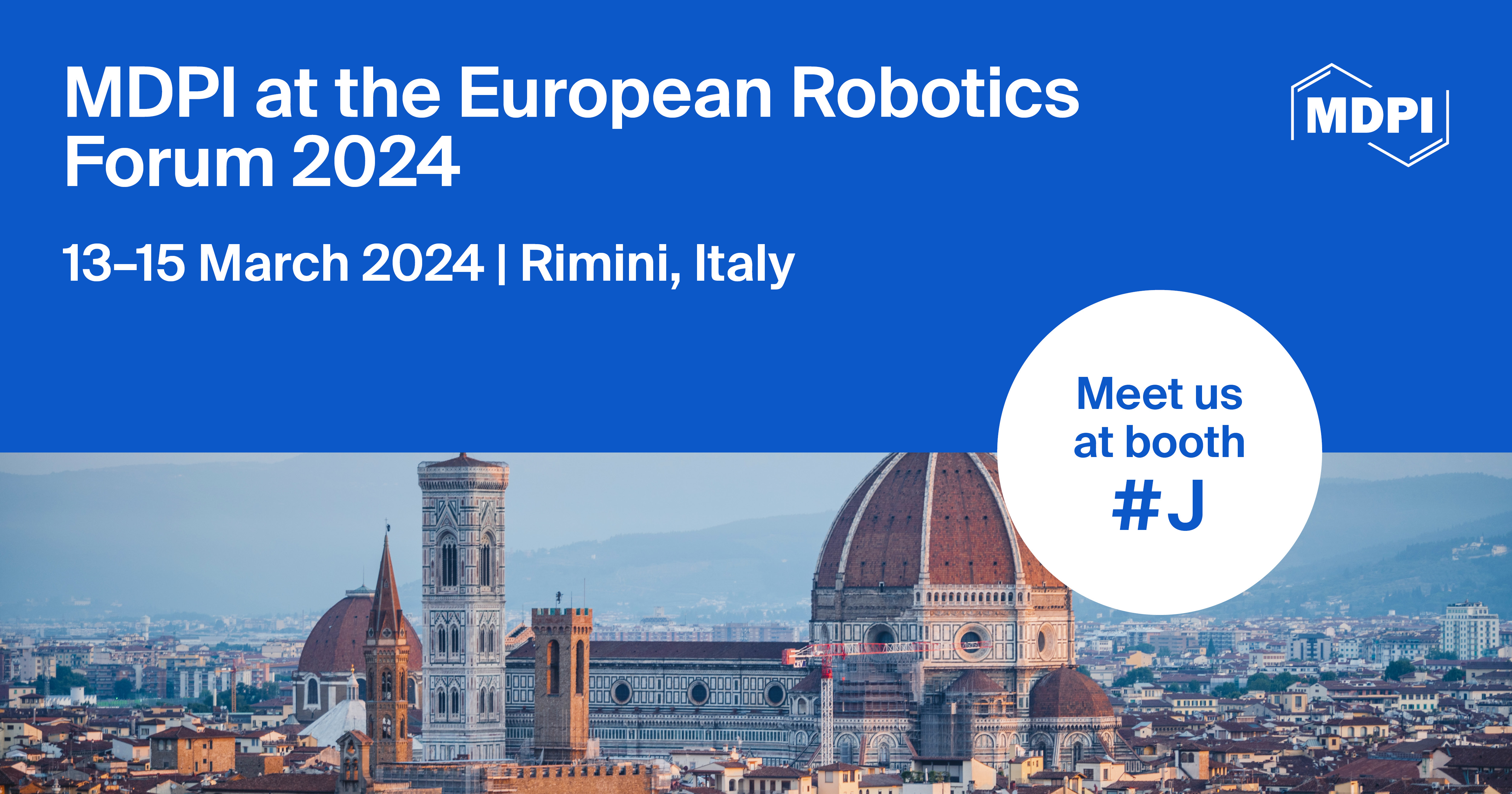
MDPI will be attending the European Robotics Forum 2024 in Rimini, Italy, which will take place from 13 to 15 March 2024. The Forum will see leading experts in robotics, both academic and industrial, at an international level, come together in the vibrant city of Rimini; the Forum will also see the presence of the major European companies with interests in this field. Topics of interest include but are not limited to the following: artificial intelligence (AI)-enabled robotics; autonomous navigation; collaborative robotics; mechatronics; soft robotics; human–robot interactions; human-centred robotics; and safety and standardization.
The following MDPI journals will be represented:
- Electronics;
- Sensors;
- AI;
- Machines;
- Robotics;
- Smart Cities;
- Systems.
If you are attending the conference, please visit our booth. Our delegates look forward to meeting you in person and answering any questions that you may have. For more information about the conference, please visit the following link: https://erf2024.eu/.
31 January 2024
MDPI Insights: The CEO's Letter #8 - Altmetric and Flat Fee Agreement
Welcome to the MDPI Insights: The CEO's Letter.
In these monthly letters, I will showcase two key aspects of our work at MDPI: our commitment to empowering researchers and our determination to facilitating open scientific exchange.
Opening Thoughts

MDPI and Digital Science Meeting
At MDPI, we are committed to providing our authors with the essential tools to publish, promote, and track their research. In line with this commitment, we have established a longstanding collaboration with Digital Science, a company specializing in research data and analytical insights for the research community. Our collaboration integrates their Altmetric tool, offering us and our authors the ability to track a variety of sources that monitor and report attention surrounding publications.
As part of our collaboration, we recently hosted Cathy Holland, Director of Global Publisher Business Development, and Helen Cooke, Managing Director of Publisher Sales, from Digital Science, at our MDPI headquarters in Basel, Switzerland.

Left to right: Facundo Santomé (Senior Marketing Manager, MDPI), Constanze Shelhorn (Indexing Manager, MDPI), Cathy Holland (Director of Global Publisher Business Development, Digital Science), Helen Cooke (Managing Director of Publisher Sales, Digital Science), and Stefan Tochev (CEO, MDPI) in front of MDPI headquarters in Basel, Switzerland.
During our meeting, we discussed MDPI’s publishing philosophy and explored further avenues for collaboration. We look forward to continuing our partnership with Digital Science, aiming to improve our services yet further and meet the needs of our authors more closely than ever.
What is Altmetric?
You will notice that MDPI articles feature an Altmetric score, a colourful doughnut capturing the score in the upper right corner of the article page. This score represents ‘alternative metrics,’ as distinct from traditional metrics such as Impact Factor, CiteScore, and Scimago Journal Rank.
Altmetrics complement traditional citation-based metrics by capturing online discussions related to a specific research topic. By analyzing both sets of data, we can obtain a comprehensive understanding of the attention a particular research output receives and the sources in which it is mentioned.
“Almetric provides visual insights into where research is being discussed”
Sources Tracked by Altmetric

Altmetric badge showing the Altmetric score and colour-coded mention sources.
Altmetric monitors various sources, categorizing them into segments such as policy documents, peer reviews, Wikipedia, news and blogs, and social media, among other sources. Each category is identifiable by a specific colour.
The Altmetric badge provides visual insights into where the research is being discussed. A more colourful badge indicates broader mentions across multiple platforms. Such tracking enables us to gauge the extent of an article’s online dissemination, noting that increased visibility may correlate with higher citation rates.
Read more:
Impactful Research

Ten High-Altmetric Articles Published by MDPI
As at 30 January 2024, Altmetric has tracked 670,500 MDPI research outputs from MDPI, resulting in over 4.3 million mentions. This includes over 71,894 mentions in policy and patents and 294,714 mentions in news and blogs, with some achieving an Altmetric score as high as 28,754.
So, what is a good Altmetric score? There are various ways to put this score into context. You can find out more about the score in context and how to evaluate your work by this means.
Here are ten MDPI papers ranking in the top 5% of all research outputs scored by Altmetric.
|
|
“Accuracy in Wrist-Worn, Sensor-Based Measurements of Heart Rate and Energy Expenditure in a Diverse Cohort” J. Pers. Med. 2017, 7(2), 3; https://doi.org/10.3390/jpm7020003 Altmetric page: https://mdpi.altmetric.com/details/20477344 Altmetric shows that this article appeared in 253 news stories from 209 outlets including Forbes, BBC, and Fox News. |
|
|
“Daylight Saving Time and Acute Myocardial Infarction: A Meta-Analysis” J. Clin. Med. 2019, 8(3), 404; https://doi.org/10.3390/jcm8030404 Altmetric page: https://mdpi.altmetric.com/details/57654628 Altmetric shows that this article appeared in 295 news stories from 207 outlets including Forbes, The Atlantic, and New York Times. |
|
|
“The Preliminary Analysis of Cave Lion Cubs Panthera spelaea (Goldfuss, 1810) from the Permafrost of Siberia” Quaternary 2021, 4(3), 24; https://doi.org/10.3390/quat4030024 Altmetric page: https://mdpi.altmetric.com/details/111086701 Altmetric shows that this article appeared in 182 news stories from 134 outlets including CBC News, CNN, and National Geographic. |
|
|
“Not the Cat’s Meow? The Impact of Posing with Cats on Female Perceptions of Male Dateability” Animals 2020, 10(6), 1007; https://doi.org/10.3390/ani10061007 Altmetric page: https://mdpi.altmetric.com/details/83796184 Altmetric shows that this article appeared in 124 news stories from 98 outlets including VICE, CNN and The Guardian. |
|
|
“Behaviour and Welfare Impacts of Releasing Elephants from Overnight Tethers: A Zimbabwean Case Study” Animals 2022, 12(15), 1933; https://doi.org/10.3390/ani12151933 Altmetric page: https://mdpi.altmetric.com/details/133463915 Altmetric shows that this article appeared in 192 news stories from 186 outlets. |


How do I use altmetrics?
Altmetric Explorer provides a detailed step-by-step guide and instruction video for first-time users of the tool. The guide includes useful diagrams that make it easy to get started.
Sharing Research Online
For research to be tracked across different sources, Altmetric needs a research output with a persistent identifier: a DOI, ISBN, PubMed ID, handle ID, etc. When sharing research, it is important to include a link to the original research output.
|
|
“An Update on Eukaryotic Viruses Revived from Ancient Permafrost” Viruses 2023, 15(2), 564; https://doi.org/10.3390/v15020564 Altmetric page: https://mdpi.altmetric.com/details/142929875 Altmetric shows that this article appeared in 250 news stories from 180 outlets including CTV, Fox News, and CNN. |
|
|
“The Global Problem of Insufficient Sleep and Its Serious Public Health Implications” Healthcare 2019, 7(1), 1; https://doi.org/10.3390/healthcare7010001 Altmetric page: https://mdpi.altmetric.com/details/53406248 Altmetric shows that this article appeared in 252 news stories from 168 outlets including BBC, Harvard Business Review, and Forbes. |
|
|
“A Detailed Review Study on Potential Effects of Microplastics and Additives of Concern on Human Health” Int. J. Environ. Res. Public Health 2020, 17(4), 1212; https://doi.org/10.3390/ijerph17041212 Altmetric page: https://mdpi.altmetric.com/details/86529137 Altmetric shows that this article appeared in 197 news stories from 150 outlets including BBC, The Tribune, and World Economic Forum. |
|
|
“An Empirical Study of Chronic Diseases in the United States: A Visual Analytics Approach to Public Health” Int. J. Environ. Res. Public Health 2018, 15(3), 431; https://doi.org/10.3390/ijerph15030431 Altmetric page: https://mdpi.altmetric.com/details/34714141 Altmetric shows that this article appeared in 232 news stories from 149 outlets including Forbes, New York Times, and Harvard Business Review. |
|
|
“Garden Scraps: Agonistic Interactions between Hedgehogs and Sympatric Mammals in Urban Gardens” Animals 2023, 13(4), 590; https://doi.org/10.3390/ani13040590 Altmetric page: https://mdpi.altmetric.com/details/142934305 Altmetric shows that this article appeared in 172 news stories from 168 outlets including BBC. |
Inside MDPI

MDPI Annual Meeting Celebrations in China
On Thursday 25 January, over 1,300 MDPI colleagues from our two offices in Beijing gathered to kick off MDPI’s traditional ‘Annual Meetings.’ These celebrations take place in MDPI’s offices across China, including Dalian, Tianjin, Wuhan, and Nanjing.
The evenings include performances, informative talks and presentations, awards, and entertainment, providing an ideal platform to recognize our colleagues, celebrate their achievements, and set our sights on the future.
“It is essential that we stay connected and share best practices”

I sent a video congratulating everyone on their work and sharing our vision of building MDPI into the most trusted OA publisher, highlighting the roles each of us has to play in achieving that goal.
Unfortunately I could not join in person, but you may recall my recent trip, when I visited our offices in Beijing and Wuhan, which I look forward to visiting again this year.
Although our headquarters are in Basel, Switzerland, and we are expanding throughout Europe and North America, the majority of MDPI’s workforce is in China and throughout the Asia-Pacific region, including offices in Singapore, Thailand, Japan, and newly opened office in South Korea. It is essential that as a global organization, we stay connected and share best practices in order to grow collectively and continue providing the exceptional service to our authors.
The Annual Meeting is a moment to reflect and enjoy the year’s hard work and dedication.
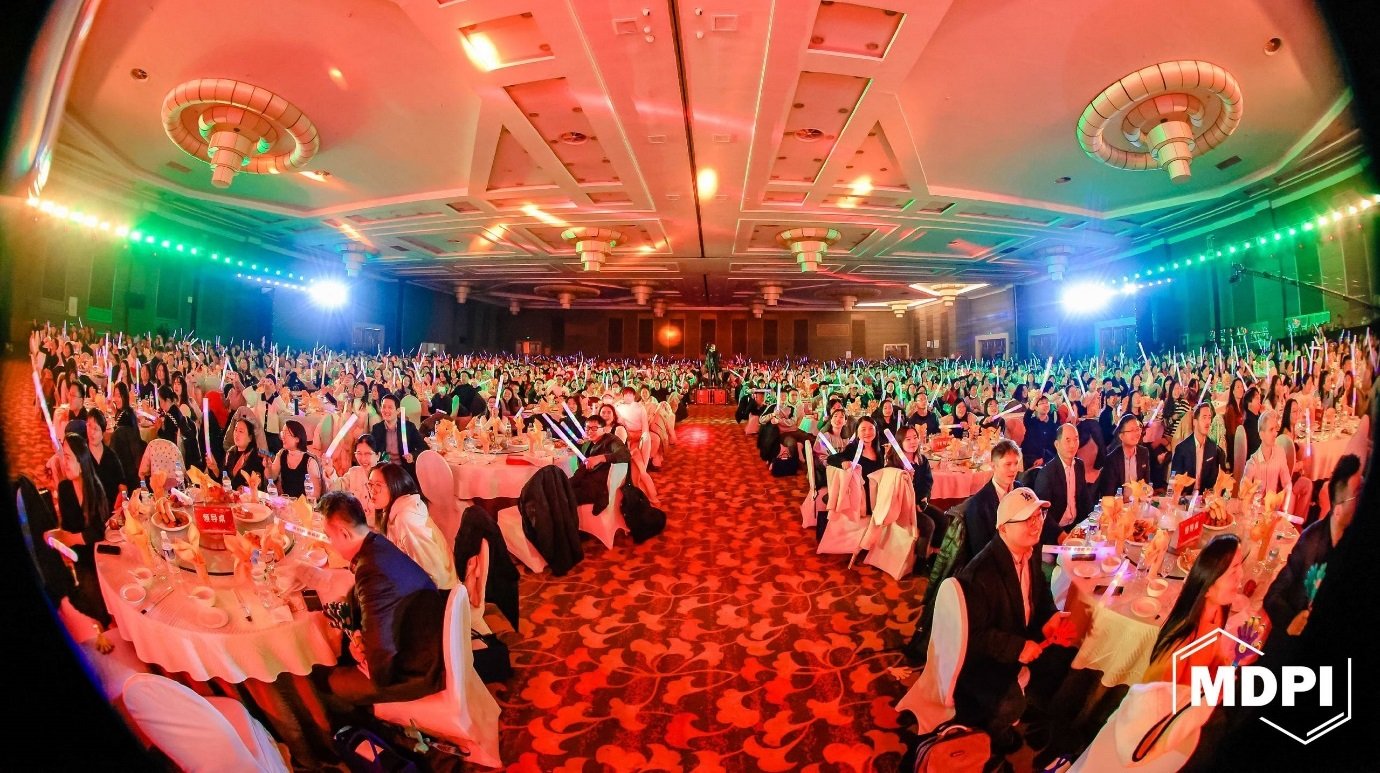
I extend our best wishes to all for the Chinese New Year (Xīnnián kuàilè)!
Coming Together for Science
MDPI and TU Delft Adopt Flat Fee Model in Extended Partnership
We are excited to announce a renewed three-year partnership with Delft University of Technology (TU Delft) in the Netherlands. This collaboration introduces a fixed lump-sum fee, covering publishing costs from 2024 to 2026.
“This initiative reflects our dedication to transparent and inclusive publishing”
TU Delft-affiliated authors will enjoy cost-free publishing in any MDPI journal during this period, aligning with our commitment to removing barriers for open access publishing. The agreement supports Plan S compliance and facilitates a seamless publishing process for TU Delft corresponding authors. This initiative reflects our dedication to transparent and inclusive publishing, providing stability and predictability both for authors and for institutions.
For further details on our Institutional Open Access Program (IOAP), please contact us.
Benefits to MDPI’s IOAP
At MDPI we have a long tradition of partnerships, including our Institutional Open Access Program (IOAP). IOAP supports institutions through simplification, access, transparency, APC discounts, and institutional repository deposits. The program simplifies administrative processes, offers central payment, and allows easy opting in and out. Participants gain free access to Susy, MDPI’s online submission system, with extensive article metadata and exportable data. APC discounts and Book Processing Charge discounts are available for affiliated authors. Automated deposits to institutional repositories and streamlined matching of papers to IOAP participants enhance the overall experience.
For further information, see our IOAP FAQ.
Closing Thoughts

Reflections on the 2024 APE Conference
MDPI was proud to co-sponsor the Academic Publishing in Europe (APE) 2024 Conference that took place in Berlin, Germany, from 9–10 January 2024.
The conference theme, ‘Keep the Conversation Going!’, explored the evolving landscape of scholarly communication. APE is one of the key conferences I make a point to attend each year. January offers a valuable opportunity to engage with new contacts, reconnect with familiar faces, and participate in impactful discussions and presentations among professionals, scholars, and practitioners in the field.
“It's fascinating to see how other publishers are leveraging AI”
Highlights
Some of the standout panels for me include: the role of the UN Sustainable Development Goals (SDGs) within the publishing industry. It was encouraging to hear the current status quo, though I was eager also to learn about the exciting projects planned for 2024 and beyond. These will allow us to track progress in subsequent years. At MDPI, we remain committed to promoting Open–Access (OA) content on SDGs through scientific articles and books. Furthermore, we extend our commitment to sustainability by financially supporting researchers through initiatives such as the World Sustainability Award and the Emerging Sustainability Leader Award, as well as waiving the APC for feature papers on each SDG.
In recent years, discussions on AI have become increasingly prominent at such conferences. It’s fascinating to see how other publishers are leveraging AI to meet the evolving needs of their audiences while at the same time using it to safeguard the scientific process. Other engaging panels that I enjoyed included updates on transformation beyond transformative agreements, the principles of lean change, incentive structures related to research integrity, and the panel on reviewer incentives.
“We can share best practices and lessons learned”
Incorporating MDPI’s Insights into Conferences
I must confess that I sometimes feel overlooked when MDPI is not invited to participate in crucial industry discussions. As the leading open access publisher and the third-largest publisher overall, we possess extensive experience in many of these areas and can offer valuable contributions to these discussions. We can share best practices, lessons learned, and our thinking about future trajectories. For instance, in panels discussing reviewer incentives, at MDPI we offer a discount voucher to reviewers for future submissions, reflecting our commitment to fostering a robust peer review process. In 2022 alone, MDPI collected over 1.4 million peer review reports, informing the decision-making processes of our editors. Given our expertise in these areas, it would be natural to include MDPI in such discussions. I therefore extend an invitation to future conference organizers to consider MDPI for speaking engagements and collaborative opportunities.
Chief Executive Officer
MDPI AG
24 January 2024
Acknowledgment of the Reviewers of Machines in 2023
In recognizing the exceptional efforts of our reviewers in 2023, we express our sincere gratitude for upholding the high standards of Machines. Their commitment ensured the rigorous peer review that is integral to quality academic publishing.
In 2023, Machines received 3695 review reports, from 2924 reviewers. This past year, we worked with reviewers from 84 countries and regions, reflecting the diversity in our collaboration with research communities. Their dedication shapes scholarly discourse and advances global research. The editorial team expresses gratitude for the vital role played by each reviewer in the Machines family throughout 2023, and we look forward to their continued support in 2024.
The following are the reviewers who have consented to show their names:
| A. Raja Annamalai | Ludmila Dulebová |
| Abdel-Nasser Sharkawy | Luigi Bregant |
| Abdul Aabid | Luigi De Napoli |
| Abdul Rauf | Luigi Tornello |
| Abdul Razzaq | Luis Alberto Rodríguez-Picón |
| Abdullah Alfaify | Luis Miguel Durao |
| Abdulnaser M. Alshoaibi | Luiz Henrique Lindquist Whitacker |
| Abhilasha Singh | Luiz Pinto |
| Abul Doulah | Lukas Hubka |
| Adam Dziubiński | Lukasz Nowakowski |
| Adam Martowicz | Łukasz Orman |
| Adam Zielonka | Łukasz Rykała |
| Adelina Bordianu | Lynn Davis |
| Adrian Gligor | Maciej Henzel |
| Adrian Lungu | Magdalini Titirla |
| Adrian-Mihail Stoica | Mahmut Burak Okuducu |
| Agathoklis Krimpenis | Mai The Vu |
| Agnese Magno | Maja Cavic |
| Agusmian Ompusunggu | Majid Vaseghi |
| Ahmed Alshara | Maksim Shirobokov |
| Ahmed El-Deeb | Małgorzata Wasilewska |
| Ahmed El-Sherbeeny | Małgorzata Wójcik |
| Ahmed Hebala | Manoharan Premkumar |
| Ahmed Refaat Ragab | Manuel Garcia |
| Ahmet Aktas | Manuel Jesús-Azabal |
| Aixiang Ding | Manuela Avadanei |
| Akhtar Rasool | Marat Leonidovich Rudakov |
| Ákos Kereszturi | Marcel Kuruc |
| Alaa Al-Ibadi | Marcel Otto |
| Alejandro Dominguez | Marcelo García |
| Alejandro Medina Santiago | Marcin Gołąbczak |
| Aleksandar Ašonja | Marcin Habrych |
| Aleksander Leicht | Marcin Pepliński |
| Aleksey Kabanov | Marcio Basilio |
| Alessandro Di Pretoro | Marco Bonopera |
| Alessandro Gasparetto | Marco Civera |
| Alessandro Zachi | Marco Mandolini |
| Alexander Mitov | Marco Roberto Cavallari |
| Alexander Sutor | Marco Todescato |
| Alexandre Mesquita | Marco Zamora Antuñano |
| Alexey Fomin | Marcus Jansson |
| Alexey Kutyrev | Marek Kliment |
| Alfonso Gómez-Espinosa | Marek Krawczuk |
| Algirdas Baskys | Marek Pawel Ciurys |
| Ali Khalfallah | Mari Koike |
| Ali Soltani Sharif Abadi | María Carmen Carnero |
| Ali Zamiri | Maria Cristea |
| Alin Dinita | Maria Datcheva |
| Alina Bianca Pop | Maria G. Ioannides |
| Alireza Rostamzadeh Khosroshahi | Maria Pia Cavatorta |
| Allan G. S. Sánchez | Marija M. Vuksanović |
| Alojz Kopacik | Mario Rosario Chiarelli |
| Alyona Lovska | Mariusz Salwin |
| Amin Ebrahimi | Marko Djapan |
| Amirhossein Majidirad | Marko Jesenik |
| Amr Ismaiel | Marko Kostić |
| Anastasios Tzotzis | Marko Mladineo |
| Andrea Gilioli | Marko Orošnjak |
| Andrea Mariscotti | Marta Rinaldi |
| Andrea Toscani | Martin Ivanov |
| Andreas Rauh | Martin Juhás |
| Andrei Andras | Martin Štroner |
| Andrei Dumitrescu | Martin Vašina |
| Andres Blanco Ortega | Márton Máté |
| Andrey Dmitriev | Marzena Sutowska |
| Andrey Mityakov | Masashi Sekine |
| Andrey Teplykh | Masoud Sotoodeh Bahraini |
| Andrii Velychkovych | Massimo Callegari |
| Andriy Kutsyk | Massimo Cardone |
| Andrzej Banaszek | Matej Sulitka |
| Andrzej Błażejewski | Matija Hoić |
| Andrzej Chudzikiewicz | Matteo Russo |
| Andrzej Leski | Md Tawhid Bin Tarek |
| Andrzej Łukaszewicz | Md. Abu Ayub Siddique |
| Andrzej Matras | Mehdi Jahangiri |
| Andrzej Popenda | Meisam Sadi |
| Andrzej Sioma | Melih Yildiz |
| Andrzej Zankiewicz | Miah Md Ashraful Alam |
| Angelo Marcelo Tusset | Michael Reke |
| Anh Tuan Nguyen | Michail Tsangas |
| Anibal Coronel | Michał Batsch |
| Ankush Ghosh | Michał Marczak |
| Ann Lee | Michal Podpora |
| Anna Bryszewska-Mazurek | Michał Stosiak |
| Anna Richelli | Michal Wieczorowski |
| Anton Antonov | Michal Wydra |
| Apostolos Korlos | Michel Darmon |
| Arafa Aly | Michele De Santis |
| Arkadiusz Bednarz | Michele Pipicelli |
| Arkadiusz Mystkowski | Miguel Angelo De Carvalho Michalski |
| Arman Amani Babadi | Miguel-Angel Luque-Nieto |
| Artem Marchenkov | Mihai Eftimie |
| Artur Iluk | Mihai Gavrilas |
| Arup Dey | Mihai Tatar |
| Avo Reinap | Mihai Tiberiu Lates |
| Ayad Al-Dujaili | Mihail Kolev |
| Azarakhsh Keipour | Mikel Diez |
| Bartłomiej Ambrożkiewicz | Milka Potrebic |
| Bartłomiej Będkowski | Min Dai |
| Beat Jäggi | Min Ye |
| Behrouz Parsa Moghaddam | Ming Xie |
| Behzad Farahani | Ming-An Chung |
| Behzad Pirouz | Ming-Hung Hsu |
| Bernhard Koelmel | Miodrag Zivkovic |
| Bilal El Yousfi | Mircea Fulea |
| Bin Wei | Mircea Viorel Drăgoi |
| Bin Xu | Mizanoor Rahman |
| Binh Tran | Mladen Radojković |
| Blaza Stojanović | Mohamadreza Zarastvand |
| Bobo Helian | Mohamed Eid |
| Bogdan Gilev | Mohamed Louzazni |
| Bowen Zhang | Mohamed Nassef |
| Bożena Gajdzik | Mohammad Afifi |
| Brahim Brahmi | Mohammad Hossein Ghaemi |
| Bruce Jo | Mohammad Sadra Rajabi |
| Bruno Brunone | Mohammad Sajid |
| Burkhard Corves | Mohammad Samadi |
| Byoungchul Ko | Mohammadreza Ilkhani |
| Carlo Corinaldesi | Mohammed Shuaib |
| Carlo Ferro | Mohan Raja Marimuthu |
| Carlos Lopez-Molina | Mohsen Mesbah |
| Carlos Rovere | Mohsen Saffari Pour |
| Carmen Bujoreanu | Mona Faraji Niri |
| Carsten Stechert | Mondher Wali |
| Cauet Sebastien | Monica Malvezzi |
| César De Santos-Berbel | Mortaza Saeidi-Javash |
| Chao Chen | Morteza Mohammadzaheri |
| Charitha Dias | Moshe Averbukh |
| Charnnarong Saikaew | Muammel Hanon |
| Chen Li | Muhammad Aamir |
| Cheng Yang | Muhammad Fahad Zia |
| Chengming Zhang | Muhammad Faisal Nadeem |
| Cheolheui Han | Muhammad Khan |
| Che-Yu Lu | Munise Didem Demirbaş |
| Chidentree Treesatayapun | Murat Altın |
| Chih-Cheng Yang | Murat Demiral |
| Chongjun Wu | Murillo Ferreira Dos Santos |
| Chris Lytridis | Mustafa Engin |
| Christian Rivera | Nabih Pico |
| Christian Tamantini | Nabil Mohammed |
| Christophe Sauvey | Nagham Saeed |
| Christos Spandonidis | Nam Dinh |
| Chung-Liang Chang | Naresh Reddy Kolanu |
| Chunlei Shao | Nelson López |
| Ciro Santus | Németh Attila |
| Clio Vossou | Nenad Ruškić |
| Codruta Jaliu | Nerija Zurauskiene |
| Constantin Ilie | Nguyen Trong Dung |
| Constantin Suru | Nicola Giannoccaro |
| Cornel Brișan | Nicola Giulietti |
| Cornelia Lex | Nicolae Pop |
| Cosmas Ifeanyi Nwakanma | Nicolas Cuperlier |
| Crhistian Baldo | Nicolás Muñoz-Galeano |
| Cristian Vasar | Nicusor Baroiu |
| Cristian-Emil Moldoveanu | Nikita Gabdullin |
| Cristina Biris | Nikita Osintsev |
| Cristina Pana | Nikolaos Fountas |
| Cristina Pelin | Nikolay Korolev |
| Dachang Zhu | Nikos Panopoulos |
| Daiane Maria De Genaro Chiroli | Nina Szczepanik-Scislo |
| Dainis Berjoza | Ning Qian |
| Damian Gogolewski | Ningzhi Jin |
| Damian Hallmann | Nirit Gavish |
| Dan-Cristian Popa | Norihiro Kamamichi |
| Danica Rosinova | Nuno Gil |
| Daniel Fodorean | Nuno Miguel Fonseca Ferreira |
| Daniel Kytyr | Nur Rashid Mat Nuri |
| Daniel Martinez Krahmer | Nurhayati Rosly |
| Daniel Olvera-Trejo | Obaid S. Alshammari |
| Daniel-Constantin Anghel | Oguzhan Der |
| Dariusz Bismor | Oleh Onysko |
| Dariusz Horla | Olga Zharkevich |
| Dariusz Kurz | Olivian Chiver |
| Dariusz Rydz | Olusegun David Samuel |
| Darrell Robinette | Omar Mahmoud |
| David Wheeler | Omar Ruiz-Martinez |
| Davide Di Battista | Omid Sam-Daliri |
| Davide Marsano | Onur Özbek |
| Dawei Zhang | Oriol Aviñó |
| Dawei Zhao | Ovidiu Alexandru Crisan |
| Dawid Wajnert | Pablo Palacios Játiva |
| Dayang Yang | Paolo Righettini |
| Debasish Jana | Parviz Kahhal |
| Déborah De Oliveira | Pascual Montes Dorantes |
| Deepam Goyal | Patrik Petroušek |
| Dejun Cheng | Patrik Šarga |
| Dengfeng Li | Paul Tucan |
| Denis Balzamov | Paulina Kostrzewa-Demczuk |
| Denis Chikurtev | Paulo Lodi |
| Denis Kotin | Paweł Droździel |
| Deniss Stepins | Pawel Dworak |
| Desire Rasolomampionona | Paweł Lonkwic |
| Deyu Li | Paweł Powroźnik |
| Di Xu | Pawel Rzucidlo |
| Diane Peters | Paweł Turek |
| Diego Tibaduiza | Paweł Zalewski |
| Dimitrios Loukatos | Paweł Zmarzły |
| Dimitrios Stamatelos | Payam Shams Ghahfarokhi |
| Dimitris Ziouzios | Pedro Fonseca |
| Dinu Dragan | Pedro García-Ramírez |
| Diogo Alves | Pedro María Villanueva Roldán |
| Djordje Vukelic | Pedro Martinho |
| Dmitry Levshun | Pedro Melo |
| Dmitry Pritykin | Peiwen Zhang |
| Donghoon Kim | Peter Futas |
| Dragan Pršić | Peter Kaššay |
| Dragan Ranđelović | Petko Petkov |
| Dumith Jayathilaka | Petr Blecha |
| Eder Mateus Gonçalves | Petrescu Lucian |
| Edgar F. Sierra-Alonso | Pham Son Minh |
| Edgar Goytia | Philipp Tempel |
| Edson Ursini | Pier Carlo Berri |
| Edyta Kardas | Pierre Dehombreux |
| Egle Jotautiene | Pilch Robert |
| Ehab Bayoumi | Pingfan Hu |
| Ehsan Farmahini Farahani | Pinghui Lee |
| Ekaterina Kopets | Piotr Derugo |
| Elbaz Abouelmagd | Piotr Gierlak |
| Elcio Oliveira | Piotr Rybacki |
| Elena Pierro | Piotr Woś |
| Eleni Aretoulaki | Piyush Chandra Verma |
| Elisa Digo | Pouyan Ghabezi |
| Elisabeta Spunei | Prakash Mishra |
| Elisabetta Sieni | Przemysław Podulka |
| Elmar Woschke | Pyo-Woong Son |
| Elrasheed Zayid | Qi Liu |
| Emil Smyk | Qichun Zhang |
| Enrique Cuan-Urquizo | Qinghua Qiu |
| Enrique Rico-García | Qinhe Zhang |
| Ericka Rechy-Ramirez | Qixu Chen |
| Erik Prada | Quoc Viet Luong |
| Ernst Tomasch | Rabab Benotsmane |
| Evgeniia Georgievskaia | Radu Ciuceanu |
| Ewa Korzeniewska | Radu Velicu |
| Fabian Andres Lara-Molina | Rafael López-García |
| Fabio Maggio | Rafael Sanchez Crespo |
| Fabio Tango | Rafael Socas |
| Faeez Masurkar | Rafal M. Wojciechowski |
| Federico Manuri | Raffaele Manca |
| Fei Liu | Ramakrishna Pramod |
| Felipe Arraño-Vargas | Ramesh Singh |
| Felipe Costa | Ramiro Barbosa |
| Felipe Grigoletto | Ray Tahir Mushtaq |
| Felipe Sorcia-Vázquez | Raymundo Buenrostro-Mariscal |
| Felix Leaman | Razvan Bogdan |
| Fernando Bento | Reza Arjmandi |
| Fernando Mas | Reza Teimouri |
| Fernando Simões | Reza Yazdanpanah |
| Fidencio Tapia | Ricardo Andrés García-León |
| Flavio Farroni | Ricardo Balcazar Montes De Oca |
| Florian Poltschak | Riccardo Nobile |
| Florin Dumitru Popescu | Rihab Lamouchi |
| Florin Mariasiu | Robert Barat |
| Fnu Asaduzzaman | Robert Owsiński |
| Fotini Kehagia | Robert R. Sattarov |
| Francisco Werley Cipriano Farias | Rodolfo Faglia |
| Franco Da Silveira | Rodrigo Perez Fernandez |
| Frederic Vella | Rogelio De Jesus Portillo-Velez |
| Furqan Alam | Roland Bouffanais |
| Gabriele Discepoli | Roman Nevshupa |
| Gang Li | Rongbo Hu |
| Gbanaibolou Jombo | Rong-Jie Wang |
| Gennaro Salvatore Ponticelli | Rui Esteves Araújo |
| Georg Rill | Rui Li |
| Georgios Mavropoulos | Rui Martinho |
| Georgios Samourgkanidis | Ruslan Fedorov |
| Georgios Skordaris | Ruslans Smigins |
| Gerasimos Arvanitis | Ryszard Dindorf |
| German Barragan | Saad Fawzi Al-Azzawi |
| Ghazanfar Anwar | Saeed Azad |
| Ghulam Jawad Sirewal | Saeid Lotfian |
| Giada Kyaw Oo D'Amore | Sajid Ali |
| Giangiacomo Minak | Sakthivel Gnansekaran |
| Gianpaolo Vitale | Saleem Riaz |
| Giulio Croce | Salvatore Esposito |
| Goga Cvetkovski | Salvatore Ponte |
| Goranka Štimac Rončević | Samet Akar |
| Gorazd Bombek | Samuel Boahen |
| Guangdeng Zong | Samuel Filgueira Da Silva |
| Guangming Wang | Sanda Mihalache |
| Guanxi Yan | Sandra Gajevic |
| Guo Xiang | Santhosh Krishnan Venkata |
| Gustavo Cerda-Villafaña | Sarbajit Paul |
| Gustavo Raush | Sebastian Dahle |
| Hadar Ben-Gida | Sebastian Nugroho |
| Haibo Yang | Sebastien Schwartz |
| Hamed Hashemi-Dezaki | Séjir Khojet El Khil |
| Hector Gutierrez | Senlin Guan |
| Helbert Da Rocha | Sergey Andreev |
| Helbert Espitia | Sergey Gandzha |
| Hélio Luiz Simonetti | Sergey Kuznetsov |
| Hendrik Richter | Sergey Mosin |
| Henrique De Carvalho Pinheiro | Sergio David |
| Heon-Sul Jeong | Serhii Stepenko |
| Hesham A. Hegazi | Shahrokh Hatefi |
| Hieyong Jeong | Shai Factor |
| Higinio Rubio Alonso | Shao-Yi Hsia |
| Hira Karagulle | Sheng Zhang |
| Hong Zhang | Sherif Zaid |
| Hongbiao Zhou | Shichong Yuan |
| Honghan Ye | Shih-Chieh Lin |
| Hossam A. Gabbar | Shilong Sun |
| Houssem Jerbi | Shiquan Zhao |
| Houssem Saafi | Shohin Aheleroff |
| Hsin-Hung Tu | Shufeng Tang |
| Hsin-Jang Shieh | Shuhong Zhao |
| Huaizhong Li | Shujuan Yi |
| Huei-Yung Lin | Shyam Deo |
| Hugo Yañez-Badillo | Shyh-Chin Huang |
| Hui Chen | Siamak Pedrammehr |
| Hui Liu | Silvia Carra |
| Husam A. Foudeh | Simona Noveanu |
| Ignas Daugėla | Sławomir Poskrobko |
| Igor Đukić | Snehsheel Sharma |
| Igor Nascimento | Sojung Kim |
| Igor Pires | Sonja Jozić |
| Ilker Ünal | Sorin Arsene |
| Ilyes Khelf | Sorin Musuroi |
| Iman Rahbari | Stamatis Amanatiadis |
| Inara Jurgena | Stamatis Karlos |
| Inês De Carvalho Jerónimo Barbosa | Stanislaw Flaga |
| Ioan Szabo | Stefano Coropulis |
| Ioannis Kansizoglou | Stefano Mauro |
| Ioannis Tsoulos | Štefica Mrvelj |
| Ion-Cornel Mituletu | Stefka Atanassova |
| Ionut Ghionea | Steven Chatterton |
| Iosif Vasile Nemoianu | Stoyan Slavov |
| Irena Pawłyszyn | Sulaymon Eshkabilov |
| Irene Buj-Corral | Suman Bista |
| Isak Karabegović | Sun Myung Won |
| Isidro Arce | Sven Matthiesen |
| Ismail Fidan | Sylwester Kłysz |
| Ivan Ivanov | Tadeusz Mikolajczyk |
| Ivan Matveev | Tadeusz Szymczak |
| Ivan Pelevin | Taher Deemyad |
| Ivan Petrunin | Takeshi Fujino |
| Ivana Atanasovska | Tamás Haidegger |
| Iwona Grobelna | Tareq Alhmiedat |
| Jacek Caban | Tatiana Minav |
| Jacek Kozyra | Teng Man |
| Jacek Pacana | Teng Zhou |
| Jacek Paś | Tengfei Tang |
| Jacinto Colan | Tenu Ioan |
| Jacqueline Huynh | Terence O'Donnell |
| Jae Nam Kim | Theodore Pachidis |
| Jaime González-Sierra | Theoharis Babanatsas |
| Jaime Ortegon Aguilar | Thiago Bazzo |
| Jairo Viola | Thirumalai Ramanathan |
| Jamshed Iqbal | Thokozani Kunene |
| Jan Dizo | Thomas Kletschkowski |
| Jan Hošek | Tiago E. F. Silva |
| Ján Kaňuch | Tieling Zhang |
| Jan Warczek | Timi Karner |
| János Botzheim | Tina Cvahte Ojsteršek |
| János Lukács | Tingrui Liu |
| Janos Simon | Todor Todorov |
| Janusz Jakubiak | Tomasz Bartkowiak |
| Janusz Kluczynski | Tomasz Binkowski |
| Janusz Telega | Tomasz Kaczmarczyk |
| Jarmila Trpčevská | Tomasz Siwulski |
| Jarosław Chodór | Tomasz Trzepieciński |
| Jarosław Mamala | Tomislav Matić |
| Jarosław Woźniak | Tongyang Pan |
| Javad Taghia | Traian Cicone |
| Jayaram Subramanian | Tuan Pham |
| Jazmin Ramirez-Hernandez | Tudor Deaconescu |
| Jean-Jacques Sinou | Tunc Asuroglu |
| Jelena Vidaković | Udochukwu Akuru |
| Jeng-Ywan Jeng | Usama Umer |
| Jerzy Balicki | Uwe Teicher |
| Jesus Fernandez_Hernandez | Vadim Kramar |
| Jiafeng Song | Vadim R. Gasiyarov |
| Jiancheng Cai | Valentina Marascu |
| Jianping Zhou | Valentyn Sobchuk |
| Jianxiong Zhu | Van Thanh Tien Nguyen |
| Jianzhong Zhang | Vasilija Šarac |
| Jiawei Xiang | Veronica Manescu (Paltanea) |
| Jibing Chen | Vicente Feliu-Batlle |
| Jie Wang | Vicente S. Fuertes-Miquel |
| Jielin Luo | Victor Mendes |
| Jincheng Wang | Vinay Vakharia |
| Jinying Huang | Vincenzo Varriale |
| Jinyong Ju | Virginio Quaglini |
| Jiun-Ren Hwang | Vishnu Suresh |
| João Marcelo Teixeira | Vitalii Ivanov |
| Joaquín Navajas Adán | Vitaliy Korendiy |
| John Sakellariou | Vítor Carvalho |
| Jordi-Roger Riba | Vittorio Michelassi |
| Jorge Brizuela Mendoza | Viviana Mariani |
| Jorge Díaz | Vladimír Bulej |
| Jorge Márquez | Vladimir Kočović |
| José Cárdenas-Valdez | Vladimir Milić |
| Jose Cornejo | Vladimir Milovanovic |
| Jose E. Naranjo | Vladimir Toporovsky |
| José Luis Huertas Talón | Vule Reljić |
| Jose Luis Outón | Waheed Ur Rehman |
| José Sánchez-Fernández | Waris Khan |
| Jose Serrano | Wasiq Ullah |
| Jose Taha-Tijerina | Wei Li |
| Joseba Mendiguren | Wei Ma |
| Joško Šoda | Wei Nai |
| Joyraj Chakraborty | Wei Tang |
| Jozef Hrbček | Weilin Luo |
| Jozef Krajnak | Weiwei Zhang |
| Jozef Simenko | Weizhong Zhang |
| Jozef Svetlík | Wen-Hsi Cheng |
| Juan Cely | Wesley Doorsamy |
| Juan Jacinto-Villegas | Wijitha Senadeera |
| Juan Ortega-Redondo | Wojciech Giernacki |
| Julia Maria Ureña | Wojciech Grega |
| Jun Zha | Wojciech Sumelka |
| Junhui Jiang | Wolf-Ruediger Canders |
| Juntian Qu | Xian Wu |
| Jupeng Ding | Xiang Tian |
| Jurij Šporin | Xiangmeng Li |
| Justyna Trojanowska | Xiangrong Xu |
| Jyotindra Narayan | Xianzeng Liu |
| Kai Zheng | Xiaoan Yan |
| Kalman Babkovic | Xiaofei Yao |
| Kambiz Tehrani | Xiaojie Wang |
| Kamil Mucha | Xiaoke Li |
| Kamran Asemi | Xiaoyang Guan |
| Kang Liu | Xingxing Huang |
| Kapil Gangwar | Xingyu Wang |
| Karim Abu Salem | Xinyu Zhang |
| Karolina Kudelina | Xiong Shu |
| Kashif Ishfaq | Xiuqing Li |
| Katarina Monkova | Xiuyu Liu |
| Katarzyna Peta | Xuejun Liu |
| Katarzyna Tajs-Zielińska | Yadong Zhou |
| Kejun Dong | Yahia Said |
| Khaled Laadjal | Yahui Wang |
| Kirill Kabalyk | Yang Chen |
| Kiwon Park | Yanpeng Hu |
| Konrad Waluś | Yeison Garcés-Gómez |
| Konstantinos Oureilidis | Yellapragada Venkata Pavan Kumar |
| Kresimir Miklosevic | Yeming Zhang |
| Krzysztof Foit | Yeoun-Jae Kim |
| Krzysztof Kukielka | Yi Han |
| Krzysztof Piotrowski | Yi-Lang Chen |
| Krzysztof Rogowski | Yi-Liang Yeh |
| Krzysztof Stankiewicz | Yincai Tang |
| Krzysztof Stepien | Yong-Chao Liu |
| Krzysztof Szwajka | Yongchao Zhang |
| Krzysztof Tomczyk | Yuan-Wei Tseng |
| Kun Yang | Yue Cao |
| Kwanho You | Yuguang Bai |
| Kyuyun Hwang | Yun Ling |
| Laib Abdelbaset | Yun Zhang |
| Laixi Zhang | Yuqing Zhou |
| Lalitha Madhavi Konila Sriram | Yury Nikitin |
| László Péter Kiss | Yury Tiumentsev |
| Laurentia Andrei | Yusif Alghamdi |
| Lavanya Vadamodala | Yusuf Polat |
| Lazaros Moysis | Zaide Duran |
| Lechosław Tuz | Zbigniew Gomolka |
| Leijie Lai | Zbigniew Krzemianowski |
| Leoneed Kirilov | Zeheng Wang |
| Leonidas Dritsas | Zeinab Malekshahi Beiranvand |
| Lihua Li | Zeljko Djurovic |
| Lijun Zhang | Zepeng Ning |
| Linbo Zhu | Zewei Yuan |
| Lingmin Xu | Zhe Kang |
| Liqiu Wei | Zhenfei Lv |
| Long Wei | Zheng Cao |
| Lorenzo Bigagli | Zhiwei Zeng |
| Lorenzo Fiorineschi | Zhongmin Xiao |
| Lozica Ivanovic | Zhongxu Hu |
| Luca Bonaiti | Zhuangjian Liu |
| Luca Sani | Zilu Wang |
| Lucas Equeter | Zoltán Virág |
| Lucas Frizera Encarnação | Zorana Golubović |
| Luciano Rolando |
2 January 2024
MDPI Insights: The CEO’s Letter #7 - Nobel Laureates Entrust MDPI with Their Research
Welcome to the MDPI Insights: The CEO's Letter.
In these monthly letters, I will showcase two key aspects of our work at MDPI: our commitment to empowering researchers and our determination to facilitating open scientific exchange.
Opening Thoughts
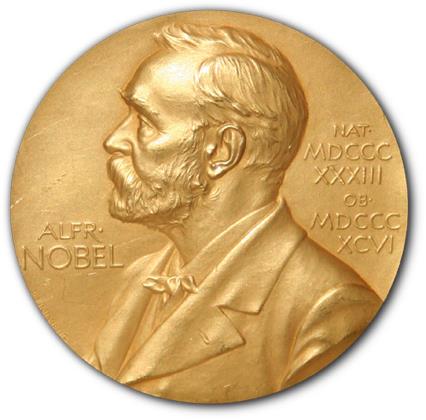
Nobel Prize Laureates Entrust MDPI with Their Research
The Nobel Prize stands as a hallmark of distinction, honouring ground-breaking research across disciplines. Annually, the Nobel Prizes are awarded in six categories: Physics, Chemistry, Medicine or Physiology, Literature, Peace, and Economic Sciences.
Through the years, renowned scholars have entrusted MDPI with their work. As at December 2023, 26 Nobel laureates have contributed to more than 75 articles across 25 MDPI journals, including: Antibiotics, Applied Sciences, Biology, Biomedicines, Cancers, Catalysts, Cells, Crystals, Entropy, Games, IJMS, Life, Materials, Micromachines, Molecules, Pharmaceuticals, Pharmaceutics, Photonics, Quantum Beam Science, Remote Sensing, Sensors, Solids, Universe, Vaccines, and Viruses.
The best of the best trust us with their work.
Nobel Prize Laureates Who Have Published with MDPI
We are proud to list the names of Pierre Agostini, Hiroshi Amano, Werner Arber, Aaron Ciechanover, Robert H. Grubbs, Oliver Hart, Gerard ‘t Hooft, Michael Houghton, Harald zur Hausen, Katalin Karikó, Jean-Marie Lehn, Gérard Mourou, Ferid Murad, Shuji Nakamura, William Nordhaus, Kostya S. Novoselov, Giorgio Parisi, Charles M. Rice, Alvin E. Roth, Donna Strickland, K. Barry Sharpless, George F. Smoot, Anne L’Huillier, Drew Weissman, Kurt Wüthrich, Ada Yonath.
The privilege of hosting such contributors resonates deeply with our editorial teams. For instance, in this interview, the Editor-in-Chief (EiC) of Universe speaks on the significance of publishing a paper by Nobel laureate Gerard ’t Hooft within the journal.
2023 Nobel Prize Winners Published by MDPI
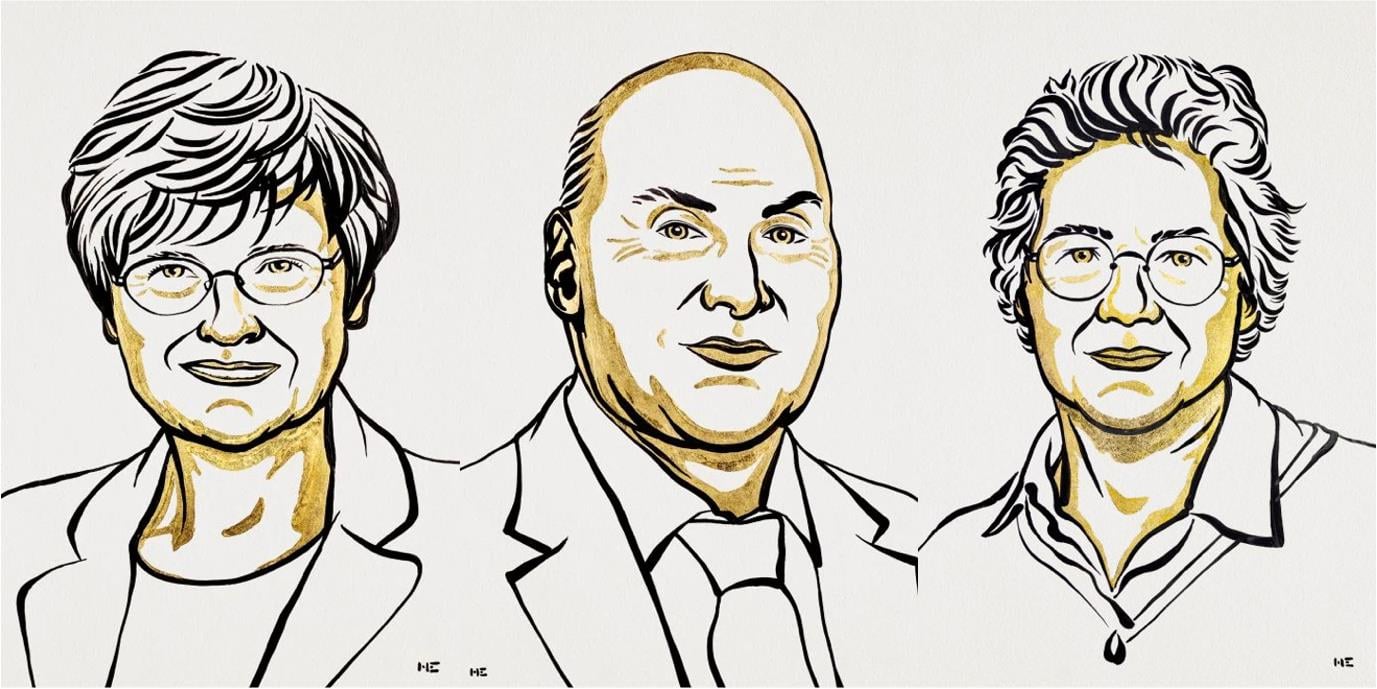
Nobel Prize Winners, 2023: Katalin Karikó, Drew Weissman, Anne L’Huillier (Ill. Niklas Elmehed © Nobel Prize Outreach)
Three laureates from the 2023 Nobel Prize cohort have trusted MDPI as their publishing platform. Notably, in a 2022 Pharmaceutics paper, molecular biologist Katalin Karikó and her team presented a methodology for evaluating mRNA capping efficiency, pivotal for therapeutic applications. Pharmaceutics had previously dedicated a Special Issue to “mRNA Therapeutics: A Themed Issue in Honor of Professor Katalin Karikó”, spotlighting ten articles from August 2021 to February 2022.
In the journal Vaccines, Professor Drew Weissman, collaborating with scholars from Pennsylvania University and George Mason University, contributed an influential review titled “Nanomaterial Delivery Systems for mRNA Vaccines”. His collaborative efforts spanned five papers across MDPI journals between 2021 and 2023.
Furthermore, Anne L'Huillier of Lund University, only the fifth female recipient of the Physics Prize, co-authored an article in Applied Sciences focusing on "Advanced EUV and X-Ray Optics". Similarly, Pierre Agostini, an Emeritus Professor from Ohio State University, co-authored an article featured in the special issue "Attosecond Science and Technology: Principles and Applications".
We extend heartfelt congratulations to all Nobel Prize laureates and express sincere gratitude for their confidence in MDPI as a platform for their scholarly contributions.
Read more:
Impactful Research

MDPI Journals Newly Indexed in 2023
The aim of indexing is to enhance the quality and credibility of published research, ensuring that researchers access the most credible resources available. While the principle behind citation indexing is straightforward, it remains one of the most dependable methods for tracking an idea's evolution across various scientific disciplines.
Throughout the year, MDPI works to expand the reach of our publications across premier multidisciplinary databases like Web of Science, Scopus, EBSCO, and ProQuest. This initiative is spearheaded by MDPI's Indexing team, under the leadership of Dr. Constanze Schelhorn.
In 2023, MDPI achieved 54 new acceptances in Scopus, 29 in Web of Science, 52 in EBSCO, and 83 in DOAJ: Directory of Open Access Journals.
The team prioritizes ensuring that our journals feature in numerous specialized databases, including PMC, PubMed, MEDLINE, Inspec, CAS, and FSTA, among others. Currently, MDPI collaborates with over 65 renowned international databases, consistently enhancing our database affiliations annually.
MDPI’s journals are indexed in all major global databases.
Furthermore, we collaborate with universities and government organizations to list our journals in country-specific ranking lists and relevant institutional repositories. This ensures compliance with requirements often set by funders or institutions for authors to publish in specific journals.
Web of Science Adds 24 MDPI Journals to Emerging Sources Citation Index (ESCI)
Clarivate recently analysed MDPI’s new journals, resulting in 24 journals, mainly established in 2020, being added to the ESCI in November and December 2023. Additionally, five journals passed this assessment earlier in the year. For a complete list of our journals in Web of Science, refer here. Journals in the ESCI meet 24 quality criteria, ensuring editorial rigor. They may be considered for inclusion in broader indices like the Science Citation Index Expanded (SCIE), the Social Sciences Citation Index (SSCI), or the Arts and Humanities Citation Index (AHCI), based on four impact criteria.
Read more:
Inside MDPI

MDPI Appoints New Chief Operating Officer (COO)

Alistair Freeland returned to MDPI and assumed the role of Chief Operating Officer in November 2023, a position he previously held from 2013 to 2019. He succeeds Dr. Yu Lin, who will remain a member of MDPI’s Board of Directors, overseeing significant financial decisions for the company. I would like to express my sincere thanks to Dr. Yu Lin for his service as COO.
Alistair brings extensive experience not only in scholarly publishing but also in technology and business management. Prior to rejoining MDPI, he was associated with SIX Group, the entity responsible for Switzerland's financial market infrastructure. There, he played a pivotal role in developing the blockchain-based platform SDX (SIX Digital Exchange), which has gained traction among major Swiss banks and the Swiss National Bank.
As COO, Alistair will collaborate with the MDPI management team to improve the practices and services we offer to scholarly communities. I am pleased to welcome Alistair back to MDPI and look forward to his contributions going forward.
Coming Together for Science

MDPI’s 2024 In-Person Academic Events Schedule
MDPI's Conference Team is dedicated to organizing and hosting in-person academic events across Europe, Asia-Pacific, and North America. We recognize conferences as invaluable platforms for scientific collaboration, scholarly exchange, discussions on contemporary topics, networking, and forging collaborations.
Here's a glimpse of the notable events we currently have scheduled for 2024:
|
|
14–16 February, 2024 |
|
|
24–26 April, 2024 |
|
|
28–31 May, 2024 |
|
|
1–4 August, 2024 |
Upcoming events with details to be announced:
- September 2024, Materials 2024 – Basel, Switzerland
- 19–21 September 2024, International Conference on Nanomaterials Sciences 2024 – Beijing, China
- October 2024, ncRNA 2024 – Basel, Switzerland
- November 2024, Pharmaceuticals 2024 – Barcelona, Spain
- 22–26 November 2024, International Conference on Science of Electronics – Wuhan, China
- Stay tuned for more details on the Sustainable Publishing Forum 2024.
Click here for all upcoming MDPI events.
Organize Your Event with MDPI’s Sciforum
Sciforum is MDPI’s platform dedicated to the organization of scientific events. In line with our mission to promote science, Sciforum supports scholars, societies, research networks, and universities at all stages of organizing in-person events, virtual events and webinars. Our platforms are efficient, user-friendly, and cost-effective. We handle all steps related to event management. Contact us for details.
Closing Thoughts

Reflecting on 2023 and Looking Ahead to 2024
As we approach 2024, I reflect on the incredible journey we’ve had together at MDPI this year. The past 12 months have been marked by ambitious projects and initiatives to improve our internal processes, and a commitment to continue delivering top-notch services to our stakeholders. I’d like to thank each and every one of our staff members for contributing to the positive experiences our stakeholders have reported in our surveys. Your dedication to speed, efficiency, and effective communication with our stakeholders is very much recognized and appreciated.
Becoming a stronger organisation
While we have encountered challenges in 2023, it’s important to understand that these are a part of our growth process. Difficulties provide us with opportunities to reflect, address problems at their roots, and ultimately evolve into a stronger organization. Our stakeholders expect us to overcome tough times, and it’s an expectation that we have for ourselves.
I extend my sincere appreciation to every MDPI employee, from our editorial office and IT department to marketing, indexing, IOAP, societies, Scientific Office board, products, production, conferences, finance, operations, admin, and beyond. To our newest team members, a warm welcome; to our longstanding colleagues, your dedication is invaluable.
“I am committed to taking MDPI to a new level of excellence.”
Interacting with many of you during my visits to our offices and representing MDPI at external events has been a personal highlight. I am deeply grateful to Dr. Lin for entrusting me with the role of CEO of MDPI. Looking forward, I am committed to working closely with our management team to lead MDPI and take it to a new level of excellence, aiming to establish it as the most trusted publisher in open access worldwide. This is a collective endeavour, with each of us shaping MDPI’s reputation. I therefore encourage us to take pride in our work, as it represents not only our craft but also MDPI as a whole.
Accountability and communication
As we look forward to 2024, there’s a lot to be excited about. Together, we’ll navigate challenges, seize growth opportunities, and refine our practices. To solidify MDPI’s position as the premier open access publisher globally, we must bolster accountability, improve stakeholder communication, share MDPI’s best practices, champion the open access philosophy, and educate stakeholders about our mission, methodologies, and motivations.
Thank you for engaging with the CEO Letter over the past six months of 2023. I will continue to release this newsletter as a method of sharing the great work being done at MDPI. Please feel free to connect directly with any insights or questions.
Here’s to a joyous and prosperous 2024!
Chief Executive Officer
MDPI AG
21 December 2023
Machines 2023 Best Ph.D. Thesis Award—Winner Announced
We are delighted to announce the winner of the Machines 2023 Best Ph.D. Thesis Award—Dr. Branko Ban from the University of Zagreb, Croatia, for his thesis entitled “Synchronous Reluctance Machine Optimization based on Reduced Set of Geometric Parameters with Improved Convergence and Robust Geometric Feasibility Verification”.
We have received a large number of excellent essays from Ph.D. students and postdocs. We would like to thank the award committee for their excellent work in the hard task of selecting winners from such excellent candidates, as well as everyone who participated in this award and helped make it a huge success!
The winner will receive CHF 500, a certificate, and a chance to publish a paper free of charge after peer review in Machines (ISSN: 2075-1702) before the end of 2024.
7 December 2023
Machines | Notable Review Papers in 2021–2022
1. “A Survey on Fault Diagnosis and Fault-Tolerant Control Methods for Unmanned Aerial Vehicles”
by George K. Fourlas and George C. Karras
Machines 2021, 9(9), 197; https://doi.org/10.3390/machines9090197
Available online: https://www.mdpi.com/2075-1702/9/9/197
2. “Actuators and Sensors for Application in Agricultural Robots: A Review”
by Dongbo Xie, Liang Chen, Lichao Liu, Liqing Chen and Hai Wang
Machines 2022, 10(10), 913; https://doi.org/10.3390/machines10100913
Available online: https://www.mdpi.com/2075-1702/10/10/913
3. “Motion Planning for Mobile Manipulators—A Systematic Review”
by Thushara Sandakalum and Marcelo H. Ang, Jr.
Machines 2022, 10(2), 97; https://doi.org/10.3390/machines10020097
Available online: https://www.mdpi.com/2075-1702/10/2/97
4. “A Review of Path-Planning Approaches for Multiple Mobile Robots”
by Shiwei Lin, Ang Liu, Jianguo Wang and Xiaoying Kong
Machines 2022, 10(9), 773; https://doi.org/10.3390/machines10090773
Available online: https://www.mdpi.com/2075-1702/10/9/773
5. “A Comprehensive Survey on Fault Tolerance in Multiphase AC Drives, Part 1: General Overview Considering Multiple Fault Types”
by Alejandro G. Yepes, Oscar Lopez, Ignacio Gonzalez-Prieto, Mario J. Duran and Jesus Doval-Gandoy
Machines 2022, 10(3), 208; https://doi.org/10.3390/machines10030208
Available online: https://www.mdpi.com/2075-1702/10/3/208
6. “Electrical Machines Winding Technology: Latest Advancements for Transportation Electrification”
by Ahmed Selema, Mohamed N. Ibrahim and Peter Sergeant
Machines 2022, 10(7), 563; https://doi.org/10.3390/machines10070563
Available online: https://www.mdpi.com/2075-1702/10/7/563
7. “A Comprehensive Survey on Fault Tolerance in Multiphase AC Drives, Part 2: Phase and Switch Open-Circuit Faults”
by Alejandro G. Yepes, Ignacio Gonzalez-Prieto, Oscar Lopez, Mario J. Duran and Jesus Doval-Gandoy
Machines 2022, 10(3), 221; https://doi.org/10.3390/machines10030221
Available online: https://www.mdpi.com/2075-1702/10/3/221
8. “Tracked Locomotion Systems for Ground Mobile Robots: A Review”
by Luca Bruzzone, Shahab Edin Nodehi and Pietro Fanghella
Machines 2022, 10(8), 648; https://doi.org/10.3390/machines10080648
Available online: https://www.mdpi.com/2075-1702/10/8/648
9. “Review of Rotor Balancing Methods”
by Liqing Li, Shuqian Cao, Jing Li, Rimin Nie and Lanlan Hou
Machines 2021, 9(5), 89; https://doi.org/10.3390/machines9050089
Available online: https://www.mdpi.com/2075-1702/9/5/89
10. “A Review on Sliding Vane and Rolling Piston Compressors”
by Kuan Thai Aw and Kim Tiow Ooi
Machines 2021, 9(6), 125; https://doi.org/10.3390/machines9060125
https://www.mdpi.com/2075-1702/9/6/125
30 November 2023
MDPI Insights: The CEO’s Letter #6 - MDPI Spain Summit and ResearchGate
Welcome to the MDPI Insights: The CEO's Letter.
In these monthly letters, I will showcase two key aspects of our work at MDPI: our commitment to empowering researchers and our determination to facilitating open scientific exchange.
Opening Thoughts

MDPI Spain Summit
Stefan Tochev (CEO, MDPI) gives the opening speech at the MDPI Spain Summit.
On Friday 10 November 2023 I was in Barcelona, Spain, to deliver the opening presentation and participate in a panel at MDPI’s Spain Summit, a two-day event, inspired by our salon events in China.
With 16 Editors-in-Chief (EiCs) and 20 Editorial Board Members (EBMs) in attendance, the event, organized by our conference team and Barcelona office, featured presentations on open access (OA), MDPI, and publishing market trends in Spain.
The event provided a great opportunity to engage with stakeholders from various MDPI journals, including Nutrients, Vaccines, Buildings, IJMS, and others. We were able to gather feedback and have open conversations around manuscript quality, the peer-review process, and journal development, as well as accreditation agencies.
The main objective of this Summit was to bring together Editors representing MDPI journals across various disciplines within Spanish universities and research centers, primarily from the Barcelona area. The aim was to facilitate an open and fruitful discussion regarding the development of their journals, the future of OA in Spain, and to provide meaningful interactions and networking opportunities.
Connecting with Editorial Board Members
Stefan Tochev in conversation with Summit participants: "Our EBMs are passionate about the journals they serve."
Interacting with our EBMs in person provides a valuable opportunity to show how important it is to us to connect with them, hear their perspectives on their journals and learn more about their own experience collaborating with MDPI.
From my conversations, it was clear that our EBMs are passionate about the journals they serve. I know the advice they provide may sometimes involve just small tweaks, but these can lead to important improvements. As the saying goes, small hinges swing open big doors.
As at November 2023, MDPI has over 6,300 EBMs affiliated with Spanish institutions, with more than 30 of them serving as EiCs or section EiCs. Furthermore, over 68,000 Spanish scholars have contributed as reviewers in MDPI journals.
Open Access in Spain
In 2023, Spain implemented legislation mandating immediate OA for all publicly funded research, aligning with the EU’s Plan S initiative to expedite the transition to OA. The Spanish government also approved a four-year, €23.8 million annual budget for the first national OA strategy, aiming to make publicly funded research freely accessible upon publication. This strategy aims to strengthen the quality and transparency of research in Spain, and to help promote movement towards a digital, low-carbon economy.
For further details of Spain's OA policy and the history of government mandates, click here.
Spain has already seen a notable decline in subscription-only articles, decreasing by 62% over a 10-year period, while gold OA increased by 42%. Green OA slightly decreased, suggesting a shift towards publishing in gold OA journals rather than traditional subscription-based ones. Here are some statistics from Scopus.
A big thank-you to the various MDPI teams, including our conference team and the Barcelona office, for organizing this very successful event!
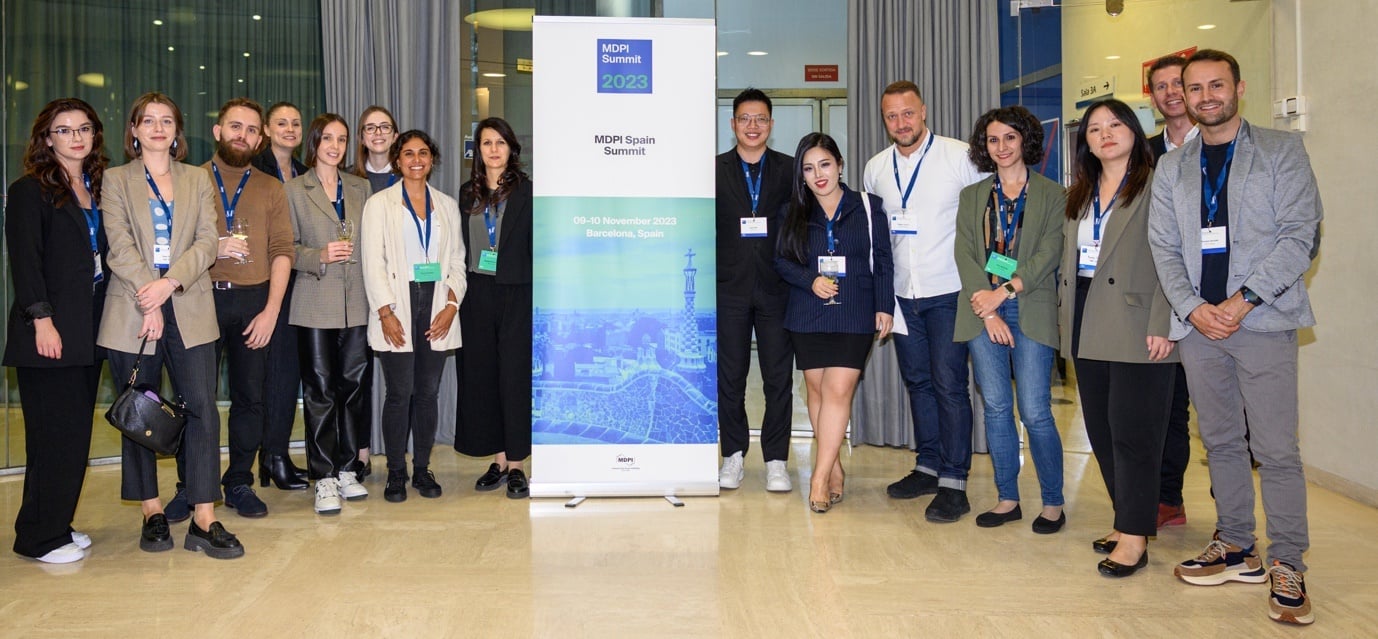
MDPI colleagues from various offices gathered to host and support the first MDPI Spain Summit, in Barcelona, Spain.
I think this type of gathering has the potential to become an annual event in various locations. For example, Manchester could be an option, as we have over 30 EiCs and over 3,000 EBMs in the UK, a top market for MDPI that publishes high-quality research.
Impactful Research

769 Editorial Board Members of MDPI Journals Recognized as Highly Cited Researchers in 2023
Congratulations to our 769 Editorial Board Members from 40 countries/territories who have been awarded Highly Cited Researcher status for 2023 by Clarivate. This recognition is based on their outstanding scientific research contributions and significant influence in various fields, as evidenced by Web of Science data.
Click here to view the full list of 769 Editorial Board Members.
Clarivate's Highly Cited ResearchersTM list identifies individuals with exceptional impact in scientific and social science domains over the past decade. Their papers rank in the top 1% of citations in 21 fields analysed in ‘Essential Science Indicators,’ showcasing their substantial influence.
This year, 7,125 Highly Cited Researcher 2023 designations were issued to 6,849 individuals from 67 countries, representing just 1 in 1,000 researchers worldwide.
These researchers demonstrate exceptional influence, representing a small fraction of contributors pushing the boundaries of knowledge, contributing to global well-being, sustainability, and security.
Congratulations to these scholars for their remarkable achievement: we are honoured to have them on board with our journals!
Inside MDPI

Corporate Marketing and Communications Strategy Session

Members of MDPI’s Corporate Marketing & Communications team.
For the past few years, I have led the Corporate Marketing & Communications department in our annual strategy session.
This typically involves 2–3 days of focused sessions covering key topics including budgeting, hiring targets, campaign reviews, and planning for the upcoming year, department strategy, and structure.
We are constantly exploring ways to optimize the Corporate Marketing & Communications department to support MDPI’s primary objectives and better convey the MDPI story while serving the scholarly community.
The strategy session also serves as a team-building activity, during which the team voted on bowling!
Strategy Session
In this strategy session, we looked at how to align our teams in order to better streamline our content with our campaigns, build a dedicated marketing team to strategically support our core MDPI products, expand our communications teams and functionalities to focus on company-critical campaigns and press releases, align our new brand design system with our marketing initiatives, set up a community and engagement team to support various teams with their outreach and communication efforts, and increase our use of data in the evaluation of campaign performance.
To grow in these areas, we will be hiring for various positions, including those of Public Relations Manager, Communications Manager, Internal Communications Manager, Campaign Manager, Marketing Associate, and Editorial Engagement Manager.
I am grateful for the way our Corporate Marketing & Communications department has grown and gelled over the years, and I look forward to supporting the department teams and their ideas for the future.
Coming Together for Science

ResearchGate and MDPI Partner to Boost the Visibility of Open Access Content through Journal Home
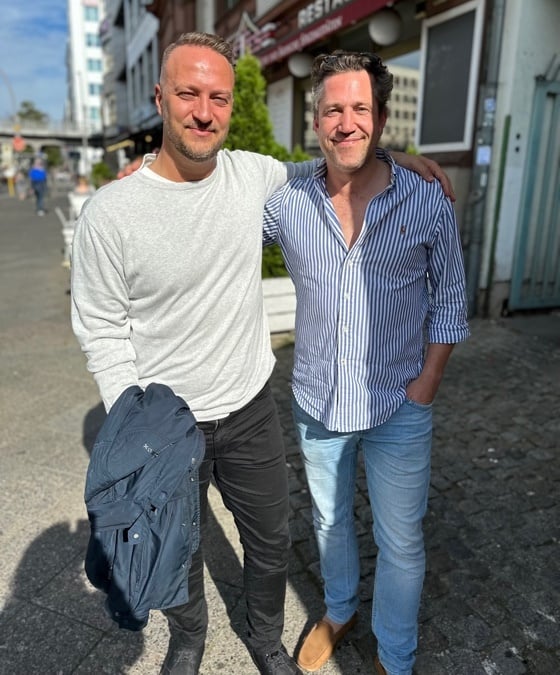
Stefan Tochev (CEO, MDPI) and Sören Hofmayer (Co-Founder and Chief Strategy Officer, ResearchGate) meet in Berlin, Germany to take their ongoing discussion further.
When I assumed the role of CEO at MDPI, my primary focus was to initiate the building of essential partnerships and collaborations within our industry. After all, I am a firm believer in achieving our goals by helping others achieve theirs and focusing on co-opetition wherever there is an opportunity. I first touched on the notion of co-opetition in MDPI Insights: The CEO's Letter #3, particularly when discussing collaborations with Elsevier.
In light of this, Sören Hofmayer (Co-Founder and Chief Strategy Officer at ResearchGate) and I connected recently to continue a discussion that had been ongoing for months. I was quickly brought up to speed and felt there was an opportunity for MDPI journals to pilot the Journal Home service that ResearchGate had launched. This would provide a new way for MDPI to engage with authors and readers and amplify the visibility of our journals.
While I receive many offers and opportunities for discussions with vendors, I am a firm believer that timing is everything, and in this case, the time for us is now. Sören and I met in person during my recent visit to Berlin and decided to proceed with piloting ten MDPI journals with the Journal Home service.
The press release below provides further details.
Press Release: Berlin (Germany) and Basel (Switzerland), 15 November 2023
ResearchGate, the professional network for researchers, and MDPI, the largest open access publisher in the world and a pioneer in open access publishing, today announced a partnership that will see ten of MDPI’s open access journals benefit from an enhanced presence on ResearchGate through its innovative Journal Home offering.
This new partnership will expand the reach and visibility of MDPI’s participating flagship journals with ResearchGate’s highly relevant community of more than 25 million researchers globally.
Around 210,000 version-of-record articles from these 10 titles will be readily available on ResearchGate, including the full archive material and all new articles as they are published. These journals also benefit from enhanced brand visibility, with dedicated journal profiles, prominent representation on all associated article pages and all relevant touchpoints across the ResearchGate network – keeping the journals top-of-mind with their reader and author audiences. All articles covered by the new partnership will automatically be added to the authors’ publication records in ResearchGate. This not only reduces MDPI authors’ needs for direct management but also offers them valuable insights into the impact of their work, including data about readership and citations.
Closing Thoughts

November is Men’s Health Awareness Month

Stefan Tochev (CEO, MDPI) listening to music as he writes at a coffee shop in Basel, Switzerland.
November is dedicated to raising awareness of various men’s health issues. I have been fortunate to have positive male role models in my life, and I strive to share my experiences with others.
I used to take part in Movember, growing my moustache throughout November to raise awareness and funds and to help “change the face of men’s health.” With male family and friends impacted by physical and mental health issues, I have recently become more interested in men’s overall well-being.
Men often face stigma involving the perceived need always to be strong and have things figured out. Recently, I’ve had meaningful conversations with male friends and colleagues about issues we rarely discuss, and it was a positive experience.
Various factors impact men’s health and well-being, all too easily leading to risky health behaviours including a lack of health awareness, poor health education, and negative, culturally induced, behaviour patterns in our work and personal lives. I hope we can break down these barriers in our work environment.
Healthy men help build healthy families and a healthy society
Men are less likely than women to seek help with their physical and mental health struggles. This is a reminder to prioritize your overall well-being. I hope that as men, we will continue to open up to one another, becoming vulnerable in order to share what we are going through. By sharing and by supporting each other, we can learn and grow together. You are not alone, and when you fall, you can still get up and stand tall.
From one broski to another, you are loved and appreciated. I hope this mindset carries into December and beyond.
Mindfulness
Our content team recently released a handful of articles on mindfulness, a practice that I believe provides a good opportunity for stress release and self-reflection:
Chief Executive Officer
MDPI AG
21 November 2023
769 Editorial Board Members of MDPI Journals Achieve Highly Cited Researcher Recognition in 2023

We extend our sincere congratulations to the 769 Editorial Board Members of our journals – from 40 different countries/territories – who have been recognized as Highly Cited Researchers for the year 2023 by Clarivate. They are being recognized for their high-quality scientific research achievements and outstanding contributions to their professional fields, as indicated by Web of Science data.
Clarivate's annual list of Highly Cited ResearchersTM identifies the most highly cited scientists for the past decade who stand out for their significant and broad influence in various scientific and social science domains. Their impactful papers are among the top 1 per cent in the citation distribution of one or more of 21 fields analyzed in the "Essential Science Indicators", distinguishing them as hugely influential among their peers.
This year, 7,125 Highly Cited Researcher 2023 designations were issued to 6,849 individuals from 67 countries, representing just 1 in 1,000 researchers worldwide.
This means that these researchers have demonstrated an incredible level of significant and broad influence in their chosen field or fields over the last decade. They represent a small fraction of the researcher population whose contributions disproportionately push the boundaries of knowledge, enhancing global well-being, sustainability, and security.
Congratulations to the scholars for their noteworthy achievement – we are honored to have them on board with our journals!
|
Abate, Antonio |
Jaiswal, Amit K. |
Shen, Zexiang |
1 November 2023
MDPI Insights: The CEO’s Letter #5 - OA Week, UK, and Strategy
Welcome to the MDPI Insights: The CEO's Letter.
In these monthly letters, I will showcase two key aspects of our work at MDPI: our commitment to empowering researchers and our determination to facilitating open scientific exchange.
Opening Thoughts

Open Access Week 2023 – the Global Drive to Open Continues
As the world's largest open-access (OA) publisher, we believe that unrestricted access to research findings is the cornerstone of transparency, efficiency, and quality control across scientific disciplines. At MDPI, we provide free, immediate access to scientific papers, empowering scientists to examine, validate, replicate, and build upon existing results. This minimizes redundancy, optimizes resources, and fosters innovative approaches.
International OA Week, held from 23 to 29 October 2023, provided a unique opportunity to link the global movement toward open sharing and open science with the progress of policy changes at the local level. Our mission, during OA Week and all the year round, is to offer educational resources highlighting the benefits of open-access publishing. The MDPI Blog is a valuable resource for information on open access and open science.
Core principles of OA publishing
Accessibility, transparency, and collaboration are core principles of OA publishing. OA aims to break down barriers that have traditionally restricted research access, ensuring that knowledge is available to all, regardless of financial situation or institutional affiliations. Our commitment to diverse pathways for OA publishing worldwide includes discounts for researchers. You can learn more about how MDPI supports scientific communities here.
One of the key strengths of OA publishing is its ability to facilitate interdisciplinary research. By removing paywalls and promoting knowledge-sharing across disciplines, OA encourages collaboration and innovation. Researchers from various fields can access and build upon each others’ work, fostering a holistic approach to addressing complex global challenges.
OA holds the potential to democratize knowledge, advance science, and drive positive societal change.
Policy driving change
Governments, institutions, and funding agencies have recognized the transformative potential of OA and have implemented policies to promote it. These policies often require publicly funded research to be made openly accessible, accelerating the growth of OA repositories and journals. Check out our spotlights on OA policies in the US, EU and China.
OA publishing is continuously evolving, with community-driven models and technologies shaping its future. Initiatives such as “Plan S” and “cOAlition S” promote OA publishing from the perspective of national funders, requiring grantees to publish their research openly. A new policy announced by the US administration last year mandates that, with effect from January 2026, all US federally funded research should be freely and immediately available after publication.
Additionally, preprint servers such as MDPI's Preprints.org, which allow researchers to share their findings before formal peer review, have gained popularity, enhancing the speed at which new knowledge is disseminated. The rise of blockchain technology is also being explored to ensure transparency and authenticity in scholarly publishing.
For more than two decades, OA publishing has been revolutionizing academic publishing by promoting accessibility, transparency, and collaboration. Its support for interdisciplinary research, evolving policies, and innovative practices all contribute to its growing influence in the global research community. As OA continues to expand, it holds the potential to democratize knowledge, advance science, and drive positive societal change.
MDPI is proud to lead the transition to open access.
Read more:
Impactful Research

Spotlight on Smart Cities
Smart cities will serve as a cornerstone for future human development. Their implementation will help us tackle many of the significant challenges we are facing – climate change, ageing populations, waste management, public safety, travel, and so on. Recognising the importance of this multifaceted field, MDPI launched the inaugural issue of Smart Cities in 2018 to provide an advanced forum for research into smart technology and society. Here we take a look at how this journal has developed, and its impact in this exciting field.
As at 30 October, 2023, Smart Cities has published 421 papers and has an Impact Factor of 6.4. It also has a CiteScore of 8.5, and more than one quarter of its published papers – 124 – have been cited 10 times or more.
Highly cited papers in Smart Cities
Below are several highly cited papers recently published in Smart Cities. Citation metrics are current as at 31 October 2023.
1. “Introducing the “15-Minute City”: Sustainability, Resilience and Place Identity in Future Post-Pandemic Cities”
Authors: Carlos Moreno, Zaheer Allam, Didier Chabaud, Catherine Gall and Florent Pratlong
Smart Cities 2021, 4(1), 93-111; https://doi.org/10.3390/smartcities4010006
Citations: Crossref (338), Scopus (366), Web of Science (270), Google Scholar (710)
The paper discusses the socio-economic impacts of the COVID-19 on cities, including increasing inequalities and rising unemployment. It introduces the concept of the "15-Minute City," a form of "chrono-urbanism," as a response to the challenges posed by the pandemic.
2. “A Review on Electric Vehicles: Technologies and Challenges”
Authors: Julio A. Sanguesa, Vicente Torres-Sanz, Piedad Garrido, Francisco J. Martinez and Johann M. Marquez-Barja
Smart Cities 2021, 4(1), 372-404; https://doi.org/10.3390/smartcities4010022
Citations: Crossref (359), Scopus (363), Web of Science (268), Google Scholar (558)
This paper provides an overview of the progress in Electric Vehicles (EVs), focusing on battery technology, charging methods, and emerging research challenges. It also analyzes the global EV market and its future outlook.
3. “IoT in Smart Cities: A Survey of Technologies, Practices and Challenges”
Authors: Abbas Shah Syed, Daniel Sierra-Sosa, Anup Kumar and Adel Elmaghraby
Smart Cities 2021, 4(2), 429-475; https://doi.org/10.3390/smartcities4020024
Citations: Crossref (121), Scopus (151), Web of Science (91), Google Scholar (215)
This paper gives an overview of the Internet of Things (IoT) in the context of Smart Cities, discussing the fundamental components, technologies, architectures, networking technologies, and artificial algorithms that underpin IoT-based Smart City systems.
4. “Artificial Intelligence Techniques in Smart Grid: A Survey”
Authors: Olufemi A. Omitaomu and Haoran Niu
Smart Cities 2021, 4(2), 548-568; https://doi.org/10.3390/smartcities4020029
Citations: Crossref (76), Scopus (94), Web of Science (57), Google Scholar (120)
This survey paper reviews the utilization of artificial intelligence (AI) techniques in the context of the smart grid. It covers various applications of AI in load forecasting, power grid stability assessment, fault detection, and security issues in the smart grid and power systems.
5. “The Metaverse as a Virtual Form of Smart Cities: Opportunities and Challenges for Environmental, Economic, and Social Sustainability in Urban Futures”
Authors: Zaheer Allam, Ayyoob Sharifi, Simon Elias Bibri, David Sydney Jones and John Krogstie
Smart Cities 2022, 5(3), 771-801; https://doi.org/10.3390/smartcities5030040
Citations: Crossref (72), Scopus (75), Web of Science (43), Google Scholar (176)
This paper discusses the concept of the Metaverse, a virtual world introduced by Meta (formerly Facebook), and its potential impact on urban life. It explores how emerging technologies such as AI, Big Data, IoT, and Digital Twins could reshape urban design and services in the context of the Metaverse.
Testimonial
“It was indeed a great and pleasant experience with MDPI regarding our recent publication. The submission process was very straightforward and less time-consuming than the norm. The review process was very fast compared to many other open access journals, which is praiseworthy. The support from the Editorial Office during the revision process was highly useful as well. We look forward to publishing with MDPI in the future, and I will most definitely recommend MDPI to my colleagues and collaborators.” – Dr. Luís Rosa, University of Minho
Article in Smart Cities: Mobile Networks and Internet of Things Infrastructures to Characterize Smart Human Mobility
Inside MDPI

MDPI Manchester office, UK Visit

Allie Shi (Editorial Director, MDPI), Stefan Tochev (CEO, MDPI), Jamie Anderson (Manchester Office Manager, MDPI), Michael O’Sullivan (Senior Scientific Officer, MDPI), Hushneara Akhtar, and Becky Castellon (IOAP Team Lead, MDPI), dining out in Manchester, UK.
In October, I visited MDPI’s new office in Manchester. During the visit, I connected with our English Editing (EE) managers, Scientific Officer, members of the Editorial team, the Marketing team, and IOAP Team Lead.
Our Manchester office focuses primarily on EE services and provides local support for the UK market. Additionally, we regularly visit Editorial Board members and participate in local conferences.
I would like to thank Jamie Anderson, Manchester Office Manager, and her team, for their deep commitment to our Manchester staff and to MDPI’s impact on the UK market.
The UK by numbers
The UK is a hub for the world’s top universities, making it a key market for MDPI and the publishing world in general. It is home to two of the top-five-ranked universities globally, 11 in the top 100, and 15 in the top 200.
As a result, the UK plays a key role in MDPI’s global market. As at October 2023, it ranks as the seventh-largest contributor to the total number of papers published by MDPI. We have 3,500 Editorial Board members affiliated with UK institutions, including 34 serving as Editors-in-Chief (EiCs). Our commitment to collaboration with institutions is evident in the UK, where we have successfully established some 60 Institutional Open Access Program (IOAP) agreements with esteemed institutions, such as the University of Oxford, the University of Cambridge, Imperial College London, the University of Edinburgh, and more.
According to InCites Dataset + ESCI for the period 2018–2022, as at October 2023, nearly 65% of UK papers are now published as OA. Just over 10% of total OA publications are by UK authors. UK papers are known for their high quality, with an average of 11 citations per paper. Furthermore, 2.16% of UK papers are in the top 1% of cited papers, and 14.61% are in the top 10% of cited papers, showcasing their impact.
We are currently hiring EEs in various locations worldwide.
English Editing at MDPI
Our English Editing (EE) department consists of two main branches, Quality Control and Learning and Development, reflecting our priorities. We are continuously enhancing the quality of our English Editing services and have raised the relevant standards, which now extend to company-wide communications. English editors participate in international interviews, conduct English assessments, and provide colleagues with presentations on ways to improve their use of written and spoken English.
While expanding, the EE department has proactively refocused its efforts on the quality of our work and how the English Editing department can benefit the company more broadly. We currently have approximately 140 full-time English Editors based across five offices worldwide, supplemented by over 700 freelance English editors.
Our Manchester office serves as the hub for the EE Department, with EE Managers situated there, except for Kurtis Jackson, who serves as the Head of EE and is located in our Basel office. Manchester EEs play a critical role in establishing and developing EE teams in our other offices, overseeing management and recruitment. The EE department plays a vital role in MDPI’s operations, as it is the department that touches every published paper. If this work interests you, I encourage you to explore our available EE positions, whether you are seeking full-time or freelance opportunities.
Testimonials
“MDPI provides an excellent service compared to any other previously used services. It delivers fast and high-quality results but at an affordable price.” – Ardha Apriyanto, University of Potsdam
“In my role as a professor, I consider that MDPI Author Services offer an excellent quality in the editing of Western academic writing while maintaining the required standards of clarity, precision and rigor. Additionally, delivery times are fast compared to other available services.” – Jesus Insuasti, University of Nariño
Read more:
Coming Together for Science

STM and Frankfurt Book Fair
Attending STM
MDPI has been a proud sponsor of the STM Conference for several years. The STM Conference is a dynamic event featuring interactive sessions, expert panellists, idea-sharing, and ample networking opportunities. On 16 October, the event kicked off with arrival drinks, sponsored by MDPI, followed by a welcoming dinner, providing a great chance to connect and network with industry professionals. The following day was filled with speakers, sessions, and further opportunities to connect. STM exemplifies the collaborative spirit of the scientific community, with session topics including achieving open, visible, and impactful research at scale; maintaining research integrity in a rapidly changing world; and exploring the impact of ever-evolving technology in the scholarly community.
Meeting with Web of Science
On a personal note, one of the highlights of STM was a candid and productive conversation with Nandita Quaderi, Editor-in-Chief and SVP at Web of Science. During our discussion, we talked about MDPI, Web of Science, the IJERPH delisting, and ways of moving forward. This open conversation aimed at fostering better collaboration for the future.
“We discussed ways to improve our communication and collaboration.”
I appreciated our frank discussion and felt that Nandita wholeheartedly supports open access. She also expressed her appreciation for the monthly CEO Letter, which she sees as a way to add personality to the MDPI brand and provide insight into the great work we do at MDPI. While we highlighted the positives, we also discussed ways to improve our communication and collaboration moving forward. This meeting alone made the trip worthwhile, and I hope Nandita doesn’t mind my sharing that she found our chat to be “the most honest and constructive discussion” she’s had with someone from MDPI in recent years.
75th Frankfurt Book Fair
Jelena Milojevic (Book Editor, MDPI), Jovana Dubajic (Book Editor, MDPI), Evan Escamilla (Project Manager, MDPI), Laura Wagner (Head of Books, MDPI), and Jenny Knowles (Commissioning Editor, MDPI), at the Frankfurt Book Fair in Frankfurt am Main, Germany.
For the 75th time, the Frankfurter Buchmesse opened its doors in October to celebrate exciting stories and their authors. If you haven’t yet had the chance to visit the Frankfurt Book Fair, I highly recommend it. It’s the largest book fair in the world, attracting thousands of visitors from around the globe. This is the place to gain valuable industry insights from top-class publishing professionals, connect with publishers directly, and learn about the latest trends in publishing.
MDPI Books
Our Books team was also present at the Frankfurt Book Fair, networking and learning from various panels. Did you know that our MDPI Books department publishes OA Books?
The book publishing program includes monographs, book series, edited books and reprints of special issues and topical collections, among other book types.
If you have a book proposal you would like to discuss, please feel free to contact our Books team to understand the benefits and methods of publishing your next book with the OA model.
Closing Thoughts

MDPI Strategy Meeting
As the newly appointed CEO, this is my first year leading the MDPI Senior Management Strategy session. I saw it as an opportunity to explore what MDPI has the potential to become in the next five years. Guided by the vision of its founder and President, Dr. Shu-kun Lin, the company has accomplished remarkable feats over the past 27 years and currently holds the position as the world’s third-largest academic publisher, following Springer Nature and Elsevier.
Our primary objective is to build upon the milestones of the past decades and consolidate MDPI’s position as well-established publishing brand. The two-day meeting emphasized the importance of communicating MDPI’s values more actively via its brand and adopting a straightforward yet impactful approach to managing MDPI as a mature academic publisher.
“Our primary objective is to consolidate MDPI’s position as well-established publishing brand”
As the world’s number one open-access publisher, MDPI has long been a game-changer in the scholarly community, serving millions of authors. The challenge in being a trailblazer is the need to continuously improve and at the same time explore the next blue-ocean strategy, while also maintaining the smooth operation of the business. Our collection model, featuring guest-curated thematic topics in the form of Special Issues, has disrupted the industry. Other publishers closely study us and attempt to replicate our models. The future of this collection model is something we are actively addressing – while, of course, looking ahead to what comes next!
Chief Executive Officer
MDPI AG
19 October 2023
Open Access Week 2023 – the Global Drive to Open Continues

MDPI has been a strong proponent of the open access publishing model right from the beginning. As one of the pioneering fully open access publishers, we firmly believe that unrestricted access to research findings forms the foundation for better transparency, efficiency, and quality control across all scientific disciplines.
In December 2022, we reached a significant milestone by surpassing one million articles published. That is one million articles freely available to all, to circulate and build upon!
Offering free and immediate access to scientific papers empowers scientists to examine, validate, replicate, and expand upon existing results. This not only helps prevent redundancy and optimizes how resources are used but also paves the way for innovative new approaches.
The International Open Access Week takes place from 23 to 29 October 2023, providing a unique opportunity to connect the global movement towards open sharing and open science with the progress of policy transformations at the local level.
Our goal, during Open Access Week as well as throughout the year, is to offer resources for educating people about the benefits of open access publishing. The MDPI Blog offers a wealth of information around open access and open science.
Promoting the values of accessibility, transparency, and collaboration
Open access publishing embodies the fundamental values of democratizing knowledge and fostering global accessibility. It aims to break down barriers that have traditionally limited access to scholarly work, ensuring that knowledge is available to all, regardless of their financial or institutional affiliations.
Discounts are part of our commitment to ensuring there are diverse pathways to Open Access publishing for researchers worldwide. MDPI supports scientific communities in several different ways.
One of the key strengths of open access publishing lies in its ability to facilitate interdisciplinary research. By removing paywalls and promoting the sharing of knowledge across disciplines, OA encourages collaboration and innovation. Researchers from diverse fields can access and build upon each other's work, fostering a holistic approach to addressing complex global challenges.
Funders' policies are getting aligned with open science
Governments, institutions, and funding agencies have recognized the transformative potential of open access and have implemented policies to promote it. These policies often mandate that publicly funded research should be made openly accessible. Such initiatives have accelerated the growth of open access repositories and journals, reinforcing the commitment to open access principles. Check our spotlights on OA policies in the US, EU and China.
Open access publishing is continually evolving, with innovative and community-driven models and technologies shaping its future. Initiatives like "Plan S" and "cOAlition S" promote the adoption of OA publishing from the national funders’ perspective by requiring grantees to publish their research openly. A new policy announced by the US administration last year requires that, as of January 2026, all US federally funded research be made freely and immediately available after publication.
Additionally, preprint servers such as MDPI's Preprints.org, which allow researchers to share their findings before formal peer review, have gained popularity, enhancing the speed at which new knowledge is disseminated. The rise of blockchain technology is also being explored to ensure transparency and authenticity in scholarly publishing.
For more than twenty years, open access scholarly publishing has been revolutionizing academia by promoting the values of accessibility, transparency, and collaboration. Its support for interdisciplinary research, evolving policies, and innovative practices all contribute to its growing influence in the global research community. As open access continues to expand, it holds the potential to democratize knowledge, advance science, and drive positive societal change.
MDPI is proud to be a leader in the transition to open access.
19 October 2023
Meet Us at the 26th International Conference on Electrical Machines and Systems (ICEMS 2023), 5–8 November 2023, Zhuhai, China
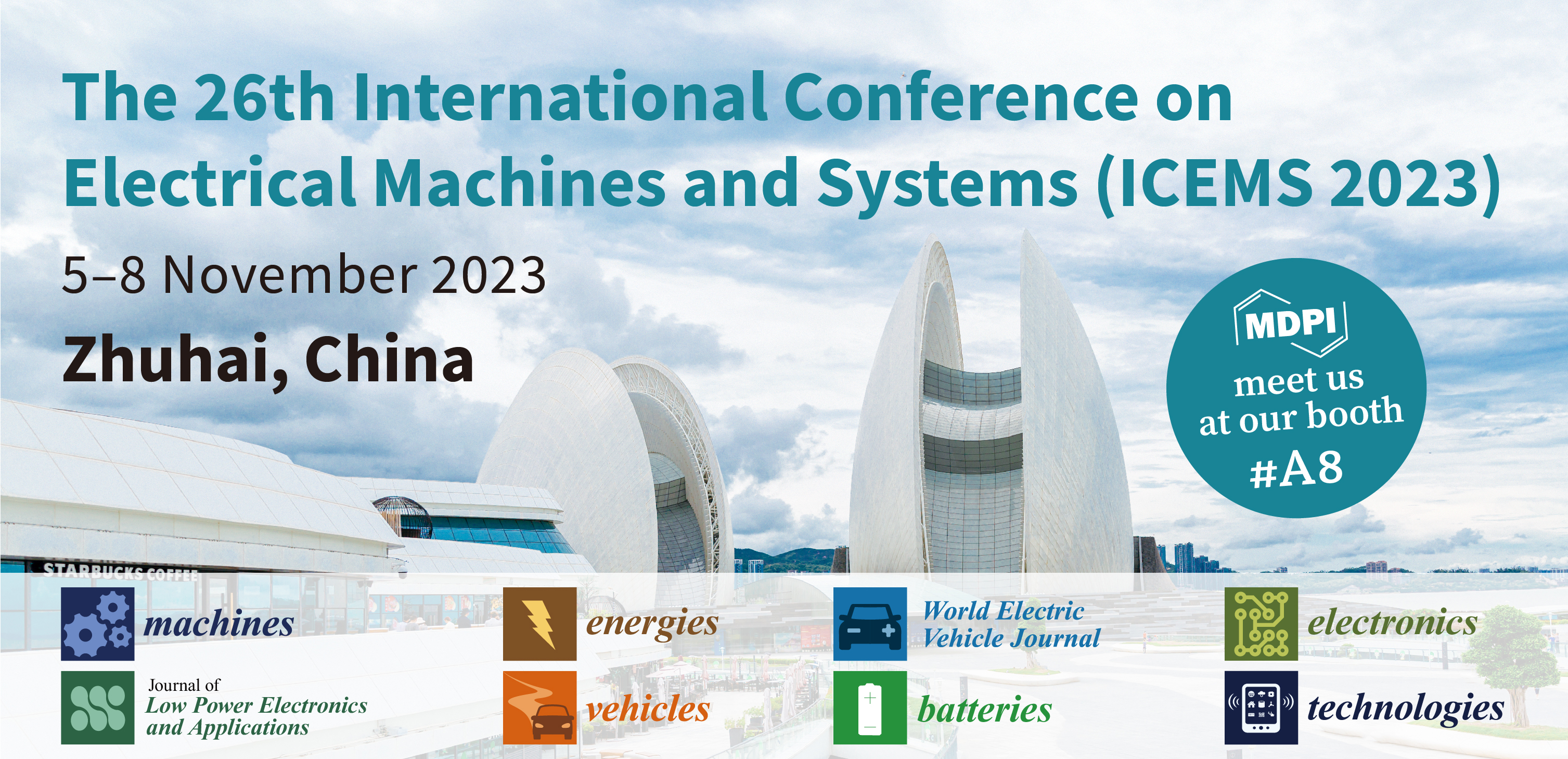
Conference: The 26th International Conference on Electrical Machines and Systems (ICEMS 2023)
Organization: China Electrotechnical Society (CES)
Date: 5–8 November 2023
Place: Zhuhai International Convention & Exhibition Center, 1663 Yinwan Road, Xiangzhou District, Zhuhai, China
Booth: #A8
MDPI journals will be attending ICEMS 2023 as an exhibitor. This meeting will be held in Zhuhai, China, from 5 to 8 November 2023.
ICEMS is an annual international conference on electrical machines and systems held since 1987, and it is jointly organized by the CES (China Electrotechnical Society), KIEE EMECS (KIEE Electrical Machinery and Energy Conversion Systems Society) and IEEJ IAS (IEEJ Industry Applications Society). It provides an extensive and exciting platform to gather the world's leading scientists, researchers and engineers in the field of electrical machines and systems together to showcase state-of-the-art ideas, methods and prototypes. We believe that this conference will benefit us by broadening our horizons, stimulating ideas and enhancing contacts with international colleagues.
The following MDPI journals will be represented:
- Machines;
- Energies;
- World Electric Vehicle Journal;
- Electronics;
- The Journal of Low Power Electronics and Applications;
- Vehicles;
- Batteries;
- Technologies.
If you are attending this conference, please feel free to start a conversation with us. Our delegates look forward to meeting you in person and answering any questions you may have. For more information about the conference, please visit the following website: https://www.icems2023.com/overview.html.
12 October 2023
Meet Us at the 3rd International Forum & Exhibition on Precision Manufacturing (PreciMan 2023), 9–11 November 2023, Kunshan, China

MDPI will be attending the 3rd International Forum & Exhibition on Precision Manufacturing (PreciMan 2023), which will be held from 9 to 11 November 2023 in Kunshan, China.
It is our great pleasure to invite you to participate in the 3rd International Forum & Exhibition on Precision Manufacturing (PreciMan2023), which will be held in the Kunshan Huaqiao International Expo Center from 9 to 11 November 2023. Kunshan is located right at the heart of the Yangzi River Delta Region (which includes the Shanghai Metropolitan Area, Jiangsu, and Zhejiang Provinces), which is the powerhouse for the modern Chinese economy. Kunshan has been ranked number one in the Chinese top 100 counties league over the last eighteen years in economy development, where there are thousands of engineering companies increasingly embracing precision engineering manufacturing and business.
The forum and exhibition will be a unique annual event aiming to bring engineering practitioners, researchers, industrialists, and academics together to discuss and interact with each other in the context of precision engineering manufacture and business.
The following MDPI journals will be represented:
- Machines;
- JMMP;
- System;
- Electronics.
If you plan to attend this conference, please feel free to start a conversation with us. Our delegates look forward to meeting you in person and answering any questions that you may have. For more information about the conference and our booth, please visit the following link: http://www.preciman.com/.
2 October 2023
MDPI Insights: The CEO’s Letter #4 - MDPI Presence in China
Welcome to the MDPI Insights: The CEO's Letter.
In these monthly letters, I will showcase two key aspects of our work at MDPI: our commitment to empowering researchers and our determination to facilitating open scientific exchange.
Opening Thoughts
Open Access in China
It is Saturday, 23 September, and I have just returned from an unforgettable 12-day trip to China, visiting our main offices in Beijing and Wuhan. In the wake of a packed and very enjoyable agenda of internal and external meetings, I would like to use this edition of the CEO Letter to showcase how MDPI supports the scholarly community in China.
Coincidentally, Jack McKenna, Communications Associate from MDPI’s corporate content team, has just released a blog article discussing China’s open access (OA) policy. It is a timely read, providing a concise overview of the development of the OA movement in China and reflecting on its future. I shall draw some content from Jack’s piece and use this edition of the CEO Letter to highlight the various ways in which MDPI is involved in this market. And it would be remiss of me not to include some pictures and highlights from my travels!
Open Access Policy in China
As per Jack’s post, in 2020, China became the world’s leading producer of research articles. Today, China is experiencing a “substantial growth rate in OA [Open Access] publication”. This growth is supported by the State’s commitment to research & development and its policy “requiring the promotion of open science”.
Over the past two decades, there have been gradual developments in China’s OA framework, with repositories and platforms being developed in a consistent manner. Currently, key institutions across China – including the National Science Library, the National Science and Technology Library, and the Natural Science Foundation of China – support OA. The State aims to establish consistent policies across government agencies – a framework for a more encompassing embrace of OA across institutions.
In China, the number of subscription-only articles decreased by nearly 30% over the 10-year period of 2011–2021, while gold OA increased by 22%. Between 2017 and 2020 alone, China published 800,921 academic papers in an OA format.
In 2023, as the leading publisher of academic research, China is pursuing “self-reliance”. Therefore, the State will be establishing consistent policies across government agencies, including those related to OA. Additionally, it will want to ensure that Chinese people can access the research that is supported by Chinese funding and produced by Chinese academics. For this reason, “Open Access is a matter of priority in China”.
MDPI Offices in China
While the history of MDPI begins in Basel, Switzerland, the story of MDPI’s founder is very much rooted in China. Dr. Shu-kun Lin, Founder and President of MDPI, graduated with a BSc from Wuhan University in 1982. He also studied physical chemistry at the Lanzhou Institute of Chemical Physics, Chinese Academy of Sciences (1982–1986; MSc in 1985), and at the University of Louisville, USA (1987–1989). Dr. Lin completed his doctorate in organic chemistry at the Swiss Federal Institute of Technology (ETH-Zürich) in 1992.
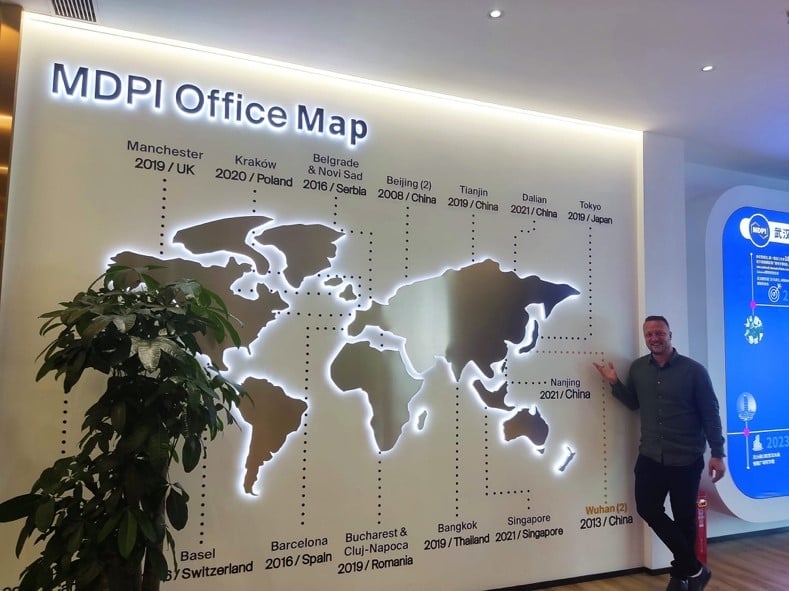
Stefan Tochev (CEO, MDPI) at MDPI’s Wuhan office.
In 2002, MDPI’s Basel headquarters moved to Matthäusstrasse 11, 4052 Basel, and Dr. Lin opened an editorial office in Qingdao, China, which launched the journal Marine Drugs in the following year. Below is a list of MDPI’s current offices in China and their respective dates of inauguration:
- 2008: Beijing (Tongzhou, Haidian)
- 2013: Wuhan (Hankou, Guanggu)
- 2019: Tianjin
- 2021: Dalian
- 2021: Nanjing
Our Strength is in Our People
With over 6,000 MDPI staff, across 20 offices in 11 countries, MDPI is able to offer authors responsive and efficient round-the-clock support, enabling a rapid publication process.
In my experience, stakeholders are genuinely surprised when they realize the extent of our global operations. My response is to reiterate that our people are our strength. This is why we have fast and efficient processes and top-notch responsiveness. Our global presence ensures that your manuscript is constantly attended to, rather than sitting on someone’s desk. We prioritize our authors’ needs and act quickly to move things through the various stages of publication. MDPI is built on speed, convenience, and competence, which I believe are core pillars for success in any industry. We continually strive to improve our systems and processes on the basis of these core strengths. We literally have over 6,000 staff worldwide dedicated to serving your needs. It’s not magic: it’s people; it’s real.
Impactful Research
MDPI Awards
To support the academic community, and especially young researchers, and also to enhance communication among scientists, MDPI journals offer various awards in specific fields. We serve the scientific community by funding research to facilitate the development of sustainable global solutions through our annual World Sustainability Award and Emerging Sustainability Leader Award.
In 2022, MDPI made awards totalling over US$1 million in recognition and support of researchers worldwide.
Across our journal catalogue, we have granted over 2,000 awards to recognize and support researchers from all disciplines. Since 2016, these awards have served as a source of recognition, acknowledging the impact of research by heightening the influence of talented individuals. The award types mainly include the Young Investigator Award, the Best PhD Thesis Award, the Best Paper Award, and the Outstanding Reviewer Award.
To learn more about MDPI Awards and to find out which are currently available, please click here.
MDPI Awards to Scholars from China
Since 2021, there have been 23 Best Paper Awards granted to authors affiliated with Chinese institutions, identifying their papers as having high-quality scientific impact. A total of 45 Chinese scholars have received awards such as the Young Investigator Award, the Best PhD Thesis Award, the Outstanding Reviewer Award, and the Tu Youyou Award, among others. Prizes for these awards include MDPI grants for paid publications, totalling over CHF 70,000 for scholars affiliated with Chinese institutions.
MDPI’s Tu Youyou Award
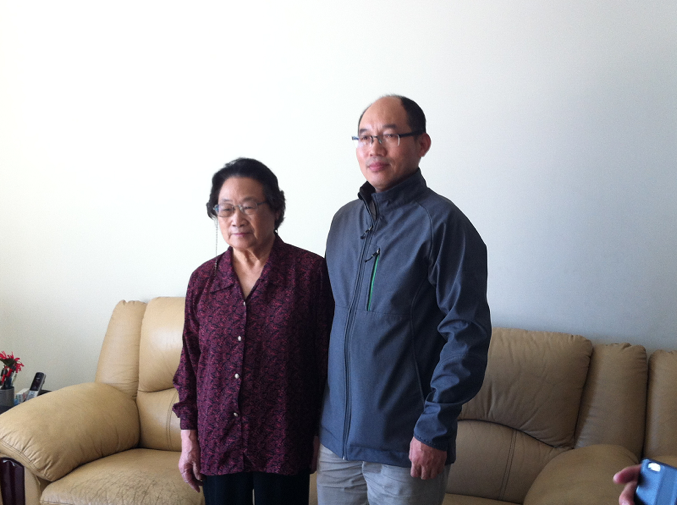
Prof. Tu Youyou (left), Dr. Shu-Kun Lin (President, MDPI).
In 2015, Professor Tu Youyou was awarded the Nobel Prize in Physiology or Medicine “for her discoveries concerning a novel therapy against Malaria.” In order to commemorate Professor Tu’s contributions to human health and to promote the passion and spirit conveyed by her experiences, MDPI in 2016 established the ‘Tu Youyou Award’, which runs biennially to recognize outstanding scholars dedicated to the research of natural products and medicinal chemistry.
The 2022 Tu Youyou Award was granted to Prof. Dr. Xiaoguang Lei of Peking University. Click here to access the interview with the winner.
2015 Nobel Prize for Medicine Awarded to Professor Youyou Tu
Professor Tu’s work was celebrated in a Special Issue from Molecules on the occasion of her 80th birthday. The Special Issue: 'Artemisinin (Qinghaosu): Commemorative Issue in Honor of Professor Youyou Tu on the Occasion of her 80th Anniversary” was created five years before she won the Nobel Prize, highlighting the visibility MDPI provides researchers and their work.
Highly Cited Articles by Chinese Scholars Published in MDPI
Click here to access the most cited MDPI papers published by scholars affiliated with Chinese institutions. This list presents the most influential research from the more than 287,000 MDPI papers published by Chinese scholars. With over 9 million total citations, I encourage you to maximize your visibility and impact by publishing with MDPI, the number one most cited open access publisher.
Read more:
- Tu Youyou Award
- World Sustainability Awards
- Available Awards
Inside MDPI
 Stefan Tochev (CEO, MDPI) with the Beijing Marketing team.
Marketing Department in China
During my visit to our offices in Beijing and Wuhan, I had the opportunity to meet with, and to present to, our local marketing teams. These teams are responsible for various journal-related and corporate promotional activities, including newsletters, conferences, seminars, author training, journal awards, content creation, digital marketing, and social media.
I was pleased by the ambition and curiosity of our marketing colleagues. They showed a strong desire to collaborate and acquire knowledge and tactics to effectively market and promote MDPI-journal-related activities. I presented some of the principles and objectives that we apply in the Corporate Marketing and Communications department, and used the opportunity to strengthen our collaborative communications across offices.
 Stefan Tochev (CEO, MDPI) with the Wuhan Marketing team.
Coming Together for Science

Collaborations, Scholarships and Meetings
MDPI maintains partnerships with nearly 190 learned societies and over 800 institutions and consortia, helping to facilitate the transition to OA publishing. Our commitment to working with institutions is evident in China, where we have successfully established over 35 Institutional Open Access Programs (IOAP) with esteemed institutions such as the Tsinghua University, Huazhong University of Science and Technology, and Shanghai Jiao Tong University.
Our institutional partnerships, waiver programs, and article processing cost discounts create diverse pathways to OA publishing for researchers worldwide.
Scholarships in China
Since 2021, several MDPI journals (Sensors, Photonics, Coatings, Materials, Energies, and Journal of Fungi) have funded full scholarships for four Master’s and five Ph.D. projects in China. These scholarships align with Tianjin University, Wuhan University of Technology, Central South University, the Chinese Academy of Sciences, and the China University of Petroleum (Beijing).
Meeting with the Society of Chinese University Journals (CUJS)
Prof. Tieming Zhang (President of CUJS, centre) and MDPI colleagues at CUJS office.
I am pleased to have participated in some highly productive meetings during my visit to China, including one with the Society of Chinese University Journals (CUJS). The meeting involved Prof. Tieming Zhang (President of CUJS), Assoc. Prof. Xin Zhang (Vice President and Secretary General), and Dr. Fei Gao (Executive Member of CUJS). Alongside my colleagues Dr. Guoshi Liu, Dr. Giulia Stefenelli, and Anita Sun, I represented MDPI and held an open discussion to address any questions regarding OA and MDPI.
We discussed several methods for collaboration, including a workshop on the future of peer review, MDPI sponsoring a funding grant for early-career researchers, and transitioning journals from diamond to gold OA. I am thankful for the opportunity to have met our colleagues at CUJS in person and feel very confident about our future collaborations in support of OA publishing in China.
MDPI hosts free academic seminars, author training sessions, and academic conferences as part of its commitment to enrich and support the scholarly community. CUJS often stages academic events (e.g., conferences, editor training, and editor competitions), and I believe there are great opportunities for CUJS and MDPI to collaborate accordingly.
Meeting with National Science Library, Chinese Academy of Sciences (NSLC)
Stefan Tochev (CEO, MDPI), Dr. Giulia Stefenelli (Chair of Scientific Officers, MDPI), Anita Sun (PR Manager, MDPI) and Dr. Guoshi Liu (Managing Director, MDPI) at the National Science Library, Chinese Academy of Sciences.
We also visited the NSLC Director, Xiwen Liu, and colleagues Ying Jin, Zhesi Shen, and Sichao Tong. Following our introductions, we gave a presentation on the history and editorial process at MDPI, discussing specific details related to MDPI’s business and data. We highlighted the status of our IOAP collaborations in China and the makeup of our author base, specifically in China, and drew attention to the fact that MDPI has published research by authors from every country in the world. We then discussed the design indicators, calculation methods and implementation purposes of the ‘Early Warning Journal List’ and how we can have open communication to provide any data regarding MDPI journals. I am pleased to report that we reached a consensus on future communications, and am grateful to NSLC for hosting us in their offices.
In-person meetings with stakeholders provide an invaluable opportunity to communicate what MDPI is about and the various ways in which we serve the scholarly community. While digital marketing and online communication are essential, they are no replacement for the understanding and trust that come about through in-person interactions.
The Numbers
As at September 2023, China holds the largest position in MDPI’s global market, ranking as the largest contributor to the total number of papers published by MDPI.
At this point in time, there were more than 847,000 China mainland scholars who have published with MDPI, 51 of whom are Section-Editors-in-Chief (SEiC) of MDPI journals, with seven serving as Editors-in-Chief (EiCs) for journals such as Air, Big Data and Cognitive Computing, Blockchains, Future, Nanoenergy Advances, and Targets.
Our growth and presence in China are a true testament to the service we provide to the scholarly community, and to the relationships we foster through collaborative activities. We look forward to continuing to support the growth of the scholarly community in China, providing a valuable and trusted experience with MDPI.
Closing Thoughts
Final Reflections on our MDPI Offices in Beijing and Wuhan

Stefan Tochev (CEO, MDPI), Dr. Constanze Schelhorn (Indexing Manager, MDPI), Jiale Shang (Admin, Tongzhou, MDPI) at Beijing Capital International Airport, Beijing.
I spent approximately two weeks visiting some of our offices in China, and the first word that comes to mind when describing my experience is ‘hospitality.’ My colleagues and I were met with enthusiasm and delight at the airport by the Tongzhou Admin team (thank you, Jiale Shang, and thank you, Eric Wang, for keeping us organized on this trip!) and were taken care of with great attention. From hotels to transportation, dinners, and meetings, our stay was catered for perfectly.
Perhaps this is where MDPI’s focus on customers and service originates. At our core, we are a service company that provides a publishing platform for its authors. It’s therefore no surprise that authors consistently rate their experience with MDPI very highly.
95% of submitting authors rate their overall experience with the MDPI publication process as Excellent or Good (Springer Nature report 90%).
91% of submitting authors rate their overall experience with the MDPI peer review process as Excellent or Good.
Speed/Efficiency and Editorial Relationship are two key reasons underlying this high satisfaction score. ‘Editorial Relationship’ can be further explored, but in the past month, the most commonly noted aspects were the professionalism, kindness, availability, communicativeness, and personalized assistance provided by our editorial staff throughout the process. These attributes are at the core of our work across all our offices and continents.
Hospitality and Service
Just as our Chinese colleagues strove to keep us engaged by showing us the city sights (thank you, Thea Pan, and Jason Wu from the Wuhan Marketing team!) and sharing a variety of wonderful meals, our editorial staff are committed to serving our authors throughout their publishing journey. Our aim is to place the author at the centre of everything we do, eager to welcome our ‘guests’ and provide them with a pleasant publishing experience.
I asked my colleague Francis Wu (Senior Publisher, Wuhan office) where this hospitality originates. He responded that it is part of Chinese culture. I reflected long and deep on this answer. China is a vast country, and when visitors arrive, hosts want to ensure they feel welcomed and taken care of in order to maximize their time and visit. I can’t think of a better analogy for how I would want our authors to feel when they visit MDPI for their publishing needs. A company culture that prioritizes service, something that goes beyond products and productivity, and focuses on the overall experience. Over 6,000 people, across all MDPI offices, are ready, willing and able to go the extra mile for their colleagues and their customers. This is something I am truly proud of.
Chief Executive Officer
MDPI AG
18 September 2023
Meet Us at the 2023 Asia-Pacific International Symposium on Aerospace Technology, 16–18 October 2023, Lingshui, Hainan, China
The 2023 Asia-Pacific International Symposium on Aerospace Technology (APISAT2023) will be held from 16 to 18 October 2023, in Lingshui, Hainan, China. The conference is co-hosted by the Chinese Society of Aeronautics and Astronautics, Tsinghua University, AVIC Aerodynamics Research Institute, Beihang University and Civil Aviation University of China. It is co-organized by the Chinese Society of Aeronautics and Astronautics, Royal Aeronautical Society, The Japan Society for Aeronautical and Space Sciences and KSAS.
Topics include the following:
- Aerodynamics and design;
- Structures and materials;
- Dynamics/control/avionics;
- Combustion and propulsion.
The following MDPI journals will be represented:
- Aerospace;
- Invention;
- Drones;
- Materials;
- Energies;
- Machines;
- Micromachines;
- Automation.
18 September 2023
Meet Us at the 16th IFToMM World Congress (WC2023), 5–10 November 2023, Tokyo, Japan
MDPI will be attending the 16th IFToMM World Congress (WC2023), which will be held from 5 to 10 November 2023 in Tokyo, Japan.
The organizing committee of the 16th World Congress of the International Federation for the Promotion of Mechanism and Machine Science is very pleased to welcome you to Tokyo.
The IFToMM World Congress is held every 4 years and is the largest congress on mechanism and machine science. It provides an opportunity for researchers, scholars and students with interests in the theory and use of mechanisms and machines for sharing new ideas and experiences and discussing future developments.
The following MDPI journals will be represented:
- Machines;
- Lubricants;
- Bioengineering;
- Robotics;
- Vibration;
- Inventions;
- Symmetry;
- Designs;
- JMMP;
- AI.
If you plan to attend this conference, please feel free to start a conversation with us. Our delegates look forward to meeting you in person and answering any questions that you may have. For more information about the conference and our booth, please visit the following link: http://wc2023.jc-iftomm.org/.
6 September 2023
Recap of Awards Granted to Scholars in 2022
MDPI is committed to supporting the academic community, nurturing talent and advancing science. Awards are an important part of the research landscape and play a vital role in helping academics gain recognition, especially young researchers as they embark on new research avenues.
In 2022, our journals presented a total number of 394 Awards, including Travel Awards, Young Investigator Awards, Best PhD Thesis Awards, Best Paper Awards, and Outstanding Reviewer Awards, with several winners announced for some of the awards. The total prize sum amounted to just under 580,000 Swiss francs (CHF), or approximately 650,000 US dollars. Overall, more than 720 scholars were awarded.
The majority of the awards were dedicated to young researchers in relatively early stages of their careers. This encompassed 66 of the afore-mentioned Travel Awards, 60 Young Investigator Awards, supporting research projects and conference attendance, as well as 51 Best PhD Thesis Awards. Additionally, 113 Best Paper Awards were given by our journals. The selection committees were entrusted with identifying the most impactful and novel research and review articles published in their journal within a given year.
MDPI will continue its support and recognition for the academic community moving forward, sponsoring new awards across disciplines. To learn more about all the awardees and their research projects in your field of study, please visit the following pages:
To explore more MDPI awards, please click here.
30 August 2023
MDPI Insights: The CEO’s Letter #3 - Sustainability and Co-opetition
Welcome to the MDPI Insights: The CEO's Letter.
In these monthly letters, I will showcase two key aspects of our work at MDPI: our commitment to empowering researchers and our determination to facilitating open scientific exchange.
Opening Thoughts

Our Commitment to Sustainability
As a pioneer in academic open access publishing since 1996, MDPI has always been dedicated to facilitating scientific exchange across all disciplines. Our approach to open science is guided by principles such as Open Access (OA), Timeliness and Efficiency, Simplicity, High-Quality Service, Flexibility, and a commitment to Sustainability. This commitment involves preserving published papers for the long term and supporting the future of science through partnerships, sponsorships, and awards.
In this edition of the CEO Letter, I will delve into MDPI’s various sustainability initiatives. As a leader in OA publishing, we are able to provide the public with a significant amount of environment-related content at no cost.
MDPI and the Sustainable Development Goals (SDGs)
In 2020, the SDG Publishers Compact was launched to accelerate implementation of the SDGs by promoting content that informs, develops, and inspires action. MDPI joined this initiative in 2021 and subsequently launched the MDPI SDG Hub in 2022, offering free access to recent research within the scope of each of the 17 SDGs. We also support authors from underrepresented communities by waiving publication charges for selected SDG-related papers. Detailed sustainability practices and supported publications are available in the report under each Goal page.
“More than 80% of MDPI articles and reviews published in 2022 relate to the Sustainable Development Goals.” [source: InCites, Accessed on 21.08.2023]
As at August 2023, MDPI boasts 14 journals dedicated to sustainability-related topics. Our first journal in this area, Sustainability, has published over 29,000 articles on the SDGs, accumulating over 240,000 citations (source: InCites, as at 1 January 2023). These journals serve as vital platforms for researchers to share insights and address environmental challenges. In addition:
MDPI journals specializing in sustainability-related topics:
- 2009: Sustainability
- 2012: Resources
- 2013: Climate
- 2014: Environments
- 2016: Recycling
- 2019: Clean Technologies
- 2020: Sustainable Chemistry
- 2021: Wind, Biomass, Conservation, Pollutants, Solar
- 2022: Waste, Microplastics
Read more:
Impactful Research

Highly Cited Articles in Sustainability
In 2022, content published in Sustainability and indexed in Journal Citation Reports (JCR) received nearly 190,000 citations. This highlights the fact that Sustainability publishes highly cited research articles related to environmental sciences and SDG-related topics such as climate action.
We are pleased to share that Sustainability received a 2022 CiteScore of 5.8, marking a 16% increase from the 2021 metric. Specifically, the CiteScore positions Sustainability as follows: Q1 (27 out of 163) in the “Environmental Science (miscellaneous)” category, and Q1 (101 out of 779) in the “Geography Planning and Development” category. For additional journal statistics, please visit here.
“Sustainability received a 2022 CiteScore of 5.8”
While MDPI journals such as Climate and Atmosphere have a distinct focus on atmosphere pollution and its impact on climate processes, journals like Sustainability, Environments, Water, Remote Sensing, and IJERPH publish content related to climate change. These journals have published over 32,300 articles related to SDG 13: Climate Action.
Highly Cited Papers in Sustainability
Below are several highly cited papers published in Sustainability over the past three years. Citation metrics are current as at 15 August 2023.
1. “A Global Assessment: Can Renewable Energy Replace Fossil Fuels by 2050?”Authors: Jerry L. Holechek, Hatim M. E. Geli, Mohammed N. Sawalhah, and Raul Valdez
Sustainability 2022, 14(8), 4792; https://doi.org/10.3390/su14084792
Citations: Crossref (97), Scopus (91), Web of Science (82), Google Scholar (125)
This paper addresses one of the most significant challenges of climate change – achieving Net Zero Carbon by 2050. The meta-analysis suggests that while difficult, this transition is possible through the concerted application of pathways, lifestyle changes, and global cooperation.
2. “Anxiety and the Ecological Crisis: An Analysis of Eco-Anxiety and Climate Anxiety”Author: Panu Pihkala
Sustainability 2020, 12(19), 7836; https://doi.org/10.3390/su12197836
Citations: Crossref (144), Scopus (121), Web of Science (159), Google Scholar (382)
This paper has received substantial media attention, including coverage by The Guardian, BBC, Vice, and CNBC. An interview with Dr. Panu Pihkala, a leading interdisciplinary researcher on the topic, can be found on MDPI’s podcast: Insight Faster, Episode 1.
3. “Impact of Climate Change on Agriculture and Its Mitigation Strategies: A Review”Authors: Gurdeep Singh Malhi, Manpreet Kaur, and Prashant Kaushik
Sustainability 2021, 13(3), 1318; https://doi.org/10.3390/su13031318
Citations: Crossref (207), Scopus (221), Web of Science (186), Google Scholar (355)
This paper reviews literature on climate change, addressing its causes, future projections, impact on agriculture, including plant physiology, growth, productivity, pest infestation, and the economic implications of mitigation strategies.
4. “Impacts of Plastic Pollution on Ecosystem Services, Sustainable Development Goals, and Need to Focus on Circular Economy and Policy Interventions”Authors: Rakesh Kumar, Anurag Verma, Arkajyoti Shome, Rama Sinha, Srishti Sinha, Prakash Kumar Jha, Ritesh Kumar, Pawan Kumar, Shubham, Shreyas Das, Prabhakar Sharma, and P. V. Vara Prasad
Sustainability 2021, 13(17), 9963; https://doi.org/10.3390/su13179963
Citations: Crossref (134), Scopus (136), Web of Science (113), Google Scholar (184)
This review aims to assess the adverse effects of plastic pollution on ecosystems, link the management of plastic with the SDGs, and propose policy measures using transdisciplinary approaches. Empowering communities to reduce plastic use is crucial. Addressing global plastic pollution is a priority.
Sustainability is an international, cross-disciplinary, open access journal that explores environmental, cultural, economic, and social sustainability of human beings. It provides a forward-looking platform for research on sustainability and sustainable development, and is published semi-monthly online by MDPI. Sustainability is affiliated with The Canadian Urban Transit Research & Innovation Consortium (CUTRIC) and The International Council for Research and Innovation in Building and Construction (CIB).
Read more:
- Testimonials: See what our editors and authors say about Sustainability.
Inside MDPI

President of Ireland Authors Editorial in MDPI Journal Sustainability
It’s a very special occasion when the president of a country takes the initiative to write an editorial for a journal. Michael D. Higgins, President of the Republic of Ireland, has contributed his insights to a forthcoming Special Issue in Sustainability:

This Special Issue, focusing on “making sustainable development happen” at grassroots levels, allows for perspectives from, and on, the major world faiths, exploring how challenges have been conceptualised and addressed, in addition to case studies of faith-based sustainability initiatives in practice.
The experience of faith institutions and communities in translating theological and moral commitments to sustainable development into action is now a topic we must examine with urgency; one on which I am so glad this Special Issue focuses.
As President of Ireland, I very much support this Special Issue of Sustainability. It is my great hope that the contents of the papers contained herein will assist in making sustainable development happen at grassroots levels across the world so that we can cooperate together, people of faith and of none, to ensure a just, inclusive and sustainable future for all on our fragile planet.
Read the completed editorial here:
Special Issue “Faith and Sustainable Development: Exploring Practice, Progress and Challenges among Faith Communities and Institutions”: Foreword by the President of Ireland
Author: Michael D. Higgins
Sustainability 2023, 15(12), 9683; https://doi.org/10.3390/su15129683
Coming Together for Science

The World Sustainability Forum 2023
The World Sustainability Forum (WSF) is a biennial MDPI event focused on sustainability. WSF 2023 marks the tenth anniversary of the conference series, taking place on 14 September. For the first time, the event will be hosted as a 24-hour conference across three locations – Singapore, Basel in Switzerland, and Toronto in Canada – alongside virtual streaming.
This unique format allows us to span three time zones, providing live coverage of critical sustainability-related topics throughout the day:
- The Singapore Hub, chaired by Professor Horn Mun Cheah and Associate Professor Renee Tan, will explore “Sustainability for Social and Community Impact”.
- The Basel Hub, chaired by Prof. Dr. Anet Režek Jambrak and Dr. Lela Mélon, will delve into “Sustainability in the industry, and at university and corporate settings”.
- The Toronto Hub, led by Dr. Umberto Berardi, will discuss “The Sustainable Built Environment”.
MDPI Sustainability Foundation: Recognizing Excellence in Sustainability Research
The MDPI Sustainability Foundation supports researchers through two sustainability-focused awards:
- The World Sustainability Award, amounting to USD 100,000, is given to senior researchers.
- The Emerging Sustainability Leader Award, valued at USD 20,000, sponsored by the journal Sustainability, is presented to early-career researchers.
The winners of the Sustainability Foundation will be formally awarded during the WSF2023 on 14 September. Interviews with the award winners and finalists are available below.
2023 World Sustainability Award Winners
Interviews with 2023 Emerging Sustainability Leader Award Finalists
- Dr. Bahareh Kamranzad
- Dr. Youjin Kim
- Dr. Julia Lohmann
As a hybrid event, WSF23 provides scholars with the option to attend in person at one of the conference sites or, for a more sustainable approach, virtually. All sessions will be recorded and archived for future access. Registration is open until 3 September 2023, with in-person and virtual tickets available here.
Read more:
Closing Thoughts
“Co-opetition”: Collaboration Plus Healthy Competition – A Visit to Elsevier
I firmly believe in fostering collaboration and at the same time promoting healthy competition within the academic publishing industry. The market offers ample room for publishers and related companies to provide valuable services and products that enrich the academic community. While MDPI is recognized for its efficient and streamlined processes –thanks to our over 6,000 colleagues, in-house tools, and initiatives that support the author journey – our ethos has always involved learning from and collaborating with other organizations.
MDPI’s Interaction with Elsevier
In January 2023, I had a brief conversation with Judy Verses, President of Global Academic and Government Markets at Elsevier, following her participation in a panel discussion at the Academic Publishers Europe event in Berlin. One of the highlights for me was Judy’s insight into the impact of research, particularly her emphasis on the role of collaboration, including policy and showing the impact of research to influence on funding decisions.
“Such collaborations drive forward-looking strategies to elevate our support for the scholarly community”
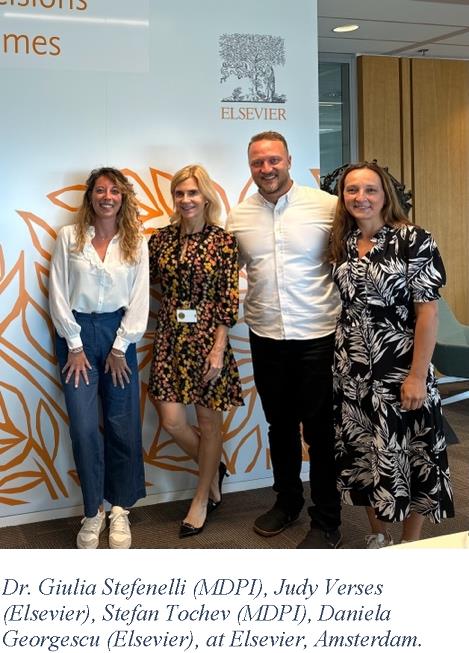
Judy and I resumed our discussion in August, when I visited Elsevier's office to review current projects, such as our recent agreement with Science Direct and the continued indexing of MDPI journals in Scopus (indexing database owned by Elsevier). We also explored possible opportunities for the future, including a potential collaboration to expand MDPI’s Scilit data infrastructure. This endeavour aims to aggregate and provide access to scholarly metadata encompassing journal articles, conference papers, books, preprints, and more. While these discussions are ongoing, the underlying principle remains that such collaborations drive forward-looking strategies to elevate our services and support for the scholarly community.
It was great that Judy and I acknowledged the merits of 'co-opetition,' a concept based of the belief that fostering cooperation alongside healthy competition can lead to shared advancements for both individual companies and the industry at large.
‘Fully OA’ Organizations Dedicated to Open Access
MDPI proudly aligns with the ‘Fully OA’ group, a collaborative initiative comprising nine organizations dedicated to Open Access. Our monthly meetings, including an OASPA representative, serve as platforms to share non-confidential information, resources, and projects. These gatherings also facilitate discussions on topics relevant to fully OA organizations. Occasionally, joint actions spring from these interactions, such as collaborative blog posts on pertinent subjects and joint statements, such as a recent response to the House Appropriations Committee.
This display of cooperation among competing entities forms a strategic alliance focused on nurturing the best interests of the OA publishing model.
As I wrap up this third edition of the CEO Letter, I encourage you to seize opportunities for collaboration and contribute to advancing our shared academic culture. As the African proverb has it, “If you want to go fast, go alone; if you want to go far, go together.”
Chief Executive Officer
MDPI AG
28 August 2023
Meet Us at the XXXV Eurosensors Conference, 10–13 September 2023, Lecce, Italy
MDPI will be attending the XXXV Eurosensors conference, which will be held from 10 to 13 September 2023 in Lecce, Italy. The conference will provide an opportunity for the presentation of updated results related to both theoretical and applied research in the fields of sensors, micro-nanosystems, etc., bringing together scientists from academic institutions and industry and promoting professional interactions between them. Furthermore, the conference also includes a one-day Tutorial Course on emerging and key arguments on the correlation between environment and health and the role of sensor technologies.
Eurosensors is an annual conference in the field of sensors that started in 1987. The Eurosensors 2020 and 2021 editions were eventually combined with the 2022 edition and held online due to the COVID-19 pandemic. Eurosensors 2023 will be chaired by Pietro Siciliano (University of Bari, Italy). The Organizing Committee would like to express their appreciation for the scientific response to the conference, which demonstrates the level of interest in the field of sensors and related technologies. It is hoped that the conference will allow for fruitful interactions among participants and new cultural proposals for the positive development of the conference and for the intellectual growth of all the participants.
The following MDPI journals will be represented:
- Sensors;
- Biosensors;
- Chemosensors;
- Materials;
- JSAN;
- Micromachines;
- Instruments;
- Technologies;
- Chips;
- Robotics;
- Machines.
If you are attending this conference, please feel free to start a conversation with us. Our delegates look forward to meeting you in person and answering any questions that you may have. For more information about the conference and our booth, please visit the following link: https://www.eurosensors2023.eu/.
16 August 2023
MDPI’s 2022 Young Investigator Awards in Engineering—Winners Announced
MDPI’s Young Investigator Awards recognize promising junior researchers, acknowledge their contributions, and enhance communication among scientists. We are proud to present the winners for the year 2022 in the engineering category. The winners were selected by the journals’ Award Evaluation Committee.
We warmly congratulate the following young investigators for their outstanding contributions. MDPI will continue to provide support and recognition to the academic community.
- Yi Zhang, University of Electronic Science and Technology, China
- Lin Ma, University of North Carolina at Charlotte, USA
- Stefano Cinti, University of Naples Federico II, Italy
- Umberto Berardi, Toronto Metropolitan University, Canada
- Benedetto Nastasi, Sapienza University of Rome, Italy
- Do Kyun Kim, Seoul National University, Republic of Korea
- Fernando Bento, University of Beira Interior, Portugal
- Goshtasp Cheraghian, Humboldt University of Berlin, Germany
- Roman Mykhailyshyn, The University of Texas at Austin, USA
- Pingan Zhu, City University of Hong Kong, China
- Viknesh Andiappan, the Swinburne University of Technology Sarawak Campus, Malaysia
- Wenzhuo Wu, Purdue University, USA
About MDPI Awards:
In order to reward the academic community, especially young researchers and enhance communication among scientists, MDPI journals regularly offer various awards to researchers in specific fields. These awards, serving as a source of inspiration and recognition, help raise the influence of talented individuals who have been credited with outstanding achievements and are making a significant contribution to the advancement of their fields.
To explore more MDPI awards, please click here.
16 August 2023
MDPI’s 2022 Travel Awards in Engineering—Winners Announced
We are proud to recognize the winners of MDPI’s 2022 Travel Awards in the engineering category for their outstanding presentations.
MDPI journals regularly offer travel awards to encourage junior scientists to present their latest research at academic conferences in specific fields, which helps to increase their influence.
The winners mentioned below were carefully selected by the journal editors based on an outline of their research and the work to be presented at an academic conference.
We would like to warmly congratulate the winners of the 2022 Travel Awards and wish them the greatest success with their future research endeavors. MDPI will continue to enhance communication among scientists.
- Dmitry Kireev, University of Texas at Austin, USA
- Danilo D’Angela, University of Naples Federico II, Italy
- Jungsub Kim, Texas A&M University, USA
About MDPI Awards:
In order to reward the academic community, especially young researchers and enhance communication among scientists, MDPI journals regularly offer various awards to researchers in specific fields. These awards, serving as a source of inspiration and recognition, help raise the influence of talented individuals who have been credited with outstanding achievements and are making a significant contribution to the advancement of their fields.
To explore more MDPI awards, please click here.
16 August 2023
MDPI’s 2022 Outstanding Reviewer Awards in Engineering—Winners Announced
In order to acknowledge our reviewers, who demonstrate diligence, professionalism, and timeliness when generously dedicating their time to reviewing papers, MDPI journals regularly offer outstanding reviewer awards to scholars who participate in the peer review process.
We are proud to recognize the winners for the year 2022 in the engineering category for their outstanding contributions by presenting them with an Outstanding Reviewer Award.
We would like to take this opportunity to congratulate all of the winners on their achievements. MDPI will continue to provide support and recognition to the academic community.
- Chongjing Cao, Shenzhen Institute of Advanced Technology (SIAT), China
- Roman Mykhailyshyn, University of Texas at Austin, USA
- Chiranjibi Sitaula, Monash University, Australia
- Davide Forcellini, 1University of Auckland, New Zealand; 2University of San Marino, San Marino
- Giuseppe Ciaburro, Università degli Studi della Campania Luigi Vanvitelli, Italy
- Yang Song, Norwegian University of Science and Technology, Norway
- Xiaoming Liu, Beijing Institute of Technology, China
- Carlos Torres-Torres, Instituto Politécnico Nacional, Mexico
- Paolo Blecich, University of Rijeka, Croatia
- Łukasz Ścislo, Cracow University of Technology, Poland
- Giorgio Sonnino, Université Libre de Bruxelles (ULB), Belgium
- Luiz Antonio Alcântara Pereira, Federal University of Itajubá (UNIFEI), Brazil
- Cagatay Iris, University of Liverpool, United Kingdom
- Chiemela Victor Amaechi, Lancaster University, United Kingdom
- Denis Istrati, University of Nevada, USA
- Mai The Vu, Sejong University, Korea
- Mina Tadros, University of Lisbon, Portugal
- Chao Fu, Northwestern Polytechnical University, China
- Eduardo Suárez, Universidade de Vigo, Spain
- Jordi-Roger Riba, Universitat Politècnica de Catalunya, Spain
- Catalin Ianasi, Institute of Chemistry “Coriolan Dragulescu”, Romania
- Daniel Ferrández, Polytechnic University of Madrid, Spain
- Kamil Krzysztof Roman, Institute of Technology and Life Sciences in Warsaw, Poland
- Marcin Dębowski, University of Warmia and Mazury in Olsztyn, Poland
- Mariusz Szymanek, University of Life Sciences in Lublin, Poland
- Agustin L. Herrera-May, Universidad Veracruzana, Mexico
- Chiachung Chen, National Chung Hsing University, Taiwan
- Jae-Myung Ryu, Kumoh National Institute of Technology, Republic of Korea
- Sebastian Głowiński, Koszalin Technical University, Poland
- Wei Zhou, University of Waterloo, Canada
About MDPI Awards:
In order to reward the academic community, especially young researchers and enhance communication among scientists, MDPI journals regularly offer various awards to researchers in specific fields. These awards, serving as a source of inspiration and recognition, help raise the influence of talented individuals who have been credited with outstanding achievements and are making a significant contribution to the advancement of their fields.
To explore more MDPI awards, please click here.
16 August 2023
MDPI’s 2022 Best PhD Thesis Awards in Engineering—Winners Announced
MDPI’s Best PhD Thesis Awards are presented to recognize the young scholars who are judged to have completed the most outstanding PhD thesis in their field of research and to encourage them to continue their excellent work and further contributions to their field.
We would like to warmly congratulate the winners of the 2022 Best PhD Thesis Awards and wish them success with their future research endeavors. MDPI will continue to enhance communication among scientists.
JMSE:
- “Mathematical Modelling of Wave-Induced Motions and Loads on Moored Offshore Structures”
by Changqing Jiang, University of Duisburg-Essen, Germany
- “Experimental Characterization of Frictional Hysteresis for Nonlinear Dynamic Analysis of Jointed Structures”
by Alfredo Fantetti, Imperial College London, UK
- “Sustainable Cultivation of Microalgae Biomass for Bioenergy Production”
by Angela Paul Peter, Xiamen University Malaysia, Malaysia
- “Studying Protein Function with Fluorescent Nanoantennas”
by Scott G. Harroun, Université de Montréal, Canada
About MDPI Awards:
In order to reward the academic community, especially young researchers and enhance communication among scientists, MDPI journals regularly offer various awards to researchers in specific fields. These awards, serving as a source of inspiration and recognition, help raise the influence of talented individuals who have been credited with outstanding achievements and are making a significant contribution to the advancement of their fields.
To explore more MDPI awards, please click here.
16 August 2023
MDPI’s Best Paper Awards in Engineering—Winners in 2022 Announced
The purpose of our Best Paper Awards is to promote and recognize the most impactful contributions published within MDPI journals.
The editors of each journal carefully selected reviews and research papers through a rigorous judging process based on criteria such as scientific merit, overall impact, and the quality of presentation of the papers published in the journal.
We are honored to present the winners announced for the year 2022 in the engineering category, who were selected from extensive competition, and congratulate the authors for their outstanding scientific publications. MDPI will continue to provide support and recognition to the academic community.
- “Two-Way and Multiple-Way Shape Memory Polymers for Soft Robotics: An Overview”
by Giulia Scalet
Actuators 2020, 9(1), 10; https://doi.org/10.3390/act9010010
- “Low-Cost, Open-Source Mechanical Ventilator with Pulmonary Monitoring for COVID-19 Patients”
by Leonardo Acho, Alessandro N. Vargas and Gisela Pujol-Vázquez
Actuators 2020, 9(3), 84; https://doi.org/10.3390/act9030084
- “Styrenic-Rubber Dielectric Elastomer Actuator with Inherent Stiffness Compensation”
by Giacomo Moretti, Luca Sarina, Lorenzo Agostini, Rocco Vertechy, Giovanni Berselli and Marco Fontana
Actuators 2020, 9(2), 44; https://doi.org/10.3390/act9020044
- “Chromium(III) Removal from Wastewater by Chitosan Flakes”
by Loris Pietrelli, Iolanda Francolini, Antonella Piozzi, Maria Sighicelli, Ilaria Silvestro and Marco Vocciante
Appl. Sci. 2020, 10(6), 1925; https://doi.org/10.3390/app10061925
- “Unravelling the Environmental Application of Biochar as Low-Cost Biosorbent: A Review”
by Antía Fdez-Sanromán, Marta Pazos, Emilio Rosales and María Angeles Sanromán
Appl. Sci. 2020, 10(21), 7810; https://doi.org/10.3390/app10217810
- “Observation of Potential Contaminants in Processed Biomass Using Fourier Transform Infrared Spectroscopy”
by Jingshun Zhuang, Mi Li, Yunqiao Pu, Arthur Jonas Ragauskas and Chang Geun Yoo
Appl. Sci. 2020, 10(12), 4345; https://doi.org/10.3390/app10124345
- “Drug-Resistant Tuberculosis 2020: Where We Stand”
by Angelo Iacobino, Lanfranco Fattorini and Federico Giannoni
Appl. Sci. 2020, 10(6), 2153; https://doi.org/10.3390/app10062153
- “Real-Time Remote Maintenance Support Based on Augmented Reality (AR)”
by Dimitris Mourtzis, Vasileios Siatras and John Angelopoulos
Appl. Sci. 2020, 10(5), 1855; https://doi.org/10.3390/app10051855
- “Dielectric Elastomer Actuator for Soft Robotics Applications and Challenges”
by Jung-Hwan Youn, Seung Mo Jeong, Geonwoo Hwang, Hyunwoo Kim, Kyujin Hyeon, Jihwan Park and Ki-Uk Kyung
Appl. Sci. 2020, 10(2), 640; https://doi.org/10.3390/app10020640
- “Low-Cost Biochar Adsorbents for Water Purification Including Microplastics Removal”
by Virpi Siipola, Stephan Pflugmacher, Henrik Romar, Laura Wendling and Pertti Koukkari
Appl. Sci. 2020, 10(3), 788; https://doi.org/10.3390/app10030788
- “Microstructure and Mechanical Properties of AISI 316L Produced by Directed Energy Deposition-Based Additive Manufacturing: A Review”
by Abdollah Saboori, Alberta Aversa, Giulio Marchese, Sara Biamino, Mariangela Lombardi and Paolo Fino
Appl. Sci. 2020, 10(9), 3310; https://doi.org/10.3390/app10093310
- “Humans-as-a-Sensor for Buildings—Intensive Longitudinal Indoor Comfort Models”
by Prageeth Jayathissa, Matias Quintana, Mahmoud Abdelrahman and Clayton Miller
Buildings 2020, 10(10), 174; https://doi.org/10.3390/buildings10100174
- “Circular Building Design: An Analysis of Barriers and Drivers for a Circular Building Sector”
by Jouri Kanters
Buildings 2020, 10(4), 77; https://doi.org/10.3390/buildings10040077
- “Building Information Modelling (BIM) to Enhance Occupational Safety in Construction Activities: Research Trends Emerging from One Decade of Studies”
by Mario Fargnoli and Mara Lombardi
Buildings 2020, 10(6), 98; https://doi.org/10.3390/buildings10060098
- “A SWOT Analysis of the Use of BIM Technology in the Polish Construction Industry”
by Krzysztof Zima, Edyta Plebankiewicz and Damian Wieczorek
Buildings 2020, 10(1), 16; https://doi.org/10.3390/buildings10010016
- “Durability and Climate Change—Implications for Service Life Prediction and the Maintainability of Buildings”
by Michael A. Lacasse, Abhishek Gaur and Travis V. Moore
Buildings 2020, 10(3), 53; https://doi.org/10.3390/buildings10030053
- “Worker 4.0: The Future of Sensored Construction Sites”
by Diego Calvetti, Pedro Mêda, Miguel Chichorro Gonçalves and Hipólito Sousa
Buildings 2020, 10(10), 169; https://doi.org/10.3390/buildings10100169
- “A Review of Topology Optimisation for Fluid-Based Problems”
by Joe Alexandersen and Casper Schousboe Andreasen
Fluids 2020, 5(1), 29; https://doi.org/10.3390/fluids5010029
- “On the Deterministic Prediction of Water Waves”
by Marco Klein, Matthias Dudek, Günther F. Clauss, Sören Ehlers, Jasper Behrendt, Norbert Hoffman and Miguel Onorato
Fluids 2020, 5(1), 9; https://doi.org/10.3390/fluids5010009
- “On the Effect of Block Roughness in Ogee Spillways with Flip Buckets”
by Rasoul Daneshfaraz, Amir Ghaderi, Aliakbar Akhtari, Silvia Di Francesco
Fluids 2020, 5(4), 182; https://doi.org/10.3390/fluids5040182
- “Marine Application of Fiber Reinforced Composites: A Review”
by Felice Rubino, Antonio Nisticò, Fausto Tucci and Pierpaolo Carlone
J. Mar. Sci. Eng. 2020, 8(1), 26; https://doi.org/10.3390/jmse8010026
- “Numerical Simulation of Large Wave Heights from Super Typhoon Nepartak (2016) in the Eastern Waters of Taiwan”
by Shih-Chun Hsiao, Hongey Chen, Han-Lun Wu, Wei-Bo Chen, Chih-Hsin Chang, Wen-Dar Guo, Yung-Ming Chen and Lee-Yaw Lin
J. Mar. Sci. Eng. 2020, 8(3), 217; https://doi.org/10.3390/jmse8030217
- “Development of Deterministic Artificial Intelligence for Unmanned Underwater Vehicles (UUV)”
by Timothy Sands
J. Mar. Sci. Eng. 2020, 8(8), 578; https://doi.org/10.3390/jmse8080578
- “Effective Application of Solid Lubricants in Spacecraft Mechanisms”
by Jeffrey R. Lince
Lubricants 2020, 8(7), 74; https://doi.org/10.3390/lubricants8070074
- “High-Rate Laser Surface Texturing for Advanced Tribological Functionality”
by Jörg Schille, Lutz Schneider, Stefan Mauersberger, Sylvia Szokup, Sören Höhn, Johannes Pötschke, Friedemann Reiß, Erhard Leidich and Udo Löschner
Lubricants 2020, 8(3), 33; https://doi.org/10.3390/lubricants8030033
- “Size Sorting of Exosomes by Tuning the Thicknesses of the Electric Double Layers on a Micro-Nanofluidic Device”
by Satoko Fujiwara, Kyojiro Morikawa, Tatsuro Endo, Hideaki Hisamoto and Kenji Sueyoshi
Micromachines 2020, 11(5), 458; https://doi.org/10.3390/mi11050458
- “Additive Manufacturing of Sub-Micron to Sub-mm Metal Structures with Hollow AFM Cantilevers”
by Giorgio Ercolano, Cathelijn van Nisselroy, Thibaut Merle, János Vörös, Dmitry Momotenko, Wabe W. Koelmans and Tomaso Zambelli
Micromachines 2020, 11(1), 6; https://doi.org/10.3390/mi11010006
- “A Robotic Biopsy Endoscope with Magnetic 5-DOF Locomotion and a Retractable Biopsy Punch”
by Manh Cuong Hoang, Viet Ha Le, Kim Tien Nguyen, Van Du Nguyen, Jayoung Kim, Eunpyo Choi, Seungmin Bang, Byungjeon Kang, Jong-Oh Park and Chang-Sei Kim
Micromachines 2020, 11(1), 98; https://doi.org/10.3390/mi11010098
- “Development of Fully Flexible Tactile Pressure Sensor with Bilayer Interlaced Bumps for Robotic Grasping Applications”
by Lingfeng Zhu, Yancheng Wang, Deqing Mei and Chengpeng Jiang
Micromachines 2020, 11(8), 770; https://doi.org/10.3390/mi11080770
- “A mm-Sized Free-Floating Wireless Implantable Opto-Electro Stimulation Device”
by Yaoyao Jia, Yan Gong, Arthur Weber, Wen Li and Maysam Ghovanloo
Micromachines 2020, 11(6), 621; https://doi.org/10.3390/mi11060621
- “Advanced Bioethanol Production: From Novel Raw Materials to Integrated Biorefineries”
by Aleta Duque, Cristina Álvarez, Pablo Doménech, Paloma Manzanares and Antonio D. Moreno
Processes 2021, 9(2), 206; https://doi.org/10.3390/pr9020206
- “An Overview on Fault Diagnosis, Prognosis and Resilient Control for Wind Turbine Systems”
by Zhiwei Gao and Xiaoxu Liu
Processes 2021, 9(2), 300; https://doi.org/10.3390/pr9020300
- “Role of Microalgae in the Recovery of Nutrients from Pig Manure”
by Ana Sánchez-Zurano, Martina Ciardi, Tomás Lafarga, José María Fernández-Sevilla, Ruperto Bermejo and Emilio Molina-Grima
Processes 2021, 9(2), 203; https://doi.org/10.3390/pr9020203
- “Applying Lean Six Sigma Methodology to a Pharmaceutical Manufacturing Facility: A Case Study”
by Brian Byrne, Olivia McDermott and John Noonan
Processes 2021, 9(3), 550; https://doi.org/10.3390/pr9030550
- “YOLO-Tomato: A Robust Algorithm for Tomato Detection Based on YOLOv3”
by Guoxu Liu, Joseph Christian Nouaze, Philippe Lyonel Touko Mbouembe and Jae Ho Kim
Sensors 2020, 20(7), 2145; https://doi.org/10.3390/s20072145
- “Piezoelectric Energy Harvesting Solutions: A Review”
by Corina Covaci and Aurel Gontean
Sensors 2020, 20(12), 3512; https://doi.org/10.3390/s20123512
- “Applications of Graphene Quantum Dots in Biomedical Sensors”
by Bhargav D. Mansuriya and Zeynep Altintas
Sensors 2020, 20(4), 1072; https://doi.org/10.3390/s20041072
WEVJ:
- “Beyond the State of the Art of Electric Vehicles: A Fact-Based Paper of the Current and Prospective Electric Vehicle Technologies”
by Joeri Van Mierlo, Maitane Berecibar, Mohamed El Baghdadi, Cedric De Cauwer, Maarten Messagie, Thierry Coosemans, Valéry Ann Jacobs and Omar Hegazy
World Electr. Veh. J. 2021, 12(1), 20; https://doi.org/10.3390/wevj12010020
- “An Overview of Parameter and Cost for Battery Electric Vehicles”
by Adrian König, Lorenzo Nicoletti, Daniel Schröder, Sebastian Wolff, Adam Waclaw and Markus Lienkamp
World Electr. Veh. J. 2021, 12(1), 21; https://doi.org/10.3390/wevj12010021
About MDPI Awards:
In order to reward the academic community, especially young researchers and enhance communication among scientists, MDPI journals regularly offer various awards to researchers in specific fields. These awards, serving as a source of inspiration and recognition, help raise the influence of talented individuals who have been credited with outstanding achievements and are making a significant contribution to the advancement of their fields.
To explore more MDPI awards, please click here.
27 July 2023
MDPI Insights: The CEO’s Letter #2 - Open Peer-Review and IJERPH
Welcome to the MDPI Insights: The CEO's Letter.
In these monthly letters, I will showcase two key aspects of our work at MDPI: our commitment to empowering researchers and our determination to facilitating open scientific exchange.
Opening Thoughts

Open Peer Review Reports
Continuing the topic of openness from my inaugural monthly CEO letter, in these Opening Thoughts, I highlight the growth and importance of open peer-review reports at MDPI. Open peer reports align with the principles of open science, making the publishing process more transparent and facilitating rigorous peer review.
MDPI journals operate an open peer-review option by default, allowing authors to publish review reports and author responses (often referred to as open reports) together with the published paper. Publishing the reviewer reports and author responses together with the article provides greater transparency and trust for readers, as this allows them to track the editorial decision-making process. Open peer-review also encourages reviewers and editors to provide high-quality comments, as these will be made public if the article is accepted for publication.
Start and Growth of Open Peer Review at MDPI
The MDPI journal Life was a pioneer in offering this opportunity to its authors in 2014. The first MDPI article with peer-review reports openly published was a review by the Nobel Laureate Werner Arber, in which the review reports were published as supplementary material. By 2018, open peer-review was available across all MDPI journals. As such, MDPI authors have embraced the open peer-review model, providing a steady increase in the number of MDPI articles. As of 2023, approximately one-third (34.0%) of MDPI articles were published with open review reports.
As at July 2023, the percentage of MDPI articles published with open peer review has increased to 36.2% of the total papers published in 2023 so far, indicating ongoing growth in adoption.
Open peer review continues to play a critical role in the assessment of the peer-review process in Life. For further insights, please see the recent editorial by Dr. Pabulo Henrique Rampelotto, the former Editor-in-Chief of Life, who spearheaded the implementation of the open peer-review process.
Benefits of Open Peer Review
The benefits of open peer review include increased transparency, trust and constructive feedback. To promote open communication further and increase the robustness of the peer-review process, we encourage reviewers to sign their reports so that their name appears on the review report (this process is referred to as open identity). The default option is for reviewers to remain anonymous; however, by signing the reports, reviewers receive direct credit for their contribution to the peer-review process and show their commitment towards open science.
As the leading open access publisher, MDPI remains committed to promoting open peer-review and encourages authors to choose this approach. Our goal is to provide a rigorous and transparent peer-review process that benefits the scientific community, and we believe that open peer-review is a vital step in fostering openness and collaboration in scientific communication.
Impactful Research
MDPI Papers Cited in the News – IJERPH edition
Every month, our corporate marketing team compiles data from Altmetrics to create a list of MDPI papers that have been cited in the news. This list continues to grow as renowned news outlets regularly reference research published by MDPI in their articles.
During 2022, a total of 111,965 MDPI research papers were mentioned in prominent news outlets such as National Geographic, The Washington Post, Forbes, The Guardian, the BBC, CNN, Time, and Harvard Business Review.
Highly Cited Journal Publications
IJERPH, known for publishing impactful research, received the most news mentions among all MDPI journals in 2022, based on Altmetrics data:
- International Journal of Environmental Research and Public Health: 3509 mentions
- Nutrients: 2698 mentions
- International Journal of Molecular Sciences: 1701 mentions
- Journal of Clinical Medicine: 1131 mentions
- Viruses: 1111 mentions
These numbers show the recognition and impact of the articles published in IJERPH. For a more detailed view of the journal’s most cited and viewed papers, you can visit here. In total, IJERPH has garnered over 28,000 mentions in prominent news outlets, and as at July 2023, an impressive count of over 17,000 papers cited 10 times or more. These figures highlight the impactful contribution of IJERPH publications to the scientific community.
Example of Recent Mentions
During May and June 2023, a noteworthy selection of articles from IJERPH was cited in news articles, including:
The Washington Post: “Bringing nature inside can improve your health. Here’s how to do it.”
IJERPH paper: “Physiological Benefits of Viewing Nature: A Systematic Review of Indoor Experiments”
Harvard Business Review: “How to Take Better Breaks at Work, According to Research”
IJERPH paper: “Canine-Assisted Therapy Improves Well-Being in Nurses”
National Geographic: “Lyme disease is spreading fast—but a vaccine may be on the way”
IJERPH paper: “Range Expansion of Tick Disease Vectors in North America: Implications for Spread of Tick-Borne Disease”
Inside MDPI

MDPI Develops an Artificial Intelligence Tool to Enhance the Peer-Review Process
At MDPI, we believe that rigorous peer-review is the corner-stone of high-quality academic publishing. We are grateful to the scholars who generously dedicate their time to peer-review articles submitted to MDPI journals. Their contributions are invaluable to the advancement of science.
Peer-review is a critical part of the publication process, ensuring that MDPI upholds the highest quality standards for the papers we publish. Every manuscript submitted to our journals undergoes a comprehensive peer-review process conducted by subject-matter experts.
To further enhance our peer-review process, our Data Analytics team has developed an Artificial Intelligence (AI) tool designed to support the selection of reviewers. This proprietary tool utilizes Natural Language Processing (NLP), a specially designed AI language model, to extract information from the title and abstract of submitted papers. It then searches our database for similar manuscripts and suggests potential reviewers based on this analysis. Integrated with MDPI's submission system (SuSy), the AI tool cross-references the suggested candidates with our reviewer database to verify their invitation status and availability.
The goal of this tool is to provide better targeted peer-review invitations, reducing the number of emails sent for each paper and increasing the efficiency of our editorial staff.
In the near future, our Data Analytics team plans to deploy similar AI projects to improve other critical aspects of our services, offering an enhanced experience to our authors and readers.
Click here to learn about MDPI’s review process, including procedures, responsibilities, and benefits.
Read more:
Coming Together for Science
The Future of IJERPH

On 5 July 2023, Prof. Dr. Paul B. Tchounwou, the founding Editor-in-Chief of IJERPH, along with five Section Editors in Chief (Prof. Dr. Germán Vicente-Rodríguez, Prof. Dr. Karl Goodkin, Prof. Dr. William A. Toscano, Prof. Dr. Jimmy T. Efird, and Prof. Dr. William Douglas Evans), gathered in Basel to discuss the future of the journal. The meeting provided an opportunity to address the recent decision by The Web of Science to delist IJERPH due to the journal failing the Content Relevance criterion, and propose best strategies that will ensure high scientific rigor as well as a clear scope and aim of IJERPH, going forward.
While the delisting is disappointing for IJERPH, as well as for our authors, academic editors, and the entire scientific community supporting our journal, we see it as an opportunity to reflect and prepare for the future direction of the journal.
Since its launch in 2004, IJERPH’s vision and mission have evolved to be more complete and comprehensive in engaging scientific communities. In light of this, we will refresh the journal’s aims and scope, ensuring they align with the organic expansion of IJERPH. Additionally, we will restructure the journal sections into broader categories, encouraging collaborative research and transdisciplinary approaches for authors. This is designed to foster collaboration and knowledge exchange among diverse fields, contributing to a holistic understanding of health promotion and disease prevention. We are confident that these next steps will enhance the scientific strength and societal impact of our journal.
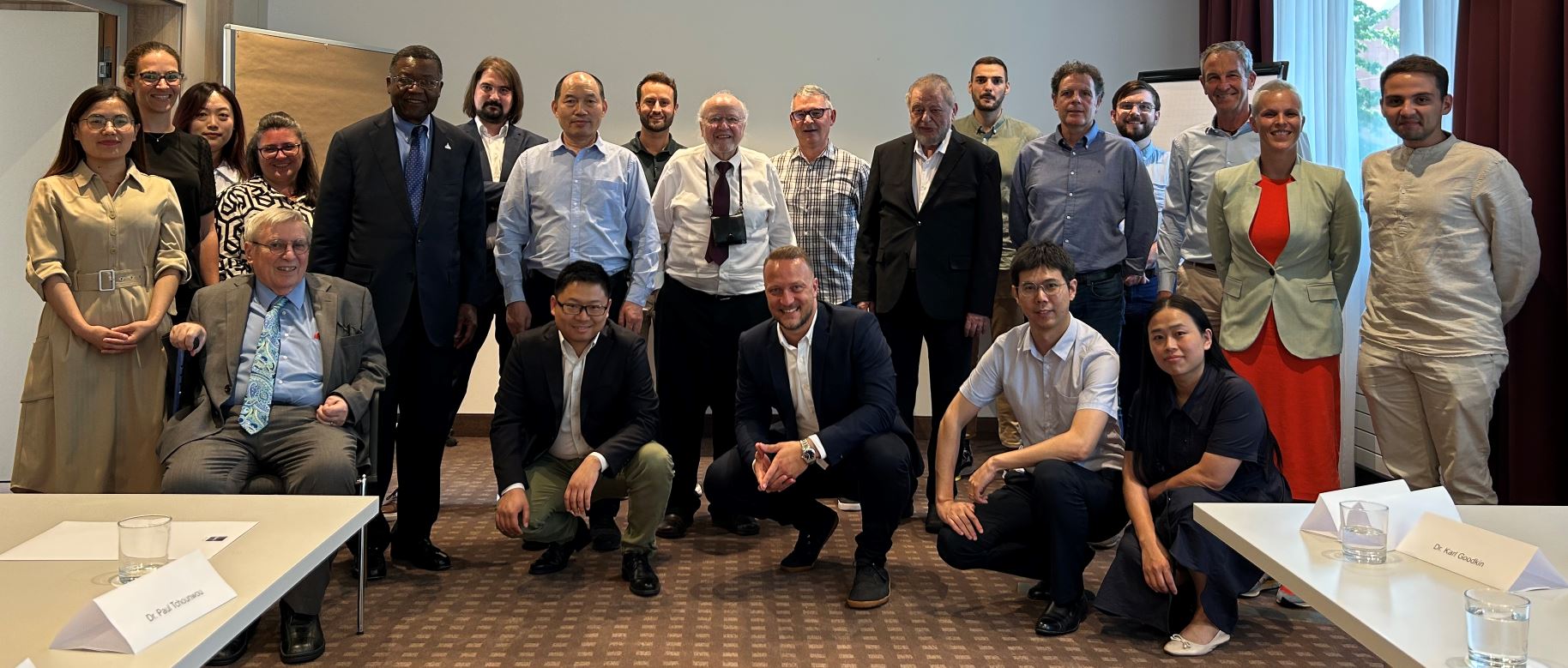
Journal Achievements
In addition to the productive discussions, we took the time to celebrate some of the remarkable achievements of IJERPH, which I highlight below:
- Founded by Prof. Dr. Paul B. Tchounwou in 2004
- Indexed in PubMed in 2008
- Received its first Impact Factor in 2012
- Published its 5000th paper in 2017
- Over 60,000 papers published as at June 30, 2023
- 131,628,173 paper views in 2018–2022
- Over 28,000 mentions in prominent news outlets
- 17,000 papers cited 10 times or more as at June 30, 2023
- No.1 journal in the 2022 Google Scholar Metrics in the category of Public Health
- Awarded several editions of Young Investigator Awards, Travel Awards, and Outstanding Reviewer Awards since 2018.
These achievements showcase the journal’s significant contributions to the field and its impact on global health. We are proud of the exceptional work accomplished by the IJERPH team and look forward to building upon this success in the years to come.
Closing Thoughts
MDPI’s Impact in Spain
During the past month, I had the opportunity to visit our new office building in Barcelona, where I met with our local colleagues to discuss the ways we serve the scholarly community, particularly in Spain. The multi-functional office plays a vital role in supporting various business needs, including editorial, design, conference management, data analytics, journal relationship management, publishing partnerships, and collaborations with societies.
Spain holds a significant position in MDPI’s global market, ranking as the fourth-largest contributor to the total number of papers published by MDPI as at July 2023, ranking next to Italy, the USA, and China, with Germany completing the top five.
The Numbers
Out of the 1,680,000 total MDPI articles published as at 25 July, almost 80,000 articles are contributed by Spanish authors, representing nearly 40,000 unique authors affiliated with Spanish institutions. Remarkably, over 6,300 of these authors hold editorial board member (EBM) positions within MDPI journals, with 30 of them serving as Editors-in-Chief (EiCs).
Our commitment to working with institutions is very evident in Spain, where we have successfully established over 40 Institutional Open Access Programs (IOAP) with esteemed institutions such as the University of Barcelona, the Autonomous University of Barcelona, Pompeu Fabra University, the University of Navarre, and Complutense University of Madrid.
Over the past five years, we have successfully organized eight in-person conferences in Barcelona, attracting over 1,150 registrations, with two forthcoming events scheduled for 2024. Barcelona's excellent connectivity to international airports makes it easily accessible to participants from around the world. Its welcoming atmosphere provides us with the perfect environment for knowledge-sharing, networking, and contributing to the local economy.
Our growth and presence in Spain are a true testament to the incredible service we provide to the scholarly community and the relationships we foster through responsive and collaborative communication. We look forward to continuing to support Spanish scholars, providing them a valuable and trusted experience with MDPI, the leader in open access publishing.
Testimonials
I close this letter as I did in the first edition, by sharing testimonials from our stakeholders. Here are a few IJERPH testimonials from a Spanish guest editor and an author:
Guest Editor
“I want to thank the kindness, attention and professionalism of the MDPI team throughout the editorial process of the Special Issue. I believe that it is a very professional and quality editorial process.”
- Professor Víctor Arufe-Giráldez, University of A Coruña
Special Issue in International Journal of Environmental Research and Public Health: Physical Activity in Childhood and Adolescence
Special Issue in International Journal of Environmental Research and Public Health: Physical Education: Present and Future
__
Author
“I want to thank the rigor of the revisions made to the manuscripts to improve their quality, the support to the authors for the editor assignment system they have and the follow-up they carry out, for the speed in answering and in carrying out the entire process of the revision, and for doing all this at an affordable price.”
- Dr. María Paz García-Caro, University of Granada
Article in International Journal of Environmental Research and Public Health: Factors Associated with Suicide Attempts and Suicides in the General Population of Andalusia (Spain)
Chief Executive Officer
MDPI AG
11 July 2023
MDPI’s Newly Launched Journals in June 2023
With the first issue released in June 2023, five new MDPI journals disseminating multi-disciplinary science are due to launch, which will cover the subjects of medicine & pharmacology, biology and physical sciences.
The newly launched journals will be overseen by professional Editorial Board Members and Editors to ensure an accurate and rapid publication, rigorous peer review and broad visibility.
Please feel free to browse and discover more about the new journals below.
| Journal | Founding Editor-in-Chief | Journal topics (selected) |
 |
Prof. Dr. Jun Ma, Peking University, China| Editorial | view inaugural issue | growth and development; diet and nutrients; school health promotion policies and practices; child health and care; adolescent health and wellbeing | view journal scope | submit an article |
 |
Prof. Dr. Bernd Rehm, Griffith University, Australia | Editorial | view inaugural issue | DNA and gene synthesis; synthetic transcription factors; protein engineering; viral engineering; metabolic engineering | view journal scope | submit an article |
 |
Prof. Dr. Varsha Gandhi, University of Texas MD Anderson Cancer Center, USA | Editorial | view inaugural issue | lymphatics; cancers associated with lymphocytes and lymphoblasts; lymphatic tissues; lymphoma; lymphoid leukemia | view journal scope | submit an article |
 |
Dr. Bradley Turner, University of Melbourne, Australia | Editorial | view inaugural issue | multiple sclerosis; amyotrophic lateral sclerosis; primary lateral sclerosis; atherosclerosis; systemic sclerosis | view journal scope | submit an article |
 |
Prof. Dr. Clemens Burda, Case Western Reserve University, USA | Editorial | view inaugural issue | Gamma ray, X-ray, and UV–Vis spectroscopies; NIR/mid-infrared/Raman spectroscopy; microwave and THz spectroscopy; high-resolution gas-phase atomic, molecular, and cluster spectroscopy; MS, NMR, and EPR spectroscopy | view journal scope | submit an article |
We wish to thank everyone who has supported the development of open access publishing. You are welcome to submit an application to the New Journal Committee ([email protected]) if you would like to create more new journals.
4 July 2023
Machines 2023 Intelligent Manufacturing Award—Open for Applications
We are pleased to announce that Machines (ISSN: 2075-1702) is now inviting applications for the Machines 2023 Intelligent Manufacturing Award. This prize will be given to one applicant who has made a unique and outstanding academic or societal contribution to intelligent manufacturing. All applications will be assessed by an Award Evaluation Committee led by the Editor-in-Chief, Prof. Dr. Antonio J. Marques Cardoso.
The prize:
- CHF 1000;
- Option to publish one paper free of charge in Machines after peer review before the end of 2024;
- An electronic certificate.
Eligibility and requirements:
- Must have received their Ph.D. no more than 10 years prior to 31 December 2023;
- Have made a unique and outstanding academic or societal contribution to intelligent manufacturing.
List of documents for application:
- The self-recommendation summary and contact details (including title, name, institutional affiliation, and email address);
- Scanned copy of doctorate certificate;
- The related work summary:
- A detailed description of the applicant’s work (max. 3000 words), highlighting the contributions to intelligent manufacturing;
- Applicant’s detailed CV;
- Applicant’s intelligent manufacturing-related publications or social work;
- Applicant’s list of funded projects (if available);
- A recommendation letter from a senior scientist;
- Other relevant information (supplementary materials).
Schedule:
Application deadline: 31 December 2023
Winner announcement: 31 March 2024
How to submit applications?
Send application materials to [email protected] with the subject “Machines 2023 Intelligent Manufacturing Award—Applicant’s Name”.
Machines Editorial Office
3 July 2023
MDPI Insights: The CEO’s Letter #1 - Open Access and Impactful Research
Welcome to the MDPI Insights: The CEO's Letter.
In these monthly letters, I will showcase two key aspects of our work at MDPI: our commitment to empowering researchers and our determination to facilitating open scientific exchange.
Opening Thoughts
The Future is Open, and MDPI is Leading the Way
I strongly believe in a future that embraces openness, where open source, open information, and open access (OA) take center stage. This belief that led me to join MDPI in 2020, and I am honored to have recently been appointed as Chief Executive Officer (CEO). In this capacity, and operating in close liaison with Dr. Lin and MDPI’s senior management, I shall work to build on Dr. Lin’s achievements of the past quarter-century. In this role, I will focus on communication initiatives to promote MDPI's remarkable work and continue to build our company as a trusted leader in OA publishing. For over two decades, MDPI has been at the forefront of reshaping the academic publishing landscape, with OA surpassing subscription-based publishing in 2020. This trajectory is deeply rooted in our history and reflects our unwavering commitment and vision for an open future.
1 Million Published Articles
2023 began with a remarkable achievement for MDPI, as we became the first OA publisher to reach the milestone of 1 million published articles. This represents 2.7 million unique authors who have trusted us with their work, or about a third of all researchers worldwide. As the world's most cited OA publisher, we are proud in sharing these significant milestones.
Our mission remains unchanged: to make science open and accessible to all. We understand the importance of knowledge access, empowering researchers to stay at the forefront of a rapidly changing world. Our diverse range of journals covers a wide spectrum of disciplines, offering cutting-edge insights, trusted tools, and crucial knowledge to address global challenges.
Liberating Science
As the world’s leading OA publisher, MDPI is actively liberating science. We are committed to eliminating the frustrations researchers and the general public face when accessing information, ensuring it is not locked behind paywalls. We firmly believe that everyone has a right to information, and our commitment to open access publishing drives our work.
In this inaugural edition of Insights: The CEO's Letter, I draw inspiration from the upcoming 20th anniversary of the Berlin Declaration on Open Access. Its stated mission reminds us that true impact is achieved when knowledge is widely and readily available to society:
"Our mission of disseminating knowledge is only half complete if the information is not made widely and readily available to society”
Impactful Research

MDPI Publishes Impactful Research: Recognized by Leading Indexing Databases
MDPI journals are indexed in every single top database in the world.
As of June 2023, we have 214 journals indexed within Web of Science, 223 indexed within Scopus, 87 indexed within PubMed and PMC, and 17 indexed within MEDLINE, and these numbers increase every month. We constantly strive to expand the coverage of our journals within leading multi-disciplinary and scope-specific databases, resulting in an incredibly broad range of journals that are indexed within a variety of databases. MDPI has active relationships with approximately 65 well-known databases around the world, and we continue to expand our portfolio every year so that your work can be found, cited, and referenced with ease.
Continued Growth of MDPI Journals
The 2022 Scopus and Web of Science journal citation metrics were officially released in June, and I am pleased to report that 31 MDPI journals received their first CiteScore, taking the total number of journals with a CiteScore to 216. The number of MDPI journals receiving an Impact Factor (IF) also continues to grow with 111 receiving their first, by being covered in the ESCI, bringing our total number of journals with an IF to 208 of which 41 journals received an IF above 4.0. Looking at 2022 CiteScores in the Scopus database, 80% of MDPI journals have a score that ranks them in Q1 or Q2 in at least one subject category.
Publishing impactful science would not be possible without all of our authors, editors and reviewers. Thank you for your contribution and continued support! Together we share the latest scientific insights faster and ensure that your work is accessible to all.
Read more
Inside MDPI

Preprints.org: Clarivate adds the Preprint Citation Index to the Web of Science
At MDPI, we are dedicated to driving the advancement of science. Through our initiative, Preprints.org, researchers can publish their work and gain valuable feedback from the broader research community, ensuring rapid progress in their respective fields. This is particularly crucial during times of health and climate challenges, where timely dissemination of findings is essential.
Increased Visibility for Preprints
I am pleased to share that Clarivate recognizes the significance of preprints and has taken a crucial step to enhance their visibility. Clarivate has added the Preprint Citation Index to the Web of Science, encompassing preprints published not only on Preprints.org but also on other reputable repositories.
Looking ahead, the future of preprints appears promising, bolstered by the recent indexing announcement from the Web of Science. As a result, preprints will receive increased visibility, serving as a valuable resource for staying informed about the latest research developments.
Read more
What are Preprints?
The Pros and Cons of Preprints
Preprints and COVID-19
Preprints—The Future of Open Access Publishing?
Coming Together for Science
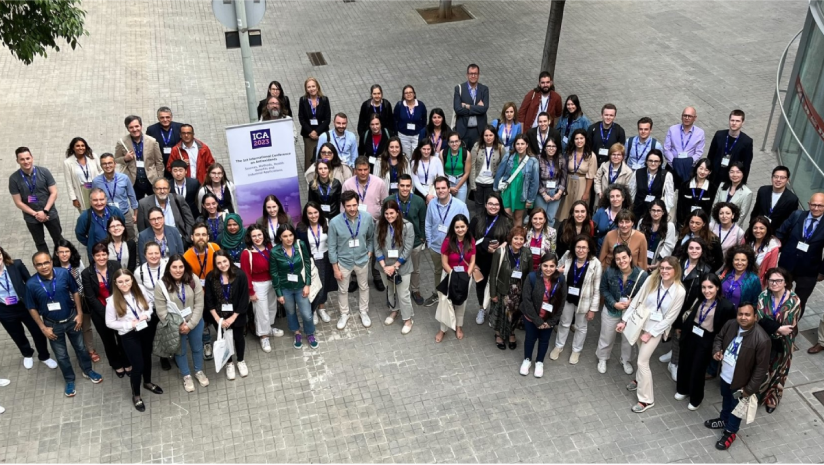
The First International Conference on Antioxidants: Sources, Methods, Health Benefits and Industrial Applications
In this edition of ‘Coming Together for Science,’ I am pleased to highlight the First International Conference on Antioxidants organized by our conference team in the beautiful city of Barcelona, Spain. The conference attracted over 130 attendees, who engaged in 42 talks, and 89 poster presentations spread across several sessions.
Working Together
Under the leadership of Prof. Dr. Alessandra Napolitano (Department of Chemical Sciences, University of Naples ‘Federico II’, Naples, Italy) and Prof. Dr. Rosa M. Lamuela Raventos (Department of Nutrition, Food Sciences and Gastronomy, University of Barcelona, Spain) as chairs, and supported by the committee members, 10 invited keynote speakers, poster presenters, and all the attendees, this dedicated group of academics came together to discuss the natural sources, methodologies, health benefits, and industrial applications of antioxidants.
Especially noteworthy is the positive feedback received from attendees, with 94% rating the overall organization of the conference as good or excellent. I particularly love the picture above, capturing the gathering of some of the participants. You can browse through more photos in the event gallery located here.
Managing Events With Sciforum
If you are considering hosting your own academic event, I highly recommend checking out Sciforum, MDPI's event management platform. Sciforum simplifies the entire process, making it easy to host your own event by allowing you to focus on what really matters: Science!
Read more
Closing Thoughts
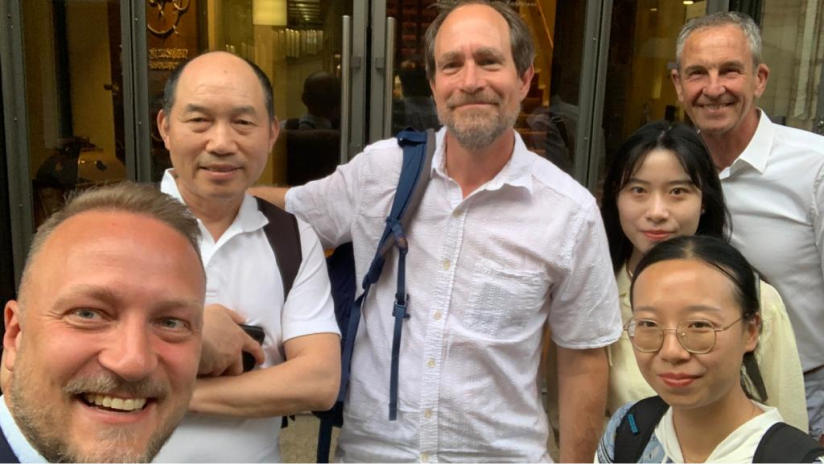 Stefan Tochev, Dr. Shu-Kun Lin, Dr. Eric O. Freed, Peter Roth, Wynne Wang, Allison Yang
Viruses and Editorial Quality: Acknowledging the Dedication of our Viruses Journal Team
During a June meeting with Dr. Eric O. Freed, the founding and current Editor-in-Chief of our journal Viruses, I was reminded of the exceptional dedication of our editorial board. Meeting with Eric is a pleasure, as he has a strong commitment and clear vision for the journal. Over the course of two days, we gained a deep understanding of the journal’s expectations and focus on strategic growth, editorial board representation, and engagement.
I am pleased to share that Viruses holds a CiteScore of 7.1 (an increase of 7.57% versus the 2021 metric) and an Impact Factor of 4.7. You can view the journal statistics here. Viruses publishes highly cited papers, and is indexed in renowned databases such as Scopus, SCIE (Web of Science), PubMed, and others, and maintains affiliations with prestigious societies. Moreover, the Viruses team has recently announced an exciting upcoming event titled ‘Viruses 2024 – A World of Viruses,’ scheduled to take place in Barcelona, Spain, from 14–16 February 2024.
Testimonials
If you notice my enthusiasm regarding our editorial service, it’s because the surveys and testimonials we receive speak volumes about the experiences of our authors, reviewers, and guest editors who collaborate with MDPI. The purpose of these letters is to highlight the exceptional work that we do and the experiences we create for the scholars – thus, let me end with this testimonial from an author:
“It was a great pleasure to publish in Viruses Special Issue [Emerging Viruses in Aquaculture]. The submission process was easy. Guest editors were very helpful and provided all the guidance and support as needed. The handling of the manuscript by the Editorial Team was very fast, efficient, and professional. The reviewer’s comments were insightful, and the publication processes were remarkably rapid.”
– Ms. Magdalena Stachnik, Państwowy Instytut Weterynaryjny | PIWet
Article in Viruses: Emerging Viral Pathogens in Sturgeon Aquaculture in Poland: Focus on Herpesviruses and Mimivirus Detection
Chief Executive Officer
MDPI AG
28 June 2023
2022 Impact Factors for MDPI Journals
The 2022 citation metrics have been released in the Journal Citation Reports (JCR), and we’re pleased to announce the following results for MDPI journals:
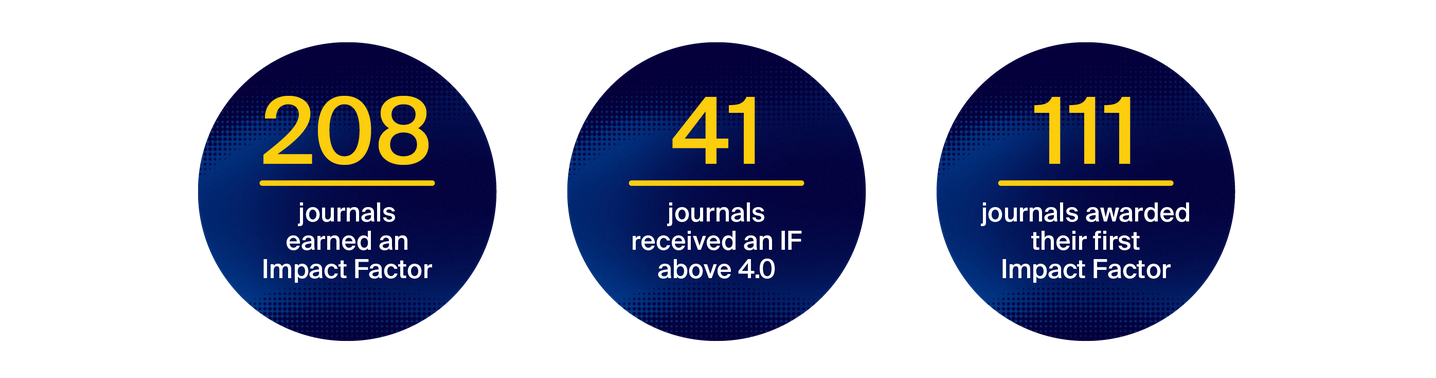
We are thrilled to announce that 90% of our ranked MDPI journals, specifically 86 out of 96 (captured in the table below), are performing above average in Q1 or Q2. This year, Clarivate has expanded its Impact Factor (IF) awards to include journals in the Emerging Sources Citation Index (ESCI) and the Arts and Humanities Citation Index (AHCI), providing greater transparency for the full set of journals indexed in the Web of Science Core Collection. As a result, 111 of MDPI journals have received their first IF in 2023, with 37 journals surpassing an IF of 3.0. In total, 208 MDPI journals have been honored with an IF.
Clarivate explains that by "expanding the coverage but holding to highly selective standards, the [Impact Factor] is now a reliable indicator of trustworthiness, as well as a measure of scholarly impact, at the journal level."
Please visit our blog post where we discuss the release of the latest citation metrics with our Indexing Manager, Dr. Constanze Schelhorn, to find out what's different this time around and how to make use of different metrics available.
| Journal | Impact Factor | Rank Quartile | Category |
| Vaccines | 7.8 | Q1 | Immunology |
| Medicine, Research & Experimental | |||
| Antioxidants | 7.0 | Q1 | Food Science & Technology |
| Biochemistry & Molecular Biology | |||
| Chemistry, Medicinal | |||
| Cells | 6.0 | Q2 | Cell Biology |
| Nutrients | 5.9 | Q1 | Nutrition & Dietetics |
| International Journal of Molecular Sciences | 5.6 | Q1 | Biochemistry & Molecular Biology |
| Q2 | Chemistry, Multidisciplinary | ||
| Journal of Theoretical and Applied Electronic Commerce Research | 5.6 | Q2 | Business |
| Biomolecules | 5.5 | Q1 | Biochemistry & Molecular Biology |
| Biosensors | 5.4 | Q1 | Chemistry, Analytical |
| Instruments & Instrumentation | |||
| Q2 | Nanoscience & Nanotechnology | ||
| Fractal and Fractional | 5.4 | Q1 | Mathematics, Interdisciplinary Applications |
| Marine Drugs | 5.4 | Q1 | Chemistry, Medicinal |
| Pharmacology & Pharmacy | |||
| Pharmaceutics | 5.4 | Q1 | Pharmacology & Pharmacy |
| Nanomaterials | 5.3 | Q1 | Physics, Applied |
| Q2 | Chemistry, Multidisciplinary | ||
| Materials Science, Multidisciplinary | |||
| Nanoscience & Nanotechnology | |||
| Cancers | 5.2 | Q2 | Oncology |
| Foods | 5.2 | Q1 | Food Science & Technology |
| Polymers | 5.0 | Q1 | Polymer Science |
| Remote Sensing | 5.0 | Q1 | Geosciences, Multidisciplinary |
| Q2 | Remote Sensing | ||
| Imaging Science & Photographic Technology | |||
| Environmental Sciences | |||
| Antibiotics | 4.8 | Q1 | Pharmacology & Pharmacy |
| Q2 | Infectious Diseases | ||
| Drones | 4.8 | Q2 | Remote Sensing |
| Journal of Functional Biomaterials | 4.8 | Q2 | Engineering, Biomedical |
| Materials Science, Biomaterials | |||
| Biomedicines | 4.7 | Q1 | Pharmacology & Pharmacy |
| Q2 | Biochemistry & Molecular Biology | ||
| Medicine, Research & Experimental | |||
| Journal of Fungi | 4.7 | Q2 | Mycology |
| Microbiology | |||
| Viruses | 4.7 | Q2 | Virology |
| Bioengineering | 4.6 | Q2 | Engineering, Biomedical |
| Gels | 4.6 | Q1 | Polymer Science |
| Molecules | 4.6 | Q2 | Chemistry, Multidisciplinary |
| Biochemistry & Molecular Biology | |||
| Pharmaceuticals | 4.6 | Q2 | Pharmacology & Pharmacy |
| Chemistry, Medicinal | |||
| Toxics | 4.6 | Q1 | Toxicology |
| Q2 | Environmental Sciences | ||
| Biomimetics | 4.5 | Q1 | Engineering, Multidisciplinary |
| Q2 | Materials Science, Biomaterials | ||
| Microorganisms | 4.5 | Q2 | Microbiology |
| Plants | 4.5 | Q1 | Plant Sciences |
| Biology | 4.2 | Q2 | Biology |
| Chemosensors | 4.2 | Q2 | Instruments & Instrumentation |
| Chemistry, Analytical | |||
| Electrochemistry | |||
| Membranes | 4.2 | Q2 | Engineering, Chemical |
| Materials Science, Multidisciplinary | |||
| Chemistry, Physical | |||
| Polymer Science | |||
| Toxins | 4.2 | Q1 | Toxicology |
| Q2 | Food Science & Technology | ||
| Metabolites | 4.2 | Q2 | Biochemistry & Molecular Biology |
| Batteries | 4.0 | Q2 | Electrochemistry |
| Materials Science, Multidisciplinary | |||
| Q3 | Energy & Fuels | ||
| Catalysts | 3.9 | Q2 | Chemistry, Physical |
| Journal of Clinical Medicine | 3.9 | Q2 | Medicine, General & Internal |
| Land | 3.9 | Q2 | Environmental Studies |
| Sensors | 3.9 | Q2 | Instruments & Instrumentation |
| Chemistry, Analytical | |||
| Engineering, Electrical & Electronic | |||
| Sustainability | 3.9 | Q2 | Environmental Sciences (SCIE) |
| Environmental Studies (SSCI) | |||
| Q3 | Green & Sustainable Science & Technology (SCIE) | ||
| Green & Sustainable Science & Technology (SSCI) | |||
| Buildings | 3.8 | Q2 | Construction & Building Technology |
| Engineering, Civil | |||
| Agronomy | 3.7 | Q1 | Agronomy |
| Q2 | Plant Sciences | ||
| Fermentation | 3.7 | Q2 | Biotechnology & Applied Microbiology |
| Pathogens | 3.7 | Q2 | Microbiology |
| Agriculture | 3.6 | Q1 | Agronomy |
| Diagnostics | 3.6 | Q2 | Medicine, General & Internal |
| Genes | 3.5 | Q2 | Genetics & Heredity |
| Journal of Intelligence | 3.5 | Q2 | Psychology, Multidisciplinary |
| Lubricants | 3.5 | Q2 | Engineering, Mechanical |
| Processes | 3.5 | Q2 | Engineering, Chemical |
| Coatings | 3.4 | Q2 | Materials Science, Coatings & Films |
| Physics, Applied | |||
| Q3 | Materials Science, Multidisciplinary | ||
| ISPRS International Journal of Geo-Information | 3.4 | Q2 | Geography, Physical |
| Q3 | Computer Science, Information Systems | ||
| Remote Sensing | |||
| Materials | 3.4 | Q2 | Metallurgy & Metallurgical Engineering |
| Physics, Applied | |||
| Physics, Condensed Matter | |||
| Q3 | Materials Science, Multidisciplinary | ||
| Chemistry, Physical | |||
| Micromachines | 3.4 | Q2 | Instruments & Instrumentation |
| Physics, Applied | |||
| Chemistry, Analytical | |||
| Q3 | Nanoscience & Nanotechnology | ||
| Water | 3.4 | Q2 | Water Resources |
| Environmental Sciences | |||
| Brain Sciences | 3.3 | Q3 | Neurosciences |
| Energies | 3.2 | Q3 | Energy & Fuels |
| Fire | 3.2 | Q1 | Forestry |
| Q2 | Ecology | ||
| Life | 3.2 | Q2 | Biology |
| Current Issues in Molecular Biology | 3.1 | Q3 | Biochemistry & Molecular Biology |
| Horticulturae | 3.1 | Q1 | Horticulture |
| Animals | 3.0 | Q1 | Agriculture, Dairy & Animal Science |
| Veterinary Sciences | |||
| Insects | 3.0 | Q1 | Entomology |
| Atmosphere | 2.9 | Q3 | Meteorology & Atmospheric Sciences |
| Environmental Sciences | |||
| Electronics | 2.9 | Q2 | Engineering, Electrical & Electronic |
| Physics, Applied | |||
| Q3 | Computer Science, Information Systems | ||
| Forests | 2.9 | Q1 | Forestry |
| Inorganics | 2.9 | Q2 | Chemistry, Inorganic & Nuclear |
| Journal of Marine Science and Engineering | 2.9 | Q1 | Engineering, Marine |
| Q2 | Oceanography | ||
| Engineering, Ocean | |||
| Metals | 2.9 | Q2 | Metallurgy & Metallurgical Engineering |
| Q3 | Materials Science, Multidisciplinary | ||
| Tropical Medicine and Infectious Disease | 2.9 | Q2 | Tropical Medicine |
| Parasitology | |||
| Q3 | Infectious Diseases | ||
| Universe | 2.9 | Q2 | Astronomy & Astrophysics |
| Physics, Particles & Fields | |||
| Healthcare | 2.8 | Q2 | Health Policy & Services (SSCI) |
| Q3 | Health Care Sciences & Services (SCIE) | ||
| Applied Sciences | 2.7 | Q2 | Engineering, Multidisciplinary |
| Physics, Applied | |||
| Q3 | Chemistry, Multidisciplinary | ||
| Materials Science, Multidisciplinary | |||
| Crystals | 2.7 | Q2 | Crystallography |
| Q3 | Materials Science, Multidisciplinary | ||
| Entropy | 2.7 | Q2 | Physics, Multidisciplinary |
| Magnetochemistry | 2.7 | Q2 | Chemistry, Inorganic & Nuclear |
| Q3 | Chemistry, Physical | ||
| Materials Science, Multidisciplinary | |||
| Symmetry | 2.7 | Q2 | Multidisciplinary Sciences |
| Actuators | 2.6 | Q2 | Instruments & Instrumentation |
| Engineering, Mechanical | |||
| Aerospace | 2.6 | Q1 | Engineering, Aerospace |
| Behavioral Sciences | 2.6 | Q2 | Psychology, Multidisciplinary |
| Current Oncology | 2.6 | Q3 | Oncology |
| Machines | 2.6 | Q2 | Engineering, Mechanical |
| Q3 | Engineering, Electrical & Electronic | ||
| Medicina | 2.6 | Q3 | Medicine, General & Internal |
| Separations | 2.6 | Q3 | Chemistry, Analytical |
| Minerals | 2.5 | Q2 | Mining & Mineral Processing |
| Mineralogy | |||
| Geochemistry & Geophysics | |||
| Children | 2.4 | Q2 | Pediatrics |
| Diversity | 2.4 | Q2 | Biodiversity Conservation |
| Q3 | Ecology | ||
| Journal of Cardiovascular Development and Disease | 2.4 | Q3 | Cardiac & Cardiovascular Systems |
| Mathematics | 2.4 | Q1 | Mathematics |
| Photonics | 2.4 | Q3 | Optics |
| Veterinary Sciences | 2.4 | Q1 | Veterinary Sciences |
| Fishes | 2.3 | Q2 | Marine & Freshwater Biology |
| Fisheries | |||
| Axioms | 2.0 | Q2 | Mathematics, Applied |
| Systems | 1.9 | Q2 | Social Sciences, Interdisciplinary |
| Tomography | 1.9 | Q3 | Radiology, Nuclear Medicine & Medical Imaging |
Note: The Journal of Personalized Medicine's Impact Factor was omitted in the original release and will be assigned separately. Please find the data on the journal webpage in due course.
Source: 2022 Journal Impact Factors, Journal Citation Reports TM (Clarivate, 2023)
27 June 2023
Meet Us at the International Conference on Processing & Manufacturing of Advanced Materials: Processing, Fabrication, Properties, Applications, 2–7 July 2023, Vienna, Austria

The International Conference on Processing & Manufacturing of Advanced Materials: Processing, Fabrication, Properties, Applications (THERMEC’2023) is the twelfth international conference on the advanced materials series built upon the proven concept and continues the tradition of its eleven predecessors: Japan (1988), Australia (1997), USA (2000), Spain (2003), Vancouver, Canada (2006), Berlin, Germany (2009), Quebec City, Canada (2011), Las Vegas, USA (2013), Graz, Austria (2016), Paris, France (2018) and Virtual Conference in June 2021.
MDPI will be attending the event as an exhibitor, and we welcome researchers from different backgrounds to visit and share their latest ideas with us.
We are looking forward to meeting you at our booth #35, where you can find more information about the MDPI journals attending the conference:
Our representatives Igor Matic and Teodora Stepanov are eager to answer your questions and address any inquiries you may have.
16 June 2023
2023 International Women in Engineering Day
International Women in Engineering Day is an international awareness campaign to raise the profile of women in engineering and focus attention on the amazing career opportunities available to girls and women in this exciting industry. The theme for this year is #makesafetyseen, and we would like to highlight the outstanding achievements of female engineers and celebrate this campaign with the brightest and bravest women in engineering.

|
|
|
|
|
|

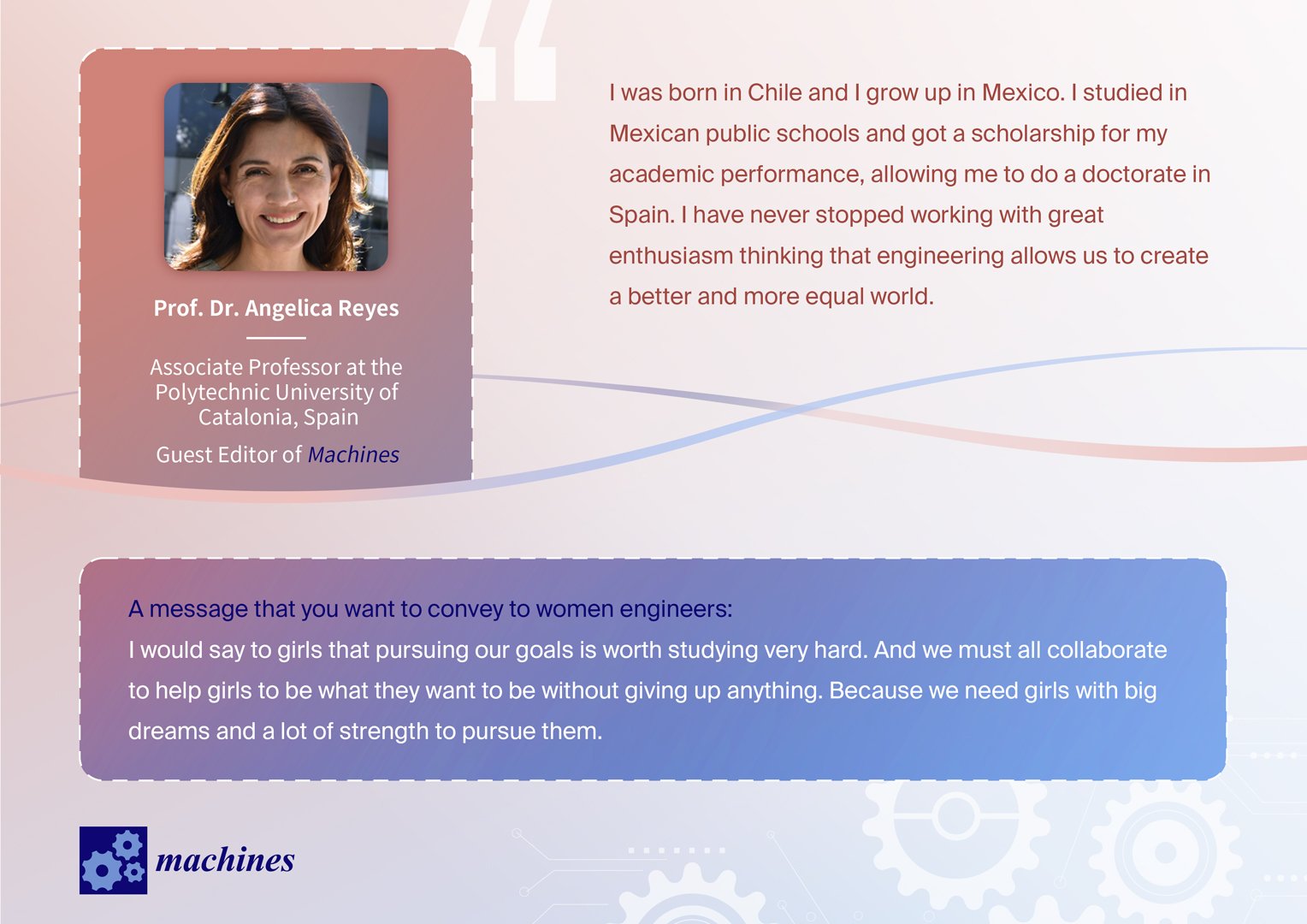


|
|
|
|
|
|
|
|







- Retention over Attraction: A Review of Women’s Experiences in the Australian Construction Industry; Challenges and Solutions
by Amir Naser Ghanbaripour, Roksana Jahan Tumpa, Riza Yosia Sunindijo, Weiwei Zhang, Parinaz Yousefian, Ranka Novak Camozzi, Carol Hon, Nima Talebian, Tingting Liu and Mina Hemmati
Buildings 2023, 13(2), 490; https://doi.org/10.3390/buildings13020490
- Colorimetric Paper Sensor for Food Spoilage Based on Biogenic Amine Monitoring
by Maria Maddalena Calabretta, Denise Gregucci, Riccardo Desiderio and Elisa Michelini
Biosensors 2023, 13(1), 126; https://doi.org/10.3390/bios13010126
- Dynamic Control of a Novel Planar Cable-Driven Parallel Robot with a Large Wrench Feasible Workspace
by Sergio Juárez-Pérez, Andrea Martín-Parra, Andrea Arena, Erika Ottaviano, Vincenzo Gattulli and Fernando J. Castillo-García
Actuators 2022, 11(12), 367; https://doi.org/10.3390/act11120367
- Review—Recent Progress in Graphene Based Modified Electrodes for Electrochemical Detection of Dopamine
by Zouhour Hsine, Rym Mlika, Nicole Jaffrezic-Renault and Hafsa Korri-Youssoufi
Chemosensors 2022, 10(7), 249; https://doi.org/10.3390/chemosensors10070249
- Controlling Aircraft Inter-Arrival Time to Reduce Arrival Traffic Delay via a Queue-Based Integer Programming Approach
by Koki Higasa and Eri Itoh
Aerospace 2022, 9(11), 663; https://doi.org/10.3390/aerospace9110663
- Spectral Methods for Response Enhancement of Microwave Resonant Sensors in Continuous Non-Invasive Blood Glucose Monitoring
by Giovanni Buonanno, Adriana Brancaccio, Sandra Costanzo and Raffaele Solimene
Bioengineering 2022, 9(4), 156; https://doi.org/10.3390/bioengineering9040156
- IBM Quantum Platforms: A Quantum Battery Perspective
by Giulia Gemme, Michele Grossi, Dario Ferraro, Sofia Vallecorsa and Maura Sassetti
Batteries 2022, 8(5), 43; https://doi.org/10.3390/batteries8050043
- Water-Based Lubricants: Development, Properties, and Performances
by Md Hafizur Rahman, Haley Warneke, Haley Webbert, Joaquin Rodriguez, Ethan Austin, Keli Tokunaga, Dipen Kumar Rajak and Pradeep L. Menezes
Lubricants 2021, 9(8), 73; https://doi.org/10.3390/lubricants9080073
- Motion Planning and Control of Redundant Manipulators for Dynamical Obstacle Avoidance
by Giacomo Palmieri and Cecilia Scoccia
Machines 2021, 9(6), 121; https://doi.org/10.3390/machines9060121
- Unmanned Aerial Vehicles for Wildland Fires: Sensing, Perception, Cooperation and Assistance
by Moulay A. Akhloufi, Andy Couturier and Nicolás A. Castro
Drones 2021, 5(1), 15; https://doi.org/10.3390/drones5010015

|
Special Issue: “Advancing towards 6G Networks” |
Special Issue: “Sensors for Artificial Movement Control” |
 |
 |
|
Special Issue: “Enhancing Workplace Safety Management in the Construction Industry” |
Special Issue: “Sustainable Civil Supersonic and Hypersonic Aircraft: Main Challenges and Latest Developments” |
 |
 |

|
|
|
|
|
15 June 2023
Meet Us at the 6th International Conference on Nanoenergy and Nanosystems (NENS 2023), 17–19 June 2023, Beijing, China
MDPI will be attending the 6th International Conference on Nanoenergy and Nanosystems (NENS 2023), held in Beijing, China, from 17 to 19 June 2023. Starting in 2014, NENS has been organized once every two years by the Beijing Institute of Nanoenergy and Nanosystems, Chinese Academy of Sciences (BINN, CAS). The conference has attracted high-profile scholars from around the world to deliver plenary and invited talks. This conference will provide a platform for scientists to exchange scientific information, build relationships, and possibly establish collaborations. During this conference, MDPI will welcome researchers from different backgrounds to visit and share their latest views as well as research with us.
The following MDPI journals will be represented:
- Energies;
- Applied Sciences;
- Nanoenergy Advances;
- Machines;
- ChemEngineering;
- Electronics;
- Technologies;
- Nanomaterials;
- Batteries.
If you are attending this conference, please stop by our booth. Our delegates look forward to meeting you in person to answer any questions that you may have. For more information about the conference, please visit the following link: http://www.nens.cn/.
6 June 2023
Topics Webinar | Smart Manufacturing and Industry 5.0, 15 June 2023

Welcome message by Dr. Dimitris Mourtzis, the webinar chair:
We welcome you to our webinar Smart Manufacturing and Industry 5.0. We will explore how the integration of advanced technologies is reshaping the manufacturing sector. Industry 5.0 represents a paradigm shift, where humans and intelligent machines collaborate in a seamless ecosystem. Our expert speakers will discuss the principles, trends, and transformative potential of smart manufacturing. We will delve into automation, AI, big data, and IoT, optimizing production and enabling real-time decision making. We will also highlight the importance of human workers in Industry 5.0, where collaborative robots, augmented reality, and cognitive computing unlock new possibilities. Therefore, we invite you to join us on this interesting webinar to uncover the potential of smart manufacturing and Industry 5.0, gain valuable insights, participate in stimulating discussions, and envision the future of manufacturing.
Date: 15 June 2023 at 9:00 a.m. CEST | 15:00 p.m. CST Asia
Register now for free!

Program:
|
Speaker/Presentation |
Time in CEST |
Time in EDT |
|
Dr. Dimitris Mourtzis Chair Introduction |
09:00–09:10 a.m. |
15:00–15:10 p.m. |
|
Dr. Pai Zheng Towards Mutual Cognitive Human–Robot Collaboration in Manufacturing |
9:10–9:30 a.m. |
15:10–15:30 p.m. |
|
Dr. Ang Liu AI-driven Engineering Design |
9:30–9:50 a.m. |
15:30–15:50 p.m. |
|
Dr. Dimitris Mourtzis Industrial Metaverse: Challenges & Opportunities |
9:50–10:10 a.m. |
15:50–16:10 p.m. |
|
Dr. Dimitris Mourtzis Closing of Webinar |
10:25–10:30 a.m. |
16:25–16:30 p.m. |
After registering, you will receive a confirmation email containing information on how to join the webinar. Registrations with academic institutional email addresses will be prioritized.
Unable to attend? Register anyway and we’ll let you know when the recording is available to watch.
Webinar Chair and Keynote Speakers:
- Dimitris Mourtzis, Department of Mechanical Engineering and Aeronautics, University of Patras, Patras, Greece;
- Pai Zheng, Department of Industrial and Systems Engineering, The Hong Kong Polytechnic University, Hong Kong Special Administrative Region of China;
- Ang Liu, The University of New South Wales, Kensington, Australia.
Relevant Topic:
“Smart Manufacturing and Industry 5.0”
Abstract submission deadline: 30 September 2023
Manuscript submission deadline: 30 November 2023
11 May 2023
Machines Webinar | Applications of Piezoelectric Devices and Materials, Held on 24 May 2023

On 24 May 2023, MDPI and the journal Machines (ISSN: 1996-1944) organized the webinar Applications of Piezoelectric Devices and Materials. The webinar focused on collecting novel applications of piezoelectric materials in mechatronic systems and robotics with an emphasis on practical aspects of modeling, fabrication, integration, driving, associated signal processing, and control methods for performance improvement.
Two presentations were delivered—“3D camera prototype based on LASER direct Time of Flight and MEMS mirrors: from simulation to real testing” by Dr. Daniele Caltabiano, and “Hybrid 3D-printed and MEMS devices based on piezoelectric resonators” by Dr. Víctor Ruiz Díez. The topics covered by the presentations represent state-of-the-art research activities in the field of piezoelectric materials and stimulated extreme interest for an intriguing and vibrant discussion among the participants in the webinar.
Please note that this webinar is associated with a Special Issue in Machines “Applications of Piezoelectric Devices and Materials”, for which the deadline is 15 August 2023.
You can watch the recorded webinar here:
Webinar Chairs and Keynote Speakers:
- Dr. Fangzhou Xia, Department of Mechanical Engineering, Massachusetts Institute of Technology, USA;
- Dr. Stefano Mariani, Department of Civil and Environmental Engineering, Politecnico di Milano, Italy;
- Dr. Daniele Caltabiano, STMicroelectronics, Italy;
- Dr. Víctor Ruiz Díez, Microsystems, Actuators, and Sensors Group, Universidad de Castilla-La Mancha, Spain.
19 April 2023
Prof. Dr. Hui Ma Appointed Section Editor-in-Chief of Section “Machines Testing and Maintenance” in Machines
We are pleased to announce that Prof. Dr. Hui Ma has been appointed Section Editor-in-Chief of the “Machines Testing and Maintenance” Section in Machines (ISSN: 2075-1702).
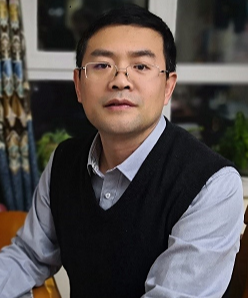
Name: Prof. Dr. Hui Ma
Email: [email protected]
Affiliation: School of Mechanical Engineering and Automation, Northeastern University, Shenyang 110819, China
Interests: rotating machinery dynamics; fault diagnosis; dynamic design of mechanical systems
Homepage: http://faculty.neu.edu.cn/mahui/en/more/138064/jsjjgd/index.htm
Prof. Dr. Hui Ma focuses on mechanical system dynamic modeling such as pipeline systems, gear transmission systems, rotor dynamics in compressor or aero engines, fault diagnosis in rotor systems such as rotor-stator rubbing faults, gear damage faults, blade cracks, etc. His main contributions are summarized as follows:
- The accurate description method of time-varying meshing stiffness of healthy and faulty gear pairs was developed, a dynamics model of the gear-rotor system was established, the relationship between typical gear faults and vibration characteristics of the system was revealed, and typical fault features were extracted;
- A new rigid-flexible coupling dynamic modeling method for a blisk combined rotor system was proposed based on the beam and plate shell theory. Based on the contact dynamics theory and analytical method, new rubbing models of the rotor-seal and blade-flexible casing were derived. The nonlinear vibration mechanism of the rotor blade and casing induced by rubbing was revealed and some typical fault features were extracted;
- Considering the effects of the fluid–structure coupling and structural coupling of parallel liquid-filled piping, an improved transfer matrix method for the dynamic modeling of complex series-parallel piping systems was proposed. Considering the influence of multi-source excitation such as fluid excitation and foundation excitation, a new method for predicting the vibration transmission characteristics of the parallel filling pipeline was proposed.
Prof. Dr. Ma has published 122 SCI-index journal papers and his works mainly appear in Mechanical Systems and Signal Processing (21), Engineering Failure Analysis (16), Journal of Sound and Vibration (9), Mechanism and Machine Theory (9), International Journal of Mechanical Sciences (8), and they have been cited over 3000 times.
With these achievements, we are confident that the “Machines Testing and Maintenance” Section of Machines will thrive under Prof. Dr. Hui Ma’s leadership.
The following is a short Q&A with Prof. Dr. Hui Ma, who shared his vision for the journal with us, as well as his views of the research area and Open Access publishing:
1. What appealed to you about the journal that made you want to take the role as its Section Editor-in-Chief?
It has a professional team and rapid publication so more readers can quickly understand the developments of this field and share the relevant scientific research results.
2. What is your vision for the journal?
I hope the journal can publish more excellent papers and provide a platform for the academic community to share knowledge.
3. What does the future of this field of research look like?
More interdisciplinary, with more emphasis on the development of artificial intelligence and digital twin technology.
4. What do you think of the development of Open Access in the publishing field?
Open Access can better promote the sharing of academic knowledge, and the acceptance rate is relatively high. Therefore, attention should be paid to improving the quality of papers.
We warmly welcome Prof. Dr. Hui Ma as our Section Editor-in-Chief.
13 March 2023
MDPI’s Newly Launched Journals in December 2022
As a leading open access publisher, MDPI provides scholars with a high-quality and rich academic exchange platform by continuously expanding into new and exciting research areas.
In December 2022, MDPI launched five new journals, covering multiple subjects such as life sciences, biology, medicine and pharmacology, social sciences and humanities. These new journals are being edited by established scholars across the world.
|
Journal |
Founding Editor-in-Chief |
Journal Topics (Selected) |
|
|
Prof. Dr. Fabio Gresta, University of Messina, Italy| Editorial | view inaugural issue |
grass/forage/turf production; grassland management; pasture monitoring; grazing and livestock; grass agro-ecosystems| view journal scope | submit an article |
|
|
Prof. Dr. Christos G. Athanassiou, University of Thessaly, Greece| Editorial | view inaugural issue |
pesticides; fungicides; herbicides; fertilizers; soil conditioners| view journal scope | submit an article |
|
|
Prof. Dr. Stephen H. Safe, Texas A&M University, USA| Editorial | view inaugural issue |
receptor structure; receptor function; receptor signaling; receptor expression and regulation; receptor interactions with drugs| view journal scope | submit an article |
|
|
Dr. Jean Jacques Vanden Eynde, University of Mons-UMONS, Belgium| Editorial | view inaugural issue |
drug discovery; medicinal chemistry; preclinical and clinical research; marketed drugs; intellectual property and regulatory affairs| view journal scope | submit an article |
|
|
Prof. Dr. Heather Kanuka, University of Alberta, Canada| Editorial | view inaugural issue |
higher education; tertiary education; policy and practice in higher education; educational leadership in higher education; educational administration and management in higher education| view journal scope | submit an article |





If you are interested in creating more open access journals with us to publish cutting-edge research, please send your journal proposal application to [email protected].
7 March 2023
Displaying Co-Authors’ Email Addresses on the Webpage of Published Papers
MDPI is pleased to announce that we now display the co-authors’ email addresses in addition to the corresponding author’s email address on the webpage of published papers, protected by Captcha. For more information about this change, please visit the journal’s instructions for authors page.
We believe this change will facilitate academic discussions and advance our cause of open science and research. The corresponding authors are responsible for communicating with their co-authors and indicating in our system (https://susy.mdpi.com/) if co-authors would prefer for their email addresses not to be displayed.
16 February 2023
Increasing Visibility for Preprints.org – Clarivate adds the Preprint Citation Index to the Web of Science

On 9 February 2023, Clarivate, a global leader in providing trusted insights and analytics, added the Preprint Citation Index to the Web of Science platform, streamlining the research process by allowing researchers to locate and link to preprints alongside other trusted content in the database.
The Preprint Citation Index will act as a bridge to connect cutting-edge preprints with peer-reviewed journal articles published within the Web of Science Core Collection. Alerts can be easily set to monitor new research across several repositories and authors will also be able to include preprints on their Web of Science Research Profile to more accurately display their various research outputs.
As of its launch, the Preprint Citation Index will provide nearly two million preprints from various repositories, including MDPI’s own Preprints.org.
MDPI's Preprints Platform – Preprints.org
To advance Open Science and the fast dissemination of research, MDPI offers researchers a free multidisciplinary preprint platform. Preprints.org accepts submissions from all research areas and offers authors high visibility, permanent archiving, article-level Metrics and immediately citable content by assigning a Digital Object Identifier (DOI) to all preprints.
During submission to any MDPI journal, authors have the option to share their research as a preprint. After an initial screening, the manuscript is available online in 48 hours or less. Once online, preprints can be downloaded, shared, commented on, and cited, providing authors maximum visibility.
We invite you to join the ranks of the over 100k researchers using Preprints.org and share your research.
For more information, please visit Preprints.org.
31 January 2023
Recruiting Editorial Board Members for Machines
Machines (ISSN: 2571-8789) is now recruiting scientists to join the Editorial Board.
As an Editorial Board Member, you would have the following responsibilities:
- Promoting Machines on your social media or among your acquaintances;
- Supervising the quality of the papers of Machines (when we have new submissions that fit well with your expertise);
- Acting as/recommending a Guest Editor for a Special Issue on a topic related to your research interests;
- Providing conference/society cooperation recommendations;
- Providing suggestions or comments on journal development.
As an Editorial Board Member, you would have the following benefits:
- Publishing one paper free of charge in Machines per year, and also publishing extra papers with special discounts;
- Publishing one paper free of charge in your own Special Issue per year;
- Organizing or promoting your own conferences by using our platform SciForum (https://sciforum.net/conferences);
- A CHF 500–1000 travel grant will be offered to Editorial Board Members that make significant contributions to the journal;
- Recommending/inviting your colleagues to submit full research articles or review papers with special discounts.
Machines is an open access international journal on machinery, manufacturing and engineering. It was launched in 2013 and has been indexed in several main databases such as the Science Citation Index Expanded (SCIE)-Web of Science, Scopus, and Inspec. Machines received a new IF of 2.899 from JCR in 2022, which equals a rank of 61/137 (Q2) in the “Engineering, Mechanical” category, as well as 127/276 (Q2) in the “Engineering, Electrical & Electronic” category.
If you are interested in joining the Editorial Board of Machines, please send your full academic CV and a short cover letter that details your interest and enthusiasm for the position to [email protected].
31 January 2023
Meet Us at the IEEE International Conference on Robotics and Automation (ICRA 2023), 29 May–2 June 2023, London, UK
Conference: IEEE International Conference on Robotics and Automation (ICRA 2023)
Date: 29 May–2 June 2023
Place: London, UK
Machines (ISSN: 2075-1702) will be attending ICRA 2023 as an exhibitor. This meeting will take place from 29 May to 2 June 2023 in London, UK.
The largest and most prestigious event of the year in the robotics and automation calendar, the 2023 IEEE International Conference on Robotics and Automation (ICRA) will bring together the world's top academics, researchers, and industry representatives. With the conference taking place in the UK for the first time, London will provide the perfect backdrop to this world-class event.
The following MDPI journals will be represented:
- Machines;
- Sensors;
- Actuators;
- Applied Sciences;
- Electronics;
- Robotics;
- Systems;
- JSAN;
- Technologies;
- Inventions;
- Designs;
- Drones;
- JMMP;
- Telecom;
- AI;
- Automation.
If you are planning to attend this conference, please do not hesitate to start an online conversation with us. Our delegates look forward to meeting you in person and answering any questions that you may have. For more information about the conference, please visit the following website: https://www.icra2023.org/.
22 December 2022
Special Issue Mentor Program
We are pleased to announce the launch of a new initiative—the MDPI Special Issue Mentor Program.
This program will enable early career researchers (who must hold a Ph.D. in a related field) to experience editing a Special Issue in MDPI journals, under the mentorship of our experienced Editorial Board Members or other experienced scientists. The mentor program will provide an excellent opportunity for early career scientists to gain editorial experience, and to cultivate their ability to edit scientific research.
The mentee’s responsibilities include:
- Proposing a Special Issue title and assisting the mentor in preparing a summary (around 200–400 words) and 3–10 keywords describing the background, importance, and goal of the Issue;
- Writing a brief promotion plan for the Special Issue;
- Preparing a list of scholars who may be interested in the Issue and personally e-mailing invitations on behalf of Guest Editors;
- Writing an editorial for the online Special Issue together with the mentor.
The mentor’s responsibilities include:
- Conducting a final check before the Special Issue is published online;
- Performing editorial control of the Special Issue and quality control of the publications, both of which must be carried out in a timely manner;
- Providing suggestions to younger scholars if they have any doubts or concerns regarding submissions;
- Organizing video calls with young scholars and the Editorial Office regularly to discuss problems and improvement suggestions for the Special Issue;
- Making and submitting decisions regarding submissions with the assistance of mentees.
Certificates and awards:
After the Special Issue closes, the Editorial Office will provide official certificates for all the mentors and early career researchers.
If you are interested in this opportunity, please send your Special Issue proposal to the Editorial Office of a journal you choose, and we will discuss the process (i.e., mentor collaboration, Special Issue topic feasibility analysis, etc.) in further detail. The full list of MDPI journals is as follows: https://www.mdpi.com/about/journals.
In addition to the new Special Issue Mentor Program, we will continue to welcome all Special Issue proposals focusing on hot research topics.
14 December 2022
"Thanks a Million!" – One Million Articles Published in MDPI Journals
MDPI has just become the first open access (OA) publisher to reach the milestone of one million articles published. That is one million articles freely available to all, to circulate and build upon! We are proud to share this special moment with the global scientific community.
This landmark has been reached thanks to the immeasurable support of more than 600,000 expert reviewers, 66,000 editorial board members and 6700 hard-working colleagues across MDPI’s global offices.
Within more than 25 years of publishing, our journals received 2.1 million manuscripts and generated 4.6 million peer review reports to get to one million papers published.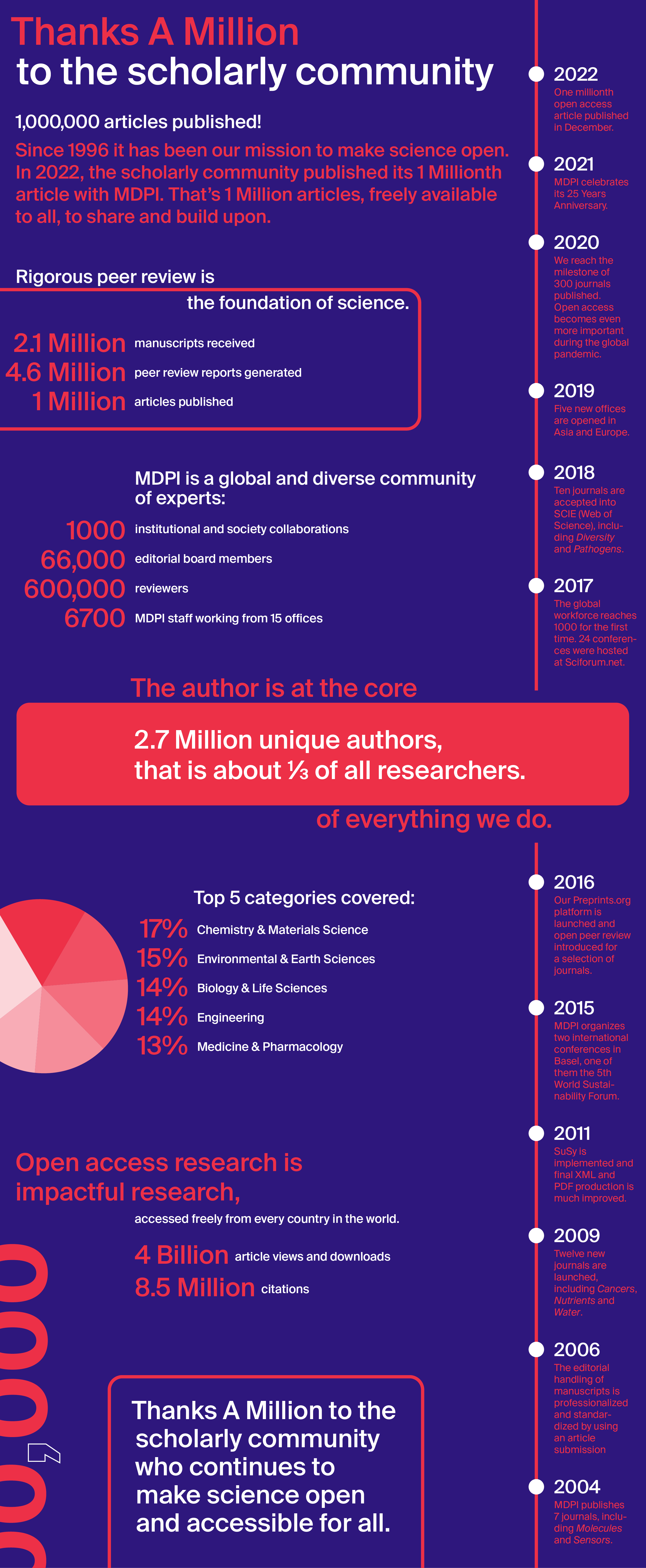
Reaching the milestone of one million articles published reinforces our mission to remove any existing barriers and to make scientific research accessible to all. Since its inception, MDPI’s goal has been to create reliable processes to make science open. This is a path towards facilitating the dissemination of novel insights in scientific communities.
Regular feedback from authors and reviewers shows that our service is greatly appreciated and needed. At the same time, the feedback helps us identify areas for further improvement.
As it stands, a significant share of published research findings remain closed access. More than half of the content published with the most well-known legacy publishers stays behind a paywall, and that is not including articles published in hybrid OA journals, or made available months or years after publication.
A new policy announced by the US administration in August 2022 requires that, as of January 2026, all US federally funded research be made freely and immediately available after publication. While the new policy does not mandate articles be published under an open access license, it is aligned with the open access movement in removing all barriers to research. Similarly, some of the most advanced research institutions in the world intend to have all funded research articles published in open access by 2025.
MDPI is proud to be the leading agent of the transition to open access.
"Thanks a Million" to all the contributors!
12 December 2022
Editorial Board Members from Machines Featured in the 2022 Highly Cited Researchers List Published by Clarivate
Recently, ClarivateTM revealed its 2022 list of Highly Cited ResearchersTM—individuals at universities, research institutes and commercial organizations.
The scientists who were selected into this year’s list of Highly Cited Researchers have published highly cited papers in the 11-year period from January 2011 to December 2021, with citation frequency in the top 1% of academic subjects and the same year of publication in the Web of ScienceTM database. Based on Web of Science Citation data, 6,938 researchers from across the globe who have demonstrated a disproportionate level of significant and broad influence in their chosen field or fields over the last decade have been awarded Highly Cited Researcher 2022 designations. The list is truly global, spanning 69 countries or regions and spread across a diverse range of research sciences and social sciences.
According to statistics, 5 members of the Editorial Board of Machines (ISSN: 2075-1702) have been selected into the list of Highly Cited Researchers of Clarivate in 2022. They are being recognized for their high-quality scientific research achievements and outstanding contributions to professional fields. The Machines journal office sincerely congratulates all elected Editorial Board Members and hopes that they continue to have an academically productive relationship with the journal.
| Name | Affiliation |
| Prof. Dr. Yaguo Lei | Xi’an Jiaotong University, China |
| Prof. Dr. Chun-Yi Su | Concordia University, Canada |
| Prof. Dr. Huijun Gao | Harbin Institute of Technology, China |
| Prof. Dr. Jiafu Wan | South China University of Technology, China |
| Prof. Dr. Xiaodi Li | Shandong Normal University, China |
8 December 2022
MDPI Sustainability Foundation: New Look and Nominations for the 2023 Sustainability Awards Now Open
We are pleased to announce that the website of the MDPI Sustainability Foundation has been revamped! For the past couple of months, our UX UI team and front-end developers have been working hard to launch the website in time for the opening of the Sustainability Awards nominations.
The website is not the only thing that has had a remodeling. Indeed, the format of the Emerging Sustainability Leader Award (ESLA) has been updated. ESLA is now a competition open to individual researchers or start-ups founded by researchers under the age of 35. Nominee applications will go through 2 rounds of selection until the final 3 are decided. The finalists will then be invited to give pitch presentations during the Award Ceremony to win either first place (10,000 USD) or runner-up (2 x 5000 USD).
The World Sustainability Award, on the other hand, remains the same: a total prize money of 100,000 USD is up for grabs by senior individual researchers or groups of researchers from the international research community.
Nominations for both the World Sustainability Award and the Emerging Sustainability Leader award are now open! Check out our new website for more information on how to nominate.
7 November 2022
Editorial Board Members from Machines Featured in Stanford’s List of the World’s Top 2% Scientists
Stanford University has recently published an update of the list of the top 2% most widely cited scientists—the World’s Top 2% Scientists.
The time node of the statistical data of this list is from 1960 to 2022, and it is divided into two lists: "Lifetime Scientific Influence Ranking" and "2022 Annual Scientific Influence Ranking". The "Lifetime Scientific Influence Ranking" counts the comprehensive influence performance of scientists during their careers, and the "2022 Annual Influence Ranking" focuses on highlighting the academic influence of scientists in the previous year. This ranking, considered the most prestigious worldwide, is based on the bibliometric information contained in the Scopus database and includes more than 200,000 researchers from the more than 10 million scientists considered to be active worldwide, with 22 scientific fields and 176 subfields taken into account.
We are pleased to share that 87 Editorial Board Members from Machines (ISSN: 2075-1702) were featured in Stanford University World’s Top 2% Scientists list in 2022.
| Prof. Dr. Antonio J. Marques Cardoso | Prof. Dr. Renquan Lu |
| Dr. Ahmed Abu-Siada | Dr. Carla Seatzu |
| Prof. Dr. Gang Chen | Prof. Dr. Singiresu S. Rao |
| Dr. Angelos P. Markopoulos | Prof. Dr. Ning Sun |
| Prof. Dr. Asok Ray | Prof. Dr. Ibrahim Nur Tansel |
| Prof. Dr. Alok Sinha. | Prof. Dr. Valter Carvelli |
| Prof. Dr. Zhuming Bi | Prof. Dr. Wei Gao |
| Dr. Bingnan Wang | Prof. Dr. Weidong Zhu |
| Prof. Dr. Chenglong Tang | Prof. Dr. Xianfeng Chen |
| Prof. Dr. Hongrui Cao | Prof. Dr. Xiaosheng Gao |
| Prof. Dr. Dan Zhang | Prof. Dr. Xiaodong Huang |
| Prof. Dr. Darwin G. Caldwell | Prof. Dr. Yuwen Sun |
| Prof. Dr. Mingcong Deng | Prof. Dr. Xuesong Jin |
| Prof. Dr. Dimitrios Chronopoulos | Prof. Dr. Yaguo Lei |
| Prof. Dr. Spilios D. Fassois | Prof. Dr. Dongsheng Yang |
| Prof. Dr. Shuxiang Guo | Prof. Dr. Jianyong Yao |
| Dr. Hai Wang | Prof. Dr. Zheng Chen |
| Dr. Hak Keung Lam | Dr. Davide Astolfi |
| Prof. Dr. Huosheng Hu | Prof. Dr. Jan Awrejcewicz |
| Prof. Dr. Huijun Gao | Prof. Dr. Vladimir Babitsky |
| Prof. Dr. Hongliang Ren | Prof. Dr. Marco Ceccarelli |
| Prof. Dr. Hui Ma | Prof. Dr. Ratna Babu Chinnam |
| Prof. Dr. Hong Zhang | Prof. Dr. David John Edwards |
| Prof. Dr. James Lam | Prof. Dr. Mohamed S. Gadala |
| Prof. Dr. Jian Xu | Prof. Dr. Saurav Goel |
| Dr. Jiangbiao He | Prof. Dr. Mark J. Jackson |
| Dr. Jie Liu | Prof. Dr. Paul Maropoulos |
| Prof. Dr. Jinhua Wang | Prof. Dr. Gregory P. Nordin |
| Prof. Dr. Jing Jin | Prof. Dr. Giovanni B. Palmerini |
| Dr. Johannes Gerstmayr | Prof. Dr. Radu-Emil Precup |
| Prof. Dr. Jyoti K. Sinha | Dr. Jeremy Straub |
| Prof. Dr. Levente Kovács | Prof. Dr. Wenjun (Chris) Zhang |
| Prof. Dr. Luis Martínez | Prof. Dr. Jose Alfonso Antonino-Daviu |
| Prof. Dr. Xiaodi Li | Prof. Dr. Giuseppe Carbone |
| Prof. Dr. Michael I. Friswell | Prof. Dr. Kai Cheng |
| Prof. Dr. Jiafu Wan | Prof. Dr. Junyong Zhai |
| Dr. Michele Scaraggi | Prof. Dr. Domenico Mundo |
| Prof. Dr. Kim Tiow Ooi | Prof. Dr. Wei-Hsin Liao |
| Prof. Dr. Nemai Chandra Karmakar | Dr. Alejandro Gómez Yepes |
| Prof. Dr. Peng Shi | Dr. Yuqian (Michael) Lu |
| Dr. Pinjia Zhang | Dr. Raul D.S.G. Campilho |
| Prof. Dr. Pingyu Jiang | Prof. Dr. Chun-Yi Su |
| Prof. Dr. Radosław Zimroz | Dr. Francisco J. G. Silva |
| Prof. Dr. Raffaele Di Gregorio |
The latest Stanford rankings reflect the significant influence and research excellence of the scientists, who are committed to furthering their knowledge for the benefit of the world.
We would like to congratulate our Editorial Board Members on their excellent achievement and thank them for their immense contribution to the scientific progression and development of Machines.
27 October 2022
Meet Us at the 2022 IEEE Transportation Electrification Conference and Expo, Asia-Pacific (ITEC-AP 2022), 28–31 October 2022, Haining, China

MDPI will be attending the 2022 IEEE Transportation Electrification Conference and Expo, Asia-Pacific (ITEC-AP 2022) in Haining, China, which will take place from 28 to 31 October 2022. The ITEC-AP 2022 is organized by Zhejiang University, and aims to provide a forum for sharing knowledge, experience, and ideas in electrical technologies for transportation. Technical sessions, tutorials, exhibitors, and industry activities are planned.
The following MDPI journals will be represented:
- Electronics;
- Machines;
- Actuators;
- Future Transportation;
- Electricity;
- Smart Cities;
- Sustainability;
- Vehicles.
If you are attending this conference, please feel free to stop by our booth. Our delegates look forward to meeting you in person to answer any questions that you may have. For more information about the conference, please visit the following link: https://www.itec-ap2022.com/.
21 October 2022
Prof. Dr. Yaguo Lei Appointed Section Editor-in-Chief of Section “Machines Testing and Maintenance” in Machines
We are pleased to announce that Prof. Dr. Yaguo Lei has been appointed Section Editor-in-Chief of the Section “Machines Testing and Maintenance” in Machines (ISSN: 2075-1702).
|
|
Name: Prof. Dr. Yaguo Lei |

Prof. Dr. Yaguo Lei received his B.E. degree and Ph.D. degree, both in mechanical engineering, from Xi’an Jiaotong University, P. R. China, in 2002 and 2007, respectively. He is currently a professor in mechanical engineering at the Xi’an Jiaotong University, P. R. China. He worked at the University of Duisburg-Essen, Germany, as an Alexander von Humboldt fellow and at the University of Alberta, Canada, as a postdoctoral research fellow. He is also a fellow of ASME, IET, and ISEAM; a senior member of IEEE; and a senior member of CMES, ORSC and CAA; and as an Associate Editor and Editorial Board Member of IEEE TIE, MSSP, NC&A, MST, etc. His research interests include health condition monitoring and intelligent maintenance, big-data-era intelligent fault diagnostics and prognostics, reliability evaluation and remaining useful life prediction, mechanical signal analysis and processing, and mechanical system dynamic modeling. He has pioneered many signal processing techniques and intelligent models for diagnosing mechanical faults. He has accomplished three monographies and published over 80 peer-reviewed papers on signal processing and fault diagnostics.
The following is a short Q&A with Prof. Dr. Yaguo Lei, who shared his vision for the journal with us, as well as his views of the research area and open access publishing:
1. What appealed to you about the journal that made you want to take on the role as its Section Editor-in-Chief?
I have collaborated with the journal Machines for a long time. I have witnessed great development in the journal in the past years, including publication quality, academic impact, etc. The journal has been very much active in the publication of cutting-edge research works in its related fields. The published papers have significantly inspired researchers all over the world. The "Machines Testing and Maintenance" Section has become a remarkable source of the latest research in this field, which is one of the major research areas in my group. Therefore, I feel very much appreciative to be appointed Editor-in-Chief of this Section.
2. What is your vision for the journal?
Considering the great efforts of the journal in the past years, I believe the journal will surely be attracting increasing worldwide attention. At present, high-end machine-related technologies have been hot topics, and the applications of the related research works have achieved great success in real industries. Therefore, the journal will continue to gain interest in the future and lead research in related areas.
3. What does the future of this field of research look like?
In recent years, machine big data have become available, and artificial intelligence technologies have experienced remarkable developments. In my opinion, this field of research will benefit more and more from big data and AI in the future, which enable us to learn underlying machine-related patterns that we did not know before. Big-data-driven machine testing and maintenance will be hot areas, as will the methodologies of integrating both machine big data and physical knowledge.
4. What do you think of the development of open access in the publishing field?
Open access is certainly a future trend in the publishing field. The knowledge produced by scholars all over the world is supposed to be extensively shared to further promote research. The traditional subscription mode has certain limitations in scientific communications. However, as a well-established approach to publication, the traditional way cannot be entirely replaced in the near future, and it will possibly take a long time for everyone to gradually accept this new and beneficial publishing mode.
We warmly welcome Prof. Dr. Yaguo Lei as he starts his new role as Section Editor-in-Chief, and we look forward to him leading Machines to achieve many more milestones.
28 September 2022
Peer Review Week 2022 – Research Integrity: Creating and Supporting Trust in Research
Peer Review Week began 19 September 2022 under the theme of “Research Integrity: Creating and Supporting Trust in Research”. Through various blog articles, podcast, and webinar, we discussed this crucial subject throughout the week, celebrating the essential role peer review plays in maintaining research quality.
To begin, we held a Webinar on the topic. Professor Peter W. Choate and Dr. Emmanuel Obeng-Gyasi joined Dr. Ioana Craciun, one of MDPI’s scientific officers, for an in-depth discussion.
We invite you to view the event recording:
During the week, the MDPI Blog in a series articles highlighted how good Peer Review safeguards research integrity. The following topics were covered:
- Peer Review Week 2022
- Research Integrity
- What We’ve Learned About Peer Review Reports
- 4 Steps to the Perfect Peer Review Report
- How to Write the Perfect Peer Review Report: An Interview
- Inviting Great Peer Reviewers
In a new edition of Insight Faster, an MDPI podcast, we were delighted to talk to the co-chairs of the Peer Review Week committee, Jayashree Rajagopalan (Senior Manager of Global Community Engagement for CACTUS) and Danielle Padula (Head of Marketing and Community Development at Scholastica) to get their take on this year’s event and its related topics.
You can find the Podcast here.
We hope you enjoy the contents!
11 July 2022
MDPI’s 2021 Best Paper Awards in “Engineering”—Winners Announced
The purpose of our Best Paper Awards is to promote and recognize the most impactful contributions published within MDPI journals.
The academic editors of each journal carefully selected reviews and research papers through a rigorous judging process based on criteria such as the scientific merit, overall impact, and the quality of presentation of the papers published in the journal.
We are honored to present the winners in the “Engineering” category, who were selected amongst extensive competition, and congratulate the authors for their outstanding scientific publications.
- “Position Control of Pneumatic Actuators Using Three-Mode Discrete-Valued Model Predictive Control”
by Haitao Qi, Gary M. Bone and Yile Zhang
Actuators 2019, 8(3), 56; doi: 10.3390/act8030056 - “Review of Electrothermal Actuators and Applications”
by Alissa Potekhina and Changhai Wang
Actuators 2019, 8(4), 69; doi: 10.3390/act8040069
- “Pre-Lithiation Strategies for Rechargeable Energy Storage Technologies: Concepts, Promises and Challenges”
by Florian Holtstiege, Peer Bärmann, Roman Nölle, Martin Winter and Tobias Placke
Batteries 2018, 4(1), 4; doi: 10.3390/batteries4010004 - “A Critical Review of Lithium-Ion Battery Recycling Processes from a Circular Economy Perspective”
by Omar Velázquez-Martínez, Johanna Valio, Annukka Santasalo-Aarnio, Markus Reuter and Rodrigo Serna-Guerrero
Batteries 2019, 5(4), 68; doi: 10.3390/batteries5040068 - “Critical Review of the Use of Reference Electrodes in Li-Ion Batteries: A Diagnostic Perspective”
by Rinaldo Raccichini, Marco Amores and Gareth Hinds
Batteries 2019, 5(1), 12; doi: 10.3390/batteries5010012 - “Life Cycle Analysis of Lithium-Ion Batteries for Automotive Applications”
by Qiang Dai, Jarod C. Kelly, Linda Gaines and Michael Wang
Batteries 2019, 5(2), 48; doi 10.3390/batteries5020048 - “Design Strategies for High Power vs. High Energy Lithium Ion Cells”
by Michael J. Lain, James Brandon and Emma Kendrick
Batteries 2019, 5(4), 64; doi: 10.3390/batteries5040064
- “Influence of Humidity on NO2-Sensing and Selectivity of Spray-CVD Grown ZnO Thin Film above 400 °C”
by Roussin Lontio Fomekong and Bilge Saruhan
Chemosensors 2019, 7(3), 42; doi: 10.3390/chemosensors7030042 - “Low Molecular Weight Fluorescent Probes (LMFPs) to Detect the Group 12 Metal Triad”
by Ashley D. Johnson, Rose M. Curtis and Karl J. Wallace
Chemosensors 2019, 7(2), 22; doi: 10.3390/chemosensors7020022
Journal of Marine Science and Engineering:
- “Marine Application of Fiber Reinforced Composites: A Review”
by Felice Rubino, Antonio Nisticò, Fausto Tucci and Pierpaolo Carlone
Mar. Sci. Eng. 2020, 8(1), 26; doi: 10.3390/jmse8010026 - “Numerical Simulation of Large Wave Heights from Super Typhoon Nepartak (2016) in the Eastern Waters of Taiwan”
by Shih-Chun Hsiao, Hongey Chen, Han-Lun Wu, Wei-Bo Chen, Chih-Hsin Chang, Wen-Dar Guo, Yung-Ming Chen and Lee-Yaw Lin
Mar. Sci. Eng. 2020, 8(3), 217; doi: 10.3390/jmse8030217 - “Development of Deterministic Artificial Intelligence for Unmanned Underwater Vehicles (UUV)”
by Timothy Sands
Mar. Sci. Eng. 2020, 8(8), 578; doi: 10.3390/jmse8080578
- “Solid Lubrication with MoS2: A Review”
by Mohammad R. Vazirisereshk, Ashlie Martini, David A. Strubbe and Mehmet Z. Baykara
Lubricants 2019, 7(7), 57; doi:10.3390/lubricants7070057 - “Investigations of the Friction Losses of Different Engine Concepts. Part 1: A Combined Approach for Applying Subassembly-Resolved Friction Loss Analysis on a Modern Passenger-Car Diesel Engine”
by Christoph Knauder, Hannes Allmaier, David E. Sander and Theodor Sams
Lubricants 2019, 7(5), 39; doi: 10.3390/lubricants7050039 - “A Discussion on Present Theories of Rubber Friction, with Particular Reference to Different Possible Choices of Arbitrary Roughness Cutoff Parameters”
by Andrea Genovese, Flavio Farroni, Antonio Papangelo and Michele Ciavarella
Lubricants 2019, 7(10), 85; doi: 10.3390/lubricants7100085
- “4D Printing of Multi-Hydrogels Using Direct Ink Writing in a Supporting Viscous Liquid”
by Takuya Uchida and Hiroaki Onoe
Micromachines 2019, 10(7), 433; doi: 10.3390/mi10070433 - “Enhanced Photocatalytic Performance and Mechanism of Au@CaTiO3 Composites with Au Nanoparticles Assembled on CaTiO3 Nanocuboids”
by Yuxiang Yan, Hua Yang, Zao Yi, Ruishan Li and Xiangxian Wang
Micromachines 2019, 10(4), 254; doi: 10.3390/mi10040254 - “Three-Dimensionally Structured Flexible Fog Harvesting Surfaces Inspired by Namib Desert Beetles”
by Jun Kyu Park and Seok Kim
Micromachines 2019, 10(3), 201; doi: 10.3390/mi10030201
- “Accelerating Biologics Manufacturing by Modeling or: Is Approval under the QbD and PAT Approaches Demanded by Authorities Acceptable without a Digital-Twin?”
by Steffen Zobel-Roos, Axel Schmidt, Fabian Mestmäcker, Mourad Mouellef, Maximilian Huter, Lukas Uhlenbrock, Martin Kornecki, Lara Lohmann, Reinhard Ditz and Jochen Strube
Processes 2019, 7(2), 94; doi: 10.3390/pr7020094 - “Multiscale Agent-Based and Hybrid Modeling of the Tumor Immune Microenvironment”
by Kerri-Ann Norton, Chang Gong, Samira Jamalian and Aleksander S. Popel
Processes 2019, 7(1), 37; doi: 10.3390/pr7010037 - “Dynamic Flowsheet Model Development and Sensitivity Analysis of a Continuous Pharmaceutical Tablet Manufacturing Process Using the Wet Granulation Route”
by Nirupaplava Metta, Michael Ghijs, Elisabeth Schäfer, Ashish Kumar, Philippe Cappuyns, Ivo Van Assche, Ravendra Singh, Rohit Ramachandran, Thomas De Beer, Marianthi Ierapetritou and Ingmar Nopens
Processes 2019, 7(4), 234; doi: 10.3390/pr7040234
- “A Decentralized Privacy-Preserving Healthcare Blockchain for IoT”
by Ashutosh Dhar Dwivedi, Gautam Srivastava, Shalini Dhar and Rajani Singh
Sensors 2019, 19(2), 326; doi: 10.3390/s19020326 - “The Progress of Glucose Monitoring—A Review of Invasive to Minimally and Non-Invasive Techniques, Devices and Sensors”
by Wilbert Villena Gonzales, Ahmed Toaha Mobashsher and Amin Abbosh
Sensors 2019, 19(4), 800; doi: 10.3390/s19040800 - “Contact-Based Methods for Measuring Respiratory Rate”
by Carlo Massaroni, Andrea Nicolò, Daniela Lo Presti, Massimo Sacchetti, Sergio Silvestri and Emiliano Schena
Sensors 2019, 19(4), 908; doi: 10.3390/s19040908
World Electric Vehicle Journal:
- “Dynamic Wireless Power Transfer Charging Infrastructure for Future EVs: From Experimental Track to Real Circulated Roads Demonstrations”
by Stéphane Laporte, Gérard Coquery, Virginie Deniau, Alexandre De Bernardinis and Nicolas Hautière
World Electr. Veh. J. 2019, 10(4), 84; doi: 10.3390/wevj10040084
11 July 2022
MDPI’s 2021 Young Investigator Awards in “Engineering”—Winners Announced
MDPI’s Young Investigator Awards recognize promising junior researchers, acknowledge their contributions, and enhance communication among scientists. We are proud to present the winners for the year 2021 in the “Engineering” category. The winners were selected by the journals’ editors.
We warmly congratulate the awarded Young Investigators for their outstanding contributions. MDPI will continue to provide support and recognition to the academic community.
- Amay J. Bandodkar, North Carolina State University, USA.
- Andrew S. Paluch, Miami University, USA.
- Mindy Levine, Ariel University, Israel.
- Amir H. Gandomi, University of Technology Sydney, Australia.
Journal of Marine Science and Engineering:
- Tiago Fazeres-Ferradosa, University of Porto, Portugal.
- Chen Lv, Nanyang Technological University (NTU), Singapore;
- Ignacio Gonzalez-Prieto, University of Malaga (UMA), Spain;
- Ning Sun, Nankai University, China.
- Anton Rassõlkin, Tallinn University of Technology, Estonia.
- Qammer H. Abbasi, Queen Mary University of London, UK;
- Chi Hwan Lee, Purdue University, USA.
11 July 2022
MDPI’s 2021 Travel Awards in “Engineering”—Winners Announced
We are proud to recognize the winners of MDPI’s 2021 Travel Awards in the “Engineering” category for their outstanding presentations and to present them with the prize.
MDPI journals regularly offer travel awards to encourage talented junior scientists to present their latest research at academic conferences in specific fields, which helps to increase their influence.
The winners mentioned below were carefully selected by the journal editors based on an outline of their research and the work to be presented at an academic conference.
We would like to warmly congratulate the winners of this year’s Travel Awards and wish them the greatest success with their future research endeavors. MDPI will continue to enhance communication among scientists.
- Matthew Wei Ming Tan, Nanyang Technological University, Singapore.
- Márcia de Sousa Oliveira, University of León, Spain;
- Caroline Sarah Taylor, University of Sheffield, UK;
- Raquel Viveiros, NOVA University of Lisbon, Portugal;
- Alfonso González Briones, University of Salamanca, Spain;
- Alen Horvat, University Carlos III Madrid, Spain;
- Marie Švecová, University of Chemistry and Technology, Czech Republic;
- Venanzio Giannella, University of Salerno, Italy;
- Michaël Lobet, University of Namur, Belgium;
- Lam Thi Ngoc Tran, National Research Council, Italy;
- Hanfei Mei, University of South Carolina, USA.
- Mert Nakip, Polish Academy of Sciences, Poland.
- Mengdi Bao, Rochester Institute of Technology, USA;
Yichi Su, Stanford University, USA.
- Karthik Panchabikesan, Concordia University, Canada;
- Xiaolei Yuan, Tongji University, China.
- Verónica Montes García, Université de Strasbourg & CNRS, France.
- Peng Hang, Nanyang Technological University, Singapore;
- Alfonso González Briones, University of Salamanca, Spain.
- Alberto Zingaro, Politecnico di Milano, Italy;
- Sarah E. Morris, Auburn University, USA.
- Angelo Aloisio, University of L’Aquila, Italy;
- André Filipe Castanheira Alves Furtado, University of Porto, Portugal.
Journal of Low Power Electronics and Applications:
- Tommaso Zanotti, University of Modena and Reggio Emilia, Italy.
Journal of Manufacturing and Materials Processing:
- Nagalingam Arun Prasanth, Rolls-Royce@NTU Corporate Lab, Singapore.
- Muhammad Jamil, Nanjing University of Aeronautics and Astronautics (NUAA), China;
- Mariagrazia Tristano, Sheffield Hallam University, UK.
- Michele Schlich, University of Cagliari, Italy;
- Álvaro Santana Mayor, University of La Laguna, Spain.
- Eleonora Macchia, Åbo Akademi University, Finland;
- Alfonso Gonzalez Briones, University of Salamanca, Spain;
- Saúl Vallejos Calzada, University of Burgos, Spain;
- Ana Novo, University of Vigo, Spain;
- Yalin Liu, Macau University of Science and Technology, China;
- Marilena Giglio, Politecnico of Bari, Italy;
- Yuzhi Shi, Nanyang Technological University (NTU), Singapore.
11 July 2022
MDPI’s 2021 Outstanding Reviewer Awards in “Engineering”—Winners Announced
In order to acknowledge our reviewers, who so generously dedicate their time to reviewing papers and demonstrate diligence, professionalism, and timeliness when reviewing manuscripts, MDPI journals regularly offer outstanding reviewer awards to scholars who participate in the peer-review process.
We are proud to recognize the winners for the year 2021 in the “Engineering” category for their outstanding contributions among extensive competition by presenting them with an Outstanding Reviewer Award.
We would like to take this opportunity to congratulate all of the winners on their achievement. MDPI will continue to provide support and recognition to the academic community.
- Ryszard Dindorf, Kielce University of Technology, Poland.
- Khaled Giasin, University of Portsmouth, UK;
- Jakub Krzysztof Grabski, University of Technology, Poland;
- Marcos Tostado-Véliz, University of Jaén, Spain;
- Luigi Pugliese, University of Calabria, Italy;
- Francesco Bennardo, University of Catanzaro, Italy;
- Heriberto Perez-Acebo, University of the Basque Country UPV/EHU, Spain.
- Amir Hatamie, University of Gothenburg, Sweden.
- Francesco Fiorito, Polytechnic University of Bari, Italy;
- Paul G. O’Brien, York University, Canada.
- Verónica Montes García, University of Strasbourg, France.
- Piotr Gierlak, Rzeszow University of Technology, Poland;
- Sebastian A. Nugroho, University of Michigan, USA;
- Viorel Paleu, Gheorghe Asachi Technical University of Iasi, Romania.
- Marcin Dębowski, University of Warmia and Mazury in Olsztyn, Poland;
- Bartłomiej Zieniuk, Warsaw University of Life Sciences, Poland;
- Zbigniew Nadolny, Poznan University of Technology, Poland;
- Attila Egedy, University of Pannonia, Hungary;
- Seok-Ho Rhi, Chungbuk National University, Korea.
- Hojong Choi, Kumoh National Institute of Technology, Korea;
- Li Fu, Hangzhou Dianzi University, China;
- Leonardo De Mello Honorio, Federal University of Juiz De Fora Juiz De Fora, Brazil;
- Mario Versaci, Mediterranea University, Italy;
- Robertas Damasevicius, Kaunas University of Technology, Lithuania.
28 June 2022
2021 Impact Factors - Released
The 2021 citation metrics have been released in the Journal Citation Reports (JCR), and we’re pleased to announce the following results for MDPI journals:

| Journal | Impact Factor | Rank | Category |
| Antioxidants | 7.675 | Q1 | Food Science & Technology |
| Biochemistry & Molecular Biology | |||
| Chemistry, Medicinal | |||
| Cells | 7.666 | Q2 | Cell Biology |
| Nutrients | 6.706 | Q1 | Nutrition & Dietetics |
| Cancers | 6.575 | Q1 | Oncology |
| Pharmaceutics | 6.525 | Q1 | Pharmacology & Pharmacy |
| International Journal of Molecular Sciences | 6.208 | Q1 | Biochemistry & Molecular Biology |
| Q2 | Chemistry, Multidisciplinary | ||
| Marine Drugs | 6.085 | Q1 | Chemistry, Medicinal |
| Pharmacology & Pharmacy | |||
| Biomolecules | 6.064 | Q2 | Biochemistry & Molecular Biology |
| Batteries * | 5.938 | Q2 | Electrochemistry |
| Energy & Fuels | |||
| Materials Science, Multidisciplinary | |||
| Viruses | 5.818 | Q2 | Virology |
| Biosensors | 5.743 | Q1 | Chemistry, Analytical |
| Instruments & Instrumentation | |||
| Q2 | Nanoscience & Nanotechnology | ||
| Journal of Fungi | 5.724 | Q1 | Mycology |
| Q2 | Microbiology | ||
| Nanomaterials | 5.719 | Q1 | Physics, Applied |
| Q2 | Chemistry, Multidisciplinary | ||
| Materials Science, Multidisciplinary | |||
| Nanoscience & Nanotechnology | |||
| Metabolites | 5.581 | Q2 | Biochemistry & Molecular Biology |
| Foods | 5.561 | Q1 | Food Science & Technology |
| Drones * | 5.532 | Q2 | Remote Sensing |
| Remote Sensing | 5.349 | Q1 | Geosciences, Multidisciplinary |
| Imaging Science & Photographic Technology | |||
| Q2 | Remote Sensing | ||
| Environmental Sciences | |||
| Journal of Theoretical and Applied Electronic Commerce Research | 5.318 | Q2 | Business |
| Antibiotics | 5.222 | Q1 | Pharmacology & Pharmacy |
| Q2 | Infectious Diseases | ||
| Pharmaceuticals | 5.215 | Q1 | Pharmacology & Pharmacy |
| Q2 | Chemistry, Medicinal | ||
| Biology | 5.168 | Q1 | Biology |
| Fermentation | 5.123 | Q2 | Biotechnology & Applied Microbiology |
| Toxins | 5.075 | Q1 | Toxicology |
| Q2 | Food Science & Technology | ||
| Bioengineering * | 5.046 | Q2 | Engineering, Biomedical |
| Polymers | 4.967 | Q1 | Polymer Science |
| Journal of Clinical Medicine | 4.964 | Q2 | Medicine, General & Internal |
| Vaccines | 4.961 | Q2 | Immunology |
| Medicine, Research & Experimental | |||
| Molecules | 4.927 | Q2 | Chemistry, Multidisciplinary |
| Biochemistry & Molecular Biology | |||
| Microorganisms | 4.926 | Q2 | Microbiology |
| Journal of Functional Biomaterials * | 4.901 | Q2 | Engineering, Biomedical |
| Materials Science, Biomaterials | |||
| Biomedicines | 4.757 | Q2 | Medicine, Research & Experimental |
| Pharmacology & Pharmacy | |||
| Biochemistry & Molecular Biology | |||
| Plants | 4.658 | Q1 | Plant Sciences |
| International Journal of Environmental Research and Public Health | 4.614 | Q1 | Public, Environmental & Occupational Health (SSCI) |
| Q2 | Public, Environmental & Occupational Health (SCIE) | ||
| Environmental Sciences (SCIE) | |||
| Membranes | 4.562 | Q1 | Polymer Science |
| Q2 | Engineering, Chemical | ||
| Materials Science, Multidisciplinary | |||
| Chemistry, Physical | |||
| Pathogens | 4.531 | Q2 | Microbiology |
| Catalysts | 4.501 | Q2 | Chemistry, Physical |
| Toxics | 4.472 | Q2 | Toxicology |
| Environmental Sciences | |||
| Gels | 4.432 | Q1 | Polymer Science |
| Journal of Cardiovascular Development and Disease | 4.415 | Q2 | Cardiac & Cardiovascular Systems |
| Chemosensors | 4.229 | Q1 | Instruments & Instrumentation |
| Q2 | Chemistry, Analytical | ||
| Q3 | Electrochemistry | ||
| Genes | 4.141 | Q2 | Genetics & Heredity |
| Diagnostics | 3.992 | Q2 | Medicine, General & Internal |
| Agronomy | 3.949 | Q1 | Agronomy |
| Plant Sciences | |||
| Land | 3.905 | Q2 | Environmental Studies |
| Sustainability | 3.889 | Q2 | Environmental Sciences (SCIE) |
| Environmental Studies (SSCI) | |||
| Q3 | Green & Sustainable Science & Technology (SCIE) | ||
| Q4 | Green & Sustainable Science & Technology (SSCI) | ||
| Sensors | 3.847 | Q2 | Instruments & Instrumentation |
| Chemistry, Analytical | |||
| Engineering, Electrical & Electronic | |||
| Materials | 3.748 | Q1 | Metallurgy & Metallurgical Engineering |
| Q2 | Physics, Applied | ||
| Physics, Condensed Matter | |||
| Q3 | Materials Science, Multidisciplinary | ||
| Chemistry, Physical | |||
| Biomimetics * | 3.743 | Q2 | Engineering, Multidisciplinary |
| Q3 | Materials Science, Biomaterials | ||
| Tropical Medicine and Infectious Disease * | 3.711 | Q1 | Tropical Medicine |
| Q2 | Parasitology | ||
| Q3 | Infectious Diseases | ||
| Lubricants * | 3.584 | Q2 | Engineering, Mechanical |
| Fractal and Fractional | 3.577 | Q1 | Mathematics, Interdisciplinary Applications |
| Water | 3.530 | Q2 | Water Resources |
| Q3 | Environmental Sciences | ||
| Micromachines | 3.523 | Q2 | Instruments & Instrumentation |
| Physics, Applied | |||
| Chemistry, Analytical | |||
| Q3 | Nanoscience & Nanotechnology | ||
| Journal of Personalized Medicine | 3.508 | Q2 | Medicine, General & Internal |
| Health Care Sciences & Services | |||
| Agriculture | 3.408 | Q1 | Agronomy |
| Processes | 3.352 | Q2 | Engineering, Chemical |
| Separations | 3.344 | Q2 | Chemistry, Analytical |
| Magnetochemistry | 3.336 | Q2 | Chemistry, Inorganic & Nuclear |
| Q3 | Chemistry, Physical | ||
| Materials Science, Multidisciplinary | |||
| Brain Sciences | 3.333 | Q3 | Neurosciences |
| Buildings | 3.324 | Q2 | Construction & Building Technology |
| Engineering, Civil | |||
| Forests | 3.282 | Q1 | Forestry |
| Energies | 3.252 | Q3 | Energy & Fuels |
| Life | 3.251 | Q2 | Biology |
| Coatings | 3.236 | Q2 | Materials Science, Coatings & Films |
| Physics, Applied | |||
| Q3 | Materials Science, Multidisciplinary | ||
| Animals | 3.231 | Q1 | Agriculture, Dairy & Animal Science |
| Veterinary Sciences | |||
| Journal of Intelligence * | 3.176 | Q2 | Psychology, Multidisciplinary |
| Fishes | 3.170 | Q1 | Marine & Freshwater Biology |
| Q2 | Fisheries | ||
| Healthcare | 3.160 | Q2 | Health Policy & Services (SSCI) |
| Health Care Sciences & Services (SCIE) | |||
| Inorganics * | 3.149 | Q2 | Chemistry, Inorganic & Nuclear |
| Insects | 3.139 | Q1 | Entomology |
| Atmosphere | 3.110 | Q3 | Meteorology & Atmospheric Sciences |
| Environmental Sciences | |||
| Current Oncology | 3.109 | Q3 | Oncology |
| ISPRS International Journal of Geo-Information | 3.099 | Q2 | Geography, Physical |
| Q3 | Computer Science, Information Systems | ||
| Remote Sensing | |||
| Diversity | 3.029 | Q2 | Biodiversity Conservation |
| Ecology | |||
| Tomography | 3.000 | Q3 | Radiology, Nuclear Medicine & Medical Imaging |
| Current Issues in Molecular Biology | 2.976 | Q3 | Biochemistry & Molecular Biology |
| Medicina | 2.948 | Q3 | Medicine, General & Internal |
| Symmetry | 2.940 | Q2 | Multidisciplinary Sciences |
| Horticulturae | 2.923 | Q1 | Horticulture |
| Machines | 2.899 | Q2 | Engineering, Mechanical |
| Engineering, Electrical & Electronic | |||
| Systems * | 2.895 | Q2 | Social Sciences, Interdisciplinary |
| Applied Sciences | 2.838 | Q2 | Engineering, Multidisciplinary |
| Physics, Applied | |||
| Q3 | Chemistry, Multidisciplinary | ||
| Materials Science, Multidisciplinary | |||
| Children | 2.835 | Q2 | Pediatrics |
| Minerals | 2.818 | Q2 | Mining & Mineral Processing |
| Mineralogy | |||
| Geochemistry & Geophysics | |||
| Universe | 2.813 | Q2 | Astronomy & Astrophysics |
| Q3 | Physics, Particles & Fields | ||
| Journal of Marine Science and Engineering | 2.744 | Q1 | Engineering, Marine |
| Q2 | Oceanography | ||
| Engineering, Ocean | |||
| Entropy | 2.738 | Q2 | Physics, Multidisciplinary |
| Fire * | 2.726 | Q2 | Forestry |
| Q3 | Ecology | ||
| Metals | 2.695 | Q2 | Metallurgy & Metallurgical Engineering |
| Q3 | Materials Science, Multidisciplinary | ||
| Electronics | 2.690 | Q3 | Engineering, Electrical & Electronic |
| Computer Science, Information Systems | |||
| Physics, Applied | |||
| Crystals | 2.670 | Q2 | Crystallography |
| Q3 | Materials Science, Multidisciplinary | ||
| Aerospace | 2.660 | Q1 | Engineering, Aerospace |
| Mathematics | 2.592 | Q1 | Mathematics |
| Photonics | 2.536 | Q3 | Optics |
| Actuators | 2.523 | Q2 | Instruments & Instrumentation |
| Q3 | Engineering, Mechanical | ||
| Veterinary Sciences | 2.518 | Q2 | Veterinary Sciences |
| Behavioral Sciences * | 2.286 | Q3 | Psychology, Multidisciplinary |
| Axioms * | 1.824 | Q2 | Mathematics, Applied |
For more information on Impact Factors and what it means to index academic journals, please visit our related blog posts.
* Journals given their first Impact Factor in 2022
Source: 2021 Journal Impact Factors, Journal Citation Reports TM (Clarivate, 2022)
15 June 2022
Meet Us at the 2022 IEEE/RSJ International Conference on Intelligent Robots and Systems (IROS 2022), 23–27 October 2022, Kyoto, Japan
Conference: The 2022 IEEE/RSJ International Conference on Intelligent Robots and Systems (IROS 2022)
Date: 23–27 October 2022
Place: Kyoto, Japan
Machines (ISSN: 2075-1702) will be attending IROS 2022 as an exhibitor. This meeting will take place from 23 to 27 October in Kyoto, Japan.
IROS is one of the largest and most impactful robotics research conferences worldwide. It provides an international forum for the international robotics research community to explore the frontiers of science and technology in intelligent robots and smart machines. The theme of IROS 2022 is “Embodied AI for a Symbiotic Society”. In addition to technical sessions and multimedia presentations, IROS conferences also hold panel discussions, forums, workshops, tutorials, exhibits, and technical tours to encourage fruitful discussions among conference attendees.
The following MDPI journals will be represented:
- Machines;
- Robotics;
- Sensors;
- Computers;
- Applied Sciences;
- Systems;
- Technologies;
- Inventions;
- JMMP;
- Fractal Fract;
- ASI;
- Smart Cities;
- AI;
- Automation.
If you are planning to attend this conference, please do not hesitate to start an online conversation with us. Our delegates look forward to meeting you in person and answering any questions that you may have. For more information about the conference and virtual booth, please visit the following website: https://iros2022.org/.
9 June 2022
2021 CiteScores - Released
The 2021 citation metrics have been officially released in Scopus!
We are pleased to announce that 182 MDPI journals are included, of which:
● 21 journals received their first CiteScore.
● 85% of journals increased their CiteScore from 2020.
● 155 journals (85%) ranked above average, in at least one category.
The following 65 MDPI journals (36%) ranked among the top 25% of journals, in at least one category:
|
Journal |
CiteScore |
Quartile |
Category |
|
10.1 |
Q1 |
Genetics |
|
|
10.0 |
Q1 |
Biomedical Engineering |
|
|
8.1 |
Q1 |
Pharmacology, Toxicology and Pharmaceutics (miscellaneous) |
|
|
7.9 |
Q1 |
Electrical and Electronic Engineering |
|
|
7.9 |
Q1 |
Nutrition and Dietetics |
|
|
7.4 |
Q1 |
General Earth and Planetary Sciences |
|
|
7.2 |
Q1 |
Computer Science Applications |
|
|
6.9 |
Q1 |
Inorganic Chemistry |
|
|
6.9 |
Q1 |
Computer Networks and Communications |
|
|
6.7 |
Q1 |
General Biochemistry, Genetics and Molecular Biology |
|
|
6.6 |
Q1 |
General Chemical Engineering |
|
|
6.6 |
Q1 |
Health, Toxicology and Mutagenesis |
|
|
6.6 |
Q1 |
Infectious Diseases |
|
|
6.5 |
Q1 |
Food Science |
|
|
6.5 |
Q1 |
Civil and Structural Engineering |
|
|
6.4 |
Q1 |
Nature and Landscape Conservation |
|
|
6.4 |
Q1 |
Instrumentation |
|
|
6.1 |
Q1 |
Management Information Systems |
|
|
5.9 |
Q1 |
Chemistry (miscellaneous) |
|
|
5.7 |
Q1 |
Polymers and Plastics |
|
|
5.6 |
Q1 |
Engineering (miscellaneous) |
|
|
5.5 |
Q1 |
General Environmental Science |
|
|
5.5 |
Q1 |
Urban Studies |
|
|
5.4 |
Q2 |
Computer Networks and Communications |
|
|
5.3 |
Q1 |
Food Science |
|
|
5.3 |
Q1 |
Plant Science |
|
|
5.2 |
Q1 |
Ecology, Evolution, Behavior and Systematics |
|
|
5.2 |
Q1 |
General Engineering |
|
|
Journal of Open Innovation: Technology, Market, and Complexity |
5.1 |
Q1 |
Development |
|
5.0 |
Q1 |
Chemistry (miscellaneous) |
|
|
5.0 |
Q1 |
Control and Optimization |
|
|
5.0 |
Q1 |
Geography, Planning and Development |
|
|
5.0 |
Q1 |
Geography, Planning and Development |
|
|
4.9 |
Q1 |
Forestry |
|
|
4.9 |
Q1 |
Control and Optimization |
|
|
4.9 |
Q1 |
Soil Science |
|
|
4.8 |
Q1 |
General Earth and Planetary Sciences |
|
|
4.8 |
Q1 |
Mechanical Engineering |
|
|
4.8 |
Q1 |
Public Health, Environmental and Occupational Health |
|
|
4.8 |
Q1 |
Geography, Planning and Development |
|
|
International Journal of Environmental Research and Public Health |
4.5 |
Q1 |
Public Health, Environmental and Occupational Health |
|
4.5 |
Q1 |
Physical Therapy, Sports Therapy and Rehabilitation |
|
|
4.4 |
Q1 |
Mathematical Physics |
|
|
4.4 |
Q1 |
General Medicine |
|
|
4.3 |
Q1 |
General Mathematics |
|
|
4.2 |
Q1 |
Surgery |
|
|
4.1 |
Q1 |
Health Professions (miscellaneous) |
|
|
4.1 |
Q1 |
Plant Science |
|
|
4.0 |
Q1 |
General Engineering |
|
|
4.0 |
Q1 |
Forestry |
|
|
4.0 |
Q1 |
Education |
|
|
3.9 |
Q1 |
General Pharmacology, Toxicology and Pharmaceutics |
|
|
3.9 |
Q1 |
Applied Mathematics |
|
|
3.8 |
Q1 |
Development |
|
|
3.8 |
Q1 |
Architecture |
|
|
3.8 |
Q1 |
Metals and Alloys |
|
|
3.5 |
Q1 |
Communication |
|
|
3.4 |
Q1 |
General Social Sciences |
|
|
2.9 |
Q1 |
General Mathematics |
|
|
2.8 |
Q1 |
Analysis |
|
|
2.7 |
Q1 |
General Veterinary |
|
|
2.6 |
Q1 |
Algebra and Number Theory |
|
|
1.8 |
Q1 |
Conservation |
|
|
1.0 |
Q1 |
Religious Studies |
|
|
0.9 |
Q1 |
Philosophy |
Source: 2021 CiteScores™ (Elsevier)
12 May 2022
Machines | Call for Special Issue Proposals
Machines (ISSN 2075-1702; IF 2.428) is an international, peer-reviewed, open access journal published semimonthly online by MDPI. It publishes articles, reviews, short communications, and letters that are relevant to any field of study in machinery and engineering. The journal is indexed within Scopus, SCIE (Web of Science), Inspec, and many other databases.
The Machines editorial team is pleased to announce this open call for Special Issue proposals, which offers a group of authors the opportunity to work on an interconnected set of papers on an innovative topic. We are soliciting high-quality proposals that will be evaluated in a continuous selection process throughout the year.
Proposals within the scope of the journal are welcome. For more details, please see: https://www.mdpi.com/journal/machines/about.
If you would like to propose a Special Issue topic for this journal, please contact the Machines Editorial Office ([email protected]) or complete and submit the form at the following link: https://www.mdpi.com/journalproposal/sendproposalspecialissue/machines. Our editors will respond to you swiftly.
As Guest Editor, you would be responsible for:
- Inviting papers from your peers to be published in this Special Issue and take advantage of our high publicity of open access publishing, our rapid and high-quality peer review process, and immediate publication after acceptance;
- Checking the suitability of abstracts/manuscripts submitted to the Special Issue;
- Making precheck decisions regarding whether to send a new submission to peer review;
- Making final decisions regarding whether to accept a paper based on peer review outcomes.
As Guest Editor, you would have the following privileges:
- A recognition certificate as a Guest Editor of Machines;
- The ability to publish papers with special discounts;
- The opportunity to invite high-quality papers to be published in your Special Issue free of charge or with certain discounts;
- Subject to the Special Issue’s success, with a minimum of 10 accepted manuscripts after full peer review, a printed book version of your Special Issue, with a copy sent to you free of charge.
The Editorial Office will set up the Special Issue’s website, arrange the promotional materials, assist with the invitations for paper contributions, and take care of the administrative tasks associated with peer review, including inviting reviewers, collating reports, contacting authors, and arranging professional production before publication.
Please do not hesitate to contact the Editorial Office ([email protected]) for further details and clarification.
We look forward to receiving your proposals.
Machines Editorial Office
6 May 2022
Machines 2021 Young Investigator Award—Winners Announced
We are pleased to announce that the winners of the Machines 2021 Young Investigator Award are Dr. Chen Lv, Dr. Ignacio Gonzalez-Prieto and Dr. Ning Sun.
As awardees, each of them will receive an honorarium of CHF 1000, an offer to publish a paper free of charge before the end of August 2022 in Machines (ISSN: 2075-1702) after the completion of the peer-review process, and an engraved plaque.
Dr. Chen Lv is an Associate Professor at the School of Mechanical and Aerospace Engineering, and the Cluster Director in Future Mobility Solutions, Nanyang Technological University (NTU), Singapore. Dr. Chen Lv’s research focuses on human-centric design, optimization and control for advanced mechatronics with particular applications in vehicle intelligence and electrification. He has published 2 books, over 120 papers (6 ESI highly cited papers, 2 hot papers, citation>3700, h-index: 33, i10-index: 70), obtained 12 granted patents, received numerous awards, and developed several real-world applications. He thanks the journal Machines for the recognition, and the support from his advisors, collaborators, and the students in his team. He also adds: “In the future, I look forward to collaborating with the journal Machines and other researchers in the community more closely, to create more innovative solutions to intelligent machines.”.
Dr. Ignacio Gonzalez-Prieto is currently a Juan de la Cierva Incorporacion researcher at the Department of Electrical Engineering at the University of Malaga (UMA), Spain. Dr. Ignacio Gonzalez-Prieto’s research interests include multiphase machines, wind energy systems, and electrical vehicles. He has been a research member with active participation in the research group ACE-TI (recognized by Junta de Andalucía with the denomination TIC 201) since September 2013. During his collaboration with ACE-TI, he published 38 JCR journal papers, with 27 of them located in the first quartile (Q1) according to the JCR index. Regarding the quality of his publications, a significant number of them (20) have been published in the first decile journals. A high impact on the area of multiphase electric drives has been generated as a consequence of his research activity (1387 citations, h-index=18 Google Scholar, h-index=16 WoS). He expressed his thanks to the Machines Evaluation Committee, his team and his family. He also adds, regarding scientific work: “Science is magic and we need to enjoy it!”.
Dr. Ning Sun is currently a Full Professor at the Institute of Robotics and Automatic Information Systems, College of Artificial Intelligence, Nankai University, China. His research interests include dynamics analysis and the advanced control of mechatronic/robotic/mechanical systems with applications in industrial systems. He has published more than 50 papers in prestigious journals and has had 18 Chinese invention patents granted. Moreover, he has been granted more than 10 research projects, including the National Natural Science Foundation of China (NSFC)-Key Program and the National Key Research and Development Program of China. He has received several important awards, including the 2021 IEEE Outstanding Paper Award for the IEEE Transactions on Industrial Electronics. He says: “I am very grateful for the great efforts of the Award Evaluation Committee and the journal Editorial Office. In the future, I will continue efforts to develop the field of machines. I also wish the journal Machines every success.”.
We would like to thank all the nominees from various fields of study for their participation and all the Award Evaluation Committee Members for their evaluation of the many excellent nominations.
Machines 2022 Young Investigator Award is now open for nominations. Please apply online before 31 October 2022 at: https://www.mdpi.com/journal/machines/awards/submit/1779.
Machines Young Investigator Award Evaluation Committee
29 April 2022
Meet Us at the 30th Mediterranean Conference on Control and Automation (MED 2022), 28 June–1 July 2022, Athens, Greece

Conference: The 30th Mediterranean Conference on Control and Automation (MED 2022)
Date: 28 June–1 July 2022
Venue: Divani Apollon Palace & Thalasso, Athens, Greece
Machines (ISSN: 2075-1702) will be attending the 30th Mediterranean Conference on Control and Automation (MED 2022) as an exhibitor and will be sponsoring a Best Paper Award. This meeting will take place from 28 June to 1 July 2022, at the Divani Apollon Palace & Thalasso seaside resort in Vougliameni, Greece.
MED 2022 is co-sponsored by the IEEE Control Systems Society (CSS), the IEEE Robotics and Automation Society (RAS), and the ICUAS Association, Inc.
The theme of MED 2022 centers on control and automation challenges and opportunities in the 21st century and focuses on system design for autonomy and resilience in high-confidence cyber physical systems. The international conference committee is soliciting technical papers as well as inviting sessions, workshops, and tutorial proposals.
The following MDPI journals will be represented:
- Machines;
- Systems;
- Robotics;
- Automation;
- Smart Cities;
- Applied sciences;
- Applied System Innovation (ASI);
- AI;
- Standards;
- Technologies;
- Big Data and Cognitive Computing (BDCC);
- Modelling.
If you are planning to attend this conference, please do not hesitate to start an online conversation with us. Our delegates look forward to meeting you in person and answering any questions you may have. For more information about the conference and virtual booth, please visit the following website: https://www.med-control.org/med2022/.
28 March 2022
Machines 2021 Best Cover Paper Award—Winner Announced

We are pleased to announce the winner of the “Machines 2021 Best Cover Paper Award”. In total, 12 cover stories published in 2021 in Machines (ISSN: 2075-1702) were considered for this award.
The winning cover paper is:
“Functional Design of a Hybrid Leg–Wheel–Track Ground Mobile Robot”
by Luca Bruzzone, Mario Baggetta, Shahab E. Nodehi, Pietro Bilancia and Pietro Fanghella
(doi: 10.3390/machines9010010)
Vol. 9, Issue 1 (January 2021)
The winners of the “Machines 2021 Best Cover Paper Award” will receive CHF 100.
Congratulations to the winners for their excellent research!
Machines Editorial Office
23 March 2022
Meet Us Virtually at the 5th IEEE—RAS International Conference on Soft Robotics (RoboSoft 2022), 4–8 April 2022, Edinburgh, UK
Machines (ISSN: 2075-1702) will be attending the 5th IEEE—RAS International Conference on Soft Robotics (RoboSoft 2022) as an exhibitor and sponsoring a Best Poster Award. This meeting will be held virtually from 4 to 8 April 2022.
The 5th IEEE-RAS International Conference on Soft Robotics deals with the theme of “Soft Robots for the Planet”, presenting the most recent progress in the various fields of soft robotics and discussing new science, new technologies, and new opportunities for the design, development, and application of “green” soft robots for the Earth’s safeguarding, human healthcare, and the improvement of quality of life.
Recent environmental and medical emergencies have highlighted the key role of science and technology in helping humanity and the planet. Soft robotics, with its highly multidisciplinary scientific and technological character, has the potential to be a game-changer for these current global challenges and future ones.
If you are attending this conference, please do not hesitate to start an online conversation with us. Our delegates look forward to meeting you in person and answering any questions you may have.
For more information about the conference and our virtual booth, please visit the following website: https://softroboticsconference.org/.
14 February 2022
Meet Us Online at the 1st International Electronic Conference on Machines and Applications (IECMA 2022), 15–30 September 2022

Conference: The 1st International Electronic Conference on Machines and Applications
Date: 15–30 September 2022
Website: https://iecma2022.sciforum.net/
We are pleased to announce that the 1st International Electronic Conference on Machines and Applications (IECMA 2022), chaired by Prof. Dr. Antonio J. Marques Cardoso, Prof. Dr. Dan Zhang and Prof. Dr. Giuseppe Carbone, will be held on Sciforum (https://iecma2022.sciforum.net/) from 15 to 30 September 2022.
The scope of this online conference is to get together renowned experts from around the world who are currently working on machinery and engineering and to provide an online forum for presenting and discussing new results.
Throughout this event, we aim to cover, among others, the following topics:
- Machines testing and maintenance;
- Automation systems;
- Mechatronic and intelligent machines;
- Turbomachinery;
- Electrical machines and drives;
- Advanced manufacturing.
There will be two special sessions:
- Vehicle dynamics and control;
- Friction and tribology.
There will also be a Poster session. Posters can be presented without an accompanying proceedings paper and will be available online on the conference website during and after the e-conference. However, they will not be added to the proceedings of the conference.
Participants will have the opportunity to examine, explore, and critically engage with issues and advances in these areas. We hope to facilitate discussions and exchanges within the community.
This event will solely be an online proceeding, which allows participation from all over the world with no concerns around travel and related expenditures. Participation as well as attendance of this online conference are free of charge.
The 1st International Electronic Conference on Machines and Applications (IECMA) will be held at https://iecma2022.sciforum.net/, on a platform developed by MDPI to organize electronic conferences.
The 1st International Electronic Conference on Machines and Applications (IECMA) is sponsored by MDPI and the scientific journal Machines (ISSN: 2075-1702), an Open Access publication journal of MDPI on machinery and engineering. Accepted papers will be published in the proceedings of this e-conference, and selected papers will be published in Machines with a 20% discount of the APC.
We hope you will join us and present your work at IECMA to be part of this stimulating online experience.
21 January 2022
Meet Us at the 9th International Symposium on Sensor Science (I3S 2022), 20–22 June 2022, Warsaw, Poland
Conference name: 9th International Symposium on Sensor Science (I3S 2022)
Conference website: https://i3s2022warsaw.sciforum.net/
Date: 20–22 June 2022
Place: Warsaw, Poland
It is with great pleasure that we announce the 9th International Symposium on Sensor Science, to be held in Warsaw, Poland, from 20 to 22 June 2022.
Sensor technology has been shown to be suitable for applications in many important fields, including industrial applications, security medical diagnostics, and environmental monitoring. This international conference, supported by the Photonics Society of Poland, Warsaw University of Technology, as well as MDPI’s Sensors (ISSN: 1424-8220), will bring together scientists from different areas to discuss important recent developments in sensor technology. It will represent a great opportunity for an in-person meeting of an interdisciplinary community aiming to discuss important breakthroughs in sensor technology and its related fields.
The main topics of the conference include:
- Chemical sensors;
- Biosensors;
- Physical sensors;
- Optical/photonic sensors;
- Sensor applications;
- Specialty optical fibers for sensing;
- Materials, microfluidics, configurations and strategies for sensing;
- Distributed sensing in optical fibers;
- Amorphous materials for sensor applications.
We look forward to your participation in this exciting event.
Dr. Piotr Lesiak, Prof. Tomasz Woliński and Prof. Leszek Jaroszewicz
I3S 2022 Conference Chairs
 Follow the conversation on Twitter with #I3S2022
22 December 2021
Dr. Matthias Meinke Appointed Editor-in-Chief of the New Section “Turbomachinery” in Machines
We are pleased to announce that Dr. Matthias Meinke has been appointed Editor-in-Chief of the newly established Section “Turbomachinery” in Machines (ISSN: 2075-1702).
Name: Dr. Matthias Meinke
Email: [email protected]
Affiliation: Institute of Aerodynamics, RWTH Aachen University, Aachen, Germany
Homepage: http://www.aia.rwth-aachen.de/en/der-lehrstuhl/abteilungsleitung/dr-ing-matthias-meinke/
Research Keywords: computational fluid dynamics; numerical methods for multiphysics; aeroacoustics; aerodynamics
Dr. Matthias Meinke received his M.Sc. (Dipl.-Ing.) and Ph.D. (Dr.-Ing.) degrees in mechanical engineering with honors from RWTH Aachen University in 1986 and 1993, respectively. After obtaining his Ph.D. degree, he became the head of the CFD group of the Institute of Aerodynamics of RWTH Aachen University. Since 1993, he has been teaching a Bachelor and Master course in computational fluid dynamics at RWTH Aachen University and has given lectures in various international universities, in Japan, Thailand, Kazakhstan, and Korea, to name a few. He is a reviewer for many international conferences and journals. Under his supervision, the CFD group is actively developing multiphysics simulation software, which will be published as an open-source project in 2022. He is the author of more than 150 journal articles, and at present, his Google Scholar h-index is 37.
The following is a short Q&A with Dr. Matthias Meinke, who shared with us his vision for the journal and his views of the research area and open access publishing:
1. What appealed to you about the journal that made you want to take on the role of its Section Editor-in-Chief?
The role of Editor-in-Chief is a responsible one, as it helps to guarantee a meaningful selection of topics for a journal and to ensure a high quality of publications. After having published many papers in the past myself, I hope that I can contribute with my experience as an editor.
2. What is your vision for the Section?
Turbomachinery contains many different fields of intertwined, complex physics. I would like to promote the publication of papers leading to an enhanced understanding of phenomena that are not yet understood, to support papers introducing new experimental or simulation techniques, which could be useful for other researchers, and finally to support new emerging topics in the field of turbomachinery.
3. What does the future of this field of research look like?
We are facing challenges such as global warming, which requires a reduction in the burning of fossil fuels. Therefore, I expect increased research in the field of operating turbines with alternative fuels, energy storage systems, and flexible operation of powerplants. Besides this, I expect topics such as digital twins, failure prediction, uncertainty quantification, and multiphysics modeling to become more important.
4. What do you think of the development of Open Access in the publishing field?
I am a big fan of publishing articles with open access, since this makes it much easier for all researchers to share their knowledge. I personally believe that more and more publishers will opt for Open Access publishing in the future.
We warmly welcome Dr. Matthias Meinke in taking up his role as Section Editor-in-Chief, and we look forward to him leading Machines to many more milestones.
14 December 2021
Prof. Dr. Kai Cheng Appointed Editor-in-Chief of the Section “Advanced Manufacturing” in Machines
We are pleased to announce that Prof. Dr. Kai Cheng has been appointed Editor-in-Chief of the Section “Advanced Manufacturing” in Machines (ISSN 2218-273X).
Prof. Dr. Kai Cheng holds the chair professorship in Manufacturing Systems at Brunel University London. His current research interests focus on ultraprecision and micro-manufacturing, design of high-precision machines, smart tooling, diamond tools, and sustainable manufacturing systems. Prof. Dr. Cheng has published over 200 papers in learned international journals and referred conferences, authored/edited 6 books, and contributed 6 book chapters.
Prof. Dr. Cheng is a fellow of the IET and IMechE. He is the Theme Leader of the Micro/Nano Manufacturing Theme at Brunel University London, which consists of 15 academics and over 50 Ph.D. students and research assistants/fellows. Prof. Dr. Cheng and his team are currently working on a number of research projects funded by the EPSRC, EU Programs, Innovate UK, KTP Programs and the industry. Prof. Dr. Cheng is the European editor of the International Journal of Advanced Manufacturing Technology.
The following is a short Q&A with Prof. Dr. Kai Cheng, who shared his vision for the journal with us, as well as his views on the research area and open access publishing:
- What appealed to you about the journal that made you want to take on the role of Editor-in-Chief?
The journal is very dynamic and quite unique in the field of machines, which is increasingly important and iconic for advanced manufacturing. I am also keen to serve this field community better by taking this role.
- What is your vision for the journal? What perspective do you think the Section “Advanced Manufacturing” will bring to the related fields?
My vision is that it should become a top leading international journal in precision machines and advanced manufacturing as well. The Section “Advanced Manufacturing” should play a key part in the journal, particularly related to machines applications, and provide continuous new drives for the R&D of next-generation machines.
- As a researcher in advanced manufacturing, what valuable suggestions would you like to share with young scholars in terms of research topic selection?
The research topics and selection likely include high-precision machines, hybrid process machines, micro/nano application machines, robotic machines, smart machines, virtual machines, and digital twins.
- What do you think of the development of Open Access in the publishing field?
I am very supportive of the development of Open Access in the publishing field, which is timely and in a fast-moving publishing area. It also reflects the publishing operations in a new business model and likely generates new opportunities as well.
25 November 2021
Machines | Best Student Paper Awards from the International Mechanical Engineering Congress & Exposition (IMECE)—Winners Announced
We are pleased to announce the winners of the Best Student Paper Awards, sponsored by Machines (ISSN: 2075-1702, Impact Factor: 2.428 (2020)), for the International Mechanical Engineering Congress & Exposition (IMECE), that was held online, from 1 to 5 November, 2021.
“Development of a Robust and Real-Time Thermal Deformation Prediction System for Machine Tool by Multi-Point Temperature”
by Shun Tanaka, Yuya Marukawa, Toru Kizaki, Kenichi Tomita, Shinji Tsujimura, Daisuke Noda, Hisashi Kobayashi and Naohiko Sugita.
The first-place awards are USD 500 and a 100% article processing charge (APC) waiver.
|
|
“I am very honored to receive such a wonderful award. I would like to thank all the people who have supported me. This paper is the result of joint research between the University of Tokyo and Komatsu Ltd. Komatsu is known as one of the largest construction, mining, and industrial machinery manufacturers in Japan. Since 2007, Komatsu Ltd. and the Department of Mechanical Engineering of the University of Tokyo have been engaged in joint research and education of students through the framework of social collaboration courses. By applying the University of Tokyo's leading-edge knowledge and technology to the problems of industrial sites, we have brought many innovations to industry. In this paper, we estimated the thermal displacement of a machining center manufactured by Komatsu NTC Ltd. using temperature data from several hundred points. The low-cost multi-point temperature measurement is an innovative method for robust and accurate thermal displacement estimation. We will keep our efforts to develop new technologies and provide value for the manufacturing industry.” — Shun Tanaka |
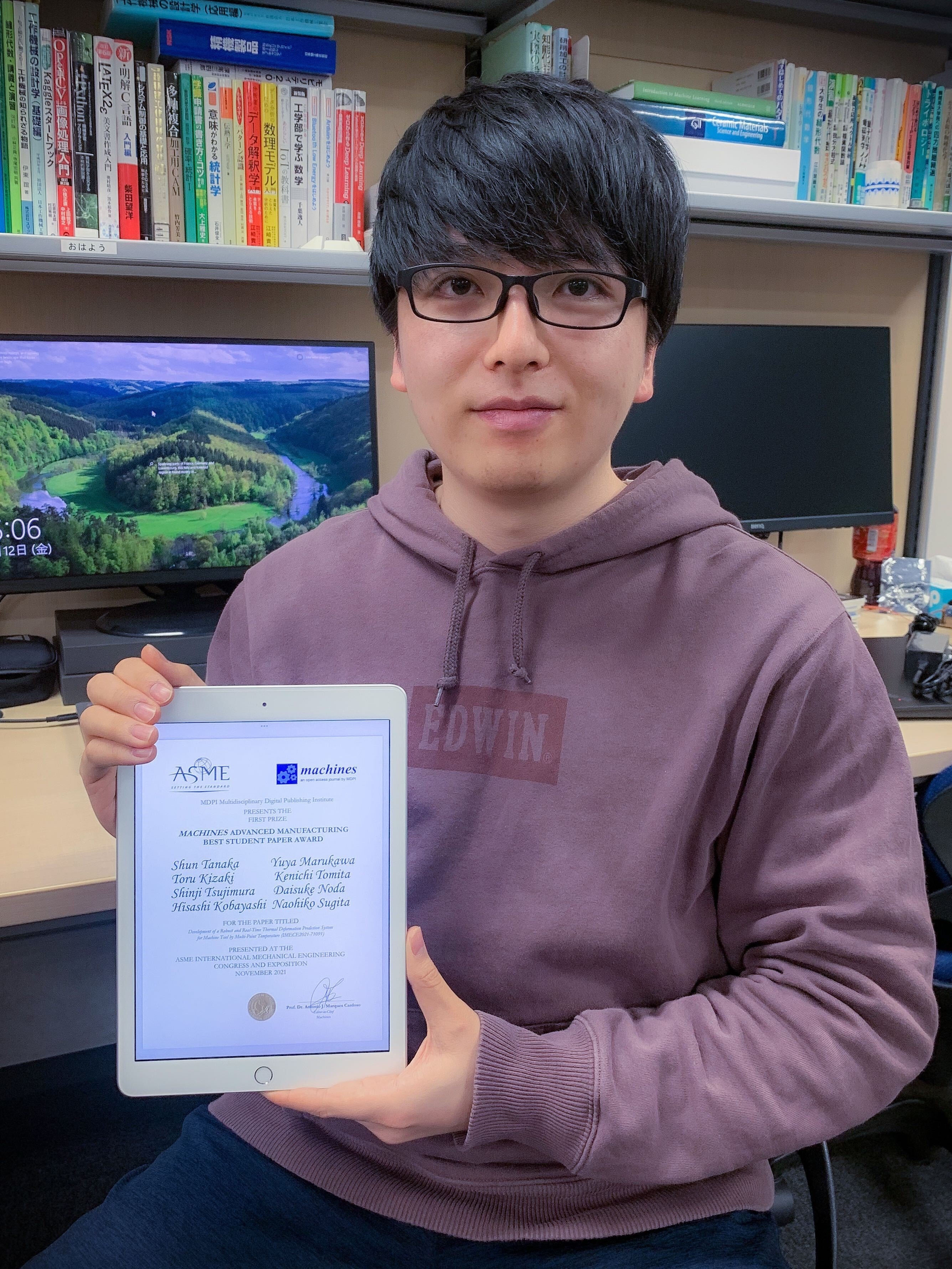
Second Place: USD 300 and a voucher for CHF 800
|
|
Title: Inline Topology Measurement of Material Jetted Metal Parts Authors: Christoph Rehekampff, Benedikt Kirchebner, Florian Krebs, Franz Irlinger, and Tim C. Lueth |
|
The 2nd prize was granted to Christoph Rehekampff. |

Third Place: USD 200 and a voucher for CHF 800
|
|
Title: A Convolutional Neural Network (CNN) for Defect Detection of Additively Manufactured Parts Authors: Mohammad Masud Parvez, Musarrat Farzana Rahman, Shaikat Galib, and Frank Liou |
|
The 3rd prize was granted to Mohammad Masud Parvez. |

24 November 2021
Prof. Dr. Jose A Antonino-Daviu Appointed Editor-in-Chief of the New Section “Electrical Machines and Drives in Machines
We are pleased to announce that Prof. Dr. Jose A Antonino-Daviu has been appointed Editor-in-Chief of the newly established Section “Electrical Machines and Drives” in Machines (ISSN: 2075-1702).
Name: Prof. Dr. Jose A Antonino-Daviu
Affiliation: Department of Electrical Engineering, Universitat Politècnica de València, 46022 Valencia, Spain
Email: [email protected]
Website: https://www.upv.es/pls/oalu/sic_person.Info?p_alias=JOANDA&P_IDIOMA=i
Interests: electric motors; fault diagnosis; transient analysis; signal processing; wavelet analysis; infrared thermography; time–frequency transforms
Prof. Dr. Jose A Antonino-Daviu holds M.Sc. and Ph.D. degrees in electrical engineering, both received from the Universitat Politècnica de València, Valencia, Spain, in 2000 and 2006, respectively. He has worked for IBM, where he was involved in several international projects. He is currently a Full Professor in the Department of Electrical Engineering, Universitat Politècnica de València. He was an Invited Professor at Helsinki University of Technology, Finland, in 2005 and 2007, Michigan State University, USA, in 2010, Korea University, South Korea, in 2014, Université Claude Bernard Lyon 1, France, and Coventry University, U.K., in 2016. He is a co-author of more than 200 papers published in technical journals and conference proceedings. He is also the co-author of one international patent.
Dr. Antonino-Daviu is an Associate Editor of the IEEE Journals Transactions on Industrial Informatics, Industrial Electronics Magazine and Emerging and Selected Topics in Industrial Electronics. He was granted the IEEE Second Prize Paper Award by the Electric Machines Committee of the IEEE Industry Applications Society (2013). He also received the Best Paper Award in the conferences IEEE ICEM 2012, IEEE SDEMPED 2011 and IEEE SDEMPED 2019, and the “Highly Commended Recognition” at the IET Innovation Awards in 2014 and in 2016. He was the General Co-Chair of SDEMPED 2013, and is a member of the Steering Committee of IEEE SDEMPED. He is also General Co-Chair of ICEM’2022 and a member of the ICEM Administrative Committee. In 2016, he received the Medal of the Spanish Royal Academy of Engineering (Madrid, Spain) for his contributions towards new techniques for predictive maintenance of electric motors. In 2018, he was awarded the prestigious “Nagamori Award” from the Nagamori Foundation (Kyoto, Japan). In 2019, he received the SDEMPED Diagnostic Achievement Award (Toulouse, France), for his contributions to the advanced diagnosis of electric motors.
The following is a short Q&A with Prof. Dr. Jose A Antonino-Daviu, who shared his vision for the Section with us, as well as his views of the research area:
- What attracted you to join the academic editorial team of Machines?
Machines is a journal that has gained an important relevance over recent years. One of the things that attracted me the most was the reputed researchers that act both as Editors-in-Chief and Associate Editors. Their excellent profile and serious work guarantee the quality of accepted papers. Moreover, the topics covered by the journal are certainly attractive, including a diversity of emerging areas that are drawing an increasing attention and that could be of special interest for young researchers.
- What is your vision for the Section?
The Section is aiming to attract recent research on electrical machines and drives, focusing on methods that have a direct applicability in practice but not excluding other works with a more theoretical content that may have a practical application in the medium term. Most importantly, the crucial factor is to publish works with a high quality that bring novel contributions to the area and may be useful for other researchers in the field.
- As an expert on electric machines, what valuable suggestions would you like to share with young scholars in terms of research topic selection?
There is not always the possibility of selecting the research topic but, if this is possible, I would suggest selecting areas in which researchers are able to develop solutions to real-world problems of today’s societies. Today, there is a need to give reliable responses to the necessities of different sectors of society. In my case, we have oriented our research to provide solutions to real problems in the industrial area, more specifically, those focused on reliable techniques and methods to determine electric motor and generator health.
We warmly welcome Prof. Dr. Jose A Antonino-Daviu to his new role as Section Editor-in-Chief, and we look forward to him leading Machines to many more milestones.
22 November 2021
722 MDPI Editorial Board Members Receiving "2021 Highly Cited Researchers" Distinction
It is our great honor to congratulate the Editorial Board Members and Editors in MDPI's journals who have been distinguished as 2021 Highly Cited Researchers by Clarivate, according to Web of Science data. We herewith express our gratitude for the immense impact the named researchers continue to make on scientific progress and on our journals' development.
Clarivate's annual list of Highly Cited ResearchersTM identifies the most highly cited scientists for the past decade. Their impactful papers are among the top 1 per cent in the citation distribution of one or more of 22 fields analyzed in the "Essential Science Indicators", distinguishing them as hugely influential among their peers.
| Abate, Antonio Abatzoglou, John T. Abbaszadeh, Mostafa Acharya, U. Rajendra Acharya, Viral V. Agarwal, Ravi P. Ahn, Myung-Ju Airoldi, Laura Ali, Imran Allakhverdiev, Suleyman I. Aluko, Rotimi E. Anasori, Babak Andersson, Dan I. Andes, David Anker, Stefan D. Apergis, Nicholas Ariga, Katsuhiko Arqub, Omar Abu Aschner, Michael Assaraf, Yehuda G. Astruc, Didier Atala, Anthony Atanasov, Atanas G. Atangana, Abdon Bahram, Mohammad Bakris, George L. Balandin, Alexander A. Baleanu, Dumitru Balsamo, Gianpaolo Bando, Yoshio Banks, William A. Bansal-Travers, Maansi Barba, Francisco J. Barros, Lillian Basit, Abdul W. Baskonus, Haci Mehmet Bassetti, Matteo Battino, Maurizio Bell, Jordana T. Bellomo, Nicola Benediktsson, Jon Atli Benelli, Giovanni Benjakul, Soottawat Bhatnagar, Amit Biddle, Stuart J. H. Biondi, Antonio Biondi-Zoccai, Giuseppe Bjarnsholt, Thomas Blaabjerg, Frede Blaschke, Thomas Blay, Jean-Yves Blumwald, Eduardo Blunt, John W. Boffetta, Paolo Bogers, Marcel Bonomo, Robert A. Bowman, David M.J.S. Boyer, Cyrille Brestic, Marian Brevik, Eric C. Buhalis, Dimitrios Burdick, Jason A. Byrd, John C. Cabeza, Luisa F. Cai, Xingjuan Cai, Jianchao Calhoun, Vince D. Calin, George Cao, Jinde Cao, Guozhong Carvalho, Andre F. Castellanos-Gomez, Andres Cerqueira, Miguel Ângelo Parente Ribeiro Chang, Jo-Shu Chang, Chih-Hao Chastin, Sebastien Chau, Kwok-wing Chemat, Farid Chen, Xiaobo Chen, YangQuan Chen, Jianmin Chen, Chaoji Chen, Min Chen, Qi Chen, Jun Chen, Xi Chen, Peng Chen, Yulin Chen, Bo Chen, Chen Chen, Zhi-Gang Chen, Wei-Hsin Chen, Gang Chen, Yongsheng Chen, Xiang Chen, Yimin Chen, Runsheng Chen, Lidong Chen, Shaowei Chen, Qian Chen, Yu Chen, Shuangming Chiclana, Francisco Cho, Sun Young Choi, Wonyong Chowdhary, Anuradha Choyke, Peter L. Cichocki, Andrzej Corella, Dolores Corma, Avelino Cortes, Javier Cortes, Jorge Costanza, Robert Crommie, Michael F. Cui, Yi Cui, Haiying Cui, Qinghua Cummings, Kenneth Michael Dai, Shifeng Dai, Sheng Daiber, Andreas Davis, Steven J. Dawson, Ted M. de la Fuente-Nunez, Cesar Decker, Eric Andrew Dekel, Avishai Demaria, Marco Deng, Yong Deng, Xiangzheng DePinho, Ronald A. Desneux, Nicolas Dimopoulos, Meletios-Athanasios Ding, Aijun Dionysiou, Dionysios D. Dokmeci, Mehmet Remzi Dolgui, Alexandre Dong, Fan Dou, Shi Xue Dou, Letian Du, Qian Du, Bo Dube, Shanta Rishi Dufresne, Alain Dummer, Reinhard Dupont, Didier Edwards, David Elaissari, Abdelhamid Elhoseny, Mohamed Ellahi, Rahmat Ellis, Erle C. ElMasry, Gamal Esteller, Manel Estévez, Mario Fabbro, Doriano Facchetti, Antonio Fan, Zhanxi Fang, Chuanglin Fasano, Alessio Fečkan, Michal Felser, Claudia Feng, Liangzhu Fensholt, Rasmus Ferdinandy, Péter Fernandez-Lafuente, Roberto Ferreira, Isabel C. F. R. Filippi, Massimo Fisher, Helen Fortino, Giancarlo Fosso Wamba, Samuel Franceschi, Claudio Fujita, Hamido Fujita, Masayuki Gai, Francesco Gaisford, Simon Galanakis, Charis M. Galluzzi, Lorenzo Galvano, Fabio Gan, Ren-You Gan, Lihua Gandomi, Amir H. Gao, Bin Gao, Feng Gao, Minrui Gao, Huijun Gao, Wei Gao, Huile Garbe, Claus Garcia, Hermenegildo Gasbarrini, Antonio Gasco, Laura Gautret, Philippe Geng, Yong Gerdts, Gunnar Geschwind, Daniel H. Ghadimi, Noradin Ghaffari, Roozbeh Ghamisi, Pedram Giampieri, Francesca Glick, Bernard R. Gnant, Michael Goel, Ajay Gogotsi, Yury Goldewijk, Kees Klein Gong, Jinlong Gong, Yongji Govindan, Kannan Granato, Daniel Grancini, Giulia Green, Douglas R. Grosso, Giuseppe Gu, Ke Guan, Cao Guastella, Adam J. Guerrero, Josep M. Gui, Guan Guizani, Mohsen Guo, Zaiping Gupta, Rangan Gutzmer, Ralf Haase, Dagmar Habibi-Yangjeh, Aziz Hagemann, Stefan Hagger, Martin Hamblin, Michael R. Hammoudeh, Shawkat Han, Heesup Hanes, Justin Harrison, Roy M. Hartung, Hans-Peter Hasanuzzaman, Mirza He, Jr-Hau He, Hongwen He, Jiaqing He, Debiao Henseler, Jörg Herrera, Francisco Herrera-Viedma, Enrique Hetz, Claudio Ho Kim, Jung Holmes, Elaine Hossain, Ekram Hsueh, Po-Ren Hu, Xiaosong Hu, Wenbin Huang, Jianping Huang, Hongwei Huang, Yu Huang, Jianying Huang, Peng Huang, Baibiao Huang, Shaoming Hubacek, Klaus |
Iqbal, Hafiz M. N. |
Saad, Fred |
The full list of 2021 Highly Cited Researchers can be accessed at the following webpage in the Web of ScienceTM https://recognition.webofscience.com/awards/highly-cited/2021/.
--- Highly Cited Researchers (HCR) is a Clarivate product.
16 November 2021
Topical Advisory Panel Established to Support Editorial Board
Academic editors play a crucial role in leading our journals and ensuring that each article undergoes a robust and timely peer-review. With the launch of Topics this year and addition of Topic Editors to our family of academic editors, we decided it would be a good time to restructure our academic boards, thus providing more clarity and support for each role. MDPI is pleased to announce the launch of a new position—Topical Advisory Panel Member, that will replace the previous position of Topics Board Member. The Topical Advisory Panel will be comprised of early career researchers eager to gain experience in editorial work.
The main responsibility of the new members of the Topical Advisory Panel is to regularly provide support to Guest Editors, Topic Editors, and Section Board Members. The responsibilities of the Topical Advisory Panel are available here: https://www.mdpi.com/editors.
Each year, the members’ performances are evaluated, and outstanding members are promoted to the Editorial Board by the Editor-in-Chief.
To qualify as a Topical Advisory Panel Member, applicants must:
- Have expertise and experience in the field related to the journal;
- Have received a Ph.D. in the last 10 years, approximately;
- Have at least 6-8 published papers in the last 5 years as first author or corresponding author;
- Currently hold an independent research position in academia or a government institute.
If you are interested in this role, please contact the editorial office by email.
We look forward to hearing from you soon.
15 November 2021
Recruiting Volunteer Reviewers for Machines
Machines (ISSN 2075-1702) is recruiting volunteer reviewers. The main responsibility of the reviewers is to regularly provide timely, high-quality reports on the submitted manuscripts. The responsibilities of the reviewers are available at https://www.mdpi.com/reviewers.
Peer review is an essential part in the publication process, ensuring that Machines maintains high quality standards for its published papers. We are striving to recognize the efforts of reviewers.
When reviewing for Machines you will:
- Receive a discount voucher code entitling you to a reduction in the article processing charge (APC) of a future submission to any MDPI journal. Vouchers are linked to your email address and can be applied online at submission or any time before acceptance. Note that vouchers cannot be used after an invoice has been issued. If your article is rejected, the voucher can be reused for your next submission;
- Receive a personalized reviewer certificate;
- Be included in the journal’s annual acknowledgment of reviewers;
- Be considered for the journal’s outstanding reviewer award;
- Build your profile on Publons and have your reviewing activity automatically added for participating journals. Publons profiles can also be integrated with ORCID.
25 October 2021
Open Access Week 2021 | It Matters How We Open Knowledge: Building Structural Equity, 25–31 October

Founded in 1996, MDPI was one of the first fully Open Access publisher. Over 25 years MDPI has grown to become the largest Open Access publisher globally, publishing over 160,000 articles across more than 350 journals in 2020. At the core, MDPI was founded in response to a pressing need of fast publication and inclusion. The scholar was set at the centre of the publication process for the first time. Acting as a service provider, rather than a product provider, MDPI exists to help scientists achive their objective to disseminate research results. At MDPI, we believe scientists deserve a better service from the publishing world.
The International Open Access Week (Open Access Week), founded by the SPARC (the Scholarly Publishing and Academic Resources Coalition) Alliance and student partners in 2008, has been successfully running for 13 years. As an advocate and pioneer of open access publishing, MDPI actively responds to the call of International Open Access Week. This year’s theme of “It Matters How We Open Knowledge: Building Structural Equity” highlights the Recommendation’s call for equitable participation from all authors and readers.
For the last 25 years, MDPI has been committed to disseminating open research. Here is a video showing MDPI’s Commitment to Equity, Inclusion and Diversity for More than 25 Years.
International Open Access Week is an important opportunity to catalyze new conversations, create connections across and between communities that can facilitate this co-design, and advance progress in the building of more equitable foundations for opening knowledge—discussions and actions that need to be continued, year in and year out. MDPI has always aimed to provide professional and efficient publishing services to scholars around the world.
Our mission is to make scientific research accessible to everyone; this year, we interview and hold discussions with open science ambassadors on how to build an equal and inclusive environment for open science. Academic editors help us collaborate with more institutions to advocate for open access ideas.
Besides this, our scientific community is a key driver of our success and MDPI’s remarkable growth. Despite the pandemic, we have prepared online conferences and workshops to gather scholars from different communities.
The Basel Sustainable Publishing online forum provides an equal opportunity for stakeholders and researchers from multi-cultural environments to exchange ideas and eliminate barriers to participation.

Conference date: 25 October 2021, online
Conference website: https://bspf2021.sciforum.net/
Main topics: MDPI discusses the current dilemma of open access science from various perspectives such as governments, libraries, and publishers, and related measures on how to change the status quo of discrimination from a global perspective.
We aim to support equality, inclusion, diversity, and accessibility in scholarly communications. We collaborate with universities and key laboratories and have scholarly communications with researchers, teachers, and students on open access workshops.

- 25 October 2021
Energies journal and Institute of Mechanics, Chinese Academy of Sciences
- 28 October 2021
Machines journal and State Key Laboratory of Traction Power, Southwest Jiaotong University
- 29 October 2021
Processes journal and Beijing Institute of Technology
- 29 October 2021
Coatings journal and Wuhan University of Technology
MDPI is committed to providing open access and high-quality publishing services for scholars and promoting rapid dissemination of academic achievements. We hope to promote the practices and policies of open access publishing and diversify the dissemination of academic achievements.
23 September 2021
Meet Us Online at the International Mechanical Engineering Congress and Exposition (IMECE), 1–5 November 2021
Machines (ISSN 2075-1702) will support and be attending the IMECE 2021 as a bronze sponsor. The conference will be held in virtual form and will take place from 1 to 5 November, 2021.
Meanwhile, Machines will be awarding three Best Student Paper Awards for the contributions on advanced manufacturing (submitted under topics 2-(1-17), 3-3, 4-16, 13-10 and 17-2) in ASME IMECE 2021. The top three winners will receive the following prizes:
- First Place: USD 500 and a 100% Article Processing Charge (APC) waiver;
- Second Place: USD 300 and a voucher for CHF 800;
- Third Place: USD 200 and a voucher for CHF 800.
All winners will receive an acknowledgment certificate and their achievements will be announced at IMECE (the time is to be confirmed in the final program). In addition, a voucher for CHF 300 will be granted for selected excellent papers. Please note that all the vouchers are only valid for the winner’s next submission in Machines. Detailed information can be found at https://event.asme.org/IMECE/Student-Programs/Best-Student-Paper-Competitions.
The International Mechanical Engineering Congress and Exposition (IMECE) is ASME's largest research and development conference. It is focused primarily on mechanical engineering, but encompasses perspectives from many engineering disciplines.
If you are attending this conference, please feel free to start an online conversation with us. Our delegates look forward to meeting you in person and answering any questions you may have. For more information, please visit: https://event.asme.org/IMECE/Sponsor-Exhibit/Bronze-Sponsors/MDPI.
23 September 2021
2020 MDPI Top Reviewer Award—Winners Announced
Rigorous peer-review is the cornerstone of high-quality academic publishing. Over 369,916 scholars served as reviewers for MDPI journals in 2020. We are extremely appreciative of all those who made a contribution to the editorial process in this capacity. At the beginning of every year, journal editorial offices publish a list of all reviewers’ names to express our gratitude. In addition, this year, the MDPI Top Reviewer Award was announced, to recognize the very best reviewers for their expertise and dedication, and their high-quality, and timely review reports. We are pleased to announce the following winners of the 2020 MDPI Top Reviewer Award:
- Adriana Burlea-Schiopoiu;
- Alban Kuriqi;
- Álvaro González-Vila;
- Alessandro Alaimo;
- Alexey Beskopylny;
- Alexander Yu Churyumov;
- Alberto Fernández-Isabel;
- Andrea Mastinu;
- Antonios N. Papadopoulos;
- Anton Rassõlkin;
- Antonio Humberto Hamad Minervino;
- Arkadiusz Matwijczuk;
- Artur Słomka;
- Baojie He;
- Bartłomiej Potaniec;
- Bojan Đurin;
- Camilo Arturo Rodriguez Diaz;
- Carmelo Maria Musarella;
- Chiachung Chen;
- Chiman Kwan;
- Cristian Busu;
- Danil Pimenov;
- Dan-Cristian Dabija;
- Delfín Ortega-Sánchez;
- Demetrio Antonio Zema;
- Denis Butusov;
- Elena Lucchi;
- Gaurab Dutta;
- Livia Anastasiu;
- M. R. Safaei.
For more information about how to become a reviewer of MDPI journals, please see: www.mdpi.com/reviewers.
23 September 2021
Meet Us at the 2023 Annual Conference for Society of Chinese Mechanical Engineering Biomanufacturing Division and the International Symposium on Bio-Manufacturing (ACBD-ISBM2023), 17–19 March, in Beijing, China
The Annual Conference for the Society of Chinese Mechanical Engineering Biomanufacturing Division and the International Symposium on Bio-Manufacturing (ACBD-ISBM2023) will be held from 17 to 19 March 2023, in Beijing, China. The conference is organized by the Society of Chinese Mechanical Engineering Biomanufacturing Division, Beihang University, and co-organized by Tsinghua University, Academy of Military Medical Sciences, and Southeast University.
Symposia:
- Biomanufacturing and Regenerative Medicine;
- Bio-Bionic Manufacturing and Planting/Interventional Devices;
- Biosensor and Flexible Electronics Manufacturing;
- Multi-Scale Biomimetic Manufacturing;
- Micromanipulation and Minimally Invasive Instruments.
- Biological Modeling and Bio-3D Printing;
- Tissue and Organ Chip;
- Innovative Medical Devices and Biomaterials.
The following MDPI journals will be represented:
- Bioengineering;
- Life
- Actuators;
- Applied Sciences;
- Biomimetics;
- Inventions;
- ASI;
- Machines.
22 September 2021
MDPI Joins SDG Publishers Compact

UN's 17 Sustainable Development Goals (SDGs) are the blueprint to achieve a better and more sustainable future for all. In 2020 the SDG Publishers Compact was launched, aimed to inspire publishers and accelerate progress to achieve the 17 goals by 2030. Members of the programme are committed to support the publication of materials that will promote and inspire actions towards SDGs.
MDPI is an eager advocate of SDGs and has already been supporting the programme by creating Special Issues and publishing a series of books on SDGs prior to joining the Compact in 2021. MDPI's Sustainability Foundation initiated the World Sustainability Awards in 2016. We fully support UN's goals to promote sustainable actions that make the world a better place for all and, as part of its commitment, we will focus our actions on SDG10: Reduced Inequalities whilst promoting all 17 SDGs. For more details, please visit the programme’s website: https://www.un.org/sustainabledevelopment/sdg-publishers-compact/.
Joining this initiative was a unanimous decision. MDPI has in its core values the dissemination of science for all, breaking the wall between research access and under-represented members of the scientific community and the general population. To support this initiative further and continue to support under-represented scientists, MDPI will take a series of actions that will be announced once ready.
The first action MDPI takes is to nominate Dr. Liliane Auwerter as the coordinator of the programme. Dr. Auwerter studied Environmental Process Technology (UTFPR, Brazil), obtained her MSc degree in Water and Environmental Engineering (University of Surrey, UK) and in 2020 completed her PhD in self-healing low-friction materials for water transport (Imperial College London, UK), always focusing on diverse scientific projects that would potentially bring sustainability to industrial processes. As a student in Brazil, she engaged in volunteering activities focused on environmental education and took part in the Millennial Development Goals meetings held at the university.
For more information, please contact:
Dr. Liliane Auwerter
Scientific Officer
[email protected]
3 August 2021
Announcement on Japanese Consumption Tax (JCT)
This serves to announce to our valued authors based in Japan that value-added tax, or consumption tax will now be imposed on article processing fees and other service fees for all papers submitted, or resubmitted (assigned new paper IDs), effective from 15 August 2021. The change is in accordance with the Japanese "Act for Partial Revision of the Income Tax Act and Other Acts" (Act No. 9 of 2015), which includes a revision of consumption taxation on cross-border supplies of services such as digital content distribution.
For additional information from the National Tax Agency please see here ("Cross-border supplies of electronic services").
Contact: Setsuko Nishihara, MDPI Tokyo
30 June 2021
2020 Impact Factors - Released
The 2020 citation metrics have been officially released in the Journal Citation Reports (JCR)!
We are pleased to announce that 85 MDPI journals are included, of which:
- 10 journals received their first impact factor
- 96% of journals increased their impact factor from 2019
- 32 journals (38%) ranked among the top 25% of journals, in at least one category
| Journal | Impact Factor | Rank | Category |
| Cancers | 6.639 | Q1 | • Oncology |
| Cells | 6.600 | Q2 | • Cell Biology |
| Pharmaceutics | 6.321 | Q1 | • Pharmacology & Pharmacy |
| Antioxidants | 6.313 | Q1 | • Food Science & Technology |
| • Biochemistry & Molecular Biology | |||
| • Chemistry, Medicinal | |||
| Biomedicines | 6.081 | Q1 | • Medicine, Research & Experimental |
| • Pharmacology & Pharmacy | |||
| • Biochemistry & Molecular Biology | |||
| International Journal of Molecular Sciences | 5.924 | Q1 | • Biochemistry & Molecular Biology |
| Q2 | • Chemistry, Multidisciplinary | ||
| Pharmaceuticals | 5.863 | Q1 | • Pharmacology & Pharmacy |
| • Chemistry, Medicinal | |||
| Journal of Fungi | 5.816 | Q1 | • Mycology |
| • Microbiology | |||
| Nutrients | 5.719 | Q1 | • Nutrition & Dietetics |
| Biosensors | 5.519 | Q1 | • Chemistry, Analytical |
| • Instruments & Instrumentation | |||
| Q2 | • Nanoscience & Nanotechnology | ||
| Marine Drugs | 5.118 | Q1 | • Chemistry, Medicinal |
| • Pharmacology & Pharmacy | |||
| Biology | 5.079 | Q1 | • Biology |
| Nanomaterials | 5.076 | Q1 | • Physics, Applied |
| Q2 | • Chemistry, Multidisciplinary | ||
| • Materials Science, Multidisciplinary | |||
| • Nanoscience & Nanotechnology | |||
| Viruses | 5.048 | Q2 | • Virology |
| Journal of Personalized Medicine | 4.945 | Q1 | • Medicine, General & Internal |
| • Health Care Sciences & Services | |||
| Metabolites | 4.932 | Q2 | • Biochemistry & Molecular Biology |
| Biomolecules | 4.879 | Q2 | • Biochemistry & Molecular Biology |
| Remote Sensing | 4.848 | Q1 | • Geosciences, Multidisciplinary |
| Q2 | • Remote Sensing | ||
| • Imaging Science & Photographic Technology | |||
| • Environmental Sciences | |||
| Gels * | 4.702 | Q1 | • Polymer Science |
| Antibiotics | 4.639 | Q2 | • Infectious Diseases |
| • Pharmacology & Pharmacy | |||
| Toxins | 4.546 | Q1 | • Toxicology |
| • Food Science & Technology | |||
| Vaccines | 4.422 | Q2 | • Immunology |
| • Medicine, Research & Experimental | |||
| Molecules | 4.412 | Q2 | • Chemistry, Multidisciplinary |
| • Biochemistry & Molecular Biology | |||
| Foods | 4.350 | Q2 | • Food Science & Technology |
| Polymers | 4.329 | Q1 | • Polymer Science |
| Journal of Clinical Medicine | 4.242 | Q1 | • Medicine, General & Internal |
| Toxics | 4.146 | Q2 | • Toxicology |
| • Environmental Sciences | |||
| Catalysts | 4.146 | Q2 | • Chemistry, Physical |
| Microorganisms | 4.128 | Q2 | • Microbiology |
| Membranes | 4.106 | Q1 | • Polymer Science |
| Q2 | • Engineering, Chemical | ||
| • Materials Science, Multidisciplinary | |||
| • Chemistry, Physical | |||
| Genes | 4.096 | Q2 | • Genetics & Heredity |
| Fermentation * | 3.975 | Q2 | • Biotechnology & Applied Microbiology |
| Journal of Cardiovascular Development and Disease * | 3.948 | Q2 | • Cardiac & Cardiovascular Systems |
| Plants | 3.935 | Q1 | • Plant Sciences |
| Life | 3.817 | Q2 | • Biology |
| Diagnostics | 3.706 | Q2 | • Medicine, General & Internal |
| Current Oncology | 3.677 | Q3 | • Oncology |
| Materials | 3.623 | Q1 | • Metallurgy & Metallurgical Engineering |
| Q2 | • Materials Science, Multidisciplinary | ||
| • Chemistry, Physical | |||
| • Physics, Applied | |||
| • Physics, Condensed Matter | |||
| Sensors | 3.576 | Q1 | • Instruments & Instrumentation |
| Q2 | • Chemistry, Analytical | ||
| • Engineering, Electrical & Electronic | |||
| Pathogens | 3.492 | Q2 | • Microbiology |
| Agronomy | 3.417 | Q1 | • Agronomy |
| • Plant Sciences | |||
| Chemosensors | 3.398 | Q2 | • Instruments & Instrumentation |
| • Chemistry, Analytical | |||
| Q3 | • Electrochemistry | ||
| Land | 3.398 | Q2 | • Environmental Studies |
| Brain Sciences | 3.394 | Q3 | • Neurosciences |
| International Journal of Environmental Research and Public Health | 3.390 | Q1 | • Public, Environmental & Occupational Health (SSCI) |
| Q2 | • Public, Environmental & Occupational Health (SCIE) | ||
| • Environmental Sciences (SCIE) | |||
| Tomography | 3.358 | Q2 | • Radiology, Nuclear Medicine & Medical Imaging |
| Fractal and Fractional * | 3.313 | Q1 | • Mathematics, Interdisciplinary Applications |
| Sustainability | 3.251 | Q2 | • Environmental Sciences (SCIE) |
| • Environmental Studies (SSCI) | |||
| Q3 | • Green & Sustainable Science & Technology (SCIE) | ||
| • Green & Sustainable Science & Technology (SSCI) | |||
| Water | 3.103 | Q2 | • Water Resources |
| • Environmental Sciences | |||
| Journal of Theoretical and Applied Electronic Commerce Research | 3.049 | Q3 | • Business |
| Energies | 3.004 | Q3 | • Energy & Fuels |
| Agriculture | 2.925 | Q1 | • Agronomy |
| ISPRS International Journal of Geo-Information | 2.899 | Q2 | • Geography, Physical |
| • Computer Science, Information Systems | |||
| Q3 | • Remote Sensing | ||
| Micromachines | 2.891 | Q2 | • Instruments & Instrumentation |
| • Physics, Applied | |||
| Q3 | • Chemistry, Analytical | ||
| • Nanoscience & Nanotechnology | |||
| Coatings | 2.881 | Q2 | • Materials Science, Coatings & Films |
| • Physics, Applied | |||
| Q3 | • Materials Science, Multidisciplinary | ||
| Children | 2.863 | Q2 | • Pediatrics |
| Processes | 2.847 | Q3 | • Engineering, Chemical |
| Separations | 2.777 | Q3 | • Chemistry, Analytical |
| Insects | 2.769 | Q1 | • Entomology |
| Animals | 2.752 | Q1 | • Agriculture, Dairy & Animal Science |
| • Veterinary Sciences | |||
| Symmetry | 2.713 | Q2 | • Multidisciplinary Sciences |
| Atmosphere | 2.686 | Q3 | • Meteorology & Atmospheric Sciences |
| • Environmental Sciences | |||
| Applied Sciences | 2.679 | Q2 | • Engineering, Multidisciplinary |
| • Physics, Applied | |||
| Q3 | • Chemistry, Multidisciplinary | ||
| • Materials Science, Multidisciplinary | |||
| Photonics | 2.676 | Q2 | • Optics |
| Buildings * | 2.648 | Q2 | • Construction & Building Technology |
| • Engineering, Civil | |||
| Healthcare | 2.645 | Q2 | • Health Policy & Services (SSCI) |
| Q3 | • Health Care Sciences & Services (SCIE) | ||
| Minerals | 2.644 | Q2 | • Mining & Mineral Processing |
| • Mineralogy | |||
| • Geochemistry & Geophysics | |||
| Forests | 2.634 | Q1 | • Forestry |
| Crystals | 2.589 | Q2 | • Crystallography |
| Q3 | • Materials Science, Multidisciplinary | ||
| Entropy | 2.524 | Q2 | • Physics, Multidisciplinary |
| Diversity | 2.465 | Q2 | • Biodiversity Conservation |
| Q3 | • Ecology | ||
| Journal of Marine Science and Engineering | 2.458 | Q2 | • Oceanography |
| • Engineering, Marine | |||
| • Engineering, Ocean | |||
| Medicina | 2.430 | Q2 | • Medicine, General & Internal |
| Machines * | 2.428 | Q2 | • Engineering, Mechanical |
| Q3 | • Engineering, Electrical & Electronic | ||
| Electronics | 2.397 | Q3 | • Engineering, Electrical & Electronic |
| • Computer Science, Information Systems | |||
| • Physics, Applied | |||
| Fishes * | 2.385 | Q2 | • Fisheries |
| • Marine & Freshwater Biology | |||
| Metals | 2.351 | Q2 | • Metallurgy & Metallurgical Engineering |
| Q3 | • Materials Science, Multidisciplinary | ||
| Horticulturae * | 2.331 | Q1 | • Horticulture |
| Veterinary Sciences * | 2.304 | Q1 | • Veterinary Sciences |
| Universe | 2.278 | Q3 | • Physics, Particles & Fields |
| • Astronomy & Astrophysics | |||
| Mathematics | 2.258 | Q1 | • Mathematics |
| Magnetochemistry | 2.193 | Q3 | • Chemistry, Inorganic & Nuclear |
| • Chemistry, Physical | |||
| • Materials Science, Multidisciplinary | |||
| Current Issues in Molecular Biology | 2.081 | Q4 | • Biochemistry & Molecular Biology |
| Actuators | 1.994 | Q3 | • Instruments & Instrumentation |
| • Engineering, Mechanical | |||
| Aerospace * | 1.659 | Q2 | • Engineering, Aerospace |
* Journals given their first Impact Factor in 2021
Source: 2020 Journal Impact Factors, Journal Citation Reports ® (Clarivate, 2021)
29 June 2021
Recruiting Editorial Board Members for Three New Sections in Machines
Machines is recruiting Editorial Board Members for the following three new Sections:
- Electrical Machines and Drives;
- Micro/Nano Electromechanical Systems (MEMS/NEMS);
The main responsibilities of the Section Editorial Board Members are as follows:
1) Promoting this new Section on your social media or among your acquaintances;
2) Supervising the quality of the papers in this Section (when we have new submissions in the Section);
3) Acting as a/recommending a Guest Editor for a Special Issue on a topic related to your research interests;
4) Providing conference/society cooperation recommendations.
Machines (ISSN 2571-8789) is an open access, international journal on machinery, manufacturing, and engineering. It was launched in 2013 and has been indexed in the Science Citation Index Expanded (SCIE)—Web of Science, Scopus, and Inspec and will receive its first Impact Factor in June 2021. Its CiteScore is 4.5 (Scopus), which equals rank 136/596 (Q1) in the Mechanical Engineering, 78/336 (Q1) Industrial and Manufacturing Engineering, 20/111 (Q1) Control and Optimization, and 12/69 (Q1) Computer Science (miscellaneous).
As we provide a low-cost publishing service in open access format, we, unfortunately, cannot pay our Editor Members an honorarium. The term of the membership is two years and after that period it can be renewed.
To apply for this position, please send your full academic CV and a short cover letter that details your interest and enthusiasm for the position to [email protected].
25 June 2021
Prof. Dr. Dan Zhang Appointed Section Editor-in-Chief of “Automation Systems” in Machines
We are pleased to announce that Prof. Dr. Dan Zhang has been appointed the Section Editor-in-Chief of the “Automation Systems” Section of Machines (ISSN 2075-1702).
Prof. Dr. Dan Zhang received his Ph.D. degree in mechanical engineering from Laval University in June 2000. He is a Kaneff Professor and the Tier 1 York Research Chair in advanced robotics and mechatronics with the Department of Mechanical Engineering, Lassonde School of Engineering, York University. His research interests include robotics and mechatronics, high-performance parallel robotic machine development, micro/nanomanipulation, and MEMS devices, and rehabilitation robots and rescue robots. He has served as a member of Natural Sciences and Engineering Research Council of Canada (NSERC) Grant Selection Committee. He is a registered Professional Engineer of Canada; a Fellow of the Canadian Academy of Engineering (CAE), the Engineering Institute of Canada (EIC), the American Society of Mechanical Engineers (ASME), and the Canadian Society for Mechanical Engineering (CSME); a Senior Member of the SME and IEEE.
We warmly welcome Prof. Dr. Dan Zhang in his role as our Section Editor-in-Chief, and we look forward to him leading Machines to achieve more milestones.

Prof. Dr. Dan Zhang
Email: [email protected]
Affiliation: Department of Mechanical Engineering, Lassonde School of Engineering, York University, 4700 Keele Street, Toronto, ON M3J 1P3, Canada
Homepage: mech.lassonde.yorku.ca/dan-zhang/
Interests: robotics and mechatronics; high-performance parallel robotic machine development; sustainable/green manufacturing systems; micro/nanomanipulation and MEMS devices (sensors); micro mobile robots and control of multi-robot cooperation; intelligent servo control system for the MEMS-based high-performance micro-robot; web-based remote manipulation; rehabilitation robot and rescue robot
21 June 2021
Meet Us at the China Instrument and Control Society Annual Meeting, Shanghai, China, 27–29 August 2021

MDPI will be attending the China Instrument and Control Society Annual Meeting, which is to be held in Shanghai, China, on 27–29 August 2021. The conference invites experts and students who are engaged in the study of instrumentation to participate in an in-depth discussion on the basic research direction, technological innovation, and industrial path of the instrumentation discipline.
The following MDPI journals will be represented at the meeting:
If you are attending this conference, please feel free to stop by our booth: C-01. Our delegates are looking forward to meeting you in person and answering any questions you may have. For more information about the conference, please visit: http://meeting.cis.org.cn/.
11 May 2021
Prof. Dr. Antonio J. Marques Cardoso Appointed Editor-in-Chief of Machines
We are pleased to announce that Prof. Dr. Antonio J. Marques Cardoso has been appointed as the Editor-in-Chief of Machines (ISSN ISSN 2075-1702).
Prof. Dr. Antonio J. Marques Cardoso received his Dipl. Eng., Dr. Eng., and Habilitation degrees from the University of Coimbra, Coimbra, Portugal, in 1985, 1995 and 2008, respectively, all in Electrical Engineering. From 1985 until 2011, he was with the University of Coimbra, Coimbra, Portugal, where he was Director of the Electrical Machines Laboratory. Since 2011, he has been with the University of Beira Interior (UBI), Covilhã, Portugal, where he is Full Professor at the Department of Electromechanical Engineering and Director of CISE—Electromechatronic Systems Research Centre (http://cise.ubi.pt). He was Vice-Rector of UBI (2013–2014). His teaching interests cover electrical machines, power electronics and drives, maintenance management, and fault diagnosis of electromechatronic systems, and his research interests are focused on diagnosis and fault tolerance of electrical machines, power electronics and drives.
He is the author of a book entitled Fault Diagnosis in Three-Phase Induction Motors (Coimbra, Portugal: Coimbra Editora, 1991), (in Portuguese), editor of a book entitled Diagnosis and Fault Tolerance of Electrical Machines, Power Electronics and Drives (IET/SciTech, UK, 2018), and also author of around 500 papers published in technical journals and conference proceedings.
Prof. Dr. Cardoso has spent two sabbatical years (2009/2010 and 2016/2017) at the Sapienza University of Rome (Italy), and he has also been an Invited Visiting Professor at several universities abroad: Vaxjo University, Sweden (2003, 2004, 2008), University of Vigo, Spain (2003, 2004 and 2005), University of Minas Gerais, Brazil (2006), University of Sciences and Technology of Oran, Algeria (2007), University of Tunis El Manar, Tunisia (2009, 2014 and 2016), Sapienza University of Rome, Italy (2007, 2008, 2009 and 2011), Universidad Autónoma de Occidente, Cali, Colombia (2011 and 2014), University Mohamed Khider, Biskra, Algeria (2012 and 2018), Universidad del Valle, Cali, Colombia (2015), Aalto University, Espoo, Finland (2015), Coventry University, Coventry, UK (2016, 2020), Technische Universitat Wien, Vienna, Austria (2017), INP-ENSEEIHT, Toulouse, France (2017) and Aalborg University, Denmark (2018).
He has been acting as European Union Expert Evaluator; Independent Scientific Expert of the Italian Ministry for Education, University and Research (MIUR); Independent Scientific Expert of the Polish Centre for Research and Development; Independent Scientific Expert of the University of Sharjah (United Arab Emirates); Independent Scientific Expert of the University of Agder (Norway); Independent Scientific Expert of the National Science Centre (Poland); External Consultant of the Universidad Autónoma de Occidente (Colombia); Independent Scientific Expert of the Fundação para a Ciência e a Tecnologia (Portuguese Bational funding agency for science, research and technology).
We warmly welcome Prof. Dr. Antonio J. Marques Cardoso as our Editor-in-Chief and are confident that his experience and expertise will help Machines continue to grow.

Prof. Dr. Antonio J. Marques Cardoso
Affiliation: CISE—Electromechatronic Systems Research Centre, Department of Electromechanical Engineering, University of Beira Interior, Calçada Fonte do Lameiro, P - 6201-001 Covilhã, Portugal
Email: [email protected]
Interests: diagnosis and fault tolerance of electrical machines; power electronics and drives
Web: http://www.cise.ubi.pt/index.php?op=details&user=5
28 April 2021
Book Builder—Compile a Customized E-Book from Your Favorite MDPI Open Access Content
MDPI Books recently released Book Builder, a new online tool to conveniently arrange, design and produce an eBook from any content published in MDPI journals. Book Builder offers two functions: on the one hand (1) Selections, available to every registered user of MDPI; on the other hand (2) Special Issue Reprints, which can be used exclusively by Guest Editors of Special Issues.
Selections
In just a matter of a few clicks, all users are now able to assemble books from MDPI articles and receive instantaneous feedback in the form of a fully produced and compiled book (PDF), which can be downloaded or ordered as print copy. Selections can include any paper published with MDPI, picking and combining content from different journals and special issues.
This way, the user may for example choose to compile an ebook focusing around a particular topic, or assemble articles from a group of others.
We invite you to make yourself familiar with the new tool! The Book Builder can be found here: https://www.mdpi.com/books/book_builder.
Special Issue Reprints
The Book Builder allows Guest Editors of MDPI journals to create a reprint from a successfully completed Special Issue or Topical Collection in book format. If you are a Guest Editor for an MDPI journal, you can use the new tool to create an PDF document which includes all articles published in the Special Issue as well as a book cover and table of contents.
For Special Issues containing a minimum of 5 articles, the Guest Editor can request its publication on the MDPI Book platform. Published reprints are assigned an ISBN and DOI.
In addition to the PDF copy of the Reprint Book, as a token of our gratitude, MDPI offers every Guest Editor one (1) complimentary print copy (via print-on-demand). All contributors benefit from a discount on orders of any additional print copies, to share with colleagues or libraries or others.

Why choose MDPI Books?
In line with our organization's values, MDPI Books publishes all content in open access, promoting the exchange of ideas and knowledge in a globalized world. MDPI Books encompasses all the benefits of open access—high availability and visibility, as well as wide and rapid dissemination. MDPI Books are distributed under the terms and conditions of the Creative Commons Attribution License, meaning as an author you retain the copyright for your work. In addition, with MDPI Books you can complement the digital version of your work with a high-quality printed counterpart.
If you are interested in editing a book volume or series, or have a monograph manuscript to be considered for publication, please submit your proposal online and look at our Information for Authors.
Contact: Laura Wagner, MDPI Books Manager (email)
15 April 2021
MDPI Celebrates Company Milestone With 25th Anniversary Page
"We exist to help scientists achieve their own objectives"

In June of this year, MDPI will celebrate the 25th anniversary of its foundation. To mark this significant milestone, we have created a 25th Anniversary page on our website that evokes the development of our company over the past quarter-century.
MDPI has been a pioneer of Open Access publishing ever since the concept was first created.
In a wide-ranging interview, our CEO Delia Mihaila reflects on the company’s 25th anniversary and its contribution to the world of scientific publishing.
Delia considers how MDPI has evolved since starting life in 1996 as a visionary ‘project’ run out of an apartment in Basel, Switzerland, by Dr. Shu-Kun Lin. A chemist who was passionate about the long-term preservation of rare chemical sample, Dr. Lin was determined to help scholars publish their findings as quickly as possible and make their research results available to as wide a readership as possible worldwide. That determination remains unchanged 25 years later.
Today, MDPI is an international organization with over 4,000 employees based on three continents and in ten countries, and ranks among the world's top four academic publishers.
MDPI's mission is to accelerate access to new scientific research, delivering insight faster for researchers worldwide. Read more here about the company's remarkable success story and what the Open Access publishing model can offer the global scientific community.
23 March 2021
Recruiting Journal Board Members for Machines
To expand our contribution to the Mechanical Engineering community, Machines is recruiting scientists to join the Journal Board: https://www.mdpi.com/journal/machines.
Should you decide to serve on the Journal Board, you will be responsible for one or some of the following tasks:
- Reviewing a couple of manuscripts per year;
- Editing a Special Issue on a topic related to your research, plus making final decisions for submitted papers;
- Recommending timely topics and suggesting potential Guest Editors;
- Identifying appropriate conferences for Editors to attend;
- Promoting the journal.
Machines (ISSN 2571-8789) is an open access international journal on machinery, manufacturing and engineering. It was launched in 2013 and has been indexed in the Science Citation Index Expanded (SCIE)-Web of Science, Scopus, Inspec and will receive its first Impact Factor in June 2021. Its CiteScore is 3.2 (Scopus). Machines ranks 92/340(Q2) in the category “Engineering: Industrial and Manufacturing Engineering” and 184/585 (Q2) in the category “Engineering: Mechanical Engineering”.
As we provide a low-cost publishing service in open access format, we, unfortunately, cannot pay our Editor Members an honorarium. The term of the membership is two years and after that period it can be renewed.
We believe that your expertise, together with our rigorous editorial policies, can build a high-standard journal specifically dedicated to mechanical research. If you are interested in becoming a Journal Editor for Machines, please send your full academic CV and a short cover letter that details your interest and enthusiasm for the position to [email protected] before 31 August 2021.
10 March 2021
Journal Selector: Helping to Find the Right MDPI Journal for Your Article

At MDPI, we strive to make your online publication process seamless and efficient. To achieve this, our team is continuously developing tools and features to make the user experience useful and convenient.
As the number of academic papers continues to grow, so does the need to analyze and work with them on a large scale. This prompted us to design a new feature aimed at helping researchers find journals that are relevant to their publication by matching their abstract topic. In this regard, we designed a similarity model that automatically identifies the most suitable academic journals for your paper.
We are pleased to introduce Journal Selector, a new feature that measures similarity in academic contexts. By simply entering the title and/or abstract into our Journal Selector, the author will see a list of the most related scientific journals published by MDPI. This method helps authors select the correct journals for their papers, highlighting the time of publication and citability.
The methodology is known as representation learning, where words are represented as vectors in hyperspace. Representation helps us differentiate between different concepts within articles, and in turn, helps us identify similarities between them.
We used an advanced machine learning model to better capture the semantic meanings of words. This helps the algorithm make better predictions by leveraging scientific text representation. In turn, this ensures high precision, helping authors decide which journal they should submit their paper to.
The goal is to support authors to publish their work in the most suitable journal for their research, as fast as possible, accelerating their career progress.
Contact: Andrea Perlato, Head of Data Analytics, MDPI (email)
25 December 2020
Machines Established 10 New Sections
We are pleased to announce the establishment of ten new sections of Machines to cover the innovative technologies and applications in the following fields of mechanical engineering:
- Machines Testing and Maintenance;
- Automation Systems;
- Mechatronic and Intelligent Machines;
- Advanced Manufacturing;
- Machine Design and Theory;
- Industrial Design and Chemical Machinery;
- Vehicle Engineering;
- Energy and Power Engineering;
- Engineering Materials;
- Bioengineering Technology.
Machines (ISSN 2075-1702; CODEN: MACHCV) is an international peer-reviewed open access journal on machinery and engineering published quarterly online by MDPI. The IFToMM are affiliated with Machines and its members receive a discount on the article processing charges.
Machines is covered in the Science Citation Index Expanded (SCIE)—Web of Science and will receive its first impact factor in 2021.
If you are interested in submitting a manuscript to the new sections mentioned above, please click here. To propose or request further information, please contact the Machines Editorial Office ([email protected]). We look forward to hearing from you.
24 December 2020
Recruiting Editorial Board Members for Machines
To expand our contribution to the Mechanical Engineering community, we are recruiting scientists to join our Editorial Board.
We encourage applications from researchers with a background in a wide range of subject areas (https://www.mdpi.com/journal/machines/sections). Should you decide to serve on the Editorial Board, you would be responsible for some of the following tasks depending on your availability:
- Reviewing a couple of manuscripts per year;
- Editing a Special Issue on a topic related to your research, and making final decisions for submitted papers;
- Recommending timely topics and suggesting potential guest editors;
- Publishing one paper per year, free of charge, in open access format;
- Identifying appropriate conferences for editors to attend;
- Promoting the journal.
Machines (https://www.mdpi.com/journal/machines) is an international open access journal, led by the Editor-in-Chief Prof. Dr. Hamid Reza Karimi from the Politecnico di Milano, Italy. Machines is covered in the Science Citation Index Expanded (SCIE) – Web of Science and will receive its first impact factor in 2021.
As we provide a low-cost publishing service in open access format, we, unfortunately, cannot pay our Editorial Board Members an honorarium. The term of the Editorial Board membership is two years and after that period it can be renewed.
We believe that your expertise together with our rigorous editorial policies can build a high-standard journal specifically dedicated to mechanical research. If you are interested in becoming an Editorial Board Member for Machines, please send your full academic CV and a short cover letter that details your interest and enthusiasm for the position to [email protected], before 10 March 2021.
15 December 2020
MDPI adopts C4DISC principles to improve diversity and inclusion in scholarly communications
MDPI is proud to adopt the principles of the Coalition for Diversity & Inclusion in Scholarly Communications (C4DISC) to support building equity, inclusion, diversity, and accessibility in scholarly communications.
The C4DISC represents organizations and individuals working in scholarly communications and is focused on addressing issues of diversity and inclusion within the publishing industry.

MDPI’s Managing Editors encourage the Editors-in-Chief and Associate Editors to appoint diverse expert Editorial Boards. This is also reflective in our multi-national and inclusive workplace. We are proud to create equal opportunities without regard to gender, ethnicity, geographic location, sexual orientation, age, disability, political beliefs, religion, or socio-economic status. There is no place for discrimination in our workplace and editors of MDPI journals are to uphold these principles in high regard.
Representatives from C4DISC meet monthly, and have started to implement initiatives to shed light and improve on the lack of diversity in scholarly communications. Some of the initiatives include developing a joint statement of principles; conducting market research; providing training resources, best practices, toolkits, and documentation for our collective memberships; and establishing outreach programs, curricula, events, and publications.
The Coalition is committed to:
- eliminating barriers to participation, extending equitable opportunities across all stakeholders, and ensuring that our practices and policies promote equitable treatment and do not allow, condone, or result in discrimination;
- creating and maintaining an environment that respects diverse traditions, heritages, and experiences;
- promoting diversity in all staff, volunteers, and audiences, including full participation in programs, policy formulation, and decision-making;
- raising awareness about career opportunities in our industries to groups who are currently underrepresented in the workforce;
- supporting our members in achieving diversity and inclusion within their organizations.
15 December 2020
Machines has changed to monthly publication
We are pleased to announce that Machines has switched to monthly publication. A monthly publication allows papers to be indexed in Web of Science and other indexing databases on a monthly basis rather than every 3 months, and they become searchable and are cited earlier.
14 December 2020
Article Layout and Templates Revised for Future Volumes
At MDPI we have slightly revised the layout for articles to be published in the 2021 Volume, starting at the end of December 2020. As of today, the article templates available for download on ‘Instructions for Authors’ pages have been updated.
The most noticeable change can be found on the first page of the article, where a left-hand column has been created to include the following front matter elements: (i) the recommended citation style for the article, (ii) the publishing history, (iii) as well as the Creative Commons Attribution license used (iv) a standard note regarding affiliations. At the same time, the extra spacing on the left means the authors’ affiliations are now more clearly set apart than before. Other front matter key elements such as journal logo, article type, article title, authors, abstract and keywords remain unchanged.
The blank column on the left runs through all pages in an article; as a result, the main text is slightly more condensed, which improve reader friendliness for smaller screens. Small figures/tables are aligned on the left with standard indenture, while large figures/tables are centered and covering the full width of the page. The revised layout was applied in the article pictured below, to serve as an example:
1) Information is displayed in the left information bar.
2) In the main text, there is a blank column on the left.
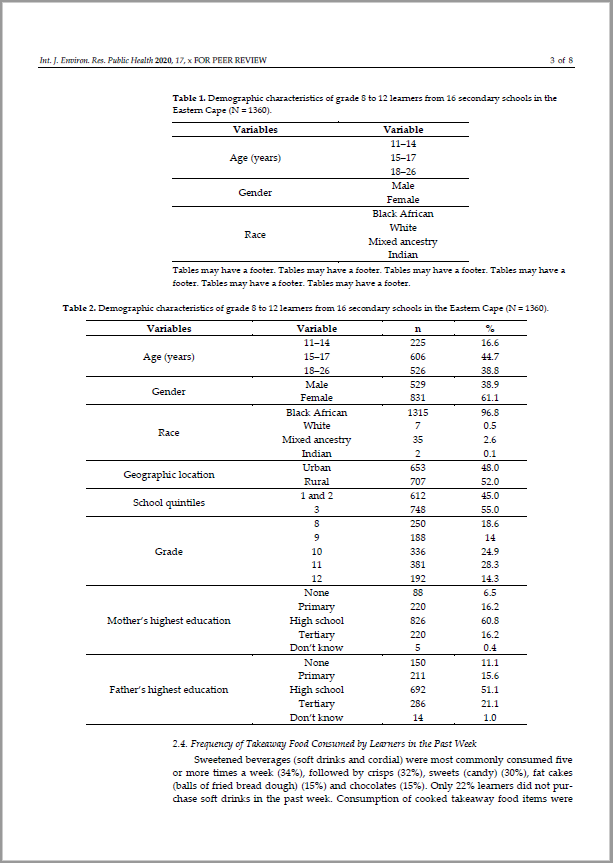
3) Small tables/figures are aligned on the left, large tables/figures are centered.
11 December 2020
2020 "Highly Cited Researchers" on MDPI Journal's Editorial Boards
We are pleased to acknowledge that many academic editors who have made an impact on MDPI journals as editorial board members, editors-in-chief, or section editors, are recognized as 2020 Highly Cited Researchers by Clarivate.
Highly Cited Researchers highlights the top 1% of researchers, by citations, in one or more of the 22 fields used in Clarivate Analytics Essential Science Indicators. We offer our congratulations to 279 academic editors of MDPI journals who were recognized as the most influential scholars in their fields in 2020.
Adams, Dave Agarwal, Ravi P. Ahn, Choon Ki Ahn, Myung-Ju Albrecht, Randy A. Andersson, Dan I. Anker, Stefan D. Apergis, Nicholas Ariga, Katsuhiko Artaxo, Paulo Balsamo, Gianpaolo Barba, Francisco J. Benediktsson, Jon Atli Benelli, Giovanni Bhatnagar, Amit Bialystok, Ellen Blaabjerg, Frede Blay, Jean-Yves Bogers, Marcel Bolton, Declan J. Boyer, Cyrille Brocca, Luca Bruix, Jordi Buhalis, Dimitrios Burdick, Jason A. Byrd, John C. Cabeza, Luisa F. Cabrerizo-Lorite, Francisco Javier Cai, Jianchao Calhoun, Vince D. Cantu, Robert C. Cerqueira, Miguel Chang, Jo-Shu Chau, Kwok-wing Chemat, Farid Chen, Jianmin Chen, Jun Chen, Min Chen, Shaowei Chen, Wei Chen, Wei-Hsin Chen, Xiaofeng Chen, Yangkang Chen, Zhi-Gang Chiclana, Francisco Corella, Dolores Cortes, Javier Cortes, Jorge Cummings, Kenneth Michael Dai, Shifeng Decker, Eric A. DePinho, Ronald A. Dimopoulos, Meletios-Athanasios Dincer, Ibrahim Du, Yihong Dupont, Didier Edwards, David Ellahi, Rahmat Ellis, Erle C. ElMasry, Gamal Esteller, Manel Estruch, Ramón Fang, Chuanglin Fasano, Alessio Fernandez-Lafuente, Roberto Ferreira, Isabel Fortino, Giancarlo Galluzzi, Lorenzo Galvano, Fabio Gandomi, Amir H. Gandomi, Amir H. Gao, Bin Gao, Feng Gao, Wei Garbe, Claus García, Hermenegildo Geschwind, Daniel H. Giampieri, Francesca Giralt, Sergio A. Glanz, Karen Goldewijk, Kees Klein Gössling, Stefan Govindan, Kannan Granato, Daniel Grosso, Giuseppe Grosso, Giuseppe Guerrero, Josep M. Haase, Dagmar Hagger, Martin S. Hamblin, Michael R. Han, Heesup Jankovic, Joseph Janotti, Anderson |
Jiang, Hai-Long Kalaji, Hazem M. Kalantar-Zadeh, Kourosh Kaner, Richard B. Karimi, Hamid Reza Kataoka, Kazunori Keesstra, Saskia Kepp, Oliver Kerminen, Veli-Matti Keyzers, Robert A. Khademhosseini, Ali Khan, Nafees A. Kim, Ki-Hyun Klemeš, Jiří Jaromír Klenk, Hans-Peter Konopleva, Marina Y. Krammer, Florian Krebs, Frederik C. Kroemer, Guido Kudo, Masatoshi Kurths, Juergen Kurzrock, Razelle Kuznetsov, Nikolay V. Kyrpides, Nikos C. La Vecchia, Carlo Lai, Yuekun Lam, James Lancellotti, Patrizio Lee, Sangmoon Leung, Victor C. M. Li, Jinghong Li, Yurui Lindahl, José M. Merigó Lip, Gregory Y. H. Loh, Xian Jun Long, Hualou Lund, Henrik Luo, Jingshan Luque, Rafael Lyons, Timothy W. Ma, Jun Ma, Wen-Xiu Ma, Yanming Maeda, Keisuke Makarova, Kira Mantovani, Alberto Martín-Belloso, Olga Martinoia, Enrico Marzband, Mousa Masclaux-Daubresse, Celine Masson, Patrick Mateos, María Victoria Mathiesen, Brian Vad Matyjaszewski, Krzysztof McArthur, Grant A. McCauley, Darren Medlock, Jolyon M. Melero, Ignacio Mezzetti, Bruno Miroshnichenko, Andrey E. Moran, Daniel Mueller, Lukas A. Mueller-Roeber, Bernd Naushad, Mu Nemeroff, Charles B. Nieto, Juan J. O'Donnell, Colm Ogino, Shuji Olabi, Abdul-Ghani O'Regan, Donal Orsini, Nicola Oswald, Isabelle P. Ozcan, Aydogan Pahl-Wostl, Claudia Pang, Huan Payne, James E. Peng, Shushi Perc, Matjaz Perez-Alvarez, Jose Angel Piquero, Alex R. Ploss, Alexander Postolache, Mihai Pradhan, Biswajeet Prinsep, Michele R. Qian, Dong Qu, Xiaogang Reiter, Russel J. Riahi, Keywan Richter, Andreas Rignot, Eric Robert, Caroline Ros, Emilio Rosell, Rafael |
Rosen, Marc A. |
The full list of 2020 Highly Cited Researchers can be accessed on https://recognition.webofsciencegroup.com/awards/highly-cited/2020/
--- Highly Cited Researchers (HCR) is a Clarivate product.
18 September 2020
JCDD, Buildings, Machines Accepted for Inclusion in Science Citation Index Expanded (SCIE) in the Web of Science
We are pleased to inform the Journal of Cardiovascular Disease and Development (ISSN 2308-3425), as well as the journals Buildings (ISSN 2075-5309) and Machines (ISSN 2075-1702) have been accepted for inclusion in the Science Citation Index Expanded (SCIE) in the Web of Science Core Collection, as well as in Current Contents. These journals are due to receive first Journal Impact Factors in the June 2021 release of the Journal Citation Reports.



The Science Citation Index Expanded (SCIE), Web of ScienceTM and Current Contents are Clarivate Analytics products.
9 July 2020
Open Access Agreement Between Jisc Collections and MDPI
We are delighted to announce the establishment of our Open Access agreement with Jisc Collections, which will allow UK institutions to benefit from access to article processing charge (APC) discounts and streamlined payment workflows.
All institutions participating in the agreement will also gain access to the MDPI online submission system where they can find full article metadata and pricing information for easy identification and additional transparency.
Eligible authors affiliated with the participating institutions are prompted to choose the corresponding Institutional Open Access Program (IOAP) when they submit an article via our online submission system.

About Jisc
Jisc's vision is for the UK to be the most digitally advanced education and research nation in the world. At its heart is the super-fast national research and education network, Janet, with built-in cyber security protection. Jisc also provides technology solutions for its members (colleges, universities and research centres) and customers (public sector bodies), helps members save time and money by negotiating sector-wide deals and provides advice and practical assistance on digital technology. Jisc is funded by the UK higher and further education and research funding bodies and member institutions.
For more information, contact [email protected].
About MDPI
MDPI is a publisher of fully peer-reviewed, Open Access journals with a focus on thorough and rapid editorial processing. Its aim is to ensure that high-quality research is verified and made available to the research community as quickly as possible. MDPI stands at the forefront of the Open Access movement, having launched its first online journal Molecules in 1996. Today, MDPI is a leader in Open Access publishing with over 250 journals across all research disciplines, and all content published under a Creative Commons Attribution License (CC BY).
For any questions about this agreement, please contact the MDPI IOAP team at [email protected].
18 June 2020
Recruiting Editors for Five New Sections Set up in Machines
To better categorize papers published in the journal, the following five new topical Sections have recently been set up:
Machine Dynamics and Automation
We are now recruiting Editorial Board Members (EBMs) for these Sections. If you are an active researcher in one of the aforementioned fields and are passionate about participating in cutting-edge research, please do not hesitate to get in touch ([email protected]).
Machines Editorial Office[email protected]
13 May 2020
COVID-19 Academic Resources Center

Since 1996, MDPI has been committed to supporting the research community by providing the latest research freely available and making relevant and useful research available as quickly as possible. The world is current experiencing a pandemic of COVID-19, and researchers are working extremely hard to understand it and find a cure.
The values MDPI holds strongly are particularly important at the moment, and we will continue to publish relevant, peer-reviewed research as quickly as possible in open access format. This means that it will immediately be available for researchers, health professionals, and the general public to read, distribute, and reuse. We believe that scientific advancements will be crucial to overcoming this pandemic, and will do everything we can to support researchers working looking for solutions.
COVID-19 Academic Resources Center contains a variety of information related to COVID-19 available from MDPI, including journal articles, special issues, and preprints, among others.
For more information, please visit: https://www.mdpi.com/covid-19
9 April 2020
Free Open Platforms to Support Academics During the COVID-19 Pandemic
As a leading Open Access publisher, MDPI is committed to fostering open scientific exchange in all forms across all disciplines. Due to the outbreak of COVID-19, many researchers have to stay at home and many academic conferences have been cancelled or postponed. In light of these changes, MDPI has adopted numerous initiatives that may help accelerate scientific exchange and provide support to the academics during this period.
Scholarly Community—Encyclopedia
Encyclopedia is an online reference created and curated by active scholars. It aims to highlight the latest research results as well as providing benchmark information for researchers and the general public interested in accurate and advanced knowledge on specific topics.
Comprehensive and Free Literature Database—Scilit
Scilit is a comprehensive, free database for scientists that uses a new method to collate data and index scientific material. Our crawlers extract the latest data from CrossRef and PubMed on a daily basis. This means that newly published articles are immediately added to Scilit.
Display Academic Achievements—SciProfiles
SciProfiles is an innovative social network for researchers and scholars that is developed by MDPI. In line with our broad mission, the purpose of SciProfiles is to accelerate discovery and innovation by facilitating immediate access to research results and providing opportunities for academic networking.
Organize and Participate in Conferences Online—Sciforum
Sciforum is an event planning platform that supports open science by offering the opportunity to host and participate in academic conferences. It provides an environment for scholarly exchange, discussion of topics of current interest, building of networks, and establishing collaborations.
Post Early Versions of Research Outputs—Preprints
Preprints is a platform dedicated to making early versions of research outputs permanently available and citable. We post original research articles and comprehensive reviews, and papers can be updated by authors at any time. Content on Preprints is not peer-reviewed, and feedback can be received from readers.
***
MDPI remains committed to open science and open data and has signed a statement, along with more than thirty scholarly publishers, showing our intention to facilitate sharing of new research findings as early on as possible. The initiative sees publishers collectively removing barriers to new research, in the face of a global healthcare crisis.
25 March 2020
MDPI Comment on the COVID-19 Virus
The world is currently suffering from a global pandemic of the corona virus COVID-19. MDPI expresses its sympathies for all of those affected by the virus and stands in solidarity with medical staff and researchers treating patients and searching for scientific solutions.
MDPI has previously published papers covering corona viruses in addition to new papers on the current outbreak, see all papers here. In particular, Viruses has published a number of Special Issues and papers on the topic (see here, here, and here) as well as a forthcoming Special Issue.
Alongside journal articles, MDPI has been a strong supporter of preprints, which are increasingly being used to rapidly disseminate the latest research, and we run the preprint server Preprints.org. Our database of research articles, Scilit, is free to use and covers all publishers including preprint servers. New papers are often in search results within hours of publication and users can set up alerts for new papers.
Our main priority during this period has been the health and safety of staff, and we continue to allow staff to work at home and closely monitor the situation in all locations in which we work. Despite the restrictions, we continue to provide a full publication service and, by close collaboration with our editorial boards and making use our in-house teams, ensure that there are no unnecessary delays in publishing vital research. Fast and open publication has always been at the core of MDPI values and is now more important than ever.
We hope that a solution to the current situation will emerge soon. In the meantime, we will do our best to continue communicating vital research in all fields.
18 March 2020
MDPI Co-Signed Position Statement on Transformative Agreements
The advantages of the open access model of scientific publishing are being increasingly recognized in the scientific community. It allows new scientific evidence to be accessed from the moment of publication for free by anyone around the globe, boosting the impact of new research. In response, many funders, libraries and universities have been adopting new principles to accelerate the transition to open access.
Recently, “transformative agreements” have been negotiated between traditional publishers and various institutions. While increasing the number of open access papers, these agreements lack binding commitments to a full transition to open access, their conditions vary across different regions, and access is still limited for many users.
MDPI is a co-signatory of the recent position statement raising concerns about potential downsides of transformative agreements and how they may delay a full transition to open access. The statement highlights that these models “risk perpetuating current limitations on access, transparency and market competitiveness, while simultaneously facilitating excessive charges on the public purse”.
As a pioneering open access journal publisher, MDPI is the first to promote the importance of science being made available to everyone. Our peer-reviewed journals, covering diverse academic disciplines, are fully accessible to the public free of charge under a Creative Commons Attribution License (CC BY). This is why, along with other open access publishers, MDPI is a proud signatory of the position paper and is committed to contributing to the replacement of weak transitional agreements with “agreements with publishers that are already fully committed to open science and who offer full, immediate and transparent Open Access”.
Read the position paper here
16 March 2020
Encyclopedia Outstanding Contributor Awards 2020 - Open for Application
We are pleased to announce that Encyclopedia will be awarding five Outstanding Contributor Awards for researchers in 2020. The nominations and applications will be assessed by an Evaluation Committee consisting of senior scholars from the Encyclopedia Editorial Board.
Prize for Winners
- An official certificate;
- A cash award of 500 CHF or an MDPI discount voucher of 800 CHF.
Application Deadline
31 December, 2020 (Please send your application email with a list of all entries you contributed to our office before the deadline: [email protected])
Candidate Requirements
- Have a Ph.D. degree;
- Have more than three qualified entries published in Encyclopedia in 2020.
Evaluation Standards
- Number of entries published in Encyclopedia in 2020;
- Quality of entries online (including length, figure quality, and novelty);
- Impact of entries (including the number of likes, discussion contents, views, and downloads).
If you are a researcher and have not yet contribute entries to Encyclopedia, please do not miss this chance to highlight your research results.
11 October 2019
Introducing SciProfiles, an Academic Social Network
MDPI is pleased to announce the release of SciProfiles, its social network platform for researchers and scholars.
The purpose of SciProfiles is aligned with MDPI’s broad mission to accelerate discovery and innovation by facilitating immediate access to research results and to serve scholars and communities by providing opportunities for academic networking.

SciProfiles also ambitions to serve as a sustainable, transparent and community-driven research evaluation system aligned with the DORA principles (https://sfdora.org/). Through their scientific profiles, academics can highlight their contribution to research communities, and measure their impact on their field, beyond publication numbers and impact factors. SciProfiles is currently a beta version and will enrich to give researchers the possibility to highlight all of their contributions to science and their scientific communities as authors, reviewers, editors, conference organizers, conference panelists, conference keynote speakers, or even as lecturers or student mentors at their University.
The classic components of popular community social networks, including follower/following, classical metrics, endorsements and recommendations (https://www.mdpi.com/about/announcements/1690), comments (https://www.mdpi.com/about/announcements/1397) are or will be very soon highlighted in SciProfiles as open science contributions.
To help increase the impact and visibility of articles and their authors to an appropriate audience, the platform offers a NewsFeed that includes recommendations of relevant content based on interests, publication history, saved searches or colleagues’ recommendations.
SciProfiles’ avatars are now being integrated on several MDPI platforms, meaning that you will directly access researchers’ profiles from any of the MDPI platforms:
MDPI's journal publishing website: www.mdpi.com
MDPI's conference hosting and management website: www.sciforum.net
MDPI's pre-print website : www.preprints.org
MDPI's knowledge sharing website : www.encyclopedia.pub
MDPI's books store: www.mdpi.com/books
MDPI's literature database : www.scilit.net
SciProfiles aims to serve scientific communities at large. It can be embedded into third-party websites and also welcomes integration of data from third-parties.
Dr. Shu-Kun Lin: https://sciprofiles.com/profile/2
Dr. Franck Vazquez: https://sciprofiles.com/profile/FranckVazquez
Dr. Martyn Rittman: https://sciprofiles.com/profile/martynrittman
2 October 2019
Winners of the 2019 MDPI Writing Prize
We are delighted to announce the winners of the 2019 MDPI Writing Prize. Entrants were asked to write on the theme "Judging research: How should research and researchers be evaluated and rewarded?" We received a large number of excellent essays from PhD students and postdocs, and the process of shortlisting and choosing winners was not an easy one. The winners demonstrated excellent writing skills alongside interesting and thought-provoking ideas.

As last year, we will begin the process of collating all entries into a book that will be available in open access format. Alongside promoting good writing skills, we see the prize as a way to promote the voices of early career researchers within broader debates and policy discussions.
Congratulations to all of the participants and especially the winners. The winners are:
1st Prize (500 CHF):
Albin Nilsson (National Centre for Nuclear Research, Warsaw, Poland)
[Read here]
2nd Prize (250 CHF):
Qi Zhang (Shandong University, Jinan, China)
[Read here]
Igor Ogashawara (Indiana University, Indianapolis, US)
[Read here]
3rd Prize (100 CHF):
Margaret Sivapragasam (Universiti Teknologi Petronas, Perak, Malaysia)
[Read here]
Arvind Sharma (The University of Queensland, Gatton, Australia)
[Read here]
Jose Flores-Guerrero (University Medical Center Groningen, Groningen, The Netherlands)
[Read here]
The MDPI Writing Prize is an annual award supported by MDPI Author Services, which provides services including language editing, reformatting, plagiarism checks, and image editing.
20 September 2019
MDPI Now Gives Scholars the Possibility to Endorse and Recommend Articles

MDPI is pleased to announce the release of a new functionality giving the possibility for researchers and scholars to endorse, and formally recommend articles to their colleagues.
MDPI was an early signatory of the San Francisco Declaration on Research Assessment (https://sfdora.org/read/) which calls for improvement in how quality and impact of scholarly research outputs are evaluated, especially in moving beyond journal-based citation metrics (journal Impact Factor, Scopus Citescore, etc.).
MDPI supports the establishment of article-level impact metrics, including citations, views, downloads, and Altmetric scores. These measures serve as an impact indicator for research articles on a case–by-case basis, assessing paper on its own merit. However, these metrics are also subjective and can give a biased picture of the article impact: they do not directly reflect the quality or the intrinsic scientific value of the article.
In our view, community engagement with publications based on community-driven metrics can help to overcome this limitation. We have therefore launched an option for scholars to endorse articles, indicating their own assessment of its content and making a recommendation to their community. This follows our implementation of the open source Hypothesis commenting tool, which has been available for all articles published by MDPI for over a year (https://www.mdpi.com/about/announcements/1397). Both endorsement and commenting are available for all previously published and forthcoming MDPI articles.
In addition to potentially serving as a sustainable solution to article assessment, endorsements will help scientific communities to identify the most relevant articles, independently of the journal in which it was published.
The code for the endorsing functionality, which relies on DOIs and ORCIDs, will be made available on GitHub with an open source license.
Dr. Shu-Kun Lin, President and Founder
Dr. Franck Vazquez, Chief Scientific Officer
Dr. Martyn Rittman, Publishing Director
11 September 2019
Create an Entry in Encyclopedia to Get a 100 CHF Voucher in Publishing in MDPI Journals
Encyclopedia is a free online reference created and curated by active scholars. It aims to highlight the latest research results as well as provide a comprehensive record of scientific development. If you have any suggestions or questions, please feel free to contact us via [email protected].

6 August 2019
Preprints Reaches 10,000 Posted Articles Milestone
We are pleased to announce that Preprints has passed the milestone of 10,000 posted preprints. We are delighted to have reached this after just over three years of operation. Our congratulations and thanks go to our authors and advisory board who have supported growth of the platform and been crucial to its operation.
You can find further details at https://www.preprints.org/announcement/show/37.
2 August 2019
DeepGreen Partnering with Publishers and Universities in Distributing Open Access Content to Institutional Repositories
Last week, the DeepGreen initiative in Germany started into an advanced test phase with the publishing partners S. Karger AG, SAGE Publishing, MDPI, Frontiers and De Gruyter, as well as 27 universities from all over Germany, from Hamburg University of Applied Sciences to University of Konstanz.
DeepGreen aims at lowering the barriers for open access publishing by automatically delivering metadata and full text publications from participating publishers to authorized repositories at German universities.
In preparation for a later live operation, the advanced test phase serves to gain experience with extensive data deliveries from publishers and also handling different repository software (including OPUS4, DSpace, EPrints, MyCoRe). DeepGreen thereby acts as a sophisticated platform, receiving articles published by authors affiliated with German universities and depositing these articles to respective university repositories, based on the affiliation metadata. For more information about DeepGreen: https://deepgreen.kobv.de
Karger AG has been a close cooperation partner of the DeepGreen consortium since 2016. S. Karger has more than 80 subscription-based and around 20 open access journals covering a wide spectrum in health science. DeepGreen will assign S. Karger articles to authorized institutions on the legal basis of German alliance and national licenses.
SAGE Publishing was founded by Sara Miller McCune in 1965 to support the dissemination of usable knowledge and educate a global community. SAGE publishes more than 1,000 journals and over 600 new books each year, spanning a wide range of subject areas. Our growing selection of library products includes archives, data, case studies and video. SAGE remains majority owned by our founder and after her lifetime will become owned by a charitable trust that secures the company’s continued independence. Principal offices are located in Los Angeles, London, New Delhi, Singapore, Washington DC and Melbourne. SAGE Publishing has been a close cooperation partner of DeepGreen since 2016.
MDPI is a scientific open access publisher and has been a partner of DeepGreen since 2017. MDPI comprises 205 peer-reviewed journals of various disciplines. All articles are published under a CC-BY license and are freely available without embargo period.
Frontiers is a scientific open access publisher with 61 journals of over 600 academic disciplines. All articles are peer-reviewed and published freely available under CC-BY license.
De Gruyter is an academic publisher with more than 700 subscription-based and open access journals of 29 disciplines. Articles provided by De Gruyter will be assigned to institutions with German alliance and national licenses.
There is promising communication with other publishers.
DeepGreen is funded by the German Research Foundation (DFG) and the consortium comprises six institutions: the Cooperative Library Network Berlin-Brandenburg, Bavarian State Library, Bavarian Library Network, University Library of the Technische Universität Berlin, University Library of Erlangen-Nuremberg and the Helmholtz Open Science Coordination Office at the GFZ German Research Centre for Geosciences.
If you would like to know in more detail which institutions take part in the advanced test phase of DeepGreen, you can find more information here.
17 July 2019
First Basel Sustainable Publishing Forum
The University of Basel and the MDPI Sustainability Foundation are organizing the First Basel Sustainable Publishing Forum on 9th September 2019.
The aim of this event is to provide background and perspectives on Plan S to Learned Societies, which have to make well-informed decisions to transition their journals to Open Access (OA).
The BSPF will bring together several representatives of Learned societies, Plan S architects as well as representatives from various publishers and publishing platforms. After getting the big picture from cOAlition S, panel discussions will allow to better understand the diverse challenges that Learned societies are facing to transition their journals to OA as well as to identify sustainable, implementable and scalable solutions for successful Open Access transition.
For program details and registration, please follow the link below:
https://sciforum.net/conference/SustainableSolutionsToOpenAccess
31 May 2019
First-Timers: MDPI Journals Receiving a First CiteScore™ in Scopus
In addition to MDPI journals who received updated CiteScores for 2018, the titles listed below were added in Scopus recently and therefore received a first CiteScore in May 2019, based on last year's citation activity in the database.
For almost all of the newly added MDPI titles, their CiteScore ranks in the upper 50% of the distribution (Q1 or Q2) in at least one of the research areas. The following titles rank in the top 25% cited journals based on CiteScore: Actuators; Biomedicines; Coatings; Cosmetics; Fermentation; Journal of Fungi; Journal of Open Innovation: Technology, Market, and Complexity; Nanomaterials; and Publications.
To access the full data for MDPI journals, please see here. More data can also be found in SJR Scimago Journal & Country Rank.
New CiteScore for MDPI Journals
| Journal | Rank (Quartile) |
Category | Link | CiteScore 2018 | SNIP 2018 |
| Actuators | 9/92 (Q1) 60/232 (Q2) |
• Control and Optimization • Control and Systems Engineering |
Link | 2.80 | 1.542 |
| Atmosphere | 26/71 (Q2) | • Environmental Science (miscellaneous) | Link | 2.27 | 0.855 |
| Atoms | 36/69 (Q3) 105/173 (Q3) 239/397 (Q3) |
• Nuclear and High Energy Physics • Atomic and Molecular Physics, and Optics • Condensed Matter Physics |
Link | 1.20 | 0.707 |
| Axioms | 25/91 (Q2) 26/78 (Q2) 11/27 (Q2) 55/135 (Q2) 35/58 (Q3) |
• Algebra and Number Theory • Geometry and Topology • Logic • Analysis • Mathematical Physics |
Link | 0.99 | 0.670 |
| Bioengineering | 42/139 (Q2) | • Bioengineering | Link | 3.14 | - |
| Biomedicines | 40/189 (Q1) 47/206 (Q1) |
• General Biochemistry, Genetics and Molecular Biology • Medicine (miscellaneous) |
Link | 3.33 | 0.908 |
| Chemosensors | 34/110 (Q2) 50/160 (Q2) |
• Analytical Chemistry • Physical and Theoretical Chemistry |
Link | 2.77 | 0.770 |
| Climate | 53/109 (Q2) | • Atmospheric Science | Link | 1.95 | 0.864 |
| Coatings | 27/116 (Q1) 63/271 (Q1) 15/53 (Q2) |
• Surfaces, Coatings and Films • Materials Chemistry • Surfaces and Interfaces |
Link | 2.42 | 1.186 |
| Computation | 74/204 (Q2) 171/460 (Q2) 58/118 (Q2) 127/259 (Q3) |
• General Computer Science • Applied Mathematics • Theoretical Computer Science • Modeling and Simulation |
Link | 1.40 | 0.552 |
| Computers | 128/274 (Q2) 52/89 (Q3) |
• Computer Networks and Communications • Human-Computer Interaction |
Link | 1.59 | - |
| Cosmetics | 92/390 (Q1) 38/128 (Q2) 67/164 (Q2) 11/23 (Q2) 23/30 (Q4) |
• Surgery • Dermatology • Pharmaceutical Science • Chemical Engineering (miscellaneous) • Aging |
Link | 1.81 | 1.689 |
| Econometrics | 339/595 (Q3) | • Economics and Econometrics | Link | 0.82 | - |
| Fermentation | 91/404 (Q1) 76/273 (Q2) 10/24 (Q2) |
• Plant Science • Food Science • Biochemistry, Genetics and Molecular Biology (miscellaneous) |
Link | 2.24 | - |
| Fibers | 86/288 (Q2) 34/103 (Q2) 118/352 (Q2) 49/83 (Q3) |
• Civil and Structural Engineering • Ceramics and Composites • Mechanics of Materials • Biomaterials |
Link | 2.01 | 0.889 |
| Galaxies | 46/76 (Q3) | • Astronomy and Astrophysics | Link | 1.08 | 0.308 |
| High-Throughput | 181/257 (Q3) 153/205 (Q4) 108/139 (Q4) 340/407 (Q4) |
• Biotechnology • Biomedical Engineering • Bioengineering • Biochemistry |
Link | 0.88 | 0.295 |
| Inorganics | 35/69 (Q3) | • Inorganic Chemistry | Link | 1.90 | 0.474 |
| International Journal of Neonatal Screening | 138/277 (Q3) 3/5 (Q3) 95/166 (Q3) |
• Pediatrics, Perinatology and Child Health • Immunology and Microbiology (miscellaneous) • Obstetrics and Gynecology |
Link | 1.07 | 0.240 |
| Journal of Developmental Biology | 39/76 (Q3) 224/375 (Q3) 164/265 (Q3) |
• Developmental Biology • Molecular Biology • Cell Biology |
Link | 2.36 | 0.813 |
| Journal of Functional Biomaterials | 11/83 (Q1) 26/205 (Q1) |
• Biomaterials • Biomedical Engineering |
Link | 5.10 | 2.234 |
| Journal of Fungi | 90/591 (Q1) 62/404 (Q1) |
• Ecology, Evolution, Behavior and Systematics • Plant Science |
Link | 2.84 | 0.982 |
| Journal of Imaging | 291/661 (Q2) 136/272 (Q3) 36/70 (Q3) 40/75 (Q3) |
• Electrical and Electronic Engineering • Radiology, Nuclear Medicine and Imaging • Computer Graphics and Computer-Aided Design • Computer Vision and Pattern Recognition |
Link | 1.47 | - |
| Journal of Marine Science and Engineering | 30/92 (Q2) 105/288 (Q2) 77/203 (Q2) |
• Ocean Engineering • Civil and Structural Engineering • Water Science and Technology |
Link | 1.76 | 0.955 |
| Journal of Open Innovation: Technology, Market, and Complexity | 4/202 (Q1) 27/1111 (Q1) 9/214 (Q1) |
• General Economics, Econometrics and Finance • Sociology and Political Science • Development |
Link | 4.26 | 2.138 |
| Journal of Sensor and Actuator Networks | 13/92 (Q1) 27/123 (Q1) 70/274 (Q2) |
• Control and Optimization • Instrumentation • Computer Networks and Communications |
Link | 2.58 | 1.036 |
| Lubricants | 182/579 (Q2) 42/116 (Q2) |
• Mechanical Engineering • Surfaces, Coatings and Films |
Link | 1.87 | 1.321 |
| Machines | 104/323 (Q2) 33/92 (Q2) 214/579 (Q2) 21/53 (Q2) 262/661 (Q2) 109/232 (Q2) |
• Industrial and Manufacturing Engineering • Control and Optimization • Mechanical Engineering • Computer Science (miscellaneous) • Electrical and Electronic Engineering • Control and Systems Engineering |
Link | 1.63 | 0.769 |
| Mathematics | 86/339 (Q2) | • General Mathematics | Link | 1.04 | 0.739 |
| Nanomaterials | 29/272 (Q1) 66/439 (Q1) |
• General Chemical Engineering • General Materials Science |
Link | 4.21 | 1.112 |
| Processes | 9/23 (Q2) 25/59 (Q2) 68/139 (Q2) |
• Chemical Engineering (miscellaneous) • Process Chemistry and Technology • Bioengineering |
Link | 2.05 | 1.049 |
| Proteomes | 54/115 (Q2) 23/46 (Q2) 213/407 (Q3) 229/375 (Q3) |
• Clinical Biochemistry • Structural Biology • Biochemistry • Molecular Biology |
Link | 2.32 | 0.445 |
| Publications | 11/66 (Q1) 51/312 (Q1) 83/351 (Q1) 233/569 (Q2) |
• Media Technology • Communication • Business and International Management • Computer Science Applications |
Link | 1.96 | 1.068 |
| Robotics | 234/579 (Q2) 38/92 (Q2) |
• Mechanical Engineering • Control and Optimization |
Link | 1.53 | 0.722 |
| Toxics | 32/117 (Q2) 3/8 (Q2) 40/114 (Q2) |
• Health, Toxicology and Mutagenesis • Chemical Health and Safety • Toxicology |
Link | 2.84 | 0.896 |
29 April 2019
Meet Us at the ELECTRIMACS 2019 in Salerno, Italy, 21–23 May 2019
MDPI will be attending the ELECTRIMACS 2019, to be held in Salerno, Italy, 21 23 May 2019.
ELECTRIMACS 2019 - The 13th international conference of the IMACS TC1 Committee - is an international conference on theory and application of modelling, simulation, analysis, design optimization, identification and diagnostics in electrical power engineering.
The following MDPI journals will be represented:
If you are also attending this conference, please feel free to stop by our booth (Booth #Procida). Our delegates look forward to meeting you in person to answer any questions you may have. For more information about the conference, please visit: http://www.electrimacs2019.unisa.it/
20 March 2019
Fostering Open Access Publishing Worldwide: New IOAP Participants in February and March 2019
We are pleased to welcome more universities from Poland, Italy, Germany, Brazil and other parts of the world to MDPI's Institutional Open Access Program (IOAP). A warm welcome to the institutions listed below, who have joined the Program in February and March this year.
Authors affiliated with these institutions can now enjoy a discount on the APC for papers accepted for publication in any MDPI journal. If you would like to learn more about our program, please visit: https://www.mdpi.com/about/ioap or email us at [email protected].
5 March 2019
MDPI Joins Jisc’s Publications Router Service
We are delighted to announce our participation in Jisc’s Publication Router project, as of March 2019.
Publications Router is a Jisc service that automatically sends notifications about research articles to institutions' systems such as their repositories or CRISs, since May 2015. Through this agreement, MDPI will provide Jisc with daily feeds and information regarding published articles, which will be gathered by their system and delivered to institutions also registered to this service. Nearly all of our articles are published within 15 days of acceptance, so institutions will receive them quite promptly.
The feed will include the full text of the published version of record, with no embargo, so the articles can be exposed immediately for public view. They are accompanied by rich metadata, including confirmation of the immediate CC BY licence, minimising the need for any manual intervention or checking.
For more information about Publications Router, you may contact Jisc’s central helpdesk at [email protected]. For any queries about MDPI’s institutional agreements and collaborations, you may get in touch with MDPI’s Institutional Engagement team at [email protected], which would be very happy to hear from further UK institutions.
1 February 2019
2018 MDPI Top Reviewer Award—Winners Announced
Rigorous peer-review is the cornerstone of high quality academic publishing. Over 97,000 scholars served as reviewers for MDPI journals in 2018. We are extremely appreciative of all those who made a contribution to the editorial process in this capacity. At the beginning of every year, journal editorial offices publish a list all reviewers’ names to express our gratitude. In addition, this year the “MDPI Top Reviewer Awards” are announced, to recognize the very best reviewers for their expertise, dedication, high quality, and timely review reports. We are pleased to announce the following winners of the 2018 MDPI Top Reviewer Awards:
- Ali Behnood
- Andrea Pezzuolo
- Angela Gorgoglione
- Anna D'Auria
- Antonio D'Andrea
- Azhar Abbas
- Bogdan Zagajewski
- Chunhui Chen
- Dominika Głąbska
- Dominika Guzek
- Dragan Pamucar
- Francisco J. G. Silva
- Frank Li
- Gianluca Serafini
- Gyorgy Szekely
- Haozhi Pan
- Helvi Heinonen-Tanski
- José Manuel Gómez-Soberón
- Kathy Lewis
- Klara Kosova
- Luis N. López De Lacalle
- M. Z. Naser
- Malwina Tytła
- Masoume Amirkhani
- Matteo Ghidelli
- Moretti Laura
- Petra Schneider
- Roberto Cerchione
- Spyros Papaefthymiou
- Ştefan Cristian Gherghina
24 January 2019
JAMS Journals: A Low-Cost Publishing Platform

Since 2010, MDPI has run its own online submission system. More recently, we have made the software, with accompanying publishing services, available to other publishers as JAMS (Journal and Article Management System). We are now delighted to announce the launch of JAMS Journals, a standardized platform for operating open access journals at low cost.
JAMS Journals provides a comprehensive service, including a shared submission website, journal websites hosted at a URL provided by the publisher, and a full production service. There is a small setup fee and the cost for each published paper is just a few hundred Swiss francs.
The platform demonstrates that running an open access journal can be straightforward and affordable. The JAMS Journals platform is suitable for
- small publishers or groups of scholars looking to launch their own journal;
- existing publishers or societies seeking to explore open access options;
- publishers looking to convert an existing subscription journal to open access.
JAMS journals launches with two journals from Canadian-based publisher Etcetera Publications:
- Canadian Journal of Pesticides & Pest Management (http://www.cjppm.ca)
- Nanotechnology in Agriculture, Food & Environment (http://www.nanoafe.ca)
Dr AJ Al-Rajab (President of Etcetera Publications) comments:
“In the past few months, we were working on our project to launch new open access scientific journals in the field of agricultural and environmental sciences. We decided to go with JAMS for this venture because of the high quality of their services, reasonable prices, professionalism and easy communication. Our portfolio is expected to grow rapidly during 2019 to include more titles covering different areas in agriculture and environment. MDPI earned already our complete satisfaction and we are looking for a long term cooperation.”
Alongside the new platform, we continue to provide flexible, tailored journal management solutions for existing publishers. For any questions or to request a quotation, contact Dr. Constanze Schelhorn ([email protected]).
24 January 2019
Popularity of Preprints Continues to Grow

2018 was a great year for preprints, with increasing numbers of authors looking to make their papers available online before peer review. Along with other preprint servers, our platform Preprints.org saw an increase in the uptake from authors, and more than double the number of announced papers compared to 2017. In fact, we recently passed two important milestones: 8000 preprints online and 30,000 authors.
We believe that the whole research community has the opportunity to benefit from work being available online as early as possible. We thank and congratulate our authors for supporting us to make this goal a reality.
In 2019, we will be looking carefully at how to provide better value for authors, maintain efficiency while growing in size, and make sure we remain well-connected with the research community.
If you want to participate, you can consider screening preprints or joining our advisory board. And, of course, posting your own work.
14 January 2019
The International Federation for the Promotion of Mechanism and Machine Science (IFToMM) is Now an Affiliated Society Member of Machines
In January 2019, The International Federation for the Promotion of Mechanism and Machine Science (IFToMM) chose Machines as its preferred journal and became an affiliated society member of the journal. As part of this collaboration, all members of IFToMM enjoy a discount on the article processing charges (APC) when submitting articles to Machines. The agreement/affiliation will officially start on 1st January 2019.
What's the Federation's mission?

IFToMM is a Federation whose mission is the promotion of mechanism and machine science through activities in research and development in the field of machines and mechanisms by theoretical and experimental methods, along with their practical application, and in contacts among persons and organizations of different countries engaged in scientific or engineering work in the field of machines and mechanisms, or related sciences. Main activities with related benefits for the communities from the member organizations can be indicated in meetings, sponsored conferences, collaboration plans in formation and research, editorial works and disseminations, and so on, with worldwide visibility and impact. More details are available on the IFToMM webpage www.iftomm.net .
IFToMM is a professional organization whose functions are highly relevant to the scope of Machines. We look forward to collaborating with IFToMM and publishing state-of-the-art research from its members in this field.
9 January 2019
Open Access Agreement between the Austrian Academic Library Consortium (KEMÖ), the Austrian Science Fund (FWF), and MDPI

We are delighted to announce the establishment of our national Open Access agreement with the Austrian Academic Library Consortium (KEMÖ) and the Austrian Science Fund (FWF). Through this national agreement, the Austrian institutions listed below as well as FWF will cover the Article Processing Charges (APC) of manuscripts published by eligible corresponding or funded authors in MDPI journals as long as central funds are available.
All participating institutions have gained access to the MDPI online submission system where they can find full article metadata and pricing information as well as Funder and Grant ID details for easy identification and additional transparency. At the same time eligible authors are benefited from an APC discount which comes at no cost for the institutions.
Eligible corresponding authors affiliated with the participating institutions are prompted to choose the corresponding Institutional Open Access Program (IOAP) when they submit an article via our online submission system. The program will be selected automatically if authors submit their papers using their institutional email address. To claim their discount, FWF funded authors should choose the particular funder and add their Grant ID upon online submission of their manuscript. The institutions will then crosscheck the information and confirm the APC funding.
Eligible authors that have their APC covered by their institution or funder are advised to include the following sentence in their acknowledgments: "Open Access Funding by the [name of the institution/funder]".
The full text of the agreement is openly available online at: http://doi.org/10.5281/zenodo.2536007
For any questions about the agreement, please contact the KEMÖ Consortium at [email protected], FWF at [email protected], or the MDPI IOAP team at [email protected].
The Austrian institutions participating in this agreement are:
- Austrian Science Fund (FWF)
- University for Continuing Education Krems
- University of Applied Sciences BFI Vienna
- University of Applied Sciences Upper Austria
- University of Applied Sciences Technikum Wien
- Vorarlberg University of Applied Sciences
- International Institute for Applied Systems Analysis (IIASA)
- Institute of Science and Technology Austria
- MCI Management Center Innsbruck
- University of Graz
- University of Linz
- University of Salzburg
- Graz University of Technology
- TU Wien
- University of Veterinary Medicine Vienna
- University of Vienna
This is our first collective agreement with a national library consortium, while the individual institutions around the world participating in our IOAP are now more than 500 - see details here: https://www.mdpi.com/about/ioap. We would be mostly interested in discussing about possible collaborations with other consortia, funders, and institutions in our mutual efforts to accelerate Open Access.
2 January 2019
Encyclopedia—the Scholarly Community Encyclopedia

We are pleased to announce the new platform Encyclopedia, which is an online reference created and curated by active scholars. It aims to highlight the latest research results as well as providing benchmark information for researchers and the general public interested in accurate and advanced knowledge on specific topics.
We encourage authors of review articles to quote and adapt the content of their published papers to create Encyclopedia entries. You can create completely new entries on topics in which you have knowledge and expertise. There is no limit on the topics or research fields. All of science and the humanities are included. Each entry will be published directly after submission.
We also have prepared a DOI application function in Encyclopedia. Once a DOI application is approved, the entry website will announce the DOI number and a pdf version with DOI information will be automatically created.
We look forward to your contributions and hope you will make use of this service. Find more about the service at: https://encyclopedia.pub/
30 October 2018
Institutional Open Access Agreement between Bill and Melinda Gates Foundation and MDPI
We are delighted to announce that the Bill and Melinda Gates Foundation (BMGF) is now a participant of our Institutional Open Access Program (IOAP). Authors funded by the BMGF can enjoy discounts on the APC, while the funder covers the costs of eligible articles centrally. BMGF also has access to the MDPI online submission system where they can find full article metadata and pricing information as well as Grant ID details for easy identification and additional transparency.
We hope that funded authors find the programme beneficial and we are happy to offer our IOAP to other funders that need a streamlined workflow of compliance checking and APC coverage.
To claim their discount, BMGF funded authors should choose the particular funder and add their Grant ID upon online submission of their manuscript.
For any questions about the BMGF agreement, please contact the funder at [email protected] or the MDPI IOAP team at [email protected].
2 October 2018
MDPI Welcomes Plan S
Recently, it was announced that a group of European funders supported 10 principles that will help to expand open access, known as Plan S. MDPI warmly welcomes this move as a step towards achieving more open and accessible communication of research across all disciplines. Some aspects remain to be clarified, however the details given so far match the aims and values that MDPI has held over the past two decades.

We believe that open access publishers should be active participants in discussions around Plan S, particularly regarding potential new business models and practical aspects of implementation. MDPI supports APCs as a transparent unit of payment for article publishing, however we are committed to exploring other measures and recently signed the Jussieu Call. Sustainability is a key value for MDPI, and future funding models should have at their heart the sustainability of knowledge and research dissemination. Plan S provides an opportunity for funders and publishers to directly discuss funding of open access journals in ways that are beneficial to all parties involved.
7 September 2018
Meet Us at ASME's International Mechanical Engineering Congress and Exposition in Pittsburgh, USA (9–15 November 2018)
MDPI will be represented at IMECE 2018 in Pittsburgh, USA, from 9–15 November 2018.
ASME's International Mechanical Engineering Congress and Exposition (IMECE) is the largest interdisciplinary mechanical engineering conference in the world. IMECE plays a significant role in stimulating innovation from basic discovery to translational application. It fosters new collaborations that engage stakeholders and partners not only from academia, but also from national laboratories, industry, research settings, and funding bodies.
The following MDPI open access journals will be represented:
If you are planning to attend this conference, please stop by our booth #202. Our delegates look forward to meeting you in person, and will be happy to answer any questions you may have regarding open access publishing or our journals. For more information about the conference, please visit: https://www.asme.org/events/imece
30 August 2018
MDPI establishes Open Access agreement with Qatar National Library

We are happy to announce the establishment of an Open Access (OA) agreement with Qatar National Library (QNL). QNL is committed to supporting and helping Qatar authors publish OA at no cost. Through this national agreement, QNL will cover the Article Processing Charges (APC) of manuscripts published by Qatar-based corresponding authors in MDPI journals.
Eligible corresponding authors affiliated with Qatar research centers and universities are prompted to choose QNL as part of our Institutional Open Access Program (IOAP) when they submit an article via our online submission system. The program will be selected automatically if authors submit their papers using their institutional email and/or a computer registered with the institution’s IP range. QNL will then crosscheck the information and confirm the APC funding.
Qatar authors that have their APC covered by QNL are advised to include the following sentence in their acknowledgments: "The publication of this article was funded by Qatar National Library".
For more information, please visit Open Access at QNL or email the QNL Open Access team at [email protected].
31 May 2018
2017 CiteScore™ Metrics Released
The 2017 CiteScore™ data is available now, based on citation data in the Scopus® database. The current CiteScore reflects citation activity in 2017 for articles published in 2014‒2016. Please note that the list below includes journals assigned a CiteScore in this year’s release. For a full list of journals indexed in Scopus, please see our journal list.
Thirteen of our journals received a CiteScore which is in the top 10% of the distribution in at least one of the categories (marked with * in the table below), while a further 32 journals exhibit scores that are in the first quartile of the respective categories.
To access the full data for MDPI journals, please see here. More data can also be found in SJR Scimago Journal & Country Rank.
Unlike CiteScores and the widely used Journal Impact Factors, the Source Normalized Impact per Paper (SNIP) metrics are normalized in order to correct for differences in citation practices between scientific fields. Therefore, the SNIP allows direct comparison between journals specialized in different fields.
According to 2017 data, MDPI publishes six journals with an average citation impact, or SNIP, in excess of 1.500. These journals are Biomolecules, Cancers, Journal of Clinical Medicine (JCM), Marine Drugs, Remote Sensing and Sensors (see the last column in the table below).
CiteScore Data for MDPI Journals
| Journal | Rank (Quartile) |
Category | Link | CiteScore 2017 | 2016 |
2015 |
SNIP 2017 |
| Aerospace | 43/116 (Q2) | • Aerospace Engineering | Link | 1.23 | - | - | 1.152 |
| Agriculture | 69/309 (Q1) 91/398 (Q1) 78/255 (Q2) |
• Agronomy and Crop Science • Plant Science • Food Science |
Link | 1.93 | - | - | 1.133 |
| Agronomy | 46/309 (Q1) | • Agronomy and Crop Science | Link | 2.38 | - | - | 1.115 |
| Algorithms | 22/46 (Q2) 61/125 (Q2) 60/107 (Q3) 64/114 (Q3) |
• Numerical Analysis • Computational Mathematics • Computational Theory and Mathematics • Theoretical Computer Science |
Link | 1.03 | 1.15 | 1.07 | 0.749 |
| Animals | 12/154 (Q1) * 48/367 (Q1) |
• General Veterinary • Animal Science and Zoology |
Link | 2.02 | 1.46 | 1.66 | 1.099 |
| Antibiotics | 6/68 (Q1) * 62/263 (Q1) 55/230 (Q1) 31/108 (Q2) 47/134 (Q2) 139/398 (Q2) |
• General Pharmacology, Toxicology and Pharmaceutics • Infectious Diseases • Pharmacology (medical) • Microbiology (medical) • Microbiology • Biochemistry |
Link | 2.85 | 1.65 | - | 0.975 |
| Antibodies | 43/143 (Q2) 61/164 (Q2) 85/189 (Q2) |
• Drug Discovery • Immunology and Allergy • Immunology |
Link | 2.85 | - | - | 0.844 |
| Antioxidants | 23/119 (Q1) 35/169 (Q2) 100/398 (Q2) 119/367 (Q2) 102/264 (Q2) |
• Clinical Biochemistry • Physiology • Biochemistry • Molecular Biology • Cell Biology |
Link | 3.42 | - | - | 1.361 |
| Applied Sciences | 48/270 (Q1) 15/66 (Q1) 31/116 (Q2) 18/53 (Q2) 151/434 (Q2) 186/535 (Q2) |
• General Engineering • Fluid Flow and Transfer Processes • Instrumentation • Process Chemistry and Technology • General Materials Science • Computer Science Applications |
Link | 1.90 | - | - | 0.801 |
| Biology | 12/177 (Q1)* 32/186 (Q1) 10/40 (Q1) |
• General Agricultural and Biological Sciences • General Biochemistry, Genetics and Molecular Biology • General Immunology and Microbiology |
Link | 3.48 | 3.02 | 2.78 | 0.961 |
| Biomolecules | 31/398 (Q1) * 41/367 (Q1) |
• Biochemistry • Molecular Biology |
Link | 5.72 | 1.67 | 3.08 | 1.542 |
| Biosensors | 20/119 (Q1) | • Clinical Biochemistry | Link | 3.59 | 2.83 | 2.37 | 1.122 |
| Brain Sciences | 47/111 (Q2) | • General Neuroscience | Link | 2.56 | - | - | 0.695 |
| Cancers | 26/323 (Q1) * 23/191 (Q1) |
• Oncology • Cancer Research |
Link | 5.82 | 5.02 | 4.07 | 1.567 |
| Catalysts | 32/151 (Q1) 21/46 (Q2) |
• Physical and Theoretical Chemistry • Catalysis |
Link | 3.23 | 3.44 | 3.45 | 0.954 |
| Crystals | 76/272 (Q2) 140/434 (Q2) 127/398 (Q2) 26/64 (Q2) |
• General Chemical Engineering • General Materials Science • Condensed Matter Physics • Inorganic Chemistry |
Link | 1.97 | 1.89 | 1.47 | 0.745 |
| Diagnostics | 49/119 (Q2) | • Clinical Biochemistry | Link | 2.43 | - | - | 0.788 |
| Diversity | 30/124 (Q1) 14/52 (Q2) 83/306 (Q2) 11/29 (Q2) |
• Nature and Landscape Conservation • Agricultural and Biological Sciences (miscellaneous) • Ecology • Ecological Modelling |
Link | 2.15 | 2.03 | 1.96 | 1.300 |
| Electronics | 109/644 (Q1) 26/148 (Q1) 42/224 (Q1) 50/259 (Q1) 23/96 (Q1) |
• Electrical and Electronic Engineering • Hardware and Architecture • Control and Systems Engineering • Computer Networks and Communications • Signal Processing |
Link | 2.97 | - | - | 1.227 |
| Energies | 6/73 (Q1) * 31/192 (Q1) 103/644 (Q1) 4/16 (Q1) 47/140 (Q2) |
• Control and Optimization • Energy Engineering and Power Technology • Electrical and Electronic Engineering • Energy (miscellaneous) • Renewable Energy, Sustainability and the Environment |
Link | 3.11 | 2.50 | 2.87 | 1.340 |
| Entropy | 35/202 (Q1) | • General Physics and Astronomy | Link | 2.41 | 1.87 | 1.99 | 1.189 |
| Forests | 17/129 (Q1) | • Forestry | Link | 2.31 | 2.06 | 1.76 | 0.990 |
| Future Internet | 132/259 (Q3) | • Computer Networks and Communications | Link | 1.25 | - | - | - |
| Games | 132/187 (Q3) 78/110 (Q3) 305/418 (Q3) |
• Statistics and Probability • Statistics, Probability and Uncertainty • Applied Mathematics |
Link | 0.61 | 0.87 | 0.57 | 1.038 |
| Genes | 21/91 (Q1) 74/311 (Q1) |
• Genetics (clinical) • Genetics |
Link | 3.49 | 3.62 | 3.18 | 0.374 |
| Geosciences | 32/182 (Q1) |
• General Earth and Planetary Sciences | Link | 1.97 | 1.67 | 1.29 | 0.856 |
| Information | 143/251 (Q3) | • Information Systems | Link | 1.16 | 0.78 | 0.94 | 1.146 |
| Insects | 27/135 (Q1) | • Insect Science | Link | 1.85 | 1.81 | 1.38 | 0.719 |
| International Journal of Environmental Research and Public Health (IJERPH) | 80/478 (Q1) 34/106 (Q2) |
• Public Health, Environmental and Occupational Health • Health, Toxicology and Mutagenesis |
Link | 2.41 | 2.38 | 2.42 | 0.931 |
| International Journal of Molecular Sciences (IJMS) | 7/69 (Q1) * 61/535 (Q1) 20/163 (Q1) 9/64 (Q1) 26/151 (Q1) 89/367 (Q2) 17/46 (Q2) |
• Spectroscopy • Computer Science Applications • Organic Chemistry • Inorganic Chemistry • Physical and Theoretical Chemistry • Molecular Biology • Catalysis |
Link | 3.86 | 3.73 | 3.37 | 0.998 |
| ISPRS International Journal of Geo-Information (IJGI) | 79/605 (Q1) 22/82 (Q2) 13/36 (Q2) |
• Geography, Planning and Development • Earth and Planetary Sciences (miscellaneous) • Computers in Earth Sciences |
Link | 2.10 | 1.62 | 1.52 | 1.062 |
| Journal of Clinical Medicine (JCM) | 10/841 (Q1) * | • General Medicine | Link | 7.07 | - | - | 1.535 |
| Journal of Functional Biomaterials (JFB) | 43/199 (Q1) 23/77 (Q2) |
• Biomedical Engineering • Biomaterials |
Link | 3.47 | - | - | 1.344 |
| Journal of Low Po- wer Electronics and Applications (JLPEA) |
301/644 (Q2) | • Electrical and Electronic Engineering | Link | 1.12 | 0.98 | 0.83 | 0.367 |
| Journal of Personalized Medicine (JPM) | 54/189 (Q2) | • Medicine (miscellaneous) | Link | 2.61 | - | - | 0.944 |
| Land | 50/124 (Q2) 129/306 (Q2) 36/65 (Q3) |
• Nature and Landscape Conservation • Ecology • Global and Planetary Change |
Link | 1.44 | - | - | 0.658 |
| Life | 4/94 (Q1) * 70/561 (Q1) 40/186 (Q1) 20/80 (Q2) |
• Palaeontology • Ecology, Evolution, Behavior and Systematics • General Biochemistry, Genetics and Molecular Biology • Space and Planetary Science |
Link | 3.16 | 2.95 | 1.68 | 0.935 |
| Marine Drugs | 17/146 (Q1) | • Drug Discovery | Link | 4.58 | 3.83 | 3.66 | 1.537 |
| Materials | 83/434 (Q1) | • General Materials Science | Link | 3.02 | 3.26 | 3.11 | 1.285 |
| Membranes | 5/18 (Q2) 15/53 (Q2) 4/10 (Q2) |
• Chemical Engineering (miscellaneous) • Process Chemistry and Technology • Filtration and Separation |
Link | 2.69 | 2.19 | 2.95 | 0.880 |
| Metabolites | 47/209 (Q1) 103/398 (Q2) 127/367 (Q2) |
• Endocrinology, Diabetes and Metabolism • Biochemistry • Molecular Biology |
Link | 3.35 | - | - | 0.925 |
| Metals | 155/434 (Q2) | • General Materials Science | Link | 1.87 | - | - | 0.955 |
| Micromachines | 105/554 (Q1) 154/644 (Q1) 64/224 (Q2) |
• Mechanical Engineering • Electrical and Electronic Engineering • Control and Systems Engineering |
Link | 2.31 | 1.83 | 1.78 | 0.987 |
| Minerals | 33/175 (Q1) 45/208 (Q1) |
• Geotechnical Engineering and Engineering Geology • Geology |
Link | 2.21 | 2.13 | 1.77 | 1.149 |
| Molecules | 4/25 (Q1) 25/172 (Q1) 18/104 (Q1) 31/163 (Q1) 30/151 (Q1) 31/146 (Q1) 55/160 (Q2) |
• Chemistry (miscellaneous) • Pharmaceutical Science • Analytical Chemistry • Organic Chemistry • Physical and Theoretical Chemistry • Drug Discovery • Molecular Medicine |
Link | 3.27 | 3.09 | 2.65 | 1.146 |
| Nutrients | 11/255 (Q1) * 9/112 (Q1) * |
• Food Science • Nutrition and Dietetics |
Link | 4.35 | 4.29 | 4.07 | 1.403 |
| Pathogens | 38/263 (Q1) 20/108 (Q1) 9/40 (Q1) 40/164 (Q1) 110/367 (Q2) |
• Infectious Diseases • Microbiology (medical) • General Immunology and Microbiology • Immunology and Allergy • Molecular Biology |
Link | 3.52 | - | - | 1.166 |
| Pharmaceuticals | 14/172 (Q1) * 33/160 (Q1) |
• Pharmaceutical Science • Molecular Medicine |
Link | 4.12 | 4.90 | 3.64 | 1.370 |
| Pharmaceutics | 21/172 (Q1) | • Pharmaceutical Science | Link | 3.68 | 3.83 | 2.68 | 1.092 |
| Photonics | 30/116 (Q1) 80/270 (Q2) 53/160 (Q2) |
• Instrumentation • Radiology Nuclear Medicine and Imaging • Atomic and Molecular Physics, and Optics |
Link | 1.96 | - | - | 0.817 |
| Plants | 73/561 (Q1) 48/389 (Q1) 44/306 (Q1) |
• Ecology, Evolution, Behavior and Systematics • Plant Science • Ecology |
Link | 3.13 | - | - | 0.969 |
| Polymers | 17/142 (Q1) 63/359 (Q1) |
• Polymers and Plastics • General Chemistry |
Link | 3.30 | 3.74 | 3.37 | 1.213 |
| Religions | 26/389 (Q1) * | • Religious Studies | Link | 0.56 | - | - | 0.676 |
| Remote Sensing | 13/182 (Q1) * | • General Earth and Planetary Sciences | Link | 4.03 | 3.56 | 3.76 | 1.559 |
| Resources | 19/142 (Q1) 39/261 (Q1) |
• Nature and Landscape Conservation • Management, Monitoring, Policy and Law |
Link | 2.69 | - | - | 1.387 |
| Scientia Pharmaceutica | 92/172 (Q3) | • Pharmaceutical Science | Link | 0.86 | - | - | 0.513 |
| Sensors | 9/116 (Q1) * 25/160 (Q1) 100/644 (Q1) 19/104 (Q1) 113/398 (Q2) |
• Instrumentation • Atomic and Molecular Physics, and Optics • Electrical and Electronic Engineering • Analytical Chemistry • Biochemistry |
Link | 3.23 | 2.78 | 2.21 | 1.550 |
| Social Sciences | 81/213 (Q2) | • General Social Sciences | Link | 0.60 | - | - | 0.445 |
| Sustainability | 61/605 (Q1) * 55/261 (Q1) 60/140 (Q2) |
• Geography, Planning and Development • Management, Monitoring, Policy and Law • Renewable Energy, Sustainability and the Environment |
Link | 2.37 | 1.96 | 1.78 | 1.030 |
| Symmetry | 44/327 (Q1) 17/45 (Q2) 16/40 (Q2) 14/25 (Q2) |
• General Mathematics • Computer Science (miscellaneous) • Physics and Astronomy (miscellaneous) • Chemistry (miscellaneous) |
Link | 1.32 | 1.12 | 0.95 | 0.802 |
| Toxins | 18/106 (Q1) 21/111 (Q1) |
• Health, Toxicology and Mutagenesis • Toxicology |
Link | 3.32 | 3.34 | 3.76 | 1.136 |
| Vaccines | 5/230 (Q1) * 13/263 (Q1) * 18/302 (Q1) * 11/146 (Q1) * 32/189 (Q1) |
• Pharmacology (medical) • Infectious Diseases • Pharmacology • Drug Discovery • Immunology |
Link | 4.88 | 1.23 | 3.76 | 1.255 |
| Viruses | 29/263 (Q1) 16/68 (Q1) |
• Virology • Infectious Diseases |
Link | 3.88 | 3.60 | 3.74 | 1.130 |
| Water | 66/605 (Q1) 37/191 (Q1) 43/199 (Q1) 193/398 (Q2) |
• Geography, Planning and Development • Water Science and Technology • Aquatic Science • Biochemistry |
Link | 2.29 | 2.05 | 1.96 | 1.007 |
30 April 2018
Winners of the First MDPI Writing Prize
We are pleased to announce the results of the first MDPI Writing Prize. We received a large number of entries from across the globe on the theme of “The Global Benefits of Open Research”. It was a pleasure to read so many original, well-researched and well-presented ideas, and the final choice was not an easy one. We are pleased to announce that the winners are as follows:
1st prize (500 CHF, Swiss knife and certificate)
Edmond Sanganyado, Shantou University, China
2nd prizes (250 CHF, Swiss knife and certificate)
Kamala T. Rajahgopal, Asia e University, Malaysia
Yin Zhixuan, Qingdao University of Technology, China
3rd prizes (100 CHF, Swiss knife and certificate)
Alexandra Ticea, Carol Davila University of Medicine and Pharmacy, Romania
Ankur Sarker, University of Virginia, USA
Daniel Attoye, United Arab Emirates University, UAE
Congratulations to all of them! The winning entries can be downloaded by clicking on the names above. A compilation of all entries will soon be available as an open access book.
The writing prize is sponsored by the MDPI English editing service.
23 March 2018
Check for Updates: A New Function in the Article PDF Version

At MDPI, we always want to keep you up to date. Even for already published articles, some corrections or minor changes may occur. To prevent you from missing any updates, from now on you will be able to access the latest version of any manuscript by clicking on the “check for updates” logo that you can find in the PDF file, even if you have saved the file on your computer.
13 March 2018
MDPI Becoming a Member of UKSG

We are proud to announce that MDPI is now a member of UKSG, the UK´s largest scholarly communications community. Through UKSG, different stakeholders share their knowledge and experience in order to improve the knowledge and information environment for researchers. UKSG´s members include universities, publishers, content providers, intermediaries, and other similar organisations. Members participate in discussions and events on issues around scholarly communications.
The UKSG Annual Conference and Exhibition is a flagship initiative from the UKSG and one of the most stimulating events in the scholarly communications calendar. It is held annually and attracts a large number of delegates. More information is available at https://www.uksg.org/events/annualconference
MDPI is delighted to be a part of this active community and we look forward to making our own contribution. We will continue to support organisations and initiatives that boost collaboration and vision within scholarly communication.
More information about UKSG can be found at https://www.uksg.org/. The full membership list is available at: https://www.uksg.org/members.
8 March 2018
Meet Us at NANOTECH 2018 in Anaheim, CA, USA, 13–16 May 2018

We will be attending the 20th annual Nanotech 2018 Conference & Expo (NANOTECH 2018), co-located with the TechConnect World Innovation Conference, Defense TechConnect Summit and Spring SBIR/STTR Conference. The event will attract more than 350 featured exhibitors and an expected crowd of more than 4000 attendees, including business executives, venture capitalists, politicians, s cientists and researchers from over 70 countries. Nanotech contains 38 symposiums and brings together specialists from a wide range of scientific fields, technology and business.
Representatives of the following open access journals will attend:
Sensors
Materials
Nanomaterials
Journal of Functional Biomaterials (JFB)
Journal of Imaging
Sustainability
Fluids
Photonics
Electronics
Catalysts
Applied Sciences
Inventions
Diagnostics
Cancers
Journal of Low Power Electronics and Applications (JLPEA)
Designs
Pharmaceuticals
C
Inorganics
International Journal of Environmental Research and Public Health (IJERPH)
Machines
Pharmaceutics
Journal of Manufacturing and Materials Processing (JMMP)
Actuators
Robotics
Energies
Biosensors
Chemosensors
Membranes
Coatings
Micromachines
If you will also attend this conference, please feel free to stop by our booth (Booth # 317). Our delegates look forward to meeting you in person to answer any questions you may have. For more information about the conference, please visit:
https://www.techconnectworld.com/Nanotech2018/
Conference Location:
Anaheim Convention Center,
800 W Katella Avenue
Anaheim CA 92802
USA
1 February 2018
MDPI Signed the San Francisco Declaration on Research Assessment (DORA)

The DORA initiative addresses the need for advanced approaches in the evaluation and measurement of the quality of scientific research outputs. It is a worldwide initiative covering all scholarly disciplines. MDPI proudly joins a list of more than 400 organizations around the world which support DORA’s recommendations for improving the way the quality of research results is evaluated.
More info can be found at http://www.ascb.org/dora/
2 January 2018
Meet Us at IEEE International Conference on Micro Electro Mechanical Systems (MEMS 2018), Belfast, UK, 21-25 January 2018
We will be attending the 31st IEEE International Conference on Micro Electro Mechanical Systems (MEMS 2018) (http://www.mems2018.org/). The MEMS 2018 will bring together academics from all over the world to one meeting covering on every aspect of Microsystems technology. This conference reflects from the rapid proliferation of the commitment and success of the microsystems research community. Its single-session format provides ample opportunity for interaction between attendees, presenters and exhibitors. Representatives of the following open access journals will attend:
Sensors
Micromachines
Machines
Actuators
Journal of Manufacturing and Materials Processing (JMMP)
If you are also attending this conference, please feel free to stop by our booth (Booth #9). Our delegates look forward to meeting you in person to answer any questions you may have. For more information about the conference, please visit: http://www.mems2018.org/.
Conference Location:
Belfast Waterfront
2 Lanyon Place
Belfast BT1 3WH
UK
19 December 2017
Announcing the MDPI English Writing Prize
The competition is still open until end of March! Please check out the banner for more details: https://mdpi-res.com/data/english-prize.pdf
15 December 2017
UCL Press Adopts the MDPI Editorial Platform JAMS
We are delighted to announce that UCL Press has adopted MDPI's Journal Article & Management System, JAMS, including production services. JAMS is a modular, integrated editorial platform for academic publishers. It offers flexibility, ease-of-use, and is a fully integrated solution for the end-to-end management of scholarly journals. JAMS is based on the software used to publish MDPI’s portfolio of journals.
Ian Caswell, UCL Press Journals Manager, says he is "excited to see UCL Press and MDPI partner together to implement the JAMS submission system for all UCL Press journals. The system offered a flexible, efficient and straightforward solution for our processes from author submission to ready for publication. I am grateful for the valuable experience and support MDPI have offered and look forward to developing our programme with an effective submission system in place.” Dr Martyn Rittman, MDPI’s Publishing Services Manager, adds, “We are proud to support one of the UK’s premier university presses in their publishing operation. This is an excellent way for us at MDPI to share our experience and knowledge, and benefit the research community beyond our own journals.”
JAMS combines services that are kept separate for many publishers. The entire editorial process, production and invoicing (e.g. for open access article processing charges) are fully integrated into a single platform. This allows for efficient, fast manuscript processing. For further information about JAMS, see https://www.mdpi.com/publishing_services.
23 November 2017
New Participants in the Institutional Open Access Program (IOAP)
We are pleased to welcome new participants to MDPI's Institutional Open Access Program (IOAP), designed to help institutions manage the transition to the Open Access publishing model. Researchers affiliated with participating universites benefit from a 10% discount on the Article Processing Charges (APC) for any paper published in an MDPI journal, while the participating library or university incurs no basic fee for participating in the program.
The IOAP set of free services, provided by MDPI to institutions that sign up, include:- No fee for participants and no obligation to prolong after the initial 12 months. The participants may withdraw from the programme at any time, and we will also keep it free for the library for as long as they continue in the programme.
- Authors affiliated with the university will receive a 10% discount on the APC.
- The institution is granted free access to the MDPI submission system and can receive free alerts of new submissions to our journals.
- By default, authors from the institution will continue to be invoiced directly unless the institution opts for central billing.
- Auto-archiving of papers into the institutions´ repository as long as it supports SWORD 1.3.
More details about the programme and a list of our current participant institutions can be found at: https://www.mdpi.com/about/ioap
Institutions which are interested to participate may do so online at: https://www.mdpi.com/ioap-form
The following North American universities have signed up to the IOAP program recently:
Connecticut College, USA
Emory University, USA
Florida International University, USA
Johns Hopkins University, USA
Mississippi State University, USA
Northeastern University, USA
Rice University, USA
University of Ontario Institute of Technology, Canada
University of Rhode Island, USA
University of Texas Southwestern Medical Center, USA
University of Toronto, Canada
University of Windsor, Canada
University of Wisconsin–Madison, USA
Wellesley College, USA
West Virginia University, USA
Many prestigious institutions from Europe and Asia have joined as well:
Asia Pacific University of Technology & Innovation, Malaysia
Czech Technical University in Prague, Czech Republic
Gdansk University of Technology, Poland
Martin-Luther-Universität Halle-Wittenberg, Germany
National Chung Hsing University, Taiwan
Newcastle University, UK
Northumbria University, UK
Southwest University, China
Technical University of Crete, Greece
University Malaya, Malaysia
University of Antwerp, Belgium
University of Cyprus, Cyprus
University of Manchester, UK
University of Reading, UK
University of Sussex, UK
University of Warwick, UK
West Pomeranian University of Technology Szczecin, Poland
We offer a warm welcome to the new participants!
10 November 2017
Available Journal Awards at MDPI
In order to reward the academic community, especially young researchers, and enhance communication among scientists, MDPI journals regularly offer various awards to researchers in specific fields, for example, Young Investigator Awards, Travel Awards, Best Paper Awards, and Best Poster Awards, etc. The awardees range from PhD students to junior scientists.
Currently, the following 44 awards given by MDPI journals are accepting applications. Please click on the award title below to check whether you are eligible for it and start the application process.
|
Subject |
Journal |
Award |
Intended Awardee |
|
Biology & Life Sciences |
Animals |
PhD students or postdoctoral researchers |
|
|
Antioxidants |
Postdoctoral researchers or PhD students |
||
|
Biology |
PhD or postdoctoral fellows |
||
|
Forests |
Postdocs or PhD students |
||
|
International Journal of Molecular Sciences (IJMS) |
Ground-breaking contribution in the fields of Molecular Biology, and Molecular Pathology |
||
|
Journal of Fungi (JoF) |
Travel Awards 2018 |
PhD graduate students, and postdoctoral fellows |
|
|
Life |
Travel Award 2018 |
PhD students or postdoctoral fellows |
|
|
Metabolites |
PhD students |
||
|
Pharmaceuticals |
PhD students |
||
|
Toxins |
Postdoctoral fellows |
||
|
Viruses |
Viruses 2018 participants |
||
|
Viruses |
Viruses 2018 participants |
||
|
Water |
2018 Young Investigator Award |
Young investigators |
|
|
Chemistry & Materials Science |
Biomimetics
|
Graduate Student or Postdoctoral Trainee / Research Associate |
|
|
Catalysts |
PhD students |
||
|
Chemosensors |
PhD or postdoctoral fellows |
||
|
Entropy |
Young investigators |
||
|
Fibers |
2018 Travel award |
Postdocs or PhD students |
|
|
Magnetochemistry |
Postdocs |
||
|
Materials |
PhD or postdoctoral fellows |
||
|
Metals |
PhD or postdoctoral fellows |
||
|
Minerals |
PhD or postdoctoral fellows |
||
|
Sensors |
Travel Award 2018 |
PhD or postdoctoral fellows |
|
|
Sensors |
Sensors' reviewers in 2017 |
||
|
Sensors |
Young investigators |
||
|
Technologies |
PhD students |
||
|
Computer Science & Mathematics |
Multimodal Technologies and Interaction (MTI) |
Postdoctoral researchers or PhD students |
|
|
ISPRS International Journal of Geo-Information(IJGI) |
Postdocs |
||
|
Journal of Sensor and Actuator Networks (JSAN) |
Postdoctoral fellows and PhD students |
||
|
Journal of Imaging |
Postdoctoral fellows and PhD students |
||
|
Engineering |
Actuators |
PhD or postdoctoral fellows |
|
|
Remote Sensing |
Authors |
||
|
Machines |
PhD or postdoctoral fellows |
||
|
Micromachines |
PhD or postdoctoral fellows |
||
|
Fluids |
Postdoctoral fellows and PhD students |
||
|
ChemEngineering |
Postdoctoral researchers and PhD students |
||
|
Environmental & Earth Sciences |
Diversity |
Travel Awards 2018 |
Postdoctoral fellows |
|
International Journal of Environmental Research and Public Health (IJERPH) |
Authors who submit from 1 Nov 2017 to 31 Oct 2018 |
||
|
Resources |
Postdocs or PhD students |
||
|
Geosciences |
Postdoctoral fellows and PhD students |
||
|
Physical Sciences & Astronomy |
Galaxies |
Ph.D. students, postdoctoral fellows, or lecturers in cosmology or galaxies physics |
|
|
Applied Science |
Postdocs |
||
|
Medicine & Pharmacology; Public Health & Healthcare |
Journal of Clinical Medicine (JCM) |
PhD or postdoctoral fellows |
|
|
Medicines |
Postdocs |
7 November 2017
MDPI has signed the Jussieu Call for Open Science and Bibliodiversity
The Jussieu Call aims to develop and implement alternative models to meet the aims of open science while promoting bibliodiversity. In particular it wishes to promote new business models for funding open access publication. It was drafted on the Jussieu campus in Paris by a group of French researchers and scientific publishing professionals.
MDPI supports scholarly communities and initiatives that innovate and further promote Open Access publishing. There is a need to explore different frameworks to fund open access in ways that ensure that excessive funds are not diverted from research towards publishing. Many fair funding models already exist, and they can be further developed and extended. These include institutional support, library contributions or subsidies, premium services, participatory funding, etc. For this reason, MDPI has signed up to the Jussieu call and welcomes its aims.
More information can be found at http://jussieucall.org/ (archived here)

30 October 2017
Meet us at NIPS 2017: Long Beach on December 4–9, 2017
We will be attending the NIPS 2017, an interdisciplinary conference that brings together researchers in all aspects of neural and statistical information processing and computation, and their applications. It will be held at Long Beach on 4-9 December 2017, representing the following MDPI open access journals:
Entropy
Symmetry
Information
Games
Computation
Algorithms
Mathematics
Mathematical and Computational Applications (MCA)
Data
Systems
Robotics
Machines
Big Data and Cognitive Computing (BDCC)
Machine Learning and Knowledge Extraction (MAKE)
If you are also attending this conference, please feel free to stop by our booth (Booth #L102). Our delegates look forward to meeting you in person to answer any questions you may have. For more information about the conference, please visit: https://nips.cc/Conferences/2017.
Conference Address
Long Beach Convention & Entertainment Center
300 E Ocean Blvd
Long Beach, CA 90802
USA
6 October 2017
Dr. Franck Vazquez, MDPI CEO, Interviewed by Scholarly Kitchen
The Society for Scholarly Publishing’s popular blog about topics in academic publishing, Scholarly Kitchen, recently interviewed MDPI’s CEO, Dr. Franck Vazquez. He shared some thoughts and information on the past and future of MDPI and open access publishing in general:
“In the long run, we aim to anchor MDPI in research communities. We recently developed and launched the preprint platform Preprints, revamped our free-to-use conference hosting platform Sciforum, and are working on other projects, such as Scilit, our bibliographic database.”
Read the full interview here.
19 September 2017
A Warm Welcome to the New IOAP Participants
We are delighted to have welcomed 24 new participants to our Institutional Open Access Programme (IOAP) since the beginning of September this year. These are University libraries and Research Institutions located around the world; from the USA and Canada to the UK, and from Norway and Spain to Greece. Well respected Universities, such as the University of Denver, the University of Colorado Boulder, and the University of Arizona in the US, have signed up, while their researchers can now benefit from a 10% discount on the Article Processing Charges (APC) for any papers they publish in MDPI journals, at no cost for the library or the University.
We are more than happy to see the Open Access movement growing stronger and wider every day and we appreciate the vital role which librarians, repository managers, and other scholarly communications professionals play in the field. Our communication with and service to this community is, therefore, one of our principal priorities. The IOAP is our way to support academic and scientific Institutions as well as their scholars in managing, administrating, and publishing research in an Open Access world.
The IOAP set of free services, provided by MDPI to institutions that sign up, include:
- No fee for participants and no obligation to prolong after the initial 12 months. The participants may withdraw from the programme at any time, and we will also keep it free for the library for as long as they continue in the programme.
- Authors affiliated with the university will receive a discount on the article processing charge (APC).
- The institution is granted free access to the MDPI submission system and can receive free alerts of new submissions to our journals.
- By default, authors from the institution will continue to be invoiced directly unless the institution opts for central billing.
- Auto-archiving of papers into the institutions´ repository as long as it supports SWORD 1.3.
More details about the programme and a list of our current participant institutions can be found at: https://www.mdpi.com/about/ioap
Institutions which are interested to participate may do so online at: https://www.mdpi.com/ioap-form
The full list of the Institutions that signed up in September is as follows:
- University of Denver, USA
- University of Colorado Boulder, USA
- University of Arizona, USA
- Institute of Metrology of Bosnia and Herzegovina, Bosnia and Herzegovina
- Middlebury College, USA
- Touro College, USA
- University of New Orleans, USA
- University of Leicester, UK
- Indiana University-Purdue University Indianapolis, USA
- University of Strathclyde, UK
- Cranfield University, UK
- Hope College, USA
- Oregon State University, USA
- Drew University, USA
- Swansea University, UK
- University of South Florida, USA
- University of Georgia, USA
- Arizona State University, USA
- University of Southern Mississippi, USA
- Université du Québec à Chicoutimi, Canada
- Grinnell College, USA
- Norwegian University of Science and Technology, Norway
- University of Patras, Greece
- Public University of Navarre, Spain
23 June 2017
Congratulations for Publishing the 100,000th Peer-Reviewed Article
Congratulations to the authors Javier Monroy and Javier Gonzalez-Jimenez from Universidad de Malaga, Spain, Victor Hernandez-Bennets, Han Fan and Achim Lilienthal from Örebro University, Sweden for publishing the 100,000th peer-reviewed article.
The article is published in the Chemical Sensors section of Sensors.
GADEN: A 3D Gas Dispersion Simulator for Mobile Robot Olfaction in Realistic Environments
Evermore pressing environmental concerns have led global actors and decision-makers to search for stricter emission monitoring approaches. As part of novel monitoring systems, robots with gas and environmental sensors are a promising solution. However, validation of such robotic inspectors is expensive, time consuming, and plagued by repeatability issues. In this article, we present GADEN (the short form for Gas Dispersion Simulator for Mobile Robot Olfaction in Realistic Environments), which combines gas dispersion and robotics simulation in a common framework. Developed under the widely used Robot Operating System (ROS), GADEN enables validation of sensing strategies with gas dispersion being simulated using computational fluid dynamics and filament dispersion theory. GADEN allows simulating complex, realistic, 3D environments for reproducible testing of robotic gas sensing algorithms. Through qualitative and quantitative evaluations, we show that GADEN is a versatile and user-friendly evaluation tool and emphasize its enormous potential for the mobile robot olfaction community.
Read the full article here: https://www.mdpi.com/1424-8220/17/7/1479/htm
6 June 2017
CiteScore™ Metrics Released for Scopus Journals
The CiteScore, the new citation metric for journals covered in the Scopus® database, was released on 1 June 2017, reflecting the citation activity in 2016 for articles published during the three previous years. Please note that the list below does not contain all MDPI journals covered in Scopus. For the CiteScore to serve as a reliable metric at least three volumes of articles need to be indexed in Scopus; journals which have not met this criterion have been omitted here.
Ten MDPI journals received a CiteScore which is in the Top 10% of scores in at least one of the categories, while a further 21 journals exhibit scores that are in the first quartile of the respective categories.
CiteScore Data for MDPI Journals
| Journal | Rank | Category | Link | CiteScore 2016 | 2015 |
2014 |
| Algorithms | 44/112 (Q2) 49/111 (Q2) 19/42 (Q2) 52/113 (Q2) |
• Numerical Analysis • Computational Mathematics • Computational Theory and Mathematics • Theoretical Computer Science |
Link | 1.15 | 1.07 | 1.06 |
| Animals | 69/343 (Q1) 21/146 (Q1) |
• Animal Science and Zoology • General Veterinary |
Link | 1.46 | 1.66 | 0.74 |
| Biology | 13/92 (Q1) 34/81 (Q1) 10/75 (Q1) |
• General Agricultural and Biological Sciences • General Biochemistry, Gene- tics and Molecular Biology • General Immunology and Microbiology |
Link | 3.02 | 2.78 | 1.74 |
| Biomolecules | 234/382 (Q3) 260/353 (Q3) |
• Biochemistry • Molecular Biology |
Link | 1.67 | 3.08 | 1.00 |
| Biosensors | 36/118 (Q2) 209/2156 (Q1) |
• Clinical Biochemistry • General Medicine |
Link | 2.83 | 2.37 | 2.04 |
| Cancers | 29/196 (Q1) 27/321 (Q1) |
• Cancer Research • Oncology |
Link | 5.02 | 4.07 | 2.31 |
| Catalysts | 18/44 (Q2) 27/144 (Q1) |
• Catalysis • Physical and Theoretical Chemistry |
Link | 3.44 | 3.45 | 2.17 |
| Crystals | 70/270 (Q2) 25/64 (Q2) 118/398 (Q2) 131/424 (Q2) |
• General Chemical Engineering • Inorganic Chemistry • Condensed Matter Physics • General Materials Science |
Link | 1.89 | 1.47 | 1.03 |
| Diversity | 10/41 (Q1) 9/25 (Q2) 76/291 (Q2) 24/109 (Q1) |
• Agricultural and Biological Sciences (miscellaneous) • Ecological Modelling • Ecology • Nature and Landscape Conservation |
Link | 2.03 | 1.96 | 1.82 |
| Energies | - | - | Link | 2.50 | 2.87 | 2.66 |
| Entropy | 51/198 (Q2) | • General Physics and Astronomy | Link | 1.87 | 1.99 | 1.69 |
| Forests | 17/127 (Q1) | • Forestry | Link | 2.06 | 1.76 | 1.84 |
| Games | 204/398 (Q3) 83/181 (Q2) 48/105 (Q2) |
• Applied Mathematics • Statistics and Probability • Statistics, Probability and Uncertainty |
Link | 0.87 | 0.57 | 0.64 |
| Genes | 62/300 (Q1) 18/90 (Q1) |
• Genetics • Genetics (clinical) |
Link | 3.62 | 3.18 | 1.33 |
| Geosciences | 36/169 (Q1) |
• General Earth and Planetary Sciences | Link | 1.67 | 1.29 | 1.13 |
| Information | 156/237 (Q3) | • Information Systems | Link | 0.78 | 0.94 | 0.74 |
| Insects | 28/131 (Q1) | • Insect Science | Link | 1.81 | 1.38 | 1.23 |
| International Journal of Environmental Research and Public Health (IJERPH) | 67/446 (Q1) 31/102 (Q2) |
• Public Health, Environmental and Occupational Health • Health, Toxicology and Mutagenesis |
Link | 2.38 | 2.42 | 2.47 |
| International Journal of Molecular Sciences (IJMS) | 23/157 (Q1) 8/64 (Q1) 90/353 (Q1) 22/144 (Q1) 16/44 (Q1) 8/62 (Q1) |
• Organic Chemistry • Inorganic Chemistry • Molecular Biology • Physical and Theoretical Chemistry • Catalysis • Spectroscopy |
Link | 3.73 | 3.37 | 3.06 |
| ISPRS International Journal of Geo-Information | 12/29 (Q2) 28/79 (Q2) 96/587 (Q1) |
• Computers in Earth Sciences • Earth and Planetary Sciences (miscellaneous) • Geography, Planning and Development |
Link | 1.62 | 1.52 | - |
| Journal of Low Power Electronic Applications (JLPEA) | 301/645 (Q2) | • Electrical and Electronic Engineering | Link | 0.98 | 0.83 | 0.83 |
| Life | 65/525 (Q1) 36/186 (Q1) 5/92 (Q1) 20/80 (Q2) |
• Ecology, Evolution, Behavior and Systematics • General Biochemistry, Gene- tics and Molecular Biology • Palaeontology • Space and Planetary Science |
Link | 2.95 | 1.68 | 1.20 |
| Marine Drugs | 18/145 (Q1) | • Drug Discovery | Link | 3.83 | 3.66 | 3.59 |
| Materials | 63/424 (Q1) | • General Materials Science | Link | 3.26 | 3.11 | 2.69 |
| Membranes | 103/424 (Q1) | • Materials Science | Link | 2.19 | 2.95 | 2.42 |
| Micromachines | 173/645 (Q2) 69/211 (Q2) 113/526 (Q1) |
• Electrical and Electronic Engineering • Control and Systems Engineering • Mechanical Engineering |
Link | 1.83 | 1.78 | 2.10 |
| Minerals | 45/206 (Q1) 29/167 (Q1) |
• Geology • Geotechnical Engineering and Engineering Geology |
Link | 2.13 | 1.77 | - |
| Molecules | 32/157 (Q1) | • Organic Chemistry | Link | 3.09 | 2.65 | 2.62 |
| Nutrients | 12/247 (Q1) | • Food Science | Link | 4.29 | 4.07 | 3.78 |
| Pharmaceuticals | 8/168 (Q1) 21/158 (Q1) |
• Pharmaceutical Science • Molecular Medicine |
Link | 4.90 | 3.64 | 1.92 |
| Pharmaceutics | 19/168 (Q1) | • Pharmaceutical Science | Link | 3.83 | 2.68 | 2.46 |
| Polymers | 13/138 (Q1) 44/354 (Q1) |
• Polymers and Plastics • General Chemistry |
Link | 3.74 | 3.37 | 4.10 |
| Remote Sensing | 13/169 (Q1) | • General Earth and Planetary Sciences | Link | 3.56 | 3.76 | 3.23 |
| Sensors | 25/96 (Q2) 25/159 (Q1) 124/382 (Q2) 103/645 (Q1) |
• Analytical Chemistry • Atomic and Molecular Physics, and Optics • Biochemistry • Electrical and Electronic Engineering |
Link | 2.78 | 2.21 | 2.40 |
| Sustainability | 49/129 (Q2) 68/587 (Q1) 56/236 (Q1) |
• Renewable Energy, Sustai-nability and the Environment • Geography, Planning and Development • Management, Monitoring, Policy and Law |
Link | 1.96 | 1.78 | 1.52 |
| Symmetry | 17/42 (Q2) 49/111 (Q2) |
• Numerical Analysis • Computational Mathematics |
Link | 1.12 | 0.95 | 1.02 |
| Toxins | 16/102 (Q1) 16/108 (Q1) |
• Health, Toxicology and Mutagenesis • Toxicology |
Link | 3.34 | 3.76 | 2.85 |
| Vaccines | 146/184 (Q4) 151/250 (Q3) 93/145 (Q3) 186/299 (Q3) 130/232 (Q3) |
• Immunology • Infectious Diseases • Drug Discovery • Pharmacology • Pharmacology (medical) |
Link | 1.23 | 3.76 | 2.85 |
| Viruses | 15/68 (Q1) 34/250 (Q1) |
• Virology • Infectious Diseases |
Link | 3.60 | 3.74 | 3.80 |
| Water | 33/184 (Q1) 48/195 (Q1) 62/587 (Q1) 198/382 (Q3) |
• Water Science and Technology • Aquatic Science • Geography, Planning and Development • Biochemistry |
Link | 2.05 | 1.96 | 1.45 |
17 May 2017
Three New Institutional Memberships Established

We are pleased to announce that the Goethe University of Frankfurt, the Technical University of Hamburg (TU Hamburg-Harburg), as well as the Humboldt University of Berlin, in Germany, have joined MDPI's institutional membership program: Primary authors from these instititions will benefit from a 10% discount on the article processing charges.
Additional details can be found on our institutional membership page.


4 May 2017
MDPI Supports the Initiative for Open Citations (I4OC)
As an open access publisher, we are keen to support openness and transparency in the research process. Citation data is very important for assessing the value of individual papers and the contribution of researchers. As such, we support the recently launched Initiative for Open Citations (I4OC). The initiative recognizes that citations should be freely available and machine-readable. By doing so, authors gain the maximum benefit from having their work cited.
MDPI now uploads citation data with metadata uploaded to Crossref when registering digital object identifiers (DOIs) for published papers. We are delighted to take this step to support a truly open research environment.
2 May 2017
Publons Peer Review Academy Goes Live
Getting high quality review reports is critical for any journal’s editorial process. At MDPI we have put in place several measures to motivate reviewers and reward them for their work. We are proud of the quality of reviewer reports we receive and grateful for the hours put in by active researchers from across the globe.
Reviewers of MDPI’s largest journals can get recognition via Publons, a website dedicated to rewarding peer reviewers. They have now taken this one step further and launched the Publons Reviewer Academy to help train reviewers to provide useful feedback. Through the academy, researchers can be trained and tutored in various aspects of how to provide structured feedback that will be of genuine help to editors and authors. We support this initiative and recommend it to potential MDPI reviewers, especially early career researchers. See the Publons announcement for further information.
More information on reviewing for MDPI, including how to volunteer as a reviewer, can be found here.
24 April 2017
Two New Institutional Memberships Established
We are pleased to announce that the following universities have joined MDPI's institutional membership program: Trinity University, San Antonio, Texas, USA and the University of New South Wales (UNSW), Sydney, Australia. Primary authors from these instititions will benefit from a 10% discount on the article processing charges.
Additional details can be found on our institutional membership page.


30 March 2017
Credit for Preprints Comments via Publons
Preprints.org is a platform run by MDPI that allows authors to make early versions of manuscripts available before peer review has been completed.
One of the major benefits of putting a preprint online is to get feedback before journal submission. Until now, however, the feedback has been on a voluntary basis. Preprints is delighted to be the first preprint server to collaborate with Publons to acknowledge substantial comments as reviews and give commentators the opportunity to receive credit for their efforts.
When you add a comment to any article, there is a check box to click for it to appear on Publons. If you have already linked your account it will be passed on automatically. If you don't already have a Publons account, you will be contacted soon afterwards with instructions on how to create one.
We appreciate the enthusiasm and cooperation of Publons in this project and expect it to be of great benefit to authors and commenters alike.

20 March 2017
MDPI 2016 Annual Report Released
We are pleased to announce that our annual report for the year 2016 has now been published.
It contains information regarding company and journal performance, conferences and other publishing services that we provided throughout 2016.
To read the report in full or download a copy, please click here.
15 March 2017
Our 100,000th Article Could be Yours!
After the 20th anniversary of MDPI in 2016, we will reach another milestone this year and will publish the 100,000th peer-reviewed article in one of our 170+ open access journals.
We would like you to be part of this great achievement and so are offering to publish the 100,000th accepted paper free of charge.
To be in with a chance, select a journal in one of our 10 scientific subject areas and submit your paper.
Access the live tracker on published articles here.
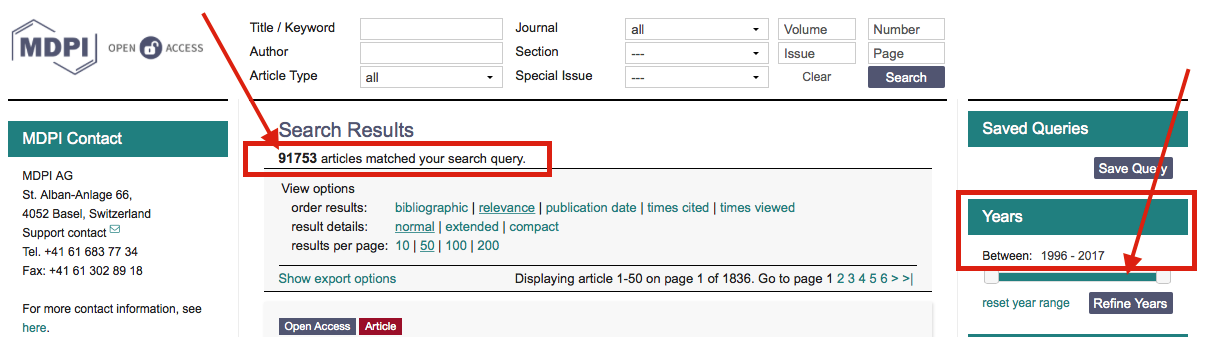
3 March 2017
1000 Preprints Online
We are delighted that Preprints now has 1000 papers online since its launch on 3 May 2016.
For more information, see the editorial here.
9 February 2017
Minister and State Secretaries Visit MDPI Office at STP, Belgrade, Serbia
Earlier this week the Science Technology Park in Belgrade, Serbia was visited by Swiss Secretary of State Dr. Mauro Dell’Ambrogio, as well as Serbian Minister of Public Administration and Local Self-Government Ana Brnabic, State Secretary Dr. Vladimir Popovic and Mayor of Belgrade Mr. Siniša Mali.
During the visit to the STP they had a short presentation from MDPI’s CEO Dr. Franck Vazquez and IT Manager Mr. Miloš Čučulović, and further discussed important issues such as Open Access and Open education. Dr. Dell'Ambrogio said he was impressed with the potential for development and ideas for business.
For more information please see:
http://bit.ly/2kpIu7k and http://bit.ly/2kpUQfz
7 February 2017
The 6th World Sustainability Forum: Final Press Release

Basel, 29 January 2017
The 6th World Sustainability Forum #WSF2017SA: African universities critical to achieving the Sustainable Development Goals
Jeffrey and Sonia Sachs win first World Sustainability Award.
Universities need to take the lead in solving the greatest challenges the world faces today, particularly in Africa. They need to do this not only through education – teaching the next generation to think critically and creatively to find sustainable solutions – but also through research that cuts across a range of disciplines. To ensure these solutions are implemented, they need to partner with the private sector and with government.
This was the key message from the 6th World Sustainability Forum (WSF2017), which took place in Cape Town on 27 and 28 January 2017. Sponsored by MDPI and the journal Sustainability under the patronage of the Universities of the Western Cape (UWC), Cape Town (UCT), University of Basel and the National Research Foundation (NRF) of South Africa, the conference was attended by key national and international speakers, including world-leading economist Professor Jeffrey D. Sachs, senior United Nations (UN) advisor and director of the Earth Institute at Columbia University.
The WSF is an annual sustainability conference which addresses research in a range of areas related to sustainable development and sustainability globally. This was the first WSF to take place on the African continent. Discussions at the 2017 conference were driven by the 17 sustainable development goals (SDGs) adopted as part of the 2030 Agenda for Sustainable Development by the UN in September 2015.
Achieving the SDGs “is the moonshot for our generation,” said Sachs. “Like the moonshot [moon landing] of the 1960s, these are tough, bold and achievable objectives.”
“This is a nasty, tough world we live in, and our world agrees on very little. So when 193 governments agree on something, that is important. And when they agree on something as important as sustainable development, that is really something for us to grab hold of – that is a lifeline.”
There was agreement at the WSF that the SDGs are particularly important for Africa, and that African universities in particular have a role to play in achieving them.
Said Professor Tyrone Pretorius, vice-chancellor of UWC: “The quest for sustainable development can only be met through education. Universities today are the oil that fuels the knowledge economy.”
As part of the drive to develop academic capacity to provide the knowledge needed to meet the SDGs, WSF2017 was preceded by the 1st Postgraduate Forum on Sustainability. “A series of workshops for postgraduate education linked to WSF are important, in order to equip postgraduates with the skills necessary to promote sustainability,” said Professor Thandi Mgwebi, director for research at UWC. A second postgraduate forum will take place alongside the WSF2018 in Beijing.
This capacity development is particularly critical to Africa. Said Sachs: “African universities need to do research to find solutions to Africa’s development challenges, because no other university will.”
The UN set a target of achieving the SDGs by 2030: “I regard this as the breakthrough period to end extreme poverty on the continent,” said Sachs, “and for Africa to become one of the most dynamic centres of the world economy.”
It is a critical time for South African universities, said Professor Mamokgethi Phakeng, deputy vice-chancellor for research and internationalisation at UCT: “Higher education is at a crossroads, and there is much polarisation. We need to think carefully about how this sustainable development agenda is owned by all so that it is inclusionary.”
There was also strong emphasis on public–private partnerships – for universities, business and government to work together to achieve the goals.
Said Professor Francis Petersen, deputy vice-chancellor at UCT and vice-chancellor designate at the University of the Free State: “Business sustainability has become critical, because there is increasing demand and complexity of demand on business from the natural, social and economic environment. Sustainability cannot be a standalone issue, divorced from business as usual. Sustainability needs to be embedded into business.”
Environmental crises and climate change was also high on the WSF agenda. In his keynote address, Sachs noted the irreversibility of the climate- and environmental-related challenges.
“If we don’t get our act together, we lose the chance of safety,” he said.
Said Professor Mark New, pro vice-chancellor and director of the African Climate and Development Initiative at UCT: “We have a fundamental challenge in responding to climate change, and we must go further than just putting a plaster on a wound. We need to address the deep structural issues, to move from our current model of development into climate-compatible development.”
“This requires researchers to find the evidence for the correct development pathways to take, and then support the ability of policymakers at all levels to enable the shift to climate-compatible development planning.”
Said Dr. Aldo Stroebel, executive director of international relations and cooperation at the NRF, in closing: “We have seen over the past two days an urgency towards the next step of thinking, that critical type of framework that we all must engage with, not only from an academic perspective, but further up into the policy environment and into rural-based environments where one can clearly see the links and effectiveness of the work.”
World Sustainability Awards
The first World Sustainability Award and the first Emerging Sustainability Leader Awards were presented by Prof. Thandi Mgwebi, Director of Research at UWC, and Dr. Franck Vazquez, CEO of MDPI, during the ceremony on 27 January 2017 as part of the gala dinner of the 6th World Sustainability Forum in South Africa.after day one of proceedings of the 2017 World Sustainability Forum South Africa.
Professor Jeffrey D. Sachs and Dr. Sonia Ehrlich Sachs are the joint recipients of the first World Sustainability Award. Jeffrey Sachs is a world-renowned economist and senior United Nations (UN) advisor and director of the Earth Institute at Columbia University. Sonia Sachs is a paediatrician and public health specialist, and director of the Health Centre at the Centre for Sustainable Development, also at Columbia University.
The joint recipients of the first Emerging Sustainability Leader Award are Dr. Esther Ngumbi and Dr. Xiaosong Hu. Esther Ngumbi is a postdoctoral researcher at Auburn University in Alabama USA and serves as a 2015 Clinton Global University Mentor for agriculture. Xiaosong Hu is a professor at the Chongqing University in China and specialises in automotive control systems and mechanical engineering.
The World Sustainability Award and the Emerging Sustainability Leader Awards are funded to encourage new initiatives and developments in sustainability with the ultimate aim of fostering the transition to sustainable practices and societies.
The World Sustainability Award is funded by the MDPI Sustainability Foundation, and included a monetary prize of USD 100,000 to Jeffrey and Sonia Sachs. The Emerging Sustainability Leader Award is funded by the journal Sustainability, awarded to researchers under 40, and included a monetary prize of USD10,000.
Issued jointly by: UCT Global Strategy and Visibility, Research Office, UWC Communications & Media and MDPI AG
Conference photos are free available at: https://sciforum.net/conference/wsf-6/page/175 Photo credit: Matthias Burkhalter
|
Carla Bernardo |
Luthando Tyhalibongo |
Matthias Burkhalter |
31 January 2017
Three New Institutional Memberships Established
We are pleased to announce that the Chalmers University of Technology, Sweden, the University of Manitoba, Canada and the Technical University of Cartagena, Spain, have joined MDPI's institutional membership program: Primary authors from these institutions will benefit from a 10% discount on the article processing charges.
Additional details can be found on our institutional membership page.



27 January 2017
6th World Sustainability Forum under way in South Africa
The 6th World Sustainability Forum is currently being held at the Cape Sun Hotel until 28 January 2017.
The Forum will showcase the work of internationally renowned researchers and include more than 150 presentations. During the conference dinner, the World Sustainability Award, associated with a US$ 100,000 prize, will be announced, as well as the Emerging Sustainability Leader Award, associated with a US$ 10,000 prize. The prizes are sponsored by the MDPI Sustainability Foundation and Sustainability, an academic open access journal by MDPI.
Here are some pictures from the forum so far:
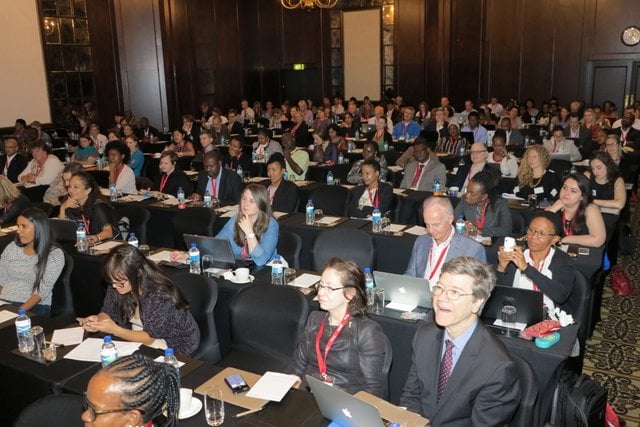
To see the full WSF2017 program and schedule, please see here: https://sciforum.net/conference/wsf-6/page/schedule
19 January 2017
Cape Town to Host the 6th World Sustainability Forum
Cape Town will host the 6th World Sustainability Forum at the Cape Sun Hotel on 27 and 28 January 2017. This prominent event, held for the first time in Africa, will include many illustrious South African and international experts, such as Her Excellency Graça Machel (Sustainable Development Advocate for the United Nations, Mozambique), Joyene Isaacs (HoD Agriculture Western Cape Government), Jeffrey Sachs (Columbia University, USA), Max Bergman (SRaM, University of Basel), Mark New (Pro Vice-Chancellor, University of Cape Town), Frans Swanepoel (FutureAfrica, University of Pretoria) and Francis Petersen (Vice-Chancellor-designate, University of the Free State). The Forum will provide a stage for national and international debates on sustainability in South Africa, the African continent, and about international perspectives on sustainability. It brings together researchers and representatives from government and the business sector to discuss a wide-ranging set of issues associated with sustainability, including food security, water and energy scarcity, mining, poverty reduction, climate change, and urbanisation.
The next few decades will be marked by profound changes in the relationships between global economics, national societies, and the environment. We have entered what some call the Anthropocene, an age in which human activity dominates the climate and the environment. These changes will have numerous consequences on societies around the globe. South Africa and Africa will play a central role, for better or worse, in creating opportunities and risks during these changing times as Africa is profoundly influencing and being influenced by global developments.
The adoption of the 17 United Nations Sustainable Development Goals and the 2030 Agenda for Sustainable Development in September 2015 was accompanied by what insiders considered an optimism they have not experienced in relation to UN resolutions before. The relative efficiency in the drafting, the lack of trenches between East and West, or between North and South, and the unanimity of support of the 193 countries speak volumes. In stark contrast, sustainability seems to go against a changing economic and political tide, where waves of nationalism and protectionism from some of the most powerful countries risk the wellbeing of the rest of the world. The 6th World Sustainability Forum will enable fruitful exchanges, which sensitise South African and international communities to the global urgency and specifics of sustainability.
The Forum will showcase the work of internationally renowned researchers and include more than 150 presentations. During the conference dinner, the World Sustainability Award, associated with a US$ 100 000 prize, will be announced, as well as the Emerging Sustainability Leader Award, associated with a US$ 10 000 prize. The prizes are sponsored by the MDPI Sustainability Foundation and Sustainability, an academic open access journal by MDPI. The World Sustainability Forum is preceded by the Postgraduate Forum on Sustainability, which will introduce more than 100 young scholars from South Africa and the African continent to sustainability research. Both events are organized and sponsored by the University of Cape Town, the University of the Western Cape, the University of Basel, MDPI, and by the National Research Foundation of South Africa.
Contacts:
Scientific Matters: Prof Manfred Max Bergman, Social Research and Methodology Group (SRaM), University of Basel, Switzerland; Email: [email protected]
Press Accreditation and General Enquiries: Mr Matthias Burkhalter, MDPI AG, Basel, Switzerland; Email: [email protected]; Tel. +41 61 683 77 34
Follow us on Twitter

#WSF2017SA
6 January 2017
MDPI Supports the OA2020 Initiative

MDPI is now a proud supporter of the OA2020 Initiative.
Open Access 2020 is an international initiative that aims to induce the swift, smooth and scholarly-oriented transformation of today’s scholarly journals from subscription to open access publishing.
MDPI is participating in the upcoming Berlin13 conference in March 2017, where we are contributing to the initiative by aiding in the design of the roadmap which will make OA the default publishing model.
For more information please see here.
5 January 2017
Three New Institutional Memberships Established
We are pleased to announce that the University of Texas at Arlington, USA, the Harbin Institute of Technology, China and TU Darmstadt, Germany, have joined MDPI's institutional membership program: Primary authors from these institutions will benefit from a 10% discount on the article processing charges.
Additional details can be found on our institutional membership page.



22 December 2016
Two New Institutional Memberships Established
We are pleased to announce that the Otto-von-Guericke-Universität Magdeburg, Germany and the University of California, Berkeley, USA, have joined MDPI's institutional membership program: Primary authors from these instititions will benefit from a 10% discount on the article processing charges.
Additional details can be found on our institutional membership page.


19 December 2016
MDPI and Wellcome Trust Compliance

The Wellcome Trust has, for a number of years, required that the results of its funded projects are published in open access format. Recently it announced criteria that publishers must fulfil for publication fees to be paid by the Trust. MDPI is pleased to have been added to the list of compliant publishers.
Only publishers who have confirmed their compliance by 16 December 2016 will be eligible to receive payment of APCs by the Wellcome Trust as of 1 April 2017. For more information on the criteria and a full list of publishers that meet them, see here.
13 December 2016
Meet MDPI at the 2016 AGU Fall Meeting
 MDPI is currently attending the 2016 AGU Fall Meeting (12–16 December, 2016)
If you are also attending the conference, please feel free to stop by our booth (Booth #1147) and meet the representative editors.
Conference details:
2016 AGU Fall Meeting
12–16 December 2016
Moscone Center
747 Howard St
San Francisco, CA 94103, USA
8 December 2016
Three New Institutional Memberships Established
We are pleased to announce that Purdue University, USA, the Universitat Politécnica de Valencia, Spain and the Queensland University of Technology, Australia, have joined MDPI's institutional membership program: Primary authors from these instititions will benefit from a 10% discount on the article processing charges.
Additional details can be found on our institutional membership page.


16 November 2016
World Sustainability Award - Final Extension
The deadline for the World Sustainability Award has been extended for one last time! You now have one more month to nominate an individual researcher, group or project! The final deadline for nominations will be December 15, 2016.
For full details, please visit here.
11 November 2016
Three New Institutional Memberships Established
We are pleased to announce that the University of Minnesota, USA, the Universidad Politécnica de Madrid, Spain and Shanghai Jiao Tong University, China, have joined MDPI's institutional membership program: Primary authors from these instititions will benefit from a 10% discount on the article processing charges.
Additional details can be found on our institutional membership page.


4 November 2016
MDPI Joins the United Nations Global Compact
MDPI has become a member of the United Nations Global Compact to support corporate sustainability and have committed ourselves to the ten principles associated with the Compact.
Sustainability has always been at the core of MDPI’s values, starting with the collection and preservation of rare chemical samples that started in 1996 and led to the first journal, Molecules. Sustainability has become one of our flagship journals and we have supported and organized several conferences and events based on Sustainability, including the upcoming 6th World Sustainability Forum. As a global enterprise, we see it as our duty to promote responsible practices that will ensure a bright future for our planet. Given this, the choice to join the Global Compact was an easy one and we will do our utmost to fully implement it.

3 November 2016
MDPI Now a Member of SPARC Europe
We are delighted to announce that MDPI has become a member of SPARC Europe, an organization that works for open scholarship in Europe, including support of open access publication.
As one of the few publishers to join SPARC Europe to date, MDPI looks forward to making a contribution that puts open scholarship on a positive and sustainable path. We fully support the goals of open scholarship that allow the largest number of people possible to benefit from work of researchers in all disciplines. We hope that our membership will enable us to work with other stakeholders to find the best possible solution.
2 November 2016
World Sustainability Award Deadline Extension
The deadline for the World Sustainability Award has been extended! You now have until November 15, 2016 to nominate an individual researcher, group or project!
For full details, please visit here.
 .
.
26 October 2016
Four New Institutional Memberships Established
We are pleased to announce that the Wuppertal Institut, Germany, the University of Girona, Spain and Central South University and Huazhong University of Science and Technology, China, have joined MDPI's institutional membership program: Primary authors from these instititions will benefit from a 10% discount on the article processing charges.
Additional details can be found on our institutional membership page.




24 October 2016
International Open Access Week 2016

Meet us during International Open Access Week 2016! We will be presenting at various locations in Europe and China.
To get involved and for full details see the complete list of events organised by MDPI here.
18 October 2016
Institutional Membership established with Universitat Pompeu Fabra, Spain and Aalto University, Finland
We are pleased to announce that the Universitat Pompeu Fabra, Spain and Aalto University, Finland, have joined MDPI's institutional membership program: Primary authors from these universities will benefit from a 10% discount on the article processing charges.
Additional details can be found on our institutional membership page.

12 October 2016
Institutional Membership Established with Iowa State University and the University of North Texas, USA
We are pleased to announce that the Iowa State University and the University of North Texas, USA, have joined MDPI's institutional membership program: Primary authors from these universities will benefit from a 10% discount on the article processing charges.
Additional details can be found on our institutional membership page.


7 October 2016
MDPI at Open Access Days in Munich, 10-11 October 2016
Meet MDPI during the Open Access Days held from 10-11 October 2016 at Ludwig Maximilian University of Munich, Germany.
The two-day event will feature experts from the open access sector, scientists from all disciplines, publishing representatives and supporters of scientific research and communication from libraries as well as research institutes and funding institutions. Join us!
For more information about the event and to see the program, visit the event webpage.

7 October 2016
Institutional Membership Established with the University of Sevilla and the University of Alicante, Spain
We are pleased to announce that the University of Sevilla and the University of Alicante, Spain have joined MDPI's institutional membership program: Primary authors from these universities will benefit from a 10% discount on the article processing charges.
Additional details can be found on our institutional membership page.

29 September 2016
Institutional Membership Established with the University of Delaware
We are pleased to announce that the University of Delaware, USA, has joined MDPI's institutional membership program: Primary authors from this university will benefit from a 10% discount on the article processing charges.
Additional details can be found on our institutional membership page.

19 September 2016
Peer Review Week 2016
As an open access publisher indebted to the work of our peer reviewers, we are proud to support Peer Review Week 2016. As part of the week's activities and to celebrate this year's theme "Recognition for Review", MDPI will host two webinars that anyone can join.
These webinars will explore the role and value of reviewers and the recognition they receive from a publishers perspective, with examples from MDPI's experience in publishing nearly 80,000 peer reviewed papers, along with evidence from reviewer surveys. It will also touch upon potential changes in how review is carried out and tips for early career researchers who want to be involved in the review process.
Details and links to join can be found below:
Wednesday September 21, 08:00 (CEST)
Friday September 23, 16:00 (CEST)
For more information about all the activites taking place, please visit the Peer Review Week website.
6 September 2016
Institutional Membership established with Kansas State University and Northwestern University, USA
We are pleased to announce that Kansas State University and Northwestern Universty, USE, have joined MDPI's institutional membership program: Primary authors from these universities will benefit from a 10% discount on the article processing charges.
Additional details can be found on our institutional membership page.


5 September 2016
Institutional Membership Established with University College Cork
We are pleased to announce that University College Cork, Ireland, has joined MDPI's institutional membership program: Primary authors from this university will benefit from a 10% discount on the article processing charges.
Additional details can be found on our institutional membership page.

22 August 2016
MDPI New Office Location

We are pleased to announce that MDPI has now moved to a new permanent address:
MDPI AG
St. Alban Anlage 66
CH-4052 Basel
Postfach, CH-4020 Basel
Switzerland
Telephone and fax numbers remain unchanged.
10 August 2016
Institutional Membership established with the University of Texas at Austin, USA, the Wroclaw University of Science and Technology, Poland and the University of Granada and the Compultense University of Madrid, Spain
We are pleased to announce that the following institutions have joined MDPI's institutional membership program in August 2016:
- University of Texas at Austin, USA
- Wroclaw University of Science and Technology, Poland
- University of Granada, Spain
- Compultense University of Madrid, Spain
Authors affiliated with these institutions will benefit from a 10% discount on the article processing charges.
Additional details can be found on our institutional membership page.


18 July 2016
Institutional Membership established with Louisiana State University and Florida State University, USA, Royal College of Surgeons, Ireland, University of Rostock, Germany, AGH University of Science and Technology, Poland and Southeast University, China
We are pleased to announce that the following institutions have joined MDPI's institutional membership program in July 2016:
- Louisiana State University, USA
- Florida State University, USA
- Royal College of Surgeons, Ireland
- University of Rostock, Germany
- AGH University of Science and Technology, Poland
- Southeast University, China
Authors affiliated with these institutions will benefit from a 10% discount on the article processing charges.
Additional details can be found on our institutional membership page.





12 July 2016
MDPI Moving to New Office Location in Basel (Switzerland) in August 2016
As of 20 August 2016, MDPI's new address in Basel will be:
MDPI AG
St. Alban-Anlage 66
CH-4052 Basel
Switzerland
Telephone and fax numbers remain unchanged.
St. Alban-Anlage 66 was built from 1947 to 1948 and initially the home of the "Bühler AG", a book printing business.


For more information about this building, see: https://www.mdpi.com/about/headquarters
21 June 2016
"Behind the Scenes of Academic Publishing—A Publisher's Perspective" - MDPI's Lecture at the University of Basel

From the 15-16 September, 2016, MDPI will run a course on Academic Publishing at the University of Basel.
In this two day workshop, MDPI will look in detail at the role performed by academic journal publishers and how they interact with academics. Ethical dimensions, what happens when problems occur and how the publisher coordinates all aspects of the submission process will also be covered.
For more detailed information about the program, trainers and registration please visit the course webpage.
14 June 2016
2015 Impact Factors Released
We are pleased to report the 2015 Journal Impact Factors in the latest Journal Citation Reports® Science Edition, published by Thomson Reuters in June 2016. Twenty out of 25 journals have seen an increase in their Impact Factor and two journals (Crystals and IJGI) received a first Impact Factor. Coatings was recently added to SCIE and will receive its first Impact Factor in next year’s JCR.
Updated Impact Factors for Journals in the Science Citation Index Expanded (SCIE)
| Journal | 2015 Impact Factor | Details | Category Rank |
| Applied Sciences | 1.726 | Link | 83/163 (Q3) in ‘Chemistry, Multidisciplinary’; 129/271 (Q2) in ‘Materials Science, Multidisciplinary’; 64/145 (Q2) in ‘Physics, Applied’ |
| Atmosphere | 1.221 | Link | 66/84 (Q4) in ‘Meteorology & Atmospheric Sciences’ |
| Catalysts | 2.964 | Link | 53/144 (Q2) in ‘Chemistry, Physical’ |
| Energies | 2.077 | Link | 43/88 (Q2) in ‘Energy & Fuels’ |
| Entropy | 1.743 | Link | 25/79 (Q2) in ‘Physics, Multidisciplinary’ |
| Forests | 1.583 | Link | 19/66 (Q2) in ‘Forestry’ |
| Genes | 3.242 | Link | 60/165 (Q2) in ‘Genetics & Heredity’ |
| International Journal of Environmental Research and Public Health (IJERPH) | 2.035 | Link | 101/225 (Q2) in ‘Environmental Sciences’ |
| International Journal of Molecular Sciences (IJMS) | 3.257 | Link | 110/289 (Q2) in ‘Biochemistry & Molecular Biology’; 51/163 (Q2) in ‘Chemistry, Multidisciplinary’ |
| Marine Drugs | 3.345 | Link | 13/59 (Q1) in ‘Chemistry, Medicinal’ |
| Materials | 2.728 | Link | 63/271 (Q1) in ‘Materials Science, Multidisciplinary’ |
| Metals | 1.574 | Link | 18/73 (Q1) in ‘Metallurgy & Metallurgical Engineering’; 145/271 (Q3) in ‘Materials Science, Multidisciplinary’ |
| Micromachines | 1.295 | Link | 30/56 (Q3) in ‘Instruments & Instrumentation’ 63/83 (Q4) in ‘Nanoscience & Nanotechnology’ |
| Minerals | 1.468 | Link | 9/21 (Q2) in ‘Mining & Mineral Processing; 14/29 (Q2) in ‘Mineralogy’ |
| Molecules | 2.465 | Link | 24/59 (Q2) in ‘Chemistry, Organic’ |
| Nanomaterials | 2.690 | Link | 64/271 (Q1) in ‘Materials Science, Multidisciplinary’; 36/83 (Q2) in ‘Nanoscience & Nanotechnology’ |
| Nutrients | 3.759 | Link | 16/78 (Q1) in ‘Nutrition & Dietetics’ |
| Polymers | 2.944 | Link | 20/85 (Q1) in ‘Polymer Science’ |
| Remote Sensing | 3.036 | Link | 5/28 (Q1) in ‘Remote Sensing’ |
| Sensors | 2.033 | Link | 36/75 (Q2) in ‘Chemistry, Analytical’; 16/27 (Q3) in ‘Electrochemistry’; 12/56 (Q1) in ‘Instruments & Instrumentation’ |
| Sustainability | 1.343 | Link | 146/225 (Q3) in ‘Environmental Sciences’; 22/29 (Q4) in ‘Green & Sustainable Science & Technology’ |
| Symmetry | 0.841 | Link | 31/63 (Q2) in ‘Multidisciplinary Sciences’ |
| Toxins | 3.571 | Link | 16/89 (Q1) in ‘Toxicology’ |
| Viruses | 3.042 | Link | 14/33 (Q2) in ‘Virology’ |
| Water | 1.687 | Link | 33/85 (Q2) in ‘Water Resources’ |
Journals with First Impact Factors
| Journal | 2015 Impact Factor | Details | Category Rank |
| Crystals | 2.075 | Link | 13/26 (Q2) in ‘Crystallography’ |
| ISPRS International Journal of Geo-Information | 0.651 | Link | 45/49 (Q4) in ‘Geography, Physical’; 26/28 (Q4) in ‘Remote Sensing’. |
26 May 2016
Institutional Membership established with University of Bremen, Germany, Koç University, Turkey, IIASA, Austria and Jilin University and Kunming Institute of Botany, CAS, China
We are pleased to announce that the following institutions have joined MDPI's institutional membership program in May 2016:
- Unversity of Bremen, Germany
- Koç University, Turkey
- International Institute for Applied Systems Analysis (IIASA), Austria
- Jilin University, China
- Kunming Institute of Botany, Chinese Academy of Sciences, China
Authors affiliated with these institutions will benefit from a 10% discount on the article processing charges.
Additional details can be found on our institutional membership page.




23 May 2016
Institutional Membership Established with the KTH Royal Institute of Technology, Sweden and the South China University of Technology, Beijing University of Technology and Southern Medical University, China
We are pleased to announce that the following institutions have joined MDPI's institutional membership program in April and May 2016:
- KTH Royal Institute of Technology, Sweden
- South China University of Technology, China
- Beijing University of Technology, China
- Southern Medical University, China
Authors affiliated with these institutions will benefit from a 10% discount on the article processing charges.
Additional details can be found on our institutional membership page.




26 April 2016
New Section on www.mdpi.com - Latest Books
You may have noticed a new section that is now visible on our home page. This section is called "Latest Books" and showcases recent publications from MDPI Books, our book publishing service.
By clicking on the hyperlink "More Books" you will be taken to the MDPI Books Home Page. There you will find more information about the service, as well as the "Recent Publications" list.
Clicking on any of the book images in this list will take you to detailed information about that book (shown below). Here you can also download a PDF version of the book, or order a hardcover printed copy.
For further information about the MDPI Books service, please visit the webpage or contact [email protected].
31 March 2016
Axioms, Behavioral Sciences, Photonics, Separations and Toxics added to the Emerging Sources Citation Index in Web of Science
We are pleased to announce that the journals Axioms, Behavioral Sciences, Photonics, Separations and Toxics were recently accepted for inclusion in the newly launched Emerging Sources Citation Index (ESCI) in Web of Science.
ESCI serves to highlight promising journals which are still under consideration for the Science Citation Index Expanded (SCIE) or the Social Sciences Citation Index (SSCI).
The Emerging Sources Citation Index (ESCI), Science Citation Index Expanded (SCIE), Social Sciences Citation Index
(SSCI), and Web of Science™ (WoS) are Thomson Reuters products.






30 March 2016
Institutional Membership established with the University of Winchester, UK, Silesian University of Technology, Poland and Beijing Jiaotong University and Zhejiang University, China
We are pleased to announce that the University of Winchester, UK, the Silesian University of Technology, Poland and Beijing Jiaotong University and Zhejiang University, China, have joined our Institutional Membership program. Primary authors from these universities will benefit from a 10% discount on article processing charges.
Additional details can be found on our institutional membership page.



24 March 2016
New Editorial Office in Barcelona, Spain
We are excited to announce the opening of our new editorial office in Barcelona, Spain. The launch team is led by a Senior Editor and comprises further staff holding doctoral degrees with several years of research experience. The new editorial team will help us to get closer to European research communities and progress Sciforum, the platform to support the scientific community via conference hosting and other functions. They will also help spread the word about Open Access and meet academics at scientific events.
We are in the process of hiring more doctoral and masters graduates to join the editorial team and welcome applications via [email protected]. For contact details about the office, see our contact page.

22 February 2016
Membership Established with the Max Planck Society
We are pleased to announce that the Max Planck Digital Library (MPDL) has signed an agreement with MDPI to support authors associated with the Max Planck Society (Max-Planck-Gesellschaft). As of 22 February 2016, corresponding authors will receive full funding from the MPDL for articles published in MDPI journals, with a 10% discount applied to the Article Processing Charges. Additional details can be found at our institutional membership page.
Founded in 1948, The Max Planck Society is one of Germany’s leading research organizations, and is currently made up of 83 institutes conducting basic research in natural sciences, life sciences, social sciences and humanities. 18 Nobel laureates have emerged from its ranks of scientists and the society has more than 15,000 publications in scientific journals each year.
5 February 2016
Institutional Membership Extension: Wageningen University, CSIC, University of Zürich, ETH Zürich, University of Tübingen and Osnabrück University
We are pleased to announce that Wageningen University, the Netherlands, the Spanish National Research Council (CSIC), Spain, the University of Zürich and ETH Zürich, Switzerland, and the University of Tübingen and Osnabrück University, Germany, have not only renewed their institutional memberships with MDPI after two years of successful cooperation, but have also increased the reduction of the article processing charges (APCs) for affiliated authors to 25%.
Additional details can be found on our institutional membership page.






5 February 2016
Institutional Membership established with Brock University, Canada and the University of Pisa, Italy
We are pleased to announce that Brock University, Cananda, and the University of Pisa, Italy, have joined MDPI's institutional membership program: Primary authors from these universities will benefit from a 10% discount on the article processing charges as of 01 February 2016.
Additional details can be found on our institutional membership page.

25 January 2016
MDPI Sponsors diss:kurs with the University of Basel
MDPI is pleased to announce its newly established sponsorship of diss:kurs, an event coordinated by the University of Basel to support their doctorate program. For more information about the event and how to register, please visit the diss:kurs webpage.
7 January 2016
New Institutional Memberships Established with Tsinghua University, the Chinese Society of Micro-Nano Technology, Ruhr University Bochum and the University of Ulm
We are pleased to announce that the following institutions have joined MDPI's institutional membership program as of 1 January 2016:
- Tsinghua University, China
- Chinese Society of Micro-Nano Technology (CSMNT)
- Ruhr University Bochum, Germany
- University of Ulm, Germany
Authors affiliated with these institutions will benefit from a 10% discount on the article processing charges.
Additional details can be found on our institutional membership page.



5 January 2016
Safety, Fermentation, C-Journal of Carbon Research, Magnetochemistry, Batteries and Horticulturae Released Their First Issue in December 2015
We are pleased to announce that MDPI's open access journals Safety, Journal of Imaging, Fermentation, C-Journal of Carbon Research, Magnetochemistry, Batteries and Horticulturae released their first issue at the end of December 2015.







17 December 2015
Institutional Membership Extension: University of Bern, Switzerland
We are pleased to announce that the University of Bern, Switzerland has not only renewed their institutional membership with MDPI after two years of successful cooperation, but also increased the reduction of the article processing charges (APCs) for affiliated authors to 25%.
17 December 2015
Institutional Membership with the University of Ulm and Helmholtz Zentrum Munich
We are pleased to announce that University of Ulm, Germany and Helmholtz Zentrum Munich, Germany has joined MDPI's institutional membership program:
Primary authors from the University of Ulm and Helmholtz Zentrum Munich will benefit from a 10% discount on the article processing charges as of 1 January 2016. Additional details can be found on our institutional membership page.


9 December 2015
Membership Established with the Virginia Polytechnic Institute and State University (Virginia Tech)
We are pleased to announce that Virginia Tech has joined MDPI's institutional membership program. Authors from Virginia Tech will benefit from a 10% discount on the article processing charges as of 1 December 2015. Additional details can be found on our institutional membership page.
1 December 2015
Membership Established with the Technical University of Denmark and the University of North Florida
We are pleased to announce that the following universities have joined MDPI's institutional membership program:
- Technical University of Denmark (as of 1 November 2015)
- University of North Florida, USA (as of 15 November 2015)
Primary authors from the Technical University of Denmark and the University of North Florida will benefit from a 10% discount on the article processing charges.
Additional details can be found on our institutional membership page.


2 October 2015
Membership Established with the University of Freiburg and the University of Regensburg
We are pleased to announce that the following universities have joined MDPI's institutional membership program:
University of Freiburg, Germany
University of Regensburg, Germany
Primary authors from the University of Freiburg and the University of Regensburg will benefit from a 10% discount on the article processing charges as of 1 October 2015 and 1 November 2015.
Additional details can be found on our institutional membership page.