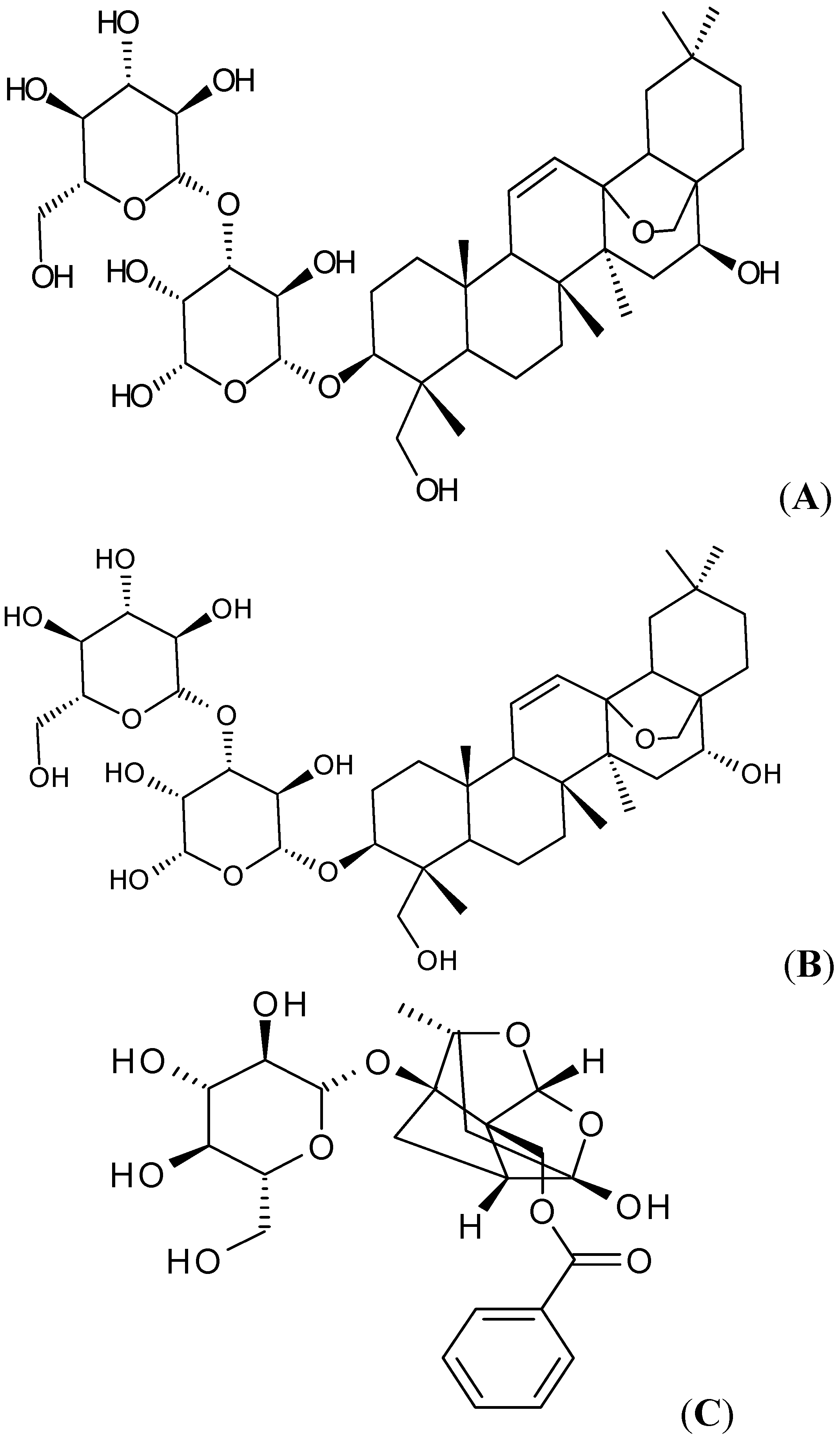
Interaction of the Main Components from the Traditional Chinese Drug Pair Chaihu-Shaoyao Based on Rat Intestinal Absorption

Abstract
:1. Introduction

2. Results and Discussion
2.1. Intestinal Absorption of SSA, SSD and Paeoniflorin

| Compound | P*eff | |||
|---|---|---|---|---|
| Duodenum | Jejunum | Ileum | Colon | |
| SSA | 0.193 ± 0.028 | 0.207 ± 0.012 | 0.361 ± 0.014 * | 0.239 ± 0.042 |
| SSD | 0.197 ± 0.036 | 0.248 ± 0.022 | 0.364 ± 0.055 * | 0.337 ± 0.084 |
| Paeoniflorin | 0.268 ± 0.042 | 0.243 ± 0.030 | 0.214 ± 0.021 | 0.219 ± 0.051 |
| Compound | 10 cm % ABS | |||
|---|---|---|---|---|
| Duodenum | Jejunum | Ileum | Colon | |
| SSA | 3.75 ± 0.57 | 3.91 ± 0.60 | 6.26 ± 0.56 * | 3.84 ± 0.10 |
| SSD | 4.52 ± 0.77 | 4.69 ± 0.81 | 6.10 ± 0.34 * | 5.35 ± 1.04 |
| Paeoniflorin | 6.57 ± 0.98 | 5.94 ± 0.70 | 5.23 ± 0.49 | 5.37 ± 1.19 |
2.2. Interaction Between SSA, SSD and Paeoniflorin
2.2.1. Effect of SSA or SSD on the Absorption of Paeoniflorin
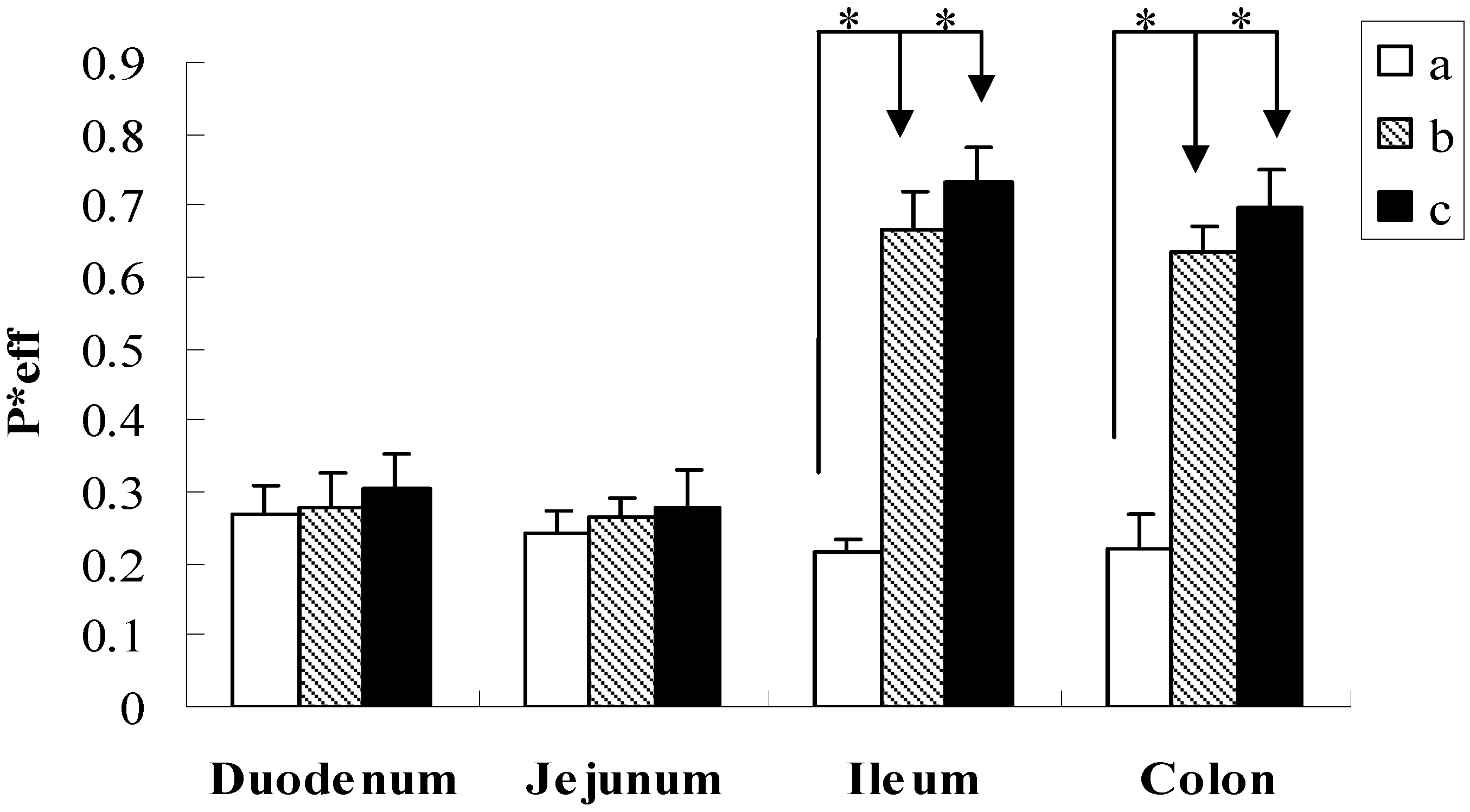
 ± s, n = 4).
| Compound | Co-administration | 10 cm % ABS | |||
|---|---|---|---|---|---|
| Duodenum | Jejunum | Ileum | Colon | ||
| Paeoniflorin | SSA | 6.13 ± 1.82 | 4.78 ± 1.15 | 12.57 ± 0.36 * | 12.07 ± 0.46 * |
| SSD | 6.68 ± 1.91 | 5.77 ± 1.39 | 13.75 ± 0.99 * | 13.48 ± 0.57 * | |
2.2.2. Effect of Paeoniflorin on the Absorption of SSA or SSD
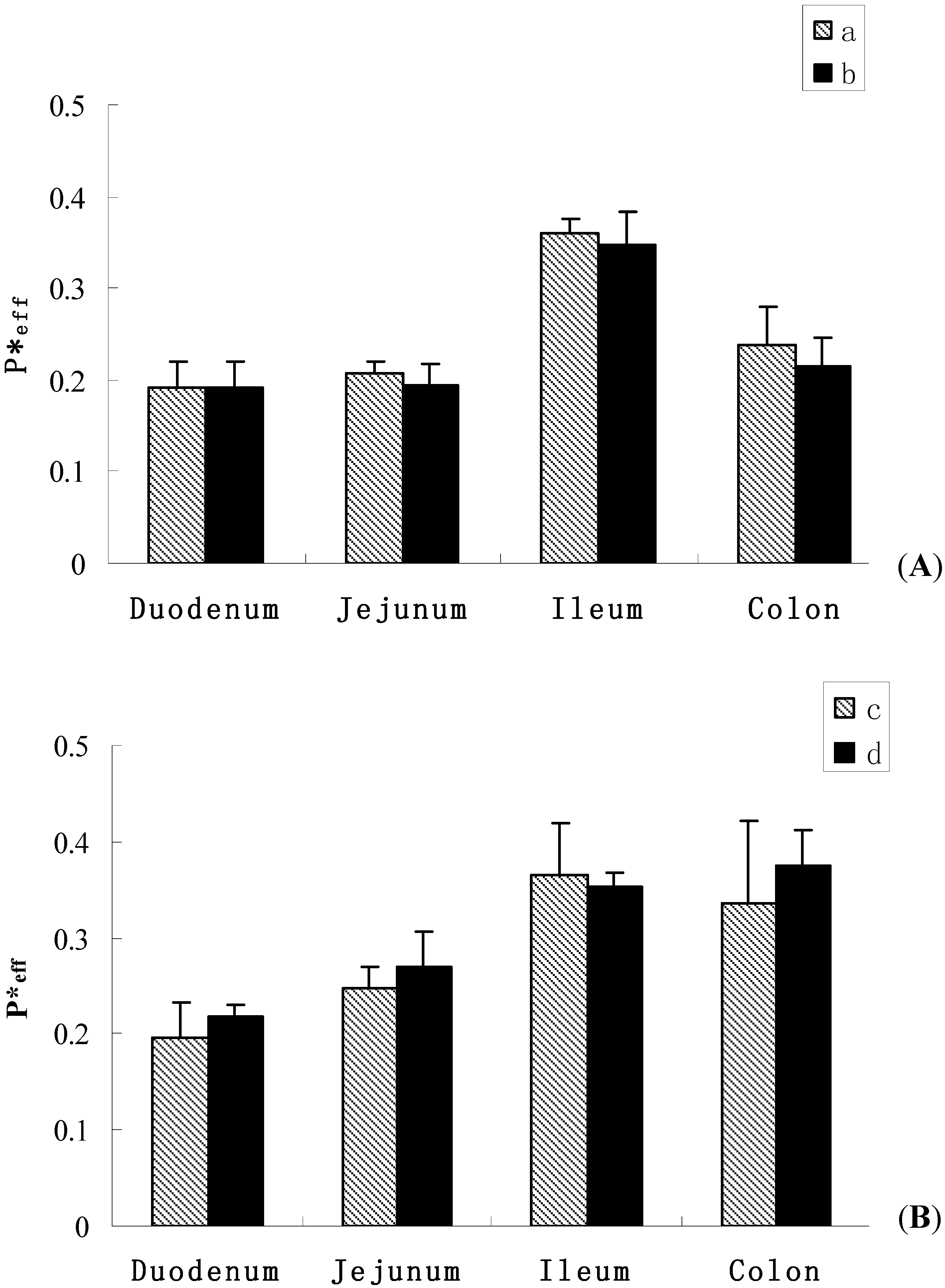
± s, n = 4). Figure (A) SSA; (a) alone; (b) co-administration with paeoniflorin; Figure (B) SSD; (c) alone; (d) co-administration with paeoniflorin.
± s, n = 4). Figure (A) SSA; (a) alone; (b) co-administration with paeoniflorin; Figure (B) SSD; (c) alone; (d) co-administration with paeoniflorin. ± s, n = 4).
| Compound | Co-administration | 10 cm % ABS | |||
|---|---|---|---|---|---|
| Duodenum | Jejunum | Ileum | Colon | ||
| SSA | Paeoniflorin | 4.11 ± 0.30 | 3.49 ± 0.61 | 5.20 ± 0.67 | 3.51 ± 0.73 |
| SSD | 4.64 ± 0.24 | 5.50 ± 0.73 | 5.97 ± 1.25 | 6.42 ± 0.91 | |
3. Experimental
3.1. Chemicals
3.2. Animals
3.3. Animal Surgery
3.4. Absorption Study in Perfused Rat Intestinal Model
3.5. LC/MS Analysis of Perfusion Samples
3.6. UPLC Analysis of Perfusion Samples
3.7. Data Analysis

 ), is a scaling factor that incorporates flow rate (Q), intestinal length (L), and diffusion coefficients (D) to make the permeability dimensionless. Cm was adjusted for water flux, data points were discarded if the water flux exceeded 0.5% cm−1 of intestine.
4. Conclusions
Acknowledgements
References and Notes
- Huang, X.; Kong, L.; Li, X.; Chen, X.; Guo, M.; Zou, H. Strategy for analysis and screening of bioactive compounds in traditional Chinese medicines. J. Chromatogr. B Anal. Technol. Biomed. Life Sci. 2004, 812, 71–84. [Google Scholar]
- Su, S.L.; Yu, L.; Hua, Y.Q.; Duan, J.A.; Deng, H.S.; Tang, Y.P.; Lu, Y.; Ding, A.W. Screening and analyzing the potential bioactive components from Shaofu Zhuyu decoction, using human umbilical vein endothelial cell extraction and high-performance liquid chromatography coupled with mass spectrometry. Biomed. Chromatogr. 2008, 22, 1385–1392. [Google Scholar] [CrossRef]
- He, J.X.; Akao, T.; Tani, T. Influence of co-administered antibiotics on the pharmacokinetic fate in rats of paeoniflorin and its active metabolite paeonimetabolin-I from Shaoyao-Gancao-tang. J. Pharm. Pharmacol. 2003, 55, 313–321. [Google Scholar]
- Yi, L.T.; Zhang, L.; Ding, A.W.; Xu, Q.; Zhu, Q.; Kong, L.D. Orthogonal array design for antidepressant compatibility of polysaccharides from Banxia-Houpu decoction, a traditional Chinese herb prescription in the mouse models of depression. Arch. Pharm. Res. 2009, 32, 1417–1423. [Google Scholar] [CrossRef]
- Liu, Y.; Yang, L. Early metabolism evaluation making traditional Chinese medicine effective and safe therapeutics. J. Zhejiang Univ. Sci. B 2006, 7, 99–106. [Google Scholar]
- Wang, Y.T.; Tan, Q.R.; Sun, L.L.; Cao, J.; Dou, K.F.; Xia, B.; Wang, W. Possible therapeutic effect of a traditional Chinese medicine, Sinisan, on chronic restraint stress related disorders. Neurosci. Lett. 2009, 449, 215–219. [Google Scholar] [CrossRef]
- Sun, Y.; Cai, T.T.; Shen, Y.; Zhou, X.B.; Chen, T.; Xu, Q. Si-Ni-San, a traditional Chinese prescription, and its active ingredient glycyrrhizin ameliorate experimental colitis through regulating cytokine balance. Int. Immunopharmacol. 2009, 9, 1437–1443. [Google Scholar] [CrossRef]
- Sun, Y.; Dong, Y.; Jiang, H.J.; Cai, T.T.; Chen, L.; Zhou, X.; Chen, T.; Xu, Q. Dissection of the role of paeoniflorin in the traditional Chinese medicinal formula Si-Ni-San against contact dermatitis in mice. Life Sci. 2009, 84, 337–344. [Google Scholar] [CrossRef]
- Zhu, Z.; Liang, Z.; Han, R. Saikosaponin accumulation and antioxidative protection in drought-stressed Bupleurum chinense DC. plants. Environ. Exp. Bot. 2009, 66, 326–333. [Google Scholar] [CrossRef]
- Hsu, Y.L.; Kuo, P.L.; Lin, C.C. The proliferative inhibition and apoptotic mechanism of Saikosaponin D in human non-small cell lung cancer A549 cells. Life Sci. 2004, 75, 1231–1242. [Google Scholar] [CrossRef]
- Feng, C.; Liu, M.; Shi, X.; Yang, W.; Kong, D.; Duan, K.; Wang, Q. Pharmacokinetic properties of paeoniflorin, albiflorin and oxypaeoniflorin after oral gavage of extracts of Radix Paeoniae Rubra and Radix Paeoniae Alba in rats. J. Ethnopharmacol. 2010, 130, 407–413. [Google Scholar] [CrossRef]
- Liu, Z.Q.; Zhou, H.; Liu, L.; Jiang, Z.H.; Wong, Y.F.; Xie, Y.; Cai, X.; Xu, H.X.; Chan, K. Influence of co-administrated sinomenine on pharmacokinetic fate of paeoniflorin in unrestrained conscious rats. J. Ethnopharmacol. 2005, 99, 61–67. [Google Scholar] [CrossRef]
- He, D.Y.; Dai, S.M. Anti-inflammatory and immunomodulatory effects of Paeonia lactiflora pall., a traditional Chinese herbal medicine. Front Pharmacol 2011, 2, 10. [Google Scholar]
- Dahan, A.; West, B.T.; Amidon, G.L. Segmental-dependent membrane permeability along the intestine following oral drug administration: Evaluation of a triple single-pass intestinal perfusion (TSPIP) approach in the rat. Eur. J. Pharm. Sci. 2009, 36, 320–329. [Google Scholar] [CrossRef]
- Hu, M.; Roland, K.; Ge, L.; Chen, J.; Li, Y.; Tyle, P.; Roy, S. Determination of absorption characteristics of AG337, a novel thymidylate synthase inhibitor, using a perfused rat intestinal model. J. Pharm. Sci. 1998, 87, 886–890. [Google Scholar] [CrossRef]
- Zhou, L.; Tang, Y.P.; Gao, L.; Fan, X.S.; Liu, C.M.; Wu, D.K. Separation, characterization and dose-effect relationship of the PPARgamma-activating bio-active constituents in the Chinese herb formulation 'San-Ao decoction. Molecules 2009, 14, 3942–3951. [Google Scholar] [CrossRef]
- Camilleri, M.; Nadeau, A.; Lamsam, J.; Nord, S.L.; Ryks, M.; Burton, D.; Sweetser, S.; Zinsmeister, A.R.; Singh, R. Understanding measurements of intestinal permeability in healthy humans with urine lactulose and mannitol excretion. Neurogastroen. Motil. 2010, 22, e15–e26. [Google Scholar]
- Chen, Y.; Zhao, Y.H.; Jia, X.B.; Hu, M. Intestinal absorption mechanisms of prenylated flavonoids present in the heat-processed Epimedium koreanum Nakai (Yin Yanghuo). Pharmaceut. Res. 2008, 25, 2190–2199. [Google Scholar] [CrossRef]
- Shyu, K.G.; Tsai, S.C.; Wang, B.W.; Liu, Y.C.; Lee, C.C. Saikosaponin C induces endothelial cells growth, migration and capillary tube formation. Life Sci. 2004, 76, 813–826. [Google Scholar] [CrossRef]
- Bittner, B.; Guenzi, A.; Fullhardt, P.; Zuercher, G.; Gonzalez, R.C.; Mountfield, R.J. Improvement of the bioavailability of colchicine in rats by co-administration of D-alpha-tocopherol polyethylene glycol 1000 succinate and a polyethoxylated derivative of 12-hydroxy-stearic acid. Arzneimittelforschung 2002, 52, 684–688. [Google Scholar]
- Chen, Y.; Wang, J.Y.; Tan, X.B.; Tan, X.B. Influence on absorption of Paeoniflorin by Saikosaponin via Caco-2 cell monolayer model. China J. Chin. Mater. Med. 2011, in press. [Google Scholar]
- Chen, Y.; Wang, J.Y.; Jia, X.B.; Tan, X.B.; Hu, M. Role of intestinal hydrolase in the absorption of prenylated flavonoids present in Yinyanghuo. Molecules 2011, 16, 1336–1348. [Google Scholar]
- Chen, J.; Lin, H.; Hu, M. Metabolism of flavonoids via enteric recycling: Role of intestinal disposition. J. Pharmacol. Exp. Ther. 2003, 304, 1228–1235. [Google Scholar]
- Sample Availability: Not available.
© 2011 by the authors; licensee MDPI, Basel, Switzerland. This article is an open access article distributed under the terms and conditions of the Creative Commons Attribution license ( http://creativecommons.org/licenses/by/3.0/).
Share and Cite
Chen, Y.; Wang, J.; Yuan, L.; Zhou, L.; Jia, X.; Tan, X. Interaction of the Main Components from the Traditional Chinese Drug Pair Chaihu-Shaoyao Based on Rat Intestinal Absorption. Molecules 2011, 16, 9600-9610. https://doi.org/10.3390/molecules16119600
Chen Y, Wang J, Yuan L, Zhou L, Jia X, Tan X. Interaction of the Main Components from the Traditional Chinese Drug Pair Chaihu-Shaoyao Based on Rat Intestinal Absorption. Molecules. 2011; 16(11):9600-9610. https://doi.org/10.3390/molecules16119600
Chicago/Turabian StyleChen, Yan, Jinyan Wang, Ling Yuan, Lei Zhou, Xiaobin Jia, and Xiaobin Tan. 2011. "Interaction of the Main Components from the Traditional Chinese Drug Pair Chaihu-Shaoyao Based on Rat Intestinal Absorption" Molecules 16, no. 11: 9600-9610. https://doi.org/10.3390/molecules16119600
APA StyleChen, Y., Wang, J., Yuan, L., Zhou, L., Jia, X., & Tan, X. (2011). Interaction of the Main Components from the Traditional Chinese Drug Pair Chaihu-Shaoyao Based on Rat Intestinal Absorption. Molecules, 16(11), 9600-9610. https://doi.org/10.3390/molecules16119600