1. Introduction
Despite the immeasurable efforts and investments in cancer research, cancer is estimated to become the overall leading cause of death in the 21st century worldwide [
1]. Herein, head and neck cancer, with its predominant form of oral squamous cell carcinoma (OSCC), is projected to be among the top ten types of cancer [
1,
2,
3]. Even after the formulation of the ‘hallmarks of cancer’ by Hanahan and Weinberg more than two decades ago, their subsequent further refinement and thereby specification of therapeutic targets, only an average survival rate of approximately 50% has been achieved in patients suffering from OSCC [
1,
4].
Current therapeutic options are diverse and primarily include surgical resection, radiotherapy, chemotherapy, oncogene-targeted therapy, immunotherapy, or combinations thereof, depending on tumor stage [
5]. Given the stage-dependent and multimodal nature of OSCC care, selecting an appropriate therapeutic strategy and coordinating treatment across specialties is challenging, making close interdisciplinary collaboration indispensable. Accordingly, multidisciplinary team (MDT) involvement and structured care pathways, including integrating pathology-driven risk stratification, adjuvant (chemo)radiotherapy, rehabilitation, dental and nutritional support, and speech/swallowing therapy, are increasingly emphasized to optimize outcomes. Systematic evidence across oncology suggests that MDT meetings can improve diagnostic accuracy, staging completeness, and adherence to guideline-concordant multimodality treatment, although survival effects vary by setting and study design [
6].
OSCC commonly emerges in the context of established exogenous risk factors, including tobacco exposure, alcohol use, and region-specific carcinogens such as areca nut/betel quid. Additionally, viral cofactors such as HPV infections are etiologically relevant in certain settings [
7,
8]. However, OSCC also occurs in patients without these exposures, suggesting that endogenous, tumor-intrinsic factors and microenvironmental programs, among others, contribute substantially to disease development, a concept highlighted in the recent literature [
5,
9,
10].
In the context of endogenous factors, cluster of differentiation 147 (CD147) has been investigated in numerous tumor entities, as well as in OSCC, since CD147 overexpression is associated with several hallmarks of cancer, including sustaining proliferation, resisting cell death, enabling invasion and metastasis, inducing angiogenesis, and immune evasion, among others [
11,
12].
CD147, also known as extracellular matrix metalloproteinase inducer (EMMPRIN) or Basigin (BSG), is a type I transmembrane glycoprotein belonging to the immunoglobulin superfamily. It has been shown to contribute to proliferation by interacting with glucose transporter 1 (GLUT1), monocarboxylate transporter 1 (MCT1), MCT3, and MCT4. GLUT1 facilitates sufficient glucose uptake into tumor cells, thereby sustaining glycolytic energy production. At the same time, MCT1, MCT3, and MCT4 mediate lactate export to regulate pH balance and thereby support the metabolic reprogramming characteristic of the Warburg effect [
11,
13,
14].
Beyond the metabolic functions, invasiveness and metastasis can be promoted by creating local conditions that enable matrix degradation and tissue remodeling. A key mechanism involves the CD147-mediated induction and vesicular secretion of matrix metalloproteinases (MMPs), such as MMP-2, -3, and -9, by tumor cells. These MMPs interact with receptors on fibroblasts and other stromal cells in the environment to amplify proteolytic activity, resulting in the breakdown of the extracellular matrix, triggering the epithelial–mesenchymal transition (EMT) and enhancing vascular permeability, thereby fostering tumor cell invasion and metastatic dissemination [
11].
CD147 also contributes to the induction of angiogenesis by promoting the release of matrix-bound angiogenic factors via MMPs and by enhancing the production of soluble vascular endothelial growth factor (VEGF) isoforms together with their receptor VEGFR-2, for which CD147 has also been reported to function as a co-receptor. Moreover, elevated extracellular lactate resulting from glycolytic reprogramming has been shown to stimulate angiogenesis further [
13,
15].
Beyond these established oncogenic functions, CD147 expression has also been closely linked to the development of chemoresistance [
12,
16,
17,
18]. In OSCC cell line models, enforced CD147 upregulation is correlated with reduced chemosensitivity and increased resistance to apoptosis. One mechanistic explanation involves receptor crosstalk between CD147 and CD44, a hyaluronic acid receptor and marker of cancer stem cells [
18]. The CD147-CD44 axis promotes the assembly of plasma membrane complexes that regulate downstream signaling pathways associated with poor survival and resistance to cytotoxic agents [
16,
18,
19,
20].
In addition, hypoxia-inducible factor 1-alpha (HIF-1α) has emerged as a critical regulator of chemoresistance, as well as tumor growth and angiogenesis [
21,
22,
23]. Evidence suggests a regulatory interplay among CD147, HIF-1α, and cyclophilin A (CypA). In lung cancer, HIF-1α upregulates CypA, conferring protection against cellular stress and chemotherapy [
23]. Moreover, CypA interacts with CD147 to promote cancer cell growth and poor prognosis, as shown in pancreatic carcinoma [
20]. Through this feed-forward loop, HIF-1α may regulate CD147 signaling via CypA, thereby linking hypoxia to enhanced tumor progression and therapy resistance.
Therefore, based on these findings, we focused our investigations on the role of CD147 in OSCC, with particular emphasis on its contribution to prognosis and resistance to adjuvant therapy.
2. Results
2.1. Clinicopathological Characteristics and CD147 Expression Patterns
A total of 229 cases of OSCC were included in this study, with baseline clinicopathological characteristics being summarized in
Table 1.
The majority of patients were male (71.2%) and younger than 70 years at diagnosis (78.2%). A history of tobacco use was reported in 78.2% of patients, and alcohol consumption in 70.7%. The most frequent tumor localization was the floor of the mouth (47.2%), followed by the lower alveolar ridge and gingiva (21.4%).
Regarding tumor staging, 65.9% of patients presented with T1/T2 tumors, while 34.1% were T3/T4 carcinomas. Lymph node involvement (N+) was observed in 44.5% of patients, and 60.3% were diagnosed with UICC stage III/IV disease. Histologically, most tumors were classified as G2 (83.0%). Vascular invasion (V1) and perineural invasion (Pn1) were relatively rare, occurring in 4.4% and 3.1% of cases, respectively. Recurrence occurred in 25.3% of patients, and 65.5% had died by the end of the follow-up period of 15.9 years. Adjuvant treatment was administered in 52.4% of patients, with 37.6% receiving radiotherapy and 14.8% receiving combined radiochemotherapy.
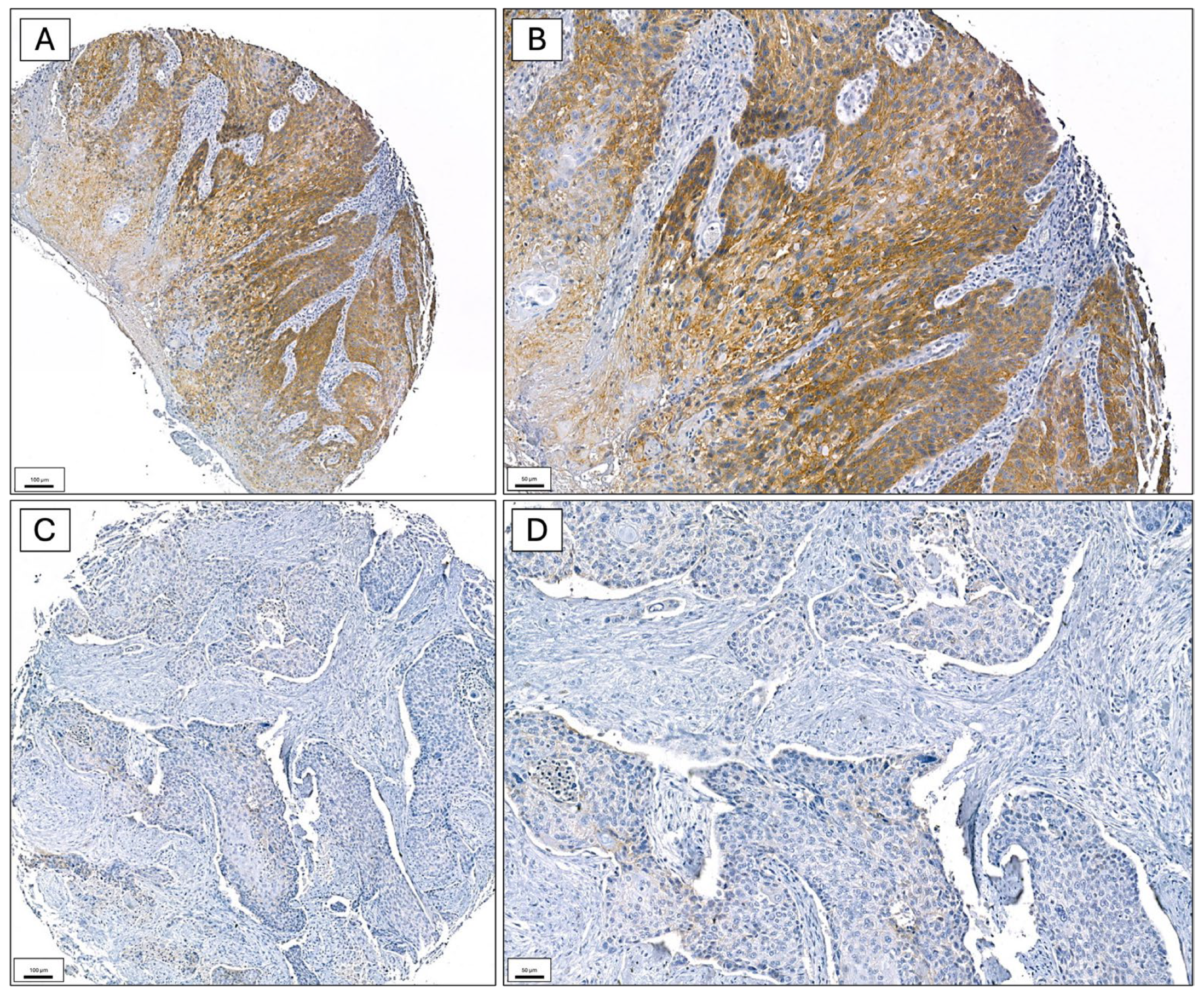
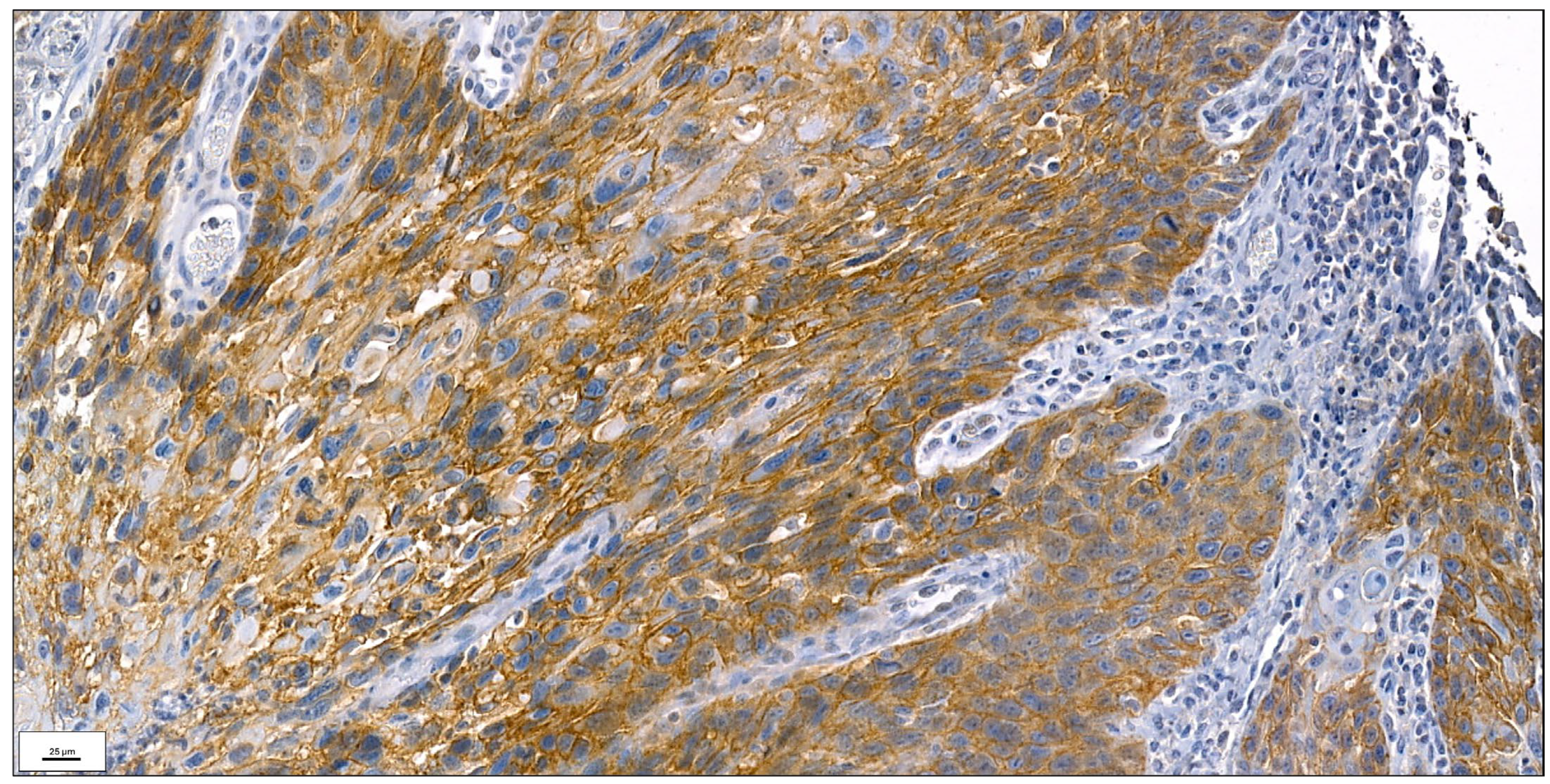
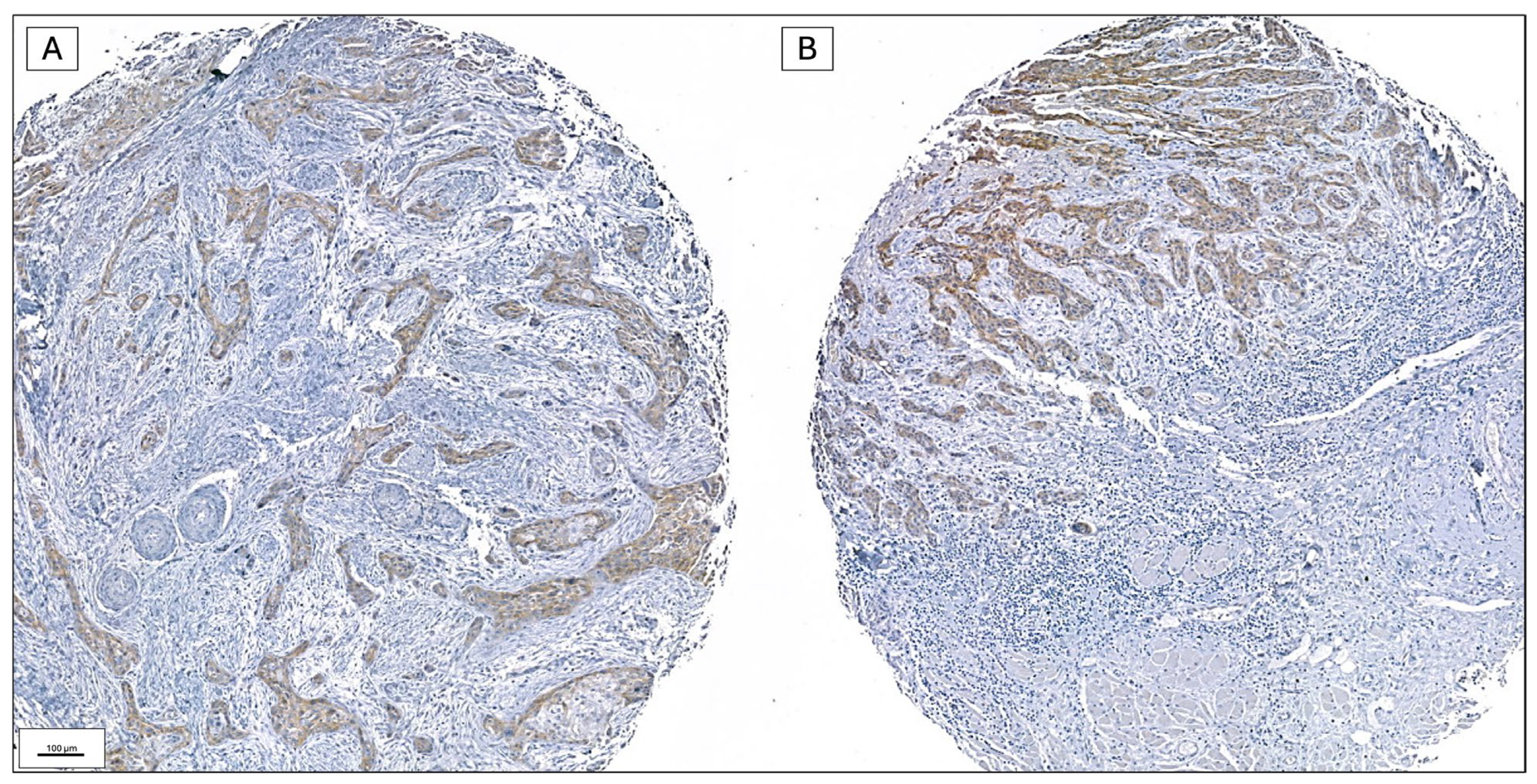
CD147 expression was assessed semiquantitatively using an immunoscore in three distinct tissue compartments, as mentioned below. In the tumor center, CD147 expression was negative in 14.4% of cases, low in 22.7%, and high in 51.1%. In the tumor periphery, negative expression was observed in 14.8% of cases, low in 16.2%, and high in 48.9% (representative staining of CD147 expression in the tumor invasion front shown in
Figure 1, comparative expression of CD147 in tumor center and tumor periphery shown in
Figure A1). In contrast, the adjacent mucosa showed predominantly low expression levels, with 23.6% of cases being negative, 31.0% having low, and 0.4% having high immunoscore. Due to insufficient tissue quality or missing tissue in the respective section, immunostaining could not be reliably evaluated in 27 cases in the tumor center, 46 cases in the tumor periphery, and 103 cases in the adjacent mucosa. These cases were excluded from the corresponding immunoscore analyses. Overall, high CD147 expression was most frequently detected in tumor compartments, whereas expression in non-tumorous mucosa was largely absent or low. This pattern suggests a tumor-specific upregulation of CD147.
2.2. Correlation and Trend Analysis of CD147 Immunoscore with Clinicopathologic Features
The association between CD147 immunoscore and clinicopathological parameters was evaluated separately for the tumor center, tumor periphery, and adjacent mucosa, as shown in
Table 2,
Table 3 and
Table 4.
In the tumor center (
n = 202), CD147 immunoscore showed no statistically significant association with any clinicopathological feature. While vascular invasion displayed a near-significant difference (Mann–Whitney U test,
p = 0.062), no correlation was found with UICC stage, nodal status, grading, or recurrence (
Table 2).
CD147 immunoscore in the tumor periphery (
n = 183) similarly did not correlate significantly with clinicopathological parameters (
Table 3).
In the adjacent mucosa (
n = 126), a significant association was observed between CD147 immunoscore and age at diagnosis (Mann–Whitney U test,
p = 0.026), with older patients showing higher CD147 expression. No significant differences were detected for gender, T-status, N-status, UICC stage, grading, or lymphovascular, vascular, or perineural invasion. Likewise, the adjuvant treatment modality did not affect mucosal CD147 immunoscore (Kruskal–Wallis test,
p = 0.960) (
Table 4).
To explore potential monotonic trends between tumor stage and CD147 expression, Jonckheere-Terpstra tests were performed for both UICC and T classifications. No significant monotonic trend in CD147 immunoscore was observed across UICC stages for any of the analyzed tissue compartments (tumor center: z = 0.189, p = 0.850; tumor periphery: z = 0.586, p = 0.558; mucosa: z = 1.160, p = 0.246). Similarly, no statistically significant trend was detected across T-stages. However, a weak tendency toward increasing CD147 expression with higher T-category was observed in the tumor center (z = 1.854, p = 0.064) and tumor periphery (z = 1.454, p = 0.146). These findings suggest that while CD147 expression may exhibit a mild increase with advancing local tumor extent, the overall relationship between CD147 immunoscore and tumor stage did not reach statistical significance.
Collectively, these findings indicate that CD147 expression, as quantified by immunoscore, is mainly independent of standard clinicopathological parameters, except for a potential trend toward higher expression with increasing tumor stage and patient age.
2.3. Kaplan–Meier Survival Analysis According to CD147 Immunoscore
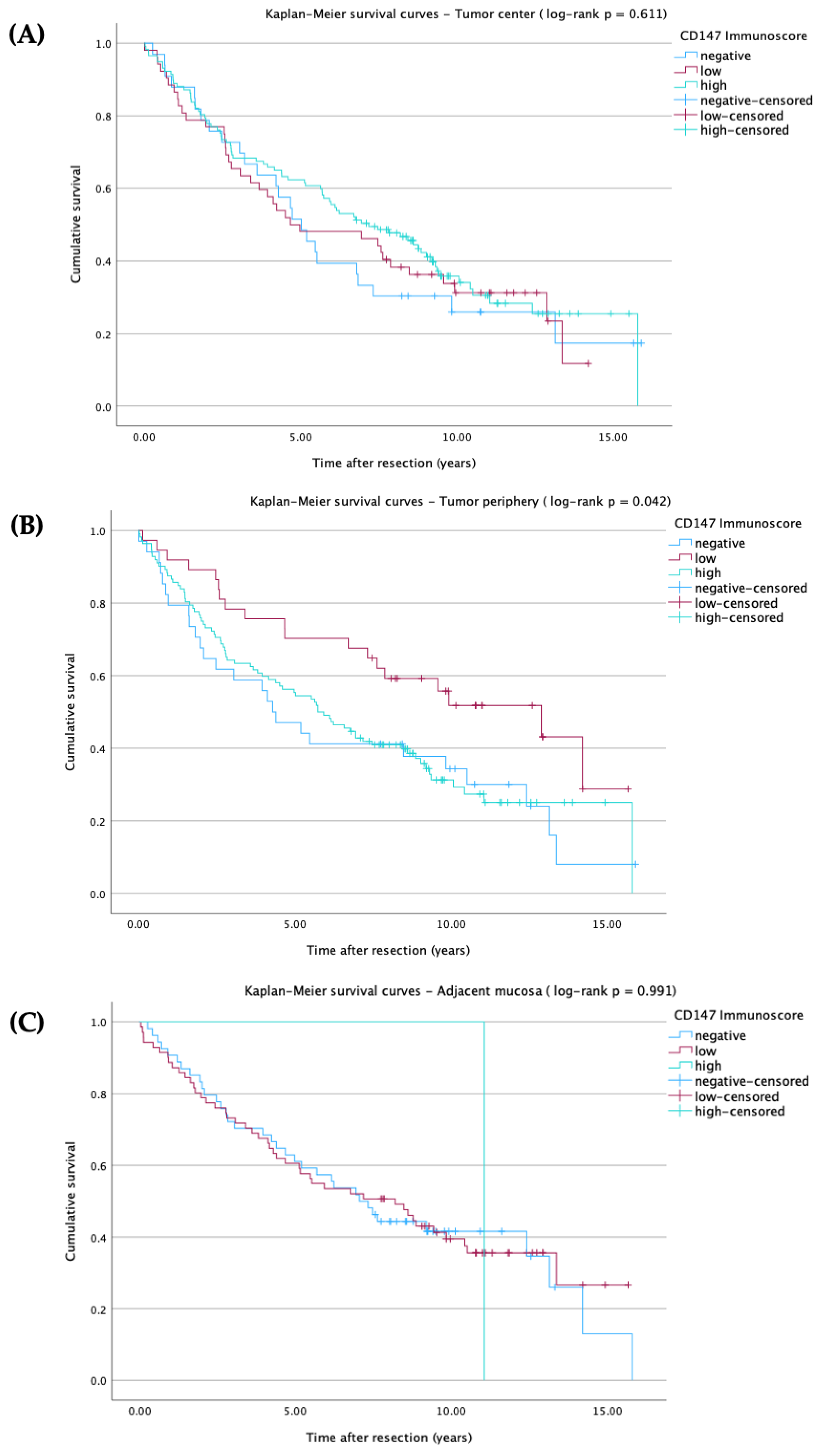
Kaplan–Meier survival analysis was performed to assess overall survival according to CD147 immunoscore (negative, low, high) in the tumor center, tumor periphery, and adjacent mucosa (
Figure 2A–C).
These analyses revealed no significant differences in survival for CD147 expression in the tumor center (log-rank
p = 0.611; HR = 0.923, 95% CI: 0.554–1.537;
Figure 2A) or in the adjacent mucosa (log-rank
p = 0.991; HR = 0.971, 95% CI: 0.621–1.518;
Figure 2C). In contrast, the CD147 immunoscore at the tumor periphery was significantly associated with overall survival (log-rank
p = 0.042, HR = 0.514, 95% CI: 0.284–0.930;
Figure 2B), with patients exhibiting low peripheral CD147 expression showing a survival advantage compared with the other immunoscore groups.
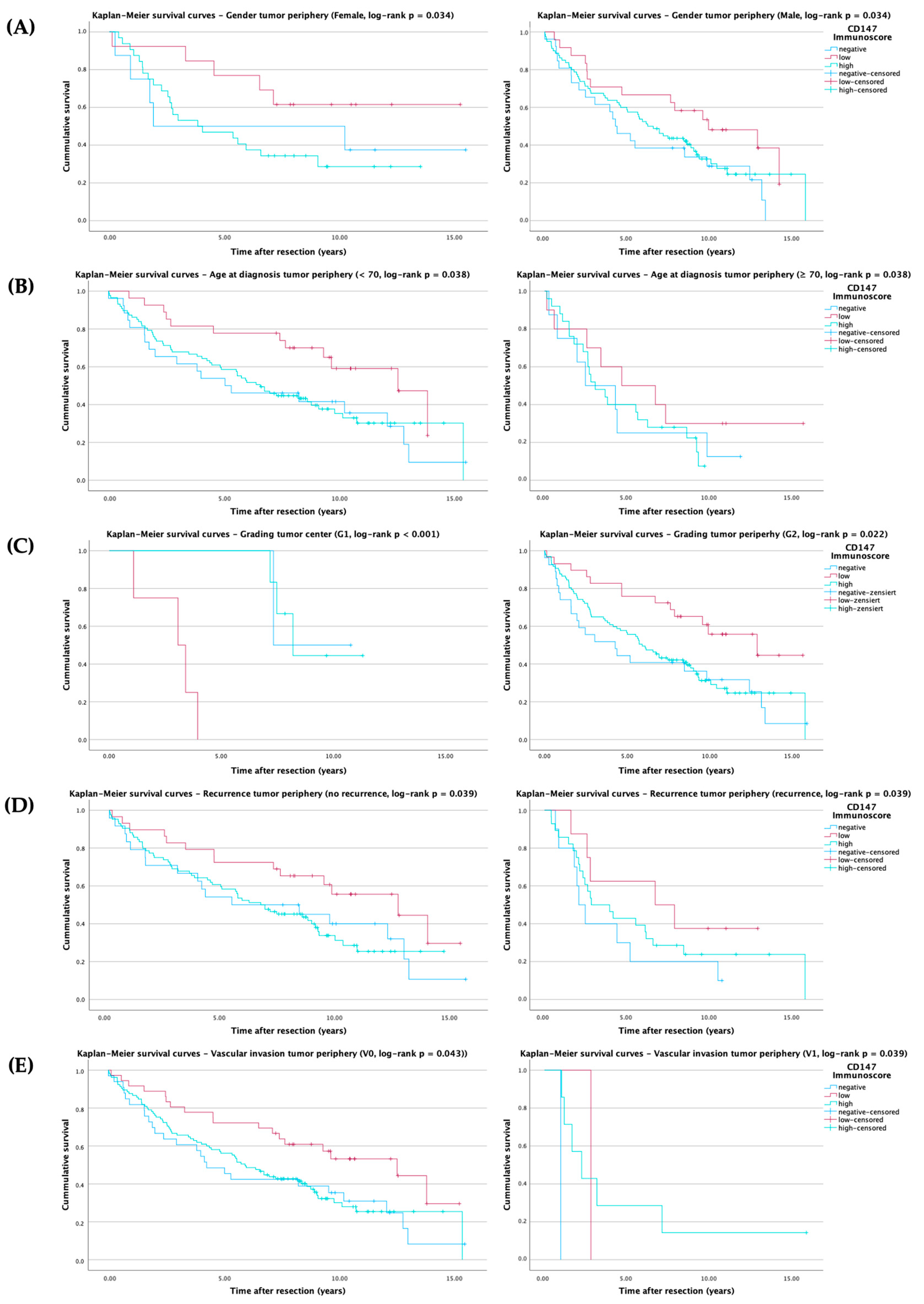
To further explore these associations, subgroup analyses were performed and stratified by clinicopathological parameters and tissue compartments. Statistically significant overall survival analyses are listed in
Table A1 and illustrated in
Figure 3A–E, while other parameters showed no significant associations and are not presented. Given the number of stratified comparisons across clinicopathological subgroups and tissue compartments, and the reduced sample size in several strata, these subgroup Kaplan–Meier analyses should be considered exploratory and hypothesis-generating. Therefore,
p-values are reported descriptively and were not adjusted for multiple testing. Findings should thus be interpreted with caution, particularly when subgroup sizes are small.
Herein, Kaplan–Meier analyses revealed that, in the tumor periphery, overall survival differed by gender (χ2 = 13.992, p = 0.034), with female patients benefiting more from low CD147 expression than male patients.
The same results could be seen in the age-at-diagnosis subgroups, as patients > 70 years of age (χ2 = 6.540, p = 0.038), compared with patients aged ≤70 years, showed poorer outcomes linked to higher peripheral CD147 expression.
Regarding tumor grading, a significant association between CD147 immunoscore and overall survival was observed in well-differentiated (G1) tumors of the tumor center (χ2 = 13.992, p = < 0.001). In this subgroup (n = 12), patients with low CD147 expression demonstrated shorter overall survival compared to those with high or negative expression levels. Although this finding contrasts with the expected direction of association, the small number of cases in this subgroup likely limits the robustness of this observation. The distribution of cases (two negative, four low, and six high expression) and the complete event occurrence in the low-expression group (4/4 deaths, zero censored) suggest that the apparent survival disadvantage of low CD147 expression may primarily reflect sample size constraints rather than a biological effect. In moderately differentiated (G2) and poorly differentiated (G3) tumors of the tumor center, no significant associations were detected (p = 0.729 and p = 0.752, respectively).
In the tumor periphery, survival also differed significantly among CD147 immunoscore groups in moderately differentiated tumors (χ2 = 7.629, p = 0.022), where low CD147 expression again correlated with improved overall survival.
However, no significant survival differences were detected for G1 (p = 0.938) or G3 (p = 0.918) tumors in the tumor periphery.
Additionally, recurrence (χ2 = 6.478, p = 0.039) and vascular invasion (χ2 = 6.299, p = 0.043) were significantly linked to survival differences, with low CD147 expression being associated with longer survival times.
While most other parameters showed no significant associations, several subgroups in the tumor periphery demonstrated near-significant trends, suggesting a biological and therefore prognostic relevance of CD147 expression.
Among patients without lymph node metastasis (N0), there was a trend toward improved survival in those cases with low peripheral CD147 immunoscore compared with high or negative expression (p = 0.090). A similar trend was observed in OSCC patients without lymph vessel invasion (L0) at the tumor periphery (p = 0.071), in which low CD147 immunoscore was associated with prolonged survival.
In UICC stage IV tumors, a comparable tendency was noted (p = 0.104), with patients showing low CD147 expression exhibiting prolonged overall survival.
Although these trends did not reach formal statistical significance, they consistently pointed toward a potential survival benefit associated with reduced CD147 expression in less invasive and advanced-stage tumor settings.
Collectively, the data support the prognostic utility of peripheral CD147 expression in OSCC, indicating its potential role in patient risk stratification. Low CD147 expression emerges as a marker of favorable prognosis across multiple clinicopathological subgroups.
2.4. Univariate and Multivariate Regression Analysis of Prognostic Factors for Survival
To identify prognostic factors for patient survival, Cox proportional hazard analyses were conducted, incorporating clinicopathological parameters and CD147 expression levels. Univariate and multivariate Cox proportional-hazards results are shown in
Table 5 and were used to examine time-to-event outcomes, focusing on overall survival. Multivariate Cox models were adjusted for relevant clinical covariates, including CD147 immunoscore levels of the tumor periphery, age, T-status, N-status, UICC stage, recurrence, lymph vessel invasion, vessel invasion, and adjuvant therapy.
In univariate Cox proportional-hazards analysis, several parameters were significantly associated with reduced survival, including older age at diagnosis (≥70 years; p = 0.002, hazard ratio (HR) = 1.778, 95% confidence interval (CI): 1.235–2.560), T-status (T4; p = 0.001, HR = 2.028, 95% CI: 1.324–3.106), positive nodal status (N+; p = 0.004, HR = 1.601, 95% CI: 1.161–2.207), UICC stage III (p = 0.048, HR = 1.735, 95% CI: 1.004–3.000), UICC stage IV (p = 0.007, HR = 1.822, 95% CI: 1.175–2.826), tumor recurrence (p = 0.004, HR = 1.675, 95% CI: 1.181–2.375), lymph vessel invasion (L1; p = < 0.001, HR = 1.958, 95% CI: 1.321–2.901), vessel invasion (V1; p = 0.020, HR = 2.234, 95% CI: 1.135–4.399), and adjuvant radiotherapy (p = 0.018, HR = 1.520, 95% CI: 1.074–2.152). Low CD147 expression in the tumor periphery showed a significant positive correlation with survival (low; p = 0.028, HR = 0.514, 95% CI: 0.284–0.930), whereas expression in the tumor center or the surrounding mucosa did not show any significant associations.
In multivariate Cox analysis, the prognostic impact of low CD147 expression in the tumor periphery remained significant (p = 0.024, HR = 0.492, 95% CI: 0.266–0.909). Age ≥ 70 (p = 0.001, HR = 2.036, 95% CI: 1.322–3.135) alongside positive nodal status (p = 0.020, HR = 2.253, 95% CI: 1.134–4.475), tumor recurrence (p = 0.021, HR = 1.613, 95% CI: 1.074–2.423), and lymph vessel invasion (p = 0.009, HR = 1.946, 95% CI: 1.179–3.213) also remained as independent factors for survival. No independent prognostic significance was observed for CD147 expression in the tumor center or adjacent mucosa.
In summary, low CD147 expression in the tumor periphery emerged as an independent prognostic marker for improved overall survival. In contrast, expression levels in the tumor center and mucosa showed no prognostic relevance. Classic clinicopathological factors such as older age, positive nodal status, recurrence, and lymphatic invasion also demonstrated independent associations with poorer prognosis, underscoring their continued relevance in survival prediction.
Additionally, logistic regression analyses were conducted to examine the association between CD147 immunoscore and treatment response across the adjuvant therapy settings, namely adjuvant therapy in general, radiation therapy alone, and radiochemotherapy. Therapy-response models were performed as exploratory analyses due to multiple comparisons (across compartments, immunoscore contrasts, and adjuvant treatment strata) and limited power in some subgroups, particularly in the radiochemotherapy stratum. Accordingly, odds ratios and p-values are presented descriptively and should be interpreted cautiously, as estimates may be unstable in small strata.
Analysis of adjuvant therapy in general revealed that CD147 expression levels in the tumor center were not significantly associated with treatment response (
Table A2). Specifically, negative and low expression compared to high expression yielded non-significant odds ratios (negative vs. high: OR = 0.590, 95% CI: 0.117–2.976,
p = 0.523; low vs. high: OR = 0.821, 95% CI: 0.277–2.435,
p = 0.723). In the tumor periphery, no statistically significant associations were found either (negative vs. high: OR = 0.828, 95% CI: 0.208–3.302,
p = 0.789; low vs. high: OR = 2.576, 95% CI: 0.838,
p = 0.099), although a trend toward improved response in the “low” subgroup was observed, no statistical significance was reached. In the adjacent mucosal compartment, model convergence issues due to small group sizes resulted in extremely high and non-interpretable odds ratios, with low explained variance (Nagelkerke R
2 < 0.05).
In the subgroup receiving radiotherapy only (
Table A3), the results followed a similar pattern. In the tumor center, negative and low CD147 expression showed no significant associations with therapy response (negative vs. high: OR = 0.296, 95% CI: 0.034–2.595,
p = 0.272; low vs. high: OR = 0.561, 95% CI: 0.135–2.333,
p = 0.427). In the tumor periphery, results were likewise non-significant (negative vs. high: OR = 0.556, 95% CI: 0.106–2.901,
p = 0.486; low vs. high: OR = 2.160, 95% CI: 0.579–8.055,
p = 0.251). Within the mucosal region, only the contrast between negative and high expression could be estimated (OR = 1.250, 95% CI: 0.326–4.797,
p = 0.745), while the “low vs. high” comparison could not be computed due to an insufficient number of cases in the “low” category. Again, no statistically significant associations emerged, and model fit remained poor (Nagelkerke R
2 ≤ 0.049).
In patients who received adjuvant radiochemotherapy, CD147 expression levels were also not significantly linked to treatment outcomes. In the tumor center, comparisons between negative and low expression against the high category reference group showed non-significant results (negative vs. high: OR = 0.4.667, 95% CI: 0.223–97.497,
p = 0.321; low vs. high: OR = 01.556, 95% CI: 0.256–9.469,
p = 0.632). Similarly, in the tumor periphery, no significant associations were found (negative vs. high: OR = 3.000, 95% CI: 0.203–44.359,
p = 424; low vs. high: OR = 4.000, 95% CI: 0.458–34.922,
p = 0.210), although the odds ratios in the “low” group suggest a non-significant trend. In the mucosa, both comparisons were estimable. Still, they resulted in extremely large, non-interpretable odds ratios, indicating a lack of statistical stability, again due to small subgroup sizes, as shown in
Table A4. As with the other models, no significant associations were found, and the model fit was poor (Nagelkerke R
2 ≤ 0.094).
Taken together, CD147 expression levels in the tumor center, periphery, and adjacent mucosa were not significantly associated with therapy response across all adjuvant treatment modalities. While some non-significant trends were observed, particularly in the tumor periphery, none of the models demonstrated sufficient predictive value.
2.5. TCGA-Based Analysis of BSG Expression, Clinical Correlates, Survival Outcomes, and Immune Signatures in HNSCC
To gain deeper insights into the biological and clinical relevance of CD147 (BSG) in OSCC, transcriptomic and immunogenic data were explored and analyzed using a TCGA-based multi-level analysis of the TCGA-HNSCC cohort. While the TCGA-HNSCC dataset includes multiple anatomic subsites, OSCC represents a major subset. Therefore, the analyses presented here provide a meaningful approximation to support and contextualize the findings derived from the OSCC-specific patient cohort investigated in this study.
2.5.1. BSG Expression in Normal vs. Tumor Tissue, Association with Clinicopathological Variables, and Prognostic Value
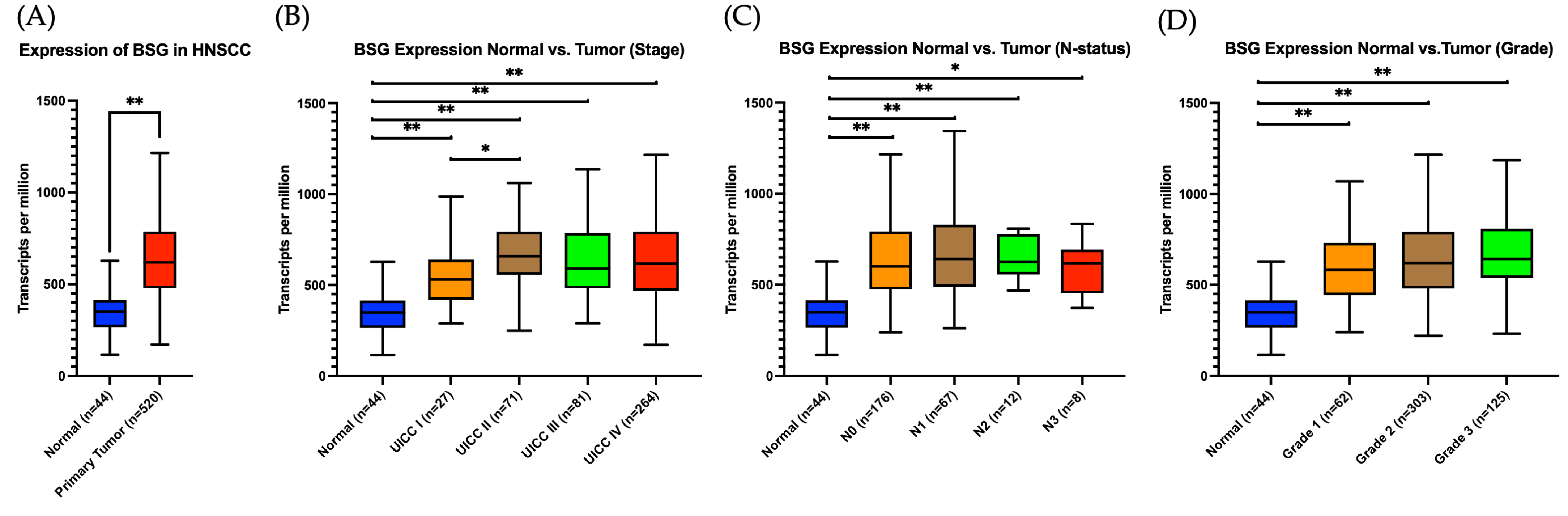
To further investigate the clinical relevance of CD147 (BSG) expression, RNA-sequencing data from the TCGA cohort in head and neck squamous cell carcinoma (HNSCC) were analyzed using the UALCAN platform and are displayed in
Figure 4.
A significant upregulation of BSG transcript levels was observed in primary tumor tissues (
n = 520) compared to normal tissues (
n = 44) (
p < 0.001,
Figure 4A).
When stratified by UICC tumor stage, BSG expression was also significantly elevated in tumor samples compared to normal tissue (
p < 0.001 for all stages I-IV), with the highest expression observed in UICC IV tumors (
Figure 4B). A statistically significant difference was noted between stage I and stage II tumors (
p = 0.025), but no further significant differences were observed among the higher tumor stages.
A comparison across lymph node status demonstrated significantly elevated BSG expression in all nodal-positive subgroups (N1-N3) as compared to normal tissue, with the most substantial difference observed in N1 samples (
p < 0.001,
Figure 4C). However, no statistically significant differences were detected among the individual N stages themselves, including N0 cases.
A similar trend was observed with respect to histological grading. Regardless of tumor grade, all tumor subgroups exhibited higher BSG expression levels compared to normal tissue (all
p < 0.001), reflecting once again a general upregulation of BSG in malignant lesions (
Figure 4D). Among intra-tumoral comparisons, a statistically significant increase in BSG expression was detected in grade 3 tumors compared to grade 1 (
p = 0.038). In contrast, no other pairwise difference among tumor grades reached statistical significance.
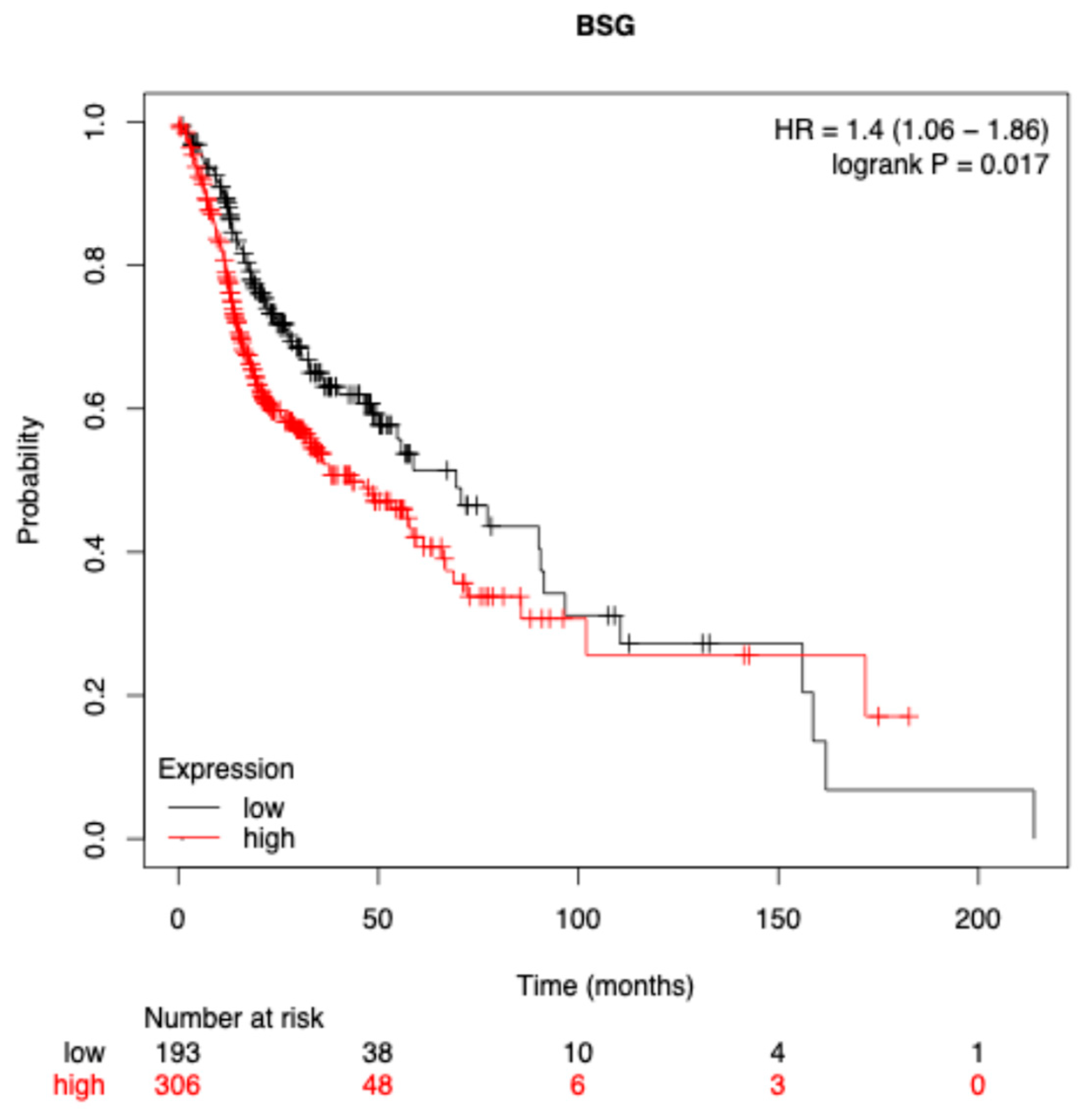
To assess the prognostic significance of BSG expression in HNSCC, a Kaplan–Meier survival analysis was performed using the KMplot.com tool, based on TCGA patient data. Patients were stratified into high- and low-expression groups based on the median BSG mRNA level. The analyses revealed a statistically significant difference in OS between the groups, with high BSG expression associated with reduced survival probability (log-rank
p = 0.017,
Figure 5). The calculated hazard ratio (HR) was 1.40 with a 95% CI of 1.06–1.86.
Taken together, these data indicate that BSG is significantly overexpressed in HNSCC and is associated with unfavorable clinical features and reduced overall survival.
2.5.2. BSG-Linked Immune Modulation in the HNSCC Tumor Microenvironment
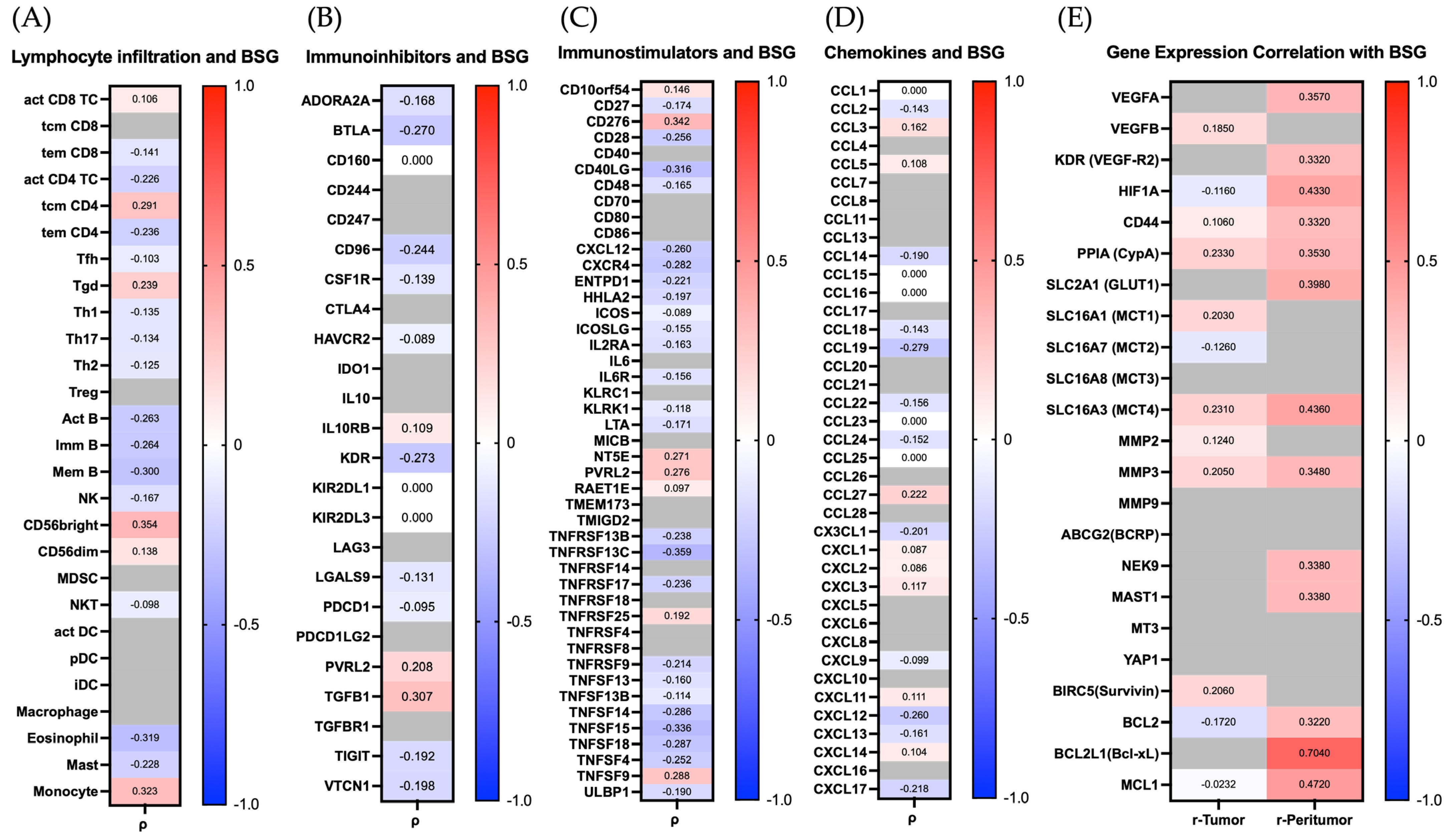
To evaluate potential immunological functions of CD147 in the tumor microenvironment, correlation analyses were conducted using the TISIDB database (
Figure 6).
Regarding lymphocyte infiltration, BSG expression showed consistently negative correlations with multiple T cell subtypes, including activated CD4
+ T cells (
ρ = −0.226), memory CD4
+ (
ρ = −0.236) and CD8
+ (
ρ = −0.141) T cells, memory B cells (
ρ = −0.300), and eosinophils (
ρ = −0.319) (
Figure 6A). These associations may reflect reduced adaptive immune response in BSG-high tumors. Interestingly, a weak positive correlation was observed between BSG and CD56
++ (bright) Natural Killer (NK) cells (
ρ = 0.354) and Monocytes (
ρ = 0.323), suggesting a potential compensatory innate immune component.
In terms of immune checkpoint interactions, BSG expression was positively correlated with the immunoinhibitory gene TGFB1 (
ρ = 0.307). At the same time, weak inverse associations were observed for KDR (
ρ = −0.273), BTLA (
ρ = −0.270), and CD96 (
ρ = −0.244), as shown in
Figure 6B. Among immunostimulatory molecules, both positive and negative associations were detected. Notably, BSG expression showed a strong positive correlation with CD276 (
ρ = 0.342), as well as a correlation with TNFSF9 (
ρ = 0.288), while inverse correlations were observed with TNFRSF13C (
ρ = −0.359), TNFRSF15 (
ρ = −0.336), CD40LG (
ρ = −0.316), and TNFSF14 (
ρ = −0.286). These findings suggest that higher BSG expression may be associated with reduced immune co-stimulatory signaling (
Figure 6C).
Finally, the analysis of chemokine expression revealed modest negative correlations between BSG and several chemokines involved in leukocyte recruitment, including CCL19 (
ρ = −0.27.9), CXCL12 (
ρ = −0.260), CX3CL1 (
ρ = −0.201), and CCL18 (
ρ = −0.143), suggesting a dampened chemotactic gradient in BSG-overexpressing tumors (
Figure 6D).
In summary, high BSG expression appears to be associated with an immunosuppressive tumor microenvironment characterized by reduced lymphocyte infiltration and altered immune-modulatory signaling.
2.5.3. Transcriptomic Correlation of CD147 with Key Regulator Genes of Tumor Promotion and Therapy Resistance in HNSCC
To deepen understanding of the molecular context surrounding CD147 expression and therapy resistance in OSCC, additional in silico correlation analyses were conducted using the GEPIA3 platform with HNSCC cohorts. Pearson correlation coefficients (
r) were calculated between BSG and a selected panel of genes functionally implicated in tumor progression, immune regulation, and metabolic adaptation. As visualized in the correlation heatmap (
Figure 6E), multiple genes showed considerable positive correlations with BSG expression.
In the peritumoral compartment, strong positive correlations were observed between BSG expression and several central effectors of oncogenic signaling and treatment resistance. These included HIF1A (HIF-1α; r = 0.433), SLC2A1 (GLUT1; r = 0.398), PPIA (CypA; r = 0.353), CD44 (r = 0.332), and SLC16A3 (MCT4; r = 0.436). These findings suggest a pattern that aligns with CD147’s known role in sustaining the glycolytic phenotype and facilitating lactate export. Furthermore, correlations with MMP3 (r = 0.348) and VEGFA (r = 0.357) support the involvement of BSG in extracellular matrix remodeling and angiogenesis.
Additionally, the anti-apoptotic regulator BCL2L1, coding for Bcl-xL, showed the strongest correlation (r = 0.704), along with MCL1 (r = 0.472) and BCL2 (r = 0.322), underscoring a potential link between CD147 and apoptosis resistance in the peritumoral niche, as these genes are critically involved in cell survival under therapeutic stress.
In contrast, correlations within the tumor core were generally weaker and more variable. Moderate associations were observed for PPIA (CypA; r = 0.233), MCT4 (r = 0.231), and BIRC5 (Survivin; r = 0.206). Negative correlations (HIF1A, SLC16A7, BCL2, and MCL1) are shown in blue shades, while non-significant correlations are covered in gray (VEGFA, KDR, SLC2A1, SLC16A8, MMP9, ABCG2, NEK9, MAST1, MT3, YAP1, and BCL2L1). Likewise, in the peritumoral compartment, non-significant results of VEGFB, SLC16A1, SLC16A7, SLC16A8, MMP2, MMP9, ABCG2, MT3, YAP1, and BIRC5 are covered in gray.
Taken together, this extended in silico analysis provides further evidence for the integration of CD147 into a pro-oncogenic transcriptional network that promotes tumor cell survival, metabolic adaptation, matrix degradation, and resistance to therapy. Notably, the strongest associations were observed in the peritumoral compartment, suggesting this zone as a critical interface for CD147-driven tumor-host interactions.
3. Discussion
In line with the growing interest in the metabolic and immunological landscape of solid tumors, this study investigated the expression patterns and clinical relevance of CD147 in oral squamous cell carcinoma (OSCC), focusing on its compartment-specific prognostic and predictive value in a large, well-characterized patient cohort.
Our findings indicate that low CD147 expression in the tumor periphery is associated with significantly prolonged overall survival, whereas CD147 levels in the tumor center or the adjacent mucosa showed no prognostic relevance. Such a pattern aligns with known pathophysiological processes, given that the invasive tumor front serves as the interface for tumor–stroma interactions, immune evasion, and metastatic potential [
24,
25]. Given the limited number of clinically implemented prognostic biomarkers in OSCC, the identification of CD147 as a compartment-specific prognostic indicator offers a promising addition to the current stratification tools. Compared to broadly expressed markers such as Epithelial-Growth-Factor-Receptor (EGFR), p53, or Survivin, CD147 may provide distinct spatial and functional information relevant to invasion dynamics and immune evasion [
26].
This effect was confirmed in multivariate analysis, highlighting peripheral CD147 as an independent prognostic marker in OSCC. However, no statistically significant associations between CD147 expression and adjuvant therapy response were found across the examined compartments.
Multiple previous studies have demonstrated that high CD147 expression is associated with poorer survival outcomes across various cancer types [
11,
27,
28]. Among others, one key mechanistic factor is its known role in activating the GLUT1-monocarboxylate transporter (MCT) axis, promoting glucose uptake and lactate efflux [
13], and thereby supporting the Warburg metabolism and pH homeostasis in cancer [
14]. CD147 also contributes to matrix metalloproteinase (MMP)-mediated extracellular matrix remodeling [
29], angiogenesis [
15], and invasion [
30], which are critical mechanisms for tumor progression and metastasis.
In breast cancer, for example, Liu et al. linked elevated CD147 expression to chemoresistance and reduced therapy efficacy [
16]. Similar findings have been reported in cervical and pancreatic cancer, supporting the hypothesis that CD147 confers therapy resistance by stabilizing survival pathways, inhibiting apoptosis, and modulating the tumor microenvironment [
20,
31].
Despite the biological rationale, we did not observe a significant association between CD147 expression and response to adjuvant therapy, including adjuvant treatment in general, radiotherapy, and radiochemotherapy. Although patients with low peripheral CD147 expression showed favorable trends, these did not reach statistical significance, likely due to small sample sizes within therapy subgroups. Consistent with this, logistic regression models demonstrated poor predictive accuracy, as shown by wide confidence intervals and a weak model fit.
In silico immunological and transcriptomic analyses of The Cancer Genome Atlas (TCGA) data, with a focus on head and neck squamous cell carcinoma (HNSCC), supported our tissue-based findings. Since most of these TCGA-based analyses are derived largely from bulk RNA sequencing, it should be emphasized that they cannot resolve intratumoral spatial heterogeneity and therefore should not be interpreted as a direct spatial validation of the compartment-specific IHC patterns observed in our cohort. Notably, only the GEPIA3 correlation analysis shown in
Figure 6E provides a limited compartmental approximation by reporting correlations separately for tumor tissue and the GEPIA3-defined peritumoral tumor infiltration zone, whereas the remaining TCGA-derived outputs reflect aggregated bulk signals from the sampled tumor tissue. Within this framework, CD147 (Basigin, BSG) expression was significantly upregulated in tumor tissue and linked to decreased overall survival. The correlation with immune signatures displayed a complex pattern, with negative correlations with adaptive immune cells (e.g., CD8
+ T cells, memory B cells) and positive associations with immunoinhibitory molecules (e.g., TGFB1, CD276), indicating a suppressive immune microenvironment in CD147-high tumors [
32,
33]. Interestingly, positive correlations with monocytes and CD56
bright natural killer (NK) cells were observed. This may reflect an innate compensatory immune response aimed at counterbalancing the immunosuppressive and tumor-promoting effects of CD147 overexpression, as similar mechanisms of blocking immunosuppression are the aim of several treatment modalities [
34]. Given that CD56
bright NKs are typically less cytotoxic but highly cytokine-productive, their presence may also indicate an altered immune contexture with unresolved immunoregulatory signaling rather than effective tumor surveillance [
35].
Also contributing to immune modulation, metabolic rewiring toward glycolysis with enhanced lactate export can acidify the local milieu and impair effector immune cell function, while supporting immunosuppressive phenotypes through metabolic–epigenetic regulation [
36]. In OSCC, spatial and single-cell analyses indicate that hypermetabolic, acidified regions can foster chemokine-driven recruitment of regulatory T cells with increased TGF-β signaling, thereby shaping an immunosuppressive niche [
37]. In parallel, CD147-driven matrix remodeling and protease activity can contribute to immune cell exclusion by restructuring extracellular barriers and altering stromal signaling [
38,
39]. Finally, CD147-related tumor-myeloid interactions have been mechanistically linked to macrophage recruitment and immunosuppression in other solid squamous tumors, supporting the plausibility of CD147-mediated immune-stroma cross-talk in squamous carcinomas [
40]. Together, these lines of evidence provide a framework in which CD147-high tumors couple metabolic adaptation and invasive remodeling with immunoregulatory signaling, consistent with the immune correlations observed in our TCGA-based analyses.
Recent work further strengthens this immunometabolic interpretation by highlighting lactate as a signaling metabolite that actively shapes tumor-immune interactions and immunotherapy responsiveness, including through lactate-driven immunosuppression and lactylation-associated reprogramming of the tumor microenvironment [
41]. In parallel, contemporary reviews of immunotherapy in head and neck cancer emphasize both the clinical relevance of immune checkpoint blockade and the need for mechanistically informed biomarkers and combination strategies to overcome immunosuppressive niches [
42]. In this context, CD147’s functional coupling to lactate transport via MCTs and its association with immunoinhibitory signaling provide a plausible mechanistic link between a CD147-high, lactate-shaped microenvironment and the immune signatures observed in our TCGA-based analyses.
Transcriptomic correlation analyses showed that high BSG expression is part of a transcriptional network promoting oncogenic signaling, metabolic adaptation, and resistance to apoptosis. Therein, strong positive correlations were observed with key regulators, including HIF1A (HIF-1α), SLC2A1 (GLUT1), SLC16A3 (MCT4), and CD44, highlighting CD147’s role in maintaining a hypoxia-driven, glycolytic phenotype and in facilitating remodeling of the acidic microenvironment, which are hallmarks of aggressive tumor behavior [
12,
43,
44]. Collectively, these correlations delineate a CD147-associated program that couples metabolic adaptation to microenvironmental remodeling. Hypoxia-driven glycolysis with enhanced lactate export can sustain tumor cell fitness under nutrient and oxygen limitation and simultaneously promote an acidic niche that favors invasion and stress tolerance. In parallel, CD147-linked extracellular matrix remodeling and invasion-associated proteolysis, including MMP-related signatures and urokinase-type plasminogen activator (uPA) pathway activity, provide a direct mechanistic route to basement membrane degradation, resulting in stromal invasion and regional spread in oral and head and neck squamous cell carcinoma models [
38,
39]. Importantly, this pathway becomes even clearer when tumors are compared with high versus low CD147 activity. In the CD147 high setting, the transcriptomic network converges on coordinated programs that are each directly relevant to OSCC progression, like afore-mentioned metabolic reprogramming under hypoxia (HIF1A, GLUT1, MCT4), remodeling of the acidic microenvironment, extracellular matrix degradation, and motility that enable invasion, and survival signaling consistent with reduced apoptosis. In contrast, CD147 low tumors are characterized by the relative attenuation of these coupled stress-adaptation and remodeling modules and, as presented in our TCGA-based immune correlation analysis, a comparatively less suppressive immune contexture, as reflected by inverse associations of BSG with adaptive immune cell signatures and positive associations with immunoinhibitory mediators in CD147 high tumors. Taken together, these patterns support a model in which high CD147 expression promotes a progression-prone phenotype by integrating metabolic adaptation, invasive remodeling, and immune suppression, whereas lower CD147 expression aligns with a less aggressive transcriptional and microenvironmental state.
Notably, high co-expression with anti-apoptotic genes such as BCL2L1 (Bcl-xL), MCL1, MAST1, and BCL2 further supports CD147’s role in treatment resistance and cell survival under stress conditions, such as radiation or chemotherapy [
17,
31,
45,
46]. These correlations were strongest in the peritumoral compartment, highlighting this area as a potential hotspot for CD147-mediated tumor-host interactions. The lack of similar correlation strength in the tumor core suggests spatially limited relevance, consistent with our IHC-based findings.
Importantly, the mechanistic pathway programs linked to high BSG expression are further substantiated by meta-analyses and evidence from larger cohorts, which consistently associate key nodes of this network with prognosis and survival, thereby strengthening the translational bridge from transcriptomic signatures to clinically observable outcomes. Consistent with this concept, pooled OSCC evidence shows that HIF-1α overexpression is associated with adverse clinicopathological features and significantly worse overall survival, in line with a hypoxia-adapted, therapy-resistant tumor state [
43]. Likewise, GLUT1 overexpression has been linked to aggressive disease characteristics and shorter overall survival in OSCC, and broader meta-analytic evidence across HNSCC supports the notion that glycolysis markers, including GLUT1 and MCT4, are associated with inferior survival outcomes [
47,
48]. Along the same line, high MCT4 expression has been reported to correlate with poor prognosis in OSCC cohorts, aligning with the concept that lactate export and extracellular acidification foster invasion, immune evasion, and treatment resistance. Beyond metabolism, progression-associated proteolysis programs that converge on uPA and MMP activity have been shown to predict metastatic risk and unfavorable prognosis in OSCC, supporting the interpretation that the BSG-correlated invasion signature reflects clinically meaningful aggressiveness [
49,
50,
51,
52]. Taken together, these external prognostic data provide a plausible bridge between the transcriptomic alterations observed in the context of high CD147/BSG expression and OSCC progression.
From a translational perspective, targeting CD147 directly or disrupting its interaction partners (e.g., MCTs, CD44, or cyclophilin A) could represent a viable therapeutic strategy, particularly in tumors displaying high peripheral CD147 expression. Direct CD147-targeting modalities (e.g., functional antibodies and emerging antibody-based formats such as antibody–drug conjugates in other tumor entities) provide proof-of-principle that CD147 is a druggable surface antigen [
53]. Mechanistically, additional rational strategies include disrupting the CD147–cyclophilin A axis and targeting lactate transport/metabolic dependencies that shape the local microenvironment, as MCT-focused approaches are being evaluated clinically in advanced cancers in phase I trials [
54]. In head-and-neck models, combined targeting of CD147/EMMPRIN and EGFR has shown additive inhibition of proliferation and migration compared with either approach alone, supporting combination concepts aligned with current multimodal care [
55]. Furthermore, preclinical models in other tumor types have demonstrated the efficacy of CD147-targeting small molecules, underscoring CD147 as a potential therapeutic target in OSCC [
56].
Despite the comprehensive design and the integration of clinical, immunohistochemical, and transcriptomic data, several limitations should be acknowledged. Given the retrospective, monocentric nature of the study, the scope of the conclusions should be interpreted in the context of the study design. This cohort comprises retrospectively collected OSCC patients treated at a single tertiary care center over a defined period, and thus, the observed effect sizes may be influenced by center-specific referral patterns, case mix, and local treatment algorithms. Moreover, because all patients were from a single institution and a relatively homogeneous population, extrapolation to other geographic regions, ethnic backgrounds, and contemporary treatment settings should be done with caution. Moreover, the incomplete granularity of some clinical variables limits causal inference and may lead to residual confounding. In addition, the TMA-based approach, while enabling standardized high-throughput assessment, samples only selected cores and may therefore not fully capture intratumoral heterogeneity, particularly across the invasive front and the tumor–stroma interface. Likewise, immunohistochemical scoring was semi-quantitative and may be susceptible to interobserver variability. Although efforts were made to standardize scoring, digital quantification may further enhance reproducibility. In this context, multiplex fluorescence approaches combined with digital analysis could also enable a more detailed spatial assessment of immune infiltration in relation to CD147 expression, and work in this direction is ongoing. Furthermore, treatment-response analyses, especially for radiochemotherapy, were constrained by small subgroup sizes, which reduced statistical power and may have left clinically meaningful trends underpowered. At the same time, the transcriptomic analyses presented here are primarily correlation-based and therefore describe co-expression networks rather than mechanistic causality. Also, functional validation experiments were not performed to confirm the biological roles of CD147 and its correlated partners. Finally, although TCGA-HNSCC data provided valuable external context, its anatomical heterogeneity prevents definitive OSCC-specific generalization.
To overcome these limitations and expand on the presented findings, the following future directions are either considered or already underway: A prospective, multicenter validation study represents a logical next step to confirm the prognostic value of CD147 expression in OSCC. Such a study, while not yet initiated, would ideally include standardized digital immunoscoring and molecular stratification to enhance external validity and clinical translatability. Functional in vitro studies are currently in preparation to investigate the causal role of CD147 in proliferation, apoptosis resistance, and treatment response. Planned approaches include CRISPR/Cas9-mediated gene editing in OSCC cell lines and co-culture experiments with stromal and immune components to explore CD147-dependent tumor-host interactions. Fluorescence-based multichannel imaging analyses are already in progress. These aim to quantitatively assess spatial co-localization between CD147 and immune cell infiltrates in TMA sections, again focusing on the tumor invasive front. This method is expected to yield high-resolution insight into the immunological landscape shaped by CD147 expression in the tumor microenvironment.



 ,
,