


Abstract
The application of emerging technologies, such as Artificial Intelligence (AI), entails risks that need to be addressed to ensure secure and trustworthy socio-technical infrastructures. Machine Learning (ML), the most developed subfield of AI, allows for improved decision-making processes. However, ML models exhibit specific vulnerabilities that conventional IT systems are not subject to. As systems incorporating ML components become increasingly pervasive, the need to provide security practitioners with threat modeling tailored to the specific AI-ML pipeline is of paramount importance. Currently, there exist no well-established approach accounting for the entire ML life-cycle in the identification and analysis of threats targeting ML techniques. In this paper, we propose an asset-centered methodology—STRIDE-AI—for assessing the security of AI-ML-based systems. We discuss how to apply the FMEA process to identify how assets generated and used at different stages of the ML life-cycle may fail. By adapting Microsoft’s STRIDE approach to the AI-ML domain, we map potential ML failure modes to threats and security properties these threats may endanger. The proposed methodology can assist ML practitioners in choosing the most effective security controls to protect ML assets. We illustrate STRIDE-AI with the help of a real-world use case selected from the TOREADOR H2020 project.
1. Introduction
Machine Learning (ML) plays a major role in a wide range of application domains. However, when ML models are deployed in production, their assets can be attacked in ways that are very different from asset attacks in conventional software systems. One example is training data sets, which can be manipulated by attackers well before model deployment time. This attack vector does not exist in conventional software, as the latter does not leverage training data to learn. Indeed, the attack surface of ML systems is the sum of specific attack vectors where an unauthorized user (the “attacker”) can try to inject spurious data into the training process or extract information from a trained model. A substantial part of this attack surface might lie beyond the reach of the organization using the ML system. For example, training data or pre-trained models are routinely acquired from third parties and can be manipulated along the supply chain. Certain ML models rely on sensor input from the physical world, which also makes them vulnerable to manipulation of physical objects. A facial recognition camera can be fooled by people wearing specially crafted glasses or clothes to escape detection. The diffusion of machine learning systems is not only creating more vulnerabilities that are harder to control but can also—if attacked successfully—trigger chain reactions affecting many other systems due to the inherent speed and automation.The call to improve the security of Artificial Intelligence (AI) systems [1] has attracted widespread attention from the ML community, which has given rise to a new vibrant line of research in security and privacy of ML models and related applications. The ML literature is now plentiful with research papers addressing the security of specific ML models, including valuable survey papers discussing individual vulnerabilities and possible defensive techniques. However, existing work mainly focuses on ingenious mechanisms that allow attackers to compromise the ML-based systems at the two core phases of the learning process, that is the training and the inference stages. In this work, we focus on the distinct, though related, problem of defining a practical methodology for assessing ML-based systems’ security. We approach the problem from the point of view of the security practitioner who has to deal with ML-based systems rather than from the one of the AI expert dealing with security. We argue that, given the current variety and scope of threats and attacks to ML models, there is some confusion about what exactly the security analyst is expected to do to alleviate them. The goal of this paper is to describe an asset-centered methodology for identifying threats to ML-based systems. Our proposal is based on STRIDE [2], a well-known and widely used approach to threat modeling originally developed by Microsoft. STRIDE has been identified by independent agencies like the European Union Agency for Cybersecurity (ENISA) as a promising starting point for AI threat modeling. We argue that our extension to the original STRIDE provides an ML-specific, security property-driven approach to threat detection which can also provide guidance in selecting the security controls needed to alleviate the identified threats. This paper is an extended version of the paper entitled “STRIDE-AI: An Approach to Identifying Vulnerabilities of Machine Learning Assets” presented at the 2021 IEEE International Conference on Cyber Security and Resilience (CSR) [3].
The paper is organized as follows. In Section 2, we review existing work in the field of adversarial machine learning and ongoing research on threat modeling AI/ML systems. Section 3 describes the different stages of our reference ML life-cycle architecture and the relevant ML assets generated therein. In Section 4, we illustrate how to apply the Failure Mode and Effects Analysis approach to AI-ML systems, providing facilitation questions and sample answers along with failure modes specific to ML data, model, and artefact assets. Section 5 describes the methodology (STRIDE-AI) we propose to identify threats to ML assets. Section 6 applies STRIDE-AI to a real-world use case selected from the AI-ML applications developed in the TOREADOR H2020 project, with a focus on data and model assets. Finally, Section 7 presents comments and discussions on the proposed security methodology, while Section 8 concludes our work and proposes future research directions motivated by our efforts toward advancing the development of secure ML-based systems.
2. Related Work
Supervised machine learning models are known to be vulnerable to attacks based on training examples crafted or manipulated by attackers. This type of adversarial exploitation is well documented for various applications. These include antivirus engines, autonomous bots, visual recognition and social networks, among others [4,5,6,7,8]. These attacks have motivated research on ML security [9,10,11,12], establishing the novel research field of Adversarial Machine Learning (AML), which lies at the intersection of machine learning and computer security. An overview of the evolution of active research in this area over the last ten years can be found in [13], where the authors presented a historical picture of the work related to the security of machine learning from a technical perspective. To summarize their findings, current ML security research aims to address the following issues: (i) identifying potential weaknesses of ML-based systems, (ii) devising the corresponding adversarial attacks and evaluating their impact on the attacked system, and (iii) proposing countermeasures against the considered attacks. The issue of adversarial attacks has recently attracted a considerable interest, resulting in the publication of a number of papers proposing novel types of attack and defense mechanisms for specific ML algorithms [14,15,16,17,18]. This line of work, which mainly focuses on identifying data-, model-, and system- oriented attacks and defenses [19,20,21], represents one of the two core branches into which research in the field of ML security can be divided. Researchers in this first area typically address the security concerns with a narrow focus on the specific type of compromise to be achieved or addressed, neglecting a thorough investigation of secure development practices that incorporate identification of both ML-specific and traditional system threats [22,23].
Another emerging research line focuses on threat analysis techniques that can support security expert’s understanding of how ML-based systems may fail. Some recent work explore the applicability of threat modeling methodologies traditionally used in the software engineering area to ML-based systems’ security. These works associate threats to artefacts produced at the different stages of ML models’ life-cycle, from requirements analysis to system maintenance (see Section 1). Wilhjelm et al. [24] apply a traditional threat modelling method together with the corresponding attack libraries to understand the security of ML-based systems at the requirements phase. In order to rank the impact of the identified threats, the authors make use of a bug bar [25] for associating severity levels to threats. Our own recent work [26] focuses instead on the ML models’ maintenance stage, proposing a metric based on the notion of a “gold standard” data set for assessing ML models’ degradation in production. Bitton et al. [27] perform a systematic ML-oriented threat analysis for the Open Radio Access Network (O-RAN) architecture, identifying potential threat actors in the O-RAN ecosystem and mapping them to the capabilities needed by the attacker. The study by Chen and Ali Babar [28] presents a holistic view of system security for ML-based modern software systems. The architectural risk analysis for ML security [29], proposed by the Berryville Institute of Machine Learning, is designed for use by developers, engineers, and others creating applications and services that rely on ML models. Specifically, the Berryville analysis lists 78 risks identified using a generic ML system as an organizing concept, and then identifies the top ten.
The well-known MITRE Adversarial Tactics, Techniques, and Common Knowledge (ATT&CK) framework [30] was created by MITRE to document adversary tactics and techniques based on real-world observations. The MITRE framework provides a common taxonomy of adversarial actions understood by both offensive and defensive sides of cybersecurity, and can be used as a tool to analyze adversary behavior. Complementary to the MITRE ATT&CK framework is MITRE ATLAS (Adversarial Threat Landscape for Artificial-Intelligence Systems) [31], a knowledge base of adversary tactics and techniques which includes demonstrations from red teams and security groups, real-world observations and the state of academic research findings. ATLAS includes some AI/ML case studies. In the threat landscape report on AI, published in late 2020 [32], the European Union Agency for Network and Information System security (ENISA) sets a baseline for a common understanding of security threats to AI, identifying a list of AI-ML assets in the context of all stages of the ML models life-cycle and mapping threats against them. Another recent ENISA’s report [33] presents a detailed analysis of threats targeting ML-based systems (including data poisoning, adversarial attacks and parameters’ exfiltration) and provides a list of security controls described in the literature. Further efforts to understand how ML-based systems may fail and, consequently, how to respond to such failures have been made by Microsoft through the release of guidelines for the mitigation and triage of AI-specific security threats [34]. Microsoft’s approach, which is developed, like ours, on STRIDE threat-modeling [2], does not address the security properties definition. Rather, it is based on a taxonomy that classifies ML failure modes into two categories, namely intentional and unintentional failures. Intentional failures are mapped to a list of attacks reported in the literature [35].
3. ML-Based Application Life-Cycle and Related At-Risk Assets
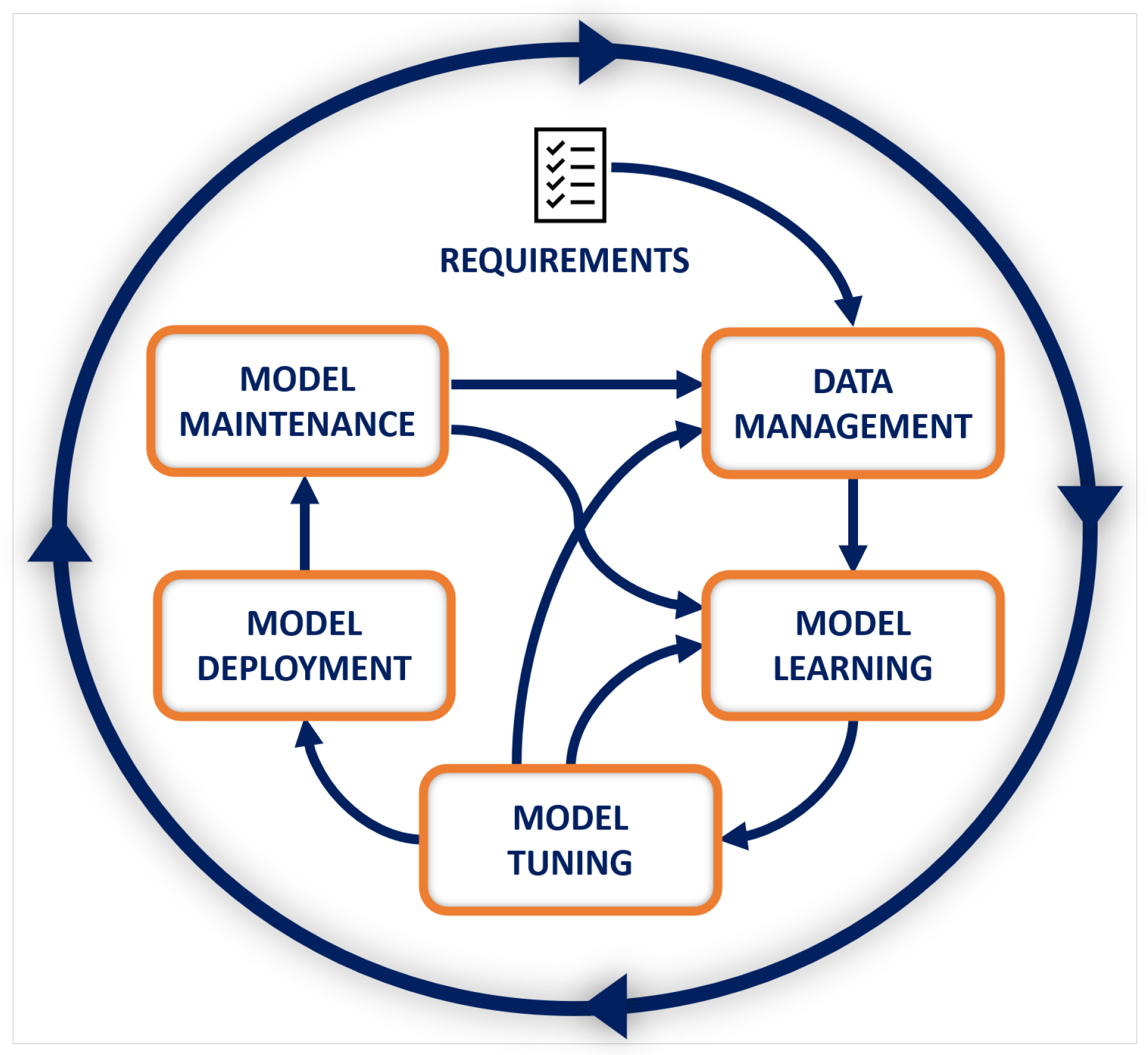
Although there exist many diverse types of learning tasks [36], the development process of ML-based systems has an intrinsic iterative multi-stage nature [37]. Figure 1 shows our reference ML life-cycle, starting from requirements analysis and ending with the ML model’s maintenance in response to changes. While this life-cycle does not cover all possible developments, we will use it to identify the key data assets produced at each phase and to analyze their failure modes. We start by outlining the activities carried out at each stage.
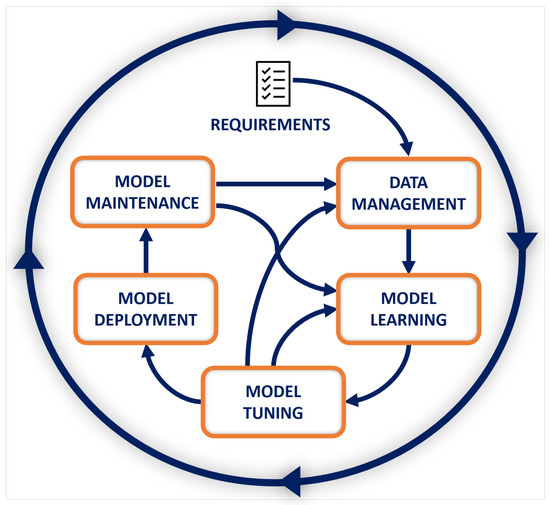
Figure 1.
Our reference ML life-cycle [3].
The initial stage of the ML life-cycle, Data Management, includes a number of steps, a major one being the ingestion of the data required for the next stages. Ingestion occurs from multiple sources, and the data collected can either be stored or immediately used. Pre-processing techniques are used to create a consistent data set suitable for training, testing and evaluation. The next step, Model Learning, involves developing or selecting an ML model that can handle the task of interest. Depending on the goals and the amount and nature of the knowledge available to the model, different ML techniques can be used, such as supervised, unsupervised and reinforcement learning. In the training process of a supervised ML-based system, a learning algorithm is provided with predefined inputs and known outputs. The learning algorithm computes some error metrics to determine whether the model is learning well, i.e., it delivers the expected output not only on the inputs it has seen in training, but also on test data it has never seen before. The so-called hyper-parameters, which control how the training is done (e.g., how the error is used to modify the ML model’s internal parameters), are fine-tuned during the Model Tuning stage. While being tuned, the ML model is also validated to determine whether it works properly on inputs collected independently from the original training and test sets. The transition from development to production is handled in the Model Deployment stage. In this stage, the model executes inferences on real inputs, generating the corresponding results. As the production data landscape may change over time, in-production ML models require continuous monitoring. The final ML life-cycle stage, Model Maintenance, monitors the ML model and retrains it when needed.
A number of attack surface and attack vectors can be identified along a typical ML life-cycle. On one hand, some of the potential vulnerabilities are already known to exist in conventional IT systems and still remain part of the ML attack surface, though perhaps they can be seen in a new light when examined through the ML lens. On the other hand, this traditional attack surface expands along new axes when considering the specific, multifaceted and dynamic nature of ML processes. The resulting surface is therefore extremely complex, and mapping it requires going through all the various steps of the ML life-cycle and explaining the different security threats, a task that is inherently challenging due to the large amount of vectors that an adversary can target. Regardless of the ML stage targeted by the adversary, attacks against ML-based systems have negative impacts that generally result in performance decrease, system misbehavior, and/or privacy breach.
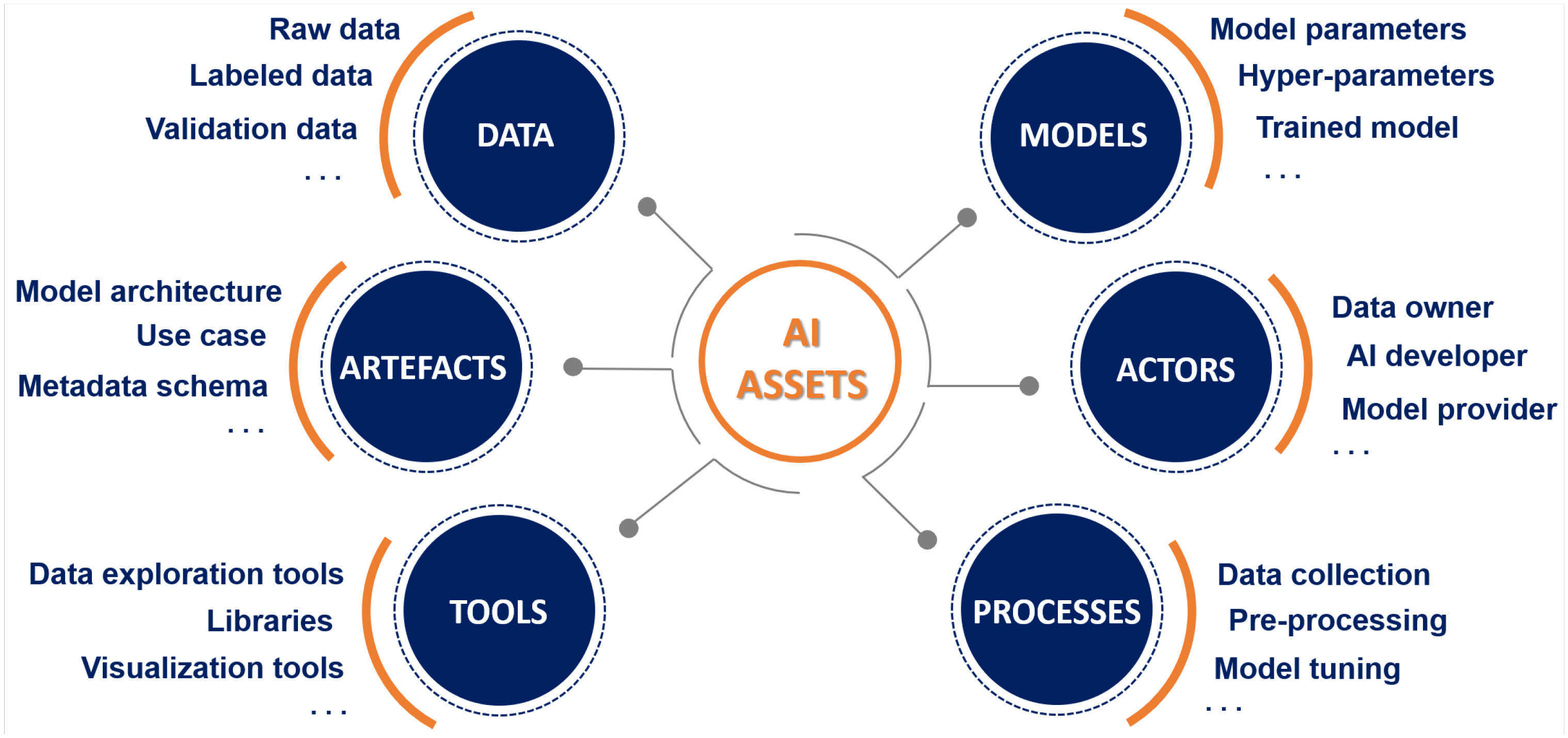
At each stage of the ML life-cycle, multiple digital assets are generated and used. Identifying assets in the context of the diverse ML life-cycle stages (including inter-dependencies between them) is a key step in pinpointing what needs to be protected and what could go wrong in terms of security of the AI ecosystem. Based on the generic ML life-cycle reference model described above (see Figure 1), at-risk ML assets can be grouped into six different macro-categories—Data, Models, Actors, Processes, Tools, and Artefacts—as shown in Figure 2. It should be noted that, given the complex and evolving nature of ML-based systems, proper identification of asset that are subject to ML-specific threats must be considered an ongoing task that needs to keep pace with developments in AI/ML solutions.
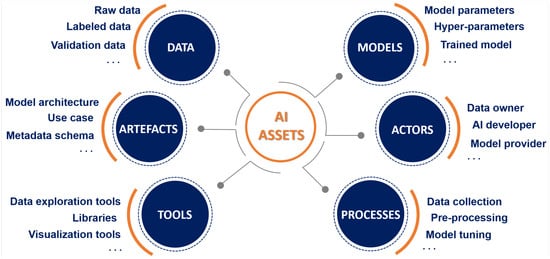
Figure 2.
Assets in the AI ecosystem [3].
4. Failure Mode and Effects Analysis of AI-ML Systems
Failure Mode and Effects Analysis (FMEA) is a well-established, structured approach to discovering potential failures that may exist in the design of a product or process [38,39]. Failure modes are the ways in which an asset (be it a process, system or component) can fail. Effects are the ways that these failures can lead to waste or harmful outcomes for the customer. FMEA techniques are intended to identify, prioritize and limit failure modes of manufacturing or engineering processes, products, designs or services in a systematic way by determining their potential occurrence, root causes, implications and impact [40]. In order to establish the next actions to be made, a quantitative score is calculated to evaluate failures on the basis of their severity.
4.1. Guide to FMEA Application in the AI-ML Life-Cycle
FMEA first emerged in the military domain and then spread to the aerospace industry and to other manufacturing domain, with various applications in the nuclear electronics, and automotive fields as well. Recently, researchers have explored how FMEA or other safety engineering tools can be used to assess the design of AI-ML systems [41,42]. Applying FMEA to an AI-ML asset includes the following activities: (i) assigning functions to the asset, (ii) creating structure, function, networks diagrams for the asset, (iii) define defects that can cause the asset’s function/function network to fail, (iv) perform threat modeling actions. Specifically, the above operations can be accomplished by performing the following steps:
- Step 1: Create one function list per asset. The content of these function lists should be different for each asset in at least a function;
- Step 2: Specify prerequisites for functions that may refer to functions of other assets. This is the basis used to create function networks;
- Step 3: Identify one or more asset defects that can impair a function (Failure Mode—FM). Add one or more causes or effects for each defect;
- Step 4: Use a threat-modeling methodology to map FMs to threats.
The steps of FMEA involve different roles, including the asset category owners (Step 1), the action managers (Steps 2 and 3) and the security analysts (Step 4). A severity score can be assigned to FMs based on the failure effects. This assignment is done independently from the severity assessment of the threats (see Section 6.3). However, to ensure that the two evaluations are consistent, FM severity should be passed on from the FMs to the threats associated to them, e.g., as a lower bound to DREAD-estimated threat severity.
4.2. Question Facilitator
In order to support practitioners in performing an effective FMEA [43] analysis, we identified some key questions to ask as part of the FMEA procedure.
Functions. When identifying functions for System or Design FMEAs, refer to the AI-ML life-cycle and to the asset list of your application
- What is the primary purpose of this asset?
- What is the asset supposed to do? What must the asset not do?
- What functions occur at the interfaces?
- What is the standard of performance?
Failure Modes. When identifying FMs refer to the architecture diagram of your AI-ML application
- In what way could the asset fail to perform its intended function?
- In what way could the asset perform an unintended function?
- What could go wrong with this asset?
- What could go wrong at the asset’s interfaces?
- What has gone wrong with this asset in the past?
- How could the asset be abused or misused?
- What concerns do you have with this asset?
Effects. When identifying effects for FMs, refer to the FM list identified in the previous step
- What is the consequence of the failure?
- If the asset fails, what will be the consequences at the local level? At the next higher level? At the overall system level? At the end user?
- If the asset fails, what will the customer see, feel or experience?
- Will the asset failure cause potential harm to the end users?
- Will the asset failure cause potential violation of regulations?
4.3. ML Assets and Their Failure Modes
Following the FMEA procedure, once assets have been identified and their intended role within the ML life-cycle is fully understood, failure mode analysis involves pinpointing defects and errors, potential or actual, that may exist. For illustrative purposes, we select three of the identified ML asset categories shown in Figure 2, namely data, models and artefacts—of which certainly the former is the most imperiled asset, as its compromise can lead to potentially catastrophic consequences for the trained model. For each of the at-risk assets comprised therein we show how the use of failure conditions may aid in identifying their relevant failure modes. To be precise, here we care about illustrating the procedure that guides ML practitioners to identify possible failure modes (useful for subsequent threat analysis), temporarily neglecting the study of the consequences of the identified FMs. Specifically, in Table 1, Table 2 and Table 3 we provide the asset description, answers to the corresponding FMEA asset questions (see Section 4.2), as well as a set of possible FMs for the data, model, and artefact assets, respectively. Of course, the manner in which the asset does not accomplish its intended function, that is, how the specific asset may fail to hold the properties needed for the correct execution of a stage of the ML model’s life-cycle, is impacted by the nature of the cause of the failure itself. As shown in the third column of each of Table 1, Table 2 and Table 3, FMs can result from the innate design of the system or by the presence of adversarial intention. Thus, FMs may include improper or poor performance of functions as well as execution of unintended or undesired functions that ultimately also reflect assumptions made about the attacker’s capabilities and strategies.

Table 1.
ML data assets and the corresponding answers to FMEA asset and failure modes questions.
Table 2.
ML model assets and possible answers to FMEA asset and failure modes questions.
Table 3.
ML artefact assets and possible answers to FMEA asset and failure modes questions.
5. Modeling Threats to ML Assets
We now discuss how the ML assets’ failure modes can be used to identify threats. Classically, Threat Modeling (TM) is the process of reviewing the security of a system, identifying critical areas, and assessing the risk associated with them. TM is a fundamental phase in the design of information systems because it allows profiling and prioritizing problems as well as assessing the value of potential mitigation in alleviating threats. A typical TM process [44] consisting of five steps is shown in Table 4.
Table 4.
A 5-step TM process.
Several TM methods are available. Popular approaches include PASTA [45], a risk-centered TM framework consisting of seven stages within which different elicitation tools are used, and OCTAVE [46], which is a three-phase method focusing on the assessment of the organizational risks rather than the technological ones. Originally defined by Loren Kohnfelder and Praerit Garg [47,48], STRIDE is the most mature one. It has been applied to many vertical domains, including cyber-physical systems and healthcare applications [49,50,51,52,53]. STRIDE uses a set of six threats based on its acronym, which stands for Spoofing, Tampering, Repudiation, Information Disclosure, Denial of service, and Elevation of privilege; Table 5 shows their definitions. Our discussion of the ML life-cycle and its key assets (Section 3) has covered steps 2 and 3 of the TM process. We need to set the security objectives (step 1), and then proceed with the threat identification step (step 4) and the vulnerability identification one (step 5). We start by proposing our ML-specific definitions of the classic security properties (step 1). Then, we will discuss how assets’ failure modes can jeopardize these properties. Finally, we will use the results of our analysis for identifying threats to the ML life-cycle (step 4).
Table 5.
STRIDE threats in a nutshell.
5.1. Extending STRIDE to ML-Based Systems
The hexagon [54] includes the six main components of security. Each STRIDE threat corresponds to the violation of a security property, as shown in Table 6.
Table 6.
Threats vs. properties in STRIDE-AI.
While STRIDE can be directly applied to vertical domains, applying it to AI-ML requires customization of the desired set of properties in order to match the domain assets’ specific failure modes [55]. Below, we propose our ML-specific definition of security properties. Then, we map the failure modes of the assets under consideration—data, model, artefact—generated in our ML life-cycle (Section 3) to the violation of one or more of these properties. For each mapping, we associate (the effects of) the corresponding failure to one or more STRIDE threats to ML-based systems. Table 7 shows our proposed definition of an ML-specific hexagon.
Table 7.
ML-specific hexagon.
For clarity, in the context of authenticity, we assume the ML model output is verifiable in the sense that results come with certain genuineness and have the property of being able to be trusted. This implies a degree of confidence in the validity of predictions, though this may be affected when integrity is compromised. As for availability, our definition is tied to the usage scenarios, and implies that output values should reflect the intended purpose of the model, and thus the learnt boundary is essentially correct. The rest of the above definitions are hopefully self-explanatory; for the sake of conciseness, we will only elaborate on our definition of the confidentiality property [56]. Let us consider a classification problem: mapping the items of a data space to categories of interest belonging to a set . A representative sample is used to tabulate a partial classification function , obtaining a labeled training set, which by abuse of notation we shall also call f. We use the training set f to train an ML model that will be able to compute another function . Finally, we deploy F into production, using it to classify individuals from as needed. This standard procedure may disclose ML data, for example if the entries in f can be inferred from F. (For instance, if F is computed using the Nearest-Neighbor technique (i.e., where is the point in S closest to x according to some domain distance), f is integral part of the definition of F and is therefore fully disclosed to the external service whenever F is deployed.) Our definition expresses the confidentiality property of a training set asset [57] as follows: a training set f is confidential if, observing the execution of a ML model F trained on f, one is able to infer the same information about any entry as by observing , obtained using the training set , where r is a random entry. The same definition of confidentiality holds for validation and augmented data assets. The resulting threat identification is summarized in Table 8, Table 9 and Table 10, where we also report some known attacks exploiting vulnerabilities to STRIDE-AI threats.
Table 8.
Mapping data assets’ failure modes to hexagon.
Table 9.
Mapping model assets’ failure modes to hexagon.
Table 10.
Mapping artefact assets’ failure modes to hexagon.
5.2. Threats Prioritization
Threat-ranking techniques are used to associate a security risk level to each threat. A popular technique is represented by the so-called bug bars, which come in the form of tables listing the criteria used to classify bugs. Recently, Microsoft has released a bug bar [25] to rank ML threats, focusing on intentional malicious behavior against ML-based systems. However, threat prioritisation bug bars are not always easy to explain to users without security expertise. One of the first developed methods to assess the severity of threats is DREAD, an acronym referring to five categories (Damage Potential, Reproducibility, Exploitability, Affected Users and Discoverability). DREAD, which was designed to complement STRIDE, assigns to each threat a value from 1 to 10. As it turned out that it can lead to inconsistent results due to the intrinsic subjectivity of the rating process [69], the DREAD scaled rating system is no longer recommended for exclusive use; yet, it is still used for quick preliminary threat assessments, as we will do for the case study described in the next section.
6. Use Case
We will now apply STRIDE-AI to a real-world use case selected from the AI-ML applications developed in TOREADOR (https://cordis.europa.eu/project/id/688797 (accessed on 26 July 2022)) H2020 project. The cyber-security of such applications is a goal of another H2020 project: THREAT-ARREST (https://cordis.europa.eu/project/id/786890 (accessed on 26 July 2022)). Our focus is on a scenario contributed by the Light-source company (henceforth LIGHT), one of the major European renewable energy providers, who is a partner in both the above projects. Specifically, the energy pilot use case we consider is a system aimed at maximizing the efficiency of solar energy, where AI-ML technologies are employed for hardware failure prediction (avoiding power cuts) and power flow optimization (avoiding waste and minimizing costs) on the energy grid.
6.1. Architecture Specification
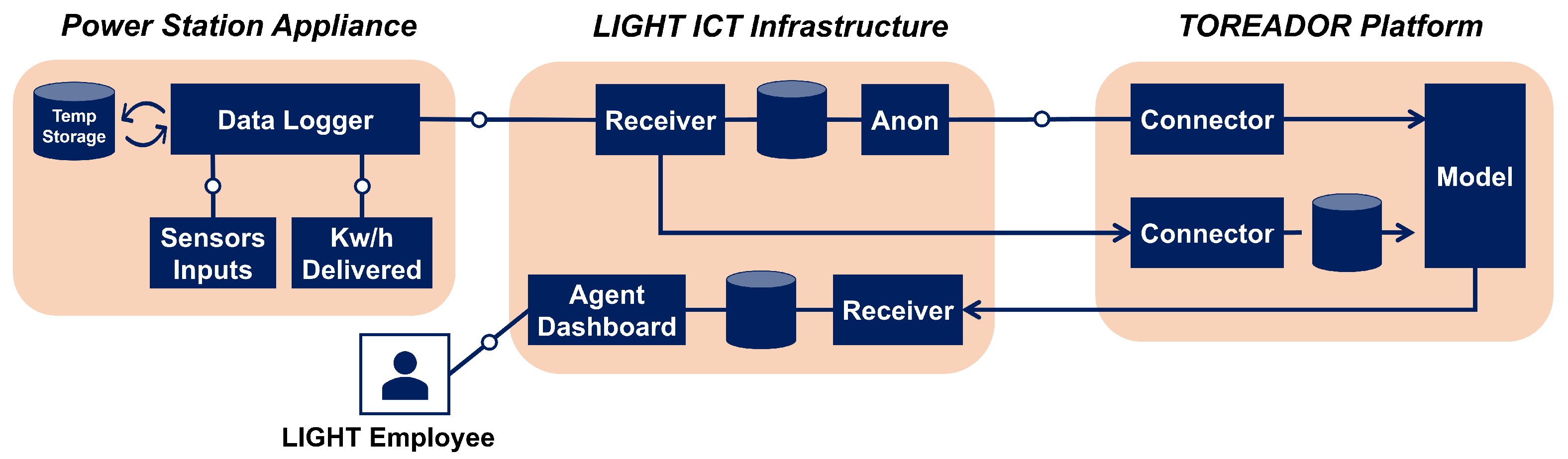
In the following, we provide a brief description of the LIGHT’s architecture together with its interface with the TOREADOR one. The use case deals with a predictive maintenance scenario in a large-scale asset example. Figure 3 shows an abstraction of the LIGHT-TOREADOR predictive maintenance architecture, and its operation is described by the steps below:
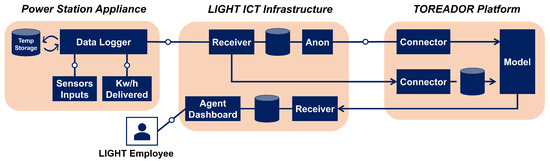
Figure 3.
The LIGHT-TOREADOR predictive maintenance architecture.
- Sensors placed at power station sites send data about power and other variables to a local Data Logger card equipped for network communication. The Data Logger has a local root-of-trust.
- The Data Logger card forwards the data to a Receiver within the LIGHT ICT infrastructure.
- The Anonymity (Anon) agent retrieves the data and applies some pre-processing, including metadata removal. Removal is not performed for training data, whose metadata are dummy.
- Pre-processed input data is streamed to a Connector on the TOREADOR platform.
- Input data is stored in the TOREADOR platform, then fed to an ML model for training/validation or failure prediction.
- In production, inference (Raw Prediction Data) is returned to the LIGHT platform (predictions are not returned during training).
- LIGHT employees log into a Dashboard on the LIGHT platform and drill into the inferences.
- Raw Prediction data is used for further action (including pro-actively maintaining components at the power station).
LIGHT’s monitoring system, whose goal is to provide information to its user on the operation of the solar farms in a timely and concise manner, collects two main categories of measurements (primary measurements and derived ones) through several equipment devices’ monitoring: G59 relay, inverters, and PV string combiners. For the purposes of this use case, we assume only the G59 monitoring device as significant, which has data logging capabilities and is able to keep a registry list with the event codes. The monitor delivers the following categories of data:
- Active energy
- Reactive energy
- Active Power
- Reactive power
- Voltage levels
- Current levels
- Frequency levels
- Power factor
- G59/Alarms
The monitoring data are summarized in a production table which records hourly snapshots of the plant activity. The attributes in this table are:
- report date and time—Store the snapshot date and time.
- production unit id—References the units used to measure the electrical power produced (the unit used to measure energy production are usually KWh (kilowatt hours) or MWh (megawatt hours)).
- quantity—The total energy produced during the report date until the report time.
6.2. Metadata
Besides the monitor logs and production table, the plant’s data assets include metadata that describe the facility. They include:
- power plant code—A unique internal code used to designate each plant.
- description—Information related to that power plant, stored in unstructured format.
- location—The power plant’s location, stored as GPS coordinates.
- active—If the power plant is currently active or not.
- date active from—The date when the power plant became active.
- date active to—The date when the power plant stopped being active.
Additional metadata are related to the organization (or the individual) owning and running the plant.
6.3. Applying STRIDE-AI
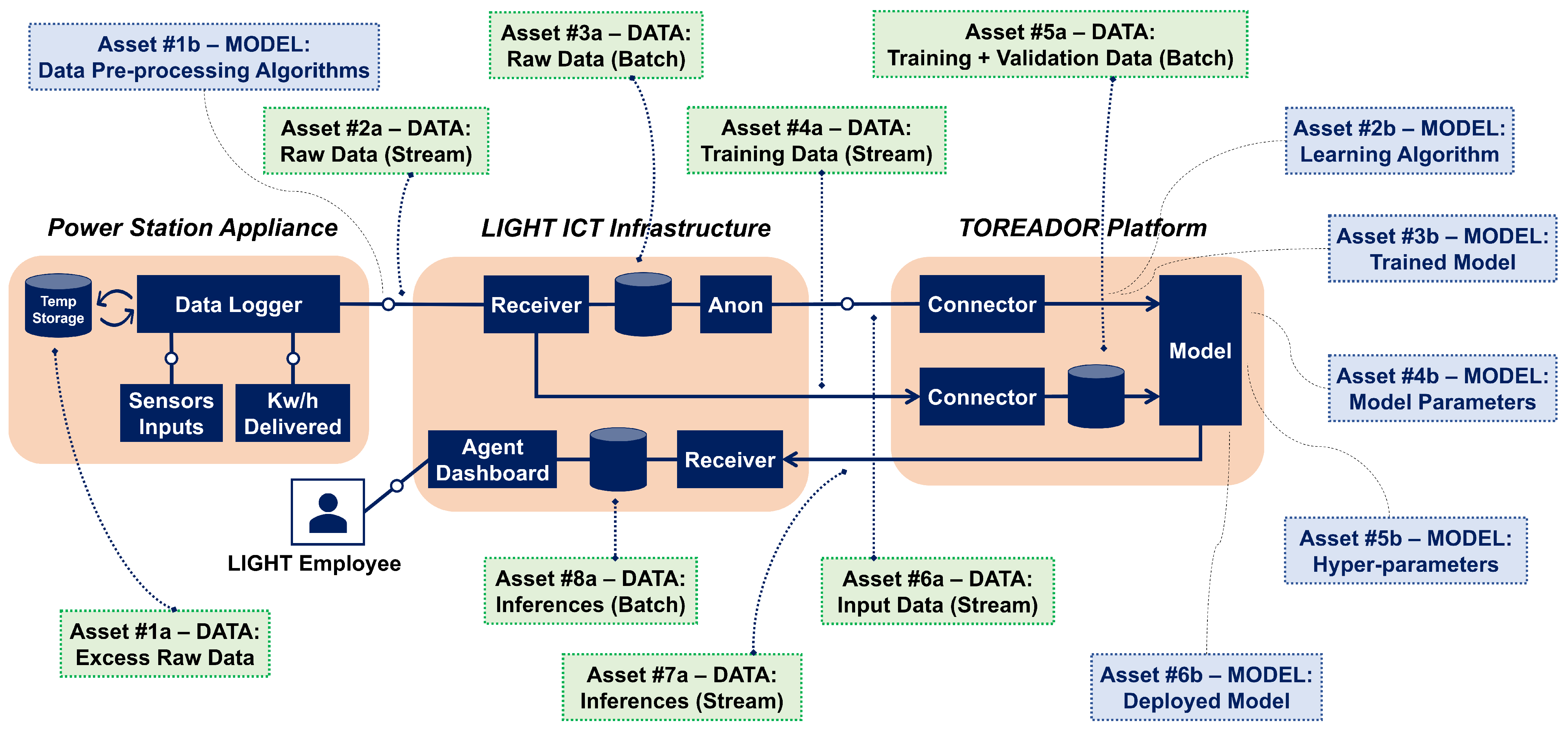
With reference to the TM process in Table 4, a security expert applying the STRIDE-AI methodology to the power plant has a ready-made set of objectives (the hexagon) and assets categories (the ones on Figure 2). The expert starts by performing architecture decomposition and identifying the relevant assets. For example, the annotations provided in Figure 4 correspond to the data and model assets identified within the predictive maintenance architecture.
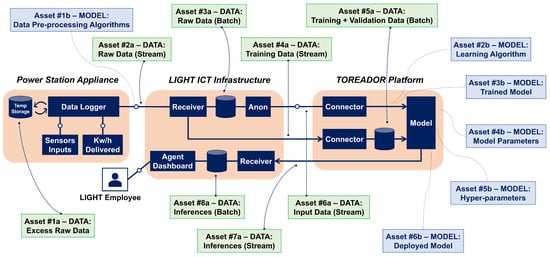
Figure 4.
The identified data and model assets.
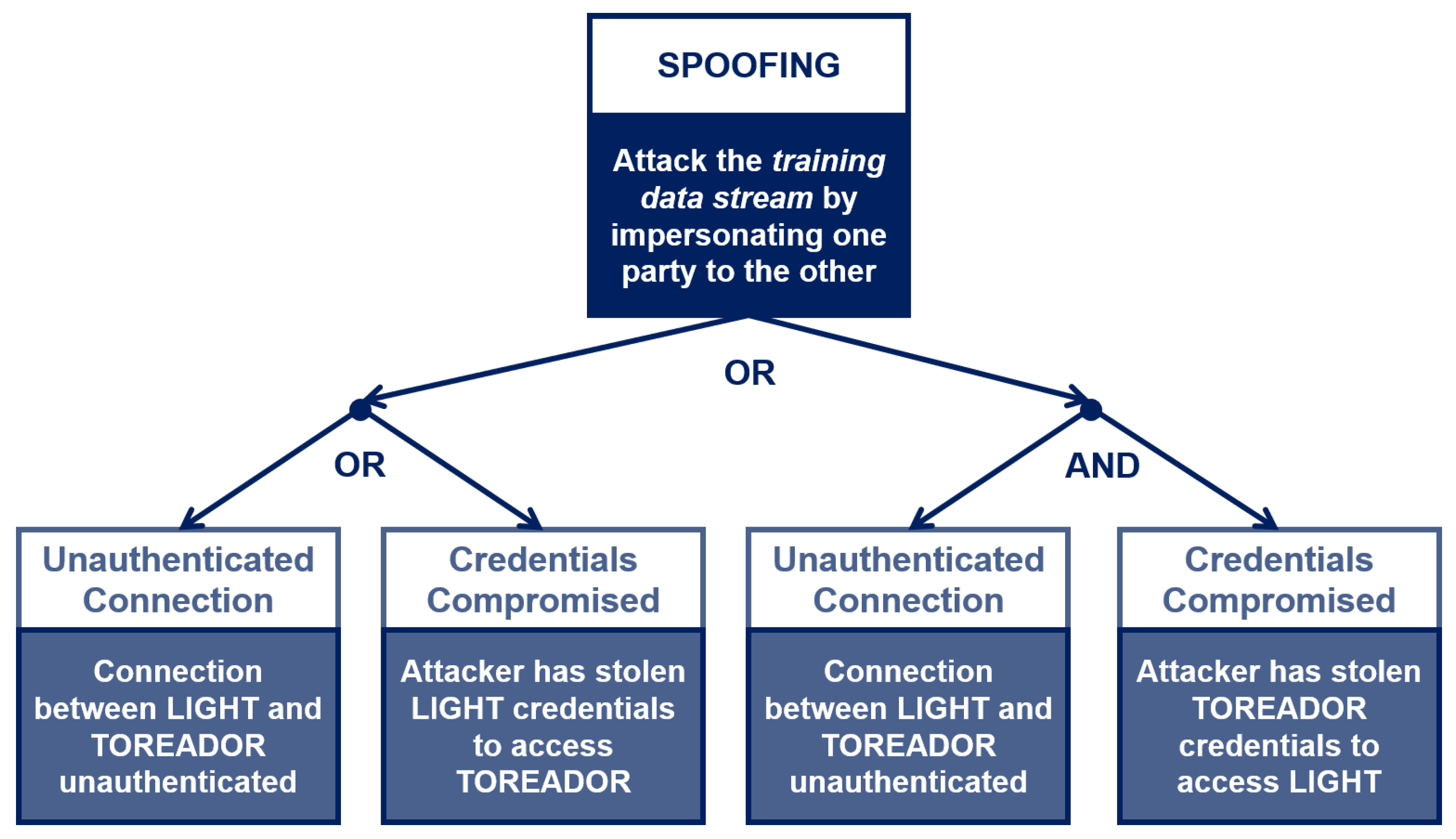
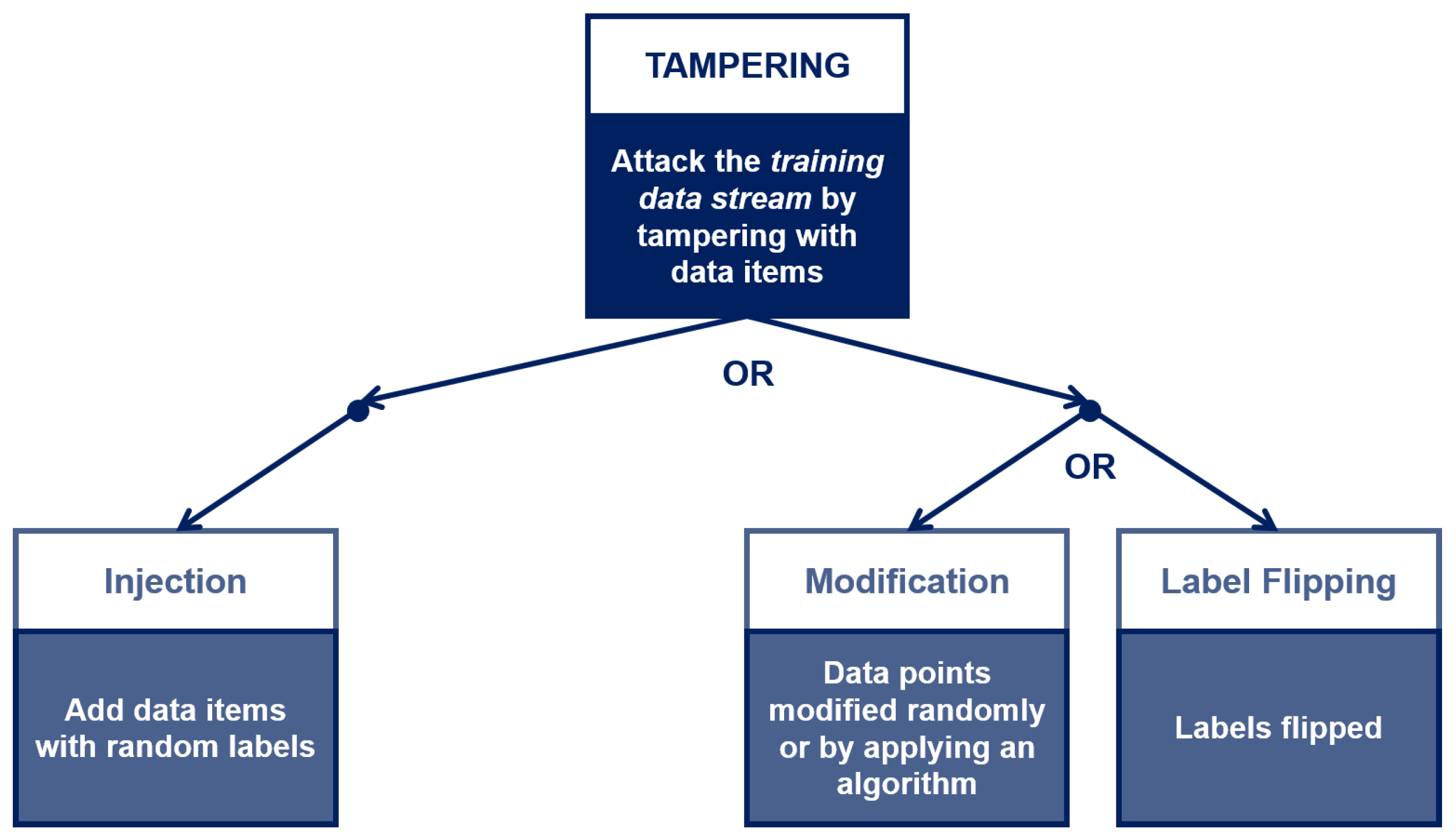
For each asset, the expert chooses a set of properties of interest within . To limit the scope of our discussion, let us consider only two assets—training data stream (Asset ) and trained model (Asset ) – belonging to the macro-category Data and Model, respectively (The complete mapping of all identified assets, properties and threats is provided in the Appendix A (Table A1). The training data stream asset belongs to the Labeled Data asset category; therefore, it should exhibit the Integrity and Authenticity properties to prevent known failures (see Table 8). (Other asset categories will have different property profiles. For example, the library used for training the ML model will need Integrity and Authenticity (to ensure its code has not been tampered with) and Availability (to make sure it will be capable of performing the training or inference task within the deadline).) With regard to the trained model asset, it should exhibit the Integrity and Availability properties (see Table 9). The third step is threat identification. Again from Table 8 and Table 9, the security expert identifies (Tampering and Spoofing) and (Tampering and DoS) as the threats corresponding to the data and model asset’s property profile, respectively. The next step of the TM process is vulnerabilities identification, where the security expert interacts with the system developers to describe under which conditions the threats associated to the assets can materialize. For asset , the Tampering threat corresponds to attackers making changes or injecting spurious data into the sensor data stream, while the Spoofing threat corresponds to attackers posing as the TOREADOR ML model to the LIGHT data platform, and as the LIGHT platform to the TOREADOR model. The expert needs to assess whether the threats are atomic or composite, i.e., they require one or more conditions to hold for being exploited. The (simplified) threat trees for the Spoofing and Tampering threats are shown in Figure 5 and Figure 6, respectively.
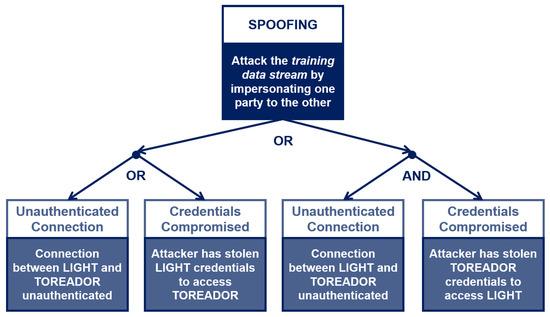
Figure 5.
The Spoofing threat tree for the Training Data Stream asset [3].
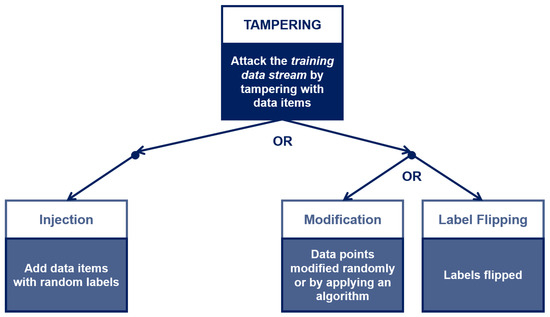
Figure 6.
The Tampering threat tree for the Training Data Stream asset [3].
The Spoofing threat tree corresponds to a standard failure mode of distributed platforms. The Tampering threat tree is more ML-specific, as it affects the training data stream by injecting spurious data items (i.e., adding data that do not come from LIGHT, with random or chosen labels) or by modifying data items that come from LIGHT by flipping the labels. The difference between the Tampering threat sub-trees (Figure 6) is relevant for the expert’s assessment, as the leftmost sub-tree can be deleted as the expert knows that the data items are signed by the Data Logger cards, but not the rightmost one: Loggers’ signature would not prevent label flipping on training data, as labels are added on the LIGHT platform before streaming the training set to TOREADOR.
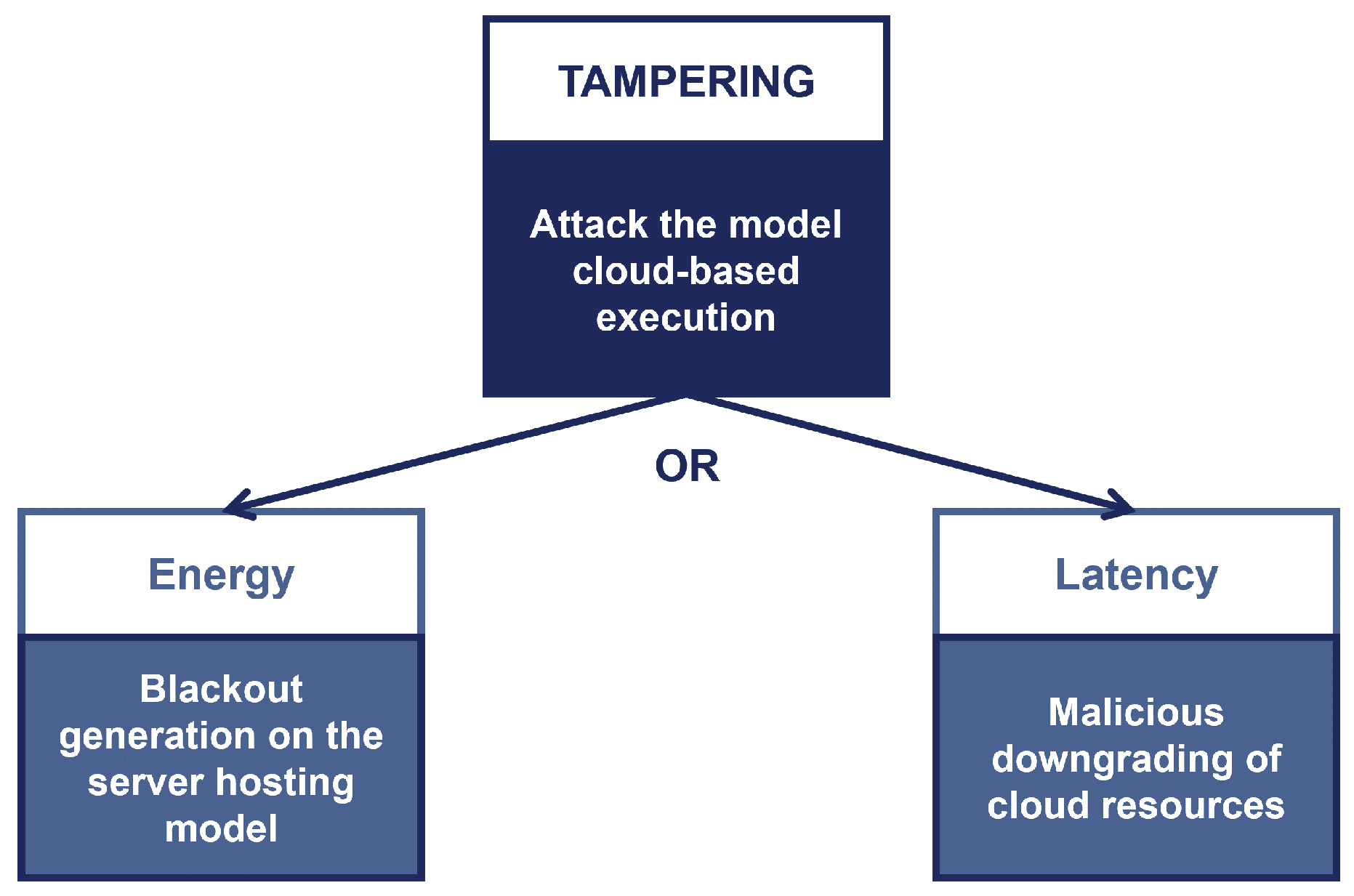
As for asset , the Tampering threat corresponds to attackers capable of interfering with the model remote execution. As the threat tree in Figure 7 shows, the attacker can mount energy-latency attacks [70]. For instance, someone with remote platform access might slow down the execution time (e.g., by excluding the GPU and switching from GPU to CPU execution, resulting in a doubling of latency). The latency that is generated causes inference values to be out of date.
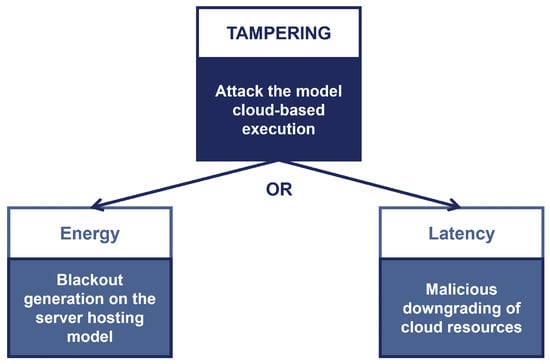
Figure 7.
The Tampering threat tree for the Trained Model asset.
Finally, we compute the threat priorities by utilizing a DREAD scorecard, whose ratings are shown in Table 11. For the training data stream asset, the potential damage that could result from a spoofing attack includes backdoor generation and substitution of data about power emission or consumption, which could alter metrics and reporting. The expertise required to perform spoofing varies depending on which branch of the Spoofing threat tree is considered. As the TOREADOR platform supports a two-factor authentication, in case the LIGHT users’ credentials consist only of a username and password, it may prove easier to gain access to TOREADOR by password cracking or by stealing the credentials (e.g., via phishing emails). An attack exploiting the Spoofing threat may result in tampering. If an attacker is able to tamper with the training data stream, she can perform label flipping or other types of data manipulation. The exploitation of this threat depends on the presence of constraints on data manipulation; as labels are added on the LIGHT platform, while data points are collected and signed by Data Loggers, adding new data with random labels requires more effort than flipping labels of existing data to obtain a particular output in the presence of certain input values.
Table 11.
DREAD rating for the Spoofing and Tampering threats.
7. Discussion
The primary objective of the proposed threat methodology is to reduce the gap between security practitioners and AI experts via a structured approach to identifying, quantifying, and addressing threats to ML. Following STRIDE-AI, an AI-ML-based system can be decomposed into relevant components, and each individual component is analyzed for its susceptibility to threats. Once the failure modes have been identified, they need to be mapped to the threats and the properties such threats may endanger. A benefit of our asset-centered approach is that any threat analyst can easily check which properties are violated as a result of a determined failure, thereby capturing the corresponding security risks of the asset under consideration. By contrast, the approach taken by most of the threat analysis methodologies available in the literature focuses on documenting adversarial tactics and techniques based on real-world observations and providing a static taxonomy of adversarial actions [29,30,31]. One of the sources of difficulty in ML security is the fact that vulnerabilities cannot be comprehensively identified. To be truly effective, the threat analysis should not be accomplished only once because fully enumerating all the failure phenomena of the entire ML-based system at the first attempt, taking into account all possible input-output data, is an infeasible task. As a result, failure modes need to be continuously updated based on additional information about the system itself and the latest research trends on weaknesses and vulnerabilities. In a sense, this corresponds to a collaborative metadata approach. Moreover, in order to evaluate the security risks in each failure mode, it is also essential to consider the system’s purpose, its operating environment, and assumption about attackers’ ability. This allows for comprehensive prioritization, also according to factors such as severity, frequency, and detectability.
8. Conclusions and Future Work
Currently, there is no systematic process or well-established technique for identifying the vulnerabilities and threats targeting ML components throughout the entire AI pipeline. This research work builds on the urgent necessity to provide any security practitioner with a customized threat modeling methodology for the specific AI pipeline and related ML models. We propose STRIDE-AI as an effective and practical property-driven methodology for assessing the security of AI-ML-based systems. The application of the STRIDE-based threat analysis to the AI-ML domain is relatively simple and has its foundation in the proper identification of critical elements (AI assets) within the ML life-cycle. Such a methodology has the potential to assist AI cybersecurity experts, ML developers, and data scientists in collaboratively identifying ML threats to devise secure ML solutions. However, we are well aware that no threat identification method is effective without providing guidance in selecting the security controls needed to mitigate the identified threats. Unfortunately, no security control framework specifically designed for ML models is currently available. Conventional security controls need to be complemented by ML-oriented security controls and mapped to the core functionalities of ML-based systems they protect and to the weaknesses that threats exploit in these systems. Following [33], future research may explore how available controls in widely used standards, such as ISO 27001 and NIST Cybersecurity framework, can effectively alleviate the harm of identified threats, but also how to carefully choose controls designed for and applicable only to the ML setting. Addressing this issue may also involve the joint use of diverse technologies. For instance, one promising approach might be to employ a trust-enabling environment for ML models training and operation, as discussed in [71]. We argue that Distributed Ledger Technologies (DLTs) can provide a complete security control framework for ML [72], as DLT usage for properties may render interference with ML inference results less attractive for attackers.
Author Contributions
Conceptualization, L.M. and E.D.; methodology, L.M. and E.D.; validation, L.M. and E.D.; formal analysis, E.D.; investigation, L.M. and E.D.; resources, E.D.; data curation, E.D.; writing—original draft preparation, L.M.; writing—review and editing, L.M. and E.D.; visualization, L.M. and E.D.; supervision, E.D. All authors have read and agreed to the published version of the manuscript.
Funding
This research was supported in part by the EU-funded project THREAT-ARREST (grant agreement No. H2020-786890) and in part by the Northrop Grumman Master Agreement fund provided to KU-C2PS for the project “Customization of Cyber-Physical Systems Testing” (No. 8434000041).
Data Availability Statement
Not applicable.
Conflicts of Interest
The authors declare no conflict of interest.
Appendix A
Table A1.
Complete mapping for the assets identified in the use case.
Table A1.
Complete mapping for the assets identified in the use case.
| Use Case Asset | Properties | Threats |
|---|---|---|
| . Excess Raw Data | Authenticity, Integrity | Spoofing, Tampering |
| . Raw Data (Stream) | Authenticity, Integrity | Spoofing, Tampering |
| . Raw Data (Batch) | Authenticity, Integrity, Authorization | Spoofing, Tampering, EoP |
| . Training Data (Stream) | Authenticity, Integrity | Spoofing, Tampering |
| . Training + Validation Data (Stream) | Authenticity, Integrity, Non-repudiability, Authorization | Spoofing, Tampering, Repudiation, EoP |
| . Input Data (Stream) | Authenticity, Integrity, Non-repudiability | Spoofing, Tampering, Repudiation |
| . Inferences (Stream) | Authenticity, Integrity, Non-repudiability, Availability | Spoofing, Tampering, Repudiation, DoS |
| . Inferences (Batch) | Authenticity, Integrity, Availability, Authorization | Spoofing, Tampering, Dos, EoP |
References
- Dietterich, T.G. Steps Toward Robust Artificial Intelligence. AI Mag. 2017, 38, 3–24. [Google Scholar] [CrossRef]
- Hernan, S.; Lambert, S.; Ostwald, T.; Shostack, A. Threat Modeling—Uncover Security Design Flaws Using the STRIDE Approach. MSDN Mag. 2006. Available online: https://docs.microsoft.com/en-us/archive/msdn-magazine/2006/november/uncover-security-design-flaws-using-the-stride-approach (accessed on 26 July 2022).
- Mauri, L.; Damiani, E. STRIDE-AI: An Approach to Identifying Vulnerabilities of Machine Learning Assets. In Proceedings of the International Conference on Cyber Security and Resilience (CSR), Rhodes, Greece, 6–28 July 2021; pp. 147–154. [Google Scholar] [CrossRef]
- Nguyen, A.; Yosinski, J.; Clune, J. Deep neural networks are easily fooled: High confidence predictions for unrecognizable images. In Proceedings of the Conference on Computer Vision and Pattern Recognition (CVPR), Boston, MA, USA, 7–12 June 2015; pp. 427–436. [Google Scholar] [CrossRef]
- Elsayed, G.; Shankar, S.; Cheung, B.; Papernot, N.; Kurakin, A.; Goodfellow, I.; Sohl-Dickstein, J. Adversarial Examples that Fool both Computer Vision and Time-Limited Humans. In Advances in Neural Information Processing Systems; Bengio, S., Wallach, H., Larochelle, H., Grauman, K., Cesa-Bianchi, N., Garnett, R., Eds.; Curran Associates, Inc.: Red Hook, NY, USA, 2018; Volume 31. [Google Scholar]
- Wang, Q.; Guo, W.; Zhang, K.; Ororbia, A.G.; Xing, X.; Liu, X.; Giles, C.L. Adversary Resistant Deep Neural Networks with an Application to Malware Detection, Proceedings of the 23rd ACM SIGKDD International Conference on Knowledge Discovery and Data Mining, Halifax, NS, Canada, 13–17 August 2017; Association for Computing Machinery: New York, NY, USA, 2017; pp. 1145–1153. [Google Scholar] [CrossRef]
- Rosenberg, I.; Shabtai, A.; Elovici, Y.; Rokach, L. Adversarial Machine Learning Attacks and Defense Methods in the Cyber Security Domain. ACM Comput. Surv. 2021, 54, 1–36. [Google Scholar] [CrossRef]
- Siva Kumar, R.S.; Nystrom, M.; Lambert, J.; Marshall, A.; Goertzel, M.; Comissoneru, A.; Swann, M.; Xia, S. Adversarial machine learning-industry perspectives. In Proceedings of the Security and Privacy Workshops (SPW), San Francisco, CA, USA, 21 May 2020. [Google Scholar]
- Barreno, M.; Nelson, B.; Sears, R.; Joseph, A.D.; Tygar, J.D. Can Machine Learning Be Secure? In Proceedings of the 2006 ACM Symposium on Information, Computer and Communications Security; Taipei, Taiwan, 21–24 March 2006, Association for Computing Machinery: New York, NY, USA, 2006; pp. 16–25. [Google Scholar] [CrossRef]
- Barreno, M.; Nelson, B.; Joseph, A.D.; Tygar, J.D. The security of machine learning. Mach. Learn. 2010, 81, 121–148. [Google Scholar] [CrossRef]
- Huang, L.; Joseph, A.D.; Nelson, B.; Rubinstein, B.I.; Tygar, J.D. Adversarial Machine Learning. In Proceedings of the 4th ACM Workshop on Security and Artificial Intelligence, AISec’ 11; Chicago, IL, USA, 21 October 2011, Association for Computing Machinery: New York, NY, USA, 2011; pp. 43–58. [Google Scholar] [CrossRef]
- Schneier, B. Attacking machine learning systems. Computer 2020, 53, 78–80. [Google Scholar] [CrossRef]
- Biggio, B.; Roli, F. Wild patterns: Ten years after the rise of adversarial machine learning. Pattern Recognit. 2018, 84, 317–331. [Google Scholar] [CrossRef] [Green Version]
- Papernot, N.; McDaniel, P.D.; Sinha, A.; Wellman, M.P. SoK: Security and Privacy in Machine Learning. In Proceedings of the European Symposium on Security and Privacy, EuroS&P 2018, London, UK, 24–26 April 2018; pp. 399–414. [Google Scholar] [CrossRef]
- Papernot, N. A Marauder’s Map of Security and Privacy in Machine Learning: An overview of current and future research directions for making machine learning secure and private. In Proceedings of the 11th ACM Workshop on Artificial Intelligence and Security, CCS 2018, Toronto, ON, Canada, 19 October 2018; p. 1. [Google Scholar] [CrossRef]
- Muñoz-González, L.; Lupu, E.C. The Security of Machine Learning Systems. In AI in Cybersecurity; Sikos, L.F., Ed.; Springer: Berlin/Heidelberg, Germany, 2019; pp. 47–79. [Google Scholar] [CrossRef]
- Yuan, X.; He, P.; Zhu, Q.; Li, X. Adversarial Examples: Attacks and Defenses for Deep Learning. IEEE Trans. Neural Netw. Learn. Syst. 2019, 30, 2805–2824. [Google Scholar] [CrossRef]
- Hongsong, C.; Yongpeng, Z.; Yongrui, C.; Bhargava, B. Security threats and defensive approaches in machine learning system under big data environment. Wirel. Pers. Commun. 2021, 117, 3505–3525. [Google Scholar] [CrossRef]
- Tabassi, E.; Burns, K.J.; Hadjimichael, M.; Molina-Markham, A.D.; Sexton, J.T. A Taxonomy and Terminology of Adversarial Machine Learning; National Institute of Standards and Technology: Gaithersburg, MD, USA, 2019. [Google Scholar]
- ISO/IEC TR 24028:2020. Information Technology—Artificial Intelligence—Overview of Trustworthiness in Artificial Intelligence. Technical Report. ISO: Geneva, Switzerland, 2020.
- Xiong, P.; Buffett, S.; Iqbal, S.; Lamontagne, P.; Mamun, M.; Molyneaux, H. Towards a robust and trustworthy machine learning system development. arXiv 2021, arXiv:2101.03042. [Google Scholar]
- Patel, K.; Fogarty, J.; Landay, J.A.; Harrison, B. Investigating statistical machine learning as a tool for software development. In Proceedings of the SIGCHI Conference on Human Factors in Computing Systems, Florence, Italy, 5–10 April 2008; pp. 667–676. [Google Scholar]
- Horkoff, J. Non-Functional Requirements for Machine Learning: Challenges and New Directions. In Proceedings of the 2019 IEEE 27th International Requirements Engineering Conference (RE), Jeju, Korea, 23–27 September 2019; pp. 386–391. [Google Scholar] [CrossRef]
- Wilhjelm, C.; Younis, A.A. A Threat Analysis Methodology for Security Requirements Elicitation in Machine Learning Based Systems. In Proceedings of the 2020 IEEE 20th International Conference on Software Quality, Reliability and Security Companion (QRS-C), Macau, China, 11–14 December 2020. [Google Scholar]
- Marshall, A.; Parikh, J.; Kiciman, E.; Kumar, R.S.S. AI/ML Pivots to the Security Development Lifecycle Bug Bar. 2019. Available online: https://docs.microsoft.com/en-us/security/engineering/bug-bar-aiml (accessed on 26 July 2022).
- Mauri, L.; Damiani, E. Estimating Degradation of Machine Learning Data Assets. ACM J. Data Inf. Qual. 2021, 14, 1–15. [Google Scholar] [CrossRef]
- Bitton, R.; Avraham, D.; Klevansky, E.; Mimran, D.; Brodt, O.; Lehmann, H.; Elovici, Y.; Shabtai, A. Adversarial Machine Learning Threat Analysis in Open Radio Access Networks. arXiv 2022, arXiv:2201.06093. [Google Scholar]
- Chen, H.; Babar, M.A. Security for Machine Learning-based Software Systems: A survey of threats, practices and challenges. arXiv 2022, arXiv:2201.04736. [Google Scholar]
- McGraw, G.; Figueroa, H.; Shepardson, V.; Bonett, R. An Architectural Risk Analysis of Machine Learning Systems; Berryville Institute of Machine Learning: Clarke County, VA, USA, 2020. [Google Scholar]
- MITRE ATT&CK (Adversarial Tactics, Techniques, and Common Knowledge). Available online: https://attack.mitre.org/ (accessed on 26 July 2022).
- MITRE ATLAS (Adversarial Threat Landscape for Artificial-Intelligence Systems). Available online: https://atlas.mitre.org/ (accessed on 26 July 2022).
- ENISA. AI Cybersecurity Challenges—Threat Landscape for Artificial Intelligence; ENISA: Athens, Greece, 2020. [Google Scholar]
- ENISA. Securing Machine Learning Algorithms; ENISA: Athens, Greece, 2021. [Google Scholar]
- Marshall, A.; Parikh, J.; Kiciman, E.; Kumar, R.S.S. Threat Modeling AI/ML Systems and Dependencies. 2019. Available online: https://docs.microsoft.com/en-us/security/engineering/threat-modeling-aiml (accessed on 26 July 2022).
- Kumar, R.S.S.; O’Brien, D.R.; Albert, K.; Viljöen, S.; Snover, J. Failure Modes in Machine Learning Systems. arXiv 2019, arXiv:1911.11034. [Google Scholar]
- de Prado, M.; Su, J.; Dahyot, R.; Saeed, R.; Keller, L.; Vállez, N. AI Pipeline—Bringing AI to you. End-to-end integration of data, algorithms and deployment tools. arXiv 2019, arXiv:1901.05049. [Google Scholar]
- Damiani, E.; Frati, F. Towards Conceptual Models for Machine Learning Computations. In Proceedings of the Conceptual Modeling—37th International Conference, Xi’an, China, 22–25 October 2018; Volume 11157, pp. 3–9. [Google Scholar] [CrossRef]
- Spreafico, C.; Russo, D.; Rizzi, C. A state-of-the-art review of FMEA/FMECA including patents. Comput. Sci. Rev. 2017, 25, 19–28. [Google Scholar] [CrossRef]
- Sankar, N.R.; Prabhu, B.S. Modified approach for prioritization of failures in a system failure mode and effects analysis. Int. J. Qual. Reliab. Manag. 2001, 18, 324–336. [Google Scholar] [CrossRef]
- Kara-Zaitri, C. Disaster prevention and limitation: State of the art; tools and technologies. Disaster Prev. Manag. Int. J. 1996, 5, 30–39. [Google Scholar] [CrossRef]
- Puente, J.; Priore, P.; Fernández, I.; García, N.; de la Fuente, D.; Pino, R. On improving failure mode and effects analysis (FMEA) from different artificial intelligence approaches. In Proceedings of the International Conference on Artificial Intelligence, Reykjavic, Iceland, 22–25 April 2014. [Google Scholar]
- Li, J.; Chignell, M. FMEA-AI: AI fairness impact assessment using failure mode and effects analysis. In Proceedings of the International Conference on Artificial Intelligence (ICAI), Messe Wien, Austria, 30–31 March 2022; pp. 1–14. [Google Scholar]
- Carlson, C. Effective FMEAs: Achieving Safe, Reliable, and Economical Products and Processes Using Failure Mode and Effects Analysis; John Wiley & Sons: Hoboken, NJ, USA, 2012; Volume 1. [Google Scholar]
- Myagmar, S.; Lee, A.J.; Yurcik, W. Threat modeling as a basis for security requirements. In Proceedings of the IEEE Symposium on Requirements Engineering for Information Security, Washington, DC, USA, 29 August–2 September 2005. [Google Scholar]
- UcedaVelez, T.; Morana, M.M. Risk Centric Threat Modeling; Wiley Online Library: Hoboken, NJ, USA, 2015. [Google Scholar]
- Oladimeji, E.A.; Supakkul, S.; Chung, L. Security threat modeling and analysis: A goal-oriented approach. In Proceedings of the 10th IASTED International Conference on Software Engineering and Applications, Dallas, TX, USA, 13–15 November 2006. [Google Scholar]
- Shostack, A. Experiences Threat Modeling at Microsoft. MODSEC@ MoDELS 2008, 413, 35. [Google Scholar]
- Shostack, A. Threat Modeling: Designing for Security; Wiley: Hoboken, NJ, USA, 2014. [Google Scholar]
- Martins, G.; Bhatia, S.; Koutsoukos, X.; Stouffer, K.; Tang, C.; Candell, R. Towards a Systematic Threat Modeling Approach for Cyber-physical Systems. In Proceedings of the 2015 Resilience Week (RWS), Philadelphia, PA, USA, 18–20 August 2015; pp. 1–6. [Google Scholar] [CrossRef]
- Khan, R.; McLaughlin, K.; Laverty, D.; Sezer, S. STRIDE-based Threat Modeling for Cyber-Physical Systems. In Proceedings of the PES Innovative Smart Grid Technologies Conference Europe (ISGT-Europe), Torino, Italy, 26–29 September 2017; pp. 1–6. [Google Scholar] [CrossRef]
- Cagnazzo, M.; Hertlein, M.; Holz, T.; Pohlmann, N. Threat Modeling for Mobile Health Systems. In Proceedings of the Wireless Communications and Networking Conference Workshops (WCNCW), Barcelona, Spain, 5–18 April 2018; pp. 314–319. [Google Scholar] [CrossRef]
- Urias, V.E.; Van Leeuwen, B.; Stout, W.M.S.; Lin, H. Applying a Threat Model to Cloud Computing. In Proceedings of the International Carnahan Conference on Security Technology (ICCST), Montreal, QC, Canada, 22–25 October 2018; pp. 1–5. [Google Scholar] [CrossRef]
- Jelacic, B.; Rosic, D.; Lendak, I.; Stanojevic, M.; Stoja, S. STRIDE to a Secure Smart Grid in a Hybrid Cloud. In Proceedings of the Computer Security, Barcelona, Spain, 3–7 September 2018; pp. 77–90. [Google Scholar]
- Hasan, R.; Myagmar, S.; Lee, A.J.; Yurcik, W. Toward a threat model for storage systems. In Proceedings of the 2005 ACM Workshop On Storage Security And Survivability, StorageSS 2005, Fairfax, VA, USA, 11 November 2005; pp. 94–102. [Google Scholar] [CrossRef]
- Abomhara, M.; Køien, G.; Gerdes, M. A STRIDE-Based Threat Model for Telehealth Systems. NISK J. 2015, 8, 82–96. [Google Scholar]
- Cimato, S.; Damiani, E. Some Ideas on Privacy-Aware Data Analytics in the Internet-of-Everything. In From Database to Cyber Security: Essays Dedicated to Sushil Jajodia on the Occasion of His 70th Birthday; Springer: Berlin/Heidelberg, Germany, 2018; pp. 113–124. [Google Scholar] [CrossRef]
- Dwork, C. Differential Privacy. Automata, Languages and Programming. In Proceedings of the 33rd International Colloquium, ICALP 2006, Venice, Italy, 10–14 July 2006; Volume 4052, pp. 1–12. [Google Scholar] [CrossRef]
- Allain, J.S. From Jeopardy! to Jaundice: The Medical Liability Implications of Dr. Watson and Other Artificial Intelligence Systems. La. Law Rev. 2013, 73, 1049. [Google Scholar]
- Yeung, D. When AI Misjudgment Is Not an Accident. 2018. Available online: https://blogs.scientificamerican.com/observations/when-ai-misjudgment-is-not-an-accident/ (accessed on 26 July 2022).
- Chen, X.; Liu, C.; Li, B.; Lu, K.; Song, D. Targeted Backdoor Attacks on Deep Learning Systems Using Data Poisoning. arXiv 2017, arXiv:1712.05526. [Google Scholar]
- Eghbal-zadeh, H.; Koutini, K.; Primus, P.; Haunschmid, V.; Lewandowski, M.; Zellinger, W.; Moser, B.A.; Widmer, G. On Data Augmentation and Adversarial Risk: An Empirical Analysis. arXiv 2020, arXiv:2007.02650. [Google Scholar]
- Paudice, A.; Muñoz-González, L.; Gyorgy, A.; Lupu, E.C. Detection of Adversarial Training Examples in Poisoning Attacks through Anomaly Detection. arXiv 2018, arXiv:1802.03041. [Google Scholar]
- Ameisen, E. Building Machine Learning Powered Applications: Going from Idea to Product; O’Reilly: Sebastopol, CA, USA, 2020. [Google Scholar]
- Kailkhura, B.; Siddhardh Nadendla, V.S.; Varshney, P.K. Distributed inference in the presence of eavesdroppers: A survey. IEEE Commun. Mag. 2015, 53, 40–46. [Google Scholar] [CrossRef]
- Wang, B.; Gong, N.Z. Stealing hyperparameters in machine learning. In Proceedings of the Symposium on Security and Privacy (SP), San Francisco, CA, USA, 20–24 May 2018; pp. 36–52. [Google Scholar]
- Chang, H.; Shokri, R. On the privacy risks of algorithmic fairness. In Proceedings of the European Symposium on Security and Privacy (EuroS&P), Vienna, Austria, 6–10 September 2021; pp. 292–303. [Google Scholar]
- Zhang, X.; Fang, C.; Shi, J. Thief, Beware of What Get You There: Towards Understanding Model Extraction Attack. arXiv 2021, arXiv:2104.05921. [Google Scholar]
- Orekondy, T.; Schiele, B.; Fritz, M. Prediction poisoning: Towards defenses against dnn model stealing attacks. arXiv 2019, arXiv:1906.10908. [Google Scholar]
- Shoufan, A.; Damiani, E. On inter-Rater reliability of information security experts. J. Inf. Sec. Appl. 2017, 37, 101–111. [Google Scholar] [CrossRef]
- Shumailov, I.; Zhao, Y.; Bates, D.; Papernot, N.; Mullins, R.; Anderson, R. Sponge Examples: Energy-Latency Attacks on Neural Networks. In Proceedings of the European Symposium on Security and Privacy (EuroS&P), Vienna, Austria, 6–10 September 2021; pp. 212–231. [Google Scholar] [CrossRef]
- ur Rehman, M.H.; Dirir, A.M.; Salah, K.; Damiani, E.; Svetinovic, D. TrustFed: A Framework for Fair and Trustworthy Cross-Device Federated Learning in IIoT. IEEE Trans. Ind. Inform. 2021, 17, 8485–8494. [Google Scholar] [CrossRef]
- Mauri, L.; Damiani, E.; Cimato, S. Be Your Neighbor’s Miner: Building Trust in Ledger Content via Reciprocally Useful Work. In Proceedings of the 2020 IEEE 13th International Conference on Cloud Computing (CLOUD), Beijing, China, 19–23 October 2020. [Google Scholar]
Publisher’s Note: MDPI stays neutral with regard to jurisdictional claims in published maps and institutional affiliations. |
© 2022 by the authors. Licensee MDPI, Basel, Switzerland. This article is an open access article distributed under the terms and conditions of the Creative Commons Attribution (CC BY) license (https://creativecommons.org/licenses/by/4.0/).