


Abstract
In the current study, the concentration of some pollutants which are categorized as volatile organic compounds (VOCs), including benzene (B), toluene (T), ethylbenzene (E), and o-xylenes (o-X), in the air of Tehran was evaluated by the aid of a systematic review and meta-analysis approach. Also, the health risk for the exposed population was estimated using the recommended methods by the Environmental Protection Agency (EPA). The rank order based on their concentration in BTEX was benzene (149.18 µg/m3: 31%) > o-xylene (127.16 µg/m3: 27%) > ethylbenzene (110.15 µg/m3: 23%) > toluene (87.97 µg/m3: 19%). The ratio B/T in this study was calculated as 1.69, repressing that both stationary and mobile sources of emission can be considered as the main sources for benzene and toluene. Moreover, strong photochemical activity in Tehran was demonstrated by the high ratio of E/o-X. Meta-regression indicates that the concentration of BTEX has insignificantly (p-value > 0.05) increased over time. The BTEX compounds based on the target hazard quotient (THQ) were ordered as benzene > o-xylene > ethylbenzene > toluene. Percentile 95% of THQ due to benzene (4.973) and o-xylene (1.272) was higher than a value of 1. Percentile 95% excessive cancer risk (ECR) for benzene (1.25 × 10⁶) and ethylbenzene (1.11 × 10⁶) was higher than a value of 1.00 × 10⁶. The health risk assessment indicated that the population of Tehran are at considerable non-carcinogenic and carcinogenic risks.
Keywords:
BTEX; systematic review; meta-analysis; health risk; Tehran; air pollution; benzene; toluene 1. Introduction
The air quality in urban areas depends on different factors such as atmospheric dispersion conditions, solar radiation, meteorological factors, geographical factors, deposition, and pollutant emissions [1]. In the last few decades, with increases in urbanization and developments in human life, the issue of air pollution has attracted considerable attention [2,3]. The primary sources of air pollution in urban regions can be summarized as natural and anthropogenic sources [4,5]. In this context, air pollutants such as volatile organic compounds (VOCs), sulfur oxides (SOx), ozone (O3), carbon oxides (COs), particulate matter (PM), nitrogen oxides (NOx), and radioactive pollutants are released from these sources [5,6].
The main sources of VOCs are anthropogenic and biogenic sources [7], including incomplete combustion in motor vehicles (fossil fuels), the petrochemical process, the fabrication of rubber and resin, solvents, and paint industries [8,9]. The presence of VOCs in a variety of forms such as toluene, benzene, ethylbenzene, and meta (m), para (p), and ortho(o) xylene in the indoor or outdoor air is important issue due to the consequence of non-carcinogenic risks (e.g., neurological impairment, allergy, nose and eye irritation, kidney and liver dysfunction, and heart disease) [10,11,12] and carcinogenic risks (e.g., lung cancer and leukemia) [13,14,15,16].
Among VOCs, benzene, as a hazardous compound with a relatively long lifetime, belongs to group 1; carcinogenic to humans [17,18]. Whilst the mutagenicity and carcinogenicity of toluene, ethylbenzene, and xylenes have not been proven [19,20], they are precursors of toxic radical in the atmosphere [21]. In this regard, in addition to direct adverse health effects of BTEX, they can be classified as the main precursors of the production of secondary pollutants by photochemical reactions such as proxy acetyl nitrate (PAN) and O3, which can endanger human health [4,22,23,24,25,26,27].
Several investigations have been performed regarding measuring the concentration of ambient BTEX around the world and also to assess the quality and quantity of air pollutants and their effects on human health [24,28,29,30,31,32,33,34]. In this regard, useful information considering ratios used for determining photochemical activity in the atmosphere, as well as the sources of substances such as benzene/toluene (B/T) and ethylbenzene/m, p-xylene (E/X), were provided [8].
Although Tehran, with more than nine million permanent people and three million floating people, was designed for more than 750,000 motor vehicles, more than four million motor vehicles are moving in this metropolitan [35]. Besides, several factories are located in southern Tehran, with the emission of various pollutants into the ambient air [36]. Despite a high number of conducted studies regarding the concentration and numerous emission sources for BTEX in Tehran ambient air [37,38,39,40,41,42,43], no systematic review and meta-analysis study has been conducted to assess the related health risks. Therefore, for the first time, in the current study, the carcinogenesis and non-carcinogenesis risks of BTEX pollutants in Tehran will be assessed by using a systematic review and meta-analysis approach.
2. Material and Methods
2.1. Strategy of Search
The search strategy was performed to obtain all citations regarding the concentration of BTEX in the air of Tehran between 2005 to 2018. The systematic review was conducted based on the Cochrane method [44] using international databases including PubMed, Scopus, and Embase, and national databases including the Scientific Information Database (SID). The following keywords were used: (a) PubMed (Medline): ((((((((((benzene[Tit/Abs]) OR toluene[Tit/Abs]) OR ethylbenzene[Tit/Abs]) OR xylene[Tit/Abs]) OR BTEX[Tit/Abs]) OR volatile organic compound[Tit/Abs])) AND (((air pollution[Tit/Abs]) OR ambient air[Tit/Abs]) OR outdoor air[Tit/Abs])) OR air pollution[MeSH Terms]) AND Iran[Tit/Abs]) OR Iran[MeSH Terms]; (b) Scopus: ((keyword (benzene) or keyword (toluene) or keyword (ethylbenzene) or keyword (xylene) or keyword (BTEX) or keyword (volatile and organic and compound))) and ((keyword (air and pollution) or keyword (ambient and air) or keyword (outdoor and air))) and (keyword (Iran)); Embase: ‘benzene’:ab,ti OR ‘toluene’:ab,ti OR ‘ethylbenzene’:ab,ti OR ‘xylene’:ab,ti OR ‘btex’:ab,ti OR ‘volatile organic compound’:ab,ti AND ‘air pollution’/exp OR ‘air pollution’ OR ‘ambient air’:ab,ti OR ‘outdoor air’/exp OR ‘outdoor air’ AND ‘IRAN’:ab,ti. Thirteen years (1 January 2005 and 11 June 2018) was selected as the period of investigation.
2.2. Screening of Articles
The evaluation of initially retrieved articles was performed independently according to (1) title, (2) abstract, and (3) full-text of the articles [45,46]. According to the title and abstract, some articles that did not perform investigations on the concentration of BTEX in the air of Tehran were excluded.
The full text of the obtained papers was downloaded, after the abstract screening. Criteria for including articles were: (1) descriptive study on the contamination of BTEX; (2) full text available; (3) original studies; and (4) reporting of the concentration of BTEX in ambient air in Tehran. Disagreement among two of the authors was resolved by discussion; otherwise, a third author decided. A reference list of retrieved articles was also checked to obtain more articles. The required management of obtained references was carried out using EndNote X7® (Thomson Reuters, Toronto, Canada) software [46].
2.3. Data Extraction and Definitions
The collected data from each article can be summarized as sampling date, type of monitoring station, number of monitoring stations, sample size, the concentration of BTEX, the method of detection, the limit of detection, and the limit of quantitation (Table 1). BTEX represents volatile chemicals including benzene, toluene, ethylbenzene, and xylene that are emitted from crude oil, natural gas, and petroleum deposits [47]. In this regard, because of the majority of studies performed on O-xylene, it was extracted from obtained articles.

Table 1.
Main characteristics included in the study.
2.4. Meta-Analysis
While the heterogeneity was higher than 50%, the random effect model (REM) was used to estimate the pooled concentration of BTEX in ambient air [45,48].
The standard error (SE) of the concentration of BTEX was calculated using standard deviation and sample size (SE = SD/√n) [45]. According to the mean and standard error, the pooled concentration of BTEX was estimated [49,50]. All data were analyzed using STATA 14.0 statistical software (College Station, TX, USA). p-value < 0.05 was considered statistically significant.
2.5. Health Risk Assessment
2.5.1. Non-Carcinogenic Risk
In the current study, according to part A and B of the risk assessment manual of EPA, the exposure dose to BTEX in ambient air was estimated [51]. Dose exposure via the inhalation [exposure concentration (EC)] pathway was calculated by Equation (1) [52,53].
All parameters used in this equation are presented in Table 2.
Table 2.
Parameters included in the health risk assessment due to the exposure inhalation pathway.
The conversion of the concentration from ppb to µg/m3 for benzene, toluene, ethylbenzene, and o-xylene was performed using 3.243, 0.843, 19.45, and 4.33 convert coefficients, respectively [59].
To estimate the non-carcinogenic risk of BTEX in the ambient air, the target hazard quotient (THQ) was calculated using Equation (2) [51]:
The total target hazard quotient (TTHQ) is equal to the sum of individual THQ [60,61,62,63,64,65,66]. The TTHQ of BTEX was calculated by Equation (3):
TTHQ = THQb + THQt + THQe + THQx
When THQ and/or TTHQ is lower than or equal to a value of 1, the population are not at a significant non-carcinogenic risk [17].
2.5.2. Carcinogenic Risk
The carcinogenic risk of benzene and ethylbenzene in adults and children was estimated using Equation (4):
The related parameters of Equations (1)–(4) are shown in Table 2.
When the ECR value of benzene and ethylbenzene is lower than 1.00 × 10⁶, between 1.00 × 10⁶ to 1.00 × 10⁴, and higher than 1.00 × 10⁴, the exposed population are at no considerable, threshold, and considerable cancer risk, respectively [54]. In the current study, the cut off point for endangering the population was a percentile of 95% (worse scenario) of THQ and ECR [65].
3. Results and Discussion
3.1. The Process of Select Papers
Among the 230 papers obtained published from 2005 to 2018 from all databases including PubMed (n = 83), Scopus (n = 66), Embased (n = 53), and SID (n = 28) in the identification step, 121 papers were excluded due to duplication. After the assessment of titles, 48 papers were regarded as unsuitable. The abstracts of 61 papers were checked, and 23 papers were excluded. Then, the full texts of the 38 papers were reviewed and finally, seven papers with 1678 samples were included in the current study (Figure 1).
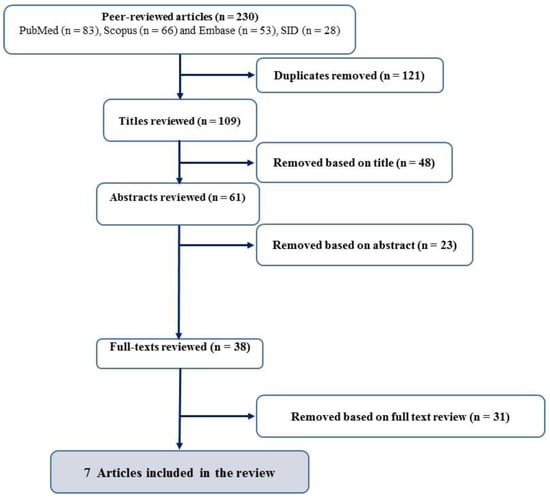
Figure 1.
The selection process of articles and inclusion.
3.2. Concentration of BTEX
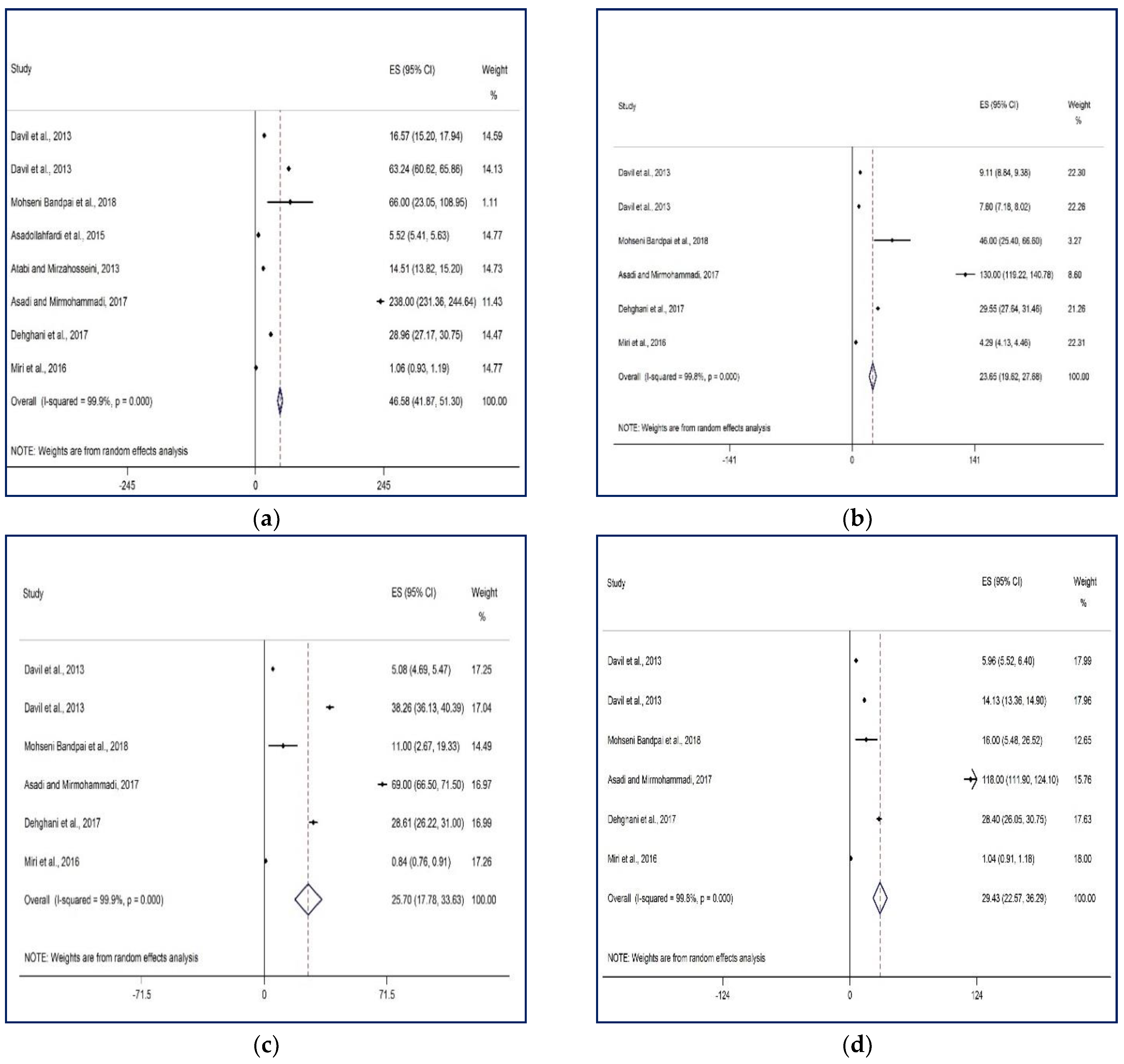
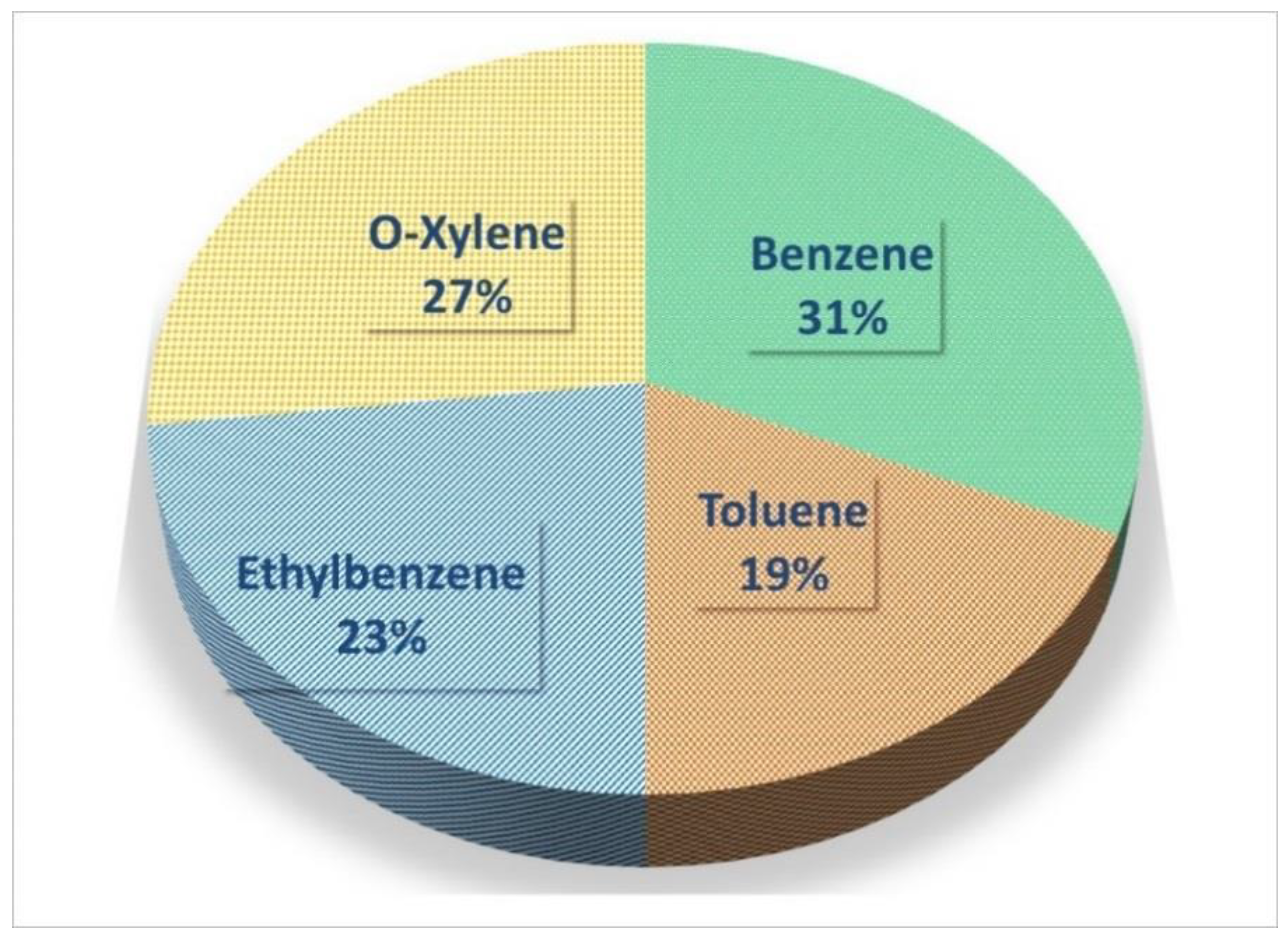
The pooled concentration (ppb) of benzene, toluene, ethylbenzene, and o-xylenes, is demonstrated in Figure 2a–d. The pooled concentration of benzene, toluene, ethylbenzene, and o-xylenes was 46.54 ppb (95% CI: 41.87–51.30 ppb), 23.65 ppb (95% CI: 19.62–27.68 ppb), 25.70 ppb (95% CI: 17.80–33.63 ppb), and 29.43 ppb (95% CI: 22.57–36.29 ppb), respectively. Also, the total BTEX concentration was measured as 125.13 ppb or 474.45 ± 29.93 µg/m3. The rank order based on their contribution in BTEX was benzene (46.54 ppb or 149.18 µg/m3: 31%) > o-xylene (29.43 ppb or 127.16 µg/m3: 27%) > ethylbenzene (25.70 ppb or 110.15 µg/m3: 23%) > toluene (23.65 ppb or 87.97 µg/m3: 19%) (Figure 3).
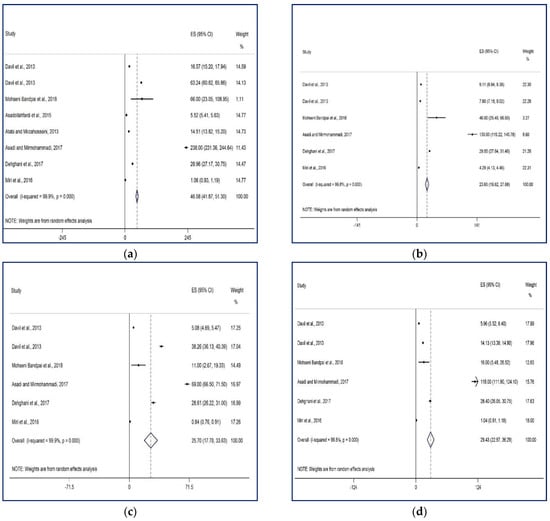
Figure 2.
Forest plot of concentration (ppb) of benzene (a), toluene (b), ethylbenzene (c), and o-xylene (d) in the ambient air of Tehran. ES: effect size, CI: Confidence interval.
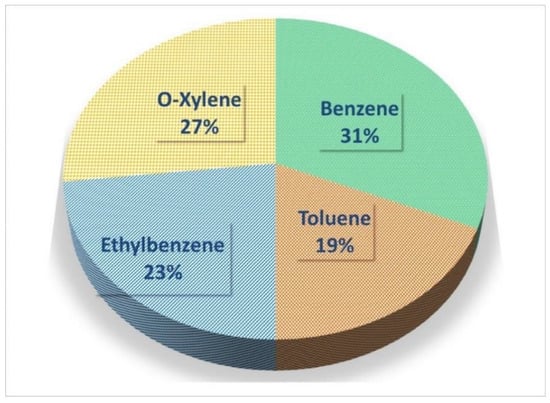
Figure 3.
The percentage of BTEX in the ambient air of Tehran.
A comparison of the concentration of BTEX in Tehran with other urban areas in the world is presented in Table 3. According to our findings, the pooled concentrations of benzene (149.18 µg/m3) and o-xylene (125.57 µg/m3) in Tehran were higher than those in other cities around the world (Table 3) [6,33,67,68,69,70,71,72,73,74] (Table 3).
Table 3.
A comparison of the concentration of BTEX in ambient air of Tehran with other regions in the world (µg/m3).
The concentration of toluene in Tehran (87.97 µg/m3) was lower than that in Malaysia (Kuala Lumpur) (113.805 µg/m3) [73], but higher than other cities [6,33,67,68,69,70,71,72,74]. However, the concentration of ethylbenzene (110.12 µg/m3) in Tehran was lower than the reported value for Malaysia (Kuala Lumpur) (661.3 µg/m3) [73], but was lower than other cities (Table 3) [6,33,67,68,69,70,71,72,74].
The toluene levels in Italy (Bari) (4.76 ± 3.41 µg/m3), Canada (Sarnia) (2.88 µg/m3), Turkey (Kocaeli) (35.51 ± 39.55 µg/m3), China (Beijing) (2.21 ± 2.10 µg/m3), and Spain (Navarra) (13.26 µg/m3) were higher than other VOC compounds (Table 3) [6,67,68,69,70,71,72]; however, the concentrations of ethylbenzene in South Korea (Seoul) (80.75 µg/m3) and Malaysia (Kuala Lumpur) (661.3 µg/m3) were higher than other VOC compounds [33,73,74] (Table 3).
The concentration of BTEX in ambient air of Tehran was higher than many urban regions in the world (Table 3). The inversion phenomenon was mentioned as one of the leading causes of the high concentration of BTEX in Tehran [37,38,40,42]. It occurs in the cold seasons that cause ambient air pollutants such as VOCs to become trapped in the surface layer of the Earth, which can result in intensifying air pollution levels [37].
In addition to the inversion phenomenon, fossil fuel consumption of old vehicles, low-quality fuel, population congestion, non-standard streets, and highways, besides several factories in the south of Tehran such as iron and steel industries, are other reasons for the high level of BTEX in Tehran city [37,38,40,42].
The higher concentration of toluene and ethylbenzene in Malaysia (Kuala Lumpur) compared with Tehran is due to the higher evaporation of petrol vapors (gasoline evaporation) and emission of higher concentrations of toluene and ethylbenzene by motor vehicles [73].
3.3. The Ratio between BTEX Compounds
The ratios of benzene/toluene (B/T) and ethylbenzene/m, p-xylene (E/X) can be used to assess the photochemical activity in the atmosphere and sources [8,75]. The ratio between BTEX compounds is the main parameter for discovering the emission sources of BTEX in the outdoor air [76,77]. The calculated B/T ratio in the range of 0.23–0.66 shows that vehicles and traffic are the main emission sources of toluene and benzene in the ambient air of Tehran [8,75,78,79]. The B/T ratio lower than this range indicates that toluene and benzene mainly originated from stationary sources. Likewise, if the B/T ratio is higher than this range, stationary (factory) and mobile (Motorcycle and car) sources are the main sources of emission [8,75]. Ratios of benzene/toluene (B/T) and ethylbenzene/o-xylene (E/o-X) in Tehran and other areas are presented in Table 4.
Table 4.
Comparison of benzene/toluene (B/T) and ethylbenzene/o-xylene (E/o-X) concentration ratio in Tehran and other areas.
The B/T ratio in this study was 1.69, which was higher than 0.23–0.66, representing that the primary sources of benzene and toluene could be both stationary and mobile sources of emission. Similar to our study, the B/T ratio in ambient air in France (Orleans) and China (Beijing) was higher than the B/T ratio in this study (0.66) [24,33,70,85]. The B/T ratio in ambient air of China (Hong Kong), France (Paris), South Korea (Seoul), Turkey (Kocaeli), and Spain (Navarra) [25,32,70,71,80] was lower than 0.23, indicating that toluene and benzene mainly originated from stationary sources [8,75].
The ratio of E/X is a good indicator that indicates the degree of photochemical reactions [86,87]. A higher ratio of E/X than Spain (Navarra: 0.82), Turkey (Kocaeli: 0.78), and Italy (Bari: 0.71) shows that photochemical activity in the ambient air of Tehran is stronger than in Spain, Turkey, and Italy (Table 4) [88].
3.4. Health Risk Assessment
3.4.1. Non-Carcinogenic Risk Assessment
Non-Carcinogenic Risk BTEX compounds are presented in Table 5. Percentile 95% of THQ of benzene, toluene, ethylbenzene, and o-xylene was determined as 5.342, 0.021, 0.142, and 1.522, respectively (Table 5). The rank order of BTEX compounds based on THQ was benzene > o-xylene > ethylbenzene > toluene. THQ of benzene was higher than other VOC compounds because the concentration of benzene was the highest (Table 5), and also its RfCi was the lowest [55].
Table 5.
Non-carcinogenic risk due to the inhalation of benzene, toluene, ethylbenzene, and o-xylene.
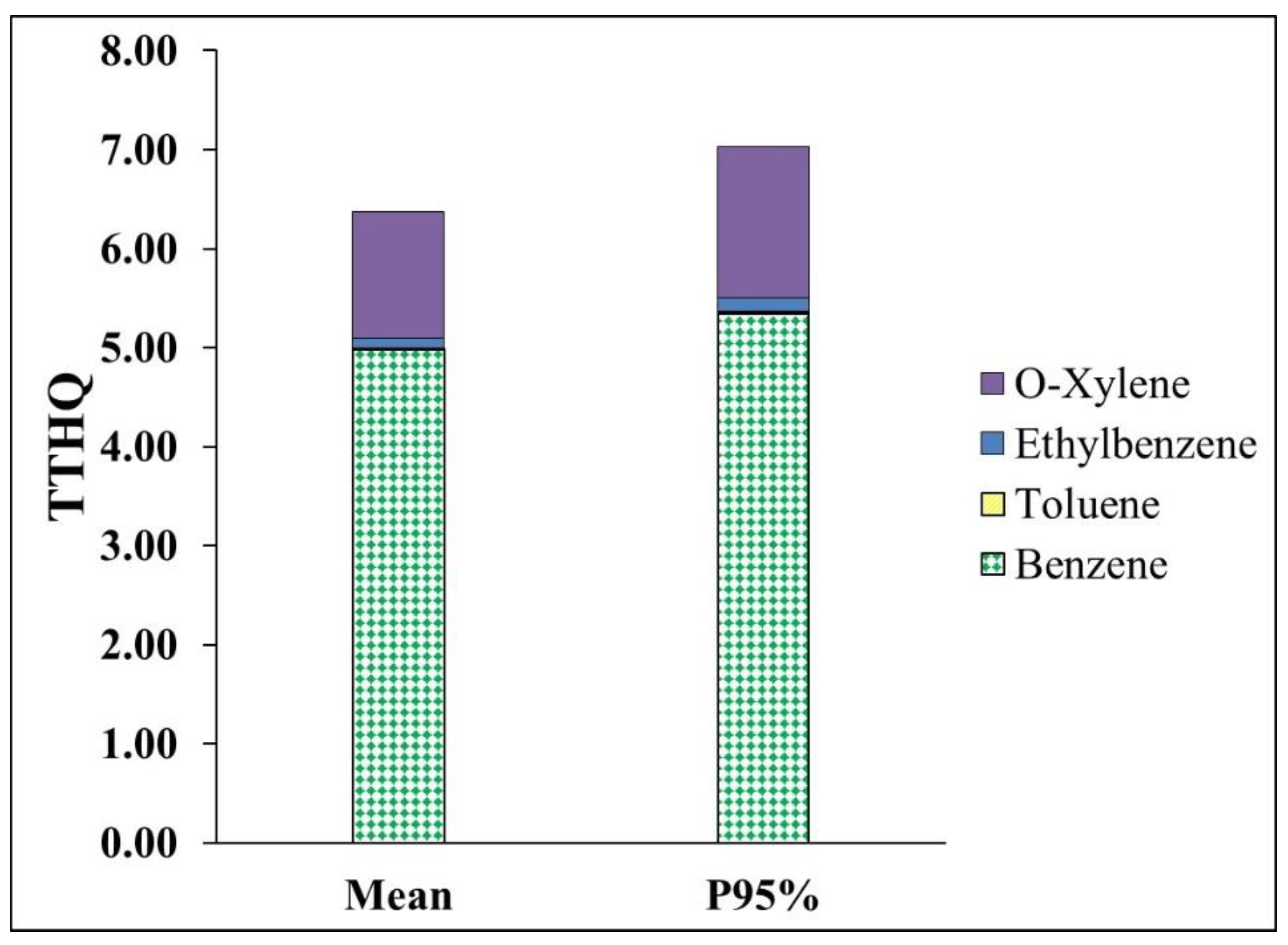
Percentile 95% of THQ of benzene and o-xylene was higher than the value of 1. Also, TTHQ values based on mean and percentile 95% was 6.37 and 7.07, respectively, which were higher than a value of 1 (Figure 4). The health risk assessment shows that the residents of Tehran are at a considerable non-carcinogenic risk (THQ and TTHQ > 1 value). THQ values of benzene, toluene, ethylbenzene, and o-xylene in the China (Beijing) city were 3.2 × 10², 3.37 × 10⁴, 3.19 × 10⁴, and 1.5 × 10³, respectively [70], which were lower than Tehran city. The lower concentration of BTEX in ambient air of China (Beijing) city (Table 3) was the main source of the lower non-carcinogenic risk when compared to Tehran city.
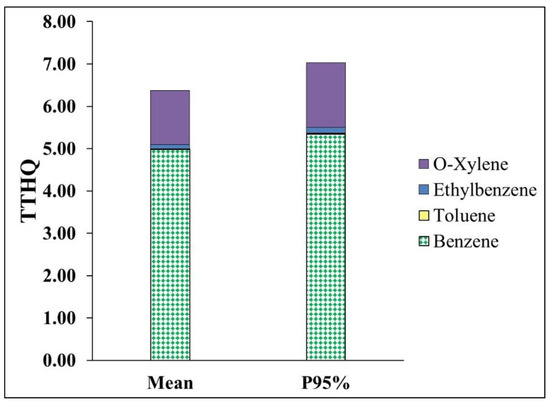
Figure 4.
TTHQ of BTEX in ambient air due to inhalation exposed population.
3.4.2. Carcinogenic Risk Assessment
The result of the carcinogenic risk assessment of benzene and ethylbenzene is presented in Table 6. Percentile 95% ECR of benzene and ethylbenzene was 1.25 × 10⁶ and 1.11 × 10⁶, respectively (Table 6). Also, percentile 95% ECR of benzene and ethylbenzene was higher than the value of 1.00 × 10⁶. In this context, the population of Tehran is at considerable carcinogenic risk. These outcomes of the health risk assessment show that strict monitoring needs to be performed to control the concentration of BTEX in ambient air in Tehran city and BTEX standards should be revised as soon as possible.
Table 6.
Carcinogenic risk due to the inhalation of benzene and ethylbenzene.
4. Conclusions
In the current study, the concentration of BTEX in Tehran ambient air was estimated based on a systematic review and meta-analysis approach and the non-carcinogenic and carcinogenic risks in the exposed population were estimated. The rank order of BTEX based on their concentration was benzene > o-xylene > ethylbenzene > toluene. The primary sources of benzene and toluene in ambient air of Tehran include both mobile and stationary sources of emission. Also, strong photochemical activities in the ambient air of Tehran were assumed. A health risk assessment based on the worse scenario (Percentile 95% THQ and ECR) indicated that the population of Tehran are at considerable non-carcinogenic and carcinogenic risks. Therefore, to reduce the health risks of BTEX, emission reduction plans should be implemented.
Author Contributions
Y.F., M.A. and A.M.K. designed the study protocol; M.T. and J.T. searched the literature; H.K., A.H. and B.M. extracted the data; N.A. and Y.F. analyzed, risk assessment and interpreted of data; Y.F., A.M.K., G.O.C. and M.F. wrote the manuscript; Y.F. and A.M.K. critically revised the manuscript.
Funding
This research was funded by [student research committee at Shahid Beheshti University of Medical Sciences] grant number [1396/62418] And [CNPq-TWAS Postgraduate Fellowship] grant number [# 3240274290].
Acknowledgments
The authors would like to thank the student research committee at Shahid Beheshti University of Medical Sciences for the financial grants of this study (1396/62418). Amin Mousavi Khaneghah wishes to thank the support of the CNPq-TWAS Postgraduate Fellowship (Grant # 3240274290).
Conflicts of Interest
There is no conflict of interest.
References
- Al-Dabbous, A.N.; Kumar, P. Number and size distribution of airborne nanoparticles during summertime in Kuwait: First observations from the Middle East. Environ. Sci. Technol. 2014, 48, 13634–13643. [Google Scholar] [CrossRef] [PubMed]
- Bouarar, I.; Wang, X.; Brasseur, G.P. Air Pollution in Eastern Asia: An Integrated Perspective; Springer: Berlin, Germany, 2017; Volume 16. [Google Scholar]
- Cecchi, L.; Annesi-Maesano, I. News on Climate change, air pollution and allergic trigger factors of asthma. J. Investig. Allergol. Clin. Immunol. 2018, 28, 91–97. [Google Scholar]
- Ghozikali, M.G.; Heibati, B.; Naddafi, K.; Kloog, I.; Conti, G.O.; Polosa, R.; Ferrante, M. Evaluation of chronic obstructive pulmonary disease (COPD) attributed to atmospheric O3, NO2, and SO2 using Air Q Model (2011–2012 year). Environ. Res. 2016, 144, 99–105. [Google Scholar] [CrossRef] [PubMed]
- Lin, R.-T.; Christiani, D.C.; Kawachi, I.; Chan, T.-C.; Chiang, P.-H.; Chan, C.-C. Increased risk of respiratory mortality associated with the high-tech manufacturing industry: A 26-Year study. Int. J. Environ. Res. Public Health. 2016, 13, 557. [Google Scholar] [CrossRef] [PubMed]
- Pekey, B.; Yılmaz, H. The use of passive sampling to monitor spatial trends of volatile organic compounds (VOCs) at an industrial city of Turkey. Microchem. J. 2011, 97, 213–219. [Google Scholar] [CrossRef]
- Sarkhosh, M.; Mahvi, A.H.; Zare, M.R.; Fakhri, Y.; Shamsolahi, H.R. Indoor contaminants from hardcopy devices: Characteristics of VOCs in photocopy centers. Atmos. Environ. 2012, 63, 307–312. [Google Scholar] [CrossRef]
- Hoque, R.R.; Khillare, P.; Agarwal, T.; Shridhar, V.; Balachandran, S. Spatial and temporal variation of BTEX in the urban atmosphere of Delhi, India. Sci. Total Environ. 2008, 392, 30–40. [Google Scholar] [CrossRef] [PubMed]
- Sharma, S.; Goel, A.; Gupta, D.; Kumar, A.; Mishra, A.; Kundu, S.; Chatani, S.; Klimont, Z. Emission inventory of non-methane volatile organic compounds from anthropogenic sources in India. Atmos. Environ. 2015, 102, 209–219. [Google Scholar] [CrossRef]
- Kim, H.; Bernstein, J.A. Air pollution and allergic disease. Curr. Allergy Asthma Rep. 2009, 9, 128–133. [Google Scholar] [CrossRef] [PubMed]
- Seaton, A.; Godden, D.; MacNee, W.; Donaldson, K. Particulate air pollution and acute health effects. Lancet 1995, 345, 176–178. [Google Scholar] [CrossRef]
- Thurston, G.D.; Burnett, R.T.; Turner, M.C.; Shi, Y.; Krewski, D.; Lall, R.; Ito, K.; Jerrett, M.; Gapstur, S.M.; Diver, W.R. Ischemic heart disease mortality and long-term exposure to source-related components of US fine particle air pollution. Environ. Health Perspect. 2016, 124, 785. [Google Scholar] [PubMed]
- Saalberg, Y.; Wolff, M. VOC breath biomarkers in lung cancer. Clin. Chim. Acta 2016, 459, 5–9. [Google Scholar] [CrossRef] [PubMed]
- Carlos-Wallace, F.M.; Zhang, L.; Smith, M.T.; Rader, G.; Steinmaus, C. Parental, in utero, and early-life exposure to benzene and the risk of childhood leukemia: A meta-analysis. Am. J. Epidemiol. 2015, 183, 1–14. [Google Scholar] [CrossRef] [PubMed]
- Masih, A.; Lall, A.S.; Taneja, A.; Singhvi, R. Exposure profiles, seasonal variation and health risk assessment of BTEX in indoor air of homes at different microenvironments of a terai province of northern India. Chemosphere 2017, 176, 8–17. [Google Scholar] [CrossRef] [PubMed]
- Partovi, E.; Fathi, M.; Assari, M.J.; Esmaeili, R.; Pourmohamadi, A.; Rahimpour, R. Risk assessment of occupational exposure to BTEX in the National Oil Distribution Company in Iran. Chronic Dis. J. 2018, 4, 48–55. [Google Scholar]
- International Agency for Research on Cancer (IARC). Agents Classified by the IARC Monographs; IARC: Lyon, France, 2011; Volume 1–102. [Google Scholar]
- Heshmati, A.; Ghadimi, S.; Khaneghah, A.M.; Barba, F.J.; Lorenzo, J.M.; Nazemi, F.; Fakhri, Y. Risk assessment of benzene in food samples of Iran’s market. Food Chem. Toxicol. 2018, 114, 278–284. [Google Scholar] [CrossRef] [PubMed]
- Mansha, M.; Saleemi, A.R.; Naqvi, J.H. Status and spatial visualization of toxic pollutants (BTEX) in urban atmosphere. Adv. Chem. Eng. Sci. 2011, 1, 231. [Google Scholar] [CrossRef]
- Helmes, C.; Atkinson, D.; Jaffer, J.; Sigman, C.; Thompson, K.; Kelsey, M.; Kraybill, H.; Munn, J. Evaluation and classification of the potential carcinogenicity of organic air pollutants. J. Environ. Sci. Health Part A 1982, 17, 321–389. [Google Scholar] [CrossRef] [PubMed]
- Possanzini, M.; Di Palo, V.; Gigliucci, P.; Scianò, M.C.T.; Cecinato, A. Determination of phase-distributed PAH in Rome ambient air by denuder/GC-MS method. Atmos. Environ. 2004, 38, 1727–1734. [Google Scholar] [CrossRef]
- Guimarães, E.D.F.; do Rego, E.C.; Cunha, H.; Rodrigues, J.M.; Figueroa-Villar, J.D. Certified reference material for traceability in environmental analysis: PAHs in toluene. J. Braz. Chem. Soc. 2014, 25, 351–360. [Google Scholar] [CrossRef]
- Henze, D.; Seinfeld, J.; Ng, N.; Kroll, J.; Fu, T.-M.; Jacob, D.J.; Heald, C. Global modeling of secondary organic aerosol formation from aromatic hydrocarbons: High-vs. low-yield pathways. Atmos. Chem. Phys. 2008, 8, 2405–2420. [Google Scholar] [CrossRef]
- Xie, X.; Shao, M.; Liu, Y.; Lu, S.; Chang, C.-C.; Chen, Z.-M. Estimate of initial isoprene contribution to ozone formation potential in Beijing, China. Atmos. Environ. 2008, 42, 6000–6010. [Google Scholar] [CrossRef]
- Na, K.; Kim, Y.P.; Moon, K.C. Diurnal characteristics of volatile organic compounds in the Seoul atmosphere. Atmos. Environ. 2003, 37, 733–742. [Google Scholar] [CrossRef]
- Zhang, Y.; Mu, Y.; Liu, J.; Mellouki, A. Levels, sources and health risks of carbonyls and BTEX in the ambient air of Beijing, China. J. Environ. Sci. 2012, 24, 124–130. [Google Scholar] [CrossRef]
- Murena, F. Air quality nearby road traffic tunnel portals: BTEX monitoring. J. Environ. Sci. 2007, 19, 578–583. [Google Scholar] [CrossRef]
- Barletta, B.; Meinardi, S.; Simpson, I.J.; Zou, S.; Rowland, F.S.; Blake, D.R. Ambient mixing ratios of nonmethane hydrocarbons (NMHCs) in two major urban centers of the Pearl River Delta (PRD) region: Guangzhou and Dongguan. Atmos. Environ. 2008, 42, 4393–4408. [Google Scholar] [CrossRef]
- Grosjean, D. In situ organic aerosol formation during a smog episode: Estimated production and chemical functionality. Atmos. Environ. Part A Gen. Top. 1992, 26, 953–963. [Google Scholar] [CrossRef]
- Song, Y.; Shao, M.; Liu, Y.; Lu, S.; Kuster, W.; Goldan, P.; Xie, S. Source apportionment of ambient volatile organic compounds in Beijing. Environ. Sci. Technol. 2007, 41, 4348–4353. [Google Scholar] [CrossRef] [PubMed]
- Lu, S.; Liu, Y.; Shao, M.; Huang, S. Chemical speciation and anthropogenic sources of ambient volatile organic compounds (VOCs) during summer in Beijing, 2004. Front. Environ. Sci. Eng. China 2007, 1, 147–152. [Google Scholar] [CrossRef]
- Gros, V.; Sciare, J.; Yu, T. Air-quality measurements in megacities: Focus on gaseous organic and particulate pollutants and comparison between two contrasted cities, Paris and Beijing. C. R. Geosci. 2007, 339, 764–774. [Google Scholar] [CrossRef]
- Jiang, Z.; Grosselin, B.; Daële, V.; Mellouki, A.; Mu, Y. Seasonal and diurnal variations of BTEX compounds in the semi-urban environment of Orleans, France. Sci. Total Environ. 2017, 574, 1659–1664. [Google Scholar] [CrossRef] [PubMed]
- Liu, K.; Zhang, C.; Cheng, Y.; Liu, C.; Zhang, H.; Zhang, G.; Sun, X.; Mu, Y. Serious BTEX pollution in rural area of the North China Plain during winter season. J. Environ. Sci. 2015, 30, 186–190. [Google Scholar] [CrossRef] [PubMed]
- Iranian Students News Agency (ISNA). 2017. Available online: https://www.isna.ir/news/96063118066/ (accessed on 1 February 2018).
- Soleimani, M.; Amini, N. Source Identification and Apportionment of Air Pollutants in Iran. J. Air Pollut. Health 2017, 2, 57–72. [Google Scholar]
- Davil, M.F.; Naddafi, K.; Rostami, R.; Zarei, A.; Feizizadeh, M. A mathematical model for predicting 24-h variations of BTEX concentrations in ambient air of Tehran. Int. J. Environ. Health Eng. 2013, 2, 4. [Google Scholar]
- Mohseni Bandpai, A.; Yaghoubi, M.; Hadei, M.; Salesi, M.; Shahsavani, A. Concentrations of Criteria Air Pollutants and BTEX in Mehrabad International Airport. J. Mazandaran Univ. Med. Sci. 2018, 28, 76–87. [Google Scholar]
- Asadollahfardi, G.; Mehdinejad, M.; Mirmohammadi, M.; Asadollahfardi, R. Predicting Atmospheric Concentrations of Benzene in the Southeast of Tehran using Artificial Neural Network. Asian J. Atmos. Environ. (AJAE) 2015, 9, 12–21. [Google Scholar] [CrossRef]
- Atabi, F.; Mirzahosseini, S.A.H. GIS-based assessment of cancer risk due to benzene in Tehran ambient air. Int. J. Occup. Med. Environ. Health 2013, 26, 770–779. [Google Scholar] [CrossRef] [PubMed]
- Asadi, M.; Mirmohammadi, M. Experimental study of benzene, toluene, ethylbenzene, and xylene (BTEX) contributions in the air pollution of Tehran, Iran. Environ. Qual. Manag. 2017, 27, 83–93. [Google Scholar] [CrossRef]
- Dehghani, M.H.; Sanaei, D.; Nabizadeh, R.; Nazmara, S.; Kumar, P. Source apportionment of BTEX compounds in Tehran, Iran using UNMIX receptor model. Air Qual. Atmos. Health 2017, 10, 225–234. [Google Scholar] [CrossRef]
- Miri, M.; Shendi, M.R.A.; Ghaffari, H.R.; Aval, H.E.; Ahmadi, E.; Taban, E.; Gholizadeh, A.; Aval, M.Y.; Mohammadi, A.; Azari, A. Investigation of outdoor BTEX: Concentration, variations, sources, spatial distribution, and risk assessment. Chemosphere 2016, 163, 601–609. [Google Scholar] [CrossRef] [PubMed]
- Higgins, J.P.; Green, S. Cochrane Handbook for Systematic Reviews of Interventions; John Wiley & Sons: Hoboken, NJ, USA, 2011; Volume 4. [Google Scholar]
- Khaneghah, A.M.; Fakhri, Y.; Raeisi, S.; Armoon, B.; Sant’Ana, A.S. Prevalence and concentration of ochratoxin A, zearalenone, deoxynivalenol and total aflatoxin in cereal-based products: A systematic review and meta-analysis. Food Chem. Toxicol. 2018, 118, 830–848. [Google Scholar] [CrossRef] [PubMed]
- Khaneghah, A.M.; Fakhri, Y.; Sant’Ana, A.S. Impact of unit operations during processing of cereal-based products on the levels of deoxynivalenol, total aflatoxin, ochratoxin A, and zearalenone: A systematic review and meta-analysis. Food Chem. 2018, 268, 611–624. [Google Scholar] [CrossRef] [PubMed]
- Dehghani, M.; Fazlzadeh, M.; Sorooshian, A.; Tabatabaee, H.R.; Miri, M.; Baghani, A.N.; Delikhoon, M.; Mahvi, A.H.; Rashidi, M. Characteristics and health effects of BTEX in a hot spot for urban pollution. Ecotoxicol. Environ. Saf. 2018, 155, 133–143. [Google Scholar] [CrossRef] [PubMed]
- Kuroki, T.; Watanabe, Y.; Teranishi, H.; Izumiyama, S.; Amemura-Maekawa, J.; Kura, F. Legionella prevalence and risk of legionellosis in Japanese households. Epidemiol. Infect. 2017, 145, 1398–1408. [Google Scholar] [CrossRef] [PubMed]
- Quan, H.; Zhang, J. Estimate of standard deviation for a log-transformed variable using arithmetic means and standard deviations. Stat. Med. 2003, 22, 2723–2736. [Google Scholar] [CrossRef] [PubMed]
- Higgins, J.; White, I.R.; Anzures-Cabrera, J. Meta-analysis of skewed data: Combining results reported on log-transformed or raw scales. Stat. Med. 2008, 27, 6072–6092. [Google Scholar] [CrossRef] [PubMed]
- United States Environmental Protection Agency (USEPA). Risk Assessment Guidance for Superfund. In Part A: Human Health Evaluation Manual; Part E, Supplemental Guidance for Dermal Risk Assessment; Part F, Supplemental Guidance for Inhalation Risk Assessment, Volume I. 2011. Available online: http://www.epa.gov/oswer/riskassessment/human_health_exposure.htm (accessed on 20 April 2011).
- Environmental Protection Agency (EPA). Risk Assessment Guidance for Superfund; Volume I: Human Health Evaluation Manual (Part A); EPA/540/1-89/002; USEPA: Washington, DC, USA, 2004.
- Environmental Protection Agency (EPA). Soil Screening Guidance Technical Background Document; EPA/540; Office of Solid Waste and Emergency Response: Washington, DC, USA, 1996; p. 95.
- United States Environmental Protection Agency (USEPA). Regional Screening Levels (RSLs)—Generic Tables. USEPA 2011b. 2017. Available online: http://www.epa.gov/region9/superfund/prg/index.html (accessed on 16 July 2017).
- United States Environmental Protection Agency (USEPA). Regional screening level (RSL) Summary Table (TR = 1E − 6, HQ = 1). Available online: https://www.epa.gov/risk/regional-screening-levels-rsls-generic-tables (accessed on 25 June 2013).
- Zheng, N.; Liu, J.; Wang, Q.; Liang, Z. Health risk assessment of heavy metal exposure to street dust in the zinc smelting district, Northeast of China. Sci. Total Environ. 2010, 408, 726–733. [Google Scholar] [CrossRef] [PubMed]
- United States Environmental Protection Agency (USEPA). Supplemental Guidance for Developing Soil Screening Levels for Superfund Sites; Peer Review Draft, OSWER 9355; USEPA: Washington, DC, USA, 2001; pp. 4–24.
- Ferreira-Baptista, L.; De Miguel, E. Geochemistry and risk assessment of street dust in Luanda, Angola: A tropical urban environment. Atmos. Environ. 2005, 39, 4501–4512. [Google Scholar] [CrossRef]
- UK-Air, Conversion Factors between ppb and µg m−3 and ppm. 2014. Available online: https://uk-air.defra.gov.uk/.../0502160851_Conversion_Factors_Between_ppb_and.p (accessed on 20 May 2014).
- De Miguel, E.; Iribarren, I.; Chacon, E.; Ordonez, A.; Charlesworth, S. Risk-based evaluation of the exposure of children to trace elements in playgrounds in Madrid (Spain). Chemosphere 2007, 66, 505–513. [Google Scholar] [CrossRef] [PubMed]
- Lim, H.-S.; Lee, J.-S.; Chon, H.-T.; Sager, M. Heavy metal contamination and health risk assessment in the vicinity of the abandoned Songcheon Au–Ag mine in Korea. J. Geochem. Explor. 2008, 96, 223–230. [Google Scholar] [CrossRef]
- Shahrbabki, P.E.; Hajimohammadi, B.; Shoeibi, S.; Elmi, M.; Yousefzadeh, A.; Conti, G.O.; Ferrante, M.; Amirahmadi, M.; Fakhri, Y.; Khaneghah, A.M. Probabilistic non-carcinogenic and carcinogenic risk assessments (Monte Carlo simulation method) of the measured acrylamide content in Tah-dig using QuEChERS extraction and UHPLC-MS/MS. Food Chem. Toxicol. 2018, 118, 361–370. [Google Scholar] [CrossRef] [PubMed]
- Ghasemidehkordi, B.; Malekirad, A.A.; Nazem, H.; Fazilati, M.; Salavati, H.; Shariatifar, N.; Rezaei, M.; Fakhri, Y.; Khaneghah, A.M. Concentration of lead and mercury in collected vegetables and herbs from Markazi province, Iran: A non-carcinogenic risk assessment. Food Chem. Toxicol. 2018, 113, 204–210. [Google Scholar] [CrossRef] [PubMed]
- Fakhri, Y.; Mohseni-Bandpei, A.; Conti, G.O.; Ferrante, M.; Cristaldi, A.; Jeihooni, A.K.; Dehkordi, M.K.; Alinejad, A.; Rasoulzadeh, H.; Mohseni, S.M.; et al. Systematic review and health risk assessment of arsenic and lead in the fished shrimps from the Persian Gulf. Food Chem. Toxicol. 2018, 113, 278–286. [Google Scholar] [CrossRef] [PubMed]
- Rahmani, J.; Alipour, S.; Miri, A.; Fakhri, Y.; Riahi, S.M.; Keramati, H.; Moradi, M.; Amanidaz, N.; Pouya, R.H.; Bahmani, Z.; et al. The prevalence of aflatoxin M1 in milk of Middle East region: A systematic review, meta-analysis and probabilistic health risk assessment. Food Chem. Toxicol. 2018, 118, 653–666. [Google Scholar] [CrossRef] [PubMed]
- Yousefi, M.; Shemshadi, G.; Khorshidian, N.; Ghasemzadeh-Mohammadi, V.; Fakhri, Y.; Hosseini, H.; Khaneghah, A.M. Polycyclic aromatic hydrocarbons (PAHs) content of edible vegetable oils in Iran: A risk assessment study. Food Chem. Toxicol. 2018, 118, 480–489. [Google Scholar] [CrossRef] [PubMed]
- Caselli, M.; de Gennaro, G.; Marzocca, A.; Trizio, L.; Tutino, M. Assessment of the impact of the vehicular traffic on BTEX concentration in ring roads in urban areas of Bari (Italy). Chemosphere 2010, 81, 306–311. [Google Scholar] [CrossRef] [PubMed]
- Xu, J.; Szyszkowicz, M.; Jovic, B.; Cakmak, S.; Austin, C.C.; Zhu, J. Estimation of indoor and outdoor ratios of selected volatile organic compounds in Canada. Atmos. Environ. 2016, 141, 523–531. [Google Scholar] [CrossRef]
- Civan, M.Y.; Elbir, T.; Seyfioglu, R.; Kuntasal, Ö.O.; Bayram, A.; Doğan, G.; Yurdakul, S.; Andiç, Ö.; Müezzinoğlu, A.; Sofuoglu, S.C.; et al. Spatial and temporal variations in atmospheric VOCs, NO2, SO2, and O3 concentrations at a heavily industrialized region in Western Turkey, and assessment of the carcinogenic risk levels of benzene. Atmos. Environ. 2015, 103, 102–113. [Google Scholar] [CrossRef]
- Gao, J.; Zhang, J.; Li, H.; Li, L.; Xu, L.; Zhang, Y.; Wang, Z.; Wang, X.; Zhang, W.; Chen, Y.; et al. Comparative study of volatile organic compounds in ambient air using observed mixing ratios and initial mixing ratios taking chemical loss into account—A case study in a typical urban area in Beijing. Sci. Total Environ. 2018, 628, 791–804. [Google Scholar] [CrossRef] [PubMed]
- Parra, M.; Elustondo, D.; Bermejo, R.; Santamaria, J. Ambient air levels of volatile organic compounds (VOC) and nitrogen dioxide (NO2) in a medium size city in Northern Spain. Sci. Total Environ. 2009, 407, 999–1009. [Google Scholar] [CrossRef] [PubMed]
- Miller, L.; Xu, X.; Wheeler, A.; Zhang, T.; Hamadani, M.; Ejaz, U. Evaluation of missing value methods for predicting ambient BTEX concentrations in two neighbouring cities in Southwestern Ontario Canada. Atmos. Environ. 2018, 181, 126–134. [Google Scholar] [CrossRef]
- Hosaini, P.N.; Khan, M.F.; Mustaffa, N.I.H.; Amil, N.; Mohamad, N.; Jaafar, S.A.; Nadzir, M.S.M.; Latif, M.T. Concentration and source apportionment of volatile organic compounds (VOCs) in the ambient air of Kuala Lumpur, Malaysia. Nat. Hazards 2017, 85, 437–452. [Google Scholar] [CrossRef]
- Nguyen, H.T.; Kim, K.-H.; Kim, M.-Y. Volatile organic compounds at an urban monitoring station in Korea. J. Hazard. Mater. 2009, 161, 163–174. [Google Scholar] [CrossRef] [PubMed]
- Buczynska, A.J.; Krata, A.; Stranger, M.; Godoi, A.F.L.; Kontozova-Deutsch, V.; Bencs, L.; Naveau, I.; Roekens, E.; Van Grieken, R. Atmospheric BTEX-concentrations in an area with intensive street traffic. Atmos. Environ. 2009, 43, 311–318. [Google Scholar] [CrossRef]
- Kerbachi, R.; Boughedaoui, M.; Bounoua, L.; Keddam, M. Ambient air pollution by aromatic hydrocarbons in Algiers. Atmos. Environ. 2006, 40, 3995–4003. [Google Scholar] [CrossRef]
- Khoder, M.I. Ambient levels of volatile organic compounds in the atmosphere of Greater Cairo. Atmos. Environ. 2007, 41, 554–566. [Google Scholar] [CrossRef]
- Perry, R.; Gee, I.L. Vehicle emissions in relation to fuel composition. Sci. Total Environ. 1995, 169, 149–156. [Google Scholar] [CrossRef]
- Barletta, B.; Meinardi, S.; Rowland, F.S.; Chan, C.-Y.; Wang, X.; Zou, S.; Chan, L.Y.; Blake, D.R. Volatile organic compounds in 43 Chinese cities. Atmos. Environ. 2005, 39, 5979–5990. [Google Scholar] [CrossRef]
- Ho, K.; Lee, S.; Guo, H.; Tsai, W. Seasonal and diurnal variations of volatile organic compounds (VOCs) in the atmosphere of Hong Kong. Sci. Total Environ. 2004, 322, 155–166. [Google Scholar] [CrossRef] [PubMed]
- Hellen, H.; Hakola, H.; Laurila, T. Determination of source contributions of NMHCs in Helsinki (60 N, 25 E) using chemical mass balance and the Unmix multivariate receptor models. Atmos. Environ. 2003, 37, 1413–1424. [Google Scholar] [CrossRef]
- Rappenglück, B.; Fabian, P. Nonmethane hydrocarbons (NMHC) in the greater Munich area/Germany. Atmos. Environ. 1999, 33, 3843–3857. [Google Scholar] [CrossRef]
- Singh, H.B.; Salas, L.J.; Cantrell, B.K.; Redmond, R.M. Distribution of aromatic hydrocarbons in the ambient air. Atmos. Environ. (1967) 1985, 19, 1911–1919. [Google Scholar] [CrossRef]
- Derwent, R.; Middleton, D.; Field, R.; Goldstone, M.; Lester, J.; Perry, R. Analysis and interpretation of air quality data from an urban roadside location in central London over the period from July 1991 to July 1992. Atmos. Environ. 1995, 29, 923–946. [Google Scholar] [CrossRef]
- Liu, Y.; Shao, M.; Zhang, J.; Fu, L.; Lu, S. Distributions and source apportionment of ambient volatile organic compounds in Beijing city, China. J. Environ. Sci. Health 2005, 40, 1843–1860. [Google Scholar] [CrossRef] [PubMed]
- Atkinson, R.; Arey, J. Gas-phase tropospheric chemistry of biogenic volatile organic compounds: A review. Atmos. Environ. 2003, 37, 197–219. [Google Scholar] [CrossRef]
- Atkinson, R. Gas-phase tropospheric chemistry of organic compounds: A review. Atmos. Environ. Part A Gen. Top. 1990, 24, 1–41. [Google Scholar] [CrossRef]
- Yassaa, N.; Brancaleoni, E.; Frattoni, M.; Ciccioli, P. Isomeric analysis of BTEXs in the atmosphere using β-cyclodextrin capillary chromatography coupled with thermal desorption and mass spectrometry. Chemosphere 2006, 63, 502–508. [Google Scholar] [CrossRef] [PubMed]

© 2018 by the authors. Licensee MDPI, Basel, Switzerland. This article is an open access article distributed under the terms and conditions of the Creative Commons Attribution (CC BY) license (http://creativecommons.org/licenses/by/4.0/).