The Impact of Mode of Birth, and Episiotomy, on Postpartum Sexual Function in the Medium- and Longer-Term: An Integrative Systematic Review

 , , ,
, , ,
Abstract
1. Introduction
2. Materials and Methods
2.1. Search Strategy
2.2. Inclusion and Exclusion Criteria
2.3. Valid Measures of Sexual Function
2.4. Classification of the Medium- and Longer-Term Studies
2.5. Selection of the Studies
2.6. Quality Assessment
2.7. Data Extraction and Analysis
3. Results
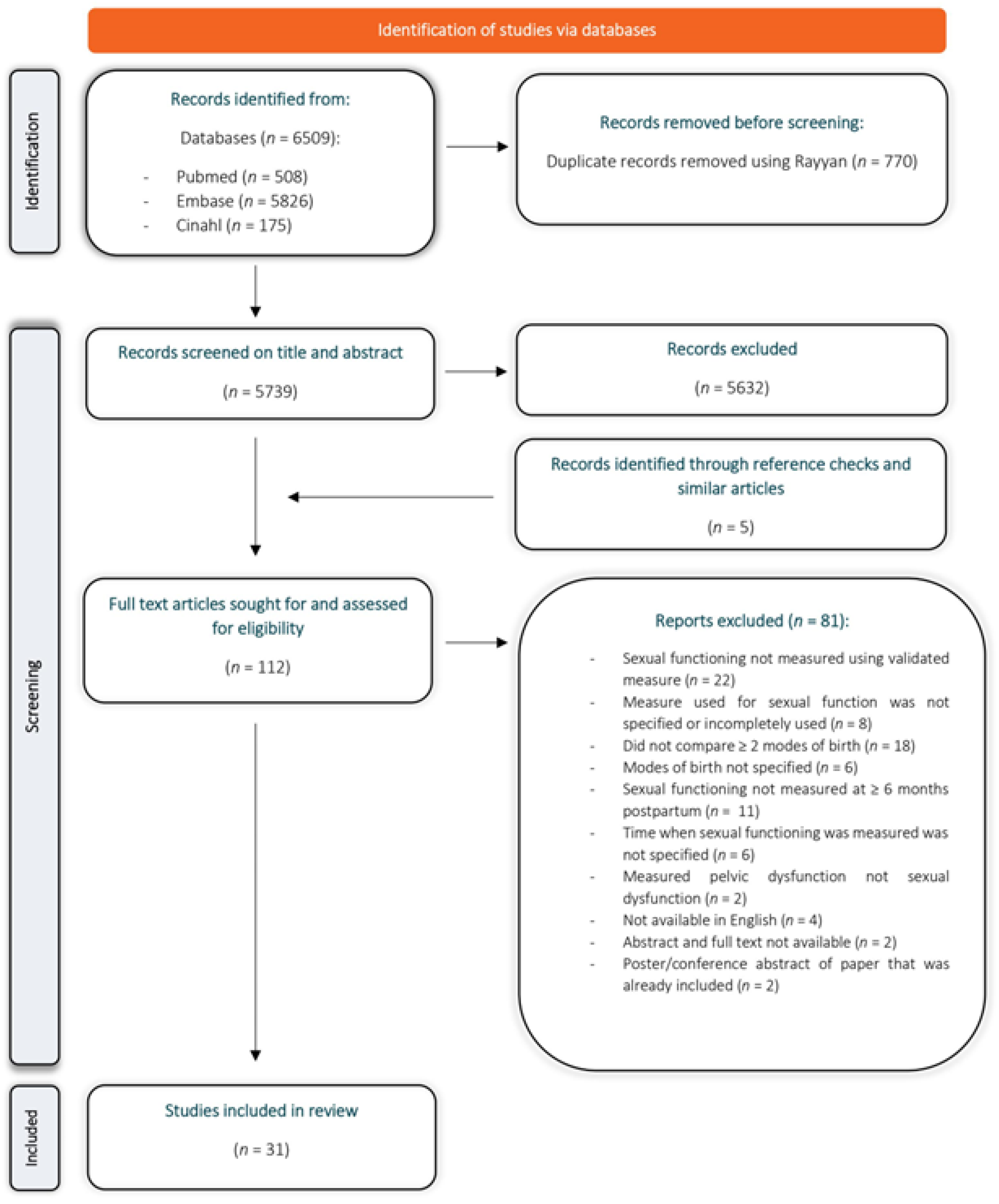
3.1. Search
3.2. Study Characteristics
3.3. Quality Assessment
3.4. Main Focus: Specific Mode of Birth Groups (SVB, VBE, AVB, pCS, eCS)
3.4.1. Medium-Term Outcomes (≥Six Months and <12 Months Postpartum)
3.4.2. Longer-Term Outcomes (≥12 months Postpartum)
3.5. Secondary Focus: Non-Specific Mode of Birth Groups (Incorporated Multiple Mode of Birth Groups into One Category)
3.5.1. Medium-Term Outcomes (≥Six Months and <12 Months Postpartum)
3.5.2. Longer-Term Outcomes (≥12 Months Postpartum)
3.6. Overall
4. Discussion
4.1. Strengths and Limitations
4.2. Recommendations
5. Conclusions
Supplementary Materials
Author Contributions
Funding
Institutional Review Board Statement
Informed Consent Statement
Data Availability Statement
Acknowledgments
Conflicts of Interest
Appendix A. Search Strategy
References
- Andreucci, C.B.; Bussadori, J.C.; Pacagnella, R.C.; Chou, D.; Filippi, V.; Say, L.; Cecatti, J.G.; Brazilian COMMAG Study Group; WHO Maternal Morbidity Working Group. Sexual life and dysfunction after maternal morbidity: A systematic review. BMC Pregnancy Childbirth 2015, 15, 307. [Google Scholar] [CrossRef]
- Jamali, S.; Inaloo, R.; Javadpour, S.; Haghbeen, M.; Poornowrooz, N. The Relationship between Sexual Function and Quality of Life in Reproductive-agegrouped Women in Iran: A Cross-Sectional Study. Ambient. Sci. 2018, 5, 20–23. [Google Scholar] [CrossRef]
- Gutzeit, O.; Levy, G.; Lowenstein, L. Postpartum Female Sexual Function: Risk Factors for Postpartum Sexual Dysfunction. Sex. Med. 2020, 8, 8–13. [Google Scholar] [CrossRef]
- Lagaert, L.; Weyers, S.; Van Kerrebroeck, H.; Elaut, E. Postpartum dyspareunia and sexual functioning: A prospective cohort study. Eur. J. Contracept. Reprod. Health Care 2017, 22, 200–206. [Google Scholar] [CrossRef]
- American Psychiatric Association, D.; American Psychiatric, A. Diagnostic and Statistical Manual of Mental Disorders: DSM-5; American Psychiatric Association: Washington, DC, USA, 2013. [Google Scholar]
- Sungur, M.Z.; Gündüz, A. A Comparison of DSM-IV-TR and DSM-5 Definitions for Sexual Dysfunctions: Critiques and Challenges. J. Sex. Med. 2014, 11, 364–373. [Google Scholar] [CrossRef] [PubMed]
- Chivers, M.L.; Bailey, J.M. A sex difference in features that elicit genital response. Biol. Psychol. 2005, 70, 115–120. [Google Scholar] [CrossRef]
- Domoney, C. Sexual function in women: What is normal? Int. Urogynecology J. 2009, 20, 9–17. [Google Scholar] [CrossRef]
- Macfarlane, A.J.; Blondel, B.; Mohangoo, A.D.; Cuttini, M.; Nijhuis, J.; Novak, Z.; Ólafsdóttir, H.S.; Zeitlin, J.; the Euro-Peristat Scientific Committee. Wide differences in mode of delivery within Europe: Risk-stratified analyses of aggregated routine data from the Euro-Peristat study. BJOG Int. J. Obstet. Gynaecol. 2016, 123, 559–568. [Google Scholar] [CrossRef] [PubMed]
- démographiques, I. Population, Births, Deaths: Population, Births and Deaths in Europe and Other Developed OECD Countries. 2021. Available online: https://www.ined.fr/en/everything_about_population/data/europe-developed-countries/population-births-deaths/ (accessed on 19 January 2022).
- Blondel, B.; Alexander, S.; Bjarnadóttir, R.; Gissler, M.; Langhoff-Roos, J.; Novak-Antolič, Ž.; Prunet, C.; Zhang, W.H.; Hindori-Mohangoo, A.D.; Zeitlin, J. Variations in rates of severe perineal tears and episiotomies in 20 European countries: A study based on routine national data in Euro-Peristat Project. Acta Obs. Gynecol. Scand. 2016, 95, 746–754. [Google Scholar] [CrossRef] [PubMed]
- Digital, N. NHS Maternity Statistics 2020–2021. 2021. Available online: https://digital.nhs.uk/data-and-information/publications/statistical/nhs-maternity-statistics/2020-21 (accessed on 6 October 2022).
- OECD. Caesarean Sections (Indicator). 2022. Available online: https://data.oecd.org/healthcare/caesarean-sections.htm (accessed on 6 October 2022).
- World Health Organisation. Caesarean Section Rates Continue to Rise, Amid Growing Inequalities in Access. 2021. Available online: https://www.who.int/news/item/16-06-2021-caesarean-section-rates-continue-to-rise-amid-growing-inequalities-in-access (accessed on 16 June 2021).
- Rudey, E.L.; Leal, M.d.C.; Rego, G. Cesarean section rates in Brazil: Trend analysis using the Robson classification system. Medicine 2020, 99, e19880. [Google Scholar] [CrossRef] [PubMed]
- Departamento de Análise Epidemiológica e Vigilância de Doenças Não Transmissíveis. Painel de Monitoramento de Nascidos Vivos-Natalidade-Painéis de Monitoramento-Centrais de Conteúdos-DANTPS-SVS/MS. 2019. Available online: http://svs.aids.gov.br/dantps/centrais-de-conteudos/paineis-de-monitoramento/natalidade/nascidos-vivos/ (accessed on 3 March 2022).
- Potter, J.E.; Berquó, E.; Perpétuo, I.H.O.; Leal, O.F.; Hopkins, K.; Souza, M.R.; de Carvalho Formiga, M.C. Unwanted caesarean sections among public and private patients in Brazil: Prospective study. BMJ 2001, 323, 1155–1158. [Google Scholar] [CrossRef] [PubMed]
- McDonald, E.; Brown, S. Does method of birth make a difference to when women resume sex after childbirth? BJOG Int. J. Obstet. Gynaecol. 2013, 120, 823–830. [Google Scholar] [CrossRef]
- McDonald, E.; Gartland, D.; Woolhouse, H.; Brown, S. Resumption of sex after a second birth: An Australian prospective cohort. Birth 2019, 46, 173–181. [Google Scholar] [CrossRef] [PubMed]
- Glazener, C.M.A. Sexual function after childbirth: Women’s experiences, persistent morbidity and lack of professional recognition. BJOG Int. J. Obstet. Gynaecol. 1997, 104, 330–335. [Google Scholar] [CrossRef]
- Faisal-Cury, A.; Menezes, P.R.; Quayle, J.; Matijasevich, A.; Diniz, S.G. The Relationship Between Mode of Delivery and Sexual Health Outcomes after Childbirth. J. Sex. Med. 2015, 12, 1212–1220. [Google Scholar] [CrossRef]
- Barrett, G.; Pendry, E.; Peacock, J.; Victor, C.; Thakar, R.; Manyonda, I. Women’s Sexuality After Childbirth: A Pilot Study. Arch. Sex. Behav. 1999, 28, 179–191. [Google Scholar] [CrossRef]
- Hjorth, S.; Kirkegaard, H.; Olsen, J.; Thornton, J.G.; Nohr, E.A. Mode of birth and long-term sexual health: A follow-up study of mothers in the Danish National Birth Cohort. BMJ Open 2019, 9, e029517. [Google Scholar] [CrossRef]
- Scavello, I.; Maseroli, E.; Di Stasi, V.; Vignozzi, L. Sexual Health in Menopause. Medicina 2019, 55, 559. [Google Scholar] [CrossRef]
- Fabre, L.F.; Smith, L.C. The Effect of Major Depression on Sexual Function in Women. J. Sex. Med. 2012, 9, 231–239. [Google Scholar] [CrossRef] [PubMed]
- Jiannine, L. An investigation of the relationship between physical fitness, self-concept, and sexual functioning. J. Educ. Health Promot. 2018, 7, 57. [Google Scholar] [CrossRef] [PubMed]
- Maseroli, E.; Rastrelli, G.; Di Stasi, V.; Cipriani, S.; Scavello, I.; Todisco, T.; Gironi, V.; Castellini, G.; Ricca, V.; Sorbi, F.; et al. Physical Activity and Female Sexual Dysfunction: A Lot Helps, But Not Too Much. J. Sex. Med. 2021, 18, 1217–1229. [Google Scholar] [CrossRef]
- Gottfried, R.; Lev-Wiesel, R.; Hallak, M.; Lang-Franco, N. Inter-relationships between sexual abuse, female sexual function and childbirth. Midwifery 2015, 31, 1087–1095. [Google Scholar] [CrossRef]
- Banaei, M.; Azizi, M.; Moridi, A.; Dashti, S.; Yabandeh, A.P.; Roozbeh, N. Sexual dysfunction and related factors in pregnancy and postpartum: A systematic review and meta-analysis protocol. Syst. Rev. 2019, 8, 161. [Google Scholar] [CrossRef] [PubMed]
- Eid, M.A.; Sayed, A.; Abdel-Rehim, R.; Mostafa, T. Impact of the mode of delivery on female sexual function after childbirth. Int. J. Impot. Res. 2015, 27, 118–120. [Google Scholar] [CrossRef] [PubMed]
- Witting, K.; Santtila, P.; Varjonen, M.; Jern, P.; Johansson, A.; Von Der Pahlen, B.; Sandnabba, K. Original Research—Couples’ Sexual Dysfunctions: Female Sexual Dysfunction, Sexual Distress, and Compatibility with Partner. J. Sex. Med. 2008, 5, 2587–2599. [Google Scholar] [CrossRef] [PubMed]
- Yıldız, H. The Relation Between Prepregnancy Sexuality and Sexual Function During Pregnancy and the Postpartum Period: A Prospective Study. J. Sex Marital. Ther. 2015, 41, 49–59. [Google Scholar] [CrossRef] [PubMed]
- Bodenmann, G.; Atkins, D.C.; Schär, M.; Poffet, V. The association between daily stress and sexual activity. J. Fam. Psychol. 2010, 24, 271–279. [Google Scholar] [CrossRef]
- Sayasneh, A.; Pandeva, I. Postpartum Sexual Dysfunction: A literature review of risk factors and role of mode of delivery. BJMP 2010, 3, 316–320. [Google Scholar]
- Hicks, T.L.; Goodall, S.F.; Quattrone, E.M.; Lydon-Rochelle, M.T. Postpartum sexual functioning and method of delivery: Summary of the evidence. J. Midwifery Women’s Health 2004, 49, 430–436. [Google Scholar] [CrossRef]
- Nikolaidou, E.; Antoniou, E.; Sarella, A.; Iliadou, M.; Orovou, E.; Dagla, M. The Effect of Type of Delivery on Female Postpartum Sexual Functioning: A Systematic Review. Healthcare 2022, 10, 1212. [Google Scholar] [CrossRef]
- Wiegel, M.; Meston, C.; Rosen, R. The Female Sexual Function Index (FSFI): Cross-Validation and Development of Clinical Cutoff Scores. J. Sex Marital. Ther. 2005, 31, 1–20. [Google Scholar] [CrossRef] [PubMed]
- Goldfarb, S.; Baron, S.R.; Tessler Lindau, S. Chapter 23-Female Sexuality and Sexual Function. In Women and Health, 2nd ed.; Academic Press: Cambridge, MA, USA, 2013; pp. 347–357. [Google Scholar] [CrossRef]
- Ter Kuile, M.M.; Brauer, M.; Laan, E. The Female Sexual Function Index (FSFI) and the Female Sexual Distress Scale (FSDS): Psychometric Properties within a Dutch Population. J. Sex Marital. Ther. 2006, 32, 289–304. [Google Scholar] [CrossRef]
- Rust, J.; Golombok, S. The GRISS: A psychometric instrument for the assessment of sexual dysfunction. Arch. Sex. Behav. 1986, 15, 157–165. [Google Scholar] [CrossRef] [PubMed]
- Shoji, M.; Hamatani, T.; Ishikawa, S.; Kuji, N.; Ohta, H.; Matsui, H.; Yoshimura, Y. Sexual Satisfaction of infertile couples assessed using the Golombok-Rust Inventory of Sexual Satisfaction (GRISS). Sci. Rep. 2014, 4, 5203. [Google Scholar] [CrossRef] [PubMed]
- Rust, J.; Golombok, S. GRISS-The Golombok Rust Inventory of Sexual Satisfaction: Test Manual. In The Psychometrics Centre; UoC, Ed.; University of Cambridge Psychometrics Centre, Cambridge Judge Business School: Cambridge, UK, 1986; p. 33. Available online: https://www.psychometrics.cam.ac.uk/files/griss_manual.pdf (accessed on 25 March 2022).
- Learman, L.A.; Huang, A.J.; Nakagawa, S.; Gregorich, S.E.; Kuppermann, M. Development and validation of a sexual functioning measure for use in diverse women’s health outcome studies. Am. J. Obstet. Gynecol. 2008, 198, 710.e1–710.e11. [Google Scholar] [CrossRef]
- Selcuk, S.; Kucukbas, M.; Cam, C.; Eser, A.; Devranoglu, B.; Turkyilmaz, S.; Karateke, A. Validation of the Turkish Version of the Sexual Health Outcomes in Women Questionnaire (SHOW-Q) in Turkish-Speaking Women. Sex. Med. 2016, 4, e89–e94. [Google Scholar] [CrossRef]
- Thirlaway, K.; Fallowfield, L.; Cuzick, J. The Sexual Activity Questionnaire: A Measure of Women’s Sexual Functioning. Qual. Life Res. 1996, 5, 81–90. Available online: http://www.jstor.org/stable/4034783 (accessed on 5 April 2022). [CrossRef]
- Oppenheimer, A.; Panel, P.; Rouquette, A.; du Cheyron, J.; Deffieux, X.; Fauconnier, A. Validation of the Sexual Activity Questionnaire in women with endometriosis. Hum. Reprod. 2019, 34, 824–833. [Google Scholar] [CrossRef]
- Vistad, I.; Fosså, S.D.; Kristensen, G.B.; Mykletun, A.; Dahl, A.A. The Sexual Activity Questionnaire: Pychometric Properties And Normative Data in A Norwegian Population Sample. J. Women’s Health 2007, 16, 139–148. [Google Scholar] [CrossRef]
- Boncinelli, V.; Civilotti, C.; Bernorio, R.; Caruso, S.; Di Fini, G.; Giommi, R.; Lenzi, E.; Mori, G.; Rossetto, C.; Rossi, R.; et al. The Sexual Activity Questionnaire (SAQ): A psychometric evaluation. Sex. Relatsh. Ther. 2022, 37, 489–511. [Google Scholar] [CrossRef]
- Quirk, F.H.; Heiman, J.R.; Rosen, R.C.; Laan, E.; Smith, M.D.; Boolell, M. Development of a Sexual Function Questionnaire for Clinical Trials of Female Sexual Dysfunction. J. Women’s Health Gend.-Based Med. 2002, 11, 277–289. [Google Scholar] [CrossRef] [PubMed]
- Quirk, F.; Haughie, S.; Symonds, T. The Use of the Sexual Function Questionnaire as a Screening Tool for Women with Sexual Dysfunction. J. Sex. Med. 2005, 2, 469–477. [Google Scholar] [CrossRef] [PubMed]
- Symonds, T.; Abraham, L.; Bushmakin, A.G.; Williams, K.; Martin, M.; Cappelleri, J.C. Sexual Function Questionnaire: Further Refinement and Validation. J. Sex. Med. 2012, 9, 2609–2616. [Google Scholar] [CrossRef]
- ‘t Hoen, L.A.; Utomo, E.; Steensma, A.B.; Blok, B.F.M.; Korfage, I.J. The Pelvic Organ Prolapse/Urinary Incontinence Sexual Questionnaire (PISQ-12): Validation of the Dutch version. Int. Urogynecology J. 2015, 26, 1293–1303. [Google Scholar] [CrossRef]
- Rogers, R.G.; Coates, K.W.; Kammerer-Doak, D.; Khalsa, S.; Qualls, C. A short form of the Pelvic Organ Prolapse/Urinary Incontinence Sexual Questionnaire (PISQ-12). Int. Urogynecology J. 2003, 14, 164–168. [Google Scholar] [CrossRef]
- Wang, H.; Lau, H.-H.; Hung, M.-J.; Huang, W.-C.; Zheng, Y.-W.; Su, T.-H. Validation of a Mandarin Chinese version of the pelvic organ prolapse/urinary incontinence sexual questionnaire IUGA–revised (PISQ-IR). Int. Urogynecology J. 2015, 26, 1695–1700. [Google Scholar] [CrossRef] [PubMed]
- Wells, G.A.; Shea, B.; O’Connell, D.; Peterson, J.; Welch, V.; Losos, M.; Tugwell, P. The Newcastle-Ottawa Scale (NOS) for Assessing the Quality of Nonrandomised Studies in Meta-Analyses; Ottawa Hospital Research Institute; Available online: http://www.ohri.ca/programs/clinical_epidemiology/oxford.asp (accessed on 19 April 2022).
- Sharmin, S.; Kypri, K.; Khanam, M.; Wadolowski, M.; Bruno, R.; Attia, J.; Holliday, E.; Palazzi, K.; Mattick, R.P. Effects of parental alcohol rules on risky drinking and related problems in adolescence: Systematic review and meta-analysis. Drug Alcohol Depend. 2017, 178, 243–256. [Google Scholar] [CrossRef]
- Sharmin, S.; Kypri, K.; Khanam, M.; Wadolowski, M.; Bruno, R.; Mattick, R.P. Parental Supply of Alcohol in Childhood and Risky Drinking in Adolescence: Systematic Review and Meta-Analysis. Int. J. Environ. Res. Public Health 2017, 14, 287. [Google Scholar] [CrossRef] [PubMed]
- National Toxicology Program. Handbook for Conducting a Literature-Based Health Assessment Using Office of Health Assessment and Translation (OHAT) Approach for Systematic Review and Evidence Integration. Available online: https://ntp.niehs.nih.gov/ntp/ohat/pubs/handbookmarch2019_508.pdf (accessed on 25 July 2022).
- Baytur, Y.B.; Deveci, A.; Uyar, Y.; Ozcakir, H.T.; Kizilkaya, S.; Caglar, H. Mode of delivery and pelvic floor muscle strength and sexual function after childbirth. Int. J. Gynecol. Obstet. 2005, 88, 276–280. [Google Scholar] [CrossRef]
- Doğan, B.; Gün, İ.; Özdamar, Ö.; Yılmaz, A.; Muhçu, M. Long-term impacts of vaginal birth with mediolateral episiotomy on sexual and pelvic dysfunction and perineal pain. J. Matern.-Fetal Neonatal Med. 2017, 30, 457–460. [Google Scholar] [CrossRef]
- Gungor, S.; Baser, I.; Ceyhan, S.; Karasahin, E.; Acikel, C.H. Mode of delivery and subsequent long-term sexual function of primiparous women. Int. J. Impot. Res. 2007, 19, 358–365. [Google Scholar] [CrossRef] [PubMed]
- Kahramanoglu, I.; Baktiroglu, M.; Hamzaoglu, K.; Kahramanoglu, O.; Verit, F.F.; Yucel, O. The impact of mode of delivery on the sexual function of primiparous women: A prospective study. Arch. Gynecol. Obstet. 2017, 295, 907–916. [Google Scholar] [CrossRef] [PubMed]
- Saydam, B.K.; Demireloz Akyuz, M.; Sogukpinar, N.; Ceber Turfan, E. Effect of delivery method on sexual dysfunction. J. Matern.-Fetal Neonatal Med. 2019, 32, 568–572. [Google Scholar] [CrossRef]
- Baksu, B.; Davas, I.; Agar, E.; Akyol, A.; Varolan, A. The effect of mode of delivery on postpartum sexual functioning in primiparous women. Int. Urogynecology J. 2007, 18, 401–406. [Google Scholar] [CrossRef]
- Crane, A.K.; Geller, E.J.; Bane, H.; Ju, R.; Myers, E.; Matthews, C.A. Evaluation of pelvic floor symptoms and sexual function in primiparous women who underwent operative vaginal delivery versus cesarean delivery for second-stage arrest. Female Pelvic Med. Reconstr. Surg. 2013, 19, 13–16. [Google Scholar] [CrossRef] [PubMed]
- Fehniger, J.E.; Brown, J.S.; Creasman, J.M.; Van Den Eeden, S.K.; Thom, D.H.; Subak, L.L.; Huang, A.J. Childbirth and female sexual function later in life. Obs. Gynecol. 2013, 122, 988–997. [Google Scholar] [CrossRef]
- Rogers, R.; Leeman, L.; Borders, N.; Qualls, C.; Fullilove, A.; Teaf, D.; Hall, R.J.; Albers, L.L. Abstracts of the oral presentations from the 37th Annual IUGA (International Urogynecological Association) Meeting. Brisbane, Australia, 4–8 September 2012. Int. Urogynecol. J. 2012, 23 (Suppl. S2), S43–S244. [Google Scholar] [CrossRef]
- Yee, L.M.; Kaimal, A.J.; Nakagawa, S.; Houston, K.; Kuppermann, M. Predictors of postpartum sexual activity and function in a diverse population of women. J. Midwifery Women’s Health 2013, 58, 654–661. [Google Scholar] [CrossRef]
- Dabiri, F.; Yabandeh, A.P.; Shahi, A.; Kamjoo, A.; Teshnizi, S.H. The effect of mode of delivery on postpartum sexual functioning in primiparous women. Oman Med. J. 2014, 29, 276–279. [Google Scholar] [CrossRef]
- Ghorat, F.; Esfehani, R.J.; Sharifzadeh, M.; Tabarraei, Y.; Aghahosseini, S.S. Long term effect of vaginal delivery and cesarean section on female sexual function in primipara mothers. Electron. Physician 2017, 9, 3991–3996. [Google Scholar] [CrossRef]
- Moghadam, M.; Zaheri, F.; Shams Alizadeh, N.; Shahsavari, S. The Relationship Between the Type of Delivery and Sexual Function in Mothers Referring to Kourdistan (Sanandaj) Health Centers in 2015–2016. Crescent J. Med. Biol. Sci. 2019, 6, 473–480. Available online: https://www.sid.ir/en/journal/ViewPaper.aspx?ID=776956 (accessed on 23 March 2022).
- Hosseini, L.; Iran-Pour, E.; Safarinejad, M.R. Sexual function of primiparous women after elective cesarean section and normal vaginal delivery. Urol. J. 2012, 9, 498–504. Available online: https://www.ncbi.nlm.nih.gov/pubmed/22641494 (accessed on 25 March 2022). [PubMed]
- Dean, N.; Wilson, D.; Herbison, P.; Glazener, C.; Aung, T.; Macarthur, C. Sexual function, delivery mode history, pelvic floor muscle exercises and incontinence: A cross-sectional study six years post-partum. Aust. N. Z. J. Obstet. Gynaecol. 2008, 48, 302–311. [Google Scholar] [CrossRef] [PubMed]
- De Souza, A.; Dwyer, P.L.; Charity, M.; Thomas, E.; Ferreira, C.H.J.; Schierlitz, L. The effects of mode delivery on postpartum sexual function: A prospective study. BJOG Int. J. Obstet. Gynaecol. 2015, 122, 1410–1418. [Google Scholar] [CrossRef] [PubMed]
- Klein, K.; Worda, C.; Leipold, H.; Gruber, C.; Husslein, P.; Wenzl, R. Does the Mode of Delivery Influence Sexual Function after Childbirth? J. Women’s Health 2009, 18, 1227–1231. [Google Scholar] [CrossRef]
- Mohammed, Y.; Hassan, H.; Dinary, A.; Rashed, N. Sexual Function after Childbirth according to the Mode of Delivery. Androl. Gynecol. Curr. Res. 2016, 4, 1. [Google Scholar] [CrossRef]
- Zgliczynska, M.; Zasztowt-Sternicka, M.; Kosinska-Kaczynska, K.; Szymusik, I.; Pazdzior, D.; Durmaj, A.; Szlachta, M.; Bartnik, P.; Wielgos, M. Impact of childbirth on women’s sexuality in the first year after the delivery. J. Obstet. Gynaecol. Res. 2021, 47, 882–892. [Google Scholar] [CrossRef] [PubMed]
- Spaich, S.; Link, G.; Alvarez, S.O.; Weiss, C.; Sütterlin, M.; Tuschy, B.; Berlit, S. Influence of Peripartum Expectations, Mode of Delivery, and Perineal Injury on Women’s Postpartum Sexuality. J. Sex. Med. 2020, 17, 1312–1325. [Google Scholar] [CrossRef]
- Song, M.; Ishii, H.; Toda, M.; Tomimatsu, T.; Katsuyama, H.; Nakamura, T.; Nakai, Y.; Shimoya, K. Association between sexual health and delivery mode. Sex. Med. 2014, 2, 153–158. [Google Scholar] [CrossRef]
- Barbara, G.; Pifarotti, P.; Facchin, F.; Cortinovis, I.; Dridi, D.; Ronchetti, C.; Calzolari, L.; Vercellini, P. Impact of Mode of Delivery on Female Postpartum Sexual Functioning: Spontaneous Vaginal Delivery and Operative Vaginal Delivery vs Cesarean Section. J. Sex. Med. 2016, 13, 393–401. [Google Scholar] [CrossRef]
- Di Dedda, M.; Cantaluppi, S.; Sorice, P.; Zehhaf, C.; Braga, A.; Cattoni, E.; Serati, M. Sexual disfunctions after childbirth and mode of delivery: Is there a correlation? Neurourol. Urodyn. 2017, 36, S49. [Google Scholar] [CrossRef]
- Baud, D.; Sichitiu, J.; Lombardi, V.; De Rham, M.; Meyer, S.; Vial, Y.; Achtari, C. Comparison of pelvic floor dysfunction 6 years after uncomplicated vaginal versus elective cesarean deliveries: A cross-sectional study. Sci. Rep. 2020, 10, 21509. [Google Scholar] [CrossRef]
- Szollosi, K.; Komka, K.; Szabo, L. Risk factors for sexual dysfunction during the first year postpartum: A prospective study. Int. J. Gynaecol. Obstet. 2021, 157, 303–312. [Google Scholar] [CrossRef]
- Cai, L.; Zhang, B.; Lin, H.; Xing, W.; Chen, J. Does vaginal delivery affect postnatal coitus? Int. J. Impot. Res. 2014, 26, 24–27. [Google Scholar] [CrossRef] [PubMed]
- Chang, S.-R.; Chen, K.-H.; Ho, H.-N.; Lai, Y.-H.; Lin, M.-I.; Lee, C.-N.; Lin, W.-A. Depressive symptoms, pain, and sexual dysfunction over the first year following vaginal or cesarean delivery: A prospective longitudinal study. Int. J. Nurs. Stud. 2015, 52, 1433–1444. [Google Scholar] [CrossRef] [PubMed]
- Dahlgren, H.; Jansson, M.H.; Franzén, K.; Hiyoshi, A.; Nilsson, K. Sexual function in primiparous women: A prospective study. Int. Urogynecology J. 2022, 33, 1567–1582. [Google Scholar] [CrossRef] [PubMed]
- Lurie, S.; Aizenberg, M.; Sulema, V.; Boaz, M.; Kovo, M.; Golan, A.; Sadan, O. Sexual function after childbirth by the mode of delivery: A prospective study. Arch. Gynecol. Obstet. 2013, 288, 785–792. [Google Scholar] [CrossRef] [PubMed]
- de Sousa, N.Q.; Borges, A.C.; Sarabando, R.; Bivar, L.; Viana, J.; Cerqueira, M.; Miranda, A.; Reis, I.; Nogueira-Silva, C. The Role of Operative Vaginal Delivery in Postpartum Sexual Dysfunction: MOODS-A Prospective Study. J. Sex. Med. 2021, 18, 1075–1082. [Google Scholar] [CrossRef]
- De souza, A.M.; Dwyer, P.L.; Thomas, E.; Charity, M.; Schierlitz, L. A prospective study of sexual well being at 12 months postpartum. Does mode of delivery matter? Int. Urogynecology J. Pelvic Floor Dysfunct. 2013, 24, S84. [Google Scholar] [CrossRef]
- Chang, S.R.; Chen, K.H.; Lin, M.I.; Lin, W.A. Sexual Dysfunction through 1 Year Postpartum Following Vaginal or Caesarean Delivery. J. Sex. Med. 2015, 12, 351–352. Available online: https://www.embase.com/search/results?subaction=viewrecord&id=L619674160&from=export (accessed on 2 November 2022).
- Gossett, D.R.; Gilchrist-Scott, D.; Wayne, D.B.; Gerber, S.E. Simulation Training for Forceps-Assisted Vaginal Delivery and Rates of Maternal Perineal Trauma. Obstet. Gynecol. 2016, 128, 429–435. Available online: https://journals.lww.com/greenjournal/Fulltext/2016/09000/Simulation_Training_for_Forceps_Assisted_Vaginal.3.aspx (accessed on 9 June 2022). [CrossRef] [PubMed]
- Hudelist, G.; Gelle’n, J.; Singer, C.; Ruecklinger, E.; Czerwenka, K.; Kandolf, O.; Keckstein, J. Factors predicting severe perineal trauma during childbirth: Role of forceps delivery routinely combined with mediolateral episiotomy. Am. J. Obstet. Gynecol. 2005, 192, 875–881. [Google Scholar] [CrossRef]
- Walker, C.; Rodríguez, T.; Herranz, A.; Espinosa, J.A.; Sánchez, E.; Espuña-Pons, M. Alternative model of birth to reduce the risk of assisted vaginal delivery and perineal trauma. Int. Urogynecology J. 2012, 23, 1249–1256. [Google Scholar] [CrossRef] [PubMed]
- Smith, L.A.; Price, N.; Simonite, V.; Burns, E.E. Incidence of and risk factors for perineal trauma: A prospective observational study. BMC Pregnancy Childbirth 2013, 13, 59. [Google Scholar] [CrossRef]
- Quoc Huy, N.V.; Phuc An, L.S.; Phuong, L.S.; Tam, L.M. Pelvic Floor and Sexual Dysfunction After Vaginal Birth With Episiotomy in Vietnamese Women. Sex. Med. 2019, 7, 514–521. [Google Scholar] [CrossRef] [PubMed]
- Lal, M.; Pattison, H.M.; Allan, T.F.; Callender, R. Does post-caesarean dyspareunia reflect sexual malfunction, pelvic floor and perineal dysfunction? J. Obstet. Gynaecol. 2011, 31, 617–630. [Google Scholar] [CrossRef]
- Almeida, E.C.S.; Nogueira, A.A.; Candido dos Reis, F.J.; Rosa e Silva, J.C. Cesarean section as a cause of chronic pelvic pain. Int. J. Gynecol. Obstet. 2002, 79, 101–104. [Google Scholar] [CrossRef]
- Fynes, M.; Donnelly, V.S.; O’Connell, P.R.; O’Herlihy, C. Cesarean delivery and anal sphincter injury. Obstet. Gynecol. 1998, 92 Pt 1, 496–500. [Google Scholar] [CrossRef]
- Pakenham, S.; Chamberlain, S.M.; Smith, G.N. Women’s Views on Elective Primary Caesarean Section. J. Obstet. Gynaecol. Can. 2006, 28, 1089–1094. [Google Scholar] [CrossRef]
- Sandall, J.; Tribe, R.M.; Avery, L.; Mola, G.; Visser, G.H.; Homer, C.S.; Gibbons, D.; Kelly, N.M.; Kennedy, H.P.; Kidanto, H.; et al. Short-term and long-term effects of caesarean section on the health of women and children. Lancet 2018, 392, 1349–1357. [Google Scholar] [CrossRef]
- Effati-Daryani, F.; Jahanfar, S.; Mohammadi, A.; Zarei, S.; Mirghafourvand, M. The relationship between sexual function and mental health in Iranian pregnant women during the COVID-19 pandemic. BMC Pregnancy Childbirth 2021, 21, 327. [Google Scholar] [CrossRef] [PubMed]
- Alligood-Percoco, N.R.; Kjerulff, K.H.; Repke, J.T. Risk Factors for Dyspareunia After First Childbirth. Obstet. Gynecol. 2016, 128, 512. Available online: https://journals.lww.com/greenjournal/Fulltext/2016/09000/Risk_Factors_for_Dyspareunia_After_First.13.aspx (accessed on 15 November 2022). [CrossRef] [PubMed]
- Masters, W.H.; Johnson, V.E. Human Sexual Response; Little Brown: Boston, MA, USA, 1966. [Google Scholar]
- Basson, R. The Female Sexual Response: A Different Model. J. Sex Marital. Ther. 2000, 26, 51–65. [Google Scholar] [CrossRef]
- Monden, C.; Pison, G.; Smits, J. Twin Peaks: More twinning in humans than ever before. Hum. Reprod. 2021, 36, 1666–1673. [Google Scholar] [CrossRef]
- Sentilhes, L.; Schmitz, T.; Azria, E.; Gallot, D.; Ducarme, G.; Korb, D.; Mattuizzi, A.; Parant, O.; Sananès, N.; Baumann, S.; et al. Présentation du siège. Recommandations pour la pratique clinique du CNGOF–Texte court. Gynécologie Obs. Fertil. Sénologie 2020, 48, 63–69. [Google Scholar] [CrossRef] [PubMed]
- Tunde-Byass, M.O.; Hannah, M.E. Breech vaginal delivery at or near term. Semin. Perinatol. 2003, 27, 34–45. [Google Scholar] [CrossRef]
- Wheeler, J.; Davis, D.; Fry, M.; Brodie, P.; Homer, C.S.E. Is Asian ethnicity an independent risk factor for severe perineal trauma in childbirth? A systematic review of the literature. Women Birth 2012, 25, 107–113. [Google Scholar] [CrossRef]
- Henderson, J.; Gao, H.; Redshaw, M. Experiencing maternity care: The care received and perceptions of women from different ethnic groups. BMC Pregnancy Childbirth 2013, 13, 196. [Google Scholar] [CrossRef] [PubMed]


| Population | Exposure/Comparison | Outcome | |||||||
|---|---|---|---|---|---|---|---|---|---|
| Author, Year | Population Characteristics | Study Design | Data Collection | Time of Data Collection | Analysed Participants | Mode of Birth | Definition Sexual Health/ Function | Statistical Analysis | Results |
| Barbara et al. 2016 [80] | Country: Italy Ethnicity: Caucasian Age: Mean = 34.4 (SD ± 4.9) Parity: 100% primiparous | Cross sectional | How: Questionnaire Inclusion rate: 53.3% (269/505) | 6 months postpartum | Number: n = 269 Recruitment: During first 3 days after birth before discharge from Department of Women’s and Children’s Health, Fondazione IRCCS Ca’ Granda, Ospedale Maggiore Policlinico, Milan, Italy in 2013. | SVB/ VBE: 49.1% (n = 132) AVB: 16.7% (n = 45) pCS: 34.2% (n = 92) | FSFI total score FSFI domain scores FSFI dichotomous score: sexual dysfunction was defined with a score ≤26.5 | Analysis: One-way and multivariate ANOVA and Chi-square test Multiple hierarchical regressions: To control for confounders (demographics, postpartum depression and breastfeeding status) | At 6 months after birth, sexual dysfunction was highest in AVB group (51.1%) compared to SVB/VBE (42.2%) and pCS (33.7%) groups. After multiple hierarchical regression: At 6 months after birth, there was association between AVB and worse total FSFI score, compared to pCS. (β = −2.566, SE = 0.995, 95% CI= −4.525, −0.607, p = 0.01). At 6 months after birth, there was association between AVB and worse arousal FSFI domain score, compared to pCS. (β = −0.471, SE = 0.192, 95% CI = −0.849, −0.093, p = 0.015) At 6 months after birth, there was association between AVB and worse lubrication FSFI domain score, compared to pCS. (β = −0.451, SE = 0.226, 95% CI = −0.897, −0.005, p = 0.05) At 6 months after birth, there was association between AVB and worse orgasm FSFI domain score, compared to pCS. (β = −0.627, SE = 0.253, 95% CI = −4.525, −0.607 p = 0.01) At 6 months after birth, there was association between SVB/VBE and better orgasm FSFI domain score, compared to AVB. (β = 0.605, SE = 0.233, 95% CI = 0.145, 1.064, p = 0.01). No significant differences were found between SVB/VBE and pCS groups for total FSFI score or FSFI domain specific scores. |
| Baud et al., 2020 [82] | Country: Switzerland Ethnicity: Not reported Age (at time of questionnaire, approximately 6 years postpartum): SVB: Mean = 36.6 (SD ± 5.3) pCS: Mean = 37.3 (SD ± 5.4) Parity: SVB: 83.7% primiparous; 16.3% multiparous pCS: 81.5% primiparous; 18.5% multiparous | Cross sectional | How: Postal questionnaires Inclusion rate: 49% (604/1231) | 6 years postpartum | Number: n = 517 Recruitment: Women who gave birth in period 1996–2011 whose data was in the obstetrical database at the Maternity Hospital of the Centre Hospitalier Universitaire Vaudois. | SVB: 59.8% (n = 309) pCS: 40.2% (n = 208) | FSFI -total score FSFI dichotomous score: severe sexual dysfunction was defined with a score ≤25 | Analysis: Generalised linear models using Poisson regression with robust variance estimates. Linear modelling: Poisson regression with robust variance estimates. Relative risks were adjusted for all sociodemographic and physical variables. Following confounders were considered: obstetrical exposures, age, ethnicity, parity, weight, smoking, level of education, marital status, religion, type of health insurance. | The occurrence of severe sexual dysfunction was statistically significantly higher after pCS than SVB (36.2% versus 26.4%, respectively). Median FSFI score for all items investigating pain during or following sexual intercourse were significantly worse after pCS (median score = 4.78 (IQR not reported) than SVB (median score = 5.14 (IQR not reported). P = 0.002 After adjustment for all sociodemographic and physical variables: Item 2 of the FSFI (low level of sexual desire) showed a significantly increased risk of presenting symptoms after pCS compared to SVB (aRR = 1.54, 95% CI = 0.96–2.50, p = 0.041). Item 17 of the FSFI (pain during vaginal penetration about half the time or more) showed a significantly increased risk of presenting symptoms after pCS compared to SVB (aRR = 2.04, 95% CI = 1.10–3.85, p = 0.001). Item 18 of the FSFI (pain following vaginal penetration more than half the time) showed a significantly increased risk of presenting symptoms after pCS compared to SVB (aRR = 1.79, 95% CI = 1.04–3.03, p = 0.027). Item 19 of the FSFI (high level of pain following vaginal penetration) showed a significantly increased risk of presenting symptoms after pCS compared to SVB (aRR = 2.50, 95% CI = 1.19–5.26, p = 0.002). |
| Dabiri et al. 2014 [69] | Country: Iran Ethnicity: Not reported Age: VBE: Mean = 27.87 (SD ± 5.64) pCS: Mean = 28.2 (SD ± 3.64) Parity: 100% primiparous | Cross sectional | How: Self-completed questionnaire Inclusion rate: Not reported | 6 months postpartum | Number: n = 150 Recruitment: Primiparous women who had brought their babies for vaccination/attended the family planning clinics at health and teaching clinics in Bandar Abbas from September 2010–April 2011. | VBE: 54% (n = 81) pCS: 46% (n = 69) | FSFI total score FSFI domain scores. | Analysis: Independent samples of t test for comparison between groups and paired t test for comparison within groups. | No significant difference in total FSFI scores and domain specific FSFI scores between pCS and VBE groups. |
| Dean et al. 2008 [73] | Country: Australia Ethnicity: Not reported Age: Mean = 35 (SD not reported) Parity: Mean parity = 2.4 | Cross sectional | How: Postal questionnaire Inclusion rate: 35% (2765/7872) | 6 years postpartum | Number: n = 2765 Recruitment: All women who delivered between January 1994 and March 1995 in 3 maternity units (Scotland, England, New Zealand). | SVB: 51.3% (n = 1419) AVB: 30.8% (n = 852) CS: 9.7% (n = 9.7%) | Non-transformed GRISS domain scores (modified) | Analysis: three-way ANOVA ANOVA: Adjustment for parity, current pelvic floor muscle exercises, urinary and faecal incontinence. | Women who had CS had a significantly better mean GRISS score (mean = 3.46, SD ± 1.02) when rating their vaginal tone for their own satisfaction, when compared with SVB/VBE (mean = 3.21, SD ± 0.99) and AVB groups (mean = 3.17, SD ± 1.09). p ≤ 0.001 Women who had CS had a significantly better mean GRISS score (mean = 3.66, SD ± 0.98) when rating their vaginal tone for their partner’s satisfaction, when compared with SVB/VBE (mean = 3.45, SD ± 0.97) and AVB groups (mean = 3.41, SD ± 1.02). p ≤ 0.01. After adjustment: Results remained significant after adjustment. |
| Ghorat et al. 2017 [70] | Country: Iran Ethnicity: Not reported Age: Mean = 31.81 (SD ± 6.31) Parity: 100% primiparous | Cross sectional | How: Questionnaire Inclusion rate: Not reported | 2 years postpartum | Number: n = 177 Recruitment Random sampling from every primiparous woman who had delivered 2 years before 2014, in Sabzevar Hospitals. | SVB/ VBE: 69.5% CS: 30.5% | FSFI total score FSFI domain scores FSFI dichotomous cut off score for sexual dysfunction: 28 FSFI domain dichotomous cut off scores for sexual dysfunction: Sexual pain = 3.8 Sexual desire = 3.3 Sexual arousal = 3.4 Lubrication = 3.7 Orgasm = 3.4 Sexual satisfaction = 3.8 | Analysis: Chi square, student t-test and Fischer exact test. | Mean FSFI score of arousal domain was significantly worse in SVB/VBE group (mean = 3.39, SD ± 1.11) compared to CS group (mean = 3.76, SD ± 1.1), p ≤ 0.05. |
| Hosseini et al. 2012 [72] | Country: Iran Ethnicity: Not reported Age: VBE: Mean = 25 (SD ± 3.2) pCS: Mean = 25 (SD ± 3.4) Parity: 100% primiparous | Cross sectional | How: hysician-administered questionnaire in interview format Inclusion rate: 85.5% (213/249) | 6 to 24 months postpartum | Number: n = 213 Recruitment: From June 2009 until September 2010, women who had been referred to health clinics at Tehran University of Medical Sciences were recruited. | VBE: 53.5% (n = 114) pCS: 46.5% (n = 99) | FSFI total score FSFI domain scores | Analysis: Student’s two tailed t test, Chi square test and one-way ANOVA Multivariable regression model: To adjust for confounders (age, duration of marriage, educational level, contraceptive method and job) | No significant differences in total FSFI or FSFI domain scores were found between VBE and pCS groups. |
| Mohammed et al. 2016 [76] | Country: Egypt Ethnicity: Not reported Age: 18–35 (range) Parity: Not reported | Cross sectional | How: Questionnaire Inclusion rate: Not reported | 12 months postpartum | Number: n = 300 Recruitment: Females attending the Dermatology & Venereology Outpatient Clinic of Al-Azhar University Hospitals and the Family Planning Clinic of Zagazig General Hospital | SVB: 17.3% (n = 52) VBE: 34.7% (n = 104) AVB: 2.0% (n = 6) pCS: 40.7% (n = 122) eCS: 5.3% (n = 16) | FSFI total score FSFI domain scores. | Analysis: Chi-square test, paired t test and ANOVA were used | Mean score for FSFI domain desire was significantly worse at one year postpartum in AVB group (mean = 3.0, SD ± 0.0) compared to other mode of birth groups (SVB mean = 3.3, SVB SD ± 0.42; VBE mean = 3.6, VBE SD ± 0.4; pCS mean = 3.6, pCS SD ± 0.4; eCS mean = 3.9, eCS SD ± 0.4), p ≤ 0.001 Mean score for FSFI domain arousal was significantly worse at 1 year postpartum in AVB group (mean = 0.5, SD ± 0.3) compared to other mode of birth groups (SVB mean = 3.6, SVB SD ± 0.2; VBE mean = 3.8, VBE SD ± 0.4; pCS mean = 3.4, pCS SD ± 0.5; eCS mean = 4.2, eCS SD ± 0.4), p ≤ 0.001 Mean score for FSFI domain orgasm was significantly worse at 1 year postpartum in SVB group (mean = 3.9, SD ± 0.6) compared to other mode of birth groups (VBE mean = 4.3, VBE SD ± 0.5; AVB mean = 4.5, AVB SD ± 0.2; pCS mean = 4.3, pCS SD ± 0.6; eCS mean = 4.2, eCS SD ± 0.3), p ≤ 0.001 Mean score for FSFI domain satisfaction was significantly worse at 1 year postpartum for pCS group (mean = 3.5, SD ± 0.4) compared to other mode of birth groups (SVB mean = 3.9, SVB SD ± 0.6; VBE mean = 3.7, VBE SD ± 0.6; AVB mean = 3.7, AVB SD ± 0.2; eCS mean = 3.8, eCS SD ± 0.7), p = 0.003. Mean score for FSFI domain pain was significantly worse at 1 year postpartum in AVB group (mean = 2.9, SD ± 0.3) compared to other mode of birth groups (SVB mean = 4.3, SVB SD ± 0.7; VBE mean = 3.4, VBE SD ± 0.6; pCS mean = 3.6, pCS SD ± 0.6; eCS mean = 3.6, eCS SD ± 0.8), p ≤ 0.001 No significant difference for an total mean FSFI score between modes of birth groups. |
| Saydam et al. 2017 [63] | Country: Turkey Ethnicity: Not reported Age: Not reported Parity: 50.7% primiparous; 49.3% multiparous | Cross sectional | How: interview Inclusion rate: 78.4% (142/181) | 6–12 months postpartum | Number: n = 142 Recruitment: Women who gave birth in past year who were registered at the Public Health Training and Research Centers (75. Yil, Adalet and Postacilar) in Izmir. | SVB: Total: 45.8% (n = 65) Primiparous: 21.8% Multiparous: 23.9% CS: Total: 54.2% (n = 77) Primiparous: 28.9% Multiparous: 25.4% | FSFI total score FSFI domain scores FSFI dichotomous score: scores ≤26.55 are considered as female sexual dysfunction | Analysis: Chi-square test, independent sample t-test and logistic regression analysis | No significant difference in total or domain specific FSFI scores between SVB and CS groups. |
| Zgliczynska et al., 2021 [77] | Country: Poland Ethnicity: Not reported Age: Mean = 27.1 (SD ± 4.4); 18–39 (range) Parity: 64.9% primiparous; 35.1% multiparous | Cross sectional | How: online survey Inclusion rate: 53.3% (231/433) | T3: 7–9 months postpartum T4: 10–12 months postpartum | Number: n = 433 Recruitment: Websites and forums dedicated to motherhood, pregnancy and childbirth between June–November 2018 | SVB: 16.2% VB with perineal trauma (VBE/perineal tear/ AVB): 47.8% CS: 36.0% | FSFI total score FSFI dichotomous score: sexual dysfunction was defined with a score <26.55 | Analysis: Mann–Whitney U test, ANOVA Kruskal–Wallis one way analysis of variance, post hoc Dunn’s test of multiple comparisons, Wilcoxon signed-rank, crosstabulation and Chi-squared test. Multiple logistic regression: Univariate analyses and multiple logistic regression model using backward stepwise construction were used | Median FSFI score for arousal (FSFI domain) was significantly worse at 7–9 months in CS (median = 4.5, IQR = 3.3, 5.1) compared to SVB (median = 5.1, IQR = 3.9, 5.7) and VB with perineal tear (median = 4.8, IQR = 4.2, 5.7), p = 0.032. Increased risk of female sexual dysfunction in first year after birth in vaginal labour with vacuum/forceps (OR = 3.98, 95%CI = 1.14–13.97, p = 0.031). No significant differences for total FSFI score (median) found between mode of birth groups at 10–12 months postpartum. After adjustment in multivariate analysis: No significant association between mode of birth and sexual dysfunction |
| Baytur et al. 2005 [59] | Country: Turkey Ethnicity: Not reported Age: VBE: Mean = 31.0, (SD ± 5.29) pCS: Mean = 29.1 (SD ± 4.4) Parity: VBE: 80% primiparous; 20% multiparous pCS: 76% primiparous; 24% multiparous | Case control | How: In person interview. Inclusion rate: 47% (53/100) | ≥2 years postpartum | Number: n = 53 + 15 controls Recruitment: Cases: Women who gave birth in Celal Bayar University School of Medicine Obstetrics Department were randomly selected from obstetric records. Controls: 15 nulliparous attending gynaecology clinics with other symptoms agreed to participate. | VBE: 60.4% (n = 32) pCS: 39.6% (n = 21) No birth (control): n = 15 | FSFI total score FSFI domain scores | Analysis: The Mann–Whitney U-test and the Chi-square test | No significant difference in total and domain specific FSFI scores were found between pCS and VBE |
| Cai et al. 2014 [84] | Country: China Ethnicity: Not reported Age: VBE: Mean = 36.7 (SD ± 5.2) CS: Mean = 34.5 (SD ± 3.8) Parity: 100% primiparous | Case-control | How: Interview questionnaire Inclusion rate: Not reported | At least 1 year since birth | Number: n = 165 How: Questionnaire given during initial visit to Department of Infertility and Sexual Medicine, The Third Affiliated Hospital, Sun Yat-sen University for fertility issues, from January 2011 to May 2011. | VBE: 53.3% (n = 88) CS: 46.7% (n = 77) | FSFI total score FSFI domain scores | Analysis: Chi-square test and t-test | No significant differences in total FSFI scores or domain specific FSFI scores between mode of birth groups. |
| Doğan et al. 2017 [60] | Country: Turkey Ethnicity: Not reported Age: Mean = 30.4 (SD ± 2.4) Parity: 100% primiparous | Case control | How: Face to face interview Inclusion rate: Not reported | ≥5 years postpartum | Number: n = 150 Recruitment: Selected from those who admitted to outpatient clinic of GATA Haydarpasa Training Hospital for routine control or with fertility desire in the period between January and July 2015. | VBE: 33.3% (n = 50) pCS: 33.3% (n = 50) No birth (control): 33.3% (n = 50) | FSFI total score FSFI categorised scores for measure of sexual dysfunction: 0–15: severe; 16–25: moderate; 26–35: mild; ≥36: normal | Analysis: One-way ANOVA and Chi-square test were used | Mean total FSFI score was significantly worse for VBE group (mean = 65.1, SD ± 10.2) compared to pCS group (mean = 70.5, SD ± 13.3) and control group (mean = 73.4, SD ± 8.8). p ≤ 0.001 Mean FSFI score for sexual desire domain was significantly worse for VBE group (mean = 6.1, SD ± 1.7) compared to control group (mean = 7.2, SD ± 1.5). p ≤ 0.01 Mean FSFI score for arousal domain was significantly worse for VBE group (mean = 12.4, SD ± 2.3) compared to pCS group (mean = 14.8, SD ± 2.8) and control group (mean = 15.7, SD ± 2.5). p ≤ 0.001 Mean FSFI score for orgasm domain was significantly worse for VBE group (mean = 10.6, SD ± 2.5) compared to pCS group (mean = 11.8, SD ± 2.6) and control group (mean = 12.4, SD ± 1.9). p ≤ 0.001 No significant differences in FSFI total score or FSFI domain specific scores between pCS and control groups. No groups suffered from any degree of sexual dysfunction. |
| Crane et al. 2013 [65] | Country: USA Ethnicity: Not reported Age: AVB: Mean = 28.8 (SD ± 5.7) CS: Mean = 29.5 (SD ± 5.0) Parity: 100% primiparous | Retrospective cohort | How: Telephone interview Inclusion rate: 32.3% (109/337) | 1 year postpartum | Number: n = 109 Recruitment: Women with second-stage arrest in first pregnancy who delivered between January 2009–May 2011 at 2 different institutions were identified by obstetric database using codes. | AVB: 48.6% (n = 53) pCS: 33% (n = 36) CS after failed AVB: 18.3% (n = 20) | FSFI total score FSFI domain scores FSFI dichotomous score: sexual dysfunction was defined with a score < 26.55 | Analysis: Chi-square test, Fisher exact test for categorical data and student t test for continuous data | Mean FSFI score for orgasm domain was significantly better in pCS group (mean = 4.52, SD not reported) compared to AVB group (mean = 3.78, SD not reported), p = 0.05. Mean FSFI score for overall sexual satisfaction was significantly better in pCS group (mean = 4.70, SD not reported) compared to AVB group (mean = 4.16, SD not reported), p = 0.04. No significant difference in amount of sexual dysfunction between AVB and pCS groups. |
| Fehniger et al. 2013 [66] | Country: USA Ethnicity: White/Caucasian: 48% (n = 526) Black/African American: 20% (n = 214) Asian/Asian-American: 16% (171) Latina/Hispanic: 17% (n = 183) Age (at time of questionnaire ≥10 years postpartum): Mean = 56.3 (SD ± 8.7) Parity: 12% primiparous; 88% multiparous | Retrospective cohort | How: Self-administered questionnaire Inclusion rate: 59.3% (1094/1844) | 95%: ≥10 years postpartum | Number: n = 1094 Recruitment: Long-term enrolees in the Kaiser Permanente Northern California (KPNC) who were participating in Reproductive Risks of Incontinence Study at Kaiser 2, January 2003 to January 2008. | SVB/VBE/AVB: 86% (n = 945) CS: 7% (n = 75) | FSFI domains (modified) | Multivariable logistic regression: Models adjusted for age, race/ethnicity, partner status, self-reported general health, diabetes status. | After adjustment: Increased risk of low sexual desire or interest >= 10 years postpartum in those who underwent AVB, compared to those who did not (aOR = 1.38, 95% CI = 1.04–1.83, p < 0.05). |
| Gungor et al. 2007 [61] | Country: Turkey Ethnicity: Not reported Age: SVB/VBE/AVB: Mean = 27.9 (SD ± 3.3) CS: Mean = 28.5 (SD ± 3.9) Parity: 100% primiparous | Retrospective cohort | How: Self-reported questionnaire at clinic. Inclusion rate: 90% (135/150) | ≥12 months postpartum Time since birth (years): VD/ VBE/ AVB: Mean = 5.6, SD ± 3.5 CS: Mean = 4.8, SD ± 2.7 | Number: n = 135 Recruitment: From December 2005 until March 2006, primiparous women with a prior live birth were identified upon their presentation at the outpatient desk and were asked to participate. | SVB/ VBE/ AVB: 66.6% (n = 90) CS: 33.3% (n = 45) | GRISS overall sexual function score GRISS domain scores: 1–4: degrees of sexual satisfaction 5–9: degrees of sexual dissatisfaction | Analysis: Chi-square test and Mann–Whitney U-test were used | No significant differences in total or domain specific GRISS scores between SVB/VBE/AVB and CS groups. |
| Klein et al. 2015 [75] | Country: Austria Ethnicity: Caucasian Age: VD: Mean = 29.6 (SD ± 5.68) CS: Mean = 33.3 (SD ± 5.24) Parity: 100% primiparous | Retrospective cohort | How: Questionnaire Inclusion rate: 63.9% (99/155) | 12–18 months postpartum | Number: n = 99 Recruitment: All primiparous women who delivered consecutively at the Department of Obstetrics and Gynecology of the Medical University of Vienna in a period of 10 months were identified using the birth register. | SVB: 56% (n = 55) pCS: 44% (n = 44) | FSFI total score FSFI domain scores | Analysis: Mann–Whitney U-test Multivariate regression analysis: To control for confounders (BMI, age, education) | No significant differences in total or domain specific FSFI scores between SVB and CS groups. |
| Song et al. 2014 [79] | Country: Japan Ethnicity: Not reported Age: Mean = 33.2 (SD ± 4.4) Parity: Not reported | Retrospective cohort | How: Postal questionnaire Inclusion rate: 86.7% (435/502) | 6 months postpartum | Number: n = 435 Recruitment: From November 2011 until June 2013, mothers were recruited during postnatal examination at Kawasaki University Hospital and related hospitals. | SVB/ VBE: 83.7% (n = 364) AVB: 5% (n = 21) pCS: 5% (n = 23) eCS: 6% (n = 27) | SFQ28 domain scores | Analysis: ANOVA, Wilcoxon signed-rank test and Spearman rank analysis. Multivariable regression analysis: To control for confounders (age). | Mean SFQ8 score for partner domain was significantly worse in SVB/VBE group (mean = 8.7, SD ± 2.2) compared to AVB group (mean = 9.1, SD ± 1.5). After adjustment in multivariable regression analysis: Caesarean section was a significant predictor of the domains of desire (p = 0.015), arousal (lubrication) (p = 0.032), and arousal (cognitive) (p = 0.036). |
| Baksu et al. 2006 [64] | Country: Turkey Ethnicity: Not reported Age: 15–35 (range) Parity: 100% primiparous | Prospective cohort | How: In person questionnaire Inclusion rate: 80.5% (248/308) | T1: 6 months postpartum | Number: n = 248 Recruitment: Primiparous women who applied to antenatal clinic from January–July 2004 and gave birth in clinic. | VBE: 62.9% (n = 156) pCS: 37.1% (n = 92) | FSFI total score FSFI domain scores | Analysis: t test was used for comparison between mode of birth groups. | At 6 months, VBE had a significantly worse mean total FSFI score (mean = 22.16, SD ± 3.68) compared to pCS (mean = 28.32, SD ± 6.53), p = ≤ 0.001 At 6 months, VBE had a significantly worse mean FSFI score for FSFI domains arousal (VBE = 3.75 ± 0.86, pCS = 4.83 ± 0.64), lubrication (VBE = 4.2 ± 0.3, pCS = 5.04 ± 0.67), orgasm (VBE = 3.36 ± 0.37, pCS = 5.48 ± 0.48), satisfaction (VBE = 4.92 ± 0.31, pCS = 5.5 ± 0.52), and pain (VBE = 3.12 ± 0.32, pCS = 4.8 ± 0.7) when compared to pCS. p ≤ 0.001 |
| Chang et al. 2015 [85] | Country: Taiwan Ethnicity: Not reported Age: VB: Mean = 32.1 (SD ± 0.3) CS: Mean = 33.9 (SD ± 0.3) Parity: VB: 53.5% primiparous CS: 53.6% primiparous | Prospective cohort | How: Not reported Inclusion rate: 47.7% (351/736) | T3: 6 months postpartum T4: 12 months postpartum | Number: n = 351 Recruitment: When they gave birth in maternity unit of a medical centre in Taiwan, between 2010 and 2011. | VB: 57.0% (n = 200) CS: 43.0% (n = 151) | FSFI total score FSFI domain scores High FSFI values were defined with a score >26.55 | Analysis: Differences in demographic characteristics explored with MANOVA. MANCOVA: Comparisons of sexual function between vaginal and caesarean groups, adjusting for significant differences in demographic covariates. Covariates included: gestational age, personal income, age, current body mass index (BMI), personal income, feeding type, gestational age of the baby, and neonatal care unit attended. | No significant differences in total FSFI scores, domain specific FSFI scores or rate of high FSFI scores between mode of birth groups. |
| Dahlgren et al. 2022 [86] | Country: Sweden Ethnicity: Not reported Age: <25: 11.27% (n = 79) 25–29: 48.2% (n = 338) 30–34: 32.1% (n = 225) ≥35: 8.4% (n = 59) Parity: 100% primiparous | Prospective cohort | How: Web-based questionnaires Inclusion rate: 66.8% (701/958) | T2: 12 months postpartum | Number: n = 701 Recruitment: Nulliparous women registering for maternity health care in the region Örebro County, Sweden, were invited to participate, from 1 October 2014 to 1 October 2017. | SVB: 69.0% (n = 658) AVB: 15.5% (n = 148) CS: 15.5% (n = 148) | PISQ-12 total score PISQ-12 sub scores (satisfaction-question 4 of questionnaire; dyspareunia- question 5 of questionnaire) | Generalised estimating equations: Coefficients and odds ratios obtained using GEEs. Adjusted estimates controlled for age, education, smoking, BMI, self-reported health, delivery mode, episiotomy, mode of start of delivery, gestational age, degree of perineal tear, high vaginal tear and breastfeeding 12 months postpartum. | AVB increased the odds of dyspareunia when compared to SVB (OR = 1.86, 95% CI = 1.19, 2.89). No significant difference in total PISQ-12 score between mode of birth groups. No significant difference in satisfaction PISQ-12 sub-score between mode of birth groups. After adjustment: Association between AVB and increased odds of dyspareunia no longer significant. After alternative adjusted analysis (excluded perineal tear, high vaginal tear, episiotomy, mode of delivery start): AVB increased the odds of dyspareunia when compared to SVB (OR = 1.63, 95% CI = 1.01, 2.63). |
| de Sousa et al., 2021 [88] | Country: Portugal Ethnicity: Not reported Age: SVB: 26–36 (range); median = 32 AVB: 28–34 (range); median = 32 Parity: SVB: 46.2% primiparous; 53.8% multiparous AVB: 84.7% primiparous; 15.3% multiparous | Prospective cohort | How: Online survey Inclusion rate: T2: 37% (72/196) T3: 52% (102/196) | T2: 6 months postpartum T3: 12 months postpartum | Number: n = 196 Recruitment: Women 3 days postpartum from giving birth at Department of Obstetrics and Gynacologie Hospital de Braga in period February–October 2018 | SVB: 33.16% AVB: 66.84% | FSFI total score FSFI dichotomous score: sexual dysfunction was defined with a score <26.55 | Analysis: Chi square and Fischer exact test used for categorical variables; independent t-test used for continuous variables. | Overall rate of sexual dysfunction at 6 months was 43%. Overall rate of sexual dysfunction at 12 months was 48%. At 12 months, pain FSFI domain was significantly worse in women with AVB (mean = 4.4, SD ± 1.4) when compared to SVB (mean = 5.1, SD ± 1.1). At 6 months, there was no differences in FSFI total score or domains between mode of birth groups. When exploring influence of different types of instruments used in operative vaginal birth (Thierry’s Spatulas or Kiwi Vacuum Extractor), FSFI scores did not differ between the two instruments at 6 or 12 months postpartum |
| de Souza et al. 2015 [74] | Country: Australia Ethnicity: Not reported Age: Mean = 30.70 (SD not reported) Parity: 100% primiparous | Prospective cohort | How: Postal questionnaire Inclusion rate: T1: 74% (322/437) T2: 65% (286/400) | T1: 6 months postpartum T2: 12 months postpartum | Number n = 286 Recruitment: From antenatal clinic Between January 2010 and July 2011. | SVB/VBE: 51.2% (n = 133) AVB: 21.9% (n = 57) CS: 26.9% (n = 70) | FSFI total score. FSFI domain scores. | Analysis: Chi-square test and Student’s t test Linear mixed modelling (LMM): Control for confounding factors: maternal age, maternal BMI, gestation at birth, neonatal weight, breastfeeding status and risk of postnatal depression. | No significant differences in FSFI total score or FSFI domain specific scores between mode of birth groups at any time point. |
| de Souza et al. 2013 [89] | Country: Not reported Ethnicity: Not reported Age: Not reported Parity: 100% primiparous | Prospective cohort | How: Not reported Inclusion rate: 65% (286/440) | T1: 6 months postpartum T2: 12 months postpartum | Number: n = 286 Recruitment: Not reported | SVB; 52.3% AVB: 21.3% CS: 26.3% VBE: Of all vaginal births, 37.9% were VBE | FSFI total score. FSFI domain scores. | Analysis: Mann–Whitney or Kruskal–Wallis tests. | At 6 months postpartum, women who had a VBE had significantly worse total FSFI score, significantly worse scores for lubrication and orgasm, and significantly better scores for pain when compared to CS. No significant differences in FSFI total score or FSFI domain specific scores between SVB, AVB or CS groups at 12 months postpartum. |
| Di Dedda et al. 2017 [81] | Country: Italy Ethnicity: Not reported Age: 18–44 (range); median = 33 Parity: 59.9% primiparous 40.1% multiparous | Prospective cohort | How: Questionnaire Inclusion rate: 52.4% (210/401) | T1: 6 months postpartum | Number: n = 210 Recruitment: Women who underwent VD or CS from single urogynaecological unit, between February and July 2016 | SVB/ VBE/ AVB: Not reported CS: Not reported | FSFI total score FSFI domain scores | Not reported | Women who underwent CS had significantly better total FSFI score compared to women who underwent SVB/VBE/AVB. p ≤ 0.001 (mean scores and SD not reported). Women who underwent CS had significantly better score for FSFI domain pain compared to women who underwent SVB/VBE/AVB. p ≤ 0.001 (mean scores and SD not reported). |
| Kahramanoglu et al. 2017 [62] | Country: Turkey Ethnicity: Not reported Age: VBE: Mean = 23.6 (SD ± 1.2) CS: Mean = 23.7 (SD ± 1.1) Parity: 100% primiparous | Prospective cohort | How: T1: Face to face interview T2 & T3: Telephone interview Inclusion rate: T1: 83.6% (337/403) T2: 74.4% (300/403) T3: 54.1% (218/403) | T1: 6 months postpartum T2: 12 months postpartum T3: 24 months postpartum | Number: T1: n = 337 T2: n = 300 T3: n = 218 Recruitment: All nulliparous women aged 18–45 years in stable relationships who presented to Obstetrics and Gynecology Department, Suleymaniye Women’s Health Training and Research Hospital, Istanbul, Turkey, from February 2012–July 2014. | VBE: 64% (T1) pCS: 36% (T1) | FSFI total score FSFI domain scores | Analysis: Student’s t test testing differences in FSFI between MOD in each timepoint. | No significant differences in total or domain specific FSFI scores between VBE and CS groups at any time point. |
| Lurie et al. 2013 [87] | Country: Israel Ethnicity: Not reported Age: SVB: Mean = 27.7 (SD ± 4.8) VBE: Mean = 28.4 (SD ± 3.9) AVB: Mean = 27.3 (SD ± 5.7) pCS: Mean = 31.2 (SD ± 5.6) eCS: Mean = 29.4 (SD ± 5.4) Parity: SVB: Mean parity = 1.0 (SD ± 0.0) VBE: Mean parity = 1.0 (SD ± 0.0) AVB: Mean parity = 1.0 (SD ± 0.0) pCS: Mean parity = 1.1 (SD ± 0.3) eCS: Mean parity = 1.1 (SD ± 0.2) | Prospective cohort | How: Telephone questionnaire Inclusion rate: 82% (82/100) | T3: 6 months postpartum | Number: n = 82 Recruitment: Women approached on day of discharge from Maternity Ward of Edith Wolfson Medical Centre between January 2010 and February 2011. | SVB: 19.5% (n = 16) VBE: 17.1% (n = 14) AVB: 17.1% (n = 14) pCS: 20.7% (n = 17) eCS: 22.0% (n = 18) | FSFI total score FSFI domain scores | Analysis: FSFI scores were compared across delivery type using Kruskal–Wallis test. General linear modelling: Used to assess across-group differences | No significant differences in total or domain specific FSFI scores between mode of birth groups. |
| Moghadam et al. 2019 [71] | Country: Iran Ethnicity: Not reported Age: Mean = 27.2 (SD ± 4.52) Parity: 100% primiparous | Prospective cohort | How: Questionnaire conducted by midwifery experts. Inclusion rate: 78% (107/136) | T1: 6 months postpartum T2: 12 months postpartum | Number: T2: n = 107 Recruitment: Nulliparous mothers aged 18–35 years who referred to 5 randomly selected healthcare centres in Sanandaj during 2015–2016 for infant vaccination. | VBE: 45.8% (n = 49) CS: 54.2% (n = 58) | FSFI total score FSFI domain scores | Analysis: Interferential and descriptive statistics and paired t test. Multiple logistic regression: To adjust for confounders (age, education, job, income, infant weight, sex per week and contraceptive method) | Mean total FSFI score at 6 months postpartum was significantly worse in VBE group (mean = 24.7, SD ± 4.45) compared to CS group (mean = 26.8, SD ± 4.24), p = 0.01. Mean score for FSFI domain sexual arousal at 6 months was significantly worse in VBE group (mean = 3.6, SD ± 0.96) compared to CS group (mean = 4.0, SD ± 0.98), p = 0.02. Mean score for FSFI domain sexual desire at 6 months was significantly worse in VBE group (mean = 3.4, SD ± 0.87) compared to CS group (mean = 3.8, SD ± 1.006), p = 0.001. Mean score for FSFI domain sexual desire at 12 months was significantly worse in VBE group (mean = 3.4, SD ± 0.92) compared to CS group (mean = 3.8, SD ± 0.87), p = 0.03. After adjustment for confounders in multiple logistic regression model: Increased odds of better total FSFI score at 6 months postpartum in CS compared to VBE (OR = 1.14, 95% CI = 1.02–1.27, p = 0.01). Increased odds of better sexual desire FSFI score at 6 months postpartum in CS compared to VBE (OR = 2.47, 95% CI = 1.15–5.32, p = 0.02). |
| Rogers et al. 2012 [67] | Country: USA Ethnicity: Not reported Age: Mean = 25.2 (SD ± 5.5) Parity: 100% primiparous | Prospective cohort | How: Questionnaire Inclusion rate: Total: 70% (469/672) VD: 74% (331/448) CS: 62% (138/224) | 6 months postpartum | Number: n = 469 Recruitment: From a population of midwifery patients. Recruited midwifery patients during pregnancy, and additional cohort who underwent CS. | SVB/ VBE/ AVB: 71% CS: 29% | FSFI total score | Multivariate analysis: Controlling for education, BMI and age differences between groups | After adjustment in multivariate analyses: At 6 months postpartum, those who underwent CS had significantly worse total FSFI score (mean = 26.6, SD ±6.3) compared to those in SVB/VBE/AVB group (mean = 28.5, SD ± 5.4). p = 0.004 |
| Spaich et al., 2020 [78] | Country: Germany Ethnicity: Not reported Age: Mean = 31.2 (SD ± 5.0); 18–47 (range) Parity: 47.3% primiparous; 52.7% multiparous | Prospective cohort | How: Questionnaires (not clear on modality Inclusion rate: T1: 66% (344/522) T2: 65% (339/522) T3: 58% (303/522) | T2: 6 months postpartum T3: 12 months postpartum | Number: n = 522 Recruitment: During peripartum hospitalisation of women giving birth in period 2013–2018 at University Medical Centre Mannheim | SVB: 50.4% (n = 263) VBE: 7.28% (n = 38) AVB: 7.9% (n = 41) CS: 41.8% (n = 218) | FSFI total score SAQ total score | Analysis: One way ANOVAs, chi square test on Fisher’s exact test, nonparametric tests (Kruskal–Wallis, Friedman). When significant group differences were found, variables were entered as possible covariates in subsequent analysis. | No significant differences in FSFI total score or SAQ total score between mode of birth groups at any time point. |
| Szollosi et al., 2021 [83] | Country: Hungary Ethnicity: Not reported Age: At 6 months postpartum: Mean = 31.8 (SD ± 4.7) At 12 months postpartum: Mean = 31.44 (SD ± 3.6) Parity: At 6 months postpartum: 53.7% primiparous; 46.3% multiparous At 12 months postpartum: 54.7% primiparous; 45.3% multiparous | Prospective cohort | How: Online questionnaires Inclusion rate: 729 invited Inclusion rate: T2: 77.0% (214/278) T3: 34.2% (95/278) | T2: 6 months postpartum T3: 12 months postpartum | Number: 3 months: n = 293 6 months: n = 214 12 months: n = 95 Recruitment: Women giving birth in period June 2018-August 2019 in 3 obstetric institutes in Budapest were personally invited within 3 days postpartum | SVB: 6 months = 14.01% 12 months = 16.84% VBE: 6 months = 26.16% 12 months = 34.73% pCS: 6 months = 27.10% 12 months = 26.31% eCS: 6 months = 19.62% 12 months = 12.63% | FSFI, sexual dysfunction was defined with a dichotomous score <26.55 | Analysis: Pearson chi square test and Mann–Whitney U test. Variables that were in significant connection with sexual dysfunction in univariate logistic regression model were examined in multivariate logistic regression model. Multivariate logistic regression modelling: Adjustment made for parity, age, and education level | No significant differences in total FSFI scores between mode of birth groups at any time point. Mode of births were not associated with sexual dysfunction at any time point. |
| Yee et al. 2013 [68] | Country: USA Ethnicity: Caucasian: 51,9% (n = 67) African America: 26,4% (n = 34) Latina: 7,8% (n = 10) Asian: 13,2% (n = 17) Other: 0,8% (n = 1) Age: Mean = 32.1 (SD ± 6.0) Parity: 34.9% primiparous; 65.1% multiparous | Prospective cohort | How: Telephone & in person questionnaire Inclusion rate: 80.6% (129/160) | T1: 6–8 months postpartum | Number: n = 129 Recruitment: From August 2008 to March 2011, letters of invitation with opt-in/opt-out cards were sent to all pregnant women obtaining prenatal care at the University of California, San Francisco obstetrics practice. | SVB/ VBE/ AVB: 76.7% (n = 99) CS: 23.3% (n = 30) | Modified SHOW-Q | Analysis: Chi-square and t test were used Multiple linear regression: To identify predictors of postpartum sexual function (age, race, education, marital status, parity, breastfeeding status and depression) | No significant differences in mean SHOW-Q scores between CS and SVB/VBE/AVB groups. |
| Study | Selection | Comparability | Outcome | Overall Rating | ||||||
|---|---|---|---|---|---|---|---|---|---|---|
| Representativeness of Exposed Cohort | Selection of the Non-Exposed Cohort from Same Source as Exposed Cohort | Ascertainment of Exposure | Outcome of Interest Was Not Present at Start of Study | Comparison of Modes of Birth including Specification, e.g., Differentiation between Types of Vaginal Birth (Spontaneous Vaginal Birth, Vaginal Birth with Episiotomy, Assisted Vaginal Birth) and Types of Caesarean Section (Planned, Emergency) | Controls for Any Additional Factor (Demographics, Health, etc.) | Assessment of Outcome | Follow-Up Long Enough for Outcome to Occur | Adequacy of Follow-Up (Rate of Women included in Analysis at Follow Up Point) | ||
| Baksu et al. 2006 [64] | Women who applied to antenatal clinic are likely to be representative of pregnant women ★ | All women came from the same source ★ | Mode of birth details were ascertained from hospital records after birth ★ | Pre-birth sexual function was measured ★ | Modes of birth compared and specified ★ | Additional factors were controlled for in study design or analysis ★ | Self-reported questionnaire ★ | Follow up at ≥6 months postpartum ★ | Follow up rate was 80.5%. Small number of participants lost unlikely to introduce bias ★ | Good |
| Barbara et al. 2016 [80] | Women recruited before discharge from Department of Women’s and Children’s Health are likely to representative of women who have given birth ★ | All women came from the same source ★ | Mode of birth was retrieved from hospital records ★ | Pre-birth sexual function was measured ★ | Comparison of modes of birth but no specific differentiation between spontaneous vaginal birth and vaginal birth with episiotomy. | Additional factors were controlled for in study design or analysis ★ | Self-reported questionnaire ★ | Follow up at ≥6 months postpartum ★ | Follow up rate <80% but description of those lost was provided ★ | Good |
| Baud et al., 2020 [82] | Women whose details were in obstetric database are likely to be representative of women who have given birth ★ | All women came from the same source ★ | Mode of birth data retrieved from obstetric database, which was collected from hospital records ★ | Pre-birth sexual function was not measured and women with sexual dysfunction prior to birth were not excluded | Modes of birth compared and specified ★ | Additional factors were controlled for in study design or analysis ★ | Self-reported questionnaire ★ | Follow up at ≥6 months postpartum ★ | Follow up rate <80% and no description of those lost was provided | Good |
| Baytur et al. 2005 [59] | Women randomly selected from obstetric records are likely to be representative of women who have given birth ★ | All women came from the same source ★ | Mode of birth data retrieved from obstetric records ★ | Pre-birth sexual function was not measured and women with sexual dysfunction prior to birth were not excluded | Modes of birth compared and specified ★ | Additional factors were controlled for in study design or analysis ★ | Self-reported questionnaire ★ | Follow up at ≥6 months postpartum ★ | Follow up rate <80% and no description of those lost was provided | Good |
| Cai et al. 2014 [84] | Women who attended a clinic for fertility issues are somewhat representative of women who have given birth ★ | All women came from the same source ★ | No description of how mode of birth data was ascertained | Pre-birth sexual function was not measured and women with sexual dysfunction prior to birth were not excluded | Comparison of modes of birth but no specific differentiation between planned caesarean section and emergency caesarean section. | Additional factors were controlled for in study design or analysis ★ | Self-reported questionnaire ★ | Follow up at ≥6 months postpartum ★ | Follow up rate not stated | Fair |
| Chang et al. 2015 [85] | Women who gave birth in a maternity unit are likely to be representative of women who have given birth ★ | All women came from the same source ★ | Mode of birth data retrieved from medical records ★ | Pre-birth sexual function was not measured and women with sexual dysfunction prior to birth were not excluded | Comparison of modes of birth but no specific differentiation between different types of vaginal birth (spontaneous, with episiotomy or assisted) and caesarean section (planned or emergency) | Additional factors were controlled for in study design or analysis ★ | Self-reported questionnaire ★ | Follow up at ≥6 months postpartum ★ | Follow up rate <80% but description of those lost was provided ★ | Good |
| Crane et al. 2013 [65] | Women identified in obstetric database are likely to be representative of women who have given birth ★ | All women came from the same source ★ | Mode of birth data retrieved from online medical records ★ | Pre-birth sexual function was not measured and women with sexual dysfunction prior to birth were not excluded | Modes of birth compared and specified ★ | Additional factors were controlled for in study design or analysis ★ | Self-reported questionnaire ★ | Follow up at ≥6 months postpartum ★ | Follow up rate <80% and no description of those lost was provided | Good |
| Dabiri et al. 2014 [69] | Women who brought children for vaccination are likely to be representative of women who have given birth ★ | All women came from the same source ★ | Mode of birth data was self-reported by patients. | Women with sexual dysfunction prior to pregnancy were excluded ★ | Modes of birth compared and specified ★ | Additional factors were controlled for in study design or analysis ★ | Self-reported questionnaire ★ | Follow up at ≥6 months postpartum ★ | Follow up rate not stated | Good |
| Dahlgren et al. 2022 [86] | Women registering for maternity health care are likely to be representative of women who have given birth ★ | All women came from the same source ★ | Mode of birth data retrieved from online database ★ | Pre-birth sexual function was measured ★ | Comparison of modes of birth but no specific differentiation between planned caesarean section and emergency caesarean section. | Additional factors were controlled for in study design or analysis ★ | Self-reported questionnaire ★ | Follow up at ≥6 months postpartum ★ | Follow up rate <80% and no description of those lost was provided | Good |
| De Sousa et al. 2021 [88] | Women who gave birth in an obstetric and gynaecology department are likely to representative of women who have given birth ★ | All women came from the same source ★ | Mode of birth was ascertained from medical records ★ | Pre-birth sexual function was not measured and women with sexual dysfunction prior to birth were not excluded | Modes of birth compared and specified ★ | Additional factors were controlled for in study design or analysis ★ | Self-reported questionnaire ★ | Follow up at ≥6 months postpartum ★ | Follow up rate <80% and no description of those lost was provided | Good |
| De Souza et al. 2015 [74] | Women who presented to an antenatal clinic are likely to be representative of women who have given birth ★ | All women came from the same source ★ | Mode of birth was ascertained from medical records ★ | Pre-birth sexual function was measured ★ | Comparison of modes of birth but no specific differentiation between different types of vaginal birth (spontaneous or with episiotomy) and caesarean section (planned or emergency) | Additional factors were controlled for in study design or analysis ★ | Self-reported questionnaire ★ | Follow up at ≥6 months postpartum ★ | Follow up rate <80% and no description of those lost was provided | Good |
| De Souza et al. 2013 [89] | No description of the derivation of the cohort | All women came from the same source ★ | Mode of birth was ascertained from hospital database ★ | Pre-birth sexual function was measured ★ | Comparison of modes of birth but no specific differentiation between planned caesarean section and emergency caesarean section. | Additional factors were not controlled for in study design or analysis. | Self-reported questionnaire ★ | Follow up at ≥6 months postpartum ★ | Follow up rate <80% and no description of those lost was provided | Poor |
| Dean et al. 2008 [73] | Women who gave birth in one of 3 different maternity units are likely to be representative of women who have given birth ★ | All women came from the same source ★ | Mode of birth was ascertained from medical records ★ | Pre-birth sexual function was not measured and women with sexual dysfunction prior to birth were not excluded | Comparison of modes of birth but no specific differentiation between planned caesarean section and emergency caesarean section. | Additional factors were controlled for in study design or analysis ★ | Self-reported questionnaire ★ | Follow up at ≥6 months postpartum ★ | Follow up rate <80% but description of those lost was provided ★ | Good |
| Di Dedda et al. 2017 [81] | Women who gave birth in a urogynaecological unit are likely to be representative of women who have given birth ★ | All women came from the same source ★ | Mode of birth data was self-reported by patients. | Women with sexual dysfunction prior to birth were excluded ★ | Comparison of modes of birth but no specific differentiation between different types of vaginal birth (spontaneous, with episiotomy or assisted) and caesarean section (planned or emergency) | Additional factors were controlled for in study design or analysis ★ | Self-reported questionnaire ★ | Follow up at ≥6 months postpartum ★ | Follow up rate <80% and no description of those lost was provided | Good |
| Doğan et al. 2016 [60] | Women who presented to a clinic with fertility desire are somewhat representative of women who have given birth ★ | All women came from the same source ★ | No description of how mode of birth data was ascertained | Pre-birth sexual function was not measured and women with sexual dysfunction prior to birth were not excluded | Modes of birth compared and specified ★ | Additional factors were controlled for in study design or analysis ★ | Self-reported questionnaire ★ | Follow up at ≥6 months postpartum ★ | Follow up rate not stated | Fair |
| Fehniger et al. 2013 [66] | Enrolees in study who were participating in a reproductive study are somewhat representative of women who have given birth ★ | All women came from the same source ★ | Mode of birth was ascertained from medical records ★ | Pre-birth sexual function was not measured and women with sexual dysfunction prior to birth were not excluded | Comparison of modes of birth but no specific differentiation between different types of vaginal birth (spontaneous or with episiotomy) and caesarean section (planned or emergency) | Additional factors were controlled for in study design or analysis ★ | Self-reported questionnaire ★ | Follow up at ≥6 months postpartum ★ | Follow up rate <80% and no description of those lost was provided | Good |
| Ghorat et al. 2017 [70] | A random sample of women who had given birth in 1 of many hospitals is representative of women who have given birth ★ | All women came from the same source ★ | Mode of birth data was self-reported by patients. | Pre-birth sexual function was not measured and women with sexual dysfunction prior to birth were not excluded | Comparison of modes of birth but no specific differentiation between different types of vaginal birth (spontaneous or with episiotomy) and caesarean section (planned or emergency) | Additional factors were controlled for in study design or analysis ★ | Self-reported questionnaire ★ | Follow up at ≥6 months postpartum ★ | Follow up rate not stated | Fair |
| Gungor et al. 2007 [61] | Women who presented to outpatient desk who had a prior birth are representative of women who have given birth ★ | All women came from the same source ★ | Mode of birth data was self-reported by patients. | Pre-birth sexual function was not measured and women with sexual dysfunction prior to birth were not excluded | Comparison of modes of birth but no specific differentiation between different types of vaginal birth (spontaneous, with episiotomy or assisted) and caesarean section (planned or emergency) | Additional factors were controlled for in study design or analysis ★ | Self-reported questionnaire ★ | Follow up at ≥6 months postpartum ★ | Follow up rate was 90%. Small number of participants lost unlikely to introduce bias ★ | Fair |
| Hosseini et al. 2012 [72] | Women who had been referred to health clinics are somewhat representative of women who have given birth ★ | All women came from the same source ★ | Mode of birth was ascertained from structured interview ★ | Women with sexual dysfunction prior to birth were excluded ★ | Modes of birth compared and specified ★ | Additional factors were controlled for in study design or analysis ★ | Self-reported questionnaire ★ | Follow up at ≥6 months postpartum ★ | Follow up rate was 85.5%. Small number of participants lost unlikely to introduce bias ★ | Good |
| Kahramanoglu et al. 2017 [62] | Women in stable relationships who presented to health clinics are representative of women who have given birth ★ | All women came from the same source ★ | No description of how mode of birth data was ascertained | Pre-birth sexual function was measured ★ | Modes of birth compared and specified ★ | Additional factors were controlled for in study design or analysis ★ | Self-reported questionnaire ★ | Follow up at ≥6 months postpartum ★ | Follow up rate <80% and no description of those lost was provided | Good |
| Klein et al. 2015 [75] | Women identified in birth register who gave birth consecutively at a tertiary care centre serving high-risk pregnancies with different pregnancy-associated complications are somewhat representative of women who have given birth ★ | All women came from the same source ★ | No description of how mode of birth data was ascertained | Women with sexual dysfunction prior to birth were excluded ★ | Modes of birth compared and specified ★ | Additional factors were controlled for in study design or analysis ★ | Self-reported questionnaire ★ | Follow up at ≥6 months postpartum ★ | Follow up rate <80% and no description of those lost was provided | Good |
| Lurie et al. 2013 [87] | Women who were discharged after birth in a maternity ward are likely to be representative of women who have given birth ★ | All women came from the same source ★ | No description of how mode of birth data was ascertained | Pre-birth sexual function was not measured and women with sexual dysfunction prior to birth were not excluded | Modes of birth compared and specified ★ | Additional factors were controlled for in study design or analysis ★ | Self-reported questionnaire ★ | Follow up at ≥6 months postpartum ★ | Follow up rate was 82%. Small number of participants lost unlikely to introduce bias ★ | Fair |
| Moghadam et al. 2019 [71] | Mothers referred from 5 randomly selected centres are representative of women who have given birth ★ | All women came from the same source ★ | Mode of birth data was self-reported by patients. | Pre-birth sexual function was measured ★ | Modes of birth compared and specified ★ | Additional factors were controlled for in study design or analysis ★ | Self-reported questionnaire ★ | Follow up at ≥6 months postpartum ★ | Follow up rate <80% and no description of those lost was provided | Good |
| Mohammed et al. 2014 [76] | The married women included in this study are only somewhat representative of women who have given birth because of the high number of women who refused to participate because of their views on discussing their sexual life ★ | All women came from the same source ★ | No description of how mode of birth data was ascertained | Pre-birth sexual function was measured ★ | Modes of birth compared and specified ★ | Additional factors were controlled for in study design or analysis ★ | Self-reported questionnaire ★ | Follow up at ≥6 months postpartum ★ | Follow up rate not stated | Good |
| Rogers et al. 2012 [67] | Midwifery patients recruited during pregnancy are representative of women who had given birth ★ | All women came from the same source ★ | No description of how mode of birth data was ascertained | Pre-birth sexual function was not measured and women with sexual dysfunction prior to birth were not excluded | Comparison of modes of birth but no specific differentiation between different types of vaginal birth (spontaneous, with episiotomy or assisted) and caesarean section (planned or emergency) | Additional factors were controlled for in study design or analysis ★ | Self-reported questionnaire ★ | Follow up at ≥6 months postpartum ★ | Follow up rate <80% and no description of those lost was provided | Fair |
| Saydam et al. 2017 [63] | Women who gave birth and are registered at research centres are somewhat representative of women who had given birth ★ | All women came from the same source ★ | Mode of birth data was self-reported by patients. | Presence of pre-birth sexual dysfunction was ascertained★ | Comparison of modes of birth but no specific differentiation between planned caesarean section and emergency caesarean section. | Additional factors were controlled for in study design or analysis ★ | Self-reported questionnaire ★ | Follow up at ≥6 months postpartum ★ | Follow up rate <80% and no description of those lost was provided | Fair |
| Song et al. 2014 [79] | Women recruited during postnatal examination are representative of women who have given birth ★ | All women came from the same source ★ | Mode of birth data was self-reported by patients. | Pre-birth sexual function was not measured and women with sexual dysfunction prior to birth were not excluded | Comparison of modes of birth but no specific differentiation between spontaneous vaginal birth and vaginal birth with episiotomy | Additional factors were controlled for in study design or analysis ★ | Self-reported questionnaire ★ | Follow up at ≥6 months postpartum ★ | Follow up rate was 86.7%. Small number of participants lost unlikely to introduce bias ★ | Fair |
| Spaich et al. 2020 [78] | Women recruited during peripartum hospitalisation are somewhat representative of women who have given birth ★ | All women came from the same source ★ | No description of how mode of birth data was ascertained | Pre-birth sexual function was measured ★ | Comparison of modes of birth but no specific differentiation between planned caesarean section and emergency caesarean section. | Additional factors were controlled for in study design or analysis ★ | Self-reported questionnaire ★ | Follow up at ≥6 months postpartum ★ | Follow up rate <80% and no description of those lost was provided | Good |
| Szollosi et al. 2021 [83] | Women giving birth in obstetric centres are somewhat representative of women who have given birth ★ | All women came from the same source ★ | Mode of birth data was self-reported by patients. | Pre-birth sexual function was not measured and women with sexual dysfunction prior to birth were not excluded | Modes of birth compared and specified ★ | Additional factors were controlled for in study design or analysis ★ | Self-reported questionnaire ★ | Follow up at ≥6 months postpartum ★ | Follow up rate <80% and no description of those lost was provided | Fair |
| Yee et al. 2013 [68] | Women obtaining prenatal care from hospital are representative of women who have given birth ★ | All women came from the same source ★ | Mode of birth was ascertained from structured interview ★ | Pre-birth sexual function was not measured and women with sexual dysfunction prior to birth were not excluded | Comparison of modes of birth but no specific differentiation between different types of vaginal birth (spontaneous, with episiotomy or assisted) and caesarean section (planned or emergency) | Additional factors were controlled for in study design or analysis ★ | Self-reported questionnaire ★ | Follow up at ≥6 months postpartum ★ | Follow up rate was 80.6%. Small number of participants lost unlikely to introduce bias ★ | Good |
| Zinczenko et al. 2021 [77] | Recruitment from websites dedicated to pregnancy etc are somewhat representative of women giving birth ★ | All women came from the same source ★ | Mode of birth data was self-reported by patients. | Pre-birth sexual function was measured ★ | Comparison of modes of birth but no specific differentiation between different types of vaginal birth (with episiotomy or assisted) and caesarean section (planned or emergency) | Additional factors were controlled for in study design or analysis ★ | Self-reported questionnaire ★ | Follow up at ≥6 months postpartum ★ | Follow up rate <80% and no description of those lost was provided | Good |
| Good quality | ||||||||||
| Fair quality | ||||||||||
| Poor quality | ||||||||||
| SVB vs. VBE | SVB vs. AVB | SVB vs. pCS | SVB vs. eCS | VBE vs. AVB | VBE vs. pCS | VBE vs. eCS | AVB vs. pCS | AVB vs. eCS | pCS vs. eCS | |
|---|---|---|---|---|---|---|---|---|---|---|
| Baksu et al. 2007 [64] | pCS protective 1,2,4,5,6,7 | |||||||||
| Barbara et al. 2016 [80] | pCS protective 1,2,4,5 | |||||||||
| Dabiri et al. 2014 [69] | ||||||||||
| De Sousa et al. 2021 [88] | ||||||||||
| Kahramanoglu et al. 2017 [62] | ||||||||||
| Lurie et al. 2013 [87] | ||||||||||
| Spaich et al. 2020 [78] | ||||||||||
| Szollosi et al. 2021 [83] | ||||||||||
| Zgliczynska et al. 2021 [77] | SVB protective 1 | |||||||||
| Adjusted association between mode of birth and sexual function | ||||||||||
| Crude association between mode of birth and sexual function | ||||||||||
| No association between mode of birth and sexual function | ||||||||||
| No association calculated between mode of birth and sexual function | ||||||||||
| SVB vs. VBE | SVB vs. AVB | SVB vs. pCS | SVB vs. eCS | VBE vs. AVB | VBE vs. pCS | VBE vs. eCS | AVB vs. pCS | AVB vs. eCS | pCS vs. eCS | ||
|---|---|---|---|---|---|---|---|---|---|---|---|
| Baud et al. 2020 [82] | SVB protective 3,7 | ||||||||||
| Crane et al. 2013 [65] | pCS protective 5,6 | ||||||||||
| Dahlgren et al. 2022 [86] | SVB protective 7 | ||||||||||
| De Sousa et al. 2021 [88] | SVB protective 7 | ||||||||||
| Doğan et al. 2016 [60] | pCS protective 1,2,5 | ||||||||||
| Kahramanoglu et al. 2017 [62] | |||||||||||
| Klein et al. 2009 [75] | |||||||||||
| Mohammed et al. 2014 [76] | SVB protective 6,7 VBE protective 2,3,5 | SVB protective 2,3,6,7 AVB protective 5 | SVB protective 2,6,7 pCS protective 3,5 | SVB protective 6,7 eCS protective 2,3,5 | VBE protective 2,3,7 AVB protective 5 | VBE protective 2,6 pCS protective 7 | VBE protective 5 eCS protective 2,3,6,7 | AVB protective 5,6 pCS protective 2,3,7 | AVB protective 5 eCS protective 2,3,6,7 | pCS protective 5 eCS protective 2,3,6 | |
| Spaich et al. 2020 [78] | |||||||||||
| Szollosi et al. 2021 [83] | |||||||||||
| Adjusted association between mode of birth and sexual function | |||||||||||
| Crude association between mode of birth and sexual function | |||||||||||
| No association between mode of birth and sexual function | |||||||||||
| No association calculated between mode of birth and sexual function | |||||||||||
| SVB vs. VB a | SVB vs. CS | VBE vs. CS | AVB vs. VB b | AVB vs. CS | VB vs. CS | VB vs. pCS | |
|---|---|---|---|---|---|---|---|
| Barbara et al. 2016 [80] | VB protective 5 | ||||||
| Chang et al. 2015 [85] | |||||||
| De Sousa et al. 2021 [88] | |||||||
| De Souza et al. 2015 [74] | |||||||
| De Souza et al. 2013 [89] | VBE protective 7 CS protective 1,4,5 | ||||||
| Di Dedda et al. 2017 [81] | CS protective 1,7 | ||||||
| Moghadam et al. 2019 [71] | CS protective 1,3 | ||||||
| Rogers et al. 2012 [67] | VB protective 1 | ||||||
| Saydam et al. 2019 [63] | |||||||
| Song et al. 2014 [79] | AVB protective 8 | CS protective 2,3,4 | CS protective 2,3,4 | ||||
| Spaich et al. 2020 [78] | |||||||
| Yee et al. 2013 [68] | |||||||
| Zgliczynska et al. 2021 [77] | SVB protective 2 | SVB protective 2 | CS protective 2 | ||||
| Adjusted association between mode of birth and sexual function | |||||||
| Crude association between mode of birth and sexual function | |||||||
| No association between mode of birth and sexual function | |||||||
| No association calculated between mode of birth and sexual function | |||||||
| SVB vs. CS | VBE vs. CS | AVB vs. VB a | AVB vs. CS | VB vs. CS | |
| Baytur et al. 2005 [59] | |||||
| Cai et al. 2014 [84] | |||||
| Chang et al. 2015 [85] | |||||
| Dahlgren et al. 2022 [86] | |||||
| De Souza et al. 2015 [74] | |||||
| De Souza et al. 2013 [89] | |||||
| Dean et al. 2008 [73] | CS protective 8 | CS protective 8 | |||
| Fehniger et al. 2013 [66] | VB protective 3 | CS protective 3 | |||
| Ghorat et al. 2017 [70] | CS protective 2 | ||||
| Gungor et al. 2007 [61] | |||||
| Moghadam et al. 2019 [71] | CS protective 3 | ||||
| Spaich et al. 2020 [78] | |||||
| Adjusted association between mode of birth and sexual function | |||||
| Crude association between mode of birth and sexual function | |||||
| No association between mode of birth and sexual function | |||||
| No association calculated between mode of birth and sexual function | |||||
Disclaimer/Publisher’s Note: The statements, opinions and data contained in all publications are solely those of the individual author(s) and contributor(s) and not of MDPI and/or the editor(s). MDPI and/or the editor(s) disclaim responsibility for any injury to people or property resulting from any ideas, methods, instructions or products referred to in the content. |
© 2023 by the authors. Licensee MDPI, Basel, Switzerland. This article is an open access article distributed under the terms and conditions of the Creative Commons Attribution (CC BY) license (https://creativecommons.org/licenses/by/4.0/).
Share and Cite
Fanshawe, A.-M.; De Jonge, A.; Ginter, N.; Takács, L.; Dahlen, H.G.; Swertz, M.A.; Peters, L.L. The Impact of Mode of Birth, and Episiotomy, on Postpartum Sexual Function in the Medium- and Longer-Term: An Integrative Systematic Review. Int. J. Environ. Res. Public Health 2023, 20, 5252. https://doi.org/10.3390/ijerph20075252
Fanshawe A-M, De Jonge A, Ginter N, Takács L, Dahlen HG, Swertz MA, Peters LL. The Impact of Mode of Birth, and Episiotomy, on Postpartum Sexual Function in the Medium- and Longer-Term: An Integrative Systematic Review. International Journal of Environmental Research and Public Health. 2023; 20(7):5252. https://doi.org/10.3390/ijerph20075252
Chicago/Turabian StyleFanshawe, Anne-Marie, Ank De Jonge, Nicole Ginter, Lea Takács, Hannah G. Dahlen, Morris A. Swertz, and Lilian L. Peters. 2023. "The Impact of Mode of Birth, and Episiotomy, on Postpartum Sexual Function in the Medium- and Longer-Term: An Integrative Systematic Review" International Journal of Environmental Research and Public Health 20, no. 7: 5252. https://doi.org/10.3390/ijerph20075252
APA StyleFanshawe, A.-M., De Jonge, A., Ginter, N., Takács, L., Dahlen, H. G., Swertz, M. A., & Peters, L. L. (2023). The Impact of Mode of Birth, and Episiotomy, on Postpartum Sexual Function in the Medium- and Longer-Term: An Integrative Systematic Review. International Journal of Environmental Research and Public Health, 20(7), 5252. https://doi.org/10.3390/ijerph20075252