Characteristics of Tight Gas Reservoirs in the Xujiahe Formation in the Western Sichuan Depression: A Systematic Review
Abstract
1. Introduction
- RQ1: What are the lithological characteristics of the tight gas sandstone reservoirs in the study area?
- RQ2: What are the pore and physical properties of the reservoirs in the study area?
- RQ3: What are the controlling factors that affect the quality of the tight gas sandstone reservoirs in the study area?
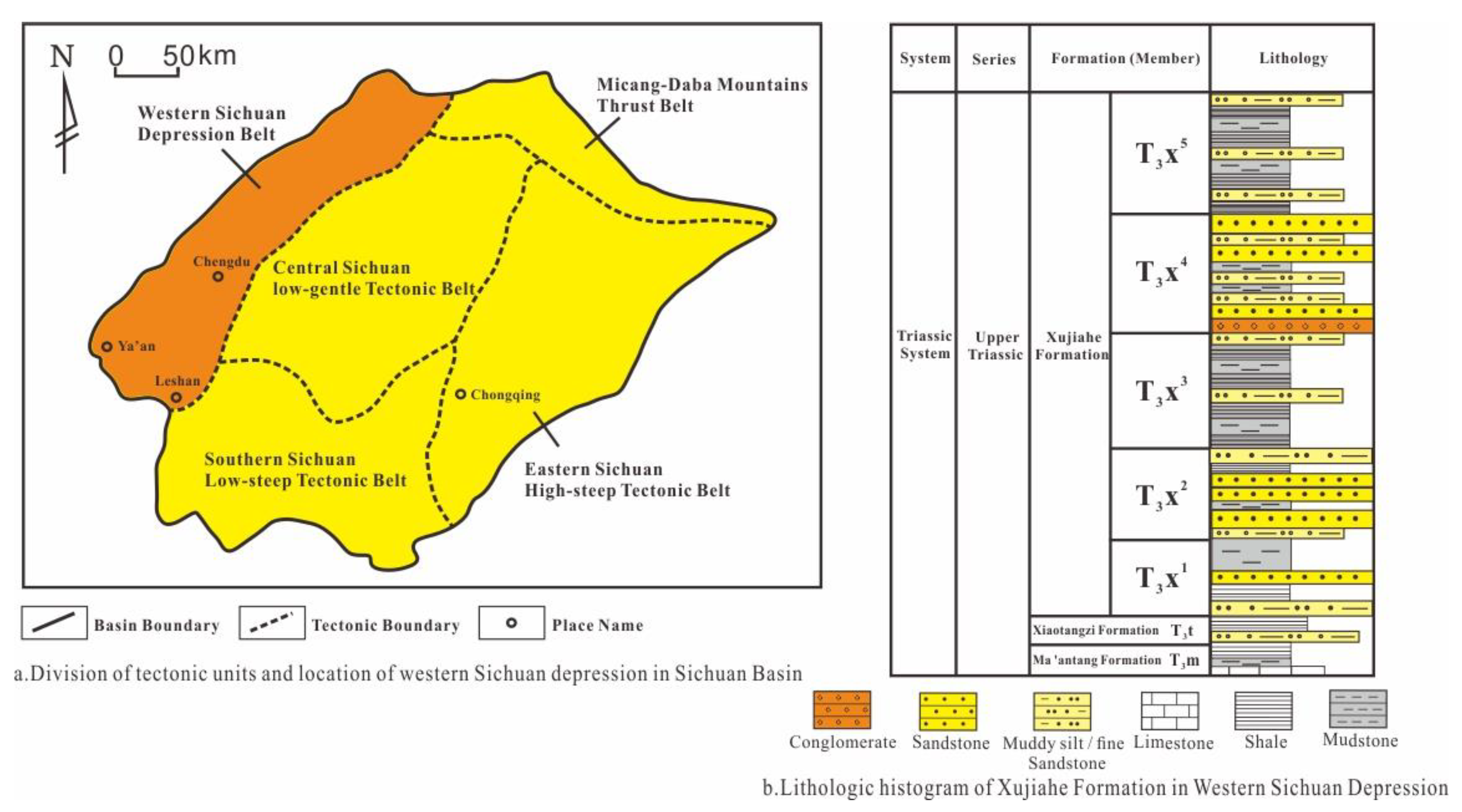
2. Regional Geological Background
3. Risk and Uncertainty Analysis in Tight Gas Exploration and Development
4. Method
4.1. Systematic Literature Review Background
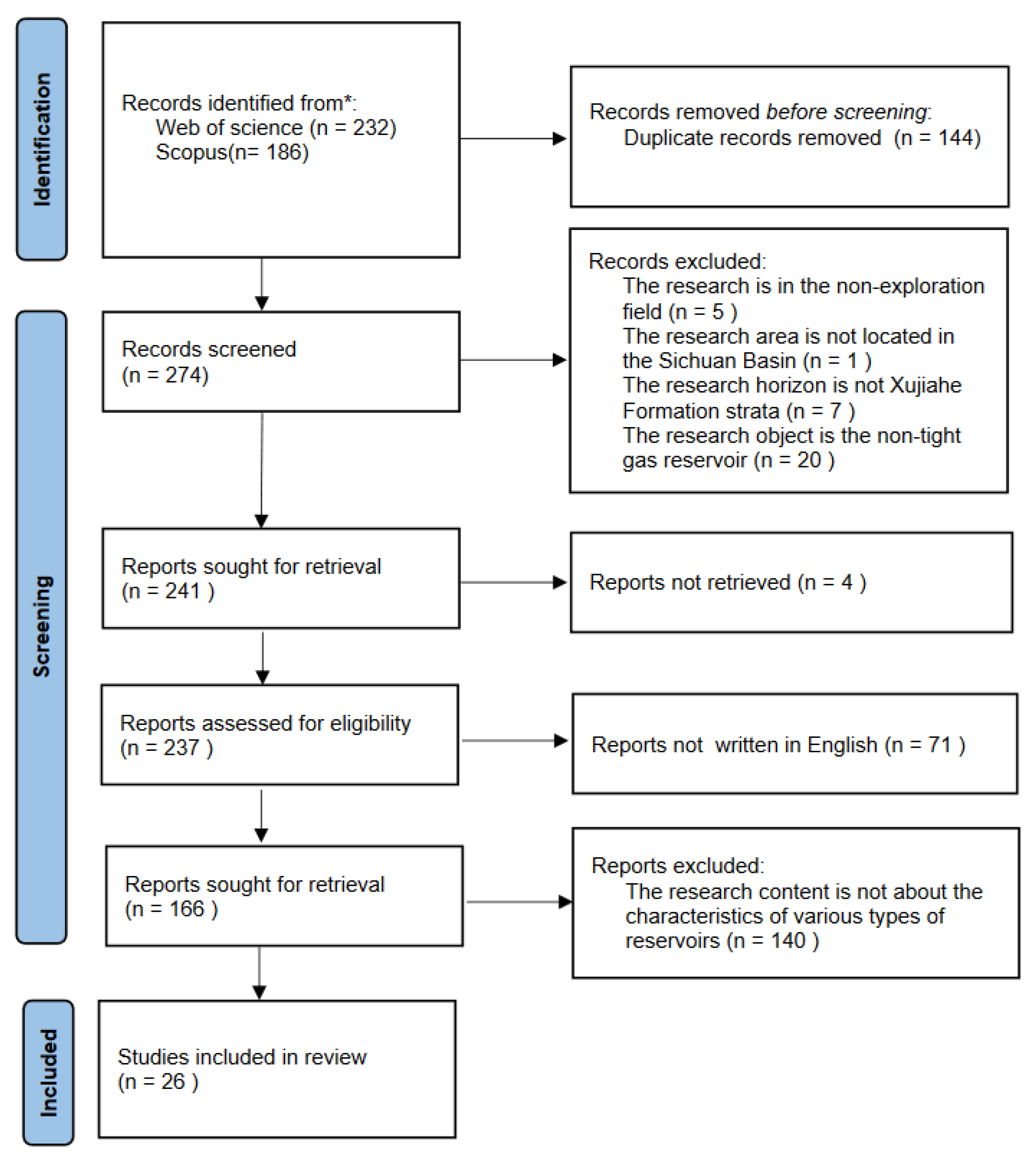
4.2. Data Collection and Processing

| Inclusion Criteria | Exclusion Criteria |
|---|---|
| Research conducted on oil and gas exploration | Research conducted on development or other non-exploration fields |
| Research area located in the western Sichuan Basin/Western Sichuan Depression | Research area not located in the Sichuan Basin |
| Research horizon is Xujiahe Formation strata | Research horizon is not Xujiahe Formation strata |
| Research object is a tight gas reservoir | Research object is a shale gas reservoir or other non-tight gas reservoir |
| Main research content is the lithology and physical properties of reservoirs | Main research content is not the characteristics of various types of reservoirs |
| Research published in a journal | Review papers, conference reports, books, etc. |
| Written in English | Written in languages other than English |
4.3. Risk of Bias and Limitation Analysis
5. Results
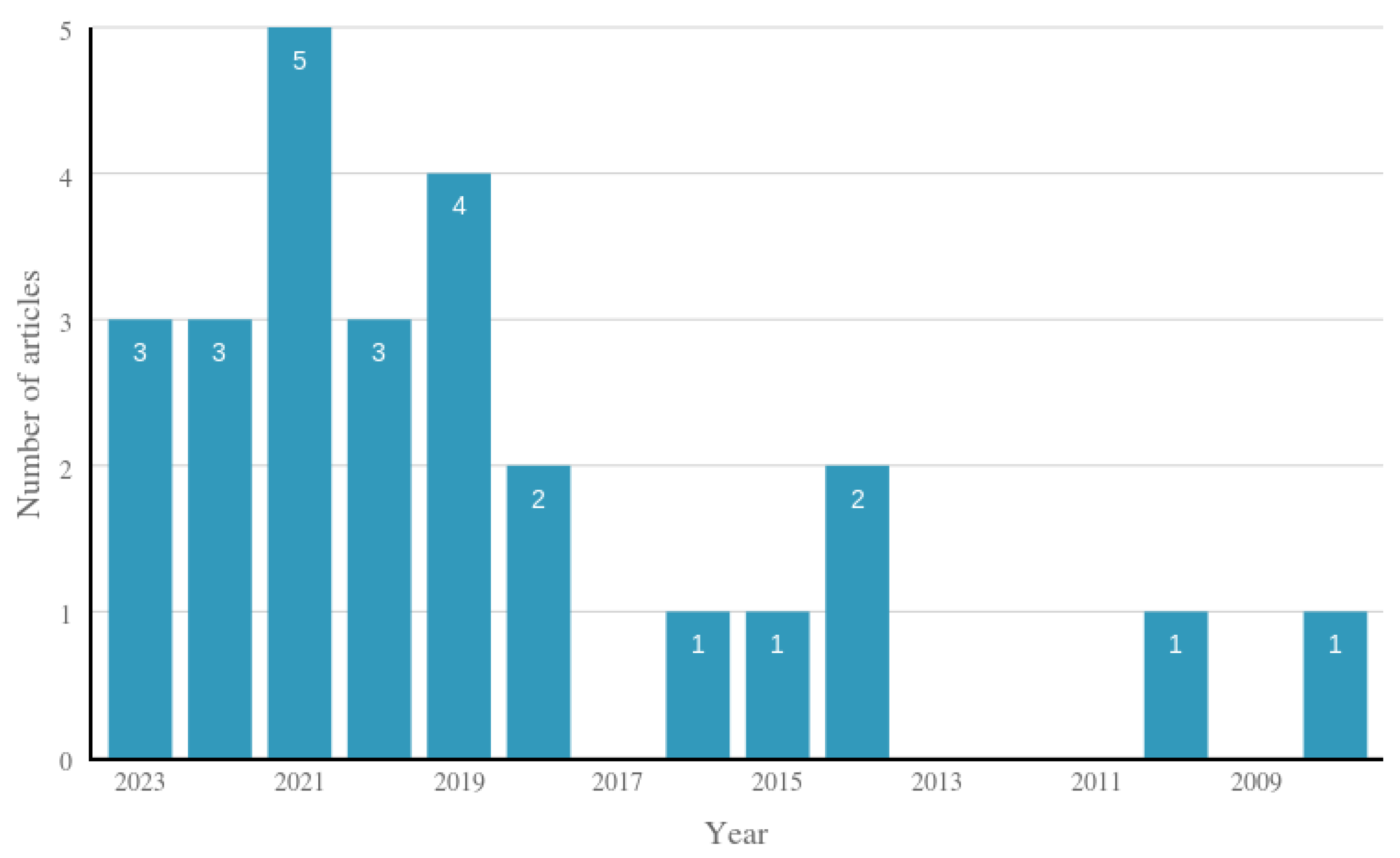
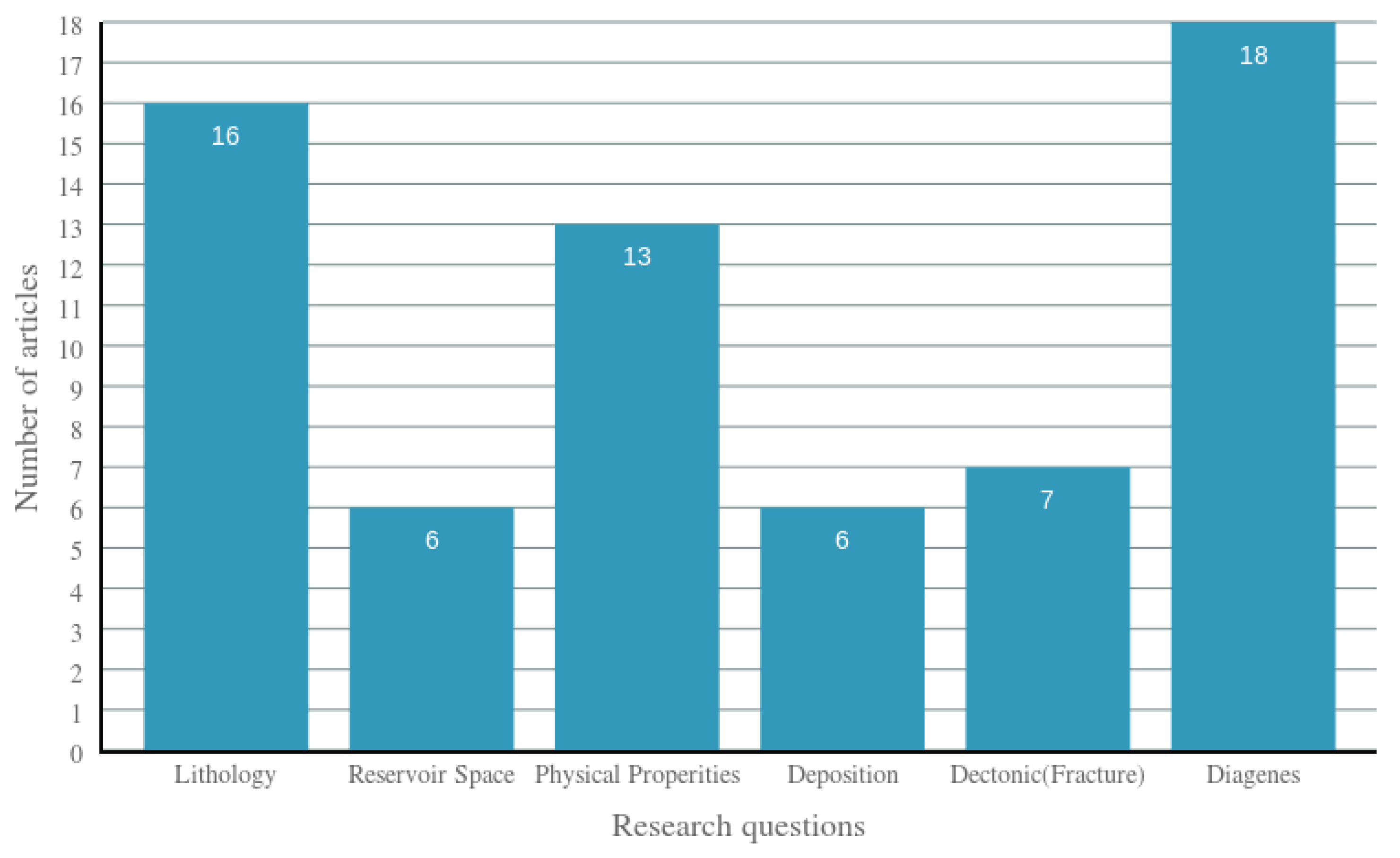
5.1. General Findings from the Literature Selected in this Study
5.2. Petrological Characteristics of Reservoirs
5.2.1. Clastic Rock Components and Interstitial Material Characteristics of Reservoirs
5.2.2. Clastic Rock Structural Characteristics of Reservoirs
5.3. Pores and Physical Characteristics of Reservoirs
5.3.1. Pore Type Characteristics
5.3.2. Pore Structure Characteristics
5.3.3. Physical Characteristics of Reservoirs
5.4. Factors Controlling Reservoir Quality
5.4.1. Sedimentation Is a Necessary Prerequisite for the Formation of Tight Gas Reservoirs
5.4.2. Diagenesis Is the Key Factor Controlling the Quality of Tight Gas Reservoirs
- (1)
- Compaction and pressure solution are the main factors leading to reductions in primary pores in tight gas reservoirs
- (2)
- Cementation has a dual impact on the pore spaces of tight gas reservoirs
- (3)
- Dissolution is the main factor improving the porosity of tight gas reservoirs
5.4.3. Tectonic Action Is an Important Factor in Improving Tight Gas Reservoirs
6. Discussion
6.1. Research on Sedimentary Systems
6.2. Research on Microfractures and Fractures
6.3. Research on Cementation
6.4. Research on the Relationships between Reservoirs and Fluids
6.5. Research on Reservoir Characteristics of Different Tight Gas Fields
6.6. Impact of Tight Gas Reservoir Characteristics Research on Actual Exploration and Development of Tight Gas Reservoirs
7. Conclusions
Author Contributions
Funding
Data Availability Statement
Acknowledgments
Conflicts of Interest
References
- Li, D. Brief introduction to low-permeability oilfield development. Pet. Geol. Oilfield Dev. Daqing 1997, 3, 36–40. [Google Scholar]
- Holditch, S.A. Tight gas sands. J. Pet. Technol. 2006, 58, 86–93. [Google Scholar] [CrossRef] [Scilit]
- Zou, C.; Tao, S.; Yuan, X.; Zhu, R.; Dong, D.; Wei, L.; Lan, W.; Gao, X.; Gong, Y.; Jia, J. Global importance of “continuous” petroleum reservoirs: Accumulation, distribution and evaluation. Pet. Explor. Dev. 2009, 36, 669–682. [Google Scholar]
- Dai, J.; Ni, Y.; Wu, X. Tight gas in China and its significance in exploration and exploitation. Pet. Explor. Dev. 2012, 39, 277–284. [Google Scholar] [CrossRef] [Scilit]
- Li, J.; Guo, B.; Zheng, M.; Yang, T. Main types, geological features and resource potential of tight sandstone gas in China. Nat. Gas Geosci. 2012, 23, 607–615. [Google Scholar]
- Tong, X.; Guo, B.; Li, J.; Huang, F. Comparison study on accumulation & distribution of tight sandstone gas between China and the United States and its significance. Eng. Sci. 2012, 6. [Google Scholar] [CrossRef]
- Li, J.; Wei, G.; Xie, Z.; Liu, R.; Hao, A. Accumulation mechanism and main controlling factors of large tight sandstone gas fields in China: Cases study on Ordos Basin and Sichuan Basin. Acta Pet. Sin. 2013, 34, 14. [Google Scholar]
- Zhang, D. Development prospect of natural gas industry in the Sichuan Basin in the next decade. Nat. Gas Ind. B 2022, 9, 119–131. [Google Scholar] [CrossRef] [Scilit]
- Yang, Y.; Wen, L.; Zhou, G.; Zhan, W.; Li, H.; Song, Z.; Zhang, J.; Tao, J.; Tian, X.; Yuan, J.; et al. New fields, new types and resource potentials of hydrocarbon exploration in Sichuan Basin. Acta Pet. Sin. 2023, 44, 2045. [Google Scholar]
- Surdam, R.C.; Jiao, Z.S.; Martinsen, R.S. The regional pressure regime in Cretaceous sandstones and shales in the Powder River Basin. In Basin Compartments and Seals; American Association of Petroleum Geologists: Tulsa, OK, USA, 1994. [Google Scholar]
- Liu, H.; Liang, H.; Cai, L.; Shen, F. Structural styles of the Longmenshan thrust belt and evolution of the foreland basin in western Sichuan Province, China. Acta Geol. Sin. 1994, 68, 101–118. [Google Scholar]
- Jia, D.; Chen, Z.; Jia, C.; Wei, G.; Li, B.; Zhang, X.; Wei, D.; Shen, Y. Structural features of the Longmen Shan fold and thrust belt and development of the western Sichuan foreland basin, central China. Geol. J. China Univ. 2003, 9, 402. [Google Scholar]
- Li, Z.; Liu, S.; Lin, J.; Tang, C.; Deng, B.; Sun, W. Structural configuration and its genetic mechanism of the West Sichuan Depression in China. J. Chengdu Univ. Technol. 2009, 36, 645–653. [Google Scholar]
- Liu, S.; Yang, Y.; Deng, B.; Zhong, Y.; Wen, L.; Sun, W.; Li, Z.; Jansa, L.; Li, J.; Song, J.; et al. Tectonic evolution of the Sichuan basin, southwest China. Earth-Sci. Rev. 2021, 213, 103470. [Google Scholar] [CrossRef] [Scilit]
- Liu, S.; Ren, X.; Yao, S.; Liu, Z.; Ning, M.; Wang, X.; Huang, X. Relationship between gas reservoir distribution and structural system of Upper Triassic Xujiahe Fm in the Sichuan Basin. Nat. Gas Ind. B 2019, 6, 220–235. [Google Scholar] [CrossRef] [Scilit]
- Zheng, H. New advances in petroleum geology and exploration techniques of clastic reservoirs in the four large-sized basins in central-western China. Oil Gas Geol. 2012, 33, 497–505. [Google Scholar]
- Zhao, M.; Yang, W.; Wang, Y.; Lu, J.; Xu, L.; Li, L.; Li, X.; Yao, L. Distribution and genetic mechanisms of connected pore systems in continental shale reservoirs: A case study of Xujiahe Formation of Upper Triassic, Western Sichuan Depression. Pet. Geol. Exp. 2022, 44, 170–179. [Google Scholar]
- Wu, X.; Zhou, X.; Chen, Y.; Wang, P.; Wang, Y.; Yang, J.; Zeng, H. Molecular characteristics of source rocks in Upper Triassic Xujiahe Formation, Western Sichuan Depression, Sichuan Basin. Pet. Geol. Exp. 2022, 44, 854–865. [Google Scholar]
- Mahjour, S.K.; Faroughi, S.A. Risks and uncertainties in carbon capture, transport, and storage projects: A comprehensive review. Gas Sci. Eng. 2023, 119, 205117. [Google Scholar] [CrossRef] [Scilit]
- Mahjour, S.K.; Santos, A.A.S.; Correia, M.G.; Schiozer, D.J. Scenario reduction methodologies under uncertainties for reservoir development purposes: Distance-based clustering and metaheuristic algorithm. J. Pet. Explor. Prod. Technol. 2021, 11, 3079–3102. [Google Scholar] [CrossRef] [Scilit]
- Chapman, A.L.; Morgan, L.C.; Gartlehner, G. Semi-automating the manual literature search for systematic reviews increases efficiency. Health Inf. Libr. J. 2010, 27, 22–27. [Google Scholar] [CrossRef] [Scilit]
- Haddaway, N.R.; Pullin, A.S. The Policy Role of Systematic Reviews: Past, Present and Future. Springer Sci. Rev. 2014, 2, 179–183. [Google Scholar] [CrossRef] [Scilit]
- Haddaway, N.R.; Woodcock, P.; Macura, B.; Collins, A. Making literature reviews more reliable through application of lessons from systematic reviews. Conserv. Biol. 2015, 29, 1596–1605. [Google Scholar] [CrossRef] [Scilit] [PubMed]
- Sriganesh, K.; Shanthanna, H.; Busse, J.W. A brief overview of systematic reviews and meta-analyses. Indian J. Anaesth. 2016, 60, 689–694. [Google Scholar] [CrossRef] [Scilit]
- Moher, D.; Liberati, A.; Tetzlaff, J.; Altman, D.G.; The PRISMA Group. Preferred Reporting Items for Systematic Reviews and Meta-Analyses: The PRISMA Statement. J. Clin. Epidemiol. 2009, 62, 1006–1012. [Google Scholar] [CrossRef] [Scilit] [PubMed]
- Page, M.J.; McKenzie, J.E.; Bossuyt, P.M.; Boutron, I.; Hoffmann, T.C.; Mulrow, C.D.; Shamseer, L.; Tetzlaff, J.M.; Akl, E.A.; Brennan, S.E.; et al. The PRISMA 2020 statement: An updated guideline for reporting systematic reviews. J. Clin. Epidemiol. 2021, 134, 178–189. [Google Scholar] [CrossRef] [Scilit]
- Ouzzani, M.; Hammady, H.; Fedorowicz, Z.; Elmagarmid, A. Rayyan—A web and mobile app for systematic reviews. Syst. Rev. 2016, 5, 210. [Google Scholar] [CrossRef] [Scilit]
- Liu, J.; Liu, Z.; Liu, Z.; Liu, Y.; Shen, B.; Xiao, K.; Bi, Y.; Wang, X.; Wang, A.; Fan, L.; et al. Geological characteristics and models of fault-fold-fracture body in deep tight sandstone of the second member of Upper Triassic Xujiahe Formation in Xinchang structural belt of Sichuan Basin, SW China. Pet. Explor. Dev. 2023, 50, 603–614. [Google Scholar] [CrossRef] [Scilit]
- Guo, Y.; Sima, L.; Wang, L.; Miao, X.; Li, A.; Su, S. Saturation evaluation of tight sandstone in the Dayi structure, West Sichuan Depression. Front. Earth Sci. 2023, 11, 1223997. [Google Scholar] [CrossRef] [Scilit]
- Duan, Z.; Liu, Y.; Lou, Z.; Liu, Z.; Xu, S.; Wu, Y. Tight gas accumulation caused by overpressure: Insights from three-dimensional seismic data in the western Sichuan Basin, Southwest China. Geoenergy Sci. Eng. 2023, 223, 211589. [Google Scholar] [CrossRef] [Scilit]
- Yu, Y.; Lin, L.; Li, Z.; Rankenburg, K.; Evans, N.J.; McInnes, B.I.A. LA-ICP-MS U–Pb dating of calcite cement in Upper Triassic tight-gas sandstone reservoirs, western Sichuan Basin, SW China. Terra Nova 2022, 34, 359–368. [Google Scholar] [CrossRef] [Scilit]
- Ma, J.; Ma, Z.; Miao, J.; Zheng, L.; Wang, Q.; He, C. Co-evolution simulation experiment of source rock fluid and reservoir rock and its geological implications: A case study of Upper Triassic Xujiahe Formation, Western Sichuan Basin. Pet. Geol. Exp. 2022, 44, 698–704. [Google Scholar]
- Yu, Y.; Lin, L.; Li, Z.; Chen, H. Source of quartz cement in tight gas sandstone: Evidence from the Upper Triassic Xujiahe Formation in the western Sichuan Basin, SW China. J. Pet. Sci. Eng. 2022, 212, 110299. [Google Scholar] [CrossRef] [Scilit]
- Pan, B.; Chen, H.; Lin, L.; Yu, Y.; Wu, D.; Dong, Y. Diagenesis and reservoir quality of the second member of the Upper Triassic Xujiahe Formation tight gas sandstones in the Western Sichuan Depression, southwest China. Geol. J. 2021, 56, 3187–3206. [Google Scholar] [CrossRef] [Scilit]
- Feng, D.; Xiao, K. Constant velocity mercury injection and nuclear magnetic resonance in evaluation of tight sandstone reservoirs in Western Sichuan Basin. Pet. Geol. Exp. 2021, 43, 368–376. [Google Scholar]
- Cheng, W.; Ba, J.; Carcione, J.M.; Pang, M.; Wu, C. Estimation of the Pore Microstructure of Tight-Gas Sandstone Reservoirs with Seismic Data. Front. Earth Sci. 2021, 9, 646372. [Google Scholar] [CrossRef] [Scilit]
- Ren, J.; Lv, Z.; Wang, H.; Wu, J.; Zhang, S. The Origin of Quartz Cement in the Upper Triassic Second Member of the Xujiahe Formation Sandstones, Western Sichuan Basin, China. Water 2021, 13, 1890. [Google Scholar] [CrossRef] [Scilit]
- Yang, P.; Zhang, L.; Liu, K.; Cao, B.; Gao, J.; Qiu, G. Diagenetic history and reservoir evolution of tight sandstones in the second member of the Upper Triassic Xujiahe Formation, Western Sichuan Basin, China. J. Pet. Sci. Eng. 2021, 201, 108451. [Google Scholar] [CrossRef] [Scilit]
- Huang, Y.; Liu, Z.; Li, P.; Liu, J.; Liao, C.; Xu, S. Analysis of lithofacies and evaluation of effective reservoirs of member 2 of Xujiahe Formation in the Xinchang area in Western Sichuan. Pet. Res. 2020, 5, 244–253. [Google Scholar] [CrossRef] [Scilit]
- Wang, Q.; Chen, D.; Gao, X.; Wang, F.; Li, J.; Liao, W.; Wang, Z.; Xie, G. Microscopic pore structures of tight sandstone reservoirs and their diagenetic controls: A case study of the Upper Triassic Xujiahe Formation of the Western Sichuan Depression, China. Mar. Pet. Geol. 2020, 113, 104119. [Google Scholar] [CrossRef] [Scilit]
- Wu, F.; Wen, Z.; Yao, C.; Wang, X.; Xi, Y.; Cong, L. Numerical Simulation of the Influence of Pore Structure on Resistivity, Formation Factor and Cementation Index in Tight Sandstone. Acta Geol. Sin. Engl. Ed. 2020, 94, 290–304. [Google Scholar] [CrossRef] [Scilit]
- Zhong, Y.-J.; Huang, K.-K.; Ye, L.-M.; Lan, Y.-F.; Liu, L. Diagenesis of tight sandstone reservoirs of Xujiahe Formation (Upper Triassic), the Xinchang Gas Field, western Sichuan Basin, China. Geol. J. 2020, 55, 4604–4624. [Google Scholar] [CrossRef] [Scilit]
- Yu, Y.; Lin, L.; Zhai, C.; Chen, H.; Wang, Y.; Li, Y.; Deng, X. Impacts of lithologic characteristics and diagenesis on reservoir quality of the 4th member of the Upper Triassic Xujiahe Formation tight gas sandstones in the western Sichuan Basin, Southwest China. Mar. Pet. Geol. 2019, 107, 1–19. [Google Scholar] [CrossRef] [Scilit]
- Li, M.; Zhu, R.; Lou, Z.; Yin, W.; Hu, Z.; Zhu, H.; Jin, A. Diagenesis and its impact on the reservoir quality of the fourth member of Xujiahe Formation, Western Sichuan Depression, China. Mar. Pet. Geol. 2019, 103, 485–498. [Google Scholar] [CrossRef] [Scilit]
- Li, M.; Lou, Z.; Gong, Y.; Jin, A.; Zhu, R. Diagenesis factor that effect the reservoir properties and gas accumulation in the 4th member of Xujiahe formation, Western Sichuan Basin, China. Pet. Sci. Technol. 2019, 37, 551–558. [Google Scholar] [CrossRef] [Scilit]
- Yue, D.; Wu, S.; Xu, Z.; Xiong, L.; Chen, D.; Ji, Y.; Zhou, Y. Reservoir quality, natural fractures, and gas productivity of upper Triassic Xujiahe tight gas sandstones in Western Sichuan Basin, China. Mar. Pet. Geol. 2018, 89, 370–386. [Google Scholar] [CrossRef] [Scilit]
- Liu, S.; Chen, A.; Shen, Z.; Lv, Z.; Zhang, X. Fluid-rock interaction and dissolution of feldspar in the Upper Triassic Xujiahe tight sandstone, western Sichuan Basin, China. Open Geosci. 2018, 10, 234–249. [Google Scholar] [CrossRef] [Scilit]
- Gong, L.; Zeng, L.; Gao, Z.; Zhu, R.; Zhang, B. Reservoir characterization and origin of tight gas sandstones in the Upper Triassic Xujiahe formation, Western Sichuan Basin, China. J. Pet. Explor. Prod. Technol. 2016, 6, 319–329. [Google Scholar] [CrossRef] [Scilit]
- Song, H.; Ji, Y.; Zhou, Y.; Chen, X.; Zhao, C.; Dong, R.; Yang, Y. Reservoir Characteristics and Control Factors of the 4th Member of Xujiahe Formation in The Middle Part of Western Sichuan Depression. Acta Geol. Sin. 2015, 89, 77–78. [Google Scholar] [CrossRef] [Scilit]
- Chen, D.; Pang, X.; Xiong, L.; Wang, L.; Xie, M. Porosity evolution in tight gas sands of the Upper Triassic Xujiahe Formation, western Sichuan basin, China. Rev. Mex. Cienc. Geol. 2014, 31, 361–375. [Google Scholar]
- Liu, S.; Huang, S.; Shen, Z.; Lu, Z.; Song, R. Diagenetic fluid evolution and water-rock interaction model of carbonate cements in sandstone: An example from the reservoir sandstone of the Fourth Member of the Xujiahe Formation of the Xiaoquan-Fenggu area, Sichuan Province, China. Sci. China-Earth Sci. 2014, 57, 1077–1092. [Google Scholar] [CrossRef] [Scilit]
- Zeng, L. Microfracturing in the Upper Triassic Sichuan Basin tight-gas sandstones: Tectonic, overpressure, and diagenetic origins. AAPG Bull. 2010, 94, 1811–1825. [Google Scholar] [CrossRef] [Scilit]
- Xu, Z.; Zhang, X.; Wu, S.; Zhao, Y. Genesis of the low-permeability reservoir bed of upper Triassic Xujiahe Formation in Xinchang gas field, Western Sichuan Depression. Pet. Sci. 2008, 5, 230–237. [Google Scholar] [CrossRef] [Scilit]
- Folk, R.L. Petrology of Sedimentary Rocks; Hemphill’s The University of Texas: Austin, TX, USA, 1968. [Google Scholar]
- Jianfeng, S.; Chunsong, S.; Xin, W. Genesis Types and Diagenesis Compaction Mechanisms of Sandstone Rreservoirs in Dynamic Environments in Oil/Gas Basins in China. Pet. Sci. 2006, 3, 23–31. [Google Scholar]
- Rong, L.; Di, Z.; Zhu, L. Densification of Upper Triassic Xujiahe tight sandstones, Western Sichuan, China. Pet. Geol. Exp. 2011, 33, 274–281. [Google Scholar]
- Zhu, H.; Liu, L.; Huang, Z.; Fan, X.; Zhang, J. Reservoir engineering geological characteristics and stimulation in Xujiahe Formation, Xinchang gas field, Western Sichuan Depression, Sichuan Basin. Oil Gas Geol. 2021, 42, 1002–1010. [Google Scholar]
- He, F.; Liang, C.; Lu, C.; Yuan, C.; Li, X. Identification and description of fault-fracture bodies in tight and low permeability reservoirs in transitional zone at the south margin of Ordos Basin. Oil Gas Geol. 2020, 41, 710–718. [Google Scholar]
- Zhu, X.; Pan, R.; Zhu, S.; Wei, W.; Lei, Y.E. Research progress and core issues in tight reservoir exploration. Earth Sci. Front. 2018, 25, 141. [Google Scholar]
- Mustafa, A.; Mahmoud, M.A.; Abdulraheem, A. A review of pore structure characterization of unconventional tight reservoirs. In Proceedings of the Abu Dhabi International Petroleum Exhibition and Conference, Abu Dhabi, United Arab Emirates, 11–13 November 2019; p. D031S098R001. [Google Scholar]
- Lai, J.; Wang, G.; Wang, Z.; Chen, J.; Pang, X.; Wang, S.; Zhou, Z.; He, Z.; Qin, Z.; Fan, X. A review on pore structure characterization in tight sandstones. Earth-Sci. Rev. 2018, 177, 436–457. [Google Scholar] [CrossRef] [Scilit]
- Shi, Z.; Zhu, X.; Zhang, Y.; Jin, H. Advances and trending topics in sedimentary reservoir research of the Upper Triassic Xujiahe Formation, Sichuan Basin. Oil Gas Geol. 2021, 42, 784–800. [Google Scholar]
- Ding, W.; Wang, X.; Hu, Q.; Shuai, Y.; Cao, X.; Liu, J. Progress in tight sandstone reservoir fractures research. Adv. Earth Sci. 2015, 30, 737. [Google Scholar]
- Zhang, T.; Li, Y.; Li, Y.; Sun, S.; Gao, X. A self-adaptive deep learning algorithm for accelerating multi-component flash calculation. Comput. Methods Appl. Mech. Eng. 2020, 369, 113207. [Google Scholar] [CrossRef] [Scilit]
- Zhang, T.; Zhang, Y.; Katterbauer, K.; Al Shehri, A.; Sun, S.; Hoteit, I. Deep learning–assisted phase equilibrium analysis for producing natural hydrogen. Int. J. Hydrogen Energy 2024, 50, 473–486. [Google Scholar] [CrossRef] [Scilit]
- Li, G.; Chen, Y.; Jia, H.; Zhao, Y.; Xie, R.; Liu, S.; Li, L. Occurrence and distribution characteristics of fluids in tight sandstone reservoirs in the Shilijiahan zone, Northern Ordos Basin. Nat. Gas Ind. B 2017, 4, 174–181. [Google Scholar] [CrossRef] [Scilit]
- Xu, J.; Yu, C.; Qi, D.; Yang, R.; Yu, H.; Zhang, W.; Wang, T. Characteristics and Controlling Factors of Tight Gas Sandstones from the Upper Shanxi and Lower Shihezi Formations in the Northern Sulige Area, Ordos Basin, China. Energy Fuels 2023, 37, 15712–15729. [Google Scholar] [CrossRef] [Scilit]
- Hao, S.; Li, L.; Zhang, W.; Qi, R.; Chen, J. Forming conditions of large-scale gas fields in Permo-Carboniferous in the northern Ordos Basin. Oil Gas Geol. 2016, 37, 149–154. [Google Scholar]
- Li, W.; Zhang, Z.; Zhang, H.; Zhao, S.; Yan, H.; Liu, X. Hydrocarbon source and accumulation in Upper Triassic to Lower Jurassic in the Tongnanba area, Northeastern Sichuan Basin. Arab. J. Geosci. 2015, 8, 2515–2525. [Google Scholar] [CrossRef] [Scilit]
- Cao, H.; Wang, W.; Liu, M. Characteristics of fractures in Xujiahe Formation of Tongnanba structural belt, Northeastern Sichuan Basin. Xinjiang Pet. Geol. 2018, 4, 424–429. [Google Scholar]
- Zou, C.; Yang, Z.; He, D.; Wei, Y.; Li, J.; Jia, A.; Chen, J.; Zhao, Q.; Li, Y.; Li, J.; et al. Theory, technology and prospects of conventional and unconventional natural gas. Pet. Explor. Dev. 2018, 45, 604–618. [Google Scholar] [CrossRef] [Scilit]
- Liu, J.; Hu, Z.; Liu, Z.; Jin, Q.; Xiao, K.; Bi, Y.; Li, J. Gas pool sweet spot models and their forming mechanism in the xu 2 member in Xinchang area, Western Sichuan Depression, Sichuan Basin. Oil Gas Geol. 2021, 42, 852–862. [Google Scholar]
- Zheng, R.; Ye, T.; Zhai, W.; Dai, C.; Gao, H. Prediction of sandbody distribution in the upper triassic Xujiahe Formation, the West Sichuan depression. Oil Gas Geol. 2008, 29, 405–411. [Google Scholar]


| Risk and Uncertainty Evaluation Indicator | Factors to Consider | |
|---|---|---|
| Technical | Geological resources | Basic geological conditions, such as sedimentation and the structure of the Western Sichuan Depression |
| The development characteristics of the tight gas accumulation elements of the Xujiahe Formation in the Western Sichuan Depression | ||
| Configuration relationships between various tight gas accumulation factors of the Xujiahe Formation in the Western Sichuan Depression | ||
| Technology and equipment | Fine reservoir and fault characterization technology | |
| The selection of tight gas enrichment zones and the locations of deployed wells in the study area | ||
| Single well production and recovery rate improvement technology | ||
| Equipment update, optimization technology, and equipment supply, demand, and deployment issues | ||
| Non-technical | Market and policy aspects | The guarantee of capital investment and increase in market demand |
| Improvements in government supervision and relevant laws and regulations | ||
| Policies and special funds related to the oil and gas resources industry | ||
| Business management | The adjustment and innovation of management models | |
| Database | Search Chain |
|---|---|
| Web of Science (WoS) | TS = ((“Western Sichuan Basin” OR “West Sichuan Basin” OR “Western Sichuan Depression” OR “West Sichuan Depression”) AND (“Xujiahe Formation” OR “Xujiahe Group”) AND (“tight sandstone reservoir” OR “tight reservoir” OR “reservoir”)) |
| Scopus | TITLE-ABS-KEY ((“Western Sichuan Basin” OR “West Sichuan Basin” OR “Western Sichuan Depression” OR “West Sichuan Depression”) AND (“Xujiahe Formation” OR “Xujiahe Group”) AND (“tight sandstone reservoir” OR “tight reservoir” OR “reservoir”)) |
| ID [Reference] Author (Year) | Characteristics of Tight Gas Reservoirs | |||||
|---|---|---|---|---|---|---|
| Lithology | Reservoir Space | Physical Properties | Deposition | Tectonic (Fracture) | Diagenesis | |
| ID1 [28] LIU Junlong et al. (2023) | √ | |||||
| ID2 [29] Yuhao Guo et al. (2023) | √ | |||||
| ID3 [30] Zhengxin Duan et al. (2023) | √ | |||||
| ID4 [31] Yu Yu et al. (2022) | √ | |||||
| ID5 [32] MA Jianfei et al. (2022) | √ | √ | √ | |||
| ID6 [33] Yu Yu et al. (2022) | √ | √ | √ | |||
| ID7 [34] Bo Pan et al. (2021) | √ | √ | √ | |||
| ID8 [35] FENG Dongjun et al. (2021) | √ | |||||
| ID9 [36] Wei Cheng et al. (2021) | √ | |||||
| ID10 [37] Jie Ren et al. (2021) | √ | √ | ||||
| ID11 [38] Peng Yang et al. (2021) | √ | √ | √ | √ | ||
| ID12 [39] Yangqing Huang et al. (2020) | √ | √ | ||||
| ID13 [40] Qiaochu Wang et al. (2020) | √ | √ | √ | √ | ||
| ID14 [41] Wu Feng et al. (2020) | √ | √ | ||||
| ID15 [42] Yijiang Zhong et al. (2020) | √ | √ | ||||
| ID16 [43] Yu Yu et al. (2019) | √ | √ | √ | |||
| ID17 [44] Mengyao Li et al. (2019) | √ | √ | √ | |||
| ID18 [45] Mengyao Li et al. (2019) | √ | √ | √ | |||
| ID19 [46] Dali Yue et al. (2018) | √ | √ | √ | √ | ||
| ID20 [47] Sibing Liu et al. (2018) | √ | |||||
| ID21 [48] Lei Gong et al. (2016) | √ | √ | √ | √ | √ | √ |
| ID22 [49] Hongyu Song et al. (2015) | √ | √ | √ | √ | √ | |
| ID23 [50] Dongxia Chen et al. (2014) | √ | √ | √ | |||
| ID24 [51] Sibing Liu et al. (2014) | √ | √ | √ | |||
| ID25 [52] Lianbo Zeng et al. (2010) | √ | |||||
| ID26 [53] Zhangyou Xu et al. (2008) | √ | √ | √ | |||
| Main Journals in which the Selected Literature Was Published | CiteScore | Web of Science Sciences Division Level |
|---|---|---|
| SCIENCE CHINA-EARTH SCIENCES | 9.9 | Q1 |
| MARINE AND PETROLEUM GEOLOGY | 9.3 | Q1 |
| JOURNAL OF PETROLUEM SCIENCE AND ENGINEERING (Continue as: GEOENERGY SCIENCE AND ENGINEERING) | 8.8 | Q3 |
| PETROLEUM EXPLORATION AND DEVELOPMENT | 8.1 | Q1 |
| PETROLEUM SCIENCE | 7.7 | Q1 |
| AAPG BULLETIN | 7.5 | Q2 |
| TERRA NOVA | 5.6 | Q3 |
| WATER | 5.5 | Q2 |
| JOURNAL OF PETROLUEM EXPLORATION AND PRODUCTION TECHNOLOGY | 5 | Q1 |
| GEOLOGICAL JOURNAL | 4.2 | Q3 |
| PETROLEUM SCIENCE AND TECHNOLOGY | 3.3 | Q2 |
| FRONTIERS IN EARTH SCIENCE | 3.2 | Q2 |
| OPEN GEOSCIENCES | 2.8 | Q3 |
| ACTA GEOLOGICA SINICA-ENGLISH EDITION | 2.4 | Q2 |
| ID [Reference] Author (Year) | Section | Number of Thin Sections | Average Contents of Detrital Components | ||
|---|---|---|---|---|---|
| Detrital Quartz | Detrital Feldspar | Rock Fragment | |||
| ID7 [34] Bo Pan et al. (2021) | T3x2 | 218 | 65.90% | 7.00% | 27.10% |
| ID11 [38] Peng Yang et al. (2021) | T3x2 | 243 | 67.50% | 7.20% | 25.30% |
| ID15 [42] Yijiang Zhong et al. (2020) | T3x2 | 105 | 65.00% | 16.00% | 19.00% |
| T3x4 | 53% | 0% | 47% | ||
| ID16 [43] Yu Yu et al. (2019) | T3x4 | 302 | 56.68% | 3.40% | 39.92% |
| ID17 [44] Mengyao Li et al. (2019) | T3x4 | 216 | 65.1% | 1.80% | 18.00% |
| ID18 [45] Mengyao Li et al. (2019) | T3x4 | 35 | 56.30% | 1.50% | 42.20% |
| ID19 [46] Dali Yue et al. (2018) | T3x2 | 158 | 69% | 8.20% | 22.80% |
| T3x4 | 86 | ||||
| ID24 [51] Sibing Liu et al. (2014) | T3x4 | — | 58.55% | 2.06% | 39.39% |
| Reservoir Space Type | Development Characteristics | ||
|---|---|---|---|
| Pores | Primary pores | Residual intergranular pore | Spaces where primary intergranular pores are filled with interstitial materials during the diagenetic process, which are mostly in the shape of triangles, long strips, etc. |
| Secondary pores | Intergranular dissolution pores | Unstable components between quartz grains formed by dissolution, mostly caused by the dissolution of feldspar or lithic debris | |
| Intragranular dissolution pores | Mainly formed by the dissolution of feldspar particles along the cleavage direction | ||
| Mold pores | Particles are completely dissolved under selective dissolution, and the size and shape of pores are consistent with the particles | ||
| Intercrystalline pores | Developed between kaolinite, illite, chlorite, and other authigenic clay minerals, with irregular shapes | ||
| Microfractures | Intragranular microfractures | Mainly develop inside quartz and feldspar particles, do not penetrate the edges of particles, and have small pore sizes | |
| Intragranular microfractures | Mainly distributed along straight lines at the boundaries between mineral particles and are narrow and short | ||
| Transgranular microfractures | Generally cut through multiple mineral particles and are longer and wider | ||
| ID [Reference] Author (Year) | Section | Lithofacies Assemblage or Microfacies | Porosity (%) | Permeability (×10−3 μm2) | ||||
|---|---|---|---|---|---|---|---|---|
| Avg. | Max. | Min. | Avg. | Max. | Min. | |||
| ID1 [28] LIU Junlong et al. (2023) | T3x2 | Medium–coarse sandstone with trough/parallel bedding | 4.85 | 5.6 | 4.5 | 19.95 | 33.2 | 0.01 |
| Medium sandstone with massive bedding and diagonal bedding | 4.35 | 4 | 4.9 | 0.3 | 4.5 | 0.001 | ||
| ID7 [34] Bo Pan et al. (2021) | T3x2 | — | 3.34 | 9.34 | 0.43 | 0.17 | 2.816 | 0.001 |
| ID11 [38] Peng Yang et al. (2021) | T3x2 | — | 3.82 | 9.38 | 0.44 | 0.05 | 2034.7 | 0.01 |
| ID12 [39] Yangqing Huang et al. (2020) | T3x2 | Medium–coarse sandstone with crossbedding | 4.01 | — | — | 0.0915 | — | — |
| Medium–coarse sandstone with crossbedding | 4.32 | — | — | 0.0996 | — | — | ||
| Medium–coarse sandstone with crossbedding | 3.73 | — | — | 0.936 | — | — | ||
| ID13 [40] Qiaochu Wang et al. (2020) | T3x2 | — | 3.26 | 7.79 | 0.67 | 0.178 | 12.22 | 0.002 |
| T3x4 | — | 5.92 | 12.71 | 0.47 | 0.078 | 0.86 | 0.001 | |
| ID15 [42] Mengyao Li et al. (2019) | T3x4 | — | 5.9 | 12.1 | 1 | 1.41 | 287.82 | 0.001 |
| ID19 [46] Dali Yue et al. (2018) | T3x2 | Subaqueous distributary channel | 3.94 | 10.4 | 1.2 | 0.064 | 0.48 | 0.005 |
| Mouth bar | 2.92 | 9.2 | 1.25 | 0.049 | 0.42 | 0.004 | ||
| Distal bar | 1.56 | 2.58 | 1.18 | 0.021 | 0.182 | 0.002 | ||
| Sheet sand | 1.73 | 3.2 | 1.2 | 0.028 | 0.115 | 0.005 | ||
| Interdistributary bay | 1.46 | 1.92 | 1.1 | 0.013 | 0.163 | 0.002 | ||
| T3x4 | Subaqueous distributary channel | 6.47 | 12.14 | 2.26 | 0.09 | 0.75 | 0.007 | |
| Mouth bar | 6.2 | 11.5 | 2.17 | 0.081 | 0.68 | 0.008 | ||
| Distal bar | 2.75 | 6.59 | 2.07 | 0.026 | 0.106 | 0.004 | ||
| Sheet sand | 2.93 | 6.62 | 2.05 | 0.028 | 0.115 | 0.005 | ||
| Interdistributary bay | 2.72 | 5.99 | 2.05 | 0.013 | 0.214 | 0.004 | ||
| ID21 [48] Lei Gong et al. (2016) | T3x2 | — | 3.59 | 6 | 2 | 0.064 | 0.1 | 0.01 |
| T3x4 | — | 2.73 | 5 | 1 | 0.038 | 0.1 | 0.005 | |
| Diagenesis | Main Characteristics | Impact on Reservoirs | |
|---|---|---|---|
| Compaction and pressure solution | Mechanical compaction | Ductile minerals deform, brittle minerals fracture along weaker surfaces, and skeleton particles are severely compacted, manifesting as bumpy and sutured contacts | Occurs in the early stage of diagenesis and is the main reason for reductions in reservoir porosity, as well as weakening the connectivity of pore structures and increasing the compactness of reservoirs |
| Chemical pressure solution | Quartz particles dissolve at contact points or interfaces and the dissolved silica precipitates again | ||
| Cementation | Carbonate cementation | There are three types of carbonate cements: calcite, dolomite and trace siderite, which widely occupy pore space in the form of pore filling or the selective replacement of framework particles | Carbonate cement in early stages consolidates rock skeletons and increases the rock’s resistance to compaction; in later stages, it blocks throats, resulting in reductions in reservoir porosity |
| Silica cementation | Mainly manifested by the secondary enlargement of authigenic quartz and the filling of pores and fracture spaces, and dust rings can also be seen between clastic particles | Generally reduces pore throat radius and reservoir porosity | |
| Mud cementation | Mainly cemented with chlorite and illite: chlorite mostly appears in the form of particle coating and pore lining, while illite often fills the inside of pores or wraps around the surfaces of particles | Mainly reduces reservoir porosity, but chlorite cementation also plays a certain positive role in the preservation of pores | |
| Dissolution | Feldspar, rock debris, and other particles are dissolved, creating more storage space | Dissolution pores in early diagenetic processes are affected by compaction or cementation and are difficult to preserve; dissolution in late diagenetic processes greatly increase reservoir porosity | |
Disclaimer/Publisher’s Note: The statements, opinions and data contained in all publications are solely those of the individual author(s) and contributor(s) and not of MDPI and/or the editor(s). MDPI and/or the editor(s) disclaim responsibility for any injury to people or property resulting from any ideas, methods, instructions or products referred to in the content. |
© 2024 by the authors. Licensee MDPI, Basel, Switzerland. This article is an open access article distributed under the terms and conditions of the Creative Commons Attribution (CC BY) license (https://creativecommons.org/licenses/by/4.0/).
Share and Cite
Wei, J.; Zhang, J.; Yong, Z. Characteristics of Tight Gas Reservoirs in the Xujiahe Formation in the Western Sichuan Depression: A Systematic Review. Energies 2024, 17, 587. https://doi.org/10.3390/en17030587
Wei J, Zhang J, Yong Z. Characteristics of Tight Gas Reservoirs in the Xujiahe Formation in the Western Sichuan Depression: A Systematic Review. Energies. 2024; 17(3):587. https://doi.org/10.3390/en17030587
Chicago/Turabian StyleWei, Jiongfan, Jingong Zhang, and Zishu Yong. 2024. "Characteristics of Tight Gas Reservoirs in the Xujiahe Formation in the Western Sichuan Depression: A Systematic Review" Energies 17, no. 3: 587. https://doi.org/10.3390/en17030587
APA StyleWei, J., Zhang, J., & Yong, Z. (2024). Characteristics of Tight Gas Reservoirs in the Xujiahe Formation in the Western Sichuan Depression: A Systematic Review. Energies, 17(3), 587. https://doi.org/10.3390/en17030587