Systematic Review

Advanced Technologies, Optimization Methodologies and Strategies for Distributed Energy Systems: A State-of-the-Art Systematic Review

by
Ramia Ouederni
1,
Mukovhe Ratshitanga
1,
Innocent Ewean Davidson
2,*,
Keorapetse Kgaswane
3 and
Prathaban Moodley
3
1
Department of Electrical, Electronic and Computer Engineering, Cape Peninsula University of Technology, Bellville, Cape Town 7535, South Africa
2
Africa Space Innovation Centre, Faculty of Engineering and the Built Environment, Cape Peninsula University of Technology, Bellville, Cape Town 7535, South Africa
3
South African National Energy Development Institute, Strathavon, Sandton 2146, South Africa
*
Author to whom correspondence should be addressed.
Energies 2026, 19(8), 1826; https://doi.org/10.3390/en19081826
Submission received: 11 February 2026 / Revised: 8 March 2026 / Accepted: 26 March 2026 / Published: 8 April 2026
(This article belongs to the Section F1: Electrical Power System)

Abstract

Hybrid renewable energy systems (HRES) combining photovoltaic, wind, fuel cell, and energy storage technologies are becoming established as viable options for reliable, environmentally friendly distributed electricity generation. In this review, we examine the key architectures, monitoring and forecast approaches, and control systems that improve the efficiency of HRES and facilitate the just-energy transition to low-carbon power generation systems. The main optimization and decision-aware approaches, particularly the evolutionary generation algorithms and machine learning-based prediction models, are addressed with a focus on improving energy allocation, cost minimization, and increased use of clean renewable energy sources. Technical, economic, and environmental performance indicators, such as the levelized cost of energy (LCOE), net present cost (NPC), renewable fraction (RF), and CO2 emissions reduction, have been compared to demonstrate the feasibility of various system scenarios. This paper evaluates and summarizes recent case studies from around the world and presents the best practices and the challenges they encounter, including resource availability, governance, and economic drivers. The balance of the paper demonstrates that smart forecasting with advanced energy management approaches is crucial for developing sustainable and resilient hybrid distributed power systems for the future.

1. Background

In recent years, the worldwide shift from centralized, low-carbon, fossil fuel-based power generation towards smart, decentralized energy supply systems has accelerated due to the reinforcement of environmental and climate policies as well as the global digitalization of the energy supply infrastructure [1,2,3]. Decentralized energy resources (DERs), namely: photovoltaics (PV), wind turbines, mini- and micro- hydroelectric power, biomass and emerging ocean technologies, are driving this change by enabling local electricity generation, reducing transmission costs, and enhancing power system resilience [4,5,6]. This development is transforming the conception and operation of modern power systems and accelerating the penetration of renewable energy.
There have been significant technological advances that have improved the performance and affordability of decentralized power systems. Solar technology continues to improve thanks to innovation in cell structures, advanced performance electronics, and intelligent converters that are optimized for two-way power transmission [7,8]. Furthermore, wind energy inverters benefit from larger turbines, improved variable speed drives, and control schemes that maximize the capture of energy in complex conditions [9]. Microgeneration based on marine energy and bioenergy is being explored a lot more for niche applications such as isolated microgrids [10,11]. These developments are supporting the move towards distributed, low-carbon electricity, despite bringing operational variables and coordination issues.
Energy storage systems (ESS) are becoming increasingly important for managing the fluctuations in power supply, ensuring power supply reliability, and maintaining a balance between frequency and voltage [12,13,14]. Lithium-ion batteries remain the predominant choice due to their high forward and backward performance, as well as declining capital costs [15]. Long-duration, high-power storage alternatives, particularly sodium-sulfur and flow batteries, supercapacitors, flywheels, and hydrogen storage, are gaining importance in grid backup roles [16,17]. Hybrid ESS designs are emerging that exploit the complementary features of various technologies, thereby improving lifecycle performances and enhancing system availability [18].
The optimum optimization of DER and ESS requires highly advanced monitoring systems that can handle both real-time uncertainties and multi-objective decisions. Predictive model control, distribution optimization, and methodologies such as particle swarm optimization and genetic algorithms play an important role in enhancing power plant efficiency, operating costs, and renewable energy utilization [19,20,21]. Virtual power plants (VPPs) enhance the involvement of DERs in the energy supply chain by combining diverse energy assets into a single digital unit [22,23,24].
Despite current advances, there are still challenges to be addressed. These include the distributed and intermittent stochastic nature of renewable energy generation; the degrading lifecycle of energy storage facilities; cybersecurity issues; and the policy obstacles that limit market penetration [25,26]. Artificial intelligence (AI) technology and high-reliability predictive modelling are being increasingly embraced to both support uncertainty-aware power management and improve real-time system control [27,28]. Future advances are dependent on robust DER-ESS optimization settings, resilient microgrid architectures, and enabling regulatory strategies for equitable access and sustainability of deployment.
In this article, a detailed analysis of distributed energy systems is presented that addresses key aspects, including decentralized production technologies, power management approaches, data and forecasting methods, and technical and economic evaluations. By summarizing the latest advances and identifying key global trends, this review demonstrates the practical value and potential of hybrid renewable energy systems (HRES) for providing cost-effective, reliable, and sustainable energy. Concrete case studies demonstrate the effectiveness of these systems. The discussion highlights gaps in knowledge and future research areas, underscoring the importance of smart, adaptive strategies for modern power and energy systems.
In this article, Section 3 presents the distributed energy production concept and its principal constituents, which include photovoltaics, wind turbines, hydrogen fuel cells, cogeneration units, and energy storage systems. In Section 4, energy management approaches for distributed and renewable energy systems are introduced. In Section 5, optimization approaches for system design and operation are discussed, including deterministic and metaheuristic optimization approaches. Section 6 covers data and forecasting, emphasizing the importance given to data in the energy systems, the forecasting techniques currently in use, and the recent trends in energy forecasting. Section 7 introduces the technical-economic parameters and the evaluation criteria used to evaluate the system’s performance. Section 8 presents case studies to validate the proposed methodologies. Finally, Section 9 presents the main findings and future research directions.

Related Work

The research focus on both distributed energy resources (DER) and energy storage systems (ESS) has increased considerably in recent years, suggesting their essential role in future cost-effective and sustainable low-carbon power supply networks. Existing reviews have taken an in-depth look at microgrid architectures, control strategies, and storage implementations across various ranges [25,26,27]. Some studies have highlighted that predictive technologies for both solar and wind generation are critical to system reliability in high-DER-penetration scenarios [28,29,30]. Data-driven methods, such as artificial intelligence (AI) and advanced deep learning methods, have shown considerable potential for improving forecasting precision by considering the stochastic and nonlinear behavior associated with the generation of renewable energy [31,32].
In parallel, studies have focused on the optimum control of hybrid energy production systems involving photovoltaics, batteries, and hydrogen technology. There has been a shift towards optimizing the integration of these technologies, with a focus on reducing costs and maximizing efficiency. For example, hydrogen systems have emerged as a highly promising long-duration energy storage option, providing both seasonal balance and sustained power for both grid-connected and isolated microgrids [33,34,35].
Despite extensive research studies, most studies address energy management and forecasting issues separately, instead of within a single overall framework. Studies on forecasting often focus on statistical precision regardless of the storage or operational considerations, whereas studies on energy management systems (EMS) typically make use of a simplified forecast, ignoring the effects of uncertainty on the reliability and cost of the system. For this review article, a unified framework that integrates the two fields and demonstrates this is presented. It shows that the accuracy of renewable energy forecasting is directly related to the accuracy of energy storage forecasting. It also shows that the accuracy of energy storage forecasting is directly related to the accuracy of renewable energy forecasting. Table 1 presents a summary of some methods and studies of hybrid energy systems.

2. Review Methodology (PRISMA 2020)

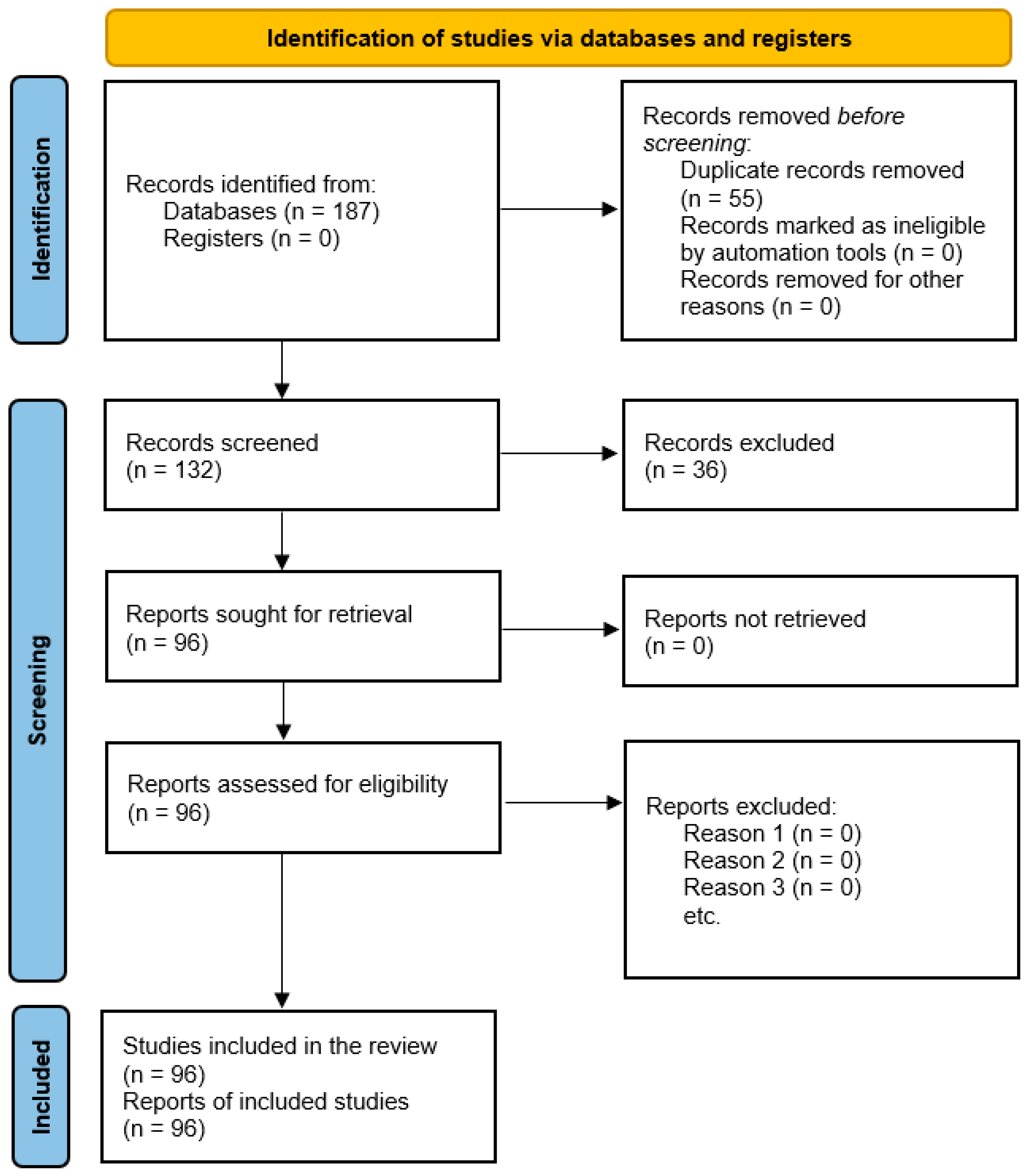
In accordance with the PRISMA 2020 guidelines, a systematic literature review was conducted to identify the most relevant studies on hybrid renewable energy systems (HRES), smart microgrids, and energy management systems (EMS). The main scientific databases, including IEEE Xplore, Scopus, Web of Science, and ScienceDirect, were systematically searched. A total of 187 records were initially identified. After removing duplicate records and non-research documents (such as editorials, book chapters, conference abstracts, and short communications), 132 records remained. Following title and abstract screening, 36 records were excluded due to irrelevance to the scope of energy management systems, hybrid renewable configurations, and microgrid applications.
The remaining 96 full-text articles were assessed for eligibility based on methodological quality, technical depth, and alignment with the objectives of this review, including system architecture, optimization techniques, artificial intelligence-based control, and techno-economic evaluation. A total of 96 studies were included in the final qualitative synthesis.
The complete study selection process is summarized in Table 2 and illustrated in Figure 1.
Although this work is a review article, all procedures were conducted in accordance with the PRISMA 2020 guidelines to ensure transparency, reproducibility, and methodological rigor.

2.1. Search Strategy

A comprehensive and systematic literature search was conducted in accordance with the PRISMA 2020 guidelines to identify relevant peer-reviewed studies addressing hybrid renewable energy systems (HRES), energy management systems (EMS), optimization approaches, and forecasting techniques. The search was performed using the following electronic databases: IEEE Xplore, Scopus, Web of Science, and ScienceDirect.
The search strategy combined keywords related to system configuration, energy management, optimization, and artificial intelligence using Boolean operators. The main search string was structured as follows:
  • (“hybrid renewable energy system” OR “HRES” OR “hybrid microgrid”)
  • AND (“energy management system” OR “EMS”)
  • AND (“optimization” OR “machine learning” OR “artificial intelligence” OR “forecasting”)
Additional database-specific filters were applied to limit the results to peer-reviewed journal articles. Reference lists of selected papers were also manually screened to identify potentially relevant studies not captured in the initial search.

2.2. Eligibility Criteria

The inclusion and exclusion criteria were defined as a priority to ensure relevance, quality, and consistency of the selected studies.
Inclusion criteria:
  • Peer-reviewed journal articles written in English
  • Studies focusing on hybrid renewable energy systems, including at least two energy sources and/or energy storage systems
  • Research addressing energy management strategies, optimization techniques, or forecasting methods
  • Studies providing technical, economic, or environmental performance indicators
Exclusion criteria:
  • Conference papers, book chapters, editorials, short communications, and review abstracts
  • Studies unrelated to electrical energy systems (e.g., thermal-only or non-energy applications)
  • Papers lacking sufficient methodological details or performance evaluation
  • Duplicate publications across databases

2.3. Study Selection Process

All retrieved records were initially screened for duplicates. Subsequently, titles and abstracts were reviewed to exclude irrelevant studies. The remaining articles underwent full-text assessment to evaluate methodological adequacy, technical depth, and alignment with the objectives of this review. The selection process followed the PRISMA 2020 flow diagram (Figure 1) and resulted in a final set of 96 eligible studies included in the qualitative synthesis.

2.4. Data Extraction and Synthesis

A structured data extraction framework was used to systematically collect relevant information from each selected study. Extracted data included system configurations, renewable energy sources, energy storage technologies, energy management strategies, optimization and forecasting methods, as well as techno-economic and environmental performance indicators such as net present cost (NPC), cost of energy (COE), renewable fraction (RF), and CO2 emissions.
The extracted data were synthesized qualitatively to identify research trends, best practices, and existing gaps in hybrid distributed energy systems. Due to the heterogeneity of methodologies and performance metrics, a quantitative meta-analysis was not performed.

2.5. Risk of Bias Assessment

Given the qualitative nature of this review and the diversity of modeling and simulation approaches employed in the selected studies, no formal risk-of-bias assessment tool was applied. However, methodological quality was indirectly assessed during the full-text screening phase by considering factors such as transparency of system modeling, clarity of optimization objectives, and completeness of performance evaluation. Potential publication bias may exist due to the exclusion of non-English and non-peer-reviewed studies.

2.6. Protocol Registration

The review protocol was not registered in a publicly accessible database. Nevertheless, the study selection, data extraction, and synthesis procedures were conducted in accordance with the PRISMA 2020 guidelines to ensure transparency, reproducibility, and methodological rigor.

3. Distributed Energy Generation

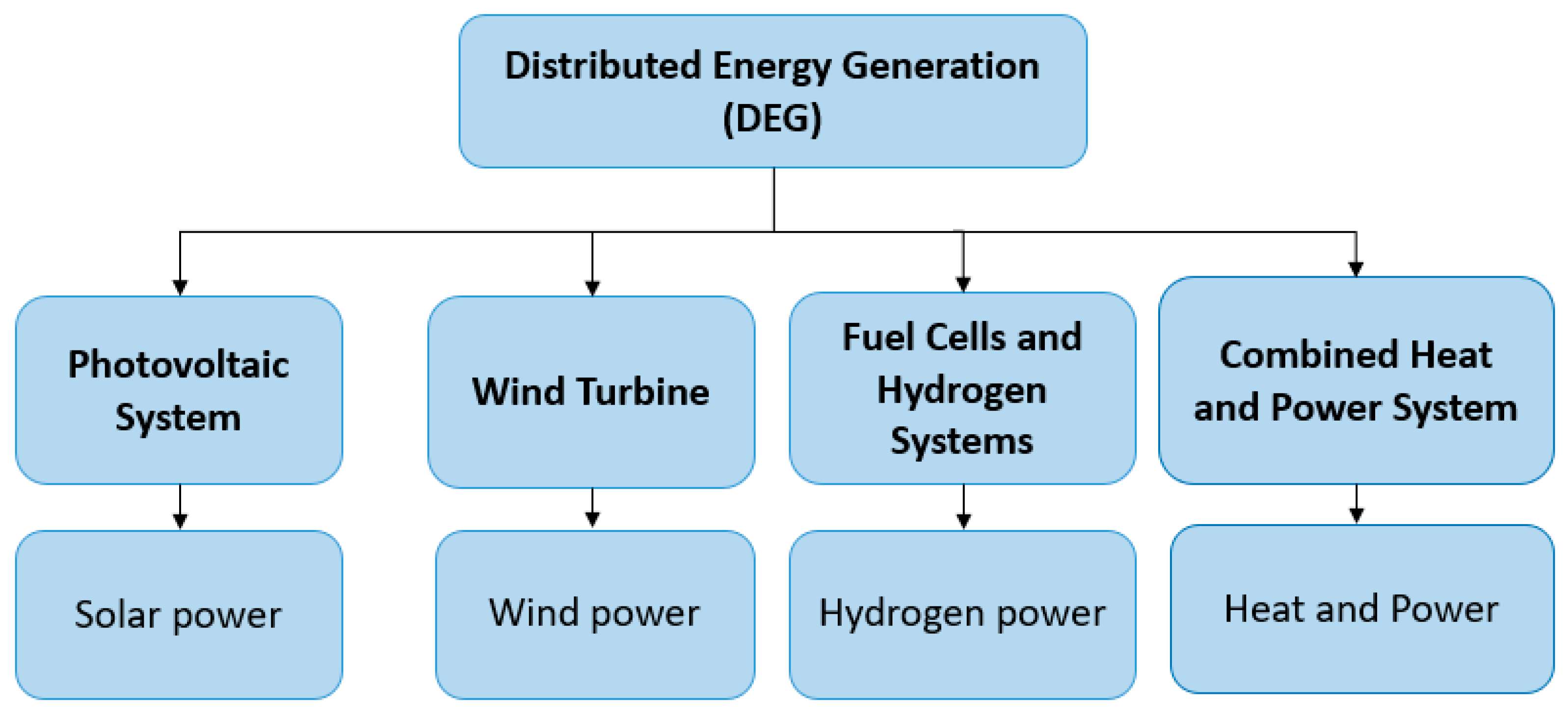
Decentralized energy generation (DEG) refers to the production of electricity from small- and medium-sized power plants located near the point of use. In contrast to conventional generation plants, DEG reduces dependence on the high-voltage transmission grid, thereby decreasing technical losses and increasing grid resilience. In addition, DEG enables the rapid integration of intermittent renewable energy sources, such as solar and wind power, which are critical to the low-carbon energy transition [36]. Beyond its technological advantages, DEG also enables the development of microgrids, enhances energy supply security, and equips consumers to become power prosumers, meaning they produce and actively consume energy [38].
In addition, recent research on dynamic electrical grids (DEG) is increasingly focused on the challenges posed by grids with high renewable energy penetration, including characterizing and mitigating uncertainties associated with intermittency in solar radiation, wind speed, and demand. This research involves stochastic modelling, probabilistic forecasting, and resilient optimization methods to guarantee grid stability and system dependability in uncertain conditions.

3.1. Components of Distributed Energy Generation

3.1.1. Photovoltaic Systems

Photovoltaic (PV) technology is among the most widely used and mature of renewable power conversion technologies, due to its scalability, adaptability, and the continuously declining average levelized cost of electricity (LCOE) in the last decade. PV can be applied in a variety of settings, from small rooftop units supplying both residential and commercial properties to major ground-based installations embedded in hybrid microgrids or in virtual power plants (VPPs) [39,40].
Technological developments, notably two-sided modules, PERC (passivated emitter and rear cell) configurations, and perovskite-silicon double-junction cells, have dramatically increased conversion efficiencies, up to 33% in laboratory prototypes [41]. In addition, improvements in maximum power point tracking (MPPT) and intelligent energy management technologies have improved the incorporation of photovoltaic systems into hybrid systems. However, the challenges of intermittency, high temperature sensitivity, and material degradation persist, prompting further research into the coupling of energy storage, IoT-based monitoring, and enhanced control systems.
Furthermore, recent studies highlight the importance of integrating photovoltaic systems into predictive and control frameworks that account for probability-based solar production forecasts, weather-related variability, and system-level uncertainties. Prediction models using machine learning, statistical ensemble forecasting methods, and real-time adaptive MPPT strategies are now essential for effectively managing micro-grids with high photovoltaic penetration. In addition to conventional crystalline silicon techniques, the latest research is exploring more advanced technologies, improved modelling methods, and smart systems.
Recent advances in the modelling of photovoltaic systems have largely shifted from representing steady-state electrical behavior and focused on the use of dynamic and multi-physics methods. In the case of photovoltaic systems, the integration of smart systems is a key factor in the development of new innovations. Electrothermal models coupled with temperature have also been explored to enhance precision during conditions of strong irradiation and high temperatures, including in arid and semi-arid climates.
Advances in technology, particularly double-sided modules, PERC (passivated emitter and rear cell) structures, and perovskite-silicon tandem solar cells, have significantly raised the conversion efficiency. The new perovskite-silicon double-layer solar cell has achieved laboratory yields of over 30%. The current focus of research is on modelling long-term stability, understanding degradation caused by humidity and temperature cycles, and addressing the challenges of scaling up for mass deployment. Furthermore, photovoltaic models that take account of degradation, including the effects of ageing, losses due to soiling and desorption phenomena, are increasingly used to enhance the long-term technical and economic evaluation of the hybrid energy systems. Advances in PV modelling, combined with machine-learning-based power forecasting, smart MPPT strategies, and IoT-based surveillance, have improved the reliability and controllability of hybrid systems with a high proportion of PV.

3.1.2. Wind Turbine Systems

Wind energy has become a mature and widely available source of renewable energy, especially in remote, isolated, and off-grid areas where there are sufficient wind resources. Small and medium-sized wind turbines (SMWTs) are being increasingly incorporated into hybrid photovoltaic-wind systems, improving reliability of supply by making use of the production profiles of the solar and wind resources [42].
Recently, research has focused increasingly on quantifying uncertainty in the wind energy sector, utilizing stochastic models of wind, probabilistic forecasts, and resilient optimization techniques to guarantee grid stability. Wake effects, fluctuation induced by turbulence, and variations in load demand have now been incorporated into system-level simulations to improve the performance of hybrid photovoltaic-wind systems under actual operation conditions.
Technological developments, such as the vertical axis wind turbine (VAWT), aerodynamically optimized blade shape, and the use of advanced power electronics to enable variable speed operation, have increased the performance and reliability characteristics of small and medium-sized wind turbines while also decreasing maintenance [42]. However, there are challenges such as intermittent output, site-specific noise, and resource variability, prompting further research into hybrid system optimization, coupled energy storage, and intelligent control strategies.
Current research is no longer focused on extracting basic aerodynamic power, but rather on advanced models, control strategies, and the systemic improvement of hybrid energy systems. The most recent wind turbine models are adopting increasingly data-driven and dynamic methods that consider wind turbulence, mechanical inertia, and the dynamics of electronic power converters.
For wind farms or multi-turbine systems, modelling wake effects is a crucial area of study, as the aerodynamic forces generated between the turbines have a significant influence on power production, the fatigue of the turbines, and the reliability of the system. State-of-the-art wake models, such as those based on computational fluid dynamics (CFD) and low-order analytic approaches, are now widely used for layout optimization and performance prediction.
Technical developments like optimized aerodynamic blades, vertical axis wind turbines (VAWTs), and high-tech power conversion systems are making wind energy systems more efficient and reliable. The variable-velocity operation enabled by advanced power electronics has greatly improved energy capture at low and variable wind speeds, particularly for hybrid renewable energy systems.
Recently published research confirmed the importance of incorporating smart control techniques, machine-learning-based predictive maintenance, and failure detection to reduce maintenance costs and increase system reliability.
Nevertheless, issues such as variable output, variability in on-site wind conditions, acoustic emissions, and structural fatigue persist, prompting continued research into the coordinated control of combined systems, the integration of energy storage, and the development of advanced wind power forecasting methods.

3.1.3. Fuel Cells and Hydrogen System

Decentralized hydrogen energy production (DEG) appears to be a viable solution for long-term energy storage and flexible electricity generation, especially for hybrid renewable energy systems. These fuel cells, particularly proton exchange membrane fuel cells (PEMFC) and solid oxide fuel cells (SOFC), enable the direct transformation from hydrogen to electricity with a high electrical efficiency (40 to 65 per cent for PEMFC, up to 60 per cent for SOFC in combined heat and power generation) and without emissions at the operating point [43,44].
The advanced research explores probabilistic modelling of hydrogen production and storage, accounting for fluctuations in renewable energy production and uncertainties related to load, to improve the operation of hybrid photovoltaic-wind-hydrogen microgrids. The control approaches now include predictive energy arbitration and dynamic optimization in the context of uncertainty.
The power output of a fuel cell is determined by the Nernst equation, which gives the open-circuit voltage based on the partial reactant pressures [45]:
E c e l l   =   E 0 + R T 2 F l n p H 2 p O 2 p H 2 O
where E 0 equals the standard cell potential (V), R equals the standard gas constant (J/molK), T equals the temperature (K), F equals the Faraday constant (C/mol), and p equals the partial pressure of the species (Pa). The real potential values under load are further decreased due to the activation, ohmic, and configuration losses, often expressed in the following way [46]:
V c e l l = E c e l l η a c t i v a t i o n η o h m i c η c o n c e n t r a t i o n
Advances in electrolysis technology, such as PEM and alkaline electrolyzers, in addition to the decreasing costs of producing hydrogen, are reinforcing the role of hydrogen in decentralized energy networks and hybrid photovoltaic, wind, and hydrogen systems. The incorporation of the fuel cell into renewable sources not only increases system reliability but also enables energy arbitrage by allowing surplus power to be stored as hydrogen during periods of lower energy demand [47].
Despite these benefits, there are still challenges related to hydrogen safety, system costs, and fuel cell sustainability, which are driving further research into advanced materials, system optimization, and fuel cell hybrid strategies.

3.1.4. Combined Heat and Power (CHP) Systems

Combined heat and power (CHP) systems, or cogeneration systems, produce both electricity and useful heating power simultaneously from one energy source, with total efficiency levels of 80%, compared to 40–50% for the conventional generation of electricity alone [48]. Micro-cogeneration systems are especially suited to domestic residential buildings or industrial installations, where the local heating demand can be efficiently adapted to electricity generation, reducing transmission losses and increasing the total efficiency of a system [48].
Recent studies on cogeneration systems emphasise comprehensive management of uncertainty, considering the fluctuation of renewable energy inputs, thermal demand, and fuel supply. Intelligent energy management systems, prediction control, and real-time control contribute to maintaining the efficiency and reliability of systems in microgrids with a high penetration of renewable energy.
The global effectiveness of a cogeneration system is frequently stated in the following manner:
η C H P   =   P e l e c + Q h e a t E f u e l
where P e l e c represents power generation (kW), Q h e a t represents recuperable heat (kW), and E f u e l represents total fuel consumption (kW) [49]. Powered by renewables such as biomass, biogas, or green hydrogen, cogeneration systems reduce the use of fossil fuels and carbon emissions, supporting the making of more decentralized and sustainable energy grids. The recent advances in the areas of high-efficiency microturbines, organic Rankine cycle (ORC) integrations, and cogeneration-photovoltaic/battery hybrid power systems have enhanced operating efficiency, flexibility, and compatibility for intermittent renewables [46]. Despite these advances, there are still challenges with investment costs, fuel logistics, and integration with local heat demand, which require more research into smart energy management, as well as hybrid and micro-cogeneration design. Figure 2 shows the necessary components of a DEG.

3.1.5. Energy Storage Systems

Energy storage systems (ESS) are critical tools available to the modern generation of distributed renewable energy systems. They enable a flexible approach to reduce the variability of solar and wind power generation, improve grid stability, and control peak loads [50,51]. By uncoupling energy generation and consumption, ESS improves the efficiency and reliability of distributed energy systems.
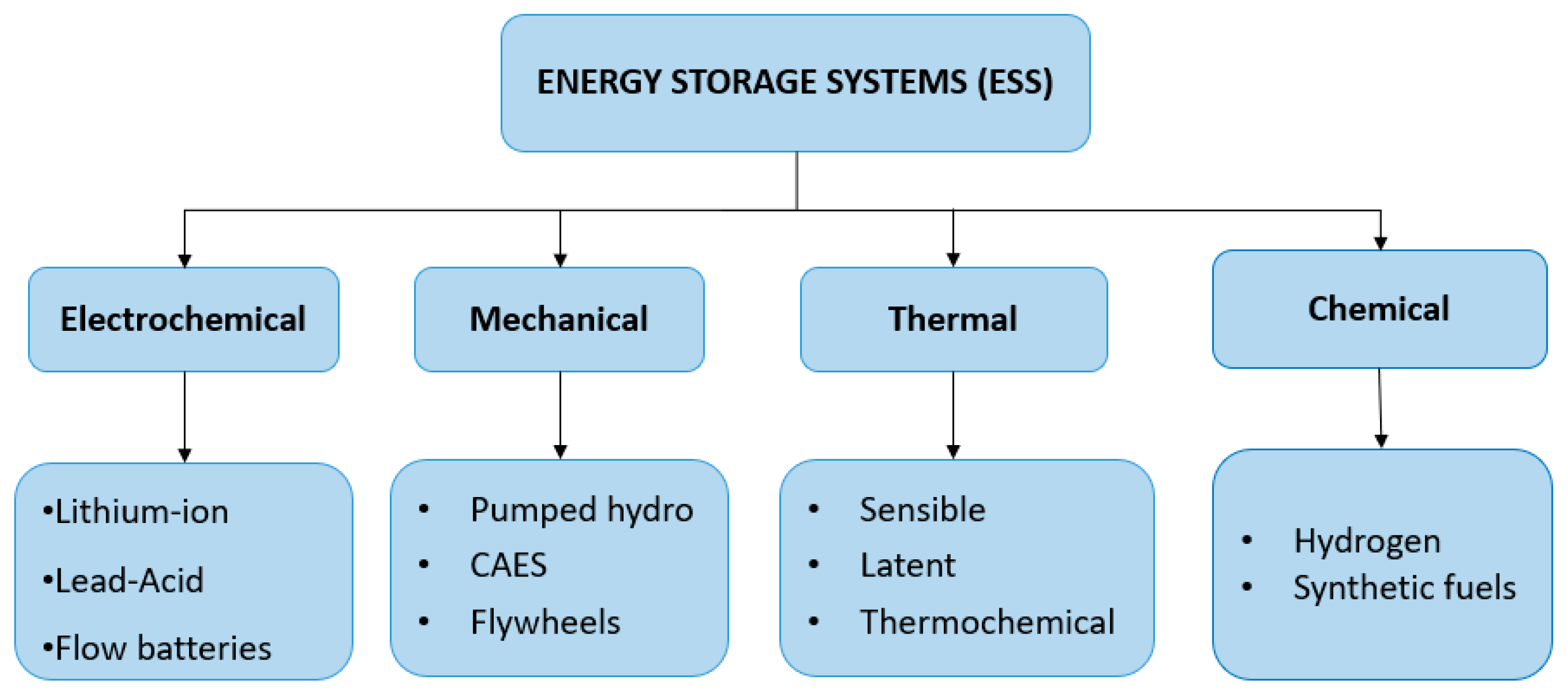
  • ESS technology can be divided into electrochemical, mechanical, thermal, and chemical storage. This study focuses primarily on electrochemical storage systems (batteries), used extensively in microgrids because of energy density, performance, and operational adaptability. Each of these categories provides different benefits and suits different applications in hybrid energy systems: Electrochemical storage, particularly lithium-ion, flow, and lead-acid batteries, are widely used for microgrids because of their energy density (150–250 Wh/kg), efficiency (85–95%), and durability (>5000 cycles) [50]. The state of charge (SOC) of a battery, a critical factor in the management of energy, can be calculated as follows:
S O C t = S O C t 0 + η c h C b a t 0 t I c h d t 1 η d i s C b a t 0 t I d i s d t
where η c h and η d i s are the charge and discharge efficiency, C b a t gives the capacity of the battery (kWh), and I c h and I d i s represent the currents (A).
  • Mechanical storage, like the pumped storage hydroelectricity (PHS), the compressed energy storage (CAES), and flywheels, is particularly adapted to the large-scale operations, providing high levels of reliability and a long lifespan [51]. Equation (5) shows the energy storage potential in a PHS system:
E P H S = ρ g h V
where ρ represents the density of water (kg/m3), g represents the acceleration due to gravity (m/s2), h represents the height difference (m), and V represents the volume stored (m3). PHS can achieve efficiency levels of 70 to 85%.
  • Thermal energy storage (TES), comprising sensitive, latent, and thermochemical energy storage systems, is widely used in concentrating solar power (CSP) plants and in hybrid microgrids, providing efficient load transfer and improving the overall system efficiency.
  • Chemical storage, such as hydrogen and synthetic fuels, allows energy to be stored over a long period of time by using electrolysis. This process converts excess electricity into chemical energy, which can then be converted back into electricity using fuel cells or combustion systems.
Integrating energy storage systems (ESS) with hybrid photovoltaic, wind, fuel cell, and cogeneration systems improves peak shaving, load levelling, and energy arbitrage. In this study, electrochemical energy storage systems (batteries) have been identified as the primary energy storage solution. In contrast, thermal and chemical energy storage have been briefly mentioned for completeness. Advanced energy management strategies, such as model predictive control (MPC) and AI-based optimization, are increasingly used to maximize efficiency, extend component life, and ensure reliable operation under variable production and load conditions [52].
The deployment of ESS continues to face challenges, including high investment costs, degradation, safety concerns, and recycling constraints. This requires further research into next-generation batteries, hybrid storage solutions, and integrated multi-energy storage systems [50]. Figure 3 shows the different types of energy storage systems. In addition to solar photovoltaic, wind, and distributed energy sources, hydroelectric power stations represent renewable and predictable energy technology with a considerable market share, offering flexible production and helping stabilize hybrid energy systems.

4. Energy Management Strategies

The energy management system (EMS) is crucial for ensuring the optimal operation, reliable performance, and cost-effectiveness of hybrid renewable energy systems (HRES). The main objective of an EMS is to achieve real-time supply and load balancing while minimizing costs, increasing renewable energy penetration, and ensuring system stability. In distributed systems incorporating photovoltaics (PV), wind turbines, fuel cells, and energy storage systems (ESS), efficient EMS drives energy control, allocation strategies, and both supply-side and demand-side management.
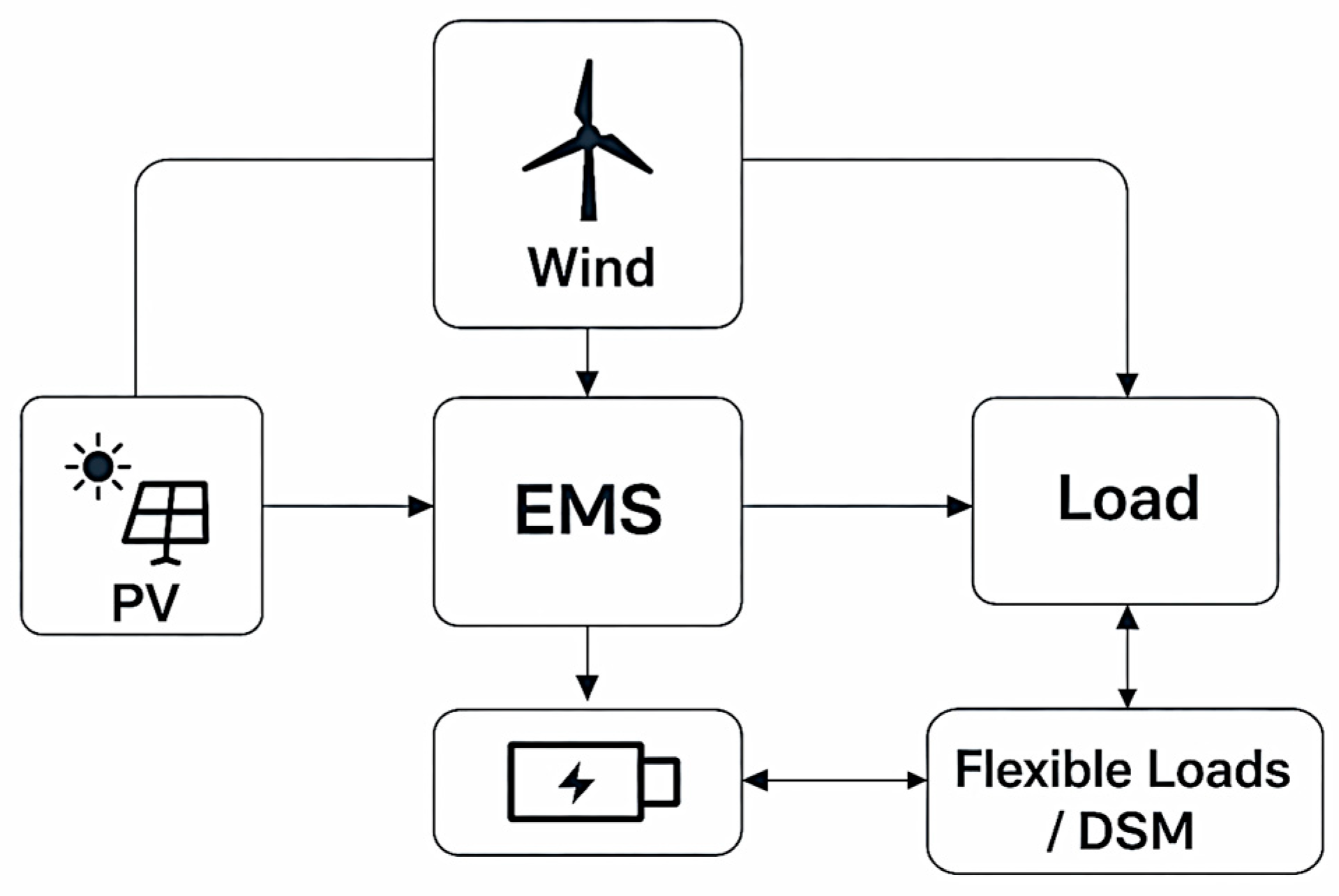
In addition to controlling generation and storage, modern EMS are increasingly incorporating demand-side management (DSM) strategies, which allow the system to adjust loads based on energy availability, price signals, or renewable energy generation forecasts. This strategy can enhance system resilience, lower peak demand, and generate energy savings without additional infrastructure costs [53]. EMS strategies have been defined at the supervisory and operations levels, prioritizing decision-making logic, the control architecture, and real-time energy distribution over the mathematical solution of optimization equations. Overall, EMS strategies can be classified as rule-based, optimization-based, and smart or feedforward.
Rule-based approaches, including heuristics and fuzzy logic controllers, are based on predetermined decision criteria and decision thresholds. Although these methods are computationally effective and straightforward to implement, they are often insufficiently flexible to accommodate dynamic changes in systems. Optimization-based methods use a mathematical approach to minimize the cost functions or maximize the efficiency of the system under the constraints. These include both deterministic techniques (e.g., linear programming, mixed-integer linear programming) as well as metaheuristic strategies, such as the genetic algorithm (GA), the particle swarm optimization (PSO), and the ant colony optimization (ACO).
In terms of energy management, they are mainly used to facilitate operations planning and distribution decisions, as opposed to exploring algorithmic details.
There has been growing interest in recent years in intelligent and predictive energy management systems based on artificial intelligence (AI) and machine learning (ML). Techniques such as artificial neural networks (ANN), adaptive neuro-fuzzy inference systems (ANFIS), and reinforcement learning (RL) enable systems to forecast future energy loads and renewable energy production, thereby improving energy planning and reducing dependence on conventional generation. Furthermore, AI- and ML-based EMS can be integrated with DSM to anticipate load flexibility and adjust consumer demand proactively, thereby enhancing overall system efficiency. Model Prediction Control (MPC) enhances the system’s adaptability by accounting for forecast uncertainties and real-time operational constraints.
Furthermore, recent advances in the management of uncertainty associated with renewable energy have demonstrated that scenario-based stochastic energy management frameworks can be reformulated as convex optimization problems and solved efficiently using convex relaxation methods. Specifically, modeling the steady-state behavior of bidirectional inverters in AC/DC hybrid microgrids in a convex manner yields simple and computationally efficient economic dispatch formulations.
AI-based and optimization methods are addressed here from a systemic perspective, focusing on their role within the architecture and control strategy of the energy management system, rather than on their algorithmic formulation. Choosing an energy management system (EMS) depends on the system size, available computing resources, and operational goals. Recent studies emphasize the efficacy of hybrid EMS approaches that combine rule-based supervision with AI-driven forecasting or optimization-based decision support to achieve both robustness and flexibility [51,54,55]. Table 3 provides a comparative summary of EMS approaches, and Figure 4 shows the general structure of an EMS.

5. Optimization Approaches

The optimization process plays a critical role in hybrid renewable energy system (HRES) design, monitoring, and operations scheduling. It identifies the system configurations and management approaches that reduce costs, minimize emissions, or reduce unsatisfied demand while optimizing efficiency and dependability.
In the literature, the problems of optimization of hybrid renewable energy systems (HRES) have been formulated in terms of different objective functions, according to the system objectives as well as the application context. The common objectives are to minimize the total cost, including investment, operation, and maintenance; maximize profit; optimize energy self-sufficiency; reduce renewable energy losses; decrease fuel consumption and emissions; and improve system reliability or outage probability. Multi-objective formulations, which consider trade-offs among economic, environmental, and technical performance indicators, are also widely used.
The optimization problem is generally expressed as a system of decision variables influencing the operation and performance of the system. Typically, these variables include the charge and discharge cycles of energy storage systems (ESS), the limits on renewable energy production, energy transfers to the grid or backup generators, load smoothing or demand response actions, and decisions regarding the deployment of generation units. The choice of decision variables has a considerable impact on the quality of the solution and its calculation complexity.
Overall, these optimization methods can be divided into deterministic, metaheuristic, and smart hybrid methods.

5.1. Deterministic Optimization

The deterministic approaches are based on formulas with objective conditions and well-established limitations. Among the common methods are linear programming (LP), mixed-integer linear programming (MILP), and non-linear programming (NLP). These approaches provide globally optimal solutions when the problem is complex, and the model accurately represents the behavior of the system. For instance, MIP has been widely used for the optimal dispatch of microgrids and unit commitment issues, thanks to its capability to manage both binary decisions and linear restrictions [53,56]. Nevertheless, the deterministic approaches are often confronted with non-neutralities, uncertainty, and the stochastic variability inherent in the renewable energy sector.

5.2. Metaheuristic Optimization

Optimization techniques based on metaheuristics such as genetic algorithms (GA), particle swarm optimization (PSO), ant colony optimization (ACO), and other evolutionary methods are well-suited to solving complex, non-linear, and multi-objective optimization problems. They are particularly efficient in dealing with large decision spaces, nonconvex objective functions, and formulations that account for uncertainty.
In recent years, developments have integrated artificial intelligence (AI) with conventional optimization to enhance both convergence and adaptivity. Hybrid methods, such as GA-ANN, PSO-Fuzzy, and ANFIS-PSO, have been developed to integrate the exploratory power of metaheuristics with the adaptive or predictive capabilities of AI frameworks. In addition, reinforced learning (RL) and model predictive control (MPC) have established themselves as smart settings capable of self-learning from the dynamic states of systems, allowing for real-time decision-making in intelligent microgrids [57,58].
These developments, from deterministic to intelligent hybrid optimization, reflect a broader shift towards data-driven, adaptive, and robust optimization paradigms that complement the strategies at the energy management system (EMS) level covered in Section 4. The future optimization architecture should incorporate digital optimization tools, Internet of Things (IoT)-based monitoring, and distributed computing to enable decentralized, real-time control of complex distributed energy systems. Table 4 presents a comparative summary of optimization methods for hybrid energy systems.

6. Data and Forecasting

The growing incorporation of renewable energy sources into modern electrical systems has considerably increased the importance of precise forecasts and data-driven decisions in energy management. Given the intermittent and stochastic characteristics of renewable energy resources such as solar irradiance and wind speed, prediction is essential for ensuring the stable, reliable, and cost-effective operation of renewable energy systems. Forecasting data and methodology enable the implementation of strategies for predictive monitoring, load balancing, and effective planning of distributed generation resources (DGR) [59,60].

6.1. Importance of Data in Energy Systems

Data is the basis of any contemporary power management system. Through real-time monitoring, historical data, and predictive analysis, improvements in system operation and optimization can be achieved. Data that is commonly utilized in power systems includes the weather data (solar irradiation, temperature, wind speed), the load demand profiles, and the price signals in the market. The implementation of enhanced monitoring infrastructures (AMI) and Internet of Things (IoT) has facilitated the acquisition of high-resolution data, enabling more accurate forecasts and more dynamic control [61,62].
Furthermore, data pre-processing, such as standardization, noise filtration, and correction of missing values, is essential for improving model performance and decreasing computational errors [63].

6.2. Forecasting Techniques

The forecasting methods are usually categorized as being statistical, machine learning (ML), or hybrid/intelligent methods:
  • Statistical models: Conventional methods such as autoregressive integrated moving average (ARIMA), exponential smoothing (ES), and regression analyses have been extensively used in short-term energy forecasting because of their inherent simplicity and ease of interpretation [64]. Nevertheless, these methods frequently encounter difficulties with the non-linearity and non-stationarity of renewable energy production data.
  • Machine learning models: Machine learning algorithms like artificial neural networks (ANNs), support vector machines (SVMs), random forests (RFs), and gradient boosting trees (GBTs) have shown improved efficiencies in catching non-linear relationships among the input variables and the output variables [65,66]. They are data-driven and adaptive, which makes them well-suited for forecasting renewable energy in a dynamic setting.
  • Hybrid and adaptive forecast models: In recent years, there has been considerable interest in hybrid methods that combine machine learning (ML) with optimization algorithms like particle swarm optimization (PSO), genetic algorithms (GA), and adaptive neuro-fuzzy inference systems (ANFIS) [67,68]. For example, PSO-ANN or GA-ANFIS hybrids have resulted in reduced root-mean-square error (RMSE) and mean absolute percentage error (MAPE) in solar and wind forecast missions.

6.3. Forecasting Horizons

Forecast time horizons are typically categorized as follows [69]:
  • Very short-term forecasts (seconds to minutes): Essential for real-time monitoring and balancing the grid.
  • Short-term forecasts (minutes to hours): Important for day-use market participation and microgrid planning.
  • Medium-term forecasts (from a few hours to a few days): Used for planning maintenance and managing energy storage.
  • Long-term forecasts (from a few weeks to a few years): Essential for planning strategic investments and expansion of the system.

6.4. Integration of Forecasting in Energy Management

An accurate forecast allows for the implementation of predictive energy management strategies (EMS) by feeding into optimization and control strategies. For example, forecasts of energy demand and generation from renewable sources enable dynamic planning of energy storage systems (ESS), load transfer, and demand management (GSD). In addition, the forecast accuracy can be reduced by using probability-based models and quantifying uncertainties, making smart grids more resilient [70].

6.5. Impact of Forecast Precision on the EMS and Optimization

The accuracy of forecasts has a significant impact on the performance of energy management systems (EMS) and optimization. Accurate forecasting is critical to avoid inefficiencies in generation dispatch, increased costs, higher battery usage, and lower reliability. Predictive control and EMS strategies based on optimization depend heavily on forecast data; consequently, better forecasts improve planning quality, decrease constraints violations, and improve overall techno-economic performance. This underlines the value of integrated forecasting, EMS, and control frameworks in hybrid energy systems.

6.6. Recent Trends

Recent developments highlight the importance of deep learning approaches such as convolutional neural networks (CNNs), long short-term memory (LSTM), and transformers in achieving state-of-the-art prediction accuracy [71,72]. Furthermore, techniques for data fusion combining multi-source data (satellites, sensors, and weather stations) and advanced information technology processing in real time are becoming key elements in the move to smart and independent power systems [73]. Table 5 is a comparison of forecasting methods for the energy system.
Precisely accurate forecasts are critical to effective energy management because prediction uncertainty directly impacts costs, reliability, and storage performance. Energy management approaches that account for prediction uncertainty, such as robust optimization and MPC, help reduce these impacts, improving the robustness and efficiency of hybrid energy systems.

7. Techno-Economic Indicators and Evaluation

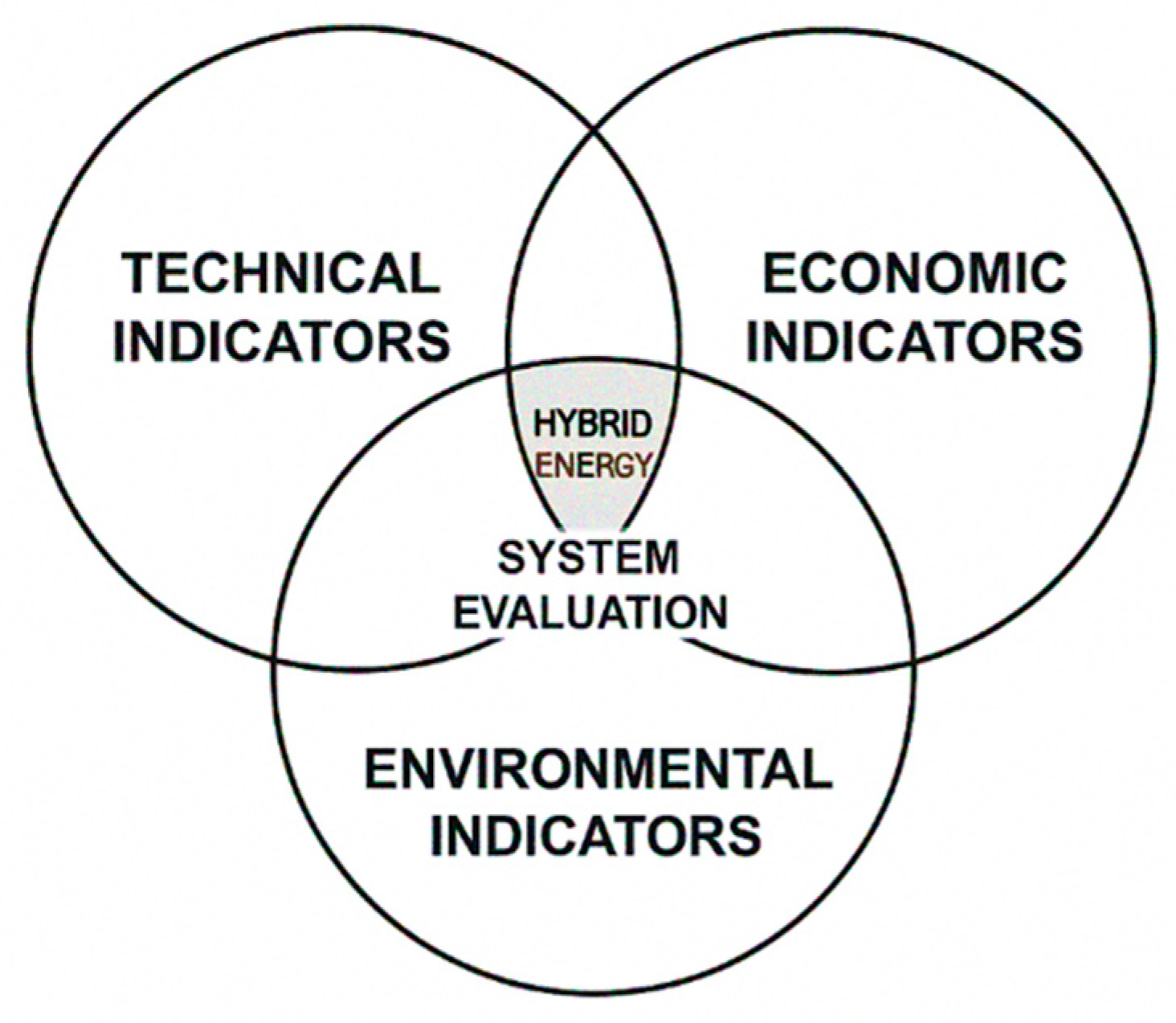
The technical and economic evaluation of renewable and hybrid energy systems is essential for their viability, durability, and cost-effectiveness. It incorporates indicators of technical and economic efficiency, providing a framework for comprehensive assessment to support decision-making in the design, optimization, and development of energy policies.
From a technical perspective, performance is usually evaluated using indicators such as energy efficiency (η), the loss of power supply probability (LPSP), and the renewable fraction (RF).
The global energy effectiveness and efficiency of a system can be described in the following equation [74]:
η =   E o u t p u t E i n p u t   ×   100 %
where E o u t p u t corresponds to the energy delivered to a load, and E i n p u t corresponds to the overall energy delivered by all the sources.
The LPSP, a measure of system efficiency, is given by the following formula [75]:
L P S P = E u n m e t   l o a d E t o t a l   l o a d
A reduced LPSP indicates greater system availability and greater energy independence. In the same way, the renewable fraction (RF) is a measure of the proportion of total energy production that comes from renewable sources [75]:
R F   =   E r e n e w a b l e E t o t a l  
In economic terms, such indicators as the net present cost (NPC), the cost of energy (COE), and the operating cost (OC) are essential. The NPC is the present cost of all the costs of the system as a whole (investment, operation, maintenance, and replacement) over the lifetime of the project [76].
N P C = t = 1 N C t 1 + i t
where C t equals the total annual cost for the year t , i equals the rate of discount, and N equals the system’s lifespan.
The operating cost (COE), the key indicator for comparing various system designs, is calculated as follows [75]:
C O E   =   C a n n u a l i z e d E a n n u a l   l o a d   s e r v e d  
The lower the COE ratings, the more cost-effective the systems are with optimized system configurations. From the environmental and sustainable development perspectives, indicators such as CO2 emissions, energy payback time (EPT), and life-cycle cost (LCC) are widely used. The EPT measures the time needed by a renewable energy system to generate an amount of energy equivalent to that used in its production and deployment [77]:
E P B T   =   E e m b o d i e d E a n n u a l   o u t p u t  
These technical and economic performance indicators are frequently used in conjunction with a multi-criteria decision-making (MCDM) approach, such as TOPSIS, AHP, or PROMETHEE, to classify various hybrid systems based on cost, operational efficiency, and durability objectives. Table 6 indicates the techno-economic and environmental factors, and Figure 5 presents the principal relationship of the hybrid system.
In addition to their definition, it is important to contextualize these indicators by referring to the target or reference values commonly reported in literature, as this provides a better understanding of their meaning and usefulness. For example, high-reliability hybrid systems typically achieve a likelihood of power interruption (LPSP) close to zero (usually <1–2%), while optimized renewable energy-based microgrids often achieve a renewable energy share (RF) of more than 60–80%, depending on resource availability and storage capacity. From an economic perspective, the cost of energy (COE) for hybrid systems in isolated or off-grid applications is typically between $0.07 and $0.28/kWh. Payback periods for economically optimized configurations are frequently reported to be between 4 and 8 years.
From an environmental perspective, CO2 emissions must be significantly reduced (often by more than 30–70% compared to diesel-only systems). This reduction is an important indicator of sustainability. These reference values provide a useful framework for evaluating and comparing renewable energy hybrid systems in different geographical and operational contexts.
Apart from technical, economic, and environmental criteria, social indicators are increasingly being integrated with multi-criteria decision-making frameworks to promote a holistic and sustainable assessment of energy systems. Social KPIs evaluate the impact of renewable and hybrid energy systems on the local community and their end users, particularly in the context of decentralized, off-grid, and remote electrification. Among the common social performance indicators are improved accessibility to energy, reduced energy poverty, affordability of electricity, creation of jobs and local employment, user acceptance, and socio-economic equity.
Several case studies have system dependability and supply continuity identified as indirect social indicators, since they influence the quality of life, the satisfaction of the community, and the acceptance of renewable technologies. The integration of social indicators with technical, economic, and environmental factors in multi-criteria decision-making (MCDM) approaches enables decision-makers to better understand the societal benefits and long-term sustainability of hybrid renewable energy systems.
Nevertheless, standard technical and economic indicators, including net present value (NPV), cost of energy (COE), and factor of renewable (RF), generally rely on determined scenarios and may not fully reflect the impact of stochastic uncertainty and behavior related to renewable energy sources, the variability of demand, and the market conditions. To overcome such limitations, evaluation approaches that account for uncertainties, including probabilistic metrics, sensitivity analysis, stochastic optimization, and scenario evaluation, are being increasingly used in the literature to improve the robustness and reliability of the evaluation of the systems.

8. Case Studies

The deployment of renewable energy hybrid systems (REHS) in different geographical areas provides useful information on their economic and practical feasibility. The case studies link theoretical improvements to practical implementation, illustrating the variety of development concepts, energy management strategies, and policy environments. The case studies also provide important insights into the impact of local factors, such as solar radiation, wind speed, temperature, and load profiles, on the system performance and cost-effectiveness.
Hybrid photovoltaic–battery–diesel systems have proven highly cost-effective in regions with high levels of sunlight and relatively stable temperatures, such as North Africa and the Middle East. A major reason for their success is that solar energy is relatively predictable, allowing solar power to cover daytime demand. At the same time, batteries reduce the time diesel generators need to run, fuel use, and maintenance costs [75,76]. In such climates, diesel generators primarily serve as backup power, increasing the system’s overall reliability without significantly increasing operating costs.
In contrast, in high-latitude areas with low sunlight, wind-dominant hybrid systems have performed better due to the complementary nature of seasonal wind and solar resources [77]. Seasonally complementary wind and solar generation significantly reduces energy deficits and lowers the capacity requirements of energy storage systems, thereby improving system reliability and lowering life-cycle costs. This configuration is especially beneficial in remote micro-grids, where fuel transportation is expensive or logistics are complex.
Current research is focusing on integrating state-of-the-art control and optimization strategies, including genetic algorithms (GA), particle swarm optimization (PSO), and artificial neural networks (ANN), to improve system operational reliability and effectiveness [78,79,80]. This allows for dynamic power distribution and coordination of components, an essential feature in settings where renewable energy sources are highly variable. In addition, the deployment of AI-based prediction tools (ANFIS, LSTM, CNN) has improved the accuracy of load and production forecasts, enabling energy management systems to manage uncertainty proactively instead of reacting to fluctuations in real time [81,82].
Economic analysis underlines the impact of state policies, feed-in tariffs, and capital subsidies on the financial viability of hybrid systems, especially in developing economies [83,84]. At the same time, developed countries are moving toward smart microgrids based on IoT and digital twin technologies, which support predictive maintenance, system transparency, and long-term operational optimization in pursuit of carbon neutrality goals [85].
Globally, hybrid renewable energy systems exceed the performance of conventional diesel solutions, due not only to the availability of sustainable resources, but also to the interdependence of these resources, energy management approaches that account for uncertainties, and the optimized design of the system. These case studies show that the success of such a system lies in the suitability of the technological configurations to the weather conditions, the accuracy of the forecasts, and the regulations.
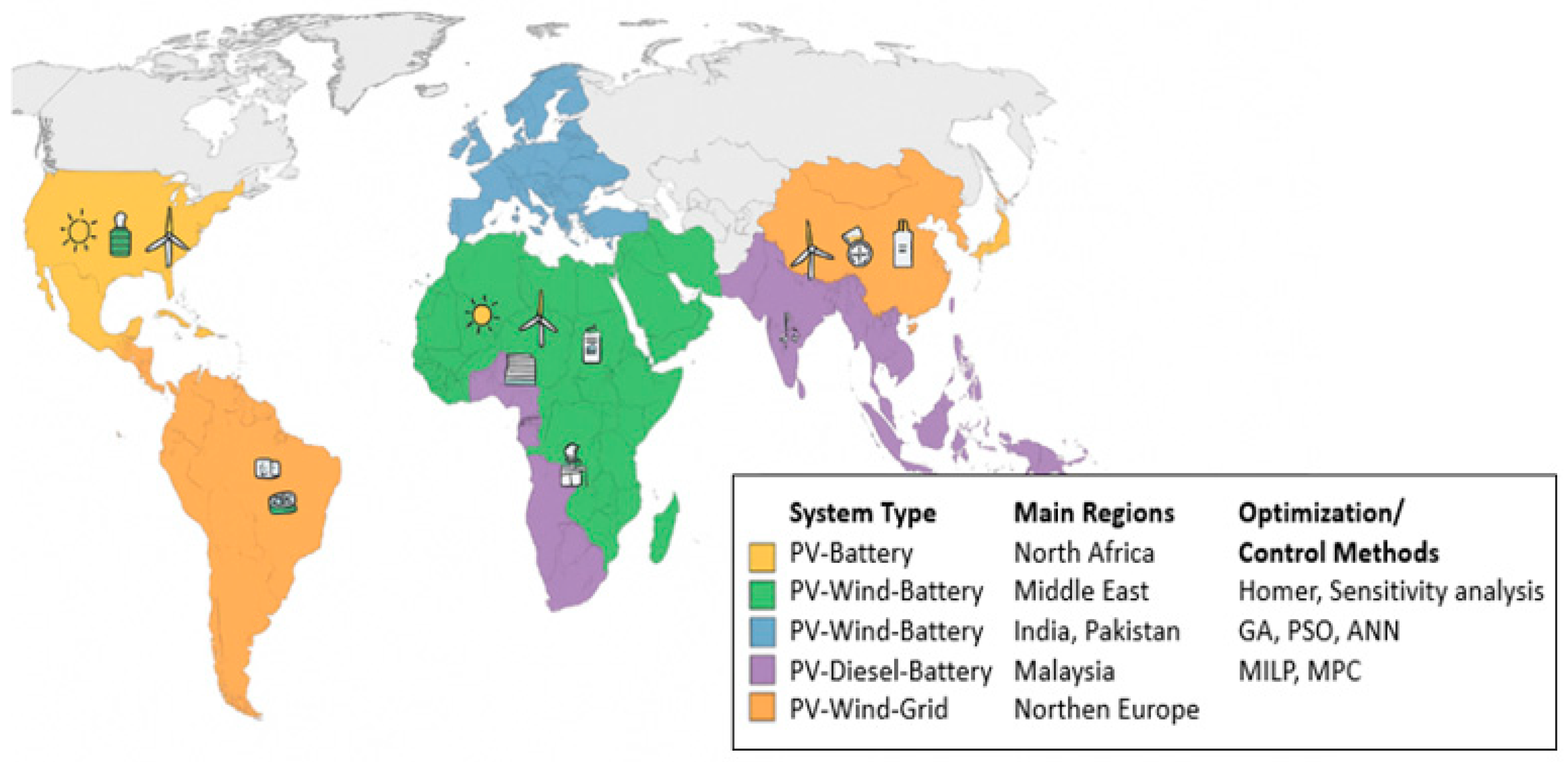
Thus, there is no single hybrid setup that is best for everyone. Climate variations, uncertainty in operations, and political incentives all play a part in figuring out the best system architecture and provide some useful pointers for rolling out renewable energy microgrids on a bigger scale. Figure 6 shows the geographical distribution and technical characteristics of the systems studied, whereas Table 7 provides a summary of the representative case studies.
A detailed study of case reports indicates that hybrid solar-battery systems typically deliver better performance than diesel-only solutions, as measured by the levelized cost of energy (LCOE) and net present cost (NPC). Advanced optimization and prediction techniques improve reliability, lower fuel consumption, and optimize planning. Ultimately, the combination of renewable sources, energy storage, and advanced energy management systems (EMS) enables cost-effective, dependable, and environmentally friendly solutions across various regions.
To enhance the interpretability of the reviewed case studies, Table 6 has been updated to include representative nominal system sizes and key quantitative indicators, including installed renewable capacity, storage capacity, and typical economic metrics. This addition enables clearer comparison of applications and highlights the scalability of different hybrid configurations.

9. Conclusions

This study has presented a global overview of hybrid and decentralized renewable energy systems (HDRES), focusing on their technologies, energy management, optimization, and techno-economic assessment. Hybrid systems that integrate photovoltaics, wind power, hydrogen, and cogeneration, supported by ESS and EMS, provide flexible and reliable electricity production.
Recently, studies have demonstrated that AI and metaheuristic algorithms, such as PSO, GA, and ANFIS, can significantly improve forecast accuracy and system optimization. Technical and economic studies have shown that properly designed hybrid systems can lower energy costs, reduce emissions, and increase operational reliability. Several case studies have highlighted the impact of key variables, including the orientation of photovoltaic panels, wind turbine site characteristics, storage capacity, and control strategies, on the overall performance of the system, demonstrating their essential role in optimizing efficiency, reliability, and the share of renewable energy.
Nevertheless, challenges remain in terms of system interoperability, data availability, and the high investment costs of hydrogen and storage systems. Future studies need to be focused on the quantification of the impact of system parameters (e.g., the orientation, the load profiles, the level of hybridization), the improvement of real-time EMS strategy, the standardization of performance indicators, and the incorporation of the digital doubles for adaptive and prediction control to guarantee the efficient, reliable, and resilient microgrid hybrid operation.
In summary, hybrid renewable energy systems are a key driver of the global energy change, offering a combination of efficiency, sustainability, and flexibility to achieve the objectives of decarbonization while maintaining the importance of carefully considering technical, economic, and operational factors in order to maximize these factors’ potential.

Author Contributions

P.M. and K.K. conceptualized the study with R.O., M.R. and I.E.D. providing methodology. R.O. carried out the writing of the original draft; M.R. and I.E.D. carried out the review, editing, supervision, and P.M. and K.K. provided APC. funding. All authors have read and agreed to the published version of the manuscript.

Funding

This research is funded by the South African National Energy Development Institute under the contract SANEDI SmartGrid (Bid2423), including APC.

Institutional Review Board Statement

Not applicable.

Informed Consent Statement

Not applicable.

Data Availability Statement

No new data were created or analyzed in this study.

Conflicts of Interest

Authors Keorapetse Kgaswane and Prathaban Moodley were employed by the company South African National Energy Development Institute. The remaining authors declare that the research was conducted in the absence of any commercial or financial relationships that could be construed as a potential conflict of interest.

Abbreviations

HRESHybrid Renewable Energy Systems
LCOELevelized Cost of Energy
RFRenewable Fraction
NPCNet Present Cost
DERsDecentralized Energy Resources
EMSEnergy Management System
PVPhotovoltaics
ESSEnergy Storage Systems
VPPsVirtual Power Plants
DEGDecentralized Energy Generation
MPPTMaximum Power Point Tracking
PERCPassivated Emitter and Rear Cell
SMWTsMedium-Sized Wind Turbines
VAWTVertical Axis Wind Turbine
SOFCSolid Oxide Fuel Cells
PEMFCProton Exchange Membrane Fuel Cells
CHPCombined Heat And Power
SOCState Of Charge
TESThermal Energy Storage
MPCModel Predictive Control
GAGenetic Algorithm
PSOParticle Swarm Optimization
ACOAnt Colony Optimization
AIArtificial Intelligence
MLMachine Learning
ANNArtificial Neural Networks
ANFISAdaptive Neuro-Fuzzy Inference Systems
RLReinforcement Learning
LPLinear Programming
MILPMixed-Integer Linear Programming
NLPNon-Linear Programming
GWOGrey Wolf Optimiser
SASimulated Annealing
IoTInternet Of Things
ARIMAAutoregressive Integrated Moving Average
ESExponential Smoothing
SVMsSupport Vector Machines
RFsRandom Forests
GBTsBoosting Trees
RMSERoot Mean Square Error
MAPEMean Absolute Percentage Error
CNNsConvolutional Neural Networks
LSTMLong Short-Term Memory
LPSPLoss Of Power Supply Probability
OCOperating Cost
EPTEnergy Payback Time
LCCLife-Cycle Cost
MCDMMulti-Criteria Decision-Making

References

  1. Parhizi, S.; Lotfi, H.; Khodaei, A.; Bahramirad, S. State of the art in research on microgrids: A review. IEEE Access 2015, 3, 890–925. [Google Scholar] [CrossRef]
  2. Fang, X.; Misra, S.; Xue, G.; Yang, D. Smart grid—The new and improved power grid: A survey. IEEE Commun. Surv. Tutor. 2012, 14, 944–980. [Google Scholar] [CrossRef]
  3. Beaudin, M.; Zareipour, H.; Schellenberglabe, A.; Rosehart, W. Energy storage for mitigating the variability of renewable electricity sources: An updated review. Energy Sustain. Dev. 2010, 14, 302–314. [Google Scholar] [CrossRef]
  4. International Renewable Energy Agency (IRENA). Renewable Capacity Statistics 2022; IRENA: Abu Dhabi, United Arab Emirates, 2022. [Google Scholar]
  5. Dunn, B.; Kamath, H.; Tarascon, J.M. Electrical energy storage for the grid: A battery of choices. Science 2011, 334, 928–935. [Google Scholar] [CrossRef]
  6. Chen, H.; Cong, T.N.; Yang, W.; Tan, C.; Li, Y.; Ding, Y. Progress in electrical energy storage system: A critical review. Prog. Nat. Sci. 2009, 19, 291–312. [Google Scholar] [CrossRef]
  7. Ali, A.O.; Elgohr, A.T.; El-Mahdy, M.H.; Zohir, H.M.; Emam, A.Z.; Mostafa, M.G.; Al-Razgan, M.; Kasem, H.M.; Elhadidy, M.S. Advancements in photovoltaic technology: A comprehensive review of recent advances and future prospects. Energy Convers. Manag. X 2025, 26, 100952. [Google Scholar] [CrossRef]
  8. Al-Ali, S.; Olabi, A.G.; Mahmoud, M. A review of solar photovoltaic technologies: Developments, challenges, and future perspectives. Energy Convers. Manag. X 2025, 27, 101057. [Google Scholar] [CrossRef]
  9. Borges, T.A.R.; Brito, F.C.; dos Santos, R.G.O.; Nascimento, P.d.T.; da Silva, C.B.; Panizio, R.M.; Saba, H.; Nascimento Filho, A.S. Smart technologies applied in microgrids of renewable energy sources: A systematic review. Energies 2025, 18, 2676. [Google Scholar] [CrossRef]
  10. Ojo, K.E.; Saha, A.K.; Srivastava, V.M. Review of advances in renewable energy-based microgrid systems: Control strategies, emerging trends, and future possibilities. Energies 2025, 18, 3704. [Google Scholar] [CrossRef]
  11. Newman, S.F.; Bhatnagar, D.; O’Neil, R.S.; Reiman, A.P.; Preziuso, D.C. Evaluating the resilience benefits of marine energy in microgrids. Int. Mar. Energy J. 2022, 5, 143–150. [Google Scholar] [CrossRef]
  12. Elalfy, D.A.; Gouda, E.; Kotb, M.F.; Bureš, V.; Sedhom, B.E. Comprehensive review of energy storage systems technologies, objectives, challenges, and future trends. Energy Storage Relat. Sci. 2024, 54, 101482. [Google Scholar] [CrossRef]
  13. Georgious, R.; Refaat, R.; Garcia, J.; Daoud, A.A. Review on energy storage systems in microgrids. Electronics 2021, 10, 2134. [Google Scholar] [CrossRef]
  14. Chaudhary, G.; Lamb, J.J.; Burheim, O.S.; Austbø, B. Review of energy storage and energy management system control strategies in microgrids. Energies 2021, 14, 4929. [Google Scholar] [CrossRef]
  15. Taabodi, M.H.; Niknam, T.; Sharifhosseini, S.M.; Asadi Aghajari, H.; Shojaeiyan, S. Electrochemical storage systems for renewable energy integration: A comprehensive review of battery technologies and grid-scale applications. J. Power Sources 2025, 641, 236832. [Google Scholar] [CrossRef]
  16. Li, X.; Palazzolo, A. A review of flywheel energy storage systems: State of the art and opportunities. J. Energy Storage 2022, 46, 103576. [Google Scholar] [CrossRef]
  17. Liu, X.; Li, W.; Guo, X.; Su, B.; Guo, S.; Jing, Y.; Zhang, X. Advancements in energy-storage technologies: A review of current developments and applications. Sustainability 2025, 17, 8316. [Google Scholar] [CrossRef]
  18. Adeyinka, M.; Esan, O.C.; Ijaola, A.O.; Farayibi, P.K. Advancements in hybrid energy storage systems for enhancing renewable energy-to-grid integration. Sustain. Energy Res. 2024, 11, 26. [Google Scholar] [CrossRef]
  19. Alzahrani, A.; Hafeez, G.; Ali, S.; Murawwat, S.; Khan, M.I.; Rehman, K.; Abed, A.M. Multi-objective energy optimization with load and distributed energy source scheduling in the smart power grid. Sustainability 2023, 15, 9970. [Google Scholar] [CrossRef]
  20. Usanova, K.I.; Kumari, M.S. Metaheuristic algorithms for optimal sizing of renewable energy systems in smart grids. MATEC Web Conf. 2024, 392, 01177. [Google Scholar] [CrossRef]
  21. Lim, S.; Lee, J.; Lee, S. Model predictive control-based energy management system for cooperative optimization of grid-connected microgrids. Energies 2025, 18, 1696. [Google Scholar] [CrossRef]
  22. Kaiss, M.; Wan, Y.; Gebbran, D.; Vila, C.U.; Dragičević, T. Review on virtual power plants/virtual aggregators: Concepts, applications, prospects and operation strategies. Renew. Sustain. Energy Rev. 2025, 211, 115242. [Google Scholar] [CrossRef]
  23. Li, Q.; Dong, F.; Zhou, G.; Mu, C.; Wang, Z.; Liu, J.; Yan, P.; Yu, D. Co-optimization of virtual power plants and distribution grids: Emphasizing flexible resource aggregation and battery capacity degradation. Appl. Energy 2025, 377, 124519. [Google Scholar] [CrossRef]
  24. Minai, A.F.; Khan, A.A.; Kitmo, K.; Ndiaye, M.F.; Alam, T.; Khargotra, R.; Singh, T. Evolution and role of virtual power plants: Market strategy with integration of renewable-based microgrids. Energy Strategy Rev. 2024, 53, 101390. [Google Scholar] [CrossRef]
  25. Almihat, M.G.M.; Munda, J.L. Comprehensive review on challenges of integration of renewable energy systems into microgrid. Sol. Energy Sustain. Dev. 2025, 14, 199–236. [Google Scholar] [CrossRef]
  26. Huang, J.; Jiang, C.; Xu, R. A review on distributed energy resources and microgrid. Renew. Sustain. Energy Rev. 2008, 12, 2472–2483. [Google Scholar] [CrossRef]
  27. Castañeda Arias, N.; Díaz Aldana, N.L.; Hernandez, A.L.; Jutinico, A.L. Energy management in microgrid systems: A comprehensive review toward bio-inspired approaches for enhancing resilience and sustainability. Electricity 2025, 6, 73. [Google Scholar] [CrossRef]
  28. Khan, M.R.; Haider, Z.M.; Malik, F.H.; Almasoudi, F.M.; Alatawi, K.S.S.; Bhutta, M.S. A comprehensive review of microgrid energy management strategies considering electric vehicles, energy storage systems, and AI techniques. Processes 2024, 12, 270. [Google Scholar] [CrossRef]
  29. Benitez, I.B.; Singh, J.G. A comprehensive review of machine learning applications in forecasting solar PV and wind turbine power output. J. Electr. Syst. Inf. Technol. 2025, 12, 54. [Google Scholar] [CrossRef]
  30. Waqas Khan, P.; Byun, Y.-C.; Lee, S.-J.; Park, N. Machine Learning Based Hybrid System for Imputation and Efficient Energy Demand Forecasting. Energies 2020, 13, 2681. [Google Scholar] [CrossRef]
  31. Tuncar, E.A.; Sağlam, Ş.; Oral, B. A review of short-term wind power generation forecasting methods in recent technological trends. Energy Rep. 2024, 12, 197–209. [Google Scholar] [CrossRef]
  32. Ying, C.; Wang, W.; Yu, J.; Li, Q.; Yu, D.; Liu, J. Deep learning for renewable energy forecasting: A taxonomy, and systematic literature review. J. Clean. Prod. 2023, 384, 135414. [Google Scholar] [CrossRef]
  33. Indrajith, B.; Gunawardane, K.; Alamgir Hossain, M.; Li, L.; Nicholson, R.; Zamora, R. Hydrogen-integrated microgrids: A comprehensive review of hydrogen technologies and energy management strategies. IEEE Access 2025, 13, 178625–178651. [Google Scholar] [CrossRef]
  34. Cerpa Contreras, J.I. Optimization of control strategies for stand-alone renewable energy systems with hydrogen storage. Renew. Energy 2007, 32, 1102–1126. [Google Scholar] [CrossRef]
  35. Zheng, Y.; Jia, J.; An, D. Energy management for microgrids with hybrid hydrogen–battery storage: A reinforcement learning framework integrated multi-objective dynamic regulation. Processes 2025, 13, 2558. [Google Scholar] [CrossRef]
  36. Ansari, M.S.; Jalil, M.F.; Bansal, R.C. A review of optimization techniques for hybrid renewable energy systems. Int. J. Model. Simul. 2023, 43, 722–735. [Google Scholar] [CrossRef]
  37. Liang, Z.; Yin, X.; Chung, C.Y.; Rayeem, S.K.; Chen, X.; Yang, H. Managing Massive RES Integration in Hybrid Microgrids: A Data-Driven Quad-Level Approach with Adjustable Conservativeness. IEEE Trans. Ind. Inform. 2025, 21, 7698–7709. [Google Scholar] [CrossRef]
  38. Islam, M.; Nagrial, M.; Rizk, J.; Hellany, A. General aspects, islanding detection, and energy management in microgrids: A review. Sustainability 2021, 13, 9301. [Google Scholar] [CrossRef]
  39. Negi, G.S.; Mohan, H.; Gupta, M.K.; Singh, R.; Gehlot, A.; Thakur, A.K.; Dogra, S.; Gupta, L.R. Leveraging machine learning for optimized microgrid management: Advances, applications, challenges, and future directions. Renew. Sustain. Energy Rev. 2026, 226, 116345. [Google Scholar] [CrossRef]
  40. He, J.-H.; Lin, J.-H. Review of microgrids to enhance power system resilience. Eng. Proc. 2025, 92, 82. [Google Scholar] [CrossRef]
  41. Shockley, W. The theory of p–n junctions in semiconductors and p–n junction transistors. Bell Syst. Tech. J. 1949, 28, 435–489. [Google Scholar] [CrossRef]
  42. Shrivastav, N.; Madan, J.; Pandey, R.; Shalan, A.E. Investigations aimed at producing 33% efficient perovskite–silicon tandem solar cells. RSC Adv. 2021, 11, 37366–37374. [Google Scholar] [CrossRef] [PubMed]
  43. Musuroi, S.; Sorandaru, C.; Ciucurita, S.; Milos, C.-L. Experimental determination of the power coefficient and energy-efficient operating zone for a 2.5 MW wind turbine under high-wind conditions. Energies 2025, 18, 4912. [Google Scholar] [CrossRef]
  44. Veza, I. Fuel-cell thermal management strategies for enhanced performance: Review of fuel-cell thermal management in proton-exchange membrane fuel cells (PEMFCs) and solid-oxide fuel cells (SOFCs). Hydrogen 2025, 6, 65. [Google Scholar] [CrossRef]
  45. Goselink, N.G.H.; Boersma, B.J.; van Biert, L. Thermodynamic evaluation of a combined SOFC–PEMFC cycle system. In Modelling and Optimisation of Ship Energy Systems, Proceedings of the 4th International Conference MOSES 2023; TU Delft OPEN Publishing: Delft, The Netherlands, 2023; pp. 1–10. [Google Scholar] [CrossRef]
  46. Hamid, L.; Elmutasim, O.; Dhawale, D.S.; Giddey, S.; Paul, G. Comparative electrochemical performance of solid oxide fuel cells: Hydrogen vs. ammonia fuels—A mini review. Processes 2025, 13, 1145. [Google Scholar] [CrossRef]
  47. Haji, S. Analytical modeling of PEM fuel cell I–V curve. Int. J. Hydrogen Energy 2010, 35, 1895–1901. [Google Scholar] [CrossRef]
  48. Louli, R.; Giurgea, S.; Salhi, I.; Laghrouche, S.; Djerdir, A. A critical review of green hydrogen production by electrolysis: From technology and modeling to performance and cost. Energies 2026, 19, 59. [Google Scholar] [CrossRef]
  49. Dobre, C. A review of available solutions for implementation of small–medium combined heat and power (CHP) systems. Inventions 2024, 9, 82. [Google Scholar] [CrossRef]
  50. Attanayaka, A.M.S.M.H.S.; Karunadasa, J.P.; Hemapala, K.T.M.U. Estimation of state of charge for lithium-ion batteries—A review. AIMS Energy 2019, 7, 186–210. [Google Scholar] [CrossRef]
  51. Zhang, M.; Fan, X. Review on the state of charge estimation methods for electric vehicle battery. World Electr. Veh. J. 2020, 11, 23. [Google Scholar] [CrossRef]
  52. U.S. Environmental Protection Agency. Methods for Calculating CHP Efficiency; EPA: Washington, DC, USA, 2025. Available online: https://www.epa.gov/chp/methods-calculating-chp-efficiency (accessed on 13 December 2025).
  53. Fotopoulou, M.; Tsekouras, G.; Rakopoulos, D.; Kontargyri, V. Demand Response Optimization for the Enhancement of the Distribution System’s Operation. Sustain. Energy Grids Netw. 2025, 44, 102051. [Google Scholar] [CrossRef]
  54. Kiehbadroudinezhad, M.; Merabet, A.; Hosseinzadeh-Bandbafha, H. Review of latest advances and prospects of energy storage systems: Considering economic, reliability, sizing, and environmental impacts approach. Clean Technol. 2022, 4, 477–501. [Google Scholar] [CrossRef]
  55. Marín, L.G.; Sumner, M.; Muñoz-Carpintero, D.; Köbrich, D.; Pholboon, S.; Sáez, D.; Núñez, A. Hierarchical energy management system for microgrid operation based on robust model predictive control. Energies 2019, 12, 4453. [Google Scholar] [CrossRef]
  56. Khodaei, A. Microgrid optimal scheduling with multi-period islanding constraints. IEEE Trans. Power Syst. 2014, 29, 1588–1597. [Google Scholar] [CrossRef]
  57. Aghaei, J.; Alizadeh, M.-I. Demand response in smart electricity grids equipped with renewable energy sources: A review. Renew. Sustain. Energy Rev. 2013, 18, 64–72. [Google Scholar] [CrossRef]
  58. Zulu, M.L.T.; Carpanen, R.P.; Tiako, R. A comprehensive review: Study of artificial intelligence optimization technique applications in a hybrid microgrid at times of fault outbreaks. Energies 2023, 16, 1786. [Google Scholar] [CrossRef]
  59. Moga, O.N.; Florea, A.; Solea, C.; Vintan, M. Reinforcement learning-based energy management in community microgrids: A comparative study. Sustainability 2025, 17, 10696. [Google Scholar] [CrossRef]
  60. Sarıman, G.; Keçebaş, A. Global renewable energy forecasting using hybrid ML/DL models: Economic and geospatial insights. Energy Policy 2026, 208, 114929. [Google Scholar] [CrossRef]
  61. Seewnath, P.; Folly, K.A. Energy management system in microgrids. In Proceedings of the IEEE AFRICON 2023, Nairobi, Kenya, 20–22 September 2023; pp. 1–5. [Google Scholar] [CrossRef]
  62. Bilal, M.; Algethami, A.A.; Imdadullah; Hameed, S. Review of computational intelligence approaches for microgrid energy management. IEEE Access 2024, 12, 123294–123321. [Google Scholar] [CrossRef]
  63. Wazirali, R.; Yaghoubi, E.; Abujazar, M.S.S.; Ahmad, R.; Vakili, A.H. State-of-the-art review on energy and load forecasting in microgrids using artificial neural networks, machine learning, and deep learning techniques. Electr. Power Syst. Res. 2023, 225, 109792. [Google Scholar] [CrossRef]
  64. Lin, Y.-J.; Chen, Y.-C.; Hsieh, S.-F.; Liu, H.-Y.; Chiang, C.-H.; Yang, H.-T. Reinforcement learning-based energy management system for microgrids with high renewable energy penetration. In Proceedings of the IEEE International Conference on Energy Technologies for Future Grids (ETFG 2023), Wollongong, Australia; IEEE: Piscataway, NJ, USA, 2023; pp. 1–6. [Google Scholar] [CrossRef]
  65. Singh, A.R.; Kumar, R.S.; Bajaj, M.; Khadse, C.B.; Zaitsev, I. Machine learning-based energy management and power forecasting in grid-connected microgrids with multiple distributed energy sources. Sci. Rep. 2024, 14, 19207. [Google Scholar] [CrossRef]
  66. Weron, R. Modeling and Forecasting Electricity Loads and Prices: A Statistical Approach; Wiley: Chichester, UK, 2006. [Google Scholar]
  67. Rosca, C.-M.; Stancu, A. A comprehensive review of machine learning models for optimizing wind power processes. Appl. Sci. 2025, 15, 3758. [Google Scholar] [CrossRef]
  68. Alkabbani, H.; Ahmadian, A.; Zhu, Q.; Elkamel, A. Machine learning and metaheuristic methods for renewable power forecasting: A recent review. Front. Chem. Eng. 2021, 3, 665415. [Google Scholar] [CrossRef]
  69. Parvathareddy, S.; Yahya, A.; Amuhaya, L.; Samikannu, R.; Suglo, R.S. A hybrid machine learning and optimization framework for energy forecasting and management. Results Eng. 2025, 26, 105425. [Google Scholar] [CrossRef]
  70. Alrashidi, M.; Rahman, S. Short-term photovoltaic power production forecasting based on novel hybrid data-driven models. J. Big Data 2023, 10, 26. [Google Scholar] [CrossRef]
  71. Quiñones, J.J.; Pineda, L.R.; Ostanek, J.; Castillo, L. Towards smart energy management for community microgrids: Leveraging deep learning in probabilistic forecasting of renewable energy sources. Energy Convers. Manag. 2023, 293, 117440. [Google Scholar] [CrossRef]
  72. Aouidad, H.I.; Bouhelal, A. Machine learning-based short-term solar power forecasting: A comparison between regression and classification approaches using extensive Australian dataset. Sustain. Energy Res. 2024, 11, 28. [Google Scholar] [CrossRef]
  73. Haq, I.U.; Kumar, A.; Rathore, P.S. Machine learning approaches for wind power forecasting: A comprehensive review. Discover Appl. Sci. 2025, 7, 1139. [Google Scholar] [CrossRef]
  74. Ye, H.; Teng, X.; Song, B.; Zou, K.; Zhu, M.; He, G. Multi-source data fusion-based grid-level load forecasting. Appl. Sci. 2025, 15, 4820. [Google Scholar] [CrossRef]
  75. Izquierdo-Monge, O.; Peña-Carro, P.; Hernández-Jiménez, A.; Zorita-Lamadrid, A.; Hernández-Callejo, L. Methodology for energy management in a smart microgrid based on the efficiency of dispatchable renewable generation sources and distributed storage systems. Appl. Sci. 2024, 14, 1946. [Google Scholar] [CrossRef]
  76. Ouederni, R.; Davidson, I.E. Co-optimized design of islanded hybrid microgrids using synergistic AI techniques: A case study for remote electrification. Energies 2025, 18, 3456. [Google Scholar] [CrossRef]
  77. Arévalo, P.; Jurado, F. Performance analysis of a PV/HKT/WT/DG hybrid autonomous grid. Electr. Eng. 2021, 103, 227–244. [Google Scholar] [CrossRef]
  78. Tahir, K.A.; Ordóñez, J.; Nieto, J. Exploring evolution and trends: A bibliometric analysis and scientific mapping of multiobjective optimization applied to hybrid microgrid systems. Sustainability 2024, 16, 5156. [Google Scholar] [CrossRef]
  79. Kiehbadroudinezhad, M.; Merabet, A.; Abo-Khalil, A.G.; Salameh, T.; Ghenai, C. Intelligent and optimized microgrids for future supply power from renewable energy resources: A review. Energies 2022, 15, 3359. [Google Scholar] [CrossRef]
  80. Hadi, M.; Elbouchikhi, E.; Zhou, Z.; Saim, A.; Shafie-khah, M.; Siano, P.; Rahbarimagham, H.; Colom, P.M. Artificial intelligence for microgrids design, control, and maintenance: A comprehensive review and prospects. Energy Convers. Manag. X 2025, 27, 101056. [Google Scholar] [CrossRef]
  81. Wang, H.; Lei, Z.; Zhang, X.; Zhou, B.; Peng, J. A review of deep learning for renewable energy forecasting. Energy Convers. Manag. 2019, 198, 111799. [Google Scholar] [CrossRef]
  82. Abisoye, B.O.; Sun, Y.; Zenghui, W. A survey of artificial intelligence methods for renewable energy forecasting: Methodologies and insights. Renew. Energy Focus 2024, 48, 100529. [Google Scholar] [CrossRef]
  83. Adaramola, M.S.; Paul, S.S.; Oyewola, O.M. Assessment of decentralized hybrid PV solar–diesel power system for applications in northern part of Nigeria. Energy Sustain. Dev. 2014, 19, 72–82. [Google Scholar] [CrossRef]
  84. Zebra, E.I.C.; van der Windt, H.J.; Nhumaio, G.; Faaij, A.P.C. A review of hybrid renewable energy systems in mini-grids for off-grid electrification in developing countries. Renew. Sustain. Energy Rev. 2021, 144, 111036. [Google Scholar] [CrossRef]
  85. Hassan, Q.; Algburi, S.; Sameen, A.Z.; Salman, H.M.; Jaszczur, M. A review of hybrid renewable energy systems: Challenges, opportunities, and policy implications. Results Eng. 2023, 20, 101621. [Google Scholar] [CrossRef]
  86. Sahoo, B.; Panda, S.; Rout, P.K.; Bajaj, M.; Blazek, V. Digital twin enabled smart microgrid system for complete automation: An overview. Results Eng. 2025, 25, 104010. [Google Scholar] [CrossRef]
  87. Luna-Rubio, R.; Trejo-Perea, M.; Vargas-Vázquez, D.; Ríos-Moreno, G.J. Optimal sizing of renewable hybrid energy systems: A review of methodologies. Sol. Energy 2012, 86, 1077–1088. [Google Scholar] [CrossRef]
  88. Olatomiwa, L.; Mekhilef, S.; Huda, A.S.N.; Sanusi, K. Techno-economic analysis of hybrid PV–diesel–battery and PV–wind–diesel–battery power systems for mobile BTS: The way forward for rural development. Energy Sci. Eng. 2015, 3, 271–285. [Google Scholar] [CrossRef]
  89. Eswaran, S.; Khan, A.A. Modeling and optimization of a hybrid solar–wind energy system using HOMER: A case study of L’Anse Au Loup. Energies 2025, 18, 5794. [Google Scholar] [CrossRef]
  90. El-Maaroufi, A.; Daoudi, M.; Ahl Laamara, R. Optimal design and techno-economic analysis of a solar–wind hybrid power system for Laayoune city electrification with hydrogen and batteries as a storage device. Phys. Chem. Earth 2024, 136, 103719. [Google Scholar] [CrossRef]
  91. De Souza, R.; Casisi, M.; Micheli, D.; Reini, M. A review of small–medium combined heat and power (CHP) technologies and their role within 100% renewable energy systems scenario. Energies 2021, 14, 5338. [Google Scholar] [CrossRef]
  92. Rice, I.K.; Zhu, H.; Zhang, C.; Tapa, A.R. A hybrid photovoltaic/diesel system for off-grid applications in Lubumbashi, DR Congo: A HOMER Pro modeling and optimization study. Sustainability 2023, 15, 8162. [Google Scholar] [CrossRef]
  93. Abdullah, H.M.; Park, S.; Seong, K.; Lee, S. Hybrid Renewable Energy System Design: A Machine Learning Approach for Optimal Sizing with Net-Metering Costs. Sustainability 2023, 15, 8538. [Google Scholar] [CrossRef]
  94. Teixeira, R.; Cerveira, A.; Pires, E.J.S.; Baptista, J. Advancing Renewable Energy Forecasting: A Comprehensive Review of Renewable Energy Forecasting Methods. Energies 2024, 17, 3480. [Google Scholar] [CrossRef]
  95. Ali, M.S.; Ali, S.U.; Qaisar, S.M.; Waqar, A.; Haroon, F.; Alzahrani, A. Techno-economic analysis of hybrid renewable energy-based electricity supply to Gwadar, Pakistan. Sustainability 2022, 14, 16281. [Google Scholar] [CrossRef]
Figure 1. Systematic literature review process based on PRISMA 2020 guidelines.
Energies 19 01826 g001
Figure 2. Components of distributed energy generation.
Energies 19 01826 g002
Figure 3. Different types of energy storage systems.
Energies 19 01826 g003
Figure 4. Structure of the energy management system.
Energies 19 01826 g004
Figure 5. Interrelationship between Technical, Economic, and Environmental Indicators in Hybrid Energy System Evaluation.
Energies 19 01826 g005
Figure 6. Geographical Distribution and Technological Focus of Reviewed Hybrid Renewable Energy Systems (HRES).
Energies 19 01826 g006
Table 1. Summary of Recent Studies on DER and ESS Forecasting and Energy Management in Microgrids.
ReferenceMethodologySystem StudiedMain
Contributions
Limitations Identified
[35]Machine LearningMicrogridsSmart management using MLValidation required on real cases
[36]Machine LearningMicrogrids with DERsEnhanced energy forecasting and energy managementThe need for real-life validation
[37]EMS and AI ReviewMicrogrids with EV and ESSManagement strategy overviewInsufficient integration with the forecast
[31]Systematic reviewMicrogrids with DERsClassify, control strategiesReduced emphasis on forecasting and optimization
[32]ANN/ML/DL ReviewMicrogridsA comparison of different forecasting methodsImpact on energy management has not been assessed
[33]ReviewHybrid microgridsIntegrating the hydrogen economyLimited emphasis on optimization methods
[30]EMS ReviewMicrogridsLevels of control, strategies for managementReduced focus on integrating hydrogen
[37]Robust EMS/Data-drivenHybrid microgrids with high-RES penetrationIntroducing a four-level energy management system (EMS) that adapts to forecasting uncertainty and ensures stable operation in the event of a high level of renewable energy integration.Needs to be validated on various microgrid designs; high level of computational difficulty
Table 2. PRISMA article selection approach.
StepDescriptionDocuments Remaining
1Records identified through database searching (IEEE Xplore, Scopus, Web of Science, ScienceDirect)187
2Records after duplicates and non-research documents were removed132
3Records excluded after title and abstract screening (irrelevant scope, non-electrical systems)36
4Full-text articles assessed for eligibility96
5Final studies included in the qualitative synthesis96
Table 3. Comparative Overview of Energy Management Strategies (EMS).
SourceMethodsPrincipal CharacteristicsAdvantagesLimitsStandard Configurations
Rule-basedHeuristic and Fuzzy LogicBasic rules using if-then statements based on limits; may include demand-side management (DSM)Simple to put into practice; easy to calculateSuboptimal; restricted flexibilitymicrogrids, domestic grid systems
Optimization-basedLinear, Nonlinear, and MILPMinimizing constraints on mathematical costs; may incorporate dynamic demand management (DSM) for load shifting and peak shavingEnables nearly optimal problem-solving; systematicallyHigh calculation requirements; requires accurate designsMains-connected-hybrid systems
Metaheuristic (GA, PSO, ACO)Techniques of inspired research; adjustable to optimize supply and demandAdaptable; overall research capacityTime-consuming calculations: no global optimum guaranteedAutonomous hybrid power systems, insular networks
Intelligent/PredictiveANN, ANFIS, MPC, RLPrediction and control based on data or learning can predict load variations and manage demand activelyHigh precision; adaptable; robust in the face of uncertaintyTraining data required; complexity is highIntelligent networks, microgrids integrated into the IoT
Hybrid EMSCombination of rule-based + AI/OptimizationIntegration of prediction, decision, and control components; includes both supply and demand management for enhanced flexibilityPerformance that is balanced, upgradeable, and adaptableComplexity of implementation; adjustment requiredEnhanced microgrids, virtual power plants (VPP)
Table 4. Comparative Overview of Optimization Approaches for Hybrid Energy Systems.
MethodsVariantPrincipal PurposesBenefitsConstraintsApplications
DeterministicLP, MILP, NLPMinimize the costs, plan optimallyPrecise and scientifically accurateRequires linearity; flexibility is restrictedGrid-connected Microgrid, Cogeneration Planning
MetaheuristicGA, PSO, ACO, GWO, SAMulti-objective dimensioning and assignmentOverall research, flexibleRequires significant computing power; stochasticAutonomous/off-grid hybrid systems
Hybrid IntelligentGA-ANN, PSO-Fuzzy, ANFIS-PSO, RL, MPCPredictive and adaptive controlRapid convergence; manages uncertaintyInvolves adjusting data and settingsIntelligent microgrids, IoT control
Table 5. Comparative Overview of Forecasting Approaches in Energy Systems.
CategoryMethodsPrincipal PurposesBenefitsConstraintsApplications
StatisticalARIMA, Regression, ESTime-series-based, linearSimply put, interpretablePoor performance for nonlinear dataCharge and cost forecasting
Machine LearningANN, SVM, RFData-driven, nonlinearHigh precision, flexibilityNeeds extensive data setsSolar and wind forecasting
Hybrid/
Intelligent
PSO-ANN, GA-ANFISCombines ML and optimizationIncreased reliability, lower error rateIntensive calculationsRenewable energy production prediction
Deep LearningLSTM, CNN, TransformerSequential learning, feature extractionManage complex modelsHigh computing costMulti-step forecasting
Table 6. Key Techno-Economic and Environmental Indicators.
CategoryIndicatorEquation/DefinitionPurpose/Insight
TechnicalEnergy Efficiency (η)Eout/EinMeasures conversion efficiency
Loss of Power Supply Probability (LPSP)Eunmet/EloadEvaluates reliability
Renewable Fraction (RF)Erenewable/EtotalAssesses renewable contribution
Voltage Drop (ΔV)Vnom − VloadAssesses voltage quality at loads
Harmonics (THD %)IEEE 519 standardEvaluates power quality and system distortion
Short-Circuit Contribution I S C I b a s e Measures the impact on network fault currents
EconomicNet Present Cost (NPC) C t / 1 + i t Evaluates total lifetime cost
Cost of Energy (COE)Cannualized/EloadCompares system economic viability
Operating Cost (OC)Annual O&M CostReflects operational burden
Payback Period (PP)Years before accumulated savings match the investmentAssess the time to financial investment return
EnvironmentalCO2 Emissionskg CO2/kWhQuantifies environmental impact
Energy Payback Time (EPBT)Eembodied/EoutputAssesses sustainability
Life Cycle Cost (LCC)Total lifetime cost analysisIntegrates cost and sustainability
Operational/ControlReductionEcurtailed/EavailableMeasure the energy that is wasted because of operational constraints
Table 7. Summary of Representative Case Studies on Hybrid Renewable Energy Systems.
ReferenceSystem ConfigurationSiteOptimization MethodsNominal Values (Typical)Results
[86]PV/Diesel/Wind/BatteryGeneral/ReviewReview of optimal sizing methodsPV: 5–100 kW, Wind: 10–50 kW, Battery: 50–500 kWhDiscusses methods like HOMER and sensitivity analyses for cost & reliability
[87]PV/Wind/Diesel/BatteryNigeriaTechno-economic optimizationPV: 30 kW, Wind: 20 kW, Battery: 120 kWhLCOE and NPC comparisons; hybrid better than diesel
[88]PV/Wind/BatteryNewfoundland & Labrador, Canada (HOMER case)Multi-objective optimization (HOMER)PV: 25 kW, Wind: 15 kW, Battery: 200 kWhNPC reduction, reliability gains compared to diesel
[89]PV/Wind/BatteryIndiaGA optimizationPV: 40 kW; Wind: 20 kW; Battery: 250 kWh; Load: 180 kWh/dayImproved reliability and reduced costs
[90]PV/Diesel/BatteryBrazilLP/MILP optimizationPV: 50 kW; Diesel: 60 kVA; Battery: 300 kWh; Load: 220 kWh/dayCO2 and cost reduction assessed
[91]PV/DieselBurkina FasoExperimental & simulation studyPV: 10 kW, Diesel: 15 kVAFuel consumption savings > 20% vs. diesel alone
[92]PV forecastingGlobal datasetsANN & DL models for forecastingPV capacity: 1–100 MW; Forecast horizon: 1 h–24 hRMSE and MAPE improvement reported
[93]PV/Wind/BatteryChinaHybrid ML + PSOPV: 60 kW; Wind: 30 kW; Battery: 400 kWh; Load: 250 kWh/dayCOE and forecasting errors reduced
[94]PV/Wind/BatteryPakistanTechno-economic analysisPV: 35 kW; Wind: 25 kW; Battery: 180 kWh; Load: 140 kWh/dayNPC and reliability metrics
[95]PV/DieselNorthern NigeriaTechno-economic studyPV: 50 kW, Diesel: 60 kVAPayback period and fuel savings quantified
[83]Smart microgridEurope (general)MPC + MILPPV: 100 kW; Battery: 500 kWh; Flexible load: 400 kWh/dayOptimal scheduling cost reduction
Disclaimer/Publisher’s Note: The statements, opinions and data contained in all publications are solely those of the individual author(s) and contributor(s) and not of MDPI and/or the editor(s). MDPI and/or the editor(s) disclaim responsibility for any injury to people or property resulting from any ideas, methods, instructions or products referred to in the content.