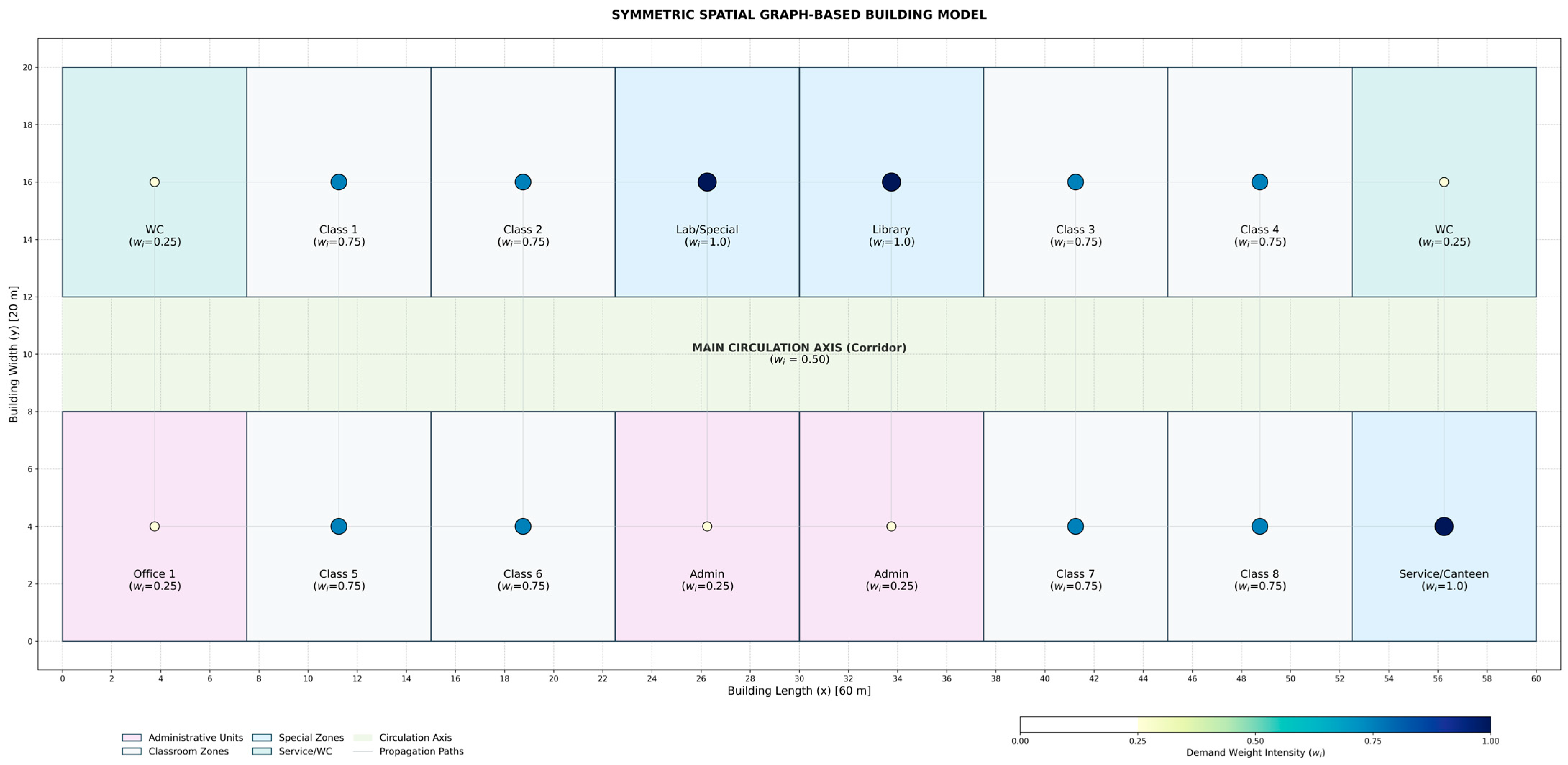
Figure 1.
Functional Graph-Based Representation and Spatial Demand Weighting of the Reference Building (generated by the author using Python, version 3.13.9, Python Software Foundation, Wilmington, DE, USA).
Figure 1.
Functional Graph-Based Representation and Spatial Demand Weighting of the Reference Building (generated by the author using Python, version 3.13.9, Python Software Foundation, Wilmington, DE, USA).
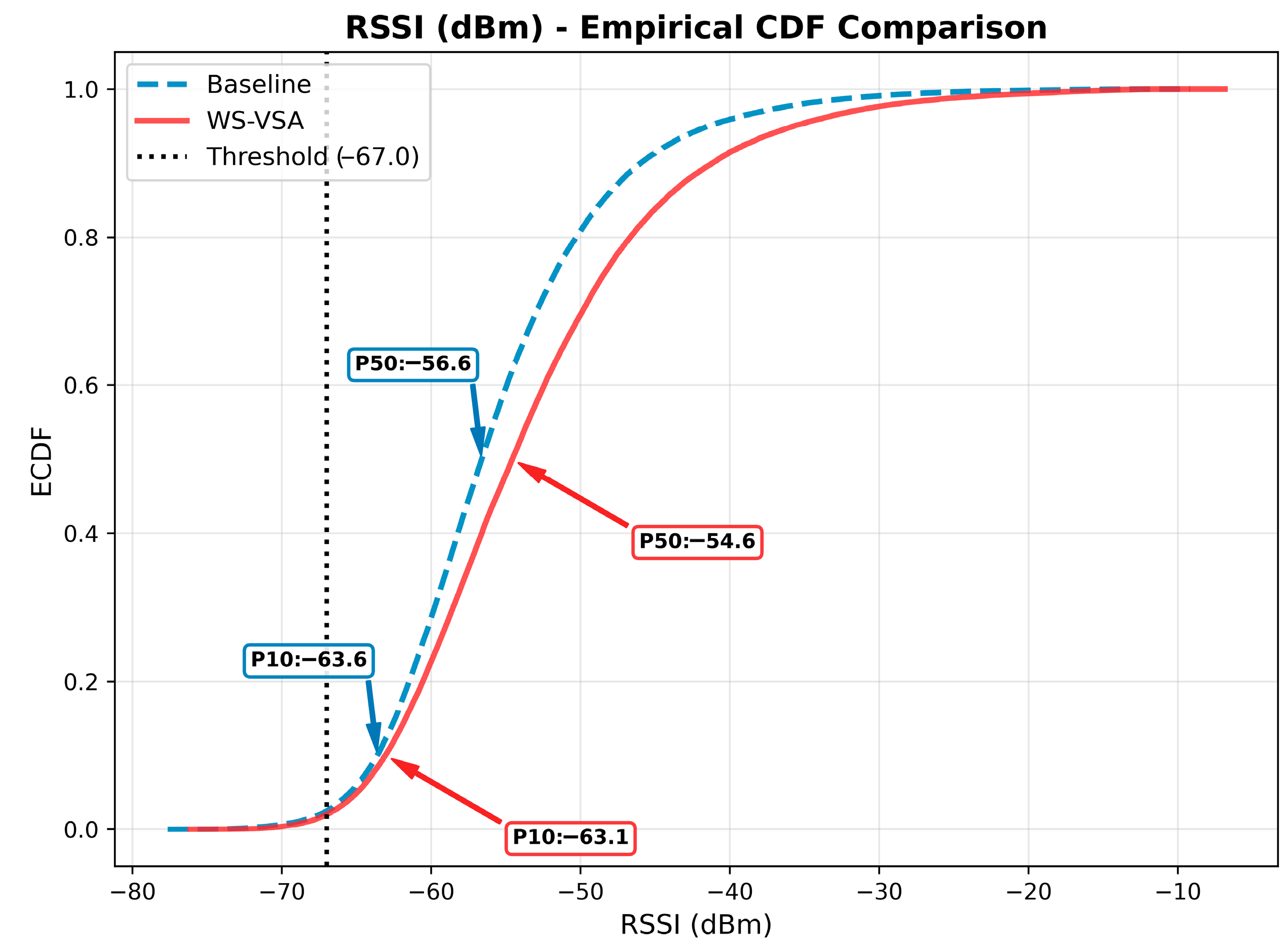
Figure 2.
ECDF of RSSI (dBm) with 10th percentile (P10) and median (P50) annotations. The WS-VSA strategy reduces the left-tail mass, indicating fewer dead zones compared to the Baseline.
Figure 2.
ECDF of RSSI (dBm) with 10th percentile (P10) and median (P50) annotations. The WS-VSA strategy reduces the left-tail mass, indicating fewer dead zones compared to the Baseline.
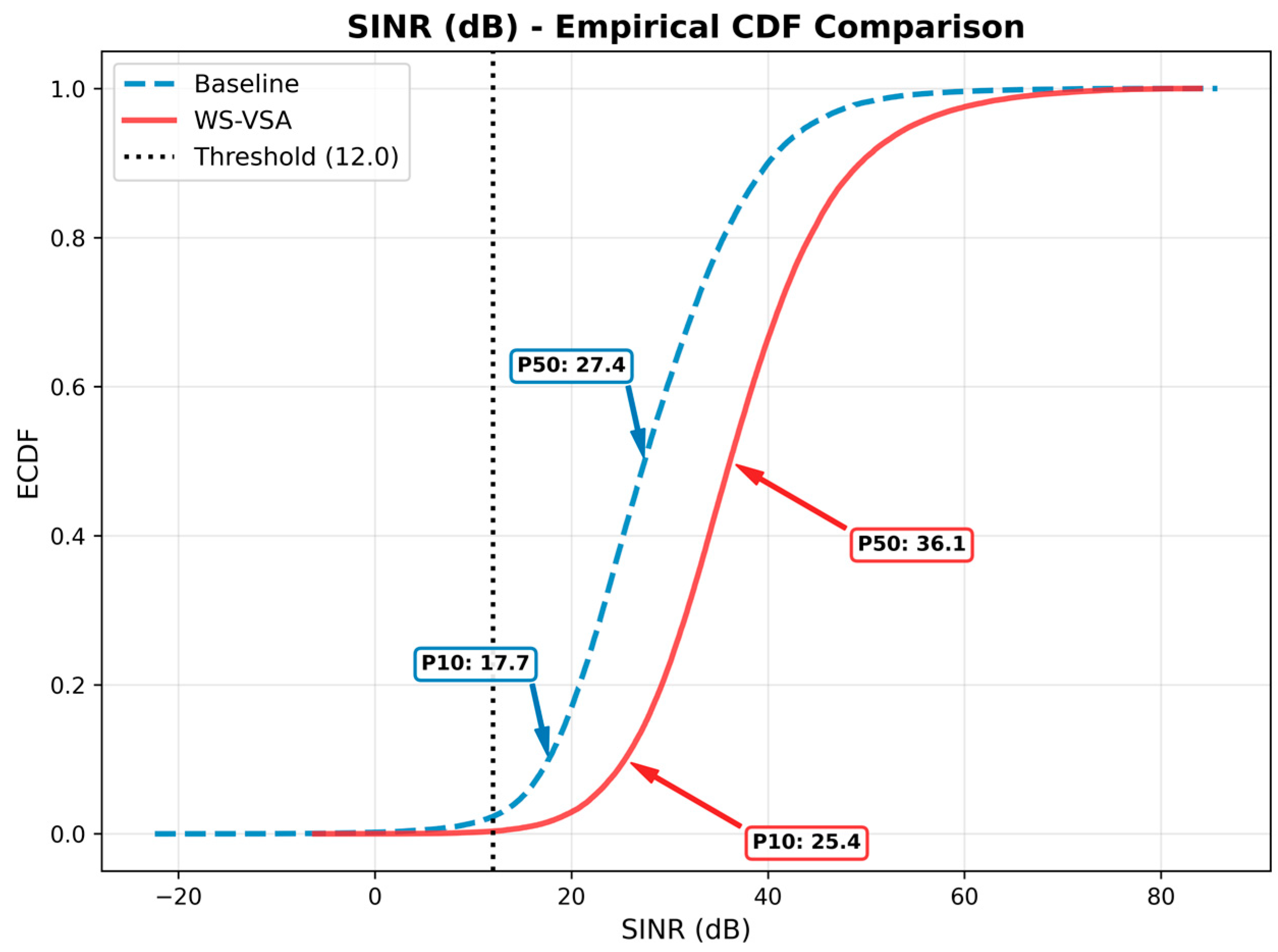
Figure 3.
ECDF of SINR (dB) highlighting P10 and P50 values. The pronounced shift in the WS-VSA curve underscores significant gains in interference robustness.
Figure 3.
ECDF of SINR (dB) highlighting P10 and P50 values. The pronounced shift in the WS-VSA curve underscores significant gains in interference robustness.
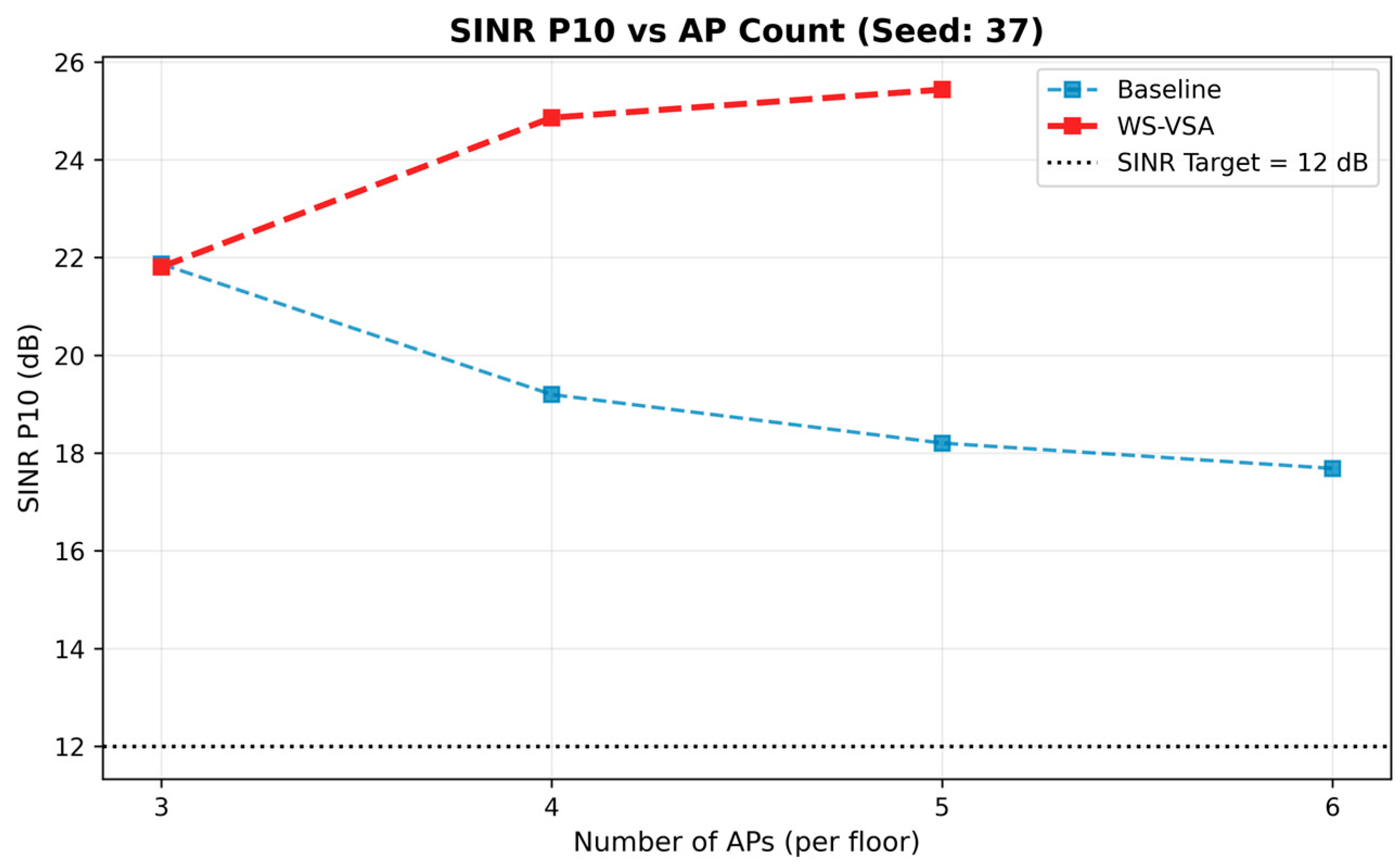
Figure 4.
SINR P10 versus AP count per floor for Baseline and WS–VSA strategies. The horizontal dashed line denotes the minimum SINR requirement (12 dB).
Figure 4.
SINR P10 versus AP count per floor for Baseline and WS–VSA strategies. The horizontal dashed line denotes the minimum SINR requirement (12 dB).
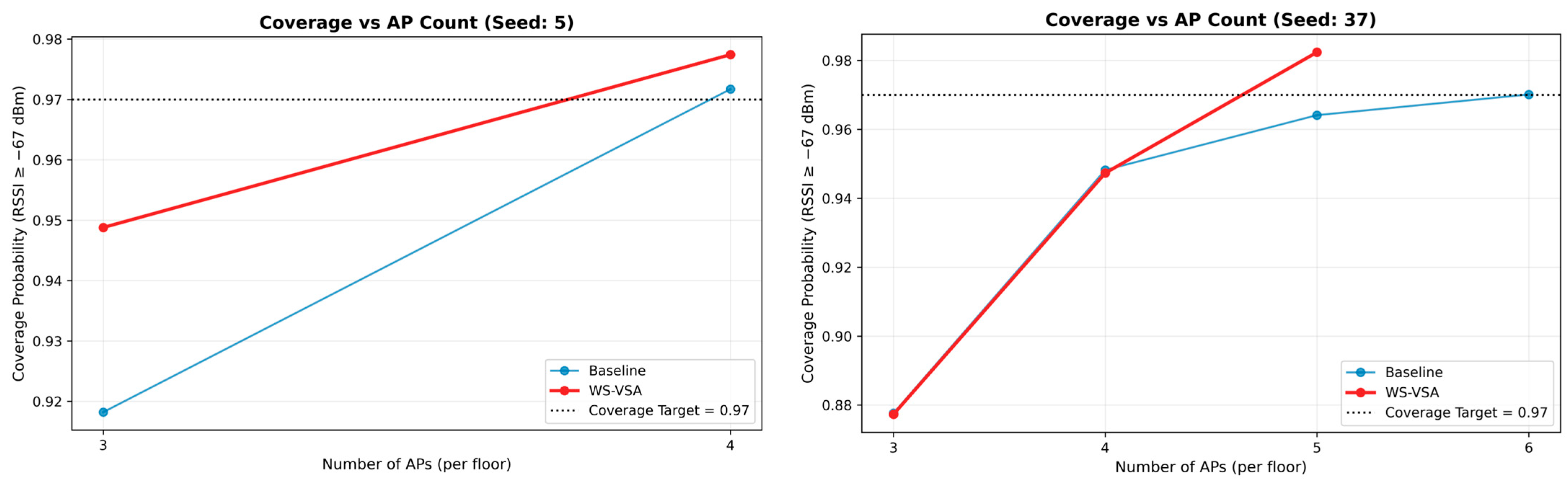
Figure 5.
Coverage probability (RSSI ≥ −67 dBm) versus AP count per floor. The dashed horizontal line represents the 97% coverage target.
Figure 5.
Coverage probability (RSSI ≥ −67 dBm) versus AP count per floor. The dashed horizontal line represents the 97% coverage target.
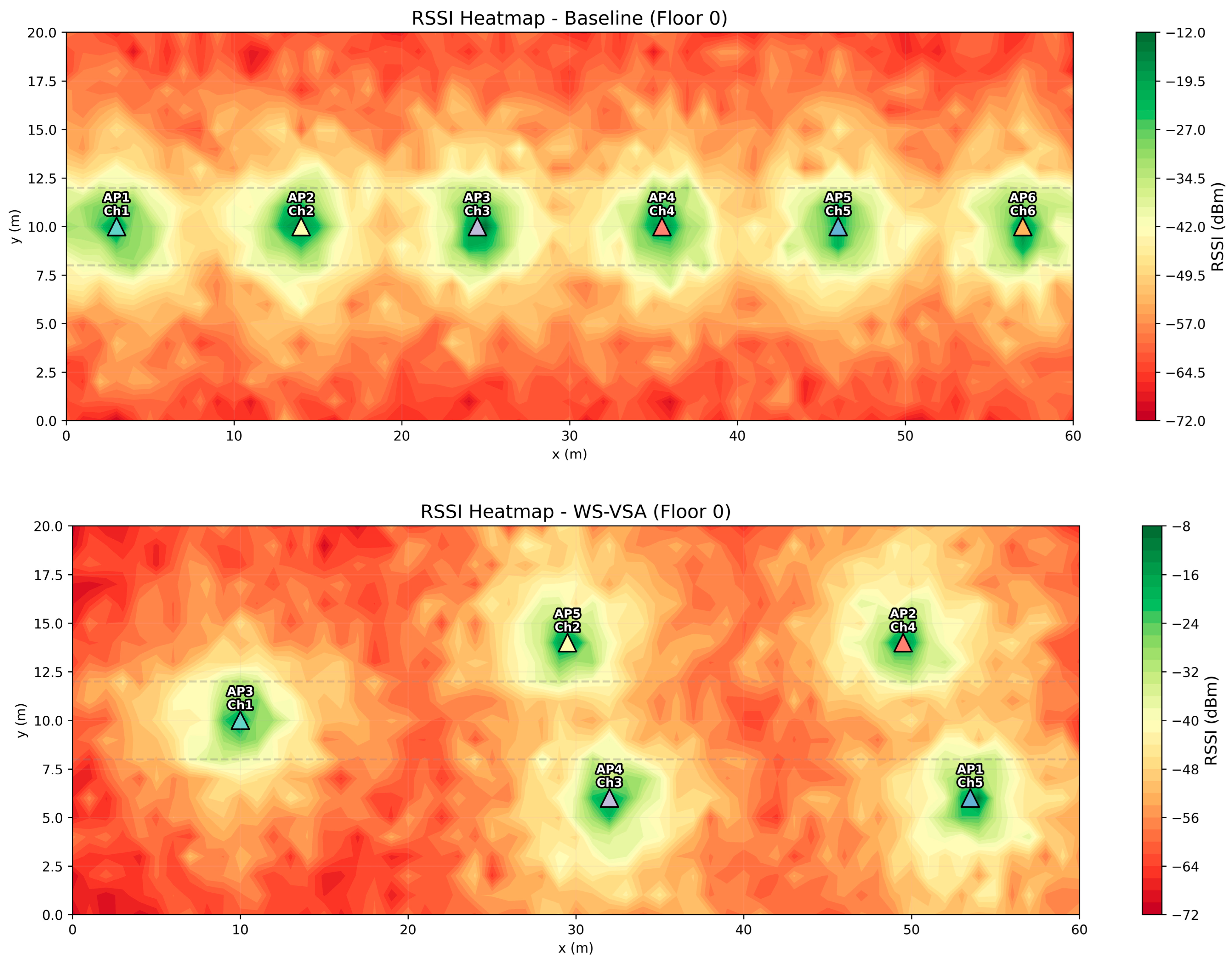
Figure 6.
RSSI (dBm) heatmaps for Floor 0 under both the Baseline and WS-VSA strategies. The dashed horizontal lines represent the corridor boundaries and internal wall structures.
Figure 6.
RSSI (dBm) heatmaps for Floor 0 under both the Baseline and WS-VSA strategies. The dashed horizontal lines represent the corridor boundaries and internal wall structures.
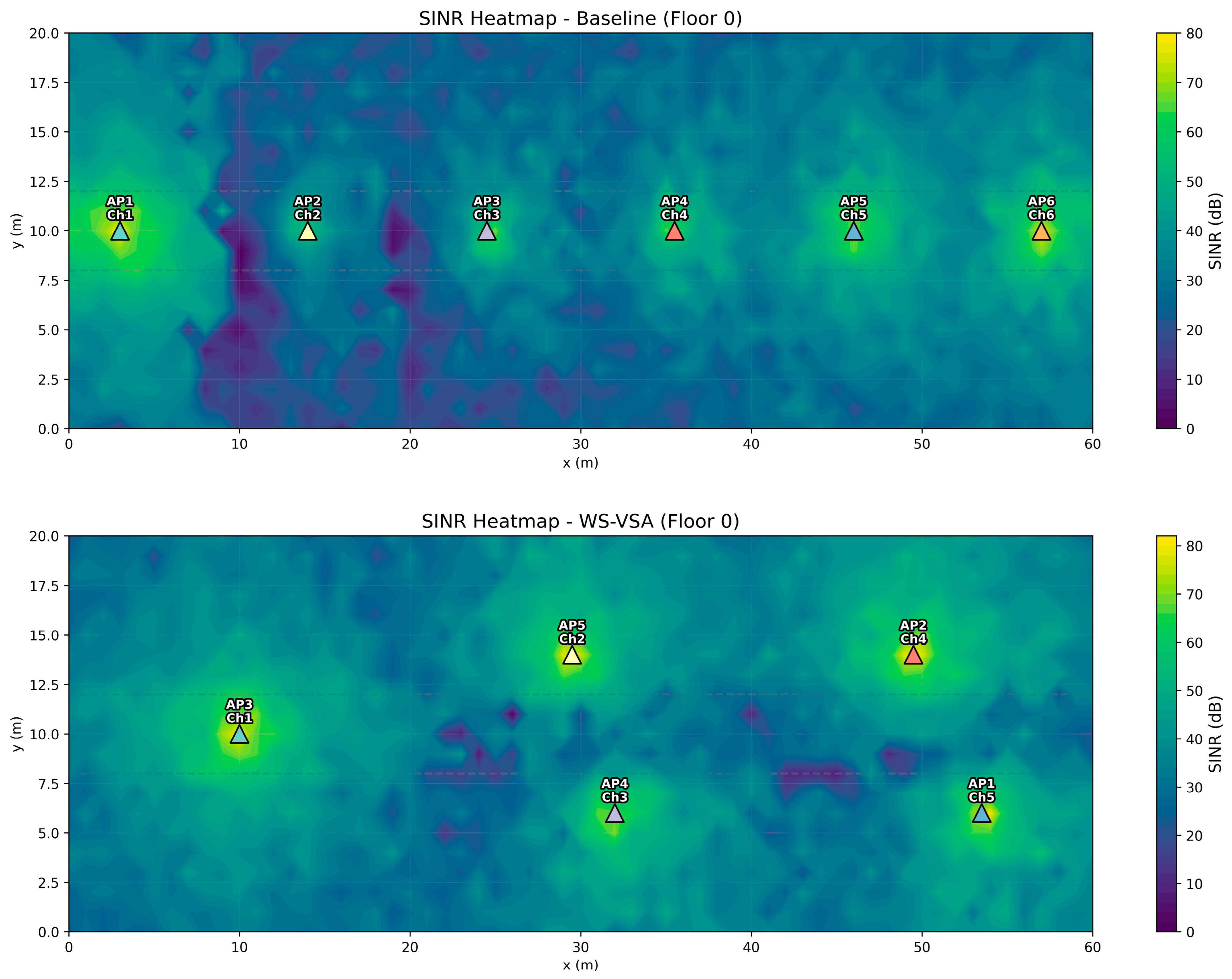
Figure 7.
Floor-0 SINR (dB) heatmaps for Baseline and WS-VSA methods. The dashed horizontal lines represent the corridor boundaries and internal wall structures.
Figure 7.
Floor-0 SINR (dB) heatmaps for Baseline and WS-VSA methods. The dashed horizontal lines represent the corridor boundaries and internal wall structures.
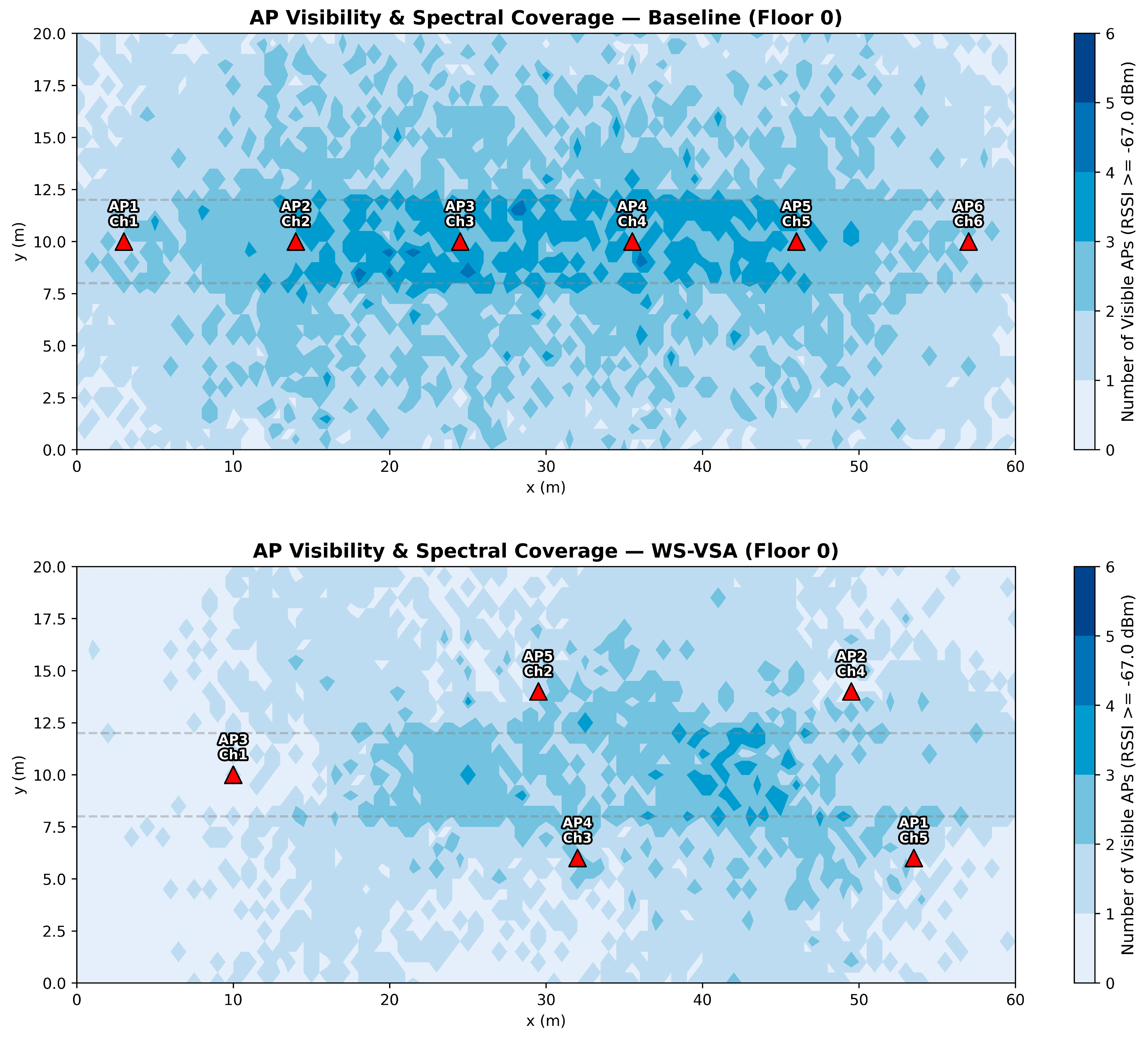
Figure 8.
AP visibility and spectral coverage analysis for Floor-0: Comparison between Baseline and WS-VSA methods. The dashed horizontal lines represent the corridor boundaries and internal wall structures.
Figure 8.
AP visibility and spectral coverage analysis for Floor-0: Comparison between Baseline and WS-VSA methods. The dashed horizontal lines represent the corridor boundaries and internal wall structures.
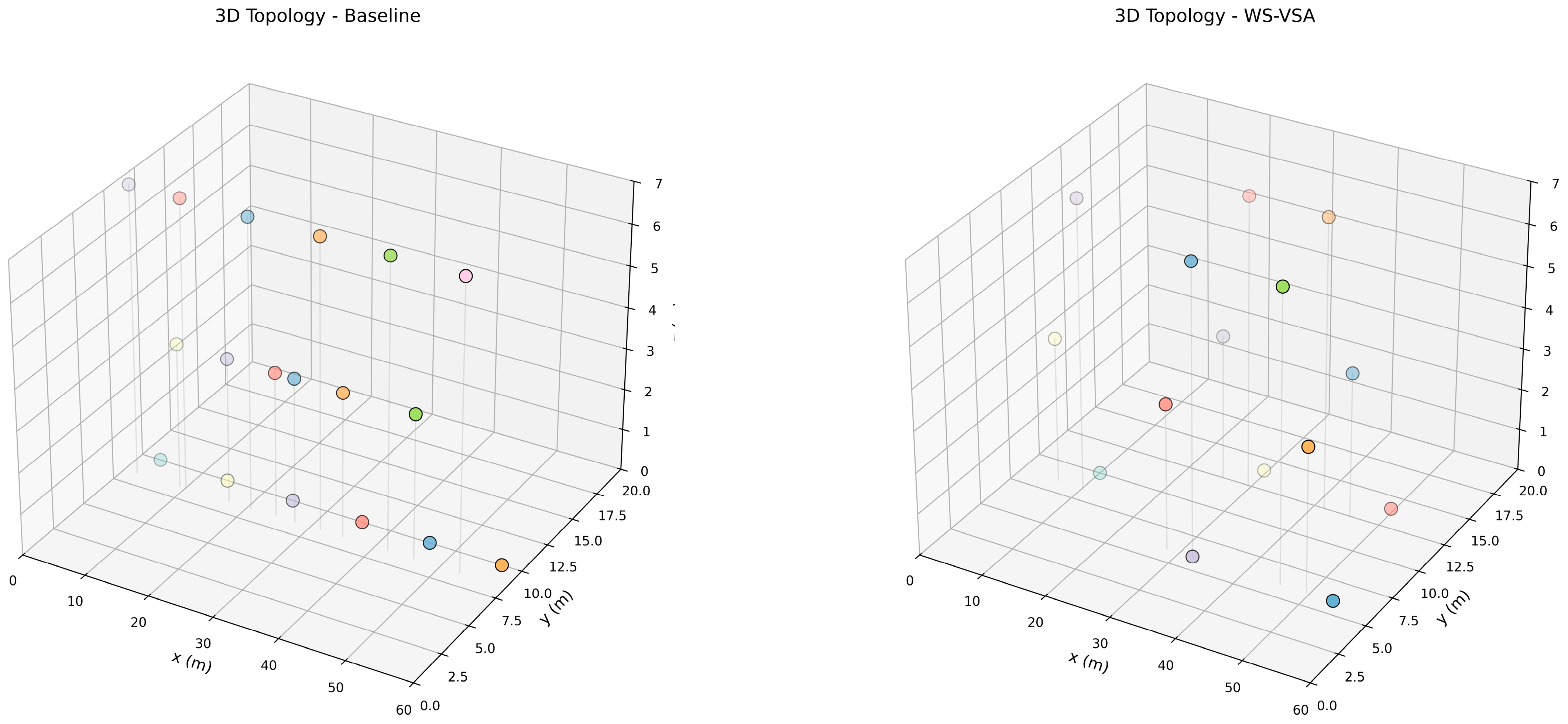
Figure 9.
3D AP deployment topology for Baseline and WS-VSA methods. The different colors of the nodes represent the various Wi-Fi channel assignments used to minimize co-channel interference within the 3D building environment.
Figure 9.
3D AP deployment topology for Baseline and WS-VSA methods. The different colors of the nodes represent the various Wi-Fi channel assignments used to minimize co-channel interference within the 3D building environment.
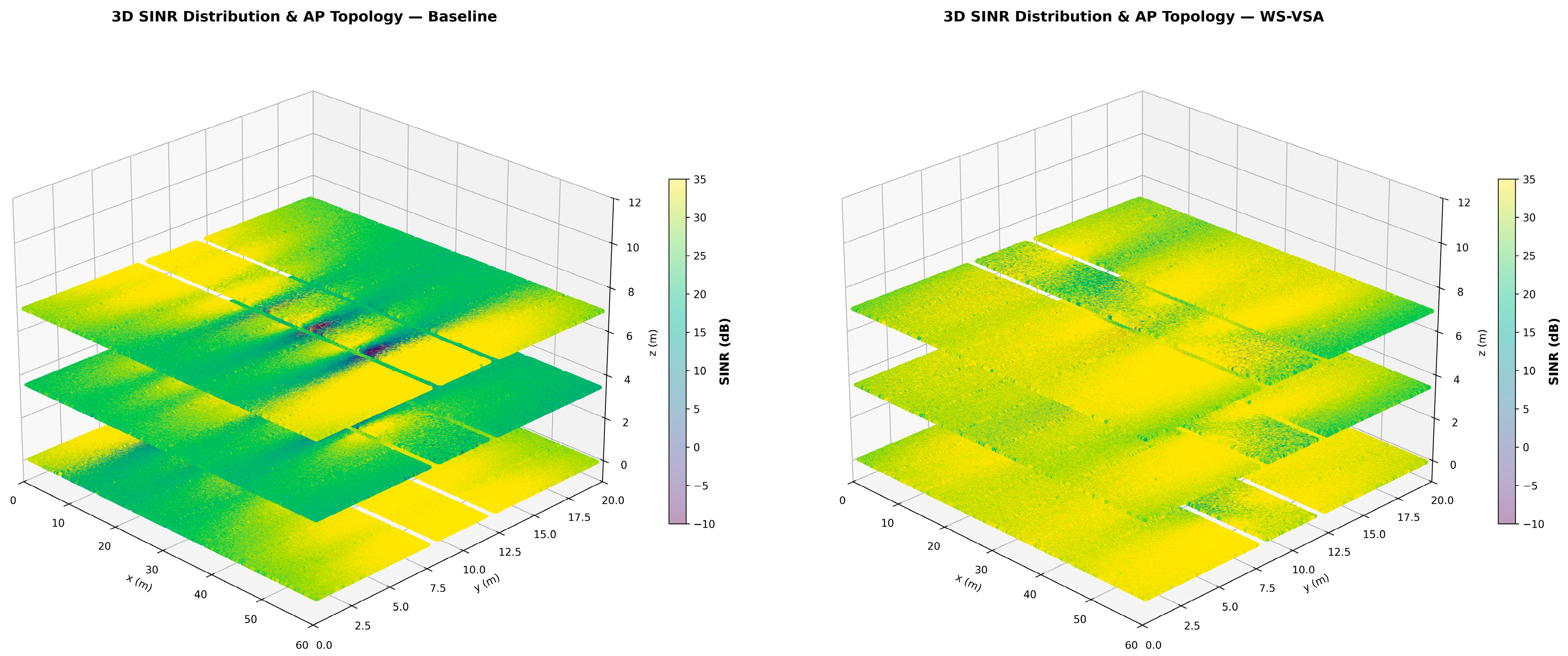
Figure 10.
3D volumetric SINR distribution for Baseline and WS-VSA methods.
Figure 10.
3D volumetric SINR distribution for Baseline and WS-VSA methods.
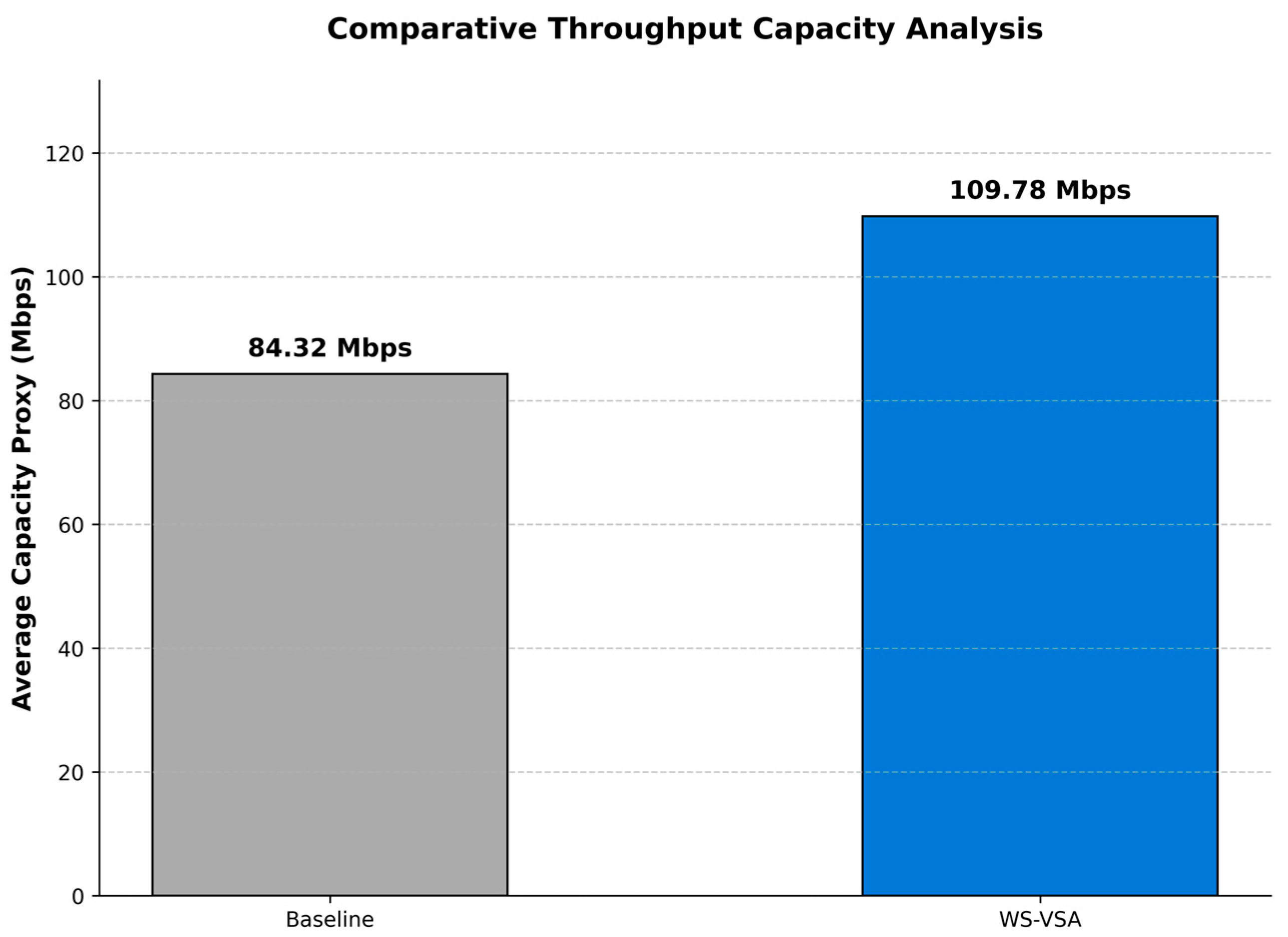
Figure 11.
Comparison of average system-level network capacity for Baseline and WS-VSA methods (bar heights represent median performance).
Figure 11.
Comparison of average system-level network capacity for Baseline and WS-VSA methods (bar heights represent median performance).
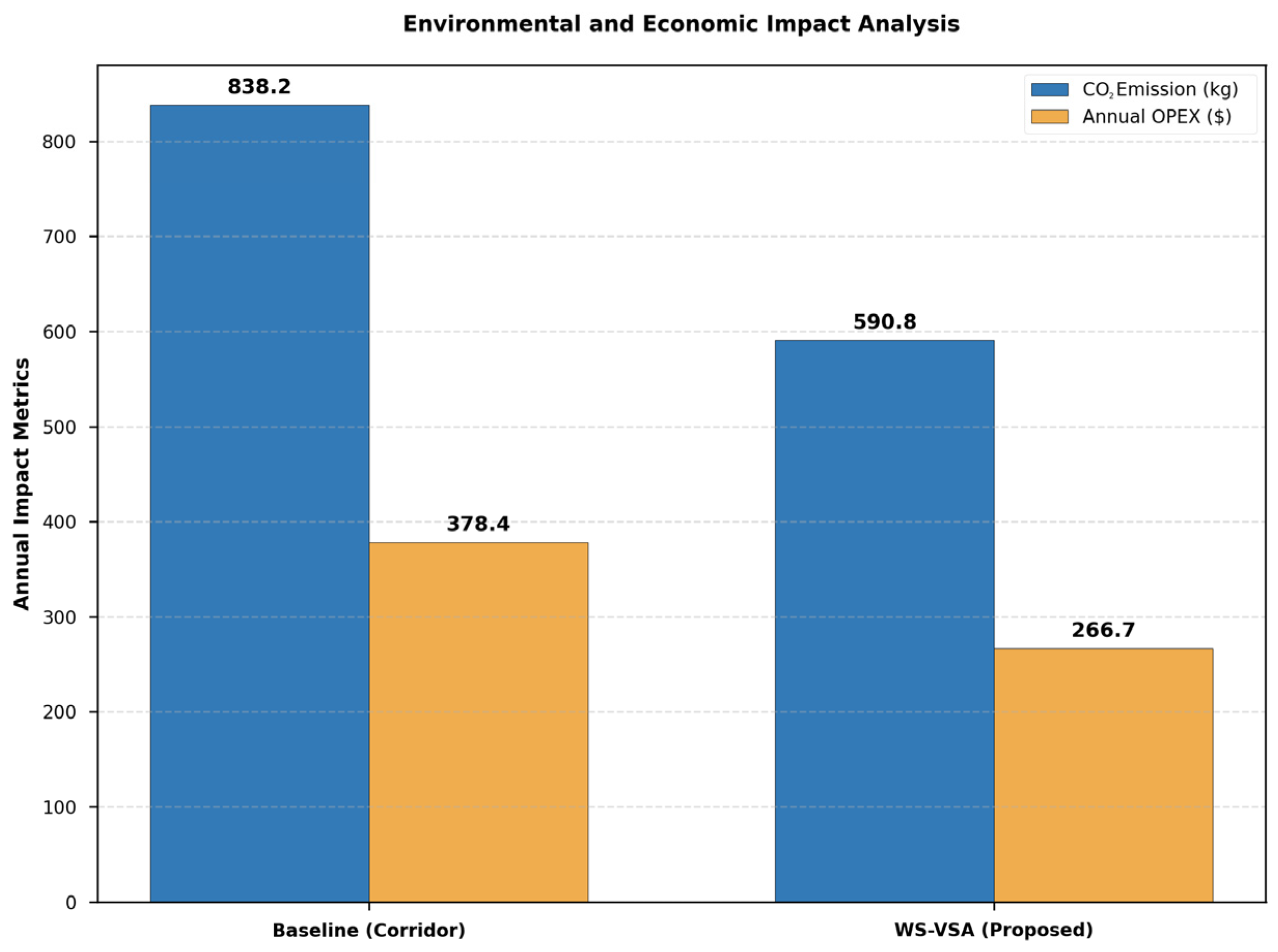
Figure 12.
Comparison of annual carbon emissions and operational expenditures for Baseline and WS-VSA approaches.
Figure 12.
Comparison of annual carbon emissions and operational expenditures for Baseline and WS-VSA approaches.
Figure 13.
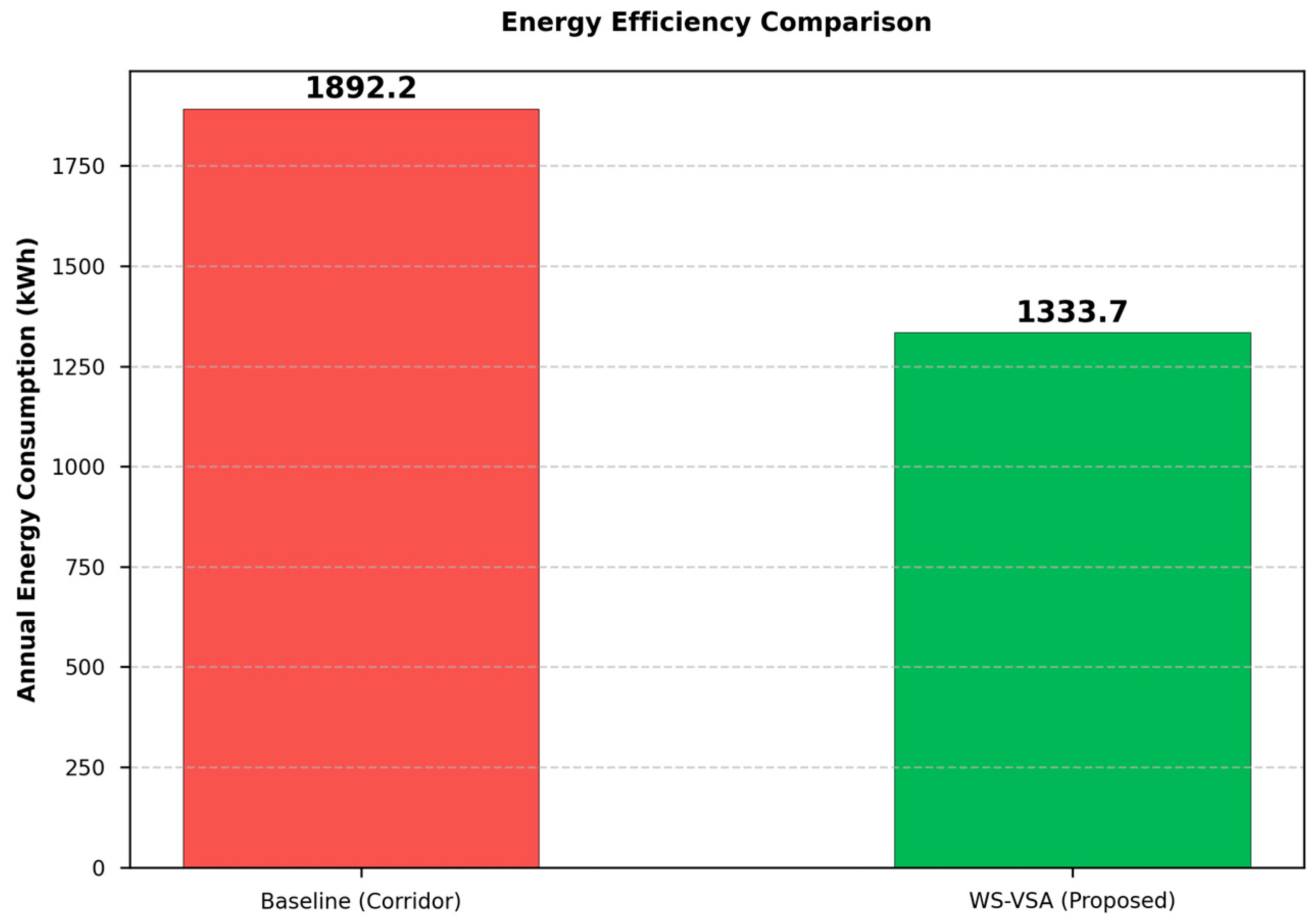
Comparison of annual energy consumption across scenarios.
Figure 13.
Comparison of annual energy consumption across scenarios.
Figure 14.
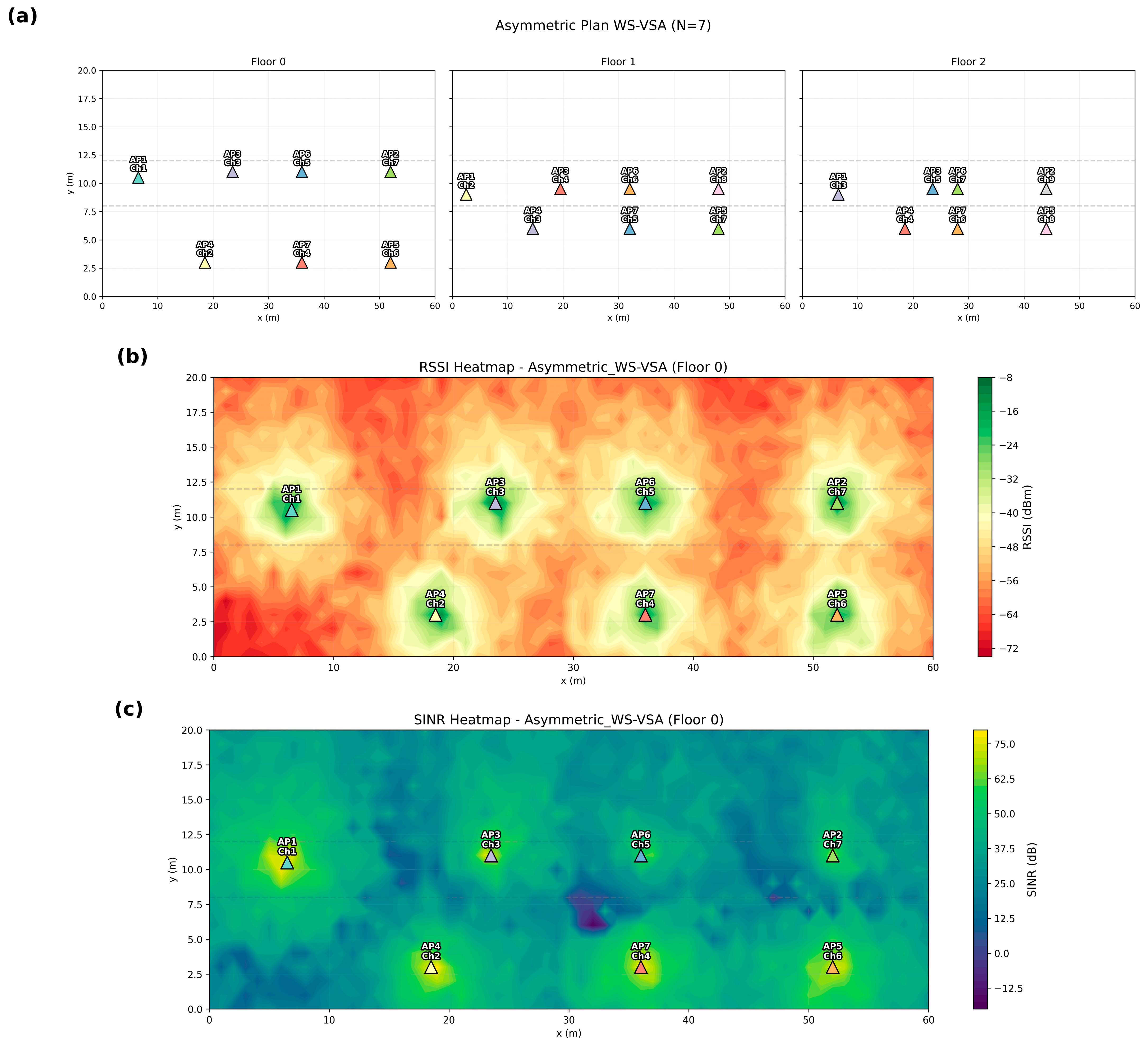
Multi-floor performance evaluation of the proposed WS-VSA framework under a realistic asymmetric building scenario. (a) 3D AP layout and channel assignment demonstrating the algorithm’s adaptive placement across irregular zone shapes (N = 7). (b) The resulting RSSI heatmap on the ground floor (Floor 0), ensuring comprehensive connectivity coverage despite the off-center corridor. (c) The corresponding SINR heatmap on the ground floor, proving the effectiveness of the vertical staggering mechanism in mitigating co-channel interference within non-uniform architectural structures. The dashed horizontal lines represent the corridor boundaries and internal wall structures.
Figure 14.
Multi-floor performance evaluation of the proposed WS-VSA framework under a realistic asymmetric building scenario. (a) 3D AP layout and channel assignment demonstrating the algorithm’s adaptive placement across irregular zone shapes (N = 7). (b) The resulting RSSI heatmap on the ground floor (Floor 0), ensuring comprehensive connectivity coverage despite the off-center corridor. (c) The corresponding SINR heatmap on the ground floor, proving the effectiveness of the vertical staggering mechanism in mitigating co-channel interference within non-uniform architectural structures. The dashed horizontal lines represent the corridor boundaries and internal wall structures.
Table 1.
Physical and structural parameters of the reference building.
Table 1.
Physical and structural parameters of the reference building.
| Parameter | Value/Description |
|---|
| Building Topology | Standard Multi-Story Public Service Building |
| Total built-up area | ~3600 m2 |
| Number of floors | 3 |
| Floor-to-floor height | 3.5 m |
| Floor Layout | Symmetrical 16-unit grid per floor block |
| External wall material | Reinforced concrete (25 cm) |
| Internal partition material | Brick masonry/hollow clay tile (15 cm) |
| Floor slab material | Reinforced concrete |
| WAF (external wall) | 12–15 dB |
| WAF (internal wall) | 4–6 dB |
| Floor slab attenuation | 18–25 dB |
| Log-normal Path Loss Exponent (η) | 2.8–3.2 (Indoor mixed environment) |
Table 2.
User–Demand weighting parameters for functional zones.
Table 2.
User–Demand weighting parameters for functional zones.
| Zone Type | User Density (Ui) | Service Coefficient (Di) | Normalized Weight (wi) |
|---|
| High Demand (Lab) | 25–30 | 1.00 | 0.90–1.00 |
| Standard Areas (Classrooms) | 20–25 | 0.75 | 0.65–0.85 |
| Administrative Offices | 5–10 | 0.25 | 0.15–0.30 |
| Circulation (Corridors, Lobbies) | 10–15 | 0.40 | 0.30–0.45 |
Table 3.
Indoor Propagation and RF Parameters.
Table 3.
Indoor Propagation and RF Parameters.
| Parameter | Symbol/Value | Source/Justification |
|---|
| Reference distance | d0 = 1 m | Standard indoor reference distance [14] |
| Reference path loss | PL(d) = 46 dB | ITU-R P.1238-14 indoor model [19] |
| Path loss exponent | n = 2.8–3.2 | Mixed indoor public buildings [19,20] |
| Transmit power | Ptx = 20 dBm | Typical enterprise WLAN configuration [40] |
| Transmit antenna gain | Gtx = 2 dBi | Ceiling-mounted AP antenna |
| Receive antenna gain | Grx = 0 dBi | Mobile user device |
| External wall attenuation | WAFeff = 12–15 dB | Reinforced concrete walls [19,41] |
| Internal wall attenuation | WAFeff = 4–6 dB | Brick masonry/partitions [19] |
| Floor slab attenuation | Lf = 18–25 dB | Reinforced concrete floor slabs [14,22] |
| Miscellaneous losses | Lmisc = 2 dB | Feeder and implementation margin |
| Thermal noise power | N0 = −94 dBm | 20 MHz channel, room temperature |
| RSSI service threshold | τ = −67 dBm | Enterprise WLAN coverage target |
| Design margin | M = 6 dB | Shadowing and modeling uncertainty |
Table 4.
Representative mapping of SINR thresholds to MCS.
Table 4.
Representative mapping of SINR thresholds to MCS.
| Minimum SINR (dB) | Modulation | Coding Rate | Efficiency/Impact |
|---|
| <10 | BPSK | 1/2 | Minimum basic connectivity |
| ≥10 | QPSK | 1/2 | Low-tier data rate |
| ≥15 | 16-QAM | 1/2 | Mid-tier data rate |
| ≥20 | 64-QAM | 2/3 | High-tier data rate |
| ≥25 | 64-QAM | 5/6 | Very high data rate |
| ≥30 | 256-QAM | 3/4 | Peak spectral efficiency |
Table 5.
Parameters and derived bounds for AP count determination per floor.
Table 5.
Parameters and derived bounds for AP count determination per floor.
| Item | Symbol/Value | Notes (Assumption) |
|---|
| Floor dimensions | L × W = 60 × 20 m | Public-service standard floor |
| Floor area | Afloor = 1200 m2 | Derived from floor dimensions |
| Service RSSI threshold | τ = −67 dBm | Enterprise WLAN coverage target |
| Tx power/antenna gains | Ptx = 20 dBm | Typical enterprise AP configuration |
| Path loss exponent | n = 3.0 | Indoor mixed environment [16,24] |
| Effective WAF | ΣWAFeff = 18 dB | Worst-case room-edge penetration |
| Floor slab attenuation | Lf = 20 dB | Reinforced concrete floor slabs [18,19] |
| Miscellaneous losses | Lmisc = 2 dB | Feeder and implementation margin |
| Design margin | M = 6 dB | Shadowing and modeling uncertainty |
| Derived service radius | r ≈ 7.1 m | From RSSI constraint from link budget |
| Area efficiency factor | ηA = 0.55 | Corridor–room topology inefficiency |
| Coverage-based AP bound | Ncov | Dominant constraint ⌈A/(ηA·π·r2)⌉ From Equation (5) |
| Maximum users per floor | Umax = 100 | Peak public building occupancy [40] |
| Concurrent activity | α = 0.5 | Conservative peak activity [40] |
| Per-user target | Ru = 5 Mbps | Digitalization service requirement |
| Required floor throughput | Rreq = 250 Mbps | (Umax · α · Ru) From Equation (6) |
| Effective AP capacity | CAP = 120 Mbps | Dense WLAN conservative estimate |
| Capacity-based AP bound | Ncap | ⌈Rreq/CAP⌉ From Equation (7) |
| Minimum feasible AP count | NAP | max(Ncov,Ncap) |
| Search margin | Δ = 10 | Practical over-provisioning range |
| Evaluated AP range | N | Simulation search space |
Table 6.
KPIs for radio performance and sustainability evaluation.
Table 6.
KPIs for radio performance and sustainability evaluation.
| Metric | Symbol/Indicator | Primary Objective |
|---|
| Coverage ratio | CR (RSSI ≥ τ) | Minimum connectivity assurance |
| Signal quality | SINR (P10, P50) | Interference robustness and fairness |
| Service capability | Capacity proxy (mean, P90) | Relative throughput comparison |
| Hardware efficiency | NAP count | Infrastructure consolidation and CAPEX savings |
| Operational energy | EWLAN | Building-scale energy performance |
| Carbon emissions | CO2,WLAN | Environmental impact, Annual CO2 emissions (kg) |
| Operating cost | OPEXWLAN | Operational operating cost management, Annual electricity cost ($) |
Table 7.
Comparative Radio Performance Statistics (Median values over 50 runs).
Table 7.
Comparative Radio Performance Statistics (Median values over 50 runs).
| Metric | Indicator | Baseline | WS–VSA | Improvement |
|---|
| Coverage | Ratio (RSSI ≥ −67 dBm) | 97.55% | 97.95% | +0.40% |
| Signal Strength | Median RSSI | −54.2 dBm | −51.8 dBm | +2.4 dB |
| Interference | SINR P10 (Edge Users) | 17.66 dB | 25.53 dB | +7.87 dB |
| SINR P50 (Median Users) | 28.40 dB | 34.10 dB | +5.70 dB |
Table 8.
Building-Wide Performance Comparison (Median over 50 Seeds).
Table 8.
Building-Wide Performance Comparison (Median over 50 Seeds).
| Metric | Baseline | WS-VSA | Relative Change (%) |
|---|
| AP Count (Per Floor/Total) | 6/18 | 5/15 | −16.7% |
| Coverage Probability (≥−67 dBm) | 97.55% | 97.95% | +0.4% |
| Robustness SINR P10 (dB) | [CI: 16.9–18.4] 17.66 | [CI: 24.8–26.1] 25.53 | +44.6% |
| Average Capacity Proxy (Mbps) | 84.62 | 110.54 | +30.6% |
| Annual CO2 Emissions (kg) | 838.23 | 590.83 | −29.5% |
| Annual Energy Consumption (kWh) | 1892.16 | 1333.71 | −29.5% |
| Annual OPEX ($) | 378.43 | 266.74 | −29.5% |
Table 9.
Quantitative sensitivity analysis of the WS-VSA framework under ±20% variations in WAF, maximum user density, and AP power consumption.
Table 9.
Quantitative sensitivity analysis of the WS-VSA framework under ±20% variations in WAF, maximum user density, and AP power consumption.
| Parameter Variation | SINR P10 (dB) | Throughput (Mbps) | Annual Energy (kWh) |
|---|
| Baseline (WS-VSA) | 24.56 | 108.68 | 1111.42 |
| WAF +20% | 25.31 | 110.97 | 1111.42 |
| WAF −20% | 23.66 | 106.09 | 1111.42 |
| User Density ±20% | 24.56 | 108.68 | 1111.42 |
| AP Power +20% | 24.56 | 108.68 | 1333.71 |
| AP Power −20% | 24.56 | 108.68 | 889.14 |