Review

Evaluation of Biomass Softwood Composites: Structural Features and Functional Properties of Advanced Engineered Wood


by
Ria Aniza
1,2,3,
Anelie Petrissans
1,*,
Mathieu Petrissans
1,*,
Erlan Rosyadi
4,
Hana Nabila Anindita
4,
Tyas Puspita Rini
4,
Zulaicha Dwi Hastuti
4,
Nurdiah Rahmawati
4,
Bralin Dwiratna
4,
Ena Marlina
5,
Akhmad Faruq Alhikami
5,6 and
I Dewa Ayu Agung Warmadewanthi
3,7
1
Laboratoire d’Etudes et de Recherche sur le Matériau Bois, INRAE, Université de Lorraine, F88000 Epinal, France
2
International Doctoral Degree Program in Energy Engineering, National Cheng Kung University, Tainan 701, Taiwan
3
Department of Environmental Engineering, Institut Teknologi Sepuluh Nopember, Jalan Teknik Kimia, Sukolilo, Surabaya 60111, Indonesia
4
Research Center for Energy Conversion and Conservation, National Research and Innovation Agency, Tangerang Selatan 15314, Indonesia
5
Department of Mechanical Engineering, Universitas Islam Malang, Malang 65144, Indonesia
6
Department of Mechanical Engineering, Universitas Brawijaya, Malang 65155, Indonesia
7
Research Center for Sustainable Infrastructure and Environment, Institut Teknologi Sepuluh Nopember, Jalan Teknik Kimia, Sukolilo, Surabaya 60111, Indonesia
*
Authors to whom correspondence should be addressed.
Forests 2025, 16(12), 1823; https://doi.org/10.3390/f16121823
Submission received: 21 October 2025 / Revised: 27 November 2025 / Accepted: 29 November 2025 / Published: 5 December 2025
(This article belongs to the Special Issue Wood Testing, Processing and Modification)

Abstract

Softwood-based composites are increasingly used in structural and nonstructural applications owing to their renewability, cost-effectiveness, and favorable strength-to-weight performance. This study applies a systematic literature review and comparative analysis, drawing on approximately 140 sources, to synthesize current knowledge on the physicochemical, mechanical, thermal, and environmental characteristics of engineered wood products derived from softwood species. The intrinsic lignocellulosic composition of softwood, comprising roughly 40%–45% cellulose, 25%–30% hemicelluloses (with mannose as the predominant sugar), and 27%–30% lignin, strongly influences hydrophilicity, stiffness, and thermal behavior. Mechanical properties vary across engineered wood product classes; for example, plywood exhibits a modulus of rupture of 33.72–42.61 MPa and a modulus of elasticity of 6.96–8.55 GPa. Microstructural and spectroscopic analyses highlight the importance of fiber–matrix interactions, chemical bonding, and surface modifications in determining composite performance. Emerging advanced materials, such as scrimber, with densities of 800–1390 kg/m3, and fluorescent transparent wood, achieving optical transmittance above 70%–85%, demonstrate the expanding functional potential of softwood-based composites. Sustainability assessments indicate that coatings, flame-retardants, and adhesives may contribute to volatile organic compound emissions, emphasizing the need for lower-emission, bio-based alternatives. Overall, the findings of this systematic review show that softwood-based composites deliver robust, quantifiable performance advantages and hold strong potential to meet the rising demand for sustainable, low-carbon engineered materials.

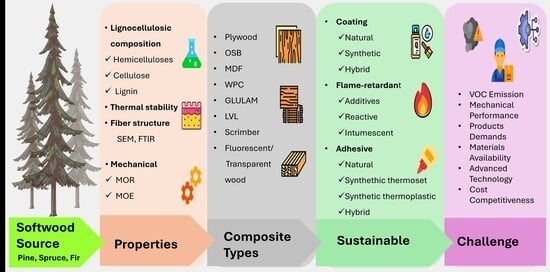
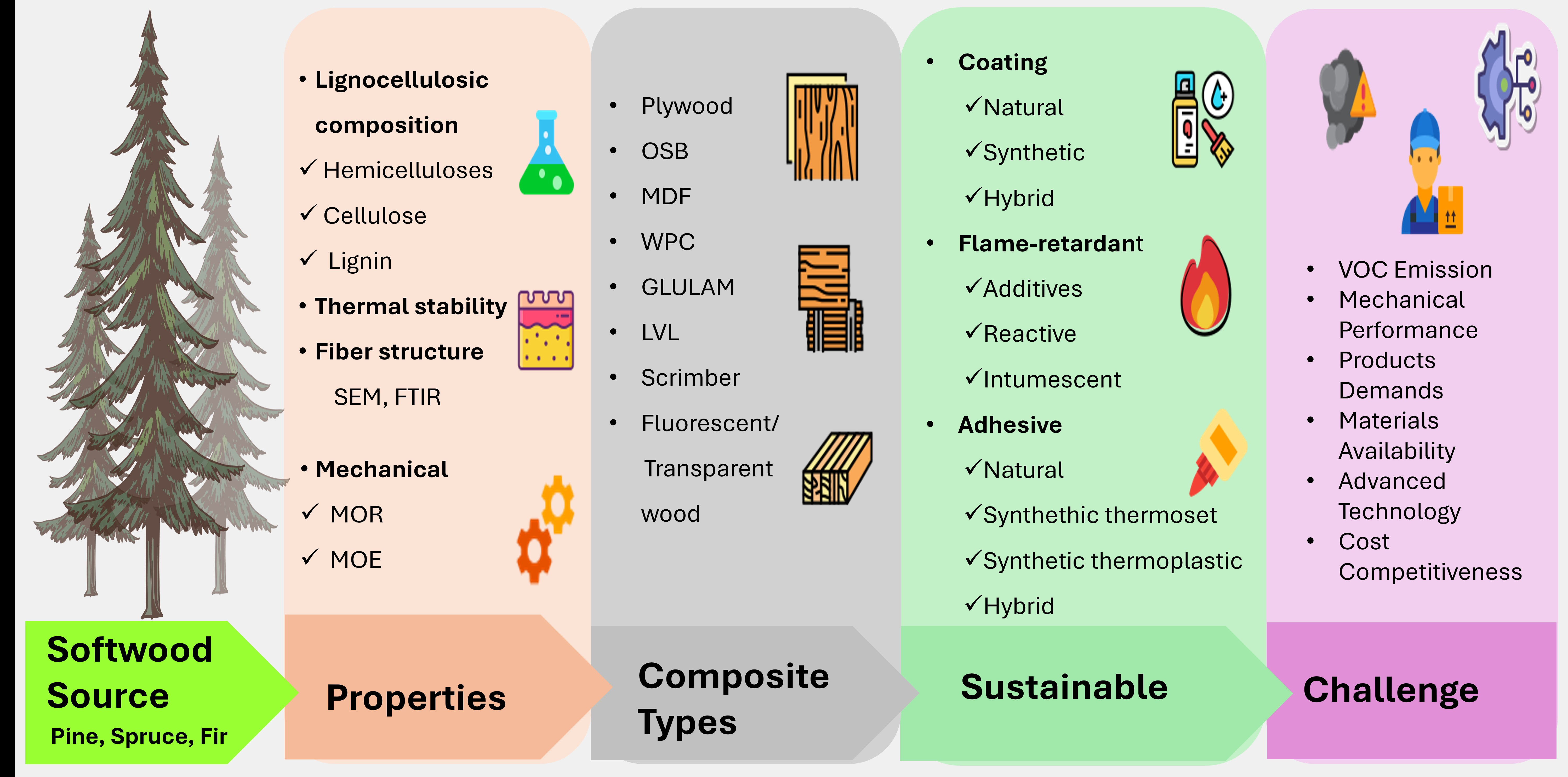
Graphical Abstract

1. Introduction

Timber, or wood, is an organic material derived from woody biomass and constitutes a fundamental component of forest products. Wood is generally classified into hardwood and softwood according to botanical origin, based on whether the seeds have a protective ovary [1,2]. Hardwoods are derived from angiosperms, comprising deciduous broadleaved species, whereas softwoods originate from gymnosperms, typically evergreen coniferous species [2,3]. Hardwoods are often preferred for applications requiring superior strength, durability, and aesthetic quality; however, they are generally more expensive and challenging to process. In contrast, softwoods provide a cost-effective and versatile alternative due to their ease of handling and adaptability for diverse applications. Globally, the distribution of hardwood and softwood species is relatively balanced. Broadleaved trees (hardwoods) constitute approximately 56% of the world’s tree population, whereas needle-leaved trees—used as a proxy for softwoods—account for roughly 44%. These estimates are based on the number of individual trees rather than forest area, with broadleaved species comprising 29% evergreen and 27% deciduous trees and needle-leaved species comprising 38% evergreen and 5% deciduous trees [4].
Softwood is widely used in construction [5,6,7], furniture [8,9], and fuelwood applications [10,11,12] due to its affordability and versatility. Softwood products from coniferous species, such as pine, spruce, and fir, form the backbone of the forestry and wood-processing sectors [13,14]. In commercial practice, softwoods are often harvested earlier than hardwoods; for example, pine rotations of 30–40 years are common, whereas hardwoods typically require around 80 years to reach harvestable size [15,16]. Although certain fast-growing softwood species allow even shorter rotations, the resulting wood may have reduced structural performance [17]. Nonetheless, the relatively short growth cycles of selected softwoods, along with their light weight and ease of processing, make them well suited for engineered composites. Moreover, softwoods provide a renewable resource capable of yielding a wide range of derivatives [18].
The increasing demand for sustainable and versatile construction materials has positioned engineered wood products (EWPs) as a critical component of modern industrial and architectural practices. Softwood-based composites, in particular, have gained significant attention due to their widespread availability, cost-effectiveness, and adaptability for specific applications [19]. These composites optimize the use of wood by-products—such as chips, sawdust, and shavings—that are often treated as waste in conventional timber industries, thereby reducing waste while creating high-value products from low-cost resources.
EWPs, including plywood, oriented strand board (OSB), medium-density fiberboard (MDF), glued laminated timber (glulam), and laminated veneer lumber (LVL), represent significant advances in material science. These products are manufactured by bonding wood fibers, particles, or veneers using adhesives, resins, or mechanical pressure to achieve uniformity and enhanced properties [20,21]. According to recent industry and regional studies, the majority of engineered wood products are manufactured from softwood species. Market analysis by Mordor Intelligence [22] reports that softwood constituted ~71.5% of the engineered wood market in 2024. Regional data and reviews [23,24] confirm that in Europe and North America, EWPs such as plywood, OSB, glulam, LVL, and cross-laminated timber (CLT) are predominantly produced from softwoods (pine, spruce, fir). At the same time, a European Union (EU) impact scan [25] shows that EWPs currently use a relatively small share (~3.6%, ≈18.5 million m3) of the total roundwood in Europe, reflecting that EWP production is growing but represents a minority of roundwood use. By leveraging softwood as a primary raw material, modern composites overcome limitations inherent in solid wood, such as inconsistent grain patterns, moisture susceptibility, and structural weaknesses.
Softwood-based composites are now widely applied in both structural and nonstructural contexts. Understanding their inherent properties is essential for optimizing design and performance. This study reviews the characterization and properties of softwood-based composites, including their chemical and mechanical attributes, the effects of treatments, such as coatings and flame retardants, and their influence on composite performance. By synthesizing scattered information from prior studies, this review provides a comprehensive overview of softwood composites, addressing challenges, future directions, and their potential to meet contemporary demands for sustainable, durable, and adaptable materials. This work is intended to benefit researchers, practitioners, academia, and industrial professionals interested in the development and application of softwood-based composites.

2. Characterization of Softwood-Based Composites

Softwood composite refers to the composite material primarily composed of softwood and other components, such as resin and plastic. The characterization of softwood-based composites focuses on two factors: the character of softwood and the complementary material. The characterization of softwood-based composites involves a thorough analysis of their physical, mechanical, thermal, and chemical properties. These properties are influenced by factors such as the type of softwood used, the particle size and orientation, the adhesive or binder composition, and the manufacturing process. For example, composites with oriented fibers, such as OSB, exhibit higher tensile and flexural strength compared to randomly oriented counterparts like particleboard [26]. Advances in material testing and analytical techniques have enabled researchers to better understand the microstructural behavior of these composites. Methods such as scanning electron microscopy (SEM), X-ray diffraction (XRD), and thermal analysis provide insights into the bonding mechanisms and degradation pathways of engineered wood products [27]. These characterizations form the basis for improving product performance and longevity.

2.1. Physicochemical Properties

The chemical properties of softwood composite depend on two main factors, including the characteristics of softwood polymer and the complementary materials, such as resin and plastic. Softwood is a lignocellulosic material that contains three major biopolymers, including lignin, cellulose, and hemicellulose, with mannose being the dominant sugar in hemicellulose [7,10,12]. The proportions of lignin, cellulose, and hemicellulose in softwood are calculated to be about 27–30, 40–45, and 25–30 wt%, respectively. Cellulose, which is a crystalline structure, provides tensile strength and rigidity, while hemicelluloses act as a matrix and facilitate water absorption [28,29]. A high hemicellulose content enhances flexibility but increases water absorption, leading to swelling and reduced dimensional stability. Meanwhile, lignin, a natural binder, provides stiffness and structural integrity, offering hydrophobic properties and thermal stability [30]. A high lignin content improves resistance to water and decay, enhancing durability and weathering performance [31,32]. A balanced composition of cellulose, hemicellulose, and lignin is essential for optimal composite quality. Structural composites, like particleboard and oriented strand board, should have a high cellulose and lignin content for strength and durability, while wood–plastic composites (WPCs) have a balanced cellulose–lignin ratio and surface treatments. This practical application is aligned to the natural biopolymer composition of softwood, whereas the ratio of cellulose–lignin is about 1.286–1.296 (approximately 1.3).
A significant number of hydroxyl compounds (-OH) found in cellulose and hemicelluloses [33,34], two types of lignocellulosic biopolymers, are thought to be more likely to absorb moisture, making a wood composite more hydrophilic. This disadvantage makes wood incompatible with thermoplastic (hydrophobic) materials and makes it vulnerable to termite or fungal infestation. Pretreatment methods used to alter the hydrophilicity caused by a softwood composite’s chemical characteristics include maleic anhydride grafted copolymers [35,36], acetylation [37], alkaline sodium hydroxide [38,39], silane [40,41], and thermal treatment [7].
The physical properties of softwood fibers, such as those derived from pine, spruce, and fir, are characterized by their long, slender, and tubular structure. These structural features and the addition of binders and additives can influence the mechanical properties, moisture absorption, and thermal stability of the resulting composite. The majority of the wood cells in coniferous and softwood species are tracheids, which makes the substance far more homogeneous in structure than most hardwoods [8]. Softwoods have neither pores nor vessels. Hardwoods, on the other hand, are packed with vessels. They are referred to as ring-porous species (e.g., oak) when bigger vessels or pores are confined in the portion of the growth ring generated in spring, generating a zone of more or less open and porous tissue [42].

2.2. Microstructural and Spectroscopic Analysis

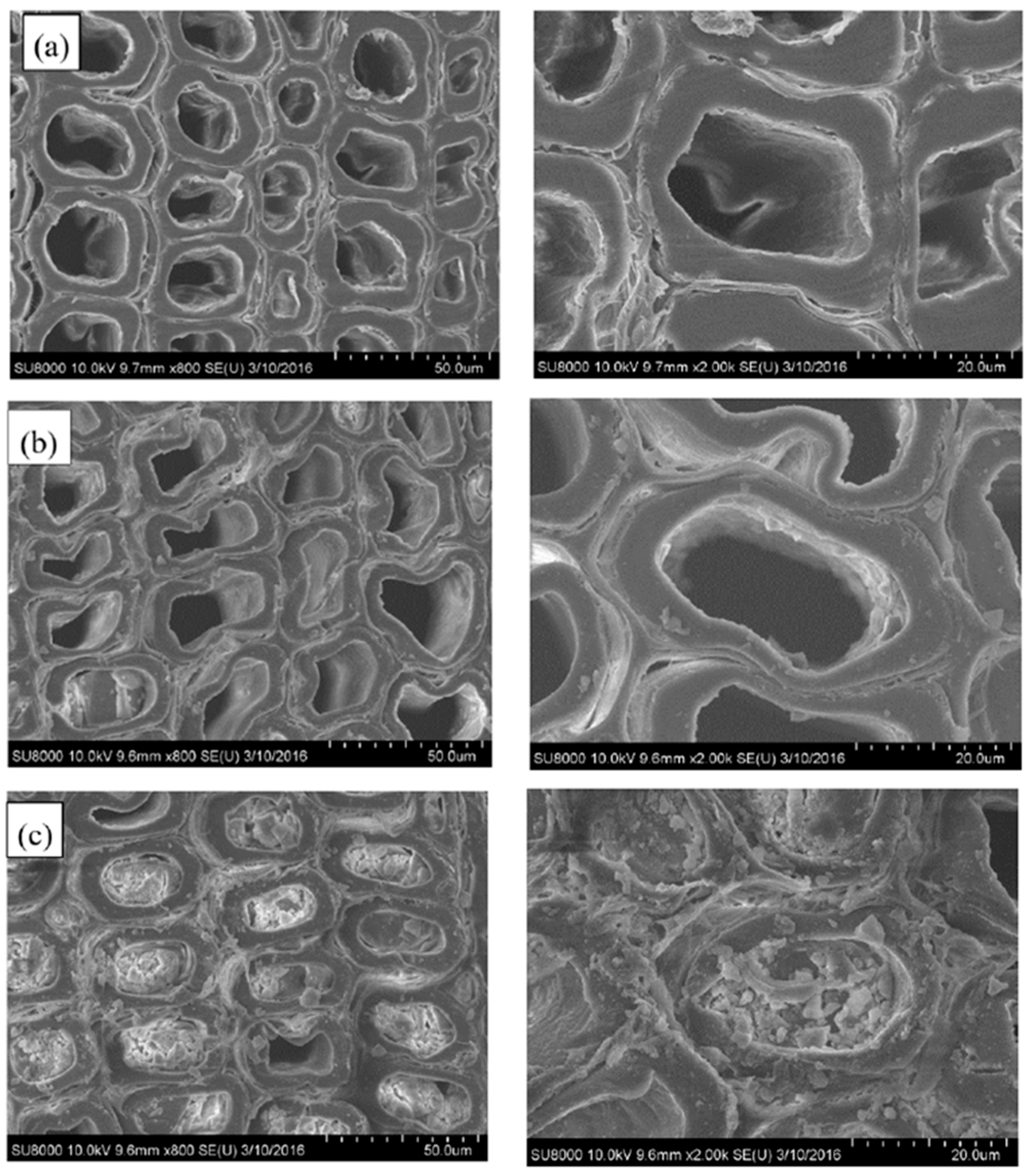
Recent studies have employed an SEM device to analyze the fiber structure and morphology of softwood-based composite materials. A study on the formulation of a soy-based adhesive for softwood composites used SEM to examine the fiber–matrix interface. The SEM pictures demonstrated effective wetting and adhesion between the soy-based binder and the softwood fibers, signifying the success of the surface modification procedures employed to improve compatibility [43]. Pupure et al. examined the fracture surfaces of softwood–polylactic acid (PLA) composites via SEM, uncovering details regarding interfacial bonding and fiber dispersion inside the matrix [44]. Additionally, Xu et al. conducted research on the impregnation of Chinese fir wood with micro-silica sol to improve its characteristics [45]. Based on the SEM result in Figure 1, untreated samples show a highly porous composite in which, with the addition of silica sol, the number of SiO2 deposited in the porous wood increased, leading to an improvement in the compact microstructure of the composite [45]. A separate study using SEM to examine polypropylene–wood composites yielded detailed pictures that emphasized regions where reinforcing elements were uniformly integrated, thus presenting the potential for enhanced composite growth. These investigations highlight the essential function of SEM in assessing the microstructural characteristics that affect physical properties, such as the morphology of the material and the overall efficacy of softwood-based composites.
The chemical bonding between softwood fibers and a binder or an adhesive is a critical factor influencing a composite’s overall performance. Recent studies have investigated innovative coupling agents and surface modification strategies to enhance the compatibility and adhesion between softwood fibers and a binder [46]. A prominent method employed to examine the chemical bonding in softwood composites is Fourier-transform infrared (FTIR) spectroscopy. FTIR analysis helps elucidate the functional groups within a composite and the interactions between softwood fibers and the binder. A study investigated wood fiber composites (WFCs) utilizing chitosan-based adhesives and those without. FTIR analysis indicated that heat pressing resulted in the degradation of ester linkages and lignin components in wood fibers, leading to the generation of low-molecular-weight organics and hydrogen bonds. These modifications promoted self-bonding among wood fibers, improving the composite’s chemical characteristics and water resistance [47].
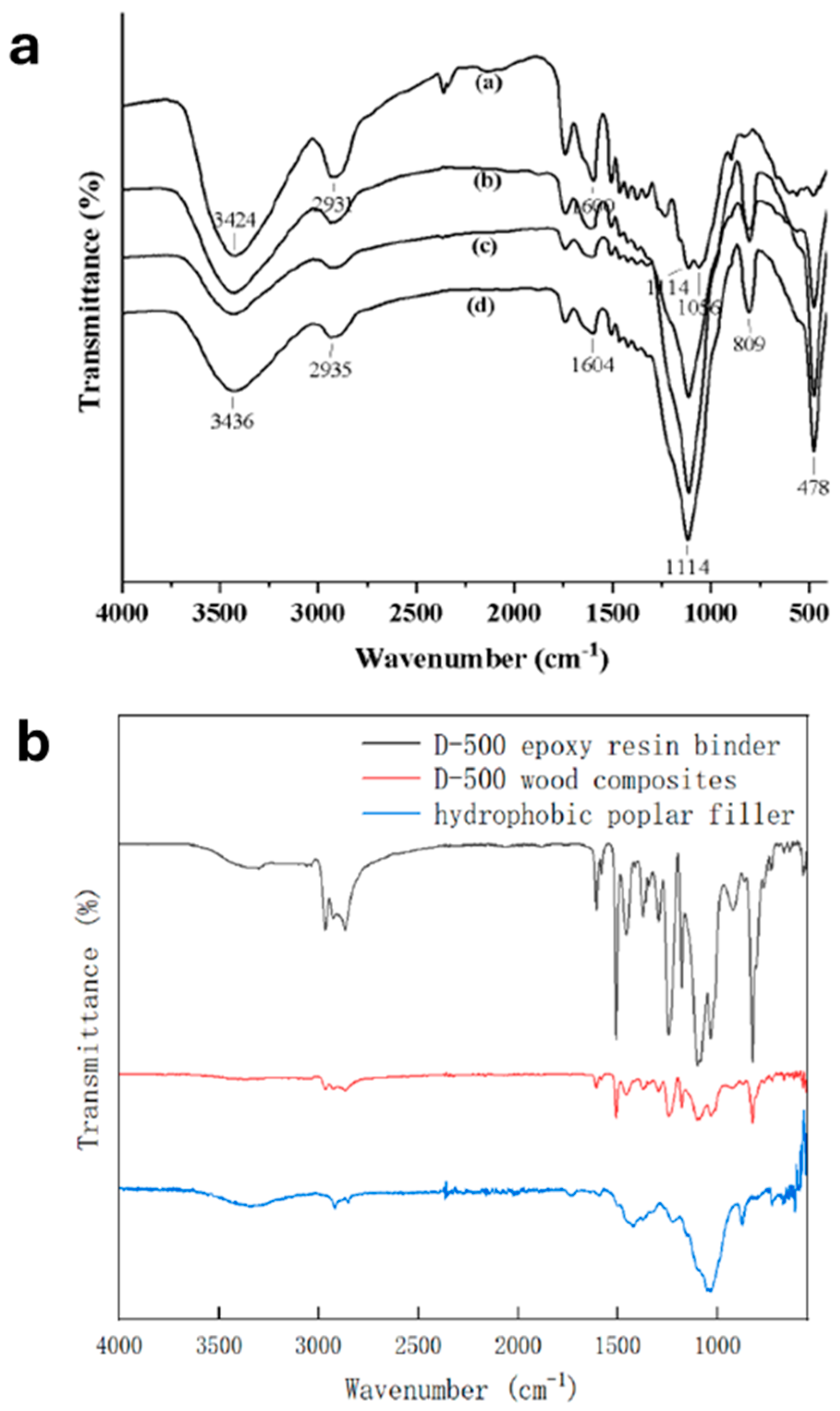
Research was conducted to explore the influence of metal alkoxide coupling agents—specifically titanium, silane, and zirconium—on wood adhesion. FTIR spectroscopy demonstrated that these compounds established covalent connections with lignin phenolics in wood, enhancing the adherence of coatings to the wood surface. No notable alterations were detected during the interaction of these compounds with cellulose or hemicellulose, underscoring the critical role of lignin in improving wood adherence [48]. The FTIR research in Figure 2a shows that there is a reduction in the intensity of -OH groups, which are replaced by SiO2, indicating that the hydroxyl groups in the wood interacted with the silica sol, resulting in the formation of Si–O–C covalent bonds. The chemical bonding resulted in greater mass and alterations in the wood’s microstructure, hence improving its mechanical and thermal capabilities [45]. A study proposed a wood-repair composite that combined epoxy resins, polyether amines, and poplar wood fibers. The functional groups identified from the FTIR study are shown in Figure 2b. The D-500 wood composite spectrum closely resembled that of the blank wood rather than the treated hydrophobic filler, aligning with the expected composition derived from the included epoxy resin binder and hydrophobic poplar filler. The results indicated that the resin functioned as a physical adhesive, which would help protect the surface of the damaged wood and could assist in the removal of the caulk during the wood’s reparation [49].
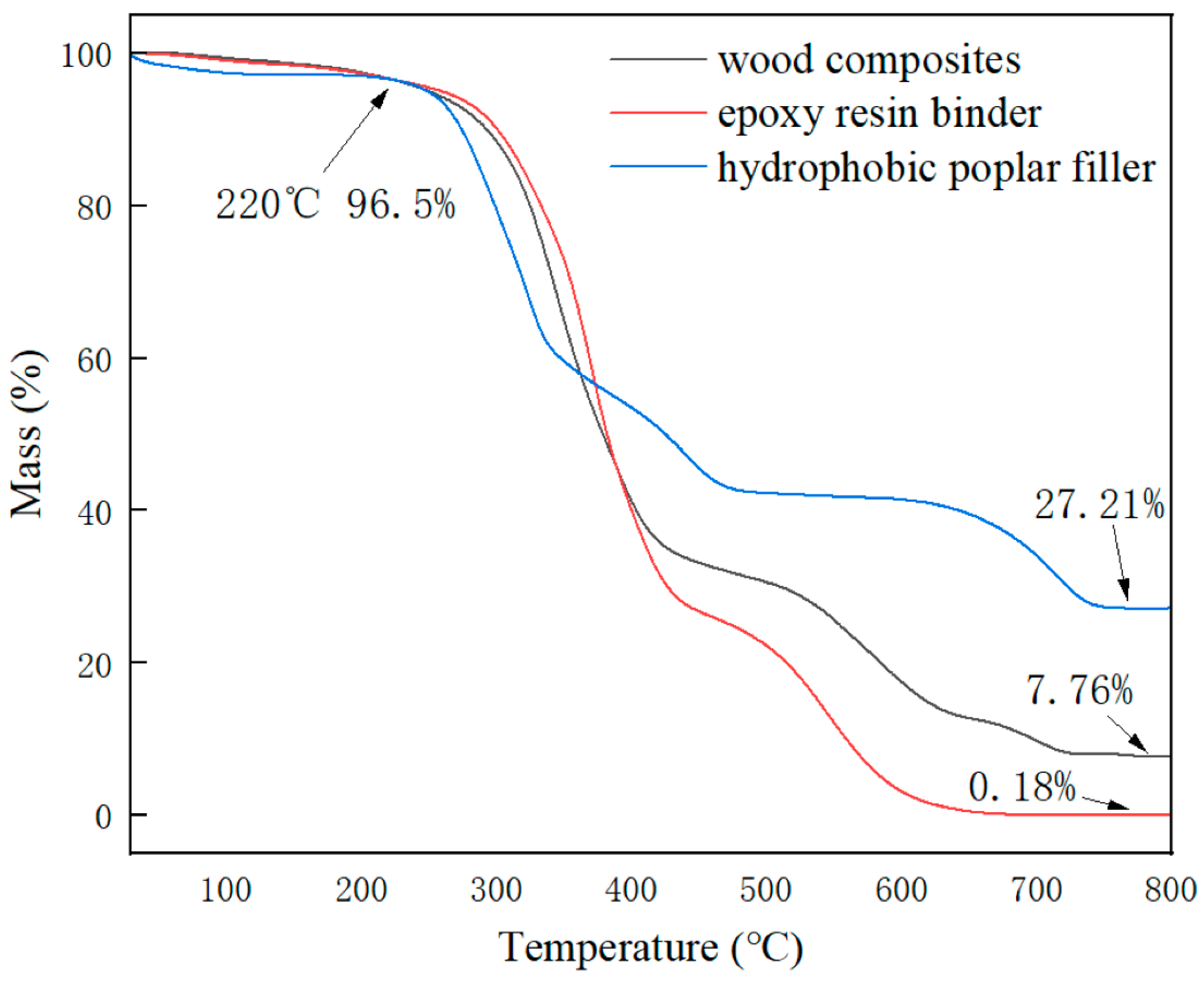
Thermal stability is essential for assessing the performance and longevity of softwood-based composites. It influences their processing, utilization, and longevity. Poor thermal stability may result in early degradation, affecting the structural integrity of a composite. Recent studies have employed thermogravimetric analysis (TGA) and Differential Scanning Calorimetry (DSC) to assess the thermal stability of softwood-based composites. A study investigated the influence of wood fiber (WF) content on the thermal characteristics of WPCs. The TGA data demonstrated that an increase in the WF content reduced the thermal stability of the composites, as indicated by a lower initial degradation temperature. The reduction in thermal stability was attributed to the intrinsic thermal properties of wood fibers [50]. Research related to the thermal analysis of a hydrophobic poplar filler, D-500 epoxy resin binder, and D-500 wood composite revealed minimal mass loss and no significant weight loss below 220 °C. The composite’s mechanical properties remained stable below 220 °C, demonstrating its thermal stability. The mass loss of the three specimens was around 3.5 wt% at 220 °C, and the residues left were about 27.21, 7.76, and 0.18 wt% for the poplar filler, epoxy resin, and wood composite of poplar and resin, respectively. This is crucial for applications requiring high temperatures, such as outdoor environments or near heat sources. [49]. The mass loss obtained in the thermal analysis is presented in Figure 3.

2.3. Mechanical Properties (Elastic and Strength)

Mechanical properties are critical for ensuring the performance, durability, safety, and sustainability of softwood-based composites in their applications. In this section, the main mechanical properties of softwood-based composites, including tensile strength, flexural strength, stiffness, and impact resistance, will be discussed. Moreover, the effects of material structure and manufacturing processes on these properties for each type of softwood-based composite, namely plywood, OSB, MDF, and WPCs, will also be discussed. The mechanical properties of the materials were determined in accordance with the relevant ASTM standards. Specifically, ASTM D1037 [51] was applied for fiber- and particle-based panels (e.g., MDF and particleboard), ASTM D3043 [52] for structural wood-based panels, such as plywood and OSB, ASTM D5456 [53] for structural composite lumber products (LVL, PSL, and LSL), ASTM D7031 [54] or ASTM D790 [55] for wood–plastic composites (WPCs), and ASTM D198 [56] for glulam. Each component contributes distinct properties, which influence the mechanical strength, water resistance, durability, and thermal stability of the composites (Table 1).

2.3.1. Transverse Rupture Strength

The transverse rupture strength measures the maximum stress a material can withstand while being stretched or pulled before failing. A high transverse rupture strength is required in softwood composites for applications involving tension pressures, guaranteeing that the material can hold loads without breaking. The transverse rupture strength in softwood-based composites is determined by wood species, grain orientation, moisture content, and binding material. In wood and composite materials, the modulus of rupture (MOR, in MPa) is used to describe a material’s transverse rupture strength under bending, indicating its resistance to failure under flexural stress conditions.
The transverse rupture strength of several EWPs is tabulated in Table 1. Plywood has a relatively high transverse rupture strength (MOR) due to its cross-laminated structure, in which the grain direction changes across layers at particular angles. The wood species, its layered arrangement, and adhesive quality have a considerable impact on plywood’s tensile strength [57]. The use of proper adhesives increases their transverse rupture strength. The transverse rupture strength parallel to the grain of plywood is generally in the range of 33.72–42.61 MPa [18]. OSB, on the other hand, has lower transverse rupture strength compared to plywood, typically in the range of 20.00–40.00 MPa, due to its larger wood strands and less controlled orientation of fibers. However, the transverse rupture strength varies based on the strand orientation, binder, and production method of OSB [58]. MDF, which is produced from compressed wood fibers, has a lower transverse rupture strength (15.00–30.00 MPa) than plywood and OSB because of its brittle structure. MDF’s fiber composition causes it to have lower transverse rupture than plywood and OSB [59]. However, this feature can be increased via fiber modification techniques. On the other hand, WPCs have a higher range of transverse rupture strength due to the presence of plastic, which provides more reinforcement to composites. The transverse rupture strength of WPCs generally lies between the strength of the wood itself and the unfilled polymer of plastic [60]. The effect of plastic changes with the wood-to-plastic content ratio [61]. The transverse rupture strength of WPCs can range from 10.00 to 35.00 MPa, depending on the composition of the polymer matrix and wood flour [62]. Using a polypropylene matrix (PP) results in a higher transverse rupture strength compared to using a high-density polyethylene (HDPE) or polyvinyl chloride (PVC) matrix, where the highest transverse rupture strength of a WPC is 52.30 MPa [18]. Therefore, PP is widely used as a polymer matrix in the production of WPCs. Additionally, among all types of EWPs, structural timber products are intentionally engineered to obtain high MOR values; for example, glued-laminated timber (28.61–62.62 MPa) and laminated veneer lumber (33.78–86.18 MPa) have the highest MOR values [18].

2.3.2. Tensile Stiffness

Stiffness is a measure of a material’s or a structure’s resistance to deformation under an applied force, which is described as the modulus of elasticity (MOE in GPa) or Young’s modulus. It indicates how much a body resists bending, stretching, or compressing when subjected to external loads. Stiffness is directly proportional to the modulus of elasticity. A higher modulus of elasticity results in a higher stiffness, though the shape of the material can also influence this property. A high stiffness in softwood composites guarantees that the composite remains stable and does not drop or distort under stress, which is critical for both the aesthetic and functional aspects of building and furniture design. Comprehensive instructions on how to calculate MOE are provided in ASTM D 1037 [51] for fiber- and particle-based panel products, ASTM D 3043 [52] for structural wood-based panels, ASTM D 5456 [53] for structural composite lumber products, and ASTM D 7031 [54] for wood–plastic composites.
A study by Bledzki et al. [63] examined how the type and amount of a wood biopolymer affected the qualities of strength and impact. Because softwood has more lignin (28 wt%) than hardwood (only 20 wt%), the study found that softwood fiber has a higher Young’s modulus (stiffness) (4–5 GPa) than hardwood fiber (3–4 GPa) with a PP matrix in WPC products. Furthermore, Ciolacu et al. [64] investigated the influence of biopolymers associated with the mechanical properties of wood composites. The study suggested that among three biopolymers (hemicellulose, cellulose, and lignin), the lignin content played a significant role in the intrinsic modulus of the reinforcing fibers, which, in turn, directly influenced the composites’ ultimate stiffness. In another study, the Young’s modulus values of fibers with a rich mixture of hemicellulose, cellulose, and lignin were identified to be about 5–8 GPa, ~3 GPa, and 2.4–9 GPa, respectively [65,66]. These phenomena imply that the type and concentration of biopolymers (hemicellulose, cellulose, and lignin) within softwood have a direct correlation with the mechanical properties of the composite.
The MOE of each EWP varies (Table 1). It may depend on the type of softwood, moisture content, and dimension. Panel types of EWPs, such as plywood, OSB, and MDF, typically have an MOE of about 2.00–9.00 GPa. Plywood has a relatively high modulus of elasticity, ranging from 6.96 to 8.55 GPa, due to its perfectly constructed cross-oriented fiber layers, which give the rigidity needed for structural purposes. The layered structure of plywood has a considerable influence on its modulus of elasticity, making it suitable for load-bearing scenarios [67]. OSB, with a modulus of elasticity ranging from 2.90 to 5.19 GPa, has a slightly lower elasticity due to the fibers’ less uniform orientation. Among the three types of panel wood, MDF has the lowest modulus of elasticity of 3.21–4.38 GPa compared to plywood and OSB. The MOE of wood–non-wood composites, such as WPCs, has a wide range between 1.93 and 2.90 GPa. The modulus of elasticity in WPCs is mostly determined by the wood-to-plastic component ratio. Increasing the plastic content usually increases stiffness, but too much plastic can reduce its stiffness. It has been discovered that a mix of wood and plastic components is critical for improving mechanical qualities in WPCs [68,69,70]. Additionally, structural wood composites, such as glued-laminated timber and laminated veneer lumber, are considered to have the highest MOE values of about 9–14.5 and 8.96–19.24, respectively [18].

2.3.3. Impact Resistance

Impact resistance measures the ability of a material to absorb energy during sudden impacts without fracturing. Softwood composites often face dynamic loads, such as those from human activity or environmental factors. A high impact resistance is crucial for ensuring safety and durability in applications like flooring and outdoor furniture. Impact resistance in composite materials is highly dependent on phase interactions [31]. Impact resistance is heavily influenced by fiber–matrix interactions, and the inclusion of fibers tends to lower impact resistance. The examination of this property can lead to a thorough investigation of the interface and stress transfer in composite materials.
Plywood, with an impact resistance of 50–100 J/m2, presents better characteristics in response to both high- and low-velocity impact loadings compared to OSB and solid wood plates due to its cross-laminated structure, which distributes applied forces across multiple layers [71]. The number of layers in plywood can enhance impact resistance. Moreover, the use of strong adhesives can contribute to better energy absorption, which also improves the impact resistance of plywood. OSB generally displays greater flexibility compared to standard plywood, which can lead to lower impact resistance in certain applications [71]. OSB has moderate impact resistance. Its layered composition of wood strands provides decent energy absorption, but it may be less resilient than plywood under high-impact conditions. Typically, OSB’s impact resistance ranges from 30 to 80 J/m2. The aligned strands in OSB can improve resistance, and a higher density can enhance impact performance. MDF generally has a lower impact resistance compared to plywood and OSB, within the range of 20–40 J/m2 [72]. The uniform fiber structure of MDF makes it more susceptible to denting and damage under impact. However, this property can be enhanced through the use of specific binding agents, additives, laminates, or veneers. The higher density of MDF also offers better impact resistance.
A study reported that spruce glulam beams exhibited a high impact resistance of 342 kJ/m2 when tested as full-scale structural elements under impact loading. [73]. Glulam exhibits higher impact resistance compared with other wood products, such as solid sawn timber, MDF, OSB, or particleboard. This enhanced performance arises from its engineered laminated structure, which minimizes defects, promotes progressive failure of individual lamellae, and benefits from adhesive layers that arrest crack propagation, thereby increasing energy absorption and fracture toughness [73,74]. Small-specimen tests indicate that solid softwoods, such as spruce, fir, and pine, can exhibit impact resistance in the range of approximately 3.94–6.14 J/cm2 (39,400–61,400 J/m2) [75,76]. Laminated veneer lumber (LVL), produced from thin veneers bonded in parallel with adhesives, provides improved uniformity and higher static bending strength than solid timber. Despite this, comprehensive experimental data on LVL’s impact resistance or energy absorption—especially for softwood species—are lacking. Limited evidence suggests that LVL may outperform other wood-based panels like MDF or OSB in impact performance due to distributed energy dissipation across veneers and minimized defects, yet quantitative impact-toughness values (e.g., J/m2) remain scarce, highlighting a significant knowledge gap.
Wood–non-wood products, such as WPCs, on the other hand, demonstrate good impact resistance, although it is still lower than that of plywood. The impact resistance of WPCs typically falls within the range of 30–70 J/m2, depending on the composition of wood and plastic. A typical commercial WPC has an impact resistance of 52 J/m2 [77]. The wood-to-plastic ratio significantly influences the impact resistance performance of WPCs [71]. In addition, a higher plastic content and the use of impact-modifier additives can improve impact resistance. The wood content and its optimal concentration are crucial for the hardness of wood–plastic composites; a moderate concentration of sawdust enhances hardness by strengthening the polymer matrix, while excessive amounts can weaken cohesion and reduce resistance to deformation [78]. Meanwhile, structural wood products commonly offer good impact resistance due to the strong adhesive and layer assembly.
Softwood plywood is commonly used in the industrial sector for construction support and general purposes because of its low cost, whereas hardwood plywood is typically used for furniture and high-end applications due to its high density and durability [79,80]. Softwood panels exceed the standard requirements in terms of both mechanical and physical qualities, except for considerable thickness swelling. When softwood and aspen strands are combined, the thickness swelling of OSB made of softwood is greatly enhanced—as the species’ wood density increases, OSB’s bending characteristics decline, and as the species’ wood density increases, so does OSB’s internal bond strength [81]. In a swelling test, a blend of softwood species for an OSB product showed a marginally superior performance to hardwood species, according to the investigation of the qualities of 24 h swelling and absorption tests [82].
Although MDF containing hardwood fiber has a higher bulk density than MDF containing softwood fiber, a study by Park et al. found that the combination of hardwood and softwood fibers changed the mechanical characteristics of MDF, resulting in the highest internal bond strength compared to MDF containing only hardwood or softwood fiber. [83]. Additionally, an interesting study was performed by Fabiyi et al. [33] on the fungal attacks on hardwood and softwood WPC products. The study suggested that White rot, or Trametes versicolor, caused noticeably greater weight losses on HDPE/poplar composites, whereas a WPC made of Douglas fir was less vulnerable to this fungus.

2.4. Emerging Softwood-Based Composites: Scrimber and Fluorescent Transparent Wood

Recent advances in softwood composite research have led to the development of multifunctional materials that extend beyond traditional structural applications. A comparison of traditional and novel softwood-based composites is tabulated in Table 2. Among these, wood-based scrimber and fluorescent/photoluminescent transparent wood (FTW) are particularly noteworthy. Scrimber is an engineered wood composite fabricated from systematically aligned and consolidated parallel wood strips, offering exceptionally high raw material utilization and efficient fiber recovery [84,85]. In contrast, FTW is produced by integrating the anisotropic porous structure of natural wood with the optical properties of luminescent quantum dots, such as carbon quantum dots [86,87].
Scrimber-based softwood is typically made from plantation softwoods such as Pinus radiata. It is manufactured by splitting veneers or small-diameter logs into oriented wood fiber mats (or long fiber bundles), impregnating these mats with a phenol–formaldehyde (PF) resin (or other thermosetting resins), and then hot-pressing to consolidate and densify the material. Reported panel densities for pine scrimber range from about 0.80 to 1.39 g·cm−3, depending on mat weight and processing. Process conditions (e.g., PF impregnation and hot pressing at ~145 °C) strongly affect dimensional stability and surface quality [92,93].
The mechanical performance of scrimber scales changes with density and resin uptake: increasing mat density and appropriate PF loading improves dimensional stability, water resistance, and transverse rupture strength (MOR), while the resin content and pressing scheme control the degree of cell wall collapse and resin distribution, which underpin high strength and stiffness. Typical manufacturing studies on pine/radiata scrimber report clear increases in MOR and MOE with density and optimized resin content. The process-dependent MOR values reported in the literature vary widely with species and density (and values reported for high-density engineered scrimbers can approach those of high-performance engineered materials) [96].
FTW is produced by reducing or modifying lignin in a softwood substrate to reduce absorption and create a porous scaffold and impregnating that scaffold with a refractive-index-matched polymer (for example, Polymethyl Methacrylate—PMMA or epoxy) containing luminescent agents, such as carbon quantum dots (CQDs), silicon or other quantum dots, or rare-earth complexes. FTW materials can achieve high optical transmittance (reports of >70%–85% at visible wavelengths depend on wood species, thickness, and treatment), combined with useful photoluminescence and improved toughness compared with delignified wood alone. The selection of polymers and luminescent agents controls optical, thermal, and mechanical trade-offs. FTW formulations based on CQDs or embedded luminescent agents have been demonstrated for ultraviolet light (UV-shielding), tunable emission, and potential use in energy-efficient, light-converting windows and smart architectural elements [86,87].
Both classes—densified softwood scrimber and functional transparent/photoluminescent softwood composites—illustrate how processing (mechanical splitting, resin impregnation, hot-pressing, delignification, and polymer infiltration) and material choices (PF or alternative resins; PMMA/epoxy or other polymers; luminescent agent) determine final performance and suitability for high-value structural and functional applications [92,95].

3. Sustainability and Environmental Impact

One of the primary drivers behind the increasing adoption of softwood-based composites is their alignment with sustainability goals. The use of softwood as a renewable resource reduces the dependency on non-renewable materials like concrete and steel, which have a higher environmental footprint. Furthermore, the production of engineered wood products often incorporates recycled wood fibers and other industrial by-products, enhancing resource efficiency [97]. Mass timber might cut CO2 emissions by more than 40% and energy use by more than 30% when compared to steel and concrete [98]. When manufactured responsibly, these materials contribute to carbon sequestration, as wood stores carbon dioxide absorbed during tree growth, offsetting emissions associated with production.
However, the environmental impact of softwood-based composites depends greatly on the choice of adhesives, resins, coatings, and other chemicals used in their manufacture. Traditional adhesives often rely on petrochemical-based binders that release volatile organic compounds (VOCs) and formaldehyde, raising concerns about indoor air quality and long-term health effects. The development of bio-based adhesives and low-VOC formulations represents a critical area of innovation, aiming to enhance the eco-friendliness of these materials without compromising performance.

3.1. Coating

Softwood-based composite feature interfaces abundant in wood fibers are distinguished by attributes such as roughness, porosity, hydrophilicity, adsorptive capacity, and chemical reactivity. The inherent hygroscopic and porous characteristics of these composite materials enable them to easily absorb moisture [99], affecting the dimensional stability, hardness, wear resistance, low resistance to different forms of radiation (ultraviolet—UV, infrared—IR, etc.), low resistance to bio-deterioration against fungi, insects, [100], and even plastic and termites, and protection against fire [101]. These weaknesses can be prevented by coating technology.
Wood coatings with nanomaterials (zinc oxide, zinc borate, and copper oxide) are important for outdoor applications. They improve durability against termites by about 3%–16% mass loss and fire resistance, as well as decrease water absorption and UV absorption in the range of 250–400 nm [102,103]. Coating materials consist of binders, pigments, solvents, fillers, and additives. The binder adheres pigment particles to the wood surface and each other, creating a protective layer [104], which is affected by certain wood types, sizes, and pores [105]. Practical examples have been given for specific problematic solvents currently used in the paint and coating industry, such as the aromatic solvent xylene and the polar solvent butyl glycol (C6H14O2) [106]. Additives prevent mold and decay, make the color drip-free, enhance the drying procedure, improve adhesion characteristics, and control finishing [102].
The coating industry has transformed for several reasons, such as reducing greenhouse gas emissions and VOCs [107]. Presently used coating materials, particularly fluorinated compounds and their organic solvents, are potentially toxic [13]. Furthermore, health considerations promote the use of locally sourced materials and the pursuit of safe and environmentally friendly coatings. VOCs produced by the solvent evaporation process during the coating curing or drying phase are considered environmentally harmful compounds that have varying effects on humans, animals, plants, and carbon emissions (Table 3). As a result, VOCs have been limited, and the VOC value varies for each country, as shown in Table 4.
Lignin, chitin/chitosan, and proteins are the biopolymers that have been the most studied in the resin replacer sector (adhesive, coating) and for their antibacterial properties [108]. The high content of diverse functional groups available in lignin and its phenylpropanoid structure enables other possible applications, such as coating and antimicrobial. Recently, lignin has been used for wood coatings, especially as a macro-polyol in polyurethane (PU) [109,110], which is made from non-renewable petrochemical resources [111]. The phenolic hydroxyl content in lignin is beneficial for improving the reactivity of its epoxy product as a crosslinking filler [112]. A substantial amount of the phenolic component in PF foams can be substituted with lignin, or it can be liquefied to create a biobased polyol for manufacturing PU foam. The substitution of lignin can lessen the reliance on petroleum-based phenol.
The presence of lignin generally increases resin viscosity, complicating the foaming process [34]. The interaction between epoxy novolac molecules and the lignin structure results in an intramolecular π-π interaction between both the aromatic rings of the epoxy novolac and the lignin. This interaction is expected to improve the barrier properties of a coating [113]. Lignin’s aromatic structure contributes to the formation of a dense carbon layer in the PU matrix that acts as a barrier to prevent the release of combustible gases and block oxygen. According to a study, Kraft lignin (water-soluble lignin—WSL) and aluminum phosphate (AP) grafted with silsesquioxane, or an aqueous sustainable formula, can create a coating that is both flame-retardant and superhydrophobic, with a high level of resistance to solvents and water. Superhydrophobic (with a water contact angle (WCA) of 158°) and flame-retardant (with a limited oxygen index (LOI) of 27.2%) properties were identified in the optimum formula, which contained WSL and AP dispersion (1/1 wt./wt.) [13].
Additionally, polysaccharides such as cellulose, starch, and chitosan from chitin are commonly studied as polymer films and coatings because of their sustainability. Nanocellulose presents a wide range of potential applications in various areas, including biodegradable films, composites, and coatings [114]. For instance, a coating treatment may influence the mechanical properties of softwood composites. Ondiek et al. [115] conducted a study on the effects of a surface coating treatment of WPCs using acrylic resin liquid with uniformly distributed 2,2,6,6-Tetramethylpiperidine-1-oxyl (TEMPO-oxidized) cellulose nanofibers (CNFs). The findings showed that while the surface texture increased following plasma radiation exposure, the surface coating of the specimens with acrylic paint and CNFs reduced surface roughness by approximately 50% when compared to the untreated specimens. Furthermore, chitosan was used with dopamine hydroxyapatite to create a layer-by-layer (LBL) coating on wood products. The LBL coating increased the wood’s hydrophobicity and delayed its degradation in seawater. In another study, medium-molecular-weight (MW) chitosan (<10% concentration) was evaluated as a water-based wood coating to protect wood against fungi [116,117]. After being exposed to 1% chitosan oligomers for 16 weeks, the wood did not exhibit any resistance against T. versicolor. However, Larnøy et al. confirmed that wood treated with about 5% low-molecular-weight chitosan exhibited resistance to T. versicolor (mass loss 2.8%), P. placenta (mass loss 1.6%), and C. puteana (mass loss 4.9%) [118]. Munstermann and Weishold [119] applied chitosan itaconate to wood, resulting in a water-insoluble, hydrophobic coating with strong adhesion due to inter-poly electrolyte crosslinking and chemical interaction with cellulose.

3.2. Flame Retardants

Flame retardants improve wood resistance to fire by reducing ignitability and the heat release rate (HRR) [120]. However, their impact on toxic gas emissions during fires remains uncertain. Applying retardants to the wood’s surface or through impregnation is a common and effective fire prevention method [121]. The key coating principle is to block oxygen, slowing burning and stopping fire spread [122]. Popular flame-retardant types for wood are halogen, nitrogen, phosphorus, silicon, boron, and metal oxide-based materials [123]. Additionally, natural flame retardants have also been discovered in organic compounds, such as lignin and graphite.
Lignin is an ideal carbon source for intumescent flame-retardant systems because of its very high carbon content [124]. Wei et al. [124] in their previous study illustrated how lignin contributes to the protection of wood against fire attack. The chemical in lignin may prevent fire from vertically and horizontally expanding into wood by creating an expanded carbon layer to form a barrier effect. Furthermore, the abundance of the aromatic ring from lignin to the copolymer, the increase in molecular weight following polymerization, and the more rigid structure driven by the presence of the inorganic phase are responsible for the increased thermal stability and glass transition temperature [13]. Wood is comparatively flammable; however, because of its high lignin concentration, bark is considered to have excellent fire resistance and insulating qualities. [125]
A wood coating containing silicon, phosphorus, and nitrogen is found to be a highly flame-retardant system. For instance, the Si-O-C bonds and hydrogen bonds in the crosslinked structure of a sodium silicate composite coating further improved the flame retardancy of the coating. Furthermore, Si-O-C bonds were formed between sodium silicate and polyvinyl alcohol in the cross-linked structure, improving the thermal stability of the flame-retardant coating [122]. A large amount of phosphoric acid derivatives is generated by the combustion of coatings during the condensed phase. These phosphoric acid derivatives promote the dehydration of the wood surface and carbonization of coatings, forming a self-protective carbon layer [126]. This carbon layer can effectively isolate the contact between heat, oxygen, and a substrate during the combustion process, enhancing the protective ability of the substrate. Simultaneously, the generated non-combustible gases dilute the oxygen (O2) concentration, which makes the combustion process challenging to continue. In the gas phase, the combustion of coatings generates a large amount of non-combustible gases, such as CO2, NH3, etc. The release of these gases can dilute the oxygen in the air and slow the degree of material combustion. On the other hand, the release of gas causes the carbon layer formed by the coating to expand, forming a better spatial barrier and further protecting the wood substrate [124,127,128].
Melamine formaldehyde resin (MF) is a film-forming resin and gas source, and phosphoric acid–tannic acid (H3PO4-TA) and nano-zinc oxide (nano-ZnO) are flame-retardant synergist compounds. The flame-retardant mechanism of coatings based on melamine by Yan et al. [123] is illustrated the schematic of the flame-retardant mechanism for coatings. After heating, phosphoric acid (H3PO4) decomposes, releasing inert gases and lowering the oxygen concentration of the flame. As temperatures rise, carbon is generated. When inert gases, such as ammonia (NH3) and carbon dioxide (CO2), are released, the carbon layer becomes porous, like a honeycomb. This construction prevents the discharge of combustible gases while isolating heat transfer. Nano-ZnO functions as a flame-retardant synergist, offering catalytic and synergistic effects in both the gas and condensed phases of the layer and stimulating the release of hydrocarbons and aromatic chemicals during combustion. Phosphoric acid and a trace amount of nano-zinc oxide react in the condensed phase to form zinc dihydrogen phosphate and water. The extended flame-retardant materials for wood are tabulated in Table 5.
Softwood-based composites, such as plywood, OSB, MDF, and LVL, exhibit distinct coating and flame-retardant characteristics, largely determined by their structural configurations and surface morphologies. Plywood, composed of layered veneers with relatively smooth surfaces, supports uniform coating adhesion and shows improved resistance to UV degradation and moisture when treated with waterborne or UV-curable formulations [131,132]. In contrast, OSB, with its coarse strands and higher porosity, typically requires thicker or nanocomposite coatings—such as those incorporating zinc oxide (ZnO) or silicon dioxide (SiO2)—to achieve comparable hydrophobicity, termite resistance, and fire protection [133,134]. MDF, characterized by a fine and homogeneous fiber network, enables consistent coating penetration and demonstrates strong performance when bio-based coatings, such as lignin–polyurethane (PU) or chitosan-derived systems, are applied, supporting lower VOC emissions and enhanced antimicrobial durability [90,135,136]. LVL, with its dense and less permeable veneer architecture, benefits from flexible, high-performance coatings capable of accommodating thermal expansion and mechanical stresses [91].
Regarding flame retardancy, softwood composites rely on phosphorus-, nitrogen-, and silicon-based coatings that promote the formation of protective carbonaceous layers, thereby reducing ignitability and heat release rates. The inclusion of lignin or nano-metal oxides in coatings further enhances char formation and thermal stability. Overall, coating systems primarily improve hydrophobicity, UV resistance, and biological durability, while flame-retardant treatments significantly enhance fire safety and thermal protection—both being critical to extending the lifespan and environmental performance of softwood-based composites in structural and exterior applications [137]. In essence, coatings are protective surface films designed to resist weathering, UV exposure, and biological decay, while flame-retardants are functional additives or treatments that improve thermal stability and fire resistance (Table 6). Some hybrid formulations now combine both roles —for example, lignin–phosphate–silane coatings act as bio-based surface protectors and flame barriers simultaneously, offering superhydrophobicity (water contact angle, WCA ≈ 158°) and flame retardancy (LOI ≈ 27.2%) [13,113,124].

3.3. Adhesives

Adhesives play a crucial role in the fabrication and performance of softwood-based composites. These bonding agents are responsible for uniting wood particles, veneers, or fibers into cohesive structural materials with enhanced mechanical strength and dimensional stability. In softwood-based composites—such as plywood, particleboard, OSB, and LVL—the choice and performance of adhesives directly influence product quality, durability, and environmental impact.
Traditionally, synthetic thermosetting adhesives, such as urea–formaldehyde (UF), PF, and melamine–urea–formaldehyde (MUF) resins, have been widely used due to their strong bonding strength and cost-effectiveness. However, increasing environmental and health concerns associated with formaldehyde emissions have driven the development of more sustainable adhesive systems. Recent research has focused on bio-based and low-emission alternatives, including lignin-, tannin-, soy-, and starch-based adhesives, as well as novel polymer systems designed to enhance bonding under variable moisture and temperature conditions typical of softwood materials [111,138,139].
Adhesive bonding efficiency varies with wood anatomy. Softwoods composed mainly of tracheids exhibit lower densities (300–500 kg/m3) and more uniform pores than hardwoods (600–800 kg/m3), facilitating deeper adhesive infiltration and stronger mechanical interlocking [137,140]. The adhesive infiltration depth in Cryptomeria japonica softwood veneers ranges from 0.3 mm to 0.9 mm [140], while hardwoods generally show shallower, more irregular infiltration [141]. Excessive infiltration may cause “starved joints”, whereas insufficient infiltration reduces bond strength [142]. Bonding performance depends not only on infiltration but also on adhesive chemistry and process parameters. Softwood composites (e.g., OSB, plywood) often achieve effective bonding with UF or MUF adhesives, while dense hardwoods require more reactive systems, such as PMDI or PF resins. Meanwhile, hardwood composites rely more on adhesive surface chemistry and preparation due to limited permeability [137]. Table 7 compares four major softwood-based composites in terms of their surface characteristics, coating behavior, flame-retardant performance, and suitable additives. This information provides insights into how each material responds to coating and fire-retardant treatments, helping guide material selection for different structural and protective applications.

3.4. Environmental Impact and Lifecycle Assessment of Adhesives in Softwood-Based Composites

Coatings, flame retardants (FRs), and adhesives are functional additives that strongly influence the environmental profile of softwood-based composites because they contribute upstream embodied impacts, process emissions during manufacture, and end-of-life risks that are often absent from wood-only assessments. Lifecycle assessments (LCAs) consistently show that binders and surface treatments can account for a substantial share of a panel’s cradle-to-gate impacts—often on the order of 10%–30% or more of global warming potential and other midpoint categories, depending on formulation and dose [138]. For adhesives, LCAs comparing petrochemical resins with bio-based alternatives (soy, lignin, tannin) report that bio-adhesives can reduce GWP and fossil energy demand in many scenarios, although the results are sensitive to functionalization steps (e.g., glyoxalation), allocation rules, and assumptions about durability and moisture resistance [138,143].
Coatings for softwood composites are applied to control moisture, abrasion, and emissions (VOC barriers). Their environmental trade-offs depend on solvent content, curing energy, and service life: solvent-borne coatings drive higher VOC emissions and photochemical ozone creation potential, whereas waterborne or UV-curable systems lower VOC and energy impacts but may introduce different hazard profiles in raw materials [143]. For softwoods specifically, terpene emissions (α-pinene, limonene) originating from resinous wood can dominate VOC profiles; however, LCA studies show that processing parameters (drying temperature, press cycle, coating/adhesive choice) typically have a larger effect on the VOC inventory than species alone [144].
Flame retardants present a complex LCA and toxicity trade-off. Systematic reviews of FR LCAs find that traditional halogenated FRs often score poorly on human toxicity and ecotoxicity despite providing high fire performance, while non-halogenated alternatives (phosphorus- or nitrogen-based, intumescent systems) reduce certain toxicity endpoints but can shift burdens to production or end-of-life scenarios [145]. Recent product-level LCA work shows that the environmental performance of specific FR chemistries depends on dose, efficacy (how much is needed to meet the same fire rating), and end-of-life scenarios—notably whether a fire LCA (accounting for avoided damages during a fire) is included [145,146].
Emerging adhesive and additive technologies aim to reconcile performance with lower lifecycle impacts. Nanocellulose-reinforced and enzymatic adhesives can offer high strength with reduced petrochemical content, yet their cradle-to-gate impacts depend heavily on nanocellulose production routes; early LCA work highlights energy-intensive isolation steps as a key driver [147]. Overall, integrating an LCA early in formulation development—using consistent functional units (e.g., 1 m2 of panel at a defined service life and performance class) and including realistic end-of-life treatments (mechanical recycling, incineration with energy recovery, fire scenarios)—is essential to avoid burden shifting between production, use, and disposal phases [138,145]. For softwood-based composites, the optimal low-impact pathway typically combines low-emission binders, waterborne or low-VOC coatings, and minimally toxic, low-dose FR strategies while prioritizing process energy efficiency and circular end-of-life routes [143,146].

4. Challenges and Future Work

Despite their advantages, softwood-based composites face several challenges that can limit their widespread adoption in certain applications. The key issues include susceptibility to biodegradation, fire resistance, and mechanical performance under extreme conditions [101,104,148]. The variability in raw material quality—affected by tree species, age, and processing methods—also complicates the achievement of consistent product properties [71,103]. Durability in outdoor applications remains a significant concern, as prolonged exposure to moisture can cause swelling, delamination, and fungal growth, ultimately reducing structural integrity. Research efforts have focused on mitigating these issues through surface treatments, additives, enhanced adhesive formulations, and the incorporation of flame-retardant agents. Advanced nanotechnology, including nanocellulose, nano-lignin, and nano-zinc oxide coatings, has shown promise in improving moisture, fungal, and UV resistance while enhancing strength, stiffness, and thermal stability [149,150].
Market dynamics present additional challenges and opportunities. For example, in the U.S., plywood ranks second only to OSB in demand, with OSB projected to gain market share in wall sheathing and roofing due to comparable performance at lower cost [151]. Globally, demand for EWPs, such as structural wood I-beams, glulam, and LVL, is expected to grow at a Compound Annual Growth Rate—CAGR of 7.1% through 2029 [152]. The main challenges, current mitigation strategies, and directions for future research are summarized in Table 8.
Looking ahead, future research should focus on improving biodegradability, fire resistance, and mechanical performance while maintaining sustainability. Developing novel nanomaterials, optimizing binder systems, and enhancing composite manufacturing processes will be crucial. Furthermore, fostering collaboration among researchers, manufacturers, and policymakers will accelerate innovation and the adoption of softwood-based composites in construction, furniture, packaging, and emerging high-performance industries, such as automotive, aerospace, and marine applications.

5. Conclusions

Softwood-based composites represent an essential class of engineered wood materials, offering sustainable, versatile, and cost-effective solutions for construction, furniture, packaging, and an expanding range of high-performance applications. This review shows that softwood composites possess several distinct advantages, including processing flexibility, ease of mechanical modification, and improved bonding when blended with hardwood fibers. Performance metrics vary across composite categories and are strongly influenced by factors such as wood-to-plastic ratios, adhesive systems, and fiber orientation. Durability, moisture resistance, and thermal stability can be substantially enhanced through treatments including flame-retardant formulations, nanomaterial reinforcement, and advanced surface modification. Current production trends emphasize the use of low-cost softwood species and established engineered wood products; however, future research should prioritize improving biodegradability, fire resistance, and mechanical robustness. Promising directions include the development of advanced nanomaterials, hybrid and bio-based binder systems, and standardized raw material specifications to reduce property variability. Addressing these challenges will broaden the applicability of softwood composites, strengthen their sustainability profile, and accelerate innovation across major industries—from construction and furniture manufacturing to packaging and emerging high-performance sectors, such as automotive, aerospace, and marine engineering.

Author Contributions

R.A.: writing—original draft, visualization, validation, methodology, investigation, formal analysis, data curation, and conceptualization. M.P.: writing—review and editing, software, resources, project administration, funding acquisition, and formal analysis. A.P.: writing—review and editing, supervision, software, resources, project administration, funding acquisition, and formal analysis. E.R.: writing, validation, investigation, formal analysis, and data curation. H.N.A.: writing, visualization, investigation, formal analysis, and data curation. T.P.R.: writing, visualization, investigation, formal analysis, and data curation. Z.D.H.: writing, visualization, investigation, formal analysis, and data curation. N.R.: writing, visualization, investigation, formal analysis, and data curation. B.D.: writing, visualization, investigation, formal analysis, and data curation. E.M.: writing, visualization, validation, formal analysis, and data curation. A.F.A.: writing, visualization, validation, formal analysis, and data curation. I.D.A.A.W.: writing, visualization, validation, formal analysis, and data curation. All authors have read and agreed to the published version of the manuscript.

Funding

This research was funded by the interdisciplinary program ARTEMIS of Lorraine Université d’Excellence (ANR-15-IDEX-04-LUE).

Data Availability Statement

Data are contained within this article.

Acknowledgments

The authors would like to acknowledge all those who supported this work and made it possible. During the preparation of this manuscript, Compilatio Magister was used as a plagiarism-checking and educational resource tool. The authors have carefully reviewed and edited its output and take full responsibility for the content of this publication.

Conflicts of Interest

The authors declare no conflicts of interest.

References

  1. Wang, X.-Q.; Ran, J.-H. Evolution and biogeography of gymnosperms. Mol. Phylogenetics Evol. 2014, 75, 24–40. [Google Scholar] [CrossRef] [PubMed]
  2. Jiao, Y.; Guo, H. Chapter Nine—Prehistory of the Angiosperms: Characterization of the Ancient Genomes. In Advances in Botanical Research; Paterson, A.H., Ed.; Academic Press: Cambridge, MA, USA, 2014; Volume 69, pp. 223–245. [Google Scholar]
  3. Déjardin, A.; Laurans, F.; Arnaud, D.; Breton, C.; Pilate, G.; Leplé, J.-C. Wood formation in Angiosperms. Comptes Rendus Biol. 2010, 333, 325–334. [Google Scholar] [CrossRef]
  4. Ma, H.; Crowther, T.W.; Mo, L.; Maynard, D.S.; Renner, S.S.; van den Hoogen, J.; Zou, Y.; Liang, J.; de-Miguel, S.; Nabuurs, G.J.; et al. The global biogeography of tree leaf form and habit. Nat. Plants 2023, 9, 1795–1809. [Google Scholar] [CrossRef]
  5. Ratanawilai, T.; Taneerat, K. Alternative polymeric matrices for wood-plastic composites: Effects on mechanical properties and resistance to natural weathering. Constr. Build. Mater. 2018, 172, 349–357. [Google Scholar] [CrossRef]
  6. Aniza, R.; Petrissans, A.; Petrissans, M. Multifunctional Nanotechnology Application for Wood Properties Enhancement: Adhesive and Coating. In Nanomaterials Additives in Bioadhesives for Wood Composites; Antov, P., Lubis, M.A.R., Lee, S.H., Taghiyari, H.R., Eds.; Smart Nanomaterials Technology; Springer Nature: Singapore, 2025; pp. 135–149. [Google Scholar]
  7. Zhang, B.; Petrissans, M.; Petrissans, A.; Pizzi, A.; Colin, B. Furanic Polymerization Causes the Change, Conservation and Recovery of Thermally-Treated Wood Hydrophobicity before and after Moist Conditions Exposure. Polymers 2023, 15, 221. [Google Scholar] [CrossRef]
  8. Chand, N.; Fahim, M. 7—Wood reinforced polymer composites. In Tribology of Natural Fiber Polymer Composites; Chand, N., Fahim, M., Eds.; Woodhead Publishing: Sawston, UK, 2008; pp. 180–196. [Google Scholar]
  9. Aniza, R.; Petrissans, A.; Petrissans, M. Life-Cycle Assessment of Nanoparticle in Wood Adhesive and Coating: The State-of-The Art. In Nanomaterials Additives in Bioadhesives for Wood Composites; Antov, P., Lubis, M.A.R., Lee, S.H., Taghiyari, H.R., Eds.; Smart Nanomaterials Technology; Springer Nature: Singapore, 2025; pp. 231–248. [Google Scholar]
  10. Aniza, R.; Chen, W.-H.; Herrera, C.J.A.; Quirino, R.; Petrissans, M.; Petrissans, A. Bioenergy and bioexergy analyses with artificial intelligence application on combustion of recycled hardwood and softwood wastes. Renew. Energy 2024, 237, 121885. [Google Scholar] [CrossRef]
  11. Aniza, R.; Chen, W.-H.; Pétrissans, A.; Hoang, A.T.; Ashokkumar, V.; Pétrissans, M. A review of biowaste remediation and valorization for environmental sustainability: Artificial intelligence approach. Environ. Pollut. 2023, 324, 121363. [Google Scholar] [CrossRef] [PubMed]
  12. Richa, L.; Colin, B.; Pétrissans, A.; Wallace, C.; Wolfgram, J.; Quirino, R.L.; Chen, W.-H.; Pétrissans, M. Potassium carbonate impregnation and torrefaction of wood block for thermal properties improvement: Prediction of torrefaction performance using artificial neural network. Appl. Energy 2023, 351, 121894. [Google Scholar] [CrossRef]
  13. Bemerw Kassaun, B.; Fatehi, P. Solvent-Free Lignin-Silsesquioxane wood coating formulation with super hydrophobic and Flame-Retardant functionalities. Chem. Eng. J. 2024, 493, 152582. [Google Scholar] [CrossRef]
  14. Bekhta, P.; Müller, M.; Hunko, I. Properties of Thermoplastic-Bonded Plywood: Effects of the Wood Species and Types of the Thermoplastic Films. Polymers 2020, 12, 2582. [Google Scholar] [CrossRef]
  15. Smith, W.B.; Miles, P.D.; Perry, C.H.; Pugh, S.A. Forest Resources of the United States, 2007; U.S. Department of Agriculture, Forest Service, Washington Office: Washington, DC, USA, 2017. [Google Scholar]
  16. Gil-Moreno, D.; Manso, R.; O’Ceallaigh, C.; Harte, A.M. The influence of age on the timber properties and grading of Scots pine and larch in Ireland. For. Int. J. For. Res. 2023, 97, 133–146. [Google Scholar] [CrossRef]
  17. Lu, C.; Wu, J.; Jiang, Q.; Liu, Y.; Zhou, L.; You, Y.; Cheng, Y.; Liu, S. Influence of juvenile and mature wood on anatomical and chemical properties of early and late wood from Chinese fir plantation. J. Wood Sci. 2021, 67, 72. [Google Scholar] [CrossRef]
  18. Cai, Z.; Ross, R.J. Mechanical Properties of Wood-Based Composite Materials. In Wood Handbook: Wood as an Engineering Material: Chapter 12; U.S. Dept. of Agriculture, Forest Service, Forest Products Laboratory: Madison, WI, USA, 2010; pp. 12.1–12.12. [Google Scholar]
  19. Bengtsson, R.; Mousavi, M.; Afshar, R.; Gamstedt, E.K. Viscoelastic behavior of softwood based on a multiscale computational homogenization. Mech. Mater. 2023, 179, 104586. [Google Scholar] [CrossRef]
  20. Zanuttini, R.; Negro, F. Wood-Based Composites: Innovation towards a Sustainable Future. Forests 2021, 12, 1717. [Google Scholar] [CrossRef]
  21. Castanié, B.; Peignon, A.; Marc, C.; Eyma, F.; Cantarel, A.; Serra, J.; Curti, R.; Hadiji, H.; Denaud, L.; Girardon, S.; et al. Wood and plywood as eco-materials for sustainable mobility: A review. Compos. Struct. 2024, 329, 117790. [Google Scholar] [CrossRef]
  22. Intelligence, M. Engineered Wood Market Size & Share Analysis—Growth Trends & Forecasts (2025–2030); Mordor Intelligence Research & Advisory: Hyderabad, India, 2025. [Google Scholar]
  23. UNECE/FAO. Forest Products Annual Market Review 2022–2023; United Nations and the Food and Agriculture Organization of the United Nations: Geneva, Switzerland, 2023. [Google Scholar]
  24. Bozzolan, N.; Mohren, F.; Grassi, G.; Schelhaas, M.-J.; Staritsky, I.; Stern, T.; Peltoniemi, M.; Šebeň, V.; Hassegawa, M.; Verkerk, P.J.; et al. Preliminary evidence of softwood shortage and hardwood availability in EU regions: A spatial analysis using the European Forest Industry Database. For. Policy Econ. 2024, 169, 103358. [Google Scholar] [CrossRef]
  25. Schouten, N.; Haisma, R.; Rohmer, M.; Boer, E. Impact Scan for Timber Construction in Europe; Metabolic Consulting: Amsterdam, The Netherlands, 2023. [Google Scholar]
  26. Väisänen, T.; Heikkinen, J.; Tomppo, L.; Lappalainen, R. Softwood Distillate as a Bio-Based Additive in Wood-Plastic Composites. J. Wood Chem. Technol. 2016, 36, 278–287. [Google Scholar] [CrossRef]
  27. Barbu, M.C.; Reh, R.; Irle, M. Wood-Based Composites. In Research Developments in Wood Engineering and Technology; Aguilera, A., Davim, J.P., Eds.; IGI Global: Hershey, PA, USA, 2014; pp. 1–45. [Google Scholar]
  28. Hill, C.A.S. Wood Modification: Chemical, Thermal and Other Processes; John Wiley & Sons: Hoboken, NJ, USA, 2006. [Google Scholar]
  29. Rowell, R.M. Handbook of Wood Chemistry and Wood Composites, 1st ed.; CRC Press: Boca Raton, FL, USA, 2005. [Google Scholar]
  30. Papadopoulos, A.N.; Hague, J.R. The potential for using flax (Linum usitatissimum L.) shiv as a lignocellulosic raw material for particleboard. Ind. Crops Prod. 2003, 17, 143–147. [Google Scholar] [CrossRef]
  31. Oliver-Ortega, H.; Tarrés, Q.; Mutjé, P.; Delgado-Aguilar, M.; Méndez, J.A.; Espinach, F.X. Impact Strength and Water Uptake Behavior of Bleached Kraft Softwood-Reinforced PLA Composites as Alternative to PP-Based Materials. Polymers 2020, 12, 2144. [Google Scholar] [CrossRef]
  32. Sanson, C.S.L.; Helm, C.V.; Magalhães, W.L.E.; de Muniz, G.I.B.; Missio, A.L.; de Cademartori, P.H.G. Enhancing water repellency and decay resistance of wood by using water-soluble fractions separated from pyrolytic lignin of fast-pyrolysis bio-oil. Ind. Crops Prod. 2022, 177, 114540. [Google Scholar] [CrossRef]
  33. Fabiyi, J.S.; McDonald, A.G.; Morrell, J.J.; Freitag, C. Effects of wood species on durability and chemical changes of fungal decayed wood plastic composites. Compos. Part A Appl. Sci. Manuf. 2011, 42, 501–510. [Google Scholar] [CrossRef]
  34. Dsouza, G.C.; Dodangeh, F.; Venkata, G.B.; Ray, M.B.; Prakash, A.; Xu, C. A comprehensive review of biobased polyurethane and phenol formaldehyd e hydrophilic foams for environmental remediation, floral, and hydropo nics applications. Biomass Bioenergy 2025, 192, 107493. [Google Scholar] [CrossRef]
  35. Baig, M.; Almeshari, B.; Aabid, A.; Junaedi, H.; Almajid, A. The effect of maleic anhydride grafted polypropylene addition on the degradation in the mechanical properties of the PP/wood composites. Heliyon 2024, 10, e30510. [Google Scholar] [CrossRef]
  36. Hao, X.; Xu, J.; Zhou, H.; Tang, W.; Li, W.; Wang, Q.; Ou, R. Interfacial adhesion mechanisms of ultra-highly filled wood fiber/polyethylene composites using maleic anhydride grafted polyethylene as a compatibilizer. Mater. Des. 2021, 212, 110182. [Google Scholar] [CrossRef]
  37. Hung, K.-C.; Wu, T.-L.; Chen, Y.-L.; Wu, J.-H. Assessing the effect of wood acetylation on mechanical properties and extended creep behavior of wood/recycled-polypropylene composites. Constr. Build. Mater. 2016, 108, 139–145. [Google Scholar] [CrossRef]
  38. Maulana, S.; Taher, T.; Rianjanu, A.; Febrina, M.; Agustina, S.; Murda, R.A.; Hidayat, W.; Bindar, Y. Physical and Mechanical Properties of Bamboo Oriented Strand Board Prepared fromAlkali-Immersed Strands. Sci. Technol. Indones. 2023, 8, 1–8. [Google Scholar] [CrossRef]
  39. Wang, W.; Wang, X.; Zhang, Y.; Yu, Q.; Tan, X.; Zhuang, X.; Yuan, Z. Effect of sodium hydroxide pretreatment on physicochemical changes and enzymatic hydrolysis of herbaceous and woody lignocelluloses. Ind. Crops Prod. 2020, 145, 112145. [Google Scholar] [CrossRef]
  40. Jian, Y.; Huang, M.; Xu, T.; Chen, S.; Wan, H.; Xie, L. Preparation of superhydrophobic/oleophobic wood coating with fluorinat ed silica sol by a simple spraying method. Colloids Surf. A Physicochem. Eng. Asp. 2024, 703, 135379. [Google Scholar] [CrossRef]
  41. Pradeep, S.A.; Rodríguez, L.J.; Kousaalya, A.B.; Farahani, S.; Orrego, C.E.; Pilla, S. Effect of silane-treated pine wood fiber (PWF) on thermal and mechanical properties of partially biobased composite foams. Compos. Part C Open Access 2022, 8, 100278. [Google Scholar] [CrossRef]
  42. Li, Y.; Ren, S. Decorative Wood. In Building Decorative Materials; Li, Y., Ren, S., Eds.; Woodhead Publishing: Sawston, UK, 2011; pp. 201–227. [Google Scholar]
  43. Hussain, A.; Podgursky, V.; Goljandin, D.; Antonov, M.; Sergejev, F.; Krasnou, I. Circular Production, Designing, and Mechanical Testing of Polypropylene-Based Reinforced Composite Materials: Statistical Analysis for Potential Automotive and Nuclear Applications. Polymers 2023, 15, 3410. [Google Scholar] [CrossRef]
  44. Pupure, L.; Janis, V.; Roberts, J.; Fredrik, B.; Miettinen, A. Mechanical properties of natural fiber composites produced using dynamic sheet former. Wood Mater. Sci. Eng. 2020, 15, 76–86. [Google Scholar] [CrossRef]
  45. Xu, E.; Zhang, Y.; Lin, L. Improvement of Mechanical, Hydrophobicity and Thermal Properties of Chinese Fir Wood by Impregnation of Nano Silica Sol. Polymers 2020, 12, 1632. [Google Scholar] [CrossRef]
  46. Zhao, Z.; Sakai, S.; Wu, D.; Chen, Z.; Zhu, N.; Huang, C.; Sun, S.; Zhang, M.; Umemura, K.; Yong, Q. Further Exploration of Sucrose–Citric Acid Adhesive: Investigation of Optimal Hot-Pressing Conditions for Plywood and Curing Behavior. Polymers 2019, 11, 1996. [Google Scholar] [CrossRef]
  47. Ji, X.; Dong, Y.; Nguyen, T.T.; Chen, X.; Guo, M. Environment-friendly wood fibre composite with high bonding strength and water resistance. R. Soc. Open Sci. 2018, 5, 172002. [Google Scholar] [CrossRef]
  48. Rasmussen, J.S.; Barsberg, S.; Venås, T.M.; Felby, C. Assessment of covalent bond formation between coupling agents and wood by FTIR spectroscopy and pull strength tests. Holzforschung 2014, 68, 799–805. [Google Scholar] [CrossRef][Green Version]
  49. Chen, T.; Ma, Q.; Li, Y.; Li, G. Preparation and Characterization of Wood Composites for Wood Restoration. Forests 2023, 14, 1743. [Google Scholar] [CrossRef]
  50. Guo, Y.; Zhu, S.; Chen, Y.; Li, D. Thermal Properties of Wood-Plastic Composites with Different Compositions. Materials 2019, 12, 881. [Google Scholar] [CrossRef]
  51. ASTM D1037-12; Standard Test Methods for Evaluating Properties of Wood-Base Fiber and Particle Panel Materials. ASTM: West Conshohocken, PA, USA, 2020. [CrossRef]
  52. ASTM D3043-17; Standard Test Methods Structural Panels Flexure. ASTM: West Conshohocken, PA, USA, 2025. [CrossRef]
  53. ASTM D5456-21e1; Standard Specification for Evaluation of Structural Composite Lumber Products. ASTM: West Conshohocken, PA, USA, 2024. [CrossRef]
  54. ASTM D7031-11; Standard Guide for Evaluating Mechanical and Physical Properties of Wood-Plastic Composite Products. ASTM: West Conshohocken, PA, USA, 2024. [CrossRef]
  55. ASTM D790-17; Standard Test Methods for Flexural Properties of Unreinforced and Reinforced Plastics and Electrical Insulating Materials. ASTM: West Conshohocken, PA, USA, 2017. [CrossRef]
  56. ASTM D198-22; Standard Test Methods of Static Tests of Lumber in Structural Sizes. ASTM: West Conshohocken, PA, USA, 2022. [CrossRef]
  57. Luo, X. Factors Influencing Mechanical Properties of OSB. Ph.D. Thesis, Lakehead University, Thunder Bay, ON, Canada, 2019. [Google Scholar]
  58. Kang, E.-C.; Lee, M.; Lee, S.-M.; Park, S.-H. Mechanical Properties of the Oriented Strand Board (OSB) Distributed in the Korean Market. J. Korean Wood Sci. Technol. 2023, 51, 253–269. [Google Scholar] [CrossRef]
  59. Zeleniuc, O.; Dumitrascu, A.-E.; Ciobanu, V.D. Properties Evaluation by Thickness and Type of Oriented Strand Boards Manufactured in Continuous Press Line. BioResources 2020, 15, 5829–5842. [Google Scholar] [CrossRef]
  60. Clemons, C. Wood-Plastic Composites in United States: The Interfacing of Two Industries. For. Prod. 2002, 52, 10–18. [Google Scholar]
  61. Schwab, S.C.; Bender, D.; Carradine, D.; Woeste, F. Tensile strength of oriented strandboard as affected by specimen width. For. Prod. J. 2007, 57, 39–45. [Google Scholar]
  62. Stark, N.M. Wood Handbook, Chapter 11: Wood-Based Composite Materials-Panel Products-Glued-Laminated Timber, Structural Composite Lumber, and Wood–Nonwood Composite Materials; U.S. Department of Agriculture, Forest Service, Forest Products Laboratory: Madison, WI, USA, 2010. [Google Scholar]
  63. Bledzki, A.K.; Omar, F.; Huque, M. Physico-mechanical studies of wood fiber reinforced composites. Polym. Plast. Technol. Eng. 2002, 41, 435–451. [Google Scholar] [CrossRef]
  64. Ciolacu, F.; Măluțan, T.; Lisa, G.; Ichim, M. Influence of Lignin Type on the Properties of Hemp Fiber-Reinforced Polypropylene Composites. Polymers 2024, 16, 3442. [Google Scholar] [CrossRef]
  65. Fu, Z.; Lu, Y.; Wu, G.; Bai, L.; Barker-Rothschild, D.; Lyu, J.; Liu, S.; Rojas, O.J. Wood elasticity and compressible wood-based materials: Functional design and applications. Prog. Mater. Sci. 2025, 147, 101354. [Google Scholar] [CrossRef]
  66. Cousins, W.J. Young’s modulus of hemicellulose as related to moisture content. Wood Sci. Technol. 1978, 12, 161–167. [Google Scholar] [CrossRef]
  67. de la Cruz-Carrera, R.; Carrillo-Parra, A.; Prieto-Ruíz, J.Á.; Fuentes-Talavera, F.J.; Ruiz-Aquino, F.; Goche-Télles, J.R. Modulus of Elasticity in Plywood Boards: Comparison between a Destructive and a Nondestructive Method. Forests 2024, 15, 1596. [Google Scholar] [CrossRef]
  68. Pokhrel, G.; Gardner, D.J.; Han, Y. Properties of Wood–Plastic Composites Manufactured from Two Different Wood Feedstocks: Wood Flour and Wood Pellets. Polymers 2021, 13, 2769. [Google Scholar] [CrossRef] [PubMed]
  69. Poletto, M. Polypropylene-based wood-plastic composites: Effect of using a coupling agent derived from a renewable resource. Maderas. Cienc. Tecnol. 2017, 19, 265–272. [Google Scholar] [CrossRef]
  70. Pipíška, T.; Nociar, M.; Král, P.; Ráheľ, J.; Bekhta, P.; Réh, R.; Krišťák, Ľ.; Jopek, M.; Pijáková, B.; Wimmer, R.; et al. Characterization of randomly oriented strand boards manufactured from juvenile wood of underutilized wood species. Eur. J. Wood Wood Prod. 2024, 82, 927–941. [Google Scholar] [CrossRef]
  71. Naghizadeh, Z.; Pol, M.H.; Alawode, A.O.; Faezipour, M.; Liaghat, G.H.; Via, B.K.; Abdolkhani, A. Performance Comparison of Wood, Plywood, and Oriented Strand Board under High- and Low-Velocity Impact Loadings. For. Prod. J. 2021, 71, 362–370. [Google Scholar] [CrossRef]
  72. Thompson, R.J.H.; Ansell, M.P.; Bonfield, P.W.; Dinwoodie, J.M. Fatigue in wood-based panels. Part 2: Property changes during fatigue cycling of OSB, chipboard and MDF. Wood Sci. Technol. 2005, 39, 311–325. [Google Scholar] [CrossRef]
  73. Cao, A.S.; Houen, M.; Frangi, A. Impact loading of glued laminated timber beams without finger-joints. Comput. Struct. 2024, 296, 107278. [Google Scholar] [CrossRef]
  74. Gáborík, J.; Gaff, M.; Ruman, D.; Záborský, V.; Kasickova, V.; Sikora, A. Adhesive as a Factor Affecting the Properties of Laminated Wood. BioResources 2016, 11, 10565–10574. [Google Scholar] [CrossRef]
  75. Özkan, O. Effect of Freezing Temperature on Impact Bending Strength and Shore-D Hardness of Some Wood Species. BioResources 2022, 17, 6123–6130. [Google Scholar] [CrossRef]
  76. Salem, M.; Zeidler, A.; Böhm, M.; Srba, J. Norway Spruce (Picea abies [L.] Karst.) as a Bioresource: Evaluation of Solid Wood, Particleboard, and MDF Technological Properties and Formaldehyde Emission. Bioresources 2013, 8, 1199–1221. [Google Scholar] [CrossRef]
  77. Bollakayala, V.L.; Vuba, K.K.; Uttaravalli, A.N.; Boppena, K.; Bethi, B.; Ganta, H. Compatibility studies of in-house prepared sustainable wood-plastic composites with commercial composites. Proc. Mater. Today Proc. 2023; in press. [Google Scholar]
  78. Oliveros-Gaviria, C.; Cumbalaza, E.; Mina-Hernandez, J.H.; Valencia-Zapata, M.E.; Suarez-Bonilla, J.N.; Martinez-Mera, N. Wood Plastic Composite Based on Recycled High-Density Polyethylene and Wood Waste (Sawdust). Polymers 2024, 16, 3136. [Google Scholar] [CrossRef]
  79. Böhm, M.; Salem, M.Z.M.; Srba, J. Formaldehyde emission monitoring from a variety of solid wood, plywood, blockboard and flooring products manufactured for building and furnishing materials. J. Hazard. Mater. 2012, 221-222, 68–79. [Google Scholar] [CrossRef]
  80. Shelly, J.R. Wood: Materials for Furniture. In Encyclopedia of Materials: Science and Technology; Buschow, K.H.J., Cahn, R.W., Flemings, M.C., Ilschner, B., Kramer, E.J., Mahajan, S., Veyssière, P., Eds.; Elsevier: Oxford, UK, 2001; pp. 9658–9662. [Google Scholar]
  81. Zhuang, B.; Cloutier, A.; Koubaa, A. Physical and Mechanical Properties of Oriented Strand Board Made from Eastern Canadian Softwood Species. Forests 2022, 13, 523. [Google Scholar] [CrossRef]
  82. Lunguleasa, A.; Dumitrascu, A.-E.; Ciobanu, V.-D. Comparative Studies on Two Types of OSB Boards Obtained from Mixed Resinous and Fast-growing Hard Wood. Appl. Sci. 2020, 10, 6634. [Google Scholar] [CrossRef]
  83. Park, B.-D.; Kim, Y.; Riedl, B. Effect of Wood-Fiber Characteristics on Medium Density Fiberboard (MDF) Performance. J. Korean Wood Sci. Technol. 2001, 29, 27–35. [Google Scholar]
  84. Jieyu, W.; Yamei, Z.; Wenji, Y. An in-depth study of the strengthening mechanism in wood scrimber prepared via roller-pressing impregnation technology. Constr. Build. Mater. 2024, 457, 139413. [Google Scholar] [CrossRef]
  85. Moya, R.; Tenorio, C.; Carranza, M.; Camacho, D.; Quesada-Pineda, H. Structural Performance of I-Beam Fabricated from A Fast-Growing Tree Gmeline Arborea. J. Trop. For. Sci. 2013, 25, 206–212. [Google Scholar]
  86. Xu, R.; Gan, J.; Wang, J.; Zhao, W.; Tong, K.; Wu, Y. Photoluminescent Transparent Wood with Excellent UV-Shielding Function. ACS Omega 2024, 9, 8092–8102. [Google Scholar] [CrossRef]
  87. Jele, T.B.; Andrew, J.; John, M.; Sithole, B. Engineered transparent wood composites: A review. Cellulose 2023, 30, 5447–5471. [Google Scholar] [CrossRef]
  88. Frihart, C.R. Wood adhesion and adhesives. In Handbook of Wood Chemistry and Wood Composites; Roger, M.R., Ed.; CRC Press: Boca Raton, FL, USA, 2005; Volume 2. [Google Scholar]
  89. Pizzi, A.; Mittal, K.L. Handbook of Adhesive Technology; CRC Press: Boca Raton, FL, USA, 2017. [Google Scholar]
  90. Cao, Y.; Qin, C.; Zhao, Z.; Wang, Z.; Jin, C. Preparation and Properties of Medium-Density Fiberboards Bonded with Vanillin Crosslinked Chitosan. Polymers 2023, 15, 2509. [Google Scholar] [CrossRef]
  91. Yang, Y.; Hu, J.; Ning, X.; Zhang, Y.; He, Y.; Gong, Y.; Yu, W.; Huang, Y. Structure Effects on Mechanical Properties of a Novel Engineered Wood Product: Cross-Laminated-Thick Veneers Based on Infinite Splicing Technology. Forests 2025, 16, 181. [Google Scholar] [CrossRef]
  92. Wei, J.; Lin, Q.; Zhang, Y.; Yu, W.; Hse, C.-Y.; Shupe, T. Surface Properties of Pine Scrimber Panels with Varying Density. Coatings 2019, 9, 397. [Google Scholar] [CrossRef]
  93. Sun, Z.; Xu, Y.; Bao, M.; Wei, J.; Liu, S.; Yu, W. Effect of resin content on the water-resistant, mechanical, and thermal properties of scrimber made from radiata pine wood (Pinus radiata D. Don). Wood Mater. Sci. Eng. 2024, 19, 1217–1225. [Google Scholar] [CrossRef]
  94. Hai, L.V.; Srikanth, N.; Le, T.D.T.; Park, S.H.; Kim, T.H. Transparent Wood Fabrication and Applications: A Review. Molecules 2025, 30, 1506. [Google Scholar] [CrossRef]
  95. Gan, W.; Xiao, S.; Gao, L.; Gao, R.; Li, J.; Zhan, X. Luminescent and Transparent Wood Composites Fabricated by Poly(methyl methacrylate) and γ-Fe2O3@YVO4:Eu3+ Nanoparticle Impregnation. ACS Sustain. Chem. Eng. 2017, 5, 3855–3862. [Google Scholar] [CrossRef]
  96. Bao, M.; Li, N.; Huang, C.; Chen, Y.; Yu, W.; Yu, Y. Fabrication, physical–mechanical properties and morphological characterizations of novel scrimber composite. Eur. J. Wood Wood Prod. 2019, 77, 741–747. [Google Scholar] [CrossRef]
  97. Sebastian, W.; Cao, C. Hardwood and softwood timber - natural stone composite connections. Constr. Build. Mater. 2024, 418, 134707. [Google Scholar] [CrossRef]
  98. Abed, J.; Rayburg, S.; Rodwell, J.; Neave, M. A Review of the Performance and Benefits of Mass Timber as an Alternative to Concrete and Steel for Improving the Sustainability of Structures. Sustainability 2022, 14, 5570. [Google Scholar] [CrossRef]
  99. Wang, X.; Wei, X.; Liang, Y.; Peng, Y.; Chen, S.; Niu, X. Advances and perspectives in natural wax composite coatings on wood-ba sed materials: Mechanisms and applications. Mater. Today Commun. 2025, 42, 111377. [Google Scholar] [CrossRef]
  100. Kristak, L.; Réh, R.; Kubovský, I. New Challenges in Wood and Wood-Based Materials II. Polymers 2023, 15, 1409. [Google Scholar] [CrossRef]
  101. Papadopoulos, A.N. Advances in Wood Composites. Polymers 2020, 12, 48. [Google Scholar] [CrossRef]
  102. Papadopoulos, A.N.; Taghiyari, H.R. Innovative Wood Surface Treatments Based on Nanotechnology. Coatings 2019, 9, 866. [Google Scholar] [CrossRef]
  103. Jirouš-Rajković, V.; Miklečić, J. Enhancing Weathering Resistance of Wood—A Review. Polymers 2021, 13, 1980. [Google Scholar] [CrossRef] [PubMed]
  104. Juhl, M.; Hauschild, M.Z.; Dam-Johansen, K. An eco-strategy for development of more sustainable coatings. Prog. Org. Coat. 2024, 197, 108781. [Google Scholar] [CrossRef]
  105. Wiedenhoeft, A. Structure and function of wood. In Wood Handbook: Wood as an Engineering Material; Ross, R.J., Ed.; Centennial Ed. General Technical Report FPL; Department of Agriculture, Forest Service, Forest Products Laboratory: Madison, WI, USA, 2010; Volume 3, pp. 3.1–3.18. [Google Scholar]
  106. Pilon, L.; Day, D.; Maslen, H.; Stevens, O.P.J.; Carslaw, N.; Shaw, D.R.; Sneddon, H.F. Development of a solvent sustainability guide for the paints and coati ngs industry. Green Chem. 2024, 26, 9697–9711. [Google Scholar] [CrossRef]
  107. Landry, V.; Boivin, G.; Schorr, D.; Mottoul, M.; Mary, A.; Abid, L.; Carrère, M.; Laratte, B. Recent Developments and Trends in Sustainable and Functional Wood Coatings. Curr. For. Rep. 2023, 9, 319–331. [Google Scholar] [CrossRef]
  108. Winotapun, C.; Hararak, B.; Treetong, A.; Chaloeijitkul, K.; Sane, A. Self-assembly of colloidal lignin nanosphere particles blended with chitosan composite coated bagasse paper: An eco-friendly food packaging with antimicrobial properties. Colloids Surf. A Physicochem. Eng. Asp. 2022, 655, 130207. [Google Scholar] [CrossRef]
  109. Griffini, G.; Passoni, V.; Suriano, R.; Levi, M.; Turri, S. Polyurethane Coatings Based on Chemically Unmodified Fractionated Lign in. ACS Sustain. Chem. Eng. 2015, 3, 1145–1154. [Google Scholar] [CrossRef]
  110. Staccioli, L.; Rodrigues dos Santos, A.M.; Gallego, J.; Kalliola, A.; Fearon, O.; Ortiz, P.; Pitacco, W.; Carvalho, A. A life cycle assessment model to evaluate the environmental sustainabi lity of lignin-based polyols. Sustain. Prod. Consum. 2024, 52, 624–639. [Google Scholar] [CrossRef]
  111. Yuan, H.; Guo, H.; Huang, Z.; Zhang, P.; Wang, Z.; Jin, C. Synthesis of multifunctional polyurethane wood coating from epoxidized soybean oil and CO2-based polyol. Colloids Surf. A Physicochem. Eng. Asp. 2025, 709, 136162. [Google Scholar] [CrossRef]
  112. Lu, X.; Gu, X. A review on lignin-based epoxy resins: Lignin effects on their synthes is and properties. Int. J. Biol. Macromol. 2023, 229, 778–790. [Google Scholar] [CrossRef] [PubMed]
  113. Laxminarayan, T.; Truncali, A.; Rajagopalan, N.; Weinell, C.E.; Johansson, M.; Kiil, S. Chemically-resistant epoxy novolac coatings: Effects of size-fractiona ted technical Kraft lignin particles as a structure-reinforcing compon ent. Prog. Org. Coat. 2023, 183, 107793. [Google Scholar] [CrossRef]
  114. Muazu, R.I.; Yaseneva, P.; Shah, N.; Titirici, M.-M. Life cycle sustainability assessment of bioderived advanced materials: A state-of-the-art Review. J. Environ. Chem. Eng. 2024, 12, 114387. [Google Scholar] [CrossRef]
  115. Ondiek, W.; Kondo, M.; Adachi, M.; Macadre, A.; Goda, K. Effect of Surface Coating and Plasma Treatment on Mechanical Properties of Wood Plastic Composites. J. Compos. Sci. 2023, 7, 296. [Google Scholar] [CrossRef]
  116. Ding, X.; Richter, D.L.; Matuana, L.M.; Heiden, P. Efficient one-pot synthesis and loading of self-assembled amphiphilic chitosan nanoparticles for low-leaching wood preservation. Carbohydr. Polym. 2011, 86, 58–64. [Google Scholar] [CrossRef]
  117. Torr, K.M.; Chittenden, C.; Franich, R.A.; Kreber, B. Advances in understanding bioactivity of chitosan and chitosan oligomers against selected wood-inhabiting fungi. Holzforschung 2005, 59, 559–567. [Google Scholar] [CrossRef]
  118. Larnøy, E.; Dantz, S.; Eikenes, M.; Militz, H. Screening of properties of modified chitosan-treated wood. Wood Mater. Sci. Eng. 2006, 1, 59–68. [Google Scholar] [CrossRef]
  119. Münstermann, N.; Weichold, O. Chitosan itaconate based water- and stain-repellent coatings for wood. Prog. Org. Coat. 2024, 194, 108630. [Google Scholar] [CrossRef]
  120. Ryszard, K.; Małgorzata, M. Smart environmentally friendly composite coatings for wood protec tion. In Smart Composite Coatings and Membranes; Montemor, M.F., Ed.; Woodhead Publishing Series in Composites Science and Engineering; Woodhead Publishing: Sawston, UK, 2016; pp. 293–325. [Google Scholar]
  121. Ran, Y.; Ding, J.; Yang, F.; Bao, Q.; Zhu, J.; Du, C.; Tao, P.; Wang, X.; Zhang, S.; Yin, W. A novel organic-inorganic composite flame-retardant coating with excel lent compatibility provides superior flame retardancy and smoke suppression for wood. Ind. Crops Prod. 2025, 224, 120286. [Google Scholar] [CrossRef]
  122. Zou, Y.; Zhang, Y.; Li, P.; Qiao, J.; Wu, Y.; Li, X.; Zuo, Y. Water-resistant, transparent, and highly efficient flame-retardant wood coating. Ind. Crops Prod. 2025, 223, 120061. [Google Scholar] [CrossRef]
  123. Yan, M.; Fang, Y.; Yan, C.; Zhao, R.; Wang, F.; Zhang, Z.; Zhang, J.; Song, Y.; Wang, Q. A novel melamine formaldehyde resin coating with phosphoric acid, tannic acid and nano zinc oxide on wood with high flame retardancy and transparency. Prog. Org. Coat. 2024, 197, 108871. [Google Scholar] [CrossRef]
  124. Wei, A.; Wang, S.; Lu, X.; Zou, Y.; Xiang, C.; Xu, F.; Sun, L.; Lu, Y. Construction of durable biomass-based flame retardant with high phosphorus and nitrogen contents for wood coatings. Polym. Degrad. Stab. 2025, 232, 111160. [Google Scholar] [CrossRef]
  125. Renner, J.S.; Mensah, R.A.; Jiang, L.; Xu, Q.; Das, O.; Berto, F. Fire Behavior of Wood-Based Composite Materials. Polymers 2021, 13, 4352. [Google Scholar] [CrossRef] [PubMed]
  126. Liang, Y.; Zuo, H.; Wen, M.; Shi, J.; Park, H. Self-healing, flame retardant and UV resistant lignin-derived epoxy wood coating with a Schiff base structure. Int. J. Biol. Macromol. 2025, 286, 138393. [Google Scholar] [CrossRef] [PubMed]
  127. Lee, Y.X.; Wang, W.; Lei, Y.; Xu, L.; Agarwal, V.; Wang, C.; Yeoh, G.H. Flame-retardant coatings for wooden structures. Prog. Org. Coat. 2025, 198, 108903. [Google Scholar] [CrossRef]
  128. Sun, R.-Y.; Wang, F.; Li, C.-B.; Deng, Z.-P.; Song, F.; Wang, Y.-Z. Formulation of environmentally robust flame-retardant and superhydroph obic coatings for wood materials. Constr. Build. Mater. 2023, 392, 131873. [Google Scholar] [CrossRef]
  129. Yan, Y.; Dong, S.; Jiang, H.; Hou, B.; Wang, Z.; Jin, C. Efficient and Durable Flame-Retardant Coatings on Wood Fabricated by C hitosan, Graphene Oxide, and Ammonium Polyphosphate Ternary Complexes via a Layer-by-Layer Self-Assembly Approach. ACS Omega 2022, 7, 29369–29379. [Google Scholar] [CrossRef]
  130. Yan, C.; Fang, Y.; Yang, R.; Yan, M.; Wang, W.; Song, Y.; Wang, Q. A novel organic-inorganic hybrid ceramicizable intumescent coating for wood fire protection. Prog. Org. Coat. 2025, 200, 109037. [Google Scholar] [CrossRef]
  131. Gržan, T.; Grieco, L.; Živković, V.; Mihulja, G. UV Irradiation of Wood Surface: Bonding Properties. Polymers 2023, 15, 2552. [Google Scholar] [CrossRef]
  132. Mohd Sabee, M.M.S.; Itam, Z.; Beddu, S.; Zahari, N.M.; Mohd Kamal, N.L.; Mohamad, D.; Zulkepli, N.A.; Shafiq, M.D.; Abdul Hamid, Z.A. Flame Retardant Coatings: Additives, Binders, and Fillers. Polymers 2022, 14, 2911. [Google Scholar] [CrossRef] [PubMed]
  133. Paul, D.; Humar, M.; Tesařová, D.; Petrič, M.; Gaff, M. Nanoparticle-based impregnation coatings for wood: Improving hydrophobicity, mechanical properties, and blue stain fungi resistance through structure–property relationship. J. Mater. Sci. 2025, 60, 13381–13397. [Google Scholar] [CrossRef]
  134. Sun, Q.F.; Lu, Y.; Xia, Y.Z.; Yang, D.J.; Li, J.; Liu, Y.X. Flame retardancy of wood treated by TiO2/ZnO coating. Surf. Eng. 2012, 28, 555–559. [Google Scholar] [CrossRef]
  135. Ji, X.; Guo, M.; Zhu, L.; Du, W.; Wang, H. Synthesis Mechanism of an Environment-Friendly Sodium Lignosulfonate/Chitosan Medium-Density Fiberboard Adhesive and Response of Bonding Performance to Synthesis Mechanism. Materials 2020, 13, 5697. [Google Scholar] [CrossRef]
  136. Silva-Castro, I.; Casados-Sanz, M.; Alonso-Cortés, A.L.; Martín-Ramos, P.; Martín-Gil, J.; Acuña-Rello, L. Chitosan-Based Coatings to Prevent the Decay of Populus spp. Wood Caused by Trametes Versicolor. Coatings 2018, 8, 415. [Google Scholar] [CrossRef]
  137. Faircloth, A.; Gilbert, B.P.; Kumar, C.; Leggate, W.; McGavin, R.L. Understanding the adhesion performance of glued laminated timber manufactured with Australian softwood and high-density hardwood species. Eur. J. Wood Wood Prod. 2024, 82, 2013–2028. [Google Scholar] [CrossRef]
  138. Arias, A.; González-García, S.; González-Rodríguez, S.; Feijoo, G.; Moreira, M.T. Cradle-to-gate Life Cycle Assessment of bio-adhesives for the wood panel industry. A comparison with petrochemical alternatives. Sci. Total Environ. 2020, 738, 140357. [Google Scholar] [CrossRef]
  139. Wang, L.; Kelly, P.V.; Ozveren, N.; Zhang, X.; Korey, M.; Chen, C.; Li, K.; Bhandari, S.; Tekinalp, H.; Zhao, X.; et al. Multifunctional polymer composite coatings and adhesives by incorporat ing cellulose nanomaterials. Matter 2023, 6, 344–372. [Google Scholar] [CrossRef]
  140. Apsari, A.N.; Tanaka, T. Effects of glue spreading rate and veneer density on sugi (Cryptomeria japonica) plywood adhesive penetration. Maderas Cienc. Tecnol. 2023, 25. [Google Scholar] [CrossRef]
  141. Kamke, F.A.; Lee, J.N. Adhesive penetration in wood—A review. Wood Fiber Sci. 2007, 39, 205–220. [Google Scholar]
  142. Laiveniece, L.; Morozovs, A. Penetration depth of adhesive depending on applied pressure during gluing process. In Proceedings of the Engineering for Rural Development, Jelgava, Latvia, 29–30 May 2014; pp. 84–89. [Google Scholar]
  143. Calvez, I.; Garcia, R.; Koubaa, A.; Landry, V.; Cloutier, A. Recent Advances in Bio-Based Adhesives and Formaldehyde-Free Technologies for Wood-Based Panel Manufacturing. Curr. For. Rep. 2024, 10, 386–400. [Google Scholar] [CrossRef]
  144. Bertheau, E.; Simon, V.; Delgado Raynaud, C. Emissions of Volatile Organic Compounds (VOCs) as Safety Indicators in the Development of Wood-Based Binderless Boards. Appl. Sci. 2024, 14, 1266. [Google Scholar] [CrossRef]
  145. Samani, P.; van der Meer, Y. Life cycle assessment (LCA) studies on flame retardants: A systematic review. J. Clean. Prod. 2020, 274, 123259. [Google Scholar] [CrossRef]
  146. Maga, D.; Aryan, V.; Beard, A. Toward Sustainable Fire Safety: Life Cycle Assessment of Phosphinate-Based and Brominated Flame Retardants in E-Mobility and Electronic Devices. ACS Sustain. Chem. Eng. 2024, 12, 3652–3658. [Google Scholar] [CrossRef]
  147. Li, Q.; McGinnis, S.; Sydnor, C.; Wong, A.; Renneckar, S. Nanocellulose Life Cycle Assessment. ACS Sustain. Chem. Eng. 2013, 1, 919–928. [Google Scholar] [CrossRef]
  148. Olakanmi, E.O.; Strydom, M.J. Critical materials and processing challenges affecting the interface and functional performance of wood polymer composites (WPCs). Mater. Chem. Phys. 2016, 171, 290–302. [Google Scholar] [CrossRef]
  149. Joshi, G.; Chauhan, S.S. Cellulose nanofibers-based UV resistant and hydrophobic wood coatings. Surf. Interfaces 2024, 54, 105259. [Google Scholar] [CrossRef]
  150. An, B.; Xu, M.; Sun, J.; Sun, W.; Miao, Y.; Ma, C.; Luo, S.; Li, J.; Li, W.; Liu, S. Cellulose nanocrystals-based bio-composite optical materials for rever sible colorimetric responsive films and coatings. Int. J. Biol. Macromol. 2023, 233, 123600. [Google Scholar] [CrossRef] [PubMed]
  151. Freedoniagroup. Plywood: Softwood & Hardwood (Industry Reports, United States); Freedoniagroup: North Bethesda, MD, USA, 2020. [Google Scholar]
  152. Technavio. Engineered Wood Products Market Analysis Europe, North America, APAC, Middle East and Africa, South America—US, Germany, China, UK, France, Japan, Italy, Canada, The Netherlands, India—Size and Forecast 2025–2029; Technavio: Elmhurst, IL, USA, 2025. [Google Scholar]
Figure 1. SEM micrographs of (a) untreated wood and SiO2-wood composites with (b) 30 min and (c) 90 min impregnating times [45].
Forests 16 01823 g001
Figure 2. (a) FTIR spectra of untreated wood (a) and SiO2-wood composites (b–d). (b) FTIR spectra of hydrophobic poplar filler, D-500 epoxy resin binder, and D-500 wood composites [45].
Forests 16 01823 g002
Figure 3. Thermal analysis of wood composites using the thermogravimetric analysis (TGA) method [49].
Forests 16 01823 g003
Table 1. Variations in mechanical properties across different softwood-based composites.
Composite TypeTransverse Rupture Strength (MOR, MPa)Tensile Stiffness (MOE, GPa)Impact Resistance
(J/m2)
Influencing Factors
Plywood33.72–42.616.96–8.5550–100Cross-laminated layers, adhesive quality, and wood species
OSB20.00–40.003.21–4.3830–80Strand orientation, density, binder type
MDF15.00–30.002.90–5.1920–40Fiber compression, binder, additives, density
WPC10–52.301.93–2.9030–70Wood-to-plastic ratio, polymer type, and additives
Glulam28.61–62.629.00–14.50343–359 kJ/m2Engineered layering, adhesive bonding, and wood species
LVL33.78–86.188.96–19.24-Layer orientation, adhesive quality, and wood species
Table 2. Comparative summary of conventional and novel softwood-based composites.
CompositeTypical Softwood Species UsedPreparationTypical Density (kg·m−3)PropertiesPrimary ApplicationsReference
Plywood (softwood)Radiata pine, spruce, fir (e.g., Pinus radiata, Picea spp., Abies spp.)Rotary-peeled veneers glued (phenol/formaldehyde or urea/formaldehyde), stacked with grain orientation, and hot-pressed.~400–700 (panel- and species-dependent). Typical pine plywood ~500–650.Good strength-to-weight; dimensional stability when cross-laminated; machinable; moderate moisture sensitivity (depends on glue class).Sheathing, structural panels, furniture, formwork, and interior finishes.[71,88]
Oriented Strand Board (OSB)Mixed softwoods: pine, spruce, fir, balsam fir, jack pine (regional mixes)Long strands oriented in surface layers, blended with resin (PF/melamine–urea–formaldehyde—MUF/Polymeric Methylene Diphenyl Diisocyanate—PMDI), formed, and hot-pressed.~600–680 (typical commercial 600).High panel stiffness and strength for shear; economical use of low-value wood; reasonable moisture resistance with appropriate resin.Subflooring, roof sheathing, wall panels, structural sheathing.[81,89]
Medium-Density Fiberboard (MDF)Plantation radiata pine and other softwood residues (and hardwood blends)Wood broken into fibers, dried, blended with UF/PF resin and wax, formed into a mat, and hot-pressed.~600–800 (typical MDF ~600–800).Smooth, uniform surface; excellent machinability and finishing; lower moisture resistance (standard grades); emits formaldehyde (resin-dependent).Furniture, cabinets, mouldings, interior joinery, and laminate substrate.[72,90]
Laminated Veneer Lumber (LVL)Softwood veneers—radiata pine, spruce, fir; regionally also eucalypts for hardwood LVLRotary-peeled veneers sorted/graded, adhesively bonded (PF, MUF), and pressed into beams.~500–800 (typical ~546 oven-dry).Engineered beam-grade product: high longitudinal stiffness, dimensional stability, predictable strength; good for long spans.Beams, headers, engineered structural members, and formwork.[62,91]
Scrimber (softwood scrimber)Plantation softwoods: Pinus radiata, Pinus massoniana (in the literature and industry)Wood split/crushed into long fiber mats or bundles (from veneers/small logs), impregnated with thermosetting resin (commonly phenol-formaldehyde or alternative bio-resins), oriented stacking, and hot-pressed into dense panels.~800–1390 reported in the literature depending on the process; typical engineered scrimbers reported ~0.8–1.39 g·cm−3 (800–1390).High density and high strength/stiffness (bending strength increases with density and resin uptake); improved dimensional stability and durability vs. native timber; surface quality depends on pressing; good strength–weight for heavy-duty structural usesHeavy-duty flooring, load-bearing beams, bridge decks, structural panels where high strength and durability are required, and value-added architectural elements.[92,93]
Fluorescent/Photoluminescent Transparent Wood (FTW/TW)Light-porous softwoods often used experimentally: balsa, pine species (softwoods with suitable porosity); many lab studies use fast-growing softwoodsDelignification/lignin modification to make a porous wood scaffold, infiltration with refractive-index-matched polymer (PMMA, epoxy, etc.), often containing luminescent agents (carbon quantum dots, rare-earth complexes, QDs), and cured.TW transmittance and optical performance vary by thickness/species; reported optical transmittance > 70%–85% for thin lab specimens; bulk density depends on polymer fill (similar to polymer composite ~500–1200 depending on matrix).Combines light transmission and photoluminescence (tunable emission); lower thermal conductivity than glass; improved toughness vs. pure glass; multifunctional (light-filtering, UV-shielding, luminescent effects). Mechanical strength is generally lower than high-density scrimber but can surpass glass in toughness and has superior fracture behavior.Emerging applications: energy-efficient windows, smart glazing, light-converting windows, decorative/architectural panels, smart lighting elements (mostly at research/early commercial scale).[94,95]
Table 3. Some hazardous materials in coating materials [104].
CategoryRaw Material
BinderEpoxy semi-solid (from bisphenol, 75% in aromatics), polyvinyl chloride (PVC) resin, phenolic resin, modified PVC, modified phenolic resin, polyvinylidene fluoride (PVDF),
Binder co-reactant4,4-methylene dicyclohexyl diisocyanate (H12MDI), hexamethylene diisocyanate trimer (HDI), isophorone diisocyanate trimer (IPDI), butylated urea formaldehyde
Corrosion inhibitorStrontium chromate
Binder, modified naturalChlorinated rubber (CR)
Monomer, otherBisphenol A (2,2-Bis(4-hydroxyphenyl)propane)
Other1,2-benzisothiazoline-3-one, 2-Methylisothiazol-3(2H)-one, 4,5-Dichloro-2-octyle-4-isothiazoline-3-one, 5-Chloro-2-methyle-4-isothiazolin-3-one, Iodopropynyl butylcarbamate (IPBC), pyrithione zinc
Table 4. VOC concentration limit values [107].
CountryMaterialsLimitation (mg/m3)
GermanyCarcinogenic compounds (3 days)0.01
Total volatile organic compounds (VOCs) (3 days)10
Carcinogenic compounds (28 days)0.001
TVOCs (28 days)0.1
BelgiumFormaldehyde (28 days)0.1
Acetaldehyde (28 days)0.2
Toluene (28 days)0.3
TVOCs (28 days)0.1
Carcinogen substances0.001
Northern EuropeFormaldehyde0.05
Organic compounds with a boiling point between 50 and 250 °C600 a
Organic compounds with a boiling point higher than 250 °C100 a
CMR (carcinogenic, mutagenic, reprotoxic)<1 a
ChinaFormaldehyde emission≤0.10
Benzene≤0.11
Toluene≤0.20
Xylene≤0.20
TVOC≤0.60
USATVOC≤0.50
Formaldehyde≤50 b
Toluene (28 days)≤25 b
Total aldehyde100 b
a: unit in µg/m3. b: unit in ppb.
Table 5. Flame retardants in wood products.
No.Specific FunctionMaterialMethodsRemarkReferences
1.Flame-retardant impregnationChitosan (CS), graphene oxide (GO), and ammonium polyphosphate (APP).Layer-by-layer (LBL) assembly approach.The deposition amount was increased with the number of LBLs. Thermogravimetric analysis revealed that the CS-GO-APP coating could decrease the initial and maximum thermal decomposition temperature of the coated wood while increasing the char residue significantly, increasing the thermal stability of the modified wood.[129]
2Superhydrophobic and flame-retardant coatingEthanolamine-modified ammonium polyphosphate (ETA-APP), pentaerythritol (PER), and SiO2 nanoparticles.Spray gun at 30 psi exhaust pressure.The modified wood exhibiteds high flame retardancy with an LOI value of 31.0% and an Underwriters Laboratories—UL 94 rating of V-0.[128]
3Flame-retardant coatingPolyamino polyether methylene phosphonate (PAP, Tech, 40%), aluminum chloride hexahydrate (AlCl3⋅6H2O, AR, 98%), magnesium chloride hexahydrate (MgCl2⋅6H2O, AR, 98%), and calcium chloride (CaCl2, AR, 96%).Impregnation in a 50% PAP solution via pressurized irrigation for 1 h at a pressure of 1.2 MPa.LOI and experimental weight loss values increased to 38.4% and 39.88%, respectively, whereas the peak heat release rate (PHRR) and total smoke release (TSR) were reduced by 30.0% and 55.9%, respectively.[40,121]
4Flame-retardant coatingSodium silicate solution, polyvinyl alcohol (PVA), and aminopropyl double-ended polydimethylsiloxane (2NH2-PDMS) as the modifier, Triton X-100 as dispersant, and ethyl acetate as the curing agent.Sol–gel method, modified silicate.The water resistance of the sodium silicate composite coating increased by 61% from 0%, the hardness reached 5 H, the brightness of wood (L) reached 75, the LOI exceeded 95%, the fire time was 252 s, the PHRR decreased by 96.6%, the THR decreased by 46.7%, the SPR decreased by 96.2%, and the TSR decreased by 47.1%. The CO2 production rate decreased by 91.7%.[122]
5Flame-retardant coatingAllyl glycidyl ether (PMFG), tannic acid (TA), and phytic acid (PA), glass powders (GPs), or silica (SiO2).Conventional rod coating process. The thickness of the coating was controlled by adjusting the weight of the coating per square meter on the substrate.The coated wood had excellent fire retardancy (LOI = 49.8), and the total heat release (THR), total smoke production (TSP), and carbon monoxide production rate (Pco) of the optimal coating were reduced by 78.77%, 78.88%, and 41.67% compared to the pure PTP coating.[130]
6Flame-retardant coatingCalcium–aluminium–acrylic acid–layered double hydroxide–acrylic emulsion (CaAl-AA-LDH@AE) flame retardant.Brushing the wood surface.The average values of surface roughness (Ra) and irregularity height (Rz) for the organic–inorganic composite flame-retardant paint exhibited notable reductions of 57.91% and 54.72%, respectively, compared with the unmodified flame retardant paint. The heat release rate (HRR) of the organic–inorganic composite flame-retardant coating-treated wood reduced by 56.21% and 20.78%, the TSP decreased by 49.69% and 20.25%, and the residue mass increased by 64.13% and 16.20% compared to flame-retardant wood and wood treated with unmodified flame-retardant coating, respectively. The organic–inorganic CaAl-AA-LDH@AE composite flame-retardant coating exhibited favorable compatibility and flame-retardant properties, contributing significantly to the sustainable development and application of wood-based materials.[121]
Table 6. Difference between coating and flame-retardant systems in softwood-based composites.
AspectCoating SystemsFlame-Retardant Systems
Primary functionProtects the wood surface from environmental degradation, such as moisture, UV radiation, abrasion, and biological attack.Reduce flammability by delaying ignition, lowering the heat release rate, and forming protective char layers.
Mechanism of actionForm a continuous protective film on the surface that limits moisture and oxygen infiltration, reflects UV light, and provides a physical barrier to biological and chemical agents.Alter thermal decomposition pathways; promote charring, release non-combustible gases (e.g., CO2, NH3), and block heat and oxygen transfer during combustion.
CompositionTypically consist of binders, pigments, solvents, fillers, and additives. Binders (acrylic, polyurethane, epoxy, or lignin-based) adhere to the substrate and hold pigments, while additives enhance drying, adhesion, and microbial resistance.Consist of phosphorus, nitrogen, silicon, boron, metal oxides (ZnO, AlPO4), or natural compounds (lignin, graphite). Often combined with polymeric matrices, such as melamine–formaldehyde or polyurethane, to form intumescent coatings.
Material examplesWaterborne acrylics, PU–lignin blends, chitosan, or nanocellulose coatings. May contain ZnO or CuO nanoparticles for UV and termite resistance.Melamine formaldehyde (MF) and phosphoric acid–tannic acid (H3PO4–TA) systems. Nano-ZnO and lignin–aluminum phosphate hybrids providing LOI ≈ 27.2%.
Performance focusEnhance dimensional stability, hydrophobicity, UV, and biological resistance (termites, fungi, insects).Enhance fire safety and thermal stability by creating a carbonized barrier and emitting gases that dilute oxygen.
Application methodTypically applied as surface films (painting, spraying, dipping) or as polymeric overlays; may require multiple layers or crosslinking treatment.Applied either as surface coatings (intumescent paints) or by impregnation into wood to achieve deeper protection.
Environmental implicationsVOC emissions depend on solvent type; waterborne and bio-based coatings have <20 mg/m2·h VOC release and low toxicity.Some flame retardants (halogenated or fluorinated types) may generate toxic gases; phosphorus- and nitrogen-based systems are preferred for lower environmental impact.
Integration in compositesUsed to improve surface aesthetics and durability of softwood composites (e.g., plywood, OSB, MDF, LVL).Used primarily in structural and safety-critical applications requiring fire resistance (e.g., LVL beams, façade panels, flooring).
Table 7. Comparison of the coating and flame-retardant properties of major softwood-based composites.
Composite TypeSurface
Characteristics
Coating PerformanceFlame-Retardant PerformanceTypical AdditivesRemarks
Softwood PlywoodSmooth veneer surface, moderate porosity, relatively uniform grainGood coating adhesion due to flat surface; moderate water absorption; UV stability improved by ~20%–30% with nanoparticle coatings (ZnO, CuO)Moderate flame resistance; improved LOI (≈27%) when coated with lignin–Al phosphate–silane hybrid; forms a dense carbon layer under heatPU- or acrylic-based coatings with lignin polyol, ZnO, Si–P–N hybrid coatingsCoating reduces termite mass loss by ~10%–15%; enhances surface hardness and hydrophobicity [101,102,103,110,113]
Oriented Strand Board (OSB)Rough surface, high porosity, heterogeneous orientationCoating infiltration varies; needs high-viscosity coatings; nanocellulose and acrylic layers reduce surface roughness by ~50% [115]Requires high loading of fire retardants for effectiveness; P–N–Si coatings form a stable char layer; moderate HRR reductionAcrylic + CNF coatings, MF–H3PO4–TA + nano-ZnO flame-retardant systemsCoating improves water resistance and UV protection (250–400 nm range); mitigates delamination [102,115,123,126]
Medium-Density Fiberboard (MDF)Dense, smooth, low permeabilityExcellent coating uniformity; limited infiltration; lignin- or chitosan-based coatings improve fungal resistance (mass loss < 3%–5%)High thermal stability after P–N–Si or lignin-based coating; effective char barrier formationLignin–epoxy, chitosan–hydroxyapatite LBL coatings, Si–P flame retardantsSusceptible to edge swelling; coatings reduce water uptake and enhance bioresistance [113,116,117,118,124]
Laminated Veneer Lumber (LVL)Smooth lamellar structure, strong adhesive interfaceGood compatibility with bio-based and polyurethane coatings; uniform coverage possible; improved hardness and wear resistanceEffective with phosphorus/nitrogen systems; forms an intumescent layer; enhances fire resistance through carbon layer buildupPU–lignin, MF–ZnO–H3PO4 systems; fluorine-free waterborne coatingsExcellent candidate for structural applications requiring low VOCs and high fire resistance [109,110,122,123,127]
Table 8. Challenges, current solutions, and future research directions for softwood-based composites.
ChallengeCurrent Solutions
(Approaches)
Future Research Directions
Biodegradability or fungal attackSurface treatments, additives, optimized adhesivesDevelopment of biodegradable binders, antifungal coatings, and nanomaterial-based protection
Fire resistanceFlame-retardant agents, chemical treatmentsAdvanced fire-retardant systems, nanocomposite coatings, and improved thermal stability
Mechanical performance (strength, stiffness, impact resistance)Optimized fiber orientation, binder selection, and nanofillersNanocellulose, nanoclays, hybrid composites, and enhanced processing techniques
Moisture sensitivity/durabilityWater-resistant coatings, additives, and improved adhesivesNanomaterial-enhanced moisture barriers, hydrophobic treatments, and long-term outdoor testing
Material variability (species, age, processing)Standardization of raw materials, quality controlGenetic selection of fast-growing species, improved processing control, and predictive modeling
Market and cost competitivenessUse of low-cost softwood species, efficient productionHybrid composites, cost-effective nanomaterials, and scalable manufacturing technologies
Disclaimer/Publisher’s Note: The statements, opinions and data contained in all publications are solely those of the individual author(s) and contributor(s) and not of MDPI and/or the editor(s). MDPI and/or the editor(s) disclaim responsibility for any injury to people or property resulting from any ideas, methods, instructions or products referred to in the content.