
Machine Learning Assisted Development of COFs Materials as Solid Electrolytes for Lithium-Ion Batteries—A Mini Review

 , ,
, , 
Abstract
1. Introduction
2. ML Foundations for COF-Based Electrolyte Design
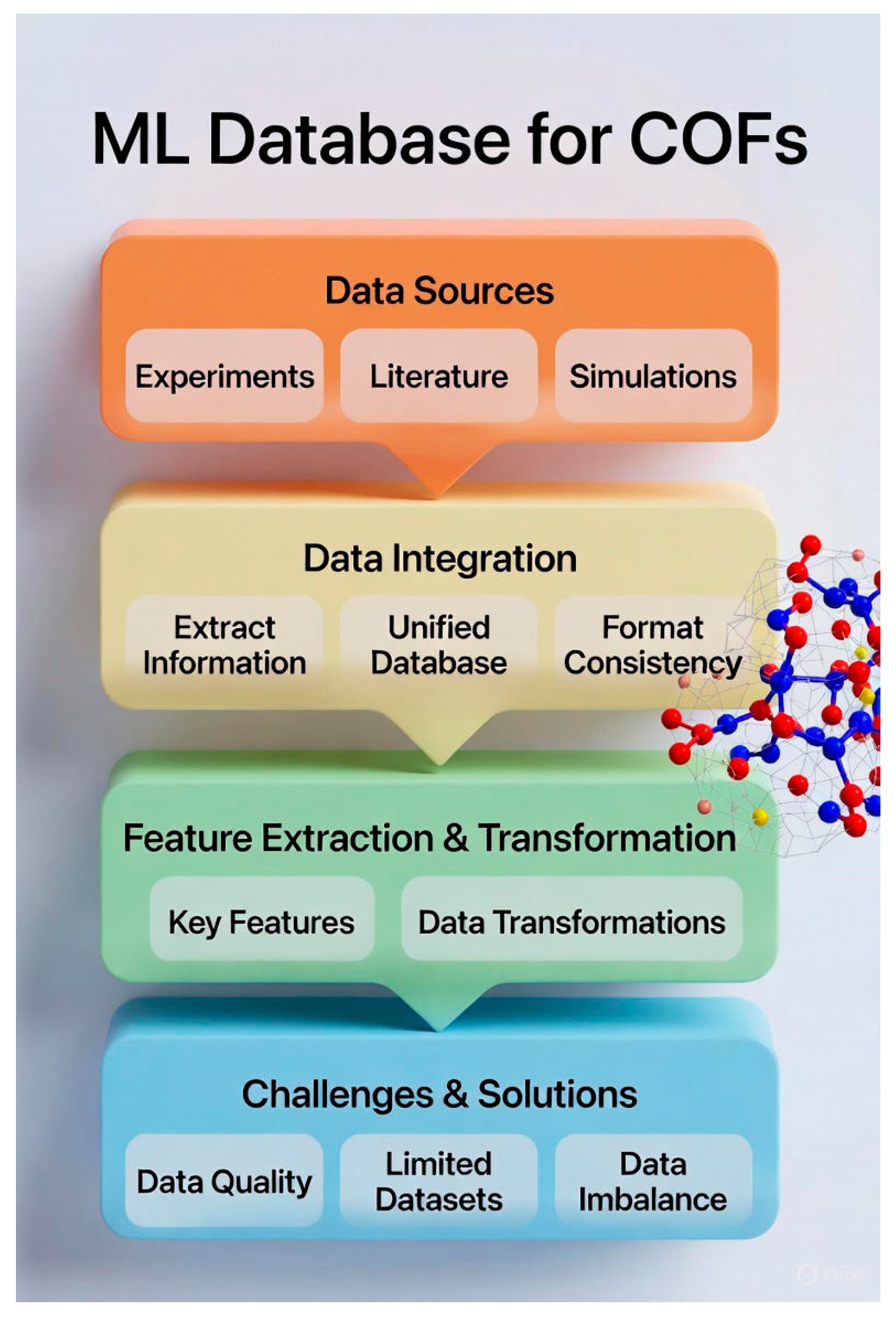
2.1. Machine Learning Databases for Covalent Organic Frameworks
- CoRE-COF Database: This repository represents one of the most comprehensive collections of experimentally synthesized COF structures, offering solvent-free, disorder-minimized files optimized for computational simulations and electronic structure calculations [26,31,32]. Its standardized format enables seamless integration with density functional theory (DFT) and molecular dynamics (MD) workflows.
2.2. ML Roles for COFs Development
2.2.1. Establishment of Performance Prediction Models
2.2.2. Development of Feature Descriptors
2.2.3. High-Throughput Screening
2.2.4. Structural Optimization
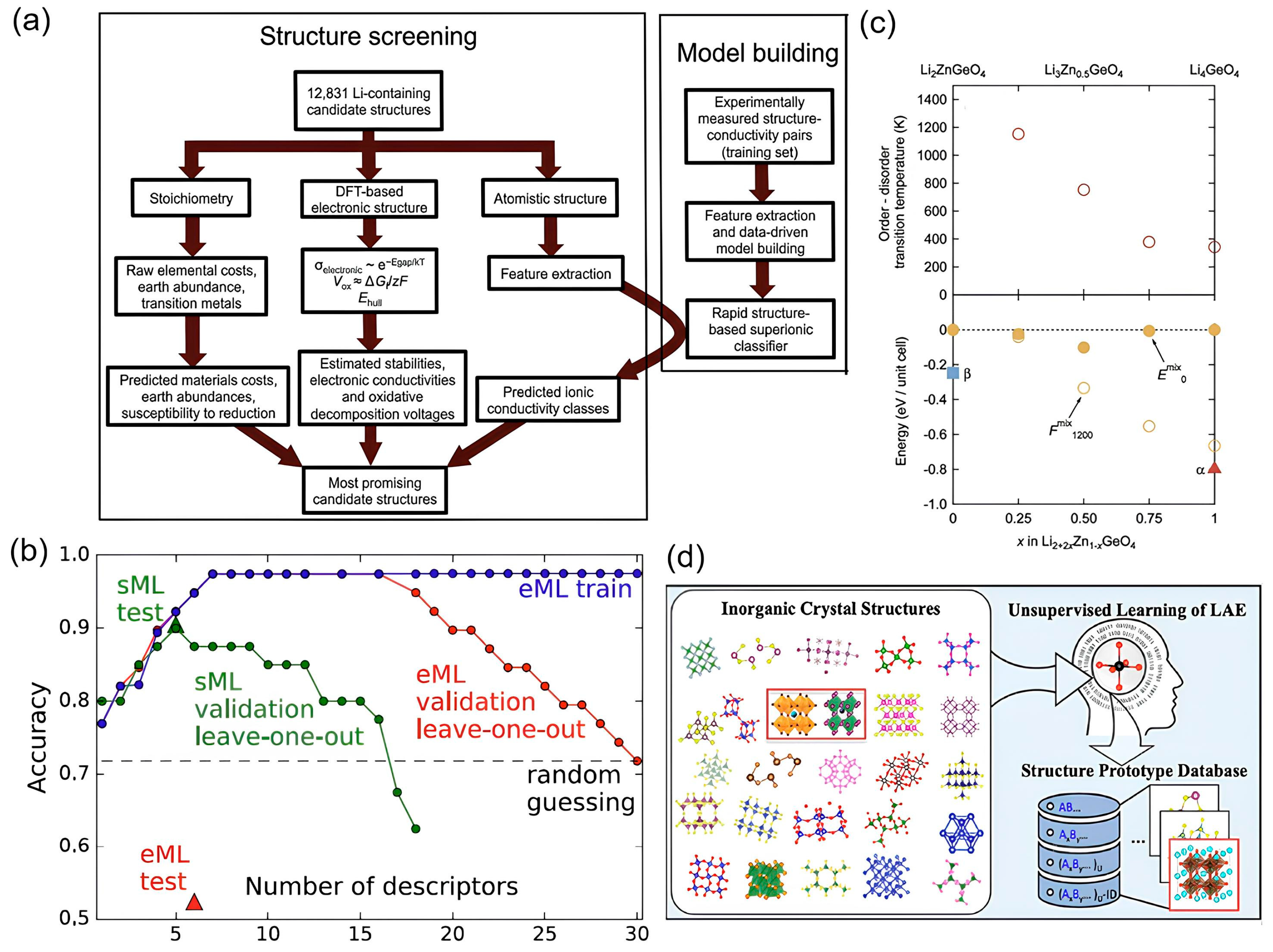
3. ML Application for COFs-Based Solid Electrolytes of LIBs
4. ML Key-Technologies for COFs-Based Solid Electrolytes of LIBs
4.1. Analysis of Ionic Conductivity
4.2. Interface Stability and Mechanical Optimization
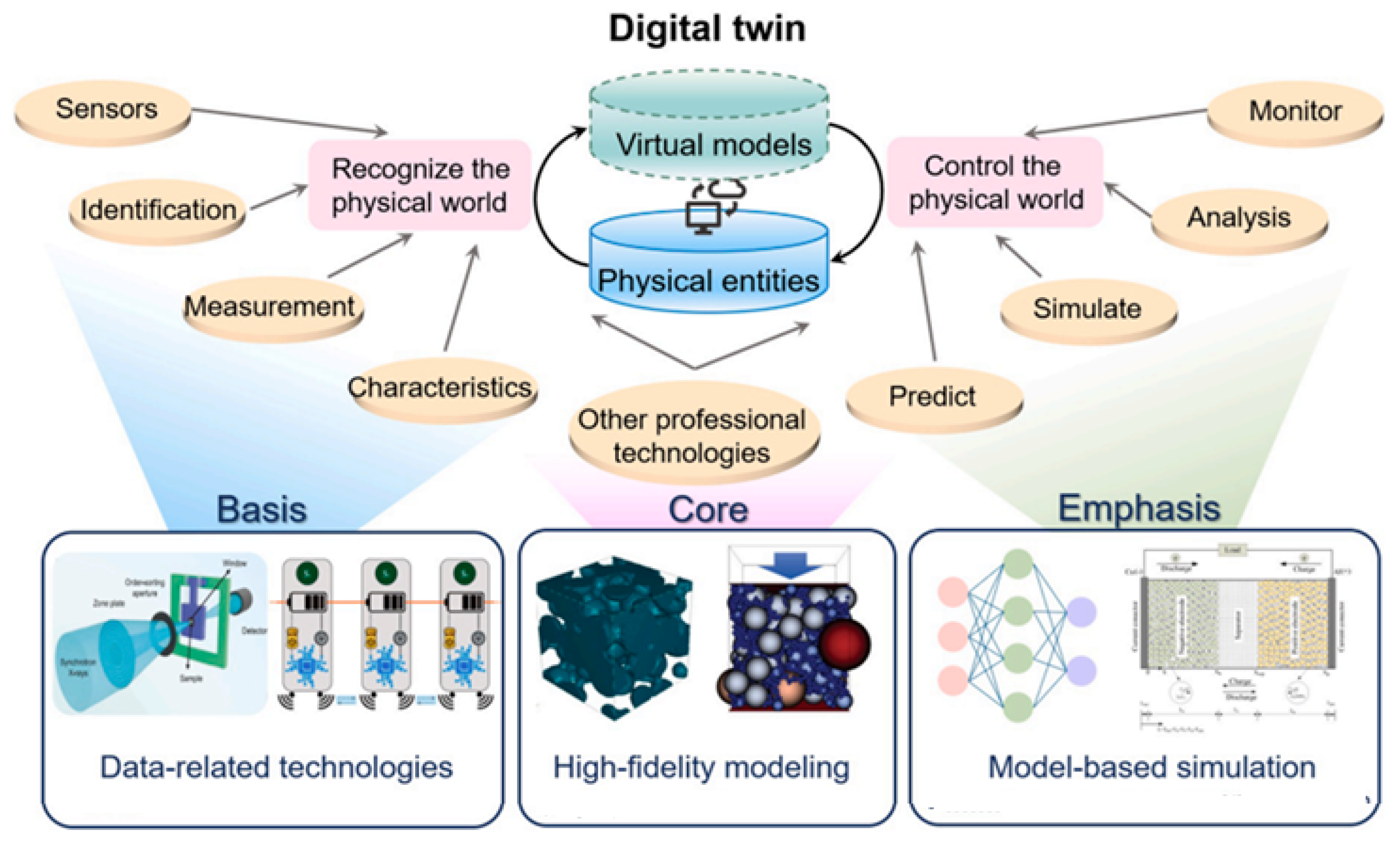
4.3. Cross-Scale Simulation and Digital Twin
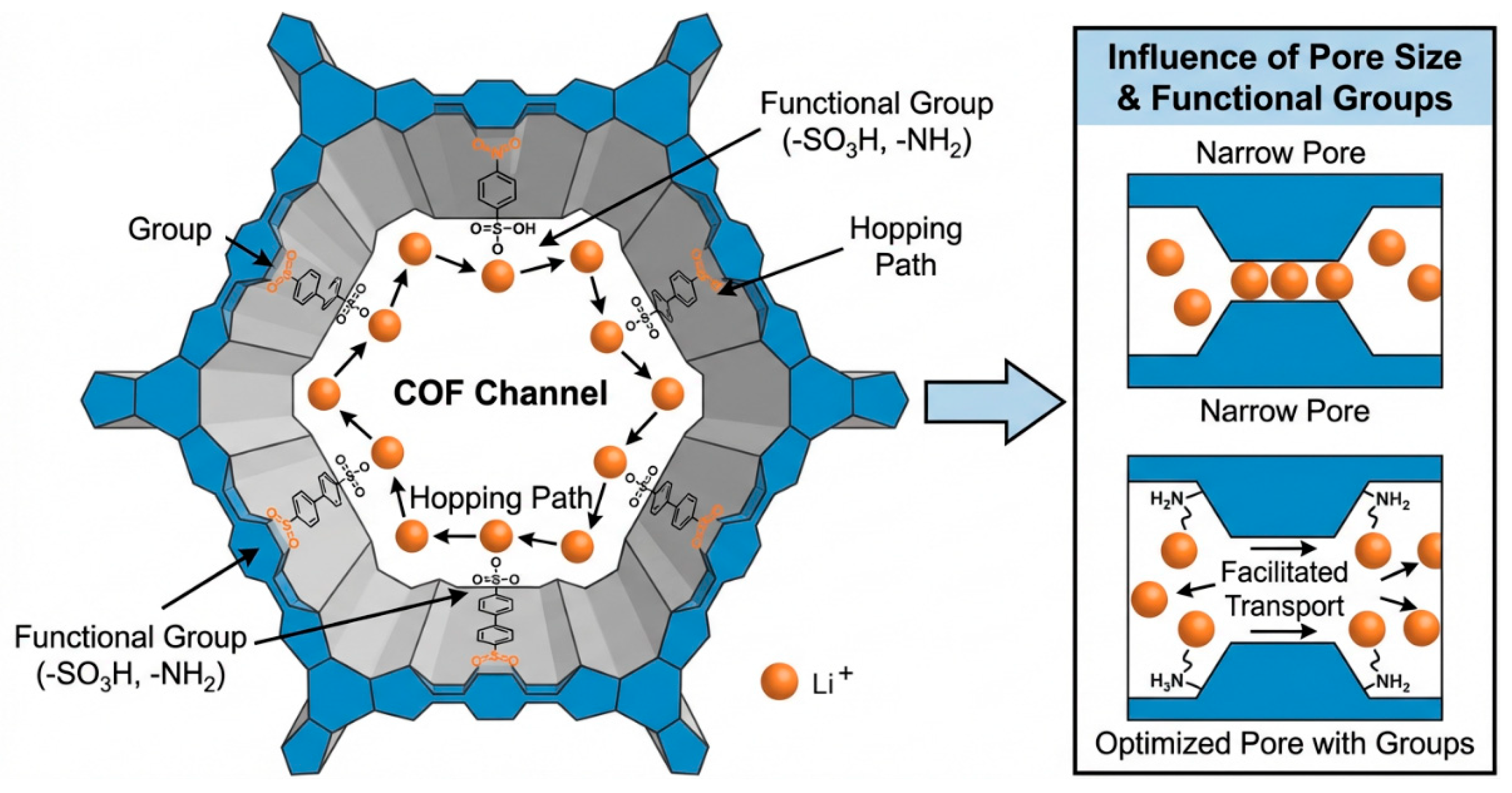
4.4. Application of Post-Synthetic Modification Techniques
4.5. Critical Evaluation, Reproducibility Challenges, and Methodological Limitations
5. Challenges and Current Limitations in Applying ML to COF-Based Systems
6. Conclusions and Perspectives
Author Contributions
Funding
Data Availability Statement
Conflicts of Interest
References
- Armand, M.; Tarascon, J.M. Building better batteries. Nature 2008, 451, 652–657. [Google Scholar] [CrossRef]
- Xu, J.; Cai, X.; Cai, S.; Shao, Y.; Hu, C.; Lu, S.; Ding, S. High-energy lithium-ion batteries: Recent progress and a promising future in applications. Energy Environ. Mater. 2023, 6, e12450. [Google Scholar] [CrossRef]
- Fan, X.; Ji, X.; Chen, L.; Chen, J.; Deng, T.; Han, F.; Yue, J.; Piao, N.; Wang, R.; Zhou, X. All-temperature batteries enabled by fluorinated electrolytes with non-polar solvents. Nat. Energy 2019, 4, 882–890. [Google Scholar] [CrossRef]
- Zhao, H.; Lam, W.-Y.A.; Sheng, L.; Wang, L.; Bai, P.; Yang, Y.; Ren, D.; Xu, H.; He, X. Cobalt-free cathode materials: Families and their prospects. Adv. Energy Mater. 2022, 12, 2103894. [Google Scholar] [CrossRef]
- Zhao, H.; Bo, X.; Xu, H.; Wang, L.; Daoud, W.A.; He, X. Advancing lithium-ion battery anodes towards a sustainable future: Approaches to achieve high specific capacity, rapid charging, and improved safety. Energy Storage Mater. 2024, 72, 103696. [Google Scholar] [CrossRef]
- Janek, J.; Zeier, W.G. Challenges in speeding up solid-state battery development. Nat. Energy 2023, 8, 230–240. [Google Scholar] [CrossRef]
- Shibutani, S.; Kodo, T.; Takeda, M.; Nagao, K.; Tokunaga, N.; Sasaki, Y.; Ohmiya, H. Organophotoredox-Catalyzed Decarboxylative C(sp3)–O Bond Formation. J. Am. Chem. Soc. 2020, 142, 1211–1216. [Google Scholar] [CrossRef]
- Chen, J.; Wang, W.; Sun, H.; He, W. Roles of Accelerated Molecular Dynamics Simulations in Predictions of Binding Kinetic Parameters. Mini Rev. Med. Chem. 2024, 24, 1323–1333. [Google Scholar] [CrossRef]
- Zhang, K.; Kirlikovali, K.O.; Varma, R.S.; Jin, Z.; Jang, H.W.; Farha, O.K.; Shokouhimehr, M. Covalent Organic Frameworks: Emerging Organic Solid Materials for Energy and Electrochemical Applications. ACS Appl. Mater. Interfaces 2020, 12, 27821–27852. [Google Scholar] [CrossRef]
- Zhu, Y.; Bai, Q.; Ouyang, S.; Jin, Y.; Zhang, W. Covalent Organic Framework-based Solid-State Electrolytes, Electrode Materials, and Separators for Lithium-ion Batteries. ChemSusChem 2024, 17, e202301118. [Google Scholar] [CrossRef]
- Zhao, H.; Bo, X.; Wang, X.; Ren, Y.; Wei, Z.; Daoud, W.A. Recent Advances and Perspectives in Single-Ion COF-Based Solid Electrolytes. Batteries 2023, 9, 432. [Google Scholar] [CrossRef]
- Xiong, Z.; Sun, B.; Zou, H.; Wang, R.; Fang, Q.; Zhang, Z.; Qiu, S. Amorphous-to-crystalline transformation: General synthesis of hollow structured covalent organic frameworks with high crystallinity. J. Am. Chem. Soc. 2022, 144, 6583–6593. [Google Scholar] [CrossRef]
- Patial, S.; Soni, V.; Kumar, A.; Raizada, P.; Ahamad, T.; Pham, X.M.; Van Le, Q.; Nguyen, V.-H.; Thakur, S.; Singh, P. Rational design, structure properties, and synthesis strategies of dual-pore covalent organic frameworks (COFs) for potent applications: A review. Environ. Res. 2023, 218, 114982. [Google Scholar]
- Zheng, Z.; Zhou, J.; Zhu, Y. Computational approach inspired advancements of solid-state electrolytes for lithium secondary batteries: From first-principles to machine learning. Chem. Soc. Rev. 2024, 53, 3134–3166. [Google Scholar] [CrossRef]
- Liu, Y.; Esan, O.C.; Pan, Z.; An, L. Machine learning for advanced energy materials. Energy AI 2021, 3, 100049. [Google Scholar] [CrossRef]
- Choudhary, K.; DeCost, B. Atomistic Line Graph Neural Network for improved materials property predictions. npj Comput. Mater. 2021, 7, 185. [Google Scholar] [CrossRef]
- Sadybekov, A.A.; Sadybekov, A.V.; Liu, Y.; Iliopoulos-Tsoutsouvas, C.; Huang, X.-P.; Pickett, J.; Houser, B.; Patel, N.; Tran, N.K.; Tong, F.; et al. Synthon-based ligand discovery in virtual libraries of over 11 billion compounds. Nature 2022, 601, 452–459. [Google Scholar] [CrossRef]
- Jackson, N.E.; Webb, M.A.; de Pablo, J.J. Recent advances in machine learning towards multiscale soft materials design. Curr. Opin. Chem. Eng. 2019, 23, 106–114. [Google Scholar] [CrossRef]
- Misra, S.; Li, H.; He, J. Machine Learning for Subsurface Characterization; Gulf Professional Publishing: Houston, TX, USA, 2019. [Google Scholar]
- Xu, Y.; Hong, K.; Tsujii, J.; Chang, E.I.-C. Feature engineering combined with machine learning and rule-based methods for structured information extraction from narrative clinical discharge summaries. J. Am. Med. Inform. Assoc. 2012, 19, 824–832. [Google Scholar] [CrossRef]
- Hippalgaonkar, K.; Li, Q.; Wang, X.; Fisher, J.W.; Kirkpatrick, J.; Buonassisi, T. Knowledge-integrated machine learning for materials: Lessons from gameplaying and robotics. Nat. Rev. Mater. 2023, 8, 241–260. [Google Scholar] [CrossRef]
- Pan, Z.; Yu, W.; Yi, X.; Khan, A.; Yuan, F.; Zheng, Y. Recent progress on generative adversarial networks (GANs): A survey. IEEE Access 2019, 7, 36322–36333. [Google Scholar] [CrossRef]
- Zhou, K.Q.; Qin, Y.; Yuen, C. Graph neural network-based lithium-ion battery state of health estimation using partial discharging curve. J. Energy Storage 2024, 100, 113502. [Google Scholar] [CrossRef]
- Zhao, J.; Han, X.; Ouyang, M.; Burke, A.F. Specialized deep neural networks for battery health prognostics: Opportunities and challenges. J. Energy Chem. 2023, 87, 416–438. [Google Scholar] [CrossRef]
- Rodrigues, J.F.; Florea, L.; de Oliveira, M.C.; Diamond, D.; Oliveira, O.N. Big data and machine learning for materials science. Discov. Mater. 2021, 1, 12. [Google Scholar] [CrossRef]
- Liu, Y.; Liu, X.; Su, A.; Gong, C.; Chen, S.; Xia, L.; Zhang, C.; Tao, X.; Li, Y.; Li, Y. Revolutionizing the structural design and determination of covalent–organic frameworks: Principles, methods, and techniques. Chem. Soc. Rev. 2024, 53, 502–544. [Google Scholar] [CrossRef]
- Zhu, J.; Ge, Z.; Song, Z.; Gao, F. Review and big data perspectives on robust data mining approaches for industrial process modeling with outliers and missing data. Annu. Rev. Control 2018, 46, 107–133. [Google Scholar] [CrossRef]
- Xu, D.; Zhang, Q.; Huo, X.; Wang, Y.; Yang, M. Advances in data-assisted high-throughput computations for material design. Mater. Genome Eng. Adv. 2023, 1, e11. [Google Scholar] [CrossRef]
- Nandan Prasad, A. Data Quality and Preprocessing. In Introduction to Data Governance for Machine Learning Systems: Fundamental Principles, Critical Practices, and Future Trends; Springer: Berlin/Heidelberg, Germany, 2024; pp. 109–223. [Google Scholar]
- Khandelwal, R.; Deshmukh, S. Towards Addressing Bias and Fairness in Machine Learning. PICT’s Int. J. Eng. Technol. 2024, 11, 100–109. [Google Scholar]
- Tong, M.; Lan, Y.; Yang, Q.; Zhong, C. Exploring the structure-property relationships of covalent organic frameworks for noble gas separations. Chem. Eng. Sci. 2017, 168, 456–464. [Google Scholar] [CrossRef]
- Wan, Y.; Zhang, J.; Wang, D.; Sun, P.; Shi, L.; Li, S.; Zhang, J.; Yan, X.; Wu, X. A data-driven search of two-dimensional covalent organic frameworks for visible-light-driven overall water splitting. J. Phys. Chem. Lett. 2023, 14, 7421–7432. [Google Scholar] [CrossRef]
- Aksu, G.O.; Erucar, I.; Haslak, Z.P.; Keskin, S. Accelerating discovery of COFs for CO2 capture and H2 purification using structurally guided computational screening. Chem. Eng. J. 2022, 427, 131574. [Google Scholar] [CrossRef]
- Aksu, G.O.; Keskin, S. Rapid and Accurate Screening of the COF Space for Natural Gas Purification: COFInformatics. ACS Appl. Mater. Interfaces 2024, 16, 19806–19818. [Google Scholar] [CrossRef]
- Aksu, G.O.; Keskin, S. Advancing CH4/H2 separation with covalent organic frameworks by combining molecular simulations and machine learning. J. Mater. Chem. A 2023, 11, 14788–14799. [Google Scholar] [CrossRef] [PubMed]
- Ga, S.; An, N.; Lee, G.Y.; Joo, C.; Kim, J. Economic analysis with multiscale high-throughput screening for covalent organic framework adsorbents in ammonia-based green hydrogen separation. Renew. Sustain. Energy Rev. 2024, 189, 113989. [Google Scholar] [CrossRef]
- Ga, S.; An, N.; Lee, G.Y.; Joo, C.; Kim, J. Economic Analysis of Cof Adsorbents in Psa/Vsa Processes for Ammonia-Based Green Hydrogen Separation via Multiscale Hts. In Vsa Processes for Ammonia-Based Green Hydrogen Separation via Multiscale Hts; Elsevier Inc.: Amsterdam, The Netherlands, 2023. [Google Scholar]
- Yang, P.; Zhang, H.; Lai, X.; Wang, K.; Yang, Q.; Yu, D. Accelerating the selection of covalent organic frameworks with automated machine learning. ACS Omega 2021, 6, 17149–17161. [Google Scholar] [CrossRef]
- Ahmed, A. Machine-learning-enhanced symbolic regression for methane storage prediction in covalent organic frameworks. Phys. Rev. Mater. 2024, 8, 115408. [Google Scholar] [CrossRef]
- Ning, J.; Shen, K.; Zhao, R.; Gao, K.; Cai, J.; Hou, L. Computer-aided design of covalent organic frameworks for SF6 capture: The combination of high-throughput screening and machine learning. J. Phys. Chem. C 2024, 128, 11355–11366. [Google Scholar] [CrossRef]
- Xin, B.; Feng, M.; Cheng, M.; Dai, Z.; Zhou, L.; Dai, Y.; Ji, X. Combining automated machine learning and molecular simulation to advance the discovery of COF-based membranes for acid gas separation. Comput. Aided Chem. Eng. 2024, 53, 2683–2688. [Google Scholar]
- Fujimura, K.; Seko, A.; Koyama, Y.; Kuwabara, A.; Kishida, I.; Shitara, K.; Fisher, C.A.; Moriwake, H.; Tanaka, I. Accelerated materials design of lithium superionic conductors based on first-principles calculations and machine learning algorithms. Adv. Energy Mater. 2013, 3, 980–985. [Google Scholar] [CrossRef]
- Sendek, A.D. Accelerating the Design and Discovery of Solid Lithium Ion Conductor Materials with Physics-Based Machine Learning. Ph.D. Thesis, Stanford University, Stanford, CA, USA, 2018. [Google Scholar]
- Sendek, A.D.; Yang, Q.; Cubuk, E.D.; Duerloo, K.-A.N.; Cui, Y.; Reed, E.J. Holistic computational structure screening of more than 12000 candidates for solid lithium-ion conductor materials. Energy Environ. Sci. 2017, 10, 306–320. [Google Scholar] [CrossRef]
- Sendek, A.D.; Antoniuk, E.R.; Cubuk, E.D.; Francisco, B.E.; Buettner-Garrett, J.; Cui, Y.; Reed, E.J. A new solid Li-ion electrolyte from the crystalline lithium-boron-sulfur system. SSRN Electron. J. 2019. [Google Scholar] [CrossRef]
- Zhang, C.; Zhai, Y.; Gong, Z.; Duan, H.; She, Y.-B.; Yang, Y.-F.; Su, A. Transfer learning across different chemical domains: Virtual screening of organic materials with deep learning models pretrained on small molecule and chemical reaction data. J. Cheminform. 2024, 16, 89. [Google Scholar] [CrossRef] [PubMed]
- Chen, A.; Wang, Z.; Vidaurre, K.L.L.; Han, Y.; Ye, S.; Tao, K.; Wang, S.; Gao, J.; Li, J. Knowledge-reused transfer learning for molecular and materials science. J. Energy Chem. 2024, 11, 149–168. [Google Scholar] [CrossRef]
- Cai, Z.; Li, W.; Chung, Y.G.; Li, S.; Liang, T.; Wu, T. Transfer learning-assisted computational screening of metal-organic frameworks and covalent-organic frameworks for the separation of Xe/Kr noble gas. Sep. Purif. Technol. 2024, 348, 127752. [Google Scholar] [CrossRef]
- Cubuk, E.D.; Sendek, A.D.; Reed, E.J. Screening billions of candidates for solid lithium-ion conductors: A transfer learning approach for small data. J. Chem. Phys. 2019, 150, 214701. [Google Scholar] [CrossRef] [PubMed]
- Eckhoff, M.; Behler, J. High-dimensional neural network potentials for magnetic systems using spin-dependent atom-centered symmetry functions. npj Comput. Mater. 2021, 7, 170. [Google Scholar] [CrossRef]
- Luo, S.; Xing, B.; Faizan, M.; Xie, J.; Zhou, K.; Zhao, R.; Li, T.; Wang, X.; Fu, Y.; He, X. Inorganic Crystal Structure Prototype Database Based on Unsupervised Learning of Local Atomic Environments. J. Phys. Chem. A 2022, 126, 4300–4312. [Google Scholar] [CrossRef]
- Xu, G.; Jiang, M.; Li, J.; Xuan, X.; Li, J.; Lu, T.; Pan, L. Machine learning-accelerated discovery and design of electrode materials and electrolytes for lithium ion batteries. Energy Storage Mater. 2024, 72, 103710. [Google Scholar] [CrossRef]
- Qiang, Z.; Li, X.; Ning, Y.; Zhang, C.; Sun, Y.; Yin, G.; Wang, J.; Lou, S. Digital modeling-assisted mesoscale visualization lights up materials science from liquid-to solid-state batteries. Energy Storage Mater. 2023, 63, 102960. [Google Scholar] [CrossRef]
- Ling, C. A review of the recent progress in battery informatics. npj Comput. Mater. 2022, 8, 33. [Google Scholar] [CrossRef]
- Qiu, Y.; Zhang, X.; Tian, Y.; Zhou, Z. Machine learning promotes the development of all-solid-state batteries. Chin. J. Struct. Chem. 2023, 42, 100118. [Google Scholar]
- Ma, B.; Zhong, L.; Huang, S.; Xiao, M.; Wang, S.; Han, D.; Meng, Y. Covalent Organic Framework Enhanced Solid Polymer Electrolyte for Lithium Metal Batteries. Molecules 2024, 29, 1759. [Google Scholar] [CrossRef] [PubMed]
- Huang, G.; Huang, F.; Dong, W. Machine learning in energy storage material discovery and performance prediction. Chem. Eng. J. 2024, 492, 152294. [Google Scholar] [CrossRef]
- Liu, X.; Fan, K.; Huang, X.; Ge, J.; Liu, Y.; Kang, H. Recent advances in artificial intelligence boosting materials design for electrochemical energy storage. Chem. Eng. J. 2024, 490, 151625. [Google Scholar] [CrossRef]
- Huang, W.-H.; Li, X.-M.; Yang, X.-F.; Zhang, X.-X.; Wang, H.-H.; Wang, H. The recent progress and perspectives on metal-and covalent-organic framework based solid-state electrolytes for lithium-ion batteries. Mater. Chem. Front. 2021, 5, 3593–3613. [Google Scholar] [CrossRef]
- Zhao, H.; Chen, J.; Wei, W.; Ke, S.; Zeng, X.; Chen, D.; Lin, P. Synthesis of Ni@NiSn Composite with High Lithium-Ion Diffusion Coefficient for Fast-Charging Lithium-Ion Batteries. Glob. Chall. 2020, 4, 1900073. [Google Scholar] [CrossRef]
- Lam, W.-Y.A.; Zhao, H.; Zhang, B.; Wang, L.; Xu, H.; He, X. Significance of direct observation of lithium-ion distribution and potential distribution inside batteries through operando analyses. Next Energy 2024, 2, 100106. [Google Scholar] [CrossRef]
- Lee, J.-H.; Lee, H.; Lee, J.; Kang, T.W.; Park, J.; Shin, J.-H.; Lee, H.; Majhi, D.; Lee, S.U.; Kim, J.-H. Multicomponent Covalent Organic Framework Solid Electrolyte Allowing Effective Li-Ion Dissociation and Diffusion for All-Solid-State Batteries. ACS Nano 2023, 17, 17372–17382. [Google Scholar] [CrossRef]
- Zheng, Y.; Yao, Y.; Ou, J.; Li, M.; Luo, D.; Dou, H.; Zhaoqiang, L.; Amine, K.; Yu, A.; Chen, Z. A review of composite solid-state electrolytes for lithium batteries: Fundamentals, key materials and advanced structures. Chem. Soc. Rev. 2020, 49, 416–438. [Google Scholar] [CrossRef]
- Zhao, H.; Wang, J.; Chen, C.; Chen, D.; Gao, Y.; Saccoccio, M.; Ciucci, F. A bi-functional catalyst for oxygen reduction and oxygen evolution reactions from used baby diapers: α-Fe2O3 wrapped in P and S dual doped graphitic carbon. RSC Adv. 2016, 6, 64258–64265. [Google Scholar] [CrossRef]
- Segura, J.L.; Royuela, S.; Ramos, M.M. Post-synthetic modification of covalent organic frameworks. Chem. Soc. Rev. 2019, 48, 3903–3945. [Google Scholar] [CrossRef]
- Rejali, N.A.; Dinari, M.; Wang, Y. Post-synthetic modifications to covalent organic frameworks (COFs) for diverse applications. Chem. Commun. 2023, 59, 11631–11647. [Google Scholar] [CrossRef] [PubMed]
- Li, H.; Chen, L. Development of Key Material System for Solid-State Batteries. Strateg. Study Chin. Acad. Eng. 2024, 26, 19–33. [Google Scholar]
- Tuoya, N.; Gu, Q.; Jiang, R.; Zhao, Y.; Zhang, L.; Zhu, A.; Wang, X.; Wu, J.; Zheng, Z.; Lee, C.-S.; et al. Nanoconfined Polymerization Facilitates Efficient Li+ Transportation in Quasi-Solid Electrolytes. Angew. Chem. Int. Ed. 2025, 64, e202509921. [Google Scholar]



| Method/Algorithm | Application in COF Development | Advantages | Limitations | Key References |
|---|---|---|---|---|
| Graph Neural Networks (GNNs) | Virtual screening of COF structures; prediction of ionic conductivity and stability. | Handles graph-based representations of COFs; captures topological features. | Requires large datasets; interpretability challenges. | [17,34,40] |
| Support Vector Regression (SVR) | Prediction of lithium-ion conductivity (e.g., γ-Li4GeO4). | Effective for small datasets; robust to noise. | Kernel selection impacts performance; struggles with high-dimensional data. | [42,43] |
| Logistic Regression | Classification of superionic conductors (e.g., screening 12,000 materials). | Simple, interpretable; efficient for binary classification. | Limited to linear decision boundaries. | [44,45] |
| Generative Adversarial Networks (GANs) | Proposing novel linker combinations for enhanced ionic transport. | Generates new COF structures; explores uncharted chemical space. | Training instability; requires validation via DFT/MD. | [22,46] |
| Transfer Learning | Cross-domain predictions (e.g., adapting small-molecule models to COFs). | Reduces data requirements; accelerates screening. | Domain shift issues; needs fine-tuning. | [47,48,49] |
| Neural Network Potentials (NNPs) | Predicting lattice parameters, diffusion barriers (e.g., LiMn2O4). | High accuracy for multiscale properties. | Computationally expensive; requires DFT training data. | [50] |
| Monte Carlo Simulations | Screening COFs for gas separation (e.g., CO2/CH4). | Efficient for thermodynamic properties. | Limited to equilibrium conditions. | [34,41] |
| Agglomerative Clustering | Unsupervised grouping of fast-conducting materials (ICSD database). | Identifies patterns without labeled data. | Sensitive to distance metrics; hard to scale. | [51] |
| Automated ML (AutoML) | Optimizing feature selection and hyperparameters for COF property prediction. | Reduces manual effort; improves model performance. | Black-box nature; may overlook domain-specific insights. | [38,52] |
| Digital Twin Strategies | Simulating COF behavior under operational conditions (e.g., charge–discharge cycles). | Integrates multiscale modeling with real-time data. | High fidelity requires extensive validation. | [53] |
| ML Application | Specific Findings | Limitations | Citations |
|---|---|---|---|
| High-throughput screening | Identified 58 high-potential COF candidates from 12,000 structures in 3 days using GNNs. | Limited experimental validation of predicted candidates. | [17,44] |
| Ionic conductivity prediction | Predicted COF-LZU1′s conductivity (3.30 × 10⁻⁴ S/cm) and validated experimentally. | Model accuracy depends on training data quality. | [42,50] |
| Structure-property optimization | ML-guided pore/functional group tuning improved COF ionic transport by 37%. | Generalizability to untested COF chemistries remains unclear. | [34,57] |
| Synthesis condition optimization | NLP extracted 92% synthesizable COFs from Reaxys, reducing trial-and-error efforts. | Requires domain-specific data preprocessing. | [16,52] |
| Transfer learning | Achieved 90% accuracy in screening 20 billion Li-ion conductors with limited data. | Performance drops if source/target domains are mismatched. | [49,50] |
| Digital twins | Simulated COF structural evolution during battery cycling using multiscale modeling. | High computational cost for real-time implementation. | [53] |
| Post-synthetic modification | ML predicted optimal linker modifications to enhance COF conductivity. | Limited experimental validation of ML-designed modifications. | [65,66] |
| ML Method | Prediction Accuracy (R2/%) | Computational Cost | Experimental Validation Rate * | Key Limitations | Refs |
|---|---|---|---|---|---|
| GNN | 0.87 (conductivity) | 120 GPU-hrs | 28% (58/207 candidates) | Requires >104 samples; overfitting risk | [17,34] |
| SVR | 0.79 (conductivity) | 2 CPU-hrs | 37% (18/49 candidates) | Poor extrapolation beyond training range | [50,51] |
| Transfer Learning | 0.91 (cross-domain) | 50 GPU-hrs | 23% (domain shift penalty) | Fails with >30% feature space mismatch | [55,56] |
| GANs | N/A (generative) | 500 GPU-hrs | 19% (novel structures) | 81% fail synthesis; kinetic barriers | [22,54] |
| Digital Twins | 0.72 (cycling stability) | 300 CPU-hrs | 38% (fidelity degrades > 50 cycles) | Lacks operando recalibration | [67] |
Disclaimer/Publisher’s Note: The statements, opinions and data contained in all publications are solely those of the individual author(s) and contributor(s) and not of MDPI and/or the editor(s). MDPI and/or the editor(s) disclaim responsibility for any injury to people or property resulting from any ideas, methods, instructions or products referred to in the content. |
© 2026 by the authors. Published by MDPI on behalf of the World Electric Vehicle Association. Licensee MDPI, Basel, Switzerland. This article is an open access article distributed under the terms and conditions of the Creative Commons Attribution (CC BY) license.
Share and Cite
Xu, W.; Sang, J.; Gong, Q.; Lin, W.; Lin, Z.; Mushtaq, F.; Mushtaq, H.; Hong, Z.; Zhao, H. Machine Learning Assisted Development of COFs Materials as Solid Electrolytes for Lithium-Ion Batteries—A Mini Review. World Electr. Veh. J. 2026, 17, 113. https://doi.org/10.3390/wevj17030113
Xu W, Sang J, Gong Q, Lin W, Lin Z, Mushtaq F, Mushtaq H, Hong Z, Zhao H. Machine Learning Assisted Development of COFs Materials as Solid Electrolytes for Lithium-Ion Batteries—A Mini Review. World Electric Vehicle Journal. 2026; 17(3):113. https://doi.org/10.3390/wevj17030113
Chicago/Turabian StyleXu, Wenhao, Jianhui Sang, Qidong Gong, Wenbin Lin, Zhihong Lin, Faheem Mushtaq, Hamza Mushtaq, Zhenyu Hong, and Hong Zhao. 2026. "Machine Learning Assisted Development of COFs Materials as Solid Electrolytes for Lithium-Ion Batteries—A Mini Review" World Electric Vehicle Journal 17, no. 3: 113. https://doi.org/10.3390/wevj17030113
APA StyleXu, W., Sang, J., Gong, Q., Lin, W., Lin, Z., Mushtaq, F., Mushtaq, H., Hong, Z., & Zhao, H. (2026). Machine Learning Assisted Development of COFs Materials as Solid Electrolytes for Lithium-Ion Batteries—A Mini Review. World Electric Vehicle Journal, 17(3), 113. https://doi.org/10.3390/wevj17030113