Article

Impact of Metabolic-Dysfunction-Associated Steatotic Liver Disease (MASLD) and Steatohepatitis (MASH) on Clostridioides difficile Inpatient Outcomes: A Propensity-Matched Study


1
Department of Internal Medicine, John H Stroger Jr. Hospital of Cook County, Chicago, IL 60612, USA
2
Division of Gastroenterology and Hepatology, John H Stroger Jr. Hospital of Cook County, Chicago, IL 60612, USA
*
Author to whom correspondence should be addressed.
Gastroenterol. Insights 2026, 17(2), 38; https://doi.org/10.3390/gastroent17020038 (registering DOI)
Submission received: 6 May 2026 / Revised: 8 June 2026 / Accepted: 10 June 2026 / Published: 12 June 2026
(This article belongs to the Section Liver)

Abstract

Background: Clostridioides difficile infection (CDI) remains a leading cause of hospital-acquired infection. Metabolic-dysfunction-associated steatotic liver disease (MASLD) is the most common chronic liver disease worldwide and has been associated with increased infectious susceptibility. However, whether non-cirrhotic MASLD independently worsens inpatient CDI outcomes and whether this differs across the MASLD spectrum remain unclear. Methods: We conducted a retrospective cohort study using the National Inpatient Sample (NIS) 2017–2023, identifying adult hospitalizations with a principal diagnosis of CDI. Patients with cirrhosis and alcoholic liver disease were excluded. Propensity score matching (1:1) was performed for the primary MASLD vs. non-MASLD comparison in the principal-diagnosis CDI cohort. To evaluate whether outcomes differ across the MASLD spectrum, survey-weighted multivariable logistic regression was used to compare K76.0-coded (MASLD without steatohepatitis) and K75.81-coded (MASH) hospitalizations against non-MASLD/MASH hospitalizations within the principal-diagnosis CDI cohort. The primary outcome was in-hospital mortality; secondary outcomes included complications, healthcare utilization, and discharge disposition. Results: The principal-diagnosis CDI cohort comprised 76,103 discharges (weighted ~380,515). MASLD prevalence among non-cirrhotic CDI hospitalizations nearly doubled from 1.98% in 2017 to 3.74% in 2023 (OR per year 1.089; p < 0.001). After propensity score matching (1756 pairs), MASLD was not associated with significantly higher in-hospital mortality (OR 1.252; p = 0.574) or most adverse outcomes, but was associated with lower odds of non-routine discharge (OR 0.794; p = 0.003). In the matched utilization analysis, length of stay and total charges were not significantly different, although the adjusted pre-match analysis showed higher charges among MASLD hospitalizations (+$4431; p = 0.001). Within the same principal-diagnosis cohort, K76.0-coded MASLD (n = 1988) was associated with lower odds of acute kidney injury (aOR 0.821; p = 0.004) and non-routine discharge (aOR 0.805; p = 0.001). K75.81-coded MASH (n = 197) was independently associated with higher in-hospital mortality (aOR 2.840, 95% CI 1.154–6.985; p = 0.023) and peritonitis (aOR 4.136, 95% CI 1.543–11.082; p = 0.005), although confidence intervals were wide and the number of MASH-coded hospitalizations was modest. Conclusions: The prevalence of MASLD among CDI hospitalizations is rising. Non-cirrhotic MASLD without steatohepatitis does not independently worsen inpatient CDI outcomes after adjustment, whereas K75.81-coded MASH may identify a higher-risk subgroup with increased mortality and peritonitis, pending confirmation in larger cohorts. These findings suggest that hepatic inflammatory activity, rather than steatosis alone, may drive adverse CDI outcomes and support further investigation of MASLD phenotyping in CDI risk stratification.

1. Introduction

Clostridioides difficile infection (CDI) remains a leading cause of healthcare-associated infection, with a pooled incidence of approximately 5.3 cases per 1000 admissions and a rising burden of community-acquired disease [1]. Despite advances in infection control and therapeutics, CDI continues to result in significant complications, including septic shock, toxic megacolon, and intestinal perforation. At the same time, metabolic-dysfunction-associated steatotic liver disease (MASLD) has emerged as the most common chronic liver disease worldwide, with an estimated burden reaching 130 million adults in the US by 2050 [2]. MASLD has a broad spectrum of disease, ranging from simple steatosis in early disease to metabolic-dysfunction-associated steatohepatitis (MASH), characterized by hepatic inflammation and hepatocellular injury. Beyond its hepatic manifestations, MASLD is increasingly recognized as a systemic disease involving chronic inflammation, immune dysregulation, and heightened susceptibility to infection.
Previous studies have linked MASLD to a higher risk of infections, including CDI [3,4,5,6], and analyses of chronic liver disease populations consistently demonstrate worse outcomes once infections occur [7,8,9]. However, these studies have important limitations. First, many did not exclude patients with cirrhosis, in whom infection outcomes are already known to be poor, making it difficult to isolate the independent effect of non-cirrhotic MASLD on CDI outcomes. Second, the MASLD spectrum itself has not been adequately differentiated: the role of MASH, characterized by hepatic inflammation, immune dysfunction, and gut microbiota alterations, remains poorly defined in the context of CDI. It is plausible that inflammatory disease activity, rather than steatosis alone, drives worse infectious outcomes, yet few large-scale studies have systematically evaluated how different stages of the MASLD spectrum influence CDI outcomes.
A biologically plausible link between MASLD and CDI is emerging from the gut–liver axis. MASLD is characterized by alterations in intestinal barrier function, gut dysbiosis, and shifts in bile acid metabolism [10,11,12,13]. Bile acids regulate C. difficile spore germination and outgrowth: primary bile acids such as taurocholate promote germination, whereas secondary bile acids inhibit it [14]. MASLD is associated with altered bile acid composition, including changes in taurine-conjugated bile acids, a milieu that may favor C. difficile colonization [13,15]. In parallel, hepatic inflammation in MASH is accompanied by systemic immune dysregulation that may further influence host defense once infection is established [3,4]. These mechanisms motivate the present comparison of non-cirrhotic MASLD with and without steatohepatitis in hospitalized CDI.
To address these gaps, we conducted a retrospective cohort study using the National Inpatient Sample (NIS) from 2017 to 2023, focusing on non-cirrhotic CDI hospitalizations. Using propensity score matching and multivariable analyses, we assessed associations between MASLD and inpatient outcomes and further compared MASLD and MASH to evaluate whether hepatic inflammatory activity influences CDI severity.

2. Methods

2.1. Data Source

This retrospective cohort study utilized the National Inpatient Sample (NIS), the largest all-payer inpatient database in the United States, developed by the Agency for Healthcare Research and Quality (AHRQ) as part of the Healthcare Cost and Utilization Project (HCUP). The NIS represents a 20% stratified sample of US hospitalizations and includes patient- and hospital-level data. Discharge-level weights were applied to generate nationally representative estimates. This study followed the Strengthening the Reporting of Observational Studies in Epidemiology (STROBE) guidelines for cohort studies. As the dataset is de-identified and publicly available, institutional review board approval was not required.

2.2. Study Population and Covariates

We identified adult hospitalizations (≥18 years) with a principal diagnosis of CDI using ICD-10-CM codes A04.71 (recurrent) and A04.72 (non-recurrent) between 2017 and 2023. Patients with cirrhosis (K74.3–K74.69) and alcoholic liver disease (K70.0–K70.9) were excluded to isolate the effect of non-cirrhotic MASLD. The exposure of interest was coded non-cirrhotic steatotic liver disease (ICD-10-CM K76.0, “fatty change of liver, not elsewhere classified”) and its inflammatory subtype, coded nonalcoholic steatohepatitis (K75.81), identified in secondary diagnosis fields. We use the contemporary nomenclature “MASLD” and “MASH” throughout; however, these designations rely on administrative coding rather than histological confirmation or formal documentation of cardiometabolic criteria and should therefore be interpreted as coded-MASLD/MASH-compatible diagnoses. A sensitivity analysis using a stricter operational definition that additionally required at least one metabolic risk factor (obesity, type 2 diabetes, hypertension, or dyslipidemia) is reported in Supplementary Table S5. The two subtype exposures (K76.0 and K75.81) were not defined as mutually exclusive in the source data: of 2183 hospitalizations carrying either code, 2 carried both K76.0 and K75.81 in different secondary diagnosis fields and were included in both subtype groups when modeled separately against non-MASLD/MASH controls. Reported sums of K76.0-coded and K75.81-coded counts therefore exceed the combined MASLD/MASH total by 2 discharges. All ICD-10-CM and ICD-10-PCS codes used for cohort definition, comorbidity assessment, and outcome ascertainment are listed in Supplementary Table S1.
The analytic cohort was restricted to hospitalizations in which CDI was the principal reason for admission (principal-diagnosis CDI cohort). The primary MASLD-versus-non-MASLD comparison was performed using propensity score matching within this cohort. The MASLD subtype comparison (K76.0 versus K75.81 versus non-MASLD/MASH hospitalizations) was also performed within the principal-diagnosis CDI cohort using survey-weighted multivariable logistic regression, with each exposure modeled separately against non-MASLD/MASH controls. We additionally constructed a broader any-diagnostic-position CDI cohort (CDI coded in any diagnosis field) for descriptive purposes and to characterize the distribution of K75.81 across CDI diagnostic positions; however, all inferential subtype analyses are presented in the principal-diagnosis cohort to preserve clinical interpretability and avoid contamination by hospitalizations admitted for unrelated primary illnesses.
Covariates included patient demographics (age, sex, race/ethnicity, primary payer, and median household income quartile), hospital characteristics (region, location/teaching status, and bed size), year of admission, CDI subtype (recurrent vs. non-recurrent), inflammatory bowel disease (Crohn’s disease, ulcerative colitis), and individual Elixhauser comorbidities (congestive heart failure, cardiac arrhythmia, chronic obstructive pulmonary disease, chronic kidney disease, coagulopathy, deficiency anemia, rheumatologic disease, solid tumor, metastatic cancer, lymphoma, depression, alcohol use disorder, drug use disorder, hypothyroidism, fluid and electrolyte disorders, weight loss/malnutrition, peptic ulcer disease, paralysis, other neurological disorders, and psychoses). Race/ethnicity data were available for 2017–2022 only. Missing race/ethnicity data were treated as a separate category in all models. Individual ICD-10-CM codes used to define each Elixhauser comorbidity in this study, together with the codes used for exposures, exclusions, and all outcomes, are provided in Supplementary Table S1. Hospital location/teaching status is coded per HCUP convention as 1 = Rural, 2 = Urban non-teaching, and 3 = Urban teaching.

2.3. Study Outcomes

The primary outcome was in-hospital mortality. Secondary outcomes included sepsis, septic shock, acute kidney injury, respiratory failure (including acute respiratory distress syndrome), mechanical ventilation, intensive care unit admission (ICU composite), blood transfusion, colectomy, myocardial infarction, venous thromboembolism, and gastrointestinal/peritoneal complications (peritonitis, toxic megacolon, paralytic ileus, and bowel perforation). The peritonitis component (ICD-10-CM K65.x) is not CDI-specific. As a sensitivity analysis, we additionally examined a narrower composite restricted to structural lower-gastrointestinal complications (toxic megacolon, bowel perforation, paralytic ileus, and colectomy), excluding the nonspecific K65.x peritonitis codes (reported in Supplementary Table S4). Non-routine discharge (defined as any discharge disposition other than routine home discharge) was assessed as a functional outcome. Healthcare utilization outcomes included length of stay and inflation-adjusted total hospital charges (adjusted to 2023 US dollars). Vasopressor use and cardiac arrest were also assessed where event counts permitted.

2.4. Propensity Score Matching

To minimize confounding in the principal-diagnosis CDI cohort, 1:1 nearest-neighbor propensity score matching without replacement was performed using a caliper width of 0.1 standard deviations of the logit of the propensity score. The propensity score was estimated using logistic regression and included the following covariates: age, sex, race/ethnicity, primary payer, median household income quartile, hospital region, location/teaching status, bed size, year of admission, CDI subtype, inflammatory bowel disease, and all individual Elixhauser comorbidities listed above. Four metabolic comorbidities, namely obesity, type 2 diabetes mellitus, hypertension, and dyslipidemia, were intentionally excluded from the propensity score model because they represent downstream consequences of MASLD on the causal pathway to outcomes (i.e., putative mediators) rather than confounders; including them would have introduced overadjustment bias by blocking pathways through which MASLD may influence CDI outcomes [16]. Post-match balance was assessed using standardized mean differences (SMD), with <10% considered acceptable.

2.5. Statistical Analysis

All analyses accounted for the complex survey design of the NIS using appropriate discharge-level weights, clustering, and stratification variables. In the pre-match principal-diagnosis cohort, baseline characteristics were compared using survey-weighted chi-square tests for categorical variables and survey-weighted linear regression for continuous variables. In the propensity score-matched cohort, outcomes were compared using logistic regression within the matched sample, with results reported as odds ratios (ORs) and 95% confidence intervals (CIs). Continuous outcomes (length of stay and total charges) were analyzed in two complementary ways: (i) survey-weighted linear regression in the pre-match principal-diagnosis cohort, adjusted for MASLD status; and (ii) survey-weighted linear regression within the propensity score-matched cohort to align with the matched binary outcome analysis. Within the principal-diagnosis CDI cohort, survey-weighted multivariable logistic regression was used to compare K76.0-coded MASLD and K75.81-coded MASH against non-MASLD/MASH CDI hospitalizations, adjusting for all covariates listed above, with results reported as adjusted odds ratios (aORs). Total hospital charges were inflation-adjusted to 2023 US dollars using the Consumer Price Index. A two-sided p-value < 0.05 was considered statistically significant. All analyses were conducted using Stata version 18 (StataCorp LLC, College Station, TX, USA). Prespecified sensitivity analyses were performed: (1) excluding all hospitalizations with a coded alcohol use disorder, with re-execution of the primary propensity score-matched MASLD analysis and the principal-diagnosis MASH/MASLD subtype analysis (Supplementary Table S3); (2) requiring at least one metabolic risk factor for the MASLD exposure definition, with re-execution of the primary propensity score-matched analysis (Supplementary Table S5); and (3) restricting the gastrointestinal/peritoneal complications composite to structural lower-GI complications, excluding nonspecific K65.x peritonitis codes (Supplementary Table S4).

3. Results

3.1. Study Cohort

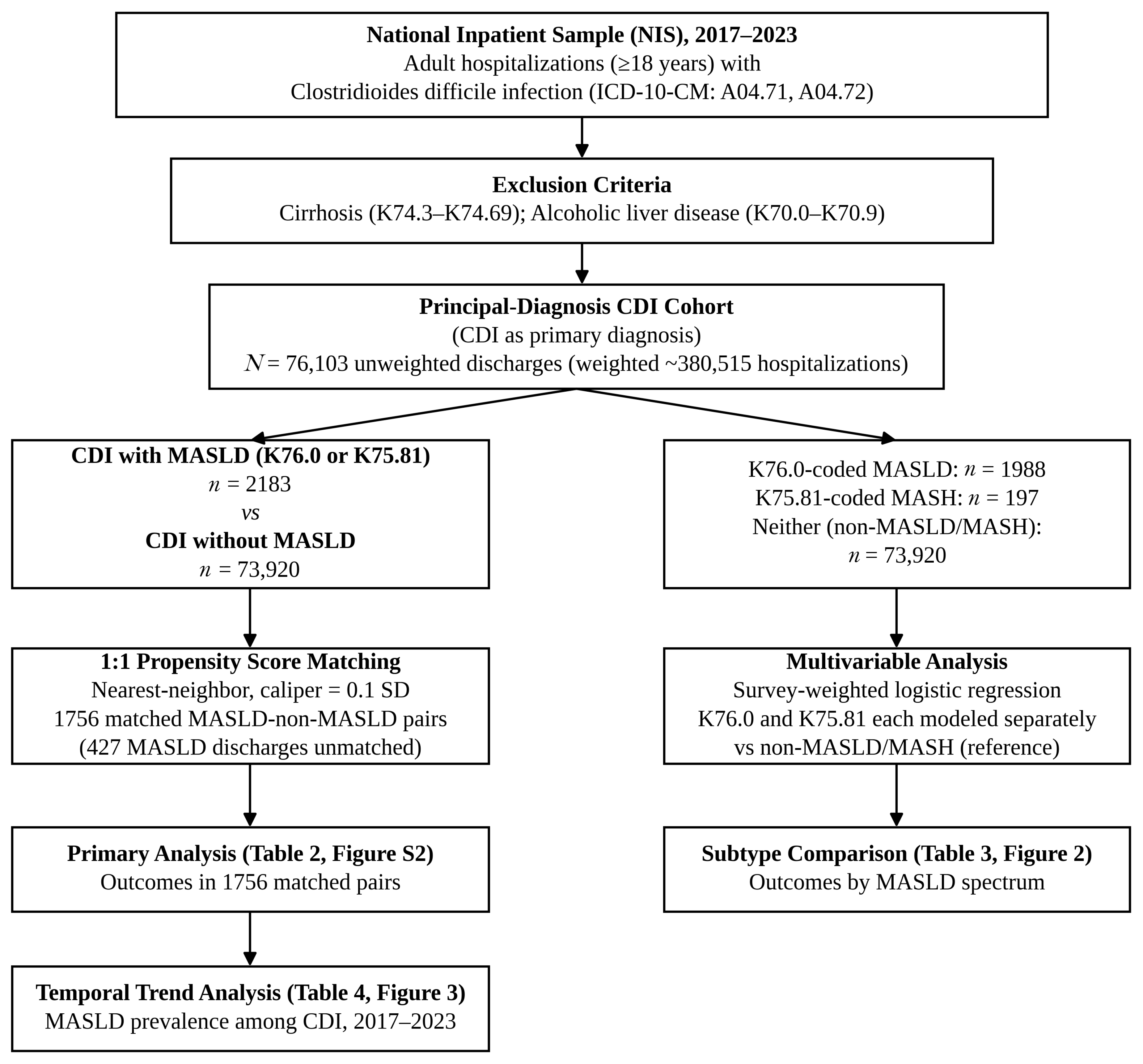
A study flow diagram is presented in Figure 1. After applying exclusion criteria, the principal-diagnosis CDI cohort comprised 76,103 unweighted hospital discharges (survey-weighted national estimate: approximately 380,515 hospitalizations) from 2017 through 2023. Of these, 2183 (2.9% weighted) had a concomitant diagnosis of non-cirrhotic MASLD, and 73,920 did not. The any-diagnostic-position CDI cohort comprised 278,770 unweighted hospitalizations, of which 6118 had MASLD, and 773 had MASH in any secondary diagnostic field.

3.2. Baseline Characteristics

Baseline characteristics stratified by MASLD status are presented in Table 1 and Figure S1. Patients with MASLD were substantially younger than those without (mean age 57.6 vs. 67.7 years; p < 0.001), with a markedly higher proportion aged 40–59 years (41% vs. 19%) and a lower proportion aged 80 years or older (7% vs. 28%). MASLD patients were more commonly female (67% vs. 64%; p = 0.008).
Payer mix differed substantially, with Medicare less frequent (45% vs. 68%) and private insurance (29% vs. 18%) and Medicaid (18% vs. 9%) more frequent in the MASLD group (p < 0.001). Race/ethnicity distribution was broadly similar (Table 1).
As expected, MASLD patients had substantially higher rates of metabolic comorbidities, including obesity (27% vs. 12%; p < 0.001) and hypertension (46% vs. 37%; p < 0.001). Notably, alcohol use disorder was markedly more prevalent among MASLD patients (15% vs. 3%; p < 0.001). Although patients with alcoholic liver disease diagnoses were excluded, this finding likely reflects diagnostic coding overlap in patients with steatosis and concurrent alcohol use that did not meet specific alcoholic liver disease criteria, and this should be considered when interpreting results. Reflecting the younger age of the MASLD cohort, several age-associated comorbidities were significantly less prevalent, including congestive heart failure (12% vs. 19%), CKD (14% vs. 28%), and metastatic cancer (2% vs. 5%; all p < 0.001). IBD was more prevalent in MASLD patients (9% vs. 7%; p = 0.001). CDI subtype distribution did not differ between groups (p = 0.226). Full comorbidity data are presented in Table 1.
Before matching and covariate adjustment, total hospital charges were modestly higher in the MASLD group ($54,688 vs. $50,257; p = 0.001), while unadjusted LOS was similar (5.56 vs. 5.53 days; p = 0.805).
Table 1. Baseline Characteristics of Non-Cirrhotic CDI Hospitalizations by MASLD Status, NIS 2017–2023 (Pre-PSM, n = 76,103).
VariableCDI Without MASLD
(n = 73,920)
CDI with MASLD
(n = 2183)
p-Value
Demographics
Age, mean (years)67.757.6<0.001
Age group, %
18–398%13%<0.001
40–5919%41%
60–7945%40%
≥8028%7%
Female, %64%67%0.008
Race/ethnicity, % a
White78%76%<0.001
Black11%9%
Hispanic8%10%
Asian/Pacific Islander1%1%
Native American1%1%
Other2%2%
Primary payer, %
Medicare68%45%<0.001
Medicaid9%18%
Private insurance18%29%
Self-pay2%6%
Other/no charge2%2%
Median household income quartile, %
Q1 (lowest)27%28%0.149
Q227%28%
Q325%23%
Q4 (highest)21%20%
CDI Subtype, %
Recurrent CDI (A04.71)21%20%0.226
Non-recurrent CDI (A04.72)79%80%
Metabolic Comorbidities, % b
Obesity12%27%<0.001
Type 2 diabetes mellitus28%30%0.047
Hypertension37%46%<0.001
Dyslipidemia43%40%0.001
Inflammatory Bowel Disease, %
IBD (Crohn’s disease or UC)7%9%0.001
Crohn’s disease3%5%<0.001
Ulcerative colitis5%5%0.764
Elixhauser Comorbidities, %
Congestive heart failure19%12%<0.001
Cardiac arrhythmia23%16%<0.001
COPD15%14%0.086
Chronic kidney disease28%14%<0.001
Coagulopathy6%10%<0.001
Deficiency anemia21%22%0.059
Rheumatologic disease6%7%0.019
Solid tumor (non-metastatic)9%5%<0.001
Metastatic cancer5%2%<0.001
Lymphoma1%1%0.067
Depression15%17%<0.001
Alcohol use disorder3%15%<0.001
Drug use disorder4%8%<0.001
Hypothyroidism19%18%0.202
Fluid/electrolyte disorders68%70%0.069
Weight loss/malnutrition18%16%0.006
Peptic ulcer disease1%2%0.001
Paralysis1%1%0.401
Other neurological disorders3%2%0.047
Psychoses1%2%0.056
Hospital Characteristics
Bed size
Small25%23%0.237
Medium29%29%
Large46%47%
Location/teaching status
Rural11.6%8.6%<0.001
Urban non-teaching21.2%18.4%
Urban teaching67.2%73.0%
Region
Northeast19%17%0.040
Midwest25%27%
South40%39%
West17%18%
Year of admission
20176%4%<0.001
201822%19%
201919%17%
202014%15%
202114%15%
202213%14%
202313%17%
Unadjusted Outcomes (Pre-PSM)
Length of stay (days, mean)5.535.560.805
Total charges (2023 $, mean)$50,257$54,6880.001
All proportions are survey-weighted. a Race data available 2017–2022 only. b Metabolic comorbidities excluded from propensity score model as putative mediators. CDI = Clostridioides difficile infection; MASLD = metabolic-dysfunction-associated steatotic liver disease; COPD = chronic obstructive pulmonary disease; IBD = inflammatory bowel disease.
Figure 1. Study flow diagram showing the selection of hospitalizations from the National Inpatient Sample (NIS), 2017–2023. The principal-diagnosis CDI cohort was used for both the propensity score-matched MASLD versus non-MASLD analysis and the exploratory MASLD subtype analysis. CDI = Clostridioides difficile infection; MASLD = metabolic-dysfunction-associated steatotic liver disease; MASH = metabolic-dysfunction-associated steatohepatitis; NIS = National Inpatient Sample; PSM = propensity score matching.
Gastroent 17 00038 g001

3.3. Propensity Score Matching and Covariate Balance

PSM yielded 1756 matched MASLD-non-MASLD pairs. Among 2183 MASLD/MASH-coded discharges eligible for the propensity score analysis, 1756 had complete PSM covariate data and were successfully matched to a non-MASLD discharge within the prespecified caliper; 427 were not included in the matched analytic cohort because of missing values in at least one PSM covariate, as detailed in Supplementary Table S2. Before matching, substantial imbalance was present; mean SMD was 13.3%, and Rubin’s B was 85.6%, with the largest imbalances for age (SMD = 63.1%), alcohol use disorder (SMD = 43.6%), primary payer (SMD = 42.0%), and CKD (SMD = 36.7%). After matching, mean SMD was 1.9%, median SMD was 1.6%, and Rubin’s B fell to 13.6%, with all modeled covariates achieving SMD < 5.5%. The four metabolic comorbidities excluded from the propensity score by design (obesity, T2DM, hypertension, dyslipidemia) retained post-match SMDs of 12.7–31.7%, consistent with their intended role as mediators on the MASLD-outcome causal pathway.
The excluded MASLD discharges differed systematically from matched discharges (Supplementary Table S2). The largest standardized mean differences (SMD) were observed for depression (matched 20.2% vs. unmatched 6.3%; SMD = 0.42), age (matched mean 57.0 vs. unmatched 60.0 years; SMD = 0.20), lymphoma (matched 1.0% vs. unmatched 0%; SMD = 0.14), congestive heart failure (matched 10.9% vs. unmatched 14.3%; SMD = 0.10), deficiency anemia (matched 21.7% vs. unmatched 25.8%; SMD = 0.10), and alcohol use disorder (matched 14.9% vs. unmatched 18.0%; SMD = 0.09). Chronic kidney disease was similar between groups (SMD = 0.04), whereas primary payer differed: unmatched MASLD discharges were more often covered by Medicare and less often by private insurance or Medicaid (Supplementary Table S2). Overall, the unmatched MASLD discharges represented a phenotype with higher psychiatric and oncologic comorbidity burden and older age than the matched MASLD population, which should be considered when generalizing the propensity-matched estimates.

3.4. Clinical Outcomes: Propensity Score-Matched Cohort

Outcomes in the 1756 matched pairs are presented in Table 2 and Figure S2. In-hospital mortality occurred in 15 of 1756 MASLD discharges and 12 of 1756 matched non-MASLD discharges (event rates 0.85% vs. 0.68%, respectively); the difference was not statistically significant (OR 1.252, 95% CI 0.571–2.745; p = 0.574). Peritonitis occurred in 8 of 1756 MASLD discharges and 11 of 1756 matched non-MASLD discharges (event rates 0.46% vs. 0.63%; p > 0.4). No statistically significant differences were observed for any other clinical complication, including sepsis, septic shock, AKI, respiratory failure, mechanical ventilation, ICU admission, blood transfusion, colectomy, myocardial infarction, VTE, or peritonitis (all p > 0.1; Table 2). Toxic megacolon, cardiac arrest, vasopressor use, paralytic ileus, and bowel perforation each had fewer than five events in the MASLD arm and were not modeled.
One binary outcome reached statistical significance: MASLD was associated with lower odds of non-routine discharge (OR 0.794, 95% CI 0.684–0.922; p = 0.003), suggesting a greater likelihood of routine home discharge. Continuous utilization outcomes were examined in two complementary analyses. In survey-weighted linear regression of the full pre-match principal-diagnosis cohort, MASLD was associated with higher total hospital charges (+$4431; 95% CI $1735–$7127; p = 0.001) but no significant difference in length of stay (+0.030 days; p = 0.805). Within the propensity score-matched cohort, both outcomes attenuated and were no longer statistically significant: length-of-stay difference +0.329 days (95% CI −0.045 to +0.702; p = 0.084) and total charges difference +$3902 (95% CI −$646 to +$8449; p = 0.093). The attenuation suggests that part of the pre-match utilization difference was attributable to baseline covariate imbalance.

3.5. Outcomes by MASLD Subtype: Principal-Diagnosis CDI Cohort

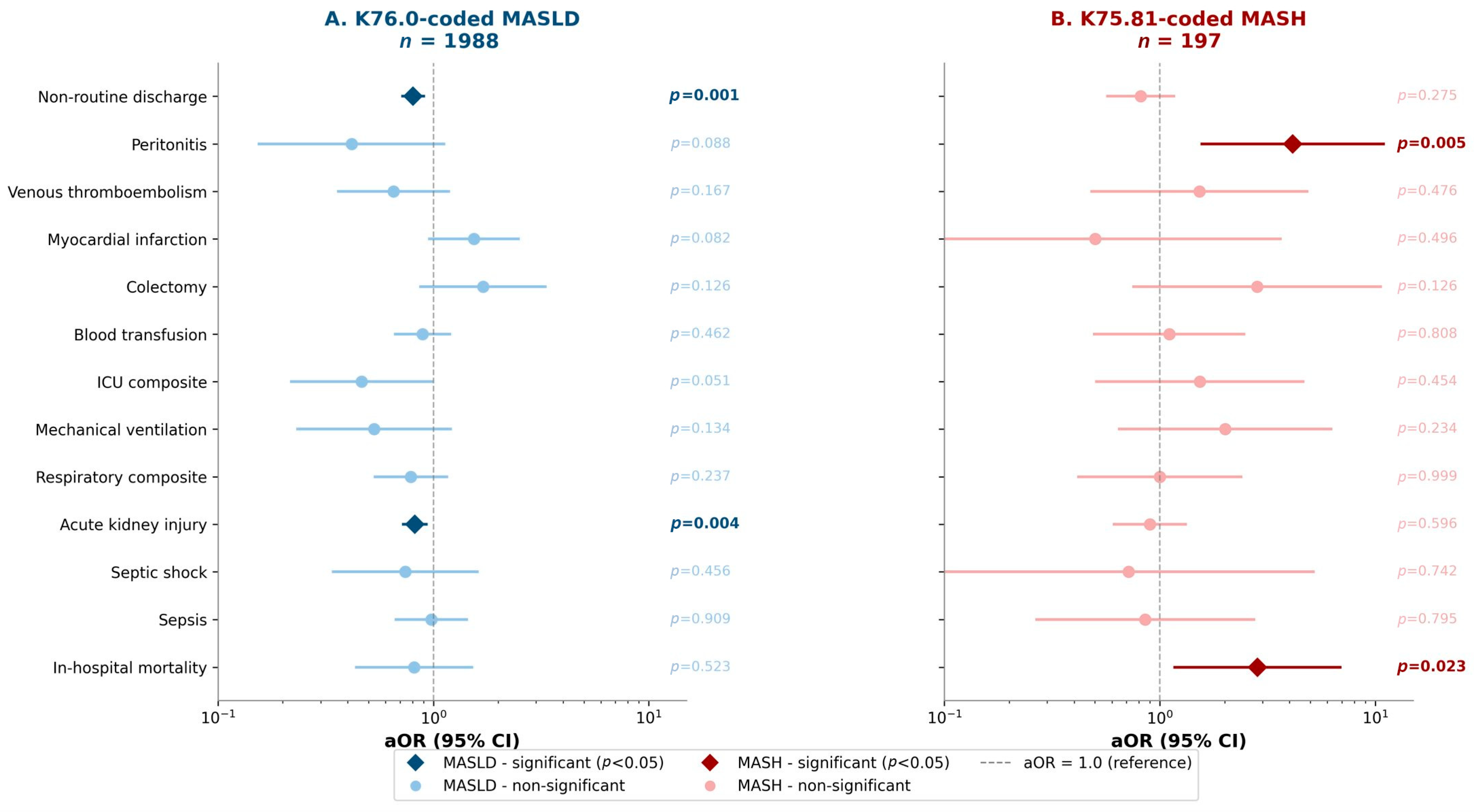
To evaluate the independent contributions of hepatic steatosis without inflammation (K76.0-coded MASLD; n = 1988) versus active steatohepatitis (K75.81-coded MASH; n = 197), survey-weighted multivariable logistic regression was performed within the principal-diagnosis CDI cohort (n = 76,103), with each exposure modeled separately against non-MASLD/MASH controls. Results are presented in Figure 2 and Table 3.
For K76.0-coded MASLD, adjusted analysis showed lower odds of acute kidney injury (aOR 0.821, 95% CI 0.716–0.940; p = 0.004) and non-routine discharge (aOR 0.805, 95% CI 0.709–0.914; p = 0.001), alongside modestly higher hospital charges (+$2952; 95% CI $169–$5735; p = 0.038). In-hospital mortality (aOR 0.814; 95% CI 0.432–1.532; p = 0.523) and all remaining outcomes did not differ significantly from non-MASLD/MASH controls (Table 3).
For K75.81-coded MASH, the outcome profile was notably different. MASH was independently associated with higher in-hospital mortality (aOR 2.840, 95% CI 1.154–6.985; p = 0.023) and peritonitis (aOR 4.136, 95% CI 1.543–11.082; p = 0.005). The peritonitis estimate, however, is based on a small number of events: of 197 K75.81-coded hospitalizations, 4 had a coded peritonitis diagnosis. Because the peritonitis component (K65.x) is not CDI-specific, we performed a prespecified sensitivity analysis using a narrower composite of structural lower-gastrointestinal complications (toxic megacolon, bowel perforation, paralytic ileus, and colectomy) excluding K65.x codes (Supplementary Table S4); within this narrower composite, the MASH association attenuated to borderline significance (aOR 2.94, 95% CI 0.96–8.97; p = 0.059). No other secondary outcomes reached statistical significance, and the confidence intervals for several outcomes were wide, reflecting the small MASH sample. Total hospital charges were numerically higher in MASH (+$7771; 95% CI −$6723 to +$22,264), but the difference was not statistically significant (p = 0.293). Across the broader any-diagnostic-position CDI cohort (descriptive only; n = 278,770), 21 of 773 K75.81-coded hospitalizations carried a coded peritonitis diagnosis; however, inferential modeling restricted to principal-diagnosis CDI for clinical interpretability is reported here.

3.6. Temporal Trend in MASLD Prevalence

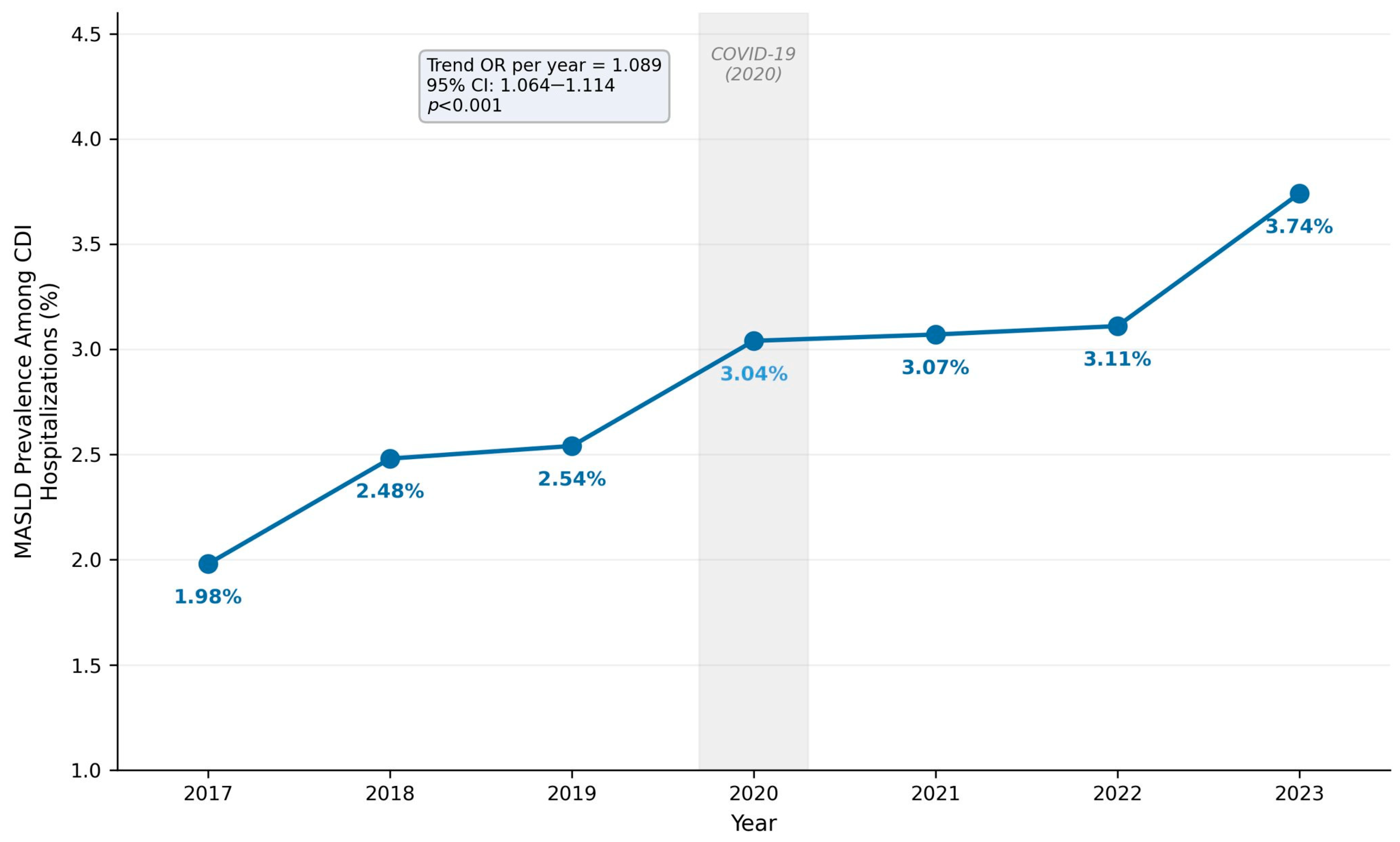
MASLD prevalence among non-cirrhotic CDI hospitalizations increased from 1.98% in 2017 to 3.74% in 2023 (Table 4; Figure 3). Survey-weighted logistic regression confirmed a significant linear temporal trend (OR 1.089 per calendar year, 95% CI 1.064–1.114; p < 0.001).

3.7. Sensitivity Analyses

Alcohol use disorder exclusion. To address potential MASLD/alcoholic-steatosis misclassification despite exclusion of coded alcoholic liver disease, we re-executed the primary analyses after additionally excluding all hospitalizations with a coded alcohol use disorder (Supplementary Table S3). After this exclusion, 1845 MASLD discharges and 71,618 non-MASLD discharges remained eligible for matching, yielding 1495 matched MASLD–non-MASLD pairs. The primary null finding for in-hospital mortality was preserved (OR 0.822, 95% CI 0.393–1.718; p = 0.602), and matched non-routine discharge remained non-significant (OR 0.921; p = 0.323). Within the matched alcohol-excluded cohort, length of stay and total charges retained statistically significant excesses for MASLD (LOS +0.493 days, 95% CI 0.143–0.843, p = 0.006; charges +$7349, 95% CI $3287–$11,411, p < 0.001). In the principal-diagnosis MASH subtype analysis after alcohol exclusion, the mortality (aOR 2.908, 95% CI 1.181–7.159; p = 0.020) and peritonitis (aOR 4.210, 95% CI 1.563–11.343; p = 0.005) signals were preserved, supporting that residual alcohol-related misclassification is unlikely to explain the MASH findings.
Stricter MASLD operational definition. In a sensitivity analysis requiring at least one coded metabolic risk factor (obesity, type 2 diabetes, hypertension, or dyslipidemia) in addition to K76.0/K75.81, 1679 hospitalizations met the strict MASLD definition. 1:1 nearest-neighbor matching yielded 1352 matched pairs, with no significant difference in in-hospital mortality (OR 0.784, 95% CI 0.342–1.799; p = 0.566) and a persistently lower odds of non-routine discharge (OR 0.772, 95% CI 0.652–0.915; p = 0.003). The principal null mortality finding was robust to this stricter phenotype definition (Supplementary Table S5).
Narrow gastrointestinal complications composite. When the gastrointestinal/peritoneal complications composite was restricted to structural lower-GI complications (toxic megacolon, bowel perforation, paralytic ileus, and colectomy), excluding the nonspecific K65.x peritonitis codes, the K75.81-coded MASH association attenuated to borderline significance (aOR 2.94, 95% CI 0.96–8.97; p = 0.059), whereas no association was observed for K76.0-coded MASLD (aOR 1.00, 95% CI 0.51–1.96; p = 1.00) or in the matched MASLD-versus-non-MASLD comparison (OR 1.50, 95% CI 0.61–3.69; p = 0.37) (Supplementary Table S4). The direction and approximate magnitude of the MASH association persisted, but its statistical significance depended on the inclusion of the nonspecific peritonitis component.

4. Discussion

In this large, nationally representative retrospective cohort of non-cirrhotic CDI hospitalizations from 2017 to 2023, we observed a near doubling in the prevalence of MASLD, from 1.98% to 3.74%. This trend mirrors the broader global rise in MASLD prevalence, which increased from an estimated 25.26% in studies from 1990–2006 to 38.00% in studies from 2016–2019 [17], though the rates in our CDI-specific cohort reflect coded prevalence among hospitalized patients rather than true population prevalence. As MASLD is increasingly recognized as a systemic metabolic disease involving chronic inflammation, immune dysregulation, and cardiovascular risk [18], its potential to influence infectious disease outcomes has garnered growing attention. Large epidemiologic studies have demonstrated that MASLD confers approximately a twofold increased risk of serious bacterial infections requiring hospitalization, with risk escalating across disease severity stages [3]. A Swedish population-based cohort similarly showed that even simple steatosis is associated with a 64% higher risk of severe infections, with progressively greater risk in steatohepatitis and fibrosis [4]. Part of this temporal increase likely reflects rising true disease prevalence in parallel with the global obesity and metabolic syndrome epidemics; however, an additional component plausibly reflects increased clinical recognition and administrative coding of MASLD over the study period, particularly following the formalization of the MASLD/MASH nomenclature and the inclusion of dedicated coding guidance. Our observed near-doubling of coded MASLD prevalence among non-cirrhotic CDI hospitalizations should therefore be interpreted as an upper bound on the increase in true biological prevalence.
Consistent with the gut–liver axis framework outlined in the Introduction, several biologically plausible mechanisms may underlie these associations. MASH is linked to gut dysbiosis and intestinal barrier dysfunction, both of which can impair host immune responses and increase susceptibility to enteric infections [10,11,12]. The gut-liver axis is increasingly recognized as a driver of MASLD progression, with alterations in microbial composition and intestinal permeability that may compound infectious risk [13,19]. Although these studies did not directly assess CDI, they support the hypothesis that hepatic inflammation in MASH could worsen infectious outcomes. Additionally, MASLD is characterized by altered bile acid metabolism, including increased taurine-conjugated bile acids such as taurocholate, which promotes C. difficile spore germination [14,15]. These changes may shift the luminal environment toward enhanced germination and colonization, consistent with case–control data demonstrating higher CDI incidence among patients with MASLD [5,6].
Our principal finding is that non-cirrhotic MASLD was not associated with increased in-hospital mortality or other adverse clinical outcomes after propensity score matching. This finding was also consistent in the principal-diagnosis multivariable subtype analysis, where MASLD remained associated with higher odds of routine home discharge (aOR 0.805; p = 0.001) and lower odds of AKI (aOR 0.821; p = 0.004) after multivariable adjustment, along with modestly higher hospital charges but no difference in length of stay. The favorable discharge and AKI findings likely reflect the substantially younger age of the MASLD cohort (mean 57.6 vs. 67.7 years), as younger age is independently associated with better renal resilience and functional outcomes during CDI hospitalization [20]. The higher charges, despite similar lengths of stay, may reflect the greater comorbidity burden in MASLD patients, particularly obesity and metabolic syndrome, which can increase the intensity of ancillary services and diagnostic workups without necessarily prolonging the hospital stay.
In contrast, K75.81-coded MASH was associated with higher in-hospital mortality (aOR 2.840, 95% CI 1.154–6.985) and peritonitis (aOR 4.136, 95% CI 1.543–11.082) in the principal-diagnosis CDI cohort. These directional findings are consistent with the hypothesis that hepatic inflammatory activity, rather than steatosis alone, may contribute to adverse infectious outcomes. However, several caveats limit the strength of inference. First, only 197 hospitalizations carried a K75.81 code in the principal-diagnosis cohort, yielding wide confidence intervals around the point estimates. Second, the peritonitis association is based on only four MASH-positive peritonitis events; in a prespecified sensitivity analysis restricting the composite to structural lower-GI complications (toxic megacolon, bowel perforation, paralytic ileus, and colectomy) and excluding the nonspecific K65.x peritonitis codes, the association attenuated to borderline significance (aOR 2.94, p = 0.059). Third, K75.81 coding likely substantially under-represents histologically defined MASH. Taken together, these results are hypothesis-generating and motivate confirmation in larger administrative cohorts and in cohorts with biopsy- or non-invasive-fibrosis-based MASH ascertainment.
Our findings extend prior work demonstrating worse CDI outcomes in chronic liver disease populations [7]. Jiang et al. reported higher rates of intestinal complications in MASLD patients hospitalized with CDI, though their comparison group comprised alcoholic and viral liver disease rather than non-MASLD patients, and they did not differentiate within the MASLD spectrum [8]. Other NIS-based analyses have similarly grouped all steatotic liver disease together or included predominantly cirrhotic populations, limiting their applicability to earlier disease stages. Our study addresses these gaps by specifically excluding cirrhosis and demonstrating that adverse outcomes are not uniform across the MASLD spectrum; MASH, but not MASLD without steatohepatitis, was associated with increased mortality and gastrointestinal complications.
Taken together, these findings identify a clinically relevant distinction between steatosis and steatohepatitis in the context of CDI. Once infection develops, non-cirrhotic MASLD without steatohepatitis does not appear to independently worsen inpatient outcomes after adjustment for confounders. This suggests that steatosis may primarily influence susceptibility to infection rather than downstream severity, and that prior associations between MASLD and worse CDI outcomes may have been partly driven by the inclusion of patients with advanced liver disease or residual confounding. By contrast, the directional association between K75.81-coded MASH and higher in-hospital mortality and peritonitis is consistent with the hypothesis that hepatic inflammation and immune dysregulation contribute to adverse infectious outcomes, although this association requires confirmation in larger MASH-enriched cohorts before clinical inferences can be drawn. This is consistent with retrospective data showing that elevated inflammatory markers, including CRP and white blood cell count, are independent predictors of CDI-related mortality [21].
Several limitations merit consideration. First, MASLD is frequently underdiagnosed and undercoded in administrative data, which increases the risk of misclassification bias. Such misclassification, however, would most likely be non-differential and bias results toward the null, potentially understating the true impact of MASLD. Second, although propensity score matching achieved good covariate balance (all SMD < 5.5%), residual confounding from unmeasured variables cannot be excluded. Third, the NIS lacks laboratory data (e.g., albumin, CRP, lactate), imaging findings, and fibrosis staging (e.g., FIB-4 or elastography), preventing direct assessment of disease severity beyond diagnostic coding. However, the comparison of MASLD and MASH provides a clinically meaningful proxy for disease severity along the steatotic liver disease spectrum. Fourth, the high prevalence of alcohol use disorder in the MASLD group (15% vs. 3%), despite the exclusion of alcoholic liver disease diagnoses, raises the possibility that some patients classified as MASLD may have had alcohol-related hepatic steatosis. While the exclusion of coded alcoholic liver disease diagnoses mitigates this concern, some degree of exposure misclassification cannot be fully excluded, and future studies should consider additional strategies to differentiate MASLD from alcohol-related steatosis. The primary null MASLD finding and the directional MASH associations were robust to a prespecified sensitivity analysis, additionally excluding all hospitalizations with a coded alcohol use disorder (Supplementary Table S3), supporting that residual alcohol-related misclassification is unlikely to fully explain the observed associations. Fifth, the K75.81-coded MASH subgroup within the principal-diagnosis CDI cohort was small (n = 197), with wide confidence intervals for all MASH effect estimates. The peritonitis association, in particular, is based on only four MASH-positive events and is attenuated to borderline significance when restricted to structural lower-GI complications (Supplementary Table S4). The direction of the MASH associations is consistent with biological plausibility, but their magnitude should be interpreted as hypothesis-generating pending replication in larger MASH-enriched cohorts. Sixth, 427 of 2183 MASLD discharges (19.6%) were not included in the matched analytic cohort because of missing values in at least one PSM covariate; the excluded MASLD population was characterized by higher psychiatric and oncologic comorbidity burden and older age (Supplementary Table S2), and the PSM estimates therefore generalize most directly to MASLD patients with complete PSM covariate data who were within the matched analytic sample. Seventh, the National Inpatient Sample does not capture CDI-specific therapeutics (oral vancomycin, fidaxomicin, intravenous metronidazole, bezlotoxumab, or fecal microbiota-based products), timing of CDI-directed therapy initiation, severity scores (e.g., white blood cell count, serum creatinine, lactate), or microbiological data; we were therefore unable to adjust for treatment intensity or CDI severity at presentation, and residual confounding by these factors cannot be excluded. Finally, the MASLD/MASH exposure was defined by ICD-10-CM coding without histological confirmation or formal cardiometabolic-criteria documentation; consequently, our exposures are best interpreted as coded-MASLD-compatible and coded-MASH-compatible phenotypes rather than clinically validated diagnoses.
These results have implications for clinical practice and future research. The rising prevalence of MASLD among CDI hospitalizations, now approaching 4%, ensures that clinicians will increasingly encounter this comorbidity in patients with CDI. While our findings suggest that non-cirrhotic MASLD without steatohepatitis does not independently worsen inpatient CDI outcomes, the association between MASH and increased mortality and peritonitis, if confirmed in larger studies, could inform risk stratification. Specifically, identifying MASH among CDI patients through clinical history, non-invasive fibrosis markers (e.g., FIB-4), or imaging may help identify a subgroup warranting closer monitoring. Future prospective studies should incorporate laboratory markers of hepatic inflammation, bile acid profiles, and microbiome characterization to elucidate the mechanisms through which MASH influences CDI severity and to determine whether MASLD phenotyping adds incremental value to existing CDI prognostic models.

5. Conclusions

In summary, the coded prevalence of MASLD among non-cirrhotic CDI hospitalizations is increasing, but non-cirrhotic MASLD without steatohepatitis does not independently worsen inpatient outcomes after adjustment, a finding robust to exclusion of alcohol use disorder and to a stricter metabolic-criteria MASLD definition. K75.81-coded MASH was directionally associated with higher in-hospital mortality and peritonitis, but the small number of MASH-coded hospitalizations and the attenuation of the peritonitis signal under a stricter, CDI-relevant lower-GI composite warrant cautious interpretation. These findings are hypothesis-generating and motivate larger MASH-enriched studies, ideally incorporating non-invasive fibrosis assessment, before the MASLD phenotype is incorporated into CDI risk stratification.

Supplementary Materials

The following supporting information can be downloaded at https://www.mdpi.com/article/10.3390/gastroent17020038/s1. Supplementary Table S1. ICD-10-CM Diagnosis Codes and ICD-10-PCS Procedure Codes Used in Study Cohort Definition, Comorbidity Assessment, and Outcome Ascertainment. Supplementary Table S2. Baseline characteristics of MASLD discharges within (n = 1756) and outside (n = 427) the matched cohort. Supplementary Table S3. Sensitivity analysis excluding all hospitalizations with a coded alcohol use disorder. Supplementary Table S4. Sensitivity analysis using a narrow lower-gastrointestinal complications composite (toxic megacolon, bowel perforation, paralytic ileus, and colectomy), excluding nonspecific K65.x peritonitis codes. Supplementary Table S5. Sensitivity analysis using a stricter MASLD operational definition: ICD-10-CM K76.0 or K75.81 plus at least one coded metabolic risk factor (obesity, type 2 diabetes, hypertension, or dyslipidemia). Figure S1: Grouped horizontal bar chart comparing survey-weighted baseline characteristics between non-cirrhotic CDI hospitalizations without MASLD (n = 73,920) and with MASLD (n = 2183) in the pre-PSM principal-diagnosis cohort (NIS, 2017–2023; N = 76,103). Hospital location/teaching status is presented per HCUP convention (1 = Rural, 2 = Urban non-teaching, 3 = Urban teaching. Figure S2: Forest plot of clinical outcomes in the propensity score-matched cohort (1756 MASLD-non-MASLD pairs) from the NIS, 2017–2023. The reference line at OR = 1.0 indicates no difference between groups. Outcomes with <5 MASLD events (toxic megacolon, cardiac arrest, vasopressor use, paralytic ileus, bowel perforation) were not modeled and are omitted from the plot.

Author Contributions

Conceptualization, S.K. and H.M.; methodology, S.K.; formal analysis, S.K.; data curation, S.K.; writing—original draft preparation, A.P.; writing—review and editing, A.P., Y.A., P.S.-M., I.-M.I.S., L.G. and J.A.; supervision, H.M.; project administration, H.M. All authors have read and agreed to the published version of the manuscript.

Funding

This research received no external funding.

Institutional Review Board Statement

Ethical review and approval were waived for this study due to the use of de-identified, publicly available data from the National Inpatient Sample (NIS).

Informed Consent Statement

Not applicable.

Data Availability Statement

Restrictions apply to the availability of these data. Data were obtained from the Agency forHealthcare Research and Quality (AHRQ) Healthcare Cost and Utilization Project (HCUP) and are available at https://www.hcup-us.ahrq.gov/nisoverview.jsp (accessed on 10 March 2026), with a data use agreement.

Conflicts of Interest

The authors declare no conflicts of interest.

References

  1. Akorful, R.A.A.; Odoom, A.; Awere-Duodu, A.; Donkor, E.S. The Global Burden of Clostridioides difficile Infections, 2016–2024: A Systematic Review and Meta-Analysis. Infect. Dis. Rep. 2025, 17, 31. [Google Scholar] [CrossRef]
  2. Le, P.; Tatar, M.; Dasarathy, S.; Alkhouri, N.; Herman, W.H.; Taksler, G.B.; Deshpande, A.; Ye, W.; Adekunle, O.A.; McCullough, A.; et al. Estimated Burden of Metabolic Dysfunction–Associated Steatotic Liver Disease in US Adults, 2020 to 2050. JAMA Netw. Open 2025, 8, e2454707. [Google Scholar] [CrossRef] [PubMed]
  3. Targher, G.; Tilg, H.; Valenti, L. Risk of Serious Bacterial and Non-Bacterial Infections in People with MASLD. Liver Int. 2025, 45, e70059. [Google Scholar] [CrossRef]
  4. Ebrahimi, F.; Simon, T.G.; Hagström, H.; Söderling, J.; Wester, A.; Roelstraete, B.; Ludvigsson, J.F. Risk of Severe Infection in Patients with Biopsy-proven Nonalcoholic Fatty Liver Disease—A Population-based Cohort Study. Clin. Gastroenterol. Hepatol. 2023, 21, 3346–3355.e19. [Google Scholar] [CrossRef] [PubMed]
  5. Papić, N.; Jelovčić, F.; Karlović, M.; Marić, L.S.; Vince, A. Nonalcoholic fatty liver disease as a risk factor for Clostridioides difficile infection. Eur. J. Clin. Microbiol. Infect. Dis. 2020, 39, 569–574. [Google Scholar] [CrossRef]
  6. Nseir, W.B.; Hussein, S.H.H.; Farah, R.; Mahamid, M.N.; Khatib, H.H.; Mograbi, J.M.; Peretz, A.; Amara, A.E. Nonalcoholic fatty liver disease as a risk factor for Clostridium difficile-associated diarrhea. QJM Int. J. Med. 2020, 113, 320–323. [Google Scholar] [CrossRef]
  7. Dotson, K.M.; Aitken, S.L.; Sofjan, A.K.; Shah, D.N.; Aparasu, R.R.; Garey, K.W. Outcomes associated with Clostridium difficile infection in patients with chronic liver disease. Epidemiol. Infect. 2018, 146, 1101–1105. [Google Scholar] [CrossRef]
  8. Jiang, Y.; Chowdhury, S.; Xu, B.H.; Meybodi, M.A.; Damiris, K.; Devalaraju, S.; Pyrsopoulos, N. Nonalcoholic fatty liver disease is associated with worse intestinal complications in patients hospitalized for Clostridioides difficile infection. World J. Hepatol. 2021, 13, 1777–1790. [Google Scholar] [CrossRef]
  9. Kruger, A.J.; Durkin, C.; Mumtaz, K.; Hinton, A.; Krishna, S.G. Early Readmission Predicts Increased Mortality in Cirrhosis Patients After Clostridium difficile Infection. J. Clin. Gastroenterol. 2019, 53, e322–e327. [Google Scholar] [CrossRef] [PubMed]
  10. Boursier, J.; Diehl, A.M. Implication of Gut Microbiota in Nonalcoholic Fatty Liver Disease. PLoS Pathog. 2015, 11, e1004559. [Google Scholar] [CrossRef]
  11. Boursier, J.; Mueller, O.; Barret, M.; Machado, M.; Fizanne, L.; Araujo-Perez, F.; Guy, C.D.; Seed, P.C.; Rawls, J.F.; David, L.A.; et al. The severity of nonalcoholic fatty liver disease is associated with gut dysbiosis and shift in the metabolic function of the gut microbiota. Hepatology 2016, 63, 764–775. [Google Scholar] [CrossRef] [PubMed]
  12. Le Roy, T.; Llopis, M.; Lepage, P.; Bruneau, A.; Rabot, S.; Bevilacqua, C.; Martin, P.; Philippe, C.; Walker, F.; Bado, A.; et al. Intestinal microbiota determines development of non-alcoholic fatty liver disease in mice. Gut 2013, 62, 1787–1794. [Google Scholar] [CrossRef] [PubMed]
  13. Lau, H.C.H.; Zhang, X.; Yu, J. Gut microbiome in metabolic dysfunction-associated steatotic liver disease and associated hepatocellular carcinoma. Nat. Rev. Gastroenterol. Hepatol. 2025, 22, 619–638. [Google Scholar] [CrossRef]
  14. Sorg, J.A.; Sonenshein, A.L. Inhibiting the Initiation of Clostridium difficile Spore Germination using Analogs of Chenodeoxycholic Acid, a Bile Acid. J. Bacteriol. 2010, 192, 4983–4990. [Google Scholar] [CrossRef]
  15. Lake, A.D.; Novak, P.; Shipkova, P.; Aranibar, N.; Robertson, D.; Reily, M.D.; Lu, Z.; Lehman-McKeeman, L.D.; Cherrington, N.J. Decreased hepatotoxic bile acid composition and altered synthesis in progressive human nonalcoholic fatty liver disease. Toxicol. Appl. Pharmacol. 2013, 268, 132–140. [Google Scholar] [CrossRef]
  16. Schisterman, E.F.; Cole, S.R.; Platt, R.W. Overadjustment bias and unnecessary adjustment in epidemiologic studies. Epidemiology 2009, 20, 488–495. [Google Scholar] [CrossRef]
  17. Younossi, Z.M.; Golabi, P.; Paik, J.M.; Henry, A.; Van Dongen, C.; Henry, L. The global epidemiology of nonalcoholic fatty liver disease (NAFLD) and nonalcoholic steatohepatitis (NASH): A systematic review. Hepatology 2023, 77, 1335–1347. [Google Scholar] [CrossRef]
  18. Stefan, N.; Yki-Järvinen, H.; Neuschwander-Tetri, B.A. Metabolic dysfunction-associated steatotic liver disease: Heterogeneous pathomechanisms and effectiveness of metabolism-based treatment. Lancet Diabetes Endocrinol. 2025, 13, 134–148. [Google Scholar] [CrossRef]
  19. Bajaj, J.S.; Kakiyama, G.; Savidge, T.; Takei, H.; Kassam, Z.A.; Fagan, A.; Gavis, E.A.; Pandak, W.M.; Nittono, H.; Hylemon, P.B.; et al. Antibiotic-Associated Disruption of Microbiota Composition and Function in Cirrhosis Is Restored by Fecal Transplant. Hepatology 2018, 68, 1549–1558. [Google Scholar] [CrossRef] [PubMed]
  20. Avni, T.; Hammud, H.; Itzhaki, O.; Gafter-Gvili, A.; Rozen-Zvi, B.; Ben-Zvi, H.; Bishara, J.; Atamna, A. The significance of acute kidney injury in Clostridioides difficile infection. Int. J. Clin. Pract. 2021, 75, e13785. [Google Scholar] [CrossRef]
  21. Bednarska, A.; Bursa, D.; Podlasin, R.; Paciorek, M.; Skrzat-Klapaczyńska, A.; Porowski, D.; Raczyńska, J.; Puła, J.; Krogulec, D.; Makowiecki, M.; et al. Advanced age and increased CRP concentration are independent risk factors associated with Clostridioides difficile infection mortality. Sci. Rep. 2020, 10, 14681. [Google Scholar] [CrossRef]
Figure 2. Forest plots of multivariable-adjusted clinical outcomes for K76.0-coded MASLD (Panel (A), n = 1988) and K75.81-coded MASH (Panel (B), n = 197) versus non-MASLD/MASH CDI hospitalizations in the principal-diagnosis CDI cohort, NIS 2017–2023 (n = 76,103). Adjusted odds ratios (aORs) were estimated by survey-weighted multivariable logistic regression with K76.0 and K75.81 modeled separately against non-MASLD/MASH controls, adjusted for age, sex, race/ethnicity, primary payer, income quartile, hospital region, location/teaching status, bed size, year, CDI recurrence, inflammatory bowel disease, and all individual Elixhauser comorbidities. Solid diamonds indicate statistically significant results (p < 0.05); open circles indicate non-significant results. ARDS and vasopressor use were not modeled due to fewer than five MASH-positive events. MASLD = metabolic-dysfunction-associated steatotic liver disease; MASH = metabolic-dysfunction-associated steatohepatitis; aOR = adjusted odds ratio.
Gastroent 17 00038 g002
Figure 3. Annual survey-weighted prevalence of non-cirrhotic MASLD among principal-diagnosis CDI hospitalizations, NIS 2017–2023. Prevalence nearly doubled from 1.98% in 2017 to 3.74% in 2023 (trend OR 1.089 per calendar year, 95% CI 1.064–1.114; p < 0.001). The shaded region denotes the COVID-19 pandemic year (2020). MASLD = metabolic-dysfunction-associated steatotic liver disease; CDI = Clostridioides difficile infection; NIS = National Inpatient Sample.
Gastroent 17 00038 g003
Table 2. Clinical Outcomes in the Propensity Score-Matched Cohort (1756 Matched Pairs): MASLD vs. Non-MASLD Among Non-Cirrhotic CDI Hospitalizations, NIS 2017–2023.
OutcomeCDI Without MASLD (n = 1756) n (%)CDI with MASLD (n = 1756) n (%)Odds Ratio95% Confidence Intervalp-Value
Mortality
In-hospital mortality12 (0.68)15 (0.85)1.2520.571–2.7450.574
Infectious/Systemic
Sepsis31 (1.77)30 (1.71)0.9670.583–1.6050.897
Septic shock12 (0.68)8 (0.46)0.6650.271–1.6330.373
Renal
Acute kidney injury357 (20.33)323 (18.39)0.8830.747–1.0450.148
Respiratory
Respiratory composite30 (1.71)31 (1.77)1.0340.618–1.7300.899
Mechanical ventilation10 (0.57)9 (0.51)0.8990.364–2.2210.818
Critical Care
ICU composite12 (0.68)10 (0.57)0.8320.359–1.9320.669
Supportive/Procedural
Blood transfusion59 (3.36)55 (3.13)0.9300.640–1.3520.704
Colectomy6 (0.34)11 (0.63)1.8390.679–4.9810.231
Cardiac/Thrombotic
Myocardial infarction14 (0.80)19 (1.08)1.3610.680–2.7240.384
Venous thromboembolism13 (0.74)14 (0.80)1.0780.505–2.3010.847
Gastrointestinal/Peritoneal Complications
Peritonitis11 (0.63)8 (0.46)0.7260.291–1.8110.492
Toxic megacolonInsufficient events for modeling
Discharge Disposition
Non-routine discharge526 (29.95)445 (25.34)0.7940.684–0.9220.003
Continuous outcomes (β coefficient, survey-weighted linear regression, matched cohort)
OutcomeCDI Without MASLD (n = 1756)CDI with MASLD (n = 1756)β95% CIp-Value
Length of stay (days)+0.329 days−0.045 to +0.7020.084
Total charges (2023 $)+$3902$646 to +$84490.093
Absolute event counts and unweighted percentages are presented for each matched arm. Binary outcomes compared by survey-weighted logistic regression within the matched cohort; continuous outcomes (length of stay and total charges) compared by survey-weighted linear regression within the matched cohort. ARDS, vasopressor use, cardiac arrest, paralytic ileus, and bowel perforation were not modeled due to fewer than five events in one or both matched arms. Toxic megacolon is shown for completeness, with insufficient events for modeling. Statistically significant results (p < 0.05) are in bold. PSM = 1:1 nearest-neighbor propensity score matching, caliper = 0.1 SD of logit propensity score, without replacement. Post-match mean bias = 1.9%; Rubin’s B = 13.6. MASLD = metabolic-dysfunction-associated steatotic liver disease; CI = confidence interval; LOS = length of stay; ICU = intensive care unit.
Table 3. Multivariable Analysis of Clinical Outcomes by MASLD Subtype (K76.0 versus K75.81) in the Principal-Diagnosis CDI Cohort, NIS 2017–2023 (n = 76,103).
K76.0-Coded MASLD n = 1988K75.81-Coded MASH n = 197
aOR95% CIpaOR95% CIp
Mortality
In-hospital mortality0.8140.432–1.5320.5232.8401.154–6.9850.023
Infectious/Systemic
Sepsis0.9770.660–1.4480.9090.8560.264–2.7770.795
Septic shock0.7420.338–1.6260.4560.7150.098–5.2430.742
Renal
Acute kidney injury0.8210.716–0.9400.0040.8980.604–1.3360.596
Respiratory
Respiratory composite0.7870.529–1.1710.2370.9990.413–2.4200.999
Mechanical ventilation0.5300.231–1.2170.1342.0090.638–6.3270.234
Critical Care
ICU composite0.4650.216–1.0020.0511.5340.501–4.7000.454
Supportive/Procedural
Blood transfusion0.8910.655–1.2120.4621.1060.490–2.4960.808
Colectomy1.7000.861–3.3540.1262.8300.746–10.7360.126
Cardiac/Thrombotic
Myocardial infarction1.5450.946–2.5230.0820.5010.068–3.6750.496
Venous thromboembolism0.6530.357–1.1950.1671.5280.476–4.9010.476
Gastrointestinal/Peritoneal Complications
Peritonitis0.4180.153–1.1370.0884.1361.543–11.0820.005
Discharge Disposition
Non-routine discharge0.8050.709–0.9140.0010.8140.564–1.1770.275
Continuous outcomes (β coefficient)
Outcomeβ ($)95% CIpβ ($)95% CIp
Total charges (2023 $)+$2952$169–$57350.038+$7771$6723 to +$22,2640.293
aOR estimated by survey-weighted multivariable logistic regression in the principal-diagnosis CDI cohort, with K76.0-coded MASLD and K75.81 (MASH) each modeled separately against non-MASLD/MASH controls, adjusted for age, sex, race, primary payer, income quartile, hospital region, location/teaching status, bed size, year, CDI recurrence (A04.71 vs. A04.72), inflammatory bowel disease, and all individual Elixhauser comorbidities listed in Methods (full ICD-10-CM code list in Supplementary Table S1). Outcomes with fewer than five MASH-positive events were not modeled. Statistically significant results (p < 0.05) are indicated by bold p-values; cell highlighting was removed to ensure consistent rendering across journal formats. K76.0 = fatty change of liver, not elsewhere classified (MASLD-compatible); K75.81 = nonalcoholic steatohepatitis (MASH-compatible); CDI = Clostridioides difficile infection; aOR = adjusted odds ratio; CI = confidence interval; NIS = National Inpatient Sample.
Table 4. Annual Survey-Weighted Prevalence of Non-Cirrhotic MASLD Among Principal-Diagnosis CDI Hospitalizations, NIS 2017–2023.
Annual Survey-Weighted Prevalence of MASLD Among Principal-Diagnosis CDI Hospitalizations
YearWeighted MASLD Prevalence (%)
20171.98%
20182.48%
20192.54%
20203.04%
20213.07%
20223.11%
20233.74%
VariableOdds Ratio95% CIp-value
Trend OR per calendar year1.0891.064–1.114<0.001
Trend OR estimated by survey-weighted logistic regression of MASLD on calendar year as a continuous predictor. MASLD = metabolic-dysfunction-associated steatotic liver disease; CDI = Clostridioides difficile infection; CI = confidence interval; NIS = National Inpatient Sample; OR = odds ratio.
Disclaimer/Publisher’s Note: The statements, opinions and data contained in all publications are solely those of the individual author(s) and contributor(s) and not of MDPI and/or the editor(s). MDPI and/or the editor(s) disclaim responsibility for any injury to people or property resulting from any ideas, methods, instructions or products referred to in the content.