Micro- and Nanoplastics as Emerging Cardiovascular Risk Factors: A Systematic Review

 , , , and
Abstract
1. Introduction
2. Materials and Methods
2.1. Search Strategy and Selection Criteria
2.2. Inclusion and Exclusion Criteria
2.3. Data Extraction
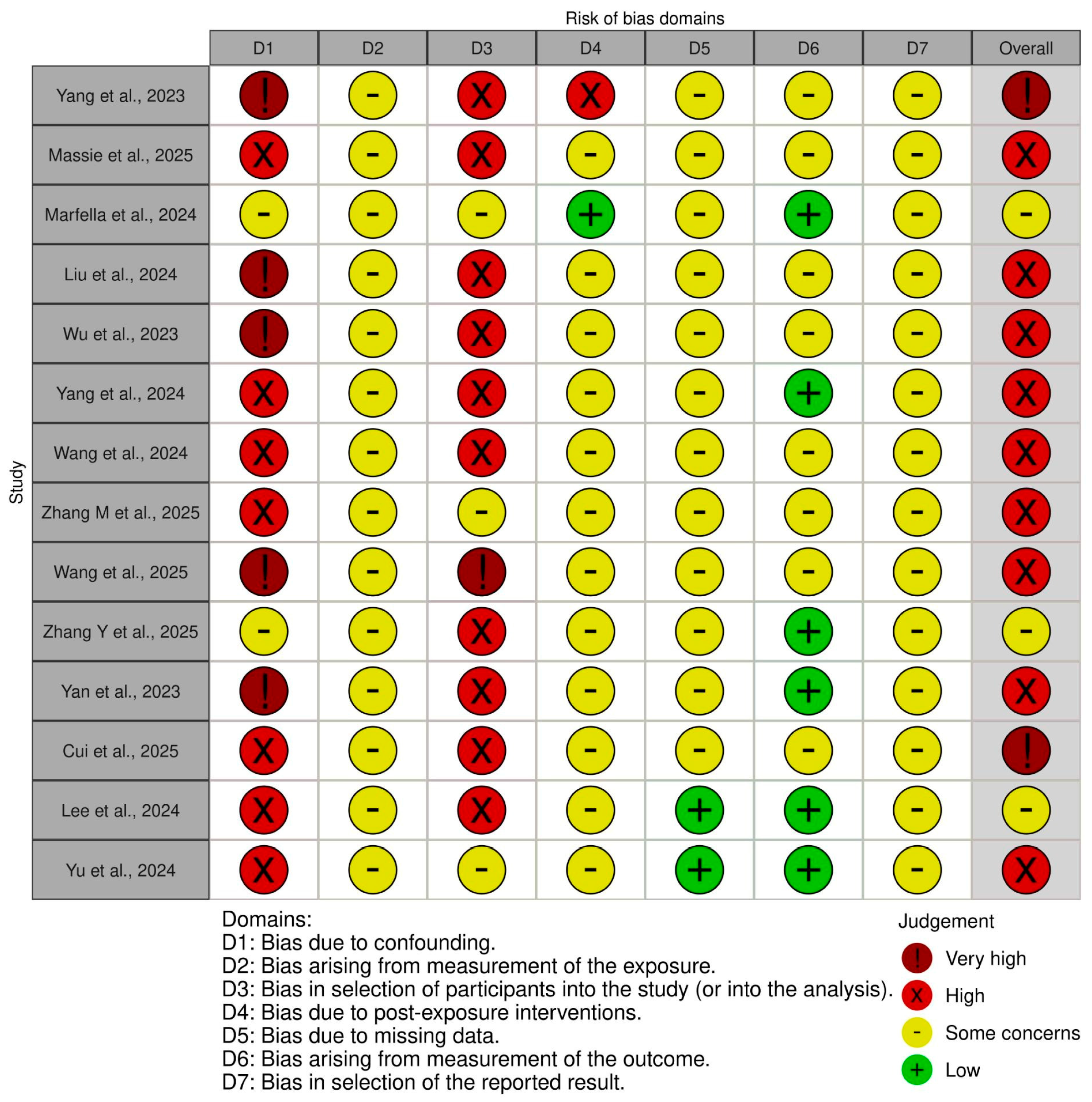
2.4. Risk-of-Bias Assessment
2.5. Certainty-of-Evidence Assessment
3. Results
3.1. Risk-of-Bias Assessment
3.2. Confounder Adjustment and Reverse Causation
3.3. Certainty of Evidence
3.4. Characteristics of Included Studies
3.5. Detection of Micro- and Nanoplastics in Cardiovascular Tissues
3.6. Localization of Microplastics in Human Tissues
3.7. Association Between Micro- and Nanoplastics and Clinical Cardiovascular Outcomes
3.7.1. Association with Major Adverse Cardiovascular Events (MACEs)
3.7.2. Association with Plaques and Arterial Calcification
3.7.3. Association with Hypertension
3.7.4. Other Findings
3.8. Mechanistic and Pathophysiological Evidence
3.8.1. Inflammatory Activation
3.8.2. Coagulation, Thromboembolic, and Lipid Biomarkers
3.9. Heterogeneity in Methodology, Detection Methods and Quantification
Sources of MNP Exposure and Sample Contamination
- Procedural blanks: These quality-control samples are essential for monitoring, identifying, and accounting for background contamination derived from the environment, equipment, or laboratory procedures, thereby establishing a clean baseline. In practice, these blanks mimic the environmental exposure of the actual samples, for example, by being opened concurrently during tissue retrieval, and undergo identical processing steps, including the same exposure times and reagent volumes.
- Non-plastic materials: Protocols generally require the use of non-plastic consumables and tools, with preference given to steel, titanium, glass, or borosilicate glass containers.
- Environmental control: Procedural steps are ideally restricted to enclosed, controlled, plastic-free, and dust-free environments, such as laminar flow hoods or dedicated cleanrooms. Sample storage conditions should also minimize the risk of contamination.
- Reagent and vessel preparation: All reagents are pre-filtered, and collection vessels are rinsed with ultrapure water or ethanol.
- Validated polymer identification protocols: Reproducible procedures are used to ensure correct polymer identification.
4. Discussion
Limitations
5. Conclusions
Supplementary Materials
Author Contributions
Funding
Institutional Review Board Statement
Informed Consent Statement
Data Availability Statement
Acknowledgments
Conflicts of Interest
Abbreviations
| ACS | Acute coronary syndrome |
| ApoB | Apolipoprotein B |
| APTT | Activated partial thromboplastin time |
| CD3 | Cluster of differentiation 3 |
| CD68 | Cluster of differentiation 68 |
| CPE | Chlorinated polyethylene |
| CRP | C-reactive protein |
| CVD | Cardiovascular disease |
| DSA | Digital subtraction angiography |
| DVT | Deep vein thrombosis |
| ECAS | Extracranial carotid artery stenosis |
| ELISA | Enzyme-linked immunosorbent assay |
| FTIR | Fourier-transform infrared spectroscopy |
| HDL-C | High-density lipoprotein cholesterol |
| hsCRP | High-sensitivity C-reactive protein |
| IL-1β | Interleukin-1 beta |
| IL-6 | Interleukin-6 |
| IL-12p70 | Interleukin-12 p70 |
| IL-18 | Interleukin-18 |
| IQR | Interquartile range |
| IS | Ischemic stroke |
| JBI | Joanna Briggs Institute |
| LC-MS | Liquid chromatography–mass spectrometry |
| LDIR | Laser direct infrared spectroscopy |
| LDL-C | Low-density lipoprotein cholesterol |
| MACE | Major adverse cardiovascular event |
| MI | Myocardial infarction |
| MNPs | Micro- and nanoplastics |
| MPs | Microplastics |
| NK | Natural killer |
| NPs | Nanoplastics |
| PA | Polyamide |
| PA66 | Polyamide 66 |
| PC | Polycarbonate |
| PE | Polyethylene |
| PET | Polyethylene terephthalate |
| PICOS | Population, Intervention, Comparison, Outcomes, and Study design |
| PIH | Pregnancy-induced hypertension |
| PP | Polypropylene |
| PRISMA | Preferred Reporting Items for Systematic Reviews and Meta-Analyses |
| PS | Polystyrene |
| PU | Polyurethane |
| PVC | Polyvinyl chloride |
| Py-GC/MS | Pyrolysis–gas chromatography–mass spectrometry |
| ROBINS-E | Risk of Bias in Non-Randomized Studies of Exposures |
| ROS | Reactive oxygen species |
| SEM | Scanning electron microscopy |
| STEMI | ST-segment elevation myocardial infarction |
| SYNTAX | Synergy Between Percutaneous Coronary Intervention with Taxus and Cardiac Surgery |
| TEM | Transmission electron microscopy |
| TNF-α | Tumor necrosis factor alpha |
| UA | Unstable angina |
| VC | Vascular calcification |
| µ-FTIR | Micro-Fourier-transform infrared spectroscopy |
| µ-Raman | Micro-Raman spectroscopy |
References
- Zheng, H.; Vidili, G.; Casu, G.; Navarese, E.P.; Sechi, L.A.; Chen, Y. Microplastics and Nanoplastics in Cardiovascular Disease—A Narrative Review with Worrying Links. Front. Toxicol. 2024, 6, 1479292. [Google Scholar] [CrossRef] [Scilit] [PubMed]
- World Health Organization. Dietary and Inhalation Exposure to Nano- and Microplastic Particles and Potential Implications for Human Health; World Health Organization: Geneva, Switzerland, 2022. [Google Scholar]
- Vethaak, A.D.; Legler, J. Microplastics and Human Health. Science 2021, 371, 672–674. [Google Scholar] [CrossRef] [Scilit] [PubMed]
- Zhu, Y.; Che, R.; Zong, X.; Wang, J.; Li, J.; Zhang, C.; Wang, F. A Comprehensive Review on the Source, Ingestion Route, Attachment and Toxicity of Microplastics/Nanoplastics in Human Systems. J. Environ. Manag. 2024, 352, 120039. [Google Scholar] [CrossRef] [Scilit] [PubMed]
- Science Advice for Policy by European Academies. A Scientific Perspective on Microplastics in Nature and Society; SAPEA: Berlin, Germany, 2019.
- Caldwell, J.; Taladriz-Blanco, P.; Lehner, R.; Lubskyy, A.; Ortuso, R.D.; Rothen-Rutishauser, B.; Petri-Fink, A. The Micro-, Submicron-, and Nanoplastic Hunt: A Review of Detection Methods for Plastic Particles. Chemosphere 2022, 293, 133514. [Google Scholar] [CrossRef] [Scilit] [PubMed]
- Marfella, R.; Prattichizzo, F.; Sardu, C.; Fulgenzi, G.; Graciotti, L.; Spadoni, T.; D’Onofrio, N.; Scisciola, L.; La Grotta, R.; Frigé, C.; et al. Microplastics and Nanoplastics in Atheromas and Cardiovascular Events. N. Engl. J. Med. 2024, 390, 900–910. [Google Scholar] [CrossRef] [Scilit] [PubMed]
- Ragusa, A.; Svelato, A.; Santacroce, C.; Catalano, P.; Notarstefano, V.; Carnevali, O.; Papa, F.; Rongioletti, M.C.A.; Baiocco, F.; Draghi, S.; et al. Plasticenta: First Evidence of Microplastics in Human Placenta. Environ. Int. 2021, 146, 106274. [Google Scholar] [CrossRef] [Scilit] [PubMed]
- Page, M.J.; Moher, D.; Bossuyt, P.M.; Boutron, I.; Hoffmann, T.C.; Mulrow, C.D.; Shamseer, L.; Tetzlaff, J.M.; Akl, E.A.; Brennan, S.E.; et al. PRISMA 2020 Explanation and Elaboration: Updated Guidance and Exemplars for Reporting Systematic Reviews. BMJ 2021, 372, n160. [Google Scholar] [CrossRef] [PubMed]
- Hilton, M. JBI Critical Appraisal Checklist for Systematic Reviews and Research Syntheses. J. Can. Health Libr. Assoc. 2024, 45, 180–183. [Google Scholar] [CrossRef] [Scilit]
- Ye, Y.; Yu, K.; Zhao, Y. The development and application of advanced analytical methods in microplastics contamination detection: A critical review. Sci. Total Environ. 2022, 818, 151851. [Google Scholar] [CrossRef] [Scilit] [PubMed]
- Ouzzani, M.; Hammady, H.; Fedorowicz, Z.; Elmagarmid, A. Rayyan—A Web and Mobile App for Systematic Reviews. Syst. Rev. 2016, 5, 210. [Google Scholar] [CrossRef] [Scilit] [PubMed]
- McHugh, M.L. Interrater Reliability: The Kappa Statistic. Biochem. Medica 2012, 22, 276–282. [Google Scholar] [CrossRef] [Scilit]
- Higgins, J.P.T.; Morgan, R.L.; Rooney, A.A.; Taylor, K.W.; Thayer, K.A.; Silva, R.A.; Lemeris, C.; Akl, E.A.; Bateson, T.F.; Berkman, N.D.; et al. A Tool to Assess Risk of Bias in Non-Randomized Follow-up Studies of Exposure Effects (ROBINS-E). Environ. Int. 2024, 186, 108602. [Google Scholar] [CrossRef] [Scilit] [PubMed]
- McGuinness, L.A.; Higgins, J.P.T. Risk-of-bias VISualization (Robvis): An R Package and Shiny Web App for Visualizing Risk-of-bias Assessments. Res. Synth. Methods 2021, 12, 55–61. [Google Scholar] [CrossRef] [Scilit] [PubMed]
- Guyatt, G.H.; Oxman, A.D.; Vist, G.E.; Kunz, R.; Falck-Ytter, Y.; Alonso-Coello, P.; Schünemann, H.J. GRADE: An Emerging Consensus on Rating Quality of Evidence and Strength of Recommendations. BMJ 2008, 336, 924–926. [Google Scholar] [CrossRef] [Scilit] [PubMed]
- Neumann, I.; Schünemann, H. (Eds.) The GRADE Book, 1st ed.; The GRADE Working Group; Available online: https://book.gradepro.org (accessed on 22 June 2026).
- Zhang, Y.; Gao, Q.; Gao, Q.; Xu, M.; Fang, N.; Mu, L.; Han, X.; Yu, H.; Zhang, S.; Li, Y.; et al. Microplastics and Nanoplastics Increase Major Adverse Cardiac Events in Patients with Myocardial Infarction. J. Hazard. Mater. 2025, 489, 137624. [Google Scholar] [CrossRef] [Scilit] [PubMed]
- Yang, Y.; Xie, E.; Du, Z.; Peng, Z.; Han, Z.; Li, L.; Zhao, R.; Qin, Y.; Xue, M.; Li, F.; et al. Detection of Various Microplastics in Patients Undergoing Cardiac Surgery. Environ. Sci. Technol. 2023, 57, 10911–10918. [Google Scholar] [CrossRef] [Scilit] [PubMed]
- Massie, P.L.; Garcia, M.A.; Gallego, D.; Schlosser, C.; Decker, A.; Liu, R.; Mazloumi Bakhshayesh, M.; Kulkarni, D.; Justus, M.P.; Pace, C.; et al. Micro- and Nanoplastics Are Elevated in Femoral Atherosclerotic Plaques Compared with Undiseased Arteries. JVS-Vasc. Sci. 2025, 6, 100393. [Google Scholar] [CrossRef] [Scilit] [PubMed]
- Liu, S.; Wang, C.; Yang, Y.; Du, Z.; Li, L.; Zhang, M.; Ni, S.; Yue, Z.; Yang, K.; Wang, Y.; et al. Microplastics in Three Types of Human Arteries Detected by Pyrolysis-Gas Chromatography/Mass Spectrometry (Py-GC/MS). J. Hazard. Mater. 2024, 469, 133855. [Google Scholar] [CrossRef] [Scilit] [PubMed]
- Wu, D.; Feng, Y.; Wang, R.; Jiang, J.; Guan, Q.; Yang, X.; Wei, H.; Xia, Y.; Luo, Y. Pigment Microparticles and Microplastics Found in Human Thrombi Based on Raman Spectral Evidence. J. Adv. Res. 2023, 49, 141–150. [Google Scholar] [CrossRef] [Scilit] [PubMed]
- Yang, Y.; Zhang, F.; Jiang, Z.; Du, Z.; Liu, S.; Zhang, M.; Jin, Y.; Qin, Y.; Yang, X.; Wang, C.; et al. Microplastics Are Associated with Elevated Atherosclerotic Risk and Increased Vascular Complexity in Acute Coronary Syndrome Patients. Part. Fibre Toxicol. 2024, 21, 34. [Google Scholar] [CrossRef] [Scilit] [PubMed]
- Wang, T.; Yi, Z.; Liu, X.; Cai, Y.; Huang, X.; Fang, J.; Shen, R.; Lu, W.; Xiao, Y.; Zhuang, W.; et al. Multimodal Detection and Analysis of Microplastics in Human Thrombi from Multiple Anatomically Distinct Sites. eBioMedicine 2024, 103, 105118. [Google Scholar] [CrossRef] [Scilit] [PubMed]
- Wang, S.; Yan, K.; Dong, Y.; Chen, Y.; Song, J.; Chen, Y.; Liu, X.; Qi, R.; Zhou, X.; Zhong, J.; et al. The Influence of Microplastics on Hypertension-Associated Cardiovascular Injury via the Modulation of Gut Microbiota. Environ. Pollut. 2025, 368, 125760. [Google Scholar] [CrossRef] [Scilit] [PubMed]
- Yan, J.; Pan, Y.; He, J.; Pang, X.; Shao, W.; Wang, C.; Wang, R.; He, Y.; Zhang, M.; Ye, J.; et al. Toxic Vascular Effects of Polystyrene Microplastic Exposure. Sci. Total Environ. 2023, 905, 167215. [Google Scholar] [CrossRef] [Scilit] [PubMed]
- Cui, C.; Guo, Z.; Liu, Y.; Han, N.; Song, J.; Chen, Y.; Zheng, Y.; Sheng, C.; Balmer, L.; Li, H.; et al. Tissue-Specific Distribution of Microplastics in Human Blood and Carotid Plaques: A Paired Sample Analysis. Environ. Int. 2025, 203, 109743. [Google Scholar] [CrossRef] [Scilit] [PubMed]
- Lee, D.-W.; Jung, J.; Park, S.; Lee, Y.; Kim, J.; Han, C.; Kim, H.-C.; Lee, J.H.; Hong, Y.-C. Microplastic Particles in Human Blood and Their Association with Coagulation Markers. Sci. Rep. 2024, 14, 30419. [Google Scholar] [CrossRef] [Scilit] [PubMed]
- Yu, H.; Li, H.; Cui, C.; Han, Y.; Xiao, Y.; Zhang, B.; Li, G. Association between Blood Microplastic Levels and Severity of Extracranial Artery Stenosis. J. Hazard. Mater. 2024, 480, 136211. [Google Scholar] [CrossRef] [Scilit] [PubMed]
- Zhang, M.; Zhang, Y.; Liu, T.; An, C.; Sun, Y. Microplastic Exposure in Daily Life and the Risk of Pregnancy-Induced Hypertension: A Study on the Association between Environmental Pollutants and Maternal-Fetal Health Outcomes. J. Hazard. Mater. 2025, 494, 138654. [Google Scholar] [CrossRef] [Scilit] [PubMed]
- Roslan, N.S.; Lee, Y.Y.; Ibrahim, Y.S.; Tuan Anuar, S.; Yusof, K.M.K.K.; Lai, L.A.; Brentnall, T. Detection of Microplastics in Human Tissues and Organs: A Scoping Review. J. Glob. Health 2024, 14, 04179. [Google Scholar] [CrossRef] [Scilit] [PubMed]
- Kufel, J.; Korbaś, M.; Janiec, J.; Pankowska, Z.; Młynek, M.; Gaweł, A.; Mitręga, A. Micro- and Nanoplastics as a Potential Risk Factor for Stroke: A Systematic Review. J. Xenobiotics 2026, 16, 34. [Google Scholar] [CrossRef] [Scilit] [PubMed]
- Ali, N.; Katsouli, J.; Marczylo, E.L.; Gant, T.W.; Wright, S.; Bernardino De La Serna, J. The Potential Impacts of Micro-and-Nano Plastics on Various Organ Systems in Humans. eBioMedicine 2024, 99, 104901. [Google Scholar] [CrossRef] [Scilit] [PubMed]
- Fu, Y.; Fan, M.; Xu, L.; Wang, H.; Hu, Q.; Jin, Y. Amino-Functionalized Polystyrene Nano-Plastics Induce Mitochondria Damage in Human Umbilical Vein Endothelial Cells. Toxics 2022, 10, 215. [Google Scholar] [CrossRef] [Scilit] [PubMed]
- Basini, G.; Grolli, S.; Bertini, S.; Bussolati, S.; Berni, M.; Berni, P.; Ramoni, R.; Scaltriti, E.; Quintavalla, F.; Grasselli, F. Nanoplastics Induced Oxidative Stress and VEGF Production in Aortic Endothelial Cells. Environ. Toxicol. Pharmacol. 2023, 104, 104294. [Google Scholar] [CrossRef] [Scilit] [PubMed]
- Liang, B.; Zhong, Y.; Huang, Y.; Lin, X.; Liu, J.; Lin, L.; Hu, M.; Jiang, J.; Dai, M.; Wang, B.; et al. Underestimated Health Risks: Polystyrene Micro- and Nanoplastics Jointly Induce Intestinal Barrier Dysfunction by ROS-Mediated Epithelial Cell Apoptosis. Part. Fibre Toxicol. 2021, 18, 20. [Google Scholar] [CrossRef] [Scilit] [PubMed]
- Persiani, E.; Cecchettini, A.; Amato, S.; Ceccherini, E.; Gisone, I.; Sgalippa, A.; Ippolito, C.; Castelvetro, V.; Lomonaco, T.; Vozzi, F. Virgin and Photo-Degraded Microplastics Induce the Activation of Human Vascular Smooth Muscle Cells. Sci. Rep. 2025, 15, 4263. [Google Scholar] [CrossRef] [Scilit] [PubMed]
- Li, Z.; Zhu, S.; Liu, Q.; Wei, J.; Jin, Y.; Wang, X.; Zhang, L. Polystyrene Microplastics Cause Cardiac Fibrosis by Activating Wnt/β-Catenin Signaling Pathway and Promoting Cardiomyocyte Apoptosis in Rats. Environ. Pollut. 2020, 265, 115025. [Google Scholar] [CrossRef] [Scilit] [PubMed]
- Lin, P.; Tong, X.; Xue, F.; Qianru, C.; Xinyu, T.; Zhe, L.; Zhikun, B.; Shu, L. Polystyrene Nanoplastics Exacerbate Lipopolysaccharide-Induced Myocardial Fibrosis and Autophagy in Mice via ROS/TGF-Β1/Smad. Toxicology 2022, 480, 153338. [Google Scholar] [CrossRef] [Scilit] [PubMed]
- Lu, T.; Yuan, X.; Sui, C.; Yang, C.; Li, D.; Liu, H.; Zhang, G.; Li, G.; Li, S.; Zhang, J.; et al. Exposure to Polypropylene Microplastics Causes Cardiomyocyte Apoptosis Through Oxidative Stress and Activation of the MAPK-Nrf2 Signaling Pathway. Environ. Toxicol. 2024, 39, 5371–5381. [Google Scholar] [CrossRef] [Scilit] [PubMed]
- Vlacil, A.-K.; Bänfer, S.; Jacob, R.; Trippel, N.; Kuzu, I.; Schieffer, B.; Grote, K. Polystyrene Microplastic Particles Induce Endothelial Activation. PLoS ONE 2021, 16, e0260181. [Google Scholar] [CrossRef] [Scilit] [PubMed]
- Libby, P. Inflammation in Atherosclerosis. Nature 2002, 420, 868–874. [Google Scholar] [CrossRef] [Scilit] [PubMed]
- The Role of Lipids and Lipoproteins in Atherosclerosis. Endotext. NCBI Bookshelf. Available online: https://www.ncbi.nlm.nih.gov/books/NBK343489/ (accessed on 25 May 2026).
- Florance, I.; Chandrasekaran, N.; Gopinath, P.M.; Mukherjee, A. Exposure to Polystyrene Nanoplastics Impairs Lipid Metabolism in Human and Murine Macrophages in Vitro. Ecotoxicol. Environ. Saf. 2022, 238, 113612. [Google Scholar] [CrossRef] [Scilit] [PubMed]
- Wen, J.; Sun, H.; Yang, B.; Song, E.; Song, Y. Long-Term Polystyrene Nanoplastic Exposure Disrupt Hepatic Lipid Metabolism and Cause Atherosclerosis in ApoE−/− Mice. J. Hazard. Mater. 2024, 466, 133583. [Google Scholar] [CrossRef] [Scilit] [PubMed]
- Yan, Z.; Liu, Y.; Zhang, T.; Zhang, F.; Ren, H.; Zhang, Y. Analysis of Microplastics in Human Feces Reveals a Correlation between Fecal Microplastics and Inflammatory Bowel Disease Status. Environ. Sci. Technol. 2022, 56, 414–421. [Google Scholar] [CrossRef] [Scilit] [PubMed]
- Du, F.; Cai, H.; Zhang, Q.; Chen, Q.; Shi, H. Microplastics in Take-out Food Containers. J. Hazard. Mater. 2020, 399, 122969. [Google Scholar] [CrossRef] [Scilit] [PubMed]
- Qian, N.; Gao, X.; Lang, X.; Deng, H.; Bratu, T.M.; Chen, Q.; Stapleton, P.; Yan, B.; Min, W. Rapid Single-Particle Chemical Imaging of Nanoplastics by SRS Microscopy. Proc. Natl. Acad. Sci. USA 2024, 121, e2300582121. [Google Scholar] [CrossRef] [Scilit] [PubMed]
- Green, J.L.; Field, D.T.; Bennett, R.; Jenner, L.C.; Chapman, E.C.; Sadofsky, L.R.; Rotchell, J.M.; Loubani, M. Microplastics in Cardiopulmonary Bypass: Quantification and Characterization of Particles across Systems. Interdiscip. Cardiovasc. Thorac. Surg. 2025, 40, ivaf080. [Google Scholar] [CrossRef] [Scilit] [PubMed]
- Dolcini, J.; Chiavarini, M.; Firmani, G.; Ponzio, E.; D’Errico, M.M.; Barbadoro, P. Consumption of Bottled Water and Chronic Diseases: A Nationwide Cross-Sectional Study. Int. J. Environ. Res. Public Health 2024, 21, 1074. [Google Scholar] [CrossRef] [Scilit] [PubMed]
- Cornelli, U.; Casella, C.; Belcaro, G.; Cesarone, M.R.; Marucci, S.; Rondanelli, M.; Recchia, M.; Zanoni, G. Definition of Emerging Microplastic Syndrome Based on Clinical and Epidemiological Evidence: A Narrative Review. Microplastics 2025, 4, 93. [Google Scholar] [CrossRef] [Scilit]
- Page, M.J.; McKenzie, J.E.; Bossuyt, P.M.; Boutron, I.; Hoffmann, T.C.; Mulrow, C.D.; Shamseer, L.; Tetzlaff, J.M.; Akl, E.A.; Brennan, S.E.; et al. The PRISMA 2020 statement: an updated guideline for reporting systematic reviews. BMJ 2021, 372, n71. [Google Scholar] [CrossRef] [Scilit]


| Author | Study Design | Study Population | Participants’ Age | Detection Method |
|---|---|---|---|---|
| Yang et al., 2023 [19] | Prospective observational study | 15 cardiac surgery patients | 59.6 years (age span: 41–75) | LDIR; SEM |
| Massie et al., 2025 [20] | Comparative study | 8 patients with common femoral artery plaques; 30 decedent donors (control group) | Femoral artery plaques group mean: 73.8 ± 5.9 | Py-GC/MS; F-Search MP software analysis |
| Marfella et al., 2024 [7] | Prospective, multicenter, observational study | 304 patients initially enrolled; 257 on follow up | Group with MNPs: median age was 71 years (IQR: 65–75) Group without MNPs: median age: 73 years (IQR: 67–77) | Py-GC/MS, TEM, SEM, and stable isotope analysis |
| Liu et al., 2024 [21] | Prospective study | 17 patients: 4 with CAD; 7 with carotid atherosclerosis; 6 with aortic dissection | Mean: 63.1 Age range: 49 to 76 | Py-GC/MS |
| Wu et al., 2023 [22] | Observational analytical study | 26 patients in total: 24 with arterial dissection; 2 with acute arterial embolism | Mean: 56.5 Age range: 32 to 74 | Raman spectrometry, spectral verification, and visual analysis |
| Yang et al., 2024 [23] | Cross-sectional study | 101 patients in total Study group: 82 with ACS Control group: 19 healthy participants | Total population median: 56.85 ± 10.77 ACS group mean: 57.61 Control group mean: 53.58 | Py-GC/MS; flow cytometry |
| Wang et al., 2024 [24] | Multimodal analytical study | 30 patients: 16 with ischemic stroke; 5 with MI; 9 with DVT | Mean: 65.2 years | Py-GC/MS, LDIR, and SEM |
| Zhang et al., 2025 [30] | Preliminary prospective study | 45 mother–infant pairs Study group: 15 with PIH Control group: 30 healthy pregnant women | PIH group median: 34.2 ± 3.8 (27–41) Control group median: 32.2 ± 4.3 (21–42) | PY-GC/MS; SEM |
| Wang et al., 2025 [25] | Human cross-sectional study with an experimental in vivo mouse model (only human research data included) | 8 patients in total Study group: 4 with hypertension Control group: 4 healthy participants | Study group median: 53.75 ± 3.09 Control group median: 53.25 ± 1.97 | LDIR |
| Zhang et al., 2025 [18] | Prospective observational study | 214 patients with STEMI 110 completed follow-up 21 additional patients with MI for validation | MACE group median: 53.9 ± 7.6 Non-MACE group median: 56.9 ± 6.6 | Py-GC/MS, ELISA, and immunohistochemistry |
| Yan et al., 2023 [26] | Observational clinical study combined with an in vivo experimental rat model (only human research included) | 47 patients Study group: 25 with vascular calcification Control group: 22 healthy participants | Total population mean: 39.7 Study group mean: 41.3 Control group mean: 38.0 | FTIR; LC-MS |
| Cui et al., 2025 [27] | Cross-sectional study | 20 patients: 12 males; 8 females | Mean age: 66 ± 7 | Py-GC/MS |
| Lee et al., 2024 [28] | Cross-sectional study | 36 healthy adults: 10 males; 26 females | Median age: 41 | µ-FTIR, µ-Raman analysis, and SEM |
| Yu et al., 2024 [29] | Prospective observational and comparative study | 30 patients who underwent DSA Study group: 20 with vascular stenosis Control group: 10 healthy participants | Total population mean age: 68.47 ± 5.90 Study group mean age: 69.55 ± 5.24 Control group mean age: 66.30 ± 6.82 | Py-GC/MS, LDIR, and SEM |
| Method | Detected Characteristics of Substances | Detection Limit | Main Constraints |
|---|---|---|---|
| Py-GC/MS | Mass concentration and polymer type | N/A (mass-based) | Destructive to the sample, no morphological data, and may slightly change readings for PE, PVC, and PVS due to lipid interference |
| LDIR | Particle size, count, and shape | ~20 μm | Proteins can interfere with outcomes |
| Raman spectrometry | Chemical identification and pigments | >360 nm | Time intensive |
| SEM | High-resolution morphology and visual data | ~1 nm | No standalone chemical identification |
| δ13 isotope | Synthetic vs. biological origin of carbon-based materials | N/A | Destructive; highly specialized equipment |
| FTIR | Infrared absorption spectrum-polymer type | >20 um | Water interferes with outcomes; skilled personnel required |
| µ-FTIR | Infrared absorption spectrum-polymer type, particle surface analysis, and single-particle analysis | 5–20 um | Time-intensive preparation; skilled personnel required |
Disclaimer/Publisher’s Note: The statements, opinions and data contained in all publications are solely those of the individual author(s) and contributor(s) and not of MDPI and/or the editor(s). MDPI and/or the editor(s) disclaim responsibility for any injury to people or property resulting from any ideas, methods, instructions or products referred to in the content. |
© 2026 by the authors. Licensee MDPI, Basel, Switzerland. This article is an open access article distributed under the terms and conditions of the Creative Commons Attribution (CC BY) license.
Share and Cite
Kaczyńska, D.; Malik, E.; Szemik, K.; Pokrzywiński, S.; Nowojewska, W.; Mitręga, A.; Kufel, J. Micro- and Nanoplastics as Emerging Cardiovascular Risk Factors: A Systematic Review. J. Xenobiotics 2026, 16, 131. https://doi.org/10.3390/jox16040131
Kaczyńska D, Malik E, Szemik K, Pokrzywiński S, Nowojewska W, Mitręga A, Kufel J. Micro- and Nanoplastics as Emerging Cardiovascular Risk Factors: A Systematic Review. Journal of Xenobiotics. 2026; 16(4):131. https://doi.org/10.3390/jox16040131
Chicago/Turabian StyleKaczyńska, Dominika, Emilia Malik, Kamil Szemik, Szymon Pokrzywiński, Wiktoria Nowojewska, Adam Mitręga, and Jakub Kufel. 2026. "Micro- and Nanoplastics as Emerging Cardiovascular Risk Factors: A Systematic Review" Journal of Xenobiotics 16, no. 4: 131. https://doi.org/10.3390/jox16040131
APA StyleKaczyńska, D., Malik, E., Szemik, K., Pokrzywiński, S., Nowojewska, W., Mitręga, A., & Kufel, J. (2026). Micro- and Nanoplastics as Emerging Cardiovascular Risk Factors: A Systematic Review. Journal of Xenobiotics, 16(4), 131. https://doi.org/10.3390/jox16040131