


Abstract
Based on the internationalization of higher education in the current global highly competitive education market, the current study aims to explore the factors affecting students in the selection of the country to continue their higher education. Following the mixed-method approach, the researchers collected data from international students studying in Germany and the United Kingdom (UK). The qualitative phase identified six themes: academic, social, personal, financial, career, and marketing as the highly influential elements in students’ choice to study abroad. Empirical analyses indicate that students in both countries consider academic reputation as a dominant theme in the selection of country for HEI. However, noteworthy differences were identified in the subsequent themes. Moreover, international students in Germany were found more satisfied with their choice of the country as compared to the students in the UK. This study provides valuable insights to the academic policymakers in the host and home countries concerning factors that pull and push students to study abroad. It also proposes recommendations to counter the brain drain element.
1. Introduction
The preceding two decades witnessed several social, technological, economic, and political changes [1] that have significantly modified the operational circumstances of organizations [2], with no exception to higher education institutions (HEIs) [3]. In the context of HEIs, some of the changes are a steady decline in states’ grants for public HEIs [4], institutional diversity, and a sharp increase in the establishment of private HEIs [5]. The gradual reduction of government grants has forced HEIs to increase their reliance on students’ fees [6]. For this reason, the management of most of the HEIs considers students as their customers and a principal source of funding [5,7].
The former two decades have also experienced the globalization of higher education [8], which has persuaded thousands of students from least developed countries (LDCs) to travel to developing or developed countries for better quality education and career orientation [9]. According to the UNESCO Institute for Stat [10], the number of migrated students has dramatically increased from 2 million in 2000 to 5.3 million in 2017. As per OECD [11], the United States of America (USA) is the most popular destination for international students, followed by the United Kingdom (UK), Australia, France, and Germany, as these countries possess an excellent international reputation for high-quality education [12], offer a flexible academic environment and are regarded as hubs for cultural diversity, which is a good way to enhance acceptance, tolerance, and openness to other cultures.
International students are not only the source of revenue for the HEIs but also improves the economy of the host country via living expenses, jobs, and tourism, such as visits of students’ relatives, etc. According to Stern [13], HEIs in the UK received £4.2 billion on account of tuition fees from non-EU students in 2014–15. Likewise, international students contributed about £20.3 billion to the economy of the UK during 2015–2016 through on and off-campus spending [14].
Even though students possess a variety of alternatives to study abroad, yet they experience tough competition in the selection of educational institutions and the country of destination. Besides, considering the challenging environment, HEIs also need to have a competitive strategy [15] to attract more and more international students. The review of the literature indicated that limited researchers had paid attention to factors affecting students’ in the selection of countries for higher education. Shah et al. [16] investigated the factors influencing students’ choice to study at a private HEI in Australia and provided qualitative evidence on the same. Zain et al. [17] also researched a similar topic and focused on local students’ selection criteria of private HEIs in Malaysia.
The present study accentuates educational psychology to understand concerns aroused when integrating behavioral, cognitive, and social psychology themes. This research brings forth interesting insights to the academic policymakers in the host and home countries concerning aspects that pull students to study in a foreign country. The authors have specifically focused on exploring “what were the factors which motivated international students to select a particular country for higher education”. The current research is in the European context, specifically Germany and the UK, as these countries are considered as the most popular destinations for international students. The authors also emphasized the experiences of international students studying in the above-mentioned countries. The present research effectively off-sets the inherent weakness of the qualitative and quantitative approaches by incorporating a mixed-method technique, which enhances the robustness of the research and eliminates the flaws identified in previous studies. The results are linked with Maslow’s hierarchy of needs (theory of human motivation), which is commonly discussed in industry and academia [18]. In 1965, Maslow proposed his hierarchy of needs, which significantly enhanced an individual’s understanding of a persons’ higher and lower order needs [19]. The rationale to add this theory is to bridge the literature gap by formulating a theoretical model by considering Maslow’s hierarchy of needs and develop potential links to student’s needs while choosing a country to study.
2. Review of Related Material
During the last three decades, HEIs experienced significant growth with an immense increase in students’ enrolment [9,20]. The massification of higher education has resulted in the inability of public HEIs to accommodate all students [21] and caused expansion in the establishment of private HEIs [22]. The internationalization of higher education has caused an increase in the number of students traveling to other countries [23]. These developments have given a rise in alternatives for students in an institution’s selection and intensified the competition among HEIs to attract and retain local and international students [24].
There are various tangible and intangible advantages linked with the provisions of higher education across borders [25], such as economic development, quality education, career prospects, social and cultural intellectual gains. James-MacEachern and Yun [26] and UNESCO [10] reported that in 2000 around 2 million students traveled to different countries for higher education. This figure increased to 4.5 million, 5 million, and 5.3 million in 2014, 2015, and 2017, respectively. The globalization of higher education benefits not only foreign students but also local students. According to Stern [13], 78% of local students believe that studying with international students enable them to work more efficiently in the global environment.
Selecting an educational institution and the country for higher education is a complicated task [27] as it involves huge costs and precious time spent away from the home country [28]. Marine [29] stated that students’ decision to study in a foreign country is influenced by multiple “push and pull” factors. The poor quality of education in the home country, inadequate career prospects [30], and low Gross National Production (GNP) rate push the young generations to pursue higher education in a relatively developed country [14]. Furthermore, an assortment of pull factors makes a specific country more pleasing than its rivals [31]. For example, the development level of a country, infrastructure and facilities [32], career prospects, quality of its educational institutions [33], and the market value of its graduates are among the common factors that considerably appeal to the young generation to move there for higher education [34]. Besides, the expatriate connections among home and host nations also have a fundamental role in choosing the direction of the students’ international flow.
The UK and Germany are among the highly popular destinations for international students [13]. These countries enjoy such a reputation not only for undergraduates programs but also for postgraduates and research activities [35]. During 2017–2018, 19.6% of the total students in the UK’s HEIs were foreigners (6% from the European Union (EU) and 13% rest of the world) [9]. Although the number of international students traveling to the UK has reduced from European countries, this trend has been off-set by non-European students’ enrolment, especially China [35]. Chinese students constitute approximately 23.3% of all international students in the UK and far exceeds any other nationality (more than 91,000 Chinese students in the UK). After China, the USA constitutes around 19,000 students, Malaysia 14,970, India 19,750, Hong Kong 16,350, and Germany 13,545 have the highest number of students approaching the UK with preferences to enroll in business and administrative sciences programs (37.6%) followed by engineering and technology (32.5%) and social sciences (19.3%) [9].
Similar to the UK, Germany is also hosting a significant number of students. According to SG’s [36] survey, during 2017–2018 around 375,000 international students were enrolled in German HEIs which constitutes 13% of the total students’ population in Germany. Contrary to the UK, during 2018 and 2019, Germany experienced a significant rise of 4.5% in international students’ inflow as compared to 2016–2017. Similar to the UK, Chinese students constitute the highest population in Germany (32,268 registered students in German HEIs in 2017), followed by India, Russia, and Austria [36].
While deciding to study abroad, the majority of students remain in the dilemma of choice of a country as well as the selection of HEI [37]. Zain et al. [17] stated that perception and promotion initiatives by HEI devise a positive impact on student’s selection of HEI. Besides, the global reputation of the country concerning the quality of programs and standard of living are the leading factors in students’ decision to study abroad. Shah et al., [16] conducted interviews of 120 enrolled international students in five high tier and low tiers HEIs in Australia and segregated the findings into six categories, i.e., student perception about the country and HEIs, learning environment, access and opportunities, course design, quality of teachers, and graduation success. Findlay et al., [31] designated national academic achievements, accreditations, and ethnic background as the appealing factors for students’ enrollment.
The findings of Belch et al. [38] and James-MacEachern and Yun [26] differ from the rest. According to them, the marketing of HEIs and information about the specific program and personal contacts, such as parents’ suggestions, are the key elements in HEIs selection. Students though have access to a lot of information through the web and other resources, yet they rely more on the positive recommendations and advice from friends, peers, parents, faculty, and students of foreign HEIs [13]. Mishra and Sinha [39] also termed marketing factors, communication channels, and references as the key factors in students’ decision criteria. Keling, Krishnan, and Nurtjahja, [40] recreated that students frequently judge the goodwill of countries and institutions before making the decision. Chapman and Cattaneo [41] are of the view that along with academic reputation and teaching quality, the career prospects and the institute impose an extraordinary influence on overseas students’ choice of selecting any particular institution.
Cost is another critical factor for internationals as quite often, the expense of education and living, respectively, is a colossal load for middle-class families [24,42]. Ivy [43] and Maringe [29] stated that financial restriction considerably affects students’ choices, presumably because the undeniably high educational costs will keep some families thinking about various best options in developed nations. Students who are sensitive to cost tend to pick a university with high ranking and quality education but at a reasonable price [44]. Fairly close to them, Lien [45] termed financial aid provided to students as the most critical factor in their decision to study abroad. Furthermore, the economic stability of the country in which an individual wants to starts his/her education becomes one of the primary considerations that influence the verdict to study in a host country [46].
Public universities in Germany are significantly subsidized by the government and normally, they do not charge tuition fees. However, each semester students have to pay €200–€500 that generally covers administration fees and travelcard. Germany has experienced a substantial rise in the number of international students as it is a top-tier destination where most public universities do not charge tuition fees. In 2014 Germany made a decision, which came into power, stating that all public universities will be exempting tuition fees from locals and international students but are required to pay only administrative costs, which accumulate around €250 each semester [47]. Since free education was approved by Germany, foreign student statistics have escalated, from 301,350 to 394,665, i.e., approximately a 30.9% increase in a matter of 5 years. Moreover, Germany experienced a 5.3% rise in international students enrolment during 2018–2019 [36].
Prazeres and Findlay [35] observed that 2012’s increase in tuition fees by the UK’s HEIs from £3000 to £9000 for students in England and Wales, intense immigration policies, and changes in student visas policies have negatively affected the mobility of international students towards the UK. In 2014–2015, the total number of local and international students enrolled in HEIs in the UK was about 2,266,000 that dropped from 2010–2011 number of 2,497,000 [48]. The recent statistics of 2018/2019 illustrate that there are around 485,645 international students in the UK. The figure has experienced growth from the preceding year’s figure, which encompassed around 458,520 students. Furthermore, according to the UK government, the number of students granted a Sponsored Study Tier 4 visa in 2019 was around 276,889. This figure has experienced a 16% rise from the former year and is observed to be the greatest number of Study visas granted since 2011 [49]. An aggregate number of students (including local and international) enrolled in HEI for the period 2018/2019 is approximately 2,383,970, with a 2% rise from 2017/2018 [49]. It presumes that any further increase in tuition fees can lead to a further decline in student enrolments. Countries such as Australia, the USA, Russia, and France are keen to amplify their market share, and their international students’ volume is escalating faster than the UK’s share [13]. An Indian study to investigate the subjective preferences of Indian students for higher education in Singapore over Australia, Anderson, and Bhatti, [50] explored that the main reason for inclination is the fee structure.
3. Methodology
3.1. Research Design
The present study follows a mixed-method approach to answer the stated questions. In the mixed-method study, the qualitative and quantitative techniques facilitate each other, thus off-setting the inherent weaknesses of the individual approach [51]. In the first phase (the qualitative phase), the interviews and focus group discussions were held, which, along with the detailed literature review, led to the development of a questionnaire for empirical analyses. In the second phase (the quantitative phase), the empirical data were collected from HEIs in the UK and Germany.
3.2. The Qualitative Phase
In the qualitative phase, the researchers approached different international students and briefly explained to them the purpose of the study. Since participation in the survey was at the discretion of the students, the researchers offered them the option of an individual interview or focus group discussion. The authors conducted interviews of 57 international students (32 males and 25 females) studying at 16 leading HEIs in Germany and the UK. The selected HEIs enjoyed a good reputation in their countries and had a good ratio of international students. Out of 57 interviews, 27 were performed in the UK, and 30 were conducted in Germany. A total of 19 focus group sessions were also conducted in which 91 students participated. Out of 19 focus group sessions, 9 sessions were conducted in the UK, and 10 sessions were performed in Germany. Most of the participants in the focus group sessions and interviews were originated from China, India, Italy, Azerbaijan, Turkey, Zimbabwe, Romania, Jordan, Pakistan, Malaysia, Nigeria, France, etc.
At the time of the interview/focus group session, the authors collected data from only those students who had completed a minimum of 1 semester. Most of the interviews/focus groups discussions were conducted in a face-to-face format. Most of the data were collected within the campuses. All the interviews and focus group sessions were conducted in the English language, and the audio of interviews and focus group sessions were recorded using the mobile recorder. When the researchers realized that the information provided by the participants had reached the saturation point and was becoming repetitive, they decided to stop the further data collection. Based on the exploratory nature of the research, in the interviews and focus group sessions, the authors tried to take international students’ opinions on the following open-ended questions developed after reviewing the literature:
RQ1: What factors pulled/motivated you to study in a foreign country?
RQ2: What factors motivated you to select this particular country for higher education?
RQ3: Which factor played a crucial role in your decision to study in this particular country?
Each question was followed up by probe questions, such as how, what, and why, thus that detailed information concerning the topic can be obtained. The collected data were analyzed through a narrative framework analysis following an open coding deductive reasoning approach. Abbas [3] also followed a similar approach in their study. The authors took the preliminary units meaning directly from the focus groups’ and interviews’ transcript and grouped similar meaning units into themes. A similar approach was also followed in Pattinson, Cotterill, and Leyland’s [52] and Abbas’ [3] study. The qualitative data analysis proposed 6 broad themes, namely marketing, personal, academic, social, financial, and career. The proposed themes were classified based on the high level of repetition of keywords and phrases. The literature provides moderate information about academic and marketing factors. However, social, financial, career, and personal factors have rarely been discussed.
- Academic Factor
Most of the respondents highlighted the important role of the country’s academic reputation, such as education quality, diverse study programs opportunities, and academic facilities, in their decision of country selection for higher education.
- Social Factor
Almost all the participants discussed the role of social factors in their decision of country for higher education. Social elements, such as language, the attitude of natives toward foreigners, and safety are discussed in this factor.
- Financial Factor
While sharing their thoughts many respondents focused on the financial aspect. Multiple participants talked about tuition fees, scholarships, and cost of living while deciding on the country for higher education.
- Personal Factor
Some students linked their decision for the country selection with personal circumstances. For example, some students said that their friends or family members were living in this country. Some participants linked their decision with the parents’ recommendation, etc.
- Marketing Factor
A good number of respondents linked their comments with the marketing factor. Many respondents said that this country was recommended by consultants or agents. Moreover, some students referred to marketing and promotional events arranged by educational institutions of this country.
- Career Factor
Some respondents referred to the career opportunities prevailing within the country. For example, few students said that after education, it is relatively easy to find a job and become settled in this country.
The common responses identified in the interviews and focus group sessions facilitated the authors in the scale development.
3.3. Questionnaire Validation
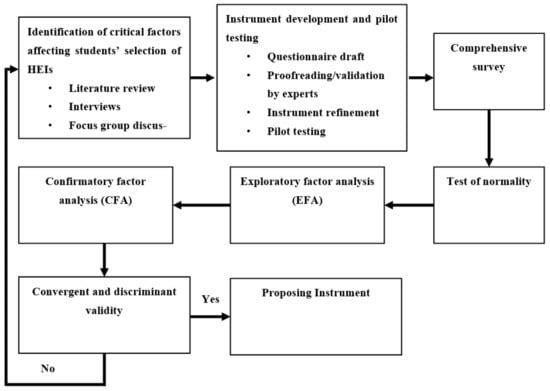
The questionnaire’s items were designed by considering the literature and interviews and focus groups’ outcomes (see Figure 1). Following Hinkin’s [53] guidelines, the initial questionnaire draft was shared with 7 academic specialists based in Germany and the UK (4 in Germany and 3 in the UK). This activity was aimed to ensure the validity of the questionnaire, including clarity, comprehensiveness, and the relevance of the questions. Based on experts’ opinions, some items were modified, and a questionnaire with 6 dimensions and 23 items were finalized for the next step. A pilot survey was conducted for the newly designed instrument, and researchers collected 66 responses (34 from the UK and 32 from Germany) from different international students. The initial responses indicated the internal consistency of the constructs with values ranging from 0.79 to 0.93 and fully complied with Hair et al.’s [54] suggestion of a minimum value of 0.7. Considering the consistency in the pilot study results, the researchers initiated the comprehensive survey.
Figure 1.
Development and Validation of Instrument.
4. Results
Descriptive Statistics
In this study, the authors used a cross-sectional design, employing a survey method to collect the data in a self-reported questionnaire. The researchers followed a non-probability convenience sampling technique to collect the data. The current study relates to the educational psychology domain since it focused on identifying the most influential factors in students’ decision to select a country for higher education. For such studies, Miller [55] recommended using a seven points Likert scale. The higher score means the higher influence or importance for the students’ decision, and the lower score refers to the lower influence. The authors collected data from June 2019 to August 2019. The quantitative responses were collected through face-to-face contact with students as well as making the questionnaire available online on a ‘Google Form’.
A total of 766 responses were received, out of which 15 responses were incomplete, and 13 responses were inconsistent. Therefore, the final sample comprised of 738 responses. The descriptive analysis indicates that out of 738 useable responses, 399 were scored from Germany, and 339 responses were recorded from the UK. Out of 738 responses, 495 responses were from males, 243 from females, and 3 preferred not to disclose their gender. Most of the respondents (361) were from the 26 to 30 years of age group. Furthermore, approximately 57.32% of the respondent were enrolled in master’s degree programs. The descriptive analysis indicates that the majority of the sampled international students in the UK and Germany were originated from China, Denmark, Turkey, Finland, Cyprus, Italy, Mexico, United States, Thailand, India, Pakistan, Malaysia, Poland, etc. Detailed information about the demographic attributes of respondents is provided in Table 1.
Table 1.
Demographic Attributes.
The researchers performed statistical analyses using SPSS v. 25 and structural analyses were performed using Amos v. 25. To ensure the adequacy of the sample size, the authors performed the Kaiser–Meyer–Olkin (KMO) test, which indicated a value of 0.911. This value fully complied with Kaiser and Rice’s [56] minimum suggested value of 0.6 and signified the suitability of data for further analyses. The examination of data normality plays a crucial role in factor analysis. The authors examined the normality of data using the Shapiro–Wilk test, which indicated a p-value of 0.089, ensuring the normal distribution of the data and provides confidence for factor analysis.
The factor analysis was conducted to identify the dimensional structure of factors affecting students in the selection of country for higher education. One of the prerequisites for factor analysis is to ensure that the data matrix contains adequate correlations [54]. During the visual examination, all correlations were found significant at p = 0.01, which offered a marvelous base for factor analysis. Exploratory factor analysis (EFA) was performed for scale refinement. Taking into account the desired parsimony and structure of the scale, only those variables were included that indicated factor loading greater than 0.4, inter-item correlation above 0.4, and factors having eigenvalues higher than 1.0 [54]. The EFA indicated six factors, where the first factor explained 38.79% variance, which is well below the cut-off value of 50% recommended by Podsakoff, MacKenzie, and Podsakoff [57]. Overall, the extracted six factors explained 74.43% of the total variance. During the EFA, five items were deleted (three items indicated poor factor loading, two items indicated cross-loading). Detailed results are given below in Table 2.
Table 2.
Measurement items and loadings.
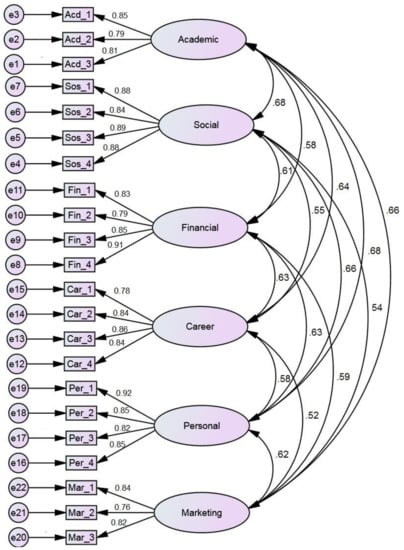
After the assurance of the unidimensionality, the authors performed confirmatory factor analysis (CFA). The authors examined composite reliability through Cronbach’s alpha, which indicated a value of 0.952. This value fully complied with Peterson’s [58] lowest requirement of 0.8 and Lance, Butts, and Michels’s [59] minimum suggestion of 0.7. The validity of the constructs was ensured through convergent and discriminant validity. According to Molina, Llorens-Montes, and Ruiz-Moreno [60], for convergent validity, the indicators should indicate a loading higher than 0.7. Moreover, Hair et al. [54] suggested that the average variance extracted (AVE) value of constructs should be higher than 0.5. Table 3 contains detailed information on constructs, number of items, reliability, standardized loading and AVE values. Discriminant validity was assessed by following Fornell and Larcker’s [61] suggestion, which states that if the square root of AVE is greater than correlation values, it ensures the existence of discriminant validity. The result of discriminant validity given in Table 4 fully complies with Fornell and Larcker’s discriminant validity criteria. Please see Figure 2 representing CFA result.
Table 3.
Instrument reliability and validity.
Table 4.
Constructs’ Discriminant Validity.
Figure 2.
Confirmatory Factor Analysis.
Values on the diagonal represent the average variance extracted; the other values are the squared correlations among the variables.
The goodness-of-fit of the statistical model describes how well it fits into a set of observations. Among the absolute fit indicators, CMIN/DF (also known as χ2/df) is the minimum discrepancy divided by its degrees of freedom. The observed values for χ2/df for the measurement and structural models were 1.798 and 1.823, respectively. These values fully comply with Bagozzi and Yi’s [62] ideal suggested value of less than 3. According to Kaynak [63], normative fit index (NFI), the goodness of fit index (GFI), adjusted goodness of fit index (AGFI), comparative fit index (CFI), Tucker-Lewis index (TLI), root mean square error of approximation (RMSEA), and standardized root means square residual (SRMR) are the key indicators that represent the goodness of model fit. Detailed results of measurement and structural model for the above-mentioned indices along with ideal recommended values are given in Table 5. The results indicated an excellent fit of the model from the collected data.
Table 5.
Measures of the model fit.
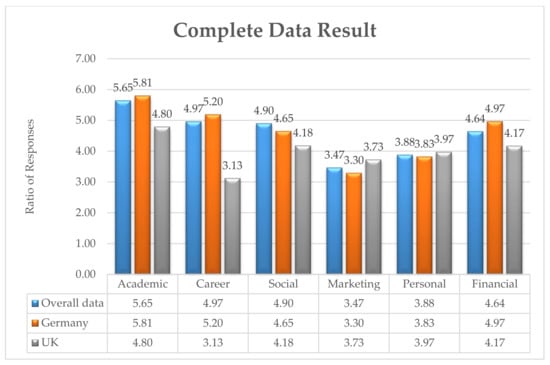
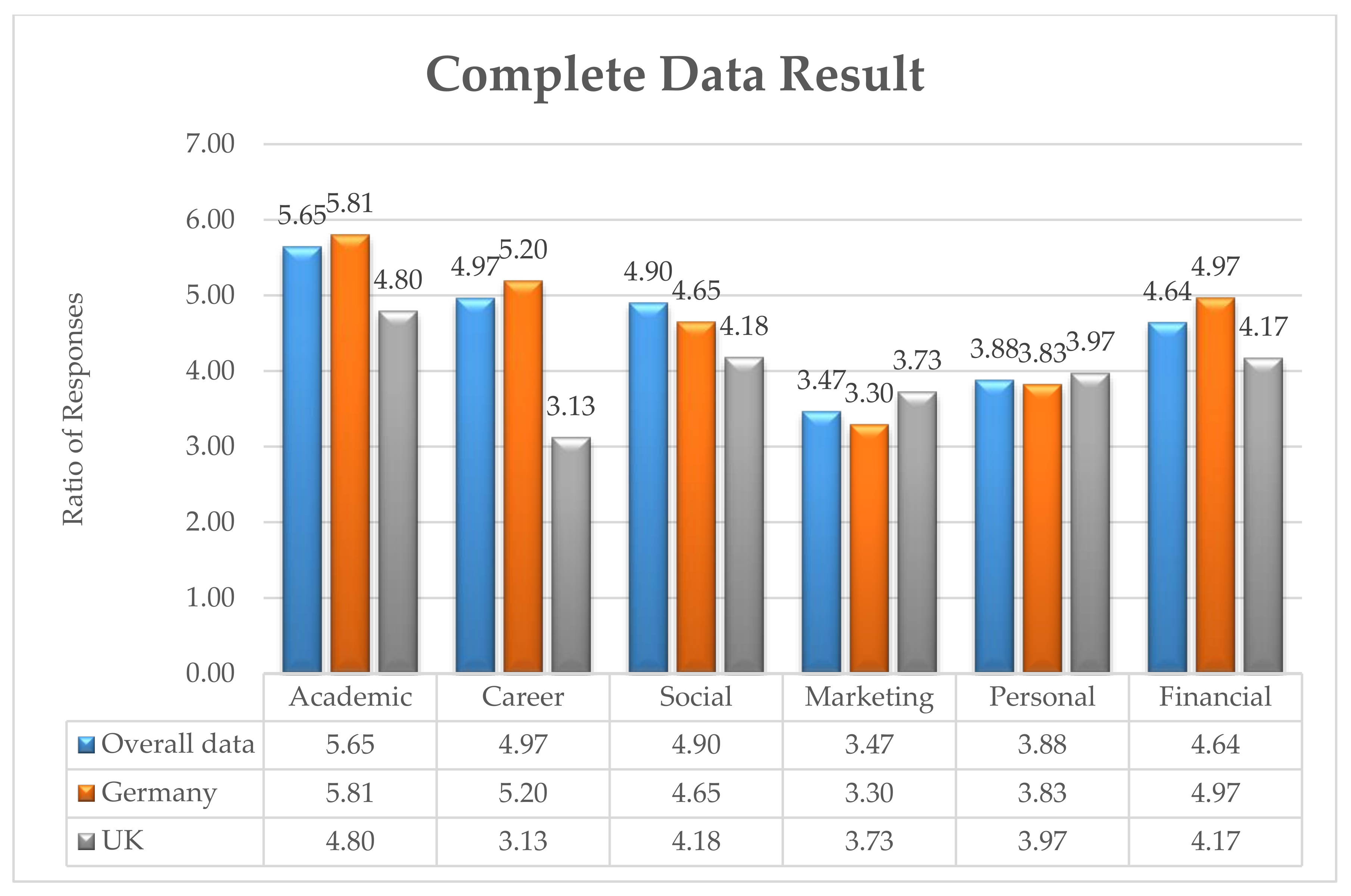
After ensuring the model fit, to identify the hierarchy of influential factors in the selection of country for higher education, the authors adopted the ranking technique. The international students were requested to rank six identified factors, i.e., academic, career, social, marketing, personal, and financial factors that may have influenced their decision to select the UK or Germany for their higher education. The mean result indicated academic factors as the most influential determinant in deciding to study abroad, followed by career, social, financial, personal, and marketing factors. While making a comparison between the students in the UK and Germany, significant differences were found in financial, career, academic, and social factors. However, insignificant differences were identified in marketing and personal factors. (see Table 6).
Table 6.
Complete data results.
The contextual analysis indicated that most of the students were originated from Asia, followed by Europe, Africa, and Arabs countries. Considering the minimal number of respondents originated from the USA, Canada, New Zealand, and Australia, the author created the fifth group and named it “other” and respondents from these regions were clubbed there. While making comparisons among these regions, Asian, European, and other regions students gave the highest importance to academic factors followed by career, social, financial, personal, and marketing. However, this trend is not consistent with students from Africa and the Arab regions (see Table 7). The examination of result responses in the context of degree level indicated that after the academic aspect, most master and bachelor students gave high preference to networking and socialization (i.e., social factor) followed by career, financial, personal, and marketing elements. However, students at the Ph.D. level termed the financial aspect as the second most influential aspect, followed by social, career, personal, and lastly, marketing factors (see Table 8). Finally, the authors examined students’ overall experience with their chosen country. The empirical result indicated that 79.55% of international students were satisfied with their decision to study in Germany, while 76.14% of respondents expressed satisfaction with their experience in the UK. The satisfaction aspect was measured in terms of their expectations and experiences within the respective country in terms of quality of education, life standard, social life, and financial situation. See Figure 3 representing results from the UK, Germany and overall responses.
Table 7.
Region-wise results.
Table 8.
Degree-wise results.
Figure 3.
Visual representation of the UK, Germany and overall responses.
5. Discussion of Results
This study aims to determine the factors influencing students to select a particular country for higher education. The researchers focused on international students studying in the UK and Germany and asked them to identify the prominent factors that entailed as driving forces in their decision to select this country. The decision to move out from the home country to the host country is based on several push-pull factors. The qualitative phase proposed six themes, namely academic, career, social interaction, financial situation, personal circumstances, and marketing, as the prominent factors that have influenced international students living in both countries. The structural analysis identified academic, career, and social factors as comparatively more significant than personal and marketing factors in both samples. The results of this study can be associated with Maslow’s theory of human motivation, which is commonly discussed in industry and academia [18]. In 1965, Maslow proposed his hierarchy of needs, which significantly enhanced an individual’s understanding of a persons’ higher and lower order needs [19].
According to Maslow, every individual possesses five types of needs, i.e., physiological, safety, love, and belonging (social), esteem, and self-actualization needs. These needs act as a driving force to reach self-fulfillment and one’s perspective in life. In the context of students’ choice to study abroad, the academic factor can be linked with students’ basic/physiological needs. Quality of education is an elementary need of students and failure to fulfill this need acts as a driving force to go to a foreign country for better education. Jupiter et al. [68] also termed the quality of education and marketing initiatives as the dominant factors in students’ choice of HEI. For this reason, home countries must take this important factor under consideration and strive to improve the quality of education, otherwise, brain drain will be a common dilemma in upcoming years.
According to Maslow’s framework, safety need refers that the individual feels physically and emotionally safe in their life. This includes safety not only from a physical perspective but also from financial and future scenarios. From the students’ perspective, safety needs are attributed to financial factors that the host country’s economy is strong and students feel mentally safe that if they make efforts, they will not have to face financial constraints and the host country contains plenty of opportunities to grow. It is also considered as a driving factor because of the higher exchange rate of the host country as compared to the country of origin. In addition to this, fee structure and scholarships provided by the foreign country also significantly influences the students’ and their guardians’ decision for the selection of the country. Besides financial factors, a peaceful, free country with a minimal crime rate and without any type of discrimination gives an edge in choosing a particular country. This finding is in accord with Lörz, Netz and Quast [69] conclusion that financial factor plays a critical role in students’ intention to study abroad and as a matter of fact, students from deprived households are less likely to anticipate to study abroad.
The social need, which refers to that individuals seek friends, affiliations, and need of belongingness in a group/society, is another aspect in Maslow’s hierarchy, and this perfectly fits with social factors which significantly attract international students to select a particular country. The social factor is not an exaggeration but considering globalization and international cultural perspectives, a student desires to connect and socialize in their daily life. For this reason, several international students consider the level of social life, cultural diversification, interaction, and environment of the host country for international students as key indicators in their decision. International students bring financial and cultural benefits to the host country in the form of living expenses, tuition fees, knowledge sharing, etc. Thus a friendly, accommodating, and flexible social life encourages international students to choose their country for higher education.
After the three needs are fulfilled, the individual moves up the hierarchy towards esteem needs. Self-esteem refers to confidence in your abilities and worth, and this can be attributed to students’ factors as foreign exposure and challenges can help you in reaching your self-esteem and self-actualization goals. However, it can also be the other way round and make students demotivated, depending upon personality type, career affirmations, and self-efficacy. Individuals who are low in self-efficacy do not accept challenging tasks and prefer not to leave their comfort zones. Besides, they undermine themselves and feel discouraged when faced with complex facets. Whereas individuals high on self-efficacy are self-assured and do not feel apprehensive about leaving their comfort zone or indulging in any complex task. However, generally, international assignment boosts one’s confidence, gives a sense of attainment and respect within society, which boosts self-esteem.
Finally, individuals can channelize self-actualization themselves. This last higher-order need is linked with career prospects, which allows them to experience, grow, and understand their potential. Future career prospects play a vital role in exercising self-actualization as students are assured that the chosen country possesses a plethora of opportunities in their respective fields. As students can combine academic standings with prospects such as indulging in research, doing internships, or gaining practical experience by working in desired professions. In a nutshell, a student packs their bags for an outstanding study adventure in a country that fulfills their basic requirements as discussed above. Thus, a country that constitutes all essentials and supports in achieving whatever an individual has planned for a future career; from providing quality education to experienced faculty that comes from all around the world enriching social capital and enlarging horizons of students along with providing a safe and multicultural environment and future career prospects.
The current research is not without limitations. Firstly, the authors focused only on international students studying in the UK and Germany and ignored other European countries. Therefore, future researchers are encouraged to expand their respondents’ scope by including students in other European countries. Secondly, most of the responses (67.07%) were received from male students, and only 32.93% were generated from female students. Similarly, 57.32% of responses were given by students from master’s degree programs and 42.68% from all other programs, such as bachelor’s, Ph.D., etc. Future researchers should try to provide results by having more balanced data.
6. Conclusions
This research intrigues significant information regarding factors affecting students’ decisions in the selection of country for higher education. Following the mixed-method approach, the authors collected qualitative data from international students stationed in the UK and Germany through interviews and focus group sessions and analyzed it via narrative framework following an open coding deductive reasoning approach that proposed six broad dimensions, namely academic, social, personal, marketing, financial, and career as the prominent factors in students’ decision of country for higher education. The identified themes provided the foundation for the scale development used in the current study. The comparative analysis of students in the UK and Germany indicated academic quality as a common dominant factor in both countries’ international student’s decision of country selection. However, significant differences were identified in the subsequent factors, such as international students in Germany termed career and financial factors as the second and third most crucial element in their decision; however, international students resided in the UK termed social interaction as the second most imperative element in their decision. This study provides valuable insights to the academic policymakers in the host and home countries concerning factors that pull and push students to study abroad. By focusing on the identified themes, the policymakers in the home country can counter the brain drain element.
Author Contributions
Conceptualization, methodology, software, validation, formal analysis, investigation, resources, data curation, writing—original draft preparation, writing—review and editing, visualization, supervision, project administration, funding acquisition by J.A., U.A., M.H., A.A. and W.M.A.-R. All authors have read and agreed to the published version of the manuscript.
Funding
This research was supported by Researchers Supporting Project number (RSP-2021/159), King Saud University, Riyadh, Saudi Arabia.
Data Availability Statement
Not applicable.
Acknowledgments
This research was supported by Researchers Supporting Project number (RSP-2021/159), King Saud University, Riyadh, Saudi Arabia. The authors would like to thank all persons who directly or indirectly participated in the completion of this manuscript.
Conflicts of Interest
The authors declare no conflict of interest.
References
- Sayaf, A.M.; Alamri, M.M.; Alqahtani, M.A.; Al-Rahmi, W.M. Information and Communications Technology Used in Higher Education: An Empirical Study on Digital Learning as Sustainability. Sustainability 2021, 13, 7074. [Google Scholar] [CrossRef] [Scilit]
- Jacob, W.J.; Gokbel, V. Global Higher Education Learning Outcomes and Financial Trends: Comparative and Innovative Approaches. Int. J. Educ. Dev. 2018, 58, 5–17. [Google Scholar] [CrossRef] [Scilit]
- Abbas, J. HEISQUAL: A Modern Approach to Measure Service Quality in Higher Education Institutions. Stud. Educ. Eval. 2020, 67, 100933. [Google Scholar] [CrossRef] [Scilit]
- Mahmood, H.K.; Hussain, F.; Mahmood, M.; Kumail, R.; Abbas, J. Impact of E-Assessment at Middle School Students’ Learning—An Empirical Study at USA Middle School Students. Int. J. Sci. Eng. Res. 2020, 11, 1722–1736. [Google Scholar]
- Safdar, B.; Habib, A.; Amjad, A.; Abbas, J. Treating Students as Customers in Higher Education Institutions and Its Impact on Their Academic Performance. Int. J. Acad. Res. Progress. Educ. Dev. 2020, 9, 176–191. [Google Scholar]
- Brunce, L.; Baird, A.; Jones, S.E. The Student-as-Consumer Approach in Higher Education and Its Effects on Academic Performance. Stud. High. Educ. 2017, 42, 1958–1978. [Google Scholar] [CrossRef] [Scilit]
- Guilbault, M. Students as Customers in Higher Education: The (Controversial) Debate Needs to End. J. Retail. Consum. Serv. 2018, 40, 295–298. [Google Scholar] [CrossRef] [Scilit]
- Brachem, J.-C.; Braun, E.M.P. Job-Related Requirements and Competences of Educational Science Graduates. J. Furth. High. Educ. 2018, 42, 166–176. [Google Scholar] [CrossRef] [Scilit]
- UKCISA. International Student Statistics: UK Higher Education. Available online: https://www.ukcisa.org.uk/Research--Policy/Statistics/International-student-statistics-UK-higher-education (accessed on 5 May 2018).
- UNESCO. Education: Outbound Internationally Mobile Students by Host Region. Available online: http://data.uis.unesco.org/Index.aspx?queryid=172 (accessed on 16 March 2020).
- OECD. International Student Mobility (Indicator). Available online: https://data.oecd.org/students/international-student-mobility.htm (accessed on 22 April 2020).
- Abbas, J. Service Quality in Higher Education Institutions: Qualitative Evidence from the Students’ Perspectives Using Maslow’s Hierarchy of Needs. Int. J. Qual. Serv. Sci. 2020, 12, 371–384. [Google Scholar] [CrossRef] [Scilit]
- Stern, V. International Facts and Figures; Higher Education Policy Institute: London, UK, 2017. Available online: https://www.universitiesuk.ac.uk/policy-and-analysis/reports/Pages/international-facts-figures-2017.aspx (accessed on 24 March 2020).
- HEPI. The Costs and Benefits of International Students by Parliamentary Constituency; Higher Education Policy Institute: London, UK, 2018. [Google Scholar]
- Abbas, J.; Sağsan, M. Impact of Knowledge Management Practices on Green Innovation and Corporate Sustainable Development: A Structural Analysis. J. Clean. Prod. 2019, 229, 611–620. [Google Scholar] [CrossRef] [Scilit]
- Shah, M.; Nair, C.S.; Bennett, L. Factors Influencing Student Choice to Study at Private Higher Education Institutions. Qual. Assur. Educ. 2013, 21, 402–416. [Google Scholar] [CrossRef] [Scilit]
- Zain, O.; Jan, M.; Ibrahim, A. Factors Influencing Students’ Decisiosn In Choosing Private Institutions of Higher Education in Malaysia: A Structural Equation Modelling Approach. Asian Acad. Manag. J. 2013, 18, 75–90. [Google Scholar]
- Maslow, A.H. A Theory of Human Motivation. Psychol. Rev. 1943, 50, 370–396. [Google Scholar] [CrossRef] [Scilit]
- Maslow, H.A. Higher and Lower Order Needs. In Understanding Human Motivation; The World Publishing Company: Cleveland, OH, USA, 1965. [Google Scholar]
- Al-Rahmi, W.M.; Alzahrani, A.I.; Yahaya, N.; Alalwan, N.; Kamin, Y.B. Digital Communication: Information and Communication Technology (ICT) Usage for Education Sustainability. Sustainability 2020, 12, 5052. [Google Scholar] [CrossRef] [Scilit]
- Mok, K.H.; Jiang, J. Massification of Higher Education and Challenges for Graduate Employment and Social Mobility: East Asian Experiences and Sociological Reflections. Int. J. Educ. Dev. 2017, 63, 44–51. [Google Scholar] [CrossRef] [Scilit]
- Silva, D.S.; de Moraes, G.H.S.M.; Makiya, I.K. Measurement of Perceived Service Quality in Higher Education Institutions: A Review of HEdPERF Scale Use. Qual. Assur. Educ. 2017, 25, 415–439. [Google Scholar] [CrossRef] [Scilit]
- GUER. Best Universities for Graduate Jobs: Global University Employability Ranking. 2018. Available online: https://www.timeshighereducation.com/student/best-universities/best-universities-graduate-jobs-global-university-employability-ranking (accessed on 2 April 2018).
- Van Truong, H.; Pham, C.H.; Vo, N.H. Service Quality and Students Level of Satisfaction in Private Colleges in Vietnam. Int. J. Financ. Res. 2016, 7, 121–128. [Google Scholar] [CrossRef] [Scilit]
- Abbas, J.; Muzaffar, A.; Shoaib, M.; Mahmood, H.K. Do Business Schools Really Fulfill Industry Requirements? An Investigation of Industrial Performance of Business Graduates. World Appl. Sci. J. 2014, 31, 1378–1384. [Google Scholar]
- James-MacEachern, M.; Yun, D. Exploring Factors Influencing International Students’ Decision to Choose a Higher Education Institution: A Comparison between Chinese and Other Students. Int. J. Educ. Manag. 2017, 31, 289–298. [Google Scholar] [CrossRef] [Scilit]
- Al-Rahmi, W.M.; Yahaya, N.; Alturki, U.; Alrobai, A.; Aldraiweesh, A.A.; Omar Alsayed, A.; Kamin, Y.B. Social Media–Based Collaborative Learning: The Effect on Learning Success with the Moderating Role of Cyberstalking and Cyberbullying. Interact. Learn. Environ. 2020, 1–14. [Google Scholar] [CrossRef] [Scilit]
- Alhussain, T.; Al-Rahmi, W.M.; Othman, M.S. Students’ Perceptions of Social Networks Platforms Use in Higher Education: A Qualitative Research. Int. J. Adv. Trends Comput. Sci. Eng. 2020, 9. [Google Scholar] [CrossRef] [Scilit]
- Maringe, F. University and Course Choice: Implications for Positioning, Recruitment and Marketing. Int. J. Educ. Manag. 2006, 20, 466–479. [Google Scholar] [CrossRef] [Scilit]
- Abbas, J.; Sagsan, M. Identification of Key Employability Attributes and Evaluation of University Graduates’ Performance: Instrument Development and Validation. High. Educ. Ski. Work-Based Learn. 2019, 10, 449–466. [Google Scholar] [CrossRef] [Scilit]
- Findlay, A.; Prazeres, L.; McCollum, D.; Packwood, H. It Was Always the Plan’: International Study as ‘learning to Migrate. AREA 2017, 49, 192–199. [Google Scholar] [CrossRef] [Scilit]
- Shakoor, F.; Fakhar, A.; Abbas, J. Impact of Smartphones Usage on the Learning Behaviour and Academic Performance of Students: Empirical Evidence from Pakistan. Int. J. Acad. Res. Bus. Soc. Sci. 2021, 11, 862–881. [Google Scholar]
- Mahmood, H.K.; Hashmi, M.S.; Shoaib, D.M.; Danish, R.; Abbas, J. Impact of TQM Practices on Motivation of Teachers in Secondary Schools Empirical Evidence from Pakistan. J. Basic Appl. Sci. Res. 2014, 4, 1–8. [Google Scholar]
- Chitra, J.; AbuBakar, N.; Nasriq, N. Factors That Determine Students’ Preferences in Selecting Higher Learning Institution. Infrastruct. Univ. Kuala Lumpur Res. J. 2013, 1, 1–12. [Google Scholar]
- Prazeres, L.; Findlay, A. An Audit of International Student Mobility to the UK; Economic and Social Research Council: London, UK, 2017. [Google Scholar]
- SG. Germany International Student Statistics. 2020. Available online: https://www.studying-in-germany.org/germany-international-student-statistics/ (accessed on 19 February 2020).
- Beggs, J.M.; Bantham, J.H.; Taylor, S. Distinguishing the Factors Influencing College Students’ Choice of Majors. Coll. Stud. J. 2018, 42, 381–394. [Google Scholar]
- Belch, G.E.; Belch, M.; Kerr, G.; Powell, I. Advertising: An Integrated Marketing Communication Perspective; McGraw Hill: North Ryde, Australia, 2012. [Google Scholar]
- Mishra, T.; Sinha, S. Employee Motivation as a Tool to Implement Internal Marketing. Organization 2014, 3, 672–679. [Google Scholar]
- Keling, S.B.A.; Krishnan, A.; Nurtjahja, O. Evaluative Criteria for Selection of Private Universities and Colleges in Malaysia. J. Int. Manag. Stud. 2007, 2, 1–11. [Google Scholar]
- Chapman, A.R.; Cattaneo, L.B. The Process of Empowerment: A Model for Use in Research and Practice. Am. Psychol. 2010, 65, 646–659. [Google Scholar]
- Habib, M.; Abbas, J.; Noman, R. Are Human Capital, Intellectual Property Rights, and Research and Development Expenditures Really Important for Total Factor Productivity? An Empirical Analysis. Int. J. Soc. Econ. 2019, 46, 756–774. [Google Scholar] [CrossRef] [Scilit]
- Ivy, J.P. Higher Education Institution Image: A Correspondence Analysis Approach. Int. J. Educ. Manag. 2010, 15, 276–282. [Google Scholar] [CrossRef] [Scilit]
- Fernandez, J.L. An Exploratory Study of Factors Influencing the Decision of Students to Study At Universiti Sains Malaysia. Kaji. Malays. J. Malays. Stud. 2010, 28, 107–136. [Google Scholar]
- Lien, D. The Role of Scholarships in Study Abroad Programs. Educ. Econ. 2007, 15, 203–213. [Google Scholar] [CrossRef] [Scilit]
- Rudy, A.R.; Irma, W.O.; Safuan, M.Y.; Norazah, M.S. Pendorong Dominan Dan Sub Dominan Kejayaan Kerjaya Ekspatriat Akademik Di Universiti Malaysia Sabah. Labu. E-J. Muamalat Soc. 2016, 10, 77–85. [Google Scholar]
- Spiegel, D. Niedersachsen: Letztes Bundesland Schafft Studiengebuhren Ab. Available online: http://www.spiegel.de/unispiegel/studium/niedersachsen-schafft-die-studiengebuehren-zum-wintersemesterab-a-938280.html (accessed on 22 December 2020).
- HESA. Publications on Students in Higher Education. Available online: https://www.hesa.ac.uk/data-and-analysis/publications/students-2014-15 (accessed on 5 May 2018).
- SIUK. International Student Statistics in UK. 2020. Available online: https://www.studying-in-uk.org/international-student-statistics-in-uk/ (accessed on 3 January 2020).
- Anderson, R.; Bhatti, A. Indian Students’ Choice of Study Destination: Reasons for Chosing Singapore. Int. J. Innov. Interdiscip. Res. 2014, 1, 66–76. [Google Scholar]
- Abbas, J. Impact of Total Quality Management on Corporate Green Performance through the Mediating Role of Corporate Social Responsibility. J. Clean. Prod. 2020, 242, 118458. [Google Scholar] [CrossRef] [Scilit]
- Pattinson, E.M.; Cotterill, S.T.; Leyland, S.D. Sources of Self-Efficacy in Springboard and Highboard Diving: A Qualitative Investigation. Sport Exerc. Psychol. Rev. 2017, 13, 80–91. [Google Scholar]
- Hinkin, T.R. A Brief Tutorial on the Development of Measures for Use in Survey Questionnaires. Organ. Res. Methods 1998, 1, 104–121. [Google Scholar] [CrossRef] [Scilit]
- Hair, J.F.; Anderson, R.E.; Tatham, R.L.; Black, W.C. Multivariate Data Analysis, 7th ed.; Pearson: Upper Saddle River, NJ, USA, 2010. [Google Scholar]
- Miller, G.A. The Magical Number Seven, plus or Minus Two: Some Limits on Our Capacity for Processing Information. Psychol. Rev. 1956, 63, 81–97. [Google Scholar] [CrossRef] [Scilit]
- Kaiser, H.F.; Rice, J. Little Jiffy, Mark Iv. Educ. Psychol. Meas. 1974, 34, 111–117. [Google Scholar] [CrossRef] [Scilit]
- Podsakoff, P.M.; MacKenzie, S.B.; Podsakoff, N.P. Sources of Method Bias in Social Science Research and Recommendations on How to Control It. Annu. Rev. Psychol. 2012, 63, 539–569. [Google Scholar] [CrossRef] [Scilit] [PubMed]
- Peterson, R.A. Meta-Analysis of Alpha Cronbach’s Coefficient. J. Consum. Res. 1994, 21, 381–391. [Google Scholar] [CrossRef] [Scilit]
- Lance, C.E.; Butts, M.M.; Michels, L.C. The Sources of Four Commonly Reported Cutoff Criteria What Did They Really Say? Organ. Res. Methods 2006, 9, 202–220. [Google Scholar] [CrossRef] [Scilit]
- Molina, L.M.; Llorens-Montes, J.; Ruiz-Moreno, A. Relationship between Quality Management Practices and Knowledge Transfer. J. Oper. Manag. 2007, 25, 682–701. [Google Scholar] [CrossRef] [Scilit]
- Fornell, C.; Larcker, D.F. Evaluating Structural Equation Models with Unobservable Variables and Measurement Error. J. Mark. Res. 1981, 18, 39–50. [Google Scholar] [CrossRef] [Scilit]
- Bagozzi, R.R.; Yi, Y. On the Evaluation of Structural Equation Models. J. Acad. Mark. Sci. 1988, 16, 074–094. [Google Scholar] [CrossRef]
- Kaynak, H. The Relationship between Total Quality Management Practices and Their Effects on Firm Performance. J. Oper. Manag. 2003, 21, 405–435. [Google Scholar] [CrossRef] [Scilit]
- Bentler, P.M.; Bonett, D.G. Significance Tests and Goodness of Fit in the Analysis of Covariance Structures. Psychol. Bull. 1980, 88, 588–606. [Google Scholar] [CrossRef]
- Byrne, B.M. A Primer of LISREL: Basic Applications and Programming for Confirmatory Factor Analytic Models; Springer: New York, NY, USA, 1989. [Google Scholar]
- Browne, M.W.; Cudeck, R. Alternative Ways of Assessing Model Fit. Sociol. Methods Res. 1992, 21, 230–258. [Google Scholar] [CrossRef] [Scilit]
- Hu, L.; Bentler, P.M. Fit Indices in Covariance Structure Modeling: Sensitivity to Underparameterized Model Misspecification. Psychol. Methods 1998, 3, 424–453. [Google Scholar] [CrossRef]
- Jupiter, H.; Othman, I.W.; Suki, N.M.; Yusoff, M.S.; Awang, H.; Razak, R.A. Factors Influencinng International Student’s Decision in Choosing Study Destination Abroad. Labu. E-J. Muamalat Soc. 2017, 11, 86–97. [Google Scholar]
- Lörz, M.; Netz, N.; Quast, H. Why Do Students from Underprivileged Families Less Often Intend to Study Abroad? High. Educ. 2016, 72, 153–174. [Google Scholar] [CrossRef] [Scilit]

Publisher’s Note: MDPI stays neutral with regard to jurisdictional claims in published maps and institutional affiliations. |
© 2021 by the authors. Licensee MDPI, Basel, Switzerland. This article is an open access article distributed under the terms and conditions of the Creative Commons Attribution (CC BY) license (https://creativecommons.org/licenses/by/4.0/).