1. Introduction
Nigeria has the highest proven gas reserves in Africa, with 5.675 billion cubic metres of gas and approximately 200.41 trillion cubic feet of natural gas. The country’s oil reserves are 36.972 billion barrels, which means that the gas reserves are 900 times higher than its oil reserves. However, gas flaring has been a problem in Nigeria’s oil and gas industry. Nigeria’s economy lost NGN 233 billion (USD 600,515,560) to gas flaring [
1]. Most developing oil- and gas-producing countries suffer the deleterious effects of gas flaring, which has caused damage to the environment and human health, and the loss of aquatic life [
2]. The environmental cost of gas flaring in Nigeria is NGN 28.8 billion (USD 0.069377141) annually [
1].
Gas flaring in Nigeria’s petroleum sector is a major contributor to greenhouse gas emissions and is responsible for climate change. Gas flaring is the burning of associated gas that emanates from the extraction of crude oil during oil and gas exploration activities [
2]. Nigeria is blessed with a vast deposit of gas; however, the country still flares a large percentage of its associated gas during upstream petroleum operations despite the country’s challenge with attaining a stable power supply. Flared gas could be used to supply gas to turbines to generate electricity. However, flared gas has occasioned the loss of billions of dollars in revenue to the Federal Government of Nigeria [
3].
Gas flaring is a violation of the fundamental right to life and dignity of the human person as guaranteed under sections 33 and 34 of the 1999 Constitution of the Federal Republic of Nigeria (as amended). Pollution of the environment through incessant gas flaring has made the environment unsafe and unhealthy and threatened the right to life and dignity of the human person as enshrined in the 1999 Constitution of the Federal Republic of Nigeria (as amended).
The study aims to combat gas flaring in Nigeria’s oil and gas industry to promote smart and sustainable technologies in energy and the environment by advocating the need for a paradigm shift in the legal regime for combating the menace. The study is divided into five sections, with the introduction to gas flaring in Nigeria as the first.
Section 2 considers the methodology, literature review, and statement of the research problem.
Section 3 analyses gas flaring in Nigeria’s oil industry, the reasons for gas flaring in Nigeria, the economic effects of gas flaring on the host communities in the Niger Delta areas, and the ecosystem and prospects of natural gas in Nigeria.
Section 4 considers the comparative analysis of the gas flaring legal framework in Russia, the United States, Norway, and Nigeria, and the lesson learnt to improve Nigeria’s legal framework for combating gas flaring.
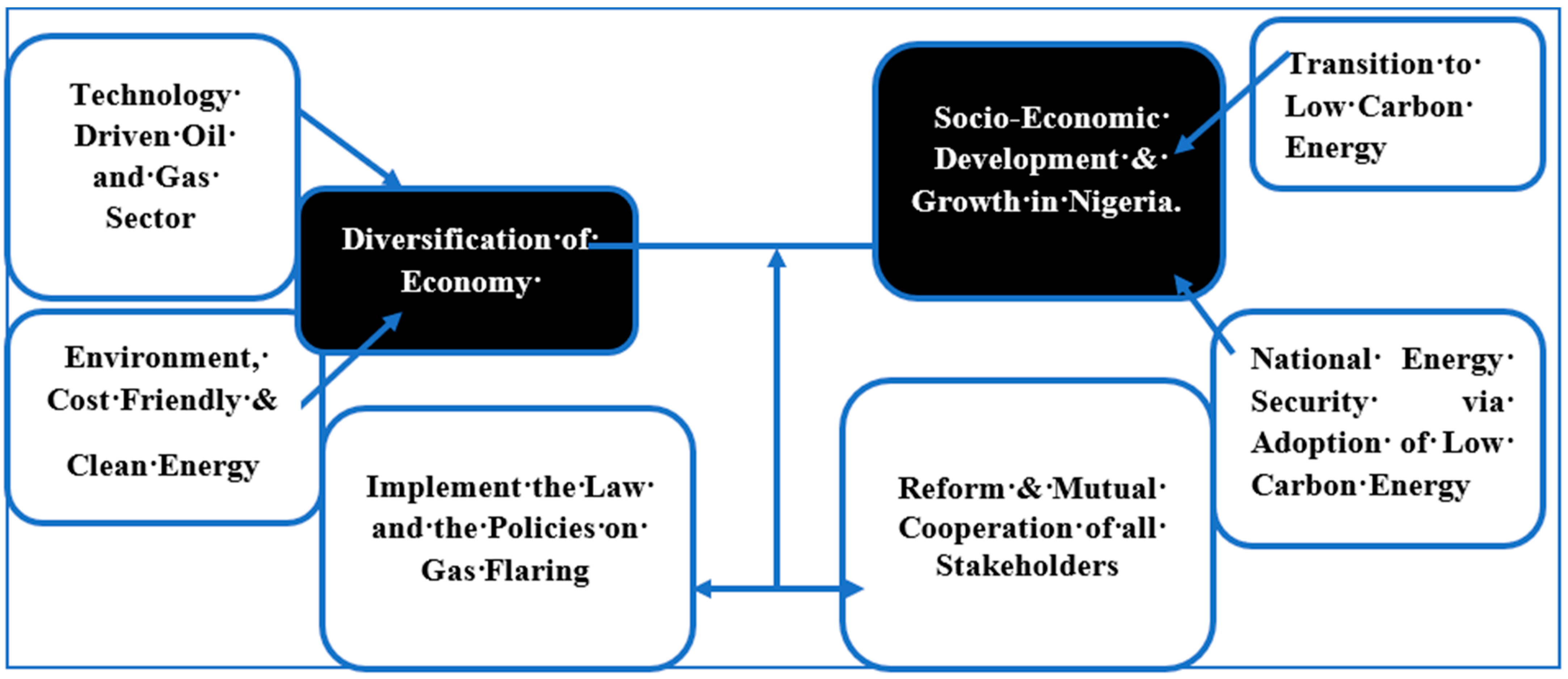
Section 5 contains the recommendations, and the study concludes that the legal regime on gas flaring in Nigeria is not adequate. The study advocates the need to adopt sustainable development theory as a hybrid model for combating gas flaring being a good strategy that will promote sustainable energy security in Nigeria.
The study designs a hybrid model or mechanism for combating gas flaring and advocates that defaulting oil and gas companies should be made to pay dearly for violation of anti-gas flaring laws to promote the commercialisation of the fled gas for sustainable energy security in Nigeria.
3. Literature Review
Gas flaring has been a concern among scholars from different fields of study, due to its deleterious effects on the ecosystem, aquatic resources, and human health hence the need for this study [
5] captured gas flaring as a menace that has to be combated to promote a healthy and sustainable environment in Nigeria. That study appears relevant to this study, but it fails to emphasise the sustainability of energy resources to promote clean or low-carbon-energy utilisation in the country [
5].
Iyorakpo [
6] postulated that the quantity of gas flared is of extreme importance because flaring at a small scale cannot cause any environmental problem but fails to adumbrate the need for a paradigm shift in the legal regime for combating gas flaring, which is the focus of the current study. Similarly, Oke opined that gas flaring is prevalent in Nigeria due to the failure of the Federal Government to stringently enforce the anti-gas flaring legislation in the country but fails to proffer the legal panaceas to the menace, which the current study intends to advocate.
Equally, a report made available by PricewaterCooper [
7] titled “Assessing the Impact of Gas Flaring on the Nigerian Economy” examined how this menace has declined the revenue accruable to the Federal Government from the oil and gas sector. The report, however, failed to assess the impact of gas flaring on the economic activities of the people in the Niger Delta areas, where these flaring or venting activities take place. The study is relevant to this current research as it provides useful insight for combating gas flaring in Nigeria. Uwem and Enobong [
8] in their work “Gas Flaring in Nigeria: Problems and Prospect,” highlight the hurdles against the prospects of natural gas in Nigeria. However, the laws discussed are not explicit enough to engender the need for a paradigm shift in the legal approach to combating gas flaring in Nigeria.
Furthermore, Oluwasoye and Odinaka [
9] maintain in their article titled “Environmental Risk of Gas Flaring in Nigeria: Lesson from Chevron and Ilaje Crisis” that gas flaring in the Niger Delta is illegal and that Chevron should make efforts to reduce the impacts of gas flaring in the communities where they operate. According to the study, Chevron has carried out a natural gas project in the Western Niger Delta and Escravos areas, a project that is said to cost USD 2.4 billion (NGN 996.29158), but the article does not tell us the reason Chevron decided to flare gas in Nigeria but comply with zero tolerance for gas flaring in other countries where they operate. The current study intends to fill this gap by preferring solutions to the challenge of weak enforcement of the anti-gas-flaring legal framework. Similarly, Hakeem et al. [
10] posited that gas flaring in the Niger Delta region releases greenhouse gas into the atmosphere but failed to adumbrate the shortcomings of the legal framework for combating the menace, which is one of the objectives of this study.
Ito and Ugbomeh [
11] specifically examined the pollutants and chemical compounds emitted by gas flaring and their impacts on the biodiversity of the Niger Delta areas, but the study paid little to no attention to the aquatic resources of the areas.
The current study seeks to contribute to the existing literature on gas flaring in Nigeria by filling the gaps in weak enforcement of anti-gas flaring laws in Nigeria to combat environmental degradations occasioned by multinational oil and gas firm operations in the country.
Olujobi [
12] reiterated the need to restructure Nigeria’s legal and institutional frameworks such as the Constitution, the National Environmental Standards Enforcement Act of 2007, and all extant laws on environmental protection, conservation, and management. He further asserted that the Nigerian government can also tackle the environmental problem by making the provision of section 20 of the 1999 Constitution of Nigeria justifiable. Environmental pollution, if enacted as a strict liability offence like in some developed oil-producing countries, will promote the compliance of multinational oil corporations with national environmental laws [
13].
4. Statement of Research Problem
The Federal Government’s efforts to combat gas flaring have not yielded the expected result. The practice of gas flaring has persisted in Nigeria’s oil and gas industry due to the market, economic constrictions, lack of an appropriate legal regime with stringent sanctions, and lack of political will of the Federal Government to implement its anti-gas-flaring laws. Nigeria and nine other countries are allegedly responsible for 75% of global gas flaring and the country is ranked the seventh position among the top 10 gas-flaring nations, with a 10% upsurge in gas-flaring intensity between 2012 and 2021 [
14].
Besides, Nigeria flares a higher percentage of its associated gas, thereby occasioning a loss of national revenues for economic and developmental projects in the country. For instance, Nigeria flares approximately 8 billion cubic meters of gas annually, approximately NGN 75 million (USD 180,670.00).
Nigerians lack access to stable electricity. The world currently flares approximately 144 billion cubic meters, which could generate electricity for the whole of Sub-Saharan Africa [
15]. Gas flaring is a colossal waste of an invaluable natural resource that could either be used for commercial purposes, such as generating electricity, or be conserved by re-injecting it back into the reservoir [
16]. Besides, gas flaring has disastrous impacts on oil-producing communities’ health, environment, means of livelihood, and agricultural production. It has contributed extensively to global warming and impacts the environment through the emission of carbon dioxide, black carbon, and other environmental pollutants. It has squandered invaluable energy resources that could be utilised for the improvement and sustainable growth of Nigeria. In the year 2021, approximately 144 billion cubic meters of gas were flared at the various oil-production sites globally thus contributing 40% of emissions annually to the black carbon deposits in the Arctic [
17].
Nigeria has the largest proven gas reserves in Africa and was ranked the ninth largest in the world in 2018, with 5675 billion cubic meters (200.41 trillion feet cubic) of natural gas.
However, this study is essential since there have been little to no research efforts on how the law can be enforced to encourage the recovery and reuse of flared gas. Besides, few academic scholars have examined this area of law, and this aspect is very important to both humans and the environment, as a clean, pollution-free global environment is not negotiable.
4.1. Theoretical Framework for Combating Gas Flaring
The Sustainable Development Theory was advanced from the Brundtland Report in 1987 after the Stockholm Conference on Human Environment in 1972. The theory is appropriate to this study since it emphasises the need for governments to utilise their copious extractive resources sustainably by remodelling their anti-gas-flaring laws in conformity with the 21-century anti-gas-flaring laws in the selected case-study countries for sustainable energy security in Nigeria, the failure of which might have negative consequences for the country’s economy. Clean energy and transition to low-carbon-energy sources will promote socio-economic growth in Nigeria for both present-day and upcoming generations and to satisfy their energy necessities [
18]. The impact of pollution on the marginalised people of Niger Delta areas and how foreign direct investment and sound government strategies, sustainability, or energy security is sine qua non for polluted and less-favoured or marginalised areas in Nigeria that can be made pollution free. The impact of pollution on marginalised people and how foreign direct investment and sound government strategies or energy security could be useful for polluted and less-favoured or marginalised and even mono-industrial areas is significant in Nigeria. These have been largely debated worldwide in different case studies [
19,
20] and such an approach could be developed in African countries [
21] and for the particular purpose of combating gas flaring in the Niger Delta areas in Nigeria, especially in those areas where poor or marginalised people live.
The Resource Curse Theory (Paradox of Plenty) was advocated between 1970 and 1990 and was initially used by Richard Auty in 1993 to conceptualise how countries that are magnificent in mineral resources are weak in utilising their copious extractive resources to enhance their economies. The justification for the theory is that it emphasises the ineptitude of many nations blessed with extractive resources but that failed regarding the provisions of infrastructure and well-being of their citizens (Natural Resources Governance Institute, 2015). The theory aids the research by emphasising the need to ensure that abundant natural resources are utilised for the optimal benefit of the citizens through the provision of stable electricity and other basic social amenities commensurate with the amount earned from abundant natural resources [
22]. The theories aid the research by emphasising the importance of energy security and sustainability in Nigeria’s energy sector by formulating policies that can combat gas flaring and its adverse effects on the country.
4.2. Reasons for Gas Flaring in the Oil Industry in Nigeria
The following are various reasons why oil firms flare gas in the Nigeria oil industry.
Under section 104 of the Petroleum Industry Act 2021, a licensee, lessee, or marginal oil field operator can only flare or vent gas in the event of an emergency, where exemption has been granted by the Commission and where such flare is the acceptable safety practice under the regulation.
Similarly, gas may be flared to prevent the overpressure of oil firms’ industrial plant equipment by releasing these gases to reduce the chance of an explosion. Another reason is that flaring may aid in the elimination of waste products from chemical manufacturing processes. It will promote the safe burning of volatile organic compounds. Often, gas is flared where oil fields are far from the nearest utiliser, and where gas transport infrastructure is insufficient, oil firms often flare gas where such oil fields have an insignificant quantity of associated gas in the location or site and where re-injection to the field is not practicable.
Another reason for gas flaring is that oil production locations are undersized and are spread over a sizeable geographical area. Capturing and utilising the associated gas by oil firms is perceived as costly; therefore, the associated gas is routinely flared [
23]. The local market of gas is yet to be fully developed in Nigeria and consumers are often not willing to pay an appropriate price for gas that is commensurable with the cost of processing the associated gas and transporting it to the market for sale [
24].
Apart from the above, there are some causes of gas flaring that are not intentional but may be due to negligence, and they are as follows: inadequate infrastructure for capturing and transporting associated gas; the lack of maintenance and replacement of old gas pipelines that convey gas products, thereby resulting in leaking and rusting of such pipelines, leading to flaring of the stored gas; failure of regulatory institutions to combat illegal oil refinery activities such as bunker and pipeline vandalism; and various illicit oil activities that have occasioned gas flaring and oil spillage that contaminate the environment.
4.3. The Effects of Gas Flaring on Nigeria’s Economy and the Need for Sustainable Development
The economic effect of gas flaring on Nigeria is severe and cannot be overemphasised. This effect is measured in terms of the amount of revenue lost in the cause of the flaring of gas, which could have been used to positively impact other sectors of the economy PricewaterCooper reported that Nigeria lost approximately NGN 233 billion (USD 561,282,189.36) of revenue to gas flaring in 2018. The report also showed that the amount lost to flaring in 2017 and 2016 was NGN 267 (USD 688,144,440) and NGN 229 billion (USD 770,618,680), respectively. Another report conducted by Vanguard in 2019 stated that Nigeria flares approximately 425.9 billion standard cubic feet of gas, which could be sold at NGN 460.5 billion (USD 1.1093152) as of 2019 if not flared [
25]. This revenue lost to gas flaring in 2019 could have been utilised on low-income housing schemes and electricity. It would have improved Nigeria’s global ranking in housing and it would have provided an additional 13,124 standard housing units in the country.
Electricity is another sector that plays a vital role in the development of the economy of any country. If a certain percentage of the money lost to gas flaring were used to repair already-existing power sector accessories, it would go a long way in solving the challenge of electricity in the country [
26].
In Nigeria, it was stated that only 62% of the total population had access to electricity in 2019 [
27], although Nigeria is one of the countries with the largest gas reserves in the world, and approximately 80% of its electricity is derived from natural gas [
28]. If gas flares were utilised in the power sector to generate electricity, it would boost the electricity supply in Nigeria. Natural gas is a resourceful commodity in both domestic and export markets that the country can export to boost its revenues [
29]. Natural gas can be processed and made available and affordable for household cooking as an alternative to kerosene, which is expensive, unclean, or and not a low-carbon source of energy that is not environmentally friendly.
Natural gas is also used as a source of heat for the production of steel, cement, ceramic, and food. It could also be used in the manufacturing of fertilizers, plastics, pharmaceuticals, and rubber. Gas has a large range of uses; instead of flaring them, industries that would use these gases can be created and employ youth, thereby reducing the rate of unemployment and reducing the crime rate and creating a safer environment that would attract investors.
The Niger Deltans are primarily fishermen and farmers, and gas flaring pollutes the rivers, causing fish to migrate to more suitable habitats, making the fishermen encounter low productivity, leading to hunger and hardship. It also causes acid rain, which negatively affects the soil, causing soil infertility, which would lead to a reduction in crop yield and cause hunger.
However, loss of income has been identified as another challenge faced by the people of the affected areas. It is not a gainsay to say that a large quantity of gas is flared in Nigeria yearly. However, if these gases were annexed, it would add up to revenue that would have accrued to the federal government, thereby equipping it with enough financial resources to discharge its economic, social, education, and environmental responsibilities.
Gas flaring has led to the degradation of the environment, which has harmed the quality of life, the enjoyment of guaranteed fundamental human rights, and ultimately the achievement of sustainable development [
30]. Man is dependent on the environment to attain the goals of meeting fundamental necessities. Gas flaring has a severe environmental impact. The necessity to reconcile economic development with environmental protection gave rise to the notion of sustainable development. Balancing these competing interests, especially when it is recognised that man is a tenant of the earth’s environment with limited time, necessitates that man act in such a way that future generations do not inherit an environment that is a liability. The necessity to protect interests justified the application of environmental legislation as a preventive measure to protect both interests [
30].
The United Nations defines sustainable development as “one that meets the need of the present without compromising the ability of future generations to meet their own needs” [
31]. Sustainable development strategies can thus be viewed as a facilitator for balancing the conservation of nature’s resources with the need for industrial and technological development and advancement. In other words, it denotes the ability to improve the quality of human life while living within the carrying capacity of the supporting ecosystem [
32].
In Nigeria, there is a need to combat this problem to provide a safe environment for unborn generations. Gas flaring has resulted in the extinction of species in the environment, and it is important to note that once species are depleted to the point of extinction, they cannot be renewed; as a result, the loss of these plant and animal species will make it difficult for future generations to meet their needs. As a result, it is critical to protect these resources to ensure long-term development. In the face of pollution and environmental degradation, maintaining the environment will be a difficult challenge. Exploration of oil and gas has become an environmental albatross in Nigeria.
The discharge or flaring of gases from exploration sites pollutes the air, water, and soil. The overreliance on fossil fuels to power cars, industrial machinery, and home energy sources in Nigeria has created a risk for petroleum resources, threatening long-term growth. The Nigerian government’s failure and inability to rely on alternative energy sources such as solar, tidal, and hydro has forced the country to rely largely on fossil fuel for energy. Nigeria should follow in the footsteps of Western countries that have previously embraced alternate energy sources. Sustainable development entails the utilisation of renewable energy sources. Achieving sustainable development goals implies a balance of environmental and economic objectives.
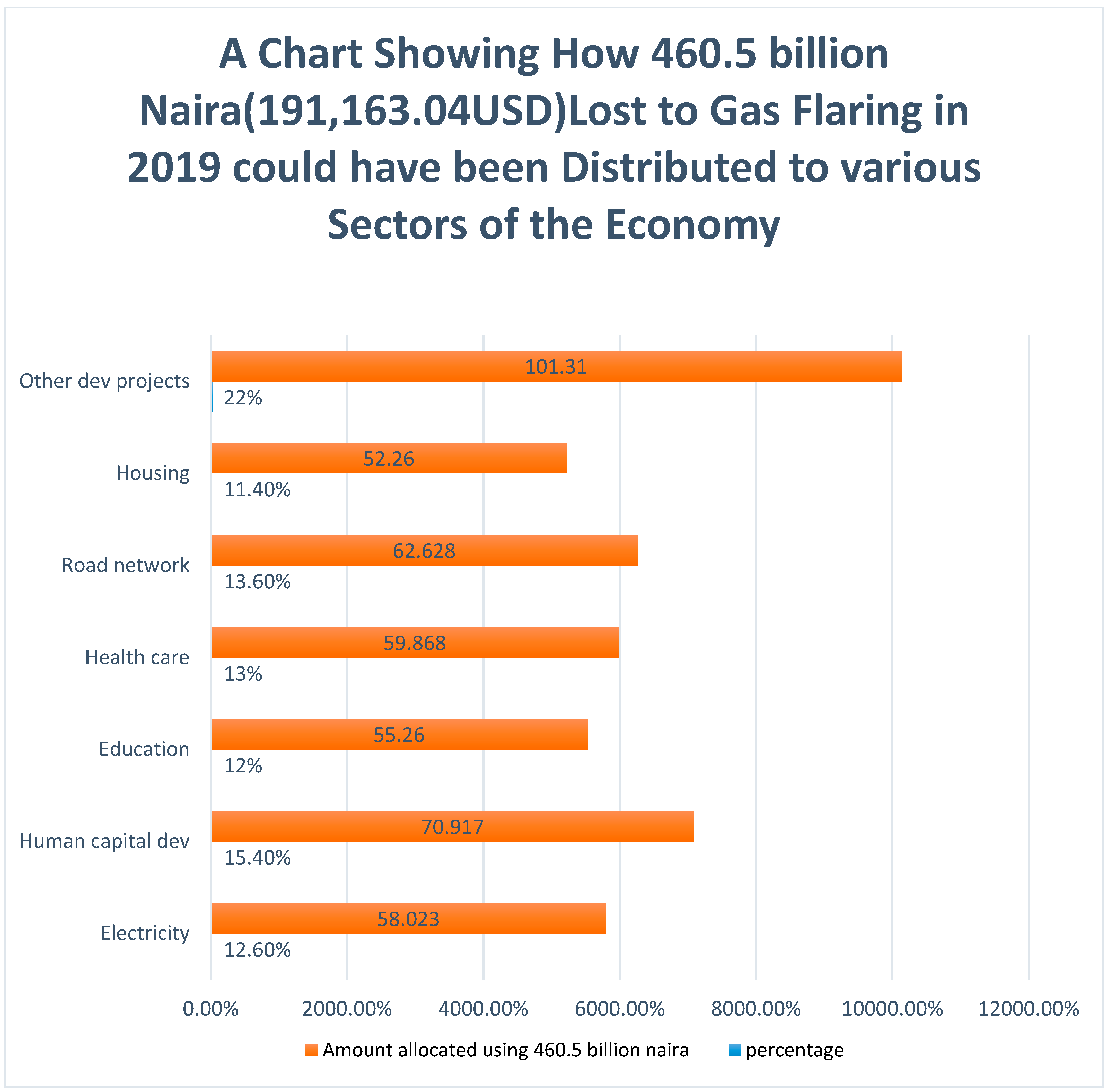
There are other different priorities in which the revenue of NGN 460.5 billion (USD 191,163.04) could have been invested.
Figure 1 shows how this money could have been used.
The discovery and exploitation of any natural resources may constitute a threat to sustainable management of the environment in Nigeria, though some countries in the world have used the discovery of crude oil in their nation to transform their nations into heaven on earth in terms of economic development and other areas. However, the case of Nigeria is different. The discovery of crude oil in Nigeria has caused serious damage to the ecological system in the Niger Delta region due to oil exploration and production activities. According to the World Bank report in 2008, the Niger Delta region has been found to host the second-largest flaring sites in the world after Russia, with the report showing that more than 150 million cubic meters of natural gas are flared annually [
30].
The burning of natural gas in the region has led to enormous environmental pollution, leading to the destruction of the ecosystem. The pollution of the ecosystem decreases fishing, farming, and other agricultural activities practised in the region. Agricultural activities such as crop farming are no longer lucrative, as flaring has caused low crop yields, which in turn has increased the poverty rate in the region. Communities located close to gas-flaring sites are prone to higher soil temperature and rainwater acidification. This acid rain is also responsible for the destruction of aquatic life [
33].
Gas flaring releases highly toxic substances such as methane, carbon dioxide, nitrogen oxides, and sulphides into the atmosphere, along with carcinogenic substances such as benzo(a) prone and dioxin. These compounds are toxic to human health [
34].
Photo pollution or light pollution is also another effect of gas flaring in the Niger Delta region. It is defined as the constant and continuous burning of huge flames with infinite brightness from natural gas-burning stacks that subject fauna and flora to constant unnatural daylight. Pollution from light leaves organisms living in that area no other choice but to migrate from their natural environment to a more friendly and habitable environment. For instance, in rivers, waters become too hot for fish to survive, and in the soil, plants and crops have withered away because of excessive heat from gas-flaring sites. Additionally, there has been a reduction in the rate at which organisms reproduce, leading to a reduction in their numbers, which is one of the factors causing extinction [
35].
Over the years, the production of natural gas has increased, and so has flaring, and this has had devastating impacts on the environment in the Niger Delta areas in Nigeria (
Figure 2,
Table 1).
The environmental impact of gas flaring can be remedied if there are concerted efforts from oil firms as well as the federal government to stop gas flaring. A study carried out by the National Environmental Economic and Development Study (NEEDS) showed that to reduce gas flaring on the environment in Nigeria, the country needs to plant 7.5 million hectares of trees that would absorb 638 million cubic tons of carbon from gas flaring and other sources of emissions, which will cost approximately NGN 39,021,337,916.23 (USD 94 million) yearly [
36].
Besides the dangers gas flaring poses to the atmospheric temperature, it also poses a great threat to the health of the people. Flared gases serve as pollutants to air, water, and land, which in turn cause different kinds of health implications. The gases released into the atmosphere are carcinogens, benzopyrene, benzene, carbon disulphide (CS
2), and toluene, as well as some metals such as mercury, arsenic, and chromium; sour gas with H
2S and SO
2; and nitrogen oxides (NOx), carbon dioxide (CO
2), and methane (CH
4), which contribute to greenhouse gases, are also released into the atmosphere [
37].
Some selected hydrocarbon compounds released through flaring have health implications. Benzene is a carbon that causes blood disorders, including a reduced number of red blood cells and aplastic anaemia, pancytopenia, and leukaemia. Naphthalene’s health effects are that it destroys the membrane of red blood cells with the liberation of haemoglobin, cataracts, headache, confusion, excitement, malaise, profuse sweating, nausea, vomiting, abdominal pain, and irritation of the bladder.
Styrene is a carbon responsible for skin irritation and causes irritation of the eyes and mucous membranes and affects the central nervous system. Toluene affects the central nervous system, which leads to narcosis, incoordination, emotional liability, headache, and fatigue. Xylene also affects the central nervous system, which causes delayed development, decreases foetal body weight, and alters enzyme activities. These pollutants also cause other kinds of damage to human health, such as cancer and reproductive, neurological, and developmental defects. It is also responsible for deformities in children’s skin problems and lung damage [
38].
5. Comparison of the Gas-Flaring Legal Framework of Russia, the United States, Norway, and Nigeria
It is a well-known fact that Nigeria is one of the countries most endowed with oil and gas reserves. Nigeria is regarded as a gas-producing country. The country has the most proven gas reserves in Africa and ranks ninth in the world. However, oil companies continue to flare a considerable amount of associated gas during exploration efforts, causing significant harm not only to humans and animals but also to the immediate environment and the ecosystem as a whole. If not addressed, this threat will wreak much more havoc, necessitating the need for stringent legislation to regulate gas flaring. This study looks at the legal frameworks in the selected oil- and gas-producing countries, as well as the necessity to tackle this scourge. The study compares the legislative framework for gas flaring in Russia, the United States, Norway, and Nigeria. The justification for the selected countries is that they have large reserves of oil and gas and are facing mostly the same gas challenges with gas flaring as Nigeria. However, unlike Nigeria, some of these selected countries have stringent and comprehensive anti-gas-flaring legal frameworks that entail transparent procedures and proper management of their gas resources [
39].
The study further examines the lesson Nigeria can gain from the selected case-study countries to improve the provision of section 44(3) of the 1999 Constitution of the Federal Republic of Nigeria (as amended) and section 1 of the Petroleum Industry Act 2021, since the right to explore any form of petroleum resources in Nigeria is strictly and exclusively granted by the federal government. In Russia, the state owns all mineral resources, including petroleum. Unlike Nigeria, exploration licences are granted to oil companies by the federal government. However, in Russia, licences are jointly granted by both the federal and regional governments. The approval of the regional authorities is required to extract oil, natural gas, and associated gas in the country. The legal regime regulating gas flaring in Nigeria is enacted by the National Assembly and it applies to all oil-producing states, but in Russia, gas-flaring restrictions are not the same in all regions. This is because the Federal Mineral Act in Russia only sets out licence terms and does not include the usage rate of associated gas. Gas flaring and how to combat it is solely the responsibility of the regional authorities. Regions have special provisions for associated gas flaring and its usage in their regional laws. The Khanty-Mansijsk and Yamalo-Nenetz regions made provisions for gas flaring in their regional laws and the oil operators and regional authorities need to reach an agreement on the prevention of gas flaring before oil licences are granted.
In the United States, natural resources are owned by private persons, companies, and federal, state, local, and tribal governments. The country has widespread private ownership of natural resources, which is different than other oil-producing countries. For natural resources on the coast, ownership is shared between the Federal Government and the individual state governments. In general, state governments have statutory power over their natural resource within a three-mile radius of their coast.
The Federal Government acquires ownership of the oil, gas, and minerals found in submerged areas on the outer continental shelf, which extends from the offshore boundaries of the states out to at least 200 nautical miles from the shore (United States Department of the Interior 2021).
In Nigeria, under the Petroleum Industry Act 2021, the commercial and regulatory functions of the regulatory body are separated. The upstream petroleum industry is regulated by the Nigerian Upstream Petroleum Regulatory Commission and the midstream and downstream regulatory body is the Nigerian Midstream and Downstream Petroleum Regulatory Authority. In Russia, the federal regulatory body is the Ministry of Natural Resources, whereas regional regulatory bodies are the regional local authorities (Department and Committees of Local Government). There are numerous regulatory agencies in the United States because each state has its own set of rules on extractive resources. The Federal Energy Regulatory Commission, on the other hand, is the major regulatory body for oil and gas corporations in the United States. The regulation of oil and gas production is governed by the individual states where such operations take place. For instance, states regulate oil- and gas-drilling activities and inspect drilling sites, safety measures, waste management procedures, and other environmental concerns. The Environmental Protection Agency, Department of the Interior, and Bureau of Land Management are regulatory agencies at the federal level in the United States.
The Nigerian Midstream and Downstream Petroleum Regulatory Authority regulates gas flaring and issues permits to gas firms in the sector) [
40]. To reduce gas flaring, the Nigerian government initiated the Nigerian Gas Flare Commercialization Programme in 2016.
The aim is to eliminate gas flaring through technically and financially viable gas-utilisation initiatives. The government is to sell flare gas via a transparent and competitive bidding process through the Nigerian Gas Flare Commercialization Programme (NGFCP) [
41]. The Federal Government has approved the Paris Climate Change Agreement and signed the Global Gas Flaring Reduction Partnership (GGFR) Principles to combat gas flaring by 2060. Russia has also followed through on its Kyoto Protocol promises by enacting laws in 2008 and 2009 requiring oil producers to invest rapidly in decreasing gas flaring. On 1 January 2012, the government mandated that oil companies could no longer flare more than 5% of the bypass gas produced with crude oil. Russia imposed fines on oil producers who failed to meet the 95% bypass gas usage rate by the 2012 deadline, with penalties increasing exponentially each year between 2013 and 2020 [
41]. Gazprom Neft, a state-controlled oil producer, reported an increase in bypass gas consumption to 89% in 2019 from 78% the previous year. The company stated that it is working on projects for its remote onshore and offshore initiatives to meet the 95% utilisation target by the end of 2021. The states of West Siberia, particularly Khanty-Mansijsk, are also signatories and members of the Global Gas Flaring Reduction Partnership, as is the United States.
In Nigeria, oil firms are to flare gas that is not cost effective and that is required for operational testing. For enterprises to flare, the Nigerian Midstream and Downstream Petroleum Regulatory Authority must give gas-flaring permits, whereas in the Khanty-Mansijsk region, Russia only allows companies to flare more than the specified proportion provided they can demonstrate that it is more cost effective to flare than to use such gas. In Nigeria, associated gas can be used in the following ways: Oil firms can produce, process, and market associated gas if a development plan is approved by the Authority. Associated gas can be used in operations, reinjected, or flared, but only with the appropriate consent (and this consent is expected not to be unnecessarily withheld). Any associated gas that is not necessary for the company’s operation must have a development plan filed with the Nigerian Midstream and Downstream Petroleum Regulatory Authority, and the Federal Government has the right to take for free any associated gas that is not economically or commercially viable that exceeds the company’s operational requirements [
42].
In Russia, oil firms can lift, process, and market related gas and they may also utilise associated gas in operations, as well as reinject or burn such gas. However, both onshore and offshore associated gas procedures are required in the United States to be managed via transportation to the market, to generate power, or to be reinjected into the field. After the oil production targets are satisfied, the gas must be produced for sale. The pipeline system is well established, and the current gas demand in the United States exceeds the current output. As a result, reducing flaring is of national interest.
Gas can be flared for up to 48 hours in a row but not for more than 144 hours. This is the situation in Nigeria, Russia, and the United States. In the United States, any operator who desires to flare for an extended period must obtain Mineral Management Service approval (MMS). The MMS may also permit operators to flare approved amounts of gas for up to a year to install equipment that eliminates the need for such flaring. Operators must, however, retain thorough flaring records, which are subject to MMS scrutiny.
As part of monthly production statements, flare gas amounts must be reported to the MMS. In Russia, data on associated gas are reported to several government agencies, including the state statistical committee, the Ministry of Taxation, the Ministry of Energy, and the Ministry of Natural Resources. There is little to no coordination among these statistical information recipients, and the data are not standardised. Section 4(2) of the Flare Gas (Prevention of Waste and Pollution) Regulations 2018 in Nigeria requires producers to furnish flare gas data within 30 days of request. Section 5 of the same Act levies penalties or imprisonment for incorrect or incomplete data [
43].
In Nigeria, the Associated Gas Reinjection Act 1979 established a cost for flaring gas. The fee was initially placed at NGN 0.50 per million cubic feet (mcf), but it was increased to NGN 10 per mcf beginning in January 1998. This payment is payable as a royalty. However, in recent years, oil corporations have been penalised between NGN 20 and 50 million per year for flaring-related gas offences. The Flare Gas (Prevention of Waste and Pollution) Regulation 2018 introduced a new gas-flaring payment for gas flared within the Oil Mining Lease or Marginal Field. Companies that produce at least 10,000 barrels of oil per day are subject to a flare payment of USD 2 (NGN 830.24) per 28.317 SCM (1000 standard cubic feet) of flared gas, according to the Act. Companies that generate less than 10,000 BPD, on the other hand, must pay a flare charge of USD 0.5 (NGN 207.56) per 28.317 SCM (1000 SCF) of gas flared. These penalties appear not to have sufficient deterrence value on defaulting oil firms. In Russia, the federal government Resolution No. 344 from 12 June 2003 lists contaminants and the pollution fines that producers must pay. SOx, NOx, sulphur, and ash are on the list, but CO2 is not. In addition, the ministries have the authority to withdraw the licences of defaulting operators. However, in Nigeria, revocation of defaulting oil firms’ licences has not been utilised efficiently like in Russia.
The last country for comparison in this study is Norway. The country has the most effective and efficient laws governing gas flaring compared to Nigeria, Russia, and the United States. The government owns all subsea and subsoil petroleum resources inside its territory, exclusive economic zone, and the Norwegian continental shelf. Unlike Nigeria, which has both onshore and offshore petroleum production, all Norwegian petroleum production is focused on offshore subsea reserves. The Petroleum Act (November 29, 1996, No. 72 as amended) is the primary piece of legislation that governs the oil and gas industry in Norway, whereas in Nigeria it is the Petroleum Industry Act 2021. Nigeria produces 2 billion bf of gas daily, whereas Norwegian net gas production is 123 bcm. In Nigeria, an estimated 324 billion standard cubic feet of gas is flared, whereas in Norway, gas flaring is not allowed under any economic conditions, but one may secure a waiver in exceptional cases such as accidents or equipment testing [
44].
In Norway, a tax of USD 120 (NGN 49,814.47) per ‘000 m
3 is paid for every amount of CO
2 gas flared at the production facility and reduced volumes, whereas in Nigeria, a penalty of NGN 612.80 (USD 1.47) per 1000 standard cubic feet of gas is paid. Additionally, the Flare Gas (Prevention of Waste and Pollution) Regulation 2018 increased the penalty to NGN 50,000 (USD 120.44) or imprisonment of six months or both for anyone who provides inaccurate or incomplete flare data [
45]. In contrast to the Nigerian Petroleum Act, the Norwegian Petroleum Act requires licensees or lessees to submit a two- to five-year decommissioning plan before a licence expires, is relinquished, or the usage of a facility is permanently discontinued. A decommissioning plan must include a section on disposal as well as an environmental impact assessment. In Nigeria, sections 232 and 233(1) of the Petroleum Industry Act 2021 made provision for decommissioning, abandonment of petroleum installations, and Decommissioning Abandonment Funds to pay for decommissioning and abandonment costs where the licensee or lessee fails to comply with the decommissioning and abandonment plan, but weak enforcement has been a challenge.
After closely studying these selected countries, the question now is, what are those other countries, particularly Norway, doing differently that has led to the country attaining the level of success recorded on zero tolerance to gas flaring that other countries with similar challenges are not accomplishing? The difference is enforcement; the Norwegian government cares about the environment, and they have very severe rules that prohibit flaring except in rare circumstances. These laws are severely enforced and followed. However, there is so much corruption in the environmental enforcement institutions in Nigeria that government officials would rather accept bribes than ensure the laws are executed and followed [
46]. Another reason Nigeria has not been truly successful in combating gas flaring is that the Nigerian oil and gas business lacks contemporary facilities and technologies capable of processing seamlessly associated gas, which is making it difficult to attain the federal government’s goal of zero gas flaring in the oil sector.
6. Legal Framework Regulating Gas Flaring in Nigeria
The principal legal framework for combating gas flaring in Nigeria is as follows.
6.1. The 1999 Constitution of the Federal Republic of Nigeria
The 1999 Nigerian Constitution, which is the principal law, provides extensive environmental protection, and it falls under Chapter 2 of the Constitution, which is nonjusticiable under section 6(6)(c) of the Constitution. Section 20 states that “the state shall maintain and improve the environment and safeguard the water, air, and land of Nigeria, as well as the forest and wildlife.” In a court of law, an injured party cannot rely on it. As a result, it will not guarantee significant environmental protection or conservation against gas flaring in the oil industry [
47].
6.2. The Petroleum Industry Act 2021
The Petroleum Industry Act 2021 section 102(1)(a)(b)(2)(3)(a)(b)(4)(5)(6) of the Act requires a licensee or lessee who engages in upstream and midstream petroleum operations to, within one (1) year of the effective date or six months after the grant of the applicable licence or lease, submit for approval an environmental management plan regarding projects that require an environmental impact assessment to the Authority. The environmental management plan must conform to the extant laws on the environment. The Authority is to approve the environmental management plan if it complies with the relevant environmental law and the applicant has the capacity or provided he can rehabilitate and manage the negative impacts of its operations on the environment.
Section 103(1)(2) of the Act provides for a financial contribution to an environmental remediation fund set up by the Authority for the restoration or management of negative environmental impacts of the licence or lease, being a prerequisite for the award of the oil licence or lease and before the approval of the environmental management plan by the Authority. The amount to be contributed is based on the size of the operations and the level of environmental risk that may exist in the operations. A licensee or lessee is to assess the environmental liability annually and increase the financial contribution to the satisfaction of the Authority. An independent assessor may be appointed by the Authority if it is dissatisfied with the licensee or lessee’s assessment to conduct the valuation and to determine the financial contribution. However, where a licensee or lessee fails to rehabilitate or manage the negative impact of their activities on the environment, the Authority after written notice to the licence holder may apply the fund to rehabilitate or manage such negative environmental impact in the affected part of the country.
In addition, section 104(1)(2)(3)(4) of the Act provides that a licensee, lessee, or marginal field operator can only flare or vent natural gas in the case of emergency, an exemption granted by the Commission as an acceptable safety practice established under this regulation. Under section 107 of the Act, a licence or lessee can flare where it is required for facility start-up or strategic operational reasons such as testing the gas equipment or plant, and failure would occasion a fine as prescribed by the Commission, which shall be paid in the same manner as royalties to the government by oil firms. The fine is not eligible for cost recovery or tax deductibility. The fees received as gas-flaring penalties are be utilised for environmental remediation and relief of the host communities of the settlors on which the fines are imposed. The penalties prescribed by the Flare Gas (Prevention of Waste and Pollution) Regulations are to be complied with by defaulting oil firms.
Section 106(1) provides for the installation of metering equipment by the licensee or lessee in every facility where natural gas may be flared or vented before the commencement of petroleum production, and non-compliance attracts a fine that the Authority may prescribe. Under section 107 of the Act, a licensee or lessee producing natural gas shall, within 12 months of the effective date, submit a natural gas flare elimination and monetization plan to the Authority in conformity with the regulations formulated under the Act. However, weak enforcement is a challenge against its efficiency.
6.3. Environmental Impact Assessment Act 1992 Cap E12, LFN 2004
The law aims to protect the environment by regulating the industrialisation process by prioritising the environment. It requires the developers of projects to subject their projects to the provisions of the Act by conducting an environmental impact assessment before commencing operations. The Act mandates the company to carry out an environmental evaluation assessment on the already polluted or impacted environment. The company would have to check this requirement. The Act has not been effectively enforced, as most projects are carried out without the environmental impact assessment. This Act, if properly enforced, would assist in the protection and management of the environment against gas flaring and other environmental-pollution activities [
48].
6.4. National Environmental Standards and Regulation Enforcement Agency (NESREA) Act 2007
The Act expressly annulled the Federal Environmental Protection Agency Act (FEPA) of 1988. It established the National Environment Standards and Regulations Enforcement Agency to establish basic institutional machinery for environmental management in Nigeria. The Act has the mandate to enforce all environmental laws in Nigeria, including international agreements or compliance with the international conventions, and the protocols are subject to the domestication of such conventions. The protection of the environment is the principal aim of this law. Section 8(f) of the Act set up mobile courts for the speedy trial of those that violate its provisions. One of the weaknesses of the Act is that section 8(g) bars the agency from enforcing hazardous waste regulations in the oil and gas sector. The agency cannot monitor, audit, or conduct investigations into the oil and gas sector’s pollution.
6.5. The Ministry of Niger Delta
The Ministry of Niger Delta was set up in September 2008 to address the region’s developmental challenges. The Niger Delta Development Commission is under the ministry as an agency. Bureaucratic rules, corruption, and lack of funds have hampered the efficiency of the ministry in addressing the developmental challenges of the region.
6.6. The Niger Delta Development Commission Act 2000 CAP N86 LFN 2004
The Niger Delta Development Commission Act 2000 CAP N86 LFN 2004 established the Niger Delta Development Commission (NDDC). The aim is to address youth agitation and demand for resource control in the area. Section 7 of the Act spelt out the function of the commission to include the formulation of policies and guidelines for the development of the Niger Delta area and to combat ecological and environmental degradation occasioned by oil exploration and production activities in the area. The Act requires the federal government to contribute 15% of the monthly statutory allocation due to member states to the commission, oil firms are to contribute 3% of their annual budgets to the commission, and member states are to contribute 50% of the ecological fund allocated to them by the government. Inadequate funding and corruption are the main challenges of the commission due to incessant delay in releasing the approved budget. Political control of the commission by the presidency hampers its efficiency in developing the region by engaging the communities in planning developmental projects. The absence of accountability and transparency in the development schemes and expenditures is also a challenge working against its efficiency [
49].
6.7. Criminal Code Act CAP. C38 LFN 2004
Pollution is classified as a crime under the penal code. Sections 245 and 247 forbid any action “that vitiates the atmosphere in any area to make it poisonous to the health of individuals in general inhabiting or carrying on business in the neighbourhood or walking along a public way...” Any perpetrator faces a six-month prison sentence. This provision contains flaws of its own. For instance, the wrongdoer can only be punished if the vitiation is harmful to human health. As a result, the emphasis is on human health rather than the environment. [
40]. This means that as long as human health is not jeopardised, no crime is committed, regardless of how much of the atmosphere is destroyed. This provision must be updated to comply with the global appeal for environmental protection and sustainability. Again, there is no option for a fine in this clause, even though approximately 80% of this offence is perpetrated by corporate bodies such as international oil firms, which are difficult to imprison. The terms “corrupts,” “foul,” or “render it less fit for the purpose for which it is ordinarily used” are too general and may require scientific evidence to prove beyond a reasonable doubt. No record of any oil firm that pollutes the Niger Delta area daily has been charged for infringing this law in Nigeria [
50].
6.8. Associated Gas Reinjection (Continued Flaring of Gas 1984) Regulation
This regulation amends the Associated Gas Reinjection Act 1979 (repealed). The aim is to re-inject all gas produced in connection with oil and not utilised in an industrial project. Defaulters are to forfeit concession granted in the field where gas is flared, and repair and restorative the reservoir where gas is flared [
51].
The Act provided limited exemptions for flaring in certain circumstances. The regulation prescribes the condition under which issuance of a certificate for continued flaring of gas under section 3(2) of the Associated Gas Reinjection Act is required. The regulations allow gas flaring if more than 75% of the produced gas is effectively utilised or conserved; more than 15% of the gas produced contains impurities, which render the gas unsuitable for industrial purposes; if an ongoing utilisation programme is interrupted by equipment failure, not longer than three months; or if the ratio of the volume of gas produced per day to the distance of the field from the nearest gas line or possible utilisation point is less than 50,000 SCF/KM and the gas-to-oil ratio of the field is less than 3500 SCF/bbl (hence, it is not technically advisable to reinject the gas in that field unless the Minister deems fit).
The shortcoming of the Act is that it introduces a penalty of two kobos per 1000 standard cubic feet (SCF) of gas flared at any place where the authority to flare was not granted was introduced under the Act. This amount was increased to 50 kobos per 1000 SCF of gas in 1990, and the amount was further increased from 1998 to NGN 10 (USD 0.02). The penalty was further increased in 2008 to NGN 3.50 (USD 1452.92) per 1000 SCF of gas flared. This penalty was so insignificant that companies preferred to pay the penalty rather than stop gas flaring [
52].
This Act was, however, further amended in 1992 through the introduction of the Association Gas Framework Agreement (AGFA). The Associated Gas Reinjection Act was amended in 2010 by the National Assembly and reintroduced as the Associated Gas Reinjection Amendment Act of 2010. Section 3(1) of the amendment set 31 December 2012 as the deadline for abatement of gas flaring in section 3(2) but went ahead to provide a new section that permitted companies to continue the flaring of gas on the payment of a temporary gas flaring fee of USD 5.00 (NGN 2075.60) per 1000 SCF of gas flared in section 3(2)(b). However, this amendment is yet to be signed into law in Nigeria.
6.9. The Nigeria Gas Flare Commercialization Programme 2017
The Nigeria Gas Flare Commercialization Programme 2017 aims to reduce the environmental and social impact of gas flaring in Nigeria for the protection of the environment, prevention of waste natural resources, and creation of social and economic benefits from gas or captured gas [
51]. It is obligatory to take up all gas assigned to be flared without any cost implication and the gas is to be sold at a competitive auction sale. A permit or licence is to be obtained to access the flare site and take up flared gas. The sanction for non-compliance is USD 2 (NGN 830.24) per thousand standard cubic feet for the production of 10,000 barrels of oil. A Further sanction of USD 2.50 (NGN 1037.80) per cubic foot is for failure to make available correct flare figures, refusal to execute the Connection Agreement, and failure to offer access to the flare site. However, weak enforcement due to the absence of the strong political will of the government to enforce its anti-gas-flaring laws and regulations is a challenge working against its efficiency.
6.10. The Nigeria Gas Master Plan 2008
The Nigeria Gas Master Plan 2008 aims is to promote the use of gas in the local market and to position the country competitively in the global export gas markets to boost Nigeria’s economy and guarantee sustainable energy security by exterminating gas flaring in Nigeria [
53].
8. Conclusions and Recommendations
Combating gas flaring is part of Nigeria’s international obligation under the United Nations Framework Convention on Climate Change and the Paris Agreement, among others. To reduces the threat to human health and the environment and to boost the revenue of the federal government, flared gas must be utilised to generate electricity to improve the economic and social welfare of the citizens. The right to life extends far beyond protection against intentional or unintentional physical harm. It includes safeguards against potentially hazardous activities such as gas flaring, which may hamper a healthy, clean, and safe environment, which are sine qua non or a perquisite to right to life.
The government must not allow oil firms to conduct their operations in a way that endangers human life. Unsustainable exploitation of extractive resources undermines the sustainability of oil and gas resources; therefore, there is a need for a balance between economic development and sustainable development, and this can only be achieved if there is a political will on the part of the federal government to enforce its anti-gas flaring laws to guarantee energy security and a safe, clean, and healthy environment in Nigeria [
55].
The following are some of the steps recommended: restructuring of the nation’s legal and institutional frameworks. and a review of the Nigerian 1999 Constitution, the National Environmental Standards Enforcement Act of 2007/2011, and all the pre-existing laws, Acts, statutes, and state policies that have colonial flavour [
56]. The Nigerian government can also tackle this environmental problem by making the provision of section 20 of the 1999 constitution justifiable. A law should be enacted that would make environmental pollution a strict liability offence, as is the case in developed countries, and enforce compliance of multinational oil corporations (MNCs) with national and international environmental laws and standards. The government should not give an option of a fine alone, as gas flaring should also be criminalised and any corporation that refuses to halt flaring should be shut down. The pneumatic system of waste control can also be borrowed in the control of greenhouse gas emissions. This refers to a system whereby the wastes are entirely transported underground [
10].
The federal government can formulate regulations and policies to incentivise and encourage gas-flaring reduction. Oil and gas firms can re-inject associated gas back into the ground or build the infrastructure needed to capture, store, and transport the associated gas to the market [
57].
Oil companies operating in Nigeria should annually report their gas flaring and progress towards Zero Routine Flaring by 2030 (ZRF) initiative set up in 2015. The ZRF commits governments and oil and gas firms to ending routine flaring no later than 2030. Satellites are utilised to verify their gas-flaring reduction activities. Although the initiative is not legally binding it is a strong public commitment to end gas flaring and to promote environmental stewardship and effective extractive resource management globally [
58].
There is a need to enact the right laws, policies, and regulations so that routine gas flaring in the Nigerian oil and gas sector can stop and the associated gas is utilised for commercial purposes in Nigeria to displace other fossil fuels, such as coal and diesel, that generate higher emissions per energy unit. As a policy implication, stringent enforcement of anti-gas-flaring laws will significantly reduce wastes that are polluting water, air, and soil in the oil-producing areas in Nigeria.
The policy and managerial implications learned from the selected case-study countries are the need for Nigeria to utilise novel technologies to process flared gas to markets using pipelines, reinject the same to enhance oil production, convert it to liquids for transportation and electricity generation, and overhaul its anti-gas flaring legal framework to encourage the utilisation of clean energy. Regulatory institutions, non-governmental organisations, and policymakers must ensure that the federal government’s economic decisions prioritise environmental considerations and stringently enforce anti-gas-flaring laws for energy security and sustainable development.
Future research should focus on the empirical legal analysis for combating gas flaring in Nigeria’s oil and gas industry to promote sustainable energy security in the country [
59].



 ,
,