Article

Understanding Household Vulnerability and Relative Poverty in Forestry Transition: A Study on Forestry-Worker Families in China’s Greater Khingan Mountains State-Owned Forest Region

1
Beijing Key Lab of Study on Sci-Tech Strategy for Urban Green Development, School of Economics and Resource Management, Beijing Normal University, Beijing 100875, China
2
Synergy Innovation Center of Under-Forest Economic Resources Development and Utilization, Northeast Forestry University, Harbin 150040, China
3
Commercial College, Shanghai DianJi University, Shanghai 200036, China
*
Authors to whom correspondence should be addressed.
Sustainability 2022, 14(9), 4936; https://doi.org/10.3390/su14094936
Submission received: 6 January 2022 / Revised: 11 April 2022 / Accepted: 18 April 2022 / Published: 20 April 2022

Abstract

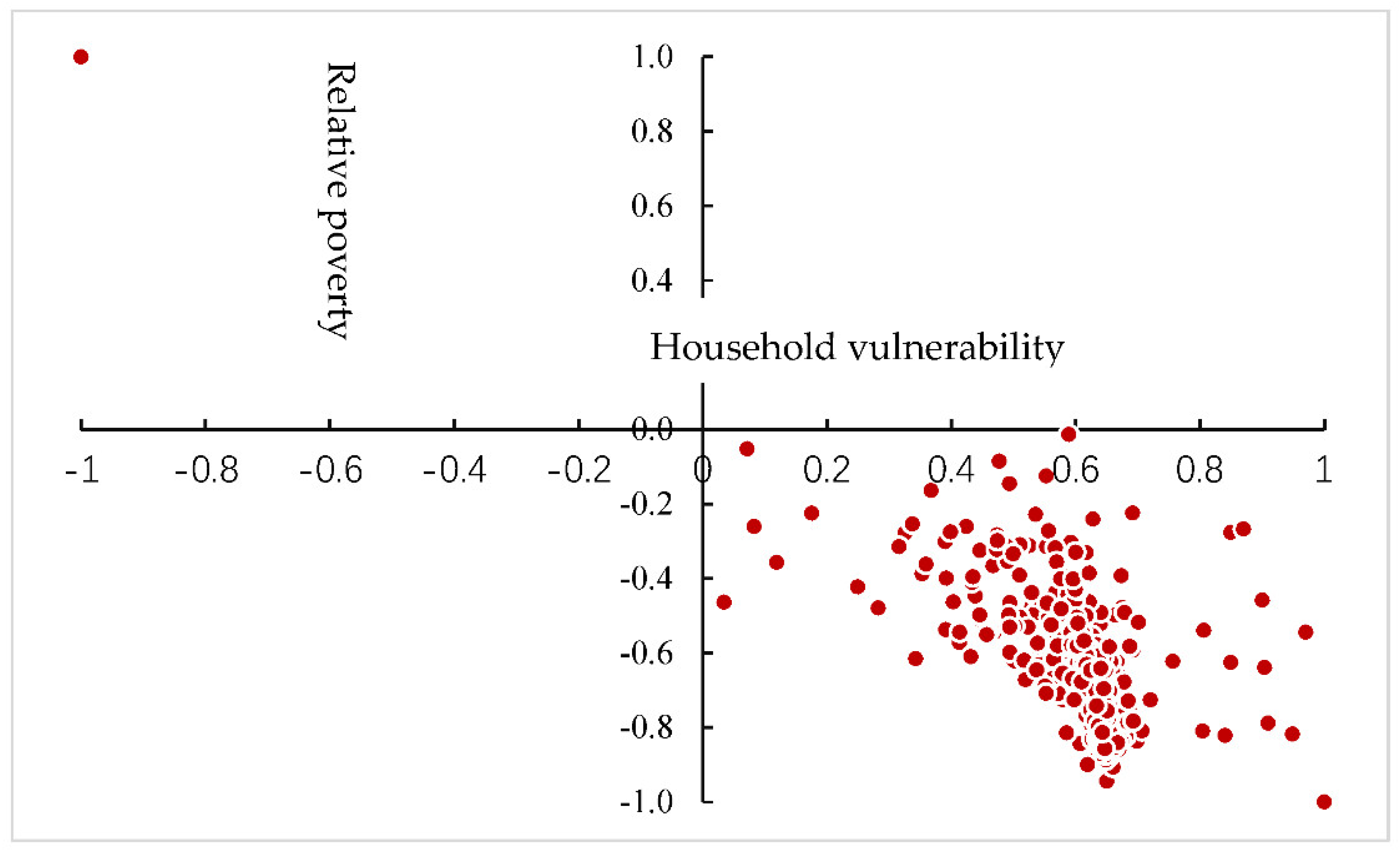
China’s logging ban policy has profoundly transformed the forestry industry, creating substantial impacts for forestry-worker households. Empirical evidence is needed to examine whether and how severe the transition policy produces vulnerability and relative poverty for the affected households. This paper samples forestry-worker households from the Greater Khingan Mountains state-owned forest region as the study subjects to evaluate their household vulnerabilities with the LVI approach proposed by IPCC. This study computes the relative poverty scores of the families and further identifies the relationships between the selected household’s socio-economic factors and the estimated vulnerability and poverty scores with OLS regression. This study derives a sleuth of valuable points. (1) The majority of the forestry-worker households have had to suffer downsized, vulnerable livelihoods with escalated relative poverty due to the policy’s impact. (2) Poverty closely connects with vulnerability, where the more impoverished the household, the more vulnerable it is. Poverty is, however, not the only factor affecting household vulnerability. Other factors, particularly of public and social-financial factors, are interconnected with poverty and, thus, compound the vulnerability issue. (3) Factors, e.g., family size, age and gender of household head, bank deposits, and life and job satisfaction, which are typically very beneficial for improving family vulnerability and poverty. (4) Regular financial assistance programs, particularly the commonly-trusted one-off household compensation program, might not provide solid support for addressing long-term household vulnerability and poverty. This study contributes to a broader understanding of household vulnerability and relative poverty for improved policy and program development addressing forestry workers and household vulnerabilities.
Keywords: state-owned forestry groups; forestry transition; forestry workers; vulnerability; poverty state-owned forestry groups; forestry transition; forestry workers; vulnerability; poverty