The Application of Machine Learning and Deep Learning in Intelligent Transportation: A Scientometric Analysis and Qualitative Review of Research Trends

 , , and
Abstract
1. Introduction
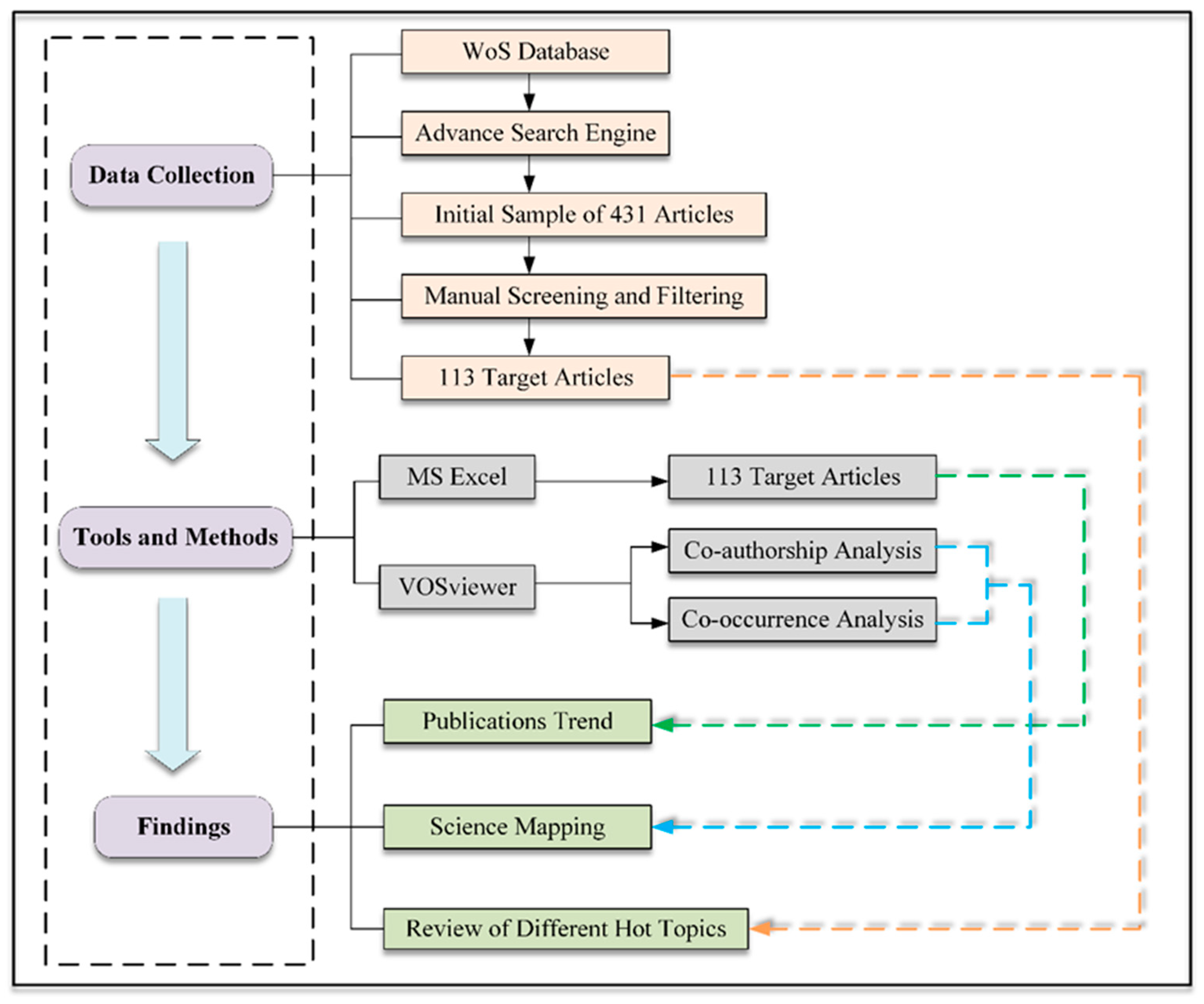
2. Research Methods
2.1. Data Collection
2.2. Tools and Methods
2.3. Findings
3. Analysis and Findings
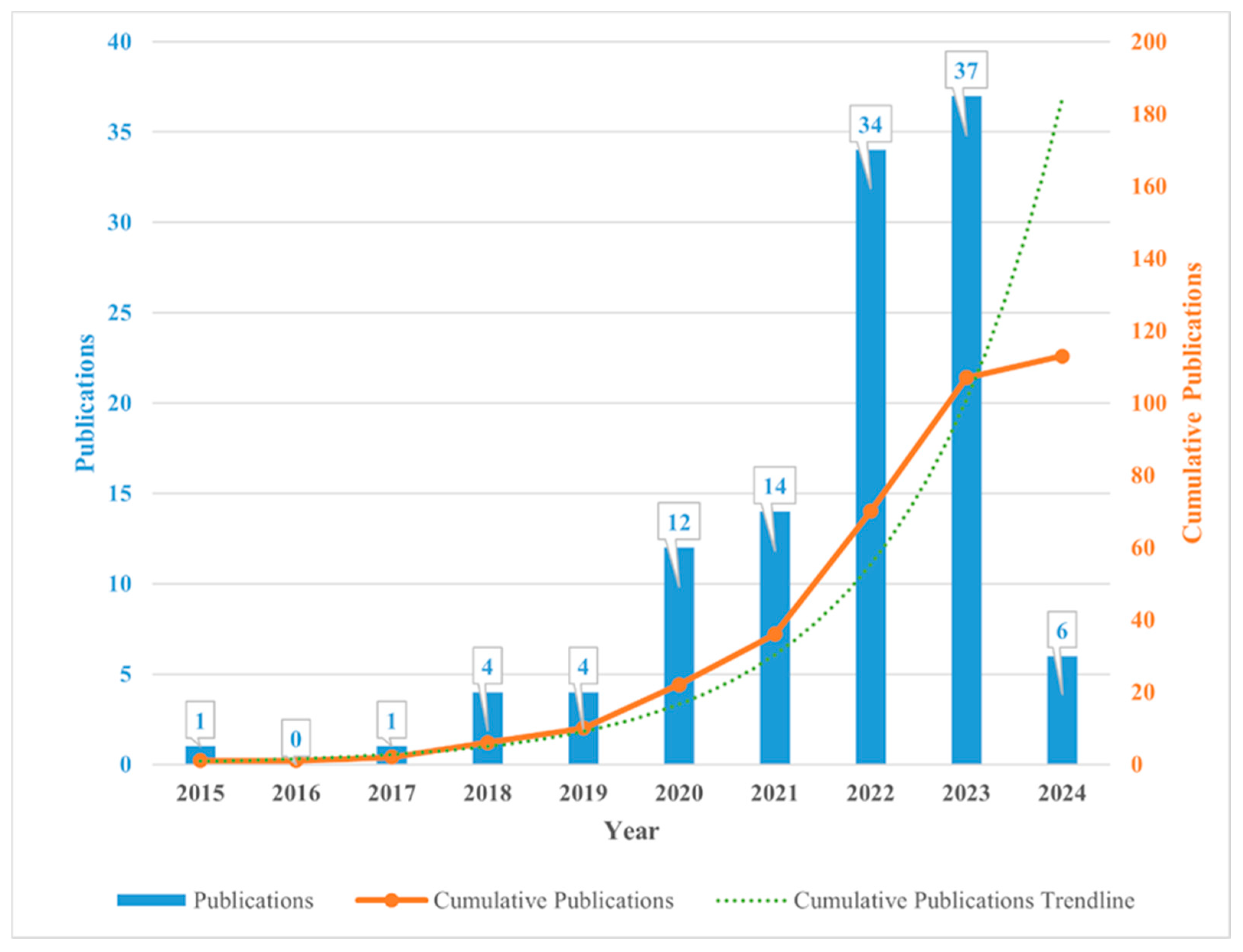
3.1. Publication Outputs
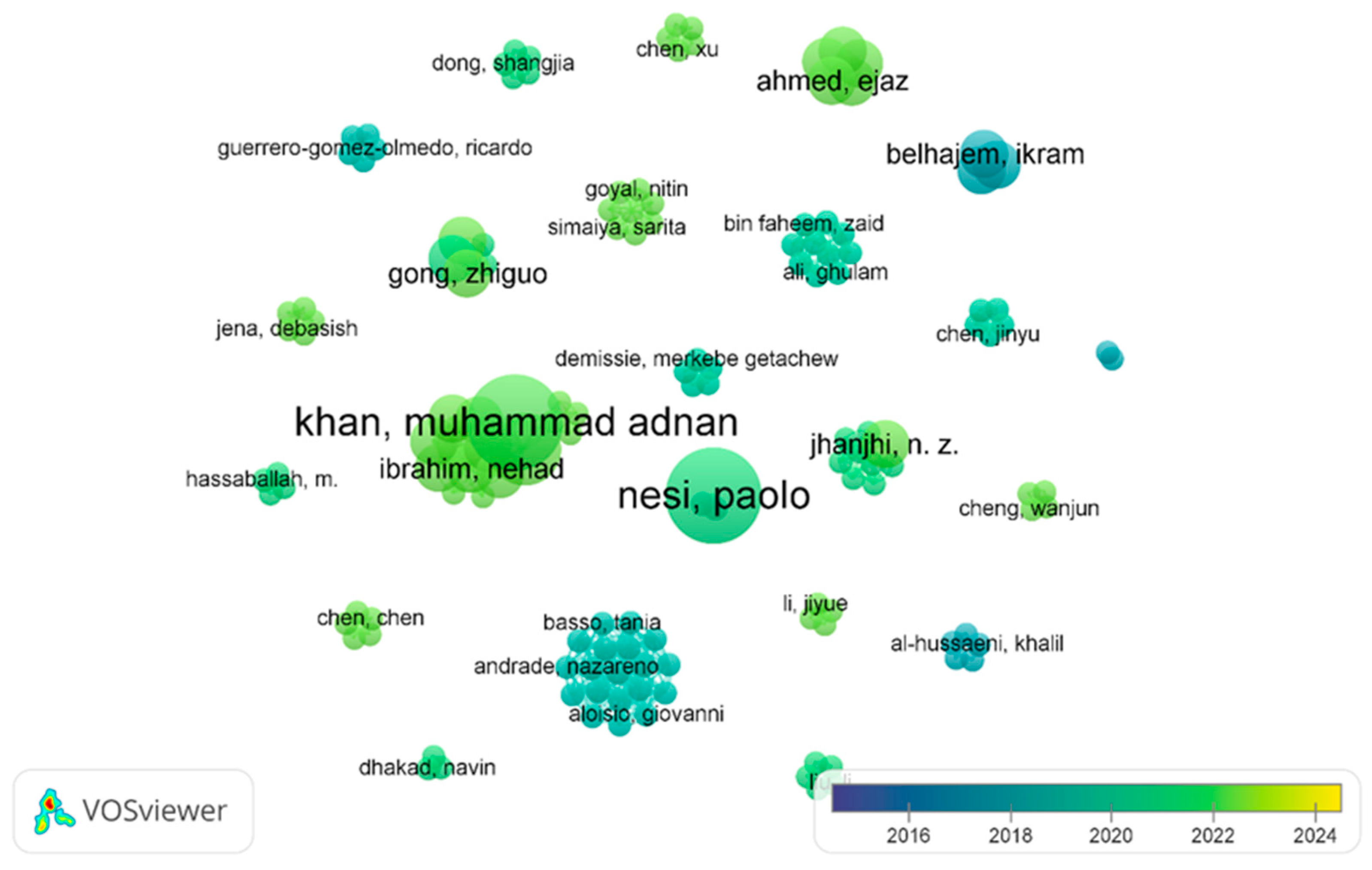
3.2. Co-Authorship
3.2.1. Researcher Cooperation
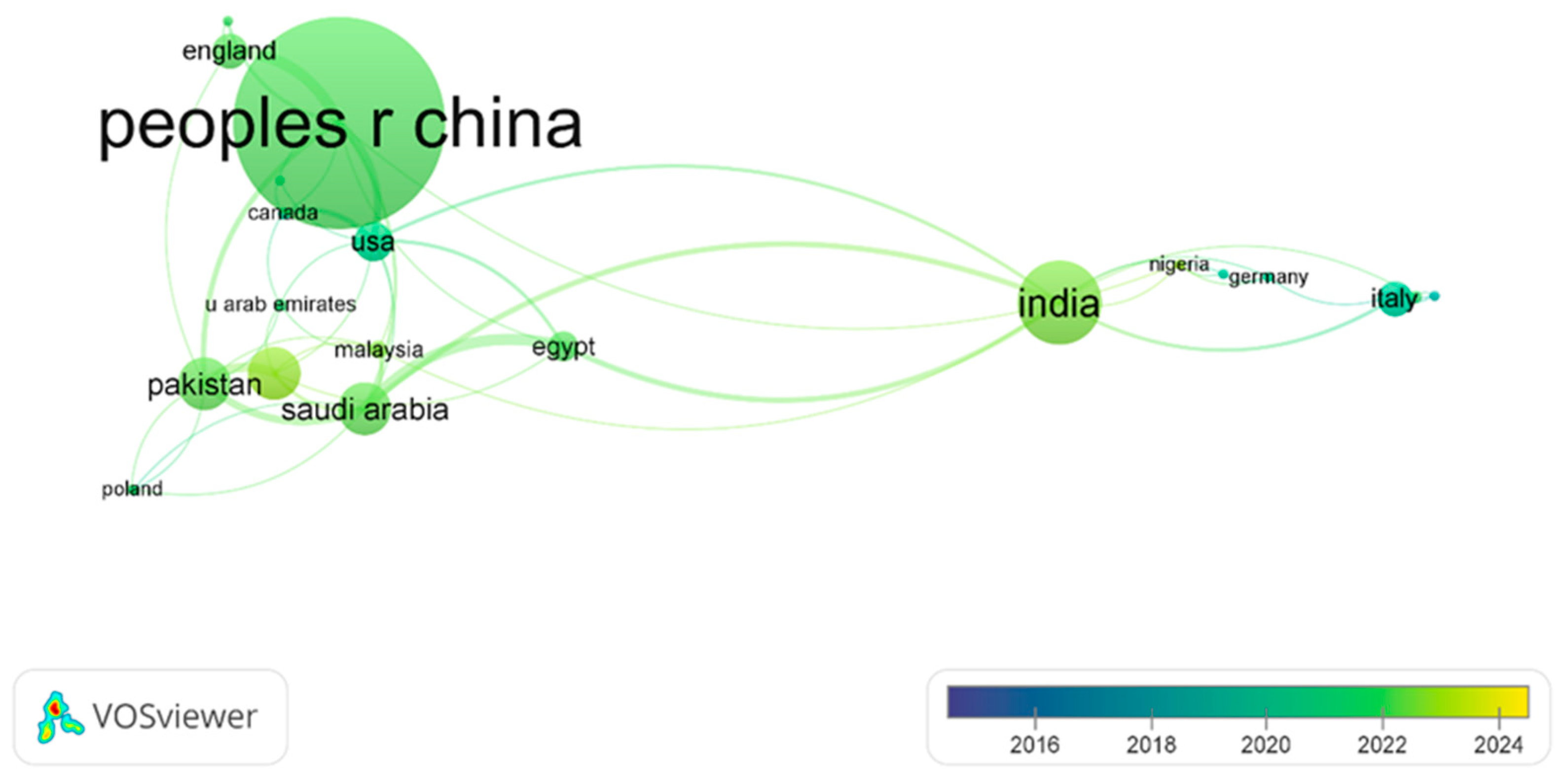
3.2.2. Countries
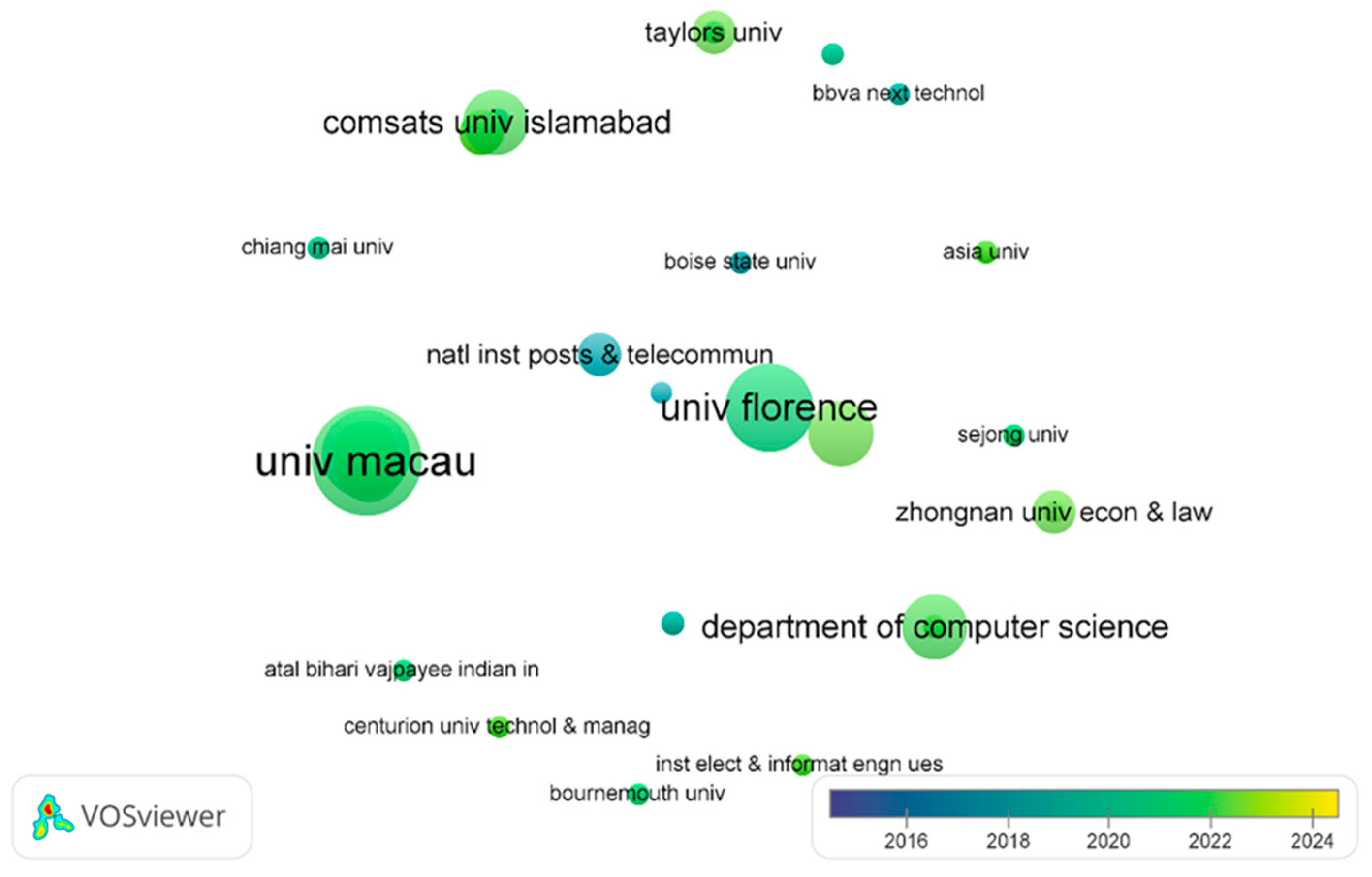
3.2.3. Organizations
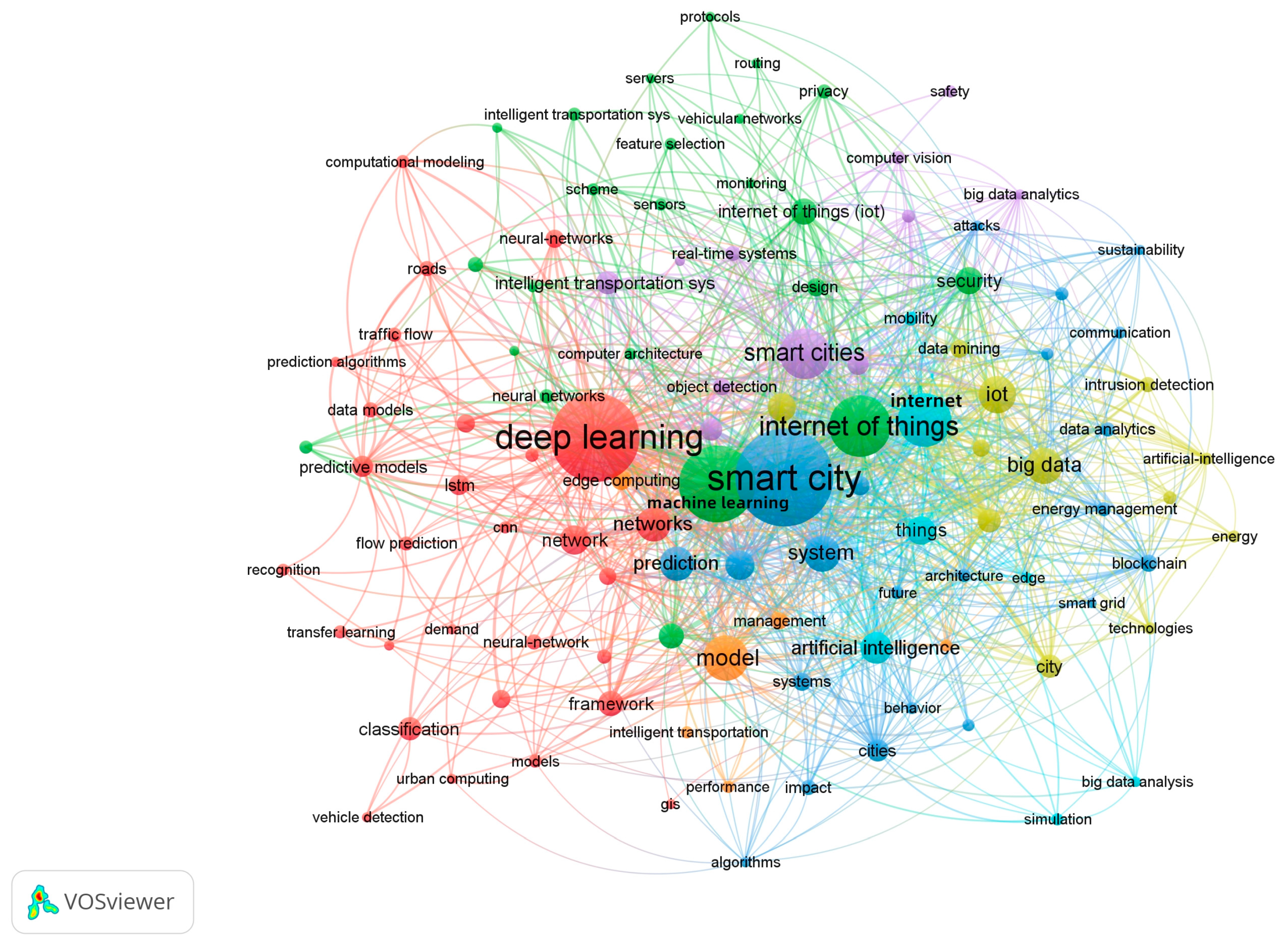
3.3. Keyword Co-Occurrence
4. Qualitative Discussion
4.1. Traffic-Flow Prediction
4.2. Public Transportation
4.3. Intelligent Traffic Data Transmission and Sharing
4.4. Intelligent Transportation System
4.5. Intelligent Parking Systems
- diverse research methods: studies use various ML and DL techniques, including random forest (RF), CatBoost, LSTM, ANN, CNN, and SVM, supplemented with genetic algorithms and Bayesian regularized NN;
- varied innovative points: innovations use contextual data to predict parking utilization rates, integrate renewable energy sources for electric vehicle charging control, and improve intelligent parking rates through advanced DL;
- rich empirical conclusions: the results demonstrate that the proposed models and methods significantly enhance parking utilization rates, profitability, accuracy, and reliability.
4.6. Traffic Congestion
4.7. Vehicle Detection and Tracking
4.8. Vehicle Identification and License Plate Number Recognition
4.9. Traffic-Light and Streetlight System
5. Conclusions
- developing more sophisticated data processing algorithms and analysis models through the deep integration of big data and artificial intelligence to enhance traffic management and control;
- enhancing information security and privacy protection by innovating encryption technologies and anonymization methods to safeguard personal data;
- utilizing ML and other advanced technologies to improve the accuracy of traffic predictions, optimize traffic flow and accident prediction models, and facilitate more precise traffic decisions;
- pairing quantum technologies with AI to open new research, development, and implementation opportunities (e.g., combinatorial optimization);
- building cross-departmental data sharing and collaboration platforms to enhance overall efficiency and promote optimal information resource allocation;
- advancing the development of autonomous vehicle technologies, including autonomous navigation and safe obstacle avoidance systems, will be critical to driving the next wave of innovations in the transportation sector.
Author Contributions
Funding
Data Availability Statement
Conflicts of Interest
Abbreviations
| AM | Activation maximization |
| ANN | Artificial neural network |
| APY | Average year of publication |
| ARI | Adjusted rand index |
| ATM | Automatic topic modeling |
| BS | Batch size |
| BiGRU | Bidirectional gated recurrent unit |
| BOA | Butterfly optimization algorithm |
| BSP | Binary space partitioning |
| BSS | Blind source separation |
| BSVR | Bayesian support vector regression |
| BUC | Bottom-up clustering |
| CNN | Convolutional neural networks |
| CS | Citation score per author |
| CSTN | Continuous surface transition network |
| DAN | Deep adaptation network |
| DBN | Deep belief networks |
| DCRFNN | Dynamic convolutional recurrent fusion neural network |
| DL | Deep learning |
| DQN | Deep q-network |
| DT | Document type |
| EAI | Explainable artificial intelligence |
| EC | Evolutionary computation |
| EdRVFL | Enhanced random vector functional link |
| ELM | Extreme learning machine |
| FDA | Fisher discriminant analysis |
| FedSTN | Federated spatial transformer network |
| FL | Federated learning |
| GA | Genetic algorithm |
| GAN | Generative adversarial network |
| GAS | Gather-apply-scatter |
| GCN | Graph convolutional network |
| GCNN | Genetic convolutional neural network |
| GNN | Graph neural network |
| GRU | Gate recurrent unit |
| IDT | Intelligent data transform |
| IoT | Internet of Things |
| IRM | Invariant risk minimization |
| ITS | Intelligent transportation systems |
| KDE | Kernel density estimation |
| KNN | K-nearest neighbor |
| LR | Logistic regression |
| LSTM | Long short-term memory neural networks |
| MDN | Mixture density network |
| MDP | Markov decision process |
| ML | Machine learning |
| MLP | Multi-layer perceptron |
| MLR | Multiple linear regression |
| MMN | Mismatch negativity |
| MTLM | Multi-task learning model |
| MVSNET | Multi-view spatiotemporal network |
| NB | Naive bayes |
| NN | Neural networks |
| NP | Number of documents per author |
| POA | Probabilistic output analysis |
| POI | Point of interest |
| RBF | Radial basis function |
| RBM | Restricted Boltzmann machine |
| RCNN | Regions with convolutional neural networks |
| ResNet | Residual network |
| RF | Random forest |
| RNN | Recurrent neural network |
| SMO | Sequential minimal optimization |
| SVC | Support-vector classification |
| SVM | Support-vector machine |
| TBI | Target bearing indicator |
| TFP | Traffic-flow prediction |
| TMS | Traffic management systems |
| WoS | Web of Science |
References
- O’Dwyer, E.; Pan, I.; Acha, S.; Shah, N. Smart energy systems for sustainable smart cities: Current developments, trends and future directions. Appl. Energy 2019, 237, 581–597. [Google Scholar] [CrossRef]
- Liu, Y.; Yang, C.; Jiang, L.; Xie, S.; Zhang, Y. Intelligent edge computing for IoT-based energy management in smart cities. IEEE Netw. 2019, 33, 111–117. [Google Scholar] [CrossRef]
- Renaud, J.; Karam, R.; Salomon, M.; Couturier, R. Deep learning and gradient boosting for urban environmental noise monitoring in smart cities. Expert Syst. Appl. 2023, 218, 119568. [Google Scholar] [CrossRef]
- Yu, D.; Xu, Z.; Pedrycz, W. Bibliometric analysis of rough sets research. Appl. Soft Comput. 2020, 94, 106467. [Google Scholar] [CrossRef]
- Ravish, R.; Swamy, S.R. Intelligent traffic management: A review of challenges, solutions, and future perspectives. Transp. Telecommun. J. 2021, 22, 163–182. [Google Scholar] [CrossRef]
- Zhai, Z.; Shan, M.; Darko, A.; Le, Y. Visualizing the knowledge domain of project governance: A scientometric review. Adv. Civ. Eng. 2020, 2020, 6813043. [Google Scholar] [CrossRef]
- Ateya, A.A.; Soliman, N.F.; Alkanhel, R.; Alhussan, A.A.; Muthanna, A.; Koucheryavy, A. Lightweight deep learning-based model for traffic prediction in fog-enabled dense deployed IOT networks. J. Electr. Eng. Technol. 2023, 18, 2275–2285. [Google Scholar] [CrossRef]
- Kaur, R.; Roul, R.K.; Batra, S. A hybrid deep learning CNN-ELM approach for parking space detection in Smart Cities. Neural Comput. Appl. 2023, 35, 13665–13683. [Google Scholar] [CrossRef]
- Khan, N.A.; Nebel, J.C.; Khaddaj, S.; Brujic-Okretic, V. Scalable system for smart urban transport management. J. Adv. Transp. 2020, 2020, 8894705. [Google Scholar] [CrossRef]
- Yan, G.; Chen, Y. The application of virtual reality technology on intelligent traffic construction and decision support in smart cities. Wirel. Commun. Mob. Comput. 2021, 2021, 3833562. [Google Scholar] [CrossRef]
- Riahi, Y.; Saikouk, T.; Gunasekaran, A.; Badraoui, I. Artificial intelligence applications in supply chain: A descriptive bibliometric analysis and future research directions. Expert Syst. Appl. 2021, 173, 114702. [Google Scholar] [CrossRef]
- Cobo, M.J.; López-Herrera, A.G.; Herrera-Viedma, E.; Herrera, F. Science mapping software tools: Review, analysis, and cooperative study among tools. J. Am. Soc. Inf. Sci. Technol. 2011, 62, 1382–1402. [Google Scholar] [CrossRef]
- Su, H.N.; Lee, P.C. Mapping knowledge structure by keyword co-occurrence: A first look at journal papers in Technology Foresight. Scientometrics 2010, 85, 65–79. [Google Scholar] [CrossRef]
- Hosseini, M.R.; Martek, I.; Zavadskas, E.K.; Aibinu, A.A.; Arashpour, M.; Chileshe, N. Critical evaluation of off-site construction research: A Scientometric analysis. Autom. Constr. 2018, 87, 235–247. [Google Scholar] [CrossRef]
- Wang, J.; Chen, J.; Hu, Y. A science mapping approach based review of model predictive control for smart building operation management. J. Civ. Eng. Manag. 2022, 28, 661–679. [Google Scholar] [CrossRef]
- Jin, R.; Zou, P.X.; Piroozfar, P.; Wood, H.; Yang, Y.; Yan, L.; Han, Y. A science mapping approach based review of construction safety research. Saf. Sci. 2019, 113, 285–297. [Google Scholar] [CrossRef]
- Wang, J.; Li, M.; Skitmore, M.; Chen, J. Predicting Construction Company Insolvent Failure: A Scientometric Analysis and Qualitative Review of Research Trends. Sustainability 2024, 16, 2290. [Google Scholar] [CrossRef]
- Fu, C.; Wang, J.; Qu, Z.; Skitmore, M.; Yi, J.; Sun, Z.; Chen, J. Structural Equation Modeling in Technology Adoption and Use in the Construction Industry: A Scientometric Analysis and Qualitative Review. Sustainability 2024, 16, 3824. [Google Scholar] [CrossRef]
- Zhou, K.; Wang, J.; Ashuri, B.; Chen, J. Discovering the Research Topics on Construction Safety and Health Using Semi-Supervised Topic Modeling. Buildings 2023, 13, 1169. [Google Scholar] [CrossRef]
- Marzouk, M.; Elhakeem, A.; Adel, K. Artificial Neural Networks Applications in Construction and Building Engineering (1991–2021): Science Mapping and Visualization. Appl. Soft Comput. 2023, 152, 111174. [Google Scholar] [CrossRef]
- Bornmann, L.; Thor, A.; Marx, W.; Schier, H. The application of bibliometrics to research evaluation in the humanities and social sciences: An exploratory study using normalized Google Scholar data for the publications of a research institute. J. Assoc. Inf. Sci. Technol. 2016, 67, 2778–2789. [Google Scholar] [CrossRef]
- Van Eck, N.; Waltman, L. Software survey: VOSviewer, a computer program for bibliometric mapping. Scientometrics 2010, 84, 523–538. [Google Scholar] [CrossRef]
- Waltman, L.; Van Eck, N.J.; Noyons, E.C. A unified approach to mapping and clustering of bibliometric networks. J. Informetr. 2010, 4, 629–635. [Google Scholar] [CrossRef]
- Yevu, S.K.; Ann, T.W.; Darko, A. Digitalization of construction supply chain and procurement in the built environment: Emerging technologies and opportunities for sustainable processes. J. Clean. Prod. 2021, 322, 129093. [Google Scholar] [CrossRef]
- Muhuri, P.K.; Shukla, A.K.; Janmaijaya, M.; Basu, A. Applied soft computing: A bibliometric analysis of the publications and citations during (2004–2016). Appl. Soft Comput. 2018, 69, 381–392. [Google Scholar] [CrossRef]
- Li, D.; Lin, C.; Gao, W.; Chen, Z.; Wang, Z.; Liu, G. Capsules TCN network for urban computing and intelligence in urban traffic prediction. Wirel. Commun. Mob. Comput. 2020, 2020, 6896579. [Google Scholar] [CrossRef]
- Hamza, M.A.; Alsolai, H.; Alzahrani, J.S.; Alamgeer, M.; Sayed, M.M.; Zamani, A.S.; Yaseen, I.; Motwakel, A. Intelligent Slime Mould Optimization with Deep Learning Enabled Traffic Prediction in Smart Cities. Comput. Mater. Contin. 2022, 73, 6563–6577. [Google Scholar]
- Awan, F.M.; Minerva, R.; Crespi, N. Using noise pollution data for traffic prediction in smart cities: Experiments based on LSTM recurrent neural networks. IEEE Sens. J. 2021, 21, 20722–20729. [Google Scholar] [CrossRef]
- Djenouri, Y.; Michalak, T.P.; Lin, J.C.W. Federated deep learning for smart city edge-based applications. Future Gener. Comput. Syst. 2023, 147, 350–359. [Google Scholar]
- Chen, L.; Bei, L.; An, Y.; Zhang, K.; Cui, P. A Hyperparameters automatic optimization method of time graph convolution network model for traffic prediction. Wirel. Netw. 2021, 27, 4411–4419. [Google Scholar] [CrossRef]
- Zhou, S.; Wei, C.; Song, C.; Pan, X.; Chang, W.; Yang, L. Short-term traffic flow prediction of the smart city using 5G internet of vehicles based on edge computing. IEEE Trans. Intell. Transp. Syst. 2022, 24, 2229–2238. [Google Scholar] [CrossRef]
- Hussain, B.; Afzal, M.K.; Anjum, S.; Rao, I.; Kim, B.S. A Novel Graph Convolutional Gated Recurrent Unit Framework for Network-Based Traffic Prediction. IEEE Access 2023, 11, 130102–130118. [Google Scholar] [CrossRef]
- Yuan, X.; Chen, J.; Yang, J.; Zhang, N.; Yang, T.; Han, T.; Taherkordi, A. Fedstn: Graph representation driven federated learning for edge computing enabled urban traffic flow prediction. IEEE Trans. Intell. Transp. Syst. 2022, 24, 8738–8748. [Google Scholar] [CrossRef]
- Bilotta, S.; Collini, E.; Nesi, P.; Pantaleo, G. Short-term prediction of city traffic flow via convolutional deep learning. IEEE Access 2022, 10, 113086–113099. [Google Scholar] [CrossRef]
- Gong, Y. Traffic Flow Prediction and Application of Smart City Based on Industry 4.0 and Big Data Analysis. Math. Probl. Eng. 2022, 2022, 5397861. [Google Scholar] [CrossRef]
- Du, L.; Gao, R.; Suganthan, P.N.; Wang, D.Z. Graph ensemble deep random vector functional link network for traffic forecasting. Appl. Soft Comput. 2022, 131, 109809. [Google Scholar] [CrossRef]
- Vijayalakshmi, B.; Ramar, K.; Jhanjhi, N.Z.; Verma, S.; Kaliappan, M.; Vijayalakshmi, K.; Vimal, S.; Kavita Ghosh, U. An attention-based deep learning model for traffic flow prediction using spatiotemporal features towards sustainable smart city. Int. J. Commun. Syst. 2021, 34, e4609. [Google Scholar] [CrossRef]
- Zheng, Y.; Li, X.; Xu, L.; Wen, N. A deep learning–based approach for moving vehicle counting and short-term traffic prediction from video images. Front. Environ. Sci. 2022, 10, 905443. [Google Scholar] [CrossRef]
- Niu, X.; Zhu, Y.; Cao, Q.; Zhang, X.; Xie, W.; Zheng, K. An online-traffic-prediction based route finding mechanism for smart city. Int. J. Distrib. Sens. Netw. 2015, 11, 970256. [Google Scholar] [CrossRef]
- Chawla, P.; Hasurkar, R.; Bogadi, C.R.; Korlapati, N.S.; Rajendran, R.; Ravichandran, S.; Tolem, S.C.; Gao, J.Z. Real-time traffic congestion prediction using big data and machine learning techniques. World J. Eng. 2022. ahead-of-print. [Google Scholar] [CrossRef]
- Xu, X.; Mao, H.; Zhao, Y.; Lü, X. An urban traffic flow fusion network based on a causal spatiotemporal graph convolution network. Appl. Sci. 2022, 12, 7010. [Google Scholar] [CrossRef]
- Han, S.Y.; Sun, Q.W.; Zhao, Q.; Han, R.Z.; Chen, Y.H. Traffic Forecasting Based on Integration of Adaptive Subgraph Reformulation and Spatio-Temporal Deep Learning Model. Electronics 2022, 11, 861. [Google Scholar] [CrossRef]
- Chen, C.; Liu, L.; Wan, S.; Hui, X.; Pei, Q. Data dissemination for industry 4.0 applications in internet of vehicles based on short-term traffic prediction. ACM Trans. Internet Technol. (TOIT) 2021, 22, 1–18. [Google Scholar] [CrossRef]
- Khan, N.U.; Shah, M.A.; Maple, C.; Ahmed, E.; Asghar, N. Traffic flow prediction: An intelligent scheme for forecasting traffic flow using air pollution data in smart cities with bagging ensemble. Sustainability 2022, 14, 4164. [Google Scholar] [CrossRef]
- Cui, J.; Zhao, J. Construction of Dynamic Traffic Pattern Recognition and Prediction Model Based on Deep Learning in the Background of Intelligent Cities. IEEE Access 2023, 12, 1418–1433. [Google Scholar] [CrossRef]
- Mohammed, G.P.; Alasmari, N.; Alsolai, H.; Alotaibi, S.S.; Alotaibi, N.; Mohsen, H. Autonomous short-term traffic flow prediction using pelican optimization with hybrid deep belief network in smart cities. Appl. Sci. 2022, 12, 10828. [Google Scholar] [CrossRef]
- Almeida, A.; Brás, S.; Oliveira, I.; Sargento, S. Vehicular traffic flow prediction using deployed traffic counters in a city. Future Gener. Comput. Syst. 2022, 128, 429–442. [Google Scholar] [CrossRef]
- Mo, J.; Gong, Z. Cross-city multi-granular adaptive transfer learning for traffic flow prediction. IEEE Trans. Knowl. Data Eng. 2022, 35, 11246–11258. [Google Scholar] [CrossRef]
- Zhang, K.; Chuai, G.; Zhang, J.; Chen, X.; Si, Z.; Maimaiti, S. Dic-st: A hybrid prediction framework based on causal structure learning for cellular traffic and its application in urban computing. Remote Sens. 2022, 14, 1439. [Google Scholar] [CrossRef]
- Yu, W.; Wu, S.; Huang, M. MmgFra: A multiscale multigraph learning framework for traffic prediction in smart cities. Earth Sci. Inform. 2023, 16, 2727–2739. [Google Scholar] [CrossRef]
- He, K.; Chen, X.; Wu, Q.; Yu, S.; Zhou, Z. Graph attention spatial-temporal network with collaborative global-local learning for citywide mobile traffic prediction. IEEE Trans. Mob. Comput. 2020, 21, 1244–1256. [Google Scholar] [CrossRef]
- Devadhas Sujakumari, P.; Dassan, P. Generative Adversarial Networks (GAN) and HDFS-Based Realtime Traffic Forecasting System Using CCTV Surveillance. Symmetry 2023, 15, 779. [Google Scholar] [CrossRef]
- Wang, S.; Miao, H.; Li, J.; Cao, J. Spatio-temporal knowledge transfer for urban crowd flow prediction via deep attentive adaptation networks. IEEE Trans. Intell. Transp. Syst. 2021, 23, 4695–4705. [Google Scholar] [CrossRef]
- Han, D.; Chen, J.; Sun, J. A parallel spatiotemporal deep learning network for highway traffic flow forecasting. Int. J. Distrib. Sens. Netw. 2019, 15, 1550147719832792. [Google Scholar] [CrossRef]
- Ismaeel, A.G.; Mary, J.; Chelliah, A.; Logeshwaran, J.; Mahmood, S.N.; Alani, S.; Shather, A.H. Enhancing Traffic Intelligence in Smart Cities Using Sustainable Deep Radial Function. Sustainability 2023, 15, 14441. [Google Scholar] [CrossRef]
- Seng, K.P.; Ang, L.M.; Ngharamike, E.; Peter, E. Ridesharing and crowdsourcing for smart cities: Technologies, paradigms and use cases. IEEE Access 2023, 11, 18038–18081. [Google Scholar] [CrossRef]
- Wu, Y.; Zhang, H.; Li, C.; Tao, S.; Yang, F. Urban ride-hailing demand prediction with multi-view information fusion deep learning framework. Appl. Intell. 2023, 53, 8879–8897. [Google Scholar] [CrossRef]
- Kong, X.; Xia, F.; Fu, Z.; Yan, X.; Tolba, A.; Almakhadmeh, Z. TBI2Flow: Travel behavioral inertia based long-term taxi passenger flow prediction. World Wide Web 2020, 23, 1381–1405. [Google Scholar] [CrossRef]
- Bhanu, M.; Priya, S.; Moreira, J.M.; Chandra, J. ST-A GP: Spatio-Temporal aggregator predictor model for multi-step taxi-demand prediction in cities. Appl. Intell. 2023, 53, 2110–2132. [Google Scholar] [CrossRef]
- Zhang, H.; Chen, J.; Li, W.; Song, X.; Shibasaki, R. Mobile phone GPS data in urban ride-sharing: An assessment method for emission reduction potential. Appl. Energy 2020, 269, 115038. [Google Scholar] [CrossRef]
- Liao, L.; Wang, Y.; Zou, F.; Bi, S.; Su, J.; Sun, Q. A multi-sensory stimulating attention model for cities’ taxi service demand prediction. Sci. Rep. 2022, 12, 3065. [Google Scholar] [CrossRef] [PubMed]
- Wang, T.; Shen, Z.; Cao, Y.; Xu, X.; Gong, H. Taxi-cruising recommendation via real-time information and historical trajectory data. IEEE Trans. Intell. Transp. Syst. 2021, 24, 7898–7910. [Google Scholar] [CrossRef]
- Rajput, P.; Chaturvedi, M.; Patel, V. Opportunistic sensing based detection of crowdedness in public transport buses. Pervasive Mob. Comput. 2020, 68, 101246. [Google Scholar] [CrossRef]
- Mandal, R.; Karmakar, P.; Chatterjee, S.; Das Spandan, D.; Pradhan, S.; Saha, S.; Chakraborty, S.; Nandi, S. Exploiting multi-modal contextual sensing for city-bus’s stay location characterization: Towards sub-60 seconds accurate arrival time prediction. ACM Trans. Internet Things 2023, 4, 1–24. [Google Scholar] [CrossRef]
- Huang, Y.P.; Chen, C.; Su, Z.C.; Chen, T.S.; Sumalee, A.; Pan, T.L.; Zhong, R.X. Bus arrival time prediction and reliability analysis: An experimental comparison of functional data analysis and Bayesian support vector regression. Appl. Soft Comput. 2021, 111, 107663. [Google Scholar] [CrossRef]
- Ning, W.; Tang, Q.; Zhao, Y.; Yang, C.; Wang, X.; Wang, T.; Liu, H.; Zhang, C.; Zhou, Z.; Shen, Q.; et al. CheetahVIS: A visual analytical system for large urban bus data. Proc. VLDB Endow. 2020, 13, 2805–2808. [Google Scholar] [CrossRef]
- Prommaharaj, P.; Phithakkitnukoon, S.; Demissie, M.G.; Kattan, L.; Ratti, C. Visualizing public transit system operation with GTFS data: A case study of Calgary, Canada. Heliyon 2020, 6, e03729. [Google Scholar] [CrossRef] [PubMed]
- Chen, Y.; Geng, M.; Zeng, J.; Yang, D.; Zhang, L.; Chen, X.M. A novel ensemble model with conditional intervening opportunities for ride-hailing travel mobility estimation. Phys. A Stat. Mech. Appl. 2023, 628, 129167. [Google Scholar] [CrossRef]
- Chai, J.; Song, J.; Fan, H.; Xu, Y.; Zhang, L.; Guo, B.; Xu, Y. ST-Bikes: Predicting Travel-Behaviors of Sharing-Bikes Exploiting Urban Big Data. IEEE Trans. Intell. Transp. Syst. 2022, 24, 7676–7686. [Google Scholar] [CrossRef]
- Collini, E.; Nesi, P.; Pantaleo, G. Deep learning for short-term prediction of available bikes on bike-sharing stations. IEEE Access 2021, 9, 124337–124347. [Google Scholar] [CrossRef]
- Lee, C.H.; Lee, J.W.; Jung, Y. Practical method to improve usage efficiency of bike-sharing systems. ETRI J. 2022, 44, 244–259. [Google Scholar] [CrossRef]
- Cagliero, L.; Cerquitelli, T.; Chiusano, S.; Garza, P.; Xiao, X. Predicting critical conditions in bicycle sharing systems. Computing 2017, 99, 39–57. [Google Scholar] [CrossRef]
- Ding, H.; Lu, Y.; Sze, N.N.; Li, H. Effect of dockless bike-sharing scheme on the demand for London Cycle Hire at the disaggregate level using a deep learning approach. Transp. Res. Part A Policy Pract. 2022, 166, 150–163. [Google Scholar] [CrossRef]
- Wang, W.; Zhao, X.; Gong, Z.; Chen, Z.; Zhang, N.; Wei, W. An attention-based deep learning framework for trip destination prediction of sharing bike. IEEE Trans. Intell. Transp. Syst. 2020, 22, 4601–4610. [Google Scholar] [CrossRef]
- Mohanta, B.K.; Jena, D.; Mohapatra, N.; Ramasubbareddy, S.; Rawal, B.S. Machine learning based accident prediction in secure IOT enable transportation system. J. Intell. Fuzzy Syst. 2022, 42, 713–725. [Google Scholar] [CrossRef]
- Chen, Q.; Wang, W.; Huang, K.; De, S.; Coenen, F. Multi-modal generative adversarial networks for traffic event detection in smart cities. Expert Syst. Appl. 2021, 177, 114939. [Google Scholar] [CrossRef]
- Pourroostaei Ardakani, S.; Liang, X.; Mengistu, K.T.; So, R.S.; Wei, X.; He, B.; Cheshmehzangi, A. Road car accident prediction using a machine-learning-enabled data analysis. Sustainability 2023, 15, 5939. [Google Scholar] [CrossRef]
- Park, N.; Cho, J.; Park, J. Assessing crash severity of urban roads with data mining techniques using big data from in-vehicle dashcam. Electron. Res. Arch. 2024, 32, 584–607. [Google Scholar] [CrossRef]
- Altaf, I.; Kaul, A. Classifying victim degree of injury in road traffic accidents: A novel stacked DCL-X approach. Multimed. Tools Appl. 2024, 83, 66691–66723. [Google Scholar] [CrossRef]
- Cui, Y.; Lei, D. Optimizing Internet of Things-Based Intelligent Transportation System’s Information Acquisition Using Deep Learning. IEEE Access 2023, 11, 11804–11810. [Google Scholar] [CrossRef]
- Zheng, Z.; Bashir, A.K. Graph-enabled intelligent vehicular network data processing. IEEE Trans. Intell. Transp. Syst. 2022, 23, 4726–4735. [Google Scholar] [CrossRef]
- Noh, B.; Lin, T.; Lee, S.; Jeong, T. Deep Learning and Geometry Flow Vector Using Estimating Vehicle Cuboid Technology in a Monovision Environment. Sensors 2023, 23, 7504. [Google Scholar] [CrossRef] [PubMed]
- Zhang, Y.; Wang, H.; Wang, X. Research on the improvement of transportation efficiency of smart city by traffic visualization based on pattern recognition. Neural Comput. Appl. 2023, 35, 2211–2224. [Google Scholar] [CrossRef]
- Gebremeskel, G.B. Leveraging big data analytics for intelligent transportation systems: Optimize the internet of vehicles data structure and modeling. Int. J. Data Sci. Anal. 2023, 1–16. [Google Scholar] [CrossRef]
- Jang, J.; Jung, A.; Oh, C.; Park, J.; Yun, D. Evaluating Driving Safety of Road Alignment Conditions by Predicted Driver’s Psychophysiological Workload Using Vehicle Maneuvering Data. Transp. Res. Rec. 2024, 2678, 479–490. [Google Scholar] [CrossRef]
- Cho, E.; Kim, Y.; Lee, S.; Oh, C. Prediction of high-risk bus drivers characterized by aggressive driving behavior. J. Transp. Saf. Secur. 2023, 1–23. [Google Scholar] [CrossRef]
- Yang, H.; Liu, L.; Min, W.; Yang, X.; Xiong, X. Driver yawning detection based on subtle facial action recognition. IEEE Trans. Multimed. 2020, 23, 572–583. [Google Scholar] [CrossRef]
- Huang, Y.; Nazir, S.; Ma, X.; Kong, S.; Liu, Y. Acquiring data traffic for sustainable IoT and smart devices using machine learning algorithm. Secur. Commun. Netw. 2021, 2021, 1852466. [Google Scholar] [CrossRef]
- Li, X.; Zhang, H.; Shen, Y.; Hao, L.; Shang, W. Intelligent traffic data transmission and sharing based on optimal gradient adaptive optimization algorithm. IEEE Trans. Intell. Transp. Syst. 2022, 24, 13330–13340. [Google Scholar] [CrossRef]
- Tiwari, P. The machine learning framework for traffic management in smart cities. Manag. Environ. Qual. Int. J. 2024, 35, 445–462. [Google Scholar] [CrossRef]
- Drosouli, I.; Voulodimos, A.; Miaoulis, G.; Mastorocostas, P.; Ghazanfarpour, D. Transportation mode detection using an optimized long short-term memory model on multimodal sensor data. Entropy 2021, 23, 1457. [Google Scholar] [CrossRef] [PubMed]
- Rani, P.; Sharma, R. Intelligent transportation system for internet of vehicles based vehicular networks for smart cities. Comput. Electr. Eng. 2023, 105, 108543. [Google Scholar] [CrossRef]
- Fiore, S.; Elia, D.; Pires, C.E.; Mestre, D.G.; Cappiello, C.; Vitali, M.; Andrade, N.; Braz, T.; Lezzi, D.; Moraes, R.; et al. An integrated big and fast data analytics platform for smart urban transportation management. IEEE Access 2019, 7, 117652–117677. [Google Scholar] [CrossRef]
- Yu, M. Construction of regional intelligent transportation system in smart city road network via 5G network. IEEE Trans. Intell. Transp. Syst. 2022, 24, 2208–2216. [Google Scholar] [CrossRef]
- Lilhore, U.K.; Imoize, A.L.; Li, C.T.; Simaiya, S.; Pani, S.K.; Goyal, N.; Kumar, A.; Lee, C.C. Design and implementation of an ML and IoT based adaptive traffic-management system for smart cities. Sensors 2022, 22, 2908. [Google Scholar] [CrossRef] [PubMed]
- Vankdoth, S.R.; Arock, M. Deep intelligent transportation system for travel time estimation on spatio-temporal data. Neural Comput. Appl. 2023, 35, 19117–19129. [Google Scholar] [CrossRef]
- Pitchai, M.P.; Ramachandran, M.; Al-Turjman, F.; Mostarda, L. Intelligent framework for secure transportation systems using software-defined-Internet of Vehicles. Comput. Mater. Contin. 2021, 68, 3947–3966. [Google Scholar] [CrossRef]
- Drosouli, I.; Voulodimos, A.; Mastorocostas, P.; Miaoulis, G.; Ghazanfarpour, D. A Spatial-Temporal Graph Convolutional Recurrent Network for Transportation Flow Estimation. Sensors 2023, 23, 7534. [Google Scholar] [CrossRef]
- Xu, S.; Zhang, R.; Cheng, W.; Xu, J. Mtlm: A multi-task learning model for travel time estimation. GeoInformatica 2022, 26, 379–395. [Google Scholar] [CrossRef]
- Lodan, K.T.; Khairina, E.; Dompak, T.; Salsabila, L.; Fathani, A.T. Readiness of the Batam City Government in implementing sustainable transportation. Masy. Kebud. Polit. 2023, 36, 246–259. [Google Scholar] [CrossRef]
- Al-Hussaeni, K.; Fung, B.C.; Iqbal, F.; Dagher, G.G.; Park, E.G. SafePath: Differentially-private publishing of passenger trajectories in transportation systems. Comput. Netw. 2018, 143, 126–139. [Google Scholar] [CrossRef]
- Inam, S.; Mahmood, A.; Khatoon, S.; Alshamari, M.; Nawaz, N. Multisource data integration and comparative analysis of machine learning models for on-street parking prediction. Sustainability 2022, 14, 7317. [Google Scholar] [CrossRef]
- Raj, A.; Shetty, S.D. Smart parking systems technologies, tools, and challenges for implementing in a smart city environment: A survey based on IoT & ML perspective. Int. J. Mach. Learn. Cybern. 2024, 15, 2673–2694. [Google Scholar]
- Jelen, G.; Podobnik, V.; Babic, J. Contextual prediction of parking spot availability: A step towards sustainable parking. J. Clean. Prod. 2021, 312, 127684. [Google Scholar] [CrossRef]
- Ding, X.; Gan, Q.; Shaker, M.P. Optimal management of parking lots as a big data for electric vehicles using internet of things and Long–Short term Memory. Energy 2023, 268, 126613. [Google Scholar] [CrossRef]
- Bilotta, S.; Palesi, L.A.I.; Nesi, P. Predicting free parking slots via deep learning in short-mid terms explaining temporal impact of features. IEEE Access 2023, 11, 101678–101693. [Google Scholar] [CrossRef]
- He, Y.; Li, X. Feasibility of Economic Forecasting Model Based on Intelligent Algorithm of Smart City. Mob. Inf. Syst. 2022, 2022, 9723190. [Google Scholar] [CrossRef]
- Canli, H.; Toklu, S. Deep learning-based mobile application design for smart parking. IEEE Access 2021, 9, 61171–61183. [Google Scholar] [CrossRef]
- Jakkaladiki, S.P.; Poulová, P.; Pražák, P.; Tesařová, B. Smart Parking System: Optimized Ensemble Deep Learning Model with Internet of Things for Smart Cities. Scalable Comput. Pract. Exp. 2023, 24, 1191–1201. [Google Scholar] [CrossRef]
- Badii, C.; Nesi, P.; Paoli, I. Predicting available parking slots on critical and regular services by exploiting a range of open data. IEEE Access 2018, 6, 44059–44071. [Google Scholar] [CrossRef]
- Ma, X.; Xue, H. Intelligent smart city parking facility layout optimization based on intelligent IoT analysis. Comput. Commun. 2020, 153, 145–151. [Google Scholar] [CrossRef]
- Ali, G.; Ali, T.; Irfan, M.; Draz, U.; Sohail, M.; Glowacz, A.; Sulowicz, M.; Mielnik, R.; Faheem, Z.B.; Martis, C. IoT based smart parking system using deep long short memory network. Electronics 2020, 9, 1696. [Google Scholar] [CrossRef]
- Saleem, M.; Abbas, S.; Ghazal, T.M.; Khan, M.A.; Sahawneh, N.; Ahmad, M. Smart cities: Fusion-based intelligent traffic congestion control system for vehicular networks using machine learning techniques. Egypt. Inform. J. 2022, 23, 417–426. [Google Scholar] [CrossRef]
- Blázquez, R.R.; Organero, M.M.; Fernández, L.S. Evaluation of outlier detection algorithms for traffic congestion assessment in smart city traffic data from vehicle sensors. Int. J. Heavy Veh. Syst. 2018, 25, 308–321. [Google Scholar] [CrossRef]
- Siddiqui, S.; Ahmad, I.; Khan, M.; Khan, B.; Ali, M.; Naseer, I.; Parveen, K.; Usama, H. AIoT enabled traffic congestion control system using deep neural network. EAI Endorsed Trans. Scalable Inf. Syst. 2021, 8, e7. [Google Scholar] [CrossRef]
- Kumar, R.; Sharma, N.V.K.; Chaurasiya, V.K. Adaptive traffic light control using deep reinforcement learning technique. Multimed. Tools Appl. 2024, 83, 13851–13872. [Google Scholar] [CrossRef]
- Gollapalli, M.; Musleh, D.; Ibrahim, N.; Khan, M.A.; Abbas, S.; Atta, A.; Khan, M.A.; Farooqui, M.; Iqbal, T.; Ahmed, M.S.; et al. A Neuro-Fuzzy Approach to Road Traffic Congestion Prediction. Comput. Mater. Contin. 2022, 73, 295–310. [Google Scholar] [CrossRef]
- Wang, Y.; Li, M.; Zhou, J.; Zheng, H. Sudden passenger flow characteristics and congestion control based on intelligent urban rail transit network. Neural Comput. Appl. 2022, 34, 6615–6624. [Google Scholar] [CrossRef]
- Fan, B.; He, Z.; Wu, Y.; He, J.; Chen, Y.; Jiang, L. Deep learning empowered traffic offloading in intelligent software defined cellular V2X networks. IEEE Trans. Veh. Technol. 2020, 69, 13328–13340. [Google Scholar] [CrossRef]
- Feng, J.; Zeng, D.; Jia, X.; Zhang, X.; Li, J.; Liang, Y.; Jiao, L. Cross-frame keypoint-based and spatial motion information-guided networks for moving vehicle detection and tracking in satellite videos. ISPRS J. Photogramm. Remote Sens. 2021, 177, 116–130. [Google Scholar] [CrossRef]
- Belhajem, I.; Maissa, Y.B.; Tamtaoui, A. Improving low cost sensor based vehicle positioning with Machine Learning. Control Eng. Pract. 2018, 74, 168–176. [Google Scholar] [CrossRef]
- Dong, Z.; Lu, Y.; Tong, G.; Shu, Y.; Wang, S.; Shi, W. Watchdog: Real-time vehicle tracking on geo-distributed edge nodes. ACM Trans. Internet Things 2023, 4, 1–23. [Google Scholar] [CrossRef]
- Belhajem, I.; Maissa, Y.B.; Tamtaoui, A. Improving vehicle localization in a smart city with low cost sensor networks and support vector machines. Mob. Netw. Appl. 2018, 23, 854–863. [Google Scholar] [CrossRef]
- López-Sastre, R.J.; Herranz-Perdiguero, C.; Guerrero-Gómez-Olmedo, R.; Oñoro-Rubio, D.; Maldonado-Bascón, S. Boosting multi-vehicle tracking with a joint object detection and viewpoint estimation sensor. Sensors 2019, 19, 4062. [Google Scholar] [CrossRef]
- Stuparu, D.G.; Ciobanu, R.I.; Dobre, C. Vehicle detection in overhead satellite images using a one-stage object detection model. Sensors 2020, 20, 6485. [Google Scholar] [CrossRef] [PubMed]
- Hassaballah, M.; Kenk, M.A.; Muhammad, K.; Minaee, S. Vehicle detection and tracking in adverse weather using a deep learning framework. IEEE Trans. Intell. Transp. Syst. 2020, 22, 4230–4242. [Google Scholar] [CrossRef]
- Jesudoss, A. Entry and exit monitoring using license plate recognition. In Proceedings of the 2017 IEEE International Conference on Smart Technologies and Management for Computing, Communication, Controls, Energy and Materials, Chennai, India, 2–4 August 2017. [Google Scholar]
- Trivedi, J.; Devi, M.S.; Dhara, D. Vehicle Classification Using the Convolution Neural Network Approach. Zeszyty Naukowe Transp./Politech. Śląska 2021, 112, 201–209. [Google Scholar] [CrossRef]
- Vetriselvi, T.; Lydia, E.L.; Mohanty, S.N.; Alabdulkreem, E.; Al-Otaibi, S.; Al-Rasheed, A.; Mansour, R.F. Deep learning based license plate number recognition for smart cities. CMC Comput. Mater Contin 2022, 70, 2049–2064. [Google Scholar] [CrossRef]
- Sharma, P.; Singh, A.; Singh, K.K.; Dhull, A. Vehicle identification using modified region based convolution network for intelligent transportation system. Multimed. Tools Appl. 2022, 81, 34893–34917. [Google Scholar] [CrossRef]
- Huang, Y.; Liu, Z.; Jiang, M.; Yu, X.; Ding, X. Cost-effective vehicle type recognition in surveillance images with deep active learning and web data. IEEE Trans. Intell. Transp. Syst. 2019, 21, 79–86. [Google Scholar] [CrossRef]
- Kumar, N.; Rahman, S.S.; Dhakad, N. Fuzzy inference enabled deep reinforcement learning-based traffic light control for intelligent transportation system. IEEE Trans. Intell. Transp. Syst. 2020, 22, 4919–4928. [Google Scholar] [CrossRef]
- Wan, C.H.; Hwang, M.C. Value-based deep reinforcement learning for adaptive isolated intersection signal control. IET Intell. Transp. Syst. 2018, 12, 1005–1010. [Google Scholar] [CrossRef]
- Maadi, S.; Stein, S.; Hong, J.; Murray-Smith, R. Real-time adaptive traffic signal control in a connected and automated vehicle environment: Optimisation of signal planning with reinforcement learning under vehicle speed guidance. Sensors 2022, 22, 7501. [Google Scholar] [CrossRef] [PubMed]
- Li, Z.; Yu, H.; Zhang, G.; Dong, S.; Xu, C.Z. Network-wide traffic signal control optimization using a multi-agent deep reinforcement learning. Transp. Res. Part C Emerg. Technol. 2021, 125, 103059. [Google Scholar] [CrossRef]



| Up-and-Coming Research Topics | Number of Publications |
|---|---|
| Traffic-Flow Prediction (TFP) | 31 |
| Public Transportation | 19 |
| Intelligent Traffic Data Transmission and Sharing | 16 |
| Intelligent Transportation System (ITS) | 13 |
| Smart Parking | 12 |
| Traffic Congestion | 7 |
| Vehicle Detection and Tracking | 6 |
| Vehicle Identification and License Plate Number Recognition | 5 |
| Traffic-Light and Streetlight System | 4 |
| Articles | Approach | Research Innovation | Data Preprocessing | Empirical Conclusion | Limitations | Proposed Future |
|---|---|---|---|---|---|---|
| [27] | SMO, BiGRU | SMO algorithm for hyperparameter adjustment | Min–max normalization approach | SMOBGRU-TP model outperforms the existing technology | - | (1) Combine mixed DL models (2) Improve the efficiency of SMOBGRU-TP method |
| [28] | LSTM, RNN | Noise pollution and time-series data for better prediction | Data Interpolation | Adding noise data improves the performance by 13.48% | - | Reduce specialization of sensing infrastructure using feature profiles and AI technology |
| [29] | FL, GCNN | Trusted authority principle integrated into federated learning for model data protection | - | FDL-TF outperforms baseline solution | - | - |
| [30] | GCN | Study of superparameter optimization of T-GCN | Min–max normalization approach | The superparameter optimizer selects T-GCN’s optimal hyperparameters | - | |
| [31] | EC, DCRFNN | Short-term traffic-flow prediction model for 5g Internet of vehicles based on EC and DL | - | Ensure good unloading performance and high prediction performance | No suitable task-scheduling algorithm is proposed | Traffic-accident risk prediction |
| [32] | RNN, GCNN | Spatiotemporal correlation obtained from traffic network | - | Better than the most advanced baseline model | - | Consider external factors that determine traffic forecasts |
| [33] | FedSTN | Privacy issues addressed in distributed traffic data | - | FedSTN has a higher prediction accuracy | - | Real-time path planning through traffic-flow prediction |
| [34] | CONV-BI-LSTM | Traffic forecasting using Industry 4.0 and big-data analysis | - | CONV-BI-LSTM is the top choice for short-term prediction | - | - |
| [35] | PVHH, IDT, Ford-Fulkerson | Node intelligent prediction is performed on specific nodes | - | Good prediction effect | Problems in prediction accuracy and time | Study of time lag and unpredictable factors |
| [36] | EdRVFL, RF, GCN, BOA | Accurate counting of moving targets under different weather conditions | - | This method excels when connections are unavailable or too complex | - | - |
| [37] | LSTM | Utilization of large-scale taxi GPS trajectories and environmental information | - | Detection and tracking accuracy increase by 10%, cutting errors by approximately 50% | Weather conditions are described using only qualitative variables, such as sunny and rainy weather | Considering quantitative and human factors |
| [38] | RBM, SVM | Application of recurrent mixed density networks for short-term traffic-flow prediction | Map matching algorithm | O-Sense can effectively improve the accuracy of travel cost estimation | - | - |
| [39] | LSTM, MDN | Big-data architecture and real-time prediction model proposed | - | This method demonstrates significant superiority | - | - |
| [40] | LSTM, GRU | Traffic-flow prediction using technologies such as bagging and air pollution | When assessing January 2020 data, its predictions were highly accurate | COVID-19 impacts prediction accuracy after January 2020 | Extend the initiative to the entirety of California | |
| [41] | KNN | Dynamic correlation of transportation nodes integrated with spatiotemporal DL models | Mean/median method, Z-score, Min–max normalization | Reduce the error rate of traffic-congestion prediction by more than 30% | - | (1) Study of the impact of different seasons on traffic flow (2) Combine satellite traffic measurements with ground-sensor values |
| [42] | GCN, Spatiotemporal DL model | Adaptation to high mobility and frequent changes in the network | Z-score normalization | Outperforms state-of-the-art GNN baselines | - | (1) Integrate different GCN-based DL models (2) Integrate the captured features into traffic prediction |
| [43] | LSTM | Parameters and operation time reduced | Handling abnormal data | High accuracy is achieved in industrial 4.0 applications | - | - |
| [44] | CNN, GNN | High-precision traffic forecasting achieved | Linear interpolation method | Improved results in short- and long-term forecasting | Not considering all kinds of accidents | Consider more factors to improve the model |
| [45] | CNN, LSTM, AM, XGBoost | Traffic-flow estimation considering external factors | Min–max normalization approach | The model has low prediction error and performs well | Lack of fine-grained stop point identification for signaling users | - |
| [46] | DBN, POA | Initial step towards sensor practicability in urban management | Min–max normalization approach | AST2FP-OHDBN outperforms the current state-of-the-art DL model | - | Design hybrid metaheuristics to enhance prediction results |
| [47] | GNN, LSTM | Migration learning is used to address data scarcity | The MSE value of the model is 6.309, MAE value is 2.256, RMSE value is 2.511 | Other weather factors and track characteristics are not considered during training | (1) Explore the optimal value of input parameters (2) Consider other factors affecting traffic flow | |
| [48] | CNN, LSTM | Method proposed for analyzing cellular communication data | Min–max normalization approach | It is the best way to predict traffic flow through traffic counters on the road | SARIMA can only predict for one hour | Plan to test a new anomaly detection algorithm |
| [49] | LSTM | Hierarchical information considering spatial interaction | Min–max normalization approach | Mgat model is superior to the most advanced method | - | - |
| [50] | GCN, KNN | Complex dynamics and spatial relationship of mobile traffic demand captured | - | Enhance cellular network traffic prediction accuracy significantly | Expand the scope of data collection | |
| [51] | GCN, GRU | Model learning mechanisms guided by prior domain knowledge | - | Model increased RMSE and MAPE by approximately 8.4–29.5% and 7.5–30.6% | Study of the impact of different spatial embedded networks | - |
| [52] | RNN, LSTM | End-to-end solution for capturing cross-domain knowledge automatically | Min–max normalization approach | GASTN can outperform the current state baseline with a faster running time | - | Explore a GCN method for mobile traffic prediction based on a spatial relationship graph |
| [53] | GAN | Parallel spatiotemporal DL network for learning features from time and space dimensions | Min–max normalization approach | This method has the highest accuracy, reaching 98.21% | - | Create a model that works effectively in both typical and unusual situations |
| [54] | DAN, LSTM | Complex patterns and dynamics of urban transportation systems captured | - | The model has excellent performance in spatiotemporal data migration learning | - | (1) Further apply ST-DAAN to traffic-flow prediction (2) POI recommendation tasks |
| [55] | CNN, LSTM | Trusted authority principle integrated into federated learning for model data protection | - | Parallel spatiotemporal DL network outperforms competitors | - | Advanced DL architecture for large-scale traffic-flow prediction |
| [56] | RBF | Study on superparameter optimization of T-GCN | Eliminate noise, outliers, and missing values | The method based on depth RBF is superior to the traditional traffic analysis method | The effectiveness of the model in various situations needs to be strictly tested | Study of the applicability of deep RBF networks in other fields |
| Articles | Approach | Research Innovation | Data Preprocessing | Empirical Conclusion | Limitations | Proposed Future |
|---|---|---|---|---|---|---|
| [57] | GCN, CNN, LSTM, Res Net | Modeling complex nonlinear spatiotemporal relationships | It shows different prediction accuracy in different regions | There are still deficiencies in the interpretation of the model | Consider improving LSTM and exploring layered attention | |
| [58] | TBI | Passenger-flow forecast using vehicle GPS records | Data cleaning, matching, and organization | The method outperforms time-series-based predictions for long-term taxi flow. | - | Real-time prediction architecture based on TBI2Flow |
| [59] | DNN | Integration of feature engineering technology with deep neural network for effective forecasting | - | The performance gain of the model is 25–37%, which is higher than the most advanced model on the standard benchmark index | - | Expect to perform well in weather forecasting, traffic-speed forecasting, and many other fields |
| [60] | RF | Quantitative analysis method for regional shared travel potential mining | - | If carpooling is adopted, the emission-reduction effect can be well reflected | Did not take a personal attitude towards carpooling into consideration | Further investigate the attitude towards carpooling |
| [61] | XGBoost, CSTN | Extraction of micro and macro spatial characteristics from urban taxi service demand data | Min–max normalization approach | Multisensory stimulation attention and multi-periodic feature learning are shown to be effective. | - | (1) Expand MSSA by learning more cyclical patterns (2) Merge more context information |
| [62] | IDT | Taxi cruise recommendation strategy based on real-time and historical trajectory data | TR-RHT can accurately recommend the cruising route for cruising time reduction | - | - | |
| [63] | DT, SVC, NB, LR, RF | Transit congestion detection method based on opportunity perception | - | Over 80% congestion can be detected when used by 8–12% of commuters | - | - |
| [64] | BuStop | Dwell position extraction from multimodal sensing using commuter’s smartphones | - | The framework can accurately detect various dwell positions | - | - |
| [65] | FDA, BSVR | Quantification of uncertainty for robust performance improvement | - | FDA’s predictions are highly accurate and effective at forecasting travel time distribution uncertainty | - | - |
| [66] | CheetahVIS | Dynamic bus routes provided to help users identify traffic flow | Proved the effectiveness of CheetahVIS | - | - | |
| [67] | PubtraVis | New visualization tool developed for public transportation system operation | Data cleaning, reorganization, extraction, and filtering | PubtraVis is a highly beneficial and user-friendly tool | “Ease of use” needs improvement | (1) Use GTFS static data (2) Real-time data to develop additional visual analysis module |
| [68] | SVR, RF, Adaboost, GBRT, XGBoost, MLP | Improved accuracy in estimating car-hailing trip mobility | - | This model outperforms other benchmarks in estimating car-hailing trip mobility | Use diverse geographic context features to measure the replaceability of location | Consider individual travel behavior in mobility modeling |
| [69] | MVST-NET | Urban big data is used to predict shared bicycle travel behavior | Min–max normalization approach | The model has good performance in various tested models | - | Performance improvement of analytical methods to make them more interpretable |
| [70] | Bi-LSTM | Forecasting available bicycles and free slots at shared bicycle stations | - | It provides a powerful method for reliable and fast prediction of available bicycles | - | - |
| [71] | BSS | Bicycle rebalancing solution in bike sharing system (BSS) | The proposed method outperforms the relocation manager in terms of bicycle shortage and task difficulty | - | - | |
| [72] | STOP | Framework proposed for predicting shared station occupancy using Bayesian and association classifiers | - | Shows the usefulness of maintenance actions based on short-term forecasts and readable models | - | Enrich station occupancy data |
| [73] | IRM, GNN, RNN | DL-based bicycle-demand forecasting model introduced | The model has higher R2, lower RMSE, and MAE and has a better prediction effect | This study is limited to possible influencing factors | Explore the impact of social population, traffic flow, and weather | |
| [74] | Attention-Based Model, CNN | Advance prediction of potential destinations for rescheduling artificial bicycles | The proposed framework excels in precision, recall, and F1 compared to top-tier methods | - | Simulate other relevant factors to provide better prediction of shared bicycle destinations |
| Articles | Approach | Research Innovation | Data Preprocessing | Empirical Conclusion | Limitations | Proposed Future |
|---|---|---|---|---|---|---|
| [75] | Logistic Regression, ANN, DT, KNN, RF | Predict accident severity using various classification models | - | The average accuracy of the decision tree (DT) model is the highest, which is 71.44% | - | - |
| [76] | RNN, GAN, SVM, CNN, MMN | Solve traffic-accident detection issues with semi-supervised DL and different data patterns | - | GAN outperforms other models’ accuracy and classification F1, with or without multimodal data | Focus only on traffic-sensor data and text data | Handle more types of data for other smart-city applications |
| [77] | DT, RF, MLR, NB | Discuss a paper on data models for road traffic accidents and propose prediction models | The results are relatively good (the accuracy is 60–80%) | - | Reduce the imbalance ratio of labels before inputting data sets into the model for training | |
| [78] | BLM, SVM, XGBoost, XAI | Gather high-quality data to infer different factors in urban road traffic accidents | - | SVM shows the highest performance in accuracy and F1 score | - | - |
| [79] | XGBoost, CatBoost, LightGBM, DT, RF, Stacked DCL-X | Classify the injuries caused by vehicle–pedestrian and vehicle–obstacle collisions | The overlapping DCL-X model has better stability, less super parameters, and higher accuracy under different training data | - | - | |
| [80] | Faster R-CNN | Introduce Faster R-CNN to extract IoT electronic data features | - | The faster R-CNN algorithm has stronger robustness and reliability in its data collection and analysis | Electronic traffic data are not clearly classified, and influence factors are not considered | (1) Accurately identify its projects (2) Optimize the designed model to obtain traffic information better |
| [81] | GAS, BSP | Address and overcome research challenges in IVN data processing | - | GPU-based graphics processing technology can achieve excellent performance on IVN data | - | Focus on other aspects of IVN data processing |
| [82] | Vehiclectron | Propose a new model to accurately estimate road vehicle cuboids using single-view sensors and road geometry information | - | Feasibility and applicability are confirmed via CCTV-captured real-road images | 3D box estimation depends on the target-detection model | Provide accurate information in the field of intelligent traffic recognition and control |
| [83] | KDE | Build a traffic visualization management system based on improved ML algorithms | - | The method in this paper is critical for smart-city traffic management | - | - |
| [84] | BD | Discuss the application of BDA in constructing large-scale sensor data and modeling autonomous vehicles | The feasibility and effectiveness of the model are verified | - | Content-based sensor data management and process | |
| [85] | ARI, KNN | Develop a method to predict the psychophysiological load affecting driving safety using vehicle manipulation data | Min–max normalization approach | Compared with previous models, the performance of this model is relatively low | - | (1) Collect data from different road environments (2) Evaluate the transferability of the proposed model |
| [86] | Bagging, Boosting, ANN | Develop a method to predict high-risk bus drivers as a benchmark for effective bus safety policies | - | The classification accuracy of the model reaches 85% | Focus only on the relationship between dangerous driving behavior and collision | The proposed neural network model can be further improved |
| [87] | 3D- LTS | Propose a driver yawning detection method based on subtle facial motion recognition | - | It can detect yawning robustness in various external environments | Low image resolution and large camera vibration reduce the effectiveness of the method | Use better image preprocessing methods |
| [88] | CNN, SVM | Propose an ML algorithm based on smart devices and IoT network firewalls to protect data traffic | - | The hybrid DL model has effectiveness and high accuracy | - | - |
| [89] | EEMR, BUC, TAdam | Design efficient multi-hop routing for intelligent traffic wireless sensor networks | - | It provides a new reference for improving the transmission and sharing efficiency of intelligent transportation data | - | Use edge computing, principal component analysis, and other methods to achieve data dimensionality reduction and rapid processing |
| [7] | CNN | Develop a new framework based on artificial intelligence (AI) to predict traffic conditions on densely deployed IoT networks | - | Compared with the existing traditional CNN model, LTP-CNN has higher prediction efficiency | - | - |
| Articles | Approach | Research Innovation | Empirical Conclusion | Limitations | Proposed Future |
|---|---|---|---|---|---|
| [90] | LTSM | Establish ML framework for smart traffic, achieve optimal accuracy | Implementing intelligent transportation systems improves transportation and air quality | - | Explore the impact of intelligent transportation on the environment and supply chain |
| [91] | LSTM, Bayesian optimization | Apply DL for traffic pattern detection using smartphone data | Extensive experiments demonstrate a high recognition rate and efficiency | Training requires ample labeled data and computational complexity | The model is more robust to diverse user behaviors and optimized for its computational efficiency |
| [92] | DT, RF, ET, XGBoost | Propose an intelligent traffic system for the IOV network with tree ML | High detection accuracy and low computational costs are key features | - | - |
| [93] | Hadoop, Spark DL | Introduce City Administration Dashboard for urban traffic analysis | Road network prediction accuracy reaches 94.05% | Suitability, data privacy, and security for specific city environments | - |
| [94] | CNN | Implement resource load balancing and DL for real-time scheduling | ATM system outperforms traditional traffic management methods | Applicability to the specific urban environment, generalization ability of model | Improve data processing and transmission efficiency |
| [95] | ATM | Enhance travel pattern extraction and path estimation with U-Net and GNN | RMSE, MAE, and MAPE are 4%, 20.49%, and 18%, respectively | Dependence on infrastructure and vehicle equipment | Consider a variety of traffic situations |
| [96] | U-Net, GNN | Identify malicious traffic in SDN-based Internet of Vehicles | Enhanced attack detection reduces latency and prevents buffer overflow issues | - | Extend the study to other urban traffic datasets |
| [97] | Fuzzy, logic | Introduce the ST-GCRN model for traffic-flow estimation | Bike-sharing system errors reduced by 98% and 63% in the estimation | - | - |
| [98] | GCN, LSTM | Propose MTLM model for travel time estimation | Real-world data sets have been extensively experimented on | - | - |
| [99] | MTLM | Batam City Government adopts smart mobility for sustainable transportation | Optimal implementation and sustainable approach are yet to be fully realized | - | Extend the datasets to other cities or transit systems |
| [100] | Qualitative analysis research method | SafePath algorithm ensures differential privacy with minimal data impact | SafePath enhances efficiency and scalability for large and sparse data situations | - | - |
| [101] | SafePath | Establish ML framework for smart traffic, achieve optimal accuracy | Implementing intelligent transportation systems improves transportation and air quality | - | - |
| Articles | Approach | Research Innovation | Empirical Conclusion | Limitations | Proposed Future |
|---|---|---|---|---|---|
| [104] | RF, CatBoost | Evaluate RF and CatBoost for ML | Using context data has a positive impact on parking utilization prediction | - | Use POI data as context data |
| [105] | LSTM | Study of electric vehicle presence in urban IoT | Proper EV charging control boosts profits | - | Use renewable energy input in the model |
| [106] | LSTM | Identify optimal predictive model in ML and DL | The results obtained improve the existing results in the literature | - | - |
| [107] | ANN | Use ANN for parking-space data collection | The proposed method improves the intelligent parking rate through DL | - | Use genetic algorithm and neural network for training |
| [108] | LSTM | Develop a mobile smart parking app with DL | High accuracy and reliability | - | Investigate the influence of parking lots on traffic density under different parameters |
| [109] | CNN, LSTM, GA | Establish a parking-space availability system | Compared to existing states, this model has better performance | - | Study of traffic density under different parameters |
| [110] | ANN, SVM, ARIMA, RNN | Predict available parking in city garages | Bayesian regularized neural network is a reliable and fast time-period prediction method | - | - |
| [111] | IoT | Address tourist city parking layout issues | Simple and easy to operate, with low requirements for data accuracy | - | - |
| [8] | CNN, ELM | Propose parking-spot detection with CNN and ELM | The CNN elm method outperforms other hybrid CNN models using different classifiers | - | Verify the performance of CNN-ELM on other parking datasets |
| [112] | IoT, LSTM | Predict parking availability via IoT, cloud, and sensors | The proposed model is superior to the most advanced prediction model at present | Only parking space occupancy information is considered without considering weather conditions and social events | Consider weather conditions, social event information, and parking-lot occupancy information |
| Articles | Approach | Research Innovation | Empirical Conclusion | Limitations | Proposed Future |
|---|---|---|---|---|---|
| [113] | FITCCS-VN | Remote viewing of road traffic flow and vehicle volume | The system achieves an accuracy of 95% and a miss rate of 5% | - | |
| [114] | Logit, SVM | Common multivariate outlier detection methods | Outlier detection plays an important role in discovering useful and valuable information | - | (1) Identify variables with high discriminatory power (2) Apply the algorithms to various road types in a smart city |
| [115] | DNN | TC2S-DNN model integrates IoT and DL for congestion forecast | The performance of the TC2S-DNN model is reported to be better than previously published approaches | If the information is obtained in delay, or there is too much noise by the signal sensors. It can be influenced by the output of the proposed solution | - |
| [116] | Deep double-Q learning | Adaptive traffic signal adjustments based on vehicle types | The average waiting time at intersection points by up to 91.7% | The sampled data is biased and not exactly the same or the same distribution | - |
| [117] | Hybrid Neuro-Fuzzy | Enhance congestion prediction accuracy with IoT sensor data | The model has an even higher accuracy of 99.214% during the training phase | - | - |
| [118] | AFT | Apply survival analysis methods for congestion assessment | The results show a dramatic improvement in data quality and successful evaluation of traffic conditions with high reliability | - | Apply proposed methods for effective traffic control and management in smart cities |
| [119] | C-V2X network | Optimize cellular AP and vehicle throughput with user-AP associations | Results confirm the effectiveness and superiority of the traffic offloading method via DL in CV2X networks | - | - |
| Articles | Approach | Research Innovation | Empirical Conclusion | Limitations | Proposed Future |
|---|---|---|---|---|---|
| [121] | EKF, NN, SVM | Integrating data from GPS augmentation and low-cost DR systems | EKF/SVM trained with particle-swarm optimization is more suitable for localization | GPS quality may decrease in actual situations | Research on vehicle prototype based on Arduino |
| [122] | - | Adapt to time-varying and unbalanced tracking workloads caused by traffic dynamics | Shows 100% tracking coverage and real-time assurance | - | - |
| [123] | EKF, SVM, RF | Using SVM to overcome the shortage of EKF when the GPS signal is interrupted | Experience 94% improvement over simple EKF prediction | When interrupted, GPS quality will decrease | (1) Test and improve this hybrid solution in case of GPS interruption (2) Combine this method with a distributed algorithm |
| [124] | EKF, SVM, Faster R-CNN | An intelligent vision sensor is preset for the detection and tracking of synchronous attitude estimation | Integrating vehicle position and attitude into EKF enhances tracking results | - | - |
| [125] | RetinaNet | Using RetinaNet architecture and Cars Overhead with Context dataset to find vehicles in satellite images | The model has good vehicle-detection accuracy and low detection time | - | (1) Expand experimental evaluation and conduct ablation experiments (2) Enhance the model with a street-detection model |
| [126] | DNN | A vehicle detection and tracking method in bad weather conditions is proposed | This method is superior to the most advanced method under adverse weather conditions | - | Some hard cases still need more attention and improvement |
| Articles | Approach | Research Innovation | Empirical Conclusion | Limitations | Proposed Future |
|---|---|---|---|---|---|
| [128] | CNN | CNN for vehicle feature extraction | The accuracy of the CNN model was evaluated based on the confidence values of the detected objects | The larger and lower size of the image can affect the validation process | (1) Expand the system to include more vehicle types (2) Improve the accuracy and robustness of the model |
| [129] | DLVLPNR model | Fast R-CNN with Inception V2 and Tesseract OCR for license plate recognition | The DL-VLPNR model can achieve optimal detection and recognition performance, as it attained the highest accuracy of 0.986 | - | Handle more diverse conditions and integration into real-time applications for smart-city management |
| [130] | RCNN | Extending vehicle ID for counting and analysis | The average accuracy of the proposed method is 90.4% | Increasing the number after some time, the network goes into the stage of overfitting, and the accuracy of the network decreases | Optimize the method for enhanced performance |
| [131] | Deep active learning framework | Memory space for active learning in vehicle-type recognition | Over 90% accuracy for 20 vehicle types | The sample data is biased and does not have the same distribution | - |
| Articles | Approach | Research Innovation | Empirical Conclusion | Limitations | Proposed Future |
|---|---|---|---|---|---|
| [133] | RL, DQN | A dynamic discount factor is embedded in the iterative Bellman equation to prevent bias in the estimation of the action value function | The trained agent outperforms the fixed timing plan, cutting total system delay by 20% | - | Apply DRL to multiple intersections |
| [134] | RL | Combining speed guidance system with traffic-signal control based on reinforcement learning | The proposed method is superior to a fixed timing plan and traditional drive control | - | (1) Add offset optimization to signal timing optimization (2) Use V2V communication and dynamic velocity guidance strategy |
| [135] | MDP, RL | KS-DDPG is proposed to achieve optimal control by enhancing the cooperation between traffic signals | KS-DDPG significantly boosts large-scale traffic network control and handles flow fluctuations effectively | All agents need to communicate, resulting in limited overall communication efficiency | Consider using heterogeneous vehicles to build a more realistic traffic flow |
Disclaimer/Publisher’s Note: The statements, opinions and data contained in all publications are solely those of the individual author(s) and contributor(s) and not of MDPI and/or the editor(s). MDPI and/or the editor(s) disclaim responsibility for any injury to people or property resulting from any ideas, methods, instructions or products referred to in the content. |
© 2024 by the authors. Licensee MDPI, Basel, Switzerland. This article is an open access article distributed under the terms and conditions of the Creative Commons Attribution (CC BY) license (https://creativecommons.org/licenses/by/4.0/).
Share and Cite
Zhang, J.; Wang, J.; Zang, H.; Ma, N.; Skitmore, M.; Qu, Z.; Skulmoski, G.; Chen, J. The Application of Machine Learning and Deep Learning in Intelligent Transportation: A Scientometric Analysis and Qualitative Review of Research Trends. Sustainability 2024, 16, 5879. https://doi.org/10.3390/su16145879
Zhang J, Wang J, Zang H, Ma N, Skitmore M, Qu Z, Skulmoski G, Chen J. The Application of Machine Learning and Deep Learning in Intelligent Transportation: A Scientometric Analysis and Qualitative Review of Research Trends. Sustainability. 2024; 16(14):5879. https://doi.org/10.3390/su16145879
Chicago/Turabian StyleZhang, Junkai, Jun Wang, Haoyu Zang, Ning Ma, Martin Skitmore, Ziyi Qu, Greg Skulmoski, and Jianli Chen. 2024. "The Application of Machine Learning and Deep Learning in Intelligent Transportation: A Scientometric Analysis and Qualitative Review of Research Trends" Sustainability 16, no. 14: 5879. https://doi.org/10.3390/su16145879
APA StyleZhang, J., Wang, J., Zang, H., Ma, N., Skitmore, M., Qu, Z., Skulmoski, G., & Chen, J. (2024). The Application of Machine Learning and Deep Learning in Intelligent Transportation: A Scientometric Analysis and Qualitative Review of Research Trends. Sustainability, 16(14), 5879. https://doi.org/10.3390/su16145879