Article

Support Vector Machine-Based Logics for Exploring Bromine and Antimony Content in ABS Plastic from E-Waste by Using Reflectance Spectroscopy


by
Riccardo Gasbarrone
1,*,
Giuseppe Bonifazi
2,
Pierre Hennebert
3,
Silvia Serranti
2 and
Roberta Palmieri
2
1
Research and Service Center for Sustainable Technological Innovation (Ce.R.S.I.Te.S.), Sapienza University of Rome, 04100 Latina, Italy
2
Department of Chemical Engineering, Materials and Environment, Sapienza University of Rome, via Eudossiana 18, 00184 Rome, Italy
3
Traverse des Roux, Meyreuil, 13590 Aix-en-Provence, France
*
Author to whom correspondence should be addressed.
Sustainability 2025, 17(23), 10585; https://doi.org/10.3390/su172310585
Submission received: 15 October 2025 / Revised: 14 November 2025 / Accepted: 24 November 2025 / Published: 26 November 2025

Abstract

Brominated Flame Retardants (BFRs), widely used in Electrical and Electronic Equipment (EEE), pose severe health and environmental risks and complicate recycling at the end-of-life stage, calling for innovative, sustainable detection and sorting solutions. In this context, new strategies that are efficient, reliable, sustainable, and cost-effective are required. This study investigates Short-Wave Infrared (SWIR) spectroscopy for detecting brominated plastics and quantifying bromine (Br) and antimony (Sb) content in Cathode-Ray Tube (CRT) e-waste. X-Ray Fluorescence (XRF) provided reference measurements, while Support Vector Machine (SVM) models were trained on reflectance spectra acquired with a portable spectroradiometer. The SVM–Discriminant Analysis models achieved near-perfect classification, with 100% accuracy in distinguishing samples above and below the regulatory thresholds for Br (2000 mg/kg) and Sb (8354 mg/kg). SVM regression yielded excellent quantitative predictions, with R2P = 0.996 and RMSEP = 2671 mg/kg for Br, and R2P = 0.999 and RMSEP = 1056 mg/kg for Sb. These performances confirm the robustness of SWIR spectroscopy for rapid, non-destructive monitoring of hazardous plastics, even in highly heterogeneous waste streams. The integration of SWIR spectroscopy with machine learning supports selective recycling and safer resource recovery, directly contributing to United Nations Sustainable Development Goals on Decent Work and Economic Growth (SDG 8), Industry, Innovation and Infrastructure (SDG 9), and Responsible Consumption and Production (SDG 12).

1. Introduction

Electronic waste (e-waste), also known as Waste Electrical and Electronic Equipment (WEEE), represents the fastest-growing category of household waste [1]. Given their average lifespan of 4 to 10 years and the relatively low cost of certain devices, which encourages frequent replacement, global WEEE generation has reached 62 Mt annually [2]. In 2022, the European Union (EU) collected approximately 5 million tons, equivalent to an average of 11.2 kg per person. Within this stream, approximately 22,000 tons of plastics containing brominated flame-retardant (BFR) plastics with bromine concentrations exceeding 2000 mg/kg mainly in the form of tetrabromobisphenol A (TBBPA) [3]. Flame retardants are generally classified into these main groups:
  • Metal hydroxides, such as aluminum hydroxide (Al(OH)3);
  • Organohalogen compounds, with brominated species frequently used alongside antimony trioxide (Sb2O3) in micrometric crystalline form;
  • Organophosphorus compounds;
  • Nitrogen-based flame retardants, which are increasingly adopted for their effectiveness and environmental profile [4].
In electronic applications, due to strict fire safety requirements, the use of flame retardants is widespread. Brominated organic compounds in combination with Sb2O3 remain the most effective and commercially widespread solutions [5]. Globally, about 50% of total antimony consumption is linked to flame retardants, with nearly 70% of this amount used in bromine-containing plastics for electrical and electronic equipment.
Bromine and antimony can reach up to 10% and 6% of the plastic waste mass, respectively [6,7]. When the bromine content exceeds the European legal threshold of 0.2%, the waste is classified as hazardous, preventing its recycling [8,9]. Consequently, safe disposal of this waste requires high-temperature incineration, which results in the loss of both bromine and antimony, a significant environmental and resource waste that underscores the critical need for recovery alternatives rather than pure disposal pathways. Recovering critical elements such as antimony from e-waste is an important environmental and economic goal due to its limited availability from primary mining. Currently, more than 80% of global antimony mining is concentrated in China, a situation that raises concerns regarding supply security for the EU [10]. For this reason, the European Union has classified antimony as a critical raw material (CRM), and secondary sources (e.g., e-waste streams) represent strategic resources to support the transition to circular economy objectives.
According to the CENELEC CLC/TS 50625-3-1 technical specification [11], a bromine concentration of 2000 mg/kg is commonly used as a threshold in sorting procedures; plastic waste with bromine levels below this value is considered BFR-free. Similarly, an antimony concentration of 8354 mg/kg represents the limit above which plastics are classified as carcinogenic under the EU HP7 criteria [9,12]. Despite these reference values, waste streams containing Sb are still defined and categorized inconsistently across European regulations [13]. In less regulated contexts, particularly in developing countries, the disposal of BFR-containing plastics by landfilling or low-temperature incineration leads to the uncontrolled release of brominated compounds, furans, dioxins [14,15], and Sb-based substances (i.e., Sb2O3 in ash, SbCl3 and SbBr3 in fumes) into air, water, and soil, thereby posing severe environmental risks [16,17,18,19].
Mechanical recycling is widely recognized as the most economically viable strategy and is consistently prioritized within waste management policies [20]. However, simple mechanical recycling without adequate pre-treatment or chemical stabilization may promote the release of BFRs, thus contaminating recycled products and limiting the safe reuse of polymers. Effective removal or stabilization of bromine and antimony, without compromising polymer integrity, therefore remains a major challenge [5,21]. Selective pre-sorting combined with integrated hydrometallurgical recovery processes has been demonstrated as technically and economically viable for critical element extraction from e-waste streams [22,23], confirming the strategic importance of rapid analytical methods for waste stream characterization. However, despite the documented technical feasibility of integrated recovery processes, bottlenecks remain in the pre-sorting stage: heterogeneous composition, mixed material streams, and variable contaminant loading require rapid, non-invasive characterization methods capable of operating at industrial scales. Spectroscopic approaches coupled with multivariate analysis offer promising solutions to this critical bottleneck [24,25].
In recent years, numerous studies have demonstrated that near-infrared spectroscopy (NIRS) is a powerful tool for the characterization, classification, and quality control of a wide range of materials across diverse application fields [26,27,28,29]. In more detail, the potential of spectroscopic and chemometric approaches has been extensively investigated as a sustainable alternative for the identification and monitoring of halogenated plastics [30,31]. In a previous study [32], the effectiveness of Short-Wave InfraRed (SWIR) spectroscopy combined with multivariate analysis was demonstrated for detecting brominated plastics in WEEE streams, showing its rapid, non-destructive, and cost-efficient nature. In a complementary work [33], the assessment of bromine content in e-waste plastics using SWIR spectroscopy supported by X-Ray Fluorescence spectroscopy (XRF) reference measurements were investigated, confirming the feasibility of predicting bromine levels through spectroscopic signatures.
Beyond BFR detection, Wu et al. (2020) [34] explored the application of NIRS for the automatic sorting of polymers, demonstrating that flame-retarded acrylonitrile–butadiene–styrene (ABS) exhibits distinct spectral features, as seen also by Amigo et al. (2015) [35], that can be exploited for selective separation. Collectively, these studies reinforce the need for analytical methods that enable real-time, non-invasive sorting of plastics, reducing dependence on costly laboratory techniques such as laser-induced breakdown spectroscopy (LIBS) or XRF.
Building on these advances and on the basis of previous findings [32,33], this study explores the potential of reflectance spectroscopy in the SWIR range (1000–2500 nm) coupled with Support Vector Machine (SVM)-based logics, both for the classification of brominated plastics and for the quantitative prediction of bromine and antimony content in e-waste derived from cathode-ray tube (CRT) monitors and televisions. Beyond prior contributions, the present work extends the analytical scope from single-element or qualitative detection to a dual-target framework that jointly classifies and predicts Br and Sb with class labels aligned to regulatory thresholds and fully transparent labeling. It also adopts non-linear kernel SVM models tailored to the high-dimensional, heterogeneous nature of SWIR spectra collected from ABS plastic scraps.

2. Materials and Methods

2.1. Analyzed Samples

The samples analyzed in this study consisted of acrylonitrile–butadiene–styrene (ABS) plastic scraps originating from cathode-ray tube (CRT) housings, collected from a company specialized in hazardous waste management. These materials were destined for incineration due to their potential content of hazardous flame retardants.
From the available waste stream, 35 individual ABS scraps were selected to capture a representative variability in color (ranging from white and gray to blue), thickness (2–4 mm), and weight (2–35 g), to assess the robustness of the analytical approach across heterogeneous samples. A detailed table (Table A1) providing reference values for Br and Sb content, as well as physical characteristics and assigned class labels for each sample, is reported in Appendix A.
The total bromine (Br) and antimony (Sb) contents were determined using X-ray fluorescence (XRF). Measurements were performed with a handheld Niton™ XL2 (Thermo Fisher Scientific Inc., Waltham, MA, USA) XRF analyzer, equipped with a benchtop stand to ensure stability and reproducibility, and operated with software specifically calibrated for plastics, including an automatic correction for sample thickness. Each measurement lasted 1 min, providing rapid yet reliable quantification of Br and Sb levels.
To facilitate the development and validation of chemometric models, the samples were grouped into three complementary classification schemes:
  • Bromine-based classification (CENELEC CLC/TS 50625-3-1 [11]): “High Br content” (Br ≥ 2000 mg/kg) and “Low Br content” (Br < 2000 mg/kg).
  • Antimony-based classification (EU HP7 criteria [9,12]): “High Sb content” (Sb ≥ 8354 mg/kg) and “Low Sb content” (Sb < 8354 mg/kg).
  • Combined Br–Sb classification, integrating both criteria into four classes: “High Br content and High Sb content”, “High Br content and Low Sb content”, “Low Br content and High Sb content” and “Low Br content and High Sb content”.
Class assignments for “high” and “low” Br/Sb content were strictly determined by applying these threshold values to the reference concentrations obtained thanks to XRF analysis. Thresholds for classifying the samples as “high” or “low” Br and Sb content were defined in accordance with CENELEC CLC/TS 50625-3-1 [11] and EU HP7 criteria [9,12], respectively. All samples were independently labeled prior to model construction to avoid subjective bias in the classification process.

2.2. Reflectance Spectra Acquisition and Data Handling

From each ABS sample, 5 reflectance spectra were acquired, resulting in a total of 175 spectra. Measurements were carried out using an ASD FieldSpec® 4 Standard-Res (ASD Inc., Boulder, CO, USA) portable spectroradiometer equipped with a contact probe.
This portable spectroradiometer operates in the visible to short-wave infrared (Vis–SWIR) range (350–2500 nm), with a spectral resolution of 3 nm at 700 nm and 10 nm at 1400 and 2100 nm [36]. The instrument consists of a detector unit connected via fiber optic cable to a personal computer and a contact probe. Inside the detector case, holographic diffraction gratings direct the incoming light towards three independent detectors, each equipped with order-separation filters to suppress higher-order diffraction. The detectors are a VNIR silicon array (512 elements; 350–1000 nm), a SWIR1 InGaAs photodiode (1001–1800 nm) and a SWIR2 InGaAs photodiode (1801–2500 nm). Both SWIR detectors are thermoelectrically cooled in two stages to minimize thermal noise. The contact probe integrates a halogen lamp (color temperature 2901 ± 10 K) providing illumination over a 10 mm (diameter) spot size (circular spot area of about 78.5 mm2).
Spectral acquisition and calibration were managed using RS3 (v.6.4.3; ASD Inc., Boulder, CO, USA) software. Each session included dark current correction and white referencing with a Spectralon® ceramic standard. Following calibration, reflectance spectra were collected and expressed as relative reflectance values. Raw spectra were stored in “.asd” binary format and subsequently exported into ASCII text files using ViewSpec Pro (v.6.2.0; ASD Inc., Boulder, CO, USA). Data were then imported into MATLAB environment (R2023b, v.23.2; The Mathworks, Inc., Natick, MA, USA) via a dedicated script (fieldspec_import.m) and analyzed using Eigenvector Research, Inc. PLS_toolbox (v. 9.3; Eigenvector Research, Inc., Wenatchee, WA, USA).
The first pre-processing step applied was Splice Correction, necessary to compensate for discontinuities at the detector overlap regions (1000 and 1800 nm). Specifically, the correction adjusts the reflectance values above 1001 nm to match the level at 1000 nm, and similarly at 1801 nm, thus ensuring signal continuity across the spectral range [37].
The spectral data were then subjected to mean centering (MC), in which each variable (wavelength) is centered to zero mean, facilitating exploratory analysis and classification. For regression tasks (bromine and antimony quantification), an additional pre-processing step was applied before MC: Orthogonal Signal Correction (OSC) which removes variance in the predictor matrix (X) that is orthogonal to the response matrix (Y) [38], thereby improving model interpretability and predictive performance.

2.3. Exploratory Analysis of Reflectance Data

Principal Component Analysis (PCA) was chosen as an exploratory tool to investigate the spectral variability of the samples with respect to color, bromine content, and antimony content. PCA is a widely used chemometric method that reduces the dimensionality of large datasets by decomposing the spectral data matrix into the product of two smaller matrices: the scores, which describe sample distribution in the new coordinate system, and the loadings, which indicate the contribution of each variable (wavelength) to the principal components [39,40].
Prior to PCA, the spectra were mean-centered (MC) to normalize the data and remove offsets. The number of principal components (PCs) retained was determined by examining the eigenvalue plot, selecting those that captured the most relevant variance. During this process, potential outliers and non-informative spectra were identified and removed to improve the robustness and interpretability of the analysis.

2.4. Classification and Regression Models

The classification of the samples according to bromine and antimony content classes was performed using the Support Vector Machine-Discriminant Analysis (SVMDA) approach. Support Vector Machines (SVMs), are supervised learning methods particularly effective for high-dimensional data [41,42]. In brief, SVM constructs a decision boundary by mapping the input data into a higher-dimensional feature space, where an optimal separating hyperplane is identified [43,44].
In this study, a C-Support Vector Classification (C-SVC) formulation with a radial basis function (RBF) kernel was adopted, allowing for non-linear separation of the classes.
SVMDA was chosen in place of Partial Least Squares–Discriminant Analysis PLS-DA (used previously in [32]) because kernel SVMs can model non-linear decision boundaries in high-dimensional SWIR data, where class separability often depends on complex, non-linear interactions among spectral variables.
The classification models were specifically designed to distinguish samples above and below the regulatory thresholds for bromine (CENELEC CLC/TS 50625-3-1 [11]) and antimony (EU HP7 criteria [9,12] ). Model training and testing were performed by splitting the full dataset through the Kennard–Stone (K-S) algorithm [45], assigning 70% of the spectra to the calibration set and the remaining 30% to the test set. To optimize the complexity of the models and to prevent overfitting, Venetian Blinds cross-validation was employed, also guiding the selection of the optimal number of latent variables (LVs).
The performance of the classifiers was assessed through the confusion matrix, from which standard statistical indicators were derived, including sensitivity, specificity, precision, accuracy and misclassification error [46]. These metrics, evaluated for the calibration (C), cross-validation (CV) and prediction (P) phases of the modeling, allowed for a comprehensive evaluation of the predictive ability of the models in discriminating between classes.
In addition to classification, Support Vector Machine regression (SVR) models were developed to quantitatively predict the Br and Sb content in the samples. Unlike classification, where the objective is to separate samples into discrete categories, SVR aims at modeling a continuous relationship between the spectral features (predictors) and the elemental content (responses) [47]. The underlying principle of SVR is to find a regression function that approximates the data within a predefined tolerance margin (ε-insensitive tube), while maintaining the function as flat as possible. The regression was carried out using a ε-SVR formulation with a RBF kernel, which allows the model to capture complex non-linear relationships between the reflectance spectra and the target concentrations.
Prior to regression analysis, spectral data were pre-processed using Orthogonal Signal Correction (OSC), to remove spectral variation orthogonal to the response variable, and MC.
As in the classification step, the datasets were partitioned into calibration (70%) and test (30%) subsets using the K-S algorithm, ensuring a uniform coverage of the spectral variability.
The predictive performance of the SVR models was assessed using the coefficient of determination (R2), which quantifies the proportion of variance explained by the model, the Root Mean Square Error (RMSE), which provides a measure of the average prediction error, and the bias, which indicates the presence of systematic deviations in the predictions. These parameters were evaluated for the C, CV and P phases of the modeling.
It should be noted that the dataset split for models training and evaluation was performed at the spectra level and not at the sample level. Therefore, spectra from the same physical ABS sample could have appeared in both the calibration and prediction sets, potentially leading to an optimistic assessment of model reliability.

3. Results and Discussion

3.1. Exploratory Analysis

The 35 selected ABS samples exhibited bromine contents of 54,070 ± 37,246 mg/kg and antimony contents of 40,465 ± 30,933 mg/kg (mean ± standard deviation). These values confirm the highly heterogeneous nature of the CRT-derived plastic stream, with some scraps containing levels well above the thresholds established by EU regulations.
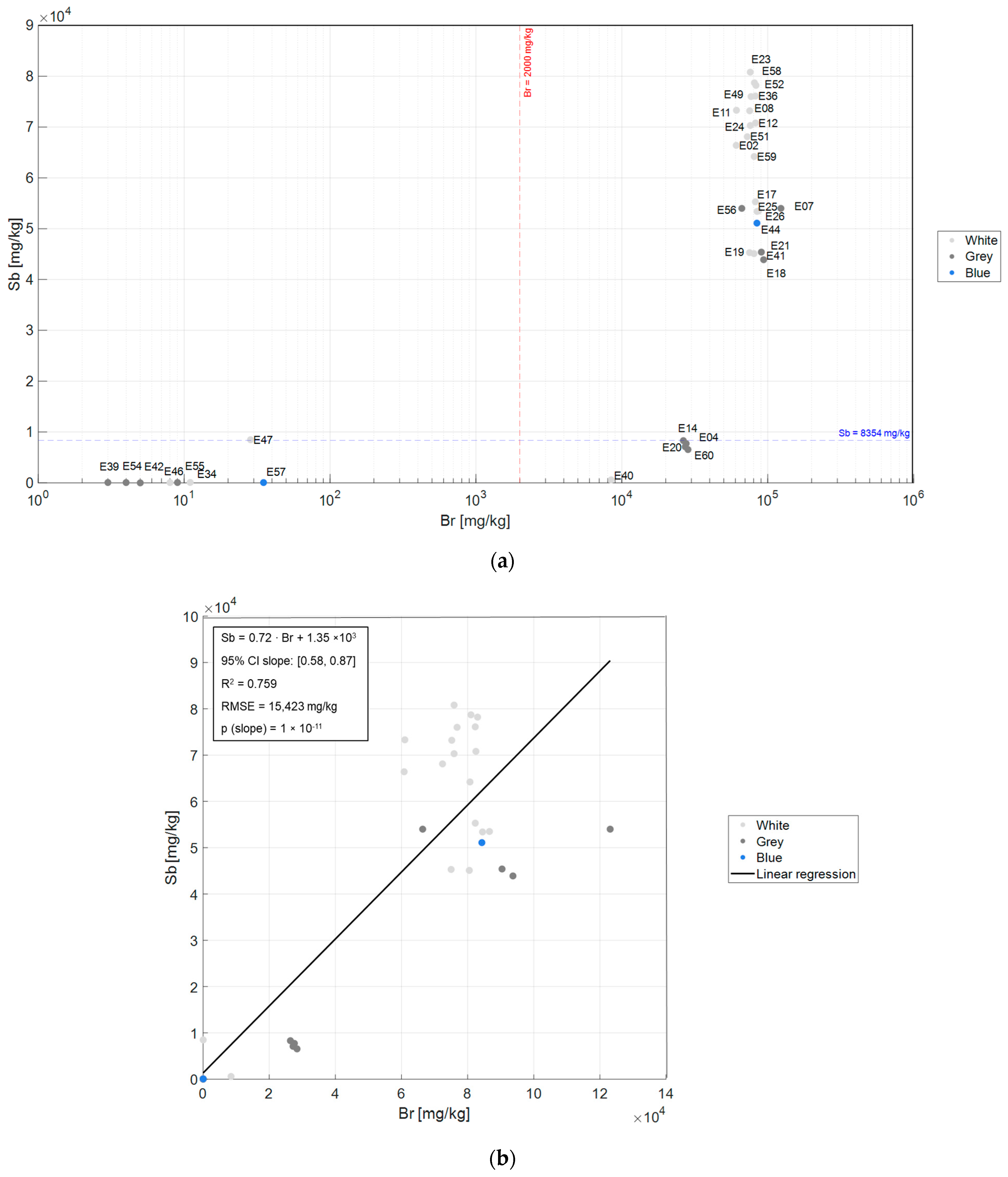
Figure 1a shows a scatter plot of Br and Sb concentrations in the plastic scraps, together with the reference thresholds (Br = 2000 mg/kg and Sb = 8354 mg/kg). Most samples largely exceed the Br threshold, while Sb contents remain below the regulatory limit, though still reaching high values in several cases. The distribution clearly reveals two distinct patterns: a cluster of samples with very low concentrations of both elements, and a group with extremely elevated Br and Sb contents. The co-occurrence of high Br and Sb concentrations in many samples suggests their joint use in polymer formulations, which complicates recycling and may require dedicated separation and treatment strategies.
Linear regression analysis results, as shown in Figure 1b, indicated a statistically significant positive relationship between Br and Sb concentrations (R2 = 0.759, with a regression slope of 0.72 (95% confidence interval: 0.58–0.87), intercept of 1350 mg/kg, and a root mean square error (RMSE) of 15,423 mg/kg (p = 1 × 10⁻¹¹). This indicates that 76% of the variance in Sb content can be explained by Br content, though the remaining variability highlights the influence of other factors and the complex composition of this waste stream.
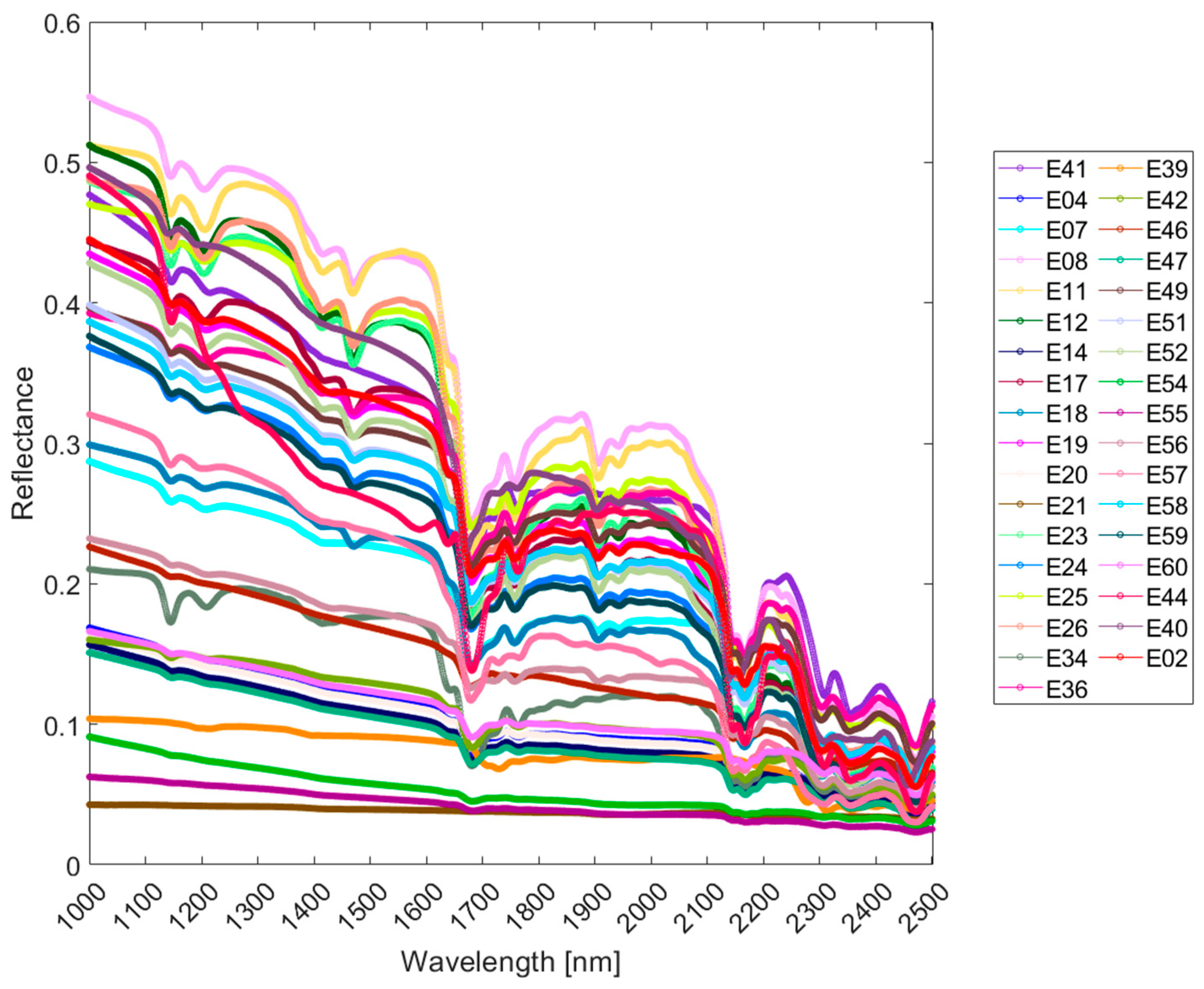
The SWIR reflectance spectra of the 35 CRT-derived plastic samples (Figure 2) show the typical spectral signatures of ABS. Strong absorption features are observed around 1700 nm and 2300 nm, which correspond to the first and second overtones of C–H stretching modes from aromatic and aliphatic groups [48]. Additional shoulders in the regions near 1200–1300 nm and 2100–2200 nm are also consistent with the vibrational modes of CH2 and CH3 groups [26].
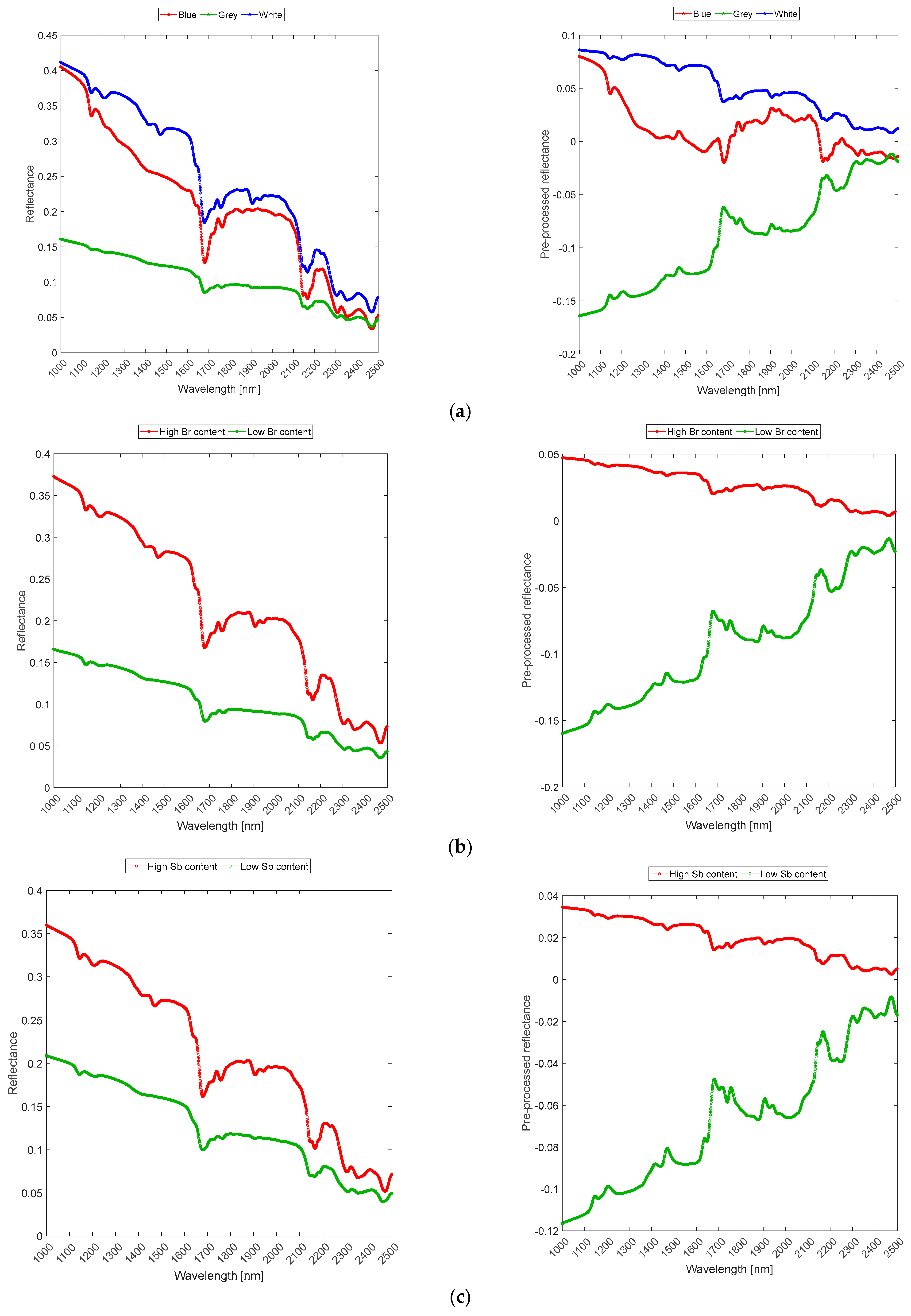
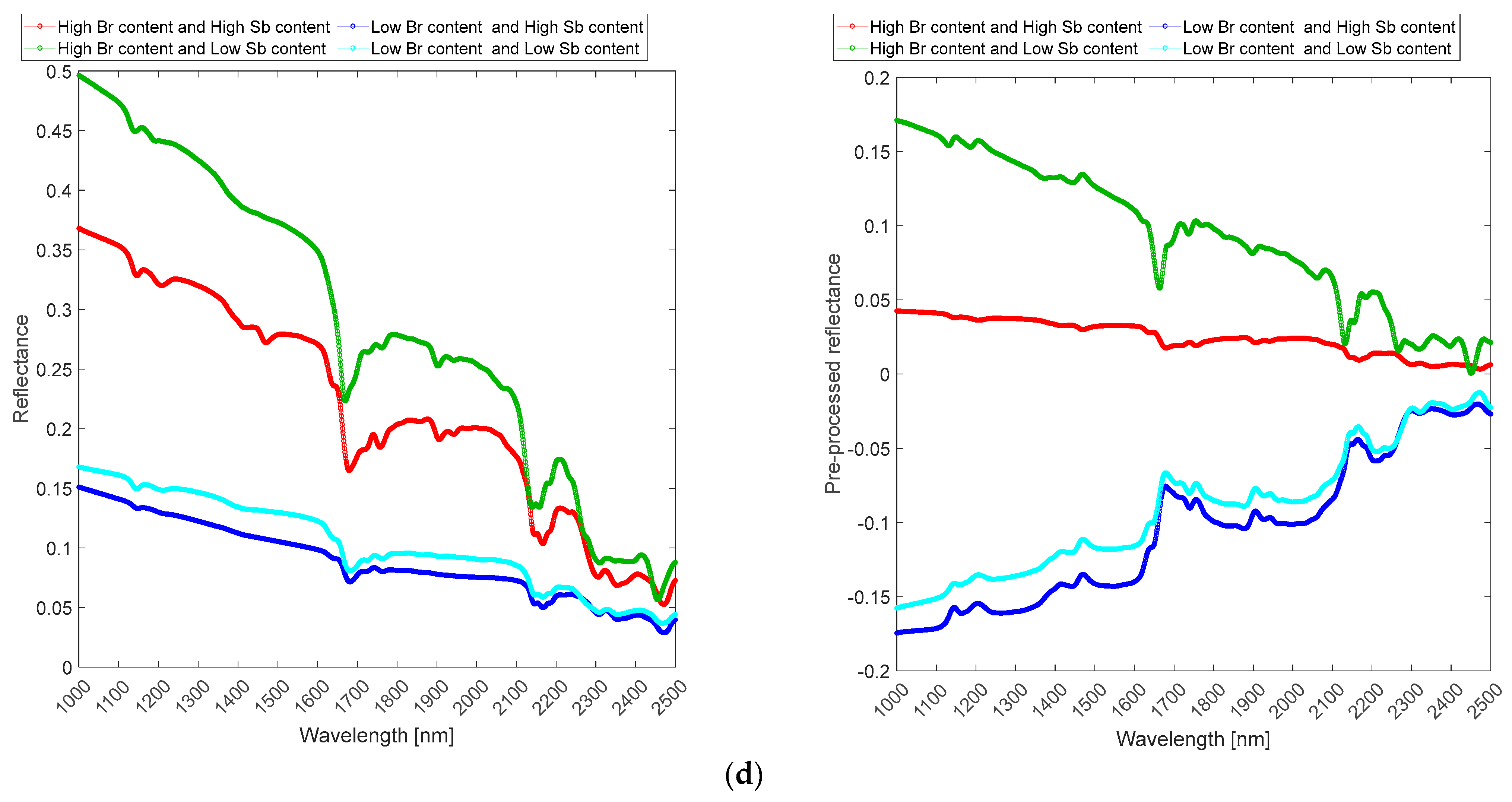
Figure 3 reports class-wise means before and after mean centering (MC): MC is expected to reduce global offsets while preserving relative band amplitudes, thereby emphasizing contrasts that may be linked to formulation rather than to color alone. In Figure 3a, color groups appear to differ mainly by baseline and amplitude, which could be consistent with pigment/filler optical effects on continuum and scattering [49]. In Figure 3b, High-Br samples seem to display higher relative reflectance around the C–H regions [48]; this pattern could be compatible with brominated flame-retardant formulations (often combined with Sb2O3) that modify matrix microstructure and internal scattering, potentially modulating band intensities and the local continuum; notably, these trends should be viewed as formulation-level effects rather than direct SWIR absorption of Br. Figure 3c appears to mirror this behavior for Sb, which would be in line with the optical influence of Sb2O3 particulate domains and refractive-index contrasts that may increase apparent reflectance in selected windows. The combined Br–Sb classes in Figure 3d seem to amplify these differences, with High-Br/High-Sb showing the largest amplitudes, which could be coherent with synergistic Br–Sb formulations reported for EEE plastics [50]. These spectral patterns align with PCA separations along PC1, as shown in Figure 4.
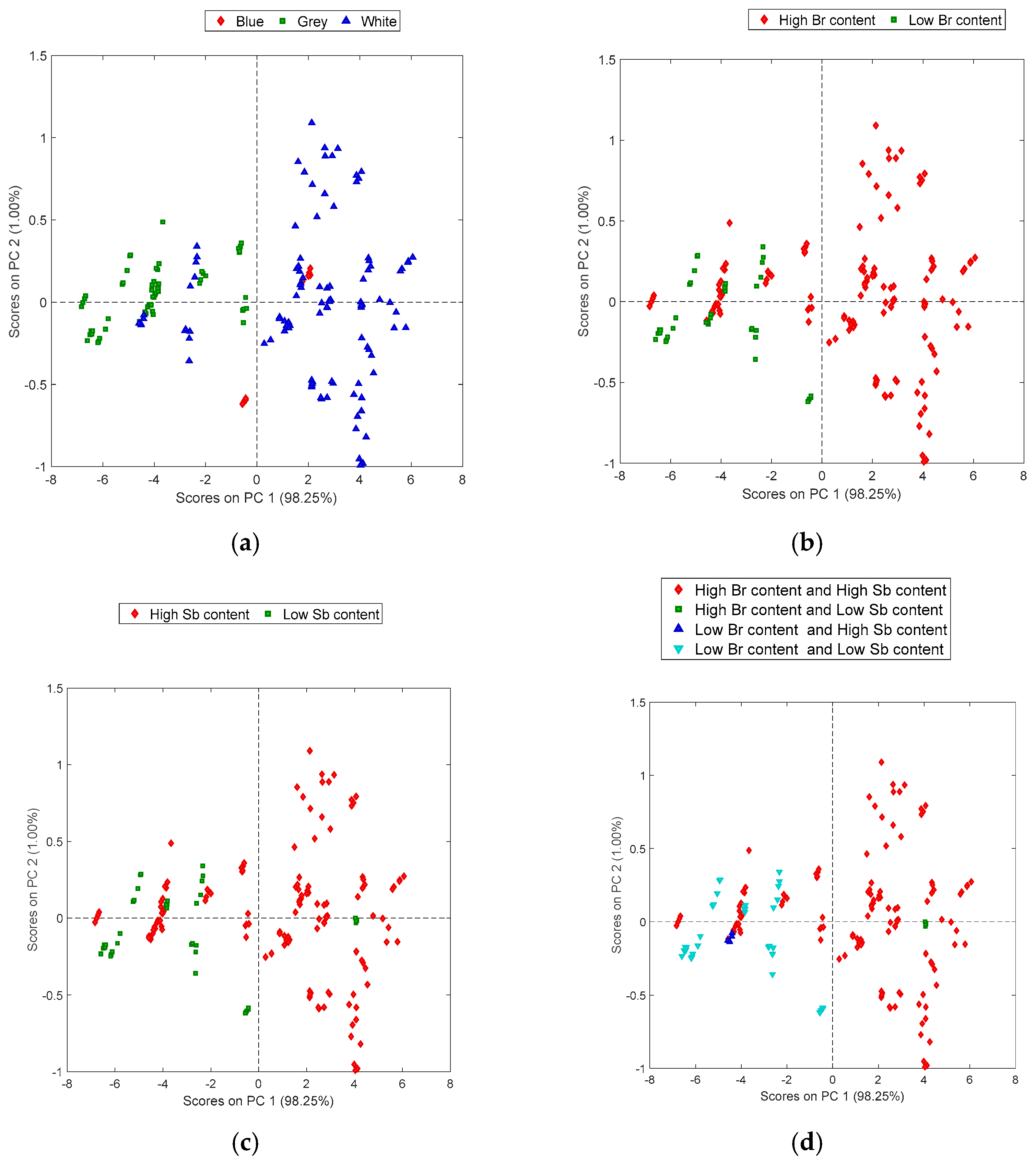
In this case PCA explained a total variance equal to 99.94% with 5 PCs. As shown in Figure 4, the score plots of the first two principal components highlight the main directions of variance within the dataset (99.25%).
In Figure 4a, gray plastics tend to cluster together in the negative space of PC1, while white plastics are mainly clustered in the positive space of PC1, indicating similarities in their spectral features compared to other color groups. Figure 4b shows that the classes based on bromine content are mainly separated along PC1: samples with high Br concentrations are in the positive region of PC1, while those with low Br levels cluster in the negative region. A similar trend is observed in Figure 4c for the antimony content, where high Sb samples are grouped in the positive PC1 space, and low Sb samples in the negative one. Finally, in Figure 4d, the combined Br–Sb content classes reinforce this separation, confirming that the main source of variability captured by PC1 is closely related to the elemental content of Br and Sb in the plastic scraps.

3.2. Classification and Regression Models for Bromine and Antimony Content

The classification results for bromine and antimony content are summarized in Table 1 and Table 2. For the bromine classification model, based on the SVMDA approach, the optimal hyperparameters cost = 31.62 and gamma = 3.16, with a total of 62 support vectors (SVs) retained. As shown in Table 1, the model achieved excellent classification performance. Both calibration and cross-validation phases yielded very high accuracy (99.2%), with balanced sensitivity and specificity for high and low Br classes. The prediction set achieved perfect discrimination (100% accuracy, sensitivity, specificity, and precision).
For the antimony classification model, the optimal hyperparameters cost = 100 and gamma = 0.32, with a reduced number of support vectors (22 SVs) compared to bromine. The obtained results (Table 2) indicate that the Sb classification was even more straightforward: the model achieved perfect classification across all evaluation stages (calibration, cross-validation, and prediction), with 100% sensitivity, specificity, precision, and accuracy for both high and low Sb content classes.
Results confirm the strong discriminative power of the SVMDA approach. The higher complexity of the Br model compared to Sb reflects the greater variability of Br in the dataset, while Sb classification achieved perfect separation with fewer SVs.
The classification performance achieved for Br is markedly superior to that reported in previous work [32], where a PLS-DA approach yielded accuracies of 0.873 (calibration), 0.857 (cross-validation), and 0.900 (prediction), with class-wise sensitivities and specificities ranging from 0.833 to 1.000 and precision between 0.636 and 1.000. This performance gap is consistent with the non-linear decision boundaries captured by kernel SVMs in high-dimensional spectroscopic feature spaces, where linear latent-variable methods like PLS-DA can be constrained. However, it should be noted that the dataset split for model training and evaluation was performed at the spectra level and not strictly at the sample level (each sample contributed five spectra). As a result, spectra from the same physical sample could appear in both calibration and prediction sets. This setup can slightly inflate performance metrics compared to a strictly sample-based split, where all spectra from a given sample are assigned exclusively to either training or testing. In such a case, the performance values might be closer to those obtained in cross-validation, as the model would have to generalize to entirely unseen samples without any shared spectral data.
As reported in Table 3, the regression models developed for Br and Sb content showed excellent predictive performance across calibration, cross-validation, and prediction phases.
For bromine, the SVM regression model achieved R2C = 0.995 and R2CV = 0.976, with low errors (RMSEC = 2527 mg/kg, RMSECV = 5286 mg/kg). In the prediction phase, the model maintained outstanding predictive power (R2P = 0.996, RMSEP = 2671 mg/kg). Bias values were negligible (−90 to 205), indicating no systematic deviations. These results confirm that the Br model is both well-fitted to the calibration data and generalizable across the full concentration range (3–123,100 mg/kg). The obtained results represent a substantial improvement with respect to a previous study on CRT plastics [33]. In more details, earlier work [33] based on partial least squares regression (PLSR) reported Rp2 ≈ 0.50 and RMSEP ≈ 27,025 mg/kg for Br prediction, while the application of a locally weighted partial least squared regression (LWPLSR) improved performance to Rp2 ≈ 0.90 and RMSEP ≈ 13,399 mg/kg. In contrast, the present SVM regression model attained markedly higher predictive power (R2P = 0.996; RMSEP = 2671 mg/kg).
While for antimony, the model performed nearly perfectly in calibration (R2C = 0.999, RMSEC = 923 mg/kg) and consistently in cross-validation (R2CV = 0.966, RMSECV = 5518 mg/kg). The independent test set achieved similar metrics (R2P = 0.999, RMSEP = 1056 mg/kg), with bias values close to zero (−60 to 359), supporting stable predictions over the wide concentration span (2–80,800 mg/kg).
Both Br and Sb models combined very high R2 values with low prediction errors relative to the wide concentration ranges across calibration, validation, and prediction.
Nevertheless, some critical points should be considered. The near-perfect R2 values (0.995–0.999) and very low RMSEP relative to the large concentration ranges could indicate a risk of overfitting, when a model fits the training data too closely, including noise, thus performing exceptionally well on known data but potentially failing to generalize to new, unseen data. This risk is particularly relevant when the number of samples is limited compared to the high dimensionality of the spectral data, as the model may capture accidental patterns unique to the dataset rather than true underlying relationships. While cross-validation (R2CV = 0.976 for Br; 0.966 for Sb) provided a more conservative assessment, further testing on an external validation set, ideally including CRT plastics from different sources and batches, would be needed to confirm robustness of the models. The reported prediction metrics (R2P and RMSEP) likely overestimate the actual model capacity for generalization. To obtain a truly unbiased evaluation of predictive performance, future studies should implement strict sample-level segregation, ensuring all spectra from selected test samples are excluded from the learning process. Under such conditions, performance estimates would likely be closer to those observed in cross-validation, reflecting a more realistic scenario.
Nevertheless, the strong performance reported here is consistent with recent literature combining SWIR spectroscopy and machine-learning approaches [26,32,33,51], highlighting the broader potential of this framework for rapid, non-destructive quantification of hazardous elements in e-waste plastics.

4. Conclusions and Future Perspectives

This study demonstrated the strong potential of SWIR spectroscopy combined with SVM-based approaches for both classification and quantitative prediction of bromine and antimony content in ABS plastics from CRT e-waste. The SVMDA models achieved near-perfect classification of high and low Br and Sb content, while the SVM regression models accurately predicted elemental concentrations across wide ranges, with high R2 values and low errors. These results confirm the feasibility of rapid, non-destructive, and cost-effective monitoring of hazardous flame retardants in heterogeneous plastic streams.
Nevertheless, the limited number of physical samples (35 ABS materials) and the spectrum-level data partitioning must be considered when interpreting these results. Since spectra from the same sample may have appeared in both training and test sets, model performance metrics might overestimate real-world generalization. As such, the reported outcomes should be seen as preliminary and optimistic estimates. Given the high spectral dimensionality relative to the limited number of unique samples, there is an inherent risk of overfitting; therefore, performance metrics should be interpreted with caution until confirmed on independent, sample-level external validation. Robust assessment of predictive accuracy and generalizability will require future validation using independent plastic batches, with strict sample-level data separation.
The implementation of these innovative approaches has the potential to support several Sustainable Development Goals (SDGs) of the United Nations, such as Decent Work and Economic Growth (SDG 8) by promoting safe and innovative opportunities in the recycling sector; Industry, Innovation, and Infrastructure (SDG 9), through the integration of advanced digital technologies into waste management processes; and Responsible Consumption and Production (SDG 12) by enabling selective recovery and improved resource efficiency for hazardous and valuable elements such as bromine and antimony.
Practical contributions to SDG 8 and SDG 9, however, are conditional on a phased pathway comprising: (i) database expansion with strict sample-level external validation on independent batches; (ii) an integrated SWIR–HSI prototype powered by a ML as core-sorting engine suitable for at-line/on-line operation; and (iii) successful industrial pilots on industrial conveyors with pre-defined operational and technical key performance indicators (KPI). In more detail, a real-world deployment of such system should be guided by explicit performance targets (e.g., low misclassification at industrial throughput, high uptime) and safety-by-design controls.
Future research should focus on extending the methodology to larger industrial-scale waste streams, implementing strict sample-level validation on independent batches, and integrating model uncertainty and monitoring into real-time sorting operations to support both environmental safety and enhanced resource recovery.

Author Contributions

Conceptualization, G.B. and S.S.; methodology, R.G.; software, R.G.; validation, G.B., R.P. and R.G.; formal analysis, R.G.; investigation, G.B., R.P., R.G., P.H. and S.S.; resources, G.B., S.S.; data curation, R.G.; writing—original draft preparation, R.G. and R.P.; writing—review and editing, G.B., R.P., P.H. and R.G.; visualization, R.P., R.G., G.B. and S.S.; supervision, G.B. and S.S. All authors have read and agreed to the published version of the manuscript.

Funding

This research received no external funding.

Institutional Review Board Statement

Not applicable.

Informed Consent Statement

Not applicable.

Data Availability Statement

The raw data supporting the conclusions of this article will be made available by the authors on request.

Acknowledgments

The authors wish to thank Galloo Plastics SA (Halluin, France) for having provided all the samples utilized in this study and for the profitable discussions. This study was carried out within the MICS (Made in Italy—Circular and Sustainable) Extended Partnership and received funding from the European Union Next-Generation EU (PIANO NAZIONALE DI RIPRESA E RESILIENZA (PNRR)—MISSIONE 4 COMPONENTE 2, INVESTIMENTO 1.3—D.D. 1551.11-10-2022, PE00000004).

Conflicts of Interest

The authors declare no conflicts of interest.

Appendix A

This appendix reports in Table A1, for each of the 35 ABS samples analyzed, the reference values of bromine (Br) and antimony (Sb) measured by XRF (mg/kg), together with the main physical characteristics (color, thickness, weight) and the associated class labels (“High”/“Low” for Br and Sb).
Table A1. Reference values and physical characteristics for the 35 ABS samples analyzed in this work.
Sample
ID
ColorBr Content
[mg/kg]
Sb Content
[mg/kg]
Thickness
(mm)
Weight
(g)
Br
Class *
Sb
Class *
E02White60,80066,400326.26High Br contentHigh Sb content
E04gray27,60077282.54.2High Br contentHigh Sb content
E07gray123,10054,00045.41High Br contentHigh Sb content
E08White75,20073,20035.32High Br contentHigh Sb content
E11White61,00073,30043.33High Br contentHigh Sb content
E12White82,50070,8003.54.18High Br contentHigh Sb content
E14gray26,4008312310.22High Br contentHigh Sb content
E17White82,30055,30036.66High Br contentHigh Sb content
E18gray93,70043,90034.63High Br contentHigh Sb content
E19White75,00045,300312.9High Br contentHigh Sb content
E20gray27,2007106320.46High Br contentHigh Sb content
E21gray90,40045,40036.97High Br contentHigh Sb content
E23White75,90080,800435.13High Br contentHigh Sb content
E24White75,90070,30028.12High Br contentHigh Sb content
E25White86,60053,50036.84High Br contentHigh Sb content
E26White84,50053,400313.59High Br contentHigh Sb content
E34White118434.27Low Br contentLow Sb content
E36White82,30076,10037.18High Br contentHigh Sb content
E39gray36835.19Low Br contentLow Sb content
E40White845059238.75High Br contentLow Sb content
E41White80,50045,10022.79High Br contentHigh Sb content
E42gray5234.7Low Br contentLow Sb content
E44Blue84,30051,10048.2High Br contentHigh Sb content
E46White86223.18Low Br contentLow Sb content
E47White28.5848634.93Low Br contentHigh Sb content
E49White76,80076,00045.39High Br contentHigh Sb content
E51White72,40068,10038.53High Br contentHigh Sb content
E52White83,00078,20034.18High Br contentHigh Sb content
E54gray46237.13Low Br contentLow Sb content
E55gray96732.61Low Br contentLow Sb content
E56gray66,40054,00036.43High Br contentHigh Sb content
E57Blue356235.27Low Br contentLow Sb content
E58White81,00078,700314.61High Br contentHigh Sb content
E59White80,70064,200311.6High Br contentHigh Sb content
E60gray28,400654824.74High Br contentHigh Sb content
(*) The thresholds for “High Br content” (>2000 mg/kg) and “High Sb content” (≥8354 mg/kg) were selected according to CENELEC CLC/TS 50625-3-1 [11] and EU HP7 criteria [9,12].

References

  1. Gaudin, M.; Semetey, V.; Rousseau, F.; Lefevre, G. Antimony Trioxide Extraction from E-Waste Brominated Flame-Retardant Laden Plastics by Simultaneous Liquid–Liquid Extraction and Leaching. ACS Sustain. Resour. Manag. 2025, 2, 473–480. [Google Scholar] [CrossRef]
  2. Perez-Martinez, B.B.; Lopez-Urionabarrenechea, A.; Serras-Malillos, A.; Acha, E.; Martínez-Santos, M.; Caballero, B.M.; Iturrondobeitia, M.; Afonso, H. Recycling of plastic-rich streams from waste electrical and electronic equipment (WEEE) sorting plants: An in-depth study of pyrolysis potential through product characterization and life cycle assessment (LCA). Energy Convers. Manag. 2025, 329, 119633. [Google Scholar] [CrossRef]
  3. Hennebert, P.; Filella, M. WEEE plastic sorting for bromine essential to enforce EU regulation. Waste Manag. 2018, 71, 390–399. [Google Scholar] [CrossRef]
  4. de Wit, C.A. An overview of brominated flame retardants in the environment. Chemosphere 2002, 46, 583–624. [Google Scholar] [CrossRef]
  5. Zhan, L.; Zhao, X.; Ahmad, Z.; Xu, Z. Leaching behavior of Sb and Br from E-waste flame retardant plastics. Chemosphere 2020, 245, 125684. [Google Scholar] [CrossRef] [PubMed]
  6. Turner, A.; Filella, M. Field-portable-XRF reveals the ubiquity of antimony in plastic consumer products. Sci. Total Environ. 2017, 584–575, 982–989. [Google Scholar] [CrossRef]
  7. Turner, A.; Filella, M. Bromine in plastic consumer products—Evidence for the widespread recycling of electronic waste. Sci. Total Environ. 2017, 601–602, 374–379. [Google Scholar] [CrossRef]
  8. EC. Directive (EU) 2017/2102 of the European Parliament and of the Council of 15 November 2017 amending Directive 2011/65/EU on the restriction of the use of certain hazardous substances in electrical and electronic equipment. Off. J. Eur. Union 2017, L305, 8–11. [Google Scholar]
  9. European Union. Council Regulation (EU) 2017/997 of 8 June 2017 amending Annex III to Directive 2008/98/EC of the European Parliament and of the Council as regards the hazardous property HP 14 ‘Ecotoxic’. Off. J. Eur. Commun. 2017, L150/1, 1–4. [Google Scholar]
  10. Henckens, M.L.C.M.; Driessen, P.P.J.; Worrell, E. How can we adapt to geological scarcity of antimony? Investigation of antimony’s substitutability and of other measures to achieve a sustainable use. Resour. Conserv. Recycl. 2016, 108, 54–62. [Google Scholar] [CrossRef]
  11. CENELEC CLC/TS 50625–3–1; Requirements for Collection, Logistics and Processing for Waste Electrical and Electronic Equipment (WEEE)—Part 3–1: Specifications for Depollution. CENELEC: Brussels, Belgium, 2015.
  12. Hennebert, P. Literature evidence on the brominated flame retardant content in plastics of construction, of textiles/furnitures and of non-food packaging: Should they be sorted before recycling? In Proceedings of the 17th International Waste Management and Landfill Symposium (Sardinia 2019), Cagliari, Italy, 30 September–4 November 2019. [Google Scholar]
  13. Filella, M.; Hennebert, P.; Okkenhaug, G.; Turner, A. Occurrence and fate of antimony in plastics. J. Hazard. Mater. 2020, 390, 121764. [Google Scholar] [CrossRef]
  14. Osako, M.; Kim, Y.-J.; Sakai, S.-I. Leaching of brominated flame retardants in leachate from landfills in Japan. Chemosphere 2004, 57, 1571–1579. [Google Scholar] [CrossRef]
  15. Al-Salem, S.M.; Antelava, A.; Constantinou, A.; Manos, G.; Dutta, A. A review on thermal and catalytic pyrolysis of plastic solid waste (PSW). J. Environ. Manag. 2017, 197, 177–198. [Google Scholar] [CrossRef]
  16. Lai, C.-Y.; Dong, Q.-Y.; Rittmann, B.E.; Zhao, H.-P. Bioreduction of Antimonate by Anaerobic Methane Oxidation in a Membrane Biofilm Batch Reactor. Environ. Sci. Technol. 2018, 52, 8693–8700. [Google Scholar] [CrossRef] [PubMed]
  17. Hu, X.; Kong, L.; He, M. Kinetics and Mechanism of Photopromoted Oxidative Dissolution of Antimony Trioxide. Environ. Sci. Technol. 2014, 48, 14266–14272. [Google Scholar] [CrossRef] [PubMed]
  18. He, M.; Wang, X.; Wu, F.; Fu, Z. Antimony pollution in China. Sci. Total Environ. 2012, 421–422, 41–50. [Google Scholar] [CrossRef]
  19. Chaine, C.; Hursthouse, A.S.; McLean, B.; McLellan, I.; McMahon, B.; McNulty, J.; Miller, J.; Viza, E. Recycling Plastics from WEEE: A Review of the Environmental and Human Health Challenges Associated with Brominated Flame Retardants. Int. J. Environ. Res. Public Health 2022, 19, 766. [Google Scholar] [CrossRef]
  20. Deng, C.; Li, Y.; Li, J.; Chen, Y.; Li, H. Emission characteristics of PBDEs during flame-retardant plastics extruding process: Field investigation and laboratorial simulation. Environ. Sci. Pollut. Res. 2017, 24, 22450–22457. [Google Scholar] [CrossRef]
  21. Haarman, A.; Fedato, S.; Aubrey, H. Brominated Flame Retardants and the Circular Economy of WEEE Plastics: State of Play; The International Bromine Council: Brissels, Belgium, 2023. [Google Scholar]
  22. Innocenzi, V.; De Michelis, I.; Ferella, F.; Beolchini, F.; Kopacek, B.; Vegliò, F. Recovery of yttrium from fluorescent powder of cathode ray tube, CRT: Zn removal by sulphide precipitation. Waste Manag. 2013, 33, 2364–2371. [Google Scholar] [CrossRef]
  23. Cesaro, A.; Gallo, M.; Moreschi, L.; Del Borghi, A. The hydrometallurgical recovery of critical and valuable elements from WEEE shredding dust: Process effectiveness in a life cycle perspective. Resour. Conserv. Recycl. 2024, 206, 107609. [Google Scholar] [CrossRef]
  24. Pocheville, A.; Uria, I.; Espana, P.; Arnaiz, S. Raman spectroscopy integrated with machine learning techniques to improve industrial sorting of Waste Electric and Electronic Equipment (WEEE) plastics. J. Environ. Manag. 2025, 373, 123897. [Google Scholar] [CrossRef]
  25. Wagner, F.; Peeters, J.R.; Ramon, H.; De Keyzer, J.; Duflou, J.R.; Dewulf, W. Quality assessment of mixed plastic flakes from Waste Electrical and Electronic Equipment (WEEE) by spectroscopic techniques. Resour. Conserv. Recycl. 2020, 158, 104801. [Google Scholar] [CrossRef]
  26. Bonifazi, G.; Fiore, L.; Gasbarrone, R.; Palmieri, R.; Serranti, S. Hyperspectral imaging applied to weee plastic recycling: A methodological approach. Sustainability 2023, 15, 11345. [Google Scholar] [CrossRef]
  27. Rodgers, J.; Beck, K. NIR Characterization and Measurement of the Cotton Content of Dyed Blend Fabrics. Text. Res. J. 2009, 79, 675–686. [Google Scholar] [CrossRef]
  28. Prieto, N.; Pawluczyk, O.; Dugan, M.E.R.; Aalhus, J.L. A Review of the Principles and Applications of Near-Infrared Spectroscopy to Characterize Meat, Fat, and Meat Products. Appl. Spectrosc. 2017, 71, 1403–1426. [Google Scholar] [CrossRef]
  29. Nicolai, B.M.; Beullens, K.; Bobelyn, E.; Peirs, A.; Saeys, W.; Theron, K.I.; Lammertyn, J. Nondestructive measurement of fruit and vegetable quality by means of NIR spectroscopy: A review. Postharvest Biol. Technol. 2007, 46, 99–118. [Google Scholar] [CrossRef]
  30. Arends, D.; Schlummer, M.; Mäurer, A.; Markowski, J.; Wagenknecht, U. Characterisation and materials flow management for waste electrical and electronic equipment plastics from German dismantling centres. Waste Manag. Res. 2015, 33, 775–784. [Google Scholar] [CrossRef]
  31. Freitag, H.; Huth-Fehre, T.; Cammann, K. Rapid Identification of Plastics from Electronic Devices with Nir-Spectroscopy. Anal. Lett. 2000, 33, 1425–1431. [Google Scholar] [CrossRef]
  32. Bonifazi, G.; Fiore, L.; Gasbarrone, R.; Hennebert, P.; Serranti, S. Detection of Brominated Plastics from E-Waste by Short-Wave Infrared Spectroscopy. Recycling 2021, 6, 54. [Google Scholar] [CrossRef]
  33. Bonifazi, G.; Fiore, L.; Gasbarrone, R.; Hennebert, P.; Serranti, S. An Investigation on Bromine Content Assessment in e-Waste Plastics by Short Wave Infrared (SWIR) Spectroscopy. Environments 2022, 9, 152. [Google Scholar] [CrossRef]
  34. Wu, X.; Li, J.; Yao, L.; Xu, Z. Auto-sorting commonly recovered plastics from waste household appliances and electronics using near-infrared spectroscopy. J. Clean. Prod. 2020, 246, 118732. [Google Scholar] [CrossRef]
  35. Amigo, J.M.; Babamoradi, H.; Elcoroaristizabal, S. Hyperspectral image analysis. A tutorial. Anal. Chim. Acta 2015, 896, 34–51. [Google Scholar] [CrossRef]
  36. ASD Inc. FieldSpec® 4 User Manual; ASD Document 600979; ASD Inc.: Falls Church, VA, USA, 2015. [Google Scholar]
  37. Danner, M.; Locherer, M.; Hank, T.; Richter, K. Spectral Sampling with the ASD FIELDSPEC 4; EnMAP Consortium: Potsdam, Germany, 2015. [Google Scholar]
  38. Sjöblom, J.; Svensson, O.; Josefson, M.; Kullberg, H.; Wold, S. An evaluation of orthogonal signal correction applied to calibration transfer of near infrared spectra. Chemom. Intell. Lab. Syst. 1998, 44, 229–244. [Google Scholar] [CrossRef]
  39. Bro, R.; Smilde, A.K. Principal component analysis. Anal. Methods 2014, 6, 2812–2831. [Google Scholar] [CrossRef]
  40. Wold, S.; Esbensen, K.; Geladi, P. Principal component analysis. Chemom. Intell. Lab. Syst. 1987, 2, 37–52. [Google Scholar] [CrossRef]
  41. Suykens, J.A.; Vandewalle, J. Least squares support vector machine classifiers. Neural Process. Lett. 1999, 9, 293–300. [Google Scholar] [CrossRef]
  42. Cortes, C.; Vapnik, V. Support-vector networks. Mach. Learn. 1995, 20, 273–297. [Google Scholar] [CrossRef]
  43. Joachims, T. A support vector method for multivariate performance measures. In Proceedings of the 22nd international conference on Machine learning, Bonn, Germany, 7–11 August 2005; pp. 377–384. [Google Scholar]
  44. Evgeniou, T.; Pontil, M. Support vector machines: Theory and applications. In Advanced Course on Artificial Intelligence; Springer: Berlin/Heidelberg, Germany, 1999; pp. 249–257. [Google Scholar]
  45. Kennard, R.W.; Stone, L.A. Computer aided design of experiments. Technometrics 1969, 11, 137–148. [Google Scholar] [CrossRef]
  46. Fawcett, T. An introduction to ROC analysis. Pattern Recognit. Lett. 2006, 27, 861–874. [Google Scholar] [CrossRef]
  47. Burges, C.J. A tutorial on support vector machines for pattern recognition. Data Min. Knowl. Discov. 1998, 2, 121–167. [Google Scholar] [CrossRef]
  48. Beć, K.B.; Grabska, J.; Badzoka, J.; Huck, C.W. Spectra-structure correlations in NIR region of polymers from quantum chemical calculations: The cases of aromatic ring, C=O, C≡N and C-Cl functionalities. Spectrochim. Acta Part A Mol. Biomol. Spectrosc. 2021, 262, 120085. [Google Scholar] [CrossRef] [PubMed]
  49. Hadi, A.N.; Meteab, M.H.; Mohammed, M.K. Influence of Inclusion Sb2O3/NiO Nanostructures on the Morphological, Microstructural, and Optical Characteristics of PVA Polymeric for Gamma-Ray Shielding Applications. Rev. Compos. Mater. Av. 2025, 35, 581. [Google Scholar] [CrossRef]
  50. Si, M.; Feng, J.; Hao, J.; Xu, L.; Du, J. Synergistic flame retardant effects and mechanisms of nano-Sb2O3 in combination with aluminum phosphinate in poly (ethylene terephthalate). Polym. Degrad. Stab. 2014, 100, 70–78. [Google Scholar] [CrossRef]
  51. Caballero, D.; Bevilacqua, M.; Amigo, J.M. Application of hyperspectral imaging and chemometrics for classifying plastics with brominated flame retardants. J. Spectr. Imaging 2019, 8, a1. [Google Scholar] [CrossRef]
Figure 1. Semi-log scatter plot with quadrant classification of High/Low Br-Sb content (a), and scatter plot of Br vs. Sb concentrations with linear regression of the plastic fragments (b). The ID of each sample in (b) is reported for each plastic fragment (35 ABS samples).
Sustainability 17 10585 g001
Figure 2. Collected SWIR raw reflectance spectra of the 35 ABS samples averaged according to ID sample (35 ABS samples).
Sustainability 17 10585 g002
Figure 3. Mean raw and MC pre-processed reflectance spectra (number of spectra = 175) averaged according to color (a), Br content (b), Sb content (c) and Br-Sb content (d).
Sustainability 17 10585 g003aSustainability 17 10585 g003b
Figure 4. Principal Component Scores plot (PC1 vs PC2), representing scores for each of the 175 spectra acquired from the 35 analyzed samples, with data visualized according to: according to color (a), Br content (b), Sb content (c) and Br-Sb content (d).
Sustainability 17 10585 g004
Table 1. Support Vector Machine classification performance metrics for bromine content classes.
Model PhaseClassSensitivitySpecificityNumber of SpectraPrecisionAccuracy
CalibrationHigh Br content0.9901.0001001.0000.992
Low Br content1.0000.990230.9580.992
Cross-validationHigh Br content0.9901.0001001.0000.992
Low Br content1.0000.990230.9580.992
PredictionHigh Br content1.0001.000351.0001.000
Low Br content1.0001.000171.0001.000
Table 2. Support Vector Machine classification performance metrics for antimony content classes.
Model PhaseClassSensitivitySpecificityNumber of SpectraPrecisionAccuracy
CalibrationHigh Sb content1.0001.0001011.0001.000
Low Sb content1.0001.000221.0001.000
Cross-validationHigh Sb content1.0001.0001011.0001.000
Low Sb content1.0001.000221.0001.000
PredictionHigh Sb content1.0001.000341.0001.000
Low Sb content1.0001.000181.0001.000
Table 3. Support Vector Machine regression performance metrics for bromine and antimony.
SVM ModelRMSECRMSECVRMSEPBiasCBiasCVBiasPR2CR2CVR2P
Br252752862671−90205−2050.9950.9760.996
Sb92355181056−60359−430.9990.9660.999
Disclaimer/Publisher’s Note: The statements, opinions and data contained in all publications are solely those of the individual author(s) and contributor(s) and not of MDPI and/or the editor(s). MDPI and/or the editor(s) disclaim responsibility for any injury to people or property resulting from any ideas, methods, instructions or products referred to in the content.