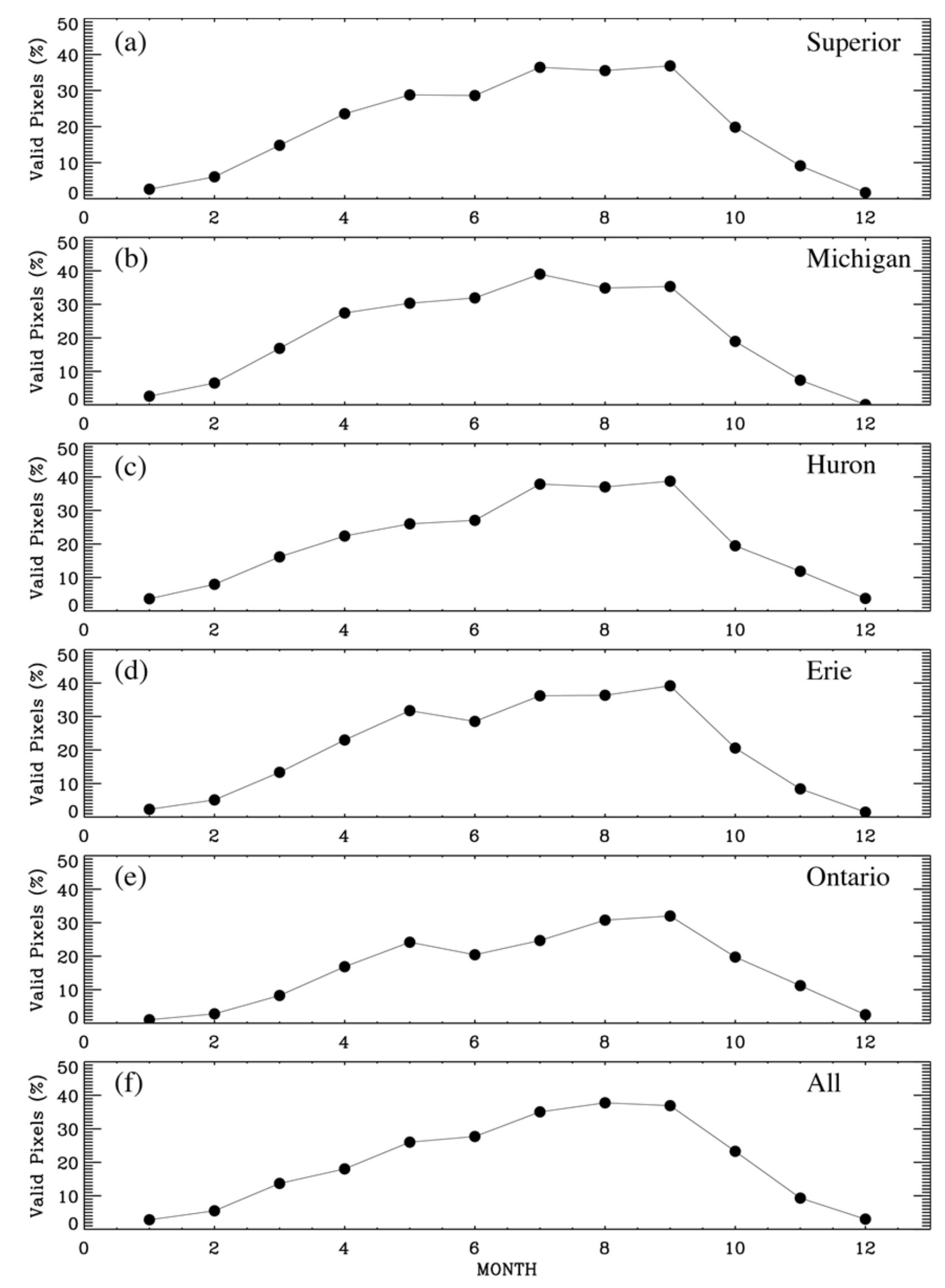
VIIRS-Derived Water Turbidity in the Great Lakes



Abstract
1. Introduction
2. Data and Methods
2.1. VIIRS–SNPP Ocean Color Data
2.2. In Situ Water Turbidity Measurements
3. Results
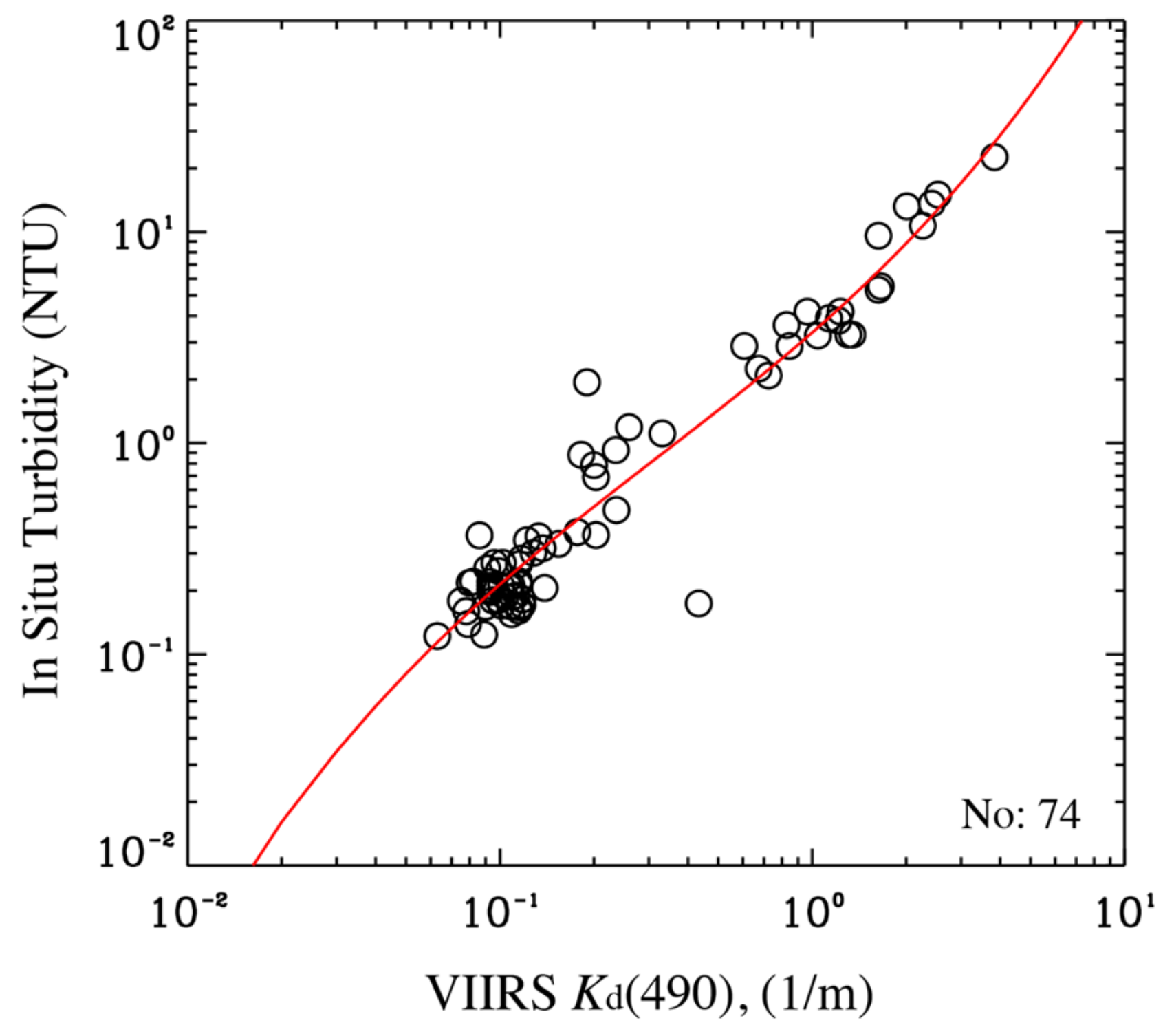
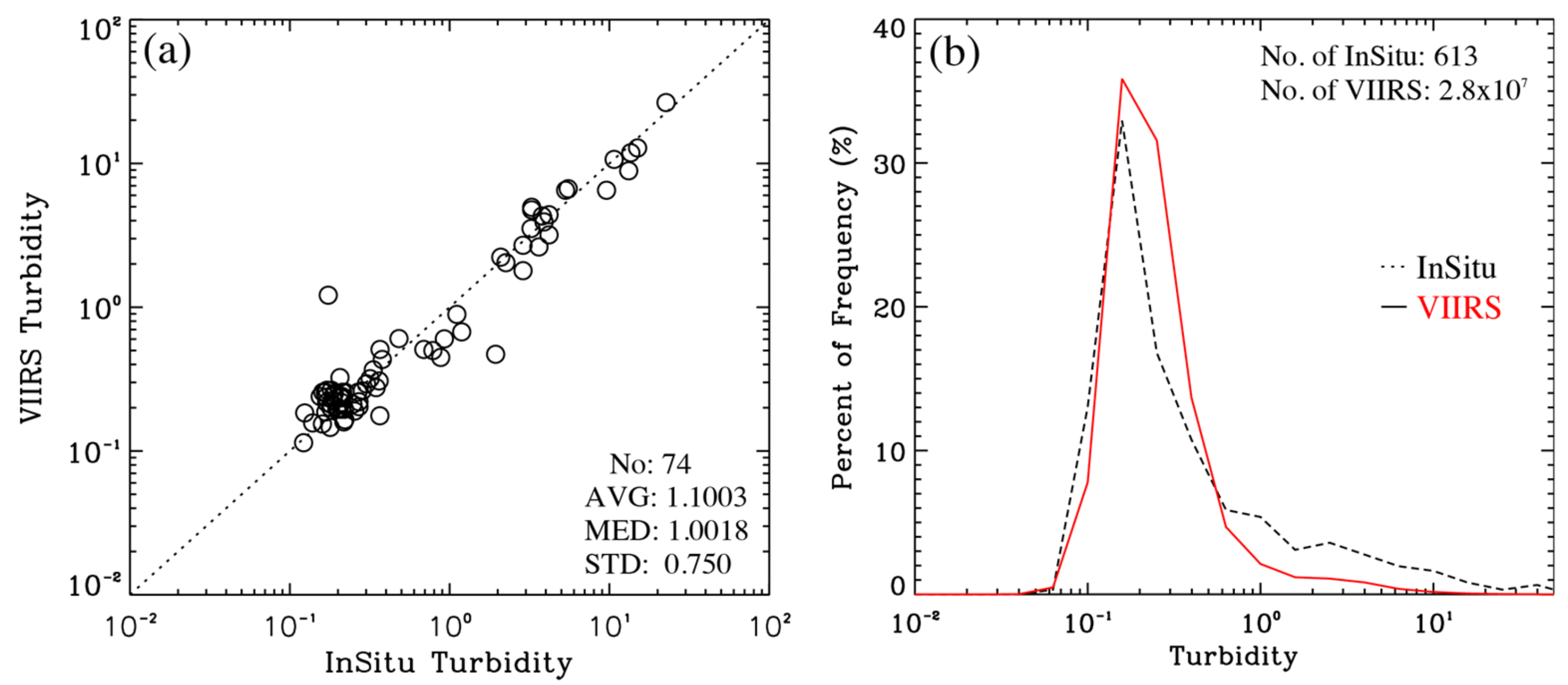
3.1. Comparison of VIIRS-Derived Kd(490) and In Situ-Measured Water Turbidity
3.2. VIIRS-Derived Monthly Climatology Water Turbidity Images
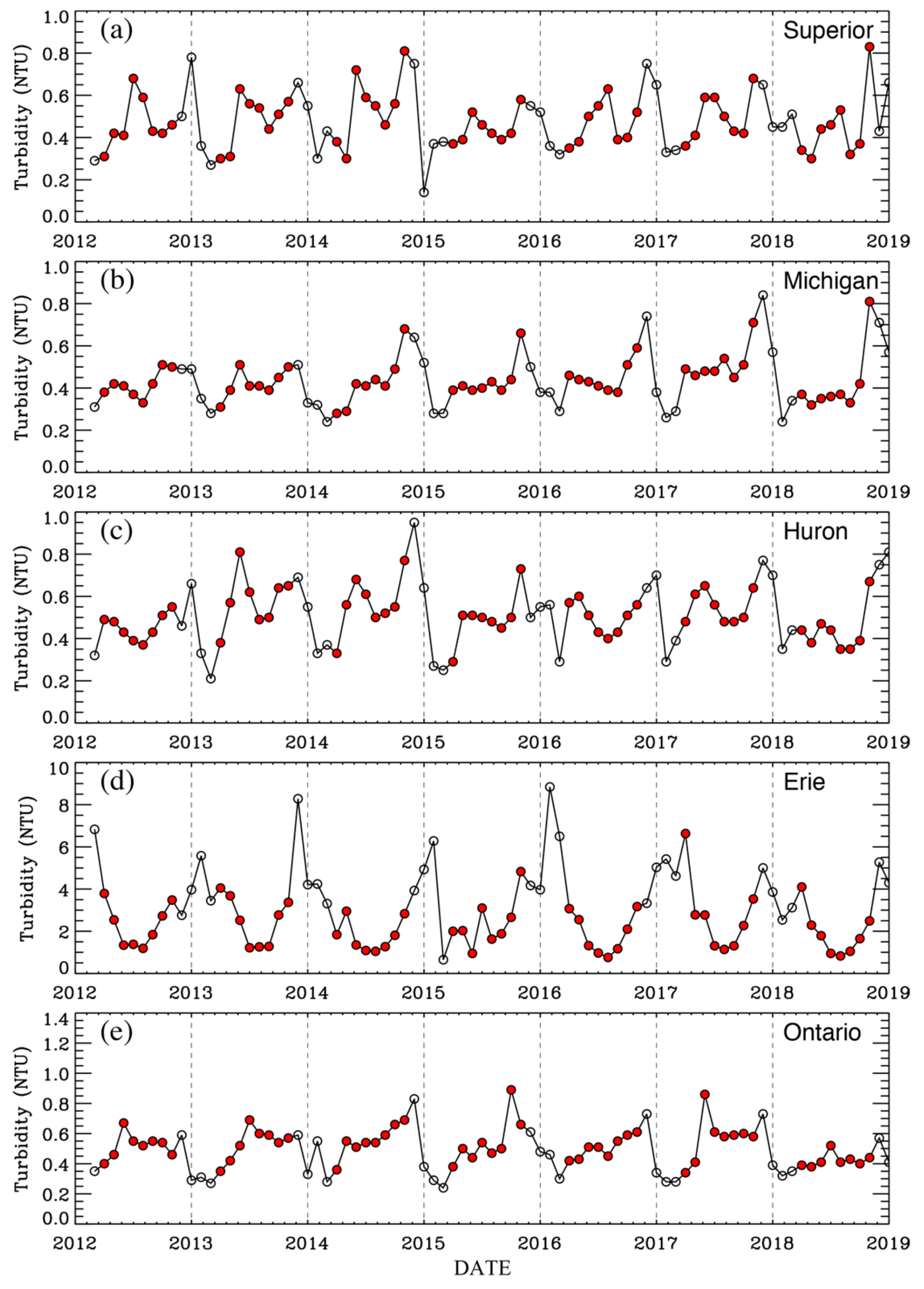
3.3. Seasonal and Interannual Variability in Water Turbidity
3.4. VIIRS-Derived Climatology Water Turbidity
4. Discussions
5. Conclusions
Author Contributions
Funding
Acknowledgments
Conflicts of Interest
References
- Kieser, M.S.; Canale, R.P.; Auer, M.T. Identification of Critical Nutrient Levels through Field Verification of Models for Phosphorus and Phytoplankton Growth. Can. J. Fish. Aquat. Sci. 1986, 43, 379–388. [Google Scholar]
- Environment Canada. Threats to Sources of Drinking Water and Aquatic Ecosystem Health in Canada; NWRI Scientific Assessment Report Ser. No. 1; National Water Research Institute: Burlington, ON, Canada, 2001. [Google Scholar]
- EPA. The Great Lakes: An Environmental Atlas and Resource Book, 3rd ed.; Government of Canada: Toronto, ON, Canada; United States Environmental Protection Agency: Chicago, IL, USA, 1995.
- Millard, E.S.; Sager, P.E. Comparison of Phosphorus, Light Climate, and Photosynthesis between Two Culturally Eutrophied Bays: Green Bay, Lake Michigan, and the Bay of Quinte, Lake Ontario. Can. J. Fish. Aquat. Sci. 1994, 51, 2579–2590. [Google Scholar] [CrossRef]
- Gordon, H.R.; Clark, D.K.; Mueller, J.L.; Hovis, W.A. Phytoplankton Pigments from the Nimbus-7 Coastal Zone Color Scanner: Comparisons with Surface Measurements. Science 1980, 210, 63–66. [Google Scholar] [CrossRef] [PubMed]
- Hovis, W.; Clark, D.; Anderson, F.; Austin, R.; Wilson, W.; Baker, E.; Ball, D.; Gordon, H.; Mueller, J.; Sayed, S.; et al. Nimbus 7 Coastal Zone Color Scanner: System description and Intial imagery. Science 1980, 210, 60–63. [Google Scholar] [CrossRef] [PubMed]
- McClain, C.R.; Feldman, G.C.; Hooker, S.B. An overview of the SeaWiFS project and strategies for producing a climate research quality global ocean bio-optical time series. Deep. Sea Res. Part II Top. Stud. Oceanogr. 2004, 51, 5–42. [Google Scholar] [CrossRef]
- Salomonson, V.; Barnes, W.; Maymon, P.; Montgomery, H.; Ostrow, H. MODIS: Advanced facility instrument for studies of the Earth as a system. IEEE Trans. Geosci. Remote. Sens. 1989, 27, 145–153. [Google Scholar] [CrossRef]
- Goldberg, M.D.; Kilcoyne, H.; Cikanek, H.; Mehta, A. Joint Polar Satellite System: The United States next generation civilian polar-orbiting environmental satellite system. J. Geophys. Res. Atmos. 2013, 118, 13463–13475. [Google Scholar] [CrossRef]
- Gons, H.J.; Auer, M.T.; Effler, S.W. MERIS satellite chlorophyll mapping of oligotrophic and eutrophic waters in the Laurentian Great Lakes. Remote. Sens. Environ. 2008, 112, 4098–4106. [Google Scholar] [CrossRef]
- Binding, C.; Jerome, J.; Bukata, R.; Booty, W. Suspended particulate matter in Lake Erie derived from MODIS aquatic colour imager. Int. J. Remote Sens. 2010, 31, 5239–5255. [Google Scholar] [CrossRef]
- Binding, C.E.; Greenberg, T.A.; Watson, S.B.; Rastin, S.; Gould, J. Long term water clarity changes in North America’s Great Lakes from multi-sensor satellite observations. Limnol. Oceanogr. 2015, 60, 1976–1995. [Google Scholar] [CrossRef]
- Lesht, B.; Barbiero, R.; Warren, G. A band-ratio algorithm for retrieving open-lake chlorophyll values from satelite observations of the Great Lakes. J. Great Lakes Res. 2013, 39, 138–152. [Google Scholar] [CrossRef]
- Pozdnyakov, D.; Shuchman, R.; Korosov, A.; Hatt, C. Operational algorithm for the retrieval of water quality in the Great Lakes. Remote. Sens. Environ. 2005, 97, 352–370. [Google Scholar] [CrossRef]
- Shuchman, R.A.; Leshkevich, G.; Sayers, M.J.; Johengen, T.H.; Brooks, C.N.; Pozdnyakov, D. An algorithm to retrieve chlorophyll, dissolved organic carbon, and suspended minerals from Great Lakes satellite data. J. Great Lakes Res. 2013, 39, 14–33. [Google Scholar] [CrossRef]
- Yousef, F.; Shuchman, R.; Sayers, M.; Fahnenstiel, G.; Henareh, A. Water clarity of the Upper Great Lakes: Tracking changes between 1998–2012. J. Great Lakes Res. 2017, 43, 239–247. [Google Scholar] [CrossRef]
- Moore, T.; Mouw, C.; Sullivan, J.; Twardowski, M.; Burtner, A.; Ciochetto, A.; McFarland, M.; Nayak, A.; Paladino, D.; Stockley, N.; et al. Bio-optical properties of cyanobacteria blooms in western Lake Erie. Front. Mar. Sci. 2017, 4, 300. [Google Scholar] [CrossRef]
- Stumpf, R.P.; Wynne, T.T.; Baker, D.B.; Fahnenstiel, G.L. Interannual Variability of Cyanobacterial Blooms in Lake Erie. PLoS ONE 2012, 7, e42444. [Google Scholar] [CrossRef] [PubMed]
- Wynne, T.T.; Tomlinson, M.C.; Stumpf, R.P.; Dyble, J. Characterizing a cyanobacterial bloom in Western Lake Erie using satellite imagery and meteorological data. Limnol. Oceanogr. 2010, 55, 2025–2036. [Google Scholar] [CrossRef]
- Son, S.; Wang, M. Ice Detection for Satellite Ocean Color Data Processing in the Great Lakes. IEEE Trans. Geosci. Remote. Sens. 2017, 55, 6793–6804. [Google Scholar] [CrossRef]
- Fahnenstiel, G.; Pothoven, S.; Vanderploeg, H.; Klarer, D.; Nalepa, T.; Scavia, D. Recent changes in primary production and phytoplankton in the offshore region of southeastern Lake Michigan. J. Great Lakes Res. 2010, 36, 20–29. [Google Scholar] [CrossRef]
- Kerfoot, W.C.; Yousef, F.; Green, S.A.; Budd, J.W.; Schwab, D.J.; Vanderploeg, H.A. Approaching storm: Disappearing winter bloom in Lake Michigan. J. Great Lakes Res. 2010, 36, 30–41. [Google Scholar] [CrossRef]
- Wang, J.; Bai, X.; Hu, H.; Clites, A.; Colton, M.; Lofgren, B. Temporal and spatial variability of Great Lakes ice cover, 1973–2010. J. Clim. 2011, 25, 1318–1329. [Google Scholar] [CrossRef]
- Yousef, F.; Kerfoot, W.C.; Shuchman, R.; Fahnenstiel, G. Bio-optical properties and primary production of Lake Michigan: Insights from 13-years of SeaWiFS imagery. J. Great Lakes Res. 2014, 40, 317–324. [Google Scholar] [CrossRef]
- Zolfaghari, K.; Duguay, C.R. Estimation of Water Quality Parameters in Lake Erie from MERIS Using Linear Mixed Effect Models. Remote. Sens. 2016, 8, 473. [Google Scholar] [CrossRef]
- Lee, Z.-P.; Darecki, M.; Carder, K.L.; Davis, C.O.; Stramski, D.; Rhea, W.J. Diffuse attenuation coefficient of downwelling irradiance: An evaluation of remote sensing methods. J. Geophys. Res. Space Phys. 2005, 110, C02017. [Google Scholar] [CrossRef]
- Wang, M.; Son, S.; Harding, L.W. Retrieval of diffuse attenuation coefficient in the Chesapeake Bay and turbid ocean regions for satellite ocean color applications. J. Geophys. Res. Space Phys. 2009, 114, C10011. [Google Scholar] [CrossRef]
- Wang, M.; Liu, X.; Tan, L.; Jiang, L.; Son, S.; Shi, W.; Rausch, K.; Voss, K. Impacts of VIIRS SDR performance on ocean color products. J. Geophys. Res. Atmos. 2013, 118, 10347–10360. [Google Scholar] [CrossRef]
- Wang, M.; Jiang, L.; Liu, X.; Son, S.; Sun, J.; Shi, W.; Tan, L.; Mikelsons, K.; Wang, X.; Lance, V. VIIRS ocean color products: A progress update. In Proceedings of the 2016 IEEE International Geoscience and Remote Sensing Symposium (IGARSS), Beijing, China, 10–15 July 2016; pp. 5848–5851. [Google Scholar]
- Sun, J.; Wang, M. Radiometric calibration of the VIIRS reflective solar bands with robust characterizations and hybrid calibration coefficients. Appl. Opt. 2015, 54, 9331–9342. [Google Scholar] [CrossRef]
- Sun, J.; Wang, M. VIIRS Reflective Solar Bands Calibration Progress and Its Impact on Ocean Color Products. Remote. Sens. 2016, 8, 194. [Google Scholar] [CrossRef]
- Wang, M. A Sensitivity Study of the SeaWiFS Atmospheric Correction Algorithm Effects of Spectral Band Variations. Remote. Sens. Environ. 1999, 67, 348–359. [Google Scholar] [CrossRef]
- Wang, M.; Franz, B. Comparing the ocean color measurements between MOS and SeaWiFS: A vicarious intercalibration approach for MOS. IEEE Trans. Geosci. Remote. Sens. 2000, 38, 184–197. [Google Scholar] [CrossRef]
- Wang, M.; Isaacman, A.; Franz, B.A.; McClain, C.R. Ocean-color optical property data derived from the Japanese Ocean Color and Temperature Scanner and the French Polarization and Directionality of the Earth’s Reflectances: A comparison study. Appl. Opt. 2002, 41, 974–990. [Google Scholar] [CrossRef] [PubMed]
- Gordon, H.R.; Wang, M. Retrieval of water-leaving radiance and aerosol optical thickness over the oceans with SeaWiFS: A preliminary algorithm. Appl. Opt. 1994, 33, 443–452. [Google Scholar] [CrossRef] [PubMed]
- Jiang, L.; Wang, M. Improved near-infrared ocean reflectance correction algorithm for satellite ocean color data processing. Opt. Express 2014, 22, 21657–21678. [Google Scholar] [CrossRef] [PubMed]
- Wang, M. Remote sensing of the ocean contributions from ultraviolet to near-infrared using the shortwave infrared bands: Simulations. Appl. Opt. 2007, 46, 1535–1547. [Google Scholar] [CrossRef] [PubMed]
- Wang, M.; Shi, W. Estimation of ocean contribution at the MODIS near-infrared wavelengths along the east coast of the U.S.: Two case studies. Geophys. Res. Lett. 2005, 32, L13606. [Google Scholar] [CrossRef]
- Wang, M.; Shi, W. The NIR-SWIR combined atmospheric correction approach for MODIS ocean color data processing. Opt. Express 2007, 15, 15722–15733. [Google Scholar] [CrossRef]
- Wang, M.; Shi, W. Sensor Noise Effects of the SWIR Bands on MODIS-Derived Ocean Color Products. IEEE Trans. Geosci. Remote. Sens. 2012, 50, 3280–3292. [Google Scholar] [CrossRef]
- Wang, M.; Son, S.; Shi, W. Evaluation of MODIS SWIR and NIR-SWIR atmospheric correction algorithms using SeaBASS data. Remote. Sens. Environ. 2009, 113, 635–644. [Google Scholar] [CrossRef]
- Wang, M.; Nim, C.J.; Son, S.; Shi, W. Characterization of turbidity in Florida’s Lake Okeechobee and Caloosahatchee and St. Lucie estuaries using MODIS-Aqua measurements. Water Res. 2012, 46, 5410–5422. [Google Scholar] [CrossRef]
- Shi, W.; Wang, M. Ocean reflectance spectra at the red, near-infrared, and shortwave infrared from highly turbid waters: A study in the Bohai Sea, Yellow Sea, and East China Sea. Limnol. Oceanogr. 2014, 59, 427–444. [Google Scholar] [CrossRef]
- Peng, F.; Effler, S.W. Characterizations of the light-scattering attributes of mineral particles in Lake Ontario and the effects of whiting. J. Great Lakes Res. 2011, 37, 672–682. [Google Scholar] [CrossRef]
- Strong, A.; Eadie, B. Satellite observations of calcium carbonate precipitations in the Great Lakes. Limnol. Oceanogr. 1978, 23, 877–887. [Google Scholar] [CrossRef]
- Mortimer, C. Fifty Years of Physical Investigations and Related Limnological Studies on Lake Erie, 1928–1977. J. Great Lakes Res. 1987, 13, 407–435. [Google Scholar] [CrossRef]
- Steffen, M.M.; Belisle, B.S.; Watson, S.B.; Boyer, G.L.; Wilhelm, S.W. Status, causes and controls of cyanobacterial blooms in Lake Erie. J. Great Lakes Res. 2014, 40, 215–225. [Google Scholar] [CrossRef]
- National Centers for Coastal Ocean Science and Great Lakes Environmental Research Laboratory, “Experimental Lake Erie Harmful Algal Bloom Bulletin,” Harmful Algal Blooms in Lake Erie, Bulletin 25, 8 October 2015. Available online: https://glerl.noaa.gov/res/HABs_and_Hypoxia/lakeErieHABArchive/bulletin_2015-025.pdf (accessed on 18 June 2019).
- Barbiero, R.P.; Lesht, B.M.; Warren, G.J. Evidence for bottom–up control of recent shifts in the pelagic food web of Lake Huron. J. Great Lakes Res. 2011, 37, 78–85. [Google Scholar] [CrossRef]
- Barbiero, R.P.; Tuchman, M.L. Long-term Dreissenid Impacts on Water Clarity in Lake Erie. J. Great Lakes Res. 2004, 30, 557–565. [Google Scholar] [CrossRef]






| Lake | Period | ALL SEASON | SPRING | SUMMER | |||
|---|---|---|---|---|---|---|---|
| Turbidity (NTU) (AVG ± STD) | No | Turbidity (NTU) (AVG ± STD) | No | Turbidity (NTU) (AVG ± STD) | No | ||
| Superior | 1983–1990 | - | - | - | - | - | - |
| 1991–2000 | 0.15 ± 0.12 | 237 | 0.15 ± 0.15 | 129 | 0.15 ± 0.08 | 108 | |
| 2001–2010 | 0.26 ± 0.17 | 249 | 0.29 ± 0.20 | 132 | 0.24 ± 0.11 | 117 | |
| 2011–2017 | 0.24 ± 0.10 | 203 | 0.24 ± 0.12 | 91 | 0.22 ± 0.09 | 112 | |
| Michigan | 1983–1990 | 0.41 ± 0.21 | 447 | 0.41 ± 0.22 | 184 | 0.41 ± 0.21 | 263 |
| 1991–2000 | 0.48 ± 0.40 | 323 | 0.38 ± 0.21 | 143 | 0.56 ± 0.49 | 180 | |
| 2001–2010 | 0.35 ± 0.17 | 138 | 0.37 ± 0.16 | 60 | 0.33 ± 0.18 | 78 | |
| 2011–2017 | 0.23 ± 0.11 | 130 | 0.23 ± 0.15 | 63 | 0.22 ± 0.07 | 67 | |
| Huron | 1983–1990 | 0.33 ± 0.17 | 389 | 0.44 ± 0.17 | 154 | 0.26 ± 0.12 | 235 |
| 1991–2000 | 0.31 ± 0.17 | 191 | 0.40 ± 0.16 | 115 | 0.18 ± 0.07 | 76 | |
| 2001–2010 | 0.27 ± 0.13 | 174 | 0.32 ± 0.14 | 90 | 0.22 ± 0.08 | 84 | |
| 2011–2017 | 0.21 ± 0.15 | 135 | 0.23 ± 0.18 | 59 | 0.20 ± 0.11 | 76 | |
| Erie | 1983–1990 | 2.65 ± 4.28 | 668 | 3.51 ± 5.42 | 281 | 2.03 ± 3.07 | 387 |
| 1991–2000 | 3.28 ± 5.44 | 395 | 4.44 ± 6.36 | 259 | 1.08 ± 1.29 | 136 | |
| 2001–2010 | 4.38 ± 7.88 | 303 | 6.25 ± 9.60 | 172 | 1.91 ± 3.50 | 131 | |
| 2011–2017 | 3.99 ± 6.94 | 221 | 6.05 ± 9.10 | 105 | 2.13 ± 3.13 | 116 | |
| Ontario | 1983–1990 | 0.99 ± 0.61 | 155 | 0.40 ± 0.23 | 63 | 1.38 ± 0.44 | 92 |
| 1991–2000 | 0.35 ± 0.22 | 143 | 0.26 ± 0.14 | 79 | 0.47 ± 0.23 | 64 | |
| 2001–2010 | 0.44 ± 0.37 | 118 | 0.29 ± 0.18 | 59 | 0.59 ± 0.44 | 59 | |
| 2011–2017 | 0.56 ± 0.44 | 89 | 0.26 ± 0.13 | 38 | 0.79 ± 0.45 | 51 | |
© 2019 by the authors. Licensee MDPI, Basel, Switzerland. This article is an open access article distributed under the terms and conditions of the Creative Commons Attribution (CC BY) license (http://creativecommons.org/licenses/by/4.0/).
Share and Cite
Son, S.; Wang, M. VIIRS-Derived Water Turbidity in the Great Lakes. Remote Sens. 2019, 11, 1448. https://doi.org/10.3390/rs11121448
Son S, Wang M. VIIRS-Derived Water Turbidity in the Great Lakes. Remote Sensing. 2019; 11(12):1448. https://doi.org/10.3390/rs11121448
Chicago/Turabian StyleSon, Seunghyun, and Menghua Wang. 2019. "VIIRS-Derived Water Turbidity in the Great Lakes" Remote Sensing 11, no. 12: 1448. https://doi.org/10.3390/rs11121448
APA StyleSon, S., & Wang, M. (2019). VIIRS-Derived Water Turbidity in the Great Lakes. Remote Sensing, 11(12), 1448. https://doi.org/10.3390/rs11121448