Article

EdgeNeXt-Attn: A Lightweight Attention-Enhanced Deep Learning Framework for Fire Detection in Remote Sensing Imagery

1
KAIST InnoCORE PRISM-AI Center, Korea Advanced Institute of Science and Technology (KAIST), Daejeon 34141, Republic of Korea
2
Department of Mechanical, Robotics and Energy Engineering, Dongguk University-Seoul, 30 Pildong-ro 1-gil, Jung-gu, Seoul 04620, Republic of Korea
3
Department of Mechanical Engineering, Sejong University, Seoul 05006, Republic of Korea
4
School of Information and Communication Engineering, Beijing University of Posts and Telecommunications, Beijing 100876, China
5
Department of Computer Sciences, College of Computer and Information Sciences, Princess Nourah bint Abdulrahman University, Riyadh 11671, Saudi Arabia
*
Author to whom correspondence should be addressed.
Remote Sens. 2026, 18(16), 2706; https://doi.org/10.3390/rs18162706
Submission received: 6 June 2026 / Revised: 30 July 2026 / Accepted: 8 August 2026 / Published: 12 August 2026
(This article belongs to the Special Issue Image Analysis for Forest Environmental Monitoring (2nd Edition))

Highlights

What are the main findings?
  • We propose EdgeNeXt-Attn, a lightweight attention-enhanced deep learning framework that effectively captures both local spatial features and global contextual information for wildfire detection in remote sensing imagery.
  • EdgeNeXt-Attn consistently outperforms existing state-of-the-art methods on the DFAN, ADSF, and Complex-Fire datasets while maintaining computational efficiency suitable for edge deployment.
What are the implications of the main findings?
  • The integration of channel and spatial attention improves the detection of small, occluded, and visually complex fire regions under challenging environmental conditions.
  • The lightweight design and explainable predictions support real-time wildfire monitoring and early warning applications using satellite, UAV, and CCTV-based remote sensing systems.

Abstract

Wildfires are a major environmental hazard with severe consequences for ecosystems, air quality, infrastructure, and public safety. The rising incidence and severity of wildfire events worldwide have increased the need for reliable early detection and monitoring systems. Remote sensing technologies, such as satellite and unmanned aerial vehicle (UAV) imagery, along with ground-based Closed-Circuit Television (CCTV) cameras, provide valuable geospatial data for large-scale wildfire monitoring. Recent advances in deep learning, particularly Convolutional Neural Networks (CNNs) and Transformer-based architectures, have significantly improved the accuracy of wildfire detection systems. Despite these advances, balancing local feature representation with global contextual modeling remains challenging. CNNs effectively capture local spatial features but have limited receptive fields, whereas Vision Transformers (ViTs) model long-range dependencies but often overlook fine-grained local details and require substantial computational resources. Consequently, accurately detecting small, occluded, and visually ambiguous fire regions remains difficult, particularly for real-time deployment on resource-constrained edge devices. To address these challenges, this study proposes EdgeNeXt-Attn, an enhanced EdgeNeXt-based framework that effectively integrates local feature learning and global contextual modeling through channel and spatial attention mechanisms. The proposed model improves the detection of small, occluded, and visually ambiguous fire regions while maintaining the computational efficiency required for real-time edge deployment. The proposed framework is evaluated on four multi-platform benchmarks spanning ground-based CCTV (DFAN, Complex-Fire), aerial drone (FLAME), and mixed drone–satellite (ADSF) imagery, achieving 92.09%, 95.16%, 96.65%, and 87.81% accuracy, respectively, and outperforming recent state-of-the-art baselines. With only 5.3M parameters, the model achieves real-time inference at 85.9, 27.3, and 8.4 FPS on GPU, CPU, and Raspberry Pi, respectively. Furthermore, ablation studies and Grad-CAM analysis validate its effectiveness and accurate fire localization. These results demonstrate an accurate and computationally efficient framework for real-time wildfire monitoring using multi-platform remote sensing and ground-based imaging systems.

1. Introduction

Fires remain one of the most devastating threats to human life and property, as they can spread rapidly and are often difficult to control, particularly in densely populated environments such as forests, residential areas, industrial sectors, and airports [1,2,3]. As reported in 2025, South Korea experienced 347 separate forest fires between March and May, which burned approximately 104,000 hectares, causing 32 deaths, including 3 firefighters, and 54 injuries [4]. Over 37,800 residents were displaced, and around 5000 buildings, including houses, factories, and farms, were destroyed [4]. These fires also released a record 0.8 megatons of CO2 into the atmosphere. The 2025 European fire season is on track to be the worst on record, with over 1 million hectares burned across the EU by December 2025, underscoring industrial vulnerabilities near wildfire-prone zones [5]. In 2024, wildfires severely impacted the El Salto industrial district in Viña del Mar, Chile, leaving 42% of surveyed companies unable to operate, with 58% lacking insurance coverage, and causing estimated losses of CLP 25 billion [6]. In the United States, according to the National Fire Protection Association (NFPA), a fire department responds to a fire every 23 s, with a residential building fire reported every 95 s. In 2023, these incidents resulted in 3670 civilian deaths, 13,350 injuries, and 89 firefighter fatalities [7]. According to the United Nations Office for Disaster Risk Reduction (UNDRR), wildfires burned approximately 390 million hectares worldwide in 2025. Although the Los Angeles wildfires affected only about 23,000 hectares, they caused more than USD 53 billion in damages, highlighting that the socioeconomic and environmental impacts of wildfires extend far beyond the burned area and include long-term health, ecological, and economic consequences [8]. Wildfires occur under two fundamentally different visual regimes that impose distinct challenges on automated detection systems. Forest fires, typically captured through long-range aerial or satellite platforms, are characterized by small fire-to-background pixel ratios (often less than 2% of the total image area), heavy occlusion by tree canopy and smoke plumes, wide radiometric variability from atmospheric conditions and viewing angles, and frequent visual confusion with sun-illuminated foliage, burnt orange terrain, or bright reflective surfaces. In contrast, urban fires are typically monitored through close-range ground-based CCTV cameras, where the fire generally occupies a large portion of the image, but the background is structurally complex and contains numerous fire-like distractors, including vehicle tail-lights, sunset reflections on windows, artificial neon lighting, and red-painted structures. These two scenarios, therefore, require complementary detection capabilities: forest-fire detection demands strong small-target sensitivity and robust background suppression under wide-area imagery, whereas urban-fire detection demands high discriminative power against structurally similar distractors under close-range imagery. A framework aiming to serve as a general-purpose remote sensing fire detector must handle both regimes within a unified architecture, a requirement that motivates the multi-platform benchmark evaluation and the specific design choices adopted in this work. In response to these statistics, early and accurate fire detection plays a crucial role in fire mitigation. This is made possible by advanced artificial intelligence (AI) algorithms; therefore, researchers have proposed different approaches based on traditional methods, as explained in [9,10,11,12], later replaced by conventional machine learning (CML) and deep learning (DL) models for effective fire scene classification [13]. Traditional fire detection relied on scalar sensors (e.g., smoke, heat, gas), which are mainly suitable for indoor use and require close proximity and multiple devices for reliable assessment [13]. Consequently, vision-based approaches have gained attention due to their broader coverage and richer fire characterization [10,14,15]. These include wide coverage, real-time response, reduced reliance on human intervention, and feasibility in both indoor and outdoor environments. These fire detection techniques are generally classified into three types: CML, DL, and hybrid methods, as discussed in [16,17]. CML-based fire detection methods primarily rely on manually created features, including texture, shape, motion, color, and other image attributes for fire detection [18,19]. However, in CML, optimal feature selection is challenging due to the flame geometry fluctuating under different airflow conditions, as well as differences in flame colors caused by varying burning materials and lighting conditions. Extracting these features requires a domain expert to select the most prominent features, which is a labor-intensive and time-consuming task [20].
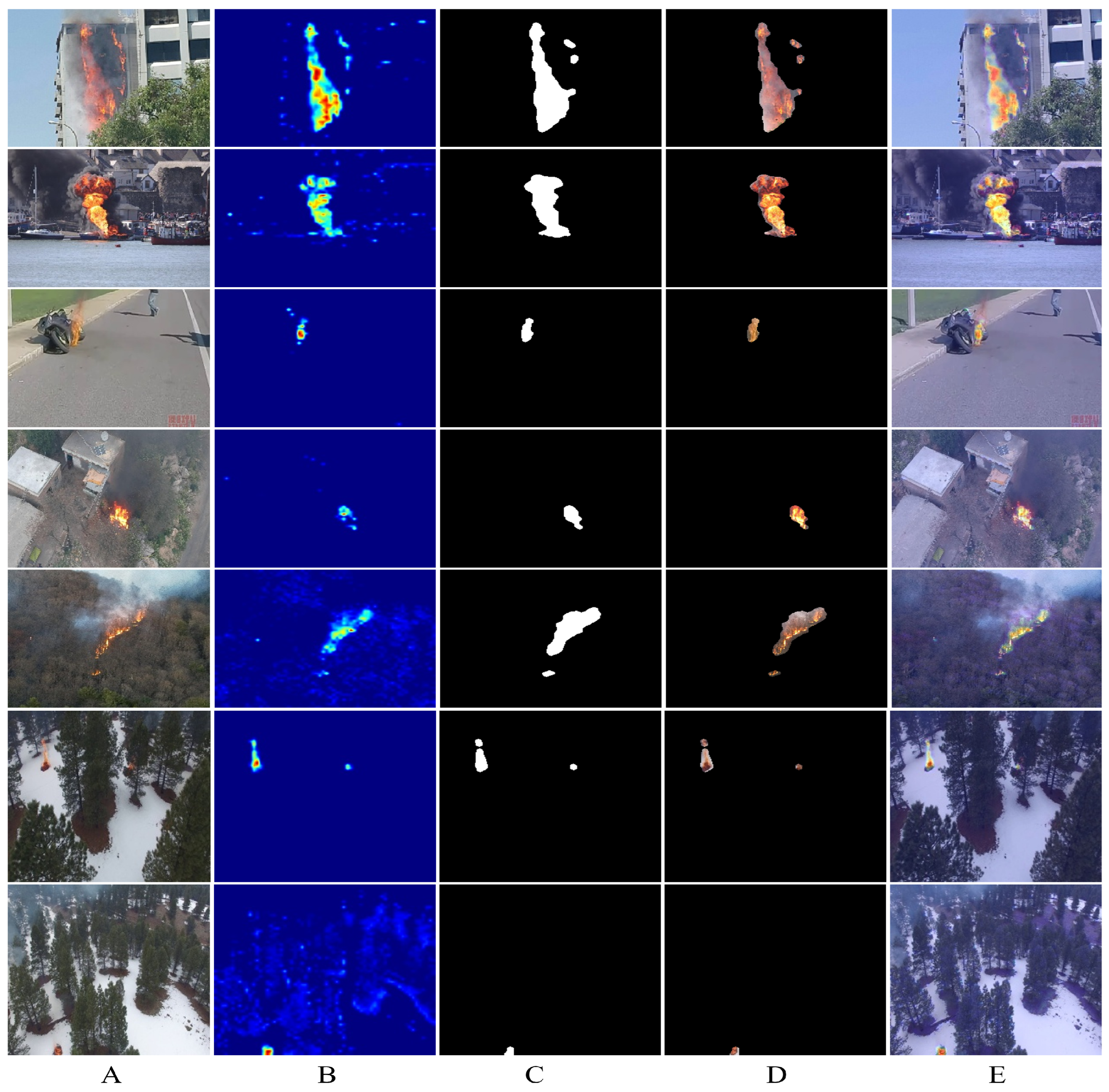
Unlike CML methods, deep learning enables automatic feature extraction and generally achieves superior fire detection performance [21,22,23]. However, standalone DL models often suffer from high computational complexity and false alarms, particularly in complex scenes with fire-like illumination, distant flames, or visually similar moving objects, necessitating more robust and efficient solutions [24]. To address the limitations of standalone approaches, researchers have proposed hybrid methods that integrate CML techniques or attention mechanisms with modern DL models [13,25,26]. For example, CNN-based feature extraction has been combined with SVM classifiers, while temporal analysis of video sequences is performed using recurrent architectures such as LSTM. Incorporating attention mechanisms in deep learning models further enhances their focus on relevant information, improving robustness in complex fire detection scenarios. Most state-of-the-art methods rely on CNNs to model visual features efficiently; however, CNNs have two key limitations: their local receptive fields restrict global contextual understanding, and fixed weights limit adaptability to varying inputs. Vision Transformers (ViTs) address these issues through self-attention, enabling explicit modeling of global feature interactions, and have therefore been adopted for improved fire detection. ViT models, while strong in global feature extraction, struggle with capturing local details crucial for accurate fire localization and incur high computational costs, limiting deployment on resource-constrained devices. Prior approaches often focus on either local (CNNs) or global (ViTs) features, leading to suboptimal performance, especially for small, distant, or obscured fires. To address this, we propose EdgeNeXt-Attn, a lightweight hybrid model combining CNN and ViT advantages with channel–spatial attention. This approach effectively captures local and global features, improving fire detection in CCTV and remote sensing imagery, as validated across diverse real-world datasets. This enables effective fire detection in CCTV and remote sensing systems, as demonstrated in Figure 1. The first and second rows represent images of the DFAN dataset, the third row represents the complex-fire dataset, and the fourth and fifth rows show images from the Aerial Drone and Satellite Fire (ADSF) dataset. Finally, the last two rows show images from the FLAME dataset. Extensive experiments on four benchmark datasets spanning ground-based CCTV and multi-platform remote sensing imagery (UAV and satellite) demonstrate the effectiveness, robustness, and practical applicability of the proposed framework for real-time wildfire monitoring. The main contributions of this work are summarized as follows:
  • We proposed EdgeNeXt-Attn, a lightweight architecture offering a favorable balance between model size, parameters, and multiply-add operations (MAdds) while achieving higher performance. The core component is the Split Depth-wise Transpose Attention encoder, which effectively captures both local and global feature representations. This design overcomes the limited receptive field of CNNs without increasing computational cost.
  • EdgeNeXt-Attn utilizes EdgeNeXt as the backbone feature extraction, further refined by combined channel–spatial attention modules for efficient and effective fire scene classification. These modules evaluate both inter-channel and spatial relationships within the feature maps to enable more effective feature selection for fire detection.
  • The effectiveness of the proposed EdgeNeXt-Attn is validated on four benchmark datasets covering ground-based CCTV and multi-platform remote sensing imagery (UAV and satellite). Extensive quantitative, qualitative, and comparative analyses demonstrate its improved accuracy, robustness, and generalization capability over recent state-of-the-art wildfire detection methods.
  • We conducted an ablation study to systematically evaluate the contribution of each component and its impact on overall performance. Additionally, Grad-CAM-based explainability is employed to visually highlight discriminative fire-relevant regions. This qualitative analysis enhances the transparency and interpretability of the EdgeNeXt-Attn model, making it more feasible for real-world applications.
The remainder of this paper is organized as follows: Section 2 reviews related work; Section 3 presents the proposed method; Section 4 details the dataset, evaluation metrics, parameter settings, and results; and Section 5 concludes this study and outlines future directions.

2. Literature Review

This section reviews the evolution from conventional methods to advanced deep learning models for complex fire scene classification.

2.1. Conventional Machine Learning Methods

CML-based methods are predominantly dependent on image processing algorithms (color, texture, shape features, etc.) and manual feature extraction mechanisms. For instance, RGB and YCbCr color schemes for fire scene classification are presented in [19,27]. Celik et al. [19] proposed a fuzzy logic model for fire pixel classification, using the YCbCr color space to separate luminance from chrominance; however, a relatively high false alarm rate of 9.50% was reported. In [28], researchers proposed motion estimators to distinguish structural objects from turbulent fire motion. Two optical flow methods, data-driven and optimal mass transport optical flow, were designed for fire detection. Foggia et al. [18] proposed a multi-expert system that integrates color, shape variation, and motion analysis, leading to enhanced performance on a large dataset with minimal false positives without affecting the accuracy and functionality of the embedded platform. In [29], a color filtering, spatiotemporal, and dynamic texture framework combined with SVM showed promising results on CCTV and news videos. However, such CML approaches rely on hand-crafted features and remain sensitive to illumination, smoke, and scene complexity, leading to high false alarms and limited robustness, thereby motivating deep learning-based solutions.

2.2. Deep Learning Methods

To overcome the limitations of CML methods, researchers have proposed various DL-based methods for effective fire detection. For instance, Khan et al. [30,31,32] introduced different methods and gradually improve their performance compared to previous methods. In these methods, Khan et al. [33,34] developed lightweight CNN models for fire detection in IoT environments, outperforming state-of-the-art methods. Dilshad et al. [35] proposed E-FireNet, a modified VGG16 model that replaces fully connected layers with global averaging to reduce parameters and enhance inference speed without sacrificing performance. Huang et al. [36] presented a Wavelet-CNN approach, employing conventional spectral analysis, deriving spectral features from images, followed by ResNet50 and MobileNetv2. The aforementioned approaches demonstrated improved performance compared to CML-based methods. Khan et al. [37] introduced an enhanced pre-trained ConvNeXtTiny architecture, delivering better performance in terms of accuracy and inference speed. However, these methods still struggle to accurately detect fires in challenging environments, particularly when the background contains fire-like artifacts or when detecting small fire areas, such as fires occurring far from the camera, drone, or satellite viewpoint.
To address these limitations, researchers proposed attention-based mechanisms for more effective and robust fire detection. For instance, Le et al. [38] proposed multi-scale feature extraction, implicit deep supervision, and channel attention mechanisms for fire detection, achieving better performance than the state-of-the-art method in terms of model accuracy and complexity. In [39], the researchers proposed a Multi-step Implicit Adams Predictor-Corrector followed by Adaptive Feature Fusion and a Spatial Attention Layer for prominent features extraction from Adams blocks. Saima et al. [40] utilized a channel attention mechanism with four different backbones: EfficientNetB0, GoogleNetV3, MobileNet, and VGG. In their experiments, EfficientNetB0, followed by channel attention, achieved the highest performance. Yar et al. [20] proposed several deep learning models incorporating channel and spatial attention mechanisms for wildfire detection. Among them, the Inception-based architecture with dual attention achieved promising performance in feature representation and fire scene classification. Furthermore, the authors employed a meta-heuristic optimization approach for model compression, improving both detection accuracy and computational efficiency. They also compared their deep learning models with traditional machine learning and color-based methods, demonstrating that the conventional approaches consistently yielded inferior performance. Shahid et al. [41] employed ViT for fire detection in a surveillance system. In [25], the researcher used a novel patch tokenization approach in ViT, utilizing locality self-attention by modifying the head of a multi-layer perceptron, and achieved better performance. In [26], the authors proposed a lightweight Cross-Module Attention Network (CANet) incorporating channel attention and multi-scale feature selection to improve fire detection accuracy while maintaining computational efficiency for real-time applications. They further compared the proposed model with modern deep learning, traditional machine learning, and color-based methods. The experimental results demonstrated that the traditional machine learning and color-based approaches achieved the lowest detection performance and exhibited higher false alarm rates than the deep learning-based methods. Khan et al. [10] introduced a modified ConvNeXtTiny architecture with channel and spatial attention modules. Experiments show that their method demonstrated higher performance, making it an ideal choice for real-time deployment over edge devices. However, most of the aforementioned approaches are based on ground-mounted CCTV systems, whose monitoring capability is inherently limited by fixed installation points, line-of-sight constraints, and restricted geographical coverage. UAV-based remote sensing addresses these limitations by providing dynamic viewpoints, high-resolution imagery, and rapid coverage of extensive forest regions, making it well-suited for early wildfire detection in remote environments.
Therefore, Shamsoshoara et al. [42] introduced the FLAME dataset, a UAV-based aerial wildfire dataset comprising RGB and thermal imagery collected during prescribed burns. They also established benchmark methods for fire classification and segmentation, providing a valuable resource for developing and evaluating wildfire detection algorithms. Ghali et al. [43] proposed a UAV-based wildfire detection framework that combines an EfficientNet-B5 and DenseNet-201 ensemble for fire classification with Transformer-based segmentation models (TransUNet and TransFire) for precise fire localization. Their approach demonstrated robust detection of small fire regions and improved performance in complex aerial environments. Similarly, Yar et al. [14] introduced the Aerial Drone and Satellite Fire (ADSF) dataset, which combines UAV imagery captured in Pakistan with additional satellite images to increase environmental diversity and improve model generalization. Based on this dataset, the authors proposed a DenseNet-121-based wildfire detection framework integrated with a soft attention mechanism. The proposed approach enhanced feature representation while reducing computational complexity, resulting in improved inference speed and detection accuracy compared with existing methods. Furthermore, Yar et al. in [13] improved the performance of the existing method by modifying the spatial attention with two depth-separable convolutional layers in the EfficientNet backbone. Tao et al. [44] proposed EF-YOLO, a UAV-Based framework for early and small-scale fire detection in Remote Sensing, and achieved promising results. Meng et al. [45] presented a YOLO-Fire based real-time warning of Incipient Fire in Multiple Urban Scenarios and achieved a mAP50 75.7%. A UAV-based multi-modality fusion (RGB and Thermal) for effective forest fire detection is presented in [46]. Danish et al. [47] proposed a hierarchical feature fusion (HFF) framework incorporating discriminative fire features and a fire-guided attention mechanism to improve multi-scale wildfire detection in UAV-based remote sensing. They also introduced a new Drone Fire (DF) dataset and demonstrated better performance across multiple aerial fire detection benchmarks. Wang et al. [48] proposed a Vision Transformer (ViT)-based fire detection framework with masked autoencoding to learn robust fire representations through self-supervised reconstruction. Their approach improves discrimination between fire and fire-like objects while achieving consistent performance across multiple benchmark datasets, including the ADSF [14] benchmark with efficient real-time deployment.
Deep Learning (DL) methods, particularly those based on CNNs, have significantly improved UAV-based wildfire detection through automated feature extraction and enhanced spatial representation. Nevertheless, existing UAV remote sensing approaches continue to face several challenges. Conventional CNN architectures, such as AlexNet, VGG, and GoogLeNet, are computationally intensive and unsuitable for resource-constrained edge platforms, whereas lightweight networks, including MobileNet and SqueezeNet, often achieve lower detection accuracy. Moreover, UAV imagery typically contains small-scale fire regions, large variations in viewing altitude and scale, complex backgrounds, smoke occlusion, and illumination changes, making reliable fire detection particularly challenging. Although Vision Transformers (ViTs) effectively capture long-range contextual relationships, they require large-scale training data and substantial computational resources while exhibiting limited sensitivity to fine-grained local fire structures. Consequently, existing UAV-based remote sensing methods often struggle to achieve an optimal balance between detection accuracy, computational efficiency, and robustness under diverse environmental conditions. To address these challenges, the proposed framework integrates CNN and ViT architectures with complementary attention mechanisms to jointly model local spatial details and global contextual information while maintaining computational efficiency for real-time edge deployment.

3. Methodology

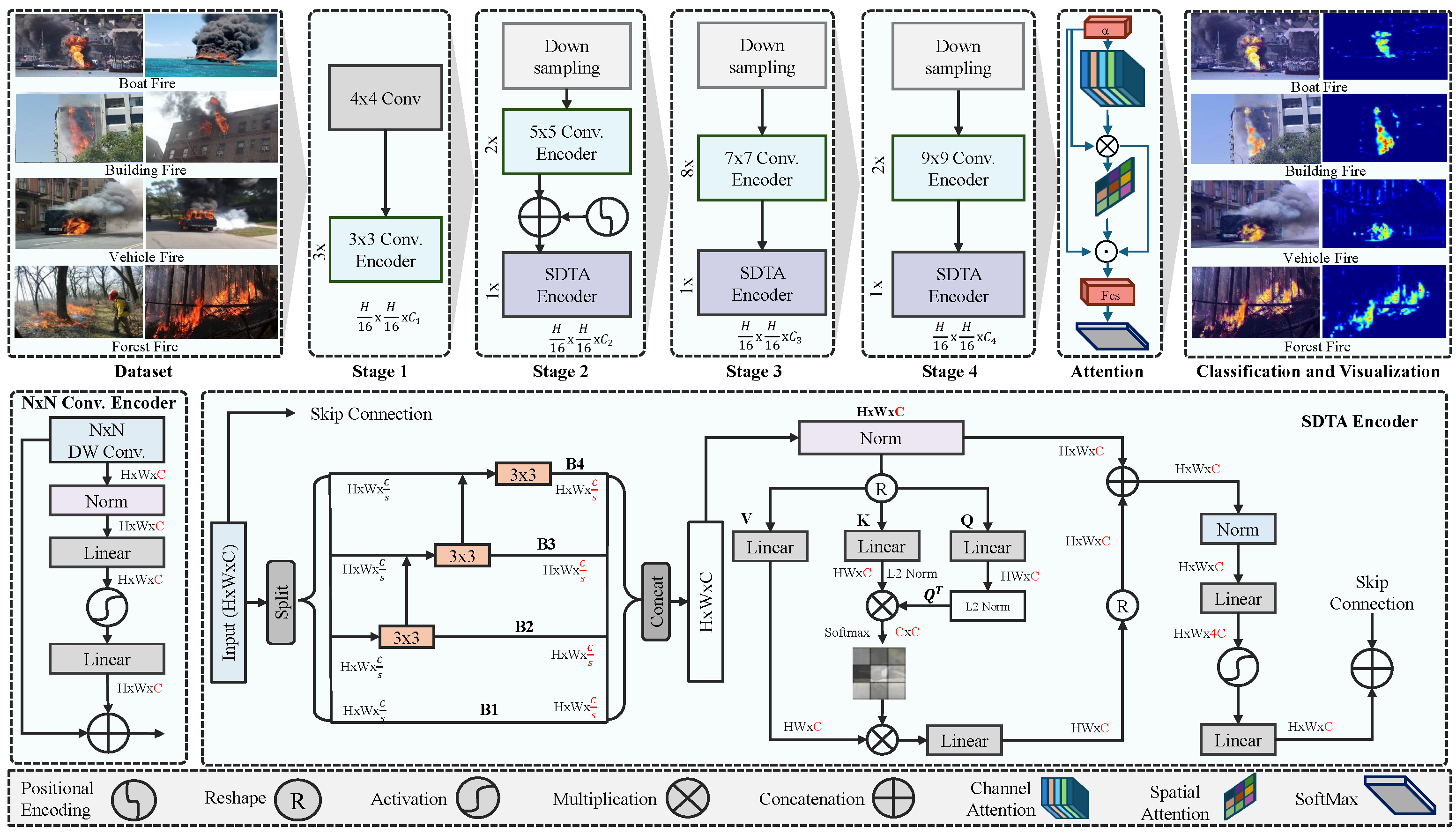
This section presents the proposed EdgeNeXt-Attn framework, which integrates CNN, ViT, and a channel–spatial attention module for effective fire detection. The overall framework is illustrated in Figure 2.

3.1. Key Innovations

Before presenting the architectural details, we summarize the three principal innovations of this work that distinguish EdgeNeXt-Attn from prior EdgeNeXt applications and from earlier fire-detection frameworks:
First EdgeNeXt-based fire detection framework with dedicated channel–spatial attention refinement: To the best of our knowledge, this is the first work to combine the EdgeNeXt hybrid CNN–ViT backbone with an integrated channel–spatial attention refinement module for fire scene classification. Previous EdgeNeXt applications have focused on generic object recognition benchmarks such as ImageNet and COCO, in which the target objects have distinct geometric priors. Fire imagery, in contrast, exhibits distinctive spectral characteristics (high R > G > B response), highly irregular non-rigid boundaries, and widely varying scales across imaging platforms. These properties require targeted feature refinement beyond what a general-purpose backbone provides. Our channel–spatial attention module is designed specifically to address these fire-specific properties within a computationally lightweight framework.
Cross-platform validation strategy with a single unified model: Existing fire-detection studies typically evaluate on a single platform type (either CCTV-only or aerial-only), and models trained on one platform generally do not transfer well to another due to fundamentally different image statistics. In contrast, our framework is validated across four datasets spanning three imaging platforms, such as ground-based CCTV (DFAN, Complex-Fire), aerial UAV (FLAME), and mixed drone–satellite (ADSF), using a single unified architecture. This demonstrates multi-source remote sensing generalization rather than platform-specific optimization, addressing an important gap in the fire detection literature.
Complete three-tier edge-deployment characterization: Beyond accuracy metrics, we proposed a lightweight hybrid CNN–ViT fire-detection model, which has the capability of real-time processing. The proposed model is evaluated on three different devices: GPU (NVIDIA RTX 2070), CPU (Intel Core i9), and low-power edge device (Raspberry Pi 4B). We report not only inference throughput (FPS) but also multiply–add operation count (MAdds), floating-point operation count (FLOPs), peak host and GPU memory footprint, and average power draw during sustained inference on the Raspberry Pi. This deployment characterization directly supports the practical deployability claim that motivates lightweight fire detection research.

3.2. Preliminary

Let I R H × W × 3 denote an input image of height H, width W, and three color channels. The goal of wildfire detection is to learn a mapping function F : I y , where y { 0 , 1 } represents the binary class label, with y = 1 indicating the presence of fire and y = 0 indicating a non-fire region. The mapping function F is parameterized by a deep neural network with learnable parameters θ , optimized by minimizing the cross-entropyloss:
L ( θ ) = 1 N i = 1 N y i log ( y ^ i ) + ( 1 y i ) log ( 1 y ^ i ) ,
where N denotes the total number of training samples, y i is the ground-truth label, and y ^ i = F ( I i ; θ ) is the predicted probability of fire for the i-th sample. The network F is composed of three sequential modules: a convolutional encoder F conv for local spatial feature extraction, an SDTA encoder F SDTA for global contextual representation, and a channel–spatial attention module F attn for discriminative feature refinement. The overall feature transformation is expressed as:
y ^ = F cls F attn F SDTA ( F conv ( I ) ) ,
where F cls denotes the final classification layer.

3.3. EdgeNeXt Overview: Design Principles

The proposed EdgeNeXt-Attn is built on the EdgeNeXt backbone(Maaz et al. [49]), with emphasis on the aspects that motivate its use for fire detection in remote sensing imagery. EdgeNeXt was originally developed for on-device mobile vision. It targets the same accuracy range as ViT-family models while operating on low computational cost devices. It achieves this through three ideas that together distinguish it from both CNNs (e.g., MobileNet, ResNet) and ViTs (e.g., DeiT, MobileViT):
(i) Adaptive per-stage kernel sizes: Unlike a standard CNN that uses a fixed kernel size (typically 3 × 3 ) at every layer, EdgeNeXt uses progressively larger kernels such as 3 × 3 , 5 × 5 , 7 × 7 , and 9 × 9 , at successively deeper stages. Small kernels in early layers capture fine local texture at low cost; larger kernels in deeper layers expand the effective receptive field to integrate wider spatial context without the quadratic cost of self-attention. This hierarchical kernel arrangement corresponds directly to the multi-scale nature of wildfire imagery: fine-grained features such as flame boundaries and combustion textures are captured through the narrow receptive fields of shallower stages, whereas broader contextual features, including smoke plume morphology, burn scar patterns, and scene-level illumination cues, are extracted through the expanded receptive fields at deeper stages.
(ii) Cross-Covariance Attention (XCA): Standard self-attention has cost quadratic in the number of image tokens, which has limited performance at high resolution. EdgeNeXt replaces this with cross-covariance attention (XCA), which computes attention along the channel dimension rather than the spatial dimension. Because the number of channels C is typically much smaller than the number of spatial tokens N ( with N = H × W ) , XCA reduces attention complexity from O ( N d ) to O ( N d ) , essentially linear in image resolution. Practically, this means EdgeNeXt can process 256 × 256 fire imagery at low latency even on edge devices.
(iii) Hybrid CNN–Transformer topology: Rather than choosing between a CNN and a Transformer, EdgeNeXt combines them: each stage contains a convolutional encoder (for local features) followed by an SDTA encoder (for global-context features via XCA). This design captures both local and global cues in the same pass, which is desirable for fire detection because both are informative: flames are locally distinctive in color and texture, while the surrounding scene provides the context that separates real fires from fire-like distractors.
While these three properties make EdgeNeXt an efficient and well-balanced backbone for general vision tasks, its standalone configuration remains insufficient for the specific challenges of remote-sensing fire detection. In particular, small and occluded fire regions captured from drone or satellite viewpoints often occupy only a marginal fraction of the image, where the discriminative spectral and structural cues are easily overwhelmed by dominant background responses. The vanilla EdgeNeXt lacks an explicit mechanism to selectively amplify these subtle fire-related signals across both channel and spatial dimensions, which limits its sensitivity to sparse and partially visible fire regions. Motivated by these limitations, we extend the baseline EdgeNeXt with a dedicated channel–spatial attention refinement module, as detailed in the following section.

3.4. Feature Extraction Using CNN/Transformer Backbone

This work proposes a lightweight hybrid CNN–ViT architecture for low-power edge deployment, utilizing EdgeNeXt for efficient feature extraction. In the EdgeNeXt backbone, the attention mechanism achieved linear computational complexity with respect to the input spatial dimension, i.e., O ( N · d 2 ) . Notably, the EdgeNeXt model utilized self-attention across the entire channel dimension, not the spatial dimension. Additionally, the proposed backbone feature extractor (EdgeNeXt) model used only three attention blocks, which is an efficient approach compared to the nine attention blocks in MobileViT. The EdgeNeXt model captures global representations with significantly fewer multiplication and addition operations (MAdds), which is a key factor in ensuring low-latency inference on resource-constrained devices. To justify the choice of the EdgeNeXt model architecture, Maaz et al. [49] emphasize two desirable design principles: efficient global information encoding and adaptive kernel sizing. Maaz et al. [49] introduced cross-covariance attention (XCA), which applies attention along feature channels rather than spatial tokens, reducing complexity from quadratic to linear while preserving global context. EdgeNeXt further improves efficiency using adaptive kernel sizes: smaller kernels in early layers and larger ones in deeper layers to balance computational cost and representational capacity.

3.5. Proposed Architecture

The proposed model mainly consists of three key components: (1) an adaptive k ( s ) × k ( s ) convolutional encoder F conv , (2) a split depth-wise transpose attention (SDTA) encoder F SDTA [50], and (3) a channel–spatial attention mechanism F attn . Given an input image I R H × W × 3 , the overall feature transformation pipeline is expressed as:
F out = F attn F SDTA ( F conv ( I ) ) ,
where F out R H 4 × W 4 × C 4 denotes the final refined feature representation passed to the classification layer F cls , with H 4 = H 32 , W 4 = W 32 , and C 4 being the channel dimension at the fourth stage.

3.5.1. Network Stem and Hierarchical Stages

Given an input image of size H × W × 3 , the network begins with a core patchify layer, implemented using a non-overlapping 4 × 4 convolution, followed by layer normalization. This operation produces feature maps of size H 4 × W 4 × C 1 , followed by a 3 × 3 convolutional encoder for local feature extraction. A 2 × 2 stride is then used for dimensionality reduction, which halves the spatial dimensions and increases the channel width, resulting in H 8 × W 8 × C 2 feature maps. This strategy is used for two consecutive 5 × 5 convolutional encoders. Positional encoding is introduced before the SDTA block only at this stage. It can be observed that applying positional encoding to all stages increases latency and provides limited benefits for dense prediction tasks such as object detection, recognition/classification, segmentation, etc. Therefore, positional encoding is used only once to efficiently encode spatial location information. In subsequent stages, the feature maps are further downsampled, generating outputs of sizes H 16 × W 16 × C 3 and H 32 × W 32 × C 4 at the third and fourth stages, respectively.

3.5.2. Convolutional Encoder

This section explains the convolutional encoder operation, which comprises a depth-wise convolution with an adaptive k ( s ) × k ( s ) kernel, where k ( s ) { 3 , 5 , 7 , 9 } for stages s { 1 , 2 , 3 , 4 } , respectively. Given an input feature map x i R H s × W s × C s , the depth-wise convolution Dw ( s ) : R H s × W s × C s R H s × W s × C s operates independently on each channel using a k ( s ) × k ( s ) kernel:
z i = LN Dw ( s ) ( x i ) ,
where LN ( · ) denotes layer normalization. Two point-wise convolutional layers W 1 R C s × C s and W 2 R C s × C s are employed to improve the local representation, integrated with layer normalization and Gaussian Error Linear Unit (GELU) activation for non-linear mapping, defined as:
GELU ( x ) = x · Φ ( x ) ,
where Φ ( x ) is the cumulative distribution function of the standard normal distribution. A skip connection ensures accurate information flow across the hierarchy. This design resembles the ConvNeXt block but uses stage-dependent dynamic kernel sizes. The convolutional encoder can be mathematically formulated as:
x i + 1 = x i + Linear G Linear ( LN ( Dw ( s ) ( x i ) ) ) ,
where x i R H s × W s × C s , Dw ( s ) , and Linear G represent the input feature map at stage s, the depth-wise convolution operation with kernel size k ( s ) , and a point-wise convolution operation followed by GELU activation, respectively. The computational cost of the depth-wise convolution at stage s is:
MAdds Dw ( s ) = ( k ( s ) ) 2 · C s · H s · W s ,
which grows with kernel size k ( s ) but remains efficient due to the reduced spatial resolution H s × W s at deeper stages. The output feature map x i + 1 R H s × W s × C s preserves the spatial dimensions while enriching the local feature representation.

3.5.3. Split Depth-Wise Transpose Attention (SDTA) Encoder

In EdgeNeXt, the SDTA encoder comprises two components: a multi-scale feature extraction module that adaptively encodes spatial information and a lightweight attention mechanism that captures global context with linear computational complexity. The multi-scale feature extraction module is inspired by Res2Net [51], which employs a multi-scale representation strategy within a single block. Unlike Res2Net, this work omits the 1 × 1 point-wise convolutions, thereby reducing both the parameter count and the number of multiply-add operations (MAdds). The input tensor X R H × W × C is divided into s subsets, each represented as x i with C s channels. Each subset passes through a 3 × 3 depth-wise convolution d i , except the first subset. The output y i of each subset is defined as represented by Equation (8).
y i = x i , i = 1 ; d i ( x i ) , i = 2 , t = 2 ; d i ( x i + y i 1 ) , 2 < i s , t .
Here, t { 2 , 3 , 4 } denotes the stage index. d i represents a depth-wise operation that receives feature maps from all previous splits { x j , j i } , enabling hierarchical and adaptive learning of the receptive field. To encode global context efficiently, transposed channel attention replaces spatial self-attention, reducing quadratic spatial complexity to linear complexity for resource-constrained devices.
Given a normalized tensor Y R H × W × C , we project onto query ( Q ), key ( K ), and value ( V ) spaces using linear transformations:
Q = W Q Y , K = W K Y , V = W V Y ,
where W Q , W K , and W V are the learnable projection weights. After L2 normalization of Q and K , cross-covariance attention is computed as:
Attention ( Q , K , V ) = V · softmax ( Q T · K ) ,
which gives us the attention matrix C × C . The final output is:
X ^ = Attention ( Q , K , V ) + X .
Two additional 1 × 1 point-wise convolution layers, followed by LN and GELU, enhance non-linear feature representation. Channel–spatial attention is then applied to further refine features, improving detection of small and challenging fire regions.

3.5.4. Channel–Spatial Attention Module

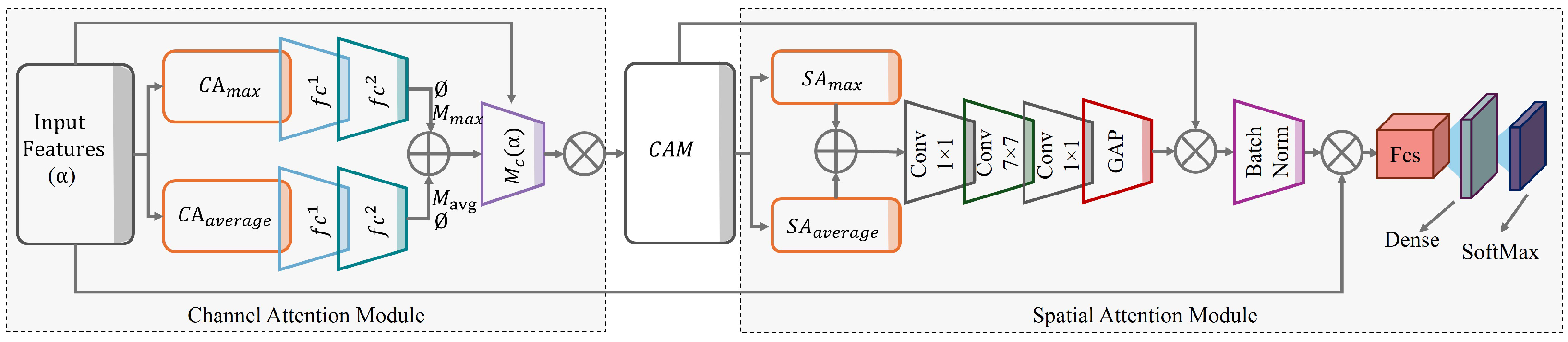
This section describes the channel and spatial attention mechanisms. Channel attention enhances discriminative capability by emphasizing informative channel-wise features in F C , H , W new , which capture fire-related cues such as color, texture, and boundaries. It improves fire–background separation through adaptive channel weighting and involves three stages: channel aggregation, shared MLP transformation, and attention map generation, shown in Figure 3.
Channel-wise aggregation summarizes the spatial information of F C , H , W new into compact descriptors using global average and maximum pooling, capturing each channel’s mean and peak contributions (Equations (11) and (12)).
γ c average = 1 H × W h = 1 H w = 1 W F c , h , w new .
The result is a descriptor vector Γ C , 1 , 1 average that highlights channels with consistently high responses across the spatial field.
β c maximum = max 1 h H , 1 w W F c , h , w new .
This yields a descriptor B C , 1 , 1 Max , which focuses on the most prominent spatial activations per channel. By integrating maximum and average pooled descriptors, the module extracts both global and extreme spatial features, providing a robust representation of each channel’s significance. The output of the maximum and average pooling operation is followed by a shared multi-layer perceptron layer (MLP) to model non-linear channel inter-dependencies. The MLP contains one hidden layer with a reduction ratio r, decreasing model complexity while preserving representational capability, as calculated by Equation (13).
W 0 R C r × C , W 1 R C × C r ,
with a ReLU activation applied after W 0 . The hidden layer output size is C r × 1 × 1 . Finally, a channel attention M C R C × 1 × 1 is obtained by summing the multi-layer perceptron outputs of both descriptors, followed by a sigmoid activation function in Equation (14).
M C = σ W 1 ( W 0 ( Γ C , 1 , 1 Avg ) ) + W 1 ( W 0 ( B C , 1 , 1 Max ) ) ,
where σ ( · ) indicates the sigmoid activation function. The attention map M C assigns a learned importance weight to each channel, allowing the network to emphasize the most discriminative ones. After obtaining the enhanced feature map, an element-wise multiplication between the original feature map and the attention map is performed.

3.5.5. Spatial Attention Mechanism

The spatial attention module enhances discriminative capability by emphasizing informative regions, such as fire shape, color, and texture, while suppressing irrelevant background features. It generates an attention map from the feature map F to highlight fire-affected areas and improve distinction from visually similar objects. The process involves feature aggregation, attention map generation, and feature modulation. First, the contextual information from the input feature map F R C × H × W is aggregated using averaging and maximization methods to obtain compact representations that emphasize informative spatial regions, as illustrated in Figure 3. In the spatial attention mechanism, the maximum pooling reflects the highest activation in the channel dimension for each spatial position, and average pooling reflects the mean activation across all channels for each spatial location, as calculated using Equations (15) and (16), respectively.
α h , w max = max c = 1 , 2 , , C F c , h , w .
ξ h , w avg = 1 C c = 1 C F c , h , w .
The input feature map F is reduced to two single-channel maps ξ Avg 1 , H , W and α Max 1 , H , W using the average and max pooling to emphasize general and extreme activations, respectively. Afterwards, the extracted feature maps are fused along the channel dimension, as given in Equation (17), to form a comprehensive spatial descriptor Υ 2 , H , W concat , which is then processed by a k × k convolution to generate the raw spatial attention scores (Equation (17)).
ϕ h , w = m = 0 k 1 n = 0 k 1 f m , n · Υ h + m , w + n concat , ( h , w ) ,
where f m , n denotes the convolution kernel weights. The convolutional output ϕ h , w is normalized using a sigmoid activation function to produce the final attention map δ h , w . Finally, the attention map δ h , w is used to reweight the original feature map F via element-wise multiplication, enhancing critical spatial regions while suppressing less relevant areas:
F c , h , w new = F c , h , w × δ h , w , c , h , w .
The resulting refined feature map F C , H , W new retains the same dimensions as the input but emphasizes diagnostically significant regions. After applying the spatial attention module, the enhanced feature map F new is passed to the channel attention mechanism for further refinement and recalibration of inter-channel features. Finally, the output of both the channel–spatial attention mechanisms is fed to the softmax layer for final classification.

3.5.6. Synergistic Interaction of Channel and Spatial Attention

The proposed model combines channel attention M C and spatial attention δ ( h , w ) as sequential refinement operations rather than as independent parallel branches. This section explains the theoretical rationale for this design choice and clarifies why the two attention branches are complementary rather than redundant. Channel attention operates in the feature-channel space and answers the question:Which spectral and textural feature channels carry fire evidence? This is well suited to fire because fire exhibits distinctive spectral properties (high R > G > B response, strong luminance, and characteristic warm-color texture patterns) that, after the EdgeNeXt convolutional encoders are applied, occupy specific feature channels in the deep feature volume. By reweighting these channels through the learned attention map M C , the network amplifies fire-discriminative spectral cues and suppresses channels dominated by irrelevant background textures (e.g., sky, foliage, and road surfaces). However, channel attention alone is spatially agnostic; it cannot indicate where within the image the fire is located, only that fire-like feature responses are present somewhere. Spatial attention operates in the complementary image-plane space and answers the question: “Which pixel locations contain fire evidence?” This is well suited to fire because flames are spatially localized within the image with irregular but coherent boundaries. The spatial attention map δ ( h , w ) emphasizes candidate fire locations while suppressing irrelevant background regions. However, spatial attention alone is spectrally agnostic; it cannot distinguish between a genuine flame region and a spatially similar fire-like distractor (e.g., a red vehicle, a sunset patch, or a burnt orange leaf cluster) that occupies a coherent image location. The synergistic combination first applies channel attention to filter spectrally plausible features, followed by spatial attention to localize within those filtered features creates a two-stage refinement that combines the strengths of both branches. Formally, the refined feature map F ( c , h , w ) new is expressed as:
F ( c , h , w ) new = δ ( h , w ) M C F ( c , h , w ) ,
where ⊙ denotes element-wise multiplication, applied channel-wise or spatially as appropriate.
A pixel location ( h , w ) produces a strong post-refinement response only if it satisfies both conditions: It has a strong response in a spectrally fire-relevant channel (channel attention stage), and It is located within a spatially plausible fire region (spatial attention stage).
This logical AND-like interaction enables the model to reject fire-like distractors that satisfy only one of these conditions. For example, a red vehicle may appear spatially coherent but does not activate fire-relevant feature channels after training, whereas diffuse sky glow may activate warm-color channels but lacks the localized spatial structure characteristic of flames. Consequently, the sequential integration of channel and spatial attention improves both feature discrimination and localization accuracy. The effectiveness of this synergistic attention mechanism is empirically validated through the ablation study and the quantitative Grad-CAM analysis.

3.6. Conceptual Justification of the Proposed Design for Wildfire Detection

The architectural components introduced in the above subsections are motivated by the physical and visual characteristics of wildfire imagery in smart surveillance and remote sensing settings. This subsection makes the correspondence explicit.
Small targets in wide-area imagery: A wildfire captured from a UAV or satellite platform often occupies only 0.1–2% of image pixels; even in CCTV footage, distant fires may cover only a few dozen pixels. Detecting such small targets requires the network to relate a small region of high fire-likelihood to the broader scene context. The SDTA encoder with cross-covariance attention establishes global channel dependencies at linear cost, allowing a small fire-signal channel to be amplified globally rather than only within a local receptive field. The 9 × 9 kernel at Stage 4, applied at the coarsest spatial resolution, further expands the effective receptive field to relate distant pixels.
Varying spatial resolution across platforms: Ground-based CCTV, aerial UAV, and satellite imagery cover ground-sample distances that differ by 3–4 orders of magnitude. The stage-adaptive kernels (3, 5, 7, 9) provide a multi-scale hierarchy in the encoder, and the 32 × total downsampling before classification ensures that a fire region occupying a large area at one scale and a small area at another map to a comparable feature-map footprint at the classification head. This is the mechanism by which the same model can classify DFAN CCTV imagery and ADSF satellite imagery.
Fire-like distractors: Every fire-detection dataset contains fire-like distractors that trigger naive color-based methods, such as sunset glow (satellite scenes), tail-lights and red vehicles (CCTV), autumnal foliage (UAV forest imagery), and artificial lighting. Distinguishing a flame from such distractors requires more than color reasoning; it requires the network to integrate global context, which the SDTA encoder’s XCA attention provides.
Occlusion by smoke, canopy, or structures: Wildfires are frequently partially occluded, especially in later phases when smoke rises and covers the flame source. The combination of local features from the CNN encoders with global attention allows inference of fire presence from partial visibility: for example, detecting fire underneath a smoke plume by attending to the plume itself as an indirect cue. This robustness to occlusion is demonstrated in the qualitative results section.
Together, these correspondences show that the design of EdgeNeXt-Attn is not a generic architecture choice but a targeted response to the specific challenges of multi-platform ground CCTV and remote sensing fire detection.

4. Results and Discussion

This section presents the experimental evaluation, including datasets, hyperparameters, evaluation metrics, and comparative and ablation analyses.

4.1. Datasets Explanation

Three different publicly available benchmark datasets, DFAN, Complex-Fire dataset, and ASD, were used in this study.
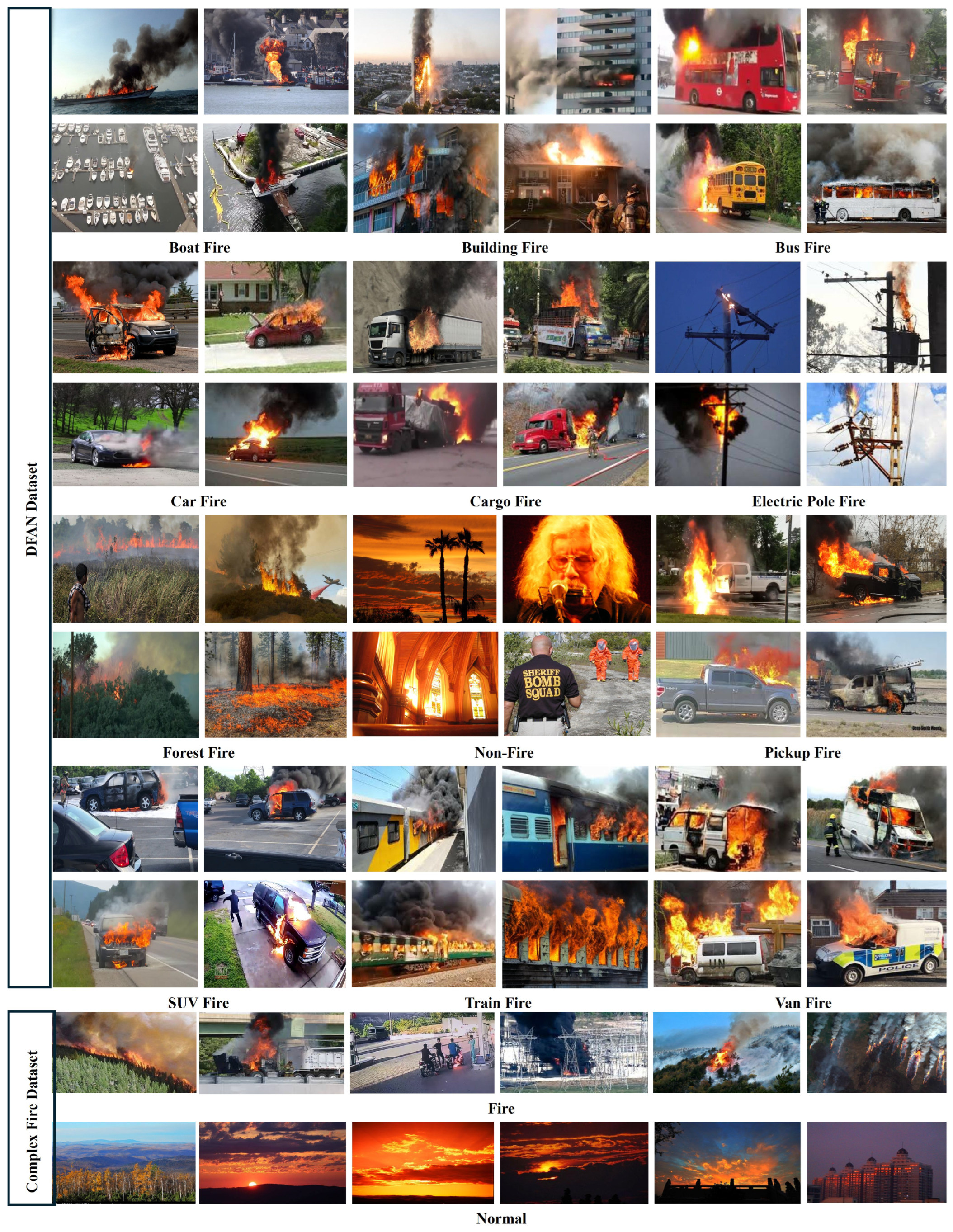
DFAN Dataset [20]: DFAN is a small-scale, challenging, diverse, and unbalanced dataset in the fire detection domain. The dataset is created from videos of disaster management agencies, Facebook, and YouTube, consisting of 12 different classes, and a total of 3804 images. The number of images in each class is as follows: 338 images of Boat-fire (class 0), 305 images of Building-fire (class 1), 400 images of Bus-fire (class 2), 579 images of Car-fire (class 3), 207 images of Cargo-fire (class 4), 300 images of Electric pole-fire (class 5), 480 images of Forest-fire (class 6), 97 images of Normal (class 7), 257 images of Pick-up-fire (class 8), 240 images of SUV-fire (class 9), 300 images of Train-fire (class 10), and 300 images of Van-fire (class 11). Sample images from the DFAN dataset are presented in Figure 4.
Complex-Fire Dataset [25]: Recently, Yar et al. [25] proposed a complex dataset that is diverse, challenging, and derived from real-time video recordings and online sources. The dataset covers multiple scenarios such as building fires, vehicle fires, gas cylinder fires, and forest fires. It consists of a total of 7642 images, of which 4036 images belong to the fire class, and the remaining images belong to the normal class. Sample images from the Complex-Fire dataset are presented in Figure 4.
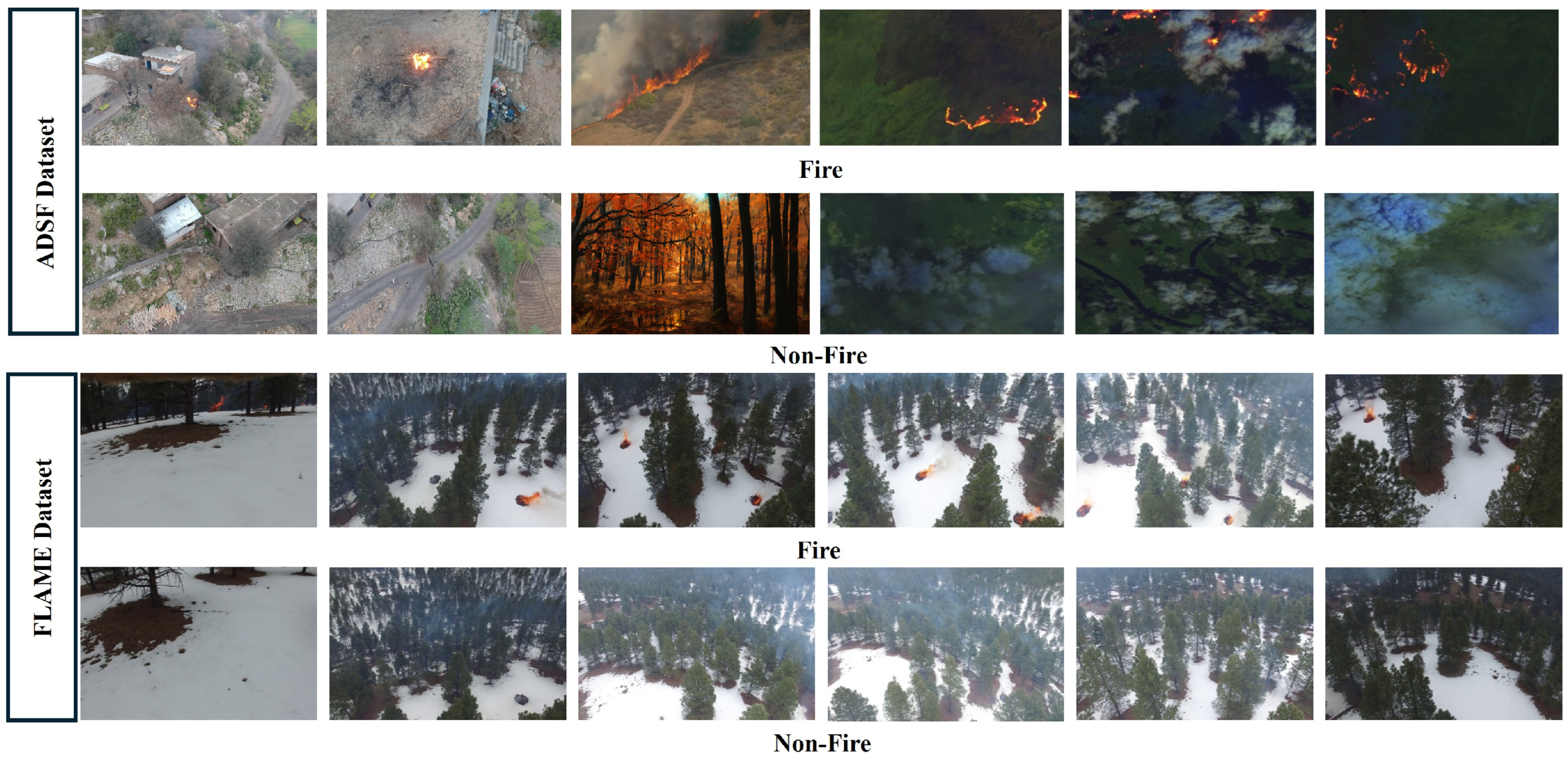
Aerial Drone and Satellite Fire (ADSF) Dataset [14]: This dataset comprises 6000 drone and satellite images labeled as fire and non-fire, evenly distributed between the two classes. The fire class includes 1000 drone images and 2000 satellite images, while the non-fire class contains 1000 forest-scene images and 2000 additional satellite and web-sourced images. All the datasets were split into 70% training, 20% validation, and 10% testing sets. Sample images from the ADSF dataset are shown in Figure 5.
The Fire Luminosity Airborne-based Machine Learning Evaluation (FLAME) Dataset is a publicly available UAV-based remote sensing dataset developed for wildfire classification and segmentation. It was collected during prescribed pile-burning operations in a ponderosa pine forest near Flagstaff, Arizona, USA, using multiple DJI drones equipped with RGB and thermal sensors. The dataset captures diverse remote sensing conditions, including varying flight altitudes, viewing angles, fire intensities, and complex environmental backgrounds, making it representative of real-world aerial wildfire monitoring scenarios. In this study, only the RGB aerial imagery is used for fire classification. The dataset comprises 39,375 labeled training images and 8617 independent test images, with each image annotated as either Fire or No Fire. The training set was further divided into training and validation subsets using an 80:20 split. Owing to challenges such as scale variation, smoke occlusion, illumination changes, and cluttered forest backgrounds, the FLAME dataset provides a valuable benchmark for evaluating lightweight deep learning models for UAV-based remote sensing and real-time wildfire monitoring on edge devices. The sample images of the FLAME dataset are shown in the last two rows of Figure 5.

4.2. Experimental Environment and Evaluation Parameters

The experiments were conducted using a high-performance computing setup, equipped with an Intel Core i9 CPU (3.60 GHz) with an NVIDIA GeForce RTX 2070 GPU. We utilized the Keras DL framework on a Windows 11 platform to develop and train the fire detection model. The required libraries used for our model implementation are Scikit-learn 1.61, NumPy 1.24.0, Pandas 2.3.3, Pillow 11.3.0, Matplotlib 3.9.4, Seaborn 0.13.2, and tqdm. The proposed model was trained for 20 epochs using an input image of 256 × 256. The batch size was set to 8, and the Adam optimizer was used with a learning rate of 0.001. These hyperparameters were chosen based on empirical experiments and prior research in fire detection. We conducted multiple trials to optimize these hyperparameters for comparable performance. The proposed model performance is evaluated using several metrics such as accuracy, recall, precision, and F1-score. These are well-known metrics and the most widely used evaluation parameters in the fire scene classification domain, as detailed in [20,38,40,52].

4.3. Experimental Results Using the DFAN Dataset

Table 1 represents the classification report of the proposed EdgeNeXt-Attn model. The proposed model obtained an average accuracy of 92.09%, with a weighted average precision of 92.36%, recall of 92.09%, and an F1-score of 92.13%. From the class-wise analysis, it can be observed that fire on the SUV and Boat classes achieved the highest F1-scores of 94.67% and 96.97%, respectively. Similarly, the fire on the Van, PickUp, and Forest fire classes achieved F1-scores of above 94%. Fire in building, car, and electric classes also performed well, attaining F1-scores of 93.44%, 92.30%, and 91.37%, respectively. The proposed model effectively detects fires in dynamic environments such as water surfaces and vehicles. However, the lower F1-scores for the Cargo (77.77%) and normal (82.35%) classes indicate challenges related to varying fire sizes, reflections, and complex backgrounds. Overall, EdgeNeXt-Attn shows better robustness and adaptability across diverse fire environments through improved handling of small or occluded fire detection.
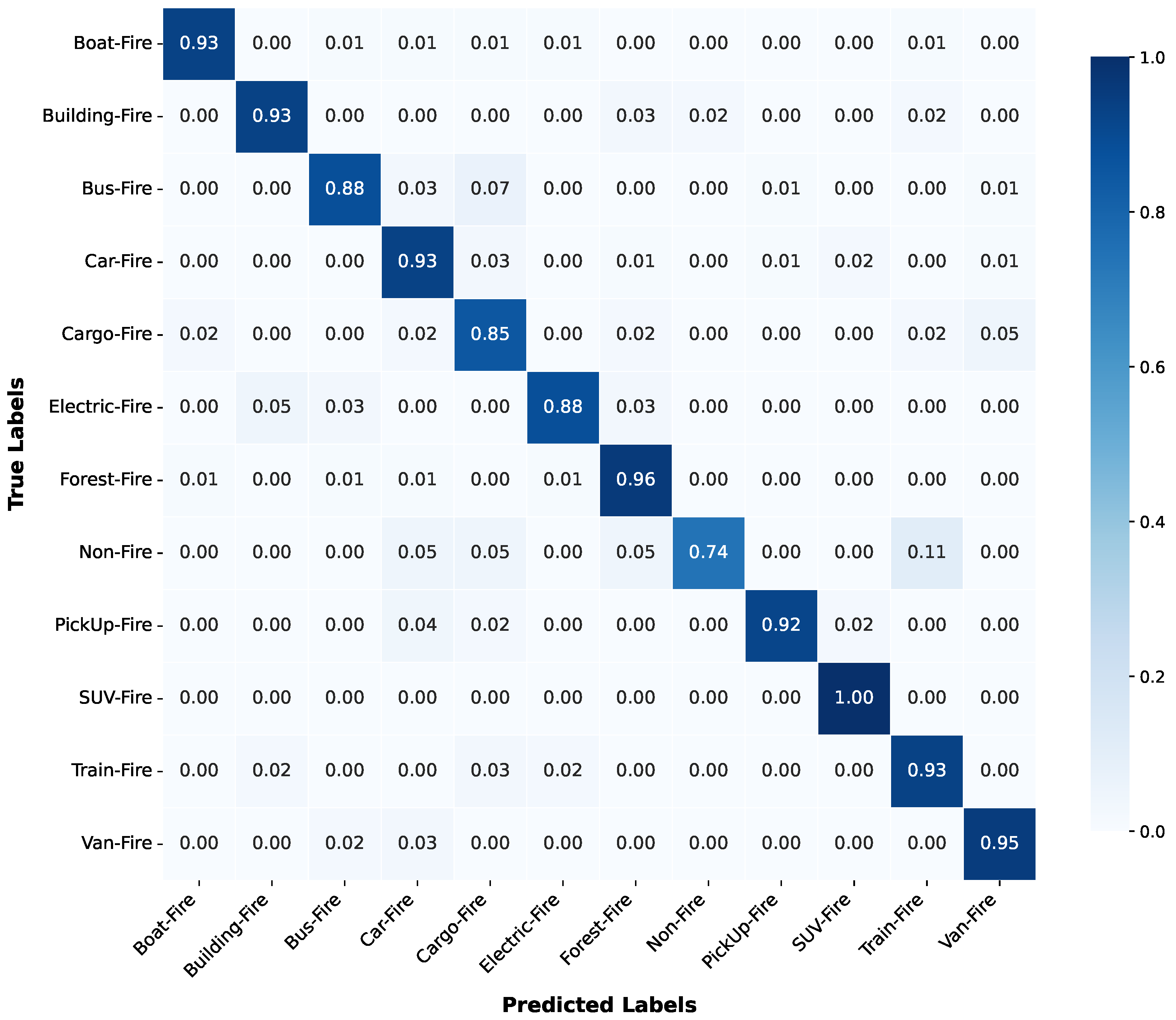
Figure 6 represents the confusion matrix of our model for the DFAN dataset. The results of EdgeNeXt-Attn show better performance across the 12 various fire classes. For most classes, including Building-Fire, Car-Fire, Forest-Fire, SUV-Fire, and Train-Fire, it achieved high accuracy, indicating strong feature learning and reliable classification. Bus-Fire and Cargo-Fire showed slightly lower confidence, mainly due to visual similarity to other vehicle fires. It also performed well on Electric-Fire but occasionally overlapped with Building-Fire because of similar indoor fire textures. It recorded the lowest performance on the Non-Fire class due to overlapping visual characteristics, confirming the model’s capability but class-dependent certainty.
The comparison given in Table 2 suggests that the lower accuracy was associated with Xception [20] and NASNetMobile [20], while EdgeNeXt-Attn obtained the highest performance among all evaluated methods. Specifically, the proposed model surpassed Xception [20] and NASNetMobile [20] by approximately 14.12% and 15.12% in accuracy, respectively. MAFire-Net [10], DFAN [20], and OFAN [53] demonstrated competitive results; nevertheless, EdgeNeXt-Attn achieved improved performance compared to these models. The proposed model achieved higher accuracies of 3.29%, 4.12%, and 3.73%, respectively, when compared to the MAFire-Net [10], DFAN [20], and OFAN [53] models. Among all methods, EFNet-CSM [13] and ADFireNet [14] achieved moderate performance, with accuracy values of 89.00% and 90.00%, respectively. Fire-MSAM [16], TensorRT FP16 [54], and KD-MobileViT [25] achieved better outcomes, with accuracy values of 91.20%, 91.22%, and 91.08%, respectively. However, the proposed model surpassed these by margins of 0.89%, 0.87%, and 1.01%, confirming its superior ability to accurately identify diverse fire scenarios in the DFAN dataset.
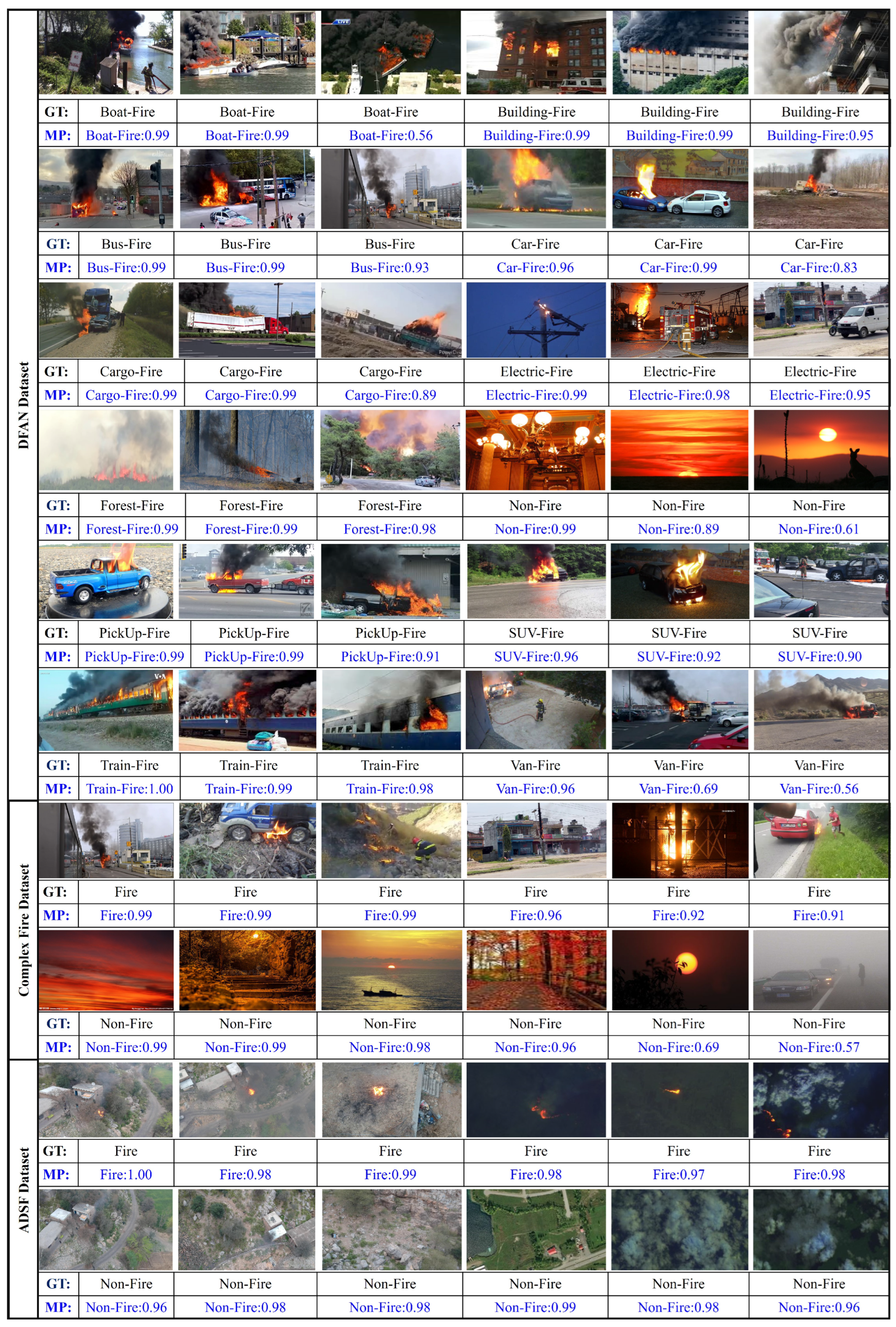
Figure 7 visualizes the EdgeNeXt-Attn predictions, where GT denotes ground truth, and MP indicates model prediction with confidence scores. The model achieves consistently high confidence above 0.90 across most fire categories, including Building-Fire, Bus-Fire, Cargo-Fire, Electric-Fire, Forest-Fire, Train-Fire, PickUp-Fire, and SUV-Fire, demonstrating strong classification reliability. Slight confidence drops in Boat-Fire, Car-Fire, Van-Fire, and Non-Fire cases are mainly due to visual similarity between vehicle types, overlapping flame patterns, or fire-like lighting conditions. Overall, the results confirm robust discrimination and high reliability across all 12 categories, with minor uncertainty in visually ambiguous scenarios.

4.4. Experimental Results Using the Complex-Fire Dataset

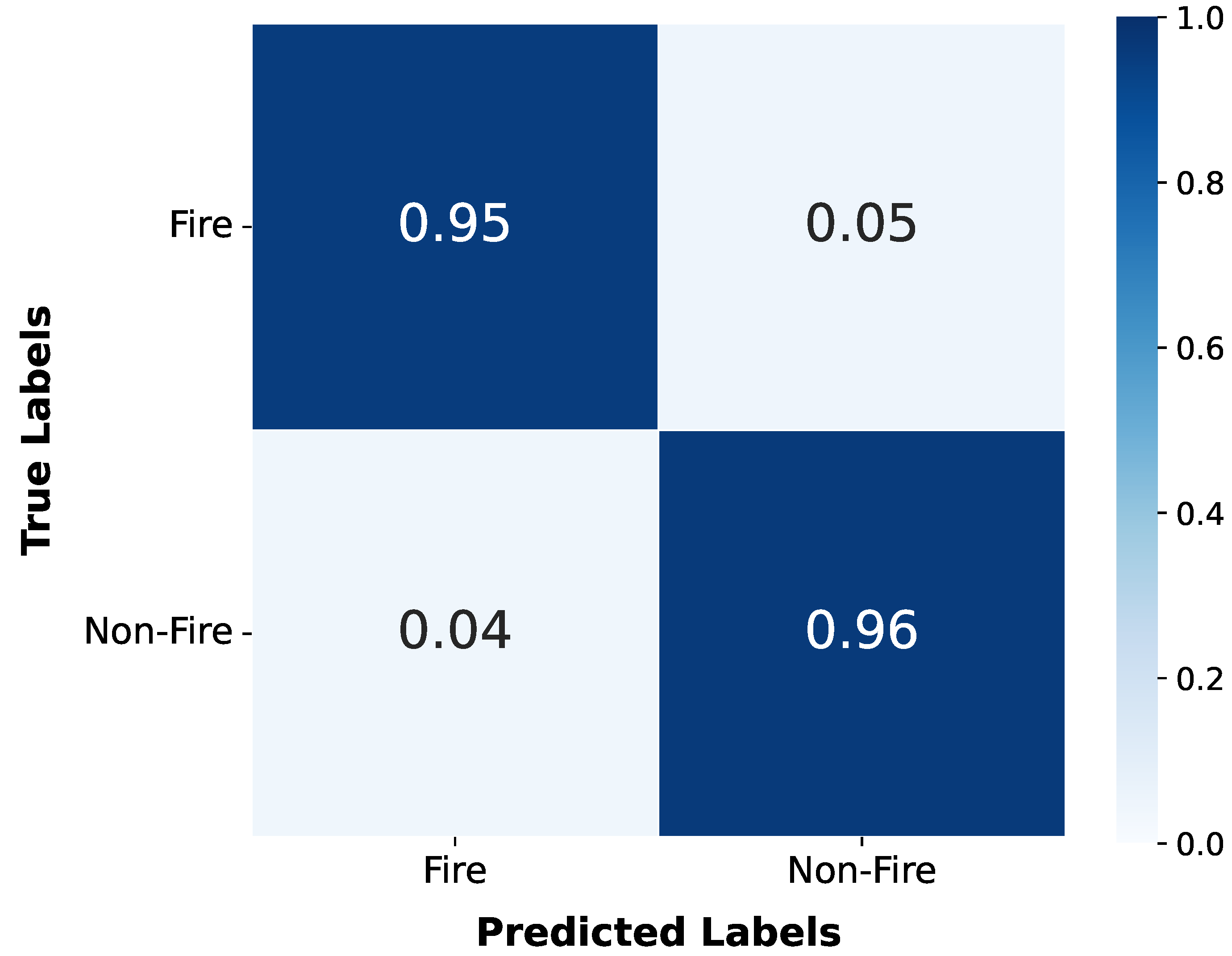
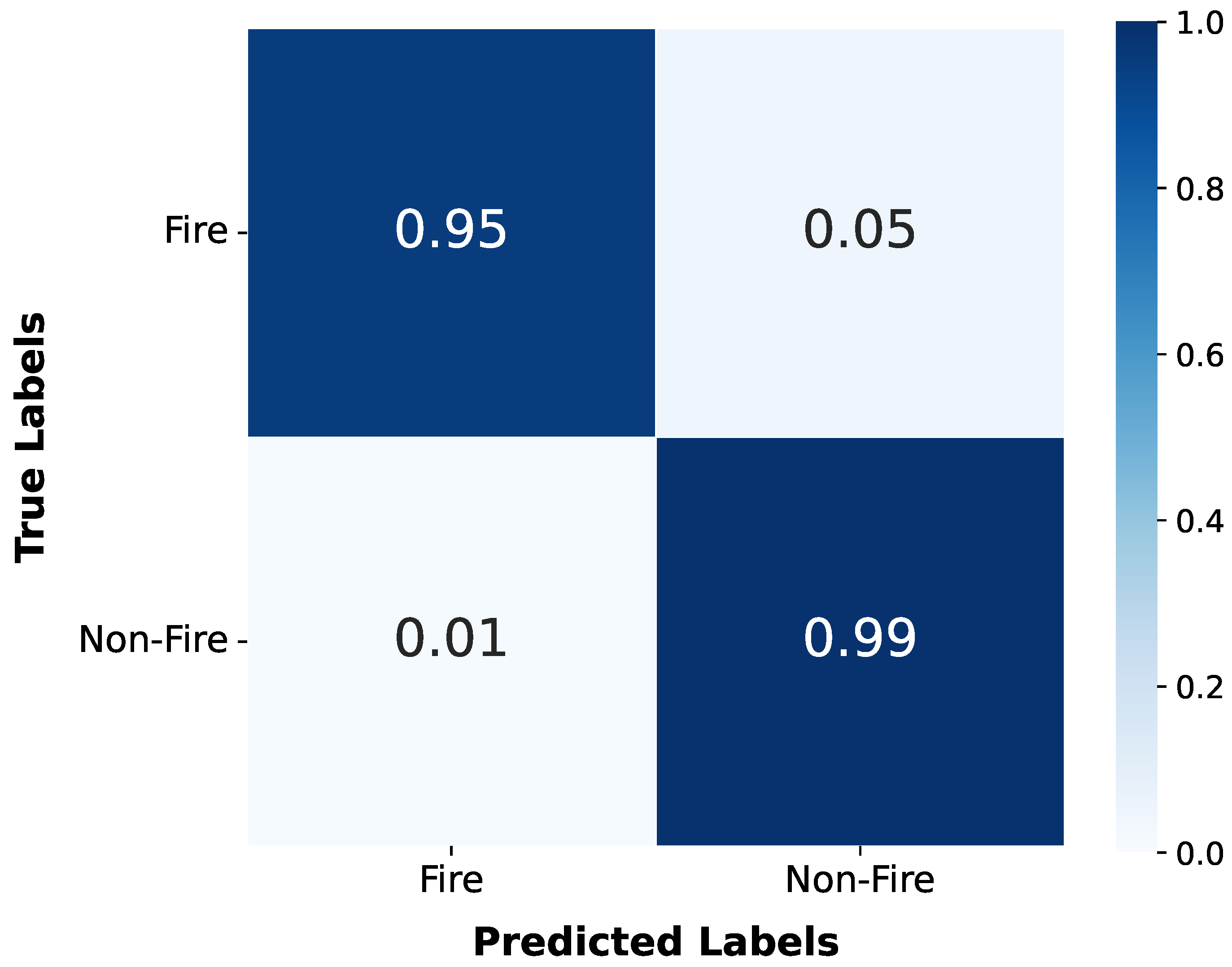
Table 3 analyzes the EdgeNeXt-Attn classification report using the Complex-Fire dataset, achieving a precision of 95.99% and a recall of 94.80% for the fire class, and a precision of 94.26% and a recall of 95.57% for the normal class. The proposed EdgeNeXt-Attn achieved average precision (95.13%), recall (95.18%), F1-score (95.15%), and accuracy (95.16%). The proposed EdgeNeXt-Attn was also assessed using a confusion matrix for each class of the Complex-Fire dataset, as demonstrated in Figure 8. Our model achieved 95% and 96% correct classification results for the fire and non-fire (normal) classes, respectively. The misclassification rates for these classes are 5% and 4%, respectively.
Table 4 presents the state-of-the-art comparisons with five existing methods, including ANetFire [30], SE-EFFNet [52], EFDNet [38], DFAN [20], and M-ViT [25]. Among them, ANetFire [30] achieved the lowest performance, with average precision, recall, F1-score, and accuracy values of 84.5%, 82.5%, 83.4%, and 82.5%, respectively. The proposed EdgeNeXt-Attn model surpassed SE-EFFNet’s [52] performance by obtaining a 5.16% higher accuracy. EdgeNeXt-Attn outperformed EFDNet [38] and DFAN [20] with accuracy improvements of 3.66% and 3.46%, respectively. The EdgeNeXt-Attn model outperformed the second-best method, M-ViT [25], achieving an average accuracy of 1.66%. Overall, Table 4 clearly shows that the EdgeNeXt-Attn model achieved better performance compared to existing fire detection methods.

4.5. Experimental Results Using the ADSF Dataset

The proposed model performance was also investigated using the ADSF dataset and achieved a precision of 96.61% and a recall of 94.66%, for the fire class, and a precision of 94.87%, and a recall of 98.66% for the normal class. The proposed model achieved an average precision, recall, F1-score, and accuracy of 96.74%, 96.66%, 96.70%, and 96.65%, respectively, as given in Table 3. Furthermore, the proposed model performance was assessed using a confusion matrix for each class, as shown in Figure 9. The proposed EdgeNeXt-Attn model achieved 95% accuracy for the fire class, while for the normal class, it reached 99%. Table 5 represents the proposed model performance against several state-of-the-art methods. These methods include EFDNet [38], DFAN [20], ADFireNet [14], Fire-MSAM [16], MobileViT-S [55], MA-ViT [48], and HFF [47]. The lowest model performance with an average accuracy of 88.0% was achieved by EFDNet [38], and the highest performance was associated with EdgeNeXt-Attn, which outperformed the second-best model with an accuracy improvement of 0.45%. When comparing the proposed model with DFAN [20], ADFireNet [14], Fire-MSAM [16], and HFF [47], our model outperformed DFAN [20], achieving 7.29% higher accuracy values. ADFireNet [14] and Fire-MSAM [16] achieved average accuracy values of 90.86% and 93.50%, respectively, which were 5.79% and 3.15% lower than those of the proposed model. The proposed model outperformed HFF [47] with an improvement in average accuracy of 0.65%. Overall, EdgeNeXt-Attn demonstrated improved performance, attaining an average accuracy of 96.65%.

4.6. Experimental Results Using the FLAME Dataset

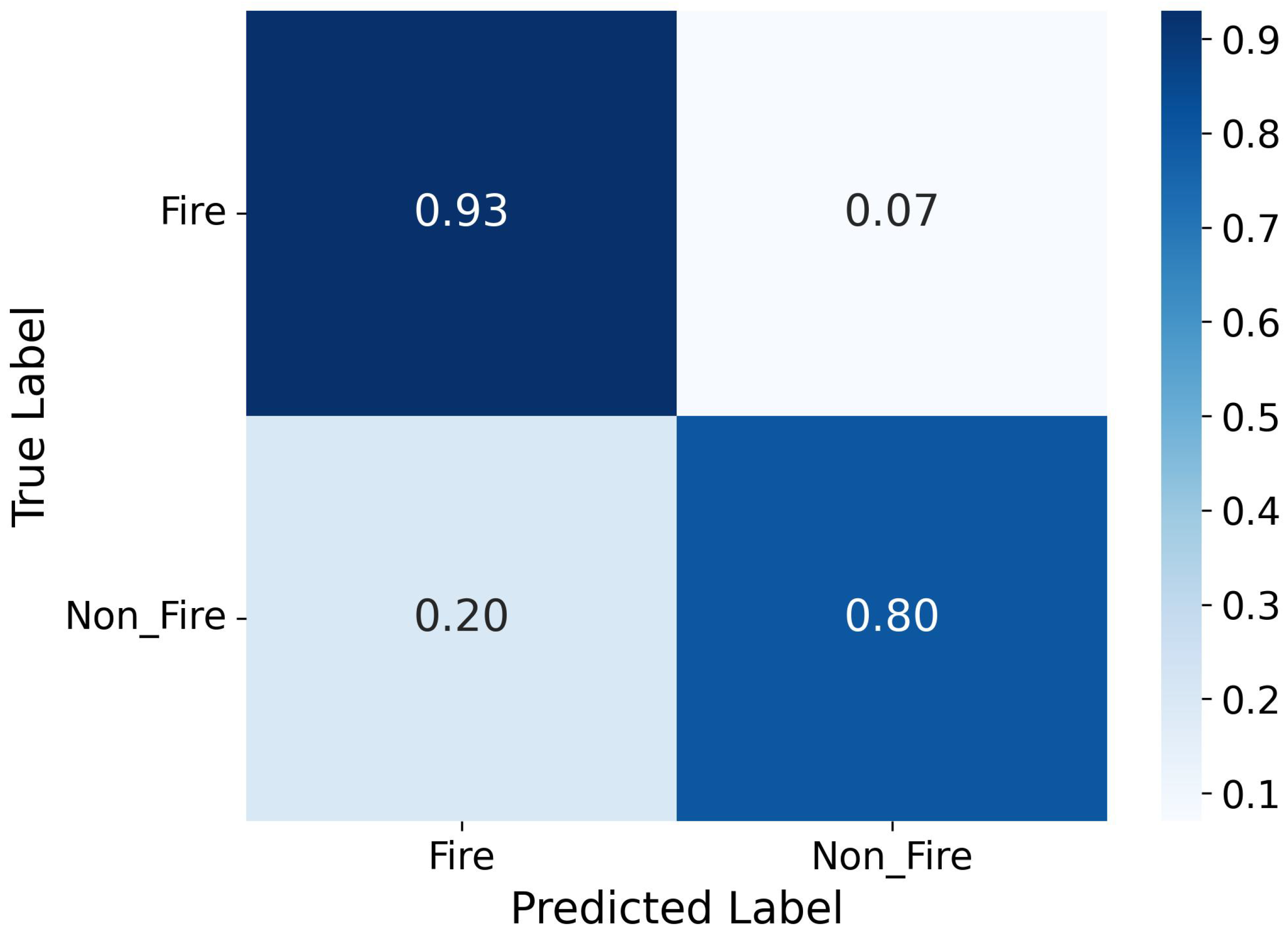
Table 3 presents the class-wise classification performance of the proposed EdgeNeXt-Attn model on the FLAME dataset. The model achieved a precision of 87.39%, recall of 92.97%, and F1-score of 90.10% for the Fire class, indicating strong sensitivity to genuine fire regions captured under aerial UAV conditions. For the Normal class, the model obtained a precision of 88.55%, a recall of 80.20%, and an F1-score of 84.17%. The proposed EdgeNeXt-Attn attained an average precision of 87.97%, recall of 86.59%, F1-score of 87.13%, and an overall accuracy of 87.81% across the entire test set. The performance of the proposed model on the FLAME dataset was further examined based on the confusion matrix illustrated in Figure 10. EdgeNeXt-Attn correctly classified 93% of Fire samples, with only 7% misclassified as Normal, demonstrating strong flame recognition under low-altitude aerial viewing conditions. For the Normal class, 80% of samples were correctly identified, with a 20% misclassification rate as Fire, primarily attributable to high visual similarity in the background objects. Overall, the confusion matrix confirms that EdgeNeXt-Attn maintains reliable fire detection performance on UAV-captured imagery, supporting its applicability to real-world aerial wildfire surveillance scenarios. To further validate the effectiveness of the proposed model on aerial remote sensing imagery, we conducted an additional experiment on the FLAME dataset, which consists of forest fire images captured by unmanned aerial vehicles (UAVs). Unlike the DFAN and Complex-Fire datasets that primarily contain ground-based CCTV imagery, FLAME reflects the operational conditions of drone-based wildfire monitoring, including varying flight altitudes, oblique viewing angles, and low fire-to-background pixel ratios that are characteristic of aerial remote sensing platforms. Table 6 presents a comparative analysis of EdgeNeXt-Attn against eighteen recent state-of-the-art methods on the FLAME dataset. Among the compared approaches, MobileNetV3-Small [43] and Unsupervised DSAN+ResNet50 [56] reported the lowest accuracy values of 51.64% and 63.90%, respectively, indicating that lightweight generic classifiers and unsupervised feature adaptation strategies struggle with the small-target and viewpoint variability inherent to UAV-captured fire imagery. Mid-range performance was achieved by conventional CNN backbones such as EfficientNet-B2, EfficientNet-B3, and MobileNetV3-Large, with accuracies between 65.10% and 66.04%, while deeper backbones, including InceptionV3 [43] and DenseNet169 [43] achieved 80.88% and 80.62%, respectively. Fire-specific attention-driven frameworks provided further improvements: DFAN [20], OFAN [53], M-ViTs [25], and EFNet-CSM [13] achieved accuracy values of 83.79%, 84.41%, 84.90%, and 85.44%, respectively, with EFNet-CSM representing the second-best performing baseline. The proposed EdgeNeXt-Attn achieved the highest performance across all four evaluation metrics on the FLAME dataset, obtaining a precision of 87.97%, recall of 86.59%, F1-score of 87.13%, and accuracy of 87.81%. Specifically, EdgeNeXt-Attn surpassed the second-best method (EFNet-CSM [13]) by 2.37 percentage points in accuracy, and it outperformed the ensemble model [43], which itself aggregates multiple deep architectures, by 2.69 percentage points. Compared to the widely adopted DFAN [20] and OFAN [53] baselines, our model achieved accuracy improvements of 4.02 and 3.40 percentage points, respectively. These results demonstrate that the proposed channel–spatial attention refinement effectively addresses the small-target and multi-scale challenges characteristic of aerial fire imagery, thereby providing strong empirical support for the applicability of EdgeNeXt-Attn to genuine UAV-based remote sensing scenarios.
The relatively lower absolute accuracy achieved on the FLAME dataset, compared to DFAN, Complex-Fire, and ADSF, is attributable to the inherently challenging nature of the benchmark rather than to any limitation of the proposed model. The FLAME dataset was captured over a densely wooded pile-burning site in a ponderosa pine forest, where fire visibility is substantially reduced by tree-canopy occlusion, smoke drift, and congested vegetation. In addition, the Non-Fire class images were acquired within the same forest environment using cropped views of fire-adjacent regions, resulting in visually similar backgrounds shared between the Fire and Non-Fire classes. This design choice introduces significant appearance overlap between the two categories, which increases classification ambiguity and requires the model to attend to subtle flame-specific cues rather than global scene context. Despite these challenging conditions, the proposed EdgeNeXt-Attn surpasses all eighteen compared state-of-the-art methods on this benchmark, demonstrating that the channel–spatial attention refinement enables the model to focus on discriminative fire evidence even under strong background similarity between classes.

4.7. Pain-Point Verification Across the Four Datasets

This subsection presents the classification results across the DFAN, Complex-Fire, ADSF, and FLAME benchmarks and interprets these results from the perspective of two key challenges identified in existing fire detection methods: missed detections and false alarms. The analysis aims to demonstrate that the proposed framework effectively mitigates both challenges.
The missed-detection rate (MDR) quantifies the fraction of true fire images that a model fails to detect and is mathematically related to recall as:
MDR = FN TP + FN = 1 Recall ,
where TP and FN denote true positives and false negatives, respectively. A high MDR reflects the safety-critical pain point of missed fires.
The false-alarm rate (FAR) quantifies the fraction of true non-fire images incorrectly predicted as fire and is obtained directly from the confusion matrices reported in Figure 6 and Figure 8, Figure 9 and Figure 10 as:
FAR = FP FP + TN ,
where FP and TN denote false positives and true negatives, respectively. A high FAR reflects the pain point of false alarms triggered by fire-like distractors. Interpreting the results reported in Table 2 and Table 6 through these two metrics confirms both pain points quantitatively. On the FLAME dataset, the DFAN baseline exhibits an MDR of 15.45% and the Xception baseline exceeds 20% MDR, reflecting the limited capacity of CNN-only architectures to detect small aerial fires. On the Complex-Fire dataset, the ANetFire baseline shows an MDR of 17.5% together with a comparatively high FAR derived from its confusion matrix, indicating that color- and CNN-based methods struggle to suppress fire-like distractors in complex urban scenes. Similar patterns are observed on the DFAN and ADSF benchmarks, where earlier CNN-based methods retain missed-detection rates of 12–22% for small or occluded fires. In contrast, the proposed EdgeNeXt-Attn simultaneously reduces both metrics across all four benchmarks. Specifically, EdgeNeXt-Attn achieves an MDR of 7.91% on DFAN, 4.82% on Complex-Fire, 5.34% on ADSF, and 7.03% on FLAME (recall = 92.97% for the Fire class), together with correspondingly low FAR values as evidenced by the strong diagonal dominance in the confusion matrices. The residual FAR on FLAME (19.80%, corresponding to 80.20% specificity for the Non-Fire class) is attributable to sun-illuminated foliage and reddish terrain patterns typical of aerial imagery. Taken together, this cross-dataset analysis directly verifies that the proposed channel–spatial attention refinement mitigates the two central pain points identified, providing quantitative evidence that complements the accuracy-based comparisons reported earlier in this section.

4.8. Grad-CAM Visualization of the Proposed Model

This subsection examines the explainability of EdgeNeXt-Attn using an XAI technique. During training, deep learning models are optimized to learn discriminative features for image classification, yet they are frequently characterized as “black boxes” because the internal reasoning underlying their predictions is not directly interpretable, and the specific features or channels driving performance cannot be inspected in a straightforward manner. To address this limitation and to expose the visual evidence relied upon by EdgeNeXt-Attn, we employ Gradient-weighted Class Activation Mapping (Grad-CAM). Grad-CAM assigns a relevance score to each neuron using the gradients back-propagated to the final convolutional layer and produces spatially localized heat-maps that highlight the regions most influential to the prediction. These heat-maps reveal whether the network attends to genuine fire evidence rather than background artifacts, thereby providing a qualitative complement to the quantitative results.
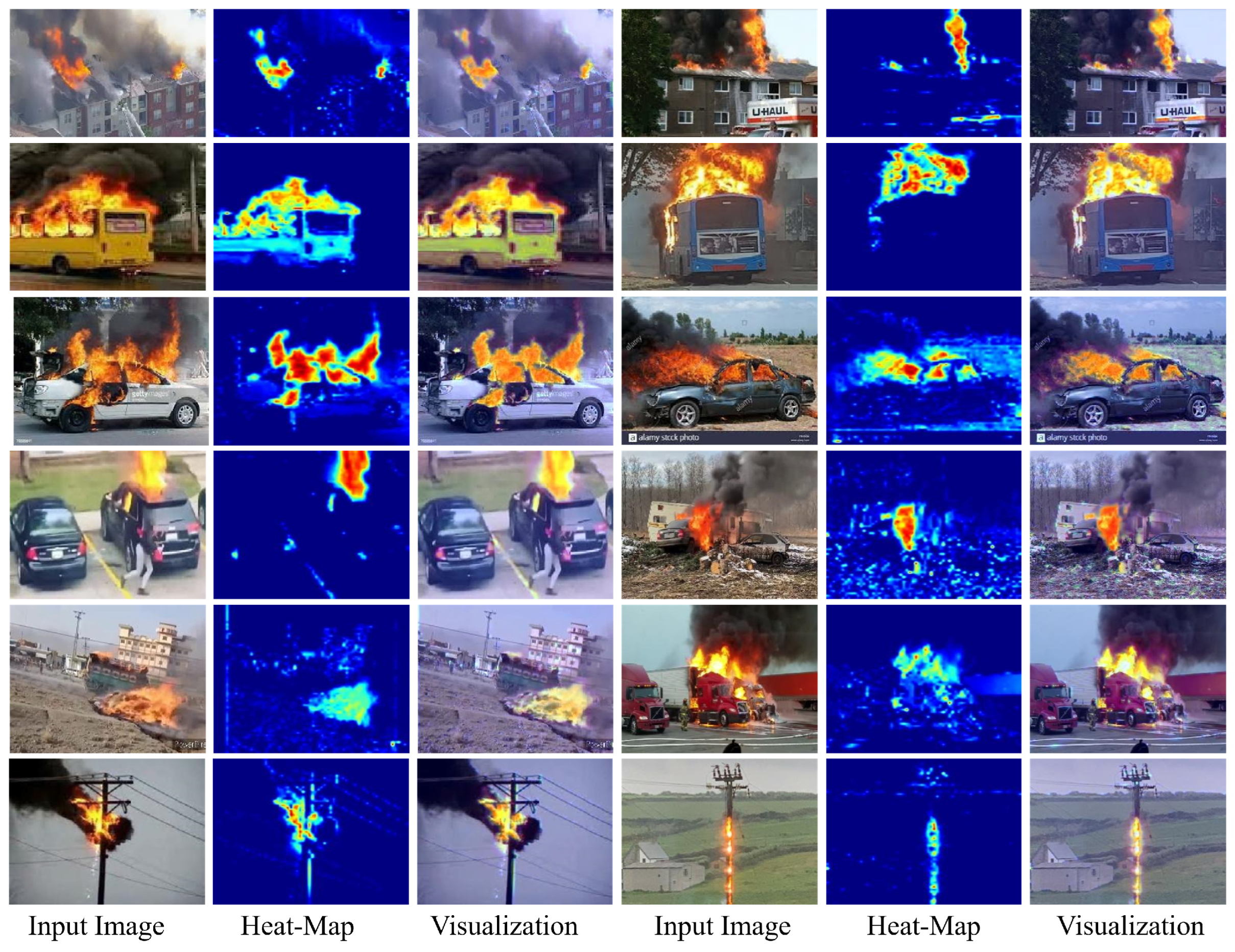
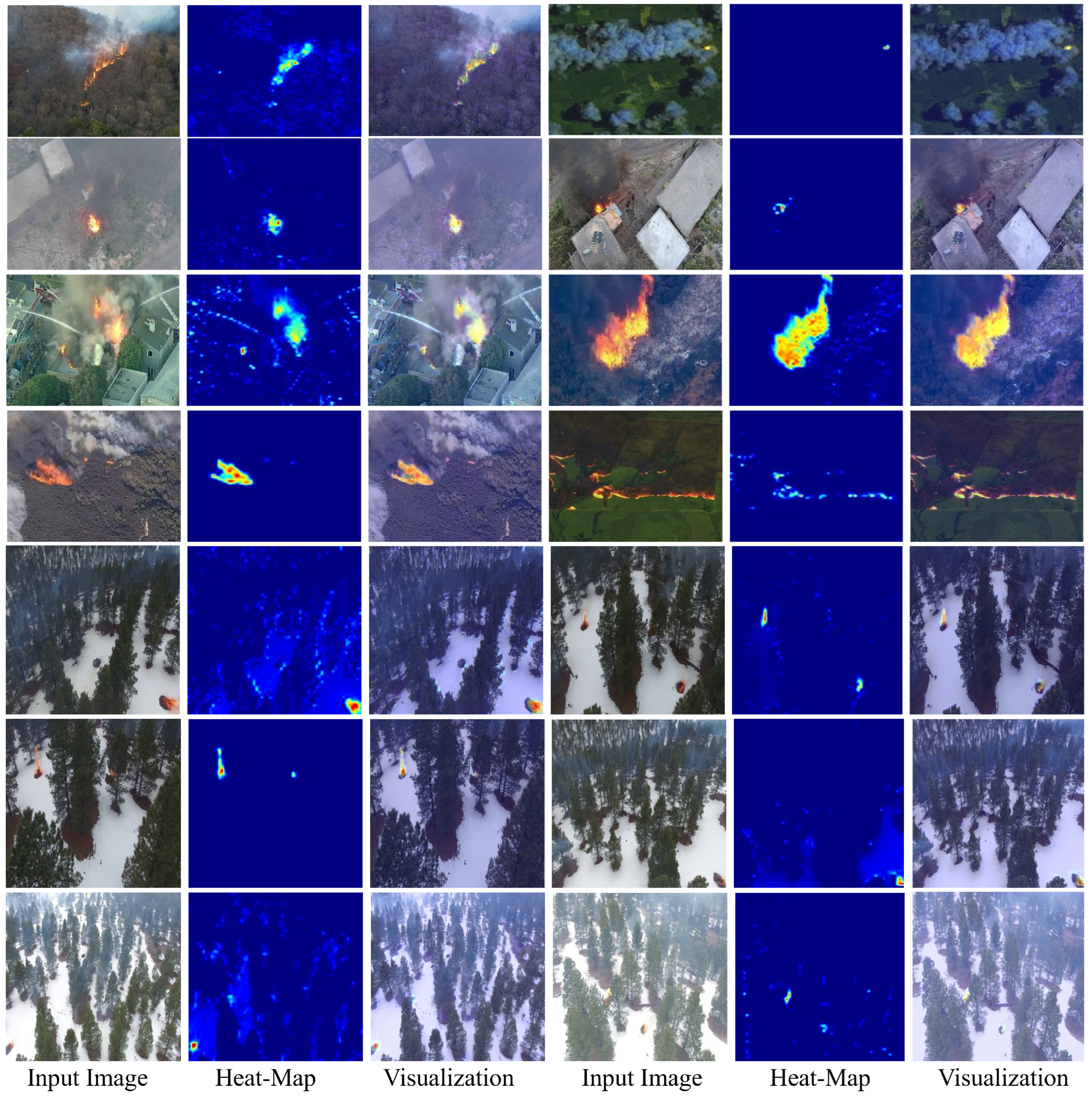
Figure 11 and Figure 12 present the Grad-CAM visualizations of the proposed model on the four target datasets. In both figures, the first and fourth columns display the input images, the second and fifth columns show the corresponding Grad-CAM heat-maps, and the third and sixth columns overlay the heat-maps onto the original inputs. The regions of interest (red and yellow) indicate a high contribution to the predicted class, whereas regions (blue) indicate a negligible response.
Figure 11 demonstrates the visualizations on CCTV- and surveillance-based imagery covering diverse urban and structural fire scenarios, including burning residential buildings, buses, private vehicles, heavy trucks, and electrical transmission poles. Across these cases, the activations concentrate tightly on the luminous flame regions while suppressing responses to visually similar distractors such as dark smoke plumes, reflective vehicle surfaces, and cluttered urban backgrounds. Even when the flames are partially occluded (e.g., the apartment scene and the multi-vehicle incident) or spatially fragmented across the object (e.g., the car and bus fires), the network localizes each flame instance rather than collapsing onto a single dominant region. The elongated activation along the burning electrical pole further indicates that EdgeNeXt-Attn adapts to the geometry of the fire source instead of relying on a fixed prior regarding flame shape or scale.
Figure 12 presents the Grad-CAM visualizations for UAV- and satellite-based remote sensing imagery from the ADSF and FLAME datasets, which represent challenging wildfire monitoring scenarios due to large viewing distances, small fire regions, smoke occlusion, and complex backgrounds, including dense forests, urban environments, and snow-covered terrain. Despite these challenges, the proposed model consistently focuses its attention on the fire-affected regions. The activation maps accurately highlight small and isolated flames within forest canopies, elongated fire fronts in open landscapes, and localized combustion areas in aerial urban scenes. Furthermore, the model exhibits limited activation over visually similar but non-fire regions, such as clouds, smoke, and bright snow surfaces, indicating effective suppression of irrelevant background information. Although weak responses are occasionally observed in a few low-contrast snowy scenes, the dominant activations remain concentrated on the actual fire regions, demonstrating the robustness and interpretability of the proposed framework across diverse remote sensing conditions. Overall, the visualizations in Figure 11 and Figure 12 demonstrate that EdgeNeXt-Attn attends to physically meaningful fire evidence across both close-range CCTV footage and long-range aerial imagery, providing qualitative support for the proposed model.
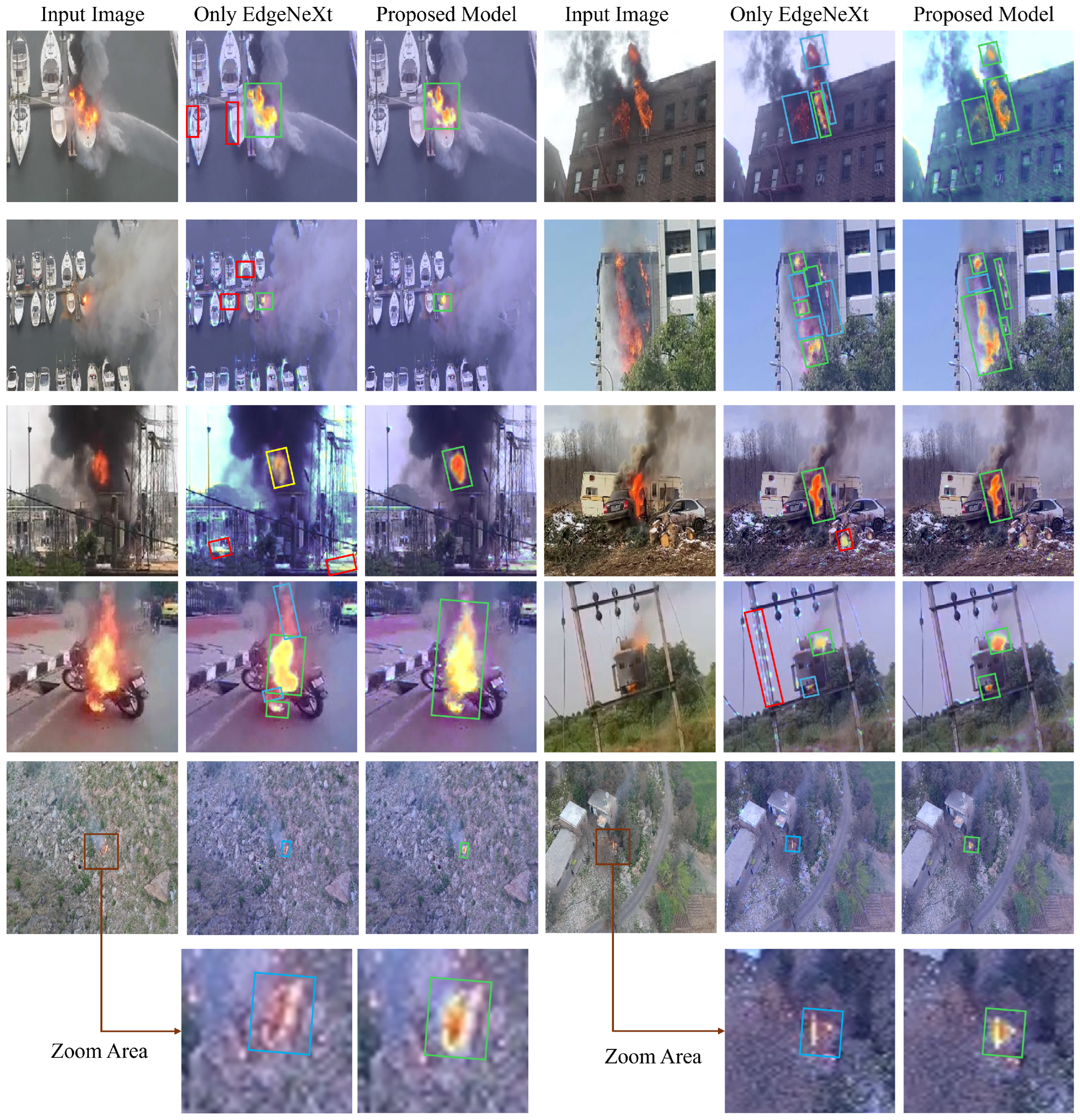
Figure 13 presents a qualitative comparison between the baseline EdgeNeXt model and the proposed EdgeNeXt-Attn framework across representative fire scenarios, including urban building fires, industrial fires, vehicle fires, electrical equipment fires, and aerial drone images containing extremely small fire instances. For each example, the first column shows the original input image, the second column illustrates the predictions generated by the baseline EdgeNeXt model, and the third column presents the corresponding predictions obtained using the proposed EdgeNeXt-Attn. In the visualization, green bounding boxes denote correctly localized fire regions, red bounding boxes indicate false positive detections, whereas blue bounding boxes represent inaccurate or partially localized detections. As illustrated in Figure 13, both models successfully detect prominent fire regions when the flames occupy a relatively large portion of the image. However, the baseline EdgeNeXt frequently produces additional false positive detections and inaccurate localization in visually complex environments containing smoke, buildings, vegetation, or other high-intensity background structures. These erroneous detections indicate that the baseline network is susceptible to confusing fire-like visual patterns with genuine fire regions, particularly in cluttered scenes. A more noticeable performance difference is observed in challenging small-object scenarios, especially in the aerial drone images shown in the final two rows. In these cases, the fire occupies only a very small fraction of the image, resulting in weak visual responses that are easily suppressed during feature extraction. Consequently, the baseline EdgeNeXt either fails to detect these small fire instances entirely or produces inaccurate localization with significant spatial deviation. Such observations suggest that the original EdgeNeXt architecture has limited capability in preserving highly localized fire cues when the target occupies only a few pixels. In contrast, the proposed EdgeNeXt-Attn consistently identifies these small and distant fire regions with substantially improved localization accuracy while simultaneously reducing false positive detections. This improvement is attributed to the proposed sequential attention refinement mechanism. Specifically, the channel attention module enhances fire-discriminative spectral features while suppressing background responses, and the subsequent spatial attention module further emphasizes the most probable fire locations within the refined feature maps. The complementary interaction between these two attention mechanisms enables the network to preserve weak fire signals that would otherwise be overlooked by the baseline model. Overall, the qualitative results demonstrate that the proposed attention-enhanced architecture provides more reliable fire localization across diverse environmental conditions. The improvements are particularly evident for small-scale fire targets, cluttered backgrounds, and scenes with visually confusing objects, where the proposed EdgeNeXt-Attn achieves more accurate localization with fewer false positive and mislocalized detections. These observations are consistent with the quantitative improvements reported in the ablation study and performance evaluation, confirming the effectiveness of the proposed attention mechanism in enhancing both detection sensitivity and localization precision.

4.9. Ablation Study

The proposed EdgeNeXt-Attn is evaluated under four settings: (1) standalone EdgeNeXt for feature extraction and classification; (2) EdgeNeXt with channel attention; (3) EdgeNeXt with spatial attention; and (4) the proposed model integrating both channel and spatial attention for enhanced feature refinement. Table 7 reports the results across the four benchmark datasets, including DFAN, Complex-Fire, ADSF, and FLAME, demonstrating that the proposed model consistently outperforms the three alternative settings on each dataset and evaluation metric. On the CCTV-based benchmarks, EdgeNeXt-Attn achieves an accuracy of 92.09% on DFAN and 95.16% on Complex-Fire, corresponding to improvements of 0.95 and 1.11 percentage points over the next-best Setting 3. Similar consistent gains are observed across precision, recall, and F1-score, indicating that channel and spatial attention contribute complementary rather than redundant information for ground-based fire recognition. On the aerial remote sensing benchmarks, EdgeNeXt-Attn achieves 96.65% accuracy on ADSF and 87.81% accuracy on FLAME, corresponding to improvements of 1.49 and 1.27 percentage points over the strongest baseline setting, respectively. The larger relative gain observed on aerial imagery suggests that the joint channel–spatial attention mechanism is particularly effective in handling the small-target and viewpoint variability characteristic of drone- and satellite-captured fire scenes. In summary, across all four datasets, the proposed EdgeNeXt-Attn yields consistent improvements in precision, recall, F1-score, and accuracy compared to Settings 1–3, with per-dataset gains ranging from 0.95 to 1.49 percentage points in accuracy. These improvements confirm that incorporating both channel and spatial attention mechanisms into the EdgeNeXt backbone meaningfully refines the extracted features and enhances classification performance under diverse fire detection scenarios.

4.10. Model Complexity Analysis

The proposed model performance in terms of model complexity, such as training parameters, model size, and inference speed, was evaluated using a graphical processing unit (GPU), a central processing unit (CPU), as mentioned in the Section 4.2, and a Raspberry Pi 4 Model B+. The proposed model was compared with eight existing fire detection methods, including ANetFire [30], ResNetFire [59], GNetFire [31], DFAN [20], SE-EFFNet [52], ADFireNet [14], MAFire-Net, and EFNet-CSM [13], as listed in Table 8. Among these models, ANetFire [30], ResNetFire [59], and MAFire-Net were found to have the lowest performance due to the number of training parameters that limit their efficiency. SE-EFFNet [52] achieved better performance compared to GNetFire [31] and DFAN [20], as shown in Table 8. In comparison, ADFireNet [14] and EFNet-CSM [13] achieved higher performance, where ADFireNet [14] achieved FPS values 72.5, 22.0, and 7.0 on GPU, CPU, and Raspberry Pi, respectively. EFNet-CSM [13] achieved the second-best performance on Raspberry Pi, CPU, and GPU with FPS values of 8.0, 25.0, and 82.53, respectively. The results, presented in Table 8, demonstrate that the proposed EdgeNeXt-Attn model achieved a better trade-off between the model size of 61.8 MB and 5.3 million learning parameters. The EdgeNeXt-Attn obtained higher FPS on the GPU, CPU, and Raspberry Pi, achieving values of 85.88, 27.3, and 8.4, respectively. Deployment on resource-constrained edge platforms requires lightweight models with low storage requirements, efficient computation, and modest memory consumption. To characterize the edge-deployment capability of the proposed EdgeNeXt-Attn, Table 9 summarizes its computational complexity and runtime performance, including model size, parameter count, Multiply–Add operations (MAdds), floating-point operations (FLOPs), inference throughput on both CPU and GPU, and peak memory usage. Static metrics were computed at an input resolution of 256 × 256 × 3 , while dynamic metrics (throughput and memory) were obtained using the TensorFlow implementation by averaging 200 timed forward passes after 30 warm-up iterations to ensure stable measurements. The proposed EdgeNeXt-Attn contains only 5.305 M parameters with 1.2746 G MAdds (2.5492 G FLOPs), requiring 20.74 MB of storage in FP32 format (61.80 MB in TensorFlow H5 format). During inference, the model achieves 27.3 FPS on the CPU and 85.88 FPS on the GPU while consuming 990.4 MB of host memory and 557.8 MB of GPU memory, respectively. These results demonstrate that EdgeNeXt-Attn provides an effective balance between computational complexity, memory efficiency, and inference speed, making it well-suited for real-time wildfire detection on resource-constrained edge platforms.

5. Discussion

This section interprets the experimental results, examines the contribution of each design component, discusses limitations, and outlines future directions.

5.1. Interpretation of Results Across the Four Datasets

The proposed EdgeNeXt-Attn demonstrates consistently better performance across four benchmark datasets that collectively span two distinct sensing regimes: ground-based CCTV imagery (DFAN, Complex-Fire) and aerial remote sensing imagery (FLAME, ADSF). Within the CCTV-based benchmarks, the proposed model achieves 92.09% accuracy on DFAN and 95.16% accuracy on Complex-Fire. The lower accuracy on DFAN is primarily attributable to multi-class classification rather than a limitation of the underlying representation due to inter-class confusion between visually similar fire subclasses. For instance, Bus-Fire versus Van-Fire, both involving large enclosed vehicles with comparable flame appearance, account for the majority of the residual error, as illustrated in the confusion matrix in Figure 6. The higher accuracy on Complex-Fire reflects the simpler binary classification task, although the residual error is dominated by fire-like distractors such as sunset scenes and artificial lighting that share chromatic characteristics with genuine flames. For the aerial remote sensing benchmarks, the proposed EdgeNeXt-Attn achieves 87.81% accuracy on FLAME and 96.65% accuracy on ADSF. The FLAME dataset, captured entirely from low-altitude UAV platforms, presents the most challenging conditions due to small fire-to-background pixel ratios, oblique viewing angles, and canopy occlusion typical of forest fire monitoring; the 87.81% accuracy achieved on this benchmark surpasses all eighteen compared state-of-the-art methods, thereby validating the model’s effectiveness under aerial remote sensing conditions. The ADSF dataset, which combines UAV and satellite imagery with more distinct fire signatures, yields the highest overall accuracy of 96.65%, consistent with the design intent of the proposed architecture: the XCA-based global attention and adaptive kernel sizing are particularly well suited to small-target detection in wide-area imagery, while channel attention effectively compensates for the radiometric variability between UAV and satellite sensors. The consistent performance across these two sensing regimes, with an accuracy range of 87.81–96.65% across four heterogeneous datasets, supports the central claim that EdgeNeXt-Attn generalizes across the different image statistics produced by ground-based and aerial remote sensing platforms.

5.2. Contribution of Each Attention Branch

The ablation results presented in Table 7 demonstrate that both the channel and spatial attention modules contribute positively to wildfire detection performance across all evaluated datasets. Compared with the EdgeNeXt baseline (Setting 1), incorporating either attention branch individually (Settings 2 and 3) consistently improves classification performance, while integrating both modules in the proposed model yields the highest precision, recall, F1-score, and accuracy. For example, on the DFAN dataset, the accuracy increases from 90.33% (Setting 1) to 91.11% and 91.14% using the individual attention branches, reaching 92.09% when both are combined. Similar trends are observed on the Complex-Fire, ADSF, and FLAME datasets. These results indicate that the channel and spatial attention modules capture complementary rather than redundant information, enabling the network to jointly enhance discriminative fire-related feature responses and spatial localization of irregular flame regions, thereby improving robustness across diverse wildfire scenarios.

5.3. Limitations

This subsection discusses the proposed model’s limitations in consideration of various perspectives.
Single-image formulation: The current framework operates on individual images and does not exploit temporal cues (motion, flicker, plume evolution) that are available in video streams. This may limit robustness on challenging cases where a single frame is ambiguous.
Visible-spectrum only: All four benchmark datasets consist of RGB imagery. Multi-spectral, hyperspectral, and thermal imagery, which are commonly available in satellite and specialized UAV platforms, are not utilized by the current model.
Moderate model size: Although EdgeNeXt-Attn is lightweight by contemporary standards (5.3 M parameters), it is still large for deployment on MCU-class devices (Cortex-M0/M4). Quantization or knowledge distillation would be required for such extreme edge scenarios.
Adverse-weather robustness: The training data does not include systematic coverage of fog, haze, or nighttime conditions. Model behavior under such conditions has not been explicitly characterized.
DFAN class imbalance: The Cargo-Fire (77.78% F1) and Non-Fire (82.35% F1) classes in DFAN remain below the model’s average performance, reflecting the small number of training samples in these classes rather than a fundamental architectural limitation.

5.4. Future Directions

Based on the above limitations, we identify four priority directions for future research work:
Temporal extension: Integrating temporal modeling (via 3D convolutions, temporal transformers, or lightweight recurrent modules) to exploit motion and flicker cues in video streams.
Multi-modal fusion: Extending the framework to fuse RGB with thermal and/or spectral bands to effectively capture prominent features from RGB and thermal modality for wildfire detection.
Extreme-edge deployment: Applying post-training quantization (INT8) and structured pruning to enable MCU-class deployment while preserving the accuracy achieved at FP32.
Robustness benchmarking: Constructing an adverse-condition benchmark (fog, haze, night) using vision–language-based synthetic augmentation and re-evaluating EdgeNeXt-Attn under these conditions to characterize deployment reliability.

6. Conclusions

Recent developments in artificial intelligence have significantly enhanced model performance. However, existing DL-based methods still face challenges in achieving an optimal balance between model accuracy and computational complexity. The performance of DL-based models tends to decline when detecting small or occluded fire areas, especially in complex and challenging environments such as drone or satellite imagery. Moreover, their complex architecture and high computational requirements make their implementation on resource-constrained devices for real-time applications impossible. To address these issues, we propose a lightweight model combining CNN and ViT capabilities. EdgeNeXt is used to capture rich spatial features, further enhancing the performance with a channel–spatial attention mechanism. Our model outperformed state-of-the-art methods, effectively detecting small, occluded, and challenging fire regions in CCTV and remote sensing datasets, including scenarios with visually similar moving objects and distant fires occupying minimal image areas.

Author Contributions

Conceptualization, H.Y.; methodology, H.Y.; software, H.Y.; validation, N.A.S., N.S.A. and W.J.; formal analysis, N.A.S., N.S.A. and W.J.; investigation, H.S.K., N.S.A. and W.J.; resources, H.S.K.; data curation, H.Y.; writing—original draft preparation, H.Y.; writing—review and editing, H.Y., H.S.K. and N.A.S.; visualization, H.Y. and N.S.A.; supervision, H.S.K.; project administration, H.S.K.; funding acquisition, H.S.K. All authors have read and agreed to the published version of the manuscript.

Funding

This work was supported by the National Research Foundation of Korea (NRF) grant funded by the Korea government (MSIT) (RS-2025-00523019), supported by the InnoCORE program of the Ministry of Science and ICT (N10260002), supported by the ANCHOR through the Seoul ANCHOR Center, funded by the Ministry of Education (MOE) and the Seoul Metropolitan Government. (2026-ANCHOR-01-007-04) and also supported by Princess Nourah bint Abdulrahman University Researchers Supporting Project number (PNURSP2026R40), Princess Nourah bint Abdulrahman University, Riyadh, Saudi Arabia.

Data Availability Statement

The original data presented in this study are publicly available for research purposes at https://github.com/tanveer-hussain/DFAN(accessed on 23 June 2025) and https://github.com/Hikmat-Yar/ISPRS-Fire-Detection (accessed on 8 July 2025). The data are also available from the authors upon reasonable request.

Acknowledgments

We would like to express our sincere gratitude to the National Research Foundation of Korea (NRF) for its generous support through the NRF grant funded by the Korea government (MSIT) (RS-2025-00523019). We also gratefully acknowledge the InnoCORE program of the Ministry of Science and ICT (N10260002) and the ANCHOR program through the Seoul ANCHOR Center, funded by the Ministry of Education (MOE) and the Seoul Metropolitan Government (2026-ANCHOR-01-007-04), for their valuable support. In addition, we sincerely thank Princess Nourah bint Abdulrahman University, Riyadh, Saudi Arabia, for supporting this work through the Researchers Supporting Project (PNURSP2026R40). During the preparation of this manuscript, the authors used ChatGPT (GPT-5) and Claude.ai (Opus 4.8) for language editing and text polishing. All content was carefully reviewed by the authors.

Conflicts of Interest

The authors declare that this research was conducted in the absence of any commercial or financial relationships that could be construed as potential conflicts of interest.

Nomenclature

SymbolDefinition
I R H × W × 3 Input RGB image of height H and width W
y { 0 , 1 } Binary fire label (extends to multi-class in DFAN)
y ^ i Predicted probability of fire for sample i
L ( θ ) Cross-entropy loss with model parameters θ
NNumber of training samples in a mini-batch
F conv Convolutional encoder module
F SDTA Split Depth-wise Transpose Attention encoder
F attn Channel–spatial attention refinement module
F cls Final classification head
s { 1 , 2 , 3 , 4 } Stage index in the hierarchical backbone
k ( s ) { 3 , 5 , 7 , 9 } Kernel size at stage s
C s , H s , W s Channel and spatial dimensions of the feature map at stage s
D w ( s ) Depth-wise convolution at stage s
LN ( · ) Layer normalization
GELU ( x ) = x Φ ( x ) Gaussian Error Linear Unit activation
x i , y i Input and output of the i-th multi-scale split (Equation (8))
d i Depth-wise convolution applied to the i-th split
t { 2 , 3 , 4 } Stage index where SDTA is applied
Q , K , V R H W × C Query, key, and value projections in XCA
γ c average Global-average pooled descriptor for channel c
β c maximum Global-max pooled descriptor for channel c
Γ ( C , 1 , 1 ) average Aggregated global-average channel descriptor
B ( C , 1 , 1 ) Max Aggregated global-max channel descriptor
W 0 R C r × C First shared MLP weight matrix
W 1 R C × C r Second shared MLP weight matrix
r = 16 Channel reduction ratio used in this work
M C R C × 1 × 1 Channel attention map
α ( h , w ) max Spatial max-pooled descriptor
ξ ( h , w ) avg Spatial average-pooled descriptor
Υ ( 2 , H , W ) concat Concatenated spatial descriptor
k = 7 Spatial-attention convolution kernel size (Equation (17))
δ ( h , w ) Spatial attention map after sigmoid activation
F ( c , h , w ) new Attention-refined feature map
σ ( · ) Sigmoid activation function

References

  1. Tian, Y.; Wu, Z.; Li, M.; Wang, B.; Zhang, X. Forest fire spread monitoring and vegetation dynamics detection based on multi-source remote sensing images. Remote Sens. 2022, 14, 4431. [Google Scholar] [CrossRef] [Scilit]
  2. Sinje, S.S.; Kamrujjaman, M.; Alqahtani, R.T. Forest beetle infestation and its impact on ecosystems: Effects of harvesting practices and fire disruptions. AIMS Math. 2025, 10, 9933–9973. [Google Scholar] [CrossRef] [Scilit]
  3. He, L.; Zhou, Y.; Liu, L.; Zhang, Y.; Ma, J. Research and application of deep learning object detection methods for forest fire smoke recognition. Sci. Rep. 2025, 15, 16328. [Google Scholar] [CrossRef] [Scilit] [PubMed]
  4. Earth.Org Asia. South Korea’s Deadliest Wildfires Twice as Likely Because of Climate Change: Study. 2025. Available online: https://earth.org/south-koreas-deadliest-wildfires-twice-as-likely-because-of-climate-change-study/ (accessed on 5 November 2025).
  5. Joint Research Centre. Europe’s Fire Season Is Expanding, New JRC Report Shows, 2025. Available online: https://joint-research-centre.ec.europa.eu/jrc-news-and-updates/europes-fire-season-expanding-new-jrc-report-shows-2025-12-05_en (accessed on 10 July 2026).
  6. Emol. 200 Empleos en Riesgo y Millonarias péRdidas: La Destrucción del Fuego en El Salto, un “Motor” EconóMico de Valparaíso, 2024. Available online: https://www.emol.com/noticias/Economia/2024/02/20/1122330/incendios-valparaiso-el-salto.html (accessed on 10 July 2026).
  7. National Fire Protection Association (NFPA). Fire Loss in the United States. 2023. Available online: https://www.nfpa.org/education-and-research/research/nfpa-research/fire-statistical-reports/fire-loss-in-the-united-states (accessed on 5 November 2025).
  8. United Nations Office for Disaster Risk Reduction (UNDRR). The Invisible Costs of Wildfire Disasters in 2025. 2026. Available online: https://www.undrr.org/news/invisible-costs-wildfire-disasters-2025 (accessed on 15 July 2026).
  9. Kadir, E.A.; Rosa, S.L.; Syukur, A.; Othman, M.; Daud, H. Forest fire spreading and carbon concentration identification in tropical region Indonesia. Alex. Eng. J. 2022, 61, 1551–1561. [Google Scholar] [CrossRef] [Scilit]
  10. Khan, T.; Khan, Z.A.; Choi, C. Enhancing real-time fire detection: An effective multi-attention network and a fire benchmark. Neural Comput. Appl. 2025, 37, 11693–11707. [Google Scholar]
  11. Li, R.; Wang, Y.; Tu, X. ConFirePatch: Context-based fire detection and segmentation via extracting key patches. Alex. Eng. J. 2025, 129, 961–975. [Google Scholar] [CrossRef] [Scilit]
  12. Sun, Y.; Pan, J.; Jiang, L.; Tian, Y.; Zhang, J.; Liu, K. A physics-based remote sensing framework for forest fire smoke detection toward early fire warning. Int. J. Appl. Earth Obs. Geoinf. 2026, 146, 105124. [Google Scholar] [CrossRef] [Scilit]
  13. Yar, H.; Ullah, F.U.M.; Khan, Z.A.; Kim, M.J.; Baik, S.W. EFNet-CSM: EfficientNet with a modified attention mechanism for effective fire detection. Knowl.-Based Syst. 2025, 329, 114353. [Google Scholar] [CrossRef] [Scilit]
  14. Yar, H.; Ullah, W.; Khan, Z.A.; Baik, S.W. An effective attention-based CNN model for fire detection in adverse weather conditions. ISPRS J. Photogramm. Remote Sens. 2023, 206, 335–346. [Google Scholar] [CrossRef] [Scilit]
  15. Abozeid, A.; Alanazi, R. An intelligent approach for early smoke/fire detection using vision sensors in smart cities. Sci. Rep. 2026, 16, 11387. [Google Scholar] [CrossRef] [Scilit] [PubMed]
  16. Yar, H.; Khan, Z.A.; Rida, I.; Ullah, W.; Kim, M.J.; Baik, S.W. An efficient deep learning architecture for effective fire detection in smart surveillance. Image Vis. Comput. 2024, 145, 104989. [Google Scholar] [CrossRef] [Scilit]
  17. Liu, X.; Zhang, Q.; Zhang, Y.; Zhu, J. Enhancing deep learning based multi-parameter fire detection by training on simulated and combustion experimental dataset. Sci. Rep. 2026, 16, 10178. [Google Scholar] [CrossRef] [Scilit] [PubMed]
  18. Foggia, P.; Saggese, A.; Vento, M. Real-time fire detection for video-surveillance applications using a combination of experts based on color, shape, and motion. IEEE Trans. Circuits Syst. Video Technol. 2015, 25, 1545–1556. [Google Scholar] [CrossRef] [Scilit]
  19. Celik, T.; Ozkaramanli, H.; Demirel, H. Fire pixel classification using fuzzy logic and statistical color model. In Proceedings of the 2007 IEEE International Conference on Acoustics, Speech and Signal Processing-ICASSP’07; IEEE: New York, NY, USA, 2007; Volume 1, pp. I-1205–I-1208. [Google Scholar]
  20. Yar, H.; Hussain, T.; Agarwal, M.; Khan, Z.A.; Gupta, S.K.; Baik, S.W. Optimized dual fire attention network and medium-scale fire classification benchmark. IEEE Trans. Image Process. 2022, 31, 6331–6343. [Google Scholar] [CrossRef] [Scilit] [PubMed]
  21. Ghali, R.; Akhloufi, M.A. Deep learning approaches for wildland fires remote sensing: Classification, detection, and segmentation. Remote Sens. 2023, 15, 1821. [Google Scholar] [CrossRef] [Scilit]
  22. Wang, Q.; Guan, S.; Lyu, S.; Cheng, G. Enhancing drone-based fire detection with flame-specific attention and optimized feature fusion. Int. J. Appl. Earth Obs. Geoinf. 2025, 142, 104655. [Google Scholar]
  23. Al-Wesabi, F.N.; Alhefdhi, A. Enhancing safety for blind and visually impaired people: Intelligent fire detection using deep learning and the lemurs optimization algorithm. AIMS Math. 2025, 10, 21617–21641. [Google Scholar]
  24. Yar, H.; Khan, Z.A.; Ullah, F.U.M.; Ullah, W.; Baik, S.W. A modified YOLOv5 architecture for efficient fire detection in smart cities. Expert Syst. Appl. 2023, 231, 120465. [Google Scholar] [CrossRef] [Scilit]
  25. Yar, H.; Khan, Z.A.; Hussain, T.; Baik, S.W. A modified vision transformer architecture with scratch learning capabilities for effective fire detection. Expert Syst. Appl. 2024, 252, 123935. [Google Scholar] [CrossRef] [Scilit]
  26. Khan, Z.A.; Ullah, F.U.M.; Yar, H.; Ullah, W.; Khan, N.; Kim, M.J.; Baik, S.W. Optimized cross-module attention network and medium-scale dataset for effective fire detection. Pattern Recognit. 2025, 161, 111273. [Google Scholar] [CrossRef] [Scilit]
  27. Celik, T.; Demirel, H. Fire detection in video sequences using a generic color model. Fire Saf. J. 2009, 44, 147–158. [Google Scholar] [CrossRef] [Scilit]
  28. Mueller, M.; Karasev, P.; Kolesov, I.; Tannenbaum, A. Optical flow estimation for flame detection in videos. IEEE Trans. Image Process. 2013, 22, 2786–2797. [Google Scholar] [CrossRef] [Scilit] [PubMed]
  29. Emmy Prema, C.; Vinsley, S.; Suresh, S. Multi feature analysis of smoke in YUV color space for early forest fire detection. Fire Technol. 2016, 52, 1319–1342. [Google Scholar] [CrossRef] [Scilit]
  30. Muhammad, K.; Ahmad, J.; Baik, S.W. Early fire detection using convolutional neural networks during surveillance for effective disaster management. Neurocomputing 2018, 288, 30–42. [Google Scholar] [CrossRef] [Scilit]
  31. Muhammad, K.; Ahmad, J.; Mehmood, I.; Rho, S.; Baik, S.W. Convolutional neural networks based fire detection in surveillance videos. IEEE Access 2018, 6, 18174–18183. [Google Scholar] [CrossRef] [Scilit]
  32. Muhammad, K.; Ahmad, J.; Lv, Z.; Bellavista, P.; Yang, P.; Baik, S.W. Efficient deep CNN-based fire detection and localization in video surveillance applications. IEEE Trans. Syst. Man Cybern. Syst. 2018, 49, 1419–1434. [Google Scholar] [CrossRef] [Scilit]
  33. Muhammad, K.; Khan, S.; Elhoseny, M.; Ahmed, S.H.; Baik, S.W. Efficient fire detection for uncertain surveillance environment. IEEE Trans. Ind. Inform. 2019, 15, 3113–3122. [Google Scholar] [CrossRef] [Scilit]
  34. Muhammad, K.; Ullah, H.; Khan, S.; Hijji, M.; Lloret, J. Efficient fire segmentation for internet-of-things-assisted intelligent transportation systems. IEEE Trans. Intell. Transp. Syst. 2022, 24, 13141–13150. [Google Scholar] [CrossRef] [Scilit]
  35. Dilshad, N.; Khan, T.; Song, J. Efficient Deep Learning Framework for Fire Detection in Complex Surveillance Environment. Comput. Syst. Sci. Eng. 2023, 46, 749–764. [Google Scholar] [CrossRef] [Scilit]
  36. Huang, L.; Liu, G.; Wang, Y.; Yuan, H.; Chen, T. Fire detection in video surveillances using convolutional neural networks and wavelet transform. Eng. Appl. Artif. Intell. 2022, 110, 104737. [Google Scholar] [CrossRef] [Scilit]
  37. Khan, T.; İsmail Aslan, H.; Choi, C. Performance Evaluation of Enhanced ConvNeXtTiny-based Fire Detection System in Real-world Scenarios. In Proceedings of the International Conference on Learning Representations (ICLR) 2023—Tiny Papers, Kigali, Rwanda, 1–5 May 2023. [Google Scholar]
  38. Li, S.; Yan, Q.; Liu, P. An efficient fire detection method based on multiscale feature extraction, implicit deep supervision and channel attention mechanism. IEEE Trans. Image Process. 2020, 29, 8467–8475. [Google Scholar] [CrossRef] [Scilit] [PubMed]
  39. Deng, Z.; Hu, S.; Yin, S.; Wang, Y.; Basu, A.; Cheng, I. Multi-step implicit Adams predictor-corrector network for fire detection. IET Image Process. 2022, 16, 2338–2350. [Google Scholar] [CrossRef] [Scilit]
  40. Majid, S.; Alenezi, F.; Masood, S.; Ahmad, M.; Gündüz, E.S.; Polat, K. Attention based CNN model for fire detection and localization in real-world images. Expert Syst. Appl. 2022, 189, 116114. [Google Scholar] [CrossRef] [Scilit]
  41. Shahid, M.; Hua, K.l. Fire detection using transformer network. In Proceedings of the 2021 International Conference on Multimedia Retrieval; Association for Computing Machinery: New York, NY, USA, 2021; pp. 627–630. [Google Scholar]
  42. Shamsoshoara, A.; Afghah, F.; Razi, A.; Zheng, L.; Fulé, P.Z.; Blasch, E. Aerial imagery pile burn detection using deep learning: The FLAME dataset. Comput. Netw. 2021, 193, 108001. [Google Scholar] [CrossRef] [Scilit]
  43. Ghali, R.; Akhloufi, M.A.; Mseddi, W.S. Deep learning and transformer approaches for UAV-based wildfire detection and segmentation. Sensors 2022, 22, 1977. [Google Scholar] [CrossRef] [Scilit] [PubMed]
  44. Tao, J.; Wang, Z.; Wu, J.; Li, Y.; Fukuda, T.; Zhang, J. EF-YOLO: Detecting Small Targets in Early-Stage Agricultural Fires via UAV-Based Remote Sensing. Remote Sens. 2026, 18, 1119. [Google Scholar] [CrossRef] [Scilit]
  45. Meng, L.; Wu, M.; Gao, J.; Wang, S.; Song, X.; Zhao, J.; Liu, H.; Cao, X.; Liu, L.; Chen, G.; et al. Real-Time Early Warning of Incipient Fire in Multiple Urban Scenarios: A Deep Learning-Based Monitoring Method. Remote Sens. 2026, 18, 1663. [Google Scholar] [CrossRef] [Scilit]
  46. Zhang, Y.; Rui, X.; Song, W. A uav-based multi-scenario rgb-thermal dataset and fusion model for enhanced forest fire detection. Remote Sens. 2025, 17, 2593. [Google Scholar] [CrossRef] [Scilit]
  47. Danish, S.; Khan, S.U.; Dang, L.M.; Song, H.K.; Moon, H. Toward Intelligent Earth Observation: Hierarchical Feature Fusion and a Drone Dataset for UAV-Based Fire Detection. IEEE J. Sel. Top. Appl. Earth Obs. Remote Sens. 2026, 19, 20880–20892. [Google Scholar]
  48. Wang, H.; Fayaz, M.; Ahmad, A.; Li, Y.; Nguyen, T.N.; Dang, L.M. Masked autoencoder-based vision framework for robust fire detection in complex environments. Process Saf. Environ. Prot. 2025, 203, 108019. [Google Scholar] [CrossRef] [Scilit]
  49. Maaz, M.; Shaker, A.; Cholakkal, H.; Khan, S.; Zamir, S.W.; Anwer, R.M.; Shahbaz Khan, F. Edgenext: Efficiently amalgamated cnn-transformer architecture for mobile vision applications. In Proceedings of the European Conference on Computer Vision; Springer: Berlin/Heidelberg, Germany, 2022; pp. 3–20. [Google Scholar]
  50. Liu, Z.; Mao, H.; Wu, C.Y.; Feichtenhofer, C.; Darrell, T.; Xie, S. A convnet for the 2020s. In Proceedings of the IEEE/CVF Conference on Computer Vision and Pattern Recognition; IEEE: New York, NY, USA, 2022; pp. 11976–11986. [Google Scholar]
  51. Gao, S.H.; Cheng, M.M.; Zhao, K.; Zhang, X.Y.; Yang, M.H.; Torr, P. Res2net: A new multi-scale backbone architecture. IEEE Trans. Pattern Anal. Mach. Intell. 2019, 43, 652–662. [Google Scholar] [CrossRef] [Scilit] [PubMed]
  52. Khan, Z.A.; Hussain, T.; Ullah, F.U.M.; Gupta, S.K.; Lee, M.Y.; Baik, S.W. Randomly initialized CNN with densely connected stacked autoencoder for efficient fire detection. Eng. Appl. Artif. Intell. 2022, 116, 105403. [Google Scholar] [CrossRef] [Scilit]
  53. Dilshad, N.; Khan, S.U.; Alghamdi, N.S.; Taleb, T.; Song, J. Toward efficient fire detection in IoT environment: A modified attention network and large-scale data set. IEEE Internet Things J. 2023, 11, 13467–13481. [Google Scholar] [CrossRef] [Scilit]
  54. Jankovic, B.; Jangirova, S.; Ullah, W.; Khan, L.U.; Guizani, M. Disaster Detection on the Fly: Optimized Transformers for UAVs. IEEE J. Sel. Top. Appl. Earth Obs. Remote Sens. 2025, 19, 4950–4962. [Google Scholar] [CrossRef] [Scilit]
  55. Jangirova, S.; Jankovic, B.; Ullah, W.; Khan, L.U.; Guizani, M. Real-time aerial fire detection on resource-constrained devices using knowledge distillation. Int. J. Appl. Earth Obs. Geoinf. 2025, 142, 104665. [Google Scholar] [CrossRef] [Scilit]
  56. Yan, Z.; Wang, L.; Qin, K.; Zhou, F.; Ouyang, J.; Wang, T.; Hou, X.; Bu, L. Unsupervised domain adaptation for forest fire recognition using transferable knowledge from public datasets. Forests 2022, 14, 52. [Google Scholar] [CrossRef] [Scilit]
  57. Zhang, L.; Wang, M.; Fu, Y.; Ding, Y. A forest fire recognition method using UAV images based on transfer learning. Forests 2022, 13, 975. [Google Scholar] [CrossRef] [Scilit]
  58. Liang, Y.P.; Chang, C.M.; Chung, C.C. Implementation of lightweight convolutional neural networks with an early exit mechanism utilizing 40 nm CMOS process for fire detection in unmanned aerial vehicles. Sensors 2024, 24, 2265. [Google Scholar] [CrossRef] [Scilit] [PubMed]
  59. Sharma, J.; Granmo, O.C.; Goodwin, M.; Fidje, J.T. Deep convolutional neural networks for fire detection in images. In Proceedings of the International Conference on Engineering Applications of Neural Networks; Springer: Berlin/Heidelberg, Germany, 2017; pp. 183–193. [Google Scholar]
Figure 1. Visualization of our model results from a CCTV and remote sensing environment. (A) Original input images; (B) heatmaps generated by the proposed model; (C) black-and-white segmentation derived from the heatmaps; (D) color-based segmentation; and (E) heat map visualization on the original input image.
Remotesensing 18 02706 g001
Figure 2. Proposed generalized fire detection framework.
Remotesensing 18 02706 g002
Figure 3. Generalized representation of the channel and spatial attention mechanism.
Remotesensing 18 02706 g003
Figure 4. Representation of sample images from CCTV-based fire detection datasets.
Remotesensing 18 02706 g004
Figure 5. Representative sample images from a remote sensing perspective for fire detection datasets.
Remotesensing 18 02706 g005
Figure 6. Confusion matrix using the DFAN dataset.
Remotesensing 18 02706 g006
Figure 7. Performance visualization of the EdgeNeXt-Attn model using the target fire detection datasets.
Remotesensing 18 02706 g007
Figure 8. Confusion matrix based on the Complex-Fire dataset.
Remotesensing 18 02706 g008
Figure 9. Confusion matrix based on the ADSF dataset.
Remotesensing 18 02706 g009
Figure 10. Confusion matrix using the FLAME dataset.
Remotesensing 18 02706 g010
Figure 11. Grad-CAM-based visualization of the proposed model using the target CCTV-based fire datasets.
Remotesensing 18 02706 g011
Figure 12. Grad-CAM-based visualization of the proposed model using UAV-based datasets.
Remotesensing 18 02706 g012
Figure 13. Grad-CAM-based visual comparison between the baseline and proposed model using the small, medium, and large fires.
Remotesensing 18 02706 g013
Table 1. Classification report based on the DFAN dataset.
ClassPrecision (%)Recall (%)F1-Score (%)Accuracy (%)
Boat-fire96.8892.5494.66
Building-fire93.4493.4493.44
Bus-fire93.3387.5090.32
Car-fire91.5393.1092.31
Cargo-fire71.4385.3777.78
Electric pole-fire94.6488.3391.38
Forest-fire92.9395.8394.3692.09
Normal93.3373.6882.35
Pick-up-fire95.9292.1694.00
SUV-fire94.12100.096.97
Train-fire91.8093.3392.56
Van-fire93.4495.0094.21
Macro Avg.91.9090.8691.20
Weighted Avg.92.3692.0992.13
Table 2. Comparative analysis based on the DFAN dataset.
ApproachYearPrecision (%)Recall (%)F1-score (%)Accuracy (%)
Xception [20]202277.0078.0076.0078.00
MobileNet [20] 83.0080.0081.0082.92
ResNet50 [20] 84.0080.0081.0083.42
NASNetMobile [20] 77.0075.0076.0077.00
InceptionV3 [20] 84.0082.0083.0083.93
Xception+FAN [20] 85.0081.0082.0084.26
MobileNet+FAN [20] 85.0085.0085.0085.30
ResNet50+FAN [20] 88.0086.0085.0086.12
NASNetMobile+FAN [20] 82.0082.0081.0082.56
DFAN compressed [20] 86.0087.0086.0086.50
DFAN [20] 88.0088.0087.0088.00
OFAN [53]202389.0088.0088.4988.39
ADFireNet [14] 90.4390.4989.9990.00
Fire-MSAM [16]202490.3691.1790.6391.20
M-ViTs [25] 87.0086.0086.4986.09
MAFire-Net [10]202589.3586.4487.5388.83
EFNet-CSM [13] 89.5088.4188.7589.00
TensorRT FP16 [54] --91.2091.22
KD-MobileViT [54] 90.2791.4390.7591.08
Proposed Model202692.3692.0992.1392.09
Table 3. Classification report of the EdgeNeXt-Attn model based on the Complex-Fire, ADSF, and FLAME dataset.
DatasetClassPrecision (%)Recall (%)F1-Score (%)Accuracy (%)
Fire95.9994.8095.39
Complex-FireNormal94.2695.5794.9195.16
Average95.1395.1895.15
Fire98.6194.6696.59
ADSFNormal94.8798.6696.7396.65
Average96.7496.6696.70
Fire87.3992.9790.10
FLAMENormal88.5580.2084.1787.81
Average87.9786.5987.13
Table 4. Comparative analysis based on the Complex-Fire dataset.
MethodsYearPrecision (%)Recall (%)F1-Score (%)Accuracy (%)
ANetFire [30]201884.582.583.482.5
EFDNet [38]202092.591.591.891.5
SE-EFFNet [52]202289.590.089.790.0
DFAN [20] 92.592.092.291.7
M-ViT [25]202493.594.093.693.5
Proposed Model202695.1395.1895.1595.16
Table 5. Comparative analysis of the ADSF dataset.
MethodsYearPrecision (%)Recall (%)F1-Score (%)Accuracy (%)
EFDNet [38]202087.5088.0087.7588.00
DFAN [20]202286.0194.0089.8489.36
ADFireNet [14]202390.9090.8689.8490.86
Fire-MSAM [16]202493.5793.5193.5193.50
MobileViT-S [55]202595.5095.5095.5095.50
MA-ViT [48] 95.1195.2595.1996.20
HFF [47]202696.8395.2596.0396.00
Proposed Model202696.7496.6696.7096.65
Table 6. Comparative analysis on the FLAME dataset.
MethodsYearPrecision (%)Recall (%)F1-Score (%)Accuracy (%)
Small-Xception [42]202176.23
Unsupervised DSAN+ResNet50 [56]202278.2060.7066.2063.90
FT-ResNet50 [57] 79.48
Xception [43] 78.1278.41
EfficientNet-B5 [43] 73.9075.82
EfficientNet-B4 [43] 65.5169.93
EfficientNet-B3 [43] 64.0265.81
EfficientNet-B2 [43] 60.7166.04
InceptionV3 [43] 79.5380.88
DenseNet169 [43] 79.4080.62
MobileNetV3-Small [43] 44.9751.64
MobileNetV3-Large [43] 60.9165.10
Ensemble Model [43] 84.7785.12
DFAN [20] 83.0084.5583.7683.79
OFAN [53]202384.1284.4984.3084.41
M-ViTs [25]202484.5884.9384.7584.90
2-D CNN (Fixed-point) [58] 81.49
EFNet-CSM [13]202584.8885.9785.1585.44
Proposed Model202687.9786.5987.1387.81
Table 7. Ablation study of the proposed model with four different settings.
DatasetMethodPrecision (%)Recall (%)F1-Score (%)Accuracy (%)
DFANEdgeNeXt90.6090.3590.4790.33
EdgeNeXt with channel attention91.1391.1691.1491.11
EdgeNeXt with spatial attention91.3491.1891.2591.14
Our Model92.3692.0992.1392.09
Complex-FireEdgeNeXt93.6093.7593.6793.71
EdgeNeXt with channel attention93.8093.8493.8293.82
EdgeNeXt with spatial attention93.9894.1094.0394.05
Our Model95.1395.1895.1595.16
ASDFEdgeNeXt93.6593.6893.6693.66
EdgeNeXt with channel attention94.2894.3494.3094.30
EdgeNeXt with spatial attention95.1395.1895.1595.16
Our Model96.7496.6696.7096.65
FLAMEEdgeNeXt85.5885.7185.6485.60
EdgeNeXt with channel attention85.8485.9895.9185.92
EdgeNeXt with spatial attention86.6386.4886.5586.54
Our Model87.9786.5987.1387.81
Table 8. Complexity analysis of the proposed model with the state-of-the-art model.
ReferenceModel SizeParametersFrame Per Seconds (FPS)
(MB)(Millions)GPUCPURPi
ANetFire [30]233.060.017
ResNetFire [59]98.025.657.32.4
GNetFire [31]43.3048.24.34.0
DFAN [20]83.6323.970.5512.900.83
SE-EFFNet [52]47.7512.445.08.06.0
ADFireNet [14]38.07.272.522.07.0
MAFire-Net [10]74.4322.678.3114.320.92
EFNet-CSM [13]38.06.482.5325.08.0
Proposed Model61.805.385.8827.38.4
Table 9. Computational complexity and edge-deployment profile of the proposed EdgeNeXt-Attn.
No.MetricValue
1Storage Footprint
iModel size, H5 (MB)61.80
iiModel size, FP32 (MB)20.74
2Computational Complexity
iTotal parameters (M)5.305
iiMAdds (G)1.2746
iiiFLOPs (G)2.5492
3CPU Inference
iThroughput (FPS)27.3
iiPeak host memory (MB)990.4
4GPU Inference
iThroughput (FPS)85.88
iiPeak GPU memory (MB)557.8
Disclaimer/Publisher’s Note: The statements, opinions and data contained in all publications are solely those of the individual author(s) and contributor(s) and not of MDPI and/or the editor(s). MDPI and/or the editor(s) disclaim responsibility for any injury to people or property resulting from any ideas, methods, instructions or products referred to in the content.